
I remember the first time I truly focused on skating faster. I had been playing hockey for two years and thought I was moving at a decent pace. Then I watched a power skating clinic at our local rink and realized I was barely gliding compared to those skaters.
Learning how to skate faster on ice changed everything for me. Within three months of applying the right techniques, I shaved two seconds off my lap time around the rink. The transformation was not about working harder or skating more often. It was about understanding the mechanics of speed and applying them deliberately.
This guide covers every technique you need to increase your skating speed, whether you play hockey, figure skate, or just enjoy recreational skating. You will learn the biomechanics of powerful strides, discover off-ice exercises that directly translate to on-ice speed, and avoid the common mistakes that hold most skaters back.
Table of Contents
Quick Tips: 8 Keys to Skating Faster Right Now
Here are the eight fundamental techniques that will immediately improve your skating speed. Master these and you will see results in your very next session.
1. Get Lower Than You Think You Should
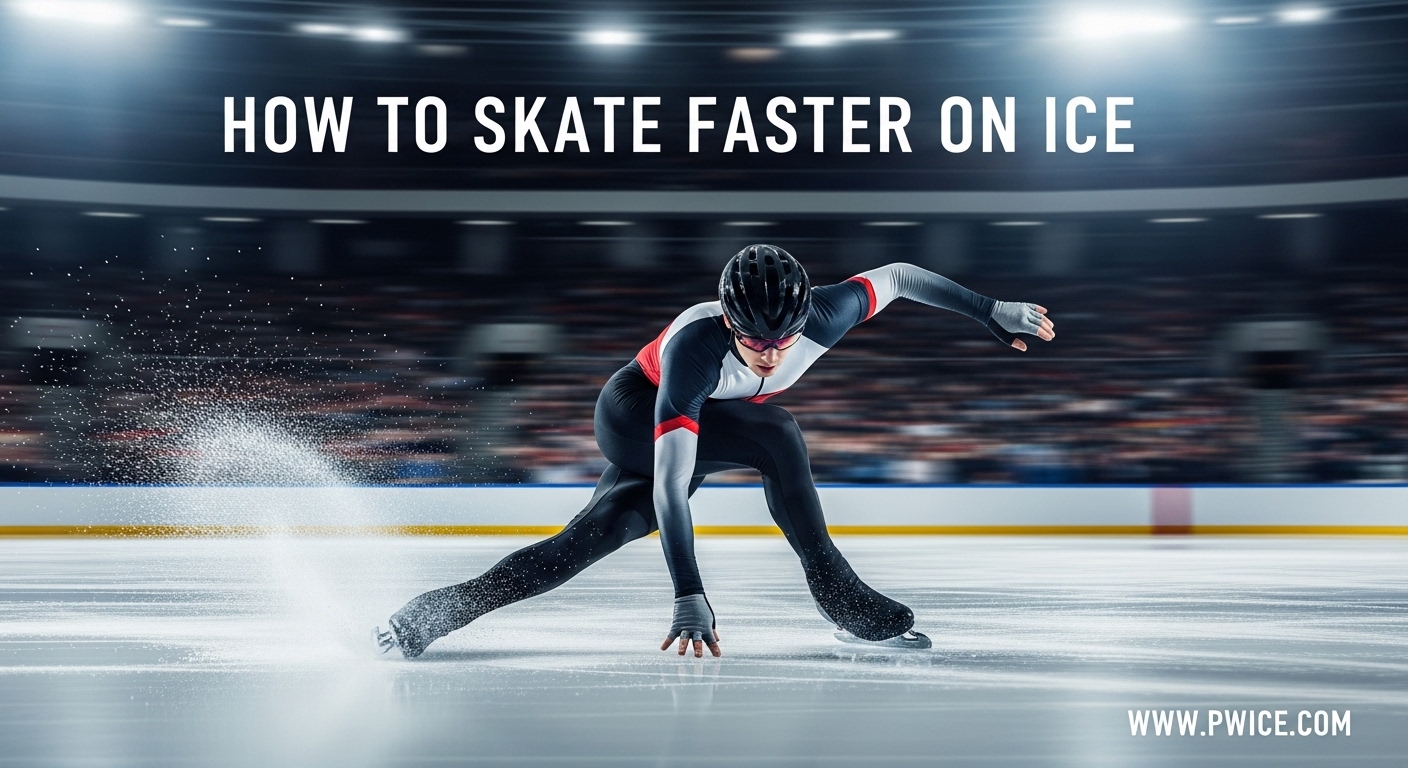
Most skaters stand too tall. Drop into a deep knee bend until your thighs are nearly parallel to the ice. This lower center of gravity allows you to push harder against the ice with each stride.
2. Extend Your Leg Fully on Every Push
A complete stride extension generates maximum power. Push through your entire leg drive, finish with a toe flick, and only return your leg once you have fully extended it behind you.
3. Push from Your Inside Edges
Power comes from the inside edge of your pushing skate. Dig that edge into the ice and push outward against it. The deeper your edge angle, the harder you can push.
4. Keep Your Stance Narrow
Many skaters adopt a wide stance thinking it helps balance. A narrower stance actually allows for longer, more powerful strides. Keep your feet under your hips, not spread wide.
5. Swing Your Arms Opposite Your Legs
Your arms counterbalance your legs. When your right leg pushes back, your left arm drives forward. This coordination creates momentum and helps drive your legs harder.
6. Use Quick, Short Steps for Acceleration
When starting from a standstill or changing direction, use rapid, short strides. Once you hit top speed, transition to longer, more powerful strides.
7. Bring Your Leg Back to Center Quickly
The recovery phase matters as much as the push. A slow leg return wastes time and momentum. Snap your leg back under your body quickly to set up the next powerful push.
8. Train Off the Ice for Power
Single-leg exercises like Bulgarian split squats and lateral lunges build the specific strength you need for explosive skating speed. Your off-ice training directly impacts your on-ice velocity.
How to Skate Faster on Ice: Complete Technique Breakdown
Now let us dive deeper into each technique. Understanding why these methods work will help you apply them more effectively and troubleshoot your own skating.
Master the Deep Knee Bend and Proper Posture
Your posture is the foundation of skating speed. Without proper body positioning, every other technique becomes less effective.
The ideal skating posture starts with a deep knee bend. Your knees should be bent at roughly 90 to 110 degrees. Your hips should sit low, almost as if you are sitting in an imaginary chair. Your back should be straight with a slight forward lean from your ankles, not your waist.
This low stance accomplishes several things. First, it positions your muscles to generate maximum power. Second, it lowers your center of gravity, improving balance and stability. Third, it allows you to push against the ice with greater force because your legs start from a compressed, ready position.
Many skaters think they are low enough when they are not. Film yourself skating or ask a coach to check your posture. You are probably standing taller than you realize. The difference between a good knee bend and a great one can be the difference between average and elite speed.
Extend Your Stride for Maximum Power
Stride length and stride frequency work together to create speed. For maximum velocity, you need the optimal combination of both.
A complete stride has three phases: the push, the extension, and the recovery. Most skaters shortchange the extension phase. They push off the ice but fail to fully extend their leg behind them. This incomplete motion leaves power on the table.
To maximize your stride, focus on hip extension. Your power comes from driving your hip forward while pushing back with your leg. The toe flick at the end of each stride is not just a flourish. It represents complete extension of the ankle, knee, and hip, ensuring you have used every bit of possible power.
Once you finish the push and flick, quickly return your leg to the center under your body. A slow recovery delays your next push and breaks your rhythm. Think of it as a quick snap back to position, not a lazy glide forward.
Use Your Edges Effectively
Edges are the secret weapon of fast skaters. Every push in skating comes from an edge. Understanding how to use them separates average skaters from fast ones.
When you skate forward, you glide on one skate while pushing with the other. The pushing skate must be on its inside edge to generate power. This inside edge digs into the ice at roughly a 45-degree angle. The deeper the edge, the more ice you can push against.
Your gliding skate typically uses an outside edge for stability during the stride. Mastering the transition between edges is crucial for speed. You need to feel comfortable rolling from your outside edge (glide) to your inside edge (push) seamlessly.
Practice edge work separately from skating fast. Do drills where you glide on one foot, feeling the outside edge hold. Then practice pushing drills, focusing entirely on the sensation of your inside edge biting into the ice.
Coordinate Your Arm Swing
Your arms are not just along for the ride. They play a crucial role in generating speed and maintaining balance.
The arm swing in skating is opposite to the leg movement. When your right leg pushes back, your left arm drives forward. This counter-rotation helps generate torque and momentum. It also keeps your upper body stable so your lower body can focus entirely on pushing.
Keep your arm motion compact and controlled. Wild, flailing arms waste energy and throw off your balance. Your hands should travel from roughly hip height to chest height, driving forward and back in a straight line. Do not let your arms cross your body midline.
Practice arm swing while standing still on the ice. Get the rhythm of opposite arm and leg working together. Once the coordination feels natural, add it to your skating stride.
Acceleration vs Top Speed Techniques
Acceleration and top speed require different techniques. Understanding when to use each will make you a more effective skater.
For acceleration, use short, quick strides with a rapid leg turnover. Think of a sprinter bursting from the blocks. Your strides are shorter, but your frequency is high. This rapid fire approach builds momentum quickly from a standstill.
Once you reach cruising speed, transition to longer, more powerful strides. Here, stride length matters more than frequency. Each push should be a full, powerful extension. Your leg turnover slows down, but each individual stride carries you farther.
Practice transitioning between these modes. Start with five explosive acceleration strides, then shift into three long, powerful speed strides. Repeat this pattern down the ice. Mastering this transition will make you faster in game situations where you constantly switch between accelerating and maintaining speed.
Off-Ice Training to Build Skating Speed
What you do off the ice directly impacts how fast you skate. These exercises build the specific strength, power, and mobility you need for explosive skating speed.
Build Skating-Specific Strength
Skating requires single-leg strength and stability. These exercises mimic the demands of skating better than traditional two-legged lifts.
Bulgarian Split Squats: Place your back foot on a bench behind you. Lower into a deep squat on your front leg, keeping your torso upright. This exercise builds the exact strength pattern you use when pushing off one skate. Do three sets of eight to ten reps per leg.
Single-Leg Romanian Deadlifts: Stand on one leg with a slight knee bend. Hinge forward at your hips, extending your free leg behind you for balance. This develops posterior chain strength and hip stability. Do three sets of ten to twelve reps per leg.
Lateral Lunges: Step out to the side, keeping your toes pointing forward. Lower your hips back and down, pushing through your heel to return to start. This builds the lateral hip strength crucial for powerful pushes. Do three sets of ten reps per side.
Develop Explosive Power
Power is the ability to generate force quickly. These plyometric exercises train your nervous system to fire faster.
Box Jumps: Stand in front of a sturdy box or platform. Drop into a quarter squat and explode upward, landing softly on the box with both feet. Step down and repeat. This builds explosive leg power. Do four sets of six reps.
Lateral Bounds: Stand on one leg and leap sideways as far as possible, landing on your opposite leg. Hold the landing for two seconds before bounding back. This mimics the lateral push of skating. Do three sets of six bounds per direction.
Single-Leg Hops: Hop forward on one leg for twenty meters, focusing on height and distance per hop. Switch legs and repeat. This builds the elastic power you need for quick, explosive strides. Do three sets per leg.
Improve Mobility and Flexibility
Flexibility limitations restrict your stride length and power output. Target these specific areas for skating improvement.
Hip Mobility: Tight hips prevent full stride extension. Spend five minutes on hip flexor stretches before and after skating. Kneel on one knee with the other foot forward, push your hips forward until you feel a stretch in the front of your back hip.
Ankle Flexibility: Limited ankle flex forces you to stand taller to compensate. Work on ankle dorsiflexion by kneeling with your toes tucked under and sitting back on your heels. Hold for thirty seconds, repeating three times.
Dynamic Warm-Up: Before skating, do leg swings, walking lunges with rotation, and lateral shuffles. These movements activate the muscles you will use and prepare your joints for the demands of speed skating.
Common Mistakes That Slow You Down
Even dedicated skaters make these errors. Recognizing and correcting them will unlock speed you did not know you had.
Standing Too Tall: This is the most common mistake. Skaters rise up when tired or when trying to see the ice better. Fight this tendency. When you feel yourself standing up, consciously drop back into your deep knee bend.
Fast Feet Without Power: Moving your legs quickly does not mean you are skating fast. Many skaters churn their feet rapidly but generate little forward momentum. Focus on hard, powerful pushes rather than quick, weak ones. Quality beats quantity.
Incomplete Stride Recovery: Letting your leg trail behind you after a push wastes time. Your leg should snap back to center immediately after extension. Practice this recovery motion until it becomes automatic.
Poor Edge Usage: Pushing with a flat skate instead of your inside edge is like trying to run in sand. You waste energy without generating speed. Consciously feel your inside edge digging into the ice with every push.
Crossing Arms Over the Body: When your arms swing across your chest, they rotate your torso and throw off your balance. Keep your arm drive straight forward and back, not side to side.
Practice Drills to Build Speed
These drills isolate specific aspects of speed skating. Add them to your practice routine for targeted improvement.
One-Foot Glides: Push off and glide as far as possible on one foot. This drill builds balance and teaches you to maintain speed efficiently. Alternate feet and try to increase your glide distance each attempt.
Line Touches: Skate from goal line to goal line, touching the ice with one hand every four strides. This forces a deep knee bend and low center of gravity. The lower you get, the easier the touch becomes.
Resistance Sprints: Have a partner hold a resistance band around your waist while you sprint. Skate as hard as possible against the resistance for ten seconds. This builds explosive power and acceleration strength.
Timed Laps: Record your time for one lap around the rink. Rest two minutes and repeat. Try to beat your previous time. This adds a competitive element and tracks your progress objectively.
Frequently Asked Questions
How to increase speed in ice skating?
Increase ice skating speed by mastering three fundamentals: a deep knee bend for power generation, full leg extension on every stride, and proper inside edge usage for push mechanics. Add off-ice training with single-leg exercises and plyometrics to build skating-specific strength and explosive power.
How do ice hockey players skate so fast?
Elite hockey players skate fast due to exceptional technique combined with superior strength and power. They maintain a deep knee bend for leverage, extend their legs fully on each stride, and use rapid acceleration strides to reach top speed quickly. Years of power skating training and off-ice conditioning develop the specific muscles and movement patterns needed for explosive speed.
What exercises help you skate faster?
The best exercises for skating speed include Bulgarian split squats and single-leg Romanian deadlifts for strength, box jumps and lateral bounds for explosive power, and slide board lunges for skating-specific movement patterns. These target the single-leg stability, hip extension power, and lateral push strength that directly translate to on-ice speed.
How long does it take to improve skating speed?
Most skaters notice technique improvements within two to three weeks of consistent practice. Significant speed gains typically appear after six to eight weeks of combining on-ice technique work with off-ice strength training. Elite-level speed development is a long-term process requiring months or years of dedicated training.
Why can I not accelerate on ice?
Acceleration problems usually stem from standing too tall, not using short quick strides, or failing to dig your inside edges into the ice. To accelerate effectively, drop into a deep knee bend, use rapid short steps with high leg turnover, and push hard against your inside edges. Poor off-ice conditioning can also limit explosive acceleration ability.
How to maintain speed while skating?
Maintain speed by transitioning from short acceleration strides to longer, more efficient power strides once you reach cruising velocity. Keep a consistent rhythm, minimize unnecessary upper body movement, and stay low to reduce wind resistance. Proper glide technique on your outside edges between pushes allows you to carry momentum forward with minimal energy expenditure.
Conclusion: Your Path to Faster Skating
Learning how to skate faster on ice is a journey of technique refinement, strength development, and consistent practice. The eight quick tips in this guide give you immediate adjustments to make in your next session. The deeper technique breakdowns help you understand why these methods work.
Remember that speed comes from efficiency, not just effort. A skater with perfect technique will outpace a stronger but less efficient skater every time. Focus on quality over quantity in your practice. Film yourself, work with a coach if possible, and track your progress with timed laps.
Combine your on-ice work with the off-ice training outlined here. The Bulgarian split squats, lateral bounds, and mobility work will build the physical foundation you need. Avoid the common mistakes that slow skaters down. Practice the drills to isolate and improve specific aspects of your stride.
Speed is one of the most trainable skills in skating. With dedication to these techniques, you will be amazed at how much faster you can become. Lace up, get low, and start pushing harder.