
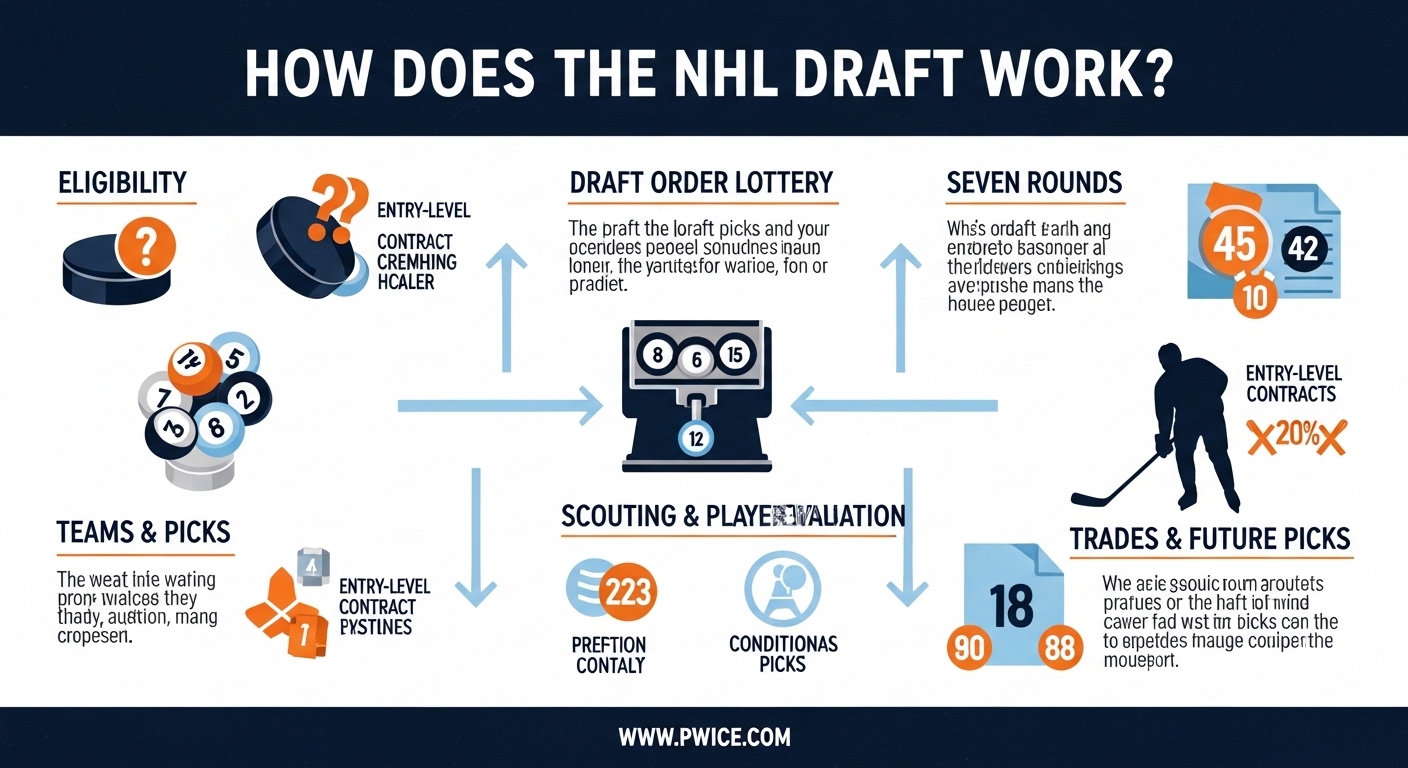
The NHL Draft is an annual seven-round event where the 32 NHL teams take turns selecting eligible amateur players to join their organizations. If you have ever wondered how does the NHL draft work, this guide breaks down everything from eligibility rules to the weighted lottery system that determines who gets the first overall pick. Teams select in reverse order of their regular-season standings, giving the worst-performing teams the best chance at landing future stars.
Table of Contents
What Is the NHL Draft?
The NHL Entry Draft is the league’s primary mechanism for maintaining competitive balance across all 32 franchises. Held every June, this event allows teams to claim rights to the world’s top young hockey talent from junior leagues, college programs, and European professional leagues.
Without the draft, wealthy teams could simply outbid smaller markets for every promising prospect. The current system ensures that struggling teams get first crack at elite talent, theoretically helping them climb the standings faster. This is why you will often hear analysts say a team is “tanking” when they trade away veterans late in a losing season.
Every draft produces approximately 224 selections across seven rounds. While not every pick becomes a superstar, the draft remains the most cost-effective way for teams to acquire franchise-changing talent. Connor McDavid, Sidney Crosby, and Auston Matthews all entered the league through this system.
Draft Eligibility Requirements
Before a player can hear their name called at the draft, they must meet specific eligibility criteria set by the NHL. These rules differ based on where a player developed.
North American Players
Players from North America must be between 18 and 20 years old by September 15 of the draft year to be eligible. This means a player who turns 18 in October could still be drafted in June of that year. Most North American prospects come from the Canadian Hockey League (OHL, WHL, QMJHL) or NCAA college hockey programs.
International Players
For European and other international players, the age requirement extends to 21 years old. This rule acknowledges that many European players develop in professional leagues overseas and may need more time to mature before NHL teams want to commit a draft pick to them.
Re-Entry Draft
Players who were previously eligible but went undrafted can re-enter in subsequent years if they still meet age requirements. This gives late bloomers a second or third chance to attract NHL attention. Some notable NHL players actually went undrafted in their first year of eligibility before being selected later.
How Does the NHL Draft Lottery Work?
The draft lottery is where things get interesting. To prevent teams from deliberately losing games to secure the top pick, the NHL uses a weighted lottery system for non-playoff teams. This system underwent significant changes in 2021 to further discourage tanking.
Here is exactly how the lottery process works step by step:
Step 1: The league places 14 numbered lottery balls into a machine. These balls are drawn to create four-digit combinations from 0001 to 1000.
Step 2: Each of the 16 non-playoff teams receives a specific number of these 1000 possible combinations based on their regular-season finish. The team with the worst record gets 185 combinations (18.5% odds), while the best non-playoff team receives only 11 combinations (1.1% odds).
Step 3: The lottery machine randomly draws four balls to create a number. Whichever team holds that combination wins the first overall pick.
Step 4: The process repeats for the second overall pick, with the remaining teams’ odds recalculated.
A critical rule from the 2021 changes limits how far a team can move up. No team can jump more than 10 spots from their standing position. This means the worst team is guaranteed to pick no lower than third overall. The lottery only determines the top two selections, with picks 3-16 going in reverse order of the standings.
Draft Order System
Once the lottery establishes the top two picks, the rest of the draft order falls into place through a straightforward reverse standings system. The team with the worst regular-season record that did not win a lottery pick selects third. The team with the second-worst record picks fourth, and so on.
Playoff teams are ordered based on when they were eliminated. Teams that lost in the first round pick before second-round losers. Conference finalists pick before Stanley Cup finalists. The Stanley Cup champion always picks last in every round, while the runner-up picks second-to-last.
This reverse order applies to every single round. If a team picks first in round one, they pick first in rounds two through seven as well. There is no “snake” format like some fantasy leagues use.
How Many Rounds Are in the NHL Draft?
The NHL draft consists of seven rounds, producing 224 total selections when all 32 teams make their picks. Each team starts with one pick per round, though trades often mean some teams have multiple picks in a round while others have none.
Historically, the draft had more rounds. From 1969 to 1974, there were eight rounds. The draft expanded to nine rounds from 1975 to 1976, then ten rounds from 1977 to 1978. The current seven-round format was established in 2005 following the NHL lockout and has remained unchanged since.
Players who are not selected become undrafted free agents. They can still sign with any NHL team, and several notable players have taken this path to the league. College free agents in particular often generate bidding wars among teams looking to add immediate depth.
Trading Draft Picks
NHL teams treat draft picks as valuable trade assets that can be exchanged just like players. A first-round pick might be included in a package for a star player at the trade deadline. Teams rebuilding often trade veteran players for multiple draft picks to stockpile future talent.
Conditional picks add another layer of strategy. A trade might specify that a team only receives a second-round pick if the acquired player re-signs, or if the team makes the playoffs. These conditions create additional drama as the season unfolds.
Teams can also trade future draft picks, though there are restrictions. The NHL prohibits teams from trading away first-round picks in consecutive years, a rule designed to prevent franchises from mortgaging their entire future for short-term gains.
What Happens on NHL Draft Day?
The NHL Draft is typically held in late June at a rotating venue, often hosted at the home arena of the team that won the Stanley Cup. The Bell Centre in Montreal has hosted multiple times due to its size and hockey tradition. Teams, prospects, and thousands of fans gather for this multi-day event.
Each team has a war room where general managers, scouts, and executives monitor the selections and debate their upcoming picks. When a team is on the clock, they submit their choice to league officials at the central podium.
Time limits keep the draft moving. Teams get five minutes to make first-round selections, three minutes for second-round picks, and just two minutes for rounds three through seven. If a team misses their window, the next team can jump ahead and make their selection.
When a player is selected, they walk to the stage to receive their new team’s jersey. Cameras capture the emotional moment as years of training and sacrifice culminate in achieving an NHL dream. Scouts who identified these players years earlier watch with particular satisfaction.
What Happens After Getting Drafted?
Getting drafted is just the beginning of a long journey to the NHL. Once a team selects a player, they gain exclusive negotiating rights for a specific period based on the player’s background.
Most drafted players do not immediately join their NHL team. Lower-round picks typically return to junior hockey or college to continue developing. The team maintains their rights while the player gains experience against age-appropriate competition.
Entry-Level Contracts (ELC)
When a team signs a draft pick, they receive an entry-level contract (ELC) that follows strict league guidelines. These contracts last three years and have maximum salary limits based on when the player was drafted. First-round picks earn more than seventh-round selections.
ELC players who make the NHL roster are subject to “slide rules” if they play fewer than 10 games. This allows teams to delay the start of the contract, effectively gaining an extra year of control over the player’s rights.
The Development Path
After signing, most prospects head to development camps run by their NHL organization. These camps focus on physical conditioning, skill development, and introducing players to professional expectations. Top prospects might attend NHL training camp in September, where they compete for roster spots.
Players who do not make the NHL roster typically join the team’s AHL affiliate. The American Hockey League serves as the primary development ground for future NHLers. Some teenage prospects may return to junior hockey if they are too young for the AHL, as the league has age restrictions.
Draft rights expire after a specific timeframe, usually seven years. If a team has not signed a player within this window, the player becomes an unrestricted free agent eligible to sign with any team.
Notable Late-Round Success Stories
While first-round picks generate the most hype, some of the NHL’s greatest players were selected deep into the draft. These stories remind us that scouting is an imperfect science and development matters as much as raw talent.
Pavel Datsyuk was selected 171st overall by the Detroit Red Wings in the 1998 draft. The Russian center became one of the most skilled two-way players in league history, winning two Stanley Cups and making the Hall of Fame.
Henrik Lundqvist heard his name called 205th overall in 2000. The Swedish goaltender became the face of the New York Rangers franchise for 15 seasons, winning the Vezina Trophy as the league’s best goalie in 2012.
Jamie Benn went 129th overall to the Dallas Stars in 2007. The British Columbia native developed into one of the league’s premier power forwards, winning the Art Ross Trophy as the NHL’s leading scorer in 2016.
These success stories keep hope alive for every kid watching the draft with family. Being a late pick is not a career death sentence. It is simply a starting point.
Draft Rights and Player Options
One common question fans ask is whether a player can refuse to play for the team that drafted them. The short answer is yes, but with significant consequences.
Players can choose not to sign with the team that holds their rights. However, that team retains exclusive NHL rights to the player for seven years. During this period, the player cannot sign with any other NHL team unless traded or released.
Some players have used this leverage to force trades. Eric Lindros famously refused to play for the Quebec Nordiques after they selected him first overall in 1991. He sat out an entire season before Quebec traded him to Philadelphia for a massive package including six players, two first-round picks, and cash.
Why Was Gretzky Never Drafted?
Wayne Gretzky, widely considered the greatest hockey player ever, was never drafted into the NHL. This was not an oversight by scouts. Gretzky signed a personal services contract with the WHA’s Indianapolis Racers as a 17-year-old minor in 1978.
When the WHA merged with the NHL in 1979, existing player contracts were honored. The Edmonton Oilers, who held Gretzky’s WHA rights, were allowed to protect him as part of the merger agreement. He never went through the entry draft system.
Frequently Asked Questions About the NHL Draft
Can a player refuse to play for the team that drafted him?
Yes, a player can refuse to sign with the team that drafted them. However, that team retains exclusive draft rights to the player for seven years, preventing them from signing with any other NHL team during that period. The player would need to wait out those rights or hope for a trade.
Why was Gretzky never drafted?
Wayne Gretzky was never drafted because he signed with the WHA’s Indianapolis Racers as a 17-year-old minor in 1978. When the WHA merged with the NHL in 1979, the Edmonton Oilers were allowed to protect Gretzky as part of the merger agreement, bypassing the entry draft entirely.
Is number 69 banned in the NHL?
Number 69 is not officially banned by the NHL, but no player has ever worn it during a regular-season game. Cultural reasons and locker room humor have made it an avoided number, though the league itself has no formal prohibition against it.
How many rounds are in the NHL draft?
The NHL draft consists of 7 rounds, with 32 teams each making one selection per round for a total of 224 picks. Teams can trade picks, so some rounds may see more or fewer than 32 selections depending on trades made.
What determines the NHL draft order?
Draft order is determined by reverse regular season standings, with the worst teams picking first. The top two picks are determined by a weighted lottery among non-playoff teams. Playoff teams draft in order of when they were eliminated, with the Stanley Cup champion picking last.
Conclusion
Understanding how does the NHL draft work gives fans a deeper appreciation for how their favorite teams build for the future. From the weighted lottery that prevents tanking to the seven rounds of selections that span two days, the draft represents hope for every franchise. Whether your team is selecting first overall or making a surprise late-round gem, the draft remains the most important tool for constructing championship rosters in professional hockey.
The next time you watch the draft in June, you will understand exactly why that lottery ball drawing matters, how those picks were ordered, and what comes next for the young players whose lives are about to change forever.