
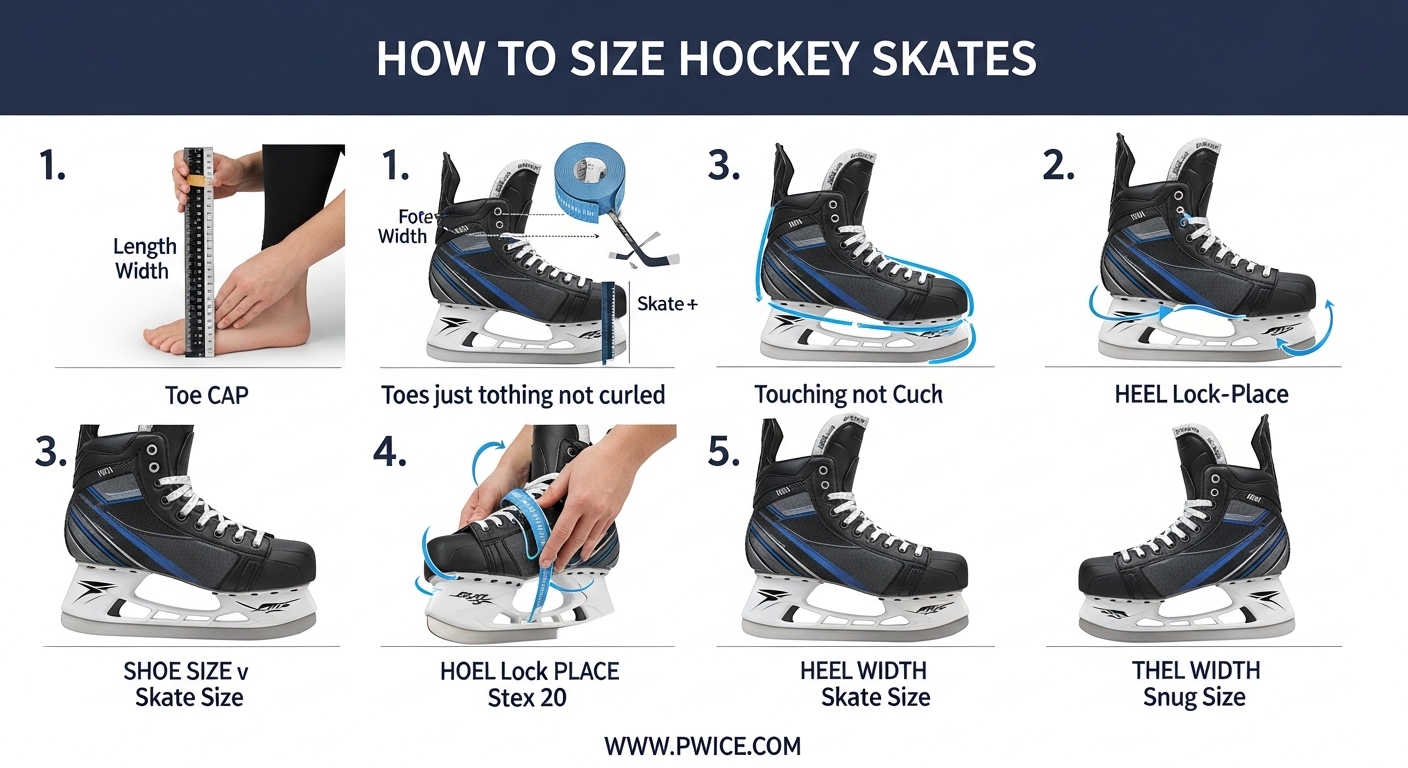
Hockey skates should fit 1 to 1.5 sizes smaller than your regular street shoes. When you stand up straight in properly sized skates, your toes should lightly brush the toe cap, and your heels should sit firmly locked in the heel pocket with zero lift. Learning how to size hockey skates correctly is the single most important step in your hockey journey.
Our team at Pwice has helped hundreds of players find their perfect fit. The wrong size destroys your skating ability, causes painful blisters, and wastes your money. The right size transforms your edge control, acceleration, and confidence on the ice.
This guide covers everything from measuring your feet at home to understanding brand-specific differences between Bauer and CCM. You will learn the exact steps to determine your size, how to test fit before hitting the ice, and the common mistakes that ruin a player’s experience before they even start.
Table of Contents
How to Size Hockey Skates: The Complete Process
Getting the right skate size involves more than just subtracting 1.5 from your shoe size. You need to account for your foot width, the specific brand’s sizing quirks, and how the skate should feel when you are in a skating stance. The process starts with accurate measurements and ends with a proper fit test.
Before you buy any skates, understand this: hockey skate sizing uses the mondopoint system, which measures your foot length in centimeters. Most adult skaters wear senior sizes ranging from 6 to 12, while youth players fall into junior or youth categories based on foot length.
Why Proper Skate Sizing Matters
Skates that are too large create energy loss with every stride. Your foot slides inside the boot, your heel lifts, and you lose the direct power transfer from your leg to the ice. This makes skating feel harder than it should be.
Skates that are too small cut off circulation, create pressure points, and cause your feet to go numb. You cannot skate well when you are focused on foot pain. The perfect fit puts your foot in complete contact with the boot interior without any pinching or dead space.
How to Measure Your Feet for Hockey Skates
Accurate measurement starts with the right tools. You will need a blank piece of paper, a pencil, a ruler or measuring tape, and the hockey socks you plan to wear while skating. Do not measure with bare feet or everyday socks.
Step-by-Step Measurement Process
Step 1: Place the paper on a hard floor against a wall. Stand on the paper with your heel touching the wall. Keep your weight evenly distributed on both feet.
Step 2: Have someone trace around your foot with the pencil held straight up and down. Keep the pencil perpendicular to the paper for accuracy.
Step 3: Measure the length from the wall (heel) to your longest toe in centimeters. This is your mondopoint measurement. Record this number.
Step 4: Measure the widest part of your foot tracing to determine your width. Standard width is D, wide is EE.
Step 5: Repeat for your other foot. Most people have one foot slightly larger than the other. Always size for your larger foot.
Understanding Mondopoint Measurements
Mondopoint is the universal sizing standard used by hockey skate manufacturers. It represents your foot length in centimeters. A mondopoint measurement of 27.0 converts to approximately a US men’s shoe size 9.
When converting to skate sizes, senior skates typically follow a direct mondopoint conversion. Junior and youth skates use different scales, so always consult the specific manufacturer’s chart rather than assuming a direct conversion.
Understanding Youth, Junior, and Senior Skate Sizes
Hockey skates come in three main size categories: Youth, Junior, and Senior. Each category covers different foot lengths and age ranges. Using the wrong category results in skates that simply will not fit.
Youth Hockey Skate Sizes
Youth skates fit children with foot lengths typically under 18.5 centimeters. These sizes roughly correspond to US shoe sizes 6 to 12 for children. The boots are designed for smaller, lighter bodies with less aggressive skating angles.
When sizing youth skates, resist the urge to buy larger sizes for growth room. Oversized skates make learning to skate significantly harder. A child cannot develop proper technique when their feet slide inside the boot.
Junior Hockey Skate Sizes
Junior skates cover the transition period between youth and senior sizes. They typically fit foot lengths from 18.5 to 22.5 centimeters, corresponding roughly to US shoe sizes 1 to 5.
Junior skaters are developing their skills rapidly. Proper fit becomes even more critical during this stage. A junior player with poorly fitted skates will develop bad habits that are difficult to correct later.
Senior Hockey Skate Sizes
Senior skates fit adult foot lengths from 22.5 centimeters and up. This is the size range most adult recreational and competitive players use. Senior skates offer the stiffest boot construction and most advanced features.
Adult players often make the mistake of sizing their skates like their running shoes. Hockey skates require a much closer fit. Your running shoes have cushioning and space for comfort; hockey skates need direct control.
Hockey Skate Size Charts
Use these general conversion charts as a starting point. Always verify with the specific manufacturer’s chart before purchasing.
Senior Skate Size Chart:
- US Men’s Shoe Size 7 = Skate Size 5.5 to 6
- US Men’s Shoe Size 8 = Skate Size 6.5 to 7
- US Men’s Shoe Size 9 = Skate Size 7.5 to 8
- US Men’s Shoe Size 10 = Skate Size 8.5 to 9
- US Men’s Shoe Size 11 = Skate Size 9.5 to 10
- US Men’s Shoe Size 12 = Skate Size 10.5 to 11
- US Men’s Shoe Size 13 = Skate Size 11.5 to 12
Junior Skate Size Chart:
- US Youth Shoe Size 1 = Junior Skate Size 13
- US Youth Shoe Size 2 = Junior Skate Size 1
- US Youth Shoe Size 3 = Junior Skate Size 2
- US Youth Shoe Size 4 = Junior Skate Size 3
- US Youth Shoe Size 5 = Junior Skate Size 4
Youth Skate Size Chart:
- US Youth Shoe Size 6 = Youth Skate Size 6
- US Youth Shoe Size 7 = Youth Skate Size 7
- US Youth Shoe Size 8 = Youth Skate Size 8
- US Youth Shoe Size 9 = Youth Skate Size 9
- US Youth Shoe Size 10 = Youth Skate Size 10
- US Youth Shoe Size 11 = Youth Skate Size 11
- US Youth Shoe Size 12 = Youth Skate Size 12
Bauer vs CCM: How Brand Differences Affect Sizing
Bauer and CCM are the two dominant hockey skate manufacturers. Each uses different sizing systems and fit philosophies. Understanding these differences helps you narrow down which brand suits your foot shape.
Bauer Skate Sizing
Bauer skates traditionally run narrow compared to CCM. The brand uses a Fit 1, Fit 2, and Fit 3 system to categorize width instead of the traditional D and EE designations.
Fit 1 is Bauer’s narrowest option, equivalent to a D width or slightly narrower. This fits players with narrow feet who need a snug heel lock.
Fit 2 is the standard width, suitable for most players with average foot width. This corresponds roughly to a D or slightly wider fit.
Fit 3 is Bauer’s widest option, comparable to an EE width. Players with wide feet or those who prefer extra forefoot room should choose this fit.
CCM Skate Sizing
CCM skates generally offer a wider fit than Bauer. The brand uses Tapered, Regular, and Wide designations across their skate lines. CCM skates are often preferred by players with wider feet who find Bauer too restrictive.
Tapered fits are narrow through the heel and forefoot, designed for low-volume feet. Regular fits suit average foot shapes with standard width. Wide fits accommodate high-volume feet with extra forefoot space.
Model-Specific Sizing Differences
Within each brand, different skate lines fit differently. Bauer’s Vapor line runs narrower and lower volume than the Supreme line. The Nexus line offers the widest fit in the Bauer range.
CCM’s JetSpeed line fits tighter and lower volume than the Tacks line. The Ribcor line offers the most flexible fit with a focus on agility. Always check line-specific sizing charts rather than relying on general brand guidelines.
Skate Width Fitting Guide: Finding Your Perfect Width
Width is just as important as length for skate fit. A skate that is the right length but wrong width will cause pressure points, foot pain, and reduced performance. Your foot volume determines the width you need.
Understanding D vs EE Width
D width is the standard width designation for hockey skates. It fits average foot shapes and works for the majority of players. If you have never had issues with shoe width, you likely need D width skates.
EE width provides extra room in the forefoot and across the ball of the foot. Players with wide feet, bunions, or who experience pinching in standard widths need EE. Some brands offer EEE for extra-wide feet.
How to Determine Your Width
Measure the widest part of your foot tracing after you measure the length. Compare this measurement to the manufacturer’s width chart. Your width relative to your length determines whether you need standard or wide skates.
A simple test: if you consistently find running shoes too narrow and prefer wide-width options, you likely need EE hockey skates. If standard-width shoes always fit fine, stick with D width.
Brand Width Equivalents
Bauer’s Fit 1 corresponds roughly to a narrow D or C width. Fit 2 matches standard D width. Fit 3 aligns with EE width.
CCM’s Tapered fits narrow feet better than Regular. Wide in CCM is comparable to EE in traditional sizing. The Ribcor line tends to fit wider through the forefoot than other CCM lines.
How to Test Your Skate Fit
Measurement gets you close, but the fit test confirms you have the right size. Always test skates before using them on the ice. Most retailers allow you to test skates at home on carpeted surfaces.
The Toe Cap Test
Put on the skates with the socks you will wear for hockey. Lace them snugly but not overly tight. Stand up straight with your weight evenly distributed.
In this standing position, your toes should lightly brush or barely touch the front of the toe cap. You should not feel cramped or curled. If your toes are jammed against the cap, the skates are too small.
Now bend your knees into a skating stance. Your toes should pull back slightly from the toe cap. There should be a small gap of about 1/4 inch between your toes and the front of the skate.
The Heel Lock Check
With the skates laced, stand straight and try to lift your heel inside the boot. Your heel should stay firmly locked in the heel pocket. Any lifting or slipping indicates the skates are too large.
Heel lift destroys your skating efficiency. Every stride loses energy when your heel moves inside the boot. You cannot generate power if your foot is sliding around.
Walk around on carpet in the skates. Your heel should remain secure with each step. If you feel your heel popping up, try a different size or width.
Red Flags to Watch For
Pain on the sides of your feet indicates the skates are too narrow. Numb toes suggest the skates are too small or laced too tightly. Heel blisters after short use mean the skates are too large.
Pressure on your ankle bones can occur if the skate is too tall or wide for your ankle. Arch pain may indicate a need for custom insoles rather than a different skate size.
Women’s Hockey Skate Sizing Conversion
Women typically have lower volume feet and different proportions than men. Most women find men’s senior skates in smaller sizes work well with the right width selection.
To convert women’s shoe size to men’s skate size, subtract approximately 1.5 sizes from your women’s shoe size, then apply the 1 to 1.5 size down rule for skate conversion.
For example, a woman wearing a women’s shoe size 9 would convert to approximately a men’s 7.5, then size down to a senior skate size 6 or 6.5. Width becomes particularly important for women, as narrower heels may require specific fit systems like Bauer Fit 1.
Common Hockey Skate Sizing Mistakes to Avoid
Players and parents make the same sizing errors repeatedly. Avoiding these mistakes saves you from pain, poor performance, and the cost of replacing incorrectly sized skates.
Buying Skates Too Large
The most common mistake is sizing up for comfort or growth room. Skates are not shoes. Extra space destroys your skating ability and causes dangerous blisters.
Parents often buy larger skates hoping to get two seasons out of them. This approach backfires when the child cannot skate properly and develops bad habits. Buy the correct size and replace them when needed.
Ignoring Width
Many players focus only on length and ignore width. A skate that is the right length but wrong width creates pressure points and pain. Width matters as much as length for comfort and performance.
If you have wide feet, do not squeeze into narrow skates hoping they will stretch. Hockey skate boots do not stretch significantly in width. Buy the correct width from the start.
Skipping the Fit Test
Never buy skates without testing the fit first. Size charts get you close, but individual foot shape varies. What works on paper may not work on your foot.
Test skates with your hockey socks, not bare feet or thin dress socks. The sock thickness affects fit significantly. Test in the afternoon when your feet are slightly swollen from daily activity.
Sizing by Shoe Size Alone
Shoe sizes vary significantly between brands. Your size 10 Nike might fit completely differently from your size 10 New Balance. Rely on actual foot measurements rather than your shoe size.
The 1 to 1.5 size down rule is a guideline, not a law. Some players need 2 sizes down depending on foot shape and brand. Measure and test rather than assuming.
FAQ
How do I know my hockey skate size?
Measure your foot length in centimeters while wearing hockey socks, then consult a brand-specific size chart. Hockey skates should fit 1 to 1.5 sizes smaller than your street shoe size. Your toes should barely touch the toe cap when standing straight.
Are ice skates the same size as shoe size?
No, ice skates are typically 1 to 1.5 sizes smaller than your shoe size. The snug fit is necessary for proper energy transfer and control. Street shoes have cushioning and comfort space; hockey skates need direct contact.
Should my toes touch the end of my skates?
Your toes should lightly brush the toe cap when standing straight, but not feel jammed or curled. When you bend your knees into a skating stance, your toes should pull back slightly and create a small gap of about 1/4 inch.
How tight should hockey skates fit?
Hockey skates should fit snugly with no heel lift and toes lightly touching the toe cap when standing. They should feel tight but not painful. Some pressure points may improve after the break-in period, but severe pain indicates wrong sizing.
What if my feet are different sizes?
Size your skates for your larger foot. Most people have one foot slightly bigger than the other. You can use a thicker sock on the smaller foot or add an insole to take up extra space if needed.
How much room should be in the heel of hockey skates?
Your heel should sit firmly in the heel pocket with zero lift. When you try to raise your heel inside the boot, it should stay locked in place. Any heel movement indicates the skates are too large.
Do hockey skates run big or small?
Hockey skates run smaller than street shoes, typically 1 to 1.5 sizes down. Bauer skates tend to fit narrower than CCM. Always check brand-specific sizing charts as fit varies between manufacturers.
How do I know if my skates are too big?
Signs your skates are too big include heel lift when striding, feet sliding inside the boot, blisters on the heel, inability to feel the edges properly, and your toes never touching the toe cap when standing.
Final Thoughts on Hockey Skate Sizing
Learning how to size hockey skates correctly takes time, but the effort pays off in better performance and comfort. Remember the fundamental rule: skates fit 1 to 1.5 sizes smaller than your street shoes. Your toes should barely touch the toe cap, and your heel should stay locked without any lift.
Measure your feet accurately using the mondopoint system. Consult brand-specific charts for Bauer and CCM differences. Test the fit before committing. A properly fitted skate transforms your hockey experience from struggling to skating with confidence and power.
Use the information in this guide to make an informed decision. Whether you are buying your first pair or upgrading your current setup, proper sizing is the foundation of every great hockey player. Take the time to get it right.