
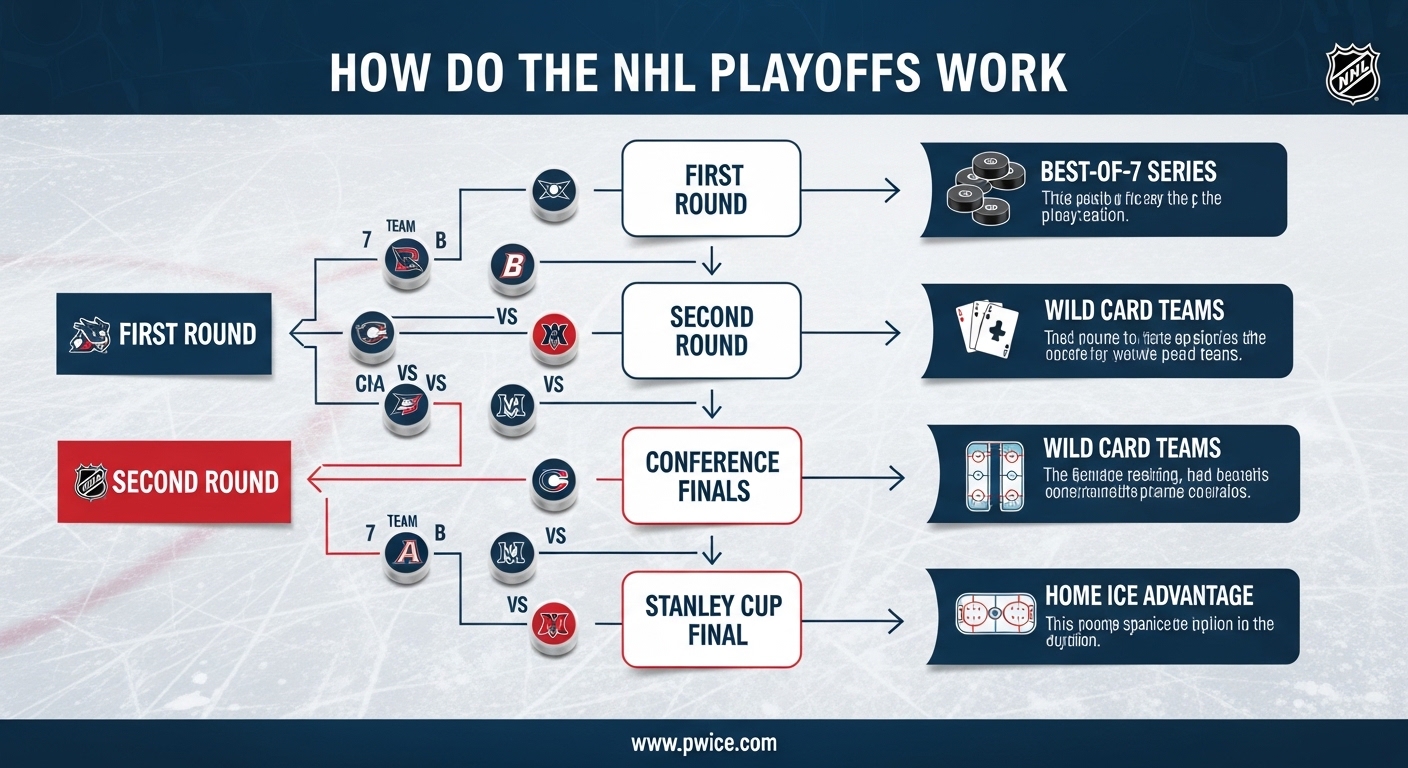
The NHL playoffs feature 16 teams competing in a four-round, best-of-seven elimination tournament to win the Stanley Cup. Eight teams from each conference qualify: the top three teams from each of the four divisions plus two wild card teams with the best remaining records. The format uses a fixed division-based bracket where teams must win four games in each series to advance.
If you are new to hockey or just need a refresher before the postseason begins, this guide breaks down everything you need to know. I will walk you through how teams qualify, how the bracket works, and what makes playoff hockey different from the regular season.
Table of Contents
NHL Playoffs at a Glance
- 16 total teams qualify – 8 from the Eastern Conference, 8 from the Western Conference
- 4 rounds total – First Round, Second Round, Conference Finals, Stanley Cup Final
- Best-of-7 series format – First team to win 4 games advances; maximum 7 games per series
- Division-based bracket – Top 3 from each division plus 2 wild cards per conference
- Home ice advantage – Higher-seeded team hosts 4 of 7 possible games
- Sudden death overtime – Playoff games cannot end in ties; they continue until someone scores
Now let us break down each part of the format so you can follow along when the puck drops in April.
How Do Teams Qualify for the NHL Playoffs?
The NHL uses a division-based qualification system with 16 teams total making the postseason. The league is split into two conferences: the Eastern Conference and the Western Conference. Each conference contains two divisions with eight teams apiece.
The Four NHL Divisions
The Eastern Conference includes the Atlantic Division and Metropolitan Division. The Western Conference includes the Central Division and Pacific Division. Each division has eight teams competing for playoff spots during the 82-game regular season.
Automatic Qualifiers: Top 3 Per Division
The top three teams in each division automatically qualify for the playoffs based on regular season points. Teams earn two points for a win, one point for an overtime or shootout loss, and zero points for a regulation loss. This system means 12 of the 16 playoff spots are determined by division standings.
The Wild Card System Explained
The remaining four playoff spots are wild card positions, with two awarded in each conference. After the top three teams from each division have qualified, the next two highest-point teams in each conference earn wild card berths regardless of their division. This means a team could finish fourth in their division yet still make the playoffs as a wild card.
The wild card system allows strong teams from tough divisions to qualify even if they cannot crack the top three in their own division. It also means one division in a conference could send five teams to the playoffs while the other sends only three.
How Does the NHL Playoff Bracket Work?
The NHL uses a fixed bracket system that is largely division-based. Unlike some sports where brackets re-seed after each round, the NHL bracket stays locked once the matchups are set. This creates clear paths to the Conference Finals and eventually the Stanley Cup Final.
First Round Matchup Structure
Within each division, the first round pairs the division winner against the lower-ranked wild card team. Meanwhile, the second and third place teams from the same division play each other. This creates intense divisional rivalries right from the start of the postseason.
In the Eastern Conference Atlantic Division, for example, the division champion plays the lower wild card while the second and third place Atlantic teams face off. The same pattern applies to the Metropolitan Division and both Western Conference divisions.
Bracket Progression: How Teams Advance
Winners of the first-round divisional matchups face each other in the second round. This means the Atlantic Division winner versus wild card winner could face the Atlantic 2-3 seed matchup winner. The same happens on the Metropolitan side, creating two divisional brackets that merge at the Conference Final.
The bracket is fixed, so there is no re-seeding. If the eighth-seeded wild card upsets the first-place division winner, they simply advance to face whoever won the other matchup in their divisional bracket. This preserves the bracket integrity and creates potential Cinderella runs.
The Four Rounds of the NHL Playoffs
The NHL postseason consists of four rounds, with the stakes rising as teams get closer to the Stanley Cup. Each round eliminates half the remaining teams until one champion remains from the original 16 qualifiers.
First Round (Round of 16)
Eight best-of-7 series run simultaneously, four in each conference. Division winners face wild cards while division rivals battle each other. This is where underdog stories begin and where heavily favored teams sometimes stumble early.
Second Round (Conference Semifinals)
Four series remain, two per conference. The winners from each divisional side of the bracket face off. The Atlantic bracket winner plays the Atlantic bracket winner from the other matchup, and the same happens in the Metropolitan and Western divisions.
Conference Finals
The final two teams in each conference meet for the right to represent their side of the league in the Stanley Cup Final. The Eastern Conference champion receives the Prince of Wales Trophy. The Western Conference champion receives the Clarence S. Campbell Bowl.
Stanley Cup Final
The Eastern and Western Conference champions face off in a best-of-7 series to determine the Stanley Cup champion. Home ice advantage goes to the team with the better regular season record. The first team to win four games hoists the most iconic trophy in professional sports.
How Many Games Are in an NHL Playoff Series?
Every NHL playoff series uses a best-of-7 format. This means the first team to win four games advances to the next round. A series can end in as few as four games (a sweep) or go the full seven games if teams trade wins back and forth.
The 2-2-1-1-1 Home Ice Format
The higher-seeded team hosts Games 1, 2, 5, and 7 at their home arena. The lower-seeded team hosts Games 3, 4, and 6. This 2-2-1-1-1 format gives the better regular season team four home games if the series goes to seven.
Historically, home ice matters less in hockey than in basketball or football. Teams can and do win on the road throughout the playoffs. But having that seventh game at home if needed provides a meaningful safety net for higher seeds.
Overtime Rules in the Playoffs
Playoff overtime is sudden death: the first team to score wins. Unlike the regular season, there is no shootout. Teams play full 20-minute overtime periods until someone scores, meaning games can extend well into the night. Some legendary playoff games have gone to triple or even quadruple overtime.
Home Ice Advantage in the NHL Playoffs
Home ice advantage means more than just familiar surroundings and loud fans. In the NHL, the home team gets the last change after stoppages in play. This allows coaches to match their preferred defensive pairings against the opponent’s top offensive lines.
The Last Change Rule
After any stoppage, the home team gets to see who the road team puts on the ice before making their own line selection. This lets home coaches deploy their shutdown defensemen against the opponent’s star forwards, or get their own stars out against weaker opposition.
Faceoff and Rest Advantages
The home team also gets the advantage for faceoffs after icings and gets to sleep in their own beds between games. Travel fatigue matters in the playoffs, especially in later rounds when series compress and teams play every other night.
NHL Playoff Tiebreaker Rules
When two or more teams finish the regular season tied in points, the NHL uses a specific hierarchy of tiebreakers to determine playoff seeding and wild card positions. These can mean the difference between hosting a Game 7 or playing it on the road.
The tiebreaker order is as follows:
- Regulation Wins (RW) – Total wins in regulation time (excludes overtime and shootout wins)
- Regulation plus Overtime Wins (ROW) – Wins in regulation or overtime (excludes shootout wins)
- Head-to-Head Points – Points earned in games against each other
- Goal Differential – Total goals scored minus goals allowed
If teams are still tied after these criteria, the league applies additional measures including total goals scored. Tiebreakers rarely decide playoff spots, but they frequently determine who gets home ice advantage in a series between teams that finished with identical records.
Why Did the NHL Change the Playoff Format?
Before the 2013-14 season, the NHL used a simple 1-8 seeding format within each conference. The top eight teams were seeded by points regardless of division, and the playoffs proceeded with 1 vs 8, 2 vs 7, 3 vs 6, and 4 vs 5 matchups.
The league switched to the current division-based format after realigning into four divisions of eight teams each. The change was designed to emphasize division rivalries and reduce travel for teams in the first two rounds. The NHL wanted division opponents to see each other more often in high-stakes games.
Fans remain divided on the change. Some love the intense divisional matchups that start immediately in Round 1. Others complain that the current system allows a stronger wild card team to be eliminated by a division winner while weaker teams advance through easier matchups.
Frequently Asked Questions
How does wild card work in NHL?
The NHL awards two wild card spots per conference to the teams with the best regular season records who did not finish in the top three of their division. Wild cards can come from either division within a conference. In the first round, the division winner with the most points faces the lower wild card, while the other division winner faces the higher wild card.
Are the NHL playoffs best of 5 or 7?
NHL playoff series are best-of-7, meaning the first team to win four games advances. The format has been best-of-7 for all four rounds since 1987. A series can end in four games (a sweep) or go the full seven games. The higher-seeded team hosts Games 1, 2, 5, and 7.
How does NHL qualify for the playoffs?
Teams qualify for the NHL playoffs based on regular season points. The top three teams from each of the four divisions automatically qualify, plus two wild card teams per conference based on remaining points totals. Points are earned through wins (2 points) and overtime/shootout losses (1 point). Teams tied in points are separated by regulation wins tiebreaker.
How many rounds are in the NHL playoffs?
The NHL playoffs have four rounds: First Round, Second Round, Conference Finals, and Stanley Cup Final. Each round is a best-of-7 series. Sixteen teams begin the playoffs, and teams must win four consecutive series to win the Stanley Cup. The entire postseason typically lasts from mid-April through early June.
What happens if teams are tied after regulation in a playoff game?
Playoff games cannot end in ties. If teams are tied after three periods, they play sudden death overtime periods of 20 minutes each until someone scores. Unlike the regular season, there is no shootout. Some playoff games have extended to triple or quadruple overtime, with the longest games lasting over six hours.
Conclusion
Now you understand how do the nhl playoffs work: 16 teams, a division-based bracket with wild cards, and four rounds of best-of-7 series to decide the Stanley Cup champion. The format creates intense divisional matchups early and rewards regular season success with home ice advantage.
The 2026 NHL playoffs typically begin in mid-April once the 82-game regular season concludes. Sixteen teams enter, and through eight weeks of sudden death hockey, one champion emerges to hoist the Stanley Cup. Now grab some snacks and enjoy the greatest tournament in professional sports.