
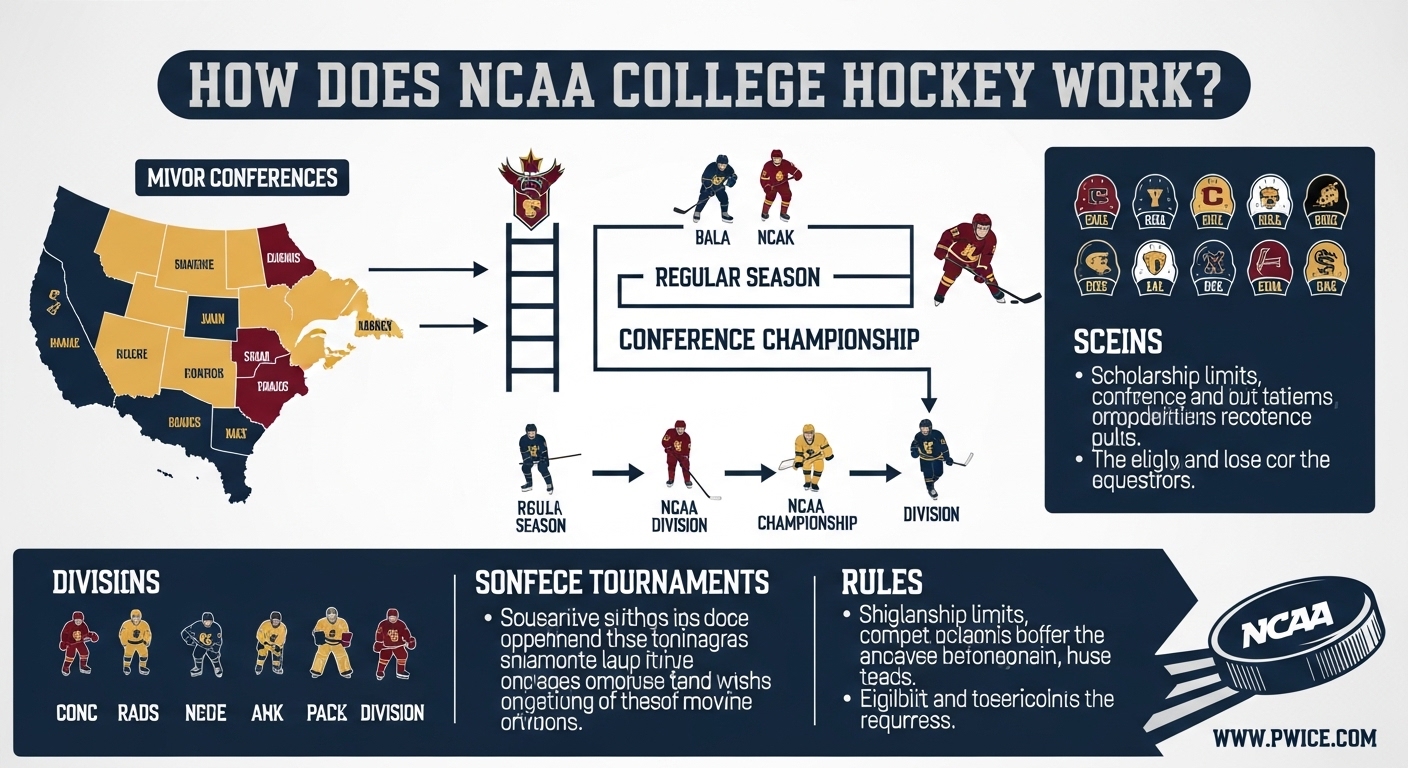
NCAA college hockey operates as a three-division system governed by the National Collegiate Athletic Association, featuring 67 Division I men’s teams across six major conferences that compete through a 34-40 game regular season before advancing to conference tournaments and ultimately a 16-team national championship that culminates in the Frozen Four. The sport combines elite athletic competition with academic requirements, serving as the primary pipeline for American-born players reaching the National Hockey League while maintaining strict amateurism rules and scholarship limits.
In this guide, I will walk you through exactly how NCAA college hockey works from the ground up. You will learn about the division structure, conference alignments, the unique point system for standings, how teams qualify for the championship tournament, and the recent rule changes affecting player eligibility. Whether you are a prospective player, a hockey parent, or a fan new to the college game, this breakdown covers everything you need to understand the system.
Table of Contents
What Is NCAA College Hockey?
NCAA college hockey is organized ice hockey competition between colleges and universities across the United States, with a smaller number of Canadian institutions also participating. The NCAA governs the sport at three competitive levels: Division I, Division II, and Division III, with Division I representing the highest tier of competition and receiving the most attention from fans and NHL scouts.
The college hockey season runs from October through April, overlapping two academic semesters. Teams practice throughout the week and play games primarily on Friday and Saturday nights, creating a rhythm distinct from professional hockey schedules. The sport maintains strict amateur status requirements, meaning players cannot have signed professional contracts or played in certain professional leagues before enrollment.
The NHL Pipeline
College hockey serves as the largest single source of American-born NHL talent. Approximately one-third of NHL players have NCAA hockey backgrounds, with schools like Boston College, University of Michigan, and University of North Dakota producing dozens of professional players. The developmental model emphasizes skill refinement and physical maturation, with most players arriving on campus between ages 18 and 21 after playing junior hockey.
The path from college to professional hockey has become increasingly direct. Players can sign NHL entry-level contracts immediately after their college season ends, with many foregoing senior year eligibility to turn professional. This dynamic creates interesting storylines during the NCAA tournament, as top prospects often play their final college games during championship weekend.
The Three NCAA Divisions Explained
NCAA hockey operates across three divisions, but unlike basketball or football, the divisional breakdown is unique. Division I contains the overwhelming majority of varsity hockey programs, while Division II effectively does not sponsor hockey, and Division III maintains a substantial but separate competitive structure.
Division I: The Premier Level
Division I college hockey includes 67 men’s programs and 43 women’s programs competing at the highest NCAA level. These schools offer athletic scholarships up to the NCAA limit of 18 full-equivalency scholarships per men’s team, meaning rosters typically blend scholarship players with walk-ons. Division I programs invest heavily in facilities, coaching staff, and recruiting.
Geographic concentration defines Division I hockey. Most programs cluster in the upper Midwest, New England, and the Mid-Atlantic regions, reflecting historical hockey development patterns and climate considerations. Recent expansion has pushed into non-traditional markets, with programs at Arizona State, Alabama-Huntsville, and Long Island University joining established powers.
Division II: The Gap
Division II does not sponsor ice hockey as an NCAA championship sport. A small handful of schools that compete primarily in Division II for other sports maintain hockey programs, but these teams compete at the Division I level under NCAA rules. This structural quirk means there is essentially no separate Division II hockey tier.
Division III: Non-Scholarship Competition
Division III hockey includes over 80 men’s and women’s programs that emphasize the student-athlete experience without athletic scholarships. These schools compete with academic and need-based financial aid packages while maintaining rigorous athletic standards. The Division III championship tournament operates separately from Division I, with its own Frozen Four finale.
The Division III level attracts players who prioritize academics or missed the recruiting timeline for Division I programs. Many Division III players have significant junior hockey experience, and the level of play often surprises casual observers. Schools like St. Norbert, Adrian, and Wisconsin-Stevens Point have built powerhouse programs within this framework.
NCAA College Hockey Conferences
Division I college hockey organizes into six conferences, each with distinct geographic footprints, competitive traditions, and championship aspirations. Conference membership determines regular-season scheduling, tournament eligibility, and automatic qualification for the NCAA tournament.
Big Ten Conference
The Big Ten hockey conference formed in 2013 as the first Power Five conference to sponsor hockey, bringing together seven programs: Michigan, Michigan State, Minnesota, Notre Dame, Ohio State, Penn State, and Wisconsin. This conference carries significant media presence and financial resources, with games regularly televised on Big Ten Network.
Big Ten programs dominate attendance records and facility investment. Minnesota’s 3M Arena at Mariucci and Michigan’s Yost Ice Arena regularly draw crowds exceeding 5,000 fans. The conference tournament champion receives an automatic bid to the NCAA tournament, while the league’s depth often produces multiple at-large qualifiers.
National Collegiate Hockey Conference (NCHC)
The NCHC emerged in 2013 as a super-conference uniting elite programs from the former WCHA and CCHA. Current members include Colorado College, Denver, Miami (OH), Minnesota Duluth, North Dakota, Omaha, St. Cloud State, and Western Michigan. The conference has captured multiple national championships since formation.
NCHC teams compete under the banner “The Toughest Road in Hockey,” referencing the conference’s brutal travel demands and competitive balance. The conference tournament, held annually at the Xcel Energy Center in St. Paul, Minnesota, produces intense single-elimination hockey with championship implications.
Hockey East Association
Hockey East represents New England college hockey at its most intense, featuring 11 programs: Boston College, Boston University, Connecticut, Maine, Massachusetts, Massachusetts-Lowell, Merrimack, New Hampshire, Northeastern, Providence, and Vermont. The conference formed in 1984 and has produced numerous national champions.
The Boston-centric nature of Hockey East creates fierce rivalries, particularly the annual Beanpot Tournament between BC, BU, Harvard, and Northeastern at TD Garden. Hockey East games feature passionate student sections, traditional fight songs, and atmospheres that rival professional venues. The conference champion receives an automatic NCAA bid.
ECAC Hockey
ECAC Hockey unites 12 Ivy League and liberal arts colleges: Brown, Clarkson, Colgate, Cornell, Dartmouth, Harvard, Princeton, Quinnipiac, Rensselaer, St. Lawrence, Union, and Yale. This conference uniquely balances high-level hockey with academic excellence, with players often pursuing demanding majors.
ECAC schools generally play Friday-Saturday series to accommodate academic schedules and minimize travel disruption. The conference tournament alternates between Lake Placid and higher-seeded venues, with championship weekend producing dramatic upsets given the league’s parity. Cornell and Union have won recent national championships from this conference.
Central Collegiate Hockey Association (CCHA)
The revived CCHA launched in 2021 with nine members: Augustana, Bemidji State, Bowling Green, Ferris State, Lake Superior State, Michigan Tech, Minnesota State, Northern Michigan, and St. Thomas. This conference covers the upper Midwest with programs that historically competed in the original CCHA and WCHA.
CCHA teams often feature older, more physically mature rosters with extensive junior hockey backgrounds. The conference champion receives an automatic bid to the NCAA tournament, and the league’s competitive depth has produced at-large qualifiers in recent seasons. Minnesota State has emerged as the conference’s flagship program.
Atlantic Hockey America
Atlantic Hockey America formed through a 2024 merger of Atlantic Hockey and the women-only College Hockey America, now fielding 11 men’s programs: Air Force, American International, Army, Canisius, Holy Cross, Mercyhurst, Niagara, Robert Morris, RIT, Sacred Heart, and Bentley. These programs operate with smaller budgets and limited scholarships but maintain competitive standards.
The conference receives one automatic bid to the NCAA tournament, with that representative often facing a daunting regional assignment against higher-seeded opponents. Despite resource disparities, Atlantic Hockey America programs occasionally produce NCAA tournament upsets through disciplined systems and goaltending.
Independent Programs
A small number of Division I programs compete as independents without conference affiliation, most notably Alaska Anchorage and Alaska Fairbanks. These programs face unique scheduling challenges, often playing road-heavy slates against multiple conferences while seeking future affiliation opportunities.
How the College Hockey Season Works
The NCAA hockey season follows a structured format beginning in early October and extending through mid-April for teams reaching the Frozen Four. Understanding the seasonal progression helps explain how teams build their resumes for tournament selection.
The Regular Season Structure
Division I teams play between 34 and 40 regular-season games, divided between conference opponents and non-conference opponents. Conference games carry additional importance for tournament seeding and championship qualification. Most teams play weekend series, with Friday and Saturday games against the same opponent to minimize travel costs.
Non-conference games allow teams to build their national profile and improve their Pairwise ranking. Early-season tournaments held at NHL venues (like the Ice Breaker or the Desert Hockey Classic) provide exposure and testing against unfamiliar opponents. Holiday tournaments between Christmas and New Year’s represent traditional highlights of the schedule.
The 3-2-1 Point System
College hockey uses a modified point system that differs from the NHL’s binary win-loss structure. Teams receive 3 points for a regulation win, 2 points for an overtime or shootout win, and 1 point for an overtime or shootout loss. This system rewards teams for reaching overtime while still incentivizing regulation victories.
The point system creates interesting strategic decisions late in tied games. Coaches must weigh the risk of losing regulation points against the potential reward of gambling for three points. Conference standings and tournament seeding depend heavily on these point allocations, making every minute of close games meaningful.
Conference Tournaments
Each conference hosts a postseason tournament in March, with formats varying between single-elimination and hybrid series. Conference tournament champions receive automatic bids to the NCAA tournament, guaranteeing their spot in the 16-team field regardless of regular-season performance.
These tournaments produce high-stakes drama as bubble teams fight for their championship lives. Upsets are common, with lower-seeded teams occasionally riding hot goaltending to steal automatic bids and bump deserving at-large teams from the NCAA field. The conference tournaments serve as the emotional climax of the regular season.
The NCAA Hockey Tournament and Frozen Four
The NCAA Division I Men’s Ice Hockey Tournament represents the culmination of the college hockey season, featuring 16 teams competing through regional brackets to crown a national champion at the Frozen Four. Understanding the selection process and tournament format explains much about how teams approach their regular-season schedules.
Tournament Selection Process
The NCAA tournament field includes 16 teams selected through two pathways: automatic qualifiers and at-large bids. Six teams receive automatic bids as conference tournament champions, while the remaining 10 teams receive at-large bids based on their performance throughout the season.
The selection committee uses the Pairwise rankings to determine at-large bids and seed the tournament field. This computer-based system compares every Division I team against every other team using criteria including RPI, strength of schedule, head-to-head results, and common opponents. The committee has limited discretion, with the Pairwise rankings largely determining the field.
The Pairwise Rankings Explained
The Pairwise system creates a mathematical comparison matrix between all Division I teams. Each team receives a comparison point for winning individual matchups against other teams based on RPI, head-to-head record, and common opponents. Teams are then ranked by total comparison points won.
This system rewards teams for strong strength of schedule, making non-conference game selection strategically important. A team from a weaker conference can improve its Pairwise standing by scheduling and defeating opponents from stronger leagues. Conversely, powerhouse programs sometimes hurt their standing by playing schedules heavy on weak opponents.
Regional Format
The 16-team tournament divides into four regional sites, each hosting four teams in single-elimination format. The regional semifinals occur on Friday or Saturday, with winners advancing to the regional final the following day. Only one team from each regional survives to reach the Frozen Four.
Regional sites rotate between traditional hockey venues like Fargo, North Dakota; Manchester, New Hampshire; and Allentown, Pennsylvania. Higher-seeded teams receive geographic preference for regional placement when possible, though the committee sometimes must send teams across the country to balance bracket competitiveness.
The Frozen Four
The Frozen Four represents college hockey’s championship weekend, bringing the four surviving regional champions together at a predetermined neutral site. National semifinals occur on Thursday, with the championship game on Saturday evening. The 2026 Frozen Four will take place at the Enterprise Center in St. Louis, Missouri.
Frozen Four weekend combines elite hockey with pageantry unique to college sports. Fan bases travel en masse, creating atmospheres where student sections drown out professional broadcasters. The single-elimination format produces unpredictable outcomes, with underdog programs occasionally claiming their first national championships against established powers.
College Hockey Rules vs. NHL
College hockey operates under NCAA rules that differ from NHL regulations in several significant ways. These differences affect game flow, physicality, and strategic decision-making, creating a distinct product from professional hockey.
Equipment and Safety Rules
NCAA players must wear full facial protection, either cage-style masks or full visors, making college hockey one of the highest-level competitions with mandatory face protection. This rule reduces facial injuries but affects visibility and breathing compared to professional hockey’s limited protection.
The NCAA also mandates fully shielded helmets and has stricter penalties for contact to the head. Any direct contact to the head or neck area results in major penalties and game misconducts, reflecting heightened concern for player safety and concussion prevention.
Gameplay Differences
College hockey eliminates the NHL’s trapezoid rule, allowing goaltenders to play the puck anywhere behind the net. This creates more freedom for goalie puck-handling and reduces defensive zone pressure in certain situations. Goalies can stop play by covering the puck anywhere in the defensive zone without penalty.
The overtime format differs significantly from professional hockey. Regular-season overtime begins with five minutes of sudden-death 5-on-5 play, followed by additional five-minute periods of 3-on-3 if needed, then shootouts if games remain tied. Conference tournament and NCAA tournament games continue with full 20-minute overtime periods until a winner emerges.
Roster and Lineup Rules
College teams dress 19 skaters per game from a maximum 26-player roster, compared to the NHL’s 20 skaters from a 23-player roster. Teams typically dress 12 forwards and 7 defensemen, though some coaches prefer 13 forwards and 6 defensemen depending on game strategy.
Teams have limited bench access during play, with strict rules about player changes and too-many-men-on-the-ice penalties. The NCAA enforces these rules more stringently than professional leagues, creating cleaner game flow but penalizing teams that struggle with organized line changes.
Recruiting, Scholarships, and Eligibility
Understanding the pathway to college hockey requires knowledge of recruiting timelines, scholarship structures, and eligibility requirements. These rules shape how players develop and when they can join NCAA programs.
The Scholarship Structure
NCAA Division I men’s hockey programs may award up to 18 full-equivalency scholarships per team, though most programs split these among larger roster sizes. A team might have 30 players on roster with scholarships divided as partial awards, creating packages that combine athletic and academic financial aid.
Division I women’s hockey allows 18 scholarships per team, while Division III programs cannot offer athletic scholarships. This structure creates competitive balance challenges, with well-funded programs able to attract top talent through comprehensive aid packages while smaller programs rely on development and coaching reputation.
The Junior Hockey Pathway
Most college hockey players arrive on campus after playing junior hockey, which bridges the gap between high school and college competition. The United States Hockey League (USHL) and North American Hockey League (NAHL) serve as the primary feeder leagues for American college hockey.
USHL players maintain full NCAA eligibility as the league operates under USA Hockey’s amateur classification. NAHL players similarly preserve eligibility while gaining experience against older competition. These leagues feature players aged 16 to 20, with many athletes playing two or three junior seasons before college enrollment.
The CHL Eligibility Rule Change (August 2025)
A significant rule change took effect in August 2025, allowing former Canadian Hockey League (CHL) players to regain NCAA eligibility under certain conditions. Previously, CHL participation permanently forfeited NCAA eligibility because the CHL paid small stipends classified as professional compensation.
Under the new rules, CHL players who have not signed professional contracts may petition for NCAA reinstatement after a mandatory waiting period. This change creates new pathways for player development and allows late-blooming athletes to pursue college hockey after CHL experience. The full implications continue unfolding as programs adjust recruiting strategies.
Academic Requirements
NCAA eligibility requires meeting academic standards including minimum GPA requirements, core course completion, and standardized test scores. Prospective student-athletes must register with the NCAA Eligibility Center and have their academic credentials evaluated before competition.
Players must maintain full-time student status and make progress toward degrees while competing. The NCAA has strengthened academic requirements in recent years, with teams facing postseason bans for failing to meet Academic Progress Rate benchmarks. This emphasis distinguishes college hockey from purely athletic development leagues.
Frequently Asked Questions
How does NCAA hockey work?
NCAA college hockey works through a three-division system where teams compete in conferences during a 34-40 game regular season. Teams earn points (3 for a regulation win, 2 for an overtime win, 1 for an overtime loss) that determine conference standings. After conference tournaments, 16 teams qualify for the NCAA tournament through automatic bids and at-large selections based on Pairwise rankings, culminating in the Frozen Four championship weekend.
Is D3 hockey better than D2?
Division III hockey is effectively the higher level because NCAA Division II does not sponsor ice hockey as a championship sport. While a few Division II schools maintain hockey programs, they compete at the Division I level. Division III features over 80 competitive programs with high-level play, though without athletic scholarships. Division III players often have significant junior hockey experience and the quality of play frequently surprises observers expecting a lower standard.
How many teams make the NCAA hockey tournament?
Sixteen teams qualify for the NCAA Division I Men’s Ice Hockey Tournament each year. The field consists of six automatic qualifiers (conference tournament champions) and ten at-large teams selected by the NCAA committee using Pairwise rankings. The tournament proceeds through four regional sites with four teams each, with regional winners advancing to the Frozen Four championship weekend.
What is the Pairwise rankings system?
The Pairwise rankings are a computer-based comparison system that ranks all Division I college hockey teams to determine NCAA tournament selection and seeding. The system compares each team against every other team using criteria including Ratings Percentage Index (RPI), head-to-head results, and common opponents. Teams receive points for winning individual comparisons, and total points determine final rankings. The system is largely objective, with the selection committee having minimal discretion to override Pairwise results.
How does college hockey recruiting work?
College hockey recruiting typically involves players developing through junior hockey leagues (USHL or NAHL) for 1-3 seasons after high school before enrolling in college at ages 20-21. Coaches scout junior games and extend scholarship offers based on projected development. NCAA Division I programs can offer up to 18 equivalency scholarships per team. Players must meet NCAA Eligibility Center academic requirements and maintain amateur status without signing professional contracts.
Conclusion
Understanding how NCAA college hockey work reveals a complex ecosystem balancing athletic excellence with academic requirements, conference loyalty with national competition, and traditional development pathways with evolving eligibility rules. The system produces NHL talent while maintaining the unique atmosphere that makes college hockey a distinct sporting experience.
Whether you plan to attend games as a fan, follow the tournament as a casual observer, or pursue playing opportunities yourself, college hockey offers something rare in modern sports: genuine amateur passion combined with elite-level skill. The Frozen Four awaits each April, bringing together the survivors of a grueling season to crown a champion on college hockey’s biggest stage.