
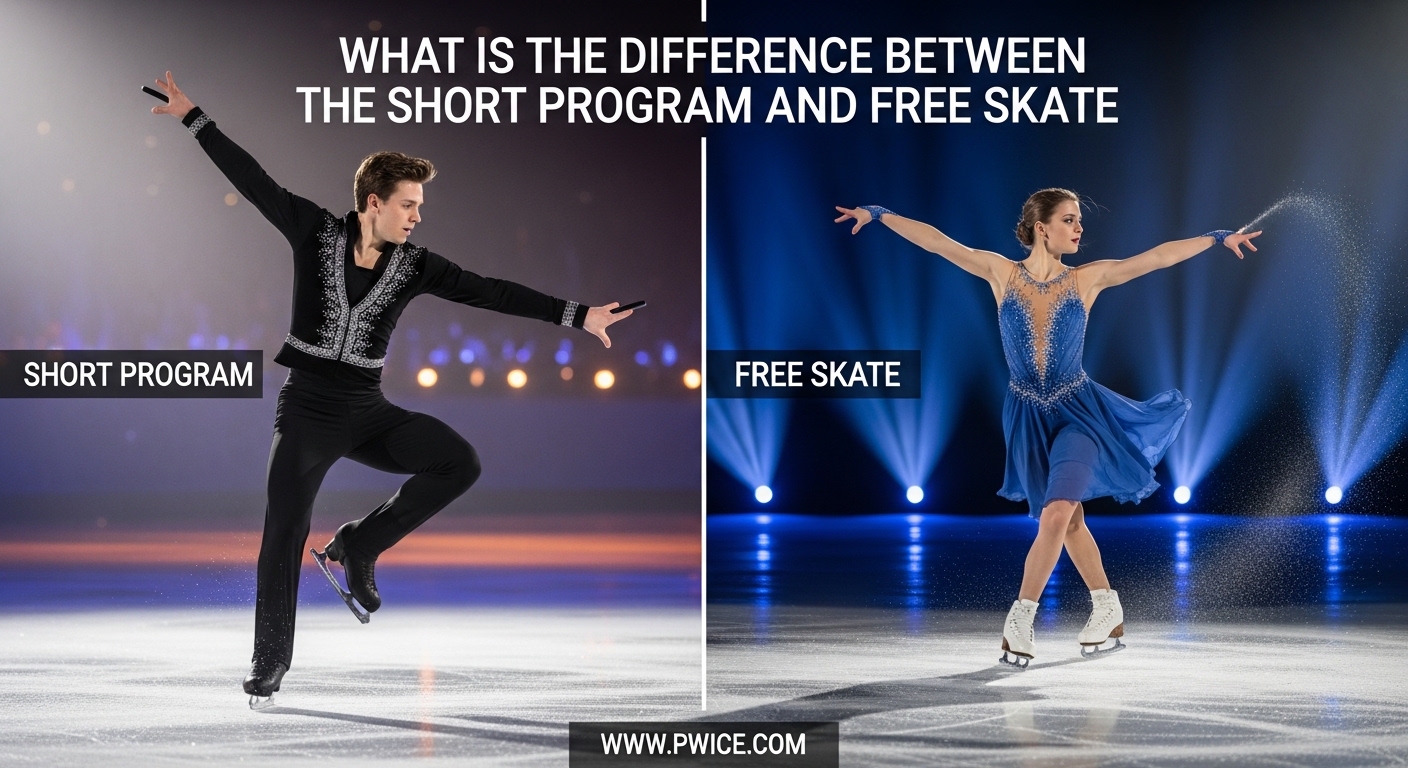
What is the difference between the short program and free skate? The short program is a 2-minute 40-second performance (plus or minus 10 seconds) with strictly required elements that every skater must complete. The free skate, also called the long program or free program, is a 4-minute performance where skaters have freedom to choose their own elements and choreograph a more expressive routine.
Understanding this distinction transforms how you watch figure skating competitions. Whether you are tuning into the Olympic Winter Games or following the World Championships, knowing what each segment tests helps you appreciate the unique skills on display.
The short program emphasizes precision under pressure. Skaters must execute specific mandatory elements within tight time constraints, leaving little room for error.
The free skate showcases stamina, creative expression, and the full range of a skater’s abilities. With double the time and freedom to select elements, this segment reveals who can sustain excellence while telling a compelling story on ice.
Table of Contents
What Is the Short Program in Figure Skating
The short program is the first of two competition segments in singles and pairs figure skating. It was invented in 1973 to create a standardized test of technical ability across all competitors.
For singles skaters, the short program lasts exactly 2 minutes and 40 seconds, with a tolerance of plus or minus 10 seconds. Pairs teams get slightly more time at 2 minutes and 50 seconds, also with the same 10-second flexibility.
Seven specific elements are required in the singles short program. Skaters must perform an axel-type jump, a maximum of three other jumps including one combination, three spins with specific positions, and a step sequence.
Each required element has detailed specifications set by the International Skating Union. For example, the spin combination must include at least one change of foot and one change of position. The step sequence must fully utilize the ice surface.
Violating these requirements results in automatic deductions. If a skater misses a required element or performs an illegal element, they lose significant points before judges even evaluate quality.
The short program tests a skater’s ability to perform under strict constraints. Think of it as a technical exam where everyone answers the same questions.
Pairs skating has different requirements reflecting the discipline’s unique aspects. Pairs must perform a maximum of three lifts, one twist lift, one throw jump, one jump combination, one solo spin combination, one pair spin combination, one death spiral, and a step sequence.
The short program score accounts for one-third of the final result in most major competitions. A poor short program performance can eliminate medal hopes before the free skate even begins.
What Is the Free Skate in Figure Skating
The free skate is the second competition segment where skaters choreograph their own programs within broad guidelines. It is also called the long program or free program, though free skate is the official ISU terminology.
Singles skaters receive 4 minutes for their free skate, plus or minus 10 seconds. Pairs teams skate for 4 minutes and 30 seconds, with the same timing tolerance.
Unlike the short program, the free skate has no required elements. Instead, skaters must create a well-balanced program that meets minimum requirements across categories.
Singles skaters can perform up to seven jumping passes in the free skate. These include one axel-type jump, maximum three spin combinations, one step sequence, and one choreographic sequence.
The freedom to choose elements allows skaters to showcase their strengths. A skater with exceptional jumping ability can load their program with difficult combinations, while one with superior artistry can emphasize spins and footwork.
Terminology confusion is common among new fans. The free skate has been called the long program for decades because it lasts longer than the short program. Some broadcasts still use this older terminology.
The free skate score accounts for two-thirds of the final result. This heavier weighting reflects the segment’s comprehensive test of a skater’s complete ability range.
Pairs teams have expanded requirements in the free skate. They can perform up to three lifts, one twist lift, two throw jumps, one solo jump, one jump combination or sequence, one solo spin combination, one pair spin combination, one death spiral, and one choreographic sequence.
The free skate rewards strategic planning. Coaches and skaters spend months determining the optimal element layout to maximize scoring potential while maintaining program flow.
What Is the Difference Between the Short Program and Free Skate
The difference between short program and free skate extends far beyond timing. Each segment tests fundamentally different aspects of a skater’s skill set and mental preparation.
| Aspect | Short Program | Free Skate |
|---|---|---|
| Duration | 2:40 +/- 10 seconds (singles) 2:50 +/- 10 seconds (pairs) | 4:00 +/- 10 seconds (singles) 4:30 +/- 10 seconds (pairs) |
| Elements | 7 strictly required elements | Well-balanced program with free choice |
| Timing Weight | One-third of final score | Two-thirds of final score |
| Primary Test | Precision under pressure | Stamina and artistic expression |
| Jumps Allowed | Maximum 3 jumping passes | Maximum 7 jumping passes |
| Music Vocals | Vocals permitted with restrictions | Vocals permitted with restrictions |
| Strategic Focus | Execute mandatory elements cleanly | Maximize difficulty while maintaining flow |
| Mental Demand | Nerves and consistency | Endurance and program management |
The duration difference fundamentally changes how skaters approach each segment. The short program’s brevity means every second counts, and mistakes carry disproportionate weight.
Element requirements create completely different preparation strategies. Short program training focuses on perfecting specific required elements until they become automatic. Free skate training involves endless experimentation to find the optimal balance of difficulty and executability.
Scoring distribution affects competitive strategy significantly. A skater trailing after the short program needs a nearly flawless free skate to overcome the deficit. Conversely, a strong short program provides psychological cushion but also increases pressure to maintain standards.
Mental demands differ substantially between segments. The short program requires managing pre-competition nerves and executing immediately upon taking the ice. The free skate demands sustained concentration, pacing awareness, and recovery from early mistakes.
Music selection reflects these different purposes. Short programs often use dramatic, attention-grabbing pieces that make immediate impact. Free skate music typically has more dynamic range, building through emotional arcs that sustain viewer interest over four minutes.
Understanding the Competition Format
The short program directly affects free skate participation through qualification rules. Not every skater who enters a competition performs both segments.
Major championships like the World Championships and Olympic Winter Games limit free skate participation to the top performers from the short program. Typically, the top 24 singles skaters and top 16 pairs teams advance.
This cut system creates intense pressure during short programs. Skaters on the qualification bubble know that one significant error could end their competition prematurely.
Final rankings combine both segment scores using simple addition. A skater’s total score equals their short program score plus their free skate score. The skater with the highest combined total wins.
The scoring math means comebacks are possible but challenging. Because the free skate counts for two-thirds of the total, a skater can overcome a short program deficit of several points with an exceptional long program.
Starting order for the free skate reflects short program results. The highest-ranked short program skaters skate last, giving them the advantage of knowing what scores they need to beat.
Team events use a modified format where multiple skaters contribute scores. In the Olympic team event, for example, nations field different athletes for short program and free skate segments across multiple disciplines.
Music Rules and Artistic Differences
Music rules have evolved significantly over the past decade. Both programs now permit vocal music with lyrics, a change implemented for the 2014-15 season.
Before this rule change, only instrumental music was permitted in singles and pairs competition. The vocal music prohibition had been in place since the early days of competitive figure skating.
Despite vocal music now being allowed, many skaters still choose instrumental pieces. Traditional preferences and choreographic considerations influence these decisions.
Artistic freedom differs substantially between segments. The short program’s required elements constrain how skaters can interpret music, forcing them to hit specific beats for element execution.
The free skate allows seamless integration of elements with musical interpretation. Skaters can choreograph entries and exits that flow naturally with phrasing, creating more cohesive artistic statements.
Music selection strategy reflects competitive goals. Short program music often prioritizes immediate recognizability and emotional clarity. Free skate music can be more complex, rewarding listeners who follow the full four-minute journey.
Program component scores reflect these artistic differences. Judges evaluate skating skills, transitions, performance, composition, and interpretation across both segments, but free skate component scores typically carry more weight in close competitions.
Ice Dance Exceptions: Rhythm Dance and Free Dance
Ice dance uses different terminology and structure than singles and pairs skating. Understanding these differences prevents confusion when watching dance competitions.
The ice dance equivalent of the short program is called the rhythm dance. This segment replaced the former short dance and has specific pattern dance requirements set annually by the ISU.
Rhythm dance duration is 2 minutes and 50 seconds, plus or minus 10 seconds. The required pattern changes each season, ensuring skaters master different historical dance styles.
The free dance corresponds to the free skate in other disciplines. Lasting 4 minutes for all teams, the free dance allows complete choreographic freedom within character requirements.
Ice dance has unique restrictions on lifts and jumps. These elements are more limited in dance than in pairs skating, emphasizing the discipline’s focus on close hold and pattern work.
Both rhythm dance and free dance permit vocal music, and many teams choose songs with lyrics. Music selection in ice dance often prioritizes danceability and rhythm adherence.
The scoring split between rhythm dance and free dance follows the same one-third/two-thirds ratio as singles and pairs. A strong rhythm dance provides foundation, but the free dance ultimately determines medal placement.
Which Is Harder: Short Program or Free Skate
Neither segment is objectively harder; they test different types of difficulty. The short program tests precision and nerve management, while the free skate tests stamina and strategic pacing.
From a technical execution standpoint, the short program is often described as harder to perform well. Skaters have no time to settle into a rhythm, and any early mistake amplifies pressure throughout the remaining elements.
Forum discussions among dedicated fans reveal nuanced perspectives. Many experienced observers note that while short programs have an easier threshold for being good, truly exceptional free skates are exceedingly rare.
The free skate represents the upper limit of what skaters can achieve. It tests not just technical ability but physical conditioning, program construction skill, and the mental fortitude to maintain focus through four demanding minutes.
Common mistakes differ between segments. Short program errors often involve missing required elements or underrotating jumps under pressure. Free skate errors typically involve pacing failures, such as exhausting energy early or saving too much for the end.
Recovery psychology varies significantly. A short program disaster can be shaken off during the days before the free skate. A free skate mistake must be processed instantly while continuing to perform.
For most elite competitors, the short program generates more pre-competition anxiety. The free skate, while physically exhausting, often feels more natural because it reflects their daily training routines.
Historical Evolution of the Format
The short program format was invented in 1973 by the International Skating Union. Before this innovation, competitions consisted only of what we now call the free skate.
The ISU created the short program to ensure all competitors demonstrated fundamental technical skills. Previously, skaters could avoid weak elements entirely by never including them in free programs.
The original short program had fewer requirements than today’s version. Over decades, the ISU has refined the element list to reflect evolving skating standards and athletic capabilities.
The introduction of the short program standardized competition structure worldwide. Before 1973, different nations used varying competition formats, making international comparison difficult.
The Judging System has transformed how both segments are evaluated. The current International Judging System replaced the former 6.0 system in 2004, introducing technical scores and program component scores.
Recent rule changes continue to evolve the format. For the 2026-27 season, the ISU plans adjustments to jump combinations and spin requirements to address current competitive trends.
Understanding this history helps viewers appreciate why competitions follow their current structure. The two-segment format emerged from legitimate sporting concerns about fair comparison, not arbitrary tradition.
Frequently Asked Questions
What is the difference between the free skate and short program?
The short program is a 2-minute 40-second performance with seven strictly required elements, while the free skate is a 4-minute program where skaters choose their own elements. The short program tests precision under pressure and accounts for one-third of the final score. The free skate tests stamina, creativity, and comprehensive ability, accounting for two-thirds of the final score.
How does the short program affect the free skate?
Short program scores determine which skaters advance to the free skate in major competitions, typically limiting participation to the top 24 singles skaters or 16 pairs teams. The short program score also combines with the free skate score to determine final rankings. Additionally, short program placement determines free skate starting order, with leaders skating last.
Is free skate or short program harder?
Neither is objectively harder; they test different skills. The short program demands precision and nerve management with no room for error, while the free skate requires physical stamina and strategic pacing over four minutes. Many skaters find the short program more mentally stressful due to immediate pressure, while the free skate is physically more demanding.
Is free skate the same as long program?
Yes, free skate and long program refer to the same competition segment. Long program is older terminology that predates the short program’s invention in 1973. The ISU officially uses free skate, but you may hear long program in broadcasts and casual conversation. Both terms describe the longer, second segment where skaters have element choice freedom.
How many jumps are allowed in short program vs free skate?
Singles skaters can perform a maximum of three jumping passes in the short program, including one required axel-type jump. In the free skate, singles skaters can perform up to seven jumping passes. Pairs skaters have similar expansion opportunities, with additional slots for throw jumps and lift combinations in the free skate.
What comes first, short program or free skate?
The short program always comes first in competition order. This sequencing allows short program scores to determine free skate qualification and starting order. Competitions typically schedule short programs on one day with free skates following a day or two later, giving skaters recovery time between segments.
What is a technical program in figure skating?
Technical program is another name for the short program. This terminology reflects the segment’s purpose: testing specific technical skills through required elements. While the free skate also contains technical elements, the short program’s strict requirements make it the definitive test of baseline technical competence.
Conclusion
What is the difference between the short program and free skate? Now you understand that these two segments create a complete picture of competitive figure skating ability. The short program provides a standardized technical test, while the free skate reveals the full artistic and athletic range each skater brings to the ice.
The next time you watch figure skating at the Olympic Winter Games or World Championships, observe how skaters approach each segment differently. Notice the immediate intensity of short programs versus the sustained pacing of free skates. Watch how the same athlete transforms between precision-focused technician and expressive performer.
Understanding these distinctions deepens appreciation for what might be the most demanding sport in the Winter Olympics. Every skater who takes the ice has trained years to master both the structured requirements of the short program and the creative freedom of the free skate.