
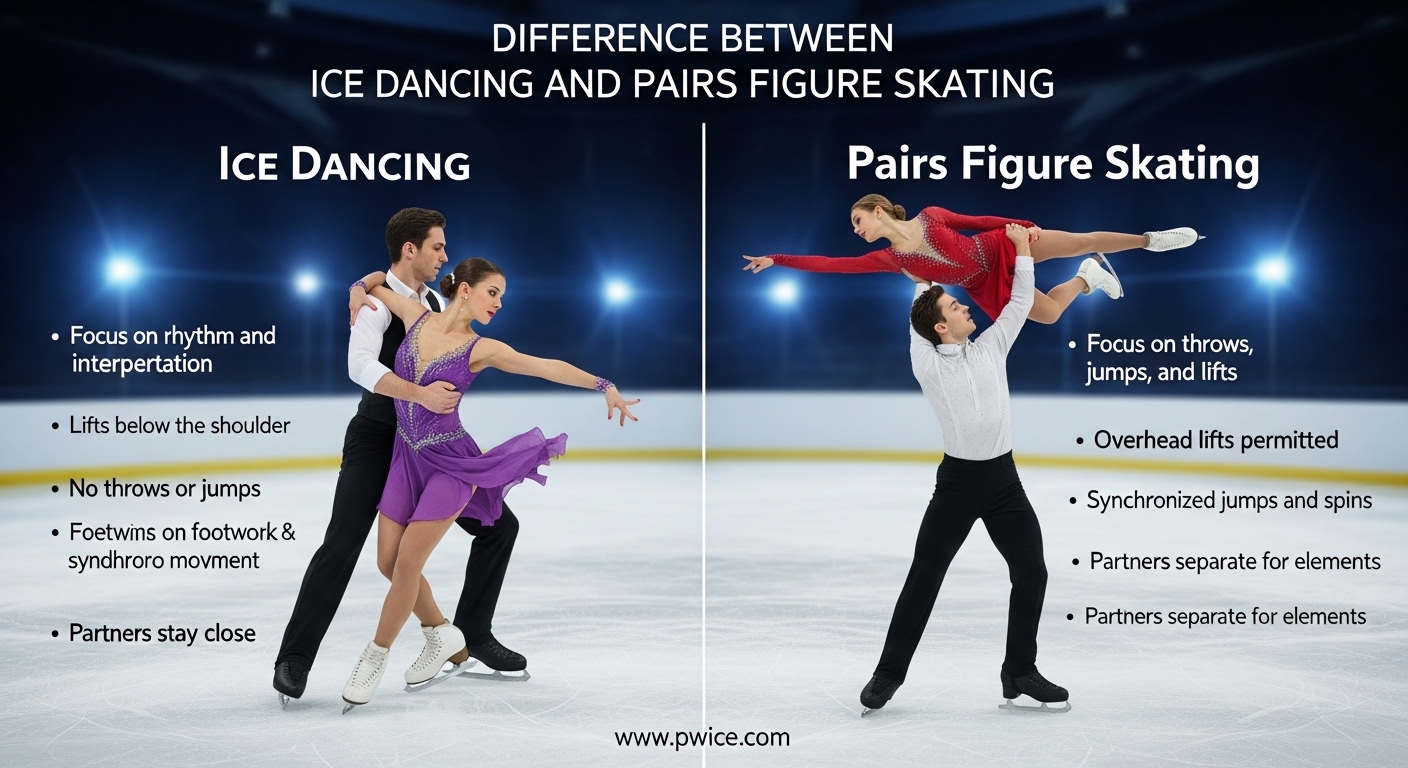
Every Winter Olympics, millions of viewers tune in to watch figure skating. Yet many cannot tell the difference between ice dancing and pairs figure skating when watching couples glide across the ice together. Understanding these two distinct Olympic disciplines will transform how you watch and appreciate the sport.
The difference between ice dancing and pairs figure skating comes down to a fundamental distinction. Pairs skating emphasizes acrobatic athleticism with high-flying throws, overhead lifts, and death spirals. Ice dancing focuses on ballroom-style movement, intricate footwork, and maintaining close physical contact between partners throughout the routine.
Both disciplines require extraordinary skill, years of training, and an unbreakable trust between partners. However, the rules governing what each discipline can and cannot do create two entirely different art forms on ice. I have analyzed competition footage, studied official ISU rulebooks, and compared training methods to bring you this complete guide.
Table of Contents
Quick Comparison at a Glance
Before diving into the details, here is a quick side-by-side comparison of how these two disciplines differ at the Olympic level.
| Feature | Pairs Figure Skating | Ice Dancing |
|---|---|---|
| Competition Segments | Short Program, Free Skate | Rhythm Dance, Free Dance |
| Throw Jumps | Allowed and required | Forbidden |
| Overhead Lifts | Allowed and required | Forbidden |
| Twizzles | Optional elements | Required sequences |
| Music Style | Flexible, any genre | Ballroom-influenced, specific rhythms |
| Partner Distance | Can separate widely | Must stay within two arm lengths |
| Primary Focus | Acrobatic athleticism | Dance interpretation and edge work |
This table captures the essential distinctions that separate these disciplines. While both involve male and female partners performing choreographed routines to music, the rules create entirely different performances. Keep these differences in mind as we explore each aspect in detail.
Competition Formats: How They Differ
The competition structure for pairs and ice dancing follows completely different formats. Understanding these formats helps you follow the action during Olympic broadcasts.
Pairs Competition Format
Pairs figure skating competitions consist of two segments: the Short Program and the Free Skate. The Short Program lasts approximately 2 minutes and 40 seconds, with specific required elements that every team must include. Skaters choose their own music and choreography, but judges evaluate how well they execute the mandated elements.
The Free Skate allows more creative freedom and extends to about 4 minutes and 30 seconds. Teams select their own music and choreograph their own routines, incorporating required elements within their chosen artistic framework. The combined scores from both segments determine the final results.
Ice Dance Competition Format
Ice dancing competitions feature the Rhythm Dance and the Free Dance. The Rhythm Dance, formerly called the Short Dance, requires teams to perform specific pattern dances set to mandated rhythms and tempos. The International Skating Union announces the required rhythms each season, which might include cha-cha, samba, rumba, or swing.
The Free Dance gives teams creative freedom within certain parameters, lasting approximately 4 minutes. Unlike pairs skating, ice dancers must maintain close physical contact and cannot perform the acrobatic elements that define pairs. The 2026 Olympic season brings fresh choreography as teams interpret the required rhythms in unique ways.
Technical Elements: What Each Discipline Allows
The technical elements permitted in each discipline reveal the fundamental difference between pairs and ice dancing. These rules define what viewers see on the ice.
Signature Elements in Pairs Skating
Throw jumps represent one of the most spectacular elements in pairs skating. The male partner launches the female partner into the air, where she performs multiple rotations before landing alone. These throws require immense trust, precise timing, and the ability to absorb impact forces equivalent to several times body weight.
Overhead lifts elevate the female partner high above the male partner’s head, creating iconic images that define pairs skating. Teams execute various types including twist lifts, where the woman rotates while airborne, and straight-line lifts that traverse the ice. The death spiral requires the male partner to pivot in a circle while holding his partner, who skates with her body nearly parallel to the ice surface.
Pair spins and side-by-side jumps add additional complexity. Partners perform synchronized rotations and jumps, requiring perfectly matched timing and technique. When executed flawlessly, these elements create moments of breathtaking beauty and athletic prowess.
Signature Elements in Ice Dancing
Twizzles serve as the signature element of ice dancing. These are one-foot turns that travel across the ice while rotating, performed simultaneously by both partners. Teams execute twizzle sequences requiring multiple rotations in perfect synchronization, with judges evaluating speed, clean execution, and unison.
Pattern dances form another essential component of ice dancing. These are predetermined step sequences with specific turn patterns and timing that all teams must perform. The compulsory nature of these patterns tests each team’s ability to execute identical choreography with precision and musicality.
Lifts in ice dancing differ dramatically from pairs skating. Partners cannot lift each other overhead; instead, they execute lifts where the lifted partner remains below the shoulders. Curve lifts, rotational lifts, and stationary lifts all stay within these height restrictions, emphasizing grace and edge quality over acrobatic height.
Step sequences and choreographic elements showcase the dance background of this discipline. Teams perform intricate footwork patterns that demonstrate deep edges, precise turns, and seamless connection between partners. The prohibition against jumps and high overhead lifts forces ice dancers to excel in these nuanced technical skills.
Why Ice Dancing Forbids Jumps
The ban on throw jumps and overhead lifts in ice dancing stems from the discipline’s ballroom dancing origins. Ice dancing evolved from ballroom dance adapted for ice, maintaining the close partner connection that defines social dancing. Jumps and high throws would break this connection and contradict the fundamental aesthetic of the discipline.
This restriction actually increases the technical difficulty in other areas. Ice dancers must achieve high component scores through exceptional edge work, precise turns, and seamless transitions rather than relying on acrobatic spectacle. The limitation creates a distinct art form that rewards different athletic and artistic skills.
Music and Rhythm Requirements
The music rules for each discipline reflect their different artistic foundations. These requirements shape the character of every performance.
Ice Dance Music Rules
Ice dancing maintains strong ties to ballroom dancing traditions. The Rhythm Dance requires teams to skate to specific dance rhythms announced by the ISU each season. These might include tango, blues, swing, or Latin rhythms. The music must fit within specified tempo ranges, ensuring that teams cannot simply skate faster to complete more elements.
The Free Dance allows more musical variety but still emphasizes danceable rhythms and continuous flow. Teams must demonstrate that they are truly dancing on ice, interpreting the music through movement rather than merely performing athletic tricks. This creates performances that feel closer to ballroom dancing than gymnastics.
Until recently, ice dancing prohibited music with vocals. While this rule has relaxed somewhat, the vocal music restrictions still shape the character of ice dance programs differently from pairs skating.
Pairs Skating Music Flexibility
Pairs skating imposes fewer musical restrictions. Teams can select any music that suits their artistic vision and technical program requirements. This flexibility allows pairs to skate to orchestral scores, movie soundtracks, classical pieces, or contemporary music with full vocals.
The music serves the athletic performance rather than constraining it. Teams choose compositions that build drama around their throw jumps, lifts, and other acrobatic elements. The result feels more like a theatrical athletic performance than a formal dance.
Training and Physical Demands
The training regimens for pairs and ice dancing develop different athletic capabilities. Both require dedication, but the specific demands vary significantly.
Pairs Training Focus
Pairs skaters undergo extensive strength training to execute lifts and throws safely. The male partner must develop upper body and core strength to lift and support his partner through complex positions. The female partner builds explosive power for jump takeoffs and landing stability to absorb impact forces.
Off-ice training includes weightlifting, plyometrics, and ballet to develop the necessary strength and flexibility. Safety training proves essential given the risks of high-flying elements. Falls from throws and lifts can cause serious injuries, making proper technique and physical preparation critical.
Ice Dance Training Focus
Ice dancers emphasize edge work, turn technique, and dance training. Hours of practice focus on developing clean twizzles, deep edges, and seamless transitions between elements. Many ice dancers train extensively in ballroom dancing off the ice to improve their understanding of rhythm, partnership, and movement quality.
While ice dancing avoids the high-impact risks of pairs skating, it demands exceptional cardiovascular endurance. The requirement to stay close to your partner while executing complex footwork creates intense physical demands. Edge quality deteriorates when skaters tire, making stamina crucial for maintaining performance quality throughout a four-minute program.
Cross-Training Between Disciplines
Some skills transfer between the disciplines. Both require excellent basic skating technique, strong partnership communication, and the ability to perform under pressure. Many skaters have successfully switched from one discipline to the other, though the transition requires significant retraining.
Pairs skaters moving to ice dance must eliminate jumping habits and develop deeper edge work. Ice dancers transitioning to pairs must build the strength for lifts and learn to trust their partner during throws. Both transitions demonstrate the distinct but related nature of these disciplines.
Equipment: Skate and Blade Differences
The equipment used by pairs skaters and ice dancers differs in subtle but important ways. These differences reflect the distinct demands of each discipline.
Blade Profile Differences
Ice dance blades feature a flatter profile compared to pairs skating blades. The flatter blade provides more stable contact with the ice, supporting the close partner positions and sustained edge work that define ice dancing. This profile sacrifices some agility for stability.
Pairs skating blades have more curve or rocker along the length of the blade. This curved profile enables the quick turns and direction changes needed for jumps, throws, and complex lift entries. The increased maneuverability supports the acrobatic elements that pairs perform.
Blade Length and Pick Configuration
Ice dance blades tend to be slightly shorter than pairs blades. The shorter length allows partners to skate closer together without their blades interfering. Ice dancers also use smaller toe picks since they rarely need the aggressive grip required for jump takeoffs.
Pairs skaters use blades with larger toe picks to assist with jump takeoffs and provide secure footing during lift entries. The blade length and pick configuration support the explosive movements and secure landings that pairs elements require.
History and Olympic Origins
Both disciplines have rich histories that shaped their current forms. Understanding this evolution explains why the rules differ so significantly.
Pairs Skating History
Pairs figure skating debuted at the Olympics in 1908, making it one of the oldest Winter Olympic disciplines. Early pairs skating focused on elegant movements and basic lifts. Over the decades, the discipline evolved toward increasingly acrobatic elements as skaters pushed athletic boundaries.
The Soviet Union dominated pairs skating for much of the late 20th century, developing many of the throw techniques and overhead lifts that define modern pairs skating. Legendary teams like Irina Rodnina and Alexander Zaitsev established standards that continue to influence the sport today.
Ice Dancing History
Ice dancing entered the Olympics much later, making its debut at the 1976 Innsbruck Winter Games. The discipline grew from compulsory dances performed at social ice skating clubs, particularly in Great Britain. Early ice dancing emphasized strict adherence to dance patterns and formal ballroom positions.
The discipline has evolved significantly since 1976. The original three-segment format of compulsory dances, original dance, and free dance has simplified to the current two-segment structure. Modern ice dancing allows more creative freedom while maintaining its ballroom dance foundations.
Canadian legends Tessa Virtue and Scott Moir became the most decorated Olympic figure skaters in history through ice dancing, winning five medals across three Olympic Games. Their success elevated the visibility and popularity of the discipline worldwide.
Which Is Harder? Ice Dance vs Pairs
Many viewers wonder which discipline demands greater skill or athleticism. The honest answer is that both are extraordinarily difficult in different ways.
Pairs skating carries higher physical risk due to throw jumps and overhead lifts. The consequences of errors include serious falls from significant heights. The male partner needs exceptional strength, while the female partner requires courage and precise aerial awareness. The psychological pressure of trusting your partner with your safety adds another dimension of difficulty.
Ice dancing demands relentless precision in edge work and partnership. Small errors in timing or position become obvious immediately. The prohibition on jumps means skaters cannot hide technical weaknesses behind spectacular acrobatic moments. The sustained cardiovascular demand of maintaining close positions while executing complex footwork creates its own physical challenge.
Rather than declaring one discipline harder than the other, appreciate that each requires mastery of different skills. Both represent the pinnacle of figure skating achievement and deserve equal respect.
What to Watch For as a Spectator
Knowing what to look for enhances your enjoyment of both disciplines. Here are key elements to watch during Olympic broadcasts.
Identifying Each Discipline Quickly
If you see a female skater flying through the air above her partner’s head, you are watching pairs skating. Overhead lifts and throw jumps are exclusive to pairs and instantly identify the discipline. The greater physical separation between partners also indicates pairs skating.
If the couple stays close together throughout the routine, performing synchronized turns while skating across the ice, you are watching ice dancing. Look for twizzle sequences where both partners rotate on one foot while traveling. The continuous physical connection defines ice dancing.
Judging Criteria to Notice
Judges evaluate pairs skating on both technical elements and program components. Watch for clean landings on throw jumps, secure positions in overhead lifts, and unison during side-by-side elements. Speed across the ice and the quality of death spirals also factor into scores.
For ice dancing, observe the depth of edges during turns and the speed of twizzle sequences. Judges look for clean turns without scraping or hopping, seamless transitions between elements, and how well the skating matches the musical rhythm. The partnership quality and interpretation of the music matter greatly.
Component scores reflect artistry, musical interpretation, and skating skills. Even without understanding the technical rules, viewers can appreciate beautiful movement, emotional connection to music, and the sense of two people moving as one.
Difference Between Ice Dancing and Pairs Figure Skating
To summarize the complete difference between ice dancing and pairs figure skating, remember these fundamental distinctions. Pairs skating emphasizes acrobatic athleticism through throw jumps, overhead lifts, and death spirals. Teams compete in Short Programs and Free Skates with relatively flexible music choices.
Ice dancing emphasizes ballroom-style dance interpretation through twizzles, pattern dances, and close partner positions. Teams compete in Rhythm Dances with specific required rhythms and Free Dances with continuous partner connection. The prohibition on jumps and high lifts forces ice dancers to excel in edge work and artistic interpretation.
Both disciplines showcase extraordinary athleticism, artistry, and partnership. Both have produced legendary Olympic moments. Understanding these differences allows you to appreciate the unique skills each discipline demands and the distinct beauty each creates on the ice.
FAQ
Is ice dance or pair harder?
Both disciplines are extremely difficult but in different ways. Pairs skating involves higher physical risk with throw jumps and overhead lifts requiring immense strength and trust. Ice dancing demands relentless precision in edge work and sustained cardiovascular endurance with no acrobatic elements to hide behind. Neither is objectively harder; each requires mastery of distinct skills.
What is the difference between ice dance and pair figure skating?
The main difference is that pairs skating features acrobatic elements like throw jumps, overhead lifts, and death spirals with greater separation allowed between partners. Ice dancing focuses on ballroom-style dance with twizzles, pattern dances, and continuous close partner contact. Pairs competes in Short Program and Free Skate; ice dance competes in Rhythm Dance and Free Dance.
Who won the pair figure skating 2026?
The pair figure skating events at the Milano-Cortina 2026 Winter Olympics concluded with competition in both the Short Program and Free Skate segments. Results from these Olympic Games continue the legacy of legendary pair skating champions throughout the history of the Winter Olympics.
What are the 4 types of figure skating?
The four Olympic figure skating disciplines are: Men’s Singles, Women’s Singles, Pair Skating, and Ice Dancing. Each discipline has distinct rules, elements, and competition formats. All four are judged on technical elements and program components, but the specific requirements differ significantly between disciplines.
Conclusion
Now that you understand the difference between ice dancing and pairs figure skating, you can enjoy watching these disciplines with newfound appreciation. The next time you tune into figure skating competitions, you will recognize the throw jumps and overhead lifts that define pairs skating. You will also spot the twizzles and close partner dancing that characterize ice dancing.
Both disciplines represent the pinnacle of what humans can achieve on ice. The trust between partners, the years of training, and the courage to perform under Olympic pressure deserve our admiration. Whether you prefer the acrobatic thrills of pairs or the dance artistry of ice dancing, you now have the knowledge to understand what makes each discipline special.