
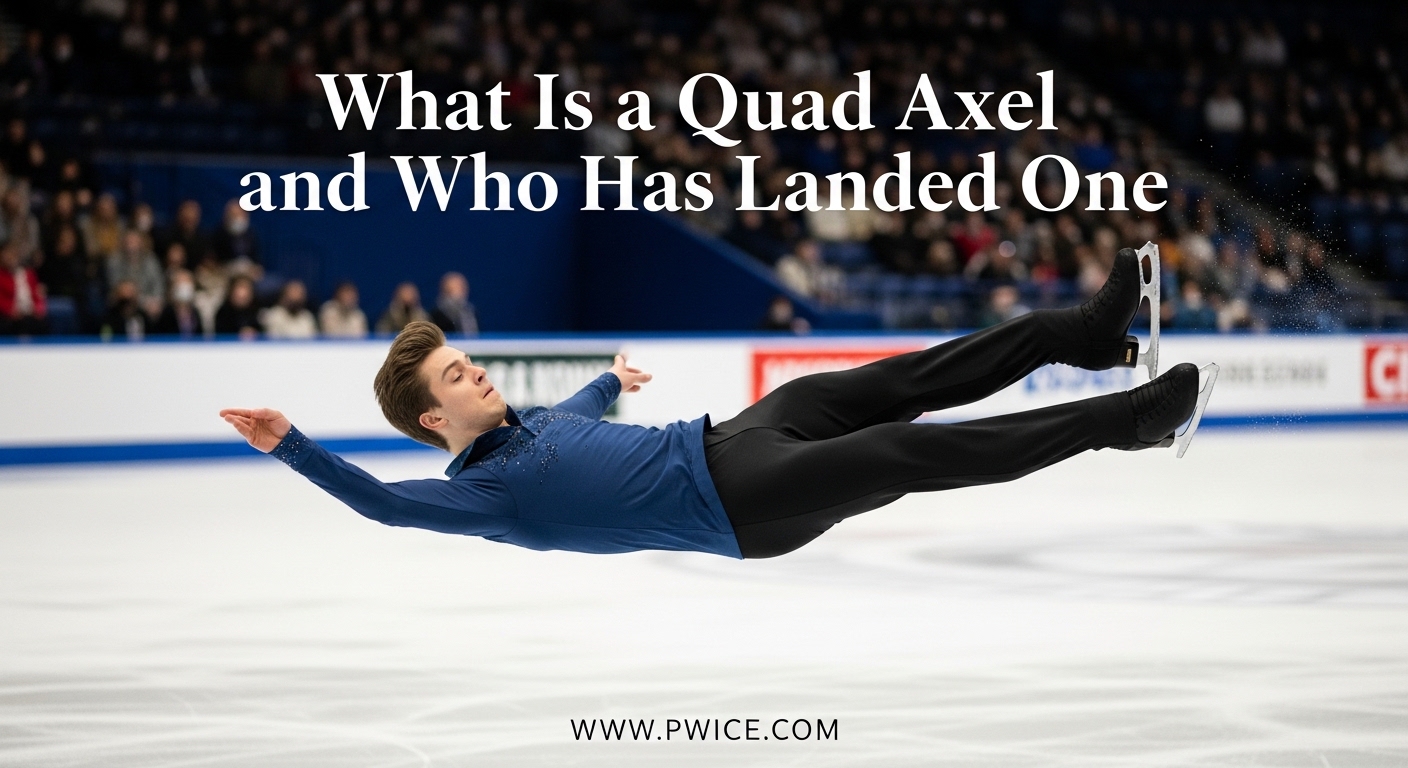
A quadruple axel is the most difficult jump in figure skating history, requiring four and a half rotations in the air. Unlike all other quadruple jumps that have four revolutions, the quad axel demands an extra half-rotation because it takes off forward and lands backward. As of 2026, only one person has ever successfully landed this jump in competition: American figure skater Ilia Malinin.
I remember watching the live stream of the U.S. International Figure Skating Classic on September 14, 2022. The skating world had been waiting decades for this moment. When Malinin’s skates touched the ice and he glided away cleanly, I realized I had just witnessed something that many experts considered physically impossible.
This guide breaks down exactly what makes a quad axel different from other jumps, why it took so long to achieve, and the physics behind this remarkable feat. Whether you are new to figure skating or a longtime fan trying to understand the significance of Malinin’s achievement, this article covers everything you need to know about the sport’s most elusive element.
Table of Contents
What Is a Quad Axel?
A quad axel is a figure skating jump consisting of four and a half rotations (1,620 degrees) in the air before landing. It is the only quadruple jump that requires more than four full rotations, making it significantly more difficult than the quad toe loop, salchow, loop, flip, or lutz. The jump takes off forward on the outside edge of one skate and lands backward on the outside edge of the opposite skate.
The axel jump family is unique because of its forward takeoff. All other jumps in figure skating take off while skating backward. This forward entry is what creates the additional half-rotation requirement. When Axel Paulsen invented the jump in 1882, he established a mechanical reality that makes every axel variation more challenging than backward-takeoff jumps with the same number of rotations.
The Six Types of Quadruple Jumps
Figure skating recognizes six quadruple jumps, each with different difficulty levels and point values. The quad axel sits at the top of this hierarchy as the only jump requiring 4.5 rotations.
| Jump | Takeoff Direction | Rotations | Base Value |
|---|---|---|---|
| Quad Toe Loop | Backward | 4.0 | 9.5 |
| Quad Salchow | Backward | 4.0 | 9.7 |
| Quad Loop | Backward | 4.0 | 10.5 |
| Quad Flip | Backward | 4.0 | 11.0 |
| Quad Lutz | Backward | 4.0 | 11.5 |
| Quad Axel | Forward | 4.5 | 12.5 |
The forward takeoff makes the axel an edge jump rather than a toe jump. Skaters must generate all their rotation from the edge of the blade without using the toe pick to assist the takeoff. This eliminates one source of rotational momentum that skaters can use on jumps like the lutz or flip.
Why 4.5 Rotations Instead of 4?
All jumps in figure skating must land backward. Since the axel takes off while skating forward, the skater must complete a half-rotation just to get back to facing forward, then complete the standard four rotations of a quad jump. This creates the 4.5 rotation requirement that makes the quad axel unique.
A triple axel requires 3.5 rotations. A double axel requires 2.5 rotations. The pattern continues with the quad axel requiring 4.5 rotations. This mathematical reality means that even though we call it a “quad” axel, it actually contains more rotation than any other jump classified as a quadruple.
Who Has Landed a Quad Axel?
Only one skater has ever landed a quadruple axel in competition: Ilia Malinin of the United States. He first accomplished this historic feat on September 14, 2022, at the U.S. International Figure Skating Classic in Lake Placid, New York. As of 2026, he remains the only person to successfully land this jump in an ISU-sanctioned competition.
Malinin was 17 years old when he made history. His achievement represents one of the most significant milestones in figure skating history, comparable to the first quad toe loop landed by Kurt Browning in 1988. The skating community immediately recognized the magnitude of what had just happened.
The nickname “Quad God” followed naturally. Former Olympic champion Scott Hamilton said he never thought he would see a quad axel landed in his lifetime. Other commentators described the jump as “defying gravity” and “pushing the boundaries of human physical capability.”
Has Any Woman Landed a Quad Axel?
No woman has landed a quad axel in competition. Several female skaters have landed other quadruple jumps, with Alexandra Trusova of Russia being the first woman to land a quad lutz, quad flip, and quad toe loop in competition. However, the quad axel remains out of reach for all female skaters as of 2026.
The physical demands of the quad axel require a combination of height, rotational speed, and upper body strength that has proven difficult for female skaters to achieve. The height needed to complete 4.5 rotations while maintaining control on landing creates significant biomechanical challenges.
The Historic First Landing: September 14, 2022
Ilia Malinin landed the first quadruple axel in competition on September 14, 2022, at the U.S. International Figure Skating Classic in Lake Placid, New York. The competition was a Challenger Series event sanctioned by the International Skating Union (ISU), making the jump officially ratified and recognized in the historical record.
The moment came during Malinin’s free skate program set to music from the film “Euphoria.” He had announced his intention to attempt the jump beforehand, putting unprecedented pressure on a 17-year-old skater at a relatively minor international competition. When he launched into the air, every knowledgeable viewer held their breath.
The jump received a base value of 12.5 points plus a grade of execution (GOE) of +2.50, totaling 15 points for a single element. This score alone exceeded what many skaters earn for their entire jump combinations in a free skate program.
The Reaction from the Skating World
Social media exploded within seconds of the landing. Adam Rippon, former Olympic bronze medalist, posted a reaction video that garnered millions of views. On Reddit’s figure skating communities, users described watching the jump as “witnessing history” and “seeing the impossible become possible.”
Some photographers at the event later admitted they stopped shooting when Malinin took off because they wanted to witness the moment with their own eyes rather than through a viewfinder. This anecdote captures the sense that something historic was happening in real-time.
Scott Hamilton, the 1984 Olympic champion and longtime commentator, said on air that he had told his colleagues he would never see a quad axel landed in his lifetime. The fact that a 17-year-old proved him wrong represented a generational shift in what skaters could achieve.
ISU Ratification Process
For a jump to be officially recognized, it must be landed in an ISU-sanctioned competition and ratified by the technical panel. The technical panel reviews video footage to confirm the jump had the correct number of rotations, was not under-rotated, and was landed without falling or touching down with any body part other than the landing foot.
Malinin’s jump passed all these criteria. The ISU officially recognized the first quadruple axel in history, cementing his place in the record books alongside pioneers like Axel Paulsen, Ulrich Salchow, and Alois Lutz who gave their names to other jumps.
Why Is the Quad Axel So Difficult?
The quad axel is difficult because it requires skaters to complete 4.5 rotations in approximately 0.7 seconds while spinning at roughly 340 revolutions per minute. This combination of rotational speed, jump height, and precise timing pushes the boundaries of human biomechanics.
The physics of the quad axel break down into several distinct challenges that make it significantly harder than other quadruple jumps. Understanding these factors explains why the jump remained impossible for over a century of competitive figure skating.
The Physics of Quad Axel Difficulty
The quad axel presents unique physical challenges that skaters must overcome simultaneously:
- Rotational Speed: Skaters must spin at approximately 340 RPM, comparable to a washing machine’s spin cycle
- Air Time: The jump requires about 0.7 seconds of hang time to complete all rotations
- Jump Height: Skaters need roughly 22-24 inches of vertical height to allow time for 4.5 rotations
- Landing Forces: Impact forces can exceed 8 times the skater’s body weight
- Forward Takeoff: The only quad jump that does not use backward momentum for rotational assist
Angular Momentum and Conservation
Once a skater leaves the ice, they cannot generate additional rotation. All angular momentum must be created during the takeoff phase and maintained through the air position. This is governed by the conservation of angular momentum: a skater’s rotation speed increases as they pull their arms and legs closer to their body.
The quad axel demands perfect air position. Any deviation from a tight, controlled spin position reduces rotation speed and prevents completing all 4.5 rotations. Skaters must maintain this position while fighting G-forces that try to pull their limbs outward.
Why the Extra Half-Rotation Matters
That additional half-rotation makes the quad axel exponentially harder than a standard quad. Consider the comparison: a quad lutz requires four rotations in the air. A quad axel requires 4.5 rotations. That extra 180 degrees represents 12.5% more rotation, but the difficulty increase is far greater because it comes at the end of the jump when rotational energy is depleting.
Skaters must maintain rotation speed through the final half-rotation while preparing for landing. This requires exceptional spatial awareness to know exactly when to open the air position and extend for touchdown. Opening too early results in under-rotation. Opening too late results in a fall.
Failed Attempts Before Malinin’s Success
Several elite skaters attempted the quad axel before Ilia Malinin succeeded, most notably Japanese superstar Yuzuru Hanyu. These attempts, while unsuccessful, built momentum toward the eventual breakthrough and demonstrated that the jump was within the realm of possibility.
Yuzuru Hanyu made the quad axel his obsession during the final years of his competitive career. At the 2022 Beijing Winter Olympics, he attempted the jump in his free skate program. The attempt ended with a fall, but slow-motion video analysis showed he completed the rotations in the air, suggesting the jump was possible with better landing technique.
Other Notable Attempts
Artur Dmitriev Jr. of Russia also attempted quad axels in competition during the 2021-2022 season. His attempts frequently ended with two-footed landings or falls, indicating he could generate sufficient rotation but struggled with the control needed for a clean landing.
These near-misses created a sense that someone would eventually succeed. Hanyu’s attempt at the Olympics, in particular, showed that the best skater of his generation believed the jump was possible. When Malinin landed it later that same year, it felt like the natural conclusion to a building narrative.
Why Others Could Not Land It
Several factors explain why Malinin succeeded where others failed. His biomechanics favor jumping: he has exceptional height on his jumps, giving him more time in the air. His rotation speed is faster than almost any other skater. His parents, both former competitive skaters who became coaches, raised him with technique optimized for difficult jumps.
Additionally, Malinin was young enough to have grown up in the “quad era” of men’s figure skating. Skaters of Hanyu’s generation had to adapt to the quad revolution midway through their careers. Malinin began his competitive career knowing that quadruple jumps were essential, and he built his technique accordingly.
Ilia Malinin: The ‘Quad God’
Ilia Malinin earned the nickname “Quad God” after becoming the first and only skater to land the quadruple axel in competition. Born December 2, 2004, in Fairfax, Virginia, Malinin represents a new generation of figure skaters who grew up in an era where quadruple jumps define competitive success.
His parents, Tatiana Malinina and Roman Skorniakov, were both competitive figure skaters who represented Uzbekistan internationally. After retiring from competition, they became coaches and raised Ilia with technical foundations specifically designed for jumping excellence. This unique upbringing gave Malinin advantages that other skaters did not have.
Malinin’s Other Achievements
The quad axel is only part of Malinin’s story. He won the World Championship in 2024 and 2025, establishing himself as the dominant male figure skater of his era. He also won the Grand Prix Final and multiple national championships.
Malinin’s consistency with the quad axel is perhaps most impressive. Since landing the first one in 2022, he has successfully completed the jump in multiple competitions with only occasional falls. This consistency proves the first landing was not a fluke but rather mastery of a skill others cannot replicate.
What Makes Malinin Unique
Biomechanical analysis shows Malinin generates more hang time than other elite skaters. His vertical jump height on the axel exceeds what physics models suggested was necessary for 4.5 rotations. Combined with his exceptional rotation speed, he creates a margin for error that other skaters cannot match.
Mental preparation also separates Malinin from his peers. Attempting a jump with significant injury risk requires confidence and focus that few skaters possess. Malinin’s willingness to attempt the quad axel in competition, knowing millions would watch any potential failure, demonstrates competitive courage beyond the physical requirements.
Quad Axel Scoring and Base Value
The quadruple axel carries a base value of 12.5 points under the ISU Judging System, making it the highest-valued single element in competitive figure skating. This compares to 8.0 points for a triple axel and 11.5 points for a quad lutz, the second-most valuable jump.
The point value reflects the jump’s difficulty and the risk skaters take in attempting it. With positive Grade of Execution (GOE) bonuses, a clean quad axel can earn 15 points or more. This scoring advantage makes the jump a game-changer for skaters who can land it consistently.
| Jump | Rotations | Base Value | Max GOE | Max Total |
|---|---|---|---|---|
| Triple Axel | 3.5 | 8.0 | +4.0 | 12.0 |
| Quad Toe Loop | 4.0 | 9.5 | +4.75 | 14.25 |
| Quad Salchow | 4.0 | 9.7 | +4.85 | 14.55 |
| Quad Loop | 4.0 | 10.5 | +5.25 | 15.75 |
| Quad Flip | 4.0 | 11.0 | +5.5 | 16.5 |
| Quad Lutz | 4.0 | 11.5 | +5.75 | 17.25 |
| Quad Axel | 4.5 | 12.5 | +6.25 | 18.75 |
The GOE Advantage
Grade of Execution allows judges to add or subtract up to 50% of the base value based on jump quality. A quad axel executed with exceptional height, speed, and a clean landing can receive +5 GOE, adding significant points beyond the base value.
Malinin has consistently earned high GOE marks on his quad axels, often receiving +4 or +5 from judges. This scoring advantage creates a points gap that competitors cannot close even if they skate clean programs with other quadruple jumps.
Frequently Asked Questions
Has anyone ever landed a quadruple axel?
Yes, only one skater has ever landed a quadruple axel in competition: American figure skater Ilia Malinin. He first accomplished this historic feat on September 14, 2022, at the U.S. International Figure Skating Classic in Lake Placid, New York. As of 2026, he remains the only person to successfully land this jump in competition.
How many men have done a quadruple axel?
Only one man has successfully landed a quadruple axel in competition: Ilia Malinin of the United States. While other elite skaters including Yuzuru Hanyu have attempted the quad axel, Malinin remains the only skater to land it cleanly and have it ratified by the ISU.
How much is a quad axel worth?
A quadruple axel has a base value of 12.5 points under the ISU Judging System. This makes it the highest-valued single jump in figure skating. With positive grade of execution (GOE), skaters can earn 15+ points for a successfully landed quad axel.
Why is a quad axel so difficult?
The quad axel is the most difficult jump in figure skating for four reasons: (1) It requires 4.5 rotations in the air instead of 4, (2) It’s the only jump that takes off forward while landing backward, (3) Skaters must rotate at approximately 340 revolutions per minute, and (4) The landing forces can exceed 8 times the skater’s body weight.
How old was Ilia Malinin when he landed the quad axel?
Ilia Malinin was 17 years old when he landed the first quadruple axel in competition on September 14, 2022.
What is the most difficult figure skating skill?
The quadruple axel is widely considered the most difficult skill ever performed in competitive figure skating. It requires 4.5 rotations in the air, making it more challenging than any other jump in the sport’s history.
Can Ilia Malinin do a quad axel consistently?
Yes, Ilia Malinin has demonstrated remarkable consistency with the quad axel since landing the first one in 2022. He has successfully completed the jump in multiple competitions including World Championships and Grand Prix events, with only occasional falls out of many attempts.
Conclusion
The quadruple axel represents the current pinnacle of human achievement in figure skating. What started as a theoretical impossibility became reality on September 14, 2022, when 17-year-old Ilia Malinin proved that 4.5 rotations in the air could be completed and landed cleanly.
Understanding what is a quad axel helps appreciate why this achievement matters. The jump requires more rotations than any other element in the sport, takes off in the only direction that makes those extra rotations necessary, and demands physical capabilities that only one skater has demonstrated.
As of 2026, the question of who has landed a quad axel still has only one answer: Ilia Malinin. Whether another skater will join him in the history books remains uncertain. The biomechanical requirements suggest this will remain one of the rarest achievements in sports for years to come. For now, fans can only watch in awe as the “Quad God” continues to perform what was once considered impossible.