
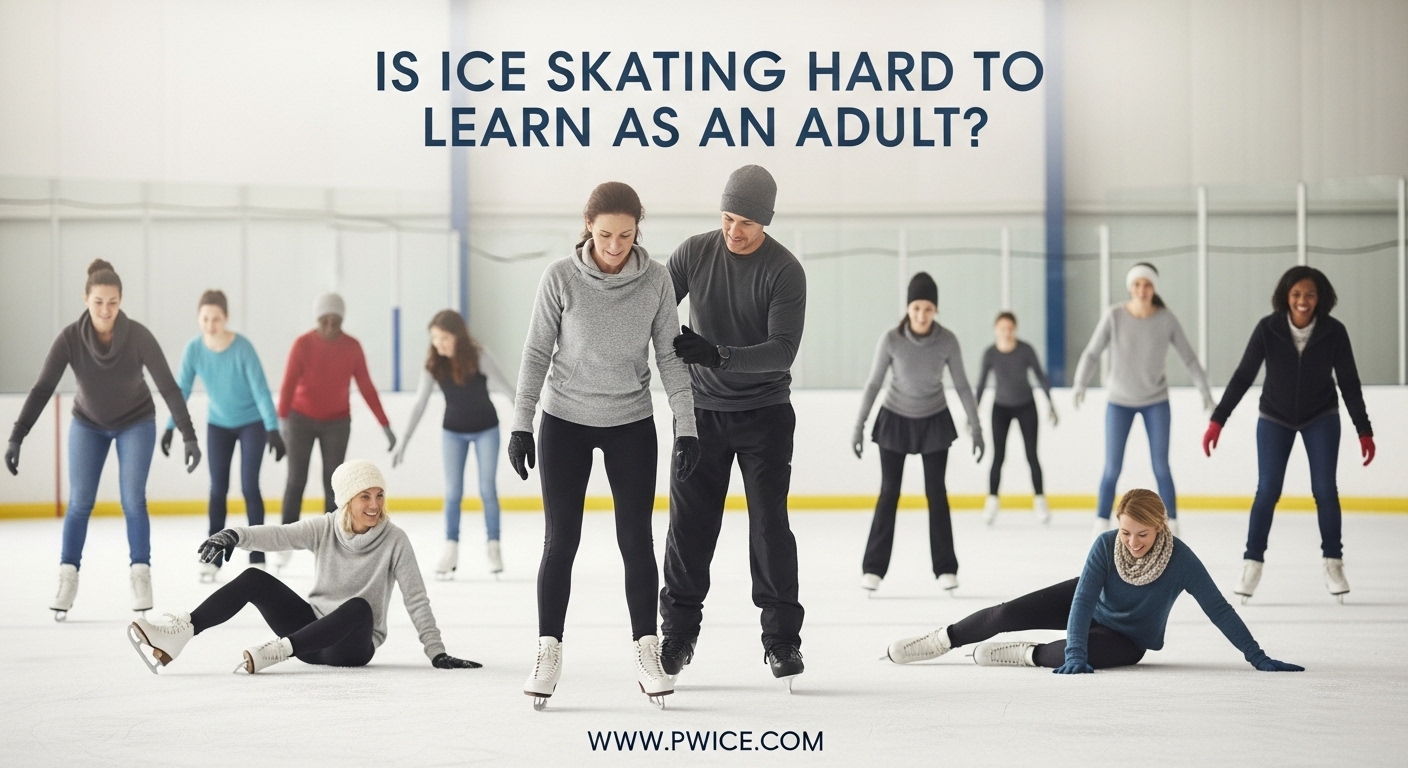
Ice skating is challenging but entirely possible for adults. While adults face a steeper learning curve than children due to fear of falling and slower muscle adaptation, most can learn basic skills within 4-8 weeks with consistent practice and proper instruction. The question “is ice skating hard to learn as an adult” comes up constantly in skating communities, and the honest answer is yes, it requires patience, but thousands of adults start every year and succeed.
I remember standing at the rink entrance at age 37, watching five-year-olds glide effortlessly while I clung to the barrier. That first session was terrifying, exhausting, and strangely exhilarating. Within three months, I could skate laps confidently. Within six months, I was learning basic spins.
In this guide, I will break down exactly what makes ice skating difficult for adults, realistic timeline expectations, and practical steps to get started. Whether you are 25 or 65, this guide answers the questions that keep adults from trying something they have always wanted to do.
Table of Contents
Are You Ever Too Old to Start Ice Skating? No, and Here Is Why
You are never too old to learn ice skating. Adults start in their 30s, 40s, 50s, 60s, and even 70s, and communities exist specifically for adult beginners at every age level.
Many skating rinks offer adult-only sessions specifically because the demand is high. Adult skaters report starting at ages ranging from mid-twenties to seventies, and the community is more welcoming than most beginners expect.
Starting Ice Skating in Your 30s and 40s
Your 30s and 40s are actually ideal times to start. You have the disposable income for lessons and equipment, the maturity to handle frustration, and the body awareness that children lack. The biggest obstacle at this age is usually self-consciousness, not physical capability.
Age 40 is not too old to learn ice skating. In fact, U.S. Figure Skating offers adult test tracks and competitions specifically for skaters who started later in life. Many adult skaters report that starting at 40 gave them a new passion they pursued for decades.
Starting Ice Skating in Your 50s, 60s, and Beyond
Starting in your 50s or 60s requires more attention to joint health and falling technique, but it remains absolutely achievable. The key differences are longer recovery times between sessions and the importance of proper protective gear.
Adult skaters in their 60s and 70s often cite ice skating as their favorite form of exercise because it is low-impact on joints while building core and leg strength. The social aspect of adult skating sessions also becomes more important at these ages.
Why Ice Skating Feels Harder for Adults Than Kids: The Science
Ice skating feels harder for adults than children because of three factors: fear response differences, muscle memory formation speed, and center of gravity changes. Understanding these differences helps explain the learning curve and reveals some surprising advantages adults actually have.
The Fear Factor: Adults Process Risk Differently
Children do not fully process the risk of falling on hard ice. Adults do. This fear response creates tension in the body, which makes balance harder. Tense ankles and locked knees are the first obstacles most adult beginners face.
The solution is learning proper falling technique early. Once adults understand how to fall safely and get up confidently, much of the fear disappears. This is why lessons that prioritize falling technique see faster student progress.
Muscle Memory and Neural Pathways Form Slower in Adults
Children’s brains form new neural pathways faster than adult brains. A child might need ten repetitions to learn a skill; an adult might need thirty. This is not a deficiency, just a biological difference that requires patience.
However, adults have better body awareness and can understand mechanics intellectually. While a child might mimic without understanding, an adult can analyze weight placement, edge pressure, and blade mechanics. This deeper understanding often leads to better long-term technique.
The Surprising Advantage: Lower Center of Gravity
Adults, especially those with more body mass in the hips and thighs, often have a lower center of gravity than lanky children. Many adult beginners report that being shorter or bottom-heavy actually helps with balance once they get comfortable.
Strong legs, even heavier ones, provide power and stability that skinny child legs lack. Adult skaters frequently mention that their “strong thick legs” became an asset rather than a limitation.
How Long Does It Actually Take to Learn Ice Skating as an Adult?
Most adults can learn basic ice skating skills within 4-8 weeks with consistent practice. The timeline varies based on prior athletic experience, frequency of practice, quality of instruction, and individual physical factors.
Weeks 1-2: Foundation Building
During the first two weeks, expect to focus entirely on balance, falling, and basic marching. Most adults cannot glide confidently at this stage. You will likely hold the barrier, take tiny steps, and feel constant ankle wobble.
This phase feels the hardest because everything is new. Your brain is processing an entirely foreign sensation. Many adults feel discouraged here, but this is completely normal. Two to three sessions per week accelerates comfort dramatically.
Weeks 3-4: First Glides and Stops
Between weeks three and four, most adults experience their first real glides. The snowplow stop begins to feel possible. You might venture away from the barrier for short distances. This is when confidence starts building.
The sensation shifts from “terrifying” to “challenging but fun” for most adults during this period. Muscle memory starts forming, and movements feel less mechanical.
Months 2-3: Comfortable Forward Skating
By month two or three, most adults can skate forward comfortably, stop reliably, and begin learning turns. Crossovers might still feel elusive, but basic rink navigation becomes possible.
This is when many adult beginners start feeling like “real skaters.” You can attend public sessions without feeling out of place. Social aspects of skating often become appealing at this stage.
Month 6 and Beyond: Skill Specialization
After six months of consistent practice, adults typically have solid foundational skills and can choose a direction. Some pursue figure skating elements like three-turns and spins. Others focus on power skating for speed and fitness.
Progress never really stops, but the learning curve flattens. Skills become refinement rather than acquisition. Many adult skaters say skating becomes “meditative” at this stage.
Your First Time on the Ice: What to Expect as an Adult Beginner
Your first ice skating session will be a mix of terror, awkwardness, and unexpected joy. Most adults describe that first step onto the ice as feeling completely foreign, like standing on a slippery, unstable surface that moves beneath you.
The First Five Minutes: Shock and Adjustment
The first five minutes are pure sensory overload. The cold, the hardness of the ice, the strange feeling of blades instead of feet. Most adults grip the barrier with white knuckles. Your ankles will wobble uncontrollably.
This is completely normal. Every single skater, including Olympians, started here. The sensation passes faster than you expect, usually within 10-15 minutes of tentative movement.
The Barrier Phase: Finding Your Balance
For the first session, expect to rely heavily on the rink barrier. This is not cheating; it is a standard learning tool. Coaches teach specific barrier exercises to build ankle strength and balance.
Try marching in place while holding the barrier. Lift one foot, then the other. Feel how the blade bites into the ice. These tiny movements build the foundation for everything else.
First Glide: The Breakthrough Moment
Most adults experience their first unassisted glide during their first or second session. It might only last two seconds and cover six feet, but it changes everything. The sensation of moving on ice becomes addictive.
That first glide is your proof that skating is possible. From that moment, fear starts transforming into excitement.
How to Start Learning Ice Skating as an Adult: Step-by-Step
Starting ice skating as an adult requires preparation beyond just showing up at the rink. These five steps will set you up for success and minimize the frustration that causes many adults to quit after one session.
Step 1: Find a Rink with Adult-Focused Programs
Not all rinks cater equally to adult beginners. Look for rinks that advertise adult-only sessions, adult learn-to-skate classes, or have coaches who specifically mention adult students. Call and ask about the typical age range in their beginner classes.
Adult-only sessions are goldmines for beginners. You avoid the chaos of birthday parties and racing teenagers. The atmosphere is calmer, and everyone is in the same boat.
Step 2: Choose Your Learning Format
Adults have three main options for learning: group lessons, private coaching, or self-teaching. Group lessons offer the best value and social support for most beginners. Private coaching accelerates progress but costs significantly more.
Self-teaching is possible but risky. Without proper falling technique instruction, adults often develop fear that limits progress. At minimum, take one private lesson to learn falling basics before going solo.
Step 3: Get Proper Equipment Basics
For your first sessions, rental skates are fine. Once you commit, invest in your own skates. Rental skates vary wildly in quality and fit, and poorly fitted skates cause ankle pain that discourages beginners.
Key equipment for adult beginners includes properly fitted skates, helmet (strongly recommended), padded shorts or tailbone protector, and warm, flexible clothing. Wrist guards help prevent the most common beginner injury.
Step 4: Prepare Your Body Off the Ice
Simple preparation exercises can dramatically improve your first session. Practice balancing on one foot while brushing your teeth. Do ankle circles and calf raises daily. These small habits build the stabilizer muscles skating demands.
Core strength matters more than leg strength for beginners. Planks and basic balance exercises translate directly to better skating posture. The lower your center of gravity stays, the more stable you feel on ice.
Step 5: Learn Falling Technique Before Your First Step
The most important skill for adult beginners is not skating forward. It is falling safely and getting up confidently. Ask your instructor to teach this in the first five minutes of your first lesson.
Once you know you can fall without injury, fear drops significantly. Most adults who quit skating do so because falling scares them, not because skating itself is too difficult.
Is Ice Skating Harder Than Roller Skating or Skiing?
Ice skating sits between roller skating and skiing in terms of learning difficulty for most adults. Roller skating is generally easier to pick up initially because of the stable, wide platform and rubber wheels that grip the ground.
Ice Skating vs Roller Skating
Roller skating offers more stability with four wheels and a wider base. The soft wheels grip the floor, and falling hurts less. However, ice skating teaches balance fundamentals that transfer beautifully to roller skating if you start there first.
Ice skates have a single blade edge that requires constant micro-adjustments. This makes ice skating harder initially but builds better balance long-term. Many skaters who learn both say ice skating feels more graceful once basics are mastered.
Ice Skating vs Skiing
Skiing has a steeper equipment and logistics barrier but a gentler initial learning curve. Ski boots lock your ankles, providing artificial stability. The long skis create a stable platform. Beginner slopes are forgiving.
Ice skating requires you to create your own stability on a single blade. The surface is harder when you fall. However, ice skating costs less per session and can be practiced year-round at indoor rinks, making skill maintenance easier.
Which Should You Learn First?
If your goal is ice skating specifically, start on ice. Skills do not transfer perfectly from roller to ice, and you may need to unlearn habits. If you want general skating confidence first, roller skating builds fundamentals with less intimidation.
For fitness-focused adults, ice skating provides a better full-body workout than roller skating because the unstable surface engages more stabilizer muscles. The cold environment also means you burn more calories staying warm.
Staying Safe and Learning to Fall Properly as an Adult Beginner
Safety concerns keep many adults from trying ice skating, but proper technique and protective gear reduce injury risk dramatically. Adults who learn falling mechanics early report feeling confident on the ice within weeks rather than months.
The Proper Falling Technique
When you feel yourself losing balance, bend your knees and squat low. Extend your arms forward, not out to the sides. Fall forward onto your hands and forearms, not backward onto your tailbone.
The lower you are when you start falling, the shorter the fall. Most adult beginner injuries happen when people try to catch themselves by locking their arms straight or falling backward while trying to stand tall.
How to Get Up Safely
From a sitting position on the ice, roll onto your hands and knees. Place one foot between your hands, blade perpendicular to your direction. Push up to standing using your leg strength, not your hands.
Practice this sequence deliberately during your first few sessions. Knowing you can get up removes a huge psychological barrier. Many beginners stay on the ice too long because they are afraid of the embarrassment of struggling to stand.
Protective Gear Recommendations
Helmets are strongly recommended for adult beginners despite not being required at most rinks. Hockey helmets or ski helmets work well. Wrist guards prevent the most common skating injury: wrist fractures from catching falls.
Padded shorts or tailbone protectors reduce fear significantly. Many adult beginners find that wearing protection lets them attempt skills without the terror of hard falls. The confidence boost is worth the slight bulk.
When to Take Breaks
Adult beginners often push too hard too fast. If your ankles are burning, your lower back is cramping, or you feel genuinely exhausted, get off the ice. First sessions should be 30-45 minutes maximum.
Cold muscles injure more easily. Take warm-up laps seriously even if you feel silly slowly marching. Stretch after skating, especially hip flexors and calves. Recovery takes longer for adults than children.
The Benefits of Ice Skating for Adults: Physical and Mental
Ice skating offers unique benefits that make the learning curve worth climbing for adults. Beyond the obvious fitness aspects, skating provides mental health benefits and social connections that many adult beginners find life-changing.
Physical Benefits and Bone Density
Ice skating is excellent for bone density. The weight-bearing nature of skating, combined with the impact from jumps and turns, stimulates bone growth. This makes it particularly valuable for adults concerned about osteoporosis.
Skating provides a full-body workout that builds core strength, leg muscles, and cardiovascular endurance simultaneously. The low-impact nature is gentler on joints than running while still providing intense exercise.
Mental Focus and Stress Relief
Skating demands complete mental presence. You cannot think about work deadlines while trying to balance on a single blade. Adult skaters consistently report that skating sessions clear their minds better than meditation.
Many describe the sensation as “knitting on a roller coaster” – meditative yet exhilarating. The combination of physical challenge and required focus creates a flow state that melts stress.
Community and Social Connection
Adult skating communities are remarkably welcoming. Unlike some fitness spaces that feel competitive, adult skaters celebrate each other’s progress regardless of level. Friendships form naturally during group lessons and practice sessions.
Adult skaters report improved sleep, better mood regulation, and a sense of accomplishment that carries over into other life areas. Learning a difficult physical skill as an adult builds confidence that transfers to work and relationships.
Frequently Asked Questions About Learning Ice Skating as an Adult
Is it possible to learn ice skating as an adult?
Yes, absolutely. Thousands of adults learn ice skating every year. While adults face a steeper learning curve than children due to fear and slower muscle adaptation, most can learn basic skills within 4-8 weeks with consistent practice and proper instruction.
Is 40 too old to learn to skate?
No, 40 is not too old to learn ice skating. Many adults start in their 40s, 50s, 60s, and even 70s. U.S. Figure Skating offers adult test tracks and competitions specifically for skaters who started later in life. Age is not a barrier to learning.
How long does it take to learn ice skating as an adult?
Most adults can learn basic skills within 4-8 weeks with consistent practice. Basic comfort on the ice develops in 2-4 weeks. Forward skating and stopping become reliable in 2-3 months. Advanced skills like crossovers and spins take 6-12 months for most adults.
Is ice skating good for bone density?
Yes, ice skating is excellent for bone density. The weight-bearing nature of skating, combined with impact from movements and jumps, stimulates bone growth. This makes skating particularly valuable for adults concerned about maintaining or improving bone health.
Will I be the only adult at the rink?
No. Adult-only skating sessions are common at most rinks. Many rinks offer adult learn-to-skate classes specifically. The adult skating community is larger than most beginners expect, and you will likely meet others in their 30s, 40s, and beyond who are also learning.
Do I need to be athletic to learn ice skating?
No, you do not need to be athletic. Ice skating builds fitness as you learn. Basic skating is accessible to people of all fitness levels. However, some off-ice preparation like balance exercises can make the first sessions more comfortable.
Is it worth the cost to learn ice skating as an adult?
Yes, most adult skaters find the cost worthwhile. Between fitness benefits, mental health improvements, social connections, and the satisfaction of mastering a challenging skill, the investment in lessons and equipment pays off. Many adults report that skating becomes their favorite hobby.
Conclusion: Is Ice Skating Hard to Learn as an Adult?
Is ice skating hard to learn as an adult? Yes, it presents real challenges. The learning curve is steeper than for children. Fear of falling creates tension that makes balance harder. Muscle memory forms more slowly. But these challenges are surmountable with patience and proper instruction.
The rewards make the effort worthwhile. Physical fitness, bone density benefits, mental clarity, social connections, and the pure joy of gliding across ice await adults who push through the initial awkwardness. Basic competency comes within weeks, not years.
You are not too old. You are not too uncoordinated. You are not too late. Thousands of adults just like you are lacing up skates for the first time this year and discovering a passion they will pursue for decades. The ice is waiting.