
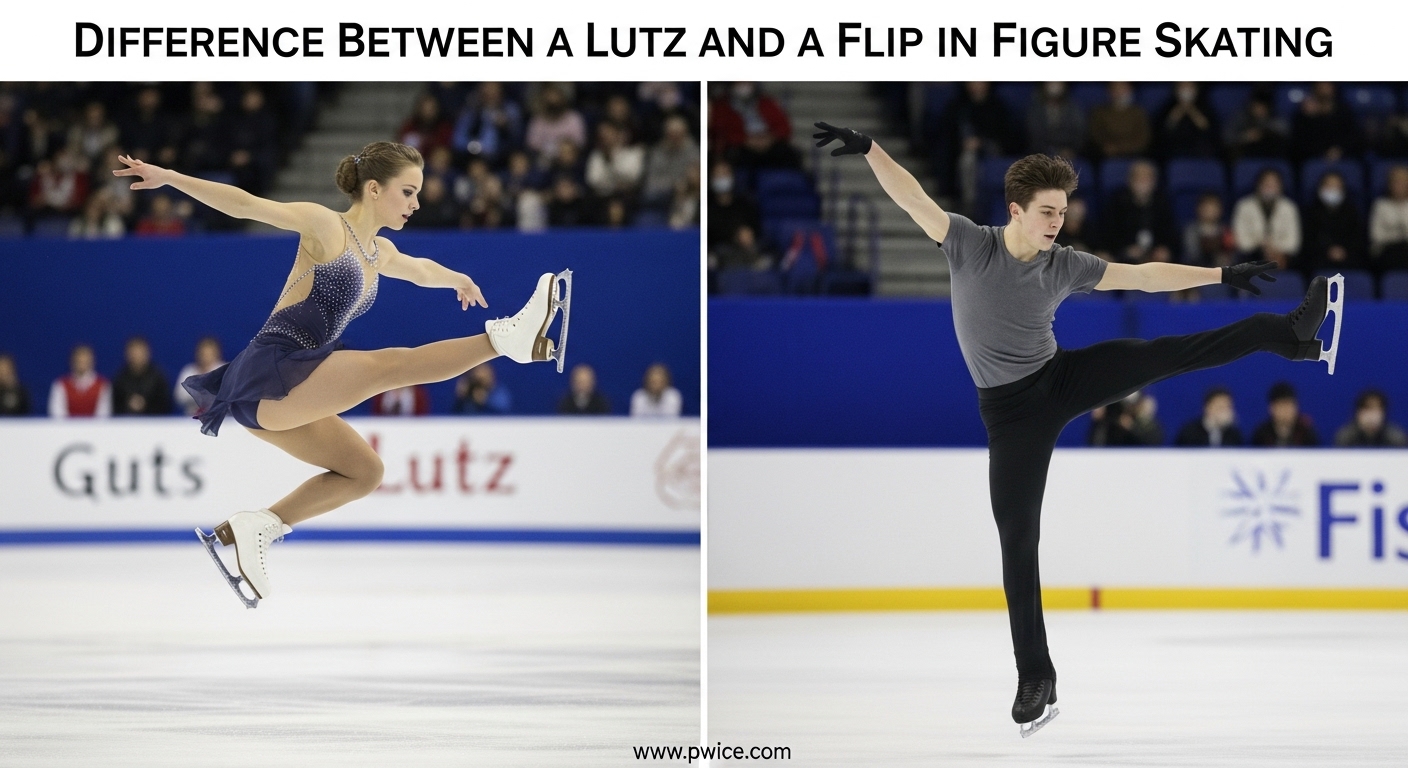
The difference between a Lutz and a flip in figure skating comes down to one critical element: the edge of the skate blade used at takeoff. Both jumps use the toe pick to vault into the air and both launch from a backward position, yet the flip takes off from a backward inside edge while the Lutz takes off from a backward outside edge. This single distinction makes the Lutz significantly harder to execute and gives it a higher base value in competitive scoring.
Understanding this difference transforms how you watch figure skating. What looks like nearly identical jumps to the untrained eye becomes clearly distinct once you know what to look for. Whether you are a skater working to master these techniques or a fan wanting to appreciate the sport at a deeper level, knowing the mechanics behind these toe jumps opens up a new dimension of appreciation.
Both the flip and Lutz belong to the toe jump family, one of two categories of figure skating jumps. Unlike edge jumps, which launch purely from the blade without toe pick assistance, toe jumps use that jagged front teeth of the skate to push off the ice. This creates a vaulting motion that gives these jumps their characteristic height and power. Yet within this shared category, the flip and Lutz sit at very different positions on the difficulty scale.
Table of Contents
Understanding the Six Figure Skating Jumps
Figure skating recognizes six standard jumps that appear in competition routines worldwide. These divide cleanly into two categories based on how the skater leaves the ice. Edge jumps launch using only the blade edge itself, while toe jumps use the toe pick to assist the takeoff.
The edge jump family includes the Axel, Salchow, and Loop. Each relies on edge pressure alone to generate lift. The toe jump family includes the Toe Loop, Flip, and Lutz. These three use the jagged front teeth of the skate blade to create a vaulting motion that adds height and power to the jump.
All six jumps share common characteristics. Each rotates in the air and lands on one foot, typically the right foot for most skaters. Each has a specific base value assigned by the International Skating Union (ISU) that contributes to the technical element score in competition. Higher rotation jumps earn higher base values, with single jumps worth the least and quadruple jumps worth the most.
The difficulty hierarchy among these jumps has remained consistent for decades. Most skaters progress through them in a specific order as their skills develop, starting with the simplest edge jumps and eventually tackling the most complex toe jumps. Understanding where each jump ranks helps explain why elite programs save their hardest passes for the final moments of a routine.
The Lutz Jump: Technique and Characteristics
The Lutz carries the name of Alois Lutz, an Austrian skater who first performed this jump in 1913. More than a century later, it remains one of the most technically demanding elements in figure skating. A skater executes the Lutz by gliding backward on an outside edge, reaching the free leg behind to strike the toe pick into the ice, and launching into the air while rotating in the opposite direction of the entry curve.
This counter-rotation requirement distinguishes the Lutz from every other jump except the Axel. While most jumps rotate in the same direction as the curve of entry, the Lutz forces the skater to work against that momentum. The body must switch from following the curve to rotating against it in a fraction of a second. This creates a whipping motion that demands precise timing and edge control.
The outside edge takeoff adds another layer of difficulty. When a skater glides on an outside edge, their body leans away from the center of the curve. This position feels inherently less stable than an inside edge, where the body leans into the curve. Maintaining a clean outside edge through the entry, especially as the skater prepares to reach back for the toe pick, requires exceptional strength and ankle control.
Elite skaters performing triple Lutzes and the rare quadruple Lutz demonstrate extraordinary athleticism. The base value for a triple Lutz stands at 5.90 points, while a quadruple Lutz earns 13.60 points. These values reflect the jump’s difficulty relative to other elements. Few women had landed clean quadruple Lutzes in competition as of 2026, making it one of the most prized achievements in the sport.
The entry pattern for a Lutz typically follows a long, shallow curve across the ice. Skaters often approach from the corner of the rink, building speed on a backward outside edge that extends nearly the full width of the ice surface. This extended entry allows them to establish a deep, controlled edge before the explosive takeoff. Rushing this preparation often results in a flawed takeoff or an edge call from judges.
The Flip Jump: Technique and Characteristics
The flip jump entered figure skating vocabulary without the clear origin story of the Lutz. Sometimes called the tulip jump in early skating literature, the flip has become a staple element that most competitive skaters master early in their progression. A skater performs the flip by gliding backward on an inside edge, reaching the free leg back to strike the toe pick, and vaulting into the air with a natural rotation that follows the direction of the entry curve.
The inside edge takeoff gives the flip a fundamentally different feel from the Lutz. When gliding on an inside edge, the skater leans into the curve, creating a stable platform from which to launch. This natural position allows the skater to load power into the takeoff leg more easily. The edge itself guides the body into the rotation rather than fighting against it.
Without the counter-rotation requirement, the flip demands less precise timing than the Lutz. The skater can ride the momentum of the entry curve directly into the air rotation. This continuous flow makes the flip more forgiving for skaters still developing their technique. Many coaches introduce the flip before the Lutz precisely because it allows students to focus on the toe pick mechanics without the added complication of counter-rotation.
The base values for flip jumps reflect their intermediate difficulty. A triple flip carries a base value of 5.30 points, compared to 5.90 for the triple Lutz. Quadruple flips have become more common than quadruple Lutzes in men’s competition, with a base value of 11.00 points. This gap in base value between the flip and Lutz at the quad level illustrates how the skating community views their relative difficulty.
Entry patterns for flips vary more than for Lutzes. Some skaters use a long, sweeping curve similar to the Lutz entry. Others use a three-turn or mohawk entrance that changes direction just before the takeoff. This flexibility in entry allows skaters to incorporate flips more easily into complex step sequences and transition elements between jumps.
Lutz vs Flip: The Key Differences
Comparing the Lutz and flip side by side reveals why one jump frustrates skaters while the other offers a more manageable path to technical mastery. The edge difference stands as the most visible distinction, but the counter-rotation requirement, entry technique, and scoring value all contribute to the gap between these two toe jumps.
Edge Type: The flip uses a backward inside edge where the skater leans into the curve. The Lutz uses a backward outside edge where the skater leans away from the curve. This single difference changes everything about how the jump feels and how difficult it is to control.
Rotation Direction: The flip rotates in the same direction as the entry curve, creating a continuous flow from approach to takeoff to air rotation. The Lutz rotates opposite to the entry curve, requiring the skater to reverse their rotational momentum at the moment of takeoff.
Base Value Comparison: At the triple level, the Lutz earns 5.90 base points while the flip earns 5.30. At the quadruple level, the gap widens further with the quad Lutz at 13.60 points and the quad flip at 11.00 points. These values, set by the ISU, reflect the consensus that the Lutz demands more technical skill.
Entry Technique: Lutz entries typically use long, shallow outside edge curves that extend across the ice. Flip entries offer more variety, with skaters using either similar long curves or shorter three-turn entries that change direction immediately before takeoff.
Common Skater Pattern: Forum discussions among figure skaters reveal an interesting pattern. Many report that if they have a strong, consistent flip, their Lutz tends to suffer, and vice versa. The different strength and timing requirements for each jump seem to favor different body types and learning styles. Some skaters naturally gravitate toward the inside edge stability of the flip, while others find the counter-rotation challenge of the Lutz more intuitive.
The consequences of confusing these jumps extend beyond practice frustration. In competition, taking off from the wrong edge results in an edge call that reduces the jump’s grade of execution. A Lutz taken off from an inside edge gets downgraded to a flip base value. Judges can spot this error by watching the blade mark left on the ice and observing the skater’s body position at takeoff.
How to Tell a Lutz from a Flip in Real Time
Learning to identify these jumps while watching a performance adds a new layer of enjoyment to figure skating. With practice, you can spot the difference even at full competition speed. The key lies in watching the entry curve, the angle of the skate at takeoff, and the timing of the toe pick strike.
Watch the Entry Curve Direction: Before the jump begins, observe which direction the skater is curving as they glide backward. A Lutz entry curves outward, away from the landing side. A flip entry curves inward, toward the landing side. This curve direction sets up the edge that will be used for takeoff.
Look for the Edge Angle: At the moment just before the toe pick strikes, observe how the skate blade meets the ice. For a Lutz, the blade tilts outward, with the skater’s ankle rolling away from the center of the body. For a flip, the blade tilts inward, with the ankle rolling toward the center of the body.
Listen for the Toe Pick Timing: The Lutz often has a sharper, more explosive toe pick strike because the counter-rotation requires a more aggressive vault. The flip tends to have a smoother transition from edge glide to toe pick to air. This audible difference becomes clearer as you watch more skating.
Check the Ice Marks: After a skater lands, look at the ice surface where they took off. A clean Lutz leaves a curved outside edge mark followed by a toe pick hole. A flip leaves a curved inside edge mark. Judges use these marks to verify edge calls when they review performance footage.
Observe the Preparation Pattern: Skaters often telegraph their Lutz attempts with a specific preparation routine. The long, shallow entry curve that crosses most of the ice surface typically signals a Lutz. A flip might use a similar entry or might emerge suddenly from a step sequence with minimal preparation.
These visual cues take time to internalize. Watching competition replays in slow motion helps train your eye to catch the edge differences. Over time, the distinction becomes as obvious as the difference between a sprint and a distance running stride.
What Is a Flutz? Understanding the Common Edge Error
The term flutz combines flip and Lutz to describe a specific technical error that plagues skaters at every level. A flutz occurs when a skater attempts a Lutz but takes off from an inside edge instead of the required outside edge. The jump looks like a Lutz in the air and lands like a Lutz, but the takeoff edge matches a flip instead.
This error happens because the inside edge feels more natural and stable. When a skater rushes their preparation or lacks the ankle strength to hold a deep outside edge through the entry, their body often rolls to the inside edge unconsciously. The skater might not even realize they have flutzed until they see the video replay or receive feedback from a coach.
Judges catch flutzes by watching the blade mark on the ice and the skater’s body position at takeoff. When they spot the wrong edge, they issue an edge call that reduces the grade of execution for that jump. In severe cases, the technical panel might downgrade the jump entirely, changing it from a Lutz to a flip in the official score calculation. This costs the skater valuable base value points.
Even elite skaters struggle with flutzes. The pressure of competition, fatigue late in a program, and the sheer difficulty of maintaining a clean outside edge through a complex entry can all lead to edge errors. Commentators often note when a top skater has a history of flutz problems, making those moments of the program particularly tense for viewers who understand the technical stakes.
Correcting a flutz requires rebuilding the entry technique from the ground up. Skaters typically return to basic outside edge drills, practicing long glides on backward outside edges without any jump attempt. They progress slowly through half-rotation and single-rotation Lutzes, with coaches watching every takeoff to ensure the edge remains correct. This process can take months or even years for skaters who developed the wrong edge habit early in their training.
Difficulty Ranking: Where Flip and Lutz Stand
Among the six standard figure skating jumps, a clear hierarchy of difficulty exists that most skaters follow as they progress through their training. Understanding this ranking puts the flip and Lutz in proper context relative to the entire jump family.
1. Salchow: The easiest jump to learn, taking off from an inside edge with no toe pick assist and rotating in the natural direction of the entry. Most skaters master this first.
2. Toe Loop: The simplest toe jump, taking off from an outside edge with toe pick assist but rotating in the natural direction of the curve. The takeoff and landing use the same foot, making it forgiving for beginners.
3. Loop: An edge jump with no toe pick assist that takes off from an outside edge. The lack of toe pick assistance makes it cleaner but requires more edge control than the Salchow.
4. Flip: The first truly challenging jump for most skaters. The toe pick assist helps, but the inside edge takeoff requires ankle strength and the vault timing must be precise.
5. Lutz: Second only to the Axel in difficulty. The outside edge combined with counter-rotation creates a technical challenge that many skaters never fully master.
6. Axel: The hardest jump due to its forward takeoff and extra half-rotation. No toe pick assist and the forward entry make it the ultimate test of jumping skill.
This ranking explains why you will see young skaters landing double Salchows and toe loops before they can consistently land single Axels. It also explains why the quadruple Axel, achieved by only a handful of men in history, remains the holy grail of figure skating jumps.
The gap between the flip and Lutz in this hierarchy might seem small, but it represents a significant jump in technical demand. Moving from a consistent triple flip to a consistent triple Lutz often takes years of dedicated training. The counter-rotation requirement adds a dimension of difficulty that cannot be overcome simply by practicing more repetitions. Skaters must develop specific strength, timing, and mental focus to execute a clean Lutz under competition pressure.
Frequently Asked Questions
Is a Lutz harder than a flip?
Yes, the Lutz is considered harder than the flip. While both are toe jumps that use the toe pick to vault into the air, the Lutz requires counter-rotation and takes off from a backward outside edge, whereas the flip uses a backward inside edge with natural rotation. The Lutz carries a higher base value in ISU scoring, reflecting its greater technical difficulty.
Which is harder, Axel or Lutz?
The Axel is harder than the Lutz. The Axel is the only jump with a forward takeoff and requires an extra half-rotation, making it the most difficult of the six standard figure skating jumps. The Lutz ranks second in difficulty due to its counter-rotation requirement and outside edge takeoff.
What’s the hardest move to do in figure skating?
The quadruple Axel is currently considered the hardest move in figure skating. It requires four and a half rotations in the air from a forward takeoff with no toe pick assist. As of 2026, only a handful of male skaters have successfully landed this jump in competition, making it the ultimate technical achievement in the sport.
Has a woman ever landed a quad Lutz?
Yes, several female skaters have landed the quadruple Lutz in competition. This achievement represents one of the highest technical accomplishments in women’s figure skating due to the jump’s extreme difficulty and the physical demands of rotating four times from a counter-rotated takeoff.
Conclusion
The difference between a Lutz and a flip in figure skating centers on the blade edge used at takeoff. The flip launches from a backward inside edge with natural rotation, while the Lutz demands a backward outside edge with counter-rotation. This distinction makes the Lutz the second-hardest jump in figure skating and gives it a higher base value in competition scoring.
Whether you watch figure skating as a casual fan or train on the ice yourself, understanding these mechanics transforms your appreciation of the sport. The next time you watch a competition, try to spot the entry curves and edge angles. Notice which skaters execute clean Lutzes and which struggle with flutz errors. The technical mastery on display becomes even more impressive when you understand the precise mechanics behind each rotation.