
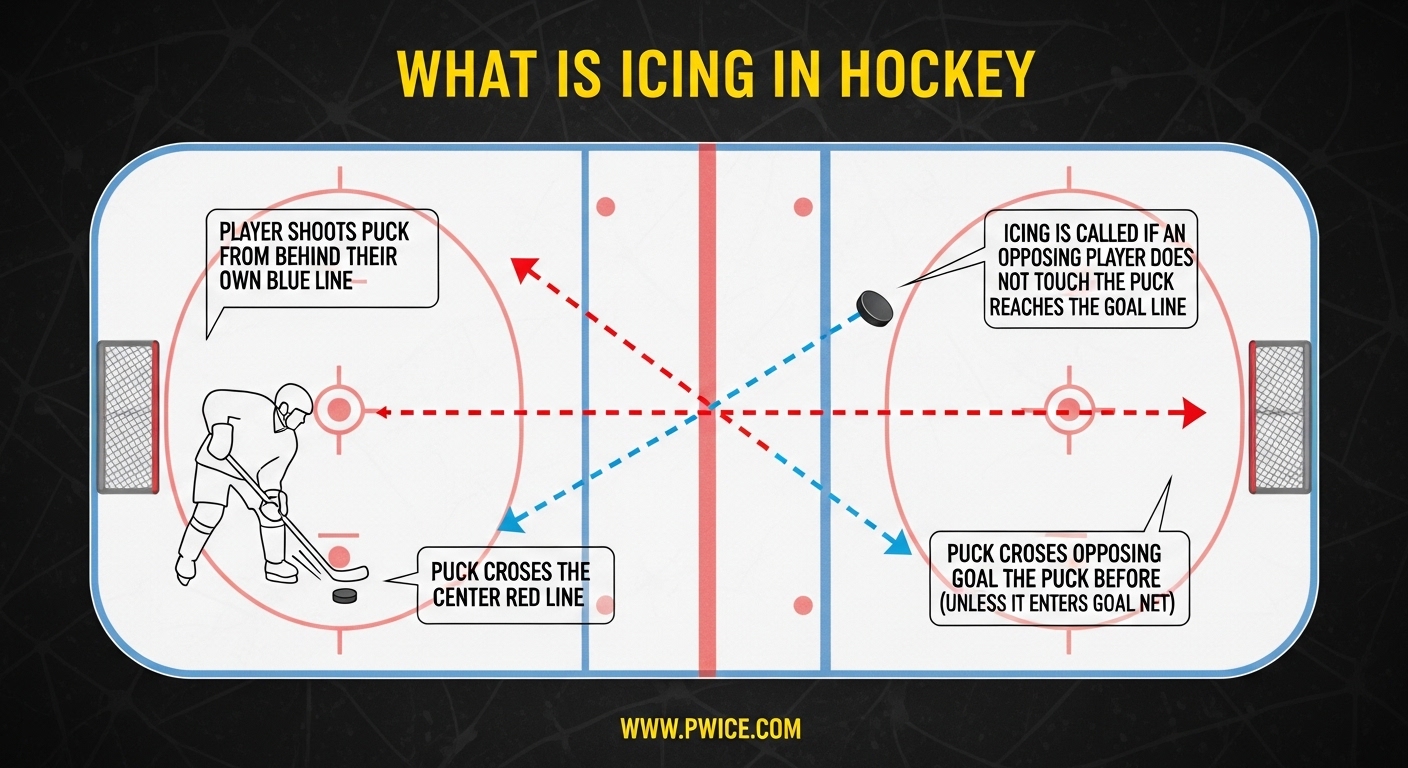
In ice hockey, icing is an infraction that occurs when a player shoots, bats, or deflects the puck from behind the center red line across the opposing team’s goal line without the puck being touched by another player. When icing is called, play stops immediately and a faceoff occurs in the offending team’s defensive zone, giving the opponent a territorial advantage. Understanding what is icing in hockey is essential for any new fan, as it is one of the most commonly called stoppages in the game and directly impacts strategy, player fatigue, and momentum shifts.
I have watched hockey for over 20 years, and I still remember the confusion when I first heard an announcer yell “Icing!” with no explanation of what just happened. This guide will walk you through everything you need to know about the hockey icing rule, from the basic definition to the subtle exceptions that even experienced fans sometimes miss.
Table of Contents
What Is Icing in Hockey?
Icing in hockey is a rule violation that penalizes a team for dumping the puck from their own defensive half of the ice all the way down to the opponent’s end without anyone playing it along the way. The National Hockey League (NHL) defines icing as occurring when a player shoots the puck from anywhere on their side of the center red line and the puck crosses the opposing team’s goal line untouched.
Picture a standard ice hockey rink with three main lines running across its width: two blue lines and one red line in the exact center. The center red line divides the rink into two halves. When a player standing behind this center line sends the puck toward the opponent’s goal and the puck slides untouched across the red goal line at the far end, the linesman will blow the whistle for icing.
The key elements that must all be present for icing to occur are: the puck must be shot from behind the center red line, it must travel the full length of the ice, it must cross the opponent’s goal line, and it must remain untouched by any player from either team during its journey. If any of these conditions are not met, the play continues without stoppage.
The purpose of the icing rule is to prevent teams from simply clearing the puck down the ice to waste time when they are under pressure in their own zone. Without this rule, teams could delay the game indefinitely by continuously firing the puck to the other end of the rink, killing precious minutes off the clock and destroying the flow of the game.
Why Was the Icing Rule Created?
Before 1937, hockey had no icing rule at all. Teams could dump the puck as often as they wanted, leading to endless delays and boring defensive tactics. The NHL introduced the icing rule in 1937 specifically to stop teams from using the puck dump as a time-wasting strategy when protecting a lead late in games.
The rule has evolved significantly since then, with changes made primarily for player safety. The original “touch icing” format created dangerous races to the boards that resulted in serious injuries, leading to the adoption of no-touch and eventually hybrid icing in modern hockey.
When Is Icing Called?
Understanding the exact sequence of events that triggers an icing call helps you recognize it developing in real-time while watching a game. Here is the step-by-step process of how icing occurs and gets enforced by the on-ice officials.
Step 1: The Puck Is Shot From Behind the Center Red Line
A player on the defending team decides to clear the puck by shooting it down the ice toward the opponent’s end. The player’s stick and the puck must both be behind the center red line at the moment of the shot for potential icing to be in play. If the puck crosses the center line before being shot, this is not icing.
Step 2: The Puck Travels the Full Length of the Ice
The puck slides, rolls, or flies down the entire length of the rink toward the opposite goal. The puck can be shot directly or deflect off the boards, but it must remain in motion and not be touched by any player during its journey across the ice.
Step 3: The Puck Crosses the Opposing Goal Line
The puck completely crosses the red goal line at the far end of the rink. The goal line is the red line that runs across the width of the ice directly in front of the net. Once the puck crosses this line untouched, the icing infraction has technically occurred.
Step 4: The Linesman Makes the Call
The linesman, positioned along the boards at the red line or blue line, skates toward the offending team’s end while watching for a potential touch by any player. In the NHL’s hybrid icing system, the linesman determines which player would reach the faceoff dots first: the attacking player racing for the puck or the defending player trying to negate the icing.
If the defending player will clearly reach the faceoff dots first, the linesman blows the whistle immediately for icing. If the attacking player has a chance to touch the puck first, the linesman allows the race to continue. If the defending player touches the puck first, icing is called. If the attacking player touches it first, the icing is washed off and play continues.
Step 5: Play Stops and Faceoff Location Is Determined
When icing is confirmed, the linesman blows the whistle to stop play. The faceoff then takes place in the defending zone of the team that committed the icing infraction, giving the attacking team an immediate territorial advantage close to the opponent’s net.
The Referee Signal for Icing
When icing is called, the linesman raises their non-whistle arm straight up in the air, holding it at shoulder height or above. This is the initial icing signal. If the icing is later washed off because of an exception or because the attacking team touched the puck first, the linesman makes a “washout” signal by extending both arms horizontally from the body with palms down.
Exceptions to the Icing Rule
Not every long pass down the ice results in an icing call. Several important exceptions exist that allow teams to clear the puck without penalty under specific circumstances. These exceptions account for strategic gameplay elements like penalty killing and goaltender participation.
Shorthanded Teams Can Ice the Puck
The most important exception is that teams on a penalty kill (playing with fewer skaters due to a penalty) are allowed to ice the puck without consequence. When a team is shorthanded, they can dump the puck from anywhere on the ice to relieve pressure in their defensive zone, and the play will not be stopped for icing.
This exception makes sense strategically because the penalty-killing team is already at a significant disadvantage with fewer players on the ice. Forcing them to maintain possession and make skillful clears would make successful penalty kills nearly impossible against skilled power-play units. The shorthanded icing exception helps balance the competitive disadvantage of being down a player.
Goaltender Touches the Puck
If the opposing team’s goaltender touches the puck at any point during its journey down the ice, the icing is automatically washed off and play continues. This applies whether the goalie makes a save, knocks the puck down with their stick, or touches it while in their crease or outside of it.
In leagues using hybrid or no-touch icing, the goaltender touching the puck negates the icing call even if the defending player would have reached the puck first at the faceoff dots. Once the goalie makes contact, the play is live and the attacking team cannot force a stoppage through icing.
Goalie Leaves the Crease
If the goaltender leaves their crease and moves toward the puck as if to play it, the linesman may wave off the icing even if the goalie does not actually touch the puck. This judgment call prevents situations where a goalie fakes a puck retrieval, causing attacking players to pull up expecting a whistle, then the goalie retreats and the defending team gains an unfair advantage.
The Puck Touches Any Player
If the puck touches any player from either team after being shot and before crossing the goal line, the potential icing is negated. This includes accidental deflections off skates, sticks, or bodies. The touch can occur anywhere on the ice between the center red line and the goal line.
The Puck Enters the Goal
If the long shot actually results in a goal, the icing is obviously washed off and the goal counts. This is extremely rare in modern hockey but has happened in instances where a goalie misjudges a long clearing attempt or the puck takes an unexpected bounce.
Washout Signal
When any exception applies and icing is waved off, the linesman makes a “washout” signal by extending both arms horizontally from the sides with palms facing down. This tells players, coaches, and fans that the icing has been negated and play continues normally.
Types of Icing in Hockey
Over the decades, different hockey leagues have implemented three main variations of the icing rule. Understanding these types helps explain why you might see different icing calls in NHL games versus international competitions or youth hockey.
Touch Icing
Under touch icing rules, play continues until a defending player actually touches the puck behind their own goal line. This creates a frantic race between attacking forwards and defending players (often defensemen) sprinting to be the first to reach the puck along the boards. If the defending player touches the puck first, icing is called. If an attacking player touches it first, the icing is negated.
Touch icing was the standard in the NHL until [cy-10] and is still used in some lower-level leagues. However, it has largely been phased out at professional levels due to the dangerous high-speed collisions that occurred when players raced full-speed into the boards chasing the puck.
No-Touch Icing (Automatic Icing)
No-touch icing, also called automatic icing, stops play immediately when the puck crosses the goal line without requiring any player to touch it. The whistle blows as soon as the puck completely crosses the red line at the far end, regardless of which player might have reached it first.
This variation was adopted by several European leagues and USA Hockey for youth levels to eliminate the dangerous board races associated with touch icing. While safer, no-touch icing has the downside of occasionally stopping exciting plays where an attacking forward might have intercepted the puck and created a scoring chance.
Hybrid Icing
Hybrid icing is the current standard in the NHL and represents a compromise between touch icing and no-touch icing. Under hybrid rules, the linesman blows the whistle for icing as soon as they determine that the defending player will be the first to reach the faceoff dots (the circular markers on each side of the ice used for faceoffs).
The race is now to the faceoff dots rather than the puck itself, which are several feet away from the boards. This change significantly reduces dangerous collisions because players no longer need to crash into the boards at full speed to win the race. If the attacking player will clearly reach the faceoff dot first, the linesman allows the play to continue, potentially leading to an exciting scoring opportunity.
Comparison of Icing Types
| Type | When Whistle Blows | Where Race Ends | Leagues Using | Safety Level |
|---|---|---|---|---|
| Touch Icing | Defender touches puck | Goal line boards | Some junior/minor leagues | Low (dangerous collisions) |
| No-Touch Icing | Puck crosses goal line | Immediate | USA Hockey youth, IIHF | High (no races) |
| Hybrid Icing | Linesman judges defender reaches dots first | Faceoff dots | NHL, AHL, NCAA | Medium-High (reduced contact) |
League-Specific Differences
The NHL adopted hybrid icing for the [cy-10] season following a tragic incident involving defenseman Joni Pitkänen. International competitions under IIHF rules typically use no-touch icing. USA Hockey uses no-touch icing at most youth levels for safety reasons. College hockey (NCAA) uses hybrid icing similar to the NHL.
What Happens After Icing Is Called?
The consequences of an icing call extend beyond just the stoppage of play. Several important rules apply specifically to faceoffs following an icing infraction, and these rules significantly impact game strategy and player management.
Faceoff Location
After an icing call, the faceoff takes place in the defensive zone of the team that iced the puck. Specifically, the faceoff occurs at the faceoff dot on the side of the ice where the puck crossed the goal line. This gives the attacking team immediate possession in the opponent’s end, creating a prime scoring opportunity.
No Line Change Rule
The most significant consequence of icing is that the offending team is not allowed to make any player substitutions before the ensuing faceoff. This “no change” rule means the tired players who were on the ice during the long defensive shift must remain on the ice for the faceoff and the subsequent play.
This rule creates strategic tension because coaches must balance the need to clear the puck defensively against the risk of trapping exhausted players on the ice. A tired line stuck on the ice after an icing is vulnerable to a fresh attacking line, often leading to quick goals against.
Goalie Exception
The one player who can be changed after an icing is the goaltender. Teams are allowed to substitute their goalie even when other players must remain on the ice. This exception exists because goalie changes are often strategic (pulling the goalie for an extra attacker late in games) or necessary due to equipment issues.
Icing vs Offside: Key Differences
New hockey fans often confuse icing with offside, as both are common stoppages that involve lines and territorial play. However, these rules serve completely different purposes and occur under different circumstances. Understanding the distinction will help you follow the game more easily.
Icing concerns the movement of the puck across lines, specifically from behind the center red line to the opponent’s goal line. Offside concerns the position of attacking players relative to the blue lines when entering the offensive zone. While icing penalizes clearing the puck too far, offside penalizes entering the attacking zone before the puck.
| Aspect | Icing | Offside |
|---|---|---|
| What triggers it | Puck shot from behind center red line across opponent’s goal line untouched | Attacking player enters offensive zone before the puck crosses the blue line |
| Key line involved | Center red line and opponent’s goal line | Blue line at entrance to offensive zone |
| Purpose of rule | Prevent delay of game tactics and time-wasting | Prevent “cherry-picking” and maintain fair territorial play |
| Faceoff location | Defensive zone of offending team | Neutral zone near blue line where infraction occurred |
| Common when | Defensive pressure, penalty kills, clearing attempts | Rushes into offensive zone, breakout plays |
| Can be intentional | Sometimes (to relieve pressure, but with consequences) | Rarely intentional (usually a timing mistake) |
If you find yourself mixing up these rules, remember this simple distinction: icing is about the puck traveling too far without being touched, while offside is about players getting ahead of the puck when entering the attacking zone.
History of the Icing Rule
The icing rule has a fascinating history that reflects the evolution of hockey from a rough, free-flowing sport to the faster, more strategic game we watch today. The rule was created to solve specific problems and has been modified over time primarily for player safety.
The Original Rule (1937)
The NHL introduced icing in 1937 to combat a growing problem: teams protecting a lead late in games would repeatedly dump the puck down the ice to kill time. This tactic, while effective for winning, made games incredibly boring to watch and broke the flow of continuous play that makes hockey exciting.
The 1931 playoff game between the Boston Bruins and New York Americans is often cited as the final straw that prompted the rule’s creation. That game featured so much deliberate clearing and time-wasting that it became notorious among hockey historians as an example of why icing rules were necessary.
The Luděk Čajka Tragedy and No-Touch Icing
In 1990, Czech defenseman Luděk Čajka died from injuries sustained during an icing race in a Czechoslovak league game. Čajka lost his footing while racing for the puck and crashed head-first into the boards, suffering fatal spinal injuries. This tragedy sparked serious discussions about banning touch icing across all levels of hockey.
Following this incident, many European leagues and youth hockey organizations adopted no-touch icing to eliminate dangerous board races entirely. The debate continued in North America for over two decades before significant changes were made.
The Joni Pitkänen Injury and Hybrid Icing
In 2013, NHL defenseman Joni Pitkänen suffered a broken heel bone in an icing race that effectively ended his career at age 29. The injury occurred when Pitkänen lost an edge while racing for a touch icing and crashed awkwardly into the end boards.
This high-profile injury accelerated the NHL’s adoption of hybrid icing, which had been discussed for years but faced resistance from traditionalists. The NHL implemented hybrid icing for the 2013-14 season, reducing the distance players must race and moving the target from the boards to the faceoff dots.
The Gretzky Rule
In the 1980s, the NHL briefly experimented with a modification sometimes called the “Gretzky Rule.” This variation prohibited the team that iced the puck from changing players except for the goaltender. While this rule was technically a separate regulation, it became closely associated with icing enforcement because it dramatically increased the strategic cost of dumping the puck.
The “Gretzky Rule” nickname came from the idea that it would particularly hurt teams with star players like Wayne Gretzky who could be trapped on the ice after an icing. This rule evolved into the current no-line-change regulation that exists in today’s NHL.
Frequently Asked Questions
What exactly does icing mean in hockey?
Icing is an infraction that occurs when a player shoots the puck from behind the center red line across the opposing team’s goal line without anyone touching it. When called, play stops and a faceoff occurs in the offending team’s defensive zone.
Why do refs sometimes not call icing?
Refs wave off icing for several reasons: the team is shorthanded on a penalty kill, the goaltender touches the puck, any player touches the puck before it crosses the goal line, or in hybrid icing leagues if the attacking player reaches the faceoff dots first.
What is the Gretzky rule in the NHL?
The Gretzky Rule was a 1980s NHL regulation that prohibited teams from changing players after an icing call (except the goalie). This evolved into today’s no-line-change rule after icing, which traps tired players on the ice to discourage dumping the puck.
What is icing for dummies?
Think of icing like this: you cannot just throw the puck down the ice to waste time when you are under pressure. If you shoot the puck from your half of the ice all the way to the other end without anyone touching it, you get penalized with a faceoff in your own zone and cannot change players.
Can you ice the puck on a penalty kill?
Yes, shorthanded teams are allowed to ice the puck without penalty. This exception exists because penalty-killing teams are already at a disadvantage with fewer players, and requiring skilled clears would make killing penalties nearly impossible.
How does hybrid icing work?
Hybrid icing lets the linesman blow the whistle when the defending player will clearly reach the faceoff dots before any attacking player. If the attacker might get there first, the race continues. This reduces dangerous board collisions while preserving exciting racing plays.
Why was the icing rule created?
The NHL introduced icing in 1937 to stop teams from deliberately dumping the puck down the ice to waste time and kill the clock when protecting a lead. The rule encourages continuous play and puck movement rather than defensive clearing tactics.
What happens to the players after icing is called?
The team that iced the puck cannot make any line changes before the ensuing faceoff, meaning the tired players must remain on the ice. The only substitution allowed is changing the goaltender. This rule increases the strategic cost of icing the puck.
Conclusion
Now you have a complete understanding of what is icing in hockey and why this rule matters to the game. From the basic definition of shooting the puck from behind the center red line to the opposing goal line, to the important exceptions for shorthanded teams and goaltender touches, you can now confidently follow the action when the linesman raises their arm for an icing call.
The icing rule has evolved significantly from its 1937 origins as a simple delay-of-game prevention tool. Today’s hybrid icing system balances the need for continuous play with player safety, a compromise born from tragic incidents that reminded the hockey world that rules must protect the athletes who play the game.
Whether you are a new fan still learning the basics or someone who has watched for years but never quite understood why that whistle blew, I hope this guide has clarified one of hockey’s most commonly called stoppages. The next time you hear an announcer call out “Icing!” you will know exactly what happened and why the tired players on the offending team are stuck on the ice for that crucial defensive zone faceoff.