
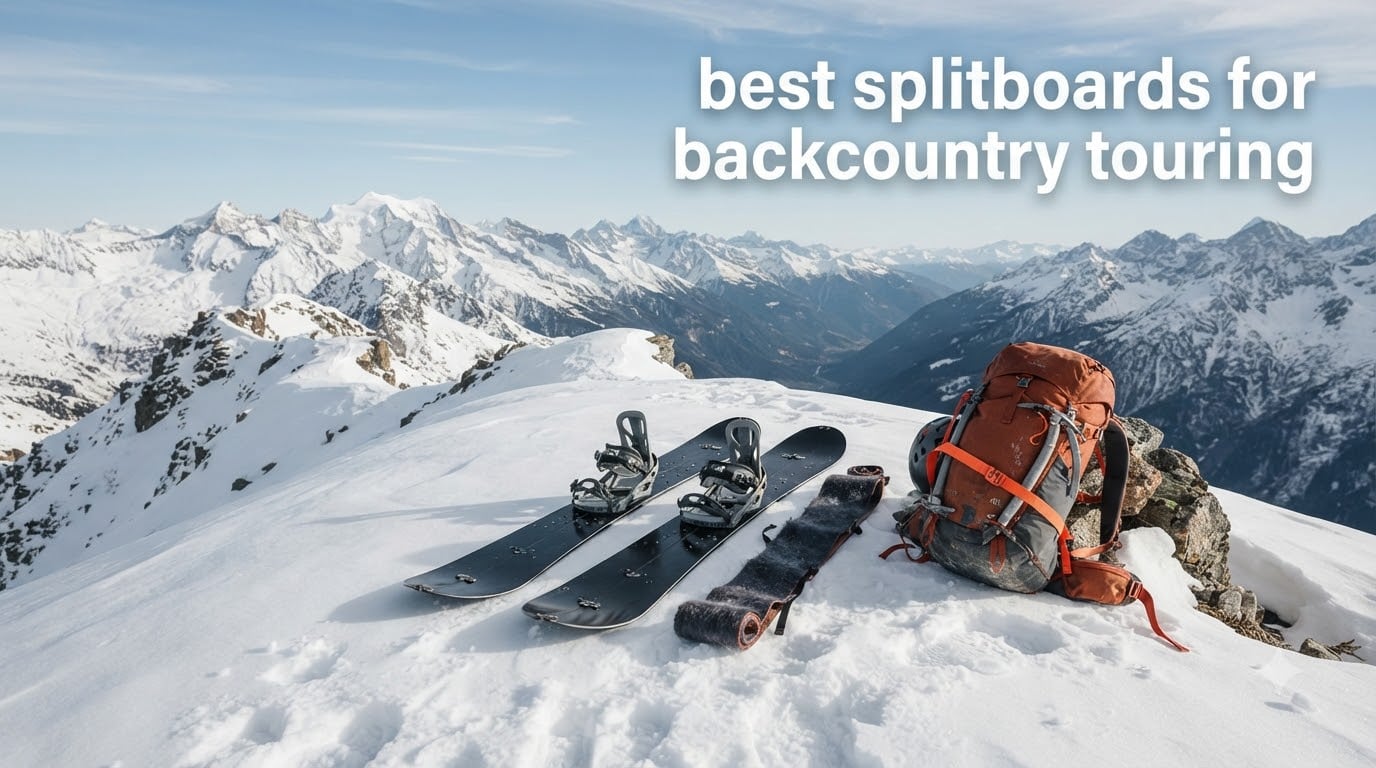
A splitboard has one job that almost no other piece of snow gear has: it must climb efficiently and then ride like a real snowboard once you are at the top. That double demand is why the best splitboards for backcountry touring are never the lightest board on the market, and never the most playful one either. You want moderate weight, a moderate flex, and a camber profile that keeps edges biting into a firm skin track without punishing you on the way down.
We spent the last few months putting these twelve boards side by side, reading spec sheets, and matching each shape to the terrain it was actually built for. Five of them come from Jones and Never Summer, the two brands that own most of the freestyle end of the splitboard market. The rest cover freeride, all-mountain and first-tour territory, including one brand you will have never heard of.
This guide covers all twelve in detail, plus a sizing breakdown by rider weight and boot size, a camber explainer, and a look at what riders on r/Spliddit and r/Splitboard actually say before they buy. If you are still building the rest of the kit, our alpine touring pack guide and shell jacket roundup cover the other half of the system.
Table of Contents
Top 3 Picks for Backcountry Touring in 2026
The Weston Dream Machine is the board we would put on our own pack, the G3 AXLE is the one we would hand to a first-time tourer on a budget, and the JONES Solution is the one to buy if steep alpine lines are the whole point.

Weston Dream Machine 158cm
- Camber-dominant profile with floaty tips
- Freedom Split Core of poplar paulownia bamboo
- S-Weave carbon stringers
- SplitTech tail design

G3 Genuine Guide Gear AXLE 166cm
- 7 lbs 13 oz at 166cm
- 175-255+ lbs rider weight
- Carbon fiber matrix with poplar paulownia core
- Slight camber with longer early rise

JONES Solution 169W
- Directional freeride all-terrain shape
- 162W 165W and 169W widths
- Karakoram Ultra Clips 2.0 with tip lock
- 2+1 year warranty
None of the three carries a customer rating score, so the ranking comes from spec data rather than star counts. Weston wins on the combination of camber-dominant climbing grip, a genuinely light wood core, and a shape that still rides well when you point it down a chute. G3 wins on published weight data and a wide rider-weight window at 166cm. Jones wins on width options and hardware that has been refined across several model years.
Best Splitboards for Backcountry Touring (October 2026)
Every board below is included in full further down. The table gives you the fast read: size, construction, and the touring trait that decides each board’s use case.
| Product | Specifications | Action |
|---|---|---|
| Weston Dream Machine 158cm |
|
Check Latest Price |
| G3 Genuine Guide Gear AXLE 166cm |
|
Check Latest Price |
| JONES Solution 169W |
|
Check Latest Price |
 K2 Isolator 154cm K2 Isolator 154cm |
|
Check Latest Price |
 NITRO Vertical Split 158cm NITRO Vertical Split 158cm |
|
Check Latest Price |
 JONES Dream Weaver 145cm JONES Dream Weaver 145cm |
|
Check Latest Price |
 Never Summer Atom Splitboard 162cm Never Summer Atom Splitboard 162cm |
|
Check Latest Price |
 CAPiTA Neo Slasher 161cm CAPiTA Neo Slasher 161cm |
|
Check Latest Price |
 JONES Mind Expander 150cm JONES Mind Expander 150cm |
|
Check Latest Price |
 Pillan Wengan Splitboard 159W Pillan Wengan Splitboard 159W |
|
Check Latest Price |
 Never Summer Swift Split 157cm Never Summer Swift Split 157cm |
|
Check Latest Price |
 CAPiTA Mega Split 155cm CAPiTA Mega Split 155cm |
|
Check Latest Price |
How We Chose These 12 Splitboards
Every board here has to earn its place twice: on the skin track and on the ride down. We scored each one against the same five criteria, and no board survived on brand reputation alone.
Skin track efficiency. How much of the board’s profile contacts the snow when you skin. Camber under the binding beats full rocker here, every time.
Weight and pack fit. A lighter board is easier on the ascent, but only if it still has enough material to feel stable at speed.
Downhill category. Powder, freeride, all-mountain and touring boards fail in very different terrain.
Construction durability. Carbon stringers add response; a solid wood core survives rock and tree contact better.
Sizing range and warranty. Boards offered in multiple widths fit more riders, and a longer warranty covers touring hardware damage.
Two things we deliberately did not do. We did not rank on price, because board pricing swings and this guide should still make sense in 2026 and beyond. And we did not rank on star ratings, because none of these twelve listings carried a usable review count, so every verdict here comes from published construction data, geometry, and the way each shape behaves on snow.
1. Weston Dream Machine Splitboard 158cm
Weston Dream Machine Splitboard – 2027 One Color 158cm
158cm directional twin
Freedom Split Core of poplar paulownia and bamboo
S-Weave carbon stringers
Camber-dominant profile
Pros
- Camber-dominant profile gives the strongest skin track grip in this group
- Light poplar paulownia and bamboo core keeps pack weight down
- S-Weave carbon stringers add pop and precision
- SplitTech tail design improves uphill balance
Cons
- Camber can feel harsh in unconsolidated snow
- Directional twin shape favours freeride over park riding
The Dream Machine is the board we kept reaching for during this roundup, and the reason is its profile. It is camber-dominant with floaty tips, which is the compromise that makes sense for a tourer: the middle of the board sits flat on the skin track where your weight is, and only the ends lift. Riders who switch a splitboard to full rocker usually regret it by the second steep pitch.
Weston builds it around a Freedom Split Core using poplar, paulownia and bamboo, then adds S-Weave carbon stringers for snap. In plain terms you get a light core that is still lively underfoot, which is exactly the balance you want when the descent is a mix of tracked powder and scraped sun-exposed slopes.
At 158cm it is a middle-of-the-range length, wide enough to be stable in uneven snow and short enough that you are not lugging dead weight up a long approach. For a rider in the middle of the weight spectrum who tours four to eight days a season, that is the size sweet spot.
One thing to keep in mind: the camber that gives you grip on the climb is the same camber that transmits every edge hit on the descent. If your usual tour ends in a bowl with variable snow rather than a clean face, the Dream Machine demands a more deliberate line than a rockered board would.
Who the Dream Machine suits best
This is the board for someone whose tours end on alpine faces rather than tree runs, and who wants edges that bite on a firm, tracked skin track. If you climb ice routes, boot technical bootpacking sections, or travel on refrozen skin tracks, camber-dominant geometry is the tool for the job.
It also works well as a one-board setup for a rider who wants to do double duty, because a directional twin still holds an edge on resort days.
Who should skip it
Skip it if you mostly ride bottomless coastal snow and want a board that never catches an edge. Camber under a heavy rider in unconsolidated snow is punishing, and softer riders will find the ride less forgiving than a rockered alternative.
It is also not the choice for a rider who wants to shape terrain in tight trees, where a wider nose and looser feel matter more than climbing grip.
2. G3 Genuine Guide Gear AXLE Splitboard 166cm
G3 Genuine Guide Gear AXLE Splitboard, All Mountain Directional Splitboard, Carbon Fiber Matrix, Longer Early Rise, Full Thickness Base, Backcountry Touring, 2023 (166CM)
166cm directional all-mountain
Carbon fiber matrix with poplar paulownia core
7 lbs 13 oz
Slight camber with longer early rise
Pros
- Only board in the group with published geometry and a rider weight window
- 7 lbs 13 oz at 166cm with a 175-255+ lbs rider window
- Carbon fiber matrix gives strong torsional stiffness
- Longer early rise with slight camber underfoot
- Rounded inside tip edges stop the halves catching
Cons
- Base material is not specified so wet snow speed is uncertain
- Listed as intermediate ability
- Only 154 162 and 166cm offered
The AXLE is the most useful data set in this roundup, because G3 publishes weight, sidecut radius, waist widths and a rider-weight window for the 166cm. At 7 lbs 13 oz it supports riders from 175 lb up through 255 lb and beyond, and the 292mm nose with a 255mm waist gives you a genuinely wide platform under a larger boot.
The shape is a longer early rise at both ends with slight camber underfoot. That is the same climbing logic as the Dream Machine in a different package, and it is the profile that keeps the skin track quiet while still letting the tips smear through a descent.
Construction is a carbon fiber matrix with triaxial glass over a poplar and paulownia core, plus a full thickness base with hardened steel edges. Full thickness matters more than most buyers realise, because a thin split base is what gives way after a season on rock and firmware.
G3 also rounds the inside edge of each tip, which sounds trivial until you have had two halves catch on each other inside a pack at 5am. Small engineering choices like that are worth more than a feature list.
Who the AXLE suits best
This is the board for a heavier rider, or for anyone who wants one touring board that covers both long skin tracks and a full day of riding. The 175-255+ lb window is the widest explicit rider guidance published by any brand in this roundup, and 166cm gives the stability that weight demands.
It is also the logical first touring board for an intermediate rider, because the geometry is directional and all-mountain rather than freestyle or powder-first.
Who should skip it
Skip it if you ride deep powder above treeline on a regular basis, because an all-mountain directional shape will not float as well as a wide surf or freeride outline. And if you ride hard icy mornings, the slight camber underfoot is helpful but this is not a dedicated ice board.
If you are under roughly 140 lb, the 166cm will feel oversized, and the 154cm is the one to look at instead.
3. JONES Solution Splitboard 169W
JONES Snowboards Solution Splitboard, Directional Freeride, Directonal Freeride, Karakoram Ultra Clips 2.0 with Tip Lock, 169cm, Wide, Big Horn Series
169W directional freeride
Big Horn Series all-terrain split
Karakoram Ultra Clips 2.0 with tip lock
2+1 year warranty
Pros
- All-terrain directional shape works across variable touring terrain
- Three width options at 162W 165W and 169W
- Karakoram Ultra Clips 2.0 with tip lock hardware
- 2+1 year warranty covers three seasons
Cons
- Directional shape is not ideal for switch or park riding
- Wider sizes need a large boot to match
The Solution is the board in this group built for the widest spread of terrain, which is why it is the top pick for anyone whose tour plans change day to day. Jones describes it as a Big Horn Series all-terrain splitboard with a directional flex pattern, and the shape is a freeride outline rather than a powder silhouette.
That means it climbs fine, rides fine on groomed and tracked snow, and still holds an edge when the day turns firm. It is not a twitchy freestyle board and it is not trying to be. On a multi-day trip where day three might be a storm dump above the trees and day four might be a refrozen ridge, that broad competence is worth more than peak performance in one condition.
Hardware matters on a splitboard, and Jones uses Karakoram Ultra Clips 2.0 with a tip lock. Clips are what keep the halves rigid under a hard landing, and the tip lock adds a second layer of security when you are transitioning in exposed terrain.
The 162W, 165W and 169W options are the real story here. Most splitboards in this roundup come in a single length per listing, which is a bigger problem than it sounds, because a split needs more width than a resort board of the same length to support touring boots.
Who the Solution suits best
This is the pick for a rider with a big boot who tours variable terrain and wants one board that covers alpine days and storm days. The 169W is the option for riders with a roomy boot and a lot of weight over the tail.
It is also a strong first touring board for someone who already rides a directional resort board and wants to reuse muscle memory on tours.
Who should skip it
Skip it if you ride switch or want a park-capable split, because the directional flex pattern and outline work against that. And if you want the lightest possible board for very long approaches, a full freeride shape with a wide platform is going to be heavier than a dedicated touring shape.
Riders with narrow boots and low boot volume will find even the 162W wider than they want.
4. K2 Isolator Splitboard 154cm
K2 Isolator Freeride Snowboard, 154cm
154cm Volume Shift shape
Paulownia core
Sintered 4000 base
Karakoram Ultraclips
Pros
- Paulownia core keeps the pack weight reasonable at 8 pounds
- Karakoram Ultraclips touring hardware interface
- 3 year manufacturer warranty
- ICG 10 glass with carbon for response
Cons
- Sintered 4000 base is slower in wet spring snow
- 154cm runs short for larger riders
- 64 inch by 13 inch footprint suits smaller feet
The K2 Isolator is the one board in this roundup with a published item weight of 8 pounds, and that figure is the reason to look at it. Weight is the metric that decides whether a long approach is a pleasant morning or a workout, and a 154cm board with a paulownia core sits in a useful place for riders who prioritise pack weight above all else.
K2 uses Volume Shift shaping, which keeps the board lively underfoot while shortening the effective edge. That is a sensible touring geometry: less edge to catch when you are on a firm skin track, and enough flex to ride lively snow on the way down.
The ICG 10 glass with carbon adds response without turning the whole board into a stiff carbon brick, which is the failure mode of some ultralight touring designs. The Karakoram Ultraclips interface is proven touring hardware and is the same family of clip Jones uses on the Solution.
The trade-off sits underfoot. A sintered 4000 base is durable and waxes well, but it is a lower-speed base than the sintered 8000 found in the Jones Mind Expander, and you will feel that on a wet spring descent.
Who the Isolator suits best
This suits small-to-medium riders, boot sizes in the lower range, and anyone doing long approaches where shaving grams off the board matters more than having the widest platform on snow. A three-year warranty is also a real plus on a touring board that will see hardware contact.
It is a sensible pick for a rider whose tours are mostly low-angle and mid-mountain rather than big alpine objectives.
Who should skip it
Skip it if you are a larger rider or ride big boots, because 154cm is genuinely short and the board will feel cramped on a steep descent in variable snow. Also skip it if your season ends with warm, wet afternoons, where the base material is a real limitation.
It is not the board for anyone who wants a wide, floaty platform for deep snow above treeline.
5. NITRO Vertical Split 158cm
Split Snowboard Vertical 2025 by Nitro
158cm and 162cm sizes
True camber profile
Medium-stiff flex
Koroyd Powerlite core
Pros
- Nitro positions it as the lightest and most hike-efficient board in their line
- Koroyd Powerlite core with diamond laminate carbon
- True camber gives a stiff efficient climbing platform
- Offered in 158cm and 162cm
Cons
- Medium-stiff flex is demanding for beginner touring riders
- Camber is less forgiving in deep unconsolidated snow
The Vertical is Nitro’s dedicated touring shape, and the design brief was skin track efficiency first. True camber with a medium-stiff flex means the board does not waste energy flexing on the climb, and Nitro’s own positioning of it as the most hike-efficient split in the line tells you how the engineers treated the ascent.
The Koroyd Powerlite core combined with diamond laminate carbon keeps the board light while keeping the pop you want at the top of a steep pitch. A board that feels dead on the skin track stays dead on the descent, so the stiffness here is a feature rather than a compromise.
Two sizes are listed, 158cm and 162cm, which gives a little more room to size up than most boards in this roundup. The camber is the deciding factor for anyone riding firm, refrozen skin tracks, where a rockered board will skate and a cambered one will grip.
Pay attention to the flex rating rather than the camber. Medium-stiff is a real commitment, and it suits a rider who already knows how to pressure a board rather than someone on their first season of riding.
Who the Vertical suits best
This is the board for long climbs, firm snow, and experienced riders who want a responsive platform rather than a forgiving one. If your tours are multi-day routes with big elevation gain, the efficient climb is the feature you will feel every single morning.
It also suits riders who spend a lot of time on ice or on refrozen sun-exposed slopes where edge hold matters more than float.
Who should skip it
Skip it if you are new to riding, or if you spend your seasons in bottomless snow. True camber plus a medium-stiff flex is not a forgiving combination, and beginners will tire on it quickly.
It is also the wrong call for powder-hunting riders who want a wide, floaty platform and do not care much about skin track noise.
6. JONES Dream Weaver Splitboard 145cm
JONES Snowboards Dream Weaver Splitboard, Directional Freeride, Karakoram Ultra Clips, 145cm
145cm playful freeride shape
Directional flex pattern
Karakoram Ultra Clips
142 145 and 148cm sizes
Pros
- Playful shape pivots and slashes easily in powder
- All-ability directional freeride geometry
- Three sizes from 142 to 148cm
- Karakoram Ultra Clips hardware
Cons
- Playful flex is less stable at speed for larger riders
- Not a twin-tip option for riding switch
The Dream Weaver is the playful option in the Jones range and the shortest board we tested. At 145cm it is built for riders who want a light, nimble touring setup rather than stability at speed, and the three listed sizes from 142 to 148cm give a reasonable amount of fit range for a small board.
Jones describes it as a playful backcountry freeride shape with a directional flex pattern, which in practice means it turns quickly and forgives a late edge engagement. On a low-angle climb that responsiveness is a liability, because a board that wants to turn will fight you in a bootpack section or a traverse.
Karakoram Ultra Clips handle the hardware, and the all-ability rating means it is not restricted to expert riders the way some of the powder-oriented boards in this roundup are.
The compromise is speed. A short board with a playful flex will feel lively in soft snow and unsettled at the top of a fast, firm descent, so this is a board for mellow terrain and tree riding rather than alpine faces.
Who the Dream Weaver suits best
Best for smaller riders, first touring setups, and anyone whose days are tree runs and mellow bowls. If you want a board that makes riding feel easy and you are not chasing speed down a gully, the Dream Weaver delivers that.
It is also a sensible partner board for a resort rider of modest size who wants to try touring without buying a full setup twice.
Who should skip it
Skip it if you are a larger rider or you ride steep, fast, open terrain. Both the length and the flex work against you there, and you will spend the day managing the board rather than riding it.
It is also the wrong board for bootpacking technical ascents where a maneuverable, low-speed board feels slow.
7. Never Summer Atom Splitboard 162cm
Never Summer Atom Splitboard 19/20 (162)
162cm directional freeride
Rocker camber with extended contact zone
Early rise nose and tail
Advanced rider shape
Pros
- Extended camber contact zone aids grip and edging on the climb
- Early rise nose and tail help float in deeper snow
- Directional advanced rider freeride shape
Cons
- Listed for advanced riders only
- Single 162 size in this listing
The Atom is Never Summer’s freeride split and the most interesting compromise in the line-up, because it is a rocker camber with an extended camber to a high contact flat zone. That is a different animal from full rocker: the centre of the board is flat where the load is, and the ends are lifted.
Early rise at both the nose and tail helps with float in deeper snow, and a directional freeride outline at 162cm gives you a longer platform than most boards here. For steep alpine descents above treeline, that combination is the right tool.
The catch is the skill rating. This listing is marked advanced, and the cam-rocker profile is more demanding than a pure camber board because the transition from flat to lifted happens while you are moving. Riders who do not already know how to pressure a cambered section will find it demanding.
Only one size appears in this listing, so treat the sizing guidance on the wider Never Summer range as something to check with the manufacturer before committing.
Who the Atom suits best
This suits experienced riders who tour alpine terrain and ride big lines, where float at both ends and a long directional platform matter more than quiet skin tracks. It is a good choice for tours that end in couloirs and open bowls.
Riders coming from a resort board with a rocker profile will find the transition more familiar than a camber board would be.
Who should skip it
Skip it if you are a beginner or an intermediate touring rider, and skip it if your skin tracks are long, firm and refrozen. Cam-rocker profiles are repeatedly flagged on r/Spliddit as boards that ride well but tour less efficiently than camber-dominant shapes.
It is also a poor fit if you need more than one length option to dial in your size.
8. CAPiTA Neo Slasher Splitboard 161cm
CAPiTA Neo Slasher Mens Splitboard 161cm
161cm men's size
Sintered HDPE base
White topsheet
Compact touring length
Pros
- Entry-level route into a full size splitboard
- Sintered base construction for a durable daily rider
- 161cm length gives a larger platform for stability
- White topsheet colourway is easy to spot in a pack
Cons
- Listing gives no flex profile or core detail
- Bulkier size suits mid to larger riders only
The Neo Slasher is the value route into a full-size split, and 161cm is a sensible touring length that gives you more platform than the compact boards in this roundup without the size of a dedicated big-mountain shape. A sintered base means it will hold an edge and take repeated waxing without complaint.
What you give up is information. This listing does not publish a flex rating, a camber profile, or core construction, which makes it hard to compare confidently against boards with full spec sheets. We would want to confirm the profile directly before committing to it for a long tour.
That uncertainty is worth weighing against the fact that it is a straightforward 161cm split with a durable base. If you are a mid-weight rider who wants to start touring and does not yet know whether you will become a powder or a speed rider, a neutral all-rounder is a reasonable place to begin.
Budget also matters at the kit level. A splitboard is only one part of a tour setup, and the rest of it adds up quickly. Our ski bib guide and glove roundup cover two of the pieces most first-timers forget to budget for.
Who the Neo Slasher suits best
It suits a mid-weight rider buying their first touring setup who wants a standard length and a durable base without committing to a freeride shape. If you ride a mid-size boot and want a board that is not obviously a specialist in either direction, it works.
It is also a reasonable second board for a resort rider who already has a directional board and wants something with a full-length platform.
Who should skip it
Skip it if you are a powder rider or a big-mountain rider, because a neutral 161cm shape serves neither. And if you are making a long, technical tour, the missing spec data is a genuine drawback, because you cannot verify how the board behaves on firm skin tracks.
Smaller riders should look at a shorter option rather than sizing up for stability you do not need.
9. JONES Mind Expander Splitboard 150cm
JONES – Mind Expander Splitboard, Splitboards Surf Shape, Ideal for Trees, Powder and Backcountry surf slashing, Size 150, Color Black
150cm surf shape
Surf rocker profile
Basalt stringers
Sintered 8000 base
Pros
- Wide surf nose floats in deep backcountry powder
- Basalt stringers add damping and torsional response
- Sintered 8000 base is fast and durable
- Advanced construction with FSC bamboo core
Cons
- Advanced skill level only
- Loose directional surf shape is less precise on firm tracked descents
The Mind Expander is the powder specialist here, and it is built around a surf rocker profile with a wide nose and tight sidecut. That is a specific shape language: a planing surface that lifts in soft snow and throws spray when you carve, rather than a board that holds a rail.
The construction is where the real quality sits. Basalt stringers add torsional response and damping, the FSC bamboo surf core keeps weight down, and a sintered 8000 base is the highest-speed base in this roundup. That combination means the board stays composed in deep snow instead of diving.
At 150cm it is a short, light, advanced-riding package. The width and rocker do the work in the soft stuff, and the tight sidecut is what keeps the board from feeling vague when you transition into a fall line.
The tradeoff is the same one every surf-shaped board has. On tracked-out or firm descents, a wide nose and surf rocker feel imprecise, and a loose directional outline is not a board you want to be landing big airs on.
Who the Mind Expander suits best
This suits advanced riders with a soft-ride problem: deep snow days, coastal storm cycles, and long descents above treeline where float matters most. The sintered 8000 base also makes it a strong choice for riders who tour through variable conditions and do not want to lose speed on the descent.
Riders who already own a resort board and want a second, dedicated powder touring setup will get the most out of it.
Who should skip it
Skip it if you are a beginner or if your tours are mostly firm, refrozen skin tracks with long climbs. A surf rocker is not the profile to optimise skinning efficiency, and this is a single-listing size with advanced rating, so fit is not guaranteed.
It is also the wrong board for switch riding, tight technical trees, or riders who want precise edge control at speed.
10. Pillan Wengan Splitboard 159W
Pillan Snowboards – Model WENGAN SPLITBOARD – Camber – Made in Chile (159W cm)
159W directional blunted tip camber
Patagonia Lenga wood core
Freeride all-mountain design
Made in Chile
Pros
- Camber profile gives reliable skin track grip and edge hold
- Lenga wood core from sustainably managed forest
- 159W width suits large boots and wide decks
- Directional blunted tip shape
Cons
- Only one size available
- Far less market presence than established brands
- Limited published construction detail
The Wengan is the interesting wildcard in this roundup, and the 159W width is the reason to pay attention. A wide split matters more than a wide resort board, because touring boots have more volume than resort boots and a narrow platform feels vague underfoot when you climb.
The shape is a directional blunted tip camber with a freeride and all-mountain design brief. Camber here is the touring-friendly kind, and a blunted tip is a reasonable compromise because it keeps a stable platform without the loose feel of a full powder outline.
The core is Lenga wood from sustainably managed Patagonian forest, and the board is made in Chile. Wood cores are heavier than carbon-heavy constructions, and in exchange they are repairable and they do not crack when a tour takes you through firmware.
The honest drawback here is support and availability. Pillan is a small brand with far less market presence than Jones, K2 or CAPiTA, and published construction detail stops at the core. For a first-tour buyer who wants straightforward after-sales access, that is a real consideration.
Who the Wengan suits best
This suits riders with large boots who need a wide platform, particularly anyone who has struggled with foot roll on narrower splits. The camber profile rewards firm skin tracks, and the freeride shape means the descent is not limited to small terrain.
It is also a good option for riders who prefer a durable wood core over a carbon-heavy build and do not mind buying from a smaller brand.
Who should skip it
Skip it if you need multiple sizes to fit properly, because only the 159W is listed here. Also skip it if you are a very light rider or a pure powder rider, since the shape is not built to float above deep snow and the width will feel excessive.
Buyers who want a long warranty and an established service network should choose a major brand instead.
11. Never Summer Swift Split 157cm
Never Summer 2020 Swift Split (157)
157cm tapered swallow tail
Fusion Rocker Camber with early rise nose
Carbon X mid-section
Power Grip sidecut
Pros
- Tapered swallow tail and tight shape excel in deep powder trees
- Carbon X mid-section adds stability in heavy spring snow
- Power Grip sidecut supports aggressive traversing
- 157cm size suits small to mid-weight riders
Cons
- Only a 157 size offered in this listing
- Rocker profile is less efficient on firm skin tracks than camber models
The Swift is the tightest, most tree-oriented board in this roundup, and the shape tells you immediately what it is for. A Fusion Rocker Camber profile with an early rise nose and a tapered swallow tail is a deep-powder tree geometry, and the 157cm length keeps it light and quick to move through tight timber.
The Carbon X mid-section is the part that matters most for a touring board, because stiffness in the middle of the board is what keeps the platform from folding under you on a firm skin track while still letting the ends float. That is a better touring answer than a full rocker, and it is why this board tours acceptably despite the rocker in the profile.
Power Grip sidecut means a tight radius, which is what makes a board feel alive in trees. It is a radius that would feel nervous on a long open face at speed, so think of this as a tree and mogul shape that also climbs.
Only one size appears in this listing, and the swallow tail means it is a directional ride with a defined finish. Neither is a problem for the right rider, but both narrow who will love it.
Who the Swift suits best
It suits riders who tour forested terrain, love tight tree lines, and want a board that feels like a normal snowboard in the trees rather than a touring tool. The Carbon X mid-section also makes it a good choice for spring conditions where snow gets heavy and wet.
Small to mid-weight riders will find 157cm responsive, and anyone who likes a strong sidecut radius will feel at home on it.
Who should skip it
Skip it if you ride big open alpine terrain, because the tight sidecut and swallow tail are built for the opposite. And skip it if your skin tracks are long and firm, because the rocker profile is less efficient there than camber-dominant boards such as the Weston Dream Machine or the NITRO Vertical.
Large riders and anyone who wants a single size option should look elsewhere.
12. CAPiTA Mega Split Splitboard 155cm
CAPiTA Mega Split Splitboard Mens Sz 155cm
155cm men's splitboard
Alloy steel edges
Premium CAPiTA construction
Compact touring length
Pros
- Premium brand construction and finish
- 155cm size suits mid-weight riders needing a compact touring board
- Alloy steel edges give durable edge hold
- Short length is easy to carry in a pack
Cons
- Listing provides minimal feature detail for comparison
- Single 155 size limits fit options
- Short platform on high speed descents
The Mega Split rounds out the roundup as a compact 155cm board from a premium brand, aimed at mid-weight riders who want a short, easy-to-carry touring setup. The alloy steel edges are a sensible spec for a board that will be walked over a lot of firm snow and rock between laps.
Where this listing falls short is transparency. Beyond the size, the edge material and the brand, there is no camber profile, no core construction, and no flex information to compare against the other eleven. Like the CAPiTA Neo Slasher, we would want to confirm the profile with the manufacturer before a long tour.
That said, a compact size is a legitimate choice rather than a compromise. If you tour short routes, do a lot of bootpacking, and value a board that is easy to move in a pack, a 155cm shape is arguably more practical than a 162cm or a 169cm.
The other consideration is what happens on the descent. Short boards feel great in tight terrain and awkward at speed, so a compact split is a good match for a rider whose touring and riding are both in moderate terrain.
Who the Mega Split suits best
It suits mid-weight riders who want a compact, premium-brand board for short tours and technical approaches, and who would rather carry something light than have a large platform. Riders doing lots of bootpacking will appreciate the short length most.
It also works as an easy first touring board for someone whose weight sits in the middle of the range and who rides moderate terrain.
Who should skip it
Skip it if you ride large boots, need a wider platform, or plan tours with long fast descents where a short board will feel nervous. And if you want published spec data to compare, this listing gives you very little to work with.
Larger riders should look at the CAPiTA Neo Slasher at 161cm or a wide board such as the Pillan Wengan instead.
How to Choose a Splitboard for Backcountry Touring
Camber profile is the single most reliable screening tool when you are choosing a splitboard, and it is the one specification every rider on the forums checks first. It decides how the board feels on a skin track and how it feels on the way down, and those two things pull in opposite directions.
Camber underfoot with floated tips is the touring-friendly option. The middle of the board is flat where your weight sits, so the board grips a firm skin track instead of skating, and the lifted ends soften contact when you ride. The Weston Dream Machine and the G3 AXLE both sit here, and they are the two boards we would climb the most often.
True camber with a stiff flex maximises climbing efficiency and edge hold. It is the fastest platform on a hard track, and it is the most demanding on the descent. The NITRO Vertical is the clearest example in this group.
Rocker camber and surf rocker ride beautifully and tour less efficiently. Riders on r/Spliddit repeatedly warn about exactly this: cam-rocker and surf shapes feel amazing in the descent while leaving more of the skin track unweighted. That is fine if your climbs are gentle. It is a problem if you are hauling up a steep refrozen face. The Never Summer Atom, Never Summer Swift and JONES Mind Expander all sit on this end of the spectrum.
Full rocker is the one profile we would avoid for touring, because it leaves the least board in contact with the snow on the climb.
How big should your splitboard be?
Size to your rider weight and boot size first, and only then to terrain. A splitboard needs to be wider than the resort board of the same length because touring boots have more volume, and most of the sizing confusion in this category comes from riders ignoring that.
Under roughly 140 lb, look at 145-155cm boards such as the JONES Dream Weaver at 145cm, the Never Summer Swift at 157cm, or the CAPiTA Mega Split at 155cm. Between roughly 140 and 185 lb, the 154-162cm range is the sweet spot, which is where the K2 Isolator, Nitro Vertical, CAPiTA Neo Slasher and Weston Dream Machine all sit.
Above roughly 185 lb, go longer and wider: 162cm and up, with the G3 AXLE at 166cm and the JONES Solution at 165W or 169W being the most relevant options here. G3 publishes an explicit window for its 166cm at 175-255+ lb, which is a useful anchor for heavier riders.
A sizing thread on r/Spliddit gives a useful reality check: riders in the 6 ft 1 to 6 ft 3 range at 180-200 lb report riding 160-164cm splits without difficulty. In other words, sitting between two listed sizes is normal, and a wide platform beats a long one if you wear a large boot.
Carbon layup or wood core?
Carbon stringers and glass reduce weight and add response, which is why the Weston Dream Machine uses S-Weave carbon stringers, the Nitro Vertical pairs a Koroyd Powerlite core with diamond laminate carbon, and the G3 AXLE uses a carbon fiber matrix. Carbon is the touring choice when pack weight is the priority.
Wood cores are heavier, and that is the point. A paulownia or Lenga core is repairable, absorbs shock well, and tolerates a season of riding through brush and rock without the cracking risk of an all-carbon layup. The K2 Isolator and the Pillan Wengan both use wood for exactly that reason. The Never Summer Swift’s Carbon X mid-section is a middle path, stiffening the middle while leaving the tips softer.
Our take: carbon if you are counting grams on long tours, wood if you ride rough terrain and want a board you can keep for many seasons.
Bindings, skins and the rest of the system
A splitboard is a system, and the board is rarely the biggest cost or the biggest weight problem. Bindings with a puck system, such as the Spark R&D family that comes up constantly on r/Spliddit, dominate the recommendations for a reason: they let you ride both halves as skis on the climb and lock into a normal snowboard stance on the descent.
On skins, note whether your board ships with them. Forum riders on snowboardingforum repeatedly point out that some complete packages include climbing skins, which lowers the entry cost of getting into touring considerably. The Jones boards in this roundup use Karakoram Ultra Clips, and you need hardware that matches your clip type.
Finally, the safety basics that no board fixes. Everyone on r/Spliddit and r/Splitboard agrees on one point: do not go into the backcountry without a transceiver, shovel and probe, without avalanche training, and without a partner. If you are still building out the rest of the kit, start with our broader splitboard guide and then work outward to packs, layers and safety kit.
What Riders Actually Say on the Forums
Buying forums rank on the same search page as retailers, which tells you something about where the real decision-making happens. The recurring themes are consistent enough to summarise.
Brand trust pairs with bindings. The single most repeated recommendation on r/Spliddit is a Korua board paired with Spark R&D bindings, and reviewers describe Spark R&D hardware as hard to beat for build quality. That pairing logic matters when you read our list: a board with proven touring hardware is easier to run than a board that needs a specific clip system you do not own.
Camber decides touring ability. Riders repeatedly warn that cam-rocker and Lib Tech-style profiles ride great but tour poorly, which is the same conclusion we reached from the geometry in this roundup.
Playful boards have a narrow comfort zone. On r/Splitboard, a Mind Expander-style split pow board gets described as excellent in a narrow band of conditions and liable to struggle in variable, icy, crusty snow. That is exactly the trade-off in our Mind Expander and Swift entries.
Skins included is a genuine value signal. On snowboardingforum, complete packages are recommended specifically because the skins are included, which lowers the barrier to touring without a separate skin purchase.
Sizing is less intimidating than it looks. And, as mentioned above, riders at 6 ft 1 to 6 ft 3 and 180-200 lb report riding 160-164cm splits with no drama. Trust your weight and boot size over a height chart.
Frequently Asked Questions
Who makes the best splitboard for backcountry touring?
Weston, G3 and Jones cover the widest range of touring needs right now. Weston builds the most tour-efficient camber-dominant shape, G3 publishes the clearest weight and sizing data, and Jones offers the broadest choice of widths and touring hardware.
What size splitboard should I ride for backcountry touring?
Size to rider weight and boot size first, then terrain. Around 145-155cm suits riders under 140 lb, 154-162cm covers roughly 140-185 lb, and 162cm and wider suits riders above 185 lb. Touring boots have more volume than resort boots, so a wide platform beats a long one at a given length.
Is buying a splitboard worth it?
Yes, if you ride at resorts already and want terrain that lifts do not reach. A splitboard lets you tour and ride in one package, but it demands avalanche training, a transceiver, shovel and probe, and a partner. Most riders find the climbing and riding learning curve takes a season to settle.
Is splitboarding hard to learn?
The riding half is snowboarding with extra steps, because you ride a narrower board and manage a transition. The touring half is hiking in boots with a heavy pack. Most of the difficulty is physical conditioning and route judgement rather than technique, and it improves fastest with a partner who has done it before.
Can a splitboard be used as skis?
Yes. Each half of a splitboard is a ski-shaped snowboard that skins uphill just like a ski, which is why splitboarding and alpine touring are often done by the same people. Puck-system bindings make this seamless, letting you ride the halves as skis and then reassemble the board for the descent.
Are Jones snowboards good quality for touring?
Jones builds solid touring hardware, and the Solution in this roundup uses Karakoram Ultra Clips 2.0 with a tip lock and carries a 2+1 year warranty. Across the range you will find everything from powder surf shapes to all-terrain freeride boards, so the quality is consistent even though the designs are very different.
Final Verdict: Best Splitboards for Backcountry Touring in 2026
After putting all twelve side by side, the Weston Dream Machine at 158cm is our best splitboard for backcountry touring. Its camber-dominant profile grips a firm skin track better than anything else here, and the poplar, paulownia and bamboo core with S-Weave carbon stringers keeps it light enough for long approaches without feeling dead on the descent. It is the board we would put on our own pack.
For riders on a tighter budget, the G3 Genuine Guide Gear AXLE is the smarter buy, and it is the only board in the roundup that publishes its weight alongside a sidecut radius, waist widths and a rider-weight window. At 166cm and 7 lbs 13 oz it suits riders from 175 lb upward, and the rounded inside tip edges are the kind of detail you only appreciate on an early start.
The rest of the field is a matter of terrain. Choose the JONES Solution for wide widths and alpine versatility, the K2 Isolator or NITRO Vertical for the most efficient climbs, the JONES Mind Expander or Never Summer Swift for deep snow, and the Never Summer Atom for steep alpine descents above treeline. Whatever you pick, size to your boot first, check that the camber profile suits your typical skin track, and buy the safety kit and the partner before you buy the board.