
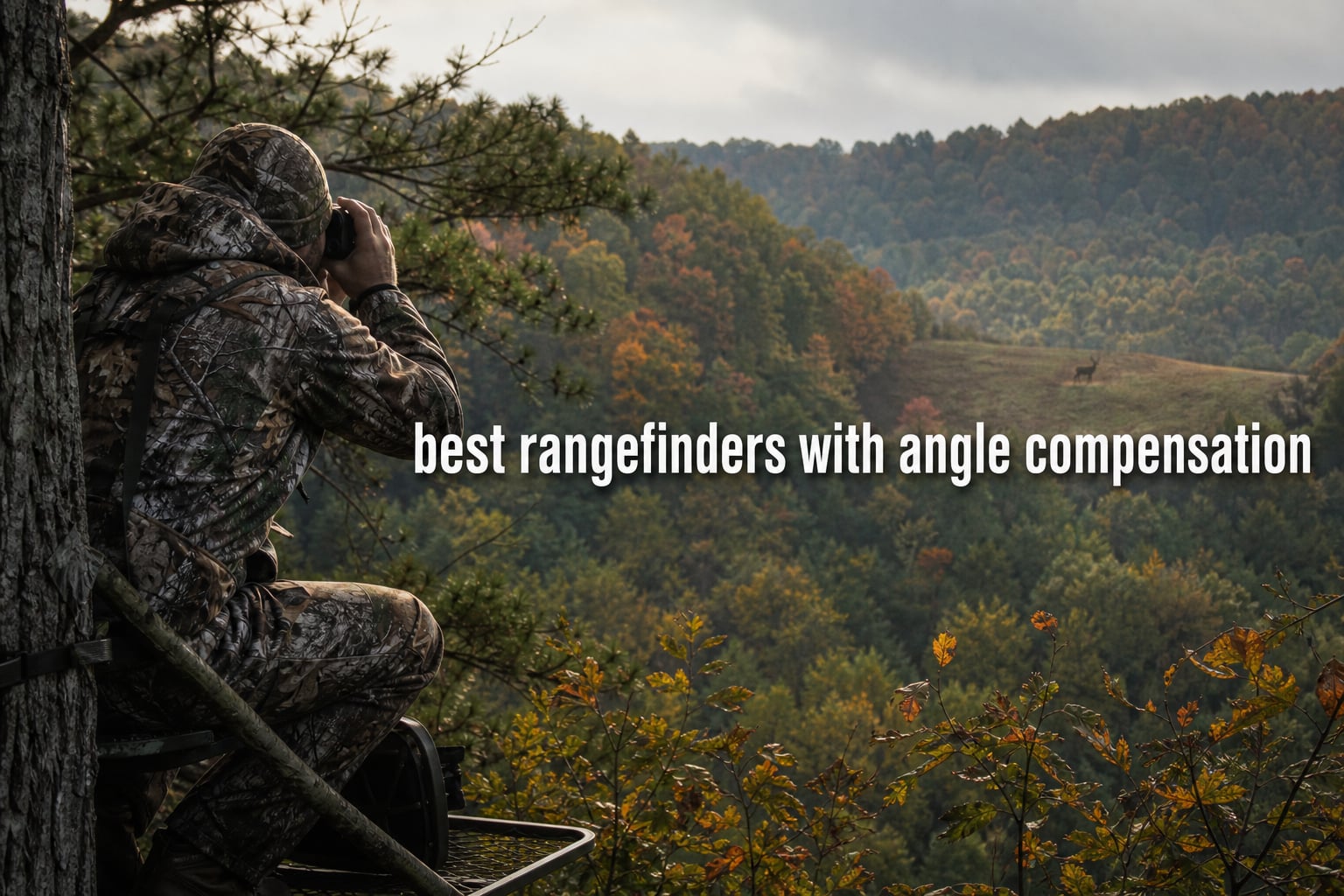
Angle compensation is a rangefinder feature that measures an uphill or downhill angle and reports the horizontal distance you need for a more accurate shot. That correction matters most from a treestand, across a ravine, or anywhere a line-of-sight number can mislead you.
These are the best rangefinders with angle compensation for hunters, archers, and golfers who need a slope-adjusted reading or a dedicated horizontal-distance mode. I compared the supplied product data for stated ranging range, magnification, angle modes, weather rating, battery setup, warranty, and target-lock feedback rather than treating a large maximum-range claim as the whole story.
For bowhunting, a model that explicitly offers bow, archery, or horizontal-distance mode deserves extra attention. For rifle work, ballistic tools such as TBR/W can be more useful, while a simple slope switch may suit golf or a user who wants a straightforward corrected distance.
There is a practical limit to every laser rangefinder: grass, brush, rain, target reflectivity, hand shake, and weak light can affect a reading. I would range the intended animal-sized target and a few nearby landmarks before the shot window opens, then keep the unit on the mode that matches the hunt.
Table of Contents
The top 3 picks answer the most common hunting needs
The Leupold is my first choice when dedicated hunting and archery functions matter, the REDTIGER is the strong all-purpose alternative, and the PEAKPULSE gives bowhunters a simple archery mode. Each reports angle-related information, but their mode sets and power systems differ.

These 12 rangefinders cover the main angle-compensation choices in 2026
This overview separates dedicated hunting options from crossover golf rangefinders, so it is easier to match the tool to your shot. Stated maximum range commonly refers to favorable targets, so read the individual notes before selecting a model for distant game.
| Product | Specifications | Action |
|---|---|---|
| Leupold RX-1400i TBR/W Gen 2 |
|
View on Amazon |
| REDTIGER WildVue S1 |
|
View on Amazon |
 PEAKPULSE 1400Yds PEAKPULSE 1400Yds |
|
View on Amazon |
 Acer Hunting 800Y Acer Hunting 800Y |
|
View on Amazon |
 WOSPORTS 1200Y WOSPORTS 1200Y |
|
View on Amazon |
 AOFAR HX1000 AOFAR HX1000 |
|
View on Amazon |
 GREEN SHOT 1200Y GREEN SHOT 1200Y |
|
View on Amazon |
 Bushnell Tour V6 Shift Bushnell Tour V6 Shift |
|
View on Amazon |
 Acer Pro Golf 1200Y Acer Pro Golf 1200Y |
|
View on Amazon |
 Kaidrus 1500Y Kaidrus 1500Y |
|
View on Amazon |
 Acer Gadget 800Y Acer Gadget 800Y |
|
View on Amazon |
 jiehome X1-660 jiehome X1-660 |
|
View on Amazon |
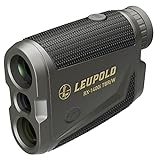
1. Leupold RX-1400i TBR/W Gen 2 is the best dedicated hunting choice
Leupold RX-1400I TBR/W Gen 2 w/Flightpath Rangefinder, Black/Gray
TBR/W
Flightpath bow mode
1.2k-yard tree range
5X
Pros
- TBR/W ballistic calculation
- Flightpath for archers
- TOLED display
- Lifetime warranty
Cons
- IP54 rather than waterproof rating
- CR2 battery
I put the RX-1400i first because its listed functions speak directly to hunting decisions instead of merely adding a generic slope number. Leupold specifies True Ballistic Range/Wind technology and Flightpath technology, with a selectable Bow mode for archers.
The stated reach is 1,400 yards on reflective objects and 1,200 yards on trees, which is more useful context than a single headline figure. Its 5X magnification favors a wide, steady view compared with some 7X units, and the compact listed weight is 5.1 ounces.
The selectable TOLED display can be adjusted for brightness, a meaningful detail when shadows arrive before legal shooting light ends. The included CR2 battery and IP54 weather protection make the setup ready for ordinary wet-weather hunting, though IP54 is not the same as a fully waterproof claim.
Forum discussions repeatedly point hunters toward the 1400 series for angle compensation, and that reputation makes sense beside the product’s mode set. I would still practice changing from Bow mode to the ballistic settings before season; mode confusion is one of the complaints hunters raise most often.
Bowhunters get the clearest fit from the Flightpath and Bow mode
Flightpath is specifically named for archers, while Bow mode provides a purpose-built starting point for treestand or hillside shots. That makes this the most direct option here for a hunter who wants an archery-first interface rather than a golf slope display adapted to the woods.
Rifle hunters get more from TBR/W when their ballistic setup is understood
TBR/W is intended to provide ballistically calculated ranges, so it is the better match for hunters who know how their rifle setup relates to the displayed calculation. Read the manual and confirm your own setup at the range before relying on a ballistic result in the field.
2. REDTIGER WildVue S1 is the best all-purpose rechargeable hunting pick
REDTIGER H002 Hunting Rangefinder with Angle & Speed, 1600 Yards
1.6k-yard range
7X
angle and horizontal modes
USB rechargeable
Pros
- Angle and horizontal readings
- 7X magnification
- 0.5-second stated speed
- 2-year warranty
Cons
- IP54 rating
- 7X may feel less steady
The REDTIGER WildVue S1 is one of the most clearly hunting-oriented alternatives because its feature list includes angle, horizontal distance, height, speed, and distance measurements. That horizontal-distance function is the relevant piece for an archer or hunter facing an uphill or downhill shot.
REDTIGER lists a 1,600-yard maximum range, 7X magnification, and plus-or-minus 0.5-yard accuracy. It also states a reading speed below 0.5 second, a useful claim for anyone who worries that a slow reading can cost a brief shot opportunity.
At 5.6 ounces, this model remains light enough for a pocket or bino-harness pouch. The listed 1,000mAh rechargeable battery is rated for up to 8,000 measurements, while IP54 protection is intended for dust and water resistance.
I like the practical package details: a soft case, hand rope, charging cable, buckle, and lens cloth are listed in the box. A stated 80% light transmission and HD LCD are attractive for dim woods, but I would judge clarity with my own eyes before making it the only optic I trust at dusk.
Hunters get a useful mix of angle and target-measurement modes
The combination of horizontal distance, angle, and scan-related functions suits spot-and-stalk hunting or a treestand setup where terrain changes from one shot lane to the next. It is also a better fit than a flag-only lock system when you need to range natural targets.
Rechargeable power suits routine practice and frequent scanning
A rechargeable battery removes the need to pack a separate CR2 or AAA set for ordinary use, but it creates a different habit: charge before the trip. I would carry a power bank on extended travel and avoid leaving any lithium-powered unit in severe cold.
3. PEAKPULSE 1400Yds is the best simple archery-mode pick
PEAKPULSE Hunting Range Finder 1400Yds – 6X Zoom, Angle Compensation, IP54 Waterproof for Deer & Bow Hunter
1.4k-yard range
M2 archery mode
true horizontal distance
6X
Pros
- Dedicated archery mode
- 90% stated light transmission
- 0.3-second stated focus
- IP54
Cons
- AAA batteries
- 1-year warranty
The PEAKPULSE stands out for stating exactly what many bowhunters want to see: M2 Archery mode with true horizontal distance. Its M1 basic mode and M3 vertical-height mode create a compact three-mode setup instead of a long menu of less relevant functions.
The stated maximum range is 1,400 yards, with 6X zoom and a 0.3-second focus claim accompanied by vibration confirmation. A 6X view can be easier to hold steady than a higher-magnification view when you are ranging freehand from a stand.
PEAKPULSE lists 90% light transmission and IP54 protection, both useful data points for early and late movement. The camouflaged housing, 144-gram listed weight, and lanyard-plus-bag package also fit a rangefinder that will travel on a hunt rather than live in a cart.
Its AAA arrangement is a tradeoff, not an automatic negative. Two battery sets are listed, each rated for 5,000 measurements, and spare AAA batteries are easy to pack; still, I would replace questionable cells before a cold-weather hunt.
Treestand bowhunters benefit most from the M2 horizontal-distance mode
M2 is the direct choice when the shot is above or below you and you need the horizontal result rather than simple line-of-sight distance. Pre-range the base of the tree, major lanes, and likely feeding routes while the stand is still quiet.
Low-light hunters should weigh the stated 90% light transmission
The listed light-transmission figure gives this unit a reason to consider for dawn and dusk, when reading the display and seeing the target both matter. No specification can replace checking the view in conditions similar to your own woods.
4. Acer Hunting 800Y is the best camo-focused basic hunting model
Acer Hunting Range Finder with Slope, 800 Yards Range Finder for Hunting, 6X Magnification, Waterproof Archery Rangefinder for Deer, Rechargeable Battery with Magnet Stripe
800-yard range
Hunt Mode
angle and slope modes
USB-C
Pros
- Camo finish
- Hunt Mode
- 0.5-second stated lock
- USB-C rechargeable
Cons
- 800-yard stated range
- 1-year warranty
Acer’s hunting model is built around a woodland-camo, non-reflective finish and a stated Hunt Mode that locks onto moving targets in 0.5 seconds. The supplied details also list angle, scan, speed, height, horizontal-distance, and slope-compensation functions.
The 800-yard maximum range is shorter than several other listings, but that is not automatically a problem for normal bowhunting lanes or many wooded hunting setups. The 6X optic and plus-or-minus 1-yard stated accuracy set realistic expectations for a simple field unit.
IP54 dust and water resistance, a textured grip, and a 0.73-pound listed weight point toward weather-tolerant utility. USB-C rechargeability is convenient, although the data says batteries are not included, so verify the charging setup when it arrives.
I would select this one when camouflage and a hunting-specific mode matter more than very long stated range. It is also worth learning how its slope-compensation display differs from its direct distance display, since those two numbers may not match on steep ground.
Woodland hunters get the most from the non-reflective camo body
A subdued finish helps a rangefinder feel at home in a chest pocket or on a lanyard, especially for hunters who minimize bright gear around close animals. The practical gain remains the mode set, but the camo choice is a welcome field detail.
Short-to-medium range hunting fits the 800-yard claim
An 800-yard listing gives plenty of headroom for closer deer and archery situations, where target separation and angle correction matter more than an extreme range number. Test it on small, natural targets rather than only large reflective objects.
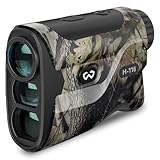
5. WOSPORTS 1200Y is the best dedicated bow-mode alternative
WOSPORTS Hunting Rangefinder, Range Finder for Hunter with Bow Hunting Mode/Distance/Angle/Speed/Scan Multi Functional, 6X Magnification, 1200-Yard
1.2k-yard range
bow mode
slope mode
6X
Pros
- Dedicated bow-hunting mode
- lightweight build
- CR2 included
- 2-year warranty
Cons
- Plastic construction
- disposable CR2 battery
WOSPORTS makes its intended audience clear with a listed M2 Bow Hunting mode alongside M1 Range, M3 Slope, and M4 Speed. That lineup is easy to understand for a new hunter who wants to avoid hunting through a complicated golf-oriented menu.
The listed 1,200-yard range and 6X magnification offer useful reach without moving to a higher-magnification view. At 145 grams, or about 0.31 pounds in the feature data, it is designed for one-handed carrying.
A CR2 battery is included, as are a bag, carabiner, hang string, lens cloth, and user manual. The two-year warranty is more reassuring than the no-warranty position on a few lower-cost entries, particularly when the rangefinder will see rain and pack wear.
The plastic construction and disposable-battery format are its main compromises. I would put a spare CR2 in the pack because community discussions often mention battery weakness in cold weather, regardless of brand.
New bowhunters get a straightforward four-mode layout
Bow mode is separated from the ordinary range and speed modes, which lowers the chance of expecting an angle-corrected result while the unit is showing direct distance. Spend an afternoon ranging marked targets from an elevated position so the display becomes familiar.
One-handed hunters benefit from the light 145-gram build
Weight matters when a rangefinder is repeatedly raised, checked, and returned to a pocket while you hold a bow or trekking pole. The included carabiner and hang string give several carry options, though a secure closed pouch remains safer in thick cover.
6. AOFAR HX1000 is the best uncomplicated angle and scan model
AOFAR HX1000 Range Finder for Hunting Archery, 1000 Yards with Angle and Horizontal Distance, Shooting Rangefinder for Rifle. Range, Scan, Speed Mode for Hunter. Waterproof
1k-yard range
angle and horizontal distance
scan mode
IP54
Pros
- Angle and scan modes
- 131-gram weight
- plus-or-minus 1-yard accuracy
- IP54
Cons
- No warranty listed
- AA or AAA power required
The AOFAR HX1000 keeps the feature set focused on range, speed, moving scan, and angle modes. It is a sensible option for a hunter who wants angle-related readings and continuous scanning without a ballistic profile or a highly specialized archery screen.
The product data lists horizontal distance, a 1,000-yard maximum range, 6X magnification, and plus-or-minus 1-yard accuracy. Its 131-gram listed weight makes it one of the lighter hunting-shaped units in this group.
IP54 protection is listed for dust and water resistance, and the body uses a rubber material according to the technical details. The small dimensions may make it easy to carry, although users with large hands should check comfort and button reach when possible.
The important limitation is power and ownership support: the listing says AA or AAA batteries are required and does not provide a warranty. I would factor in those two points if the rangefinder will be used hard through a long season.
Simple-mode users benefit from the focused range, scan, speed, and angle options
A short menu can be a real advantage when an animal appears suddenly. Continuous scan is useful for mapping several shooting lanes, but pause on the target itself so vegetation does not become the returned distance.
Pack hunters benefit from the 131-gram listed weight
A lightweight tool has less reason to be left in camp, and the AOFAR is small enough to be practical for day hunts. Carry spare batteries in a sealed pouch, since the package information does not list them as included.
7. GREEN SHOT 1200Y is the best slope-switch hunting alternative
GREEN SHOT Range Finder for Hunting – 1200 Yards Golf Rangefinder with Slope Switch, Flag Lock, Speed Mode, Waterproof Rechargeable Hunting Range Finder, Ideal for Archery, Golf, Bow Hunter
1.2k-yard range
slope on-off
hunting mode
6X
Pros
- Slope toggle
- Hunting Mode
- 0.5-yard stated accuracy
- 2-year warranty
Cons
- Lower review count
- plastic construction
GREEN SHOT combines a stated 1,200-yard range with a slope on/off switch, a dedicated Hunting Mode, flagpole lock, direct distance, golf, and speed modes. For an archery or hunting user, the attraction is the ability to select the slope-related function without giving up a target-filtering mode.
The listing claims 0.5-yard accuracy and identifies Hunting Mode as a way to filter background noise while locking onto game. That is relevant when tall grass or branches sit between you and the target, though no rangefinder can guarantee the desired target in every cluttered scene.
At a listed 0.35 pounds, it is easy to carry, and the package includes a soft case, carabiner, lanyard, lens cloth, and manual. Its rechargeable battery and two-year manufacturer warranty make the ownership details stronger than some basic models.
The lower review count means there is less crowd feedback than for several established alternatives in this list. I would use a deliberate test at home: range a clear trunk, then grass in front of it, and learn how the Hunting Mode responds.
Brushy setups benefit most from the stated background-filtering Hunting Mode
Hunting Mode is the reason to shortlist this rangefinder over a basic golf unit. It is designed to help prioritize the game target, but users still need to check that the returned distance fits the animal or landmark they intended to range.
Users who switch sports benefit from the physical slope toggle
A visible on/off approach is easier to audit than a buried menu setting. That matters if you move between hunting and organized golf, where a slope-adjusted distance may not be permitted under the event’s rules.
8. Bushnell Tour V6 Shift is the best premium golf crossover
Bushnell Golf Tour V6 Shift Laser Rangefinder, Patriot Pack
1.3k-yard range
external slope switch
Pinseeker
6X
Pros
- External slope switch
- Visual Jolt confirmation
- BITE magnetic mount
- IPX6 waterproof
Cons
- Golf-focused targeting
- CR2 battery not included
The Bushnell Tour V6 Shift is a polished choice for golf first, with an external slope switch that makes its corrected-distance state easy to identify. Its 6X magnification and 5-to-1,300-yard listed measuring range add versatility beyond a typical short-range golf use case.
Pinseeker with Visual Jolt gives a red visual ring flash and vibration when the unit locks onto a flag, which is excellent feedback for golf targets. It is less directly suited to deer-sized targets in brush, so I would not rank it above dedicated hunting models for a woods-only buyer.
The BITE magnetic mount is genuinely convenient around a cart, while the IPX6 waterproof rating is the strongest water-resistance claim among these listings. A two-year manufacturer warranty is also specified.
Its slope switch allows a non-slope setting for tournament-legal golf as described in the product data. It needs a CR2 battery that is not listed as included, so add one before the first round or trip.
Golfers get the best fit from Pinseeker and Visual Jolt feedback
Flag-lock confirmation makes it easier to know when the laser has found the pin rather than the trees behind it. That feedback is a practical confidence cue when the flag is distant or the hand is not perfectly steady.
Wet-weather users benefit from the IPX6 waterproof claim
IPX6 indicates protection against powerful water jets, making this the more weather-ready golf crossover on the supplied specifications. Dry the lenses and the exterior after use anyway, then store the unit in its case.
9. Acer Pro Golf 1200Y is the best rechargeable 7X golf crossover
Acer Pro Golf Rangefinder with Slope Switch, Pin Lock Vibration, 1200 Yards
1.2k-yard range
7X
slope switch
USB-C rechargeable
Pros
- 7X with anti-shake
- Slope Off setting
- 20k stated measurements
- magnetic stripe
Cons
- Golf-focused modes
- IP54 not full waterproof
The Acer Pro pairs a 7X view with anti-shake technology and a fast Pin Lock system that claims plus-or-minus 0.5-yard accuracy. Its 6-in-1 mode set covers flag lock, slope, horizontal and vertical distance, speed, and continuous scan.
The slope switch can turn slope off for tournament use, while its horizontal and vertical readouts add flexibility for casual outdoor measuring. The 5-to-1,200-yard stated range gives ample headroom for golf-course targets, and the IP54 rating addresses routine dust and wet conditions.
Its rechargeable 750mAh battery is listed for 20,000 measurements per charge, with USB-C in the box. The magnetic stripe is intended for cart mounting, which strengthens the golf-first appeal.
I would choose it for someone who wants a 7X display and rechargeable power but does not need a named bow mode or ballistic system. The 52.5-gram listed weight is notably light, so it should be easy to keep accessible.
Golf users get the clearest benefit from the Pin Lock and magnetic stripe
Pin Lock and vibration-style confirmation are built for flag hunting, while the magnet makes cart storage simple between shots. These features are less meaningful in a treestand than a dedicated horizontal-distance mode that is clearly labeled for archery.
Frequent users benefit from the stated 20,000-measurement rechargeable battery
A long stated measurement count is appealing for practice sessions and repeat readings across a course. Recharge it before departure, because a built-in battery cannot be swapped immediately like a CR2 cell.
10. Kaidrus 1500Y is the best high-magnification long-range crossover
Golf Rangefinder with Slope On/Off 1500 Yards 7X Magnification Golf Gifts
1.5k-yard range
7X
slope switch
0.5-second stated lock
Pros
- 1.5k-yard stated range
- fast stated lock
- bright LCD
- rechargeable
Cons
- Golf-focused flag lock
- 18-month warranty
Kaidrus advertises a 1,500-yard maximum range, 7X magnification, and a 0.5-second flag-lock claim. It is the crossover to examine if you want an ambitious stated range and a bright LCD instead of a bow-specific mode.
The 2X HD Bright LCD and vibration feedback aim to make flag confirmation more obvious. A slope-switch function allows a non-slope state for tournament play, and the listed magnetic mount supports cart use.
A rechargeable battery, premium carrying case, charging cable, carabiner, lens cloth, and hang string are included. The 170-gram listed weight remains reasonable, but its 18-month warranty is shorter than the two-year coverage offered on several alternatives.
For hunting, I would view the 1,500-yard claim as extra headroom, not proof of consistent readings on dark, small, or partially blocked game. The ability to get a clean range on the animal or nearby trunk in real terrain is the better decision test.
Open-course users benefit most from the bright LCD and 7X view
Seven-power magnification can make distant flags easier to identify, and the bright display can help the number stand out in changing conditions. The tradeoff is that stronger magnification can reveal more hand movement when ranging without support.
Long-distance users should separate stated maximum range from game-target performance
Manufacturers often quote the best result on favorable reflective targets. For hunting, compare performance on tree bark, a deer-sized target surrogate, and terrain with brush, then decide whether the rangefinder fits your realistic shot distance.
11. Acer Gadget 800Y is the best compact six-mode crossover
Acer Golf Rangefinder with Slope – 800Yards Range Finder for Hunting, 6X Magnification with Flag Pole Locking Vibration, Rechargeable Battery with Magnet Stripe Golf Accessories for Men, Gifts
800-yard range
6X
six modes
USB-C rechargeable
Pros
- Anti-shake technology
- flag lock vibration
- six mode options
- USB-C power
Cons
- 800-yard stated range
- golf-oriented interface
The Acer Gadget model has six stated modes: slope, vertical and horizontal distance, angle, speed, and continuous scanning. That makes it a flexible small unit for users who need more than a direct-distance number but do not need a dedicated ballistic calculator.
Its 800-yard maximum range, 6X magnification, and plus-or-minus 0.5-yard accuracy claim fit typical golf and close-to-medium hunting work. Anti-shake technology and flagpole locking with vibration aim to make the process less fussy for a newer user.
The listed body measures 4.2 by 2.5 by 1.5 inches and weighs 0.7 pounds. USB-C rechargeability and a magnetic stripe add practical convenience, while the listing identifies a one-year warranty.
The product ranks strongly in its supplied golf-category data and has a substantial review count, but popularity does not turn flag lock into a hunting mode. I would pick it for measured targets, open property, golf, or basic angle learning rather than dense brush situations.
Casual users benefit from the broad six-mode menu
The menu covers the common measurements a newer user may want to explore: direct distance, horizontal distance, vertical distance, angle, speed, and scan. Learn one mode at a time and record the display behavior on a marked target.
Close-range users get enough reach from the 800-yard stated maximum
Most bow shots occur far inside this unit’s stated maximum. The more relevant questions are close-target acquisition, display readability, and whether the horizontal result is available when the target sits above or below you.
12. jiehome X1-660 is the best compact entry-level slope-switch model
JIEHOME Golf Range Finder X1 660 Yards Rangefinder with Slope Magnetic Flag Locking 7X Magnification Rechargeable Hunting Range Finders Rangefinder for Disc Golfing Bowhunting
660-yard range
slope switch
H/V distance
USB-C battery
Pros
- Slope switch
- flag lock vibration
- adjustable diopter
- 20k stated measurements
Cons
- Plus-or-minus 1-yard accuracy
- 660-yard stated range
The jiehome X1-660 is a compact crossover with a 3-to-660-yard stated measuring range, slope switch, continuous scanning, flag lock, horizontal and vertical distance, and speed modes. It is the entry-level option for a user who wants to learn how a slope-corrected reading differs from direct distance.
The feature data lists plus-or-minus 1-yard accuracy, a sub-0.5-second measuring speed, and 6X magnification in the specification block, while a separate feature line says 7X; I would verify the exact optical specification in the product manual before purchase. Multi-layer-coated lenses and an adjustable diopter are listed for visual adjustment.
Its 750mAh rechargeable battery is rated for 20,000 measurements per charge, and the built-in magnet can attach to a cart or metal belt clip. IP54 water resistance and a 124-gram listed weight add to the compact, practical design.
The 660-yard stated maximum and plus-or-minus 1-yard claim are the tradeoffs against the higher-ranked hunting models. It is better suited to modest-distance ranging and golf-style target lock than demanding long-range hunting in complex cover.
New rangefinder owners benefit from the clear slope-switch concept
A physical slope control makes it easier to recognize whether you are viewing an adjusted number or a direct-distance number. Practice with a known flat target first, then compare readings from an elevated position to see why the modes exist.
Eyeglass wearers benefit from the listed adjustable diopter
A diopter can sharpen the display for your eye, which matters more than many buyers expect. Adjust it against the display rather than the distant scene, then leave it alone once the digits look crisp.
Choose an angle-compensation rangefinder by shot type and conditions
Start with the number you actually need to make a shot. A line-of-sight distance is the laser’s direct measurement to the target, while an angle-compensated result translates the slope into a horizontal or ballistic equivalent; for archery from elevation, that corrected result is normally the more useful one.
Bowhunters should choose a named bow mode or horizontal-distance result
A bow mode, archery mode, EHR, or horizontal-distance reading is intended to account for the geometry of an angled shot. The Leupold’s Flightpath and Bow mode, PEAKPULSE M2 Archery mode, and WOSPORTS M2 Bow Hunting mode are the clearest examples in this group.
Range the actual lanes before an animal appears and make a note of the corrected distance at each marker. Do not assume a unit reporting an angle also shows the specific distance your setup requires; look at the manual and display symbols.
Rifle hunters should distinguish TBR from simple horizontal distance
HCD, or horizontal component distance, is the flat-ground component of the shot. EHR, or equivalent horizontal range, is a similar angle-adjusted concept commonly used for archery and basic hunting, while TBR, or true ballistic range, adds a ballistic calculation and may account for more than slope alone.
The RX-1400i names TBR/W and is the strongest fit here for that category. Any ballistic feature still requires you to understand the selected setting and confirm results with range practice; a rangefinder cannot replace knowledge of your firearm and ammunition.
Target behavior matters more than the largest range number
Maximum range claims are usually more attainable on reflective targets than on tree bark, animals, or brushy terrain. For deer hunting, test a rangefinder on a small stump, a dark trunk, and a target roughly the size you expect to range.
Use scan mode for mapping a hillside or multiple lanes, but stop and confirm the final reading. If the number suddenly matches the grass in front of the target rather than the landmark beyond it, change your angle, steady your hands, or range a clearer nearby object.
Display and magnification should suit your hand and your light
A 6X optic often gives a steadier view, while 7X may help identify a distant flag or target but can magnify hand movement. A bright or adjustable display is useful in dim cover, though excessive brightness can be distracting in darkness.
Hold a prospective model as you would in the field, with gloves if you hunt in cold conditions. Button placement, eyecup comfort, diopter adjustment, and the clarity of the mode icon affect practical speed more than a long feature list.
Weather rating, warranty, and battery format shape field reliability
IP54 indicates dust and water resistance, while the Bushnell’s stated IPX6 claim is stronger against water exposure. Keep any electronic rangefinder in a case or pouch in sustained rain, and wipe the lenses with a proper cloth rather than a shirt sleeve.
Rechargeable models work well for routine use if you build charging into your pre-hunt checklist. CR2 and AAA systems let you carry immediate spares, which can be reassuring in cold weather; warranties range from none listed on the AOFAR to lifetime coverage stated for the Leupold.
Tournament golfers should switch off slope when rules require it
Slope compensation is restricted in many organized golf competitions because it provides information about elevation that players otherwise must judge themselves. A device may be usable only when its slope function is disabled, so check the local event’s rules and confirm that the indicator shows the permitted setting.
For hunting, a slope-adjusted result is normally a practical safety and accuracy aid, not a tournament issue. The same physical switch is still valuable because it lets you compare direct distance with the corrected number during practice.
These common questions explain angle compensation
What is the best archery rangefinder with angle compensation?
The Leupold RX-1400i TBR/W Gen 2 is the best archery-focused pick in this list because it names both a selectable Bow mode and Flightpath technology for archers. The PEAKPULSE 1400Yds is a simpler alternative with an M2 Archery mode that reports true horizontal distance.
Do rangefinders compensate for angle?
Many rangefinders do compensate for angle when they have a slope, angle, horizontal-distance, EHR, HCD, bow, or ballistic mode. An internal inclinometer measures the uphill or downhill angle and the device calculates a corrected result, but you must select the applicable mode.
Why is slope on range finder illegal?
Slope is restricted in many organized golf events because it supplies an elevation-adjusted distance that can influence club selection. A rangefinder with a slope switch may be allowed when the slope function is disabled, but always check the rules of the specific competition.
What is slope compensation in rangefinder?
Slope compensation measures the incline or decline to a target and converts line-of-sight distance into a distance that better represents the shot’s horizontal component. It is especially helpful for treestand bowhunting, mountain hunting, and uphill or downhill shots.
The right choice depends on your hunting distance and angle
The Leupold RX-1400i TBR/W Gen 2 is my leading recommendation because it brings TBR/W, Bow mode, Flightpath, a clear display system, and a stated lifetime warranty into a hunting-first package. Pick the REDTIGER when rechargeable power and a broad set of angle and horizontal-distance modes matter most, or the PEAKPULSE when a straightforward archery mode is the priority.
The best rangefinders with angle compensation are not simply the ones with the biggest stated maximum range. Select the device whose corrected-distance mode you understand, practice on the terrain you hunt, and confirm its read before taking any shot.
Once you have narrowed the field, review the mode labels, battery plan, and weather rating one more time. A rangefinder that is familiar in your hand is more useful than a more complicated model that stays in your pack.