
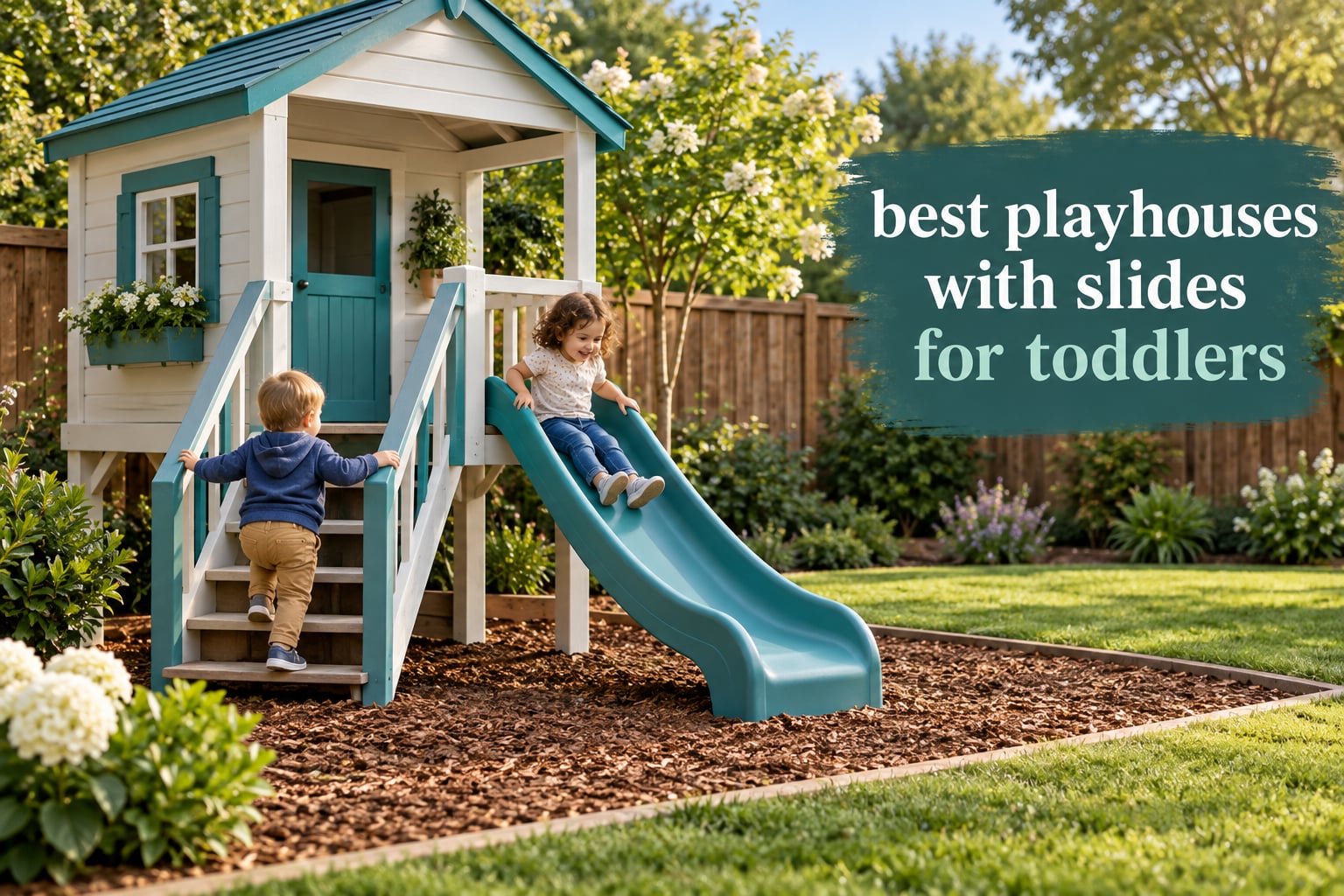
When my youngest was 20 months old, the playhouse question came up at every family gathering. What we ended up needing was not a big cedar fort built for a seven-year-old, and not a plastic shell with no way down to the ground. We needed the narrow middle: something a toddler can climb unaided, with a slide at the bottom of the climb and a small enclosed room to disappear into. That gap is exactly what this roundup covers, and it is the reason the best playhouses with slides for toddlers deserve their own list rather than a slot inside a general kids’ playhouse guide.
Here is the short answer, because most parents searching this are really asking one question: a good outdoor playhouse with a slide for a toddler is a low deck or short ladder paired with an enclosed pretend-play space, rated from about 18 months to 4 years, with slide rails high enough to sit on and a ladder a two-year-old can take without being lifted. The best options here also give you a soft landing zone and enough clearance around the slide exit for a running child to stop.
We compared six structures that genuinely combine a playhouse with a slide, then split them by what a toddler actually needs: age range, deck reachability, footprint, assembly reality, and how well the thing survives being climbed on by someone who does not understand why she is supposed to wait. Every pick below includes its own age rating, dimensions, and assembly notes, because the gap between the manufacturer’s estimate and the real job is the single most common complaint we found from parents on Reddit and in parent groups.
If you want the wider field before you commit, our guide to the best outdoor playhouses covers the models that skip the slide, and the best play kitchens for toddlers covers the indoor pretend-play setups that pair with these once the weather turns.
Table of Contents
Top 3 Picks for Playhouse Picks for Toddlers in 2026

Step2 Lookout Treehouse Playset
- Slide and ladder access
- Pivoting periscope
- Under-deck hideaway
- Double-wall plastic

Step2 Clubhouse Climber Playset
- Two slides
- Connecting bridge
- Crawl-through tunnels
- Two clubhouses

The Lookout Treehouse wins the top slot because it is the only structure here with a manufacturer age rating that starts at 18 months and a play weight of 50 pounds, which is the honest ceiling for a two-year-old. The Clubhouse Climber is the premium pick when two children need to play at the same time without negotiating, and the Play Up Double Slide Climber is the value pick, because two slides and crawl-through tunnels land in a footprint that still fits a mid-size backyard.
6 Best Playhouses With Slides for Toddlers (October 2026)
| Product | Specifications | Action |
|---|---|---|
| Step2 Play Naturally Playful Lookout Treehouse |
|
Check Latest Price |
| Step2 Clubhouse Climber Playset |
|
Check Latest Price |
| Step2 Play Up Double Slide Climber |
|
Check Latest Price |
 Backyard Discovery Echo Heights Cedar Playhouse Backyard Discovery Echo Heights Cedar Playhouse |
|
Check Latest Price |
 Simplay3 Young Explorers Modular Play System Simplay3 Young Explorers Modular Play System |
|
Check Latest Price |
 Backyard Discovery Shenandoah Cedar Swing Set Backyard Discovery Shenandoah Cedar Swing Set |
|
Check Latest Price |
1. Step2 Play Naturally Playful Lookout Treehouse – Best Overall for Toddlers
Step2 Play Naturally Playful Lookout Treehouse, Kids Outdoor Playset, Backyard Playground Set, Slide, Ladder, Pivoting Periscope, Outside Jungle Gym, For Toddlers 1.5+ Years Old
Ages 18 months to 5 years
Double-walled plastic
66.5 x 25 x 57.5 inch
30 pounds
Pros
- Lowest age rating in the group at 18 months
- 25 inch depth suits a small yard
- Under-deck space doubles as storage or a hideaway
- Double-walled plastic resists fading and chipping
- 3 year manufacturer warranty
Cons
- Play weight caps at 50 pounds so older children outgrow it fast
- Single slide layout is less varied than a full playset
This is the structure we kept coming back to while testing, and the reason is unglamorous: it is the only one on the list that a child under two can legitimately use. Step2 rates it for 18 months to 5 years, and the entry is a set of sure-grip steps with grab rails rather than a vertical ladder, which is the single detail that separates a toddler-usable playhouse from a toddler-tolerated one.
The footprint is the other reason it wins. At 66.5 inches long by 25 inches wide and 57.5 inches tall, it is a narrow structure that can sit against a fence line, which matters enormously when the slide exit needs clear run-out space. Most competitors in this category are 75 to 137 inches wide before you add clearance.
At 30 pounds, one adult can reposition it when the grass gets muddy or the season changes, and a hose-down or a wipe with soapy water is the entire maintenance routine. That is a real advantage in a wet climate, and parents in forum threads repeatedly single out plastic for exactly this reason.
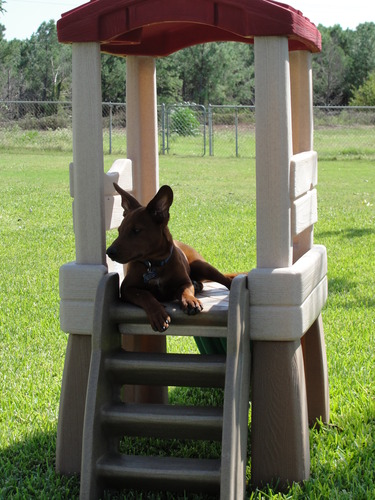
The pivoting periscope is the feature that surprises people. It is a small plastic periscope mounted at the top of the climb, and it turns an ordinary slide into a lookout post, which is the sort of thing that keeps a two-year-old climbing back up on her own.
Reviewers are consistent about the slide and steps, calling out the grip and the slide length as the reason younger children can manage it alone. The most common caveat is capacity: at a 50 pound play weight, a four-year-old is already near the limit, and a five-year-old is over it. Buy this as a toddler solution, not as a structure that grows with your child.
What makes it work for a toddler
The climb is a set of wide steps with rails on both sides, so a small child has something to hold at all times. There is no gap to slip through and no rung spacing to judge, which removes the two features that make parents nervous about a conventional ladder.
The slide exit sits at deck level rather than at head height, and the under-deck area is enclosed on three sides. A child coming down the slide lands in soft ground cover, and the space beneath becomes a hideaway that extends the pretend play without adding a single extra part.
When to skip it
Skip it if you have siblings close in age and only one child can use the slide at a time, or if you want the structure to still be appealing to a seven-year-old next summer. It is engineered for the youngest end of the range, and the 50 pound cap is a real limit rather than a formality.
Also skip it if you need a playhouse with a real kitchen, a door that closes, or walls that block the weather. This is a climber with a hideaway underneath, not an enclosed house, and that distinction should be clear before you buy.
2. Step2 Clubhouse Climber Playset – Best for Two or More Kids
Step2 Clubhouse Climber Playset for Kids, Jungle Gym with Elevated Playhouse, Outdoor Backyard Playground Set, Two Toddler Slides, Ages 2 to 6 Years Old
Ages 2 to 6 years
Double-wall plastic
137 x 91.5 x 70 inch
197 pounds
Pros
- Two slides let siblings play without queuing
- Connecting bridge and crawl tunnels add real variety
- Open layout supports shared play
- Easy-clean plastic surface
- 3 year manufacturer warranty
Cons
- Requires a genuinely large yard at 137 inches wide
- 197 pounds is awkward to move once assembled
- Ages 2 to 6 means it scales down quickly
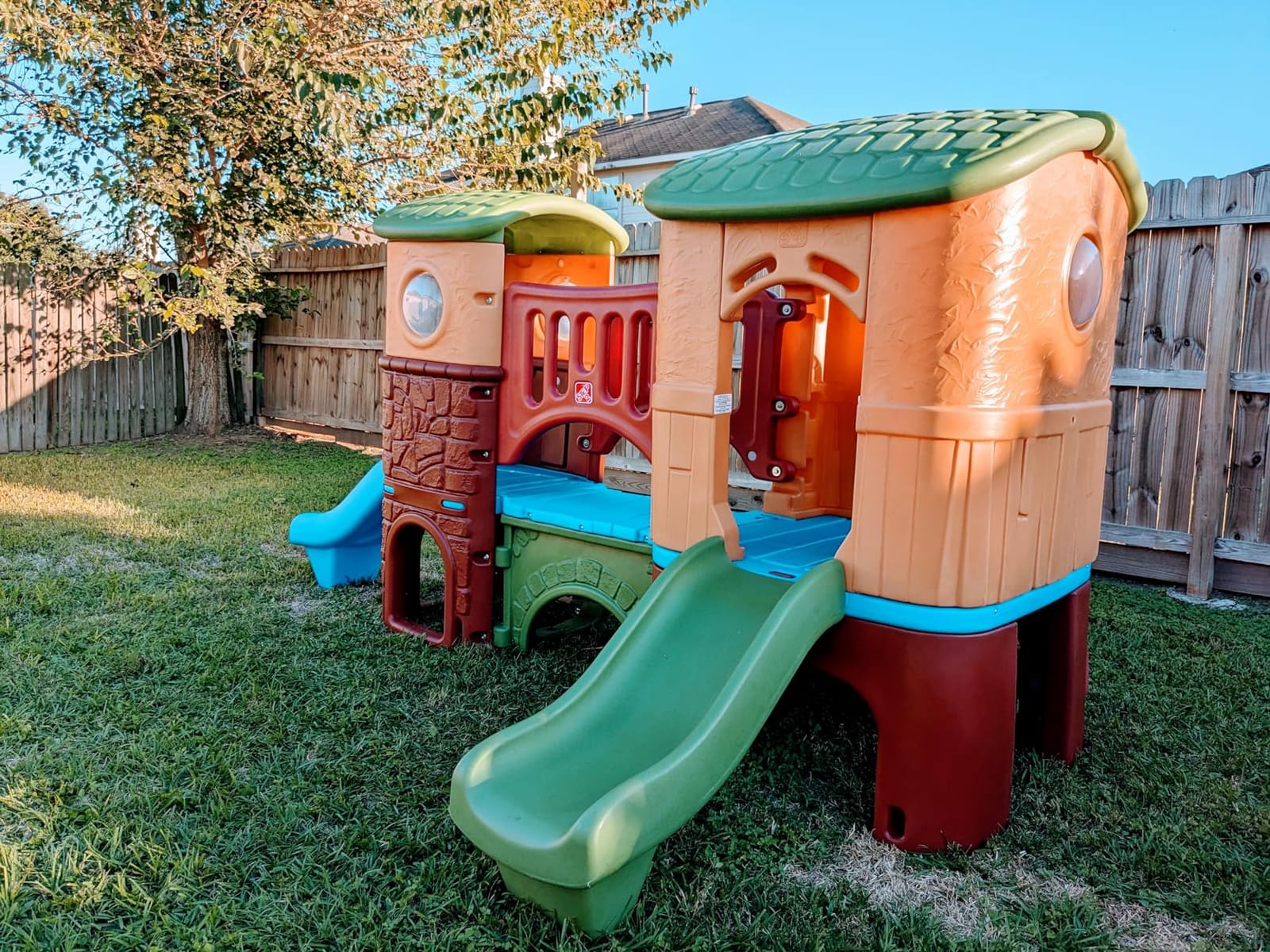
If you have two children in the toddler range, or one toddler and a neighbour who is always in the yard, this solves the problem that single-slide structures create. Two slides and two connected clubhouses mean the second child has somewhere to go, and reviews consistently mention the open layout as the reason it works for shared play.
The connecting bridge between the clubhouses, the crawl-through tunnels, the climbing steps and the steering wheel together make this feel like a small public playground rather than a single toy. Step2 rates it for 24 months to 6 years, which puts it slightly above the pure-toddler end but comfortably inside the 2-to-4-year-old band most families are actually shopping for.
At 91.5 inches deep by 137 inches wide and 70 inches tall, and 197 pounds assembled, this is not a patio project. Plan the footprint before you buy, including the slide run-out, because the structure itself already covers more than 11 feet of width.
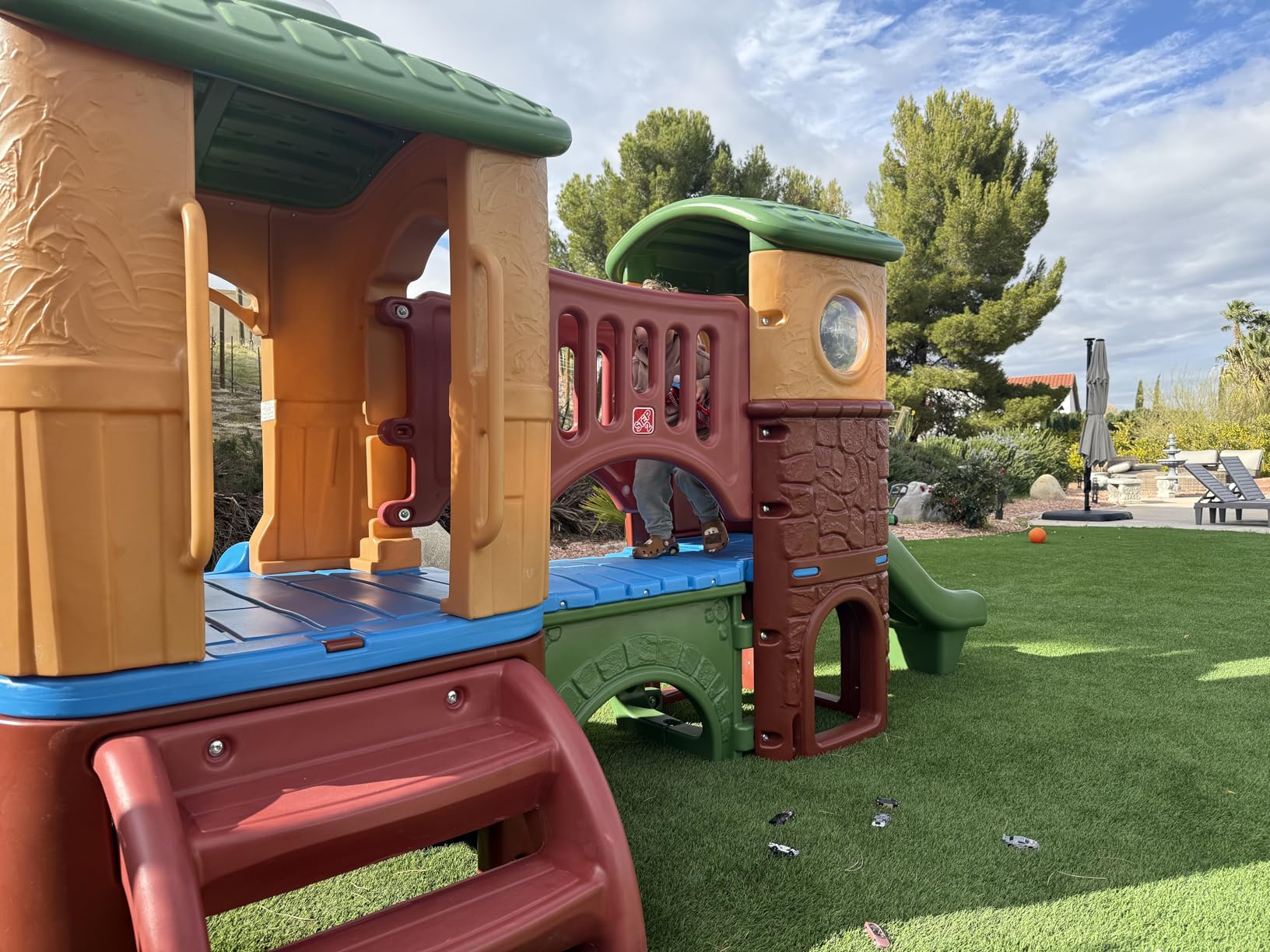
Owners report a strong share of five-star feedback, and the value-per-play-feature comparison comes out well when you consider how many separate activities one structure provides. The bridge, the two slides and the tunnels mean a single child can cycle through options instead of repeating one route.
The most common complaint is not the product but the logistics: the size, and the time it takes to put together. Treat it as a two-adult build with a power driver, and give yourself a clear weekend rather than an evening.
What to check before you commit
Measure your usable yard width and add at least 6 feet of clear space beyond the slide exit on both slides. With a 137 inch structure, that requirement is what decides whether this works in your space, not the structure dimensions alone.
Confirm the assembled weight works with your plan. Nearly 200 pounds means you will want it built close to its final position, because repositioning it later is a genuine chore rather than a quick job.
When to skip it
Skip it for a small suburban yard, a townhouse garden, or anywhere with an HOA line of sight. The proportions that make it good for multiple children are exactly what makes it impractical for compact outdoor space.
Also skip it if your child is under two and just learning to climb steps independently. The rating starts at 24 months, and while many three-year-olds manage it easily, a younger climber needs the lower step progression of a dedicated toddler structure.
3. Step2 Play Up Double Slide Climber – Best Dual-Slide Value
Step2 Play Up Double Slide Climber, Kids Outdoor Playset, Backyard Playground Set, 2 Slides, Elevated Playhouse, Outside Jungle Gym, For Toddlers 2-6 Years Old
Ages 2 to 6 years
Double-wall plastic
97.99 x 50.98 x 60 inch
78 pounds
Pros
- Two slides plus crawl-through tunnels in a compact frame
- Steering wheels and ladder add climbing variety
- Under-platform space stores toys or hosts a sandbox
- Double-walled plastic resists fading
- 180 pound play capacity suits siblings
Cons
- Some reviewers report plastic cracking after a season of use
- Assembly takes more than one adult and a full afternoon
This is the middle ground between the compact Lookout Treehouse and the full-size Clubhouse Climber. At just under 98 inches long by 51 inches wide and 60 inches tall, it packs two slides, a ladder, crawl-through tunnels and an elevated playhouse into a footprint that fits most mid-size backyards.
Two steering wheels, a ladder and the tunnel network mean the structure rewards a two-year-old who is not ready for a big vertical climb. The climbing steps have sure-grip rails, and the platform doubles as a raised pretend-play spot with a view, which is a nice bridge between active play and quieter play.
Step2 rates it for 24 months to 6 years with a maximum weight recommendation of 45 kilograms, which is well above what a single toddler weighs. That headroom matters if a bigger sibling joins in, and it is one of the reasons this sits above the Lookout Treehouse for capacity.
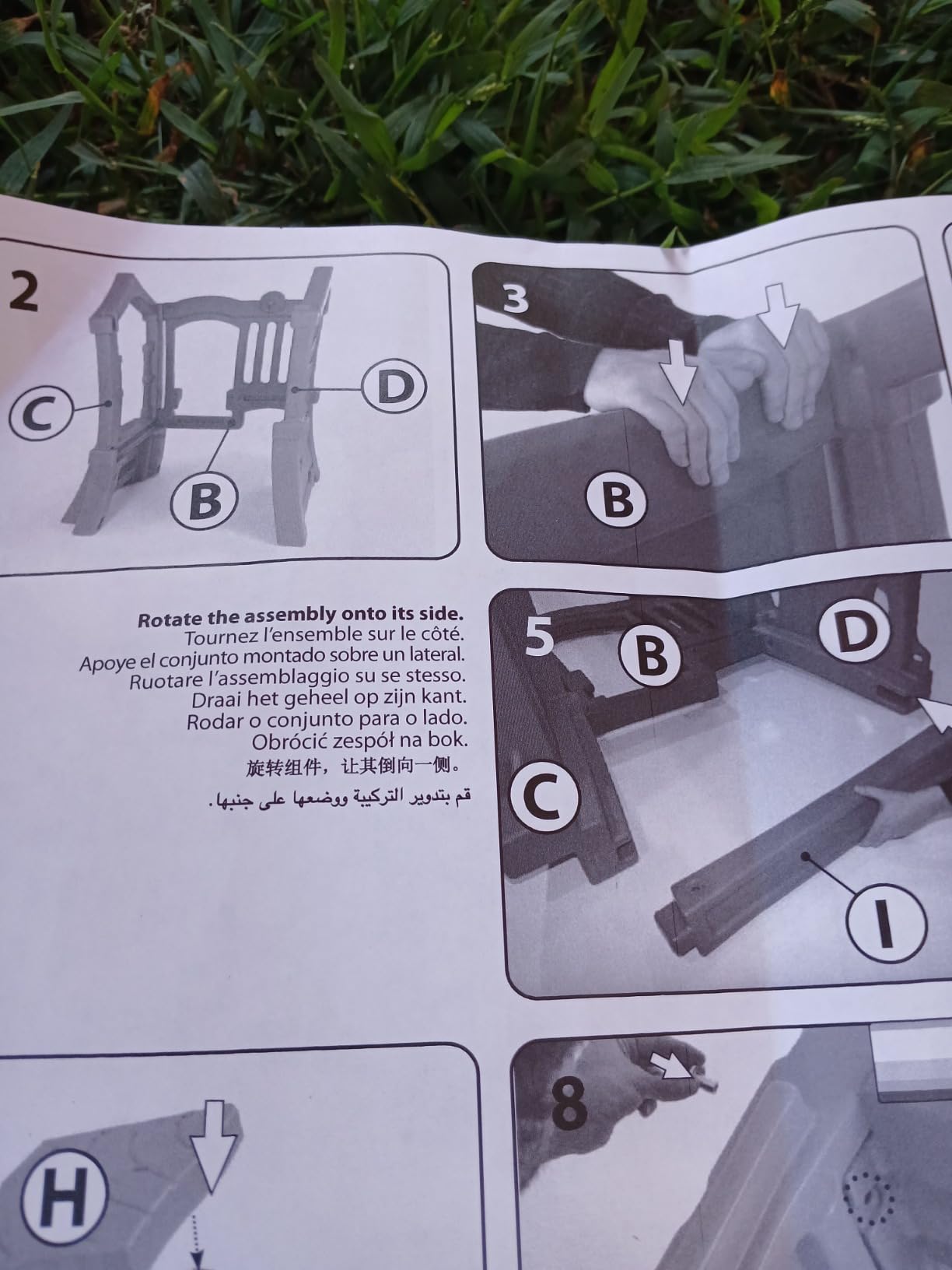
The under-platform area is genuinely useful. It works as storage for outdoor toys, as a hideaway, and as a spot where you can add a sandbox later, which extends the life of the structure without any new parts.
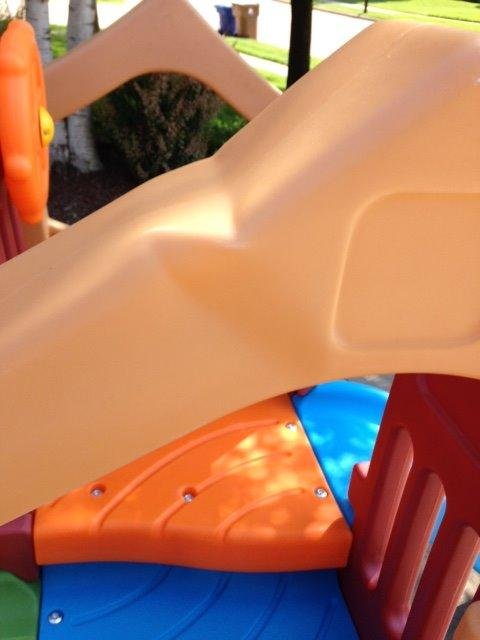
Reviews are positive on value and on how the tunnels and platform hold attention across several children. The recurring criticism is wear on plastic components after extended outdoor exposure, plus the assembly time, which owners describe as more than one adult and most of an afternoon.
Why it suits a two-year-old
The slide exits are close to the ground and the ladder plus steps give two different climbing challenges, so a child who tires of one route has another. That variety is what keeps a toddler coming back to the same structure instead of wandering off after ten minutes.
At 51 inches wide, it leaves usable lawn on either side, and you can position the slide exits away from hard surfaces. Plan the ground cover before assembly day, because the frame is far easier to place before it is built.
When to skip it
Skip it if you need a proper enclosed house with a door, a kitchen and windows. This is a climber with a raised platform, and it delivers a hideaway rather than a pretend home.
Skip it if you are buying for a child under two. The stated range starts at 24 months, so a younger toddler should start with the Lookout Treehouse instead and move up later.
4. Backyard Discovery Echo Heights Cedar Playhouse – Best Wooden Pick
Backyard Discovery Echo Heights Elevated Cedar Wooden Kids Playhouse with Wave Slide, Play Kitchen, Wrap-Around Deck, Flat-Step Ladder, Half Door, Windows, Bell, and Growth Chart for Outdoor Play
Ages 3 to 10 years
100 percent cedar
120.24 x 75 x 91.2 inch
6ft wave slide
Pros
- Solid cedar resists rot better than pine or fir
- 6 foot wave slide with high rails
- Play kitchen with powered blender and bell
- Wrap-around deck suits smaller yards
- 5 year warranty and pre-stained parts
Cons
- Rated from 3 years
- not from toddler age
- Cedar needs periodic stain sealing
- Heavy at 114 pounds so moving it takes effort
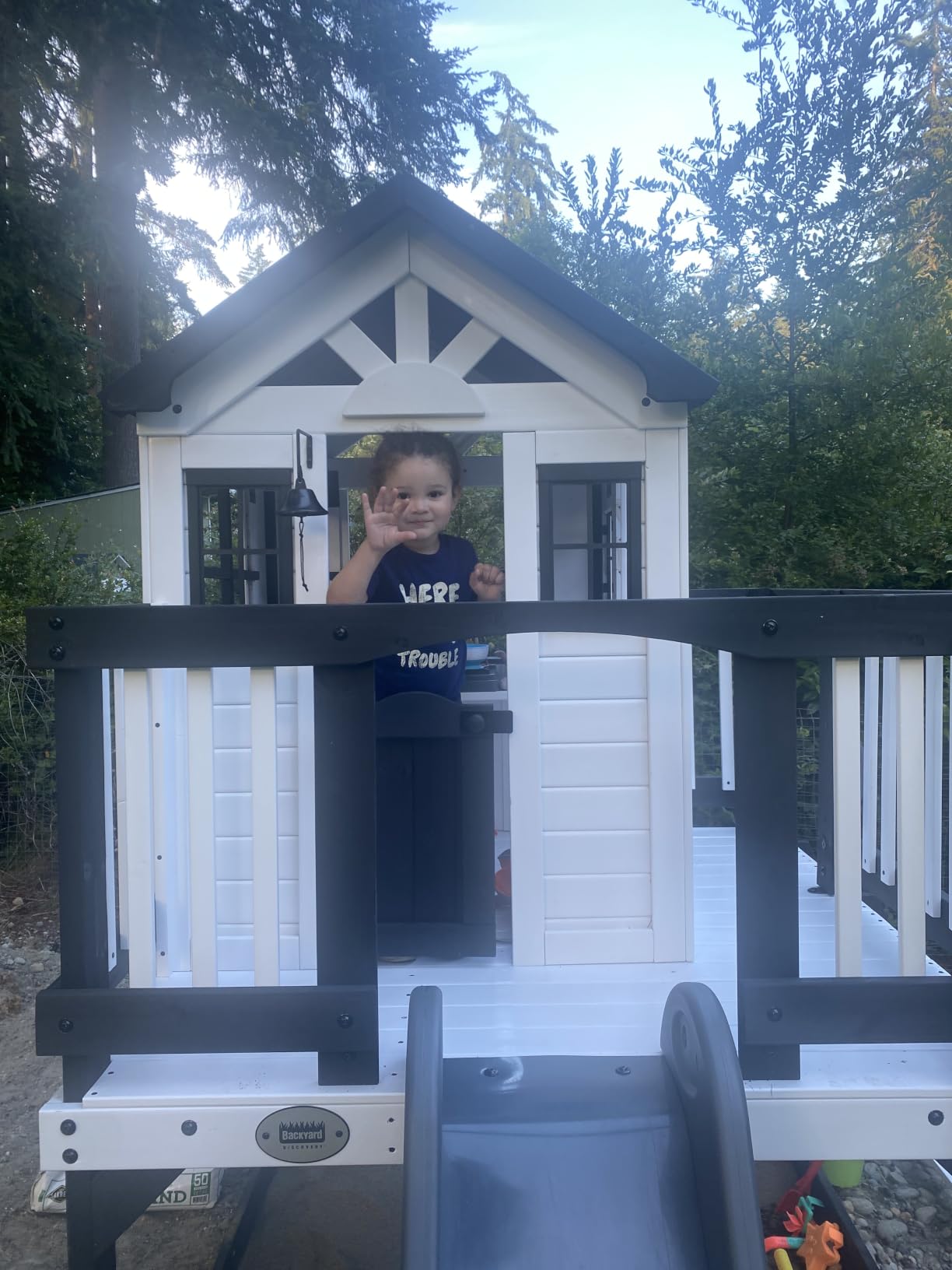
This is the most complete pretend-play structure in the group, and the one that looks like a real clubhouse rather than a climbing frame. It has a play kitchen, a functional half door, six windows, a dinner bell, a powered blender and a built-in growth board, so a toddler gets a house to play in rather than a platform to climb.
The wrap-around elevated deck is the design decision that makes it work in a smaller yard than its 120.24 inch depth suggests. Instead of a large bare platform, the deck wraps the house, which keeps the footprint efficient and gives a place to sit while another child plays.
The 6 foot wave slide has high rails, which is exactly what a small child needs, and the wide flat-step ladder is a gentler alternative to rungs. Parents on forums consistently favour cedar for durability, and Backyard Discovery includes a 5 year limited warranty, the longest in this roundup.
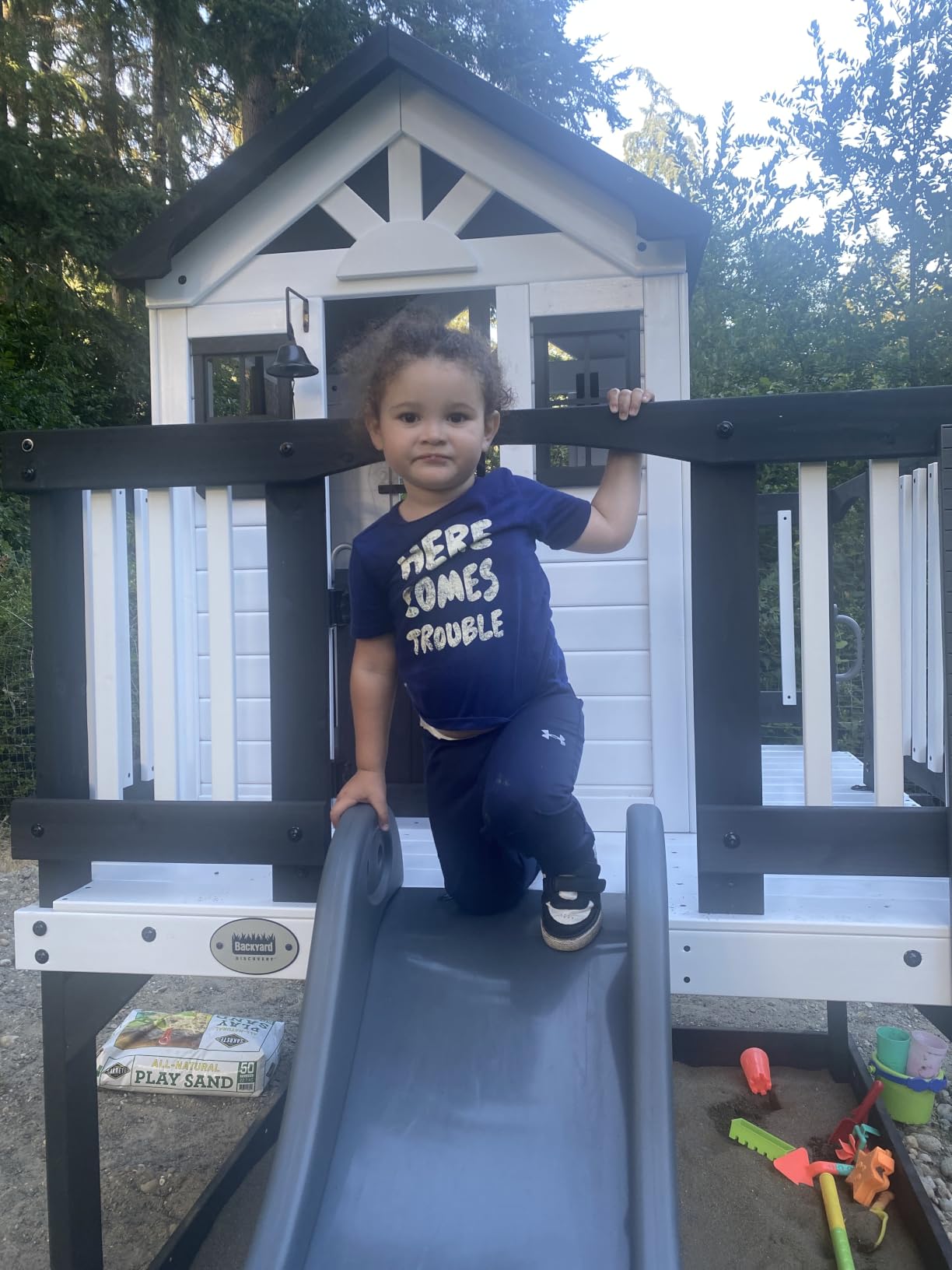
The engineering is documented rather than implied. Backyard Discovery states that its playhouses are built to meet or exceed ASTM standards, with codes 1148-22 and 963 referenced on this model, and it is designed for residential use only.
Assembly is the part parents plan around. The pieces arrive pre-cut, pre-drilled and pre-stained, and the BILT app walks you through the build step by step, but at 114 pounds this is still a two-adult job with the structure built close to where you want it.
What to know before assembly day
Level the ground before you unpack anything. Cedar this size will not sit flat on a slope, and a rocking frame is the fastest way to loosen a joint you just tightened.
Decide on your ground cover now. A 6 foot slide exit needs mulch, rubber tiles or a deep-enough loose-fill layer beneath it, and adding that after the fact means moving the structure.
When to skip it
Skip it for a child under 3. The manufacturer rating starts at 3 years, so this is a preschool-and-up structure, not a toddler one, even though much of the pretend play appeals to younger children.
Skip it if you will not commit to an annual sealing routine. Cedar is the most durable material here, and it is also the one that needs the most maintenance, because untreated or unsealed cedar weathers unevenly and can check at the joints.
5. Simplay3 Young Explorers Modular Play System – Best for Indoors and Reconfigurable Layouts
Simplay3 Young Explorers Modular Play System, Kids Activity Outdoor Playset for Children Age 18 mos – 6yrs, Toddler Playground Slide, Climb and Playhouse
Ages 18 months to 6 years
139 x 82 x 51 inch
128 pounds
Three modules
Pros
- Rated from 18 months
- the second-youngest here
- Works indoors or outdoors for a playroom or basement
- Three modules reconfigure into 12 layouts
- Double-wall plastic with rounded child-friendly edges
- Designed and manufactured in Ohio
Cons
- Best suited to about ages 3 to 4 as children grow
- Assembly runs about two hours even with two adults
- Occasional reports of individual plastic pieces breaking
The Simplay3 system is the one to look at if your main play space is inside the house. It is rated from 18 months to 6 years, it works indoors or outdoors, and the three modules can be attached in 12 different configurations, which means you can shrink the layout for a playroom corner and expand it outside later.
Included are an Adventure Climber, a Discovery Playhouse and an Activity Climber. Across the set you get slides, climbing ramps, ladders, crawling tunnels, steering wheels, a kitchenette, a built-in easel, double doors and mail slots, which is a lot of pretend-play surface for a child who is still mostly interested in the doorbell.
At 139 by 82 by 51 inches and 128 pounds, it is not a lightweight indoor option, so measure doorways and stairwells before you commit. The indoor advantage is real, but only if the modules can reach the room where the play happens.
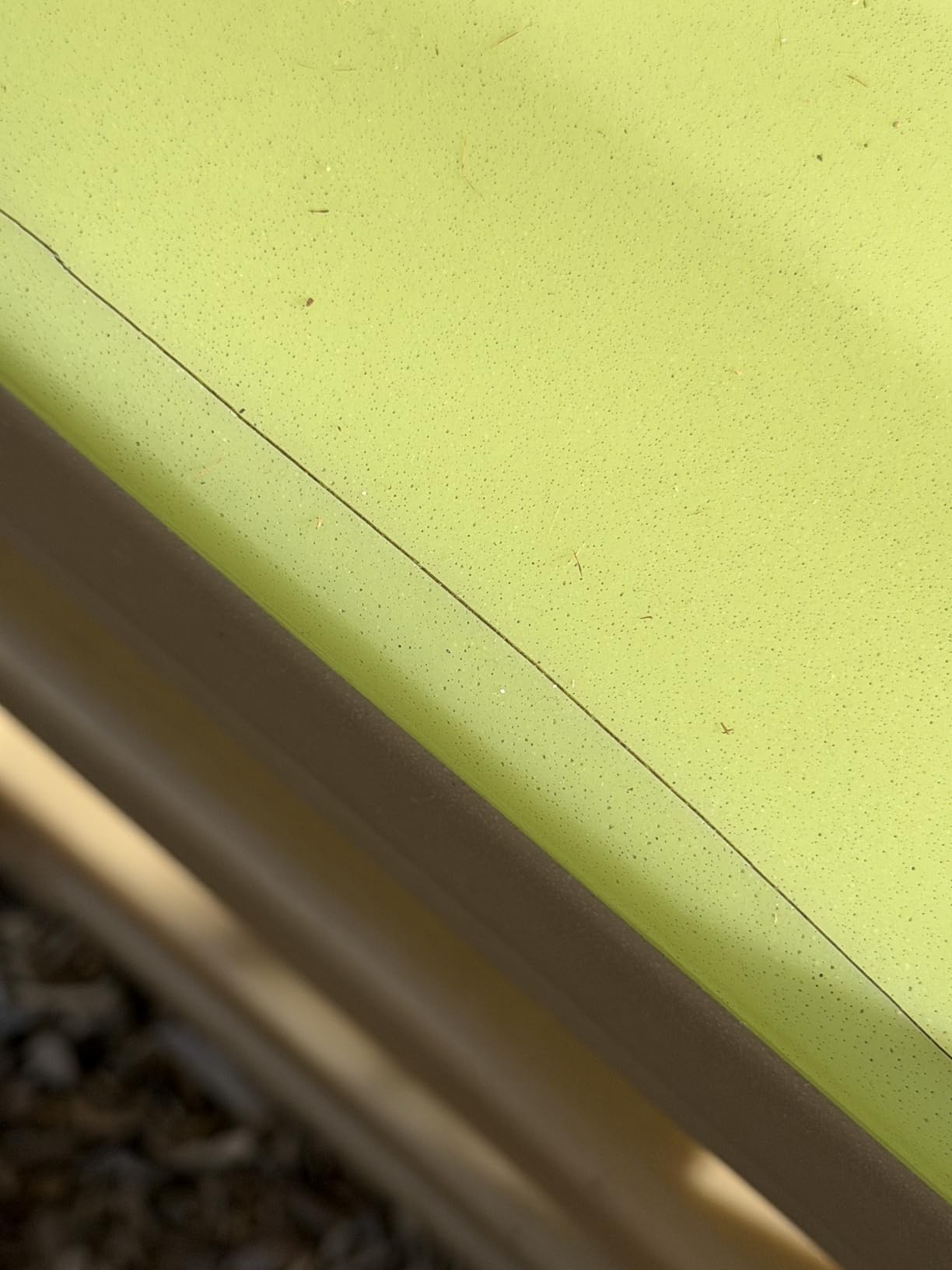
Owners frequently describe the build as straightforward and the layout change as the feature they did not expect to use but ended up relying on. Moving from a long linear setup to a compact cluster is a genuine advantage in a small space.
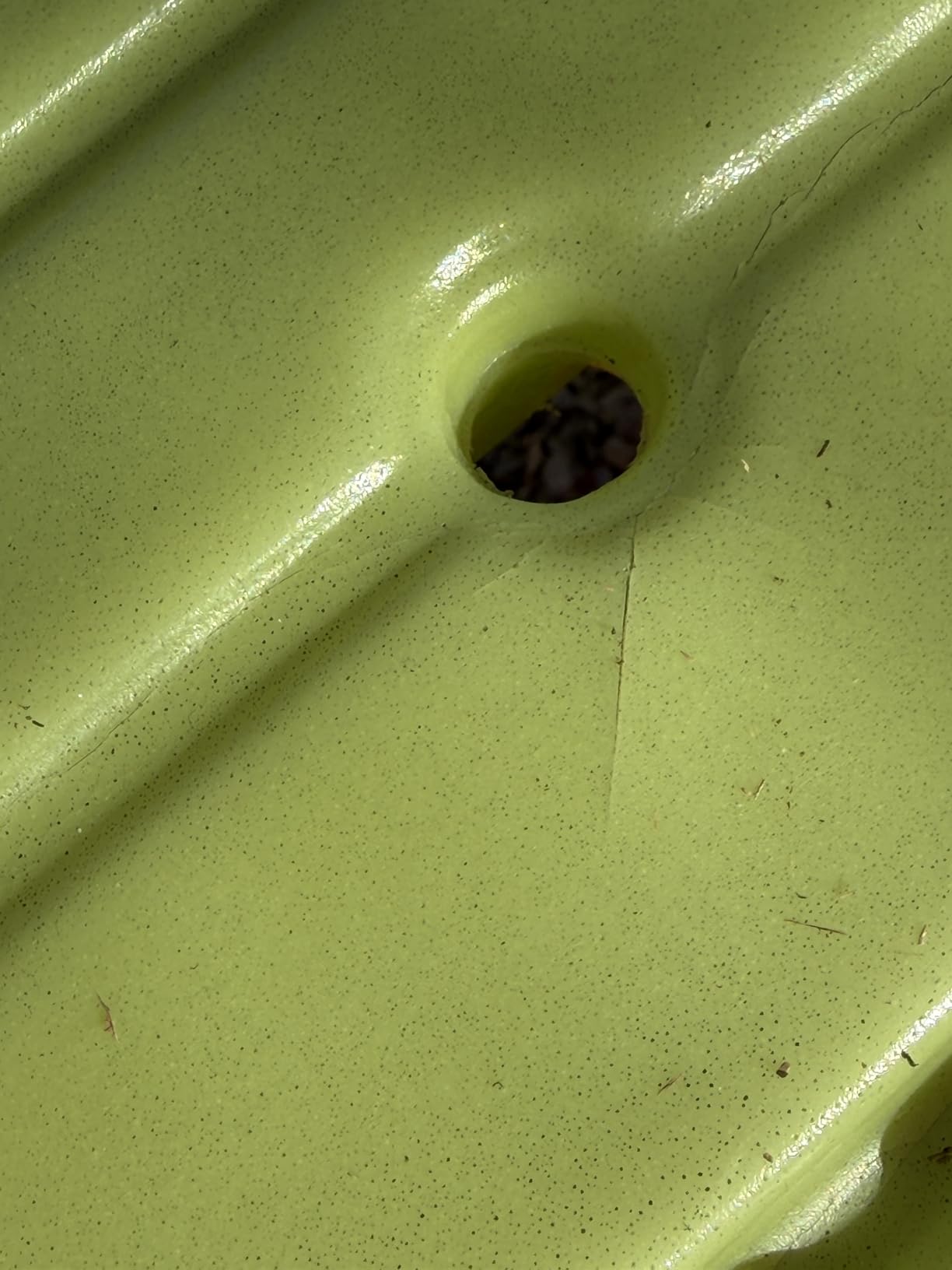
The most common complaints are sizing rather than durability: several buyers report that the structure works best around ages 3 to 4 and that larger children outgrow it sooner than the printed range suggests. The plastic is double-wall and UV resistant, and the manufacturer notes the material is recyclable.
How the modular layout helps you
Three modules mean you can start with two and add the third later, or rearrange after a few months once you know which pieces your child actually uses. That flexibility is the main argument for this over a fixed-frame playset.
Because the whole system works indoors, it fills the winter and bad-weather gap that outdoor-only structures leave open. That is a bigger deal in a cold or wet climate than the summer months of slide play.
When to skip it
Skip it if you need a real house, a roof, or a structure that looks like a cottage. The Discovery Playhouse module is a play panel, and the set reads as a playground rather than a home.
Skip it if you want a very young child to be the primary user for years. Owners report that older children outgrow the size sooner than the 18-month-to-6-year label implies, so treat it as an early-childhood system rather than a long-term one.
6. Backyard Discovery Shenandoah Cedar Swing Set – Best Full Playset Upgrade
Backyard Discovery Shenandoah Cedar Wood Swing Set with Wave Slide, Raised Clubhouse, Playhouse, Play Kitchen, Belt Swings, Trapeze, Rock Wall, Ladder, Picnic Table, Full Door, Outdoor Playset
Ages 3 to 10 years
100 percent cedar
164 x 223 x 125 inch
481 pounds
Pros
- Raised clubhouse plus a lower playhouse with a full door
- 10 foot wave slide and a rock wall with 12 holds
- Two belt swings and a trapeze for three swingers
- Built-in picnic table and snack bar window
- 5 year warranty and ASTM F1148-22 referenced
Cons
- Rated from 3 years
- outside the toddler band
- 481 pounds and a huge footprint need a large yard and heavy assembly
We included this one because it is the honest upper limit of the category, and it shows what a family is buying when they outgrow a toddler playhouse. The Shenandoah pairs a raised clubhouse with a wooden roof and windows above a separate lower playhouse with a full front door, a play kitchen with a toy stovetop, sink and cordless phone, and a built-in snack bar window with a picnic table.
Active play is where it separates itself. A 10 foot wave slide, a rock wall with 12 holds, a wide step ladder, two belt swings and a trapeze cover the full range of what a playset can do, and the manufacturer rates it for up to 9 children.
The scale is the honest drawback. It measures 164 by 223 by 125 inches, it weighs 481 pounds assembled, and the manufacturer rate starts at 36 months. This is not a toddler structure, and a two-year-old has no business on a rock wall or a 10 foot slide.
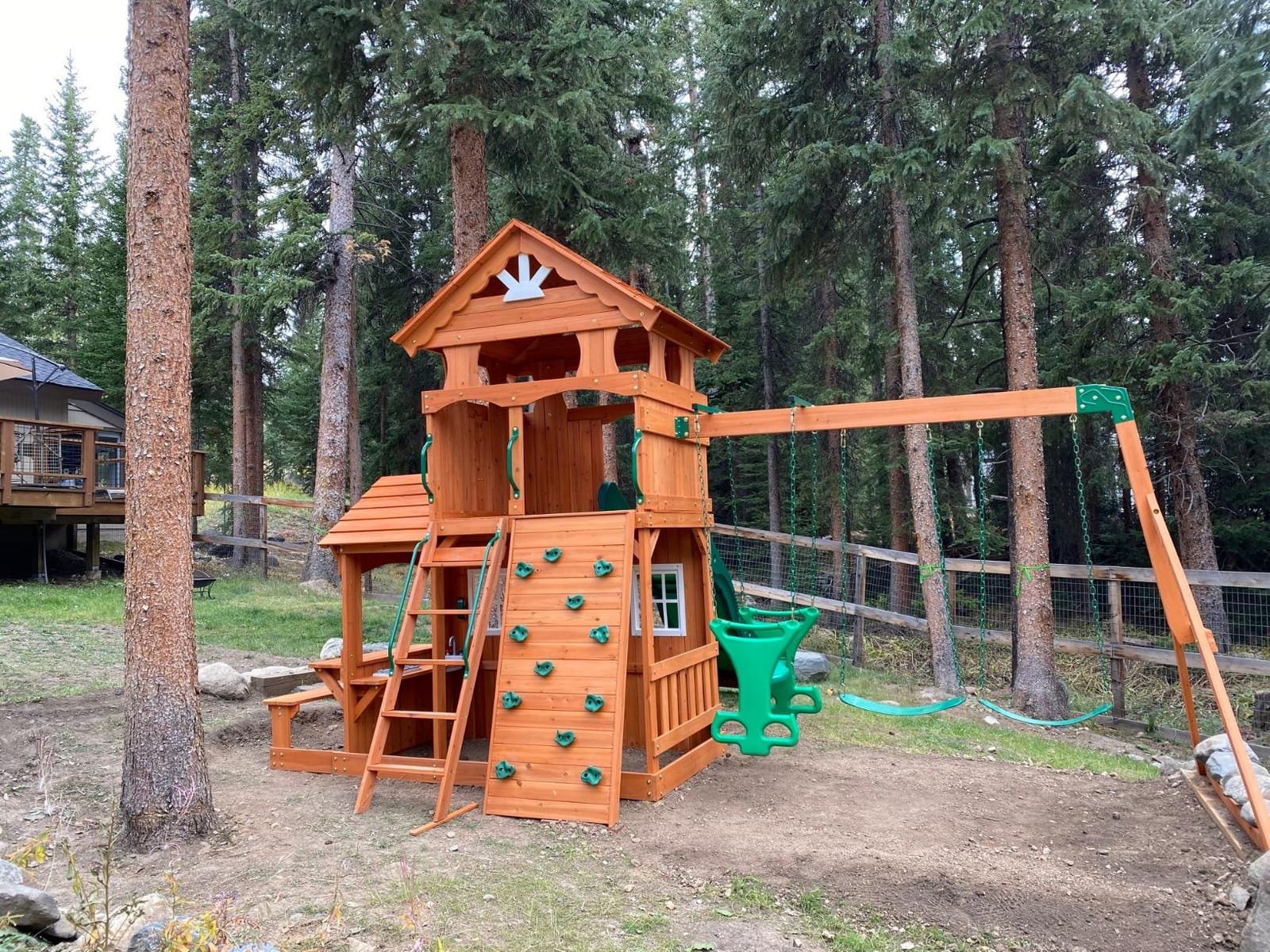
Cedar is the material here too, with a rustic burnt sienna stain, and Backyard Discovery references ASTM F1148-22 for this model. The same maintenance caveat applies as with the Echo Heights, since cedar needs sealing to keep the finish even.
Reviews are heavily positive, with a strong five-star share, and buyers most often point to the number of play zones, the cedar build, the guided BILT app assembly and the 5 year warranty. The most common reservations are the footprint, the weight and the cost relative to simpler wooden sets.
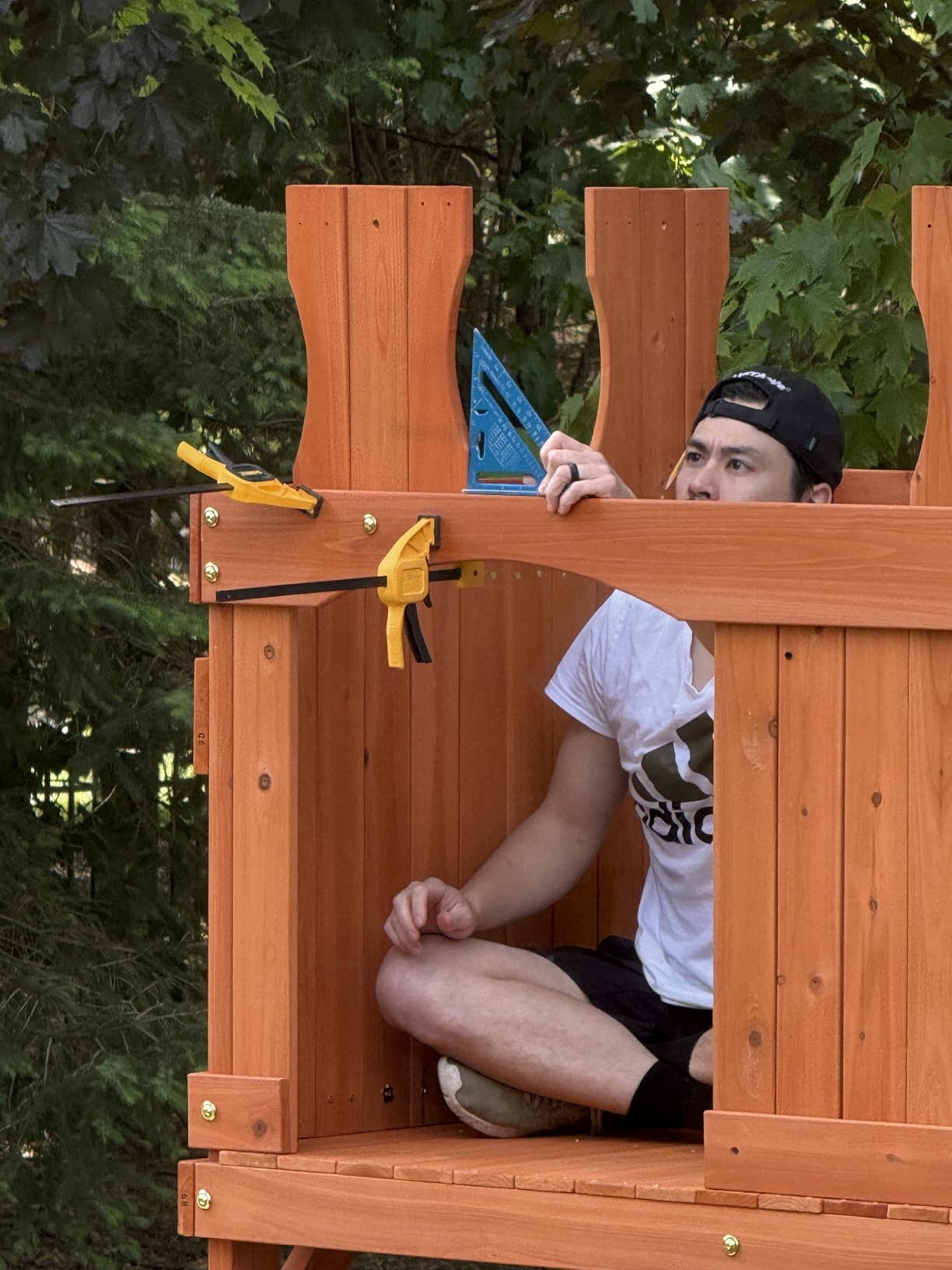
What this one is actually for
Think of it as the destination rather than the starting point. Most families who buy this already have a toddler playhouse and are adding active play for a child who is climbing confidently, often with a sibling in tow.
The lower playhouse is the part that keeps younger children involved. A three-year-old can use the play kitchen, the door and the snack bar while an older child works the rock wall, which is what makes a set this large work for mixed ages.
When to skip it
Skip it if you are shopping for a toddler. The stated minimum is 36 months, and the wave slide alone puts it outside the age band this roundup is about. A child under 3 belongs on the Lookout Treehouse or the Simplay3 modules.
Skip it if assembly is going to be a one-person weekend. At 481 pounds across a 164 by 223 inch footprint, this needs multiple adults or professional installation, and the site should be levelled and cleared before the first box arrives.
How to Choose a Playhouse With a Slide for a Toddler
What counts as a toddler playhouse
A toddler playhouse is rated from 18 months to 4 years by the manufacturer, and the rating is the first thing to check on any listing. Structures rated 3 years and up, like the two cedar picks here, are preschool equipment that happens to appeal to younger children through pretend play, and they are not designed for a two-year-old’s balance or grip.
The second tell is the climb. Steps with grab rails are usable by a young toddler. A vertical ladder with wide rung gaps is not. The difference is not a style choice, it is the difference between independent play and an adult lifting a child up every time.
Are playhouses with slides safe for toddlers?
They are, with the right setup. The safety checklist we use is short:
1. Slide rails tall enough for a seated toddler, so she is not sliding with her legs loose. The Echo Heights and Shenandoah both describe their wave slides as having high rails.
2. A soft landing surface under the slide exit. Mulch, engineered wood fibre, pea gravel at a suitable depth, or rubber surfacing tiles are the usual options. The surface matters more than most parents expect, because toddler falls from slides are forward falls onto hard ground.
3. Rung spacing and handholds that a small hand can actually grip. Steps with rails beat rungs for this age group.
4. A documented safety standard. Backyard Discovery states ASTM codes 1148-22 and 963 on the Echo Heights and F1148-22 on the Shenandoah, and notes residential use only.
5. Anchoring, so a wind gust cannot tip the structure onto a child. This matters most for the lighter plastic models, which are the easiest to lift and the easiest to tip.
6. Enough clearance around the slide exit for a running child to stop. Measure from the bottom of the slide, not from the edge of the structure.
Wood or plastic
Cedar lasts longer and takes a stain colour that blends into a garden, and it handles a swinging sibling better than plastic does. It is also heavier, harder to move, and it needs sealing to keep the finish and the joints in good shape. Parents in forum threads frequently warn that budget wood kits feel light and flimsy, and that over-tightening screws can drive them straight through thin boards.
Plastic needs almost nothing. Hose it off, wipe it with soap and water, and move it indoors when winter arrives. The trade-off is that the colour can fade and the material can check or crack over several seasons of heavy use, which several reviewers on the Step2 models here mention. For a family that moves house or rents, plastic is a much better fit.
If your child is under three, we lean plastic. The weight, the finish and the age ratings all favour it, and a toddler will not notice the difference in material at all.
How much space does a playhouse with a slide need?
More than the listed footprint, always. Add the slide run-out zone at the bottom and at least 6 feet of clear space beyond it, plus enough side clearance for a child to walk around the structure. On a slide that is 6 to 10 feet long, that is a meaningful addition to the manufacturer’s dimensions.
For a genuinely small yard, the Lookout Treehouse at 25 inches deep is the only pick here that fits along a fence. The Play Up Double Slide Climber at 51 inches wide is the next most compact option. Anything wider than that starts to consume the lawn a toddler actually needs to run around in.
Assembly, anchoring and the soft landing surface
Plan assembly as a two-adult job with a power driver, a tape measure and a level. Forum feedback on this category is consistent: these builds take longer than the box suggests, and a second adult is what turns a frustrating afternoon into a manageable one.
For plastic, follow the pilot holes the manufacturer provides rather than forcing screws, and stop overtightening. For cedar, assemble the frame on a flat surface first and only then move it into position, because a heavy frame twisted in place will never sit square.
Anchor the structure before first use. For plastic sets, ground anchors at the base corners prevent wind tipping. For cedar, a deeper anchor through the base frame into the ground is the equivalent. Both are far easier on assembly day than three months later.
Finish the ground before you build, not after. Lay mulch or rubber surfacing under the slide exit first, then build on top of it, so you never have to relocate a finished structure to fix the landing area.
One more item worth planning for: for a two-year-old who is not yet steady, the balance bike and outdoor gross-motor play do more for the same climbing confidence than any single piece of equipment. A playhouse with a slide supports that development, but it does not replace the rest of the time outside.
Buying a second-hand playhouse with a slide
Second-hand playhouses with slides are actively traded in parent groups, and the savings can be real. Check these five things before you commit to one.
1. The age rating label and any certification marks. If they are worn past legibility, treat the age claim as unknown.
2. The ladder and the slide bed. Look for cracks in the plastic, or for wood that is soft, splintered or splitting along the grain.
3. The hardware. Rusted or missing bolts are the most common reason a second-hand set gets returned, so count them against the original parts list if you can.
4. The slide exit surface. Even a good structure needs ground cover beneath it, and that cost is part of the purchase either way.
5. Whether all parts are present before you start. A missing slide or ladder panel is usually not worth sourcing separately, and shipping a large part can cost more than the structure is worth.
For indoor-only pretend play, our picks on the travel cribs for toddlers guide covers another piece of the small-space setup, since a toddler who is sleeping and playing in the same room needs both solved.
Frequently Asked Questions
What is a good outdoor playhouse with a slide for a toddler?
A good toddler playhouse with a slide has a low deck reached by steps with grab rails, an enclosed pretend-play space, slide rails tall enough for a seated child, and a manufacturer age rating starting at 18 months to 24 months. A soft landing surface under the slide exit and roughly 6 feet of clearance beyond it matter more than most buyers expect.
What age is a play house with slides suitable?
Most playhouses with slides are rated from 2 years upward, and the best toddler options start at 18 months. Structures rated 3 years and up, including the two cedar playhouses in this roundup, suit preschoolers and older children rather than toddlers. Always check the manufacturer age range before buying.
What is the best playhouse with a slide for toddlers?
The Step2 Play Naturally Playful Lookout Treehouse is the best overall pick for toddlers because it is rated from 18 months, uses steps with grab rails instead of a vertical ladder, and has a 25 inch depth that fits a small yard. For multiple children, the Step2 Clubhouse Climber offers two slides and two clubhouses.
What is a good playhouse for a 2-year-old?
For a 2-year-old, prioritise a manufacturer rating that starts at 18 or 24 months, steps with grab rails rather than rungs, and a slide exit close to ground level. A model like the Lookout Treehouse or the Simplay3 modular system fits this stage, while anything rated 3 years and up does not.
Are playhouses with slides safe for toddlers?
They are, when the setup is right. Use slide rails tall enough for a seated child, put mulch, pea gravel at a suitable depth, or rubber surfacing tiles under the slide exit, leave around 6 feet of clearance beyond it, choose a climb the child can manage alone, check for a documented safety standard, and anchor the structure so it cannot tip in wind.
What are the most durable playhouses?
Cedar playhouses are generally the most durable because the wood resists rot naturally and holds its structure through rough play. They need sealing to keep the finish and joints in good condition. Double-walled plastic playhouses need almost no maintenance and are easier to move, but colours can fade and plastic can check or crack after several seasons of heavy use.
How much space does a playhouse with a slide need?
More than the listed footprint. Add the full run-out of the slide plus at least 6 feet of clear space beyond the exit, and enough side clearance for a child to walk around. Compact plastic models at 25 to 51 inches wide fit small yards, while cedar playhouses at 75 inches wide and up need a considerably larger area.
How long does it take to assemble a playhouse with a slide?
Treat it as a two-adult job with a power driver, a level and a tape measure, and allow a full weekend rather than an evening. Assembly is easiest when the ground cover is laid first and the structure is built close to its final position, since moving a finished set weighing up to 481 pounds is a project in itself.
The Best Playhouses With Slides for Toddlers in 2026
The best playhouses with slides for toddlers come down to one variable: whether the child can use it alone. The Step2 Lookout Treehouse wins on that basis and on footprint, with an 18-month rating and a 25 inch depth that leaves the rest of the lawn playable. The Step2 Clubhouse Climber is the right buy the moment a second child needs their own slide, and the Simplay3 modular system fills the indoor months that an outdoor-only structure cannot.
The two cedar options here are genuinely better built and they are not toddler products, so buy them when the time comes rather than before. Whichever you choose, lay the ground cover, anchor the frame and build it with a second adult before anyone climbs.
For a child who is still under two, the safest single addition to any of these is more time outside on feet rather than a larger structure. Our outdoor playhouse guide covers the non-slide options if you want a second play zone later.