
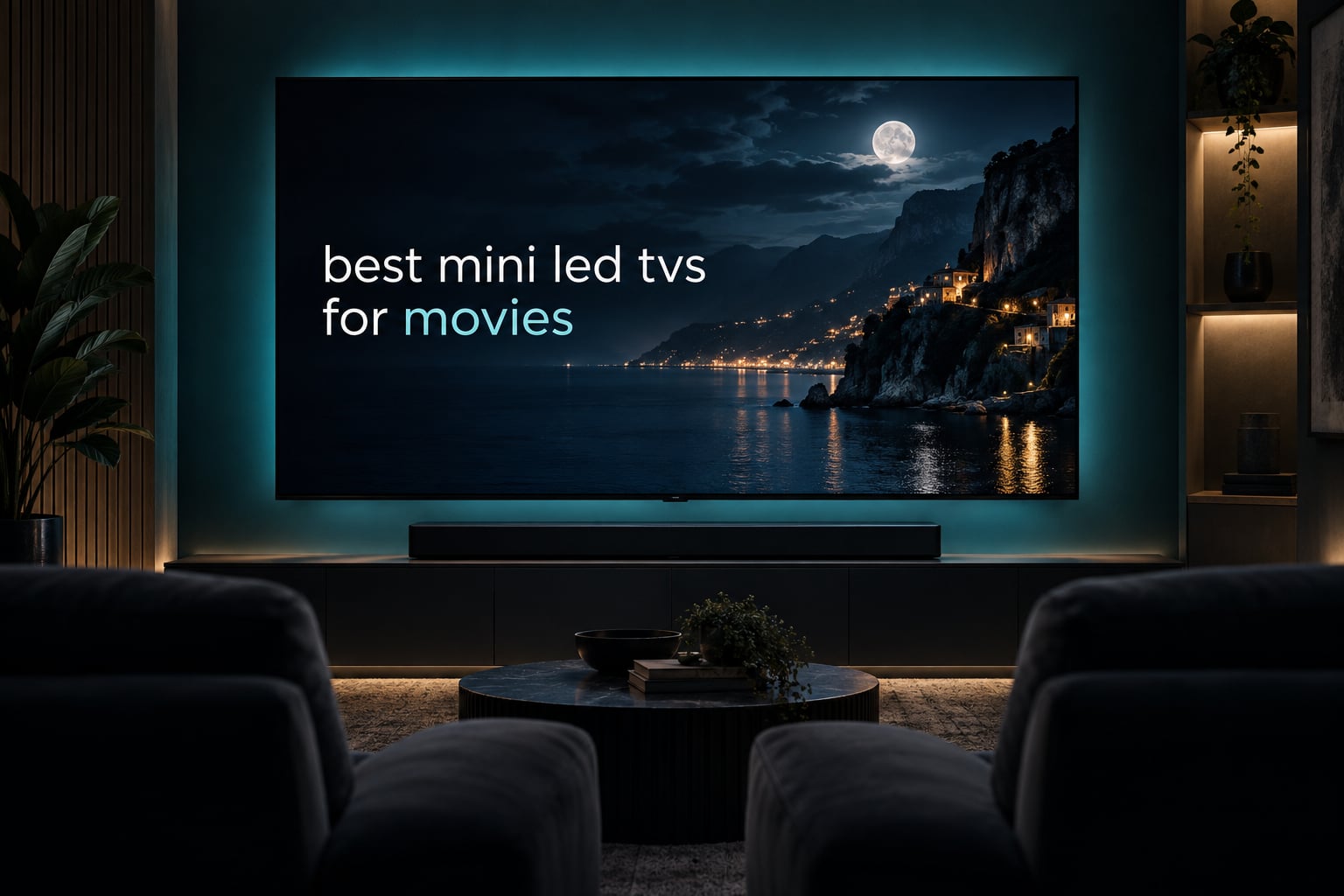
Mini LED is the panel type that finally lets an LCD television behave like a cinema screen. Thousands of tiny backlight LEDs sit in hundreds or thousands of independently dimmable zones, so the set can drop the backlight to near-black behind a letterboxed title card and push hard for a sunlit explosion in the same frame. That combination of deep black and serious HDR brightness is exactly what a movie needs, and it never carries the permanent burn-in risk that OLED panels can develop from static subtitles or channel logos.
Most “best mini LED” lists you will find are organised by price tier or by gaming features. We took a different approach. Every set in this roundup of the best mini LED TVs for movies was judged on the things you actually notice during a two-hour film: how black the blacks get with the lights off, whether white subtitles halo against dark backgrounds, whether HDR highlights flare or fade, whether the panel keeps its contrast when you sit off-centre on the sofa, and whether FILMMAKER mode holds the frame rate and aspect ratio the director intended.
We reviewed ten Mini LED sets spanning 50 to 85 inches, from a slim wall-mountable 55-incher to an 85-inch home theatre panel with thousands of zones. Below you will find what each one does well with movies, where it falls short, and who should skip it. If your setup is smaller, our best tablets for watching movies covers the portable end of the spectrum.
Table of Contents
Top 3 Best Mini LED Picks for Movies in 2026


All 10 Mini LED TVs for Movies Compared (October 2026)
| Product | Specifications | Action |
|---|---|---|
 TCL 55A400U 55-inch QD-Mini LED TCL 55A400U 55-inch QD-Mini LED |
|
Check Latest Price |
 TCL 65QM6K 65-inch QD-Mini LED TCL 65QM6K 65-inch QD-Mini LED |
|
Check Latest Price |
 Samsung M70H 65-inch Mini LED Samsung M70H 65-inch Mini LED |
|
Check Latest Price |
| Hisense 85U8QG 85-inch ULED Mini LED |
|
Check Latest Price |
| Roku 65 Plus Series 65-inch |
|
Check Latest Price |
 Samsung QN70F 55-inch Neo QLED Samsung QN70F 55-inch Neo QLED |
|
Check Latest Price |
 Hisense 65E7SF Cinema Series Hisense 65E7SF Cinema Series |
|
Check Latest Price |
 Samsung QN90F 50-inch Neo QLED Samsung QN90F 50-inch Neo QLED |
|
Check Latest Price |
 Toshiba 65Z670R Mini LED Toshiba 65Z670R Mini LED |
|
Check Latest Price |
 Sony 85-inch BRAVIA 5 Sony 85-inch BRAVIA 5 |
|
Check Latest Price |
How We Picked: What We Actually Checked for Movies
Most roundups tell you about peak brightness and stop there. For a movie roundup we looked at six things, in this order: local dimming behaviour on dark scenes, sustained brightness in a lit versus darkened room, HDR format support, motion handling for 24fps cinema content, viewing-angle stability, and how the set behaves with a physical 4K Blu-ray player attached.
We leaned on manufacturer specification data and on thousands of owner reviews, which is where the practical warnings live. Zone counts and brightness figures are useful but they are not the whole story, and we say so in every section below. Where a figure is an “up to” claim that varies by screen size or content, we flag it rather than repeating it as fact.
One structural note that catches most buyers off guard: the same model name can ship with a different panel type depending on size, and a VA panel and an ADS panel do not produce the same black level in a dark room. Where the data we had was ambiguous we told you rather than guessing.
Mini LED vs OLED for Movies: The Honest Trade
An OLED panel switches its own pixels off, so it produces perfect black and unbeatable viewing angles with no haloing at all. A Mini LED keeps a full LCD layer in front of the backlight, so a small amount of light always leaks through and bright subtitles can throw a halo into the surrounding frame. That is the single trade you are making.
What you get in exchange is a screen that will never burn in from a static news ticker or a streaming service’s logo, brightness headroom that survives a sunlit living room, and size options that reach 85 inches at a price an OLED simply does not occupy in this roundup. For a family that watches films in a bright room with the curtains open, brightness often matters more than absolute black.
Our rule of thumb: if you watch in a fully darkened dedicated room and you are bothered by any halo, look at OLED. If you want a very large screen, a bright room, or marathon viewing with static elements on screen all day, the best mini LED TVs for movies are the smarter buy.
1. TCL 55A400U – The Best Mini LED TV for Movies Overall
TCL 55-Inch Designer Series QD-Mini LED TV, 4K Google Smart TV, 55A400U
55-inch QD-Mini LED
448 dimming zones
650 nits listed peak
4K 144Hz
93% DCI-P3
Pros
- Deep Mini LED blacks give dimensional night scenes
- 448 zones give granular shadow control
- Low-reflection HVA Pro panel suits bright rooms
- 1.57-inch profile mounts near-flush to a wall
- Google TV sets up quickly
Cons
- Listed peak brightness of 650 nits is modest for HDR
- 448 zones is coarse next to premium Mini LED
- 20W ONKYO 2.0 speakers want a sound bar
I keep coming back to this set because it does the boring things right. Watch a night scene in a dim room and the panel goes genuinely dark rather than settling into a grey haze, which is the difference between feeling like a cinema and feeling like a monitor. Owners describe dark movie scenes as dimensional, and that matches what the local dimming hardware should deliver.
The Designer Series angle is not just marketing. At 1.57 inches deep with roughly a 0.12-inch gap when wall mounted, it sits almost flat against the wall with no external control box, so it disappears into a built-out media wall better than any other set here.
The specification sheet is where you have to read carefully. It lists a maximum display brightness of 650 nits and a 6000:1 contrast ratio, and separately describes 448 dimming zones with up to HDR 2500 nits peak. Treat the 650-nit figure as the realistic anchor for a normal living room and the 2500-nit number as a small-window peak claim. For film use, 650 nits still gives a satisfying HDR picture on a typical screen, it simply will not throw the highlights as hard as the Hisense later in this list.
Colour coverage is rated at 93% DCI-P3 with an HVA Pro low-reflection panel, and the TSR AiPQ processor handles picture, sound and motion optimisation. It runs native 4K at 144Hz with VRR, FreeSync Premium Pro and ALLM, which you will not need for films but which costs you nothing to have. Dolby Vision, HDR10, HDR10+ and HLG are all supported, so every major HDR source is covered.
Why it works for movie night
The combination of 448 zones, full array local dimming and a low-reflection panel is exactly the spec sheet you want for a mixed-use room. Film grain and shadow detail hold up because the backlight has enough independent control to keep dark areas dark without crushing everything else.
It also ships with Art Gallery, Digital Art and Ambient Mode features, which is a small but pleasant bonus if the set lives in a living room rather than a theatre.
Where it falls short
The listed 650-nit ceiling means HDR highlights are present but restrained. On a very dark, very large screen in a blacked-out room you will notice that a flagship Mini LED or an OLED reaches further. If your priority is maximum HDR punch and you have the room and the wall space, look further down this list.
The 20W ONKYO 2.0 system is genuinely thin for cinema. Many owners add a sound bar, and DTS:X plus DTS Virtual:X are supported if you route audio that way.
2. TCL 65QM6K – Best 65-Inch Mini LED for Big-Screen Value
TCL 65 Inch Class QM6K Series | Mini LED QLED 4K HDR | 65QM6K, Latest Model | 120HZ-144HZ High Brightness Smart Google TV Dolby Atmos Onkyo Audio | Voice Remote Alexa Gaming Streaming Television
65-inch QD-Mini LED
144Hz native
HDR10+ and Dolby Vision
ONKYO 2.1 with subwoofer
Pros
- Halo Control local dimming reduces halos and lifts shadow detail
- 65-inch screen with a built-in subwoofer
- 144Hz native refresh with Motion Rate 480
- Handles bright rooms and off-angle viewing well
Cons
- Brightness trails premium Mini LED in very bright rooms
- Black level stops short of OLED and flagship sets
- Google TV home screen is ad-heavy
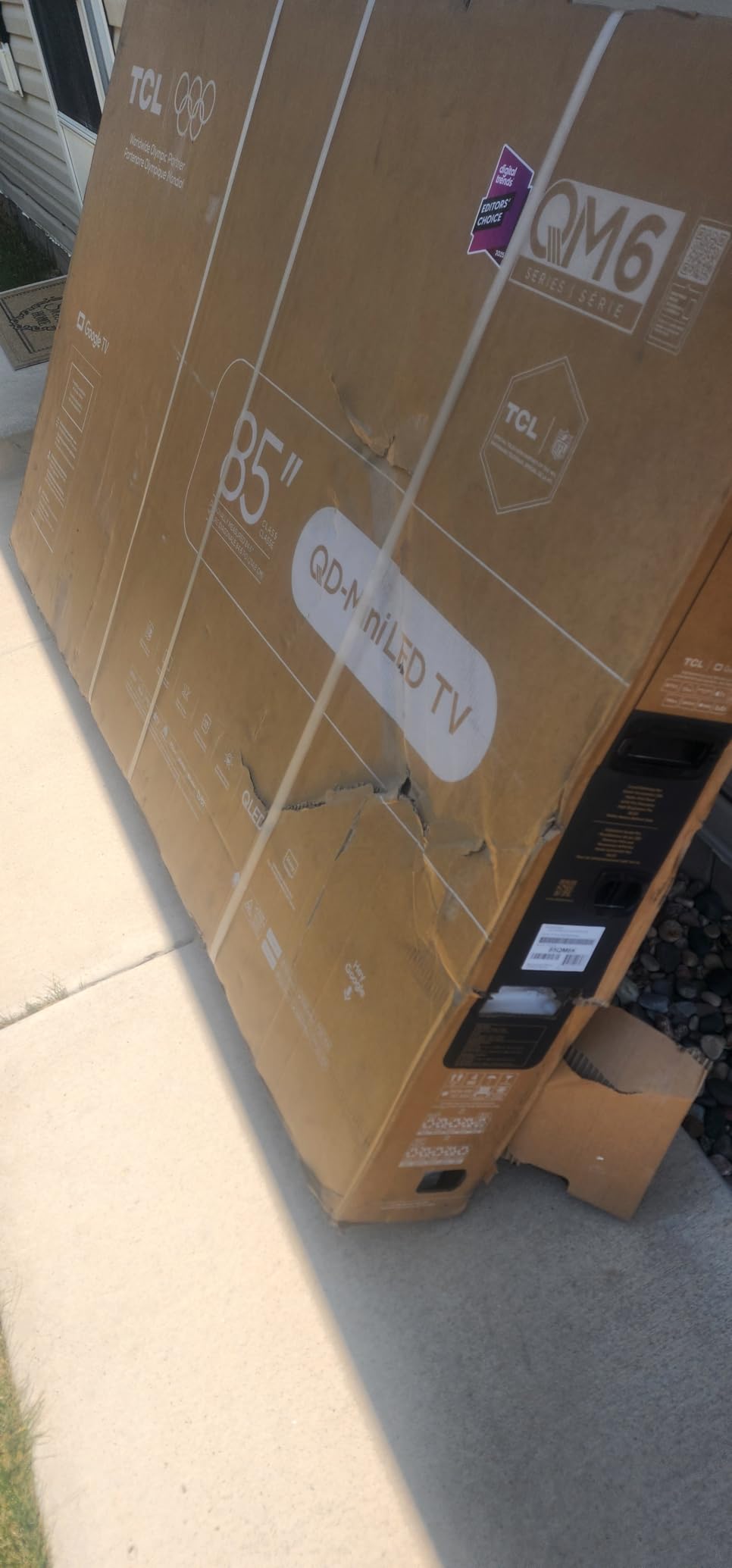
This is the set most people end up buying, and for a film-focused household it earns the place. The 65-inch panel runs at 144Hz natively with Motion Rate 480, which means film grain and slow camera moves look stable rather than smeared, and it keeps a 178-degree viewing angle that matters when the sofa is wider than the screen.
The TCL Halo Control System is the piece that matters most for movies. It is a local dimming approach designed specifically to reduce haloing around bright objects and to improve shadow detail, which is precisely the failure mode people complain about on budget Mini LED sets. Owners consistently report deeper blacks and brighter HDR than the entry-level LED sets they replaced.
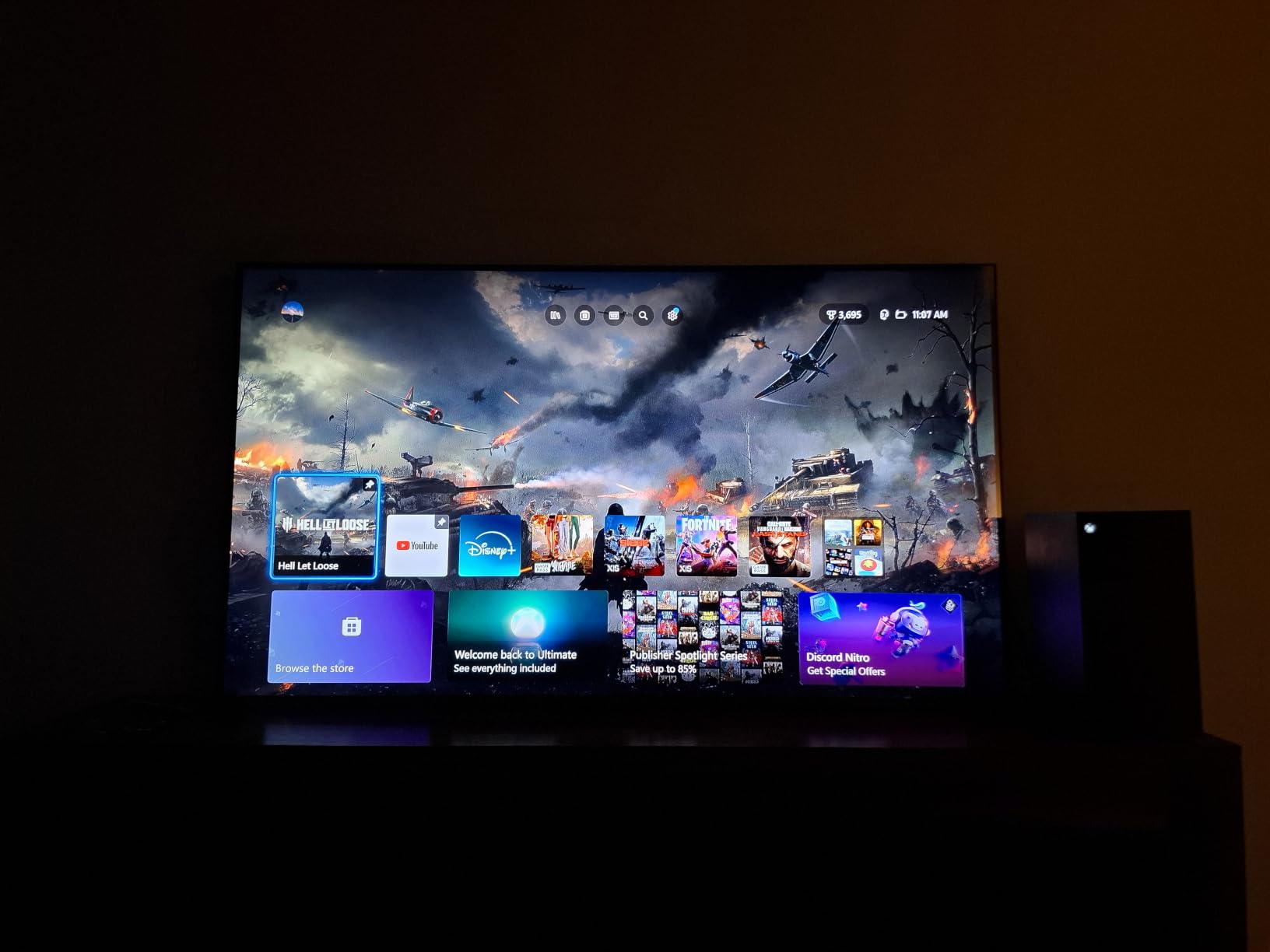
Audio is the quiet surprise. The ONKYO 2.1 system includes a built-in subwoofer, and reviewers single it out as better than expected at this price class. If you are building a first home cinema on a sensible budget, you can get through a film without immediately shopping for a sound bar.
On the specification side you get Dolby Vision, HDR10+, HDR10 and HLG, four HDMI ports, optical audio out, and Google TV with AirPlay 2, Google Cast and a voice remote. That is a complete streaming and disc package.
Why it works for movie night
Halo control and a 65-inch screen in the same set is the pairing we would prioritise. A large panel magnifies every halo artefact, so the dimming system matters more as the screen grows, not less.
It is also a good fit for a bright living room. Owners report it handles daylight and off-axis seating well, which is where several cheaper Mini LED panels start to look washed out.
Where it falls short
Brightness is the limitation reviewers name most. In a very bright room the HDR impact is modest, and the black level does not reach OLED or flagship Mini LED performance in a fully darkened room.
The Google TV home screen is ad-heavy unless you install a third-party launcher, and the auto volume adjustment feature annoys some owners enough that they switch it off. The Google Home phone app also fails to detect the TV for a minority of users.
3. Samsung M70H 65-Inch – The Budget Route Into Mini LED
Samsung 65-Inch Class M70H Series, Mini LED, 4K, Smart TV, 2026 Model
65-inch Mini LED
Mini LED Processor 4K
HDR10+
60Hz native
3x HDMI
Pros
- Genuine Mini LED contrast at the lowest tier here
- 65 inches is a lot of film for the money
- Samsung TV Plus gives 750+ free channels
- Lightweight design is easy to mount
Cons
- Native 60Hz trails every other set in motion clarity
- HDR10+ only with no Dolby Vision or Atmos
- Only 3x HDMI and 1x USB limits hookups
The pitch here is simple: a full-size Mini LED panel with real local dimming and a Mini LED Processor 4K for handling highlights and blacks, on a smaller budget than anything else in this roundup. Owners frame it as the no-compromise entry point into 65-inch Mini LED, and for a first upgrade from an older LED set the jump in contrast is immediate.
Motion Xcelerator with Turbo+ drives 120Hz-class motion handling, and Color Booster plus Soccer Mode add punch to saturated content. For films, the useful part is the dimming behaviour and the free streaming catalogue rather than the extra picture modes.
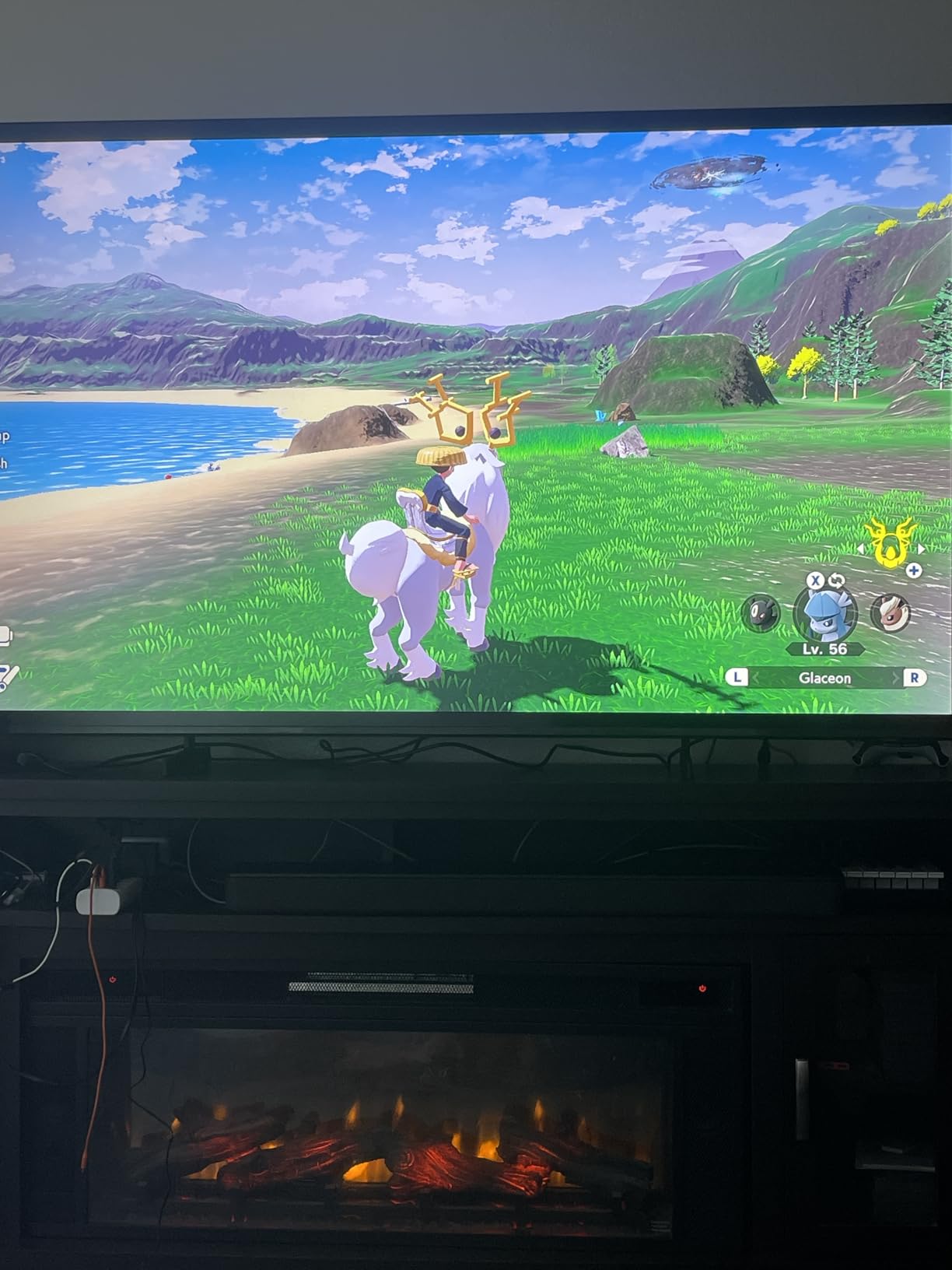
Two things to know before you commit. The native panel is 60Hz, which is the lowest here and means motion detail trails the 120Hz and 144Hz rivals, particularly on fast action. And the HDR support is HDR10+ only, with no Dolby Vision and no Dolby Atmos, so a 4K Dolby Vision disc or a Dolby Vision stream will fall back to a lesser format.
Samsung TV Plus is a genuine perk for a movie set: more than 750 subscription-free channels, plus 2,700 or so free streaming options, and no subscription needed for the basics. Connectivity is 3x HDMI, 1x USB, Bluetooth 5.3 and Wi-Fi, with 200 x 200 mm VESA mounting.
Why it works for movie night
If your goal is the biggest possible step up in black level from a standard LED television without stretching the budget, this does it. The Mini LED Processor 4K does the heavy lifting on highlight and shadow handling.
It is a light, easy set to handle and mount, which matters if you have never installed a large panel before.
Where it falls short
The 60Hz panel is the compromise. Film content is mostly 24fps so it is less damaging than it is for sports or gaming, but it is still the weakest motion performer here.
No published dimming zone count means halo control is less predictable than on the QD-Mini LED sets, and losing Dolby Vision on a TV you bought for movies is the bigger regret. Built-in speakers are basic 2-channel, and the 1-star share in the reviews is comparatively large for a Samsung set.
4. Hisense 85U8QG – The Best Mini LED for a Dedicated Home Theater
Hisense 85″ U8 Series ULED Mini-LED 4K UHD Smart Google TV (85U8QG) – QLED, Native 165Hz, VRR 288, Up to LD5600, 5000 Nits, HDR10+, Dolby Vision IQ · Atmos, IMAX Enhanced, 4.1.2 Ch Audio
85-inch Mini LED
Up to 5600 dimming zones
5000 nits peak
4.1.2 Dolby Atmos
Pros
- Thousands of zones and 5000 nits give real HDR punch
- Dolby Vision IQ with IMAX Enhanced and Filmmaker Mode
- 4.1.2 Atmos with up-firing speakers and subwoofer
- Anti-Reflection Pro coating holds up in lit rooms
- Two-year warranty
Cons
- 104.5 pounds needs two people and careful mounting
- Only 3x HDMI on a set this size
- Platform polish trails the major brands
At 85 inches with up to 5600 local dimming zones and a listed 5000-nit peak, this is the set in the roundup that most resembles what a commercial home cinema room would run. The zone density at this size is what kills haloing around subtitles and keeps night scenes from washing out, and that is exactly the movie-night problem we set out to solve.
Picture processing comes from the Hi-View AI Engine Pro. Colour is PANTONE-validated QLED with Filmmaker Mode, and the HDR support list is the longest here: Dolby Vision IQ, HDR10+ Adaptive, HDR10, HLG and Technicolor Advanced HDR, plus IMAX Enhanced certification with DTS-powered audio. If you own an IMAX Enhanced 4K disc, this is the set that will actually show you the enhanced version.
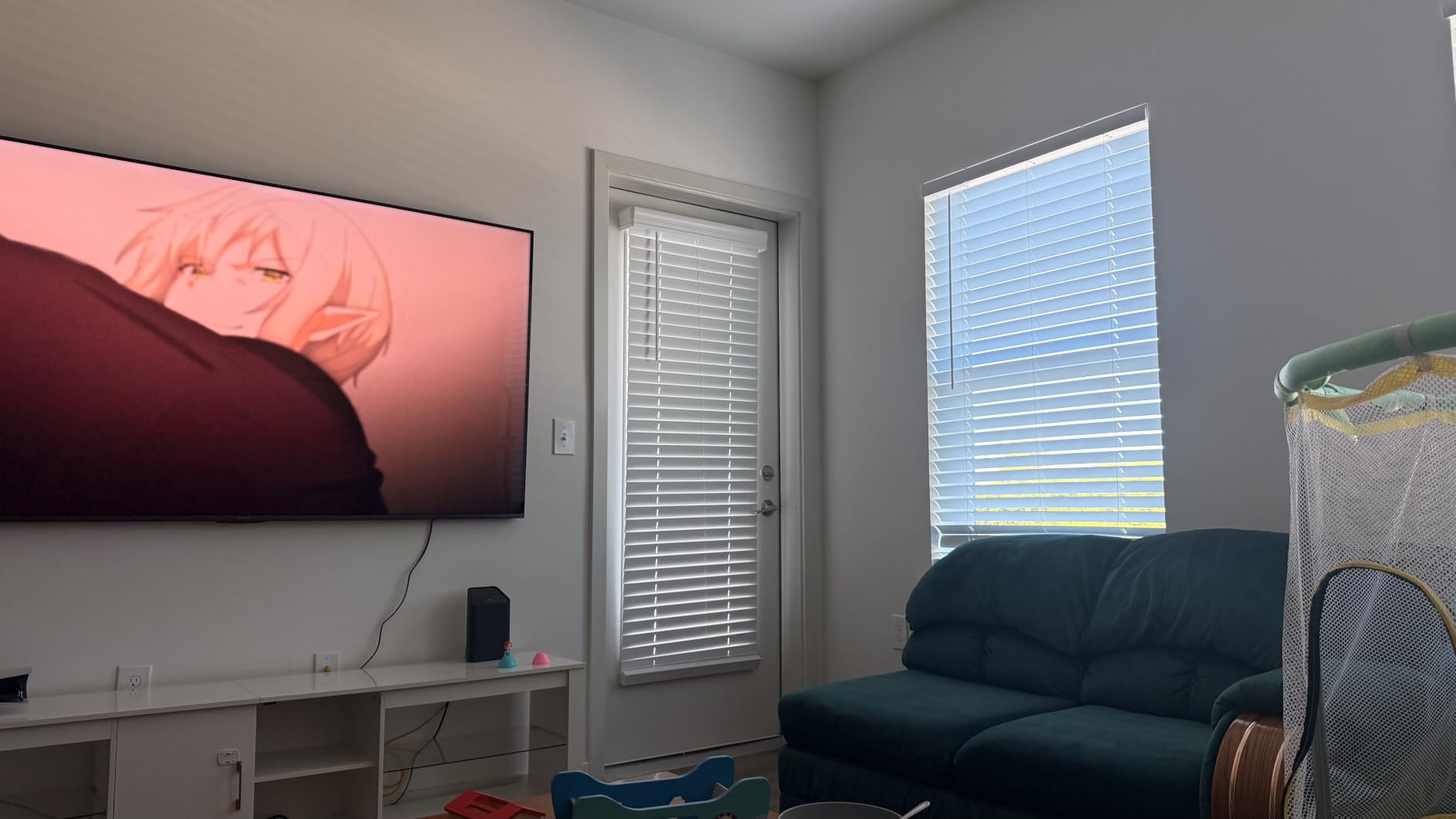
Sound is unusually serious for a television. The 4.1.2 channel system includes up-firing speakers and a built-in subwoofer at 82W, which gives you real height effects from an Atmos mix without adding a soundbar on day one.
Anti-Reflection Pro is applied inside the liquid crystal layer rather than as a surface coating, and owners note it keeps the picture clear in lit rooms. For cinema use the native 165Hz panel, VRR 48-165Hz, Game Booster 288 and Low Latency MEMC are extras you will not need for films. A two-year manufacturer warranty is longer than most in this list.
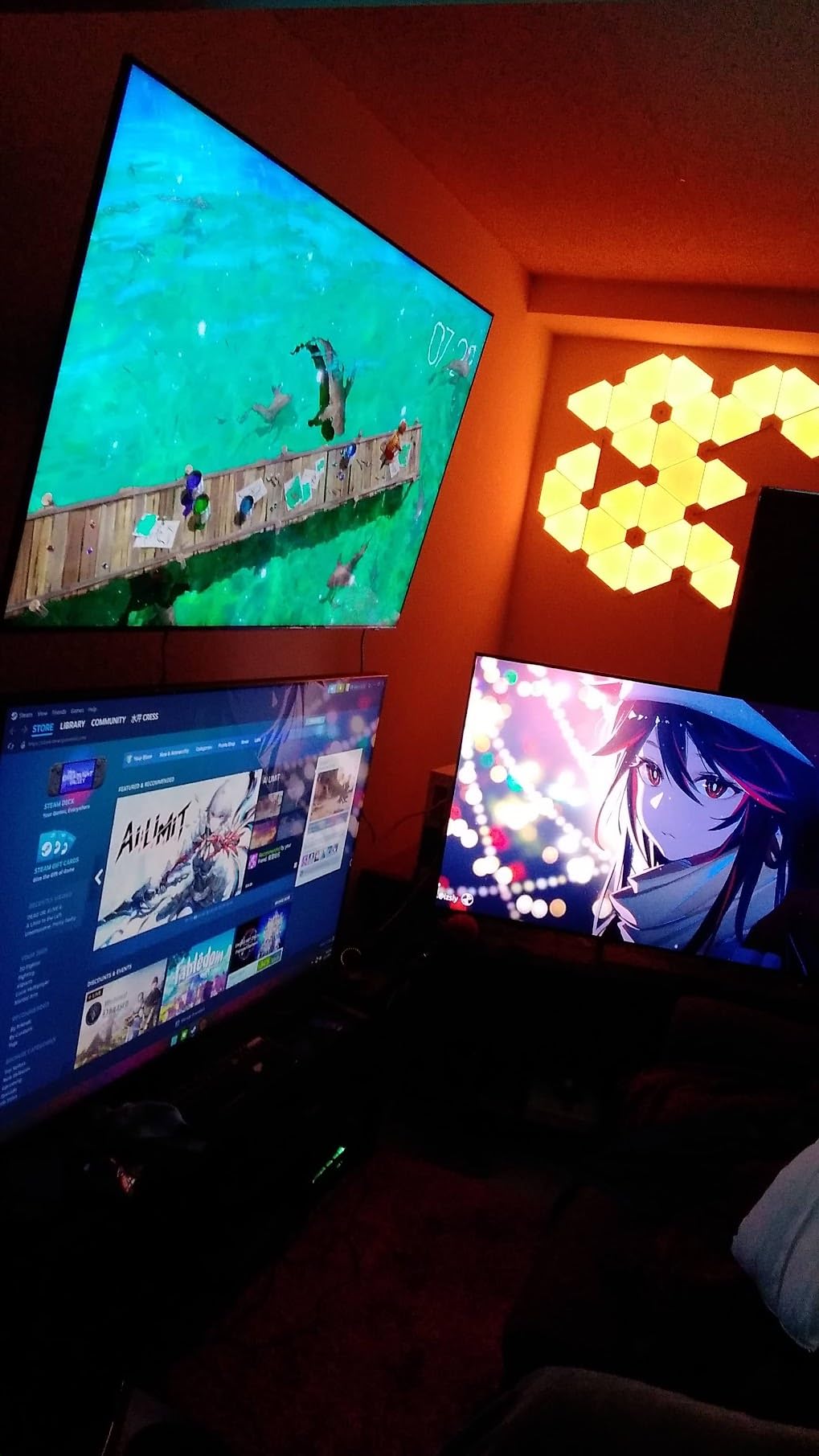
Why it works for movie night
Zone density and brightness headroom in the same panel. Dimming granularity is what determines whether a dark sequence reads as black or as dark grey, and this set has more of it than anything else here.
The combination of Dolby Vision IQ, IMAX Enhanced and Filmmaker Mode makes it the most cinema-oriented specification sheet in the roundup, and the built-in 4.1.2 Atmos is a real bonus for a room where you cannot run surround speakers.
Where it falls short
The practical obstacle is physical. At 104.5 pounds, an 85-inch panel needs two people and careful planning, and professional mounting is sensible. Power draw is substantial at 400 watts.
Only three HDMI ports on a set at this level is a genuine shortfall if you plan to keep a player, a console and a receiver connected. Zone count and brightness figures are “up to” claims that vary by size and content, and Hisense’s platform and app polish trail the major brands. A minority of early buyers needed a firmware update to get setup support working.
5. Roku 65 Plus Series – The Best Value Mini LED for Movies
Roku 65-Inch Plus Series Smart TV – 4K QLED Mini-LED TV – RokuTV
65-inch Mini LED QLED
Dolby Vision and HDR10+
Dolby Atmos with subwoofer
Roku OS
Pros
- Mini LED backlight with Dolby Vision at a low price point
- Highest rated budget Mini LED set here at 4.5 stars
- Roku OS is the simplest interface for streaming
- Built-in subwoofer and Atmos outperform the class
- Bluetooth Headphone Mode for late-night viewing
Cons
- Native 60Hz limits motion detail for fast action
- No published dimming zone count
- 4.1 channels means no true height channel
If you want the shortest path from an old LED set to a Mini LED picture with Dolby Vision, this is it. Roku TV owners consistently point to fast, minutes-long setup, an uncluttered remote, and the simplest interface in the roundup, which matters if the television is being bought to watch films rather than to be configured.
Roku Smart Picture Max handles signal cleanup, colour and sharpness work automatically, which is helpful with the compressed streams most people actually watch. For disc playback the panel is full array local dimming with QLED colour and Dolby Vision plus HDR10+ and HLG support.
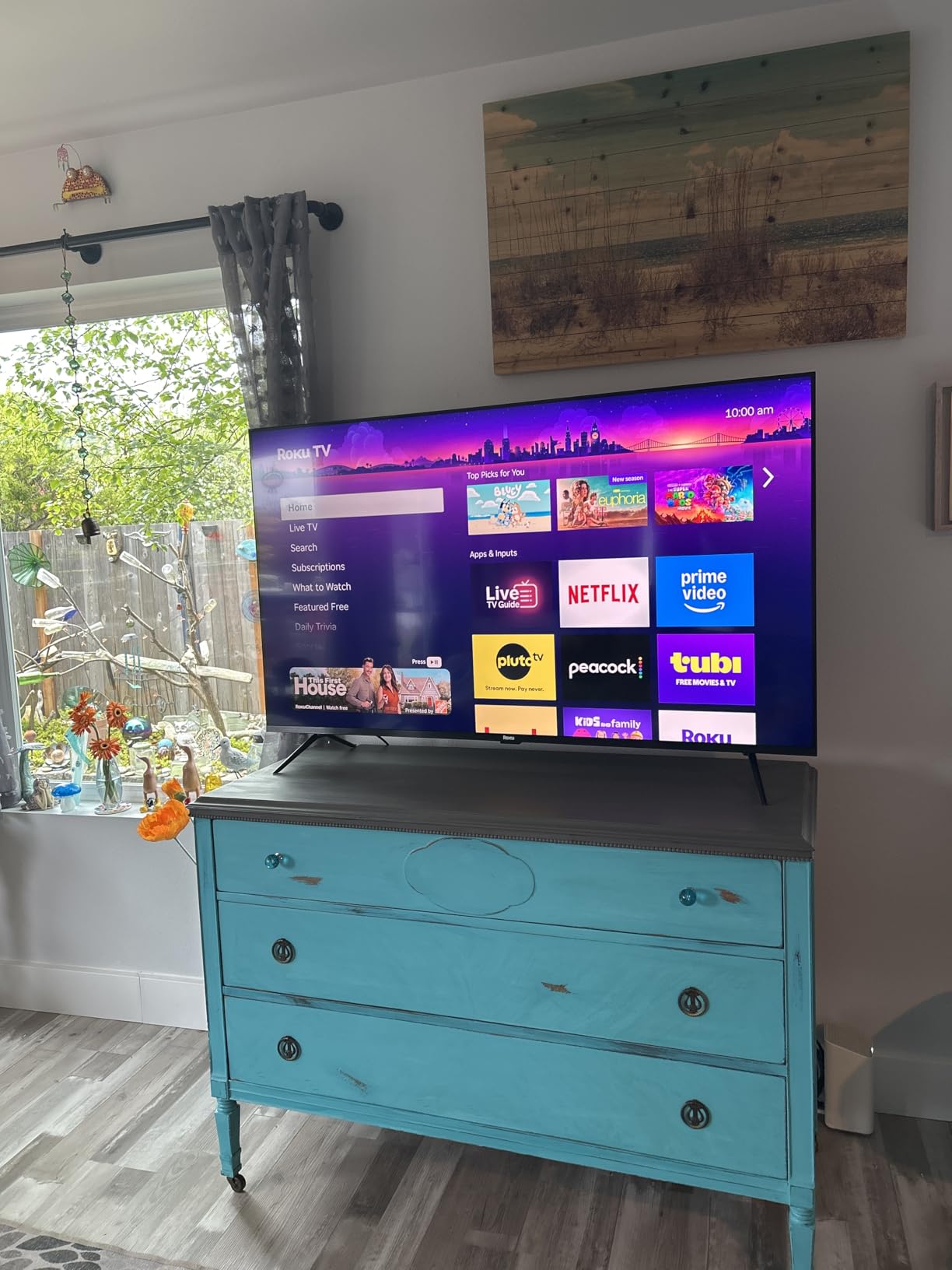
Two omissions to weigh. There is no published dimming zone count, so the granularity of local dimming is unknown and haloing around subtitles is harder to predict than on the TCL sets. The panel is natively 60Hz, so motion detail is limited for fast action.
Audio is better than the 4.1 channel count suggests, with Dolby Atmos, a built-in subwoofer and up to 50W of output. Bluetooth Headphone Mode lets two people watch without disturbing anyone, which is a genuinely useful movie-night feature. Connectivity covers 4x HDMI, USB-C, Ethernet and optical out.
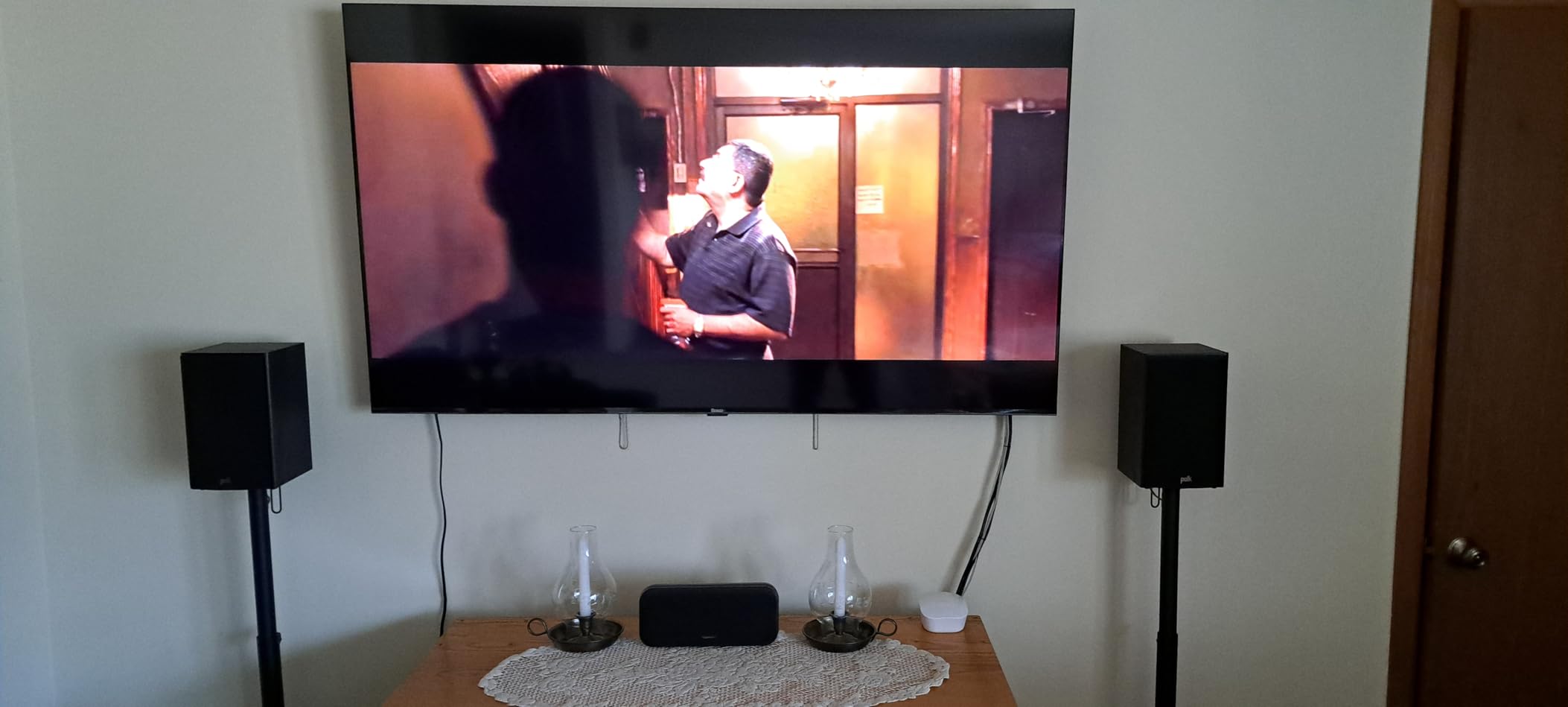
Why it works for movie night
Dolby Vision on a Mini LED panel at this price point is unusual, and Dolby Vision is the format most 4K discs and the major streaming services deliver. Roku OS also gets you to a film in a couple of taps with minimal friction.
For a household that streams rather than collecting discs, the simplicity is a real feature and the picture is a clear upgrade over a standard LED.
Where it falls short
The 60Hz panel is the compromise, and it matters more if you also watch sport or play consoles. Roku OS also offers less deep picture adjustment than Google TV or Tizen, so if you intend to calibrate, this is the wrong platform.
There is no true height channel in the audio, only one USB port beyond the USB-C, and Smart Picture Max can soften fine detail in some scenes. A soundbar is still advisable for a proper cinema feel.
6. Samsung QN70F 55-Inch – Best Mini LED for Glare and Late Nights
Samsung 55-Inch Class Neo QLED QN70F 4K Mini LED Smart TV (2025 Model) NQ4 AI Gen2 Processor, Quantum Matrix Technology Slim, Motion Xcelerator 144Hz, Samsung Vision AI, Alexa Built-in
55-inch Mini LED
NQ4 AI Gen2 processor
Matte anti-glare finish
144Hz
HDR10+
Pros
- Matte finish resists reflections from room lighting
- Inky blacks from Mini LED lighting
- NQ4 AI Gen2 gives noticeably better upscaling
- Optical out works with older surround receivers
- Solar-style remote needs no batteries
Cons
- No Dolby Vision or Dolby Atmos
- 20W 2-channel speakers are weak for cinema
- Some owners report HDMI handshake issues with PCs and Macs
This is the set to look at if your room has a window opposite the screen or a lamp that reflects off the panel. The matte anti-glare finish is described by owners as a major upgrade over glossy panels, and it is the single feature that changes day-to-day comfort more than any brightness number.
Picture processing runs on the NQ4 AI Gen2 processor using 20 neural networks for 4K upscaling and scene analysis. Reviewers call the resulting clarity a noticeable step up from budget sets, which matters for older Blu-ray transfers and lower-bitrate streaming. Quantum Matrix Technology Slim Mini LED lighting with Supreme UHD dimming delivers sharp contrast and inky blacks.
Motion Xcelerator 144Hz with VRR up to 4K 144Hz handles motion cleanly, and Samsung Vision AI can transform SDR content toward an HDR look. Tizen gives you 2,700+ free channels including 400+ Samsung TV Plus channels, plus optical audio out for a legacy surround receiver.
Now the catch. HDR support is HDR10+ only. There is no Dolby Vision and no Dolby Atmos, so Dolby Vision discs and streams downgrade, and a 2-channel 20W speaker system is thin for film sound. Both are real trade-offs when movies are the primary use.
Why it works for movie night
The matte panel plus Mini LED blacks is a combination that rewards a dim room. Reflections stop competing with dark scenes, which is where most glossy panels lose their sense of depth at night.
Optical audio output is a quietly valuable feature for anyone still running an older surround receiver, and seven-year spare parts availability is a long-term ownership plus.
Where it falls short
No Dolby Vision is the headline drawback for a movie-first buyer, and 20W 2-channel audio means a soundbar is close to mandatory. The slim panel needs careful handling to avoid twisting the body during installation.
A small but vocal group of owners report HDMI handshake issues with PCs and Macs, including magenta screens, and one owner reported a full panel failure after nine months while audio kept playing. The rechargeable remote is easy to forget to top up, and its volume rocker is awkward.
7. Hisense 65E7SF – Best Mini LED for Dolby Vision on a Mid Budget
Hisense 65″ E7 Cinema Series Hi-QLED Mini-LED 4K UHD Smart Fire TV (65E7SF, 2026 NEW) – Native 144Hz, AI Picture, Dolby Vision IQ · Atmos, FALD, HDR10+ Adaptive, MEMC, Alexa+
65-inch Hi-QLED Mini LED
Full Array Local Dimming
Dolby Vision IQ and Atmos
Filmmaker Mode
Pros
- Dolby Vision IQ plus Atmos at a mid-range price is rare value
- Mini LED local dimming beats the owner's old LED set clearly
- Filmmaker Mode preserves aspect ratio and frame rate
- Native 144Hz with MEMC keeps action sharp
- Fire OS responds quickly to voice
Cons
- Sound is average 20W 2.0 and most owners add a soundbar
- Black depth is QLED-typical rather than OLED class
- Some owners report Fire OS Wi-Fi dropouts and black-screen crashes
This is the set for anyone who watches Dolby Vision discs and wants them without moving up a tier. Dolby Vision with Dolby Vision IQ, plus the Total HDR Solution covering HDR10+ Adaptive, HDR10 and HLG, is a fuller format list than most sets in this bracket offer.
The 65-inch panel uses Hi-QLED Mini LED backlighting with Full Array Local Dimming, and owners report noticeably better dark-scene performance than the budget LED sets they replaced. That is the practical upgrade that matters for late-evening viewing.
Filmmaker Mode is a genuine cinema feature rather than a checkbox. It preserves the original aspect ratio, colour, frame rate and sound, so a 2.39:1 film letterboxes correctly and 24fps content is not forced into a different cadence. For movie purists that is worth more than a gaming feature.
Motion handling is strong: native 144Hz with AI Smooth Motion MEMC and black frame insertion keeps fast action in films and sport sharp. An AI Light Sensor adapts brightness to the room, the AI 4K upscaler adds detail reconstruction, and Fire OS with an Alexa+ remote keeps navigation quick.
Why it works for movie night
Format support is the story. Dolby Vision IQ with Atmos, Filmmaker Mode and full array local dimming at the same time is a rare combination, and it covers 4K Blu-ray, HDR streaming and broadcast in one box.
Four HDMI ports, optical audio out and a 2.6-inch slim profile make it easy to integrate with a player and soundbar without cable juggling.
Where it falls short
Black level depth is QLED-typical rather than OLED or flagship Mini LED, so a fully darkened room will show where the budget ends. The 20W 2.0 audio is the most common upgrade request, with many owners planning to add a soundbar.
A meaningful minority of reviews centre on Fire OS reliability, including recurring Wi-Fi dropouts, black-screen crashes and remote pairing failures that required factory resets. No wall-mount bracket is included in the box, and the vivid picture presets can look oversaturated to some viewers.
8. Samsung QN90F 50-Inch – Best Mini LED for a Bright Living Room
Samsung 50-Inch Class Neo QLED 4K QN90F Series, Vision AI, Mini LED Smart TV (2025 Model, 50QN90F) Neo Quantum HDR+, Object Tracking Sound Lite w/Dolby Atmos, Glare Free, Gaming Hub, Alexa Built-in
50-inch Mini LED
Neo Quantum HDR+
Glare Free matte screen
165Hz
Dolby Atmos
Pros
- Bright enough for a sunlit room with drapes open
- Glare Free matte screen praised over glossy panels
- AI upscaling markedly improves older SD and streaming
- Strong built-in sound
- Several owners skipped a soundbar
Cons
- 50 inches is small for a theatre room
- AI upscaling struggles with very old low-resolution video
- Included stand leaves the set slightly wobbly
Owners describe the picture here as bright, sharp and vibrant, and specifically note it holds up with the drapes open and daylight in the room. The Glare Free matte anti-reflection screen is the reason, and it is repeatedly called a major upgrade over glossy panels when the set faces a window.
The NQ4 AI Gen3 processor runs 128 neural networks for 4K upscaling and sound optimisation, and the upscaling is credited with making older standard-definition and streaming content look far better at 4K. Mini LED backlighting with Ultimate UHD dimming and Neo Quantum HDR+ handles the contrast work.
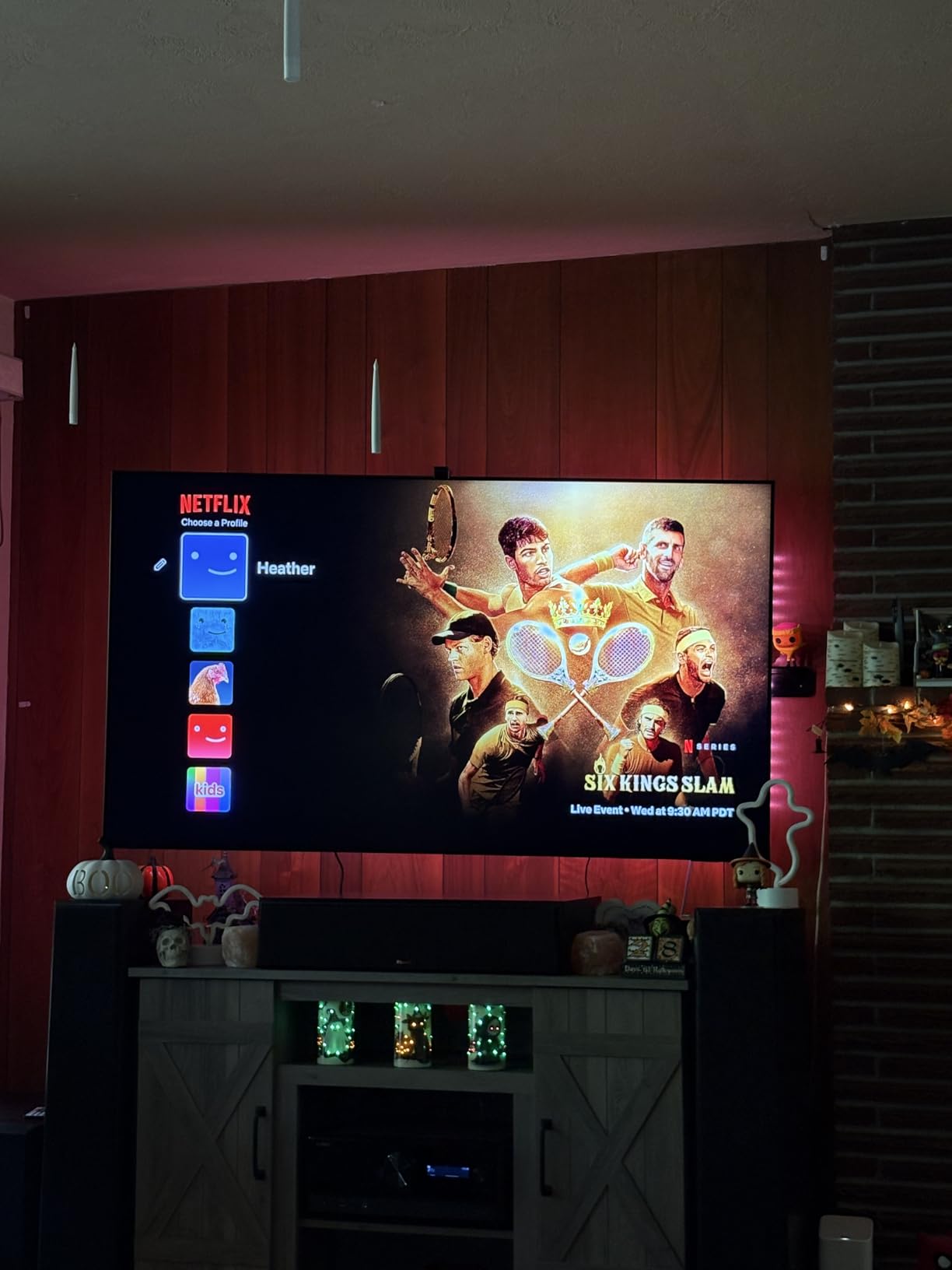
Sound is the quiet strength. Object Tracking Sound Lite with Dolby Atmos across 2.2 channels at 40W is good enough that several owners skipped adding a soundbar entirely, which is unusual at this screen size. Motion Xcelerator 165Hz with VRR up to 4K 165Hz handles fast-moving balls and text cleanly.
Also worth knowing: a Mini LED panel cannot burn in, unlike OLED. If you leave a streaming service logo on screen all day or run long films with static subtitles, that is a real durability advantage. Four HDMI, two USB, Ethernet, Wi-Fi and Bluetooth 5.3 round out connectivity.
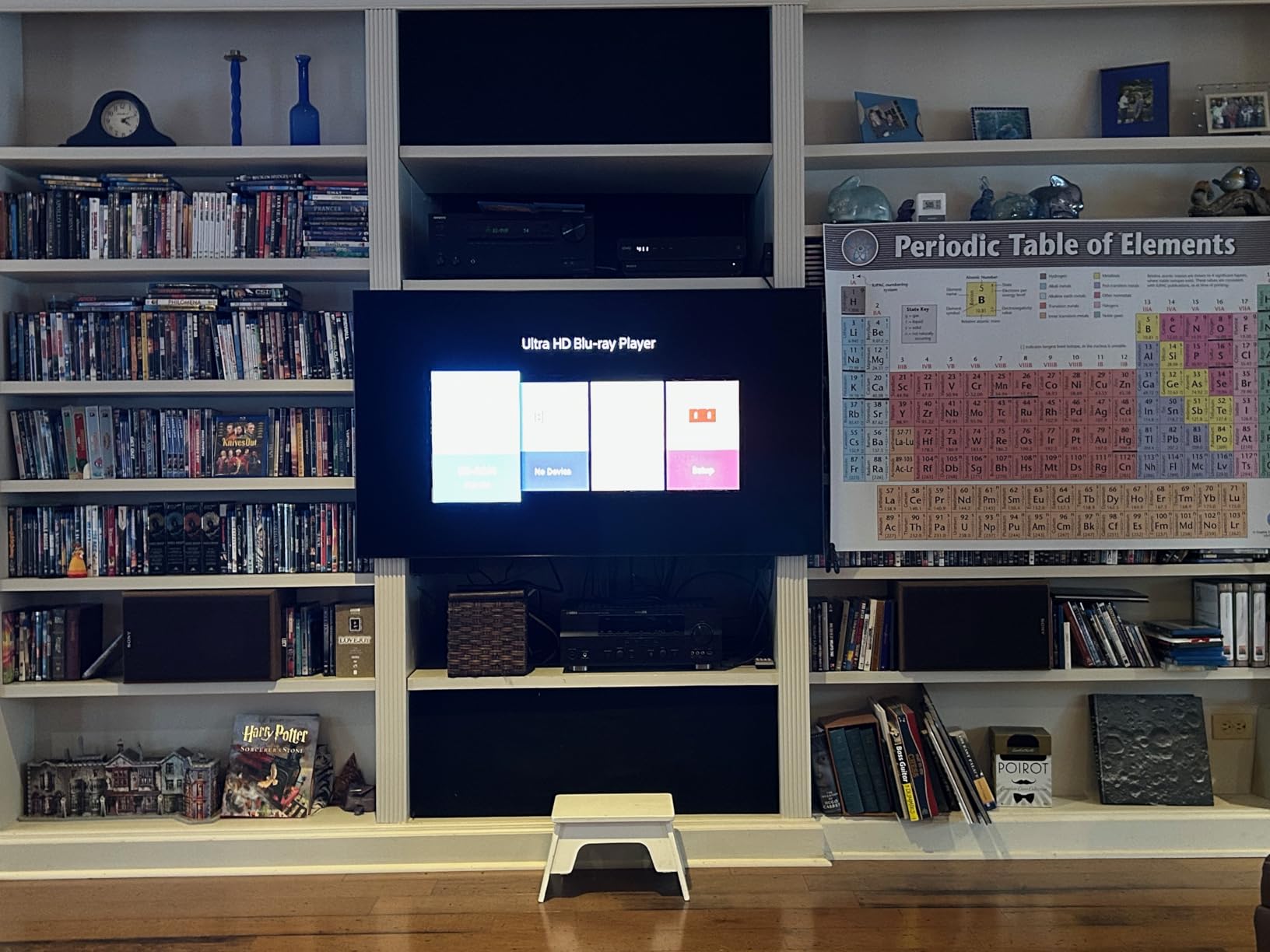
Why it works for movie night
Brightness plus a matte panel is the winning pair for daylight viewing. Reflections stop washing out the image, which means you do not have to close the curtains and dim the room to enjoy a film.
At 50 inches it suits a bedroom, a smaller lounge or a secondary room where seating distance is limited. Nobody reported buying this for sound and being disappointed.
Where it falls short
Fifty inches is modest if you are building a cinema-style room, and this is not the screen to sit far back from. The AI upscaler also struggles with genuinely old, low-resolution video and can look pixelated, so it helps compressed streaming more than it helps a worn-out VHS rip.
Only one remote is included and it is small, the stand leaves the set slightly wobbly, and the sets are heavy enough that two people are needed for larger sizes. A few owners report audio cutting out roughly weekly until a power cycle, and Tizen offers less customisation than Roku or Fire TV.
9. Toshiba 65Z670R – Best Mini LED for Natural, Unforced Colour
Toshiba 65″ Class Z670R Series Mini-LED 4K UHD Smart Fire TV (65Z670R, 2026 New) – QLED, Native 144Hz, HDR10+, Dolby Vision IQ, REGZA Engine Zri, Dolby Atmos, Game Mode Pro, ALLM, Alexa Built-in
65-inch Mini LED
3000:1 contrast
REGZA Engine Zri Gen3
Dolby Vision IQ
4x HDMI 2.1
Pros
- Japanese REGZA tuning gives natural colour and skin tones
- Zone-based Mini LED delivers deep blacks for night scenes
- Four full-spec HDMI 2.1 ports
- Built-in Atmos with a bass woofer
- Lightweight and easy to set up
Cons
- Smallest review base in the roundup at 139 ratings
- Fire TV home screen is cluttered and promotional
- Customer support line routes to Hisense representatives
The differentiator here is colour. The REGZA Engine Zri Gen3 is an AI picture and sound processor tuned in Japan, and owners consistently describe natural, soft colour with pleasing skin tones rather than the oversaturated look that vivid picture modes produce. If you are tired of films looking like a showroom demo, this is the set that fixes it.
Black level is handled by a Mini LED backlight with Full Array Local Dimming and a listed 3000:1 contrast ratio, which gives deep blacks and clean night scenes. Dolby Vision IQ, HDR10+, HDR10+ Adaptive, HDR10 and HLG cover every current HDR format, and there is a Filmmaker-adjacent approach via the AI Light Sensor Pro that adapts brightness and colour balance to the room.
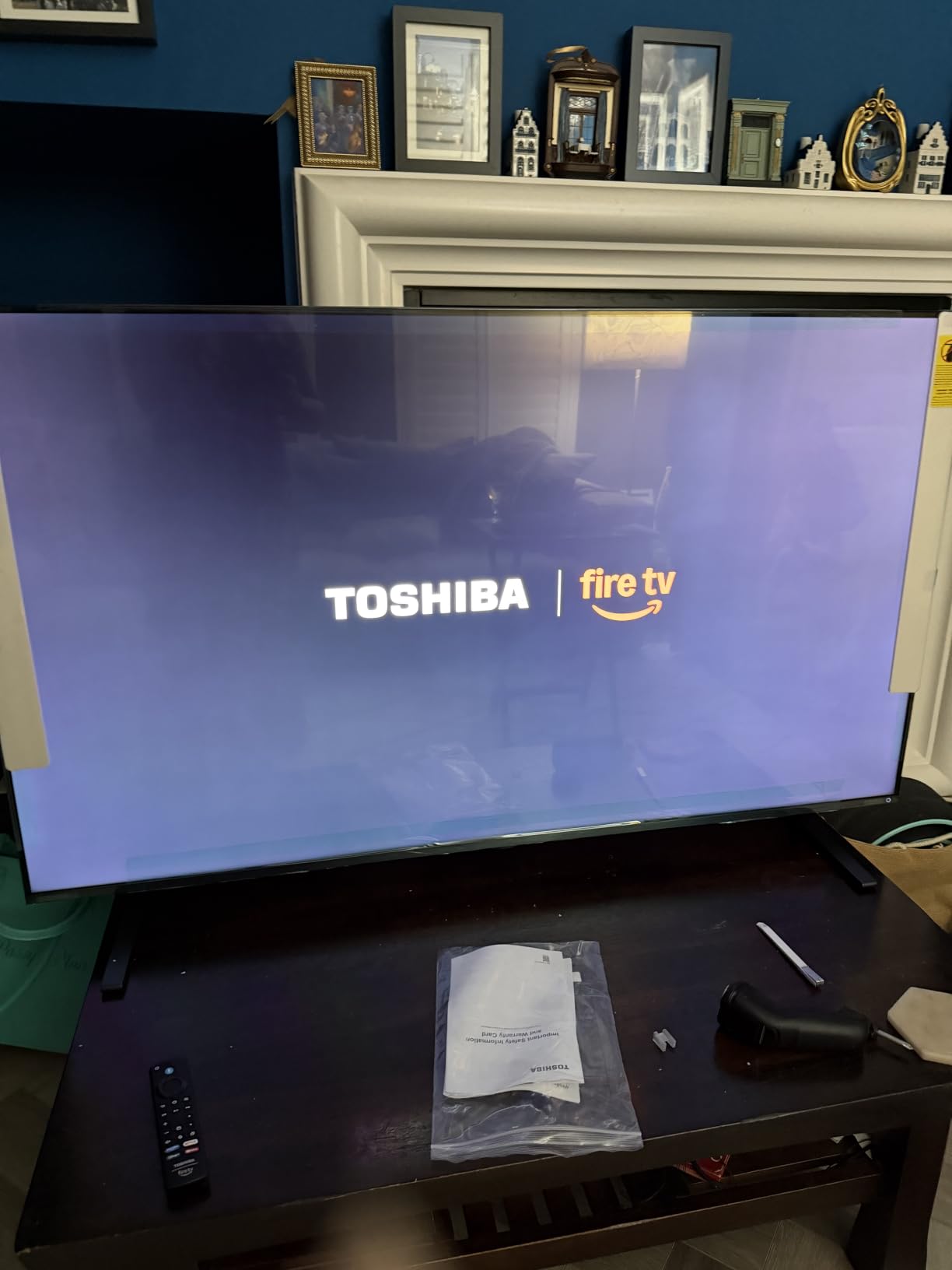
Connectivity is a real strength for a cinema build. Four full-spec HDMI 2.1 ports mean no swapping cables between a player, a console and a receiver, and there are two USB ports, Ethernet and optical audio out. Native 144Hz with AMD FreeSync Premium, VRR 144Hz, ALLM and Game Mode Pro round it out.
Audio is Dolby Atmos through REGZA Power Audio Pro with a REGZA Bass Woofer at 2.1 channels and 40W, which owners describe as surprisingly immersive for television speakers. Fire TV brings the usual streaming apps, and the set weighs 44.1 pounds, so installation is straightforward.
Why it works for movie night
Accurate, restrained colour is the thing most movie-first buyers notice once they stop watching on a set tuned to showroom brightness. Japanese picture tuning is a genuine differentiator at this tier.
Full array local dimming with a 3000:1 contrast claim gives you a usable dark room picture, and the full HDR format list means every source has a matching mode.
Where it falls short
It carries the smallest review base here with 139 ratings, so there is less long-term owner evidence behind it than any other pick. That is not a dealbreaker for a brand with a long television history, but you are buying on specification rather than on a large body of user reports.
The Fire TV home screen is cluttered and heavily promotional, some owners report audio-visual sync issues and channels flipping back while browsing, and Toshiba customer support routes to Hisense representatives. No full user manual is included, and soundbar pairing can be fiddly at first setup.
10. Sony BRAVIA 5 85-Inch – Best Mini LED for Streaming Films and IMAX
Sony 85 Inch BRAVIA 5 Mini LED 4K HDR Smart Google TV (K-85XR50)
85-inch Mini LED
XR Backlight Master Drive
IMAX Enhanced
Dolby Vision and DTS:X
Google TV
Pros
- XR Backlight Master Drive controls thousands of Mini LEDs precisely
- Studio calibrated modes tuned to Netflix and Prime Video
- IMAX Enhanced via Sony Pictures Core for film content
- XR Clear Image recovers detail in older HD and digital video
- 5.1 channel acoustic audio at 40W
Cons
- The most expensive set in the roundup by a wide margin
- 1000 nits peak is modest for a premium panel
- 102 pounds at 85 inches needs professional handling
- 120Hz native refresh below the 144Hz and 165Hz rivals
Sony’s argument is calibration rather than raw numbers. Studio calibrated picture modes are provided for Netflix, Prime Video and Sony Pictures Core, so when you open a film on one of those services the set is already set up the way the colourist intended. That is the closest thing to a cinema grade experience in this roundup.
The backlight is the XR Backlight Master Drive, which handles precision control of thousands of Mini LEDs, and colour comes from XR Triluminos Pro. Dolby Vision, Dolby Atmos, DTS:X and IMAX Enhanced are all supported, and movies are included alongside the Sony Pictures Core IMAX Enhanced catalogue.
Upscaling is a genuine strength. XR Clear Image uses AI to recover detail in older HD and digital content, which is exactly what a 4K Blu-ray collector or a watcher of restored archive films needs. XR Motion Clarity and XR Contrast Booster 10 keep fast action smooth, and PS5 integration includes Auto HDR Tone Mapping and Auto Genre Picture Mode.
Sound is 5.1 channel Acoustic Multi-Audio at 40W, and connectivity includes four HDMI, two USB, Ethernet, optical out, RS232C and a built-in microphone switch. Google TV with Google Assistant, AirPlay 2 and Google Cast covers the streaming side, and 32GB of storage is included.
Why it works for movie night
Studio calibrated modes plus IMAX Enhanced is the strongest film-first feature set here. If your viewing is streaming and disc based rather than broadcast, this set is tuned for exactly that.
XR Clear Image upscaling means older catalogue material holds up, and the precision backlight control keeps blacks clean without crushing shadow detail.
Where it falls short
Cost is the first hurdle. It is more than double several Mini LED rivals in this list, and the money buys calibration and processing rather than headline brightness. Peak brightness is listed at 1000 nits, which leaves HDR punch on the table next to higher-end Mini LED and OLED sets.
At 85 inches and 102 pounds you should plan on professional handling and mounting. The 120Hz native refresh is below the 144Hz and 165Hz sets here, power consumption is substantial at 372 watts, and it runs at 546 kWh per 1000 hours. On value per square inch of screen, cheaper sets simply do better.
Size Guide: 50, 55, 65 and 85 Inches for Movie Night
Size is the decision buyers regret most, because a screen that is too small feels wasted in a dark room while one that is too large has to be watched from an uncomfortable distance. A practical rule for movies is that the screen should roughly fill your field of vision when you are seated, which for a 16:9 panel means sitting about 1.2 to 1.5 times the screen diagonal away from it.
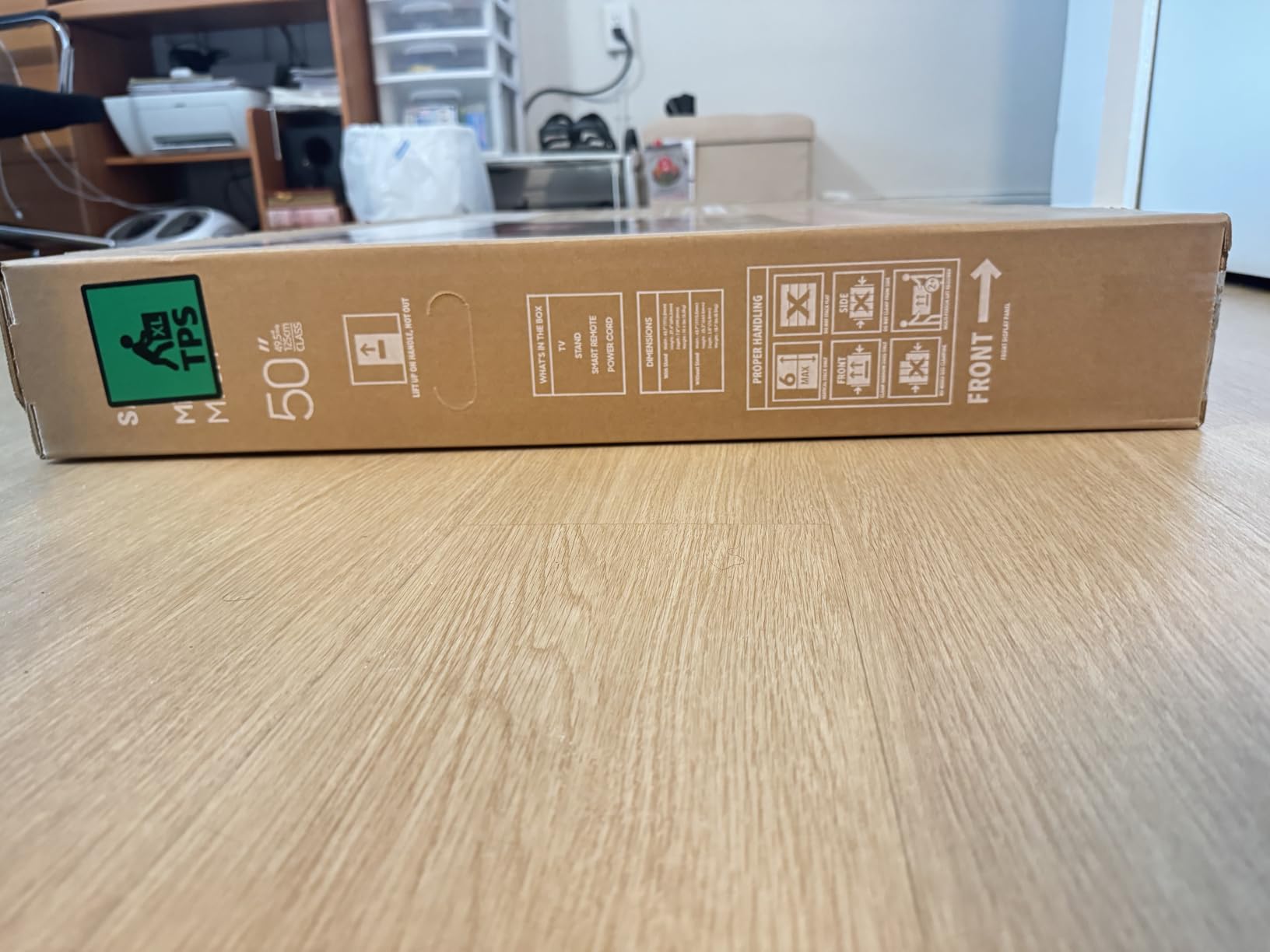
50 inches suits seating distances of about 6 to 8 feet and works well in a bedroom or a smaller lounge. The Samsung QN90F is the pick at this size, and its matte panel is the main reason it works in a room that gets daylight.
55 inches fills a typical living room at 7 to 9 feet. The TCL 55A400U and the Samsung QN70F cover the wall-mountable and anti-glare options here. If your seating is off-centre, check the viewing-angle behaviour before you commit, because VA-type panels lose colour and contrast off-axis.
65 inches is the sweet spot for most people and the size most of this roundup offers. At 8 to 11 feet it reads as genuinely cinematic without forcing anyone to crane their neck. The TCL 65QM6K, Roku 65 Plus, Hisense 65E7SF and Toshiba 65Z670R all sit here.
85 inches is a commitment. You want 11 feet or more of distance and a room that can take a 104-pound panel. The Hisense 85U8QG is the brighter, more zone-dense option; the Sony BRAVIA 5 is the calibrated one. Both need two people at minimum. If the room is a converted garage or basement, ambient room lighting matters as much as the panel, and our picks for even, low-glare illumination are in the best LED shop lights guide.
How to Choose a Mini LED TV for Movies
1. Dimming zones matter, but backlight control matters more. Zone count is the headline number on the box, and forum consensus is that it does not translate directly into contrast. A set with fewer zones but a disciplined dimming algorithm often looks better in a dark room than a set with thousands of zones and sloppy behaviour. TCL’s Halo Control system on the 65QM6K is the clearest example of control quality beating raw count in this roundup.
2. Match brightness to your room, not to the spec sheet. Peak brightness figures are usually small-window measurements. In a bright living room you need genuine sustained brightness and, increasingly, an anti-reflection coating, because a glossy screen reflects room light no matter how many nits the panel produces. In a blacked-out room you care about black level instead.
3. Treat Dolby Vision as the priority format. If you own 4K Blu-ray discs or subscribe to Netflix, Apple TV+ or Disney+, Dolby Vision is where most of the high-quality HDR content is delivered. Several sets here support HDR10+ only, which is a real downgrade. Check the format list before anything else.
4. Check the panel type and viewing angle. VA panels typically deliver deeper blacks but narrow viewing angles; ADS and IPS panels are wider but shallower. Forum reports describe Mini LED colour and contrast falling off noticeably when viewed off-axis, and that is often the reason people abandon a model for a wide-seating room.
5. Look for a real Filmmaker mode. A proper Filmmaker Mode preserves original aspect ratio, frame rate and colour intent rather than forcing a vivid preset. It is the closest thing to a cinema grade default on a television, and it matters more for films than any gaming feature.
6. Plan for sound. Built-in speakers on Mini LED sets have improved, but only the 4.1.2 Hisense and the 5.1 Sony give you real channel separation. If you care about Atmos, budget for a soundbar or an eARC-connected receiver, and note that the Samsung QN70F’s optical out is useful with older receivers.
7. Pick a platform you will not fight. Roku OS is the simplest, Fire OS is serviceable but its reliability varies by brand, Tizen is powerful with the best free channel catalogue, and Google TV is flexible but ad-heavy out of the box. Whichever you pick, download the remote app to your phone and get firmware current before you judge performance.
One last practical tip from our own setup habits: once the panel is mounted, add soft bias lighting behind the set. A pair of low-output strips reduces the eye strain of watching black bars in a dark room without adding any brightness to the picture itself. Our picks for that job are in the best LED desk lamps guide.
Frequently Asked Questions
What is good about Mini LED TVs?
Mini LED televisions put thousands of tiny backlight LEDs behind an LCD panel, grouped into hundreds or thousands of independently dimmable zones. That lets the set darken the area behind a dark scene while pushing hard on an HDR highlight, giving far better contrast than a standard LED without the burn-in risk of OLED. For movies it means black letterbox bars, visible shadow detail, and brightness that survives a lit room.
Which is better, QLED or Mini LED?
Mini LED is better for movies in almost every respect, because QLED describes the colour filter layer while Mini LED describes the backlight. A QLED set may have a standard edge-lit LED backlight with no local dimming, which leaves dark scenes grey. A Mini LED set adds full array local dimming and quantum dot colour on top, so it wins on contrast, black level and HDR brightness. QLED only makes sense as a description of the colour technology, not as a competing picture performance tier.
Which is better, 4K LED or OLED, for movies?
OLED wins on perfect black, viewing angles and zero haloing around subtitles. Mini LED wins on brightness, screen size options and burn-in safety. If you watch in a fully darkened room and notice any glow around white text, choose OLED. If you want an 85-inch screen, watch in daylight, or leave static logos on screen for hours, the best mini LED TVs for movies are the better long-term buy.
What is the best Mini LED TV right now?
For most people watching films, the TCL 55A400U is the strongest all-round pick here, pairing 448 dimming zones with a low-reflection panel and a near-flush 1.57-inch profile that mounts cleanly to a wall. The Hisense 85U8QG is the choice for a dedicated home theater with up to 5600 zones and 5000 nits, and the Roku 65 Plus is the best value option with Dolby Vision at a lower tier.
How many local dimming zones do you need for movies?
More zones generally reduce the size of the halo around bright objects, so subtitle glow and letterbox edges look cleaner. But zone count alone is a poor guide, because dimming algorithm quality determines how tightly each zone responds. A few hundred well-controlled zones often beat thousands loosely controlled ones. For a 65-inch or larger set where halos are more visible, prioritise full array local dimming with a documented dimming system over a headline count.
Do Mini LED TVs have burn-in risk?
No. Mini LED is an LCD, so the pixels do not emit light and do not degrade with static content in the way OLED panels can. You can leave a streaming service logo on screen all day or watch long films with static subtitles without permanent image retention. That is one of the strongest arguments for choosing Mini LED over OLED for a family that watches a lot of movies.
How bright should a TV be for HDR movies?
Around 600 to 700 nits delivers a clearly visible HDR improvement over standard dynamic range content in a normally lit or dim room. Above 1000 nits starts to look noticeably punchier in a darkened room, and 2000 nits or more is noticeable mainly on small highlights. Match brightness to your room rather than chasing a number, and prioritise an anti-reflection coating if your screen faces a window.
What size TV is best for movies?
For a 16:9 screen, sitting roughly 1.2 to 1.5 times the screen diagonal away gives a cinematic fill of your vision. In practice that means 55 inches at 7 to 9 feet, 65 inches at 8 to 11 feet, and 85 inches at 11 feet or more. Bigger screens also magnify halo artefacts and viewing-angle problems, so a larger panel demands a better dimming system and a matte finish.
The Best Mini LED TV for Movies in 2026
After working through ten sets, the TCL 55A400U comes out on top as our best mini LED TV for movies. It pairs 448 dimming zones with a low-reflection panel and a listed 650-nit ceiling, and it carries the deepest review base in the roundup at 4.5 stars across more than 1900 ratings. The 1.57-inch profile means it also disappears into a wall better than anything else here.
If your budget stretches further, the Hisense 85U8QG is the home theatre answer with up to 5600 zones, a 5000-nit peak, Dolby Vision IQ and real 4.1.2 Dolby Atmos. The Roku 65 Plus is the value route with Dolby Vision and the simplest interface, and the Sony BRAVIA 5 is the pick when calibrated studio modes and IMAX Enhanced matter more to you than brightness or price.
Whichever you choose, get the picture mode right before you judge it. Filmmaker mode where it exists, firmware updated on day one, and bias lighting behind the panel will do more for your movie nights than any extra hundred nits.