
The best home theater receiver for Dolby Atmos is the Denon AVR-X1700H: it decodes a 5.1.2 Atmos bed with real height speakers, runs Audyssey room correction, and has the highest average rating in this group at 4.4 stars from 703 owners. If you need more channels, the Onkyo TX-NR7100 handles 9.2 channels with Dirac Live.
Choosing among the best home theater receivers for Dolby Atmos is harder than the spec sheets suggest. Every brand quotes wattage with only two channels driven, every receiver claims Atmos support, and the models that decode the most height channels often cost several times more than the ones that suit a normal living room. We compared ten of them on channel count, amplifier output, calibration quality, HDMI bandwidth and long-term owner reports.
We have also put together broader buying guides for [AV receivers for home theater](https://www.pwice.com/best-av-receivers-for-home-theater/), [Dolby Atmos soundbars](https://www.pwice.com/best-dolby-atmos-soundbars/) and complete [home theater systems](https://www.pwice.com/best-home-theater-systems/) if you are still building the rest of the chain. Everything below reflects published specifications plus patterns that show up repeatedly in owner reviews, not lab measurements of our own.
Table of Contents
Top 3 Best Dolby Atmos Receivers for 2026
Denon AVR-X1700H
- 7.2 channels
- Dolby Atmos and DTS:X
- 80W per channel
- Audyssey room correction


Every Dolby Atmos Receiver We Ranked at a Glance (October 2026)
| Product | Specifications | Action |
|---|---|---|
| Denon AVR-X1700H |
|
Check Latest Price |
 Denon AVR-S570BT Denon AVR-S570BT |
|
Check Latest Price |
| Denon AVR-S760H |
|
Check Latest Price |
 Onkyo TX-NR6100 Onkyo TX-NR6100 |
|
Check Latest Price |
| Onkyo TX-NR7100 |
|
Check Latest Price |
 Sony STR-AN1000 Sony STR-AN1000 |
|
Check Latest Price |
 Pioneer VSX-935 Pioneer VSX-935 |
|
Check Latest Price |
 Marantz NR1510 Marantz NR1510 |
|
Check Latest Price |
 Yamaha RX-A2A Yamaha RX-A2A |
|
Check Latest Price |
 Marantz Cinema 60 Marantz Cinema 60 |
|
Check Latest Price |
1. Denon AVR-X1700H – The Best All-Round Dolby Atmos Receiver
Denon AVR-X1700H 7.2 Channel AV Receiver – 80W/Channel, Built-in HEOS
7.2 channels
80W per channel
Audyssey calibration
3 dedicated 8K inputs
6 HDMI total
Pros
- Audyssey calibration is the most accurate in this group
- 80W per channel across 7 channels
- Three dedicated 8K/60 and 4K/120 inputs
- Color-coded rear panel makes wiring simple
- Phono input and two subwoofer pre-outs
Cons
- On-screen menus and HEOS app are dated
- Audyssey often sets the centre channel too low
- Slightly harsh treble compared with Marantz
The Denon AVR-X1700H is the receiver we keep coming back to, because it does the three things that matter for Dolby Atmos without any of them being an obviously weak link. It decodes a 5.1.2 Atmos bed, it puts out 80 watts per channel across all seven amplifiers, and it ships with Audyssey, which owners consistently rate above the basic correction routines on cheaper rivals.
In our ranking of the best home theater receivers for Dolby Atmos, it takes the top spot on the balance of rating and owner volume rather than on any single headline specification. Nothing below it in this list has a higher average rating with a similar number of reviews behind it, and the gap between it and the cheaper Denons is mostly calibration quality rather than raw feature count.
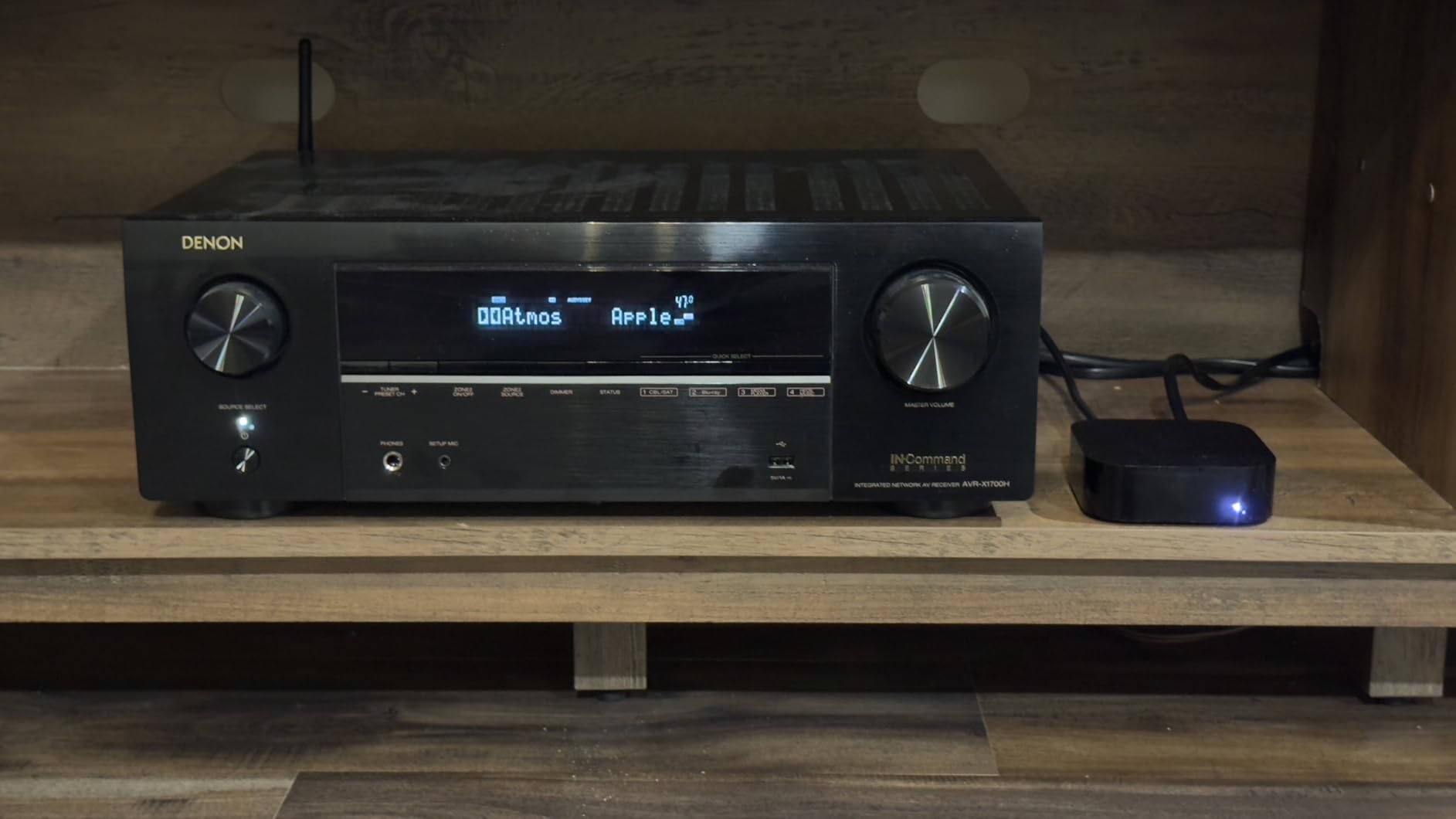
The specification sheet is unremarkable in the best way. Six HDMI inputs, three of them full 40 Gbps for 4K/120Hz gaming, plus 8K upscaling on every input. Two digital, two analog, one coaxial and a phono input for a turntable, and two subwoofer pre-outs if your sub amp runs out of headroom. Dolby Vision, HDR10+, HDR10 and HLG all pass through untouched.
The weak point is software, and owners say so repeatedly. The front-panel menu system looks like it was designed in the 1990s, and the HEOS app takes practice. Neither issue affects sound, but both make setup slower than the price suggests it should be. A second recurring note: Audyssey frequently sets the centre channel a few dB low, and correcting that one slider changes the Atmos presentation more than any upgrade below this tier.
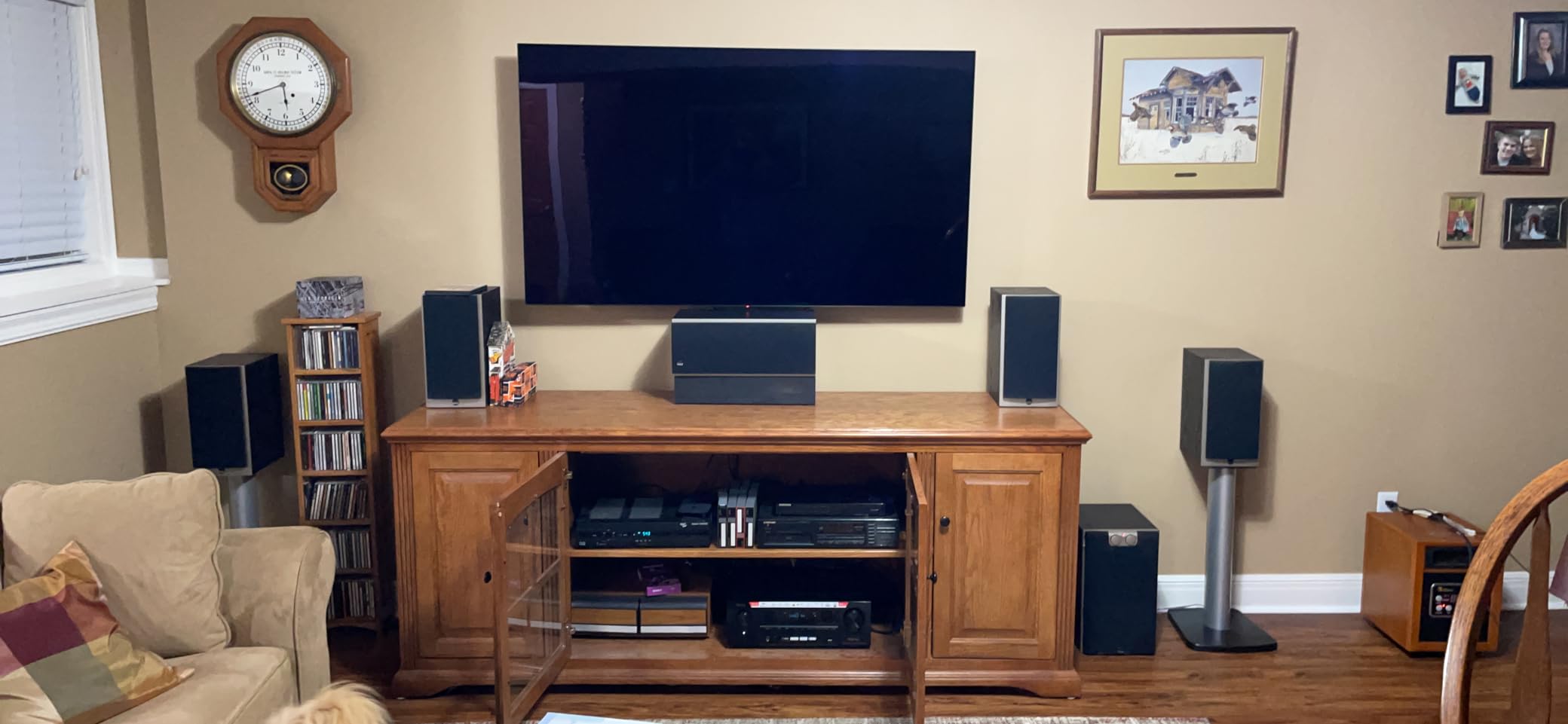
Is the AVR-X1700H powerful enough for a real Atmos room?
Eighty watts per channel is adequate rather than generous. In a living room of roughly 1500 to 2500 cubic feet with efficient bookshelf speakers, it plays reference levels without strain and the height channels never fall behind the rest. Push into a dedicated theater room over 3000 cubic feet with less sensitive floorstanders, and you will hear the difference that a 100W or 165W alternative makes.
Owners who moved up from a 5.1 system to this unit report that the Atmos height layer is the first thing they notice, particularly on films with rain, aircraft and crowd scenes where objects genuinely travel overhead. The value case is strongest for anyone who will never leave 7.2 behind, because the processing headroom is already there when you add a fourth height speaker or a second sub.
Should you buy the AVR-X1700H or spend more on a 9.2-channel model?
Buy the X1700H if your ceiling plan tops out at two height speakers, which is the most common 5.1.2 layout. The 80W figure, the Audyssey implementation and the HDMI selection are all at a level where nothing important is missing, and it is the model we would put in a typical family room.
Move up if you know you want 5.1.4 or 7.1.2. Once you are past two heights, a 9.2-channel chassis with more internal amplification stops being a luxury and starts being the correct tool, and the Onkyo TX-NR7100 covers that without leaving the same general price band. Buying the 7.2 now and the 9.2 later is fine, as long as the second unit goes in a different room rather than replacing the first.
2. Denon AVR-S570BT – The Cheapest Way Into a Full 5.2 System
Denon AVR-S570BT 5.2 Channel AV Receiver – 8K Ultra HD Audio & Video
5.2 channels
70W per channel
4 HDMI 2.1 inputs
eARC at 40 Gbps
No Wi-Fi
Pros
- Clear and powerful for the tier
- HD Setup Assistant walks through setup well
- Runs cooler than larger rivals
- Four HDMI 2.1 inputs plus eARC
Cons
- No height channels
- so no true object-based Atmos
- No Wi-Fi or Ethernet
- No phono input
The AVR-S570BT is the value pick of this roundup, and it comes with a warning label that has to be stated plainly: it is a 5.2-channel receiver with no height processing at all. If Dolby Atmos is the reason you are reading this, you should know before you fall for the rest of the specification sheet that it will not deliver an Atmos bed.
What it does deliver is a clean, powerful 5.1 or 5.2 system with 70 watts per channel, four HDMI 2.1 inputs rated at 40 Gbps, eARC on the output, and support for VRR and Quick Frame Transport. Several owners specifically mention that it drives inefficient 6-ohm speakers without complaint, which is not always true at this power level.
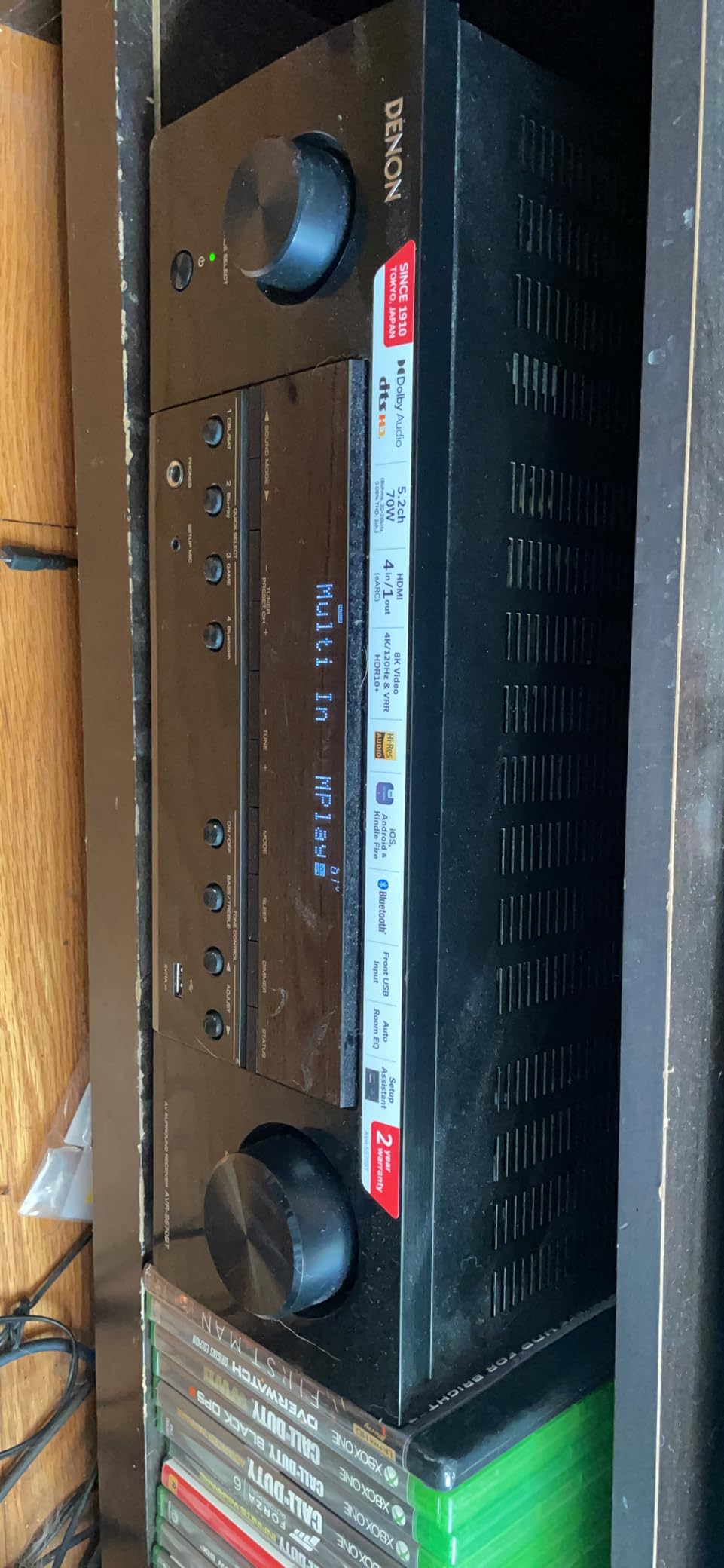
It is also one of the few receivers in this group with no Wi-Fi or Ethernet. Streaming is Bluetooth only, so HEOS multi-room is off the table and the Denon Remote App has nothing to connect to over the network. The front-panel and on-screen interfaces work fine, but the volume step on the remote is slow and then jumps in bursts, which is the single most-cited complaint across reviews.
Setup is the other soft spot. Owners report firmware and HDMI-CEC behaviour that is unreliable when several source devices are connected, and inputs cannot be renamed. The auto-calibration routine is described as reasonably accurate with room for manual adjustment, which is enough to get a flat 5.1 soundstage even though there is no object-based layer to render.
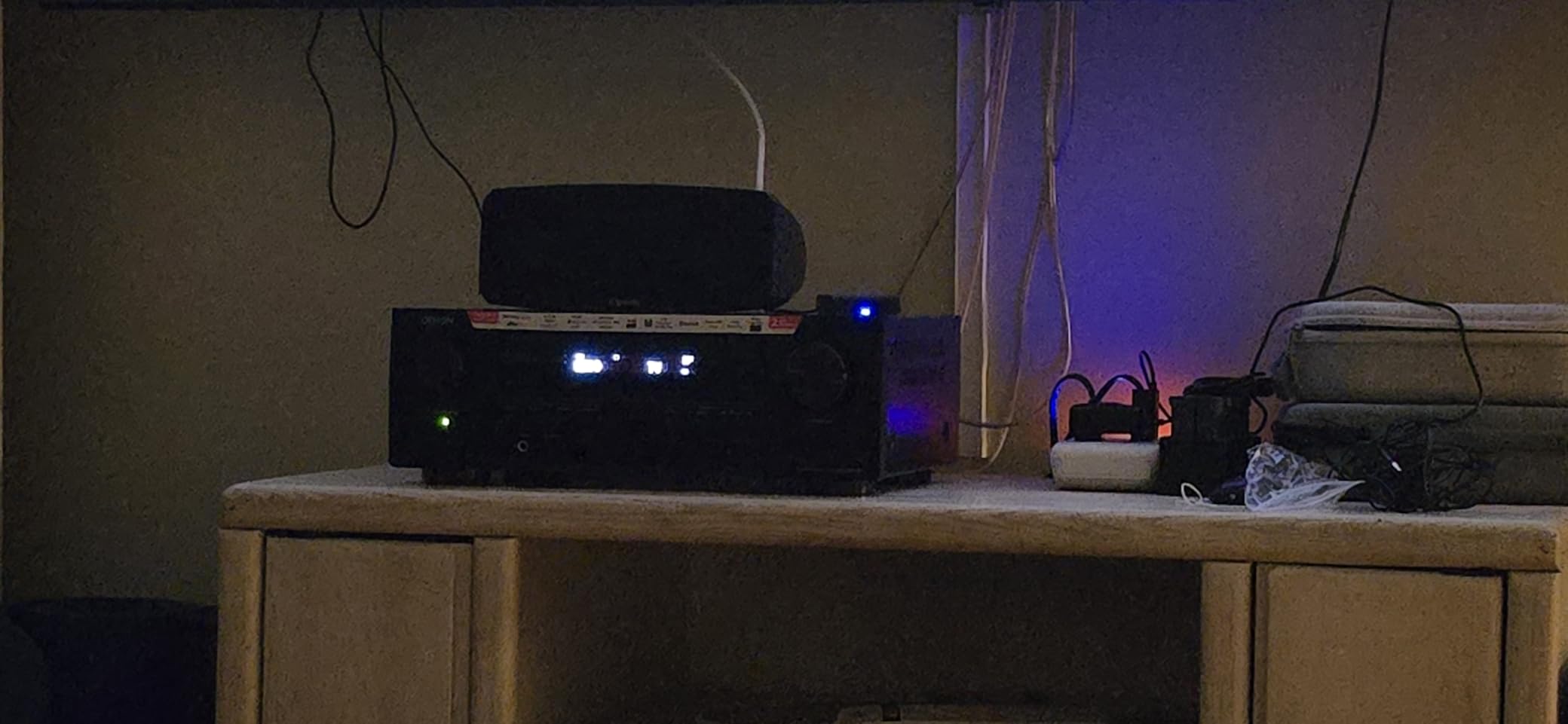
When does the 5.2 limitation not matter?
It stops mattering in two situations. The first is a secondary room, bedroom or den where a full 5.1 bed from good bookshelf speakers is the realistic goal, and spending on speakers rather than processing will be heard more clearly. The second is a first step that you expect to replace in two or three years, where low power draw and quiet running are the priorities.
It matters a great deal in a main living room where you already own or plan to buy height speakers, because those speakers simply cannot be driven. Our advice is to treat the S570BT as a 5.2 product and skip it entirely if Atmos is non-negotiable. The step up to a 7.2-channel model such as the AVR-X1700H adds real height processing for money that is small compared with the speakers involved.
What do you give up by skipping Wi-Fi here?
You give up network streaming, multi-room grouping and app control. That is a real loss for a household already running HEOS or AirPlay throughout, and it is the single reason we would not put this receiver in a main room. The four HDMI inputs and 40 Gbps eARC mean picture and game signals are handled properly, so nothing about video is compromised.
Everything else on the list is standard. Dolby Vision, HDR10+, HDR, HLG, Dolby TrueHD and DTS-HD Master all decode, and the on-screen HD Setup Assistant walks through connections and speaker balance in plain language, which owners consistently praise. The 2-year warranty is shorter than the 3-year cover on the X-series, another small reason to stretch if you can.
3. Denon AVR-S760H – The Most Popular First Atmos Receiver
Denon AVR-S760H 7.2 Ch AVR – 75 W/Ch (2021 Model), Advanced 8K Upscaling
7.2 channels
75W per channel
Dolby Atmos Height Virtualization
3x 8K inputs
HEOS
Pros
- Atmos Height Virtualization adds overhead effects on 7.1 layouts
- Three dedicated 8K/60 and 4K/120 inputs
- HEOS multi-room streaming
- VRR Quick Frame Transport and ALLM present
Cons
- 75W per channel is modest
- Only three inputs carry full 40 Gbps
- Dated on-screen and HEOS interfaces
- No independent multi-zone HDMI switching
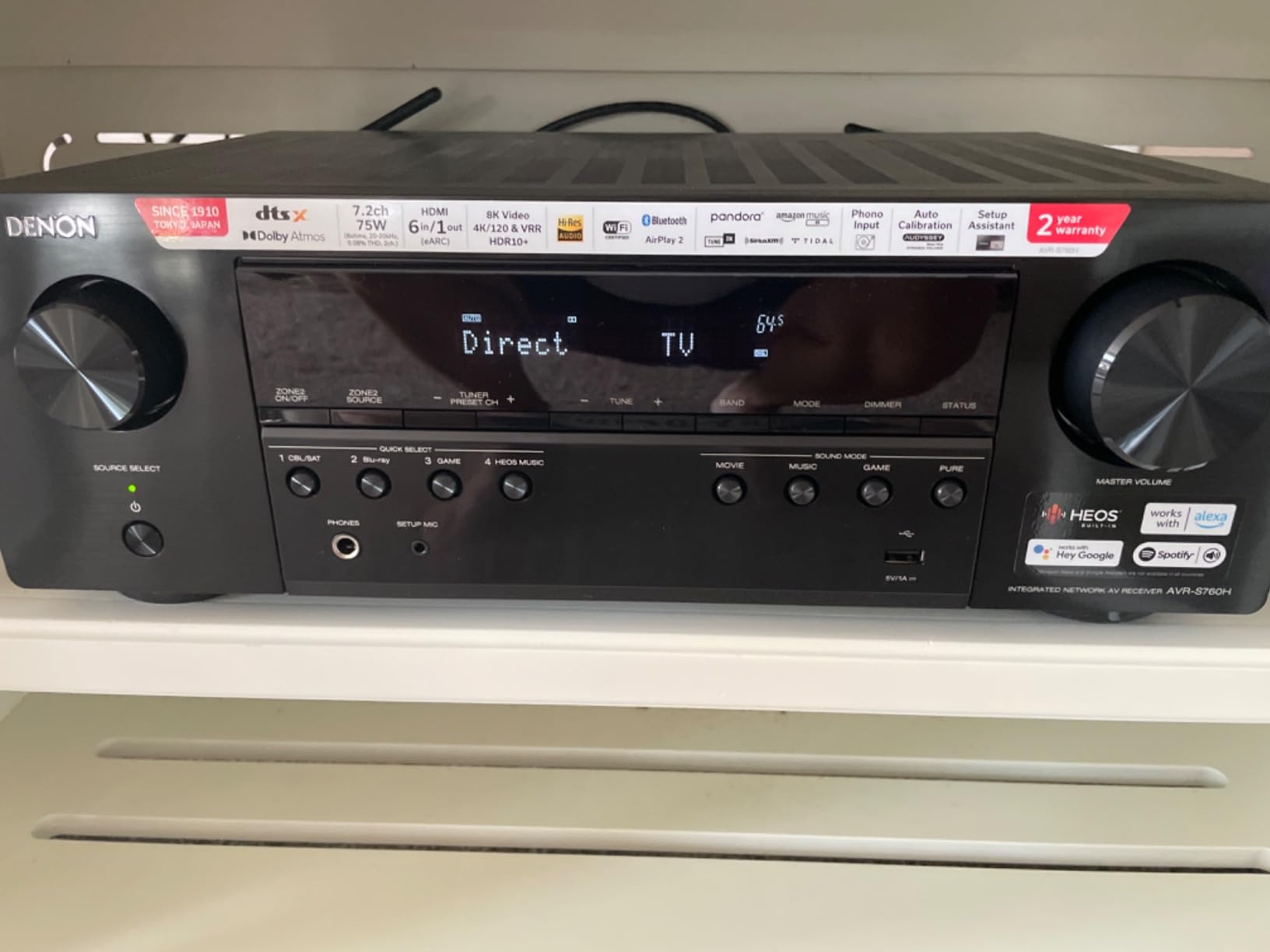
The AVR-S760H has the largest review base in this roundup at 1,190 ratings, which makes it the safest default recommendation for someone building a first Atmos system on a budget. It is a 7.2-channel receiver with 75 watts per channel, three dedicated 8K/60 and 4K/120 inputs, and HEOS built in for multi-room streaming.
The feature that separates it from cheaper 7.2 units is Dolby Atmos Height Virtualization, which renders virtual overhead effects from a 7.1 speaker bed. It is a genuine compromise, not real height, but owners report it adds a noticeable overhead layer to films that were mixed for Atmos before you ever install speakers in the ceiling.
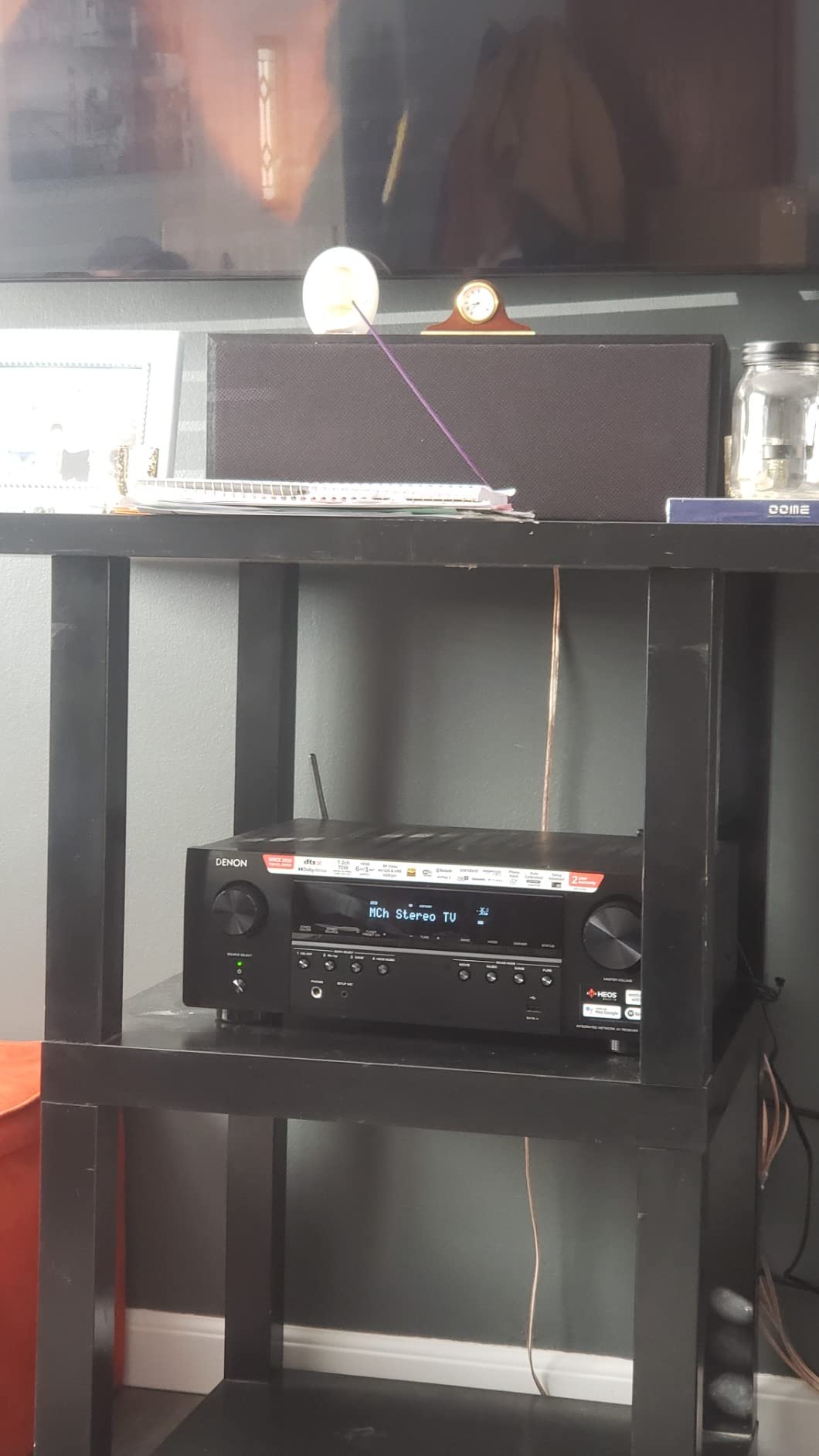
Video handling is good but not class-leading. Of the seven HDMI ports, only three are full 40 Gbps, so a PS5 and an Xbox Series X both at 4K/120 with VRR would exhaust them alongside any 4K streaming device. 8K upscaling is present, as are Dolby Vision, HDR10+ and HLG passthrough on all inputs.
Owners are split in a predictable place. Happy reviewers point to clean 7.2 Atmos and DTS:X decoding, height virtualization, working VRR and Quick Frame Transport, and reliable HEOS. Critics point to modest power for large rooms, the limited number of full-bandwidth inputs, and a clunky text-heavy interface that is tedious to navigate for basic settings.
Is virtual height good enough instead of ceiling speakers?
It is good enough for a rental, a flat, or a room where drilling is not an option, and it is a reasonable way to decide whether you care about the overhead dimension at all. Owners who move from no height to virtualization almost always end up wanting real speakers later, which is worth knowing before you settle.
For a dedicated room you control, real height speakers paired with a 5.1.2 layout are the better use of the same budget, and at that point the extra processing power in the X1700H becomes the more sensible purchase. The S760H makes more sense when your existing speaker layout is 7.1 and you want Atmos-style effects from speakers you already own.
How much power do you really get from 75 watts?
The quoted figure is measured with only two channels driven, and in a 5.1.2 Atmos mix all seven amplifiers share the power supply. In practice this unit plays a mid-size room comfortably and will not strain, but it runs out of headroom faster than the Onkyo TX-NR6100 or the Sony STR-AN1000 when the system is pushed to reference levels in a large space.
For a typical 1500 to 2500 cubic foot living room with bookshelf speakers, that is fine. If you have floorstanding speakers with low sensitivity, or a room with high ceilings, buy the power instead. Speaker impedance is worth checking too: this unit is happiest with 6-ohm and 8-ohm loads, and pushing 4-ohm demands across every channel is asking for trouble.
4. Onkyo TX-NR6100 – The Most Volume for the Money
Onkyo TX-NR6100 7.2 Channel THX Certified Network AV Receiver – Black
7.2 channels
210W per channel
THX Select certified
Zone 2 audio and video
3x HDMI 2.1
Pros
- THX Select certified amplifier gives far more headroom than 80W rivals
- 5.2.2 Dolby Atmos and DTS:X decoding
- Discrete Zone 2 audio and video
- Built-in cooling fan limits heat
- Eight HDMI ports
Cons
- Only three inputs are full 40 Gbps
- AccuEQ is less capable than Dirac Live on the TX-NR7100
- Some units report HDMI handshake failures
- No composite video input
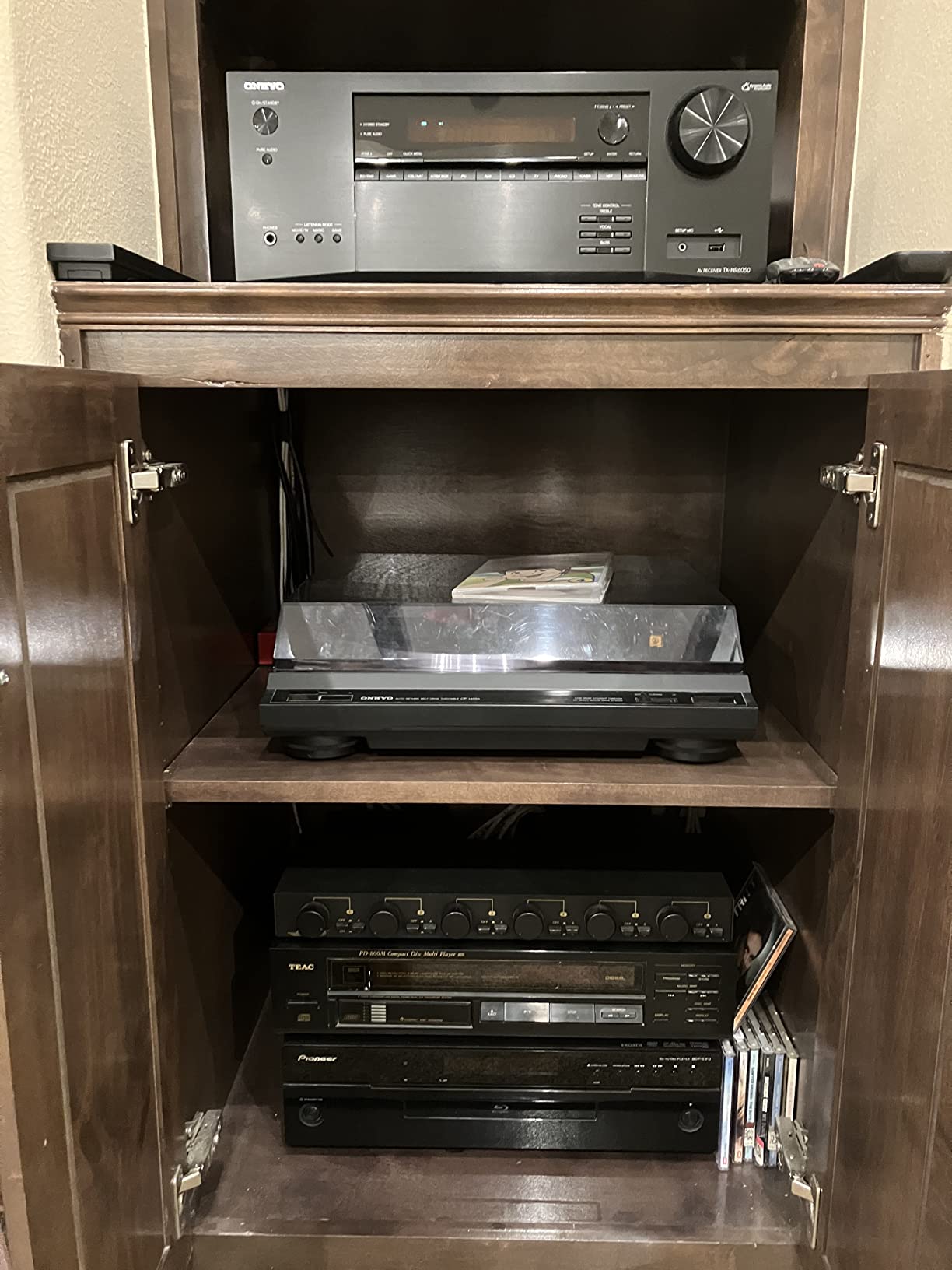
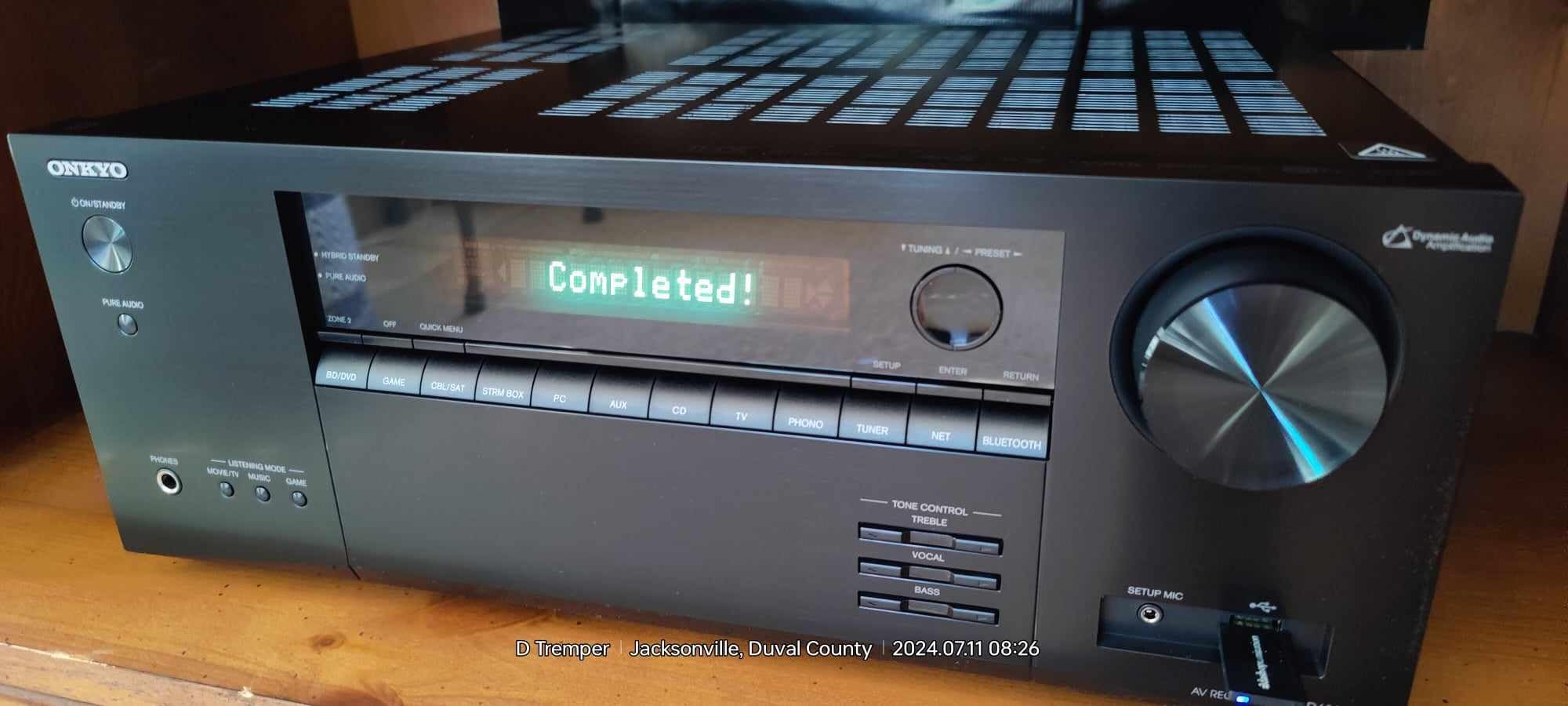
The Onkyo TX-NR6100 exists for one reason: power. Its THX Select certified amplifier is quoted at 210 watts per channel, and owners repeatedly describe buying it after finding 80W Denon units too quiet for their room. Several came from larger spaces or less efficient speakers where the difference was not subtle.
It is a 7.2-channel receiver with 5.2.2 Dolby Atmos and DTS:X decoding, three HDMI 2.1 inputs at 40 Gbps with 8K support out of eight total ports, and discrete Zone 2 audio and video output. Onkyo’s app gives unusually deep control when you would rather not reach for the remote.
The trade-off is calibration. This unit uses AccuEQ rather than Audyssey or Dirac Live, and that is the single most common reason buyers end up on the TX-NR7100 instead. AccuEQ handles level and distance and a basic EQ pass, but it does not correct the phase and reflection problems that shape how an Atmos bed integrates with the rest of the mix.
Reliability reports are worth reading carefully. The 4.1 average is the second-lowest here, and an 11% one-star group is larger than most rivals in this class, driven largely by reported HDMI handshake failures and menu display delays on some units, several of them bought from third-party sellers. Owners also note it runs warm and needs airflow clearance in a tight cabinet.
Is 210 watts real or just a headline number?
It is measured with one or two channels driven, like every figure in this article, so the all-channel number will be lower. Even so, owners report it as noticeably louder than 80W-class rivals in the same rooms, and the gap is big enough that this is not marketing inflation. The practical effect is that you hit comfortable listening levels with more headroom left before the amplifier runs out.
That headroom matters most in a large room, with low-sensitivity speakers, or at long listening distances in a dedicated theater. In a small apartment it is more than you need, and you would be paying for capability you will not use, which is why the loudest receiver is not our top pick.
What should you check before buying this Onkyo?
Buy through a seller with a straightforward return policy, and check the return window before you commit. Reviewers who hit HDMI problems in the first weeks resolved them by exchanging the unit, so a generous window converts a potential frustration into a routine return. Confirm your legacy devices too: there is no composite video input, so older consoles or a VCR need an adapter.
Plan the cabinet ventilation before the delivery arrives, not after. Heat build-up in an enclosed media console is a recurring complaint with high-power amplifiers, and clearance around the chassis costs nothing. The included remote is also not programmable for non-Onkyo components, so if you have legacy gear, budget for a universal remote.
5. Onkyo TX-NR7100 – The Best 9.2-Channel Receiver Here
TX-NR7100 9.2-Channel THX Certified AV Receiver
9.2 channels
100W per channel
Dirac Live correction
THX Select certified
6 HDMI 2.1 inputs
Pros
- 9.2 channels supports 5.1.4 and 7.1.2 Atmos layouts
- Dirac Live produces the flattest measured response in this group
- All six HDMI inputs are full HDMI 2.1
- THX Select and IMAX Enhanced processing
- Discrete Zone 2 HDMI switching
Cons
- Dirac calibration can fail repeatedly
- Initial Setup message can block video until reset
- No pre-outs
- so it cannot grow past 9 channels
- Plastic faceplate feels cheap for the class
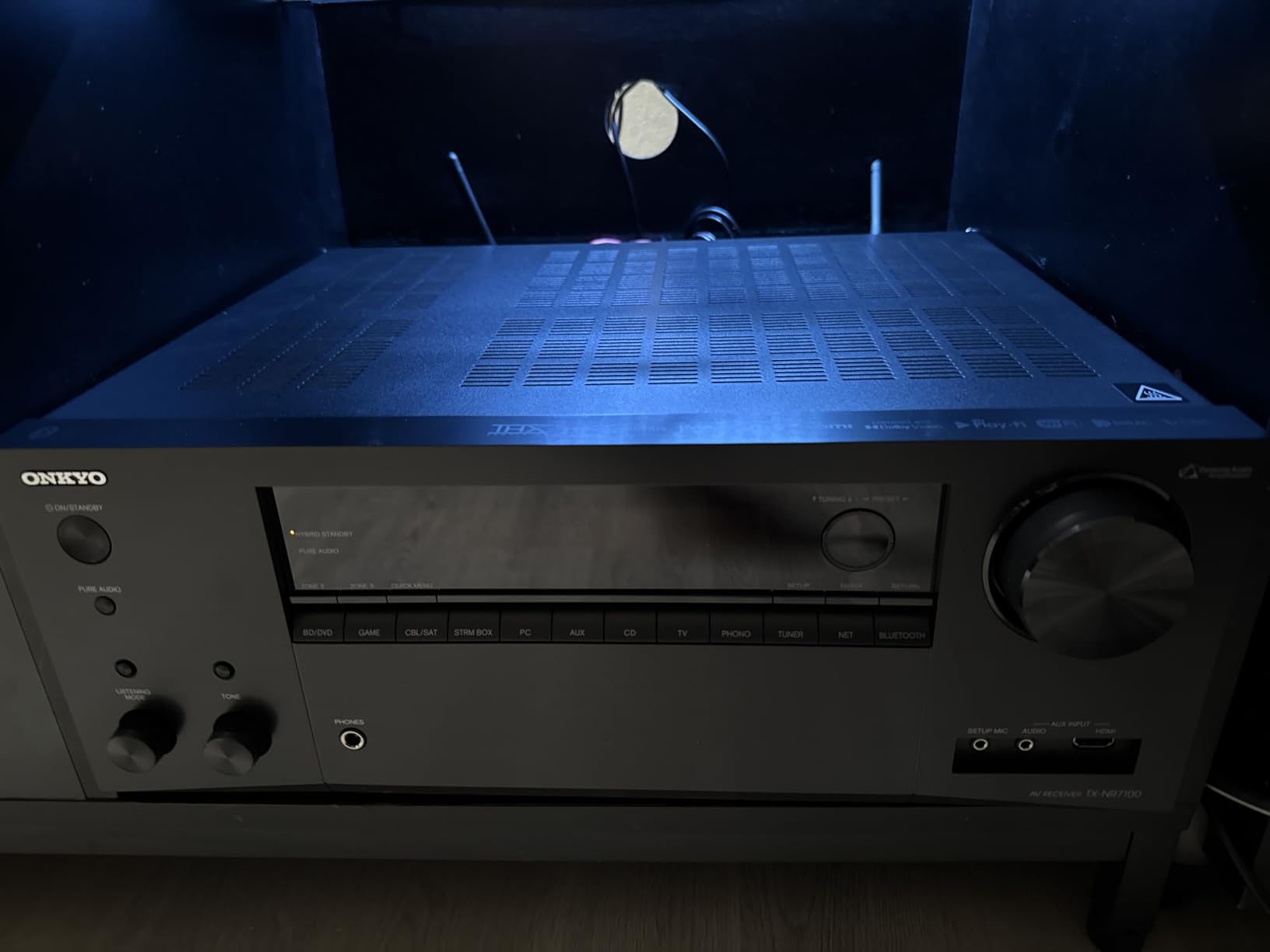
The TX-NR7100 is the most interesting receiver in this group for anyone who actually wants Dolby Atmos rather than a surround upgrade. Nine channels of processing means a 5.1.4 bed with four ceiling speakers, or 7.1.2 with a full seven-speaker bed plus two heights, and owners consistently describe the move from 5.1.2 to one of those layouts as the point where Atmos starts to feel genuinely immersive.
Paired with that is Dirac Live, which is the most capable correction system represented here. Owners report dramatically flatter measured tone curves after calibration, and forum discussion broadly treats room correction quality as the single most-cited deciding specification in this category. Audyssey is good; Dirac on this chassis corrects more of the room.
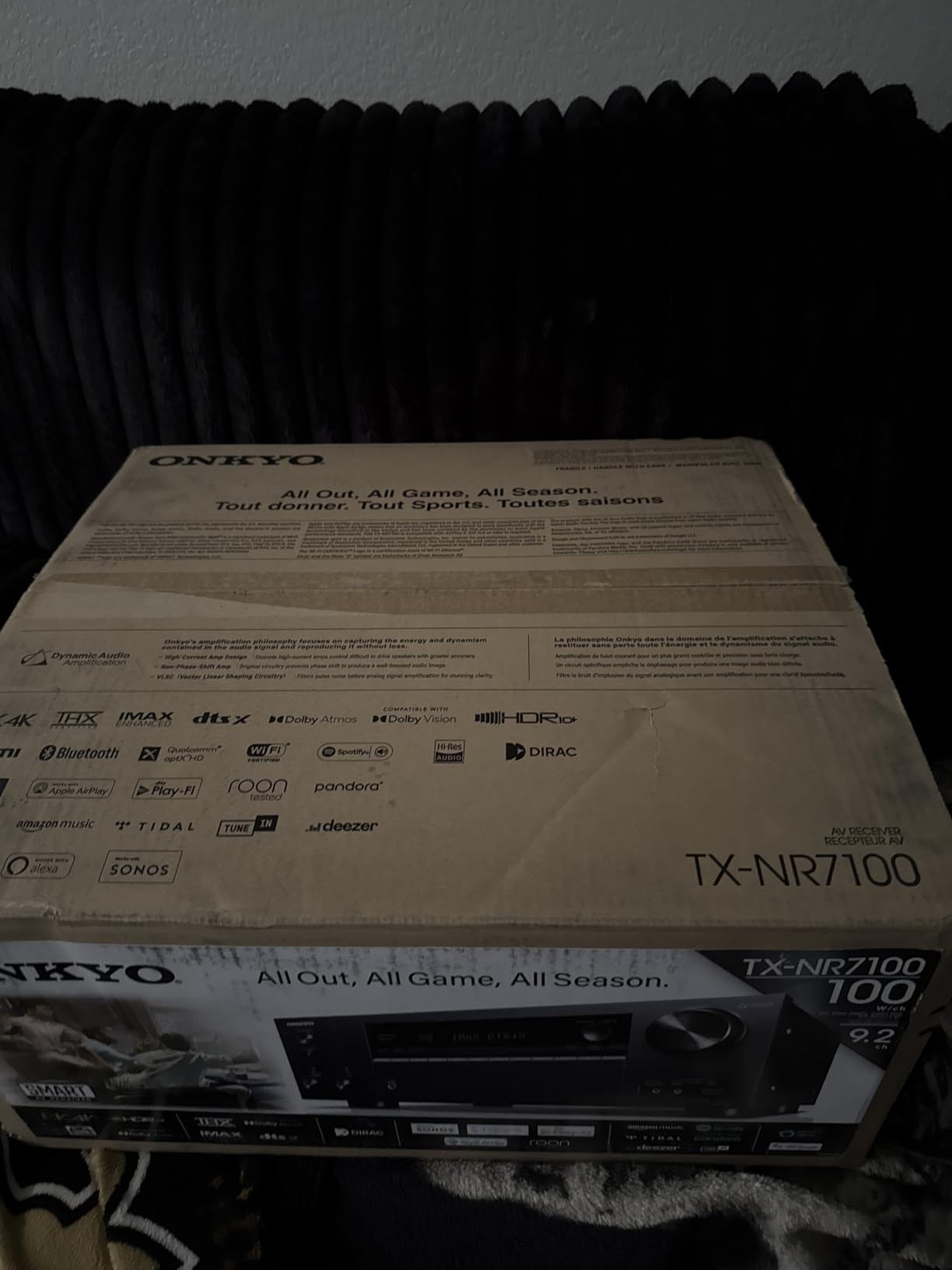
The HDMI situation is the best in the roundup: all six inputs are full-bandwidth HDMI 2.1, plus two HDMI 2.1 outputs with discrete Zone 2 switching up to 8K60. VRR, ALLM and Quick Frame Transport are all present, so two next-generation consoles and a 4K TV cause no compromise. Sonos Certified, DTS Play-Fi, AirPlay 2 and Chromecast built in round out a strong streaming layer.
There are real software caveats. Dirac calibration is reported to fail repeatedly for some users, and a first-boot message reading Initial Setup – See TV can block video output until a factory reset. Owners also report brief audio drop-outs as new content starts and the unit re-detects the audio format, plus app Wi-Fi that is unreliable after a power cycle.
Does 9.2 channels justify skipping the 7.2 models?
If you are installing four ceiling speakers, yes, decisively. A 7.2 receiver cannot render a 5.1.4 bed at all, and pairing this with height channels plus a wide surround pair is the configuration most people describe as the true Atmos sweet spot. If your plan is two heights only, this chassis adds processing you will not use.
There is a catch on expansion. With no pre-outs and no independent subwoofer outputs, you cannot add an external amplifier to grow past nine channels later. That is a deliberate trade for the power and processing budget, and it means the choice is final in a way a 7.2 unit with pre-outs is not. Speakers, on the other hand, are far cheaper to change than a receiver, so the risk is lower than it sounds.
Is Dirac Live really better than Audyssey?
For most rooms, yes, and the difference is most audible in the low midrange where room modes cause a muddy Atmos bed. Audyssey corrects amplitude and timing well and is easier to run, but Dirac’s filter design handles a wider bandwidth and tends to leave the centre channel cleaner. If you have never run either, the accuracy difference is smaller than the difference between a calibrated room and an uncalibrated one.
Both systems are far less important than getting the microphone placement right. A single measurement position in a large room produces a result that can make things worse, so budget time for multiple sweeps and a second pass rather than trusting the first run. If the calibration menu frustrates you, no system will rescue a speaker placement that puts a height speaker directly over your head.
6. Sony STR-AN1000 – The Best Receiver for PS5 and Sony TV Owners
Sony STR-AN1000 7.2ch Home Theater 8K A/V Bluetooth Receiver
7.2 channels
165W per channel
Dolby Atmos and DTS:X
6 HDMI in, 2 out
Zone 2 and Zone 3
Pros
- 165W per channel drives a living-room 7.2 system with impact
- Dolby Atmos plus DTS:X with 360 Spatial Sound mapping
- HDMI 2.1 with 6 inputs and 2 outputs
- eARC works reliably with most TVs
- Zone 2 and Zone 3 distribution
Cons
- Dolby Vision pass-through issues reported with Apple TV 4K
- Boot time up to about two minutes
- Front panel display too small to read
- No phono input
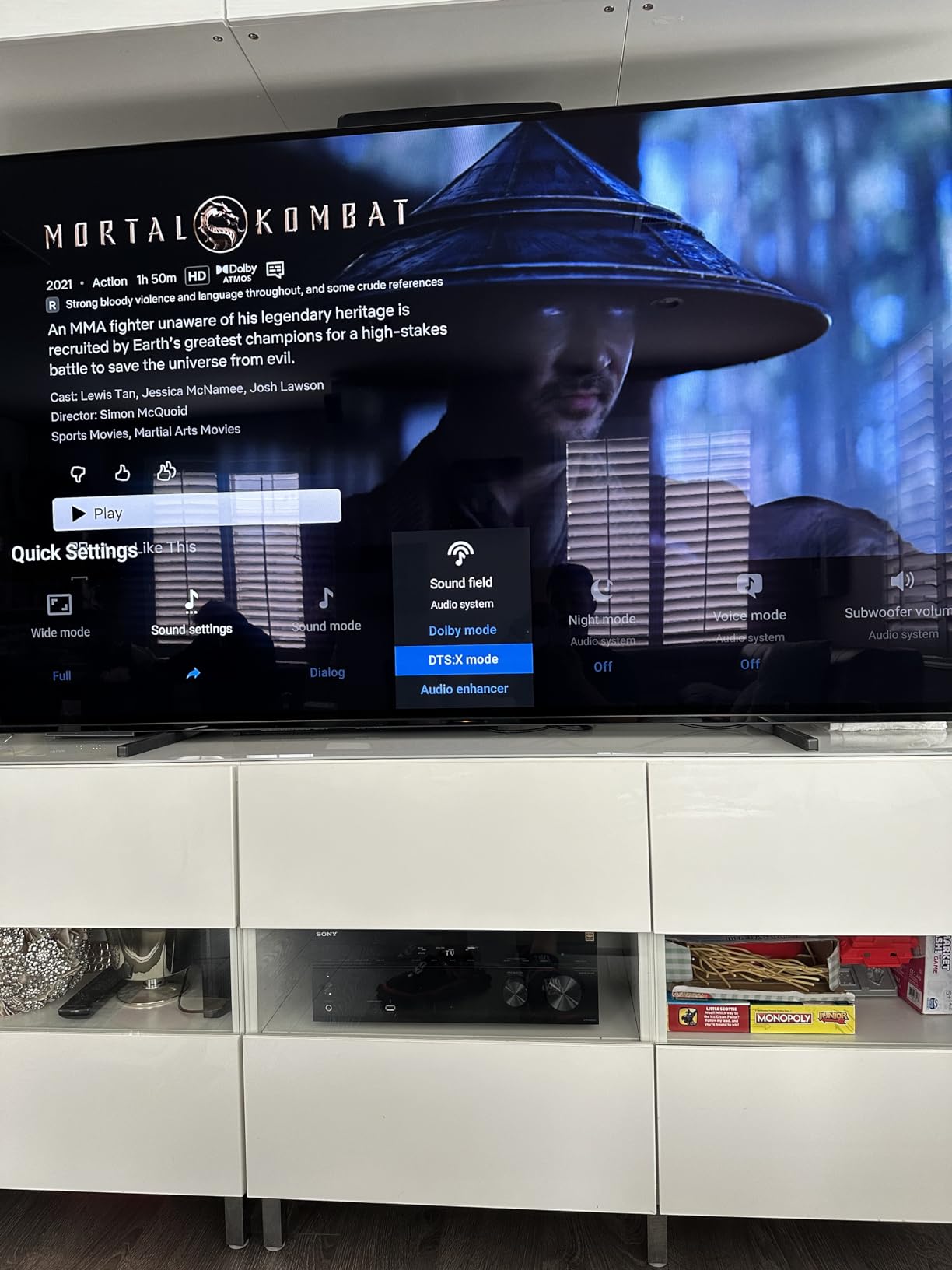
The Sony STR-AN1000 is the pick if your television and console are both Sony. It delivers 165 watts per channel into a 7.2 system, decodes Dolby Atmos and DTS:X, and adds 360 Spatial Sound Mapping, which converts non-object-based content into an overhead field. Owners in the PS5 ecosystem single that feature out repeatedly, along with S-Center Acoustic pairing.
On paper the connectivity is strong: HDMI 2.1 with 6 inputs and 2 outputs, 8K and 4K/120 pass-through, and Digital Cinema Auto Calibration IX with a calibration microphone included. Zone 2 and Zone 3 outputs let you distribute to other rooms, and it works with Sonos alongside built-in Chromecast, Spotify Connect, AirPlay and Google Assistant.
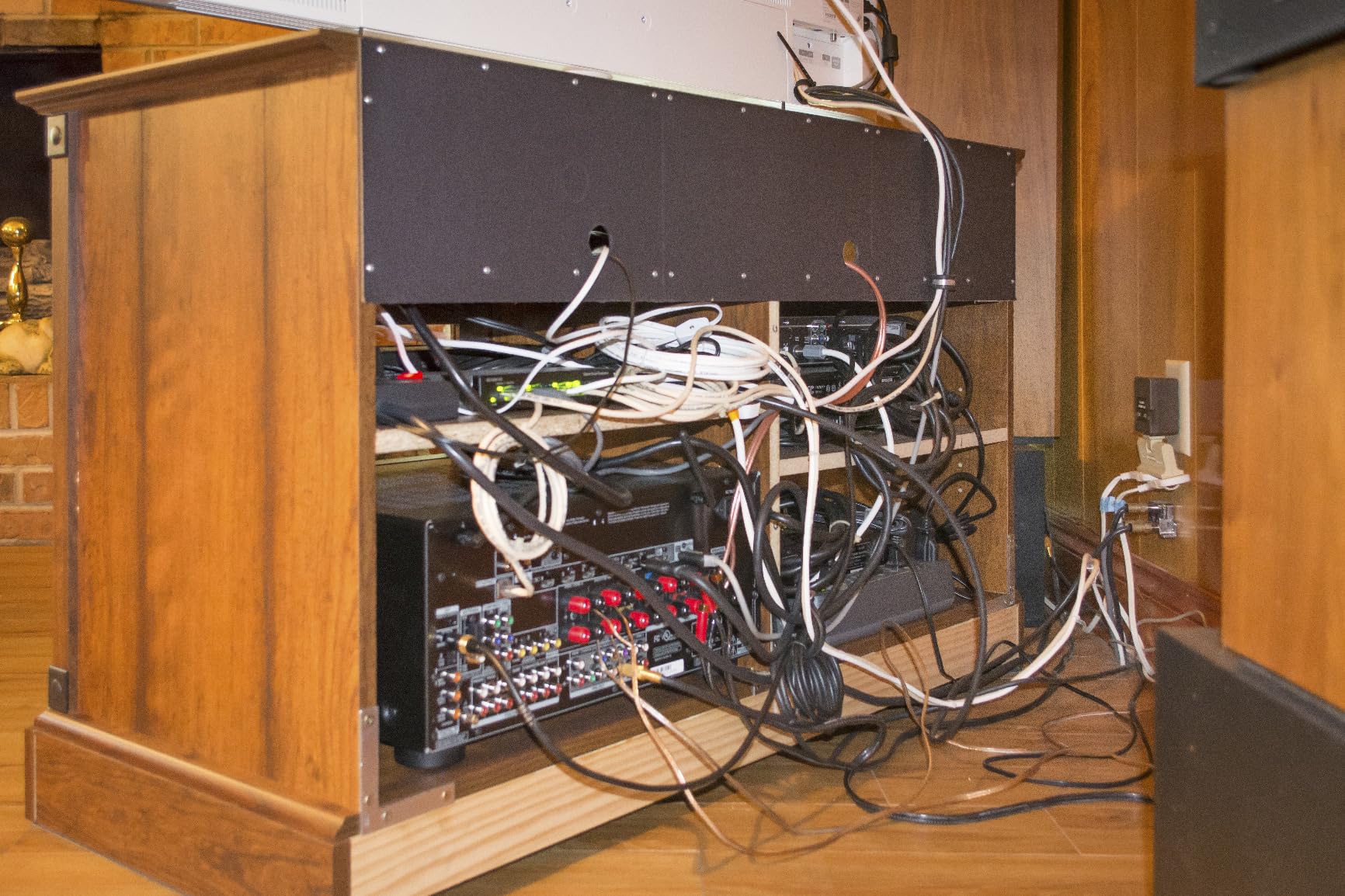
The practical weaknesses show up during setup rather than playback. Several detailed reviews document Dolby Vision pass-through failures with Apple TV 4K, and some owners report HDCP-related black screens and relay failures. Boot time runs up to about two minutes, with occasional input-detection failures when a source is switched on.
There is no phono input, which matters more to music-first listeners than the specification list suggests. The remote is small and short range, the front panel display is too small to read from a couch, and the thin sheet-steel case rattles when the main relay engages. Calibration is quick and mostly accurate, though the interface does not offer a bookshelf-sized option for rear surrounds.
Is 360 Spatial Sound a real upgrade for non-Atmos content?
It is a genuine upgrade for broadcast television and older films, where 360 Spatial Sound Mapping places a version of the mix above the listener. On a properly set up 5.1.2 system it adds a sense of air that the original mix never contained. On a 7.1 system without height speakers, the effect is smaller and more diffuse.
It does nothing for content that is already Dolby Atmos, which is already placing objects precisely. So the value depends on how much of your watching is legacy surround versus modern object-based material, and that is a fair question to ask before choosing Sony over a brand that spends the same money on room correction.
Which pairing does this receiver suit best?
A PS5 with a Sony television, direct HDMI connection, and a living-room-sized 7.2 system with bookshelf speakers. The power is more than enough for that room, the HDMI count handles the console and streaming devices without compromise, and the gaming features are all present including VRR and ALLM support.
It suits vinyl listeners least, because there is no phono stage, and it suits anyone with a mixed-brand ecosystem less well than the Denons with their broader input handling. If you run an Apple TV 4K as your main source, check the Dolby Vision reports for your specific generation before committing, since that is the most common complaint in detailed reviews.
7. Pioneer VSX-935 – The Best Value With Genuine Power
Pioneer VSX-935 7.2 Channel Surround Sound Network Receiver Dolby Atmos (2021)
7.2 channels
80W per channel
Phase correction calibration
HDMI 2.1 with 8K
8 HDMI ports
Pros
- Enough power for 7 ceiling speakers in a dedicated room
- Plays all speakers in stereo music mode
- Phase correction is a real step up from old receivers
- Dual zone speaker output and RF remote
- Strong value for the feature set
Cons
- Two-way Bluetooth is buried in menus and unreliable
- Interface looks like a 1990s design
- Firmware updates are USB-only and often fail
- Sometimes struggles with TrueHD from TV apps with HDR
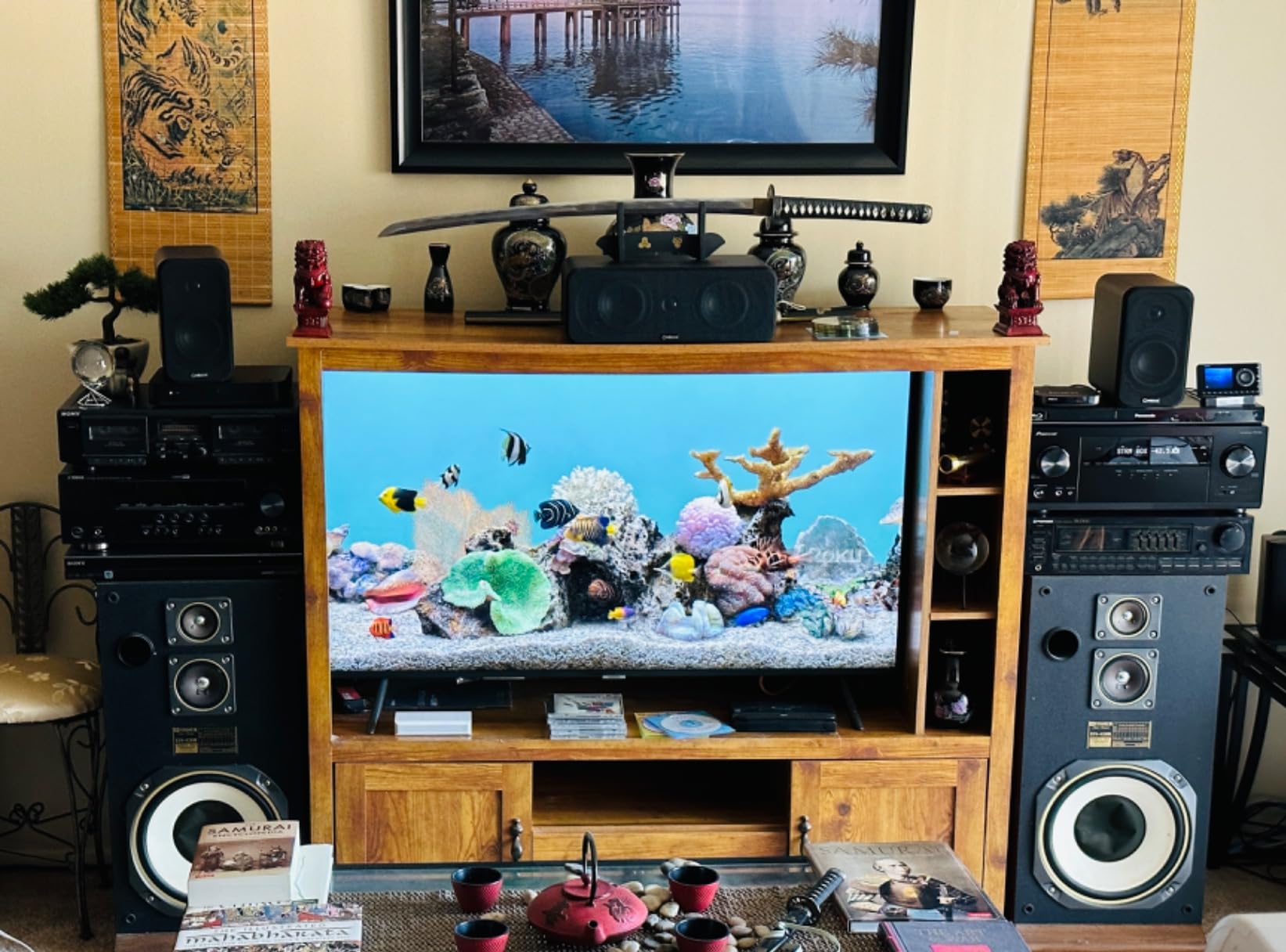
The Pioneer VSX-935 is the cheapest way into a real 7.2-channel Atmos receiver in this roundup, and several owners replacing an older Onkyo describe it as a clear upgrade in both volume and clarity. It decodes Dolby Atmos with height virtualization, passes 8K over HDMI 2.1, and adds VRR and ALLM for gaming across eight HDMI ports.
Its calibration is phase correction rather than a full measurement suite, which is a step up from the decade-old receivers it typically replaces but a clear step down from Audyssey or Dirac. Auto setup results frequently need manual level and distance correction before the image is right, so treat the first run as a starting point rather than an answer.
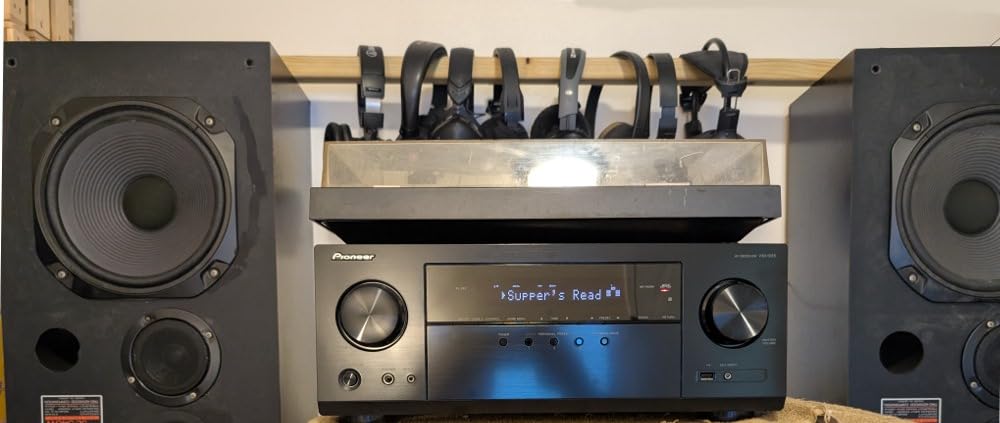
Feature-wise it is unusually generous. Dual zone speaker output, an RF-capable remote that works through closed cabinet doors, immersive audio from TV apps over eARC, and high-resolution DSD streaming. Several owners specifically wanted the ability to play all speakers in stereo music mode, and this unit does it without a menu fight.
The rough edges are software. The interface looks and behaves like a 1990s design, two-way Bluetooth for headphones is buried deep in the menus and unreliable, and firmware updates are USB-only and often fail with error codes. A few owners also report difficulty getting TrueHD Atmos from TV apps while simultaneously passing HDR video.
Is Pioneer phase correction good enough for Atmos?
It handles speaker placement and phase alignment, which are the two things that most obviously break an Atmos bed. What it does not do is sweep for room modes and EQ the response the way Audyssey or Dirac does, so in a reflective room the results will be less accurate. In a room with rugs, curtains and reasonable furniture, it is entirely serviceable.
Given the price position, it is the right call for most buyers in this bracket. If your room is untreated with hard walls and bare floor, either add soft furnishings or spend up on a model with real measurement EQ. Speakers and room treatment will do more for the sound than the correction system at this level.
What breaks on this receiver in daily use?
The two-way Bluetooth path and the firmware process. Bluetooth headphone output for late-night TV viewing is a genuinely popular feature and it is unreliable here, so if you rely on it, test it immediately and keep the return window in mind. The USB-only firmware updates that fail with error codes mean you may need service or a dealer to resolve an issue.
Some owners have also reported units that stopped producing sound or showed dead displays, which is why the 1-year warranty and a dealer with a real return policy are worth checking. If you want fewer support questions and a longer warranty for the same general outlay, the three-year cover on the Denon X-series is the safer purchase.
8. Marantz NR1510 – The Best Receiver for a Slimline Shelf
Marantz NR1510 Slimline 5.2 Channel AV Receiver Powered by HEOS™ with 50 W, 4K, and 6 HDMI Inputs
5.2 channels
50W per channel
4.1 inch tall chassis
Audyssey MultEQ
HEOS streaming
Pros
- Half-height chassis fits shelves and cabinets
- Warm musical tuning with clear centre-channel clarity
- Six HDMI plus analog digital and phono inputs
- HEOS with Spotify TIDAL and Amazon Music HD
- eARC integration works reliably
Cons
- No height channels
- so no true object-based Atmos
- 50W is modest and will not fill a large room
- Bluetooth playback described as scratchy at low volume
- Setup routine is tedious
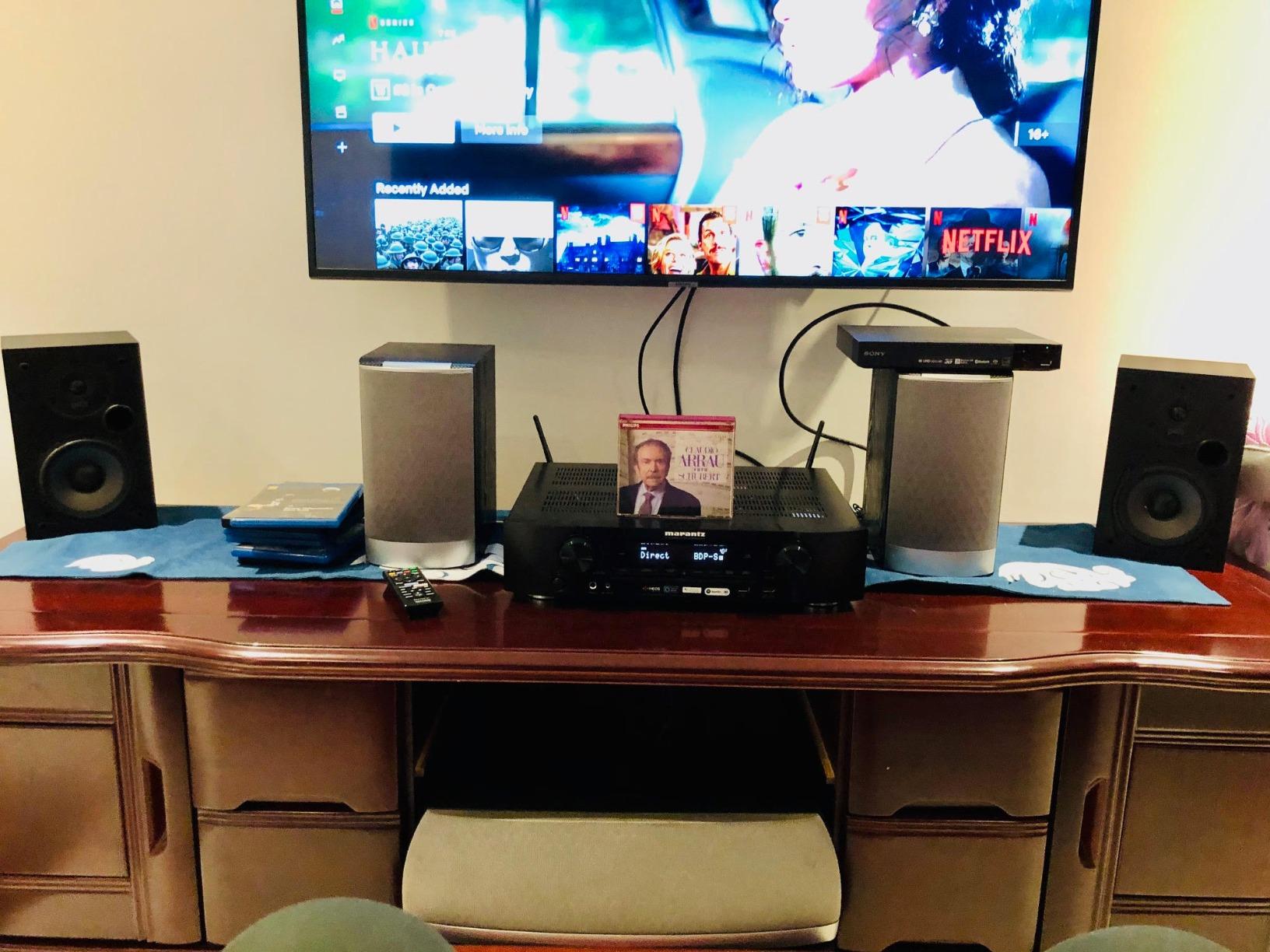
The Marantz NR1510 solves a problem no full-size receiver in this list can: it is 4.1 inches tall. That half-height slimline chassis fits furniture shelves and enclosed cabinets where every other model here physically will not go, and owners describe loving that it fits where nothing else would.
It is also the highest-rated model in the roundup alongside the X1700H, at 4.4 stars, and the sound character is distinct. Marantz tuning is warm and musical with noticeably better centre-channel clarity and more even bass than the budget receivers it typically replaces, which matters most on dialogue-heavy films and on music.
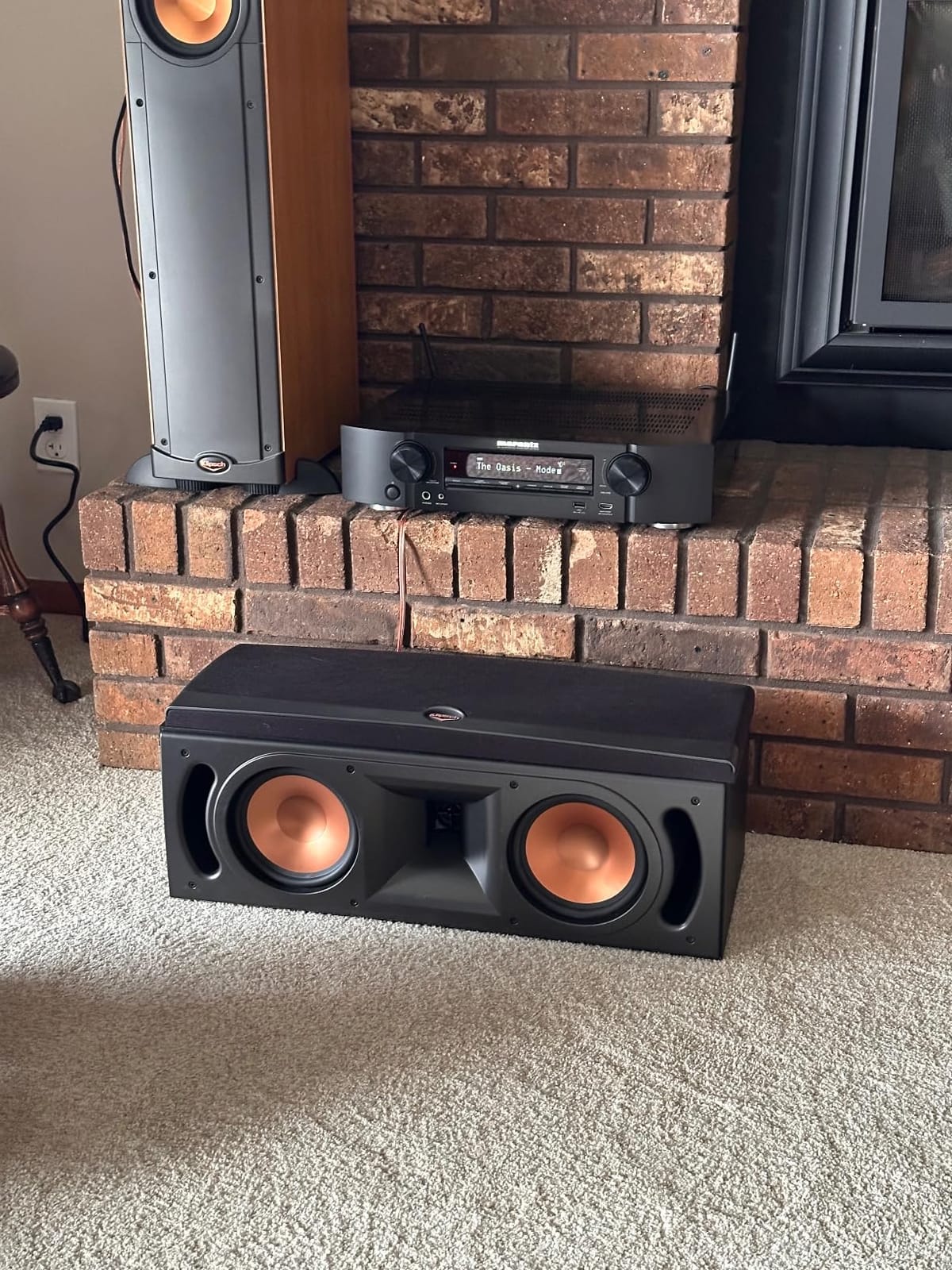
The limitations are structural and have to be accepted. Five channels at 50 watts each, no height speaker support, so no true object-based Dolby Atmos at all. Owners also note it is not loud and will not shake a room, and that Bluetooth playback is scratchy at low volume. Treat it as a 5.2 music-and-film machine, not an Atmos receiver.
Everything else is well executed. Six HDMI inputs plus analog, digital and phono connections, Dolby TrueHD and DTS-HD Master decoding, 4K passthrough with Dolby Vision and HLG, and HEOS with Spotify, TIDAL and Amazon Music HD alongside AirPlay. Audyssey MultEQ is fitted, and owners report it can surface subwoofer faults they did not know about.
Should an Atmos shopper skip the NR1510 entirely?
If Dolby Atmos is the deciding requirement, yes. There is no height virtualization and no object-based rendering on a 5.2 chassis, so no firmware update changes that. The Marantz in this list that supports a real Atmos bed is the Cinema 60, which is a full-size chassis and a different price bracket entirely.
If the constraint is the cabinet, not the format, the NR1510 is the answer. Half-height chassis, phono input, warm tuning and a 3-year warranty in a box that fits furniture most receivers cannot. It is also a strong second zone or a living room system paired with a soundbar in the main room.
What does the setup routine cost you in time?
More than most, and owners are blunt about it. The Audyssey MultEQ routine is tedious, the unit cannot be used until it completes, and the remote has redundant buttons, no backlighting and no presets. Budget an evening for the first run rather than an afternoon, and keep the microphone where you can reach it.
There are also reports of units shutting off on their own and long repair cycles, which is where the 8% one-star group comes from. That is a small share, but if you are filling a room that runs warm, check ventilation first. The three-year manufacturer warranty is a genuine advantage in this class.
9. Yamaha RX-A2A – The Best Multi-Room and Music Platform
Yamaha RX-A2A AVENTAGE 7.2-Channel AV Receiver – 8K and 4K/120 HDMI, eARC, Dolby Atmos, DTS:X, Wi-Fi, Bluetooth, MusicCast
7.2 channels
100W per channel
YPAO R.S.C. calibration
Surround:AI
3 inputs at 8K60 and 4K120
Pros
- YPAO R.S.C. multipoint calibration is accurate out of the box
- Surround:AI optimises the sound field in real time
- 100W per channel across 7 channels
- Best streaming app set including Qobuz and Roon Tested
- Zone 2 plus phono input
Cons
- Only three HDMI inputs carry full 40 Gbps
- 7.2 cannot decode a 5.1.4 Atmos bed
- Surround:AI can override manual speaker levels
- Premium pricing for a lower-tier channel count
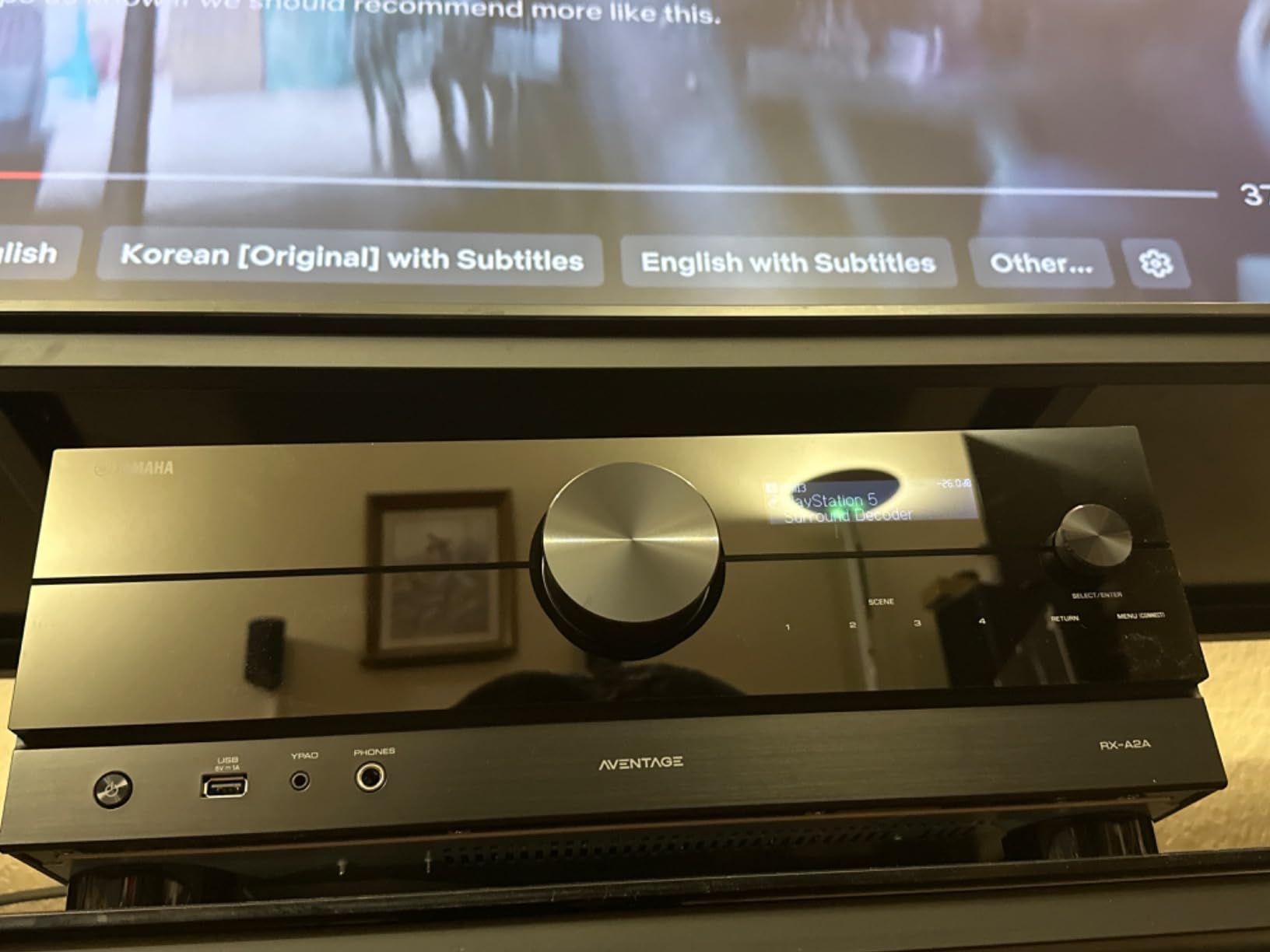
The Yamaha RX-A2A is the receiver to buy if music and whole-home streaming matter as much as films. The streaming platform is the best in this roundup: MusicCast, Spotify Connect, AirPlay 2, Amazon Music HD, SiriusXM, TIDAL, Deezer, Qobuz and Roon Tested, plus Sonos compatibility through a Sonos Port sold separately.
Its calibration is the strongest in the group for reflection-heavy rooms. YPAO R.S.C. takes multipoint measurements and is described by owners as accurate out of the box, and Surround:AI analyses content in real time to reshape the sound field for what is playing. The AVENTAGE build uses premium components, and the resulting sound is clean and refined.
Video is handled well but narrowly. Seven HDMI inputs and one output with HDCP 2.3 and eARC, with all inputs at 4K60 and three carrying 8K60B and 4K120AB. If you run a PS5 and an Xbox Series X both at 4K/120 with VRR, you will use two of those three immediately, which leaves little room for a 4K Apple TV or a projector input at full bandwidth.
The channel count is the other limitation owners raise most. At 7.2 it cannot decode a 5.1.4 Atmos bed, so if your plan is four height speakers you are looking at the wrong chassis. There is also a recurring note that Surround:AI can override accurate manual speaker level settings, which annoys anyone who has calibrated the system themselves.
Does YPAO R.S.C. handle a reflective room better than Audyssey?
Usually, yes, in the specific situation it was designed for. YPAO’s reflected sound control measures how the room returns energy to the listener and adjusts accordingly, which pays off in rooms with bare walls, glass and hard floors. Audyssey is generally regarded as more precise on frequency response, and some owners find the correction more faithful once the measurement positions are chosen well.
If you can treat the room, either system will get you close. If you cannot, Yamaha’s approach tends to be the more forgiving one. Run several measurement points rather than the single default position, and re-run after moving any speaker or large piece of furniture, because the calculation is only as good as the geometry it was given.
Is the Yamaha worth the premium over a Denon?
It is worth it for the streaming ecosystem, the room-reflection handling and the build quality, particularly in a household that plays music through the receiver daily. Yamaha pairs a MusicCast speaker or two with a Sonos Port and you have whole-home audio without rethinking the architecture, which is genuinely hard to reproduce on a Denon.
It is harder to justify for movie-only listening in a treated room, where the Audyssey-equipped X1700H gets you a similar 7.2 result for less. Zone 2 output and a phono input are both useful additions, and the 2-year warranty is a year shorter than the X-series cover.
10. Marantz Cinema 60 – The Best Build Quality for a 7.2 Bed
Marantz Cinema 60 Premium 7.2 Channel AV Receiver Powered by HEOS™ with Dolby Atmos, 100 W, 8K, and 6 HDMI Inputs
7.2 channels
100W per channel
Audyssey MultEQ XT
6 HDMI, 3 at 8K
5-year warranty
Pros
- Premium symmetrical chassis with high-quality materials
- Tuned by a Marantz Sound Master in Japan
- 100W per channel across 7 channels
- Six HDMI inputs with three 8K-compatible
- Audyssey MultEQ XT with mic and stand
- Five-year manufacturer warranty
Cons
- Seven channels only
- no 9.2 processing for 5.1.4 layouts
- HEOS app experience is less refined than Denon or Sony
- Large footprint for a 7.2 channel receiver
The Marantz Cinema 60 is the newest and least reviewed receiver here, with 74 ratings at a 4.4 average, so treat the owner feedback as early rather than settled. What those buyers describe is a premium symmetrical chassis hand-tuned at Marantz’s Shirakawa facility in Japan, with a warm enveloping sound that carries Marantz’s music-first character straight through to home cinema.
Under the styling it is a competent 7.2 receiver: 100 watts per channel, Dolby Atmos and DTS:X decoding, six HDMI inputs with three 8K-compatible, plus analog, digital and phono connections. Audyssey MultEQ XT is fitted, which is a step up from the plain MultEQ in the NR1510 and includes a microphone stand for proper placement.
The catch is the same one that runs through this whole list: seven channels only. There is no 9.2 processing, so a 5.1.4 or 7.1.4 Atmos layout is impossible no matter how good the amplifier is. For a music-first household with a 5.1.2 or 7.1.2 layout, that is a fair trade; for anyone planning four height speakers, it is the wrong chassis at this price.
The five-year warranty is the longest in the roundup and the strongest signal of manufacturer confidence. Streaming is HEOS with Spotify, TIDAL and Amazon Music HD, plus AirPlay, Bluetooth and Apple HomeKit, and owners note the app experience is less refined than the Denon or Sony equivalents. The chassis is physically large for a 7.2 receiver, so measure the cabinet.
Does a premium chassis measurably improve the sound?
Partly, and it is worth being honest about which part. Construction quality reduces vibration and delivers a more stable, lower-noise amplifier stage, and the Japanese Sound Master tuning gives a distinctly different voicing that many listeners prefer for music. Neither effect is as large as the difference between a calibrated and uncalibrated room, or between adequate and inadequate power.
Where the premium is easier to feel is in the things you touch every day: the weight of the volume control, the finish, the way the case resists resonance, and a five-year warranty instead of two or three. If the system is the centre of a room you use daily, that is a reasonable use of money rather than a spec-sheet upgrade.
Who should wait before buying this one?
Anyone who wants to read a long-term reliability history. Seventy-four ratings is not enough to know how the HDMI board, the fan or the app behave in year three, and this category punishes buyers who skip that research. Wait for the review volume to build if the purchase is a major system decision for you.
Also wait if your layout will exceed 7.2. There is no preamp output to add an external amplifier and no 9.2 processing, so a 5.1.4 plan makes this a dead end. In that case, put the same money toward the Onkyo TX-NR7100, which decodes the wider layouts and adds Dirac Live calibration, and accept a less refined chassis in exchange for the right number of channels.
How to Choose a Dolby Atmos Receiver in 2026?
How many channels do you actually need?
Map your speaker layout to the receiver before anything else, because this single decision eliminates most returns. Dolby Atmos renders audio objects to whatever speakers you have, and each additional height layer makes the overhead field more convincing. The rule of thumb below covers almost every living room and dedicated theater.
5.1.2 Atmos (two ceiling or upfiring heights): a 7.2-channel receiver. This is the entry point and the most common build.
5.1.4 or 7.1.2 Atmos (four heights, or full bed plus two): a 9.2-channel receiver, like the Onkyo TX-NR7100. A 7.2 unit cannot decode this at all.
7.1.4 Atmos (seven-speaker bed plus four heights): an 11.2 or 11.4-channel receiver, which is beyond every model in this roundup.
5.1 only, no heights yet: any 7.2 receiver, with pre-outs if you may add speakers later.
For a 5.1.2 layout, real ceiling speakers beat upfiring modules. Upfiring speakers bounce height content off the ceiling and are a reasonable compromise when you cannot drill, but they depend on a reflective ceiling surface and correct distance from the listening position. Placed too close to a seat, they will pull the effect directly down onto your head and sound worse than no height channels.
Room correction matters more than channel count
Forum consensus, and our own reading of the owner reports, is consistent on this: buyers overspend on channels and watts while neglecting calibration, then wonder why the Atmos sounds flat. Every receiver in this roundup ships with some form of measurement EQ, and the difference between the tiers is real.
Dirac Live on the TX-NR7100 is the most capable correction here, handling a wider filter bandwidth and leaving the centre channel cleaner. Audyssey MultEQ XT in the Denon X-series is a close second and easier to run, and the complaint owners report most is that auto-calibration sets the centre channel too low, which a manual adjustment fixes. AccuEQ on the TX-NR6100 and phase correction on the VSX-935 handle placement and phase but not full room mode correction.
Whichever system you buy, run multiple measurement points from the main seat and re-run after moving furniture. One sweep in a large room produces a result that can be worse than no calibration at all. This is the single highest-value hour you will spend on the system.
Wattage numbers are misleading, so plan for headroom
Every receiver here quotes a headline wattage measured with only one or two channels driven. In a 5.1.2 Atmos mix, all seven amplifiers draw from the same power supply at once, so the realistic all-channel figure lands well below the marketing number. Budget roughly two-thirds of the quoted watts for planning purposes.
Match that number to room volume and speaker sensitivity rather than to the receiver price. A 1500 to 2500 cubic foot living room with efficient bookshelf speakers runs comfortably on 75 to 85 watts per channel. A dedicated theater over 3000 cubic feet with low-sensitivity floorstanders wants 100 watts or more, which is where the Onkyo TX-NR6100 and Sony STR-AN1000 pull ahead.
Check speaker impedance too. 6-ohm and 8-ohm loads are easy; driving 4-ohm demands across every channel is not, and doing so on an underpowered unit produces distortion and instability long before it produces better sound. If your speakers are 4-ohm, buy external amplification rather than pushing a 50W or 75W chassis.
HDMI 2.1, eARC and the gaming features that matter
Count full-bandwidth inputs, not total HDMI ports. A receiver with six or eight inputs where only three are 40 Gbps is fine until you connect a PS5, an Xbox Series X and a 4K projector, at which point you are negotiating for bandwidth. In this roundup, the TX-NR7100 is the only model with HDMI 2.1 on every input.
For gaming, check VRR and ALLM support rather than assuming it. Both handle variable refresh rate and automatic low-latency switching, and both matter if you play on a modern console. eARC on the output lets your TV send Atmos audio back to the receiver, which is how most streaming apps deliver object-based sound today.
eARC is also the source of the most common complaints in this category. Lip-sync delay with Atmos audio arriving behind the picture forces many owners to disable eARC or fall back to 7.1, and Atmos flags drop out intermittently when a TV app negotiates a new format. If the flag disappears mid-scene, a receiver restart normally restores it. If lip-sync is the problem, try disabling HDMI-CEC, or feed the streaming device directly into the receiver instead of through the TV.
Test that your height channels are actually firing
Most disappointing Atmos is a setup problem, not a hardware problem, so verify the basics before blaming the receiver. First, confirm the Atmos logo appears on the display for native content rather than a Dolby Surround or DTS:X badge. Second, use the setup menu to check that each height channel shows signal when played.
For a hands-on test, play a scene you know well with clear overhead content, such as rain, an aircraft passing overhead or a crowded marketplace, and listen with someone else in the room. Then run the calibration routine again and listen for the change. Height channels set to zero in the menu, or assigned to the wrong terminal, are far more common than a faulty decoder.
If Atmos still sounds harsh or flat, the cause is almost always speaker placement, an uncalibrated room, or a subwoofer crossing too high. Turn off the sub briefly and listen again to isolate the bass contribution. Owners who make those three fixes, not receiver changes, are the ones whose systems start working.
Receiver, soundbar, or preamp with separate amplifiers?
A receiver is the right answer when you want true surround and height channels, gaming features, and a single box that handles switching, amplification and calibration. That is what the best home theater receivers for Dolby Atmos deliver, and nothing in this category replaces that combination at a sensible outlay.
A soundbar wins on simplicity and room footprint. If the system lives in a living room where wiring is not an option, a dedicated [Dolby Atmos soundbar](https://www.pwice.com/best-dolby-atmos-soundbars/) with a wireless subwoofer gets you an overhead dimension in an afternoon, with no calibration mic and no rack. Our broader [projector guide](https://www.pwice.com/best-home-theater-projectors/) covers the other half of a dedicated room if you are building one.
A preamp with separate amplifiers is the enthusiast answer for very large rooms or demanding speakers, and it costs considerably more because you are buying two chassis instead of one. Consider it when a single amplifier cannot drive your system cleanly, or when you want to upgrade amplification independently over a decade. For most people, that money is better spent on speakers.
What long-term reliability actually looks like
Nobody covers this, and it is one of the most-asked questions in home theater forums: which brand stays trouble-free over five years. Owner reports are the only honest source, and they are more mixed than the star ratings suggest.
Denon units in this roundup draw the fewest hardware complaints, with the dominant gripes about dated software rather than failures. The Yamaha RX-A2A is praised for build quality and an accurate first calibration run. Onkyo owners report the most operational issues, concentrated in app stability, HDMI handshake behaviour and Dirac calibration failures, so those units benefit most from a generous return window.
Two practical reliability factors sit outside the brand entirely. Ventilation is the first: a high-power amplifier in an enclosed media cabinet will shorten the life of any receiver, and owners across brands report heat as a recurring failure trigger. The second is where you buy. Warranty service is honoured through authorized dealers, so a marketplace import may ship with no local cover at all, and the return window is worth checking before you commit.
Building up over time without wasting money
Starting in 2.0 or 5.1 and expanding later is a normal path, and the smart move is to buy a receiver with spare channels and pre-outs rather than the smallest one that works today. The Denon X-series layout of analog, digital and phono inputs plus two subwoofer pre-outs is exactly what makes future expansion painless.
The point at which owners report Atmos starts to feel genuinely immersive rather than merely enhanced is the move from 5.1.2 to 5.1.4 or 7.1.2. Plan for that ceiling layout now, whether or not you can afford the speakers today, because the receiver is the component that has to be able to decode it. Speakers are cheap to change later. A receiver that cannot process 5.1.4 is not.
Frequently Asked Questions
What is the best receiver for Dolby Atmos?
The Denon AVR-X1700H is our top pick for most people. It decodes a 5.1.2 Dolby Atmos bed with real height speakers, drives 80 watts per channel across all seven amplifiers, and ships with Audyssey room correction, which owners rate above the basic routines on cheaper rivals. It holds a 4.4 star average across 703 ratings. If you need more than two height channels, step up to a 9.2-channel model such as the Onkyo TX-NR7100.
How many channels do I need for Dolby Atmos?
A 5.1.2 Atmos layout with two ceiling or upfiring height speakers needs a 7.2-channel receiver. A 5.1.4 or 7.1.2 layout with four heights, or a full seven-speaker bed plus two, needs a 9.2-channel receiver. A 7.1.4 layout with four heights needs 11.2 or more. A 7.2 receiver cannot decode 5.1.4 at all, so match the chassis to the ceiling plan before you buy.
Do I need HDMI 2.1 on my receiver?
Yes, if you own a PS5 or an Xbox Series X and want 4K at 120Hz with VRR. Count full 40 Gbps inputs rather than total HDMI ports, because many receivers have several inputs that are not full bandwidth. In this roundup the Onkyo TX-NR7100 is the only model with HDMI 2.1 on every input. For 4K at 60Hz viewing, a single full-bandwidth port is enough.
What room correction system is best?
Dirac Live on the Onkyo TX-NR7100 is the most capable system in this group, handling a wider filter bandwidth and leaving the centre channel cleaner, which matters most in rooms with strong low-mid modes. Audyssey MultEQ XT on the Denon X-series is a close second and easier to run. AccuEQ and phase correction handle placement and phase but not full room mode correction. Run multiple measurement points and re-calibrate after moving furniture.
Why does my Dolby Atmos sound awful?
In almost every case it is setup, not hardware. Check that the Atmos logo appears for native content, confirm every height channel shows signal in the setup menu, and re-run calibration with several measurement points. Then isolate the subwoofer by turning it off and listening again, because a sub crossing too high smears the whole bed. Placing a height speaker directly over the listening position is the other common cause of a harsh overhead image.
What is the most reliable AV receiver brand?
Owner reports are more mixed than star ratings suggest. Denon models in this roundup draw the fewest hardware complaints, with most criticism aimed at dated menus and apps rather than failures. Yamaha is praised for build quality and first-run calibration accuracy. Onkyo owners report the most operational issues, concentrated in app stability, HDMI handshakes and Dirac calibration failures, so buy those with a generous return window. Ventilation and authorized-dealer purchase affect reliability more than brand alone.
The Verdict on the Best Home Theater Receivers for Dolby Atmos
The Denon AVR-X1700H is the pick for most homes, because it decodes a 5.1.2 Atmos bed, calibrates well, and holds the highest rating in this group at 4.4 stars from 703 owners. The Onkyo TX-NR7100 is the step up when your ceiling plan calls for four height speakers or a 7.1.2 bed, and it is the only model here with full HDMI 2.1 bandwidth on every input.
Below those two, the AVR-S760H is the most popular first Atmos receiver with the largest owner base, the AVR-X1700H’s sibling AVR-S570BT is a capable 5.2 machine that cannot render Atmos at all, and the Sony, Yamaha and Marantz options serve music-first rooms, Sony ecosystems and half-height cabinets respectively. Match the channel count to your speaker layout first, calibrate with several measurement points, and most Atmos problems disappear before you reach for a different receiver.