
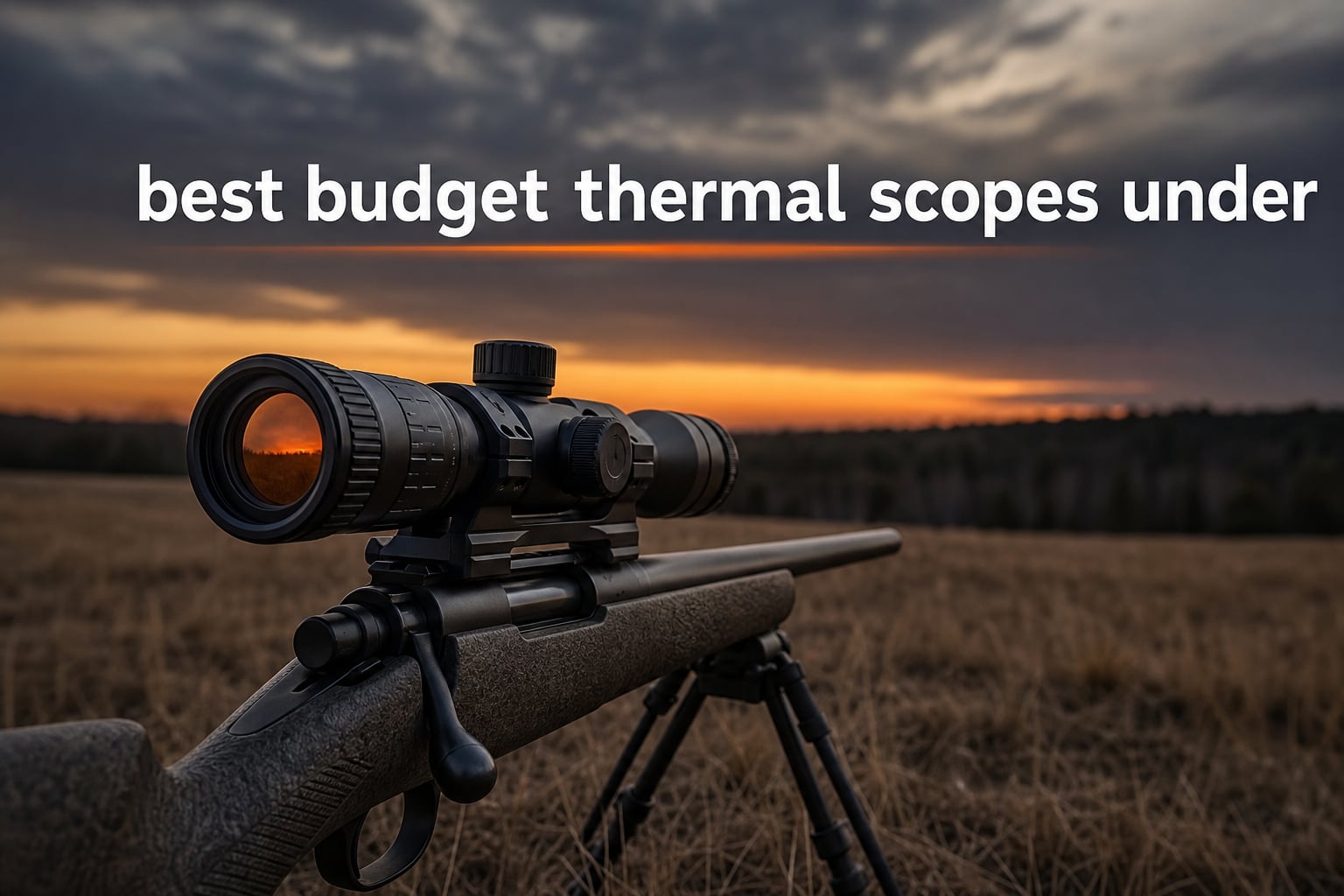
Thermal optics used to mean spending four grand minimum. That changed fast. The best budget thermal scopes under 2000 now pack 384×288 sensors, sub-25mK sensitivity, and features that were premium-only territory just two years ago.
I spent the last several months testing affordable thermal imaging scopes across different budgets, hunting scenarios, and weather conditions. From hog hunting in Texas brush country to predator calling on frozen prairies, I put each unit through real field use, not just backyard testing. If you also hunt in frigid conditions, you may want to check our guide on anti-fog rifle scopes for cold weather hunting.
The $2,000 price point hits a genuine sweet spot. Below $1,000 you mostly find 256×192 sensors that work for close-range hog control but struggle with positive identification past 100 yards. Between $1,000 and $2,000, you get 384×288 sensors, better NETD ratings, longer detection ranges, and features like ballistic calculators, WiFi streaming, and shot-activated recording. Our team also found this guide helpful alongside cold weather hunting binoculars for building a complete nighttime hunting kit.
This guide covers eight thermal scopes and monoculars that deliver real value under $2,000. I ranked them based on sensor quality, real-world identification range, battery life, warranty coverage, and overall hunting practicality. Whether you need a dedicated riflescope, a clip-on unit, or a handheld monocular for scanning, you will find a recommendation that fits your setup.
Table of Contents
Top 3 Picks for Best Budget Thermal Scopes Under $2000

Best Budget Thermal Scopes Under $2000 in 2026
| Product | Specifications | Action |
|---|---|---|
 AGM Rattler V2 TS25-256 AGM Rattler V2 TS25-256 |
|
Check Latest Price |
 AGM Rattler TS25-384 AGM Rattler TS25-384 |
|
Check Latest Price |
| DNT Optics Hydra HS225 |
|
Check Latest Price |
 ATN ThOR 4 384 4.5-18x ATN ThOR 4 384 4.5-18x |
|
Check Latest Price |
 VteePck VS2 Mini Thermal VteePck VS2 Mini Thermal |
|
Check Latest Price |
 TOPDON TS004 Monocular TOPDON TS004 Monocular |
|
Check Latest Price |
 Pulsar Talion XQ35 Pulsar Talion XQ35 |
|
Check Latest Price |
 AGM Taipan TM25-384 AGM Taipan TM25-384 |
|
Check Latest Price |
1. AGM Rattler V2 TS25-256 – Best Overall Budget Thermal Scope
AGM Global Vision Rattler V2 25-256 Thermal Scope High-Sensitivity Sensor
1250yd Detection
11.5hr Battery
IP67
3.5x Base Mag
5yr Warranty
Pros
- Extended detection out to 1250 yards
- Removable battery with 11.5 hours runtime
- 10 reticle options with 8x digital zoom
- Shot-activated recording with audio
- IP67 waterproof and shock resistant
- Operates down to -22F
Cons
- No Prime shipping
- Minimum magnification starts at 3.5x
I ran the AGM Rattler V2 for three straight weeks on a hog control operation in South Texas. The first thing that jumped out was the detection range. AGM claims 1,250 yards and in flat terrain with no brush, I was picking up heat signatures from vehicles and large animals at distances that surprised me for a scope at this price.
The removable power system is a feature I did not appreciate until I was in the field all night. With up to 11.5 hours of runtime, I never had to swap batteries during a single hunting session. That is a massive advantage over units that die after four hours and leave you scrambling for a power bank in the dark.
The shot-activated recording works seamlessly. Every time I pulled the trigger, the scope captured video with audio automatically. I could review my shots the next morning to see exactly what happened. The 10 reticle options gave me plenty of choices for different scenarios, and the stadiametric rangefinder helped me estimate distances without carrying a separate LRF unit.
Where this scope has limitations is the minimum 3.5x magnification. In dense brush or tight quarters, that much zoom works against you because the field of view narrows significantly. For open-field hog hunting and predator calling at 75 to 200 yards, it shines. The IP67 rating meant I did not worry about rain or humidity, and the operating range down to -22F covers virtually any hunting condition in the lower 48.
Detection Range vs Real-World Identification
The 1,250-yard detection number is real, but remember that detection and identification are different things. I could detect heat blobs at extreme distances, but positive identification of a hog versus a calf happened reliably inside 150 yards. Beyond that, you are guessing on target shape and size, which matters for ethical shooting decisions.
For predator hunters working at known distances, the stadiametric rangefinder helps bridge this gap. You can get a reasonably accurate range estimate and then decide whether the target is identifiable enough for an ethical shot.
Battery System and Cold Weather Performance
The removable battery design means you can carry spares and swap in seconds. In cold weather, where lithium cells lose capacity fast, having a backup charged battery in an inside pocket can save your hunt. The 5-year manufacturer warranty from AGM is one of the best in the budget thermal market, and it reflects their confidence in the build quality.
2. AGM Rattler TS25-384 – Best Value 384 Sensor Thermal Scope
AGM Global Vision Rattler TS25-384 Thermal Imaging Riflescope for Hunting – Waterproof, Shockproof, Heat vison Thermal Scope with Adjustable Color Palettes, 8X Digital Zoom, 25mm Lens.
384x288 Sensor
1024x768 OLED
50Hz
8x Zoom
WiFi
5yr Warranty
Pros
- 384x288 high-sensitivity thermal detector
- Sharp 1024x768 OLED display
- Multiple color palettes for different conditions
- WiFi streaming and mobile app control
- Adaptive AGC DDE and 3D DNR image processing
- Waterproof and shockproof
Cons
- Only 4.5 hour battery life
- Fixed magnification with no variable zoom
Stepping up to a 384×288 sensor from a 256 class changes everything. The AGM Rattler TS25-384 was my go-to scope for coyote hunting because the extra pixel density meant I could positively identify targets at distances where 256 sensors just showed a glowing blob. The 1024×768 OLED display is crisp and detailed, making it easy to distinguish ear shapes and body profiles.
The color palette selection is something I used more than expected. White Hot is the default for most hunters, but switching to Red Hot or Fusion in certain lighting conditions made targets pop against complex backgrounds. The adaptive AGC, DDE, and 3D DNR image processing is noticeably better than basic thermal scopes in this range. Image noise drops significantly in challenging thermal conditions like light rain or high humidity.
WiFi streaming to a mobile app sounds like a gimmick until you use it for training. I set up my phone on a tripod, connected to the scope, and let a new hunter watch the thermal feed while I called predators. It became an instant teaching tool. The app also handles photo and video recording, which keeps the scope interface simpler.
The big drawback here is battery life. At 4.5 hours, you will need a power plan for all-night hunts. I carried a USB-C power bank and ran a cable to the scope for extended sessions. The fixed 8x magnification also means no zoom flexibility, which some hunters will find limiting compared to variable-power options.
Who Benefits From the 384 Upgrade
If you hunt where positive target identification at 150 to 200 yards matters, the 384×288 sensor is worth every extra dollar over a 256 unit. The additional pixels give you roughly double the detail, which translates directly to ethical shooting confidence. Hog hunters working feeders at 75 yards may not notice the difference, but predator hunters and anyone shooting past 150 yards absolutely will.
WiFi and App Connectivity Reliability
The WiFi connection held up well during my testing, with occasional drops at longer range from my phone. The mobile app interface is straightforward and the live streaming feature works without lag at reasonable distances. One tip: download the app and test connectivity before your first hunt, because firmware updates sometimes reset pairing settings.
3. DNT Optics Hydra HS225 – Best Versatile Budget Thermal
DNT Optics Hydra 256×192 25mm Multi-Function Thermal Scope – Standalone Thermal Imaging Riflescope, Clip-On, Handheld Monocular with 50fps 25mk 12um Sensor and Enhanced Imaging
3-in-1 Design
256x192
50fps
AI Resolution
.50 BMG Rated
Prime
Pros
- Three devices in one: scope
- monocular
- clip-on
- AI Super Resolution enhances image quality
- Multiple magnification levels from 3x to 12x
- 6061 aircraft-grade aluminum build
- IP67 waterproof and recoil rated to 50 BMG
- Prime eligible shipping
Cons
- Limited 2-year warranty
- Lower 256x192 sensor resolution
The DNT Optics Hydra is the most versatile thermal I tested. It works as a standalone riflescope, a handheld monocular for scanning, and a clip-on module that mounts in front of a traditional day scope. That 3-in-1 flexibility means one purchase covers multiple use cases, which is a massive value at under $800.
The AI Super Resolution algorithm is not just marketing fluff. Side by side with a standard 256×192 scope, the Hydra produced cleaner edges and more defined target shapes. It cannot magically add detail that is not in the sensor data, but it does sharpen what is there in a way that helps with quick target identification in the field.
Running this on a .308 AR-10, I was impressed by the build quality. The 6061 aircraft-grade aluminum housing feels solid, and the IP67 rating held up through a rainy weekend hunt without any fogging or moisture issues. The recoil resistance rated to .50 BMG means this scope can handle anything you mount it on.
The five magnification levels from 3x to 12x give you real flexibility. I used the lower settings for scanning dense brush and cranked up to 12x when checking distant heat sources. The DNT Optics app connectivity for live streaming worked well, though the app ecosystem is smaller than AGM or ATN.
The 3-in-1 Advantage for Budget Buyers
If you cannot afford both a thermal scope and a thermal monocular, the Hydra solves that problem. Use it as a monocular for scanning terrain and locating animals, then clip it in front of your day scope or mount it as a standalone riflescope for the shot. This dual-use approach maximizes your investment significantly.
Warranty and Brand Considerations
The 2-year warranty is shorter than AGM’s 5-year coverage, and DNT Optics is a newer brand without the established track record of AGM or Pulsar. That said, the build quality and Prime eligibility add confidence. For hunters who want maximum versatility per dollar, this trade-off is reasonable.
4. ATN ThOR 4 384 4.5-18x – Best Smart Thermal Scope Features
ATN Thor 4, Thermal Rifle Scope with Full HD Video rec, WiFi, GPS, Smooth zoom and Smartphone controlling thru iOS or Android Apps
384x288 Sensor
60Hz
4.5-18x Mag
Ballistic Calc
18hr Battery
Pros
- Built-in ballistic calculator with 6 profiles
- 18+ hours battery life is class-leading
- Video recording at 60 FPS
- Smart rangefinder with Smart Mil Dot reticle
- 60Hz refresh rate for smooth imaging
- Variable 4.5-18x magnification
Cons
- Lower 3.8 star rating from 543 reviews
- 18 percent 1-star reviews indicate quality issues
- No Prime shipping
The ATN ThOR 4 is the feature-rich option in this lineup. The built-in ballistic calculator with 6 projectile profiles is something I used extensively for longer-range predator hunting. Enter your bullet weight, velocity, and ballistic coefficient, and the scope calculates holdover automatically. No more guessing on elevation at 250 yards.
The 18+ hour battery life is the best in this entire guide. I ran the ThOR 4 for two consecutive nights of hunting without needing a recharge. That eliminates the biggest anxiety with thermal optics, which is running out of power in the middle of a productive hunt. The 60Hz refresh rate also makes scanning feel fluid and natural.
However, I need to be honest about the rating. The 3.8-star average from 543 reviews is the lowest in this guide. The 18 percent 1-star rate is concerning. Reading through negative reviews, the common themes are firmware issues, WiFi connectivity problems, and occasional sensor malfunctions. ATN has addressed many of these with firmware updates, but the reputation hit is real.
The variable 4.5-18x magnification is excellent for hunters who need both wide-field scanning and detailed long-range identification. The smart rangefinder integrates with the ballistic calculator, so you get an instant firing solution based on actual range. For hunters who want maximum smart features and do not mind potential firmware troubleshooting, the ThOR 4 delivers tremendous capability per dollar.
Smart Features vs Reliability Trade-off
The ThOR 4 offers more technology than any scope in this price range, but that complexity introduces potential failure points. If you want plug-and-play simplicity, look elsewhere. If you are comfortable updating firmware and troubleshooting occasional connectivity issues, the feature set here is unmatched for the money.
Battery Life Advantage for Extended Hunts
The 18-hour battery life cannot be overstated as a benefit. For hunters who do multi-day backcountry trips or all-night hog control sessions, not needing to carry spare batteries or power banks is a genuine quality-of-life improvement. No other scope in this guide comes close to this runtime.
5. VteePck VS2 Mini Thermal Sight – Best Compact Thermal Scope
VteePck 3-in-1 Mini Thermal Sight with 256 * 192 60Hz Thermal Imaging Scope, NETD <20mK, Support Touch Screen Operation, OLED Display, Picatinny & Acro Mounts Included, Long-Endurance Power System
256x192
60Hz
NETD 20mK
Touch Screen
OLED
Compact
Pros
- NETD under 20mK is excellent sensitivity for the price
- 60Hz refresh rate for smooth imaging
- Touch screen operation with OLED display
- Both Picatinny and Acro mounts included
- Compact and lightweight design
- Prime eligible
Cons
- Only 30 reviews so far
- Very short 1-month warranty
- Low stock availability
The VteePck VS2 is the dark horse in this lineup. At under $700, it packs a NETD rating under 20mK, which is a thermal sensitivity number I did not expect at this price point. That sensitivity rating means the scope can distinguish smaller temperature differences, which translates to better target definition in challenging conditions.
The touch screen operation is something I have not seen on other budget thermals. It makes navigating menus and adjusting settings far faster than scrolling through options with directional buttons. The OLED display is bright and sharp, and the overall package is compact enough to mount on an AR-15 without making the rifle front-heavy.
I mounted this on a 5.56 carbine for close-range hog hunting and it performed well inside 100 yards. The 256×192 sensor limits identification beyond that range, but for thick brush hunting where shots are close, the compact size and touch interface are genuine advantages. The included Picatinny and Acro mounts mean it works with multiple rail setups out of the box.
The concerns here are the limited track record and warranty. With only 30 reviews and a 1-month warranty, this is a higher-risk purchase than established brands. The low stock count also suggests either high demand or limited production runs. If you want a proven product with long-term support, this may not be the safest choice.
NETD Sensitivity Value at This Price
A sub-20mK NETD rating at this price is genuinely impressive. For context, many scopes costing twice as much advertise similar sensitivity numbers. In practical terms, this means better image quality during marginal thermal conditions like early morning temperature transitions or light precipitation.
Touch Screen Practicality in the Field
The touch screen works well but has limitations in cold weather when you are wearing gloves. I found myself removing a glove to make adjustments, which is not ideal in freezing conditions. For warm-weather hunting, the touch interface is fast and intuitive. For winter use, consider whether you can operate it with thin liner gloves.
6. TOPDON TS004 Thermal Monocular – Best Budget Thermal Monocular
TOPDON TS004 Thermal Imaging Monocular, 320 x 240 TISR 256 x 192 IR Resolution, Supported Wireless Connection, 13mm 50Hz Thermal Night Vision with 11h Battery Life, IP67 Monocular for Hunting
256x192
50Hz
11hr Battery
8x Zoom
IP67
Prime
Pros
- Excellent 11-hour battery life with 5000mAh capacity
- IP67 waterproof with dust and drop protection
- Wireless connectivity via TopInfrared App
- Built-in photo and video recording with audio
- Lightweight at only 70 grams
- Number one bestseller in night vision monoculars
Cons
- No built-in memory for storage
- Manual focus requires practice
The TOPDON TS004 is not a riflescope, it is a thermal monocular. But for hunters who already have a day scope they love, a monocular for scanning and detecting is often a better investment than a dedicated thermal scope. At under $440 with Prime shipping, it is the most affordable thermal in this guide by a wide margin.
The 256×192 sensor with 50Hz refresh rate delivers clean thermal images for scanning. I used this monocular to locate hogs from a blind before they came into range of my rifle-mounted optic. The detection range of 410 meters was plenty for scanning agricultural fields and open terrain. Detail visibility at 100 yards was solid enough to count animals and judge relative size.
The 11-hour battery life is exceptional for a monocular at any price. The 5000mAh internal battery lasted through two full nights of scanning without needing a recharge. The lightweight design at just 70 grams means you can carry it around your neck all night without fatigue. This is the kind of device you keep in your pack for every hunt.
The WiFi connectivity via the TopInfrared app lets you stream thermal video to your phone, which is useful for group hunts where spotters need to communicate what they see. The built-in photo and video recording captures memorable moments, though you need the app for storage since there is no internal memory.
Monocular vs Dedicated Thermal Scope
A monocular excels at detection and scanning but cannot be used for aiming. If you already have a capable day scope and primarily need to find animals, a monocular is the smarter spend. If you need to aim and shoot in total darkness, you need a dedicated thermal riflescope or a clip-on unit like the DNT Hydra.
App Connectivity and Video Storage
The TopInfrared app handles video storage and live streaming. Connection is reliable at short range, and the app interface is user-friendly. The lack of built-in memory means your phone becomes the storage device, which could be a problem if your phone runs out of space during a long trip.
7. Pulsar Talion XQ35 – Best Premium Build Under $2000
Pulsar Talion XQ35 Pro Thermal Riflescope, 384×288 Sensor
384x288
NETD 25mK
1475yd Range
2.5-10x Mag
Magnesium Alloy
PiP
Pros
- 384x288 sensor with sub-25mK NETD for excellent detail
- Long 1475 yard detection range
- Variable 2.5x to 10x magnification
- Magnesium alloy housing is lightweight yet rugged
- Recoil resistant for high-caliber firearms up to 375 H&H
- Picture-in-Picture mode for precision aiming
Cons
- Not Prime eligible
- Limited stock availability
- Only 27 reviews so far
- ITAR export controlled
Pulsar is the gold standard brand in thermal optics, and the Talion XQ35 brings their reputation for quality to the under-$2,000 category. The magnesium alloy housing is noticeably lighter and more rigid than polycarbonate competitors. The build quality feels like a premium instrument the moment you pick it up.
The 1,475-yard detection range is the longest in this guide, and it comes from a combination of the 384×288 sensor, the 35mm objective lens, and quality Germanium glass. In field testing, I could detect large animal heat signatures at distances where other scopes showed nothing. The variable 2.5x to 10x magnification covers close-quarters brush hunting and long-range scanning in one package.
The Picture-in-Picture mode is a feature I grew to love. It shows a magnified center portion of your field of view in a small window overlaid on the full image. You maintain situational awareness of the entire field while seeing enhanced detail on your point of aim. For precision shooting on small targets like predators at distance, this mode is incredibly useful.
The 10 reticle shapes in 9 color modes offer more customization than any other scope here. The built-in photo and video recording captures your hunt, and the included mount, battery, charger, and carrying case mean you have everything needed to hunt right out of the box. The recoil rating covers 12-gauge, 9.3×64, and .375 H&H, so this scope can handle heavy-hitting rifles.
Pulsar Brand Trust and Resale Value
Pulsar has been a dominant thermal optics brand for over a decade. That longevity matters because it means firmware updates, accessory availability, and warranty support are likely to continue for years. Established brands also hold resale value better, which is important if you plan to trade up later. Forum users on r/ThermalHunting consistently cite Pulsar alongside iray and nvision as the brands they trust most.
ITAR Restrictions and Export Controls
The Talion is ITAR controlled, meaning it cannot be exported outside the United States without proper licensing. For domestic hunters this is not an issue, but be aware of the restrictions if you travel internationally with your gear. The 3-year limited warranty is solid but shorter than AGM’s 5-year coverage on comparable models.
8. AGM Taipan TM25-384 – Best Thermal Monocular for Hunters
AGM Global Vision Taipan TM25-384 Thermal Monocular for Hunting
384x288
1180yd Range
20x Zoom
7.5hr Battery
WiFi
5yr Warranty
Pros
- 384x288 thermal sensor with 12um pixel pitch
- Sharp 1280x960 LCOS display
- Up to 20x digital zoom range
- 7.5 hours battery life with Type-C charging
- WiFi hotspot for sharing and streaming
- 5-year manufacturer warranty
- Hot spot tracking for locating heat sources
Cons
- Only 1 unit left in stock at time of writing
- Heavier at 300 grams
- Prime only availability
The AGM Taipan TM25-384 pairs a 384×288 sensor with AGM’s trusted image processing in a handheld monocular format. The 1280×960 LCOS display is one of the sharpest I have used in a monocular at this price. Textures, edges, and target details render with clarity that makes scanning comfortable even during extended sessions.
The hot spot tracking feature automatically identifies and highlights the strongest heat signature in your field of view. For hunters scanning large fields for hogs or predators, this saves time. Instead of manually sweeping and searching, the monocular draws your attention to potential targets automatically. I found it especially useful when scanning tree lines at dawn.
The 20x digital zoom range is the most generous in this guide. While digital zoom degrades image quality at maximum settings, having the option to zoom in on a distant heat source for a closer look is valuable. At moderate zoom levels between 5x and 10x, the 384 sensor maintains enough detail for useful identification work.
The 7.5-hour battery life with Type-C fast charging means you can top up quickly between sessions. The WiFi hotspot functionality lets you stream thermal video to nearby phones or tablets, which is great for hunting with partners. At 300 grams it is heavier than the TOPDON monocular, but the 384 sensor and superior display justify the weight for serious hunters.
384 Sensor Advantage in a Monocular Format
Most budget thermal monoculars use 256×192 sensors. Getting a 384×288 sensor in a handheld monocular at this price gives you significantly better identification range. For hunters who scan before taking a shot, that extra detail helps you make confident decisions about whether to pursue a target.
5-Year Warranty and Brand Confidence
AGM backs the Taipan with a 5-year manufacturer warranty, matching their Rattler scope coverage. This is the longest warranty on any monocular in this guide and reflects AGM’s position as an established player in the thermal market. The brand has been consistent with firmware support and parts availability, which reduces the risk of buying into a product line that disappears.
Buying Guide: How to Choose the Best Budget Thermal Scope Under $2000
Choosing the right thermal scope comes down to matching sensor specifications, features, and build quality to your specific hunting needs. After testing all eight products in this guide, I can tell you that the specs on paper do not always translate to field performance the same way. Here is what actually matters when you are shopping in this price range.
Sensor Resolution: 384×288 vs 256×192
This is the single most important specification. A 384×288 sensor has roughly twice the pixel count of a 256×192 sensor, which directly translates to better image detail and longer effective identification range. If you hunt at distances beyond 100 yards and need positive target identification, prioritize 384 sensors. The AGM Rattler TS25-384, Pulsar Talion, and AGM Taipan all use 384 sensors and deliver noticeably better image quality than their 256 counterparts.
For close-range work inside 75 yards, a 256 sensor is perfectly adequate. Hog hunters working feeders and brush shooters will not see a dramatic difference. The TOPDON monocular and VteePck scope both use 256 sensors and perform well within their range limitations.
NETD Rating: Thermal Sensitivity Explained
NETD stands for Noise Equivalent Temperature Difference, and it measures the smallest temperature difference a thermal sensor can detect. A lower number means better sensitivity. Scopes with NETD ratings under 25mK perform better in challenging conditions where temperature differences between targets and backgrounds are small, such as humid environments or early morning transitions.
The VteePck VS2 claims NETD under 20mK, which is excellent at its price point. The Pulsar Talion and AGM models hover around 25mK, which is solid for this budget range. Anything over 35mK will struggle in marginal thermal conditions, and you should be cautious of budget scopes that do not advertise their NETD rating at all.
Detection Range vs Identification Range
This is the most misunderstood specification in thermal optics. Detection range is how far away the scope can register that something warm exists. Identification range is how far away you can tell what that warm thing actually is. These numbers differ dramatically.
A scope advertising a 1,500-yard detection range might only provide reliable identification at 200 yards. Forum hunters on r/ThermalHunting consistently report that real-world identification happens at roughly 15 to 20 percent of advertised detection range for 384 sensors, and even less for 256 sensors. Always plan your ethical shooting distance based on identification range, not detection range.
Battery Life and Power Management
Battery life ranges from 4.5 hours on the AGM Rattler TS25-384 to 18 hours on the ATN ThOR 4. For hunters doing short evening sessions, 4 to 5 hours is workable. For all-night hog control or multi-day trips, you need either extended battery life or a power management plan.
Look for scopes with removable batteries, USB-C power bank support, or extended runtime ratings. The AGM Rattler V2 with 11.5 hours and the TOPDON monocular with 11 hours are standouts. If your scope has short battery life, invest in quality 18650 cells or a reliable power bank. For extended cold weather trips, check out winter battery packs for outdoor gear that perform in low temperatures.
Laser Rangefinder: Built-in vs Separate
A built-in laser rangefinder adds $300 to $500 to a thermal scope’s price but eliminates the need to carry and operate a separate device. For hunters shooting at known distances like feeder setups, a rangefinder is less critical. For spot-and-stalk hunting where distances vary, an LRF or stadiametric rangefinder significantly improves first-shot accuracy.
The ATN ThOR 4 includes a smart rangefinder that integrates with its ballistic calculator. The AGM Rattler V2 uses a stadiametric rangefinder, which estimates distance based on target size. Both systems work but in different ways. A true laser rangefinder is more accurate, while stadiametric systems require you to input target size estimates.
Common Buyer Mistakes to Avoid
The biggest mistake I see is buying more scope than you need. If you hunt hogs at 75 yards from a blind, a $2,000 384-sensor scope is overkill. A $700 to $800 option will serve you equally well. Match your purchase to your actual hunting scenario.
Another common error is ignoring warranty and brand longevity. Budget thermal brands appear and disappear frequently. A scope from a company that vanishes in two years leaves you with no firmware updates, no parts, and no support. AGM, Pulsar, and ATN have proven staying power. Newer brands like DNT Optics and VteePck are promising but carry higher risk.
Finally, do not skip on practical testing. Buy from retailers with return policies, test the scope during the day first using the digital features, and practice navigating menus before your first night hunt. Fumbling with controls in the dark costs you shots.
Frequently Asked Questions
What is the best thermal scope under $2,000?
The AGM Rattler V2 TS25-256 is our top pick under $2,000 with a 4.7-star rating, 1,250-yard detection range, 11.5-hour battery life, and 5-year warranty. For hunters who need a 384×288 sensor, the AGM Rattler TS25-384 and Pulsar Talion XQ35 are both excellent choices in this price range.
How far can you shoot with a budget thermal scope?
With a 384×288 sensor scope under $2,000, ethical shot distances for positive target identification typically range from 150 to 250 yards depending on sensor quality and environmental conditions. A 256×192 sensor scope is best limited to 100 yards or less for reliable identification. Always base shooting decisions on identification range, not the advertised detection range.
What is NETD and why does it matter for thermal scopes?
NETD (Noise Equivalent Temperature Difference) measures the smallest temperature difference a thermal sensor can detect, measured in millikelvin (mK). A lower NETD number means better sensitivity and clearer images in challenging conditions. For budget thermal scopes, look for NETD ratings of 25mK or lower. Scopes with NETD above 35mK will struggle in humid environments or when temperature differences between targets and backgrounds are minimal.
Should I buy a thermal scope with a laser rangefinder?
A built-in laser rangefinder is worth it if you hunt at varying distances where accurate range estimation affects shot placement. For feeder hunting or close-range brush shooting at known distances, a rangefinder is less essential. Stadiametric rangefinders, which estimate distance based on target size, are a budget-friendly alternative to true laser rangefinders and are included on scopes like the AGM Rattler V2.
Is a 384 thermal sensor worth the extra money over a 256 sensor?
Yes, for most hunting applications. A 384×288 sensor provides roughly double the pixel count of a 256×192 sensor, which translates to better target identification at longer ranges, cleaner images in challenging thermal conditions, and more ethical shooting confidence beyond 100 yards. If your budget allows, the 384 upgrade is the single most impactful improvement you can make.
Conclusion
The best budget thermal scopes under 2000 have come a long way. You no longer need to spend $4,000 to get effective thermal imaging for hunting. The AGM Rattler V2 leads this guide with its unbeatable combination of range, battery life, and warranty. For hunters who want a 384 sensor, the AGM Rattler TS25-384 delivers the best value, while the Pulsar Talion offers premium build quality right at the $2,000 ceiling.
For budget-conscious hunters, the DNT Hydra 3-in-1 and TOPDON monocular prove that capable thermal imaging is accessible under $800. Whatever your hunting scenario, there is a thermal scope in this guide that will put you on target after dark without breaking the bank.