
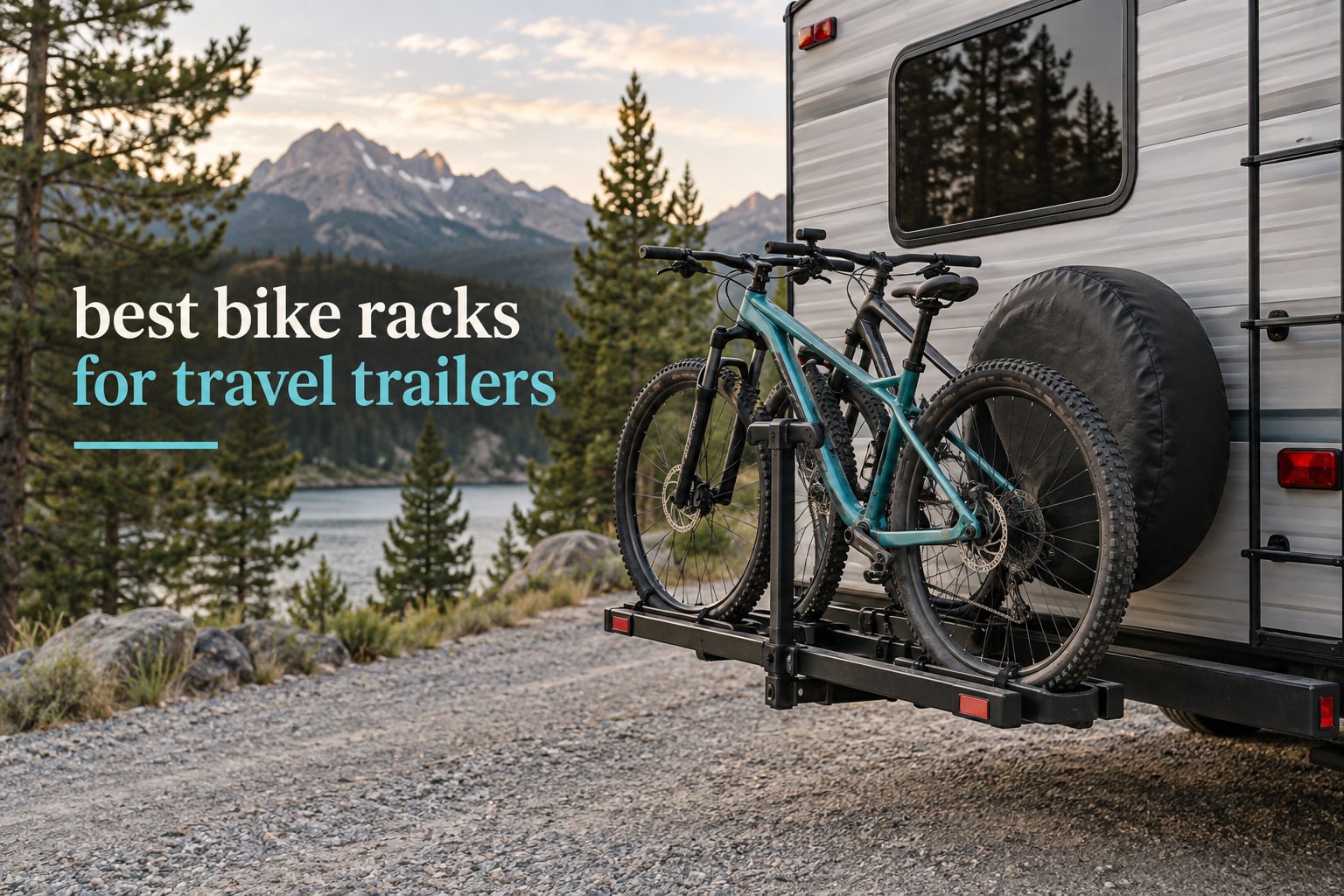
Most bike racks fail on a travel trailer for one reason: the trailer has no shock absorbers. A car absorbs bumps with its suspension, so a rack bolted to a 2-inch receiver sees a steady pull. A travel trailer bounces, sways, and pitches over every concrete joint, and that repeated shock is what bends receivers, loosens bolts, and drops bikes onto the highway. Finding the best bike racks for travel trailers comes down to three things: a rack the manufacturer actually approves for trailer use, a frame-welded 2-inch receiver on your trailer, and a per-bike weight rating above the weight of your heaviest bike.
I spent weeks reading owner reports on RV and Brinkley owner forums, comparing manufacturer warranty language, and matching every rack’s specs to the way trailers actually behave. What I found surprised me. The most expensive racks in my test group are not the safest, and the racks with the loudest RV-approved labels are often built for a different kind of vehicle entirely.
Here are the key takeaways before the full list.
The safest rear-mounted option is a platform rack on a frame-welded 2-inch receiver, with the bikes held by their wheels rather than their frames.
A towable trailer’s rear bumper is a plastic cover on a steel beam, not a load-bearing structure. Never bolt a bike rack to it.
RV-approved is not one certification. It is a marketing phrase that some manufacturers use only for motorized motorhomes, and towable owners have to confirm trailer use in writing.
E-bikes and fat-tire e-bikes typically weigh 60 to 100 pounds, which rules out every rack in this roundup rated under 35 pounds per bike.
The best alternative to a rear rack is a front A-frame tongue mount, which carries bikes where bounce is lowest.
If you are shopping for family trailers, our guide to the best bike trailers for families covers a different use case entirely: pulling bikes behind you rather than carrying them on the trailer. For at-home organization, see our bike storage rack picks.
Table of Contents
Top 3 Picks for Travel Trailer Bike Racks in 2026
These three racks earned the top spots in our comparison, and each one solves a different trailer problem. The Swagman Traveller XC2 is the safest rear-mounted choice. The Allen Sports Deluxe is the strongest value for families carrying four bikes. The Lippert Jack-It removes the rear-mount problem altogether.
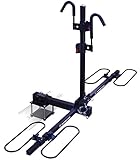
Swagman Traveller XC2
- RV approved platform carrier
- 35 lb per bike
- Fits 2 inch Class 3 receiver
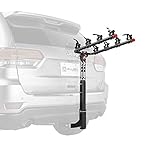
Allen Sports Deluxe 4-Bike
- Four bike capacity
- Alloy steel construction
- No-wobble hitch bolt

Let’s Go Aero Jack-It Double
- A-frame tongue mount
- Frees rear trailer space
- Padlockable pins
All 12 Bike Racks Compared Side by Side in 2026
The table below lists every rack in this roundup with its capacity, mount type, and trailer approval status. Read the approval column carefully, because two of these racks are labeled for RV bumpers and are not appropriate for a towable trailer’s rear bumper.
| Product | Specifications | Action |
|---|---|---|
| Swagman Traveller XC2 |
|
Check Latest Price |
| Allen Sports Deluxe 4-Bike |
|
Check Latest Price |
| Let’s Go Aero Jack-It Double |
|
Check Latest Price |
 Thule Range Hanging Rack Thule Range Hanging Rack |
|
Check Latest Price |
 Hollywood Racks Destination 2 Hollywood Racks Destination 2 |
|
Check Latest Price |
 TRIMAX Road-MAX 4 Bike TRIMAX Road-MAX 4 Bike |
|
Check Latest Price |
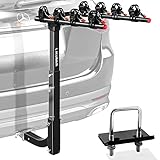 IKURAM R 4 Bike Rack IKURAM R 4 Bike Rack |
|
Check Latest Price |
 Swagman RV Approved 2 Bike Swagman RV Approved 2 Bike |
|
Check Latest Price |
 Swagman Around The Spare DLX Swagman Around The Spare DLX |
|
Check Latest Price |
 Bell Right Up 350 Bell Right Up 350 |
|
Check Latest Price |
 Camco RV Ladder Mount Rack Camco RV Ladder Mount Rack |
|
Check Latest Price |
 Stromberg Carlson LA-102 Stromberg Carlson LA-102 |
|
Check Latest Price |
Are Bike Racks Allowed on RVs? Why the Trailer Bumper Is the One Place to Avoid
Bike racks are not prohibited on RVs. There is no federal rule banning a bike carrier on a motorhome or a travel trailer, and state law generally regulates overhang and plate visibility rather than the rack itself. What people mean when they say racks are banned on RVs is narrower: many racks are not approved for towing platforms, and the rear bumper of a travel trailer is not a place to mount one.
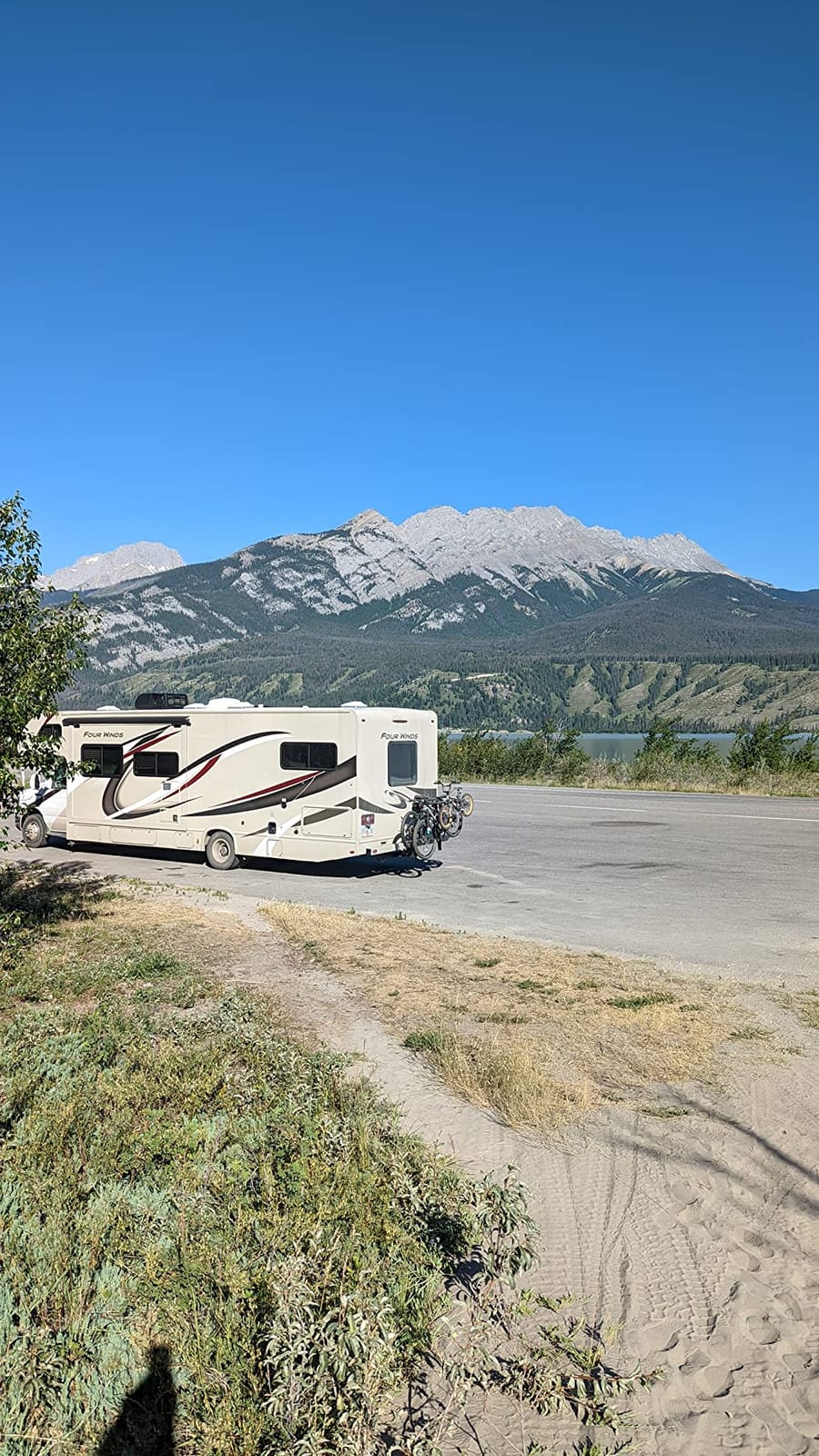
A travel trailer bumper is a 4 to 4.5 inch square steel beam wrapped in a plastic or fiberglass cover, held to the frame with U-bolts. The cover is there to hide the beam, not to carry a couple hundred pounds several feet behind the axle. When you hang a loaded rack off the back, you create a lever arm that converts ordinary bumps into twisting force, and that force lands on the U-bolts and the frame rail rather than on the bumper beam.
Forum owners describe the same failure pattern repeatedly. A rack on a bumper-backed receiver has been reported coming apart on the highway with loose bolts and a warped frame, and the bikes nearly went off the rack. On RV owner forums the consensus is consistent: torque on the receiver matters more than the static weight of the load, and a trailer with no suspension roughly doubles the effective stress each time the trailer hits a concrete joint.
This is the part that trips people up. Several racks in this roundup are genuinely built for RVs, but the ones built for RVs are designed for a motorhome bumper, which is a structural steel bumper bolted directly to the chassis. A towable trailer bumper is a different part with a different job. If a product page says the rack fits a continuous welded steel bumper, check what kind of bumper it means before you drill.
The safe play is a frame-welded receiver. Most travel trailers and fifth wheels have a 2-inch receiver welded to the frame rail, rated for a tow bar or a swing-away hitch. That receiver is the only place on a towable where a bike rack belongs.
Hitch-Mounted vs A-Frame vs Ladder-Mounted: Which Rack Type Fits Your Trailer
There are three practical rack types for a travel trailer, and one to avoid. Hitch-mounted racks go into the frame receiver, load the bikes at the back, and carry the most weight. A-frame racks clamp to the tongue jack and hold bikes at the front. Ladder racks clip onto the rear ladder and are the only option for trailers with no receiver at all.
Hitch-mounted. The most capacity and the easiest ground clearance story, since bikes ride high on a shank. The tradeoff is rear access, since a loaded rack can block the trailer door, and interference with a tow bar or a vehicle carried behind the trailer. Platform designs that grip the wheels beat hanging designs because they do not touch paint.
A-frame tongue mount. The bikes sit at the front of the trailer where the tongue is already braced, so bounce is at its lowest. It also frees the entire rear of the trailer for cargo. The cost is loading height, since the trailer-side bike rides high and often needs two people or a step ladder.
Ladder mount. No drilling, no receiver required, and it mounts in minutes. Capacity is low, usually one bike or two light ones, and the arms can bend under a heavy e-bike. It is the right answer for a small pop-up or a trailer whose bumper is all you have.
Bumper mount. Skip it on a travel trailer. The category exists for motorhomes with true steel chassis bumpers, and for that use the racks work well.
1. Swagman Traveller XC2 RV Bike Rack: The Safest Rear Mount in the Roundup
Swagman Traveller XC2 RV Bike Rack – RV Approved Platform Carrier for 2 Bikes, 35lbs per Bike, Ratcheting Hook System, Foldable Design, Adjustable Wheel Trays, 2″ Receiver
35 lb per bike
2 inch Class 3 receiver
Foldable upright bar
Pros
- RV approved by the manufacturer
- Full 2 inch by 2 inch hitch pin
- Lockable wheel-retainer hooks
- Bumper adapter included
- Limited lifetime warranty
Cons
- Handlebars can rub the rear wall on tight fits
- Bolt-on hitch pin rejects standard locking pins
The Traveller XC2 is the only rear-mounted rack in this roundup that the manufacturer labels for RV and trailer use while fitting a full 2-inch by 2-inch pin into a Class 3 receiver. That combination is what put it at the top for me. It does not need a bumper adapter when you have a frame receiver, which removes the single most common failure point on trailer racks.
Owners consistently describe quick assembly and a build that feels heavier than it needs to be for a two-bike carrier, at 39 pounds. The ratcheting hook system grips the front wheel rather than clamping a frame, so a carbon or painted frame never touches steel. The fold-down upright bar is a genuinely useful detail, since it lets you reach the rear of the trailer when the bikes are off.
Trailer approval status: approved. The product data lists it as an RV approved platform carrier compatible with a 2-inch Class 3 hitch receiver, and the maker states a 35-pound limit per bike. The limited lifetime warranty is a strong signal, and it is the kind of warranty you rarely see from a brand willing to accept trailer bouncing.
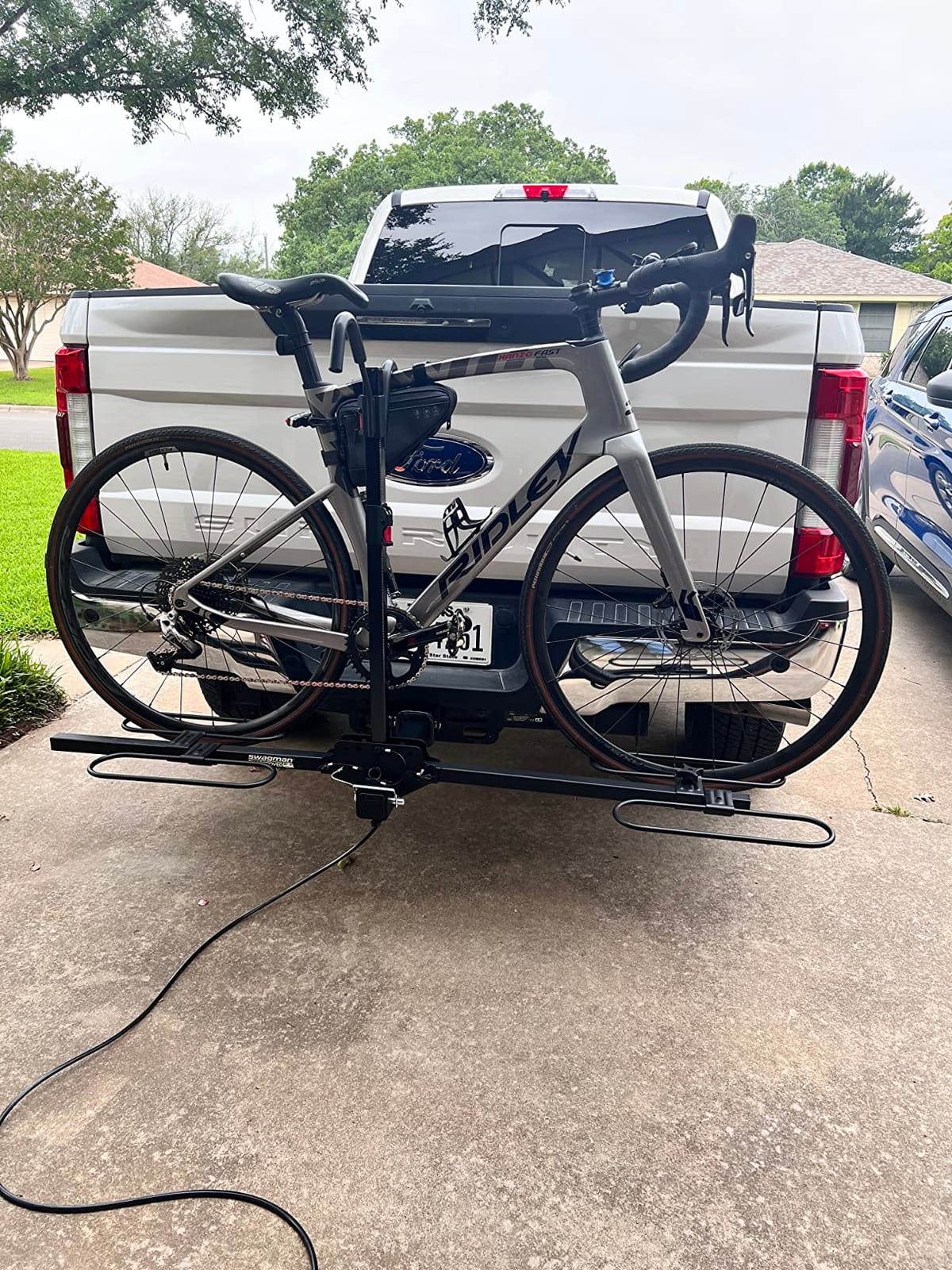
Two caveats came up often enough that I would not skip them. Handlebars on wider bikes can rub the trailer’s rear wall unless you turn them or add an extension bar, and the bolt-on hitch pin will not accept a standard 5/8-inch locking pin, so plan on a separate lock or a hitch pin lock. Pedals can also catch the center bar on bikes with a low crank position, which is worth checking during your first load.
If you use the included bumper adapter instead of the receiver, do not overtighten it. Owners report the adapter can pinch the dump hose housing on some trailers. On a properly welded receiver, you should not need the adapter at all.
What to check before ordering the XC2
Measure the distance from your trailer’s rear wall to the spare tire, or to the taillight housing if you have no rear spare. The wheel trays are adjustable, but the wall clearance is not, and a handlebar-width problem is the most common install complaint. If you carry bar-mounted accessories, add the extension bar to your order rather than discovering the fit at the campground.
Also confirm your receiver is genuinely Class 3 and genuinely frame-welded. Bend down and look at where the receiver tube meets the frame rail. If you see a U-bolt clamp and a plastic bumper cover, you are looking at a bumper-mounted receiver, not what this rack needs.
Where the XC2 falls short
Thirty-five pounds per bike rules out most modern e-bikes. A mid-weight e-bike commonly lands between 50 and 90 pounds, and fat-tire models run heavier still, so owners carrying e-bikes end up modifying or upgrading. Two bikes is also a real ceiling for a family of four, even if the receiver behind it could hold more.
At 39 pounds the XC2 is also one of the heavier racks here, which matters if you plan to remove it between the trailer and the truck. Frequent removal argues for a lighter tray rack, and for lighter bikes.
2. Allen Sports Deluxe 4-Bike Hitch Mount Rack: Best Value for Family Loads
Allen Sports Deluxe 4-Bike Hitch Mount Rack (2-Inch Receiver) , Black
Four bikes
22 kg load capacity
Fits 2 inch receiver
Pros
- Boxed alloy steel with thick welds
- No-wobble hitch bolt
- Tilt-down post works when loaded
- Over 9000 owner reviews
- Folds flat when empty
Cons
- Hitch pin uses 3/8 inch threads not standard 5/8 inch
- Lower tie-down strap not included on the Deluxe model
No rack here has more owner history than the Allen Deluxe. With more than nine thousand reviews averaging 4.5 stars, the pattern is consistent: heavy boxed steel, a two-bolt assembly, and years of stable family use. For a household carrying four bikes on a frame-welded 2-inch receiver, that combination of build and track record is hard to argue with.
The patented tie-down cradle system uses fabric loops rather than frame clamps, which is kinder to thick kids’ tubes and carbon frames alike. Carry arms fold out of the way when the rack is empty, and the whole post tilts back for lift-gate access even with bikes loaded, which is a rare convenience at this level.
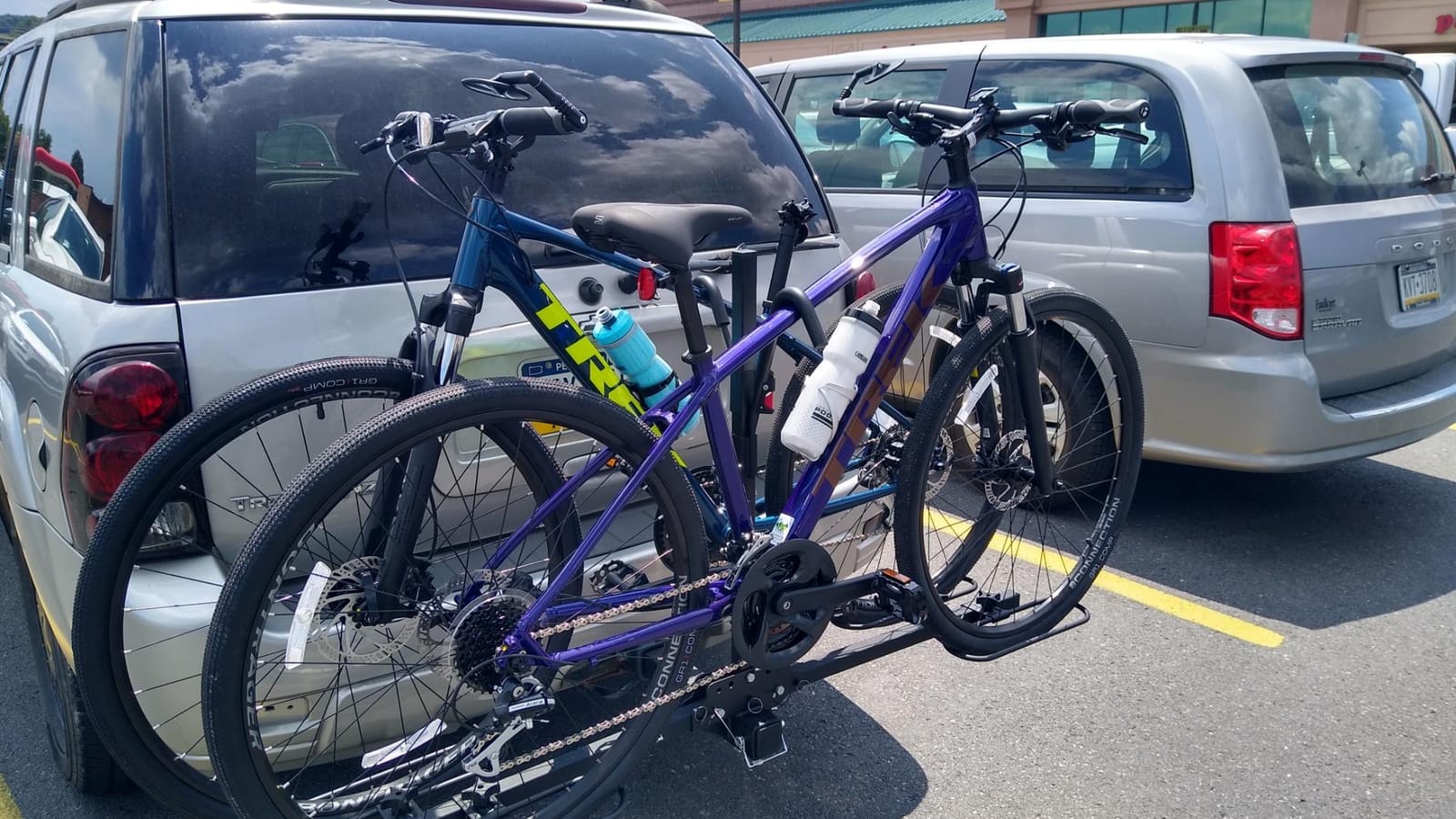
Trailer approval status: not stated. The listed vehicle types are car, SUV, and truck, and the maker does not print a trailer or RV approval line. The 2-inch receiver fit and the no-wobble bolt are the reasons this rack tolerates trailer bouncing better than its price suggests, but the warranty language is a lifetime repair or replacement warranty for defects, not a trailer-use endorsement. Ask before you rely on it with heavy e-bikes.
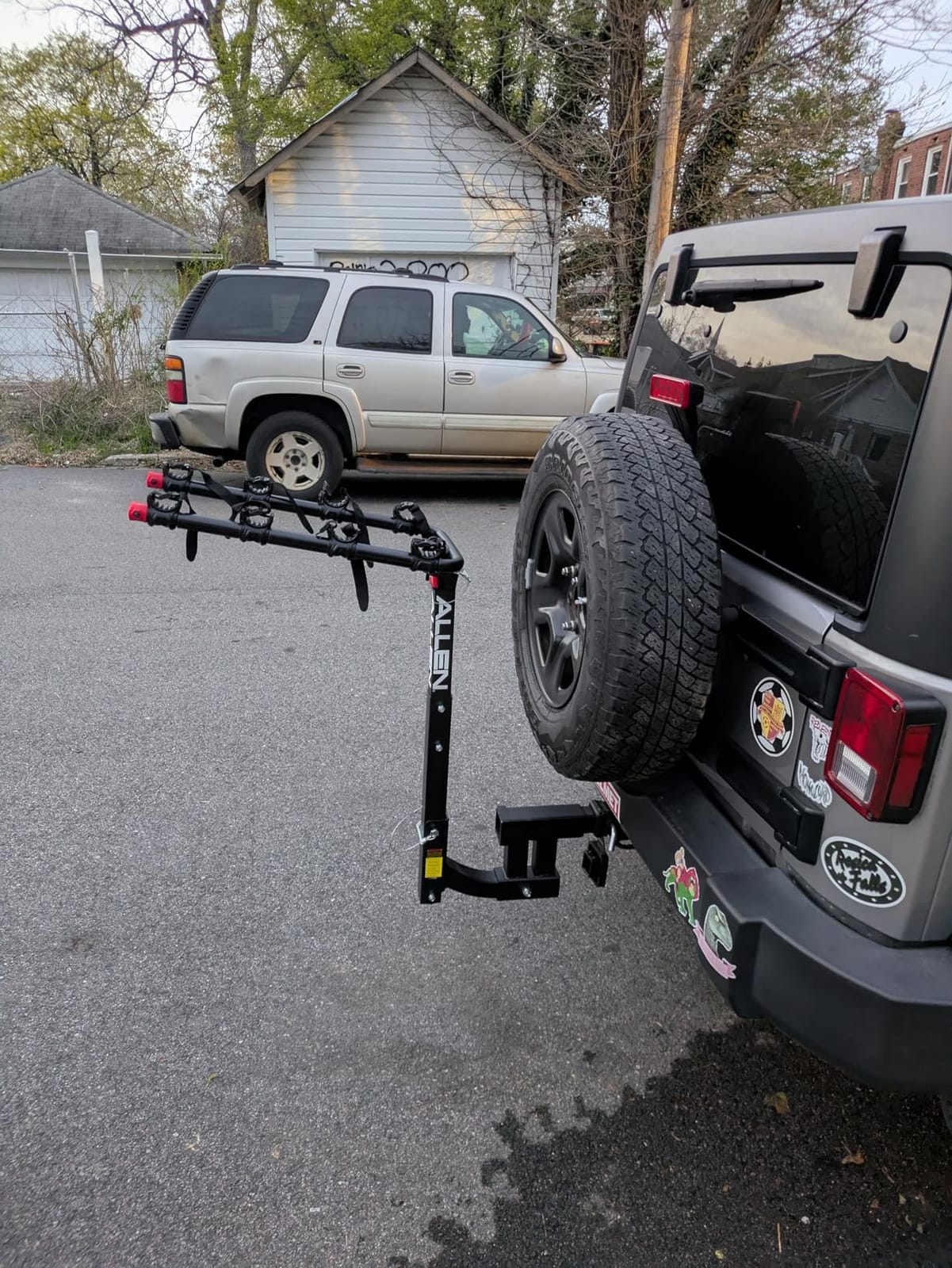
Two small things caught my attention among the reviews. The included hitch bolt uses 3/8-inch threads, so a common 5/8-inch locking hitch pin will not fit without an adapter, which undercuts one of the reasons people buy a hitch rack. And the Deluxe model is reported as shipping without the lower tie-down strap, so check the box before your first trip.
The plastic safety bail clips on the retainer pins can unclip under vibration, so a quick walk-around at every fuel stop is worthwhile. A few owners also report the rack rocking upward on rough roads, which usually points to a loose no-wobble bolt rather than a bent frame.
How to tell if the Allen Deluxe fits your trailer
It needs a genuine 2-inch receiver, not a 1-1/4-inch one, so a Class 3 receiver is the minimum. Four bikes means the rack sits roughly four feet behind the receiver, which lengthens the lever arm considerably compared with a two-bike carrier. If your trailer has a short rear overhang, measure from the receiver to the rear-most point of the rack against your state’s length rules before you commit.
Check that the loaded rack still clears the trailer door. The tilt-down post helps here, since you can fold the loaded rack back to open the door on many installations.
Where the Allen Deluxe falls short
The listed load capacity is 22 kg for the whole rack, which works out to roughly 48 pounds per bike with four aboard. That is fine for a family of gravel bikes and kids’ bikes, and light for e-bikes. Two loaded e-bikes would consume most of that budget before the rack’s own 23 pounds.
It is also a hanging-style design, so bikes are held by their frames. Frame contact works against carbon paint and against bikes with unusual frame shapes, and it is the main reason platform racks exist.
3. Let’s Go Aero Jack-It Double Bike Carrier System: Best A-Frame Mount
Let’s Go Aero – 429756 Jack-It Double Bike Carrier System
80 lb load capacity
Tongue jack mount
Padlockable pins
Pros
- Front mount has the least bounce of any location
- Frees rear space over propane and batteries
- No drilling required
- Foam bumpers protect the frame
- Bikes visible in the tow vehicle mirror
Cons
- Trailer-side bike loads high and needs two people
- Instructions are incomplete
- May block a powered jack override
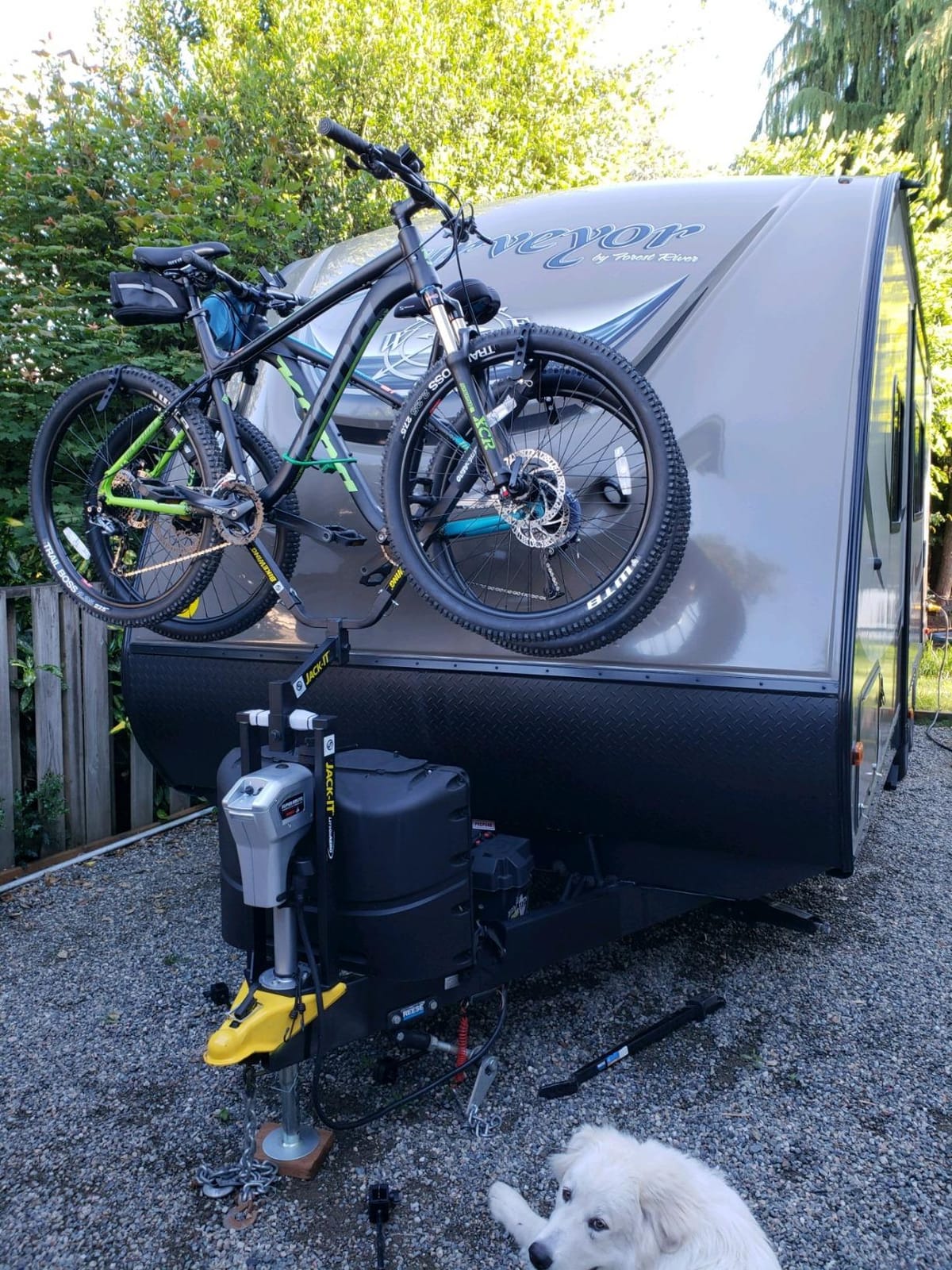
The Jack-It is the answer for anyone who does not want to think about a rear rack at all. It bolts over the tongue jack and holds two bikes at the front of the A-frame, which means the bikes travel where the trailer is already braced and where bounce is at its lowest. Owners on RV forums repeat this recommendation constantly as the zero-risk option.
It carries an 80-pound total load across two bikes, which is a meaningful jump over the 30 and 35 pound per-bike limits of the smaller racks. The included NoMotion pins can be padlocked, and the curved SwayControl cradles with foam bumpers keep frames from contacting each other or the A-frame.
Trailer approval status: approved by design. This is a Lippert Components product built around a trailer’s own tongue jack, so trailer use is the intended application rather than an adaptation. The warranty is one year, which is the shortest in this roundup and the main reason it does not sit at number one.
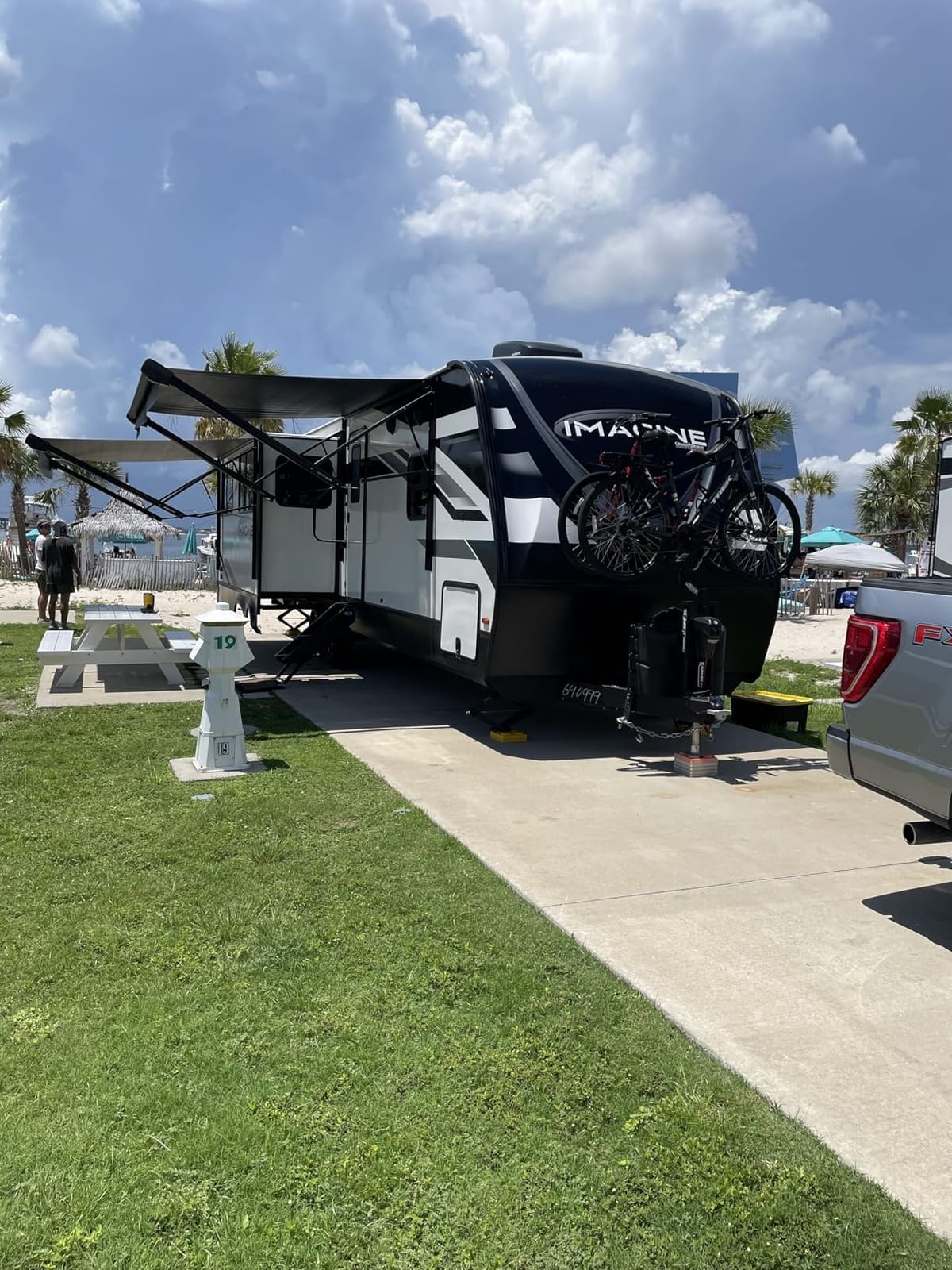
The loading position is the honest drawback. The trailer-side bike rides high, and many owners report needing a second person or a step ladder. A common workaround is to skip the lower sway pins when loading the trailer-side bike, then install them once it is seated. Instructions are reported as incomplete, with photos that do not always match the hardware, so budget extra time for setup.
Check your jack type before ordering. This system is not compatible with side-mount hand-crank jacks, and it may block the manual override on a powered tongue jack. The smallest bike it takes is roughly a 31-inch wheelbase, so kids’ bikes of a certain size are out.
Who the Jack-It suits best
It suits owners with two heavy bikes and a trailer that has no rear receiver worth using, and anyone towing a vehicle behind the trailer who needs the rear of the rig free. It also suits people who park on grass, sand, or uneven ground, since a front-loaded rack does not scrape on dips the way a rear rack can.
If your bikes are heavy, verify the 80-pound total against their combined weight before you buy. Two 65-pound bikes fit. Two fat-tire e-bikes at 90 pounds each do not.
Where the Jack-It falls short
It is a two-bike system, full stop. Families of four need a second solution or a different rack. The one-year warranty is also the thinnest here, and tongue-mounted systems see more road grime and salt than hitch racks do, so a stainless or coated A-frame jack matters more than it would on a car.
Most importantly, it does nothing for a trailer you tow without a front jack in the way, and it cannot be moved to the tow vehicle. If you switch rigs seasonally, you are buying a second rack.
4. Thule Range Hanging Bike Rack: Built for RV and Trailer Hitches
Thule Range Hanging Bike Rack, Carry 4 Bikes, Integrated Locks Included
4 bikes
150 lb total capacity
37.5 lb per bike
Pros
- Heavy steel built for trailer bounce
- Integrated cable lock included
- Anti-sway cradles with ratcheting straps
- 7 inch spacing between bikes
- Limited lifetime warranty
Cons
- Hanging design struggles with modern frame shapes
- Threaded hitch pin loosens and needs re-tightening
- No tilt-down for trunk access
Thule’s Range is the only rack here whose published application is RV and travel trailer hitch use, with a stated 150-pound total capacity and 37.5 pounds per bike. At 36 pounds it is built like a piece of trailer equipment rather than a car accessory, and RV owners who run long distances describe it as the most planted rack they have used.
The integrated cable lock is unusual at this level and saves a separate purchase. Anti-sway cradles with ratcheting straps hold mixed bike sizes, and the 7-inch spacing between bikes gives wider handlebars some room, which is the main reason this design works better with modern bikes than most hanging racks.
Trailer approval status: approved. The listed compatible vehicle type is recreational vehicle and the product data describes it as an RV and travel trailer hanging hitch rack, and the warranty is a limited lifetime. Review volume is the lowest in this roundup at 105 reviews, so long-term evidence is thinner than the engineering suggests.
The honest problem is the hanging design. Bikes are held by their frames, and modern bikes with sloped top tubes and wide handlebars are the hardest to fit. Some owners need a frame adapter or a cross-bar to load four modern bikes, and handlebars can still interfere with adjacent bikes. If your family rides modern mountain or gravel bikes, test one frame before committing to four.
Check the threaded hitch pin at every stop. It loosens over distance and needs re-tightening, which is minor, and a single review reported the rack breaking away from the trailer hitch, an isolated report that still means you should re-torque the pin. The arms fold down, but the rack does not tilt for trunk access.

How to load modern bikes on the Thule Range
Load the bikes nearest the trailer first, and alternate handlebar angles side to side. The 7-inch spacing helps, and rotating alternate handlebars keeps bars from touching across the rack. Bikes with a sloping top tube may need the ratcheting strap at a different rung, so expect to experiment once and then mark the setting.
Because it is a hanging design, frame contact is part of the deal. If you ride carbon or expensive paint, put a frame protector sleeve on before loading and leave it on once you are parked at the site.
Where the Thule Range falls short
It does not tilt down, so rear access to the tow vehicle is more awkward than with the Allen or Trimax racks. Thirty-seven and a half pounds per bike is still short of a typical e-bike, and the 36-pound product weight means removing it between the trailer and the truck is a two-person job.
With only 105 reviews, we are relying on the manufacturer’s application statement and the build rather than on a large body of long-term owner reports. That is a fair reason to double-check the fit on your receiver before ordering.
5. Hollywood Racks Destination 2 Hitch Bike Rack: Best for Fast Tray Loading
Hollywood Racks Destination 2 Hitch Bike Rack, Transports Up to 35 lbs Each
35 lb per bike
20 lb rack weight
Locking hitch pin
Pros
- Very light at about 20 pounds
- Stiff platform trays with rotating holders
- Soft single-point frame contact
- Locking threaded hitch pin included
- Fits 1-1/4 and 2 inch receivers
Cons
- Maker states it is not for use on a trailer
- Long 48 inch wheelbase bikes barely fit
The Destination 2 earns the highest average rating in this roundup at 4.6, and the reason is balance. It weighs about 20 pounds, it installs and removes one-handed, and it still feels stiff in the trays rather than flexing like a plastic rack. For owners who swap racks between the trailer and the tow vehicle constantly, that combination is worth more than raw capacity.
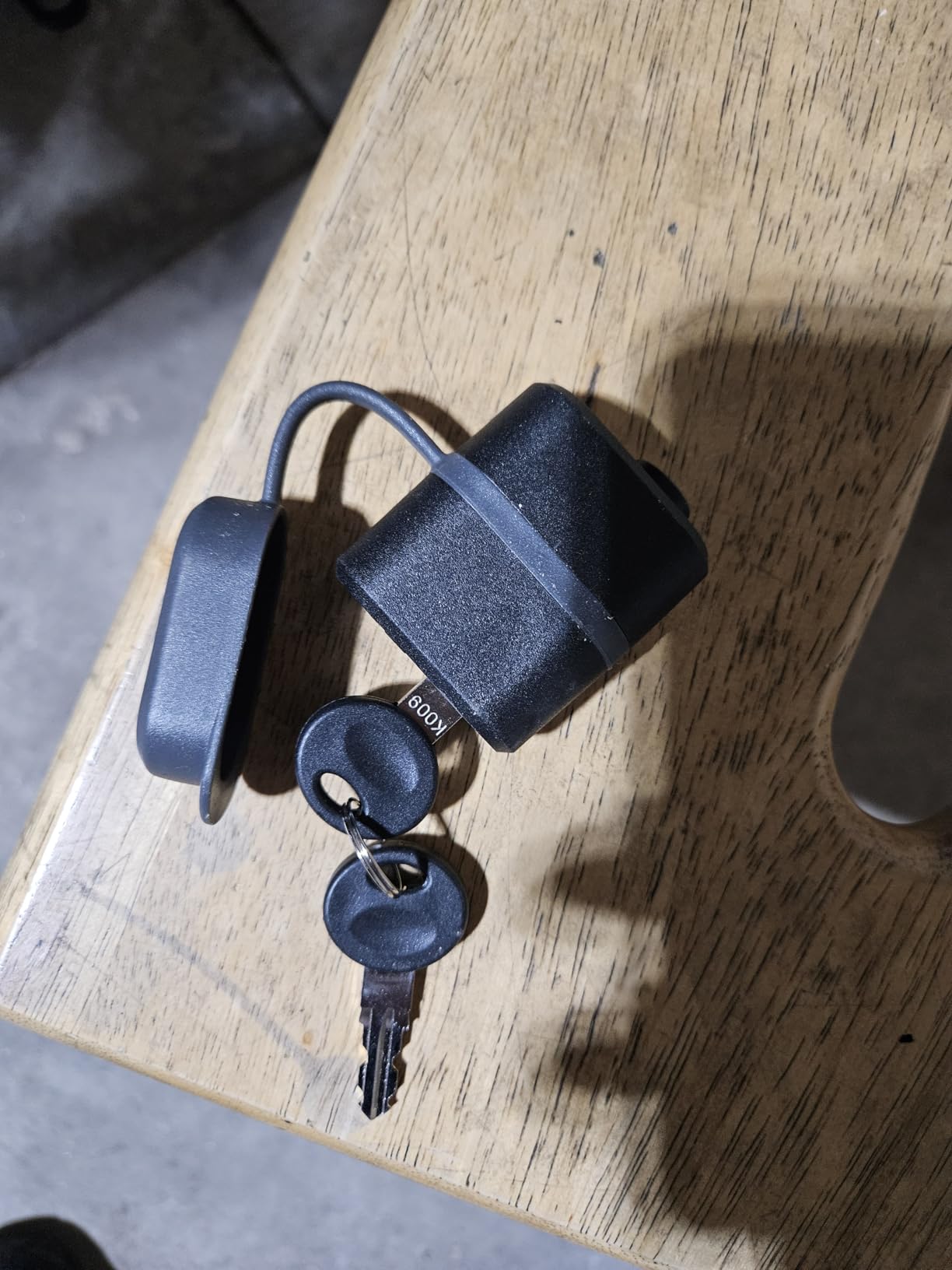
The sliding padded frame holders rotate 360 degrees, so a single clamp fits nearly any frame style including fenders and step-throughs. Contact is a soft single point rather than a hard clamp, and a locking threaded hitch pin is included, which is unusual at this price and helps with sway.
Trailer approval status: excluded. The product data states plainly that the rack is not to be used on a trailer or towed vehicle, and the listed vehicle types are car, SUV, and truck. We include it because owners ask about it constantly, but the maker’s own language should decide the question. If you need a trailer-rated tray rack at this weight, we do not have one in this group.
Because the trays are platform-style and the bike sits on a wheel cradle, the rack carries bikes high. On a vehicle with a lift gate that opens at a fixed height, clearance is the recurring complaint. A frame-mounted pump or bottle cage can also interfere with the single clamp point, so check your accessory layout.
Very long bikes are a squeeze. A 48-inch wheelbase bike, which is common on 29ers and large touring frames, barely fits. Only the 2-inch bolt is included, so a 1-1/4-inch receiver needs an extra part.
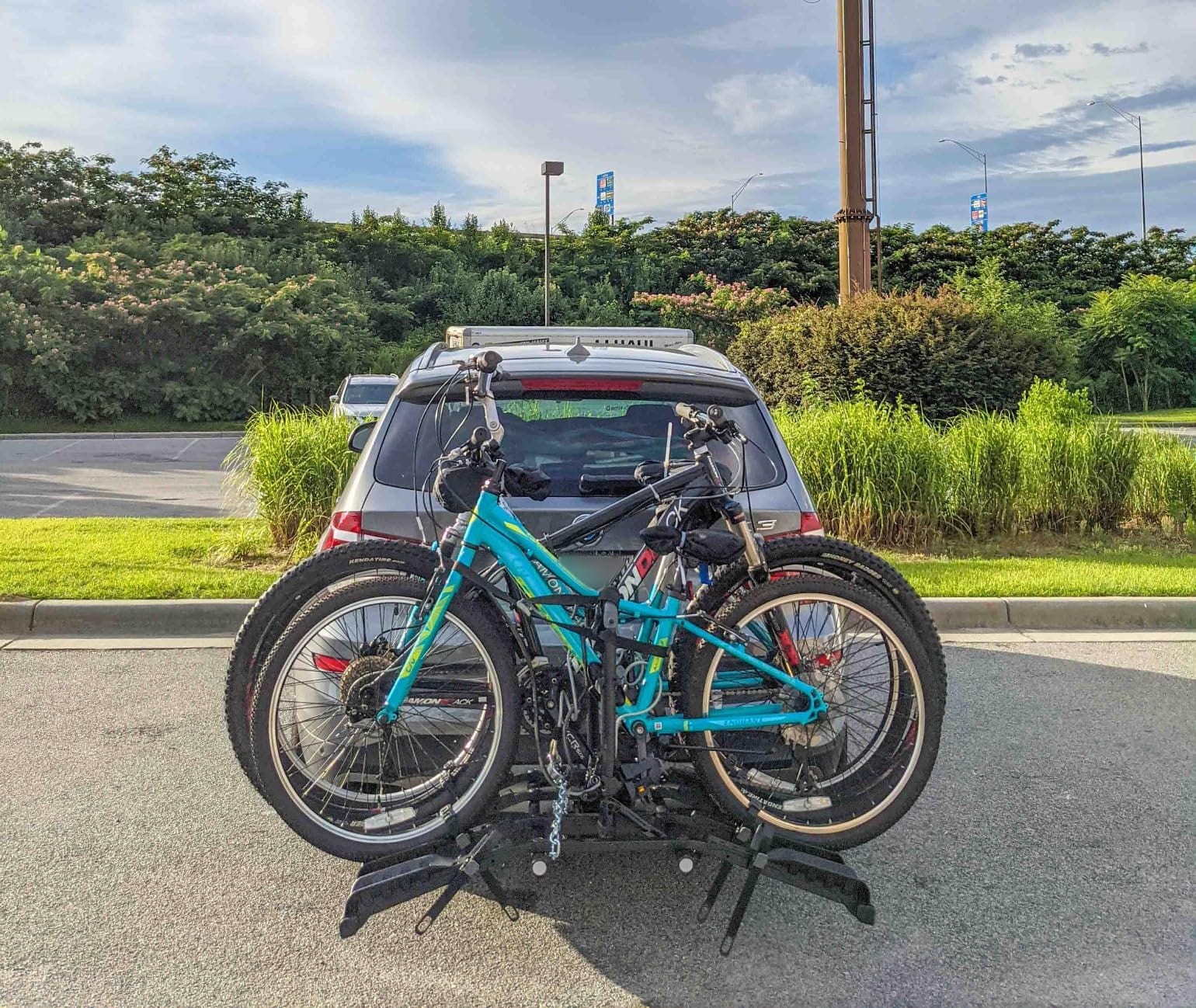
Why trailer owners ask about this rack anyway
It comes up because it is light, well rated, and easy to move, and because the maker’s exclusion is easy to miss on a listing. The exclusion is a real engineering statement rather than paperwork, since the rack is a car-class tray carrier with a light-duty shank. Treat it as a tow vehicle rack, not a trailer rack.
If your trailer has no receiver and your tow vehicle has a 2-inch hitch, this is a strong pairing. The bikes ride at the back of the truck, the trailer carries your gear, and nothing hangs off a bumper.
Where the Destination 2 falls short
The trailer exclusion is the headline, and no owner report changes it. Thirty-five pounds per bike excludes most e-bikes, and the high tray ride height makes it a poor match for lift-gate-equipped tow vehicles. It is also less rigid than heavier all-metal tray racks, which some owners notice with wide handlebars.
For our purposes, this is the rack to buy when the bikes ride on the truck, not on the trailer.
6. TRIMAX Road-MAX 4 Bike Hitch Rack: Best Folding Four-Bike Tray Rack
TRIMAX RMBR4 Road-MAX 4 Bike Hitch Rack, Foldable, 2″ Receiver
4 bikes
135 lb maximum
Fits any 2 inch receiver
Pros
- Light and compact for a four-bike tray rack
- Anti-rattle threaded bolt stops sway
- Handles mixed 26 and 29 inch wheels
- Folding arm opens for gate access
- Rubber grip protects frames
Cons
- Wheel cradles do not slide side to side
- Frame straps are fiddly and easy to lose
- Common padlocks do not fit the lock pin
The Road-MAX is a well-built, affordable alternative to the premium tray racks, and it is one of the few four-bike platform designs in this roundup. Reviewers describe it as sturdy and relatively light, and they praise the anti-rattle threaded bolt, which is the feature that matters most once a rack is on a bouncing trailer.
High-resistance wheel straps with zamack buckles fit all rim and tire sizes, and owners confirm it handles a mix of vintage 26-inch and modern 29er wheels. The folding arm opens with a single pin for gate access, and the rubber grip on the U-bar keeps frames off the metal.
Trailer approval status: not stated. Listed vehicle types are car, SUV, truck, and van, and no RV or trailer approval appears in the product data. The anti-rattle bolt and the all-metal construction are the reasons it behaves well, but confirm with the maker if trailer use matters to your warranty.
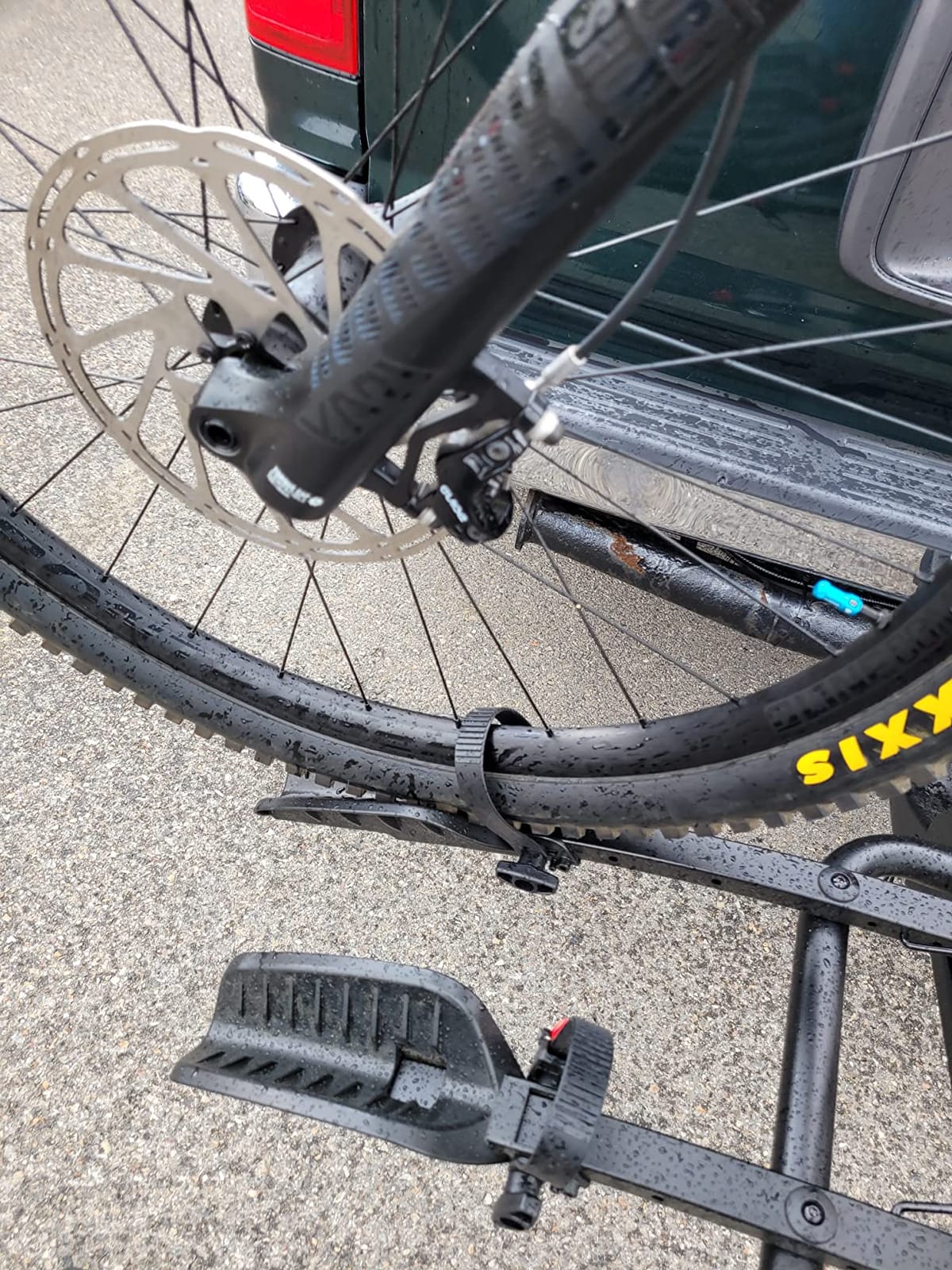
The main usability complaint is the fixed cradle spacing. Wheel cradles do not slide side to side, so bike placement is set and you plan around it rather than adjusting per trip. For a family with four very different frame sizes, that is a genuine annoyance.
The frame straps are also fiddly to thread, harsh on fingers, and easy to lose when not in use. The lock pin requires a threaded design, so a common Master Lock does not fit and you need the matching part. Stabilizer U-bar wire tensioners are reported to look fragile, so treat them as a wear item.
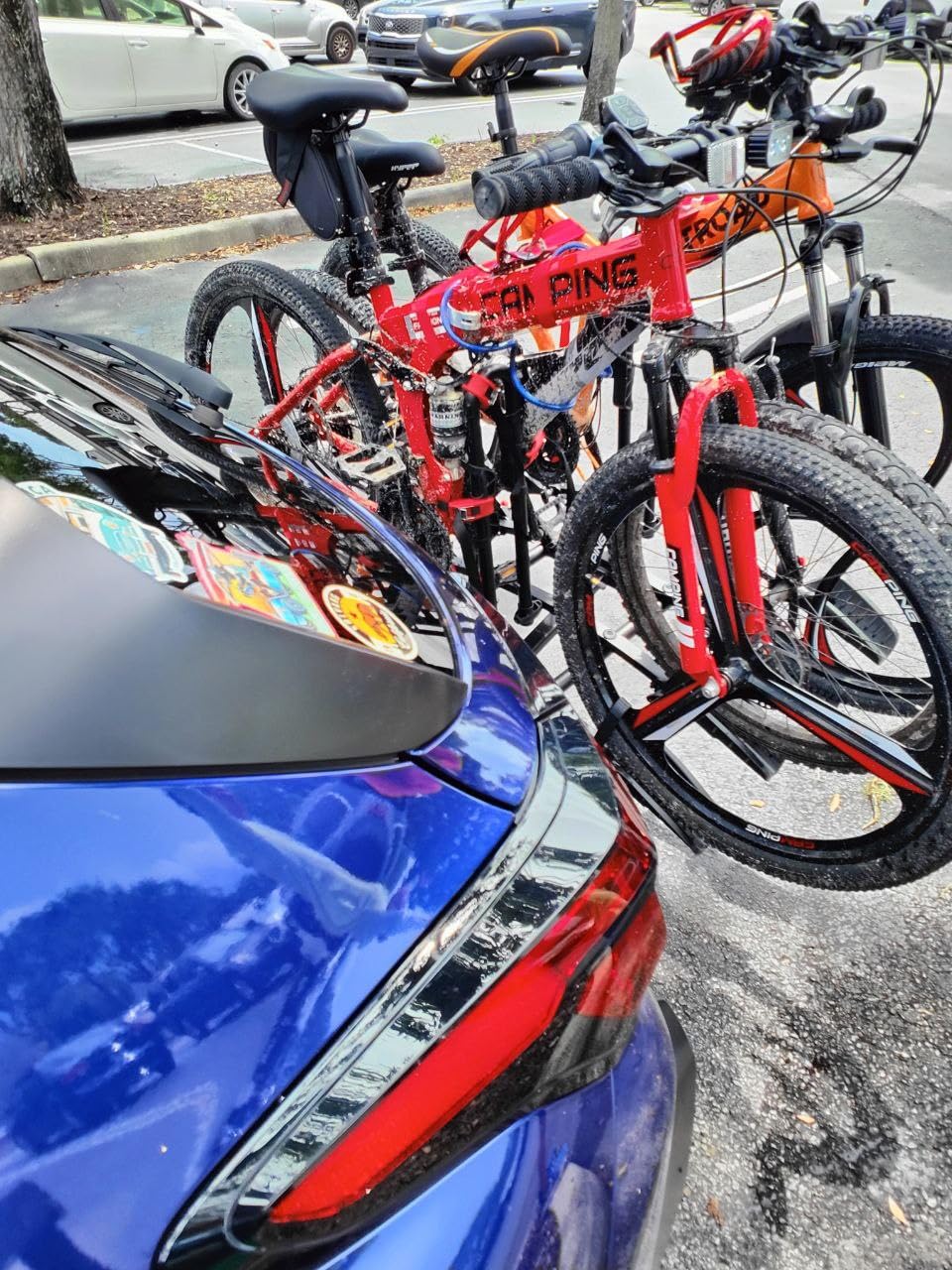
Where the Road-MAX earns its place
It earns its place when you need four bikes on a platform tray design and want to fold the arm away at campground or at a gate. Mixed wheel sizes are handled well, which matters for families with a mix of older road bikes and newer mountain bikes.
Measure before ordering. At 47 inches, this is a long rack, and a four-bike tray rack sitting behind a trailer receiver is a meaningful addition to overall length. Check your state rules and your trailer’s rear overhang clearance.
Where the Road-MAX falls short
Fixed cradles and easily lost frame straps make loading slower than a rack with sliding trays and attached straps. The listed 135-pound total works out to about 34 pounds per bike, which again excludes e-bikes.
It is also a rear-mounted design, so the entire stability question still depends on your trailer having a frame-welded receiver and on a tight hitch pin. Do the anti-rattle check at every stop.
7. IKURAM R 4 Bike Hitch Rack: Budget Pick for Four Bikes
IKURAM R 4 Bike Rack Bicycle Carrier Racks Hitch Mount Double Foldable Rack for Cars, Trucks, SUV’s and minivans with a 2″ Hitch Receiver
4 bikes
140 lb capacity
23 lb rack weight
Pros
- Rigid all-steel frame with powder coat finish
- Dual-arm spacing fits varied frame sizes
- Tilt-down and fold-down arms
- Anti-rattle hitch tightener included
- Over 5000 owner reviews
Cons
- Wheel straps loosen with vibration and need re-tightening
- Some receivers need an extra hitch pin or bushing
With more than five thousand reviews, the IKURAM R is one of the most widely used budget four-bike carriers, and the value case is simple. You get an all-steel frame with a powder coat finish, dual-arm spacing that accepts a range of frame sizes, and tilt-down plus fold-down arms at the low end of the range.
The included anti-rattle hitch tightener is the detail that matters on a trailer. Movement inside a loose hitch receiver is the single biggest source of rattles and cycling loads, and tightening that bolt is the cheapest fix available. The maker backs it with a lifetime warranty.
Trailer approval status: not stated. Listed vehicle types are car, minivan, truck, and SUV, with no RV or trailer line in the product data. Treat it the same way as the other car-rated racks here: verify with the maker before you depend on the warranty with heavy bikes.
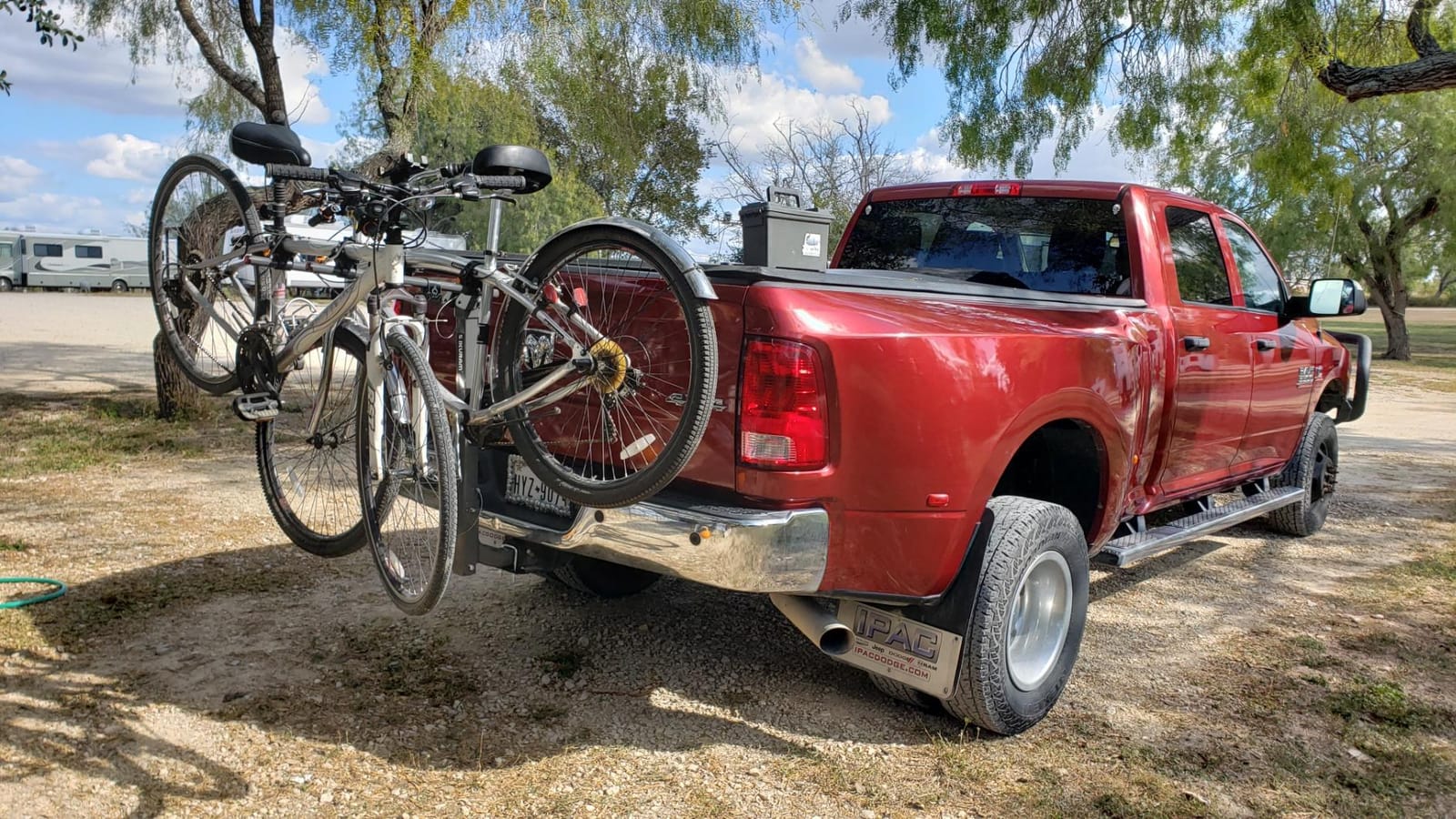
Wheel straps loosen over a long trip, and owners consistently report re-tightening them after driving. Treat it as a fifteen-second check at every fuel stop rather than a fault. A smaller issue: some buyers needed an extra hitch pin or bushing for their receiver, so keep your existing hardware in mind.
It is a hanging design, so bikes are held by the frame, and the dual arms are not adjustable trays. Four bikes of very different sizes need careful loading order to sit correctly.
How to set it up so the straps stop loosening
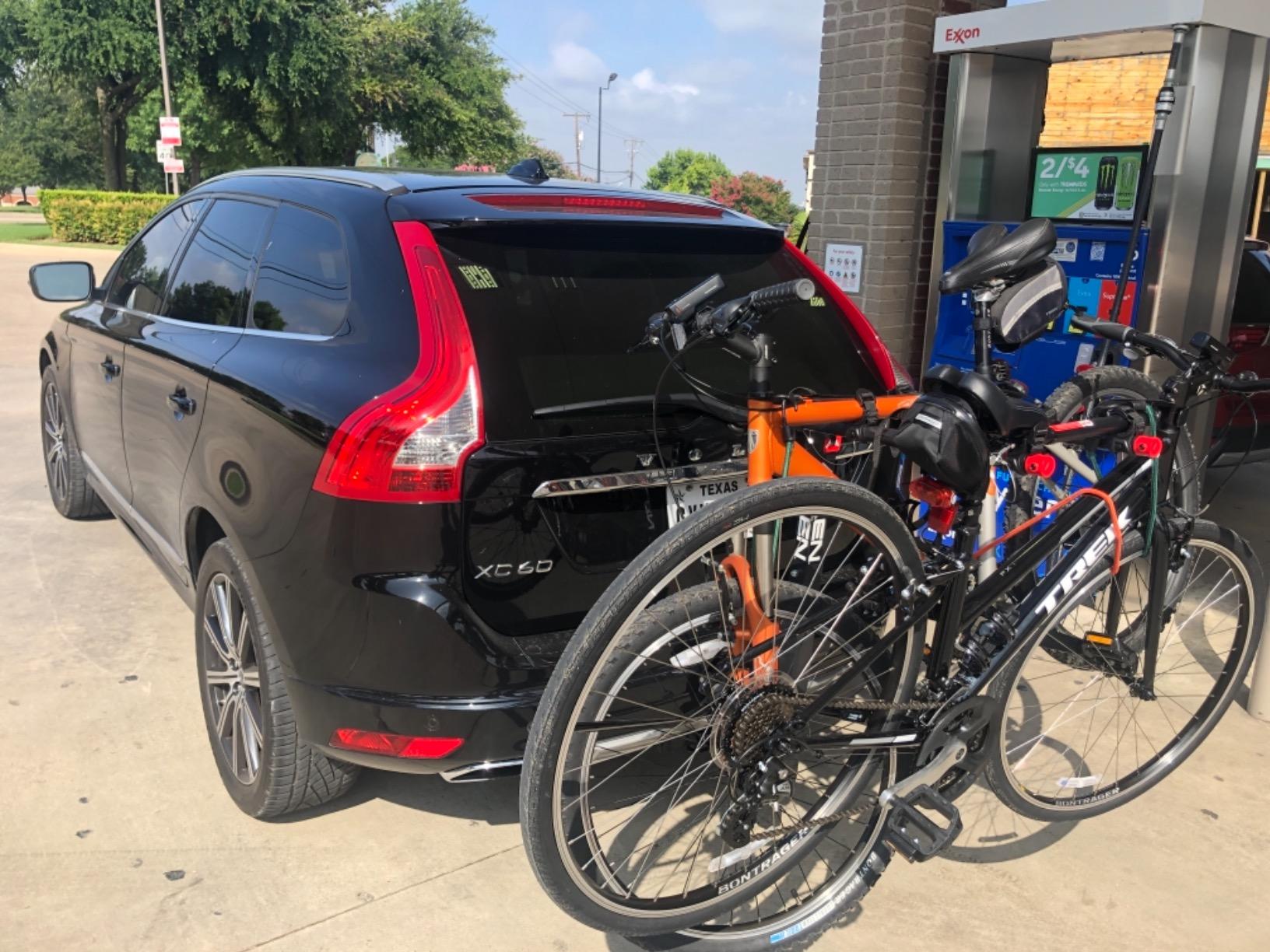
Load the heaviest bike nearest the trailer, then alternate the lighter bikes outward. Check strap tension before you leave the driveway, not after the first fifty miles, because the initial settle is the biggest loss of tension. A picture of your loaded rack at rest helps you re-check quickly later.
Re-torque the anti-rattle tightener at the same time. The whole point of that included part is defeated if it goes loose at the first rest stop.
Where the IKURAM R falls short
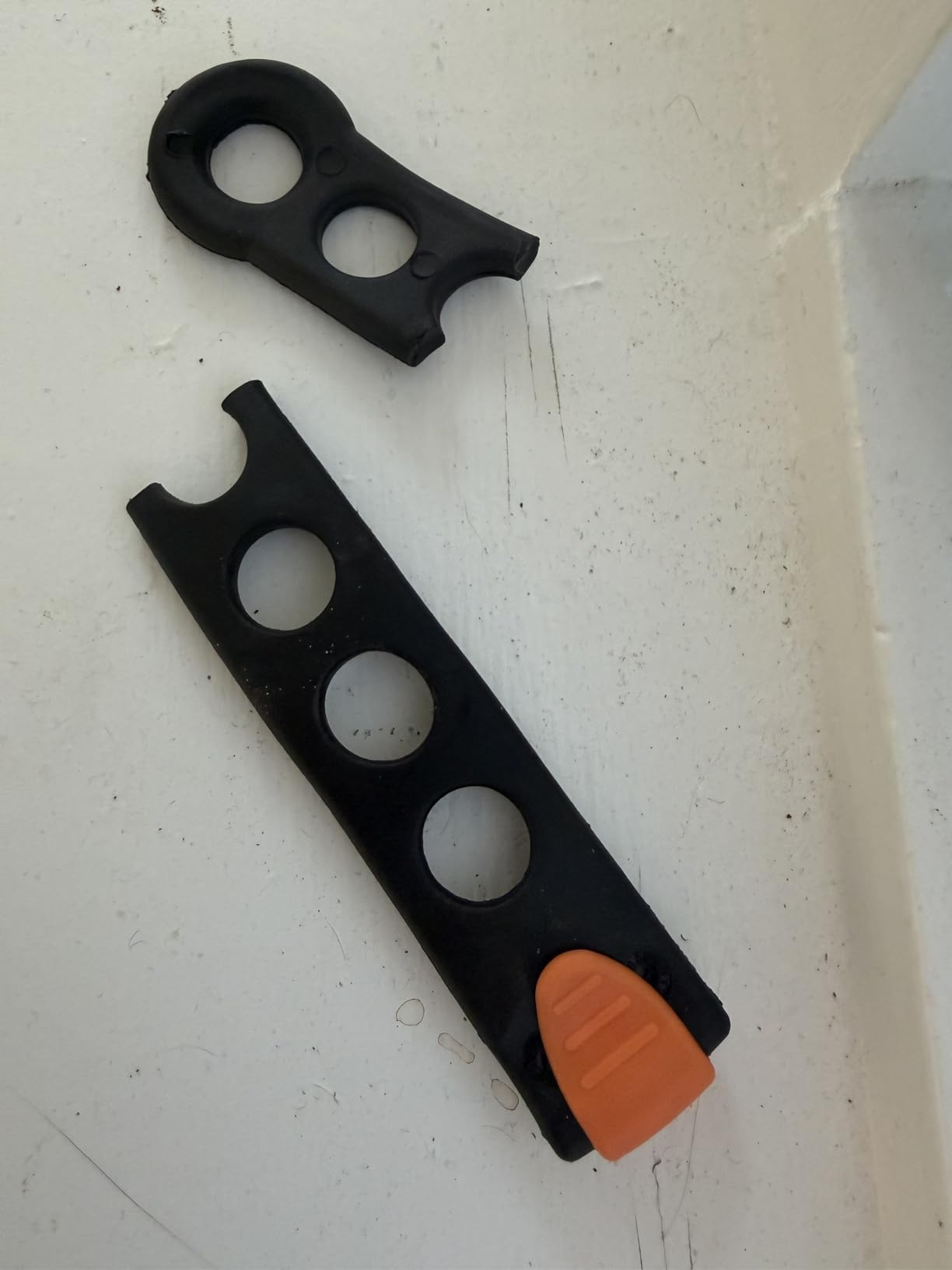
It is a frame-hanging rack, so it is less kind to carbon frames and less forgiving of unusual frame shapes than a tray design. Straps that need re-tensioning are a genuine annoyance on long drives, and the plastic bail-style retainers are the part most likely to need replacing eventually.
It is also four bikes behind a receiver, which is the longest lever arm in this roundup. If your trailer’s receiver sits close to the rear axle, a four-bike rack is a real stability question, not a capacity question.
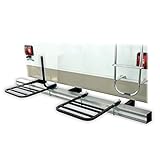
8. Swagman RV Approved 2 Bike RV Bumper Mount Rack: For Steel RV Bumpers Only
Swagman RV Approved 2 Bike RV Bumper Mount Rack – U-Bolt Mounted Carrier for Travel Trailers and RVs
2 bikes
30 lb per bike
21 lb carrier weight
Pros
- Simple install with a basic socket set
- Distributes load across the bumper for less shake
- Sturdy steel made in Penticton BC
- Easy loading height at bumper level
Cons
- Not removable once installed
- Only one upright support bar for two bikes
- Fixed rails will not take bikes of very different sizes
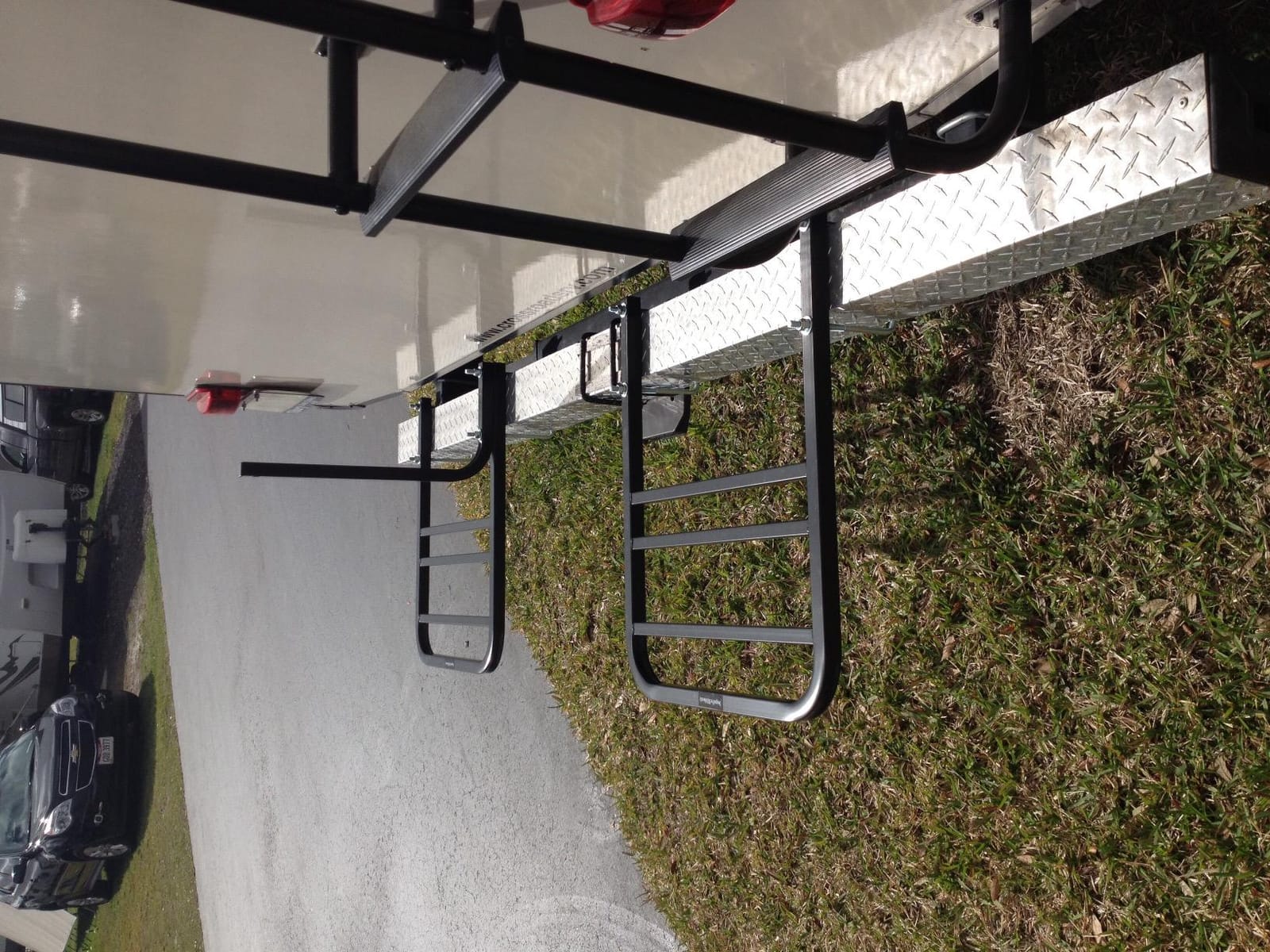
This rack is genuinely well made and genuinely misapplied by a lot of travel trailer owners. It is designed for 4 to 4.5 inch continuous welded steel bumpers, it carries two bikes at 30 pounds each, and owners report tens of thousands of miles of trouble-free use on travel trailers. That last detail is exactly why we flag it.
The steel is substantial and the load is distributed across the bumper with U-bolt mounting rather than hung from a single receiver slot, which is why it shakes less than a slot-mounted rack. Installation is genuinely simple with a socket set, and the loading height at bumper level is the easiest in this entire roundup for a 60-pound bike.
Trailer approval status: approved for motorhome bumpers, not recommended for towable bumpers. The listed compatible vehicle type is RV and camper trailer, and the listed mounting type is bumper mount. Our position is firm: on a travel trailer, the rear bumper is a cover over a beam held by U-bolts, and this is not the mount we would trust with a loaded rack at highway speed. Use a frame-welded receiver instead.
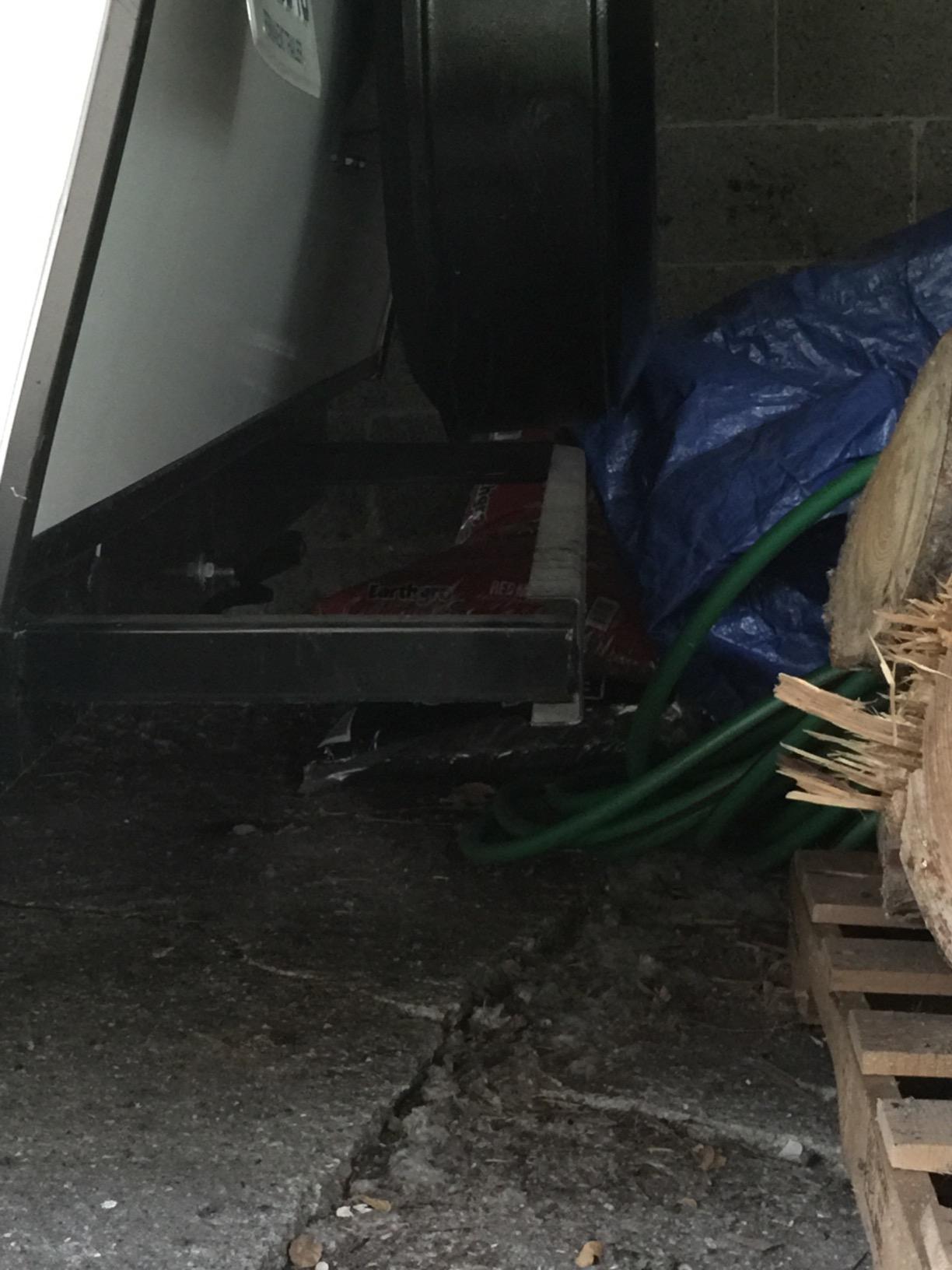
Even on the correct application there are quirks. The rack is not removable once installed, so if you need the rear of the trailer for a bike rack on a car one weekend and not the next, this is the wrong shape of product. It also ships with only one upright support bar for a two-bike rack, so extra straps are usually needed.
Check your bumper’s cross-section and the spare tire clearance before buying. The rails are not adjustable, so two bikes of very different sizes may not both fit, and the rack sits tight against a bumper-mounted spare. The included instruction sheet is reported as confusing, so budget an hour.
When this rack is the right answer
It is the right answer on a motorhome with a true continuous welded steel bumper, and it is the right answer on older RVs with that bumper style. Owners there praise the low load height, the steel build, and the fact that the bikes stay close to the trailer rather than sticking out behind it.
On a pop-up or a small trailer with no receiver, a ladder rack like the Camco below is a safer route than bolting this to a bumper.
Where the Swagman bumper mount falls short
The biggest shortcoming is the one already covered: it is not a travel trailer bumper product. Beyond that, 30 pounds per bike excludes nearly every e-bike, the fixed rails limit you to similarly sized bikes, and the one-bar support means bikes can shift more than owners expect without added straps.
Being not removable is a real operational limitation, not a nitpick, if your trailer does double duty.
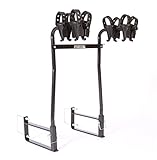
9. Swagman Around The Spare DLX: Best for Rear Spare Tire Clearance
Swagman Around The Spare DLX – RV Bike Rack for Trailers with Rear Bumper Mounted Spare Tires
1 or 2 bikes
30 lb per bike
22 lb rack weight
Pros
- Wraps neatly around a bumper-mounted spare tire
- Very stable hitch-style adapters
- Removable pins allow spare access
- Triangular rubber cradles with two straps per bike
Cons
- Narrow joining bar can strike tires on adult bikes
- Rubber straps are very tight
- Needs a large triangular opening in the frame
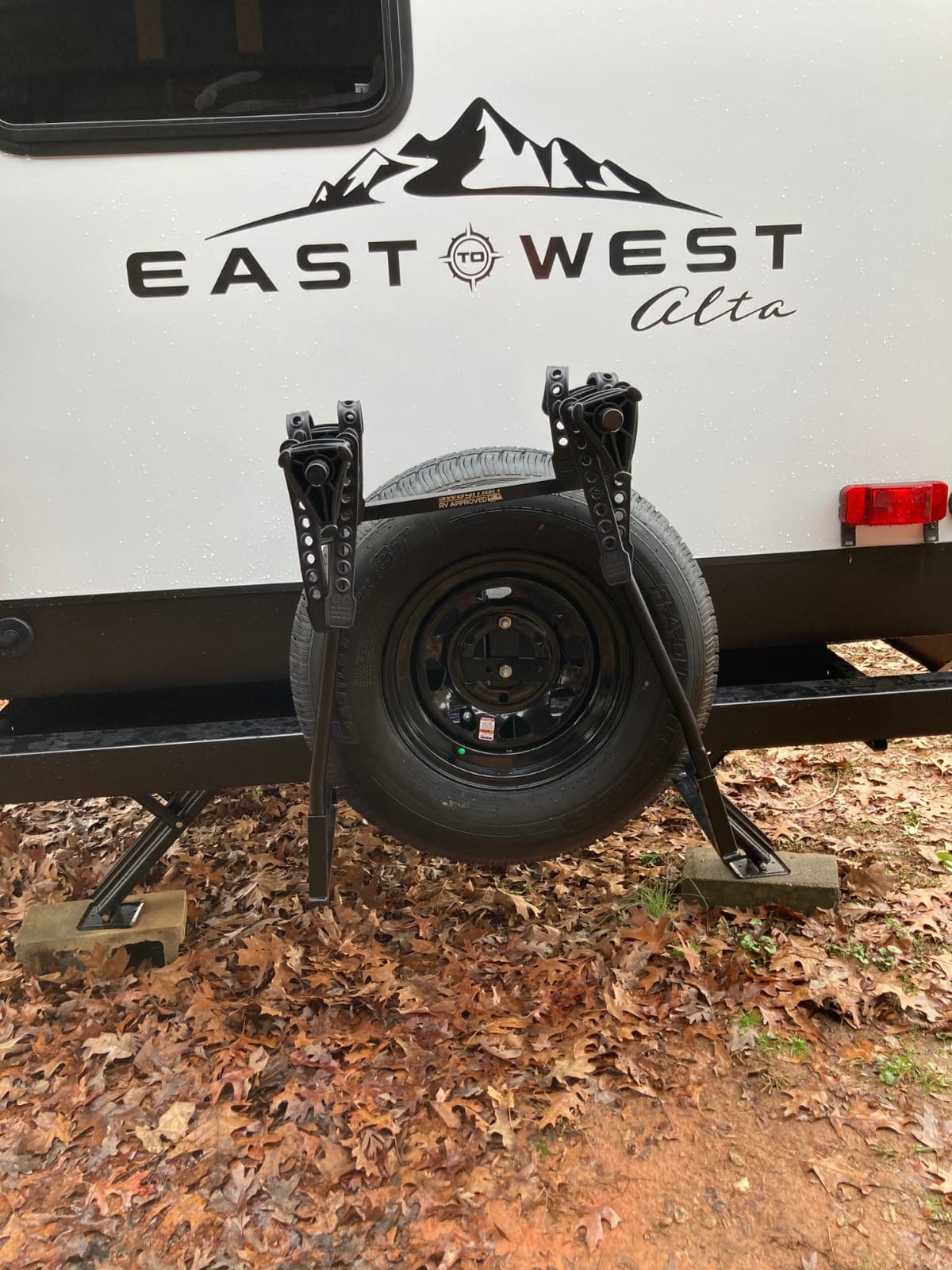
The Around The Spare solves a specific and annoying problem: a travel trailer with a rear bumper-mounted spare tire has almost no flat surface for a rack. This one wraps around the tire and holds one or two bikes at 30 pounds each, using rubber cradle arms instead of a frame clamp.
Owners call it stable, with hitch-style adapters that do not wobble, and the removable pins let you access the spare without pulling the whole base. Anti-sway cradles stop bikes from touching each other, and at 22 pounds the rack itself is light to handle.
Trailer approval status: RV and trailer bumper use, with the same caution as the rack above. The listed mounting types are tire mount and hitch mount, and the listed compatible vehicle type is bicycle, so treat the bumper side as intended for welded RV bumpers. For a towable, the hitch-style adapter is the version worth understanding, and a frame-welded receiver remains our recommendation.
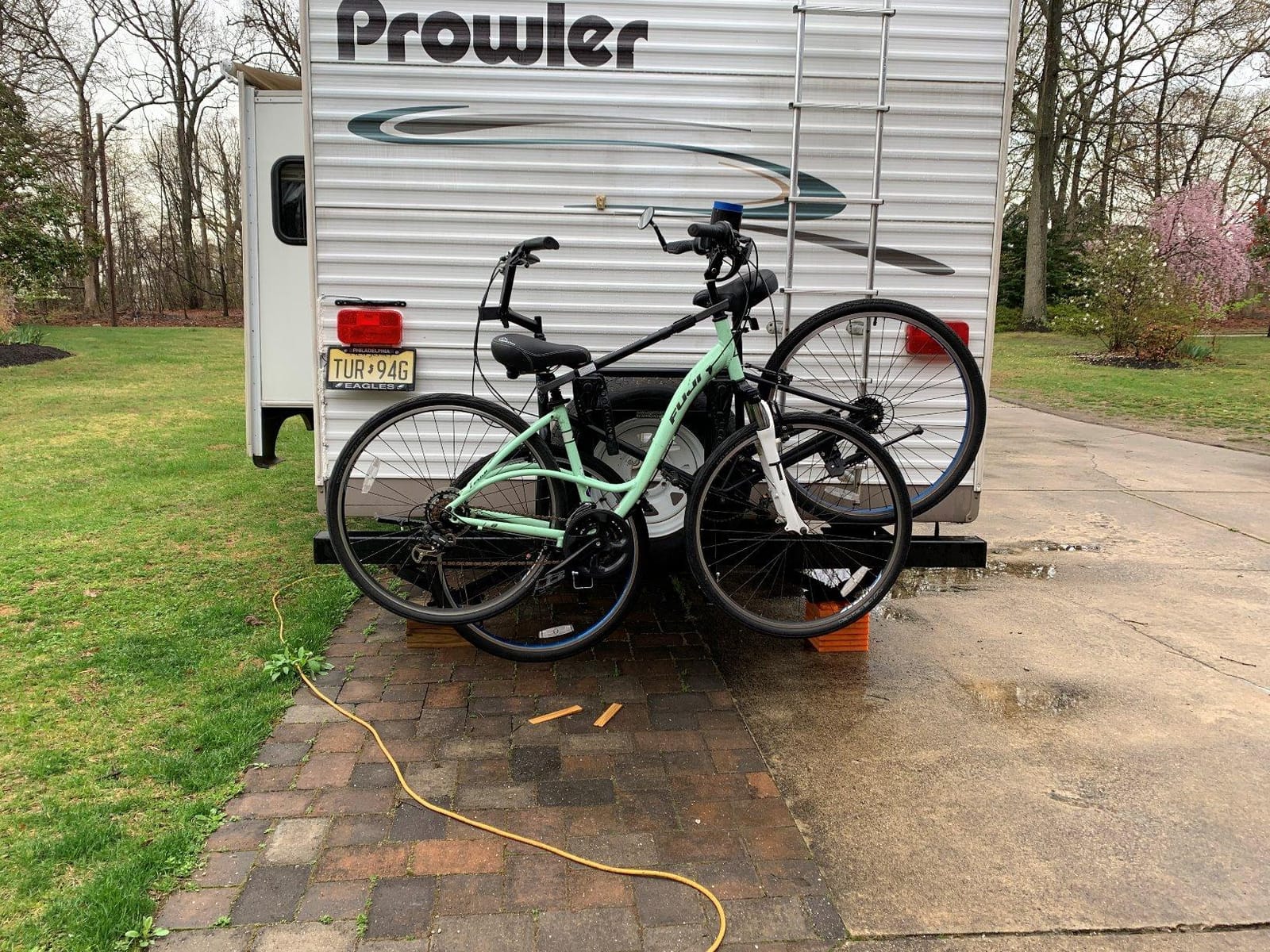
The frame geometry requirement is the biggest limitation and it is not obvious from photos. It needs a large triangular opening in the frame, which many modern mountain bikes do not have, since sloping top tubes and compact triangles are now standard. Measure the opening before you order, and check your bike’s shape rather than assuming.
Reviewers also report that the horizontal joining bar is narrow enough to strike tires, which limits adult bike fit, and that the rubber straps are very tight and hard to connect with gloves on. Square uprights can need force to slide into the receiver tubes. It will not fit behind a rear folding gear platform with an exterior-mounted spare.
Measure these three things before buying
First, the spare tire’s position and diameter, since the whole cradle design hinges on it. Second, the triangular frame opening on each bike you plan to carry. Third, the vertical clearance behind the spare, because a taller bike can hit the trailer wall even if the rack fits.
If you have modern mountain bikes with sloping top tubes, this is likely the wrong rack. That limitation is structural, not a matter of careful loading.
Where the Around The Spare falls short
Thirty pounds per bike is the same low ceiling as the other Swagman models here. One bike is its realistic maximum in most real installations, and the tight straps make cold-weather loading genuinely unpleasant, which is when you will be loading it most often.
Review volume of 511 sits below the middle of this roundup, and the 4.2 rating reflects those fit limitations rather than any quality problem.
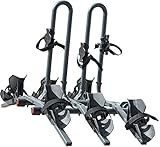
10. Bell Right Up 350 3-Bike Platform Hitch Rack: Best for Mixed Bike Sizes
Bell Right Up 350 3-Bicycle Platform Hitch Rack
3 bikes
105 lb total
35 lb per bike
Pros
- Wide wheel range from 12 to 29 inch wheels
- Stabilizing hoops stop bikes shifting
- Folds for compact storage
- Handles mixed adult and youth bikes
Cons
- Plastic trays flex more than all-metal racks
- Hoops need adjustment after long trips
The Right Up 350 solves the family problem of carrying very small and very large bikes at once. It carries three bikes with wheels from 12 inches to 29 inches, which covers everything from a young child’s bike to a full-size 29er in one load, and it fits both 1-1/4-inch and 2-inch receivers.
Stabilizing hoops keep bikes from shifting on the road, which matters more than it sounds on a trailer where lateral movement is constant. Trays accommodate tires up to 3 inches wide, so plus-size tires are not an automatic problem, and the design folds down for storage in a garage between trips.
Trailer approval status: not stated. The product data lists bicycles as the compatible vehicle type and gives no RV or trailer approval, so verify with the maker. At 22.1 pounds it is light enough to handle, and the folding design makes removal between the trailer and the truck realistic.
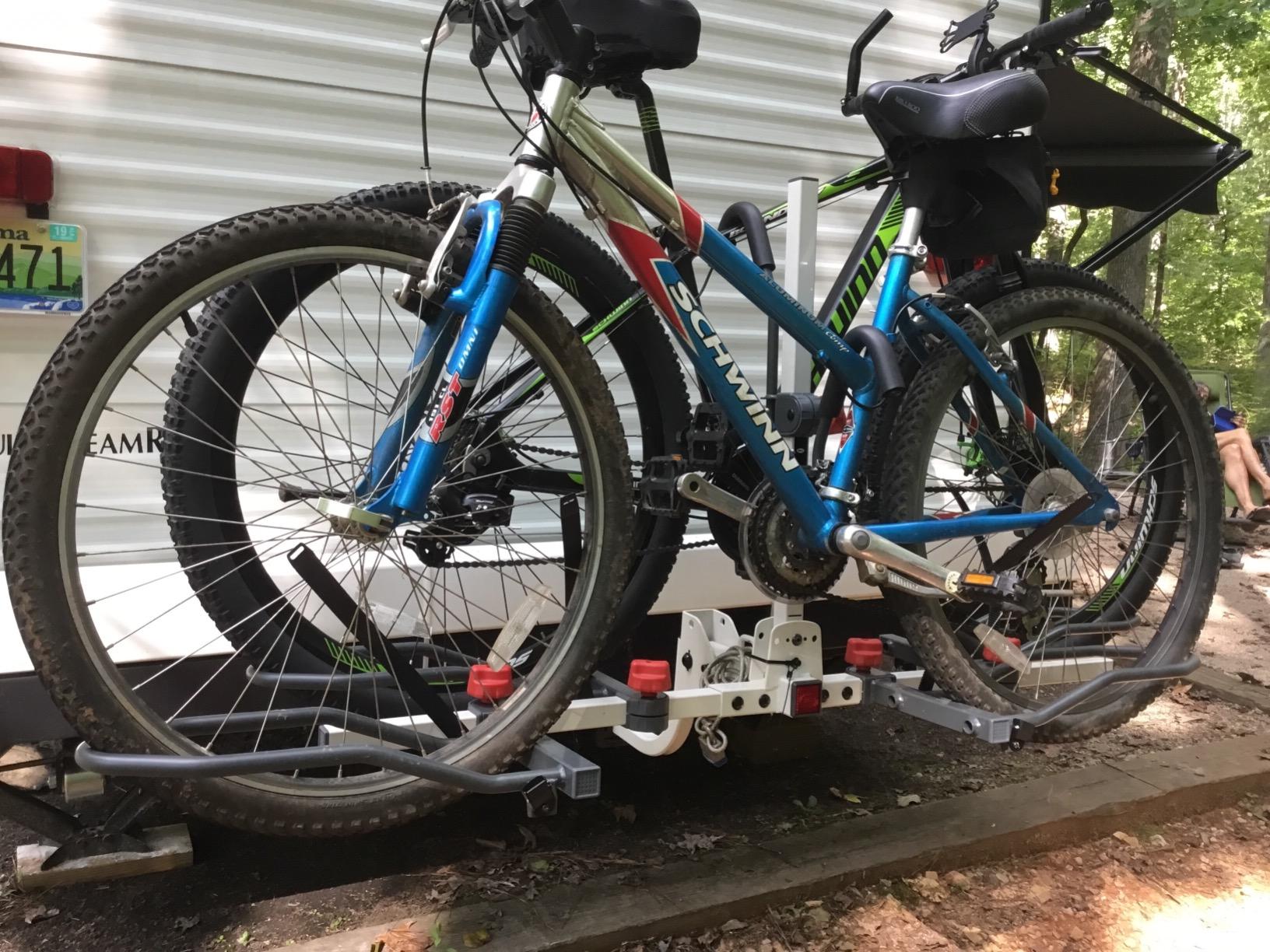
The material is the trade-off. These are plastic trays, and owners report more flex under load than an all-metal rack, which translates into more bounce and more noise over rough road. The hoops are the part that needs attention: check them after long trips and readjust if bikes have shifted.
Wheel straps need occasional re-tensioning over rough roads, on top of the hoop adjustment. Budget a couple of minutes at every stop rather than discovering a shifted bike at the next fuel island.
When the Bell is the smarter buy
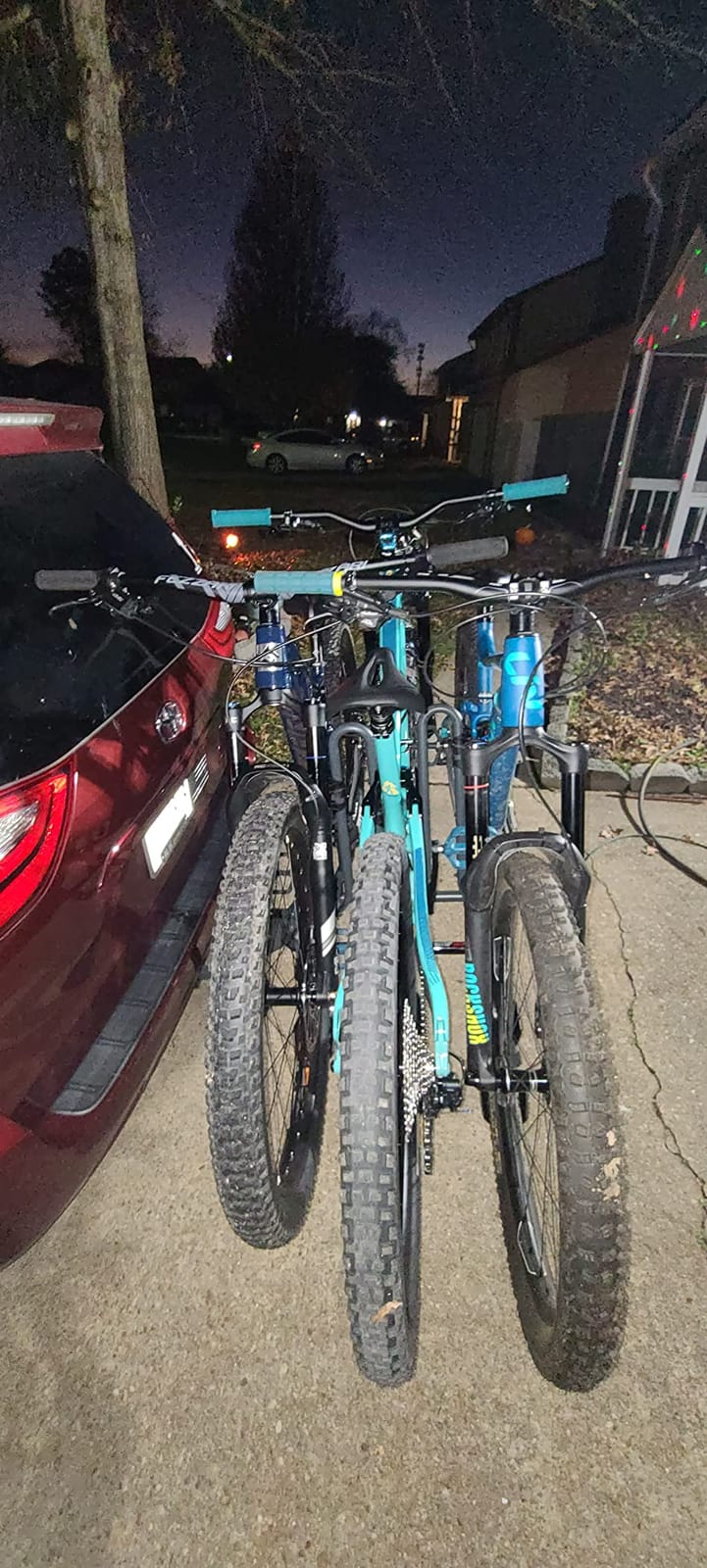
It is the smarter buy for a household with three riders of very different sizes, which is the most common family configuration we ran into. A 12-inch-wheel kids’ bike and a 29-inch adult bike fit the same rack, which no two-bike hanging design in this roundup can promise.
It is also lighter than most four-bike racks, so if you move the rack between rigs regularly, three bikes in a folding plastic design is a manageable combination.
Where the Bell Right Up 350 falls short
Plastic trays are the limit, and they matter more on a bouncing trailer than on a car. Thirty-five pounds per bike again excludes e-bikes. Three bikes is also a compromise number, since a family of four will still need a plan for the fourth bike.
The hoops and straps both need attention after long drives, which makes it a slightly higher-maintenance choice than an all-steel rack with fewer adjustment points.
11. Camco RV Camper Ladder Mount Folding Bike Rack: For Trailers With No Receiver
Camco RV Camper Ladder Mount Folding Bike Rack, Heavy-Duty Steel, 51492
2 bikes
60 lb combined limit
Tool-free install
Pros
- Tool-free mounting to most RV ladders
- Light at 9.8 pounds and folds for storage
- Does not block the trailer door
- Extra straps included
Cons
- Straps and braces creep downward under weight and vibration
- Arms slope downward when loaded
- Not ideal for heavier mountain bikes
The Camco is the answer when a trailer has no frame-welded receiver and no safe bumper to use. It clamps to most standard RV ladders without tools, and it does not require drilling, which is exactly what small pop-ups and older trailers need.
At 9.8 pounds it is the easiest rack here to remove and reinstall, and the folding design means it stores flat in a storage compartment. Owners also note that it does not block the RV door when installed, which is not true of every rear-mounted option.
Trailer approval status: intended for RV use. The listed compatible vehicle type is RV and the listed mounting type is a power grip clamp on a standard ladder, so trailer ladders are the intended application rather than an adaptation. Warranty is a limited one year.
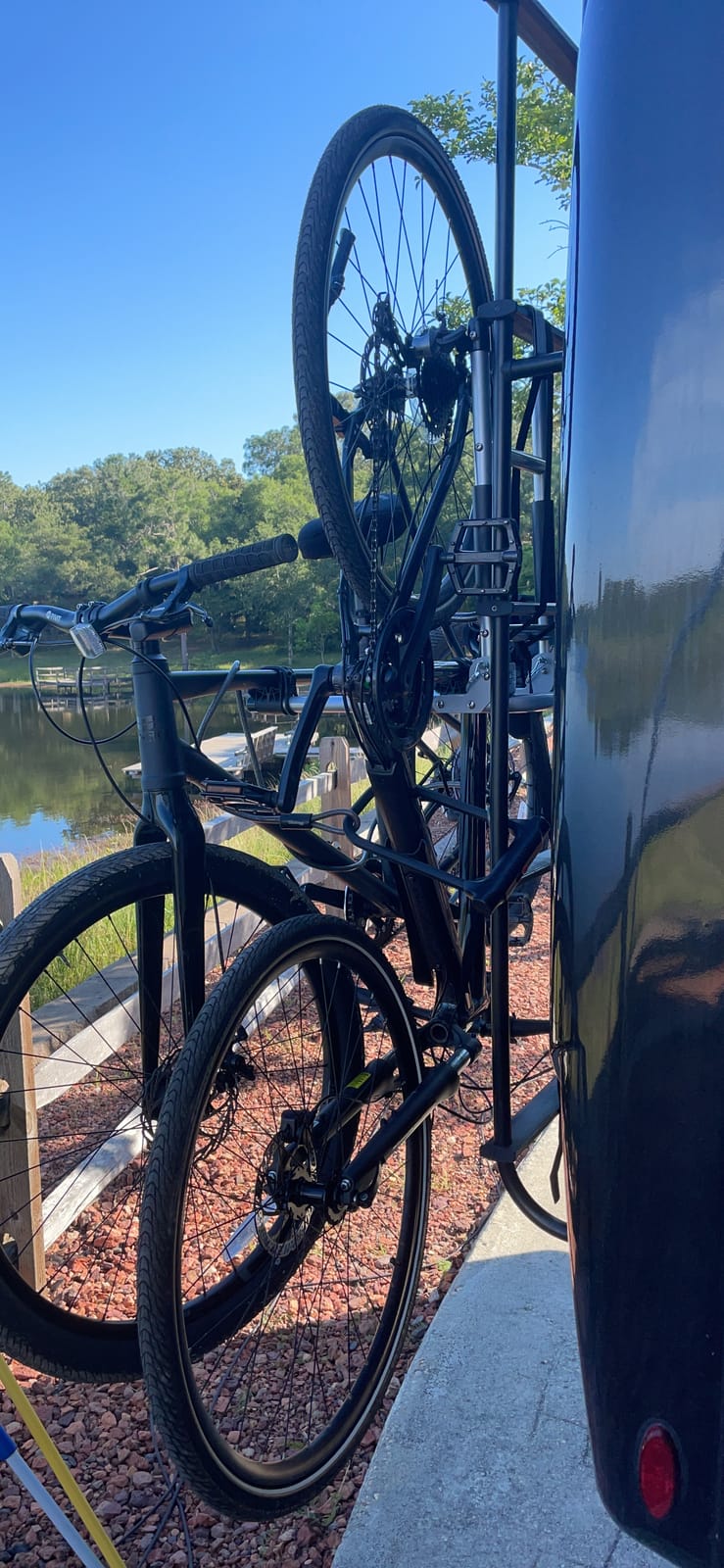
The main mechanical issue is creep. The rubber retaining straps and braces slide downward under weight and road vibration, and the arms slope downward when loaded, so the straps are doing real work rather than just adding security. Many owners solve this by marking the original strap position with paint and re-checking it at every stop.
It is not ideal for heavier mountain bikes, and a 60-pound combined limit is less than one serious e-bike plus a normal bike. One reviewer also reported a unit arriving with an end cap missing a drilled assembly hole, which is a straightforward quality-control issue to check for at delivery.
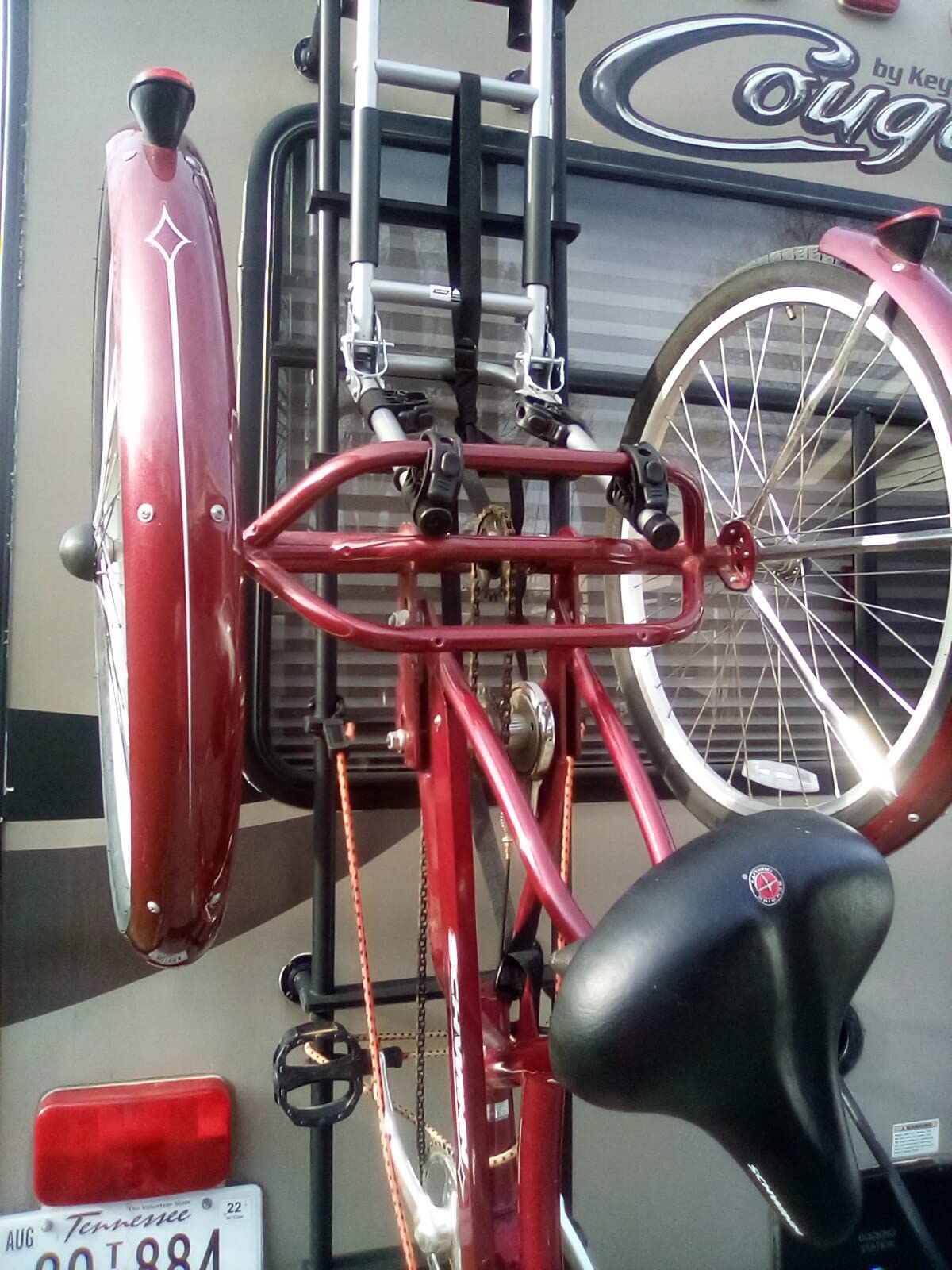
How to keep the Camco from creeping
Mark each arm position on the ladder with a permanent marker or a strip of tape before the first trip, so you have a visual reference. Check the straps after the first ten miles, when everything has settled, and again at each stop after that. The included extra straps are worth using even though the cradles already hold a light bike.
If you carry anything close to the 60-pound limit, upgrade the straps to ratchet straps before you rely on it. That is the difference between a rack that holds and a rack that lets a bike go.
Where the Camco falls short
Sixty pounds combined is the ceiling, and reviewers are clear that it suits kids’ bikes and lighter loads. The downward creep of the arms is a real behavior, not an isolated complaint, and it means this rack needs checking at every stop.
It also sits at the rear of the trailer in the same place as a hitch rack, so it faces the same clearance and length questions, with less capacity and less stiffness. A ladder rack is a good answer to a missing receiver, not a better answer than a frame receiver.
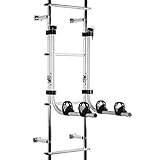
12. Stromberg Carlson LA-102 Bike Rack for Universal Ladder: Lightest Ladder Option
Stromberg Carlson LA-102 1-Inch Bike Rack for Universal Ladder, black
50 lb capacity
5 lb rack weight
13 inch arms
Pros
- Weighs about 5 pounds
- Tool-free ladder attachment
- Good value for one lighter bike
- Reported stable after mounting
Cons
- Included screws roughly 1/4 inch too short for many ladders
- Rubber straps are extremely stiff
- Support arms can bend under heavier bikes
The LA-102 is the lightest rack in this roundup at about 5 pounds, and that is genuinely the feature. If you are putting bikes on a pop-up, a small trailer, or a trailer with no receiver at all, weight you can lift one-handed changes the whole experience.
It attaches to a universal outdoor RV ladder, the arms extend 13 inches from the bend to the tip, and cradle spacing reaches 9 inches. Reviewers describe it as a workable budget ladder rack for a single lighter bike, with many reporting thousands of miles of use.
Trailer approval status: intended for RV use, with a light-duty scope. The listed compatible vehicle type is RV, the mounting type is a ladder mount, and the capacity is 50 pounds. The stated support is limited to issues within 30 days of receipt, which is the shortest warranty in this roundup.
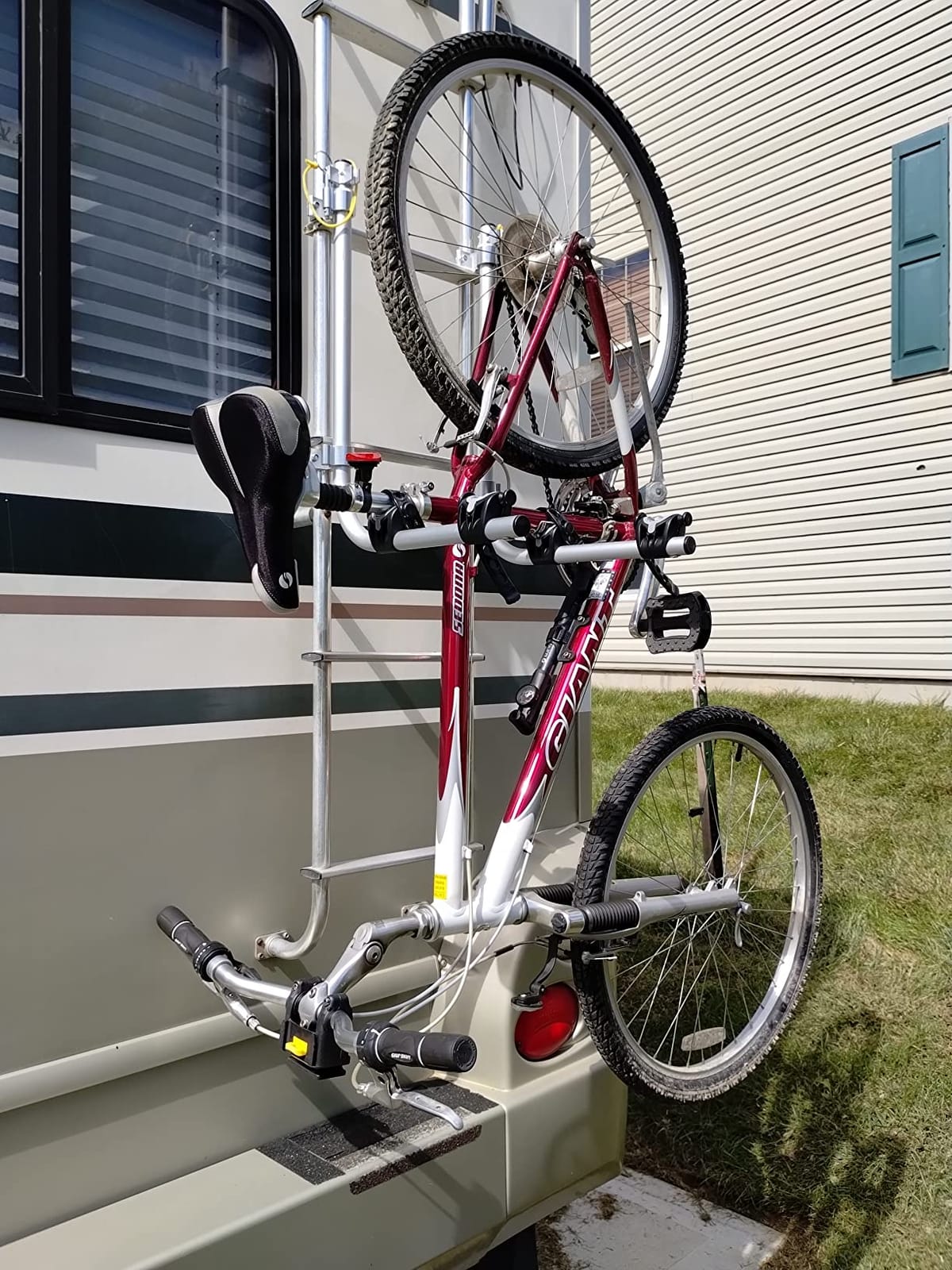
The included screws are reported to be roughly a quarter inch too short for many ladders, which is the most common install problem. Bring your own longer fasteners and check the ladder wall thickness before you assume the hardware is adequate.
The rubber straps are extremely stiff and hard to stretch and fasten, and the metal support arms can bend under heavier loads. Two bikes can interfere with each other through pedals and handlebars, and depending on where the ladder sits, bikes can protrude past the trailer side, which is a visibility and overhang concern rather than just a fitting one.
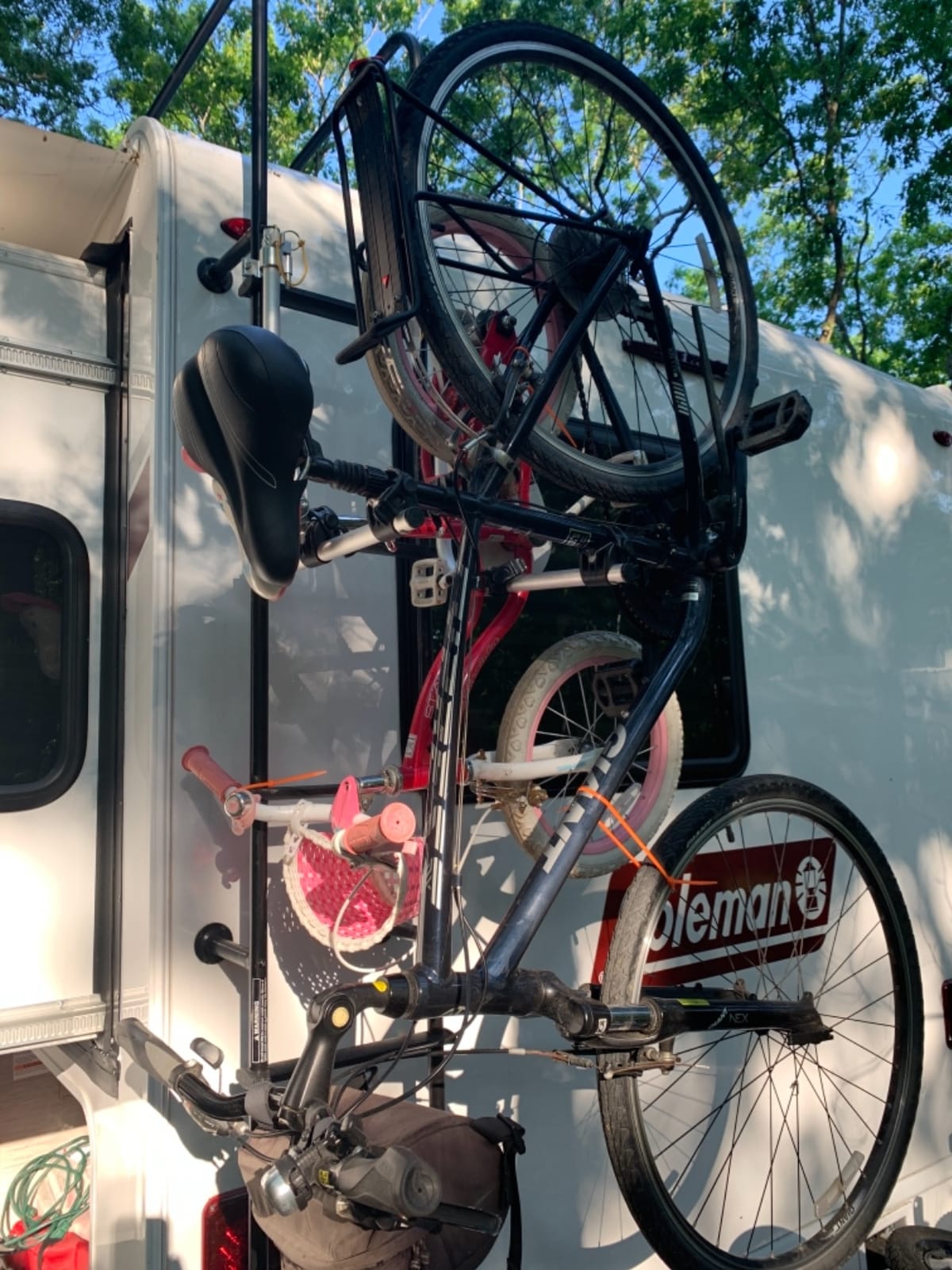
Is the LA-102 right for your trailer?
It is right for a small trailer with no receiver, one light road bike or hybrid, and an owner who will re-check straps at every stop. It is the right answer when the alternative is putting a rack on a trailer bumper, which it plainly is not.
It is wrong for e-bikes, wrong for fat-tire bikes, and wrong for anyone carrying two bikes regularly. Check the lateral protrusion issue, since a ladder’s position relative to the trailer body determines whether bikes stick out into an adjacent lane.
Where the Stromberg Carlson falls short
Fifty pounds is one lighter bike, and the 30-day support window is the shortest here. Stiff straps and arms that can bend make it a poor choice for anything heavy or long-distance without regular checks.
At a 4.0 average rating across 291 reviews, it is the least proven product in this roundup. It finishes last here because of its weight limit and its hardware, not because of its concept.
How to Confirm a Rack Is Really Travel-Trailer Rated Before You Buy?
Confirming trailer approval takes four steps and about ten minutes, and it prevents the most common and most expensive mistake in this category. Start with the word RV itself, because that phrase covers two completely different vehicles. A motorized motorhome has suspension, a chassis, and a steel bumper. A travel trailer has a tongue, a frame, and a plastic-covered bumper beam.
Read the vehicle type line, not the marketing headline. If the listing says compatible with car, SUV, and truck only, the maker has not approved trailer use, whatever the title claims. Look for RV or travel trailer language in the specifications.
Email the manufacturer the exact question. Ask: Is this rack approved for mounting on a towable travel trailer’s frame-welded 2-inch hitch receiver, and does the warranty cover trailer use? A written yes is worth more than a phone answer, and forum owners report that written confirmations are exactly what settled their own doubts.
Check the per-bike rating against your heaviest bike. Weigh each bike. Most e-bikes exceed the 30 to 35 pound per-bike ceiling in this roundup, and fat-tire models exceed it by a wide margin. If a rack cannot hold your heaviest bike, it cannot hold your family.
Verify your trailer’s receiver before you order anything. Crouch behind the trailer and look at how the receiver tube is attached. A frame-welded receiver meets the frame rail directly. A bumper-mounted receiver comes out of a beam held by U-bolts inside a plastic cover. Confirm the receiver is 2-inch and rated for the load you intend.
One more check that costs nothing: ask whether the warranty language names towable RVs. Some brands that print RV-approved in a headline explicitly exclude trailers in the warranty terms, and the only way to find out is to ask before you buy rather than after a claim.
If you also need somewhere to keep the bikes at home between trips, our garage bike rack guide covers storage rather than transport.
How to Install a Rear Rack and Stop the Bounce
Most trailer rack complaints are installation problems, not product problems. A tight receiver, correct pin, and one stabilization strap take about fifteen minutes and remove most of the noise and movement owners report. Work through these steps in order.
Confirm the receiver and clean it. Remove rust, paint chips, and sealant from inside the receiver tube so the hitch bolt seats fully on metal rather than on a surface layer.
Fit the anti-rattle device before the pin. Whether it is the included tightener, a hitch pin lock, or a wedge, this is the piece that stops the rack from cycling inside the receiver. Tighten it until the rack no longer rotates by hand.
Use the correct pin and torque it. Check the thread diameter before the trip. Three racks in this roundup include non-standard bolts, and a bolt that does not match a locking pin means a bike rack that can be walked off in a parking lot.
Load the heaviest bike nearest the trailer. Load order changes how a rack handles its load far more than most owners expect. Alternate handlebar angles across the rack to stop bars from touching.
Add a ratchet strap from the rack to the trailer ladder or frame. Owners on RV forums report that a single strap from the rack to the trailer’s ladder or frame corner eliminates bounce over very long mileage. This is the single most effective anti-rattle modification, and it costs almost nothing.
Mark strap positions and re-check after the first ten miles. Everything settles after the first stretch of road. Mark arms, cradles, and wheel straps so a fast visual check catches any movement at each stop.
One caution on tightening. Over-tightening a bolt on a bumper adapter can crush wiring or a dump hose housing, and over-tightening a strap arm can bend a thin aluminum support. Tighten until motion stops, not until the part creaks.
Will a Bike Rack Block Your Lights or Plate? Overhang and Length Rules
A rear bike rack can block taillights, brake lights, the license plate, or all three, and that is a legal problem rather than a preference. Most state rules require every lamp and the plate to be visible and readable from a set distance, and they treat the combination of trailer and accessories as one vehicle for overall length purposes.
Two things follow from that. First, check your lights and plate with the rack installed and loaded, not in the driveway with the bikes off. If the tray or a wheel blocks the plate, you can often solve it with a plate relocation or a different bike order. If a wheel blocks a taillight, move the bikes and confirm.
Second, the combined length of tow vehicle, trailer, and rear-mounted rack is what you compare against your state’s limit. A four-bike tray rack is a long object hanging several feet behind a receiver that is itself well behind the axle, so overhang adds up fast. If you tow a car behind the trailer, a long rear rack can also interfere with that towing package, which is a separate problem with a separate solution.
Racks mounted at the front of the A-frame, like the Jack-It, avoid nearly all of this. They add nothing to your overall length and never sit behind your lights.
Frequently Asked Questions
Why are bike racks prohibited on RVs?
They are not prohibited by any general rule. What most people mean is that many racks are approved only for certain vehicles, and a travel trailer rear bumper cannot carry a rack. Bike racks are legal on RVs and travel trailers as long as your lights and license plate stay visible and your overall length stays within state limits. The mount matters far more than the permission.
What are the best RV-approved bike racks?
The strongest RV-approved picks for trailers are the Swagman Traveller XC2, which is rated for a 2-inch Class 3 receiver and 35 pounds per bike, the Thule Range, which is built for RV and travel trailer hitches and carries four bikes, and the Let’s Go Aero Jack-It, which mounts to the A-frame tongue so no rear mount is involved. Confirm trailer approval in writing before you buy.
How do I carry bikes on a travel trailer?
Use a frame-welded 2-inch hitch receiver on the trailer and a platform rack that holds bikes by their wheels, with an anti-rattle hitch pin. Load the heaviest bike nearest the trailer, alternate handlebar angles, and add one ratchet strap from the rack to the trailer ladder or frame. Check taillight and plate visibility with the rack loaded.
What is the best bike holder for a trailer?
It depends on the trailer. With a frame-welded 2-inch receiver, a hitch-mounted platform rack such as the Swagman Traveller XC2 is the safest and most stable choice. With no receiver, a front A-frame tongue mount such as the Let’s Go Aero Jack-It avoids rear mounting entirely. With neither, a ladder rack such as the Camco is the least risky option. Never mount to a travel trailer bumper.
Can I carry e-bikes on a travel trailer bike rack?
Only on racks rated above your heaviest bike. Most e-bikes weigh 50 to 90 pounds and fat-tire models run heavier, which exceeds the 30 to 35 pounds per bike limit of most racks in this roundup. Look for per-bike ratings at or above 80 pounds, or move the bikes to the tow vehicle or a front A-frame rack with a higher total capacity.
What size hitch receiver do I need for a bike rack on a travel trailer?
You need a 2-inch receiver, ideally a Class 3 or better, welded to the trailer frame. A 1-1/4-inch receiver is not adequate for a loaded trailer rack. A receiver attached to a bumper beam rather than the frame is also not adequate, regardless of its size, because the force acts on the U-bolts and the frame rail.
Conclusion: Where to Start With Your Bike Rack
If you have a frame-welded 2-inch receiver and two bikes under 35 pounds each, the Swagman Traveller XC2 is the pick. It is the only rear rack here that the manufacturer approves for trailer use while using a true 2-inch pin, and it has the largest review base of the trailer-rated group. For four bikes on a receiver and a family that rides light bikes, the Allen Sports Deluxe is the value choice, with a clear caveat that no e-bike fits under its capacity.
If you want the rear of the trailer free, the Let’s Go Aero Jack-It puts the bikes at the A-frame where bounce is lowest, and its 80-pound total handles heavier bikes than anything else in this roundup. If you own e-bikes, plan to move them to the tow vehicle or budget for a rack rated well above 80 pounds per bike, because nothing in this group is designed for that weight at the rear of a trailer.
Start by crouching behind your trailer and confirming that the receiver is welded to the frame. Everything else follows from that one fact. Our guide to bike trailers for kids covers the other half of the family transport picture for anyone towing young riders behind the vehicle.