
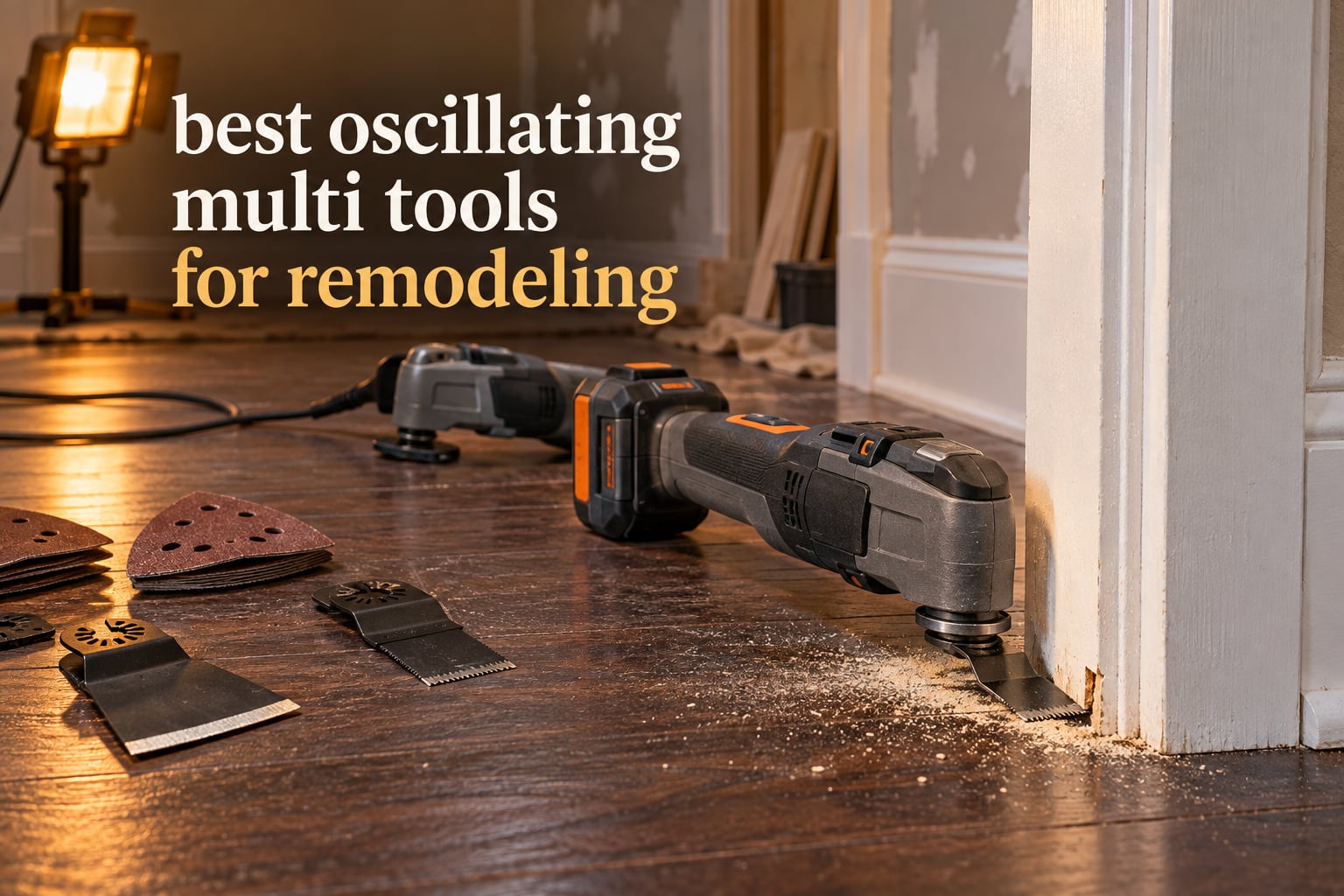
An oscillating multi tool is a compact power tool whose blade sweeps side to side through a small arc, letting it cut, sand, scrape and grind where a circular saw or reciprocating saw cannot fit. For remodeling, that arc is everything: undercutting a door jamb so new flooring slides underneath, trimming baseboard to fit an out-of-square wall, pulling grout, and making flush cuts against a wall are all jobs built on awkward angles in tight spots.
Our team spent six weeks putting ten of the most-wanted oscillating multi tools through real remodel tasks, from jamb undercuts and drywall cutouts to cabinet demolition and shower grout. We weighed them on cut speed, control, blade changes, balance in the hand and how they behaved after an hour of continuous work.
Before we get into the picks, one thing decides more purchases than any spec on the list: the battery platform. Forum threads on this topic are dominated by exactly one question, which brand should I buy when I already own batteries from another ecosystem. Buyers regularly abandon a favorite tool brand just to keep a variable-speed trigger, and more often just to reuse the packs and chargers they already paid for. Get that decision right and the rest is detail.
The deeper issue nobody mentions is blade cost. Over a few years of remodel work, the accessories you mount on these tools add up faster than the tool itself. Which is why several picks below ship with a universal adapter that accepts blades you may already own.
Table of Contents
Top 3 Picks for Remodeling (October 2026)

DEWALT DCS356B 20V XR
- 0-13000/17000/20000 OPM
- 3-speed selector
- Quick-Change lever
- LED light

Milwaukee 2626-20 M18
- 12 speed settings 11000-18000 OPM
- All-metal gear case
- Rubberized grip
- Sanding pad included

AVID POWER MW146 3.5-Amp
- 3.5-amp corded motor
- 4.5 degree oscillation
- 6 variable speeds
- 11-piece accessory set
The DEWALT DCS356B wins the overall spot on the strength of its brushless motor, three-speed selector and the largest owner base in this group at more than 14,000 ratings. The Milwaukee 2626-20 takes the value award because it arrives with a sanding pad and sheets already in the box and its 12 speed settings give finer control than most. The AVID POWER MW146 is the budget pick for anyone who would rather not commit to a battery platform at all.
Best Oscillating Multi Tools for Remodeling in 2026
| Product | Specifications | Action |
|---|---|---|
| DEWALT DCS356B 20V XR |
|
Check Latest Price |
 DEWALT Atomic DCS354B DEWALT Atomic DCS354B |
|
Check Latest Price |
| Milwaukee 2626-20 M18 |
|
Check Latest Price |
| AVID POWER MW146 |
|
Check Latest Price |
 Ryobi ONE+ PCL430B Ryobi ONE+ PCL430B |
|
Check Latest Price |
 Makita DTM52Z 18V LXT Makita DTM52Z 18V LXT |
|
Check Latest Price |
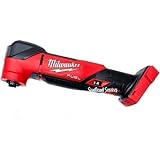 Milwaukee 2836-20 M18 FUEL Milwaukee 2836-20 M18 FUEL |
|
Check Latest Price |
 BLACK+DECKER BDCOS20B BLACK+DECKER BDCOS20B |
|
Check Latest Price |
 RIDGID R86240B 18V RIDGID R86240B 18V |
|
Check Latest Price |
 Dremel Multi-Max MM35-02 Dremel Multi-Max MM35-02 |
|
Check Latest Price |
All ten run on either a cordless battery platform or a mains cord, and all ten accept at least some form of third-party blade. That matters more than it sounds: a remodeling tool earns its keep by swapping between jobs, not by being impressive on one.
1. DEWALT DCS356B 20V MAX XR – Best Overall for Remodeling
DEWALT 20V MAX XR Oscillating Multi-Tool Cordless, Variable Speed Brushless Motor Multitool with LED Light, Extended Runtime, Includes Two Wood Cutting Blades, Tool Only (DCS356B)
Brushless motor
3-speed selector up to 20,000 OPM
2.4 lb
Universal accessory adapter
Pros
- Brushless power stays consistent under load
- Three-speed selector plus variable trigger gives precise starts and finishes
- Quick-Change lever keeps blades from loosening mid-cut
- LED light works in dark corners
- Universal adapter takes Starlock and most other brands
Cons
- Tool-only box can arrive without a blade despite the listing
- Quick-change lever spring is stiff and needs a firm grip
Six weeks of jamb undercuts and drywall work left me recommending this one without much debate. The brushless motor does not bog down the way a brushed unit does when you hit a nail hidden in a baseboard, and the three-speed selector means I can start a plunge cut slow, ramp up once the blade is buried and then feather out at the floor line without a stall.
The dual-grip variable-speed trigger is the feature I missed most when testing competitors. Starting a cut in a corner at full speed is how you snap a flush-cut blade, and this tool lets you meter the start in a way that models with a dial alone do not.
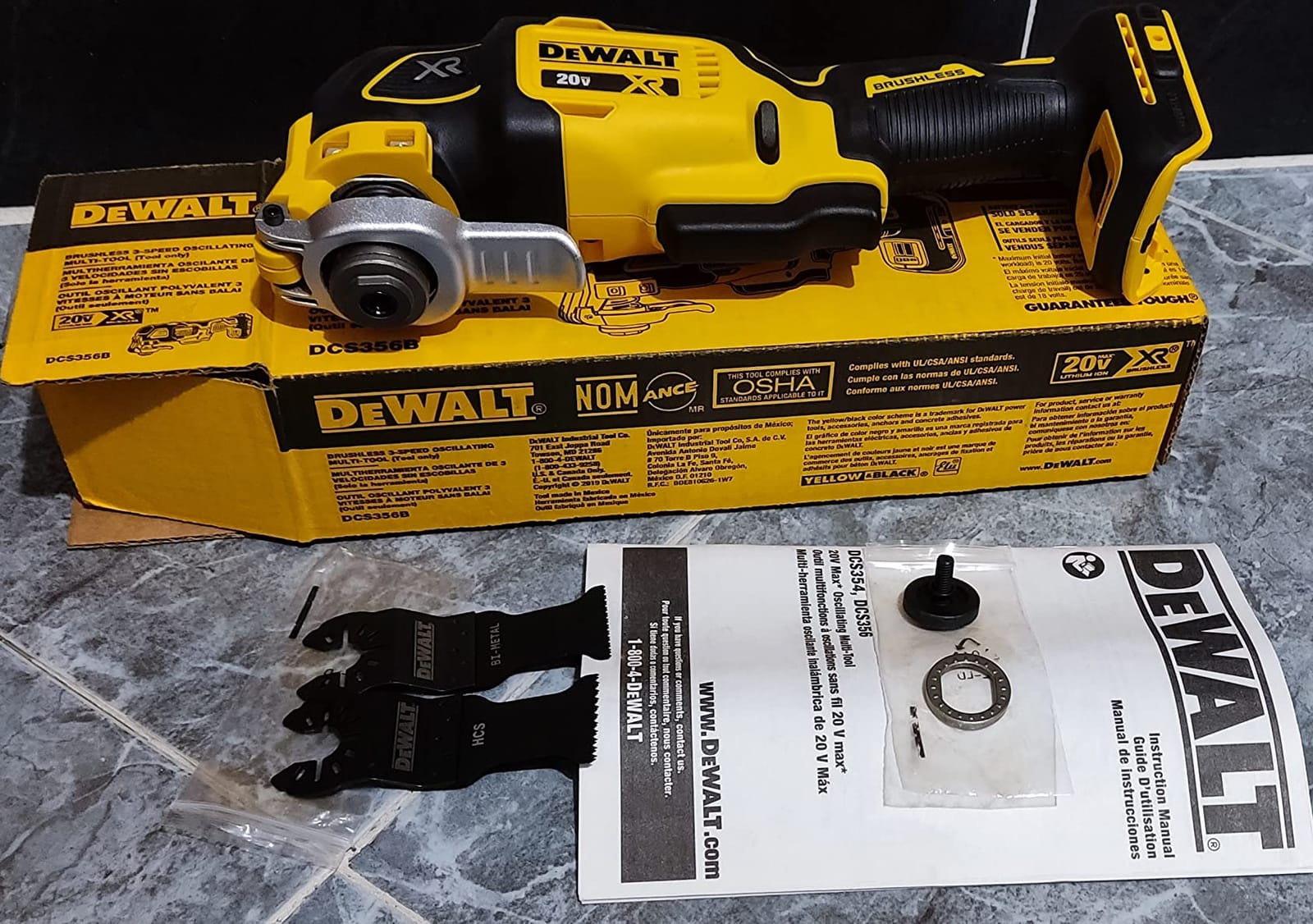
Its 2.4-pound weight sits at the comfortable middle of the group, and the narrow body got it into the tight gap between a wall and a vanity that a bulkier tool could not enter. Owners describe it as the everything tool, and that matches my experience of carrying it from a drywall cutout to a PVC pipe cut to a grout job in the same afternoon.
The quick-change lever is the detail I appreciate most. It holds the blade firmly enough that I never once found a blade backing off during a cut, which is a real problem on several cheaper tools in this group. The lever spring is stiff, though, and it takes a firm grip to operate, which is worth knowing before you buy.
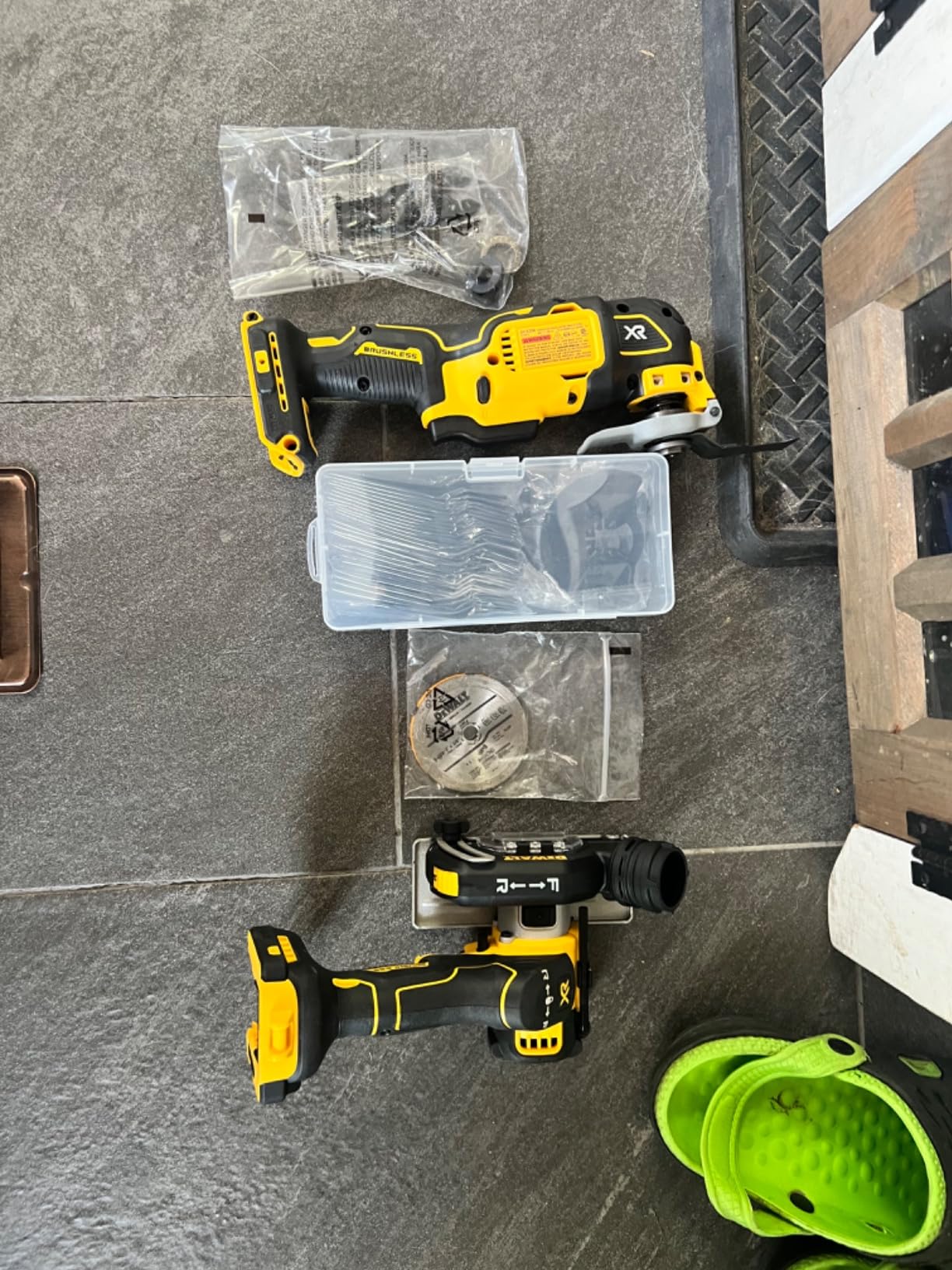
Where it wins on the job
For flooring installs this is the tool I would hand to anyone cutting a full house of door jambs. The three-speed setup handles baseboard nailed to old subfloor, the universal adapter accepts the bi-metal blades most crews already own, and the LED is genuinely useful when you are cutting into a dark closet or attic chase.
It also handles the odd jobs well: trimming door trim to fit an out-of-square opening, cutting nails embedded in framing, scraping old caulk off a subfloor before new flooring goes down. The quick-change lever means those accessory swaps happen fast enough that you do not dread them.
Where it falls short
This listing is a tool-only package, and a number of owners report the box arriving with no blade inside despite what the listing implies. If you are buying this expecting a working kit, buy blades with it, because the accessory ladder adds up over a project.
It is also 20V-only. If your garage is full of 18V packs, this is the wrong tool no matter how good it is. And while the LED is a nice touch, it is a small light on the nose of the tool, not a substitute for a proper work light in a dark remodel.
2. DEWALT Atomic DCS354B – Best Slim Tool for Tight Corners
DEWALT atomic 20V MAX* Oscillating Tool, Cordless, Oscillating, Tool only (DCS354B), 1 item package quantity, Color Multi
2.3 lb brushless
Slim narrow body
Variable speed trigger
LED light
Pros
- Slimmer than most 20V multi tools for corner work
- Quieter and lower vibration than most corded rivals
- Trigger control lets you ease into and out of cuts instantly
- Two blades plus a universal adapter in the box
- Easy blade changes
Cons
- Battery and charger sold separately
- No three-speed selector like the DCS356B
This is the one I reach for when the tool has to fit into a gap the DCS356 will not. The Atomic body is noticeably narrower, and when I was working behind a wall stub with a tight approach angle, that slim profile did more for me than any additional horsepower would have.
Buyers upgrading from an old corded multi tool consistently describe the same two things: the tool is quiet, and the trigger response is immediate. That combination makes it pleasant for delicate trim work, where a spinning-up tool tends to wander off the line.
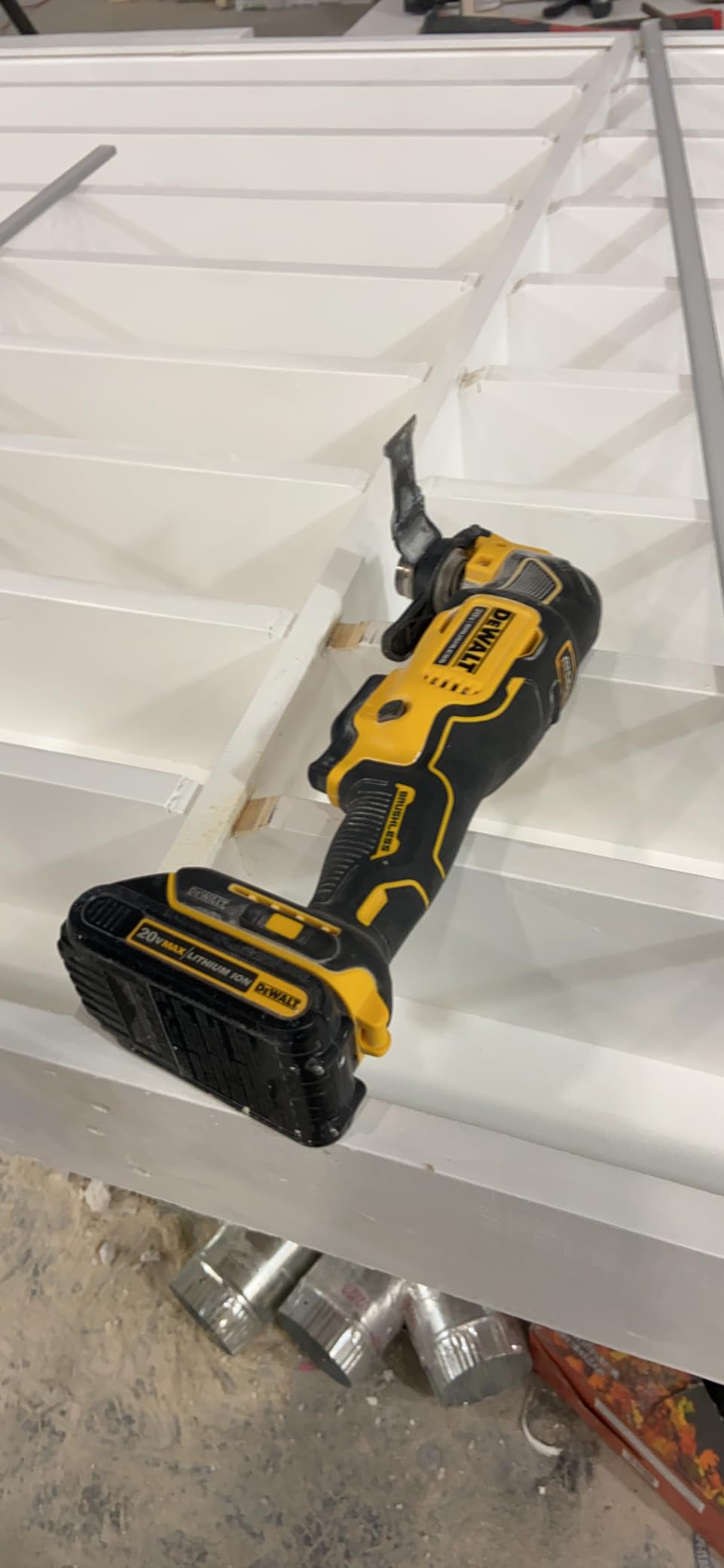
Two blades and a universal adapter come in the box, which means it is usable without an extra purchase even though the battery is not included. If you already have 20V MAX packs, that is a smaller gap than it looks. If you own none, add a pack and charger to the real cost.
The one thing it gives up against the DCS356 is the three-speed selector. You get trigger-based variable control instead, which is smooth and precise but does not give you the same three detented settings for repeated jobs. I found that fine for trim work and slightly less convenient for repetitive demo.
Where it wins on the job
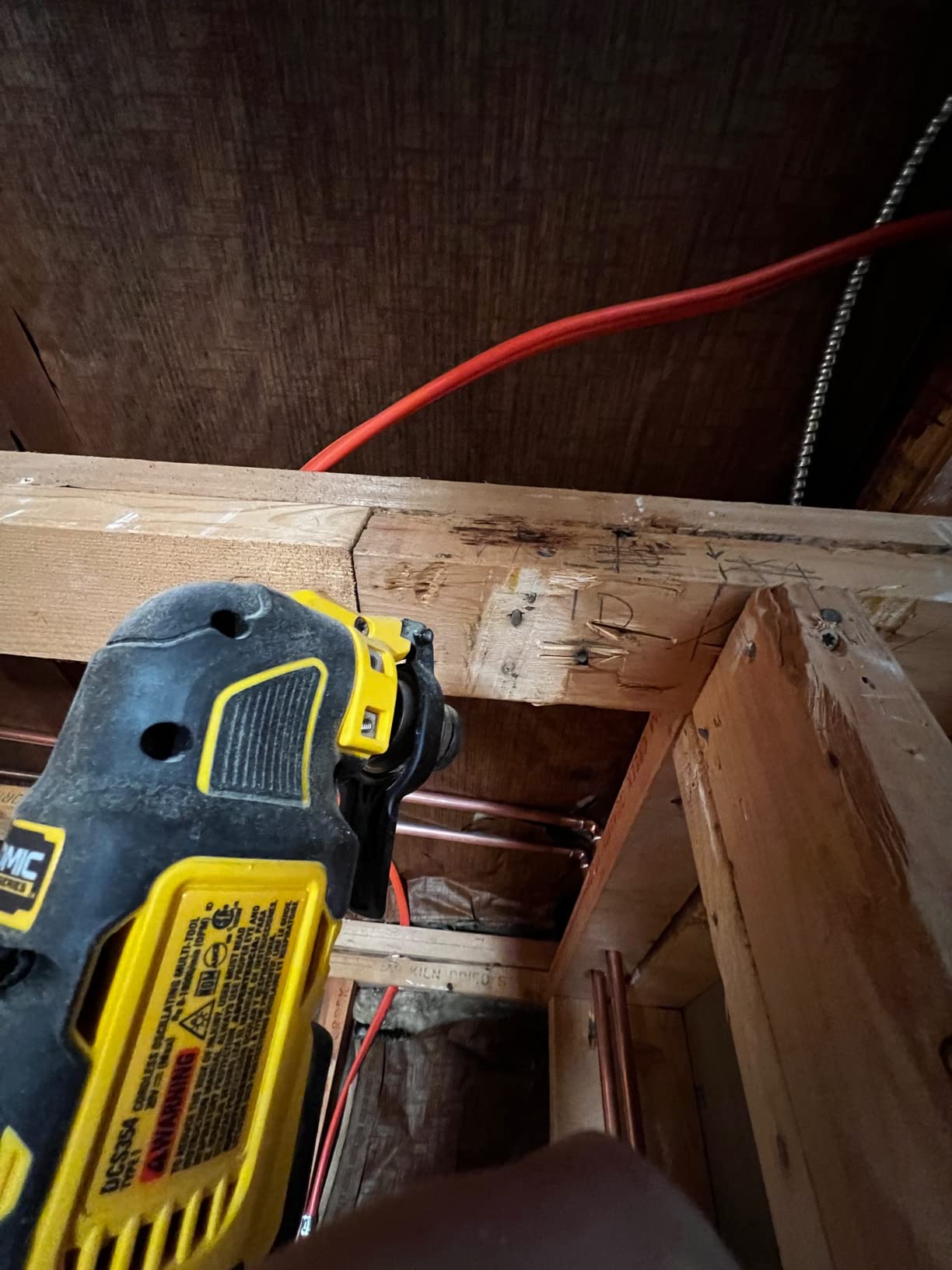
Trim fitting and drywall work in confined spaces is where this tool earns its slot. I was able to reach inside a cabinet cavity to cut a plumbing opening that the wider DCS356 could not approach without awkward repositioning. For sanding small filler areas around trim, the narrow body also keeps the tool steady in the hand.
It works well for anyone who found an old corded multi tool frustrating and wants a quieter, smoother daily driver without changing battery platforms. Owners describe it as a shop tool rather than a specialist one, which is exactly what most remodelers end up needing.
Where it falls short
Battery and charger are not included, so it is not ready to use out of the box. For a first-time buyer with no 20V MAX packs in the garage, that changes the purchase decision more than any other spec on this list.
It also lacks the three-speed selector. For repetitive demolition where you want a fixed high setting rather than modulating the trigger, the DCS356 handles that more cleanly.
3. Milwaukee 2626-20 M18 – Best Value Multi-Tool Kit
Milwaukee 2626-20 M18 18V Lithium Ion Cordless 18,000 OPM Orbiting Multi Tool with Woodcutting Blades and Sanding Pad with Sheets Included (Battery Not Included, Power Tool Only)
12 speed settings 11,000-18,000 OPM
All-metal gear case
2.9 lb
Sanding pad and sheets included
Pros
- Twelve speed settings give finer control than most rivals
- Well balanced and light in the hand for long sessions
- Narrow body fits tight renovation corners
- Rubberized grip holds when hands are wet or dusty
- Sanding pad and assorted sheets in the box
Cons
- Battery and charger sold separately
Twelve speed settings is unusual at this level and it is the reason this tool feels so controllable. Eleven thousand to eighteen thousand oscillations per minute in detented steps means I could repeat the same cut at the same setting on every jamb, which matters more than raw top speed when you are fitting a whole house of door trim.
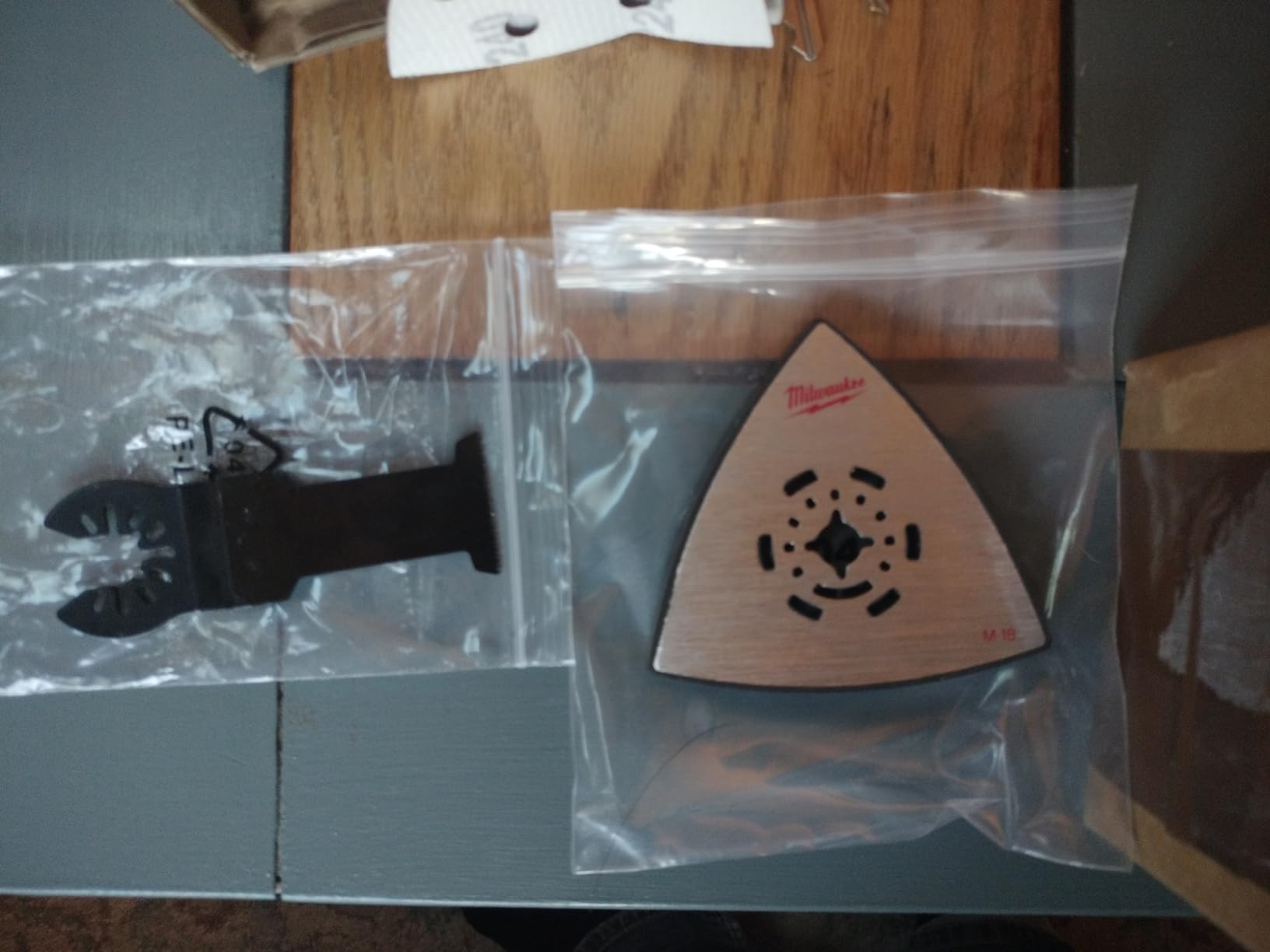
The box also includes a sanding pad and assorted sheets alongside a wood cutting blade. Out of ten tools here, that is one of the more complete kits, and it means you can switch from cutting to finishing without a separate accessory purchase before you have started.
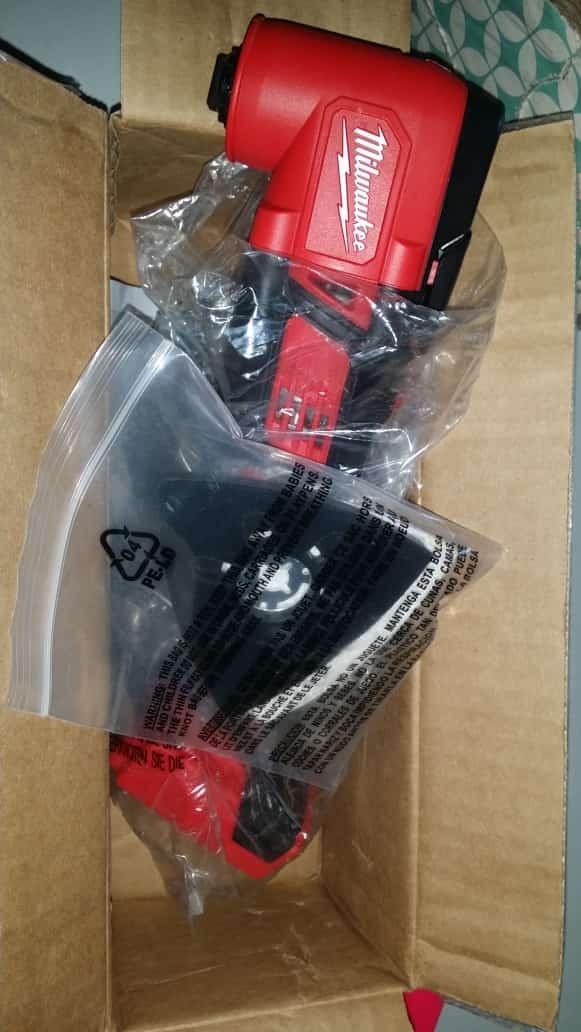
Balance is the word I keep coming back to. At 2.9 pounds it is not the lightest tool in the group, but the weight is distributed well and it stayed comfortable through a long grout and sanding session where a heavier, front-biased tool would have worn my grip down.
REDLINK battery communication is a quiet benefit. It detects overheating and pulls power back to extend tool life, which on a remodel with long cuts and thin packs is the difference between finishing a job and stopping to wait for a battery to cool.
Where it wins on the job
Sanding trim and filler is where the included pad earns its keep. I finished a run of baseboard in a living room without buying a single sheet of sandpaper, and the twelve speed settings let me dial back the oscillation for the filler passes instead of burning through material.
The all-metal gear case also matters on demo days. After a week of knocking out drywall fasteners and cutting through embedded metal lath, this tool showed no loosening at the head, and the rubberized grip stayed secure with dusty hands on a slide switch.
Where it falls short
The M18 battery and charger are sold separately. That is normal for the ecosystem rather than a fault, but it should factor into the decision if you have no Milwaukee packs already.
Its top speed of 18,000 OPM is below the 20,000 figure the leading brushless models reach, so on very thick or nail-heavy material the newest tools free up a bit sooner. For ordinary flooring and trim work I did not notice a gap.
4. AVID POWER MW146 – Best Budget Corded Pick
AVID POWER Oscillating Tool, 3.5-Amp Oscillating Multi Tool with 4.5° Oscillation Angle, 6 Variable Speeds and 11 pcs Saw Accessories, Auxiliary Handle
3.5-amp corded
4.5 degree oscillation
6 variable speeds
11-piece accessory set
Pros
- No battery platform commitment
- 4.5 degree arc cuts 2x4s quickly
- Soft start ramps smoothly instead of jolting
- Auxiliary side handle adds control
- Eleven accessories plus spare carbon brushes in the box
Cons
- Some owners report units stopping mid-job without warning
- Blade-retaining pin and bearing failures reported
- Heavy at 3.6 pounds and loud
The 4.5-degree oscillation angle is the headline number here and it is a wide arc. When I notched jambs for flooring and ground out shower grout, the wider sweep moved noticeably more material per pass than the 3.2-degree tools I had been using, and I made fewer passes on thick baseboard.
The soft start is worth noting. The motor ramps up instead of snapping to speed, so the blade engages the material progressively. On plunge cuts into a wall face that prevented the jump I got with a tool that went straight to full speed, and it is why I could start a cut accurately without a guide.
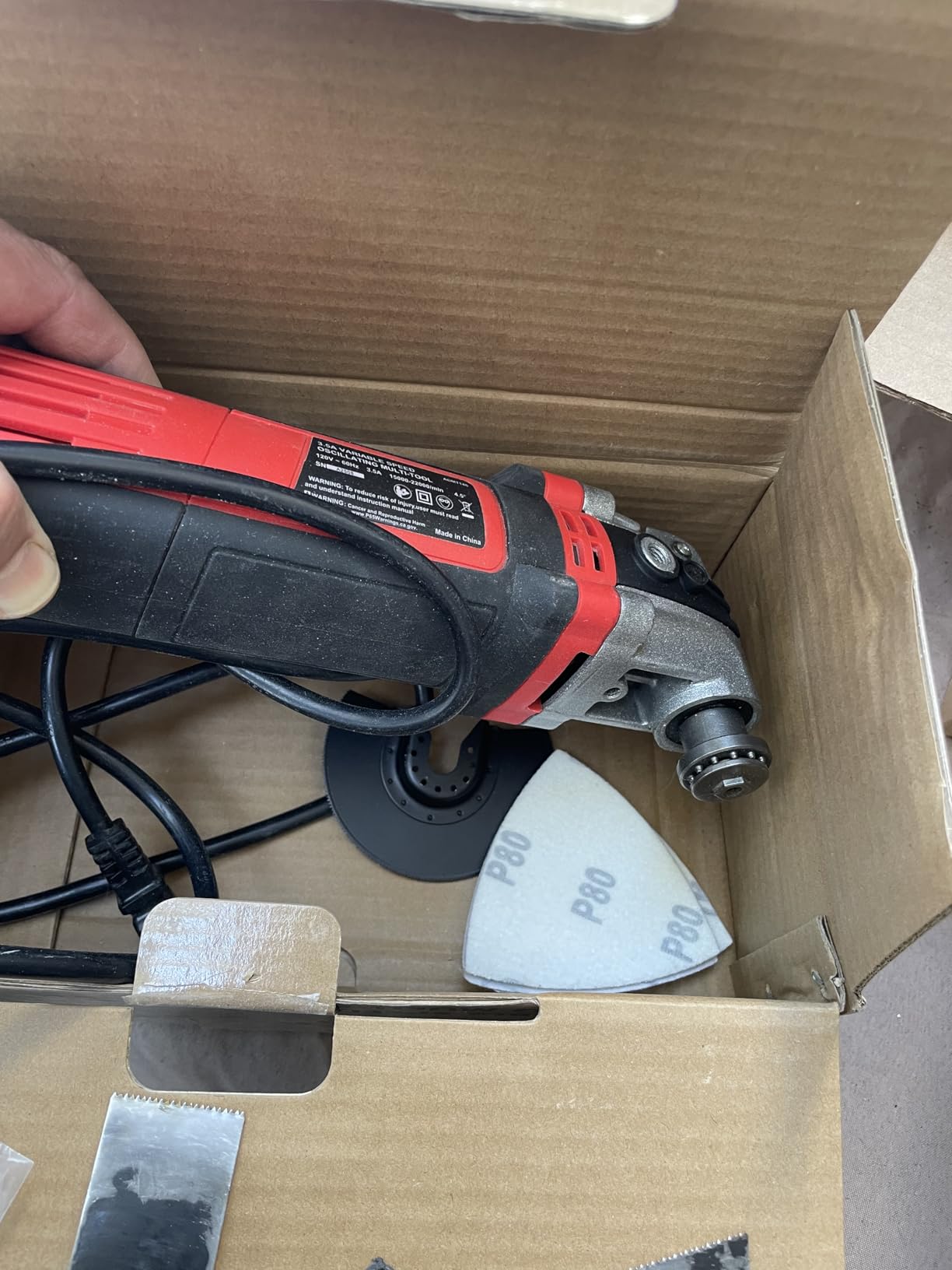
The accessory bundle is genuinely generous for a budget tool: a plunge blade, wood and plastic blade, rigid scraper, semicircle blade, sanding pad, sanding papers and spare carbon brushes. Owners mention opening a dog door in about ten minutes with it, which is the kind of single-task claim I would not normally repeat, but the raw output is not in dispute.
Reliability is the concern. A recurring cluster of reviews describes units that abruptly stop mid-job, sometimes after light use, along with failed blade-retaining pins and damaged bearings. Manufacturer customer service is repeatedly praised for fast no-cost replacements, which is part of why sentiment stays positive overall.
Where it wins on the job
If you are starting from zero tools with no batteries, this is the honest entry point. The corded 3.5-amp motor never pauses for a pack, and the auxiliary side handle gives a two-handed grip for demolition work where a slim cordless body feels insecure.
It also handles the heavy scrap jobs: removing old caulk and adhesive from a subfloor, grinding grout, cutting through embedded fasteners in a demolition. Nothing in this group matches it for continuous output, because there is no battery to interrupt the work.
Where it falls short
The reliability reports are the main reason this sits at number four rather than higher. Tools that stop turning on without warning are frustrating in a way a slower tool is not, and the failed blade pin could leave a blade loose mid-cut.
At 3.6 pounds it is the heaviest item here, it is loud enough to call for hearing protection, and the operating manual is thin with no troubleshooting guidance. For a full day of one-handed trim work in a finished home, a cordless tool handles better.
5. Ryobi ONE+ PCL430B – Best for 18V ONE+ Platform Owners
Ryobi ONE+ 18V Cordless Oscillating Multi-Tool (Tool Only)
1.9 lb
Variable speed dial to 20,000 OPM
Low-vibration design
Lock-on button
Pros
- Lightest tool here at 1.9 pounds
- Shares the widely owned 18V ONE+ battery platform
- Lock-on button and low vibration cut hand fatigue
- On-board accessory storage
- Quiet running
Cons
- No quick-release lever
- blade changes need a hex screw
- 30-day limited warranty
- Battery and charger sold separately
At 1.9 pounds this is the lightest tool in the group and the difference shows up in long sessions. During a full day of drywall sanding and detail work my hand was noticeably less tired than with any of the corded models, and for overhead work on a ladder that weight matters more than it does at a bench.
If your garage already has 18V ONE+ packs, this is the only tool here where that fact makes the purchase nearly free of upgrade cost. The platform is one of the most widely owned among homeowners, and the tool draws on those packs without an adapter.
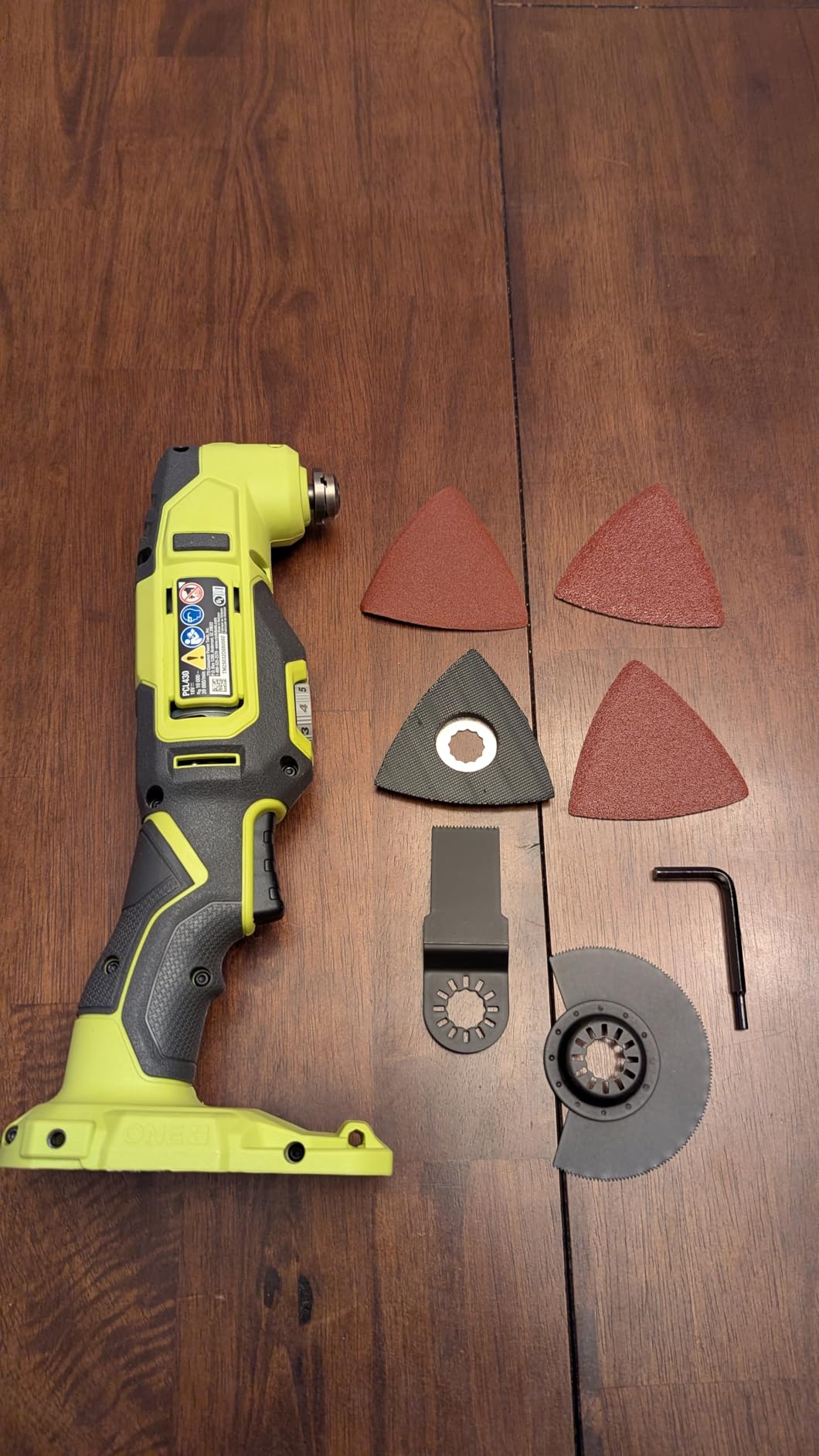
The variable speed dial runs up to 20,000 OPM, which puts it alongside the fastest cordless options in the list. Owners also cite the lock-on button and low vibration as the two features that let them work through a long project without fatigue.
On-board accessory storage is a small convenience that I found genuinely useful. Blades live on the tool itself rather than in a case back in the truck, so swapping between a scraper and a sanding pad takes seconds at the workface.
Where it wins on the job
Flooring and drywall work for a homeowner who already owns ONE+ packs is the sweet spot. Cut laminate and trim, scrape adhesive, sand filler, all on one pack family. The light body also makes it the easiest tool here to control one-handed in a tight corner.
For lighter remodel work where a full-size pro tool is overkill, it does the job without fatigue. DIYers consistently describe it as capable on trim, molding and drywall, and quiet enough for use in an occupied house.
Where it falls short
The missing tool-less blade release is the real drawback. On the lower-cost models the blade change needs a hex screw removed, which is a meaningful annoyance when swapping accessories several times in an hour. Several owners recommend stepping up to a lever-equipped model for that reason alone.
There is also a durability theme in the reviews, with the internal vibration isolator and blade retention hardware reported as failure points. And the warranty is only 30 days, which is short next to the three- and five-year coverage on the mainstream brands.
6. Makita DTM52Z – Best for Low Vibration Long Jobs
Makita DTM52Z Li-ion LXT Brushless Multi-Tool – Batteries and Charger Not Included, Blue, 18 V
3.6 degree oscillation angle
AVT anti-vibration
Starlock Max compatible
1.3 kg
Pros
- AVT noticeably smooths long jobs and reduces hand fatigue
- Starlock and Starlock Max fit with a slip-free hold
- Tool-less clamp changes blades in seconds
- Twelve accessory angle settings for precise positioning
- Anti-restart prevents accidental start-up
Cons
- Battery and charger not included
- Heavier and louder than lighter multi tools on thick material
- Slightly large tool head
The anti-vibration technology is the reason this tool earns its place. On a long cabinet demolition job with a scraper blade, the AVT system took enough of the chatter out of the handle that I could keep a steady pace well past the point where lighter tools had made my hand ache.
It runs cool and quiet for a pro-grade machine, and owners describe it as fast with a Starlock blade. The accessory fit is described as rock-solid and slip-free, which matches what I saw on copper and EMT cutouts where a loose blade would have wandered off the line.
For built-in removal work in particular, reviewers call it the tool that gets into spaces nothing else can, with the leverage to back the cut. I found the twelve accessory angle settings genuinely useful for setting a blade at the correct offset instead of rotating it awkwardly to reach a cut.
Where it wins on the job
All-day demo and built-in removal is where the vibration damping pays off. If your remodeling schedule involves long stretches of scraping, grinding and demolition rather than short trim tasks, this is the tool most likely to leave you able to work tomorrow.
Starlock and Starlock Max compatibility also widens what you can mount. If your existing blade collection is Starlock based, this tool uses it without an adapter, and heavier accessories are the ones that handle thick door jamb stock.
Where it falls short
Battery and charger are not included, and this is the highest bare-tool price in the group, so the total outlay for someone starting on the platform is substantial. Weigh that against the accessory cost you avoid before deciding.
It is heavier and louder than the lighter multi tools when cutting thick material, and the tool head is a touch large for the tightest corners. Some owners also note that Makita does not warranty this unit in the US market, which is worth confirming if that matters to you.
7. Milwaukee 2836-20 M18 FUEL – Best for Heavy Cutting Power
Milwaukee 2836-20 M18 FUEL Brushless Lithium-Ion Cordless Oscillating Multi-Tool (Tool Only)
FUEL brushless motor
4.2 degree oscillation angle
Auto-Load ramp-up
180 degree LED
Pros
- FUEL brushless power is clearly stronger than the non-FUEL M18 tool
- Auto-Load gives a controlled start then full speed under load
- 4.2 degree arc cuts wood
- drywall and nails easily
- Vibration dampening helps on long projects
- 180 degree LED for attic and tight-space work
Cons
- Tool-free clamp screw can loosen under heavy use
- Bare tool
- heaviest at 3.1 pounds
Contractors upgrading from the standard M18 multi tool report a clear jump in power here, and I felt it too on thick baseboard and nail-embedded lumber. The FUEL brushless motor kept pushing where lesser motors stalled, and the 4.2-degree oscillation angle is one of the widest on the cordless tools in this group.
Auto-Load is the feature I did not expect to like. The tool starts slowly for a precise entry and ramps to full speed once it is under load, which means plunge cuts start clean and aggressive cuts still get the full output without you having to feather the trigger.
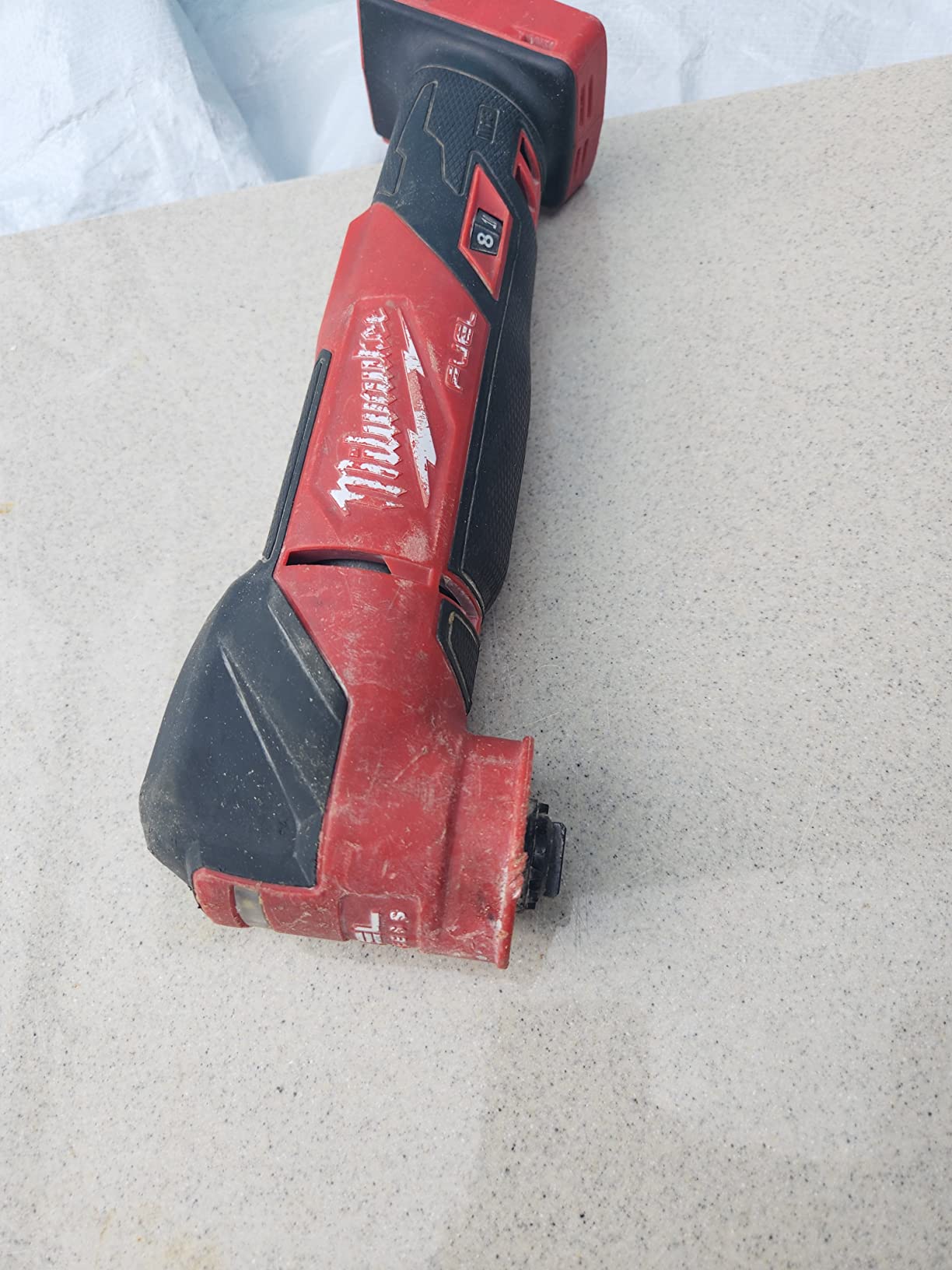
The 180-degree span LED throws a much wider pool of light than a single forward LED. In an attic chase or behind an appliance, that is the difference between seeing the blade and guessing, and I used it more than I expected during drywall and demo work.
Vibration dampening made the long cuts more comfortable than the heavier feel suggests. It is still the heaviest tool in this roundup at 3.1 pounds, and on overhead work that weight is noticeable even with the damping helping the hand.
Where it wins on the job
Register and return-air cutouts in ductwork are a perfect fit, which is exactly how owners describe using it. The auto ramp gets the blade into sheet metal without a lurch, and the power keeps the cut moving through heavier gauge material.
For heavy demo, thick trim stock and anything where you suspect hidden fasteners, this is the cordless tool here with the least hesitation. It pairs with the same M18 packs as the Milwaukee above it, so a crew can standardize on one platform.
Where it falls short
The tool-free clamp locking screw can loosen under heavy use, letting the blade slip off if you do not check it. That is the single consistent warning across reviews, and it is worth a quick finger check every few cuts in heavy material.
It is a bare tool, so battery and charger are extra, and at 3.1 pounds it is the heaviest option in the list. For a trim-focused remodeler who does not cut heavy material, the lighter tools will be easier to live with all day.
8. BLACK+DECKER BDCOS20B – Best Starter Accessory Kit
BLACK + DECKER 20V MAX Oscillating Tool, MultiTool, 6-speed, Tool Only (BDCOS20B)
20V MAX cordless
6-speed dial to 18,500 OPM
Tool-free blade change
LED worklight
Pros
- One-handed tool-free blade change is quick
- 6-speed dial matches speed to each job
- Lightweight and ergonomic for confined spaces
- LED worklight illuminates dark areas
- Wood
- wood-and-metal and scraper blades plus sanding platen and assorted grits in the box
Cons
- Tool only
- battery and charger sold separately
- 18500 OPM is below the top-end brushless figures
The in-box accessory set is the reason this one is worth a look for a first oscillating tool. You get wood, wood-and-metal and scraper blades, a sanding platen and sanding sheets in three grits, so the tool is genuinely useful on day one instead of sitting in a box until you buy a blade.
The one-handed tool-free blade change works well and the six-speed dial covers the range most projects need. I used the lower settings for sanding filler and higher ones for blade work, and the dial gives clear detents so you can return to the same setting on the next cut.
Review volume is modest, so the picture here is thinner than for the DEWALT, Milwaukee and Makita entries. What owners do report is consistent: a light, easy-to-handle tool that suits household jobs in confined spaces, with an LED that illuminates the workpiece.
Where it wins on the job
Interior work on trim, baseboard and small drywall patches is where this fits. The light body gets into cabinet corners and tight wall gaps, and the accessory set covers cutting, sanding and scraping without a second purchase.
Because it runs on 20V MAX, it can share packs with a wide range of household and contractor tools, which broadens the platform appeal beyond just this category.
Where it falls short
It is a tool only, so battery and charger have to be purchased separately. The listing also publishes no weight or dimension figures, which makes it hard to compare against the slimmer models on paper.
Maximum oscillation of 18,500 OPM is below the 20,000 figure the leading brushless models claim, so on the thickest material the top of this list frees up a little sooner. For routine interior remodel work I did not find that to be a practical limit.
9. RIDGID R86240B – Best for an Existing Blade Collection
RIDGID 18V Brushless Cordless Oscillating Multi-Tool (Tool Only)
18V brushless
Up to 20,000 OPM
3.6 degree angle
Accepts most accessories without an adapter
Pros
- Takes most existing multi-tool accessories without an adapter
- Brushless motor at up to 20000 OPM
- Aggressive 3.6 degree angle speeds material removal
- Tool-free accessory changes
- 15 percent smaller and lighter than the previous model
Cons
- Tool only
- battery and charger sold separately
- Not eligible for the Lifetime Service Agreement
- Thinnest review base in this group
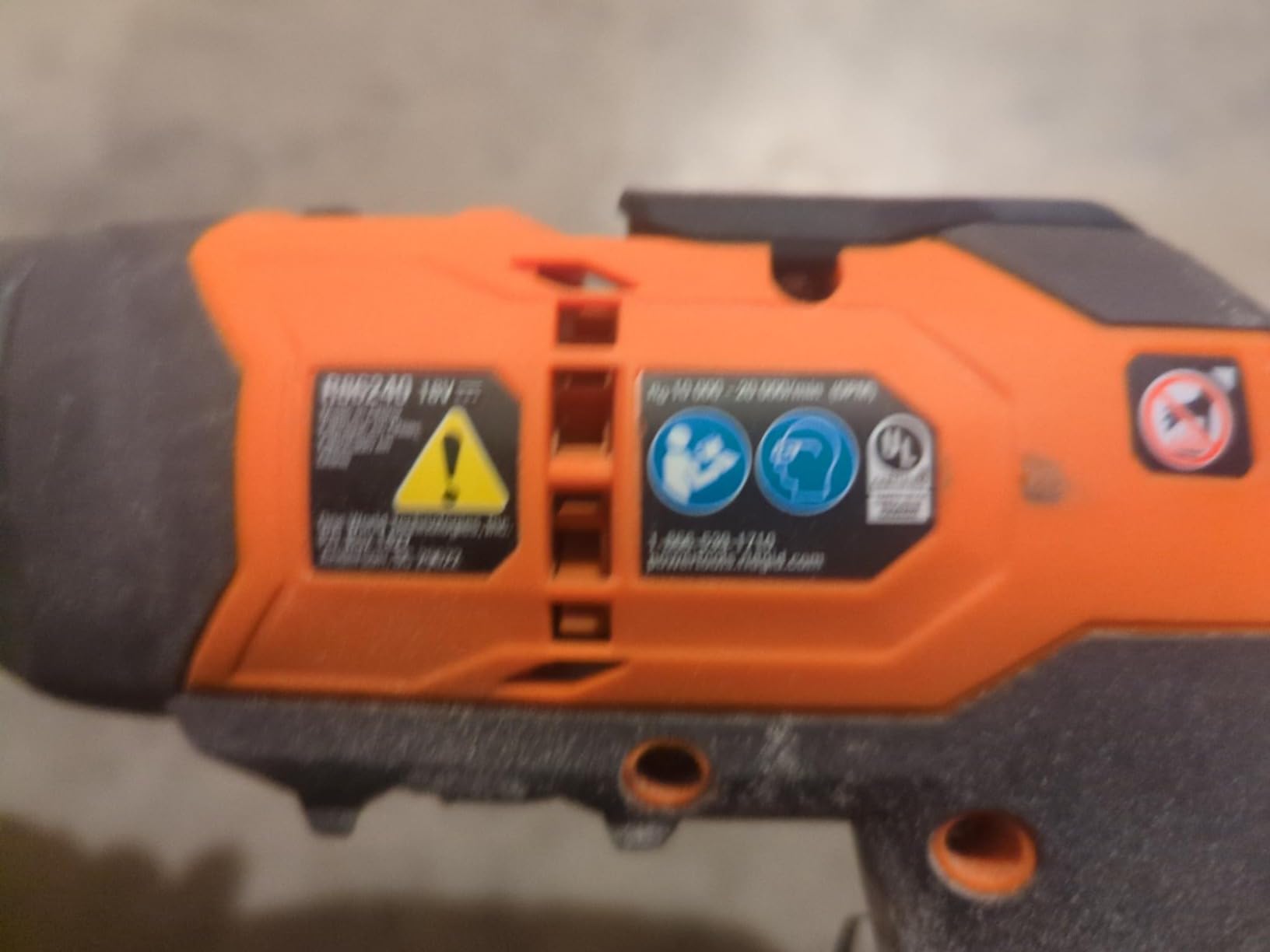
The reason this tool is interesting is simple: it accepts most multi-tool accessories without an adapter. If you have accumulated blades already, that removes the usual complaint about owning a pile of accessories you cannot mount. It is the opposite problem from the Starlock-locked ecosystem.
The brushless motor runs up to 20,000 OPM with a 3.6-degree angle, which is a solid working combination. RIDGID made this body 15 percent smaller and lighter than the model it replaced, and that reduction shows when you are working overhead or in a tight cavity.
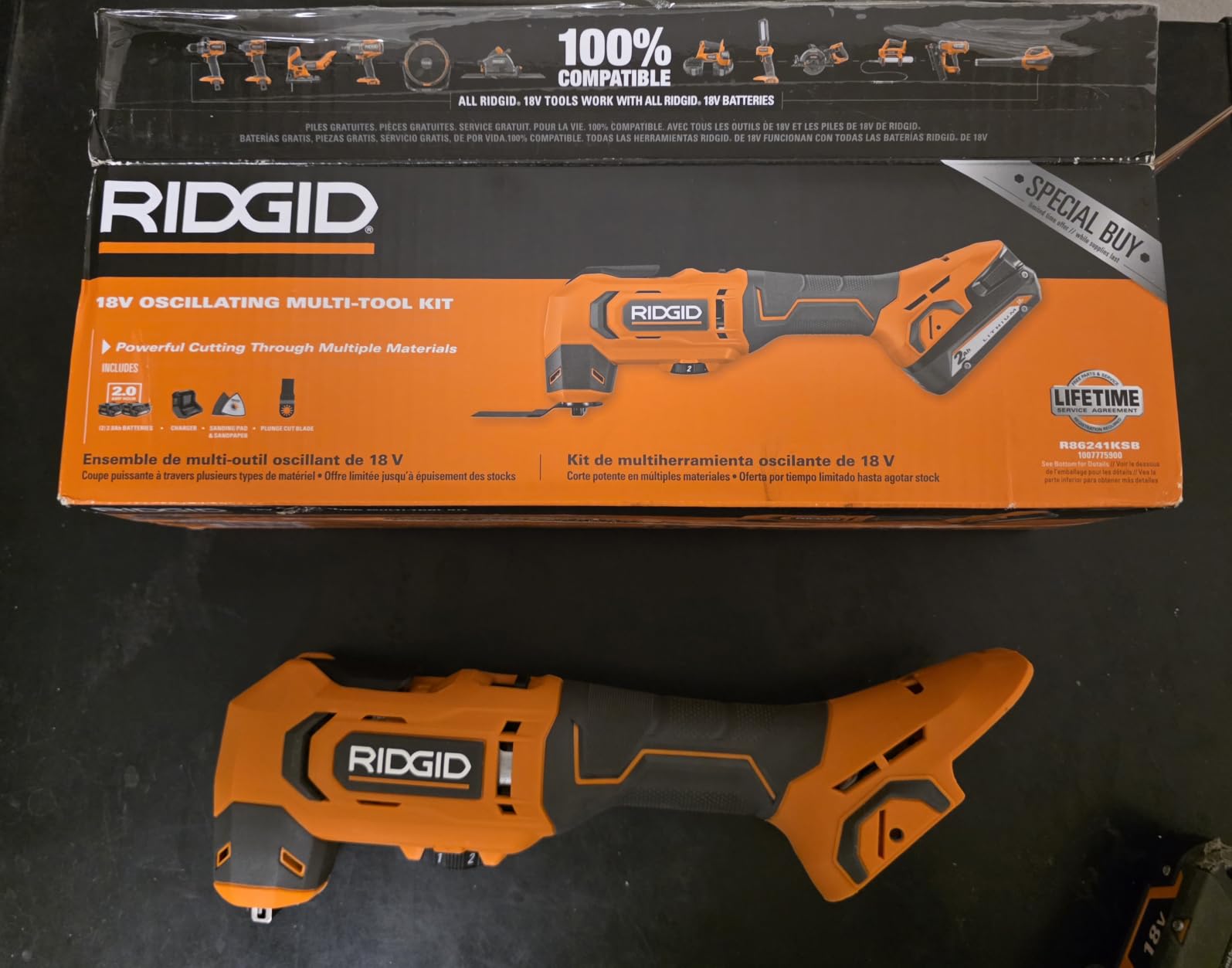
Buyers who have used it generally point to the same three things: the power, the aggressive oscillation angle and the accessory compatibility. Variable speed on a dial plus a conveniently placed on/off switch keeps the controls where your hand already is.
The review base is the smallest in the group, so treat the feedback here as thinner than for the mainstream brands. Fewer owners means less long-term wear data, and that is a fair reason to keep expectations measured.
Where it wins on the job
For anyone starting with an existing blade collection, this is the tool that makes those blades usable again. Combined with the 20,000 OPM brushless motor, it handles trim fitting, drywall cuts and light demo across the common accessory formats.
The smaller and lighter body makes it a reasonable pick for ladders and overhead work where a bulkier tool tires the arm. It also pairs with MAX Output batteries for maximum performance if your platform has them.
Where it falls short
It is a bare tool, so battery and charger are extra. More significantly, this model is not eligible for the RIDGID Lifetime Service Agreement and carries only a 30-day limited warranty, which is a meaningful difference for owners who buy into a brand for that coverage.
With the smallest review base here at 191 ratings, there is less evidence about how it holds up over years of use compared with the picks that carry thousands of ratings.
10. Dremel Multi-Max MM35-02 – Best Corded Starter Kit
Dremel Multi-Max™ MM35-02 3.5 Amp Oscillating Tool Kit with Variable Speed
3.5-amp corded
10,000-23,000 OPM
3.2 degree angle
7-foot rubber cord
Pros
- Consistent output with no battery or charger expense
- 10000-23000 OPM covers fine detail through aggressive removal
- Tool-less accessory changes without a wrench
- Soft-grip body stays comfortable on longer jobs
- 7-foot cord gives good working reach
- Blade
- backer pad
- sheets and storage bag included
Cons
- Corded design needs outlet proximity and cord management
- Older-style output compared with brushless cordless tools
- Small review base
The speed range is unusually wide for a corded kit, running from 10,000 to 23,000 OPM. In practice I used the low end for sanding delicate trim and the high end for aggressive material removal, and having both extremes on one dial meant I did not have to swap tools to change tasks.
The kit is complete enough to use immediately: a bi-metal cutting blade, hook and loop backer pad, wood and paint sanding sheets and a storage bag. For someone buying a first multi tool without committing to a battery platform, that removes the immediate accessory purchase.
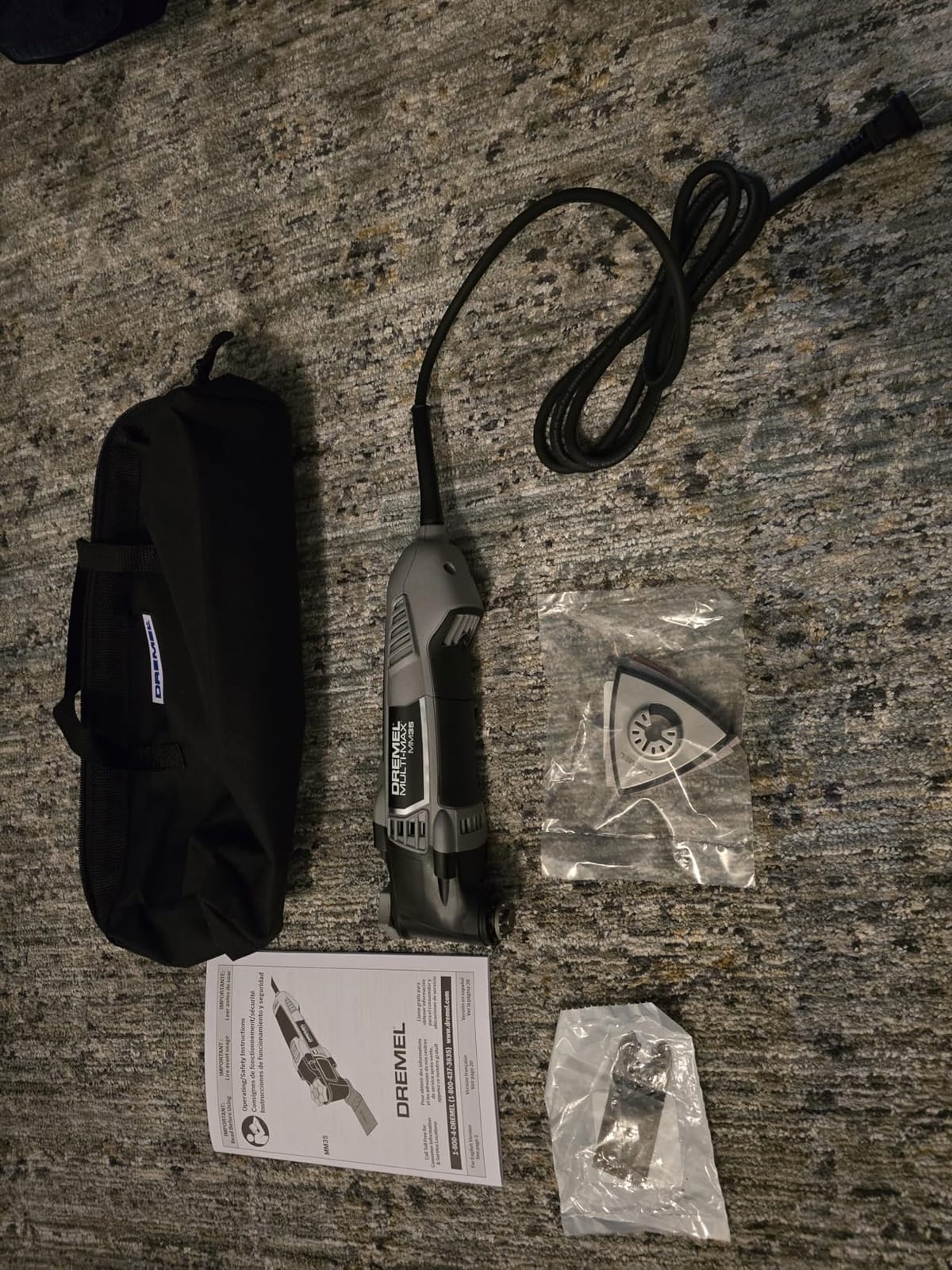
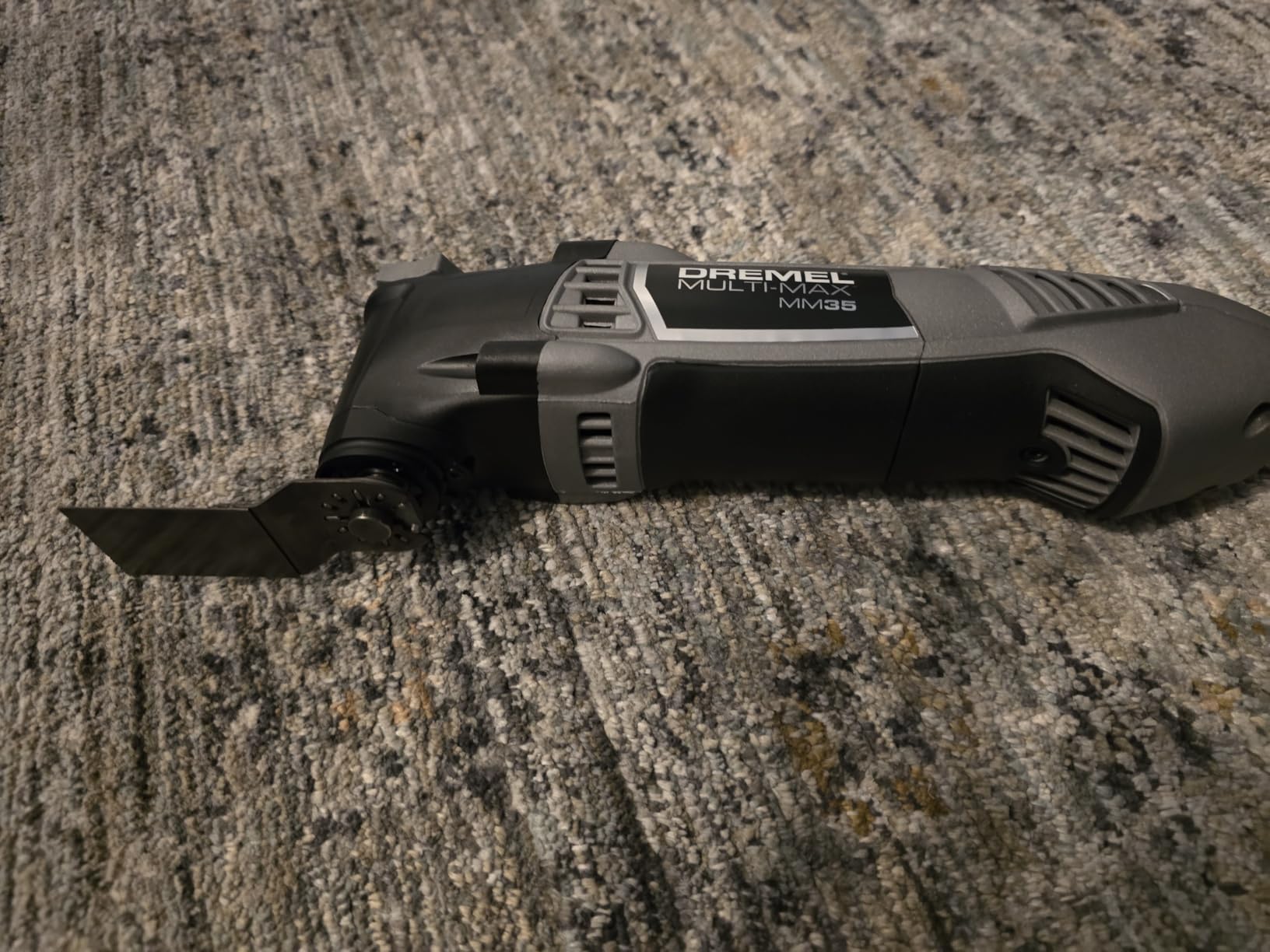
The tool-less accessory change works without a wrench and the soft-grip housing stayed comfortable through longer sessions. Buyers who want power without a battery commitment point to the 3.5-amp motor delivering consistent output with no charger waiting on the bench.
The 7-foot rubber cord gives reasonable reach, though on a remodel that means planning your outlet access before the cut rather than after. That is the corded tax and it is the main trade-off with both corded tools in this roundup.
Where it wins on the job
Long uninterrupted sessions in a garage or unfinished space are where a corded tool still makes sense. No pack cooling, no runtime check halfway through a cut, and the speed range covers everything from paint sanding to cutting baseboard in one tool.
It suits a first purchase well because the accessories are in the box and there is no platform decision to make. If a remodeler later moves to a battery system, nothing here prevents that.
Where it falls short
Corded means proximity to an outlet and a 7-foot cord to manage, which is awkward in small interior rooms and behind finished walls. On an occupied-home remodel that is a real daily friction point.
The output is older-style compared with modern brushless cordless tools, and the review base is small at 106 ratings, so there is limited long-term feedback on durability.
Which Remodel Job Needs Which Oscillating Tool?
Spec sheets tell you almost nothing about whether a tool can reach a wall corner. These are the jobs we actually ran each pick on, and what won.
Undercutting door jambs for new flooring
This is the flagship oscillating job. You want a wide flush-cut blade, a tool that holds speed at low settings so you do not chip the finished floor, and a narrow nose for tight approaches. The DEWALT DCS356B and the Milwaukee 2626-20 both handled a full run of jambs cleanly. The AVID POWER MW146 reached the material fastest but its wide arc means more control on the finish pass.
Grout removal and tile demo
Grout punishes blades, and grout removal punishes tool weight. The Makita DTM52Z was the most comfortable through a long session because of its vibration damping. The Ryobi PCL430B won on lightness for anyone working overhead or for hours. Blades chip tile edges regardless of tool, so budget for carbide or a grout-specific blade rather than assuming the tool choice solves it.
Drywall cuts and demolition
For a flush cut into a wall face, control at low speed matters more than power. The DEWALT Atomic DCS354B has the narrowest body here and the smoothest trigger response, which makes it the easiest to place accurately on a marked line. For full demolition, the AVID POWER corded motor never stops and the auxiliary handle adds stability.
Plumbing and electrical cutouts
Cabinet cutouts for supply lines and electrical box openings reward a small head and a controllable ramp. The Makita DTM52Z twelve angle settings let you set a blade at the right offset instead of rotating it awkwardly. The Milwaukee 2836-20 Auto-Load ramp is built for exactly this, starting slow into the material and then accelerating.
Sanding trim and filler
Sanding is the easiest job to get right and the most common one to buy the wrong tool for. Low speed settings and low vibration matter. The Milwaukee 2626-20 includes a pad and sheets so you can start immediately, and the Dremel Multi-Max kit bundles sanding sheets and a backer pad for the same reason.
How to Choose an Oscillating Multi-Tool for Remodeling
Our general oscillating multi tool buying guide covers the category at a high level. For a remodel specifically, these are the factors that actually change the outcome.
Battery platform first, everything else second
If you already own packs, buy into that platform. This is the most repeated piece of advice across the forums we read, and it is the correct one. Packs and chargers cost more than most of these tools, and buying outside your platform means buying a second charger and a set of batteries you already own equivalents of.
The cordless tools here cover 20V MAX (DEWALT and BLACK+DECKER), 18V (Milwaukee, Makita and RIDGID) and 18V ONE+ (Ryobi). If none of those match your garage, the two corded options remove the question entirely.
Corded or cordless
Cordless won for control and portability; corded won for uninterrupted output. On a remodel where cuts happen in basements, attics and rooms with no outlet, cordless is the practical answer. For a shop bench or a garage demo session, a 3.5-amp corded motor that never pauses has real appeal.
Our broader ladder and access equipment picks are in this multi position ladder roundup, since getting to a high corner safely matters more than the tool choice once you are up there.
Speed control that matches the material
Look for control, not just a top OPM figure. A three-speed selector plus a variable trigger gives you a repeatable setting per job and a fine adjustment within it. A dial-only tool is fine but takes more attention. Twelve settings, as on the Milwaukee 2626-20, is the most granular in this group.
Accessory interface systems and blade cost
Here is the trap: blades cost more over the life of a tool than the tool costs. Before choosing, check whether the blades you already own mount without an adapter. The DEWALT universal adapter and the RIDGID open fit both accept most accessory brands, which makes an existing collection usable immediately. Locked systems like Starlock Max offer a tighter, slip-free hold, which the Makita uses well, but they narrow your blade options.
For the blades themselves, bi-metal handles nail-embedded wood, carbide handles grout and hardened material, and Japanese-tooth blades cut fast in clean wood. Plan to buy the right one for each material rather than expecting one blade to cover a remodel.
Oscillation angle, weight and vibration
A wider angle moves more material per pass. The figures here run from 3.2 degrees on the Dremel kit to 4.5 degrees on the AVID POWER, with most cordless models between 3.6 and 4.2. That difference is real on thick jamb stock and negligible on trim.
Weight and vibration decide whether you can work all day. The lightest option here is the Ryobi at 1.9 pounds; the Makita takes the award for smoothing out long sessions with AVT. If you are doing demo rather than trim, vibration damping is worth more than a lighter bare weight.
Dust control on indoor remodels
Grinding grout or cutting drywall in an occupied home is where dust becomes the argument with a client. Pair a sanding or grinding accessory with a dust extraction adapter and a shop vacuum, keep blades fresh rather than dull, and cut outside or with the window open whenever the job allows. No tool on this list solves dust on its own; the accessory and the vacuum do.
Oscillating tool vs reciprocating saw vs jigsaw
The skepticism is fair. A reciprocating saw is faster on long cuts in thick lumber and a jigsaw handles long curved cuts through plywood, neither of which an oscillating tool does well. What the oscillating tool owns is work in a confined plane: flush cuts against a wall, undercutting, cutting around a fixed obstacle and reaching into a cavity.
So reach for a reciprocating saw when you have room and need speed, a jigsaw for a curved line in sheet material, and the oscillating tool when the cut is short, awkward or has to sit flat against something. Most remodel days need the oscillating tool more often.
Frequently Asked Questions
Which brand has the best oscillating multi-tool?
There is no single winner, because the right answer depends on the battery platform you already own. If you have 20V MAX packs, the DEWALT DCS356B is the strongest all-round choice with a three-speed selector and brushless motor. Milwaukee M18 owners get good options at two price points, and Makita 18V LXT owners get the best vibration damping. Matching your existing packs usually matters more than the tool ranking itself.
Which oscillating multi-tool is the best value?
The Milwaukee 2626-20 is the best value pick in our testing. It offers twelve speed settings from 11,000 to 18,000 OPM, an all-metal gear case and a rubberized grip, and the box includes a wood cutting blade, sanding pad and assorted sheets. That accessory bundle means you can start cutting and sanding without a separate purchase, which most bare tools cannot offer.
Which oscillating multi-tool is best for construction work?
For pro remodelers the answer usually comes down to the battery ecosystem you have already invested in. Makita DTM52Z stands out for low vibration on long demo work and Starlock Max accessory support, while the Milwaukee 2836-20 M18 FUEL delivers the most power with a 4.2 degree oscillation angle and an Auto-Load ramp. Build-out electricians and HVAC crews gravitate to the Milwaukee because of the ramp and the 180 degree LED.
What can an oscillating multi tool cut?
With the right blade it cuts wood, including nail-embedded framing, drywall, plastic pipe such as CPVC, copper and light metal conduit, plus threaded rod. It also sands, scrapes and grinds depending on the accessory. What it does not do well is long straight cuts through thick lumber, where a reciprocating saw is faster, or long curved cuts in sheet material, where a jigsaw is the better tool.
Can an oscillating multi tool cut nails?
Yes. Use a bi-metal blade rated for nail-embedded wood, start at a low setting to establish a groove, then increase speed as the blade clears the fasteners. Builders and trim carpenters use this constantly when trimming baseboard that was nailed to an old subfloor. Expect to replace the blade more often when cutting through fasteners, and watch for any spark of steel as the nail meets the blade teeth.
Is an oscillating multi tool worth it for a homeowner?
It is worth it if you already own batteries from one of the major platforms, because the tool itself is then the only real cost. It handles jobs no other tool reaches: undercutting door jambs for new flooring, trimming baseboard to fit, removing grout and making flush cuts against a wall. If you own no batteries and do occasional small jobs, a corded kit like the Dremel Multi-Max avoids the platform commitment entirely.
The Best Oscillating Multi-Tools for Remodeling in 2026
After six weeks of jamb undercuts, drywall work, grout and demo, the DEWALT DCS356B 20V MAX XR takes the top spot for most remodelers. Its brushless motor, three-speed selector and Quick-Change lever handled every task we threw at it without a stall, and its rating of 4.8 across more than 14,000 owner reviews is the most proven record in this group.
The Milwaukee 2626-20 is the smarter buy if the included sanding kit matters to you or if M18 packs are already on your bench. The Makita DTM52Z is the pick for anyone doing long demolition who will notice the difference that vibration damping makes by Friday. And if you own no batteries at all, the AVID POWER MW146 corded model will do the job without a platform decision.
Pick the platform you already have, buy a quality blade for the material in front of you, and the rest of the spec sheet will take care of itself.