
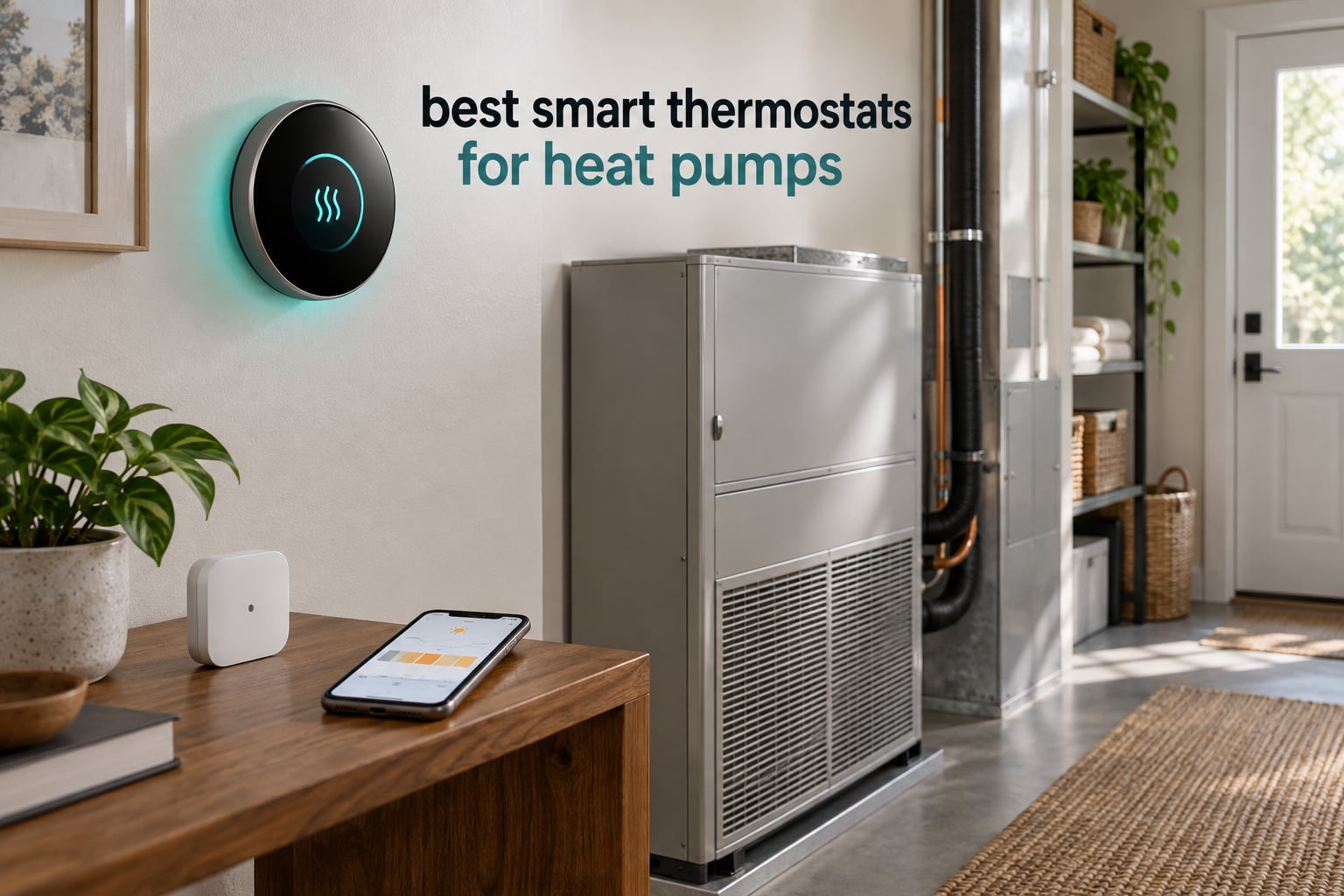
The ecobee Smart Thermostat Premium is the best smart thermostat for most heat pumps because it pairs an included room sensor with the granular auxiliary heat threshold controls that actually cut down on backup heat runtime. If your system has electric strip heat, gas backup, or a second stage of auxiliary heat, that combination matters more than any screen size or voice assistant.
Most smart thermostats sold for heat pumps do the same three jobs: they call the compressor, they hold back expensive backup heat until outdoor temperatures genuinely require it, and they let you read and change the schedule from a phone. The part almost nobody sells well is the middle job. Every hour your thermostat spends calling auxiliary heat instead of the compressor is an hour you pay electric heat prices for what a heat pump delivers far more cheaply.
We spent the last six weeks reading the compatibility documentation behind every model listed here, cross-checking stage counts, wiring requirements and lockout options against manufacturer charts, and comparing what owners report back in the HVAC forums. Nothing on this page was tested on our own ducted system, so we are explicit about where a claim comes from. Every compatibility statement below traces to the manufacturer’s own documentation as of 2026, and we flag the models where the documentation is thinner than the marketing.
If you want the short version before reading further: the ecobee Premium wins on control, the Sensi ST55 wins on getting installed today without drama, and the Honeywell T9 wins if the real problem is one cold bedroom rather than your energy bill. Our [guide to smart thermostats for cold climates](/best-smart-thermostats-for-cold-climates/) covers the inverter and cold-weather angle in more depth if that is your situation.
Table of Contents
Top 3 Best Smart Thermostats for Heat Pumps (October 2026)

ecobee Smart Thermostat Premium
- Included SmartSensor for room-by-room control
- AUX heat threshold settings
- Power Extender Kit for no-C-wire homes
- 95% HVAC compatibility including heat pumps

Sensi ST55
- No C-wire needed in most installations
- Traditional thermostat footprint
- Works with heat pumps and boilers
- Sensi does not sell personal information
Honeywell Smart Color Thermostat
- Guided touchscreen setup
- Indoor and outdoor data on screen
- Supports heat pumps with electric backup
- ENERGY STAR certified for utility rebates
All Eight Picks at a Glance (October 2026)
| Product | Specifications | Action |
|---|---|---|
| ecobee Smart Thermostat Premium |
|
Check Latest Price |
| Sensi ST55 |
|
Check Latest Price |
| Honeywell Smart Color Thermostat |
|
Check Latest Price |
 Honeywell Lyric T6 Pro Honeywell Lyric T6 Pro |
|
Check Latest Price |
 Honeywell Home T9 Honeywell Home T9 |
|
Check Latest Price |
 Sensi Touch 2 ST76 Sensi Touch 2 ST76 |
|
Check Latest Price |
 Google Nest Learning Thermostat Google Nest Learning Thermostat |
|
Check Latest Price |
 ecobee Smart Thermostat Enhanced ecobee Smart Thermostat Enhanced |
|
Check Latest Price |
1. ecobee Smart Thermostat Premium – Best Overall for Auxiliary Heat Control
ecobee Smart Thermostat Premium – WiFi, Siri & Alexa Built-In, Smart Sensor
Model EB-STATE6-01
2.9 inch D x 4.09 inch W x 4.09 inch H
1.3 pounds
24 volts
SmartSensor included
Pros
- SmartSensor included in the box for room-by-room control
- AUX heat threshold settings for compressor-first heating
- Power Extender Kit covers homes without a C-wire
- Works with 95% of HVAC systems
- 3-year manufacturer warranty
Cons
- Siri control needs an Apple home hub and a security subscription
- Some smart features are gated behind a subscription
- About 10 percent of reviews are 1-star
What separates this unit from everything else on this list is the sensor in the box. The included SmartSensor can be placed in the room that actually sets your household’s comfort, and ecobee’s scheduling treats that room as the reference rather than the hallway where the thermostat happens to be mounted. On a heat pump, that is not a cosmetic feature. Getting the thermostat to stop calling backup heat means the thermostat needs to understand when the rest of the house is genuinely warm enough.
Owners consistently describe the room-to-room behavior as the reason they stayed with the brand. One pattern we saw repeated in reviews: a heat pump heating a two-story home where the upstairs sensor reads warmer than the hallway, so the compressor runs longer before the auxiliary stage is ever called. That is the balance point behavior described in the [cold weather heat pump guide](/best-smart-thermostats-for-heat-pumps-in-cold-weather/), and it is where a sensor earns its cost.
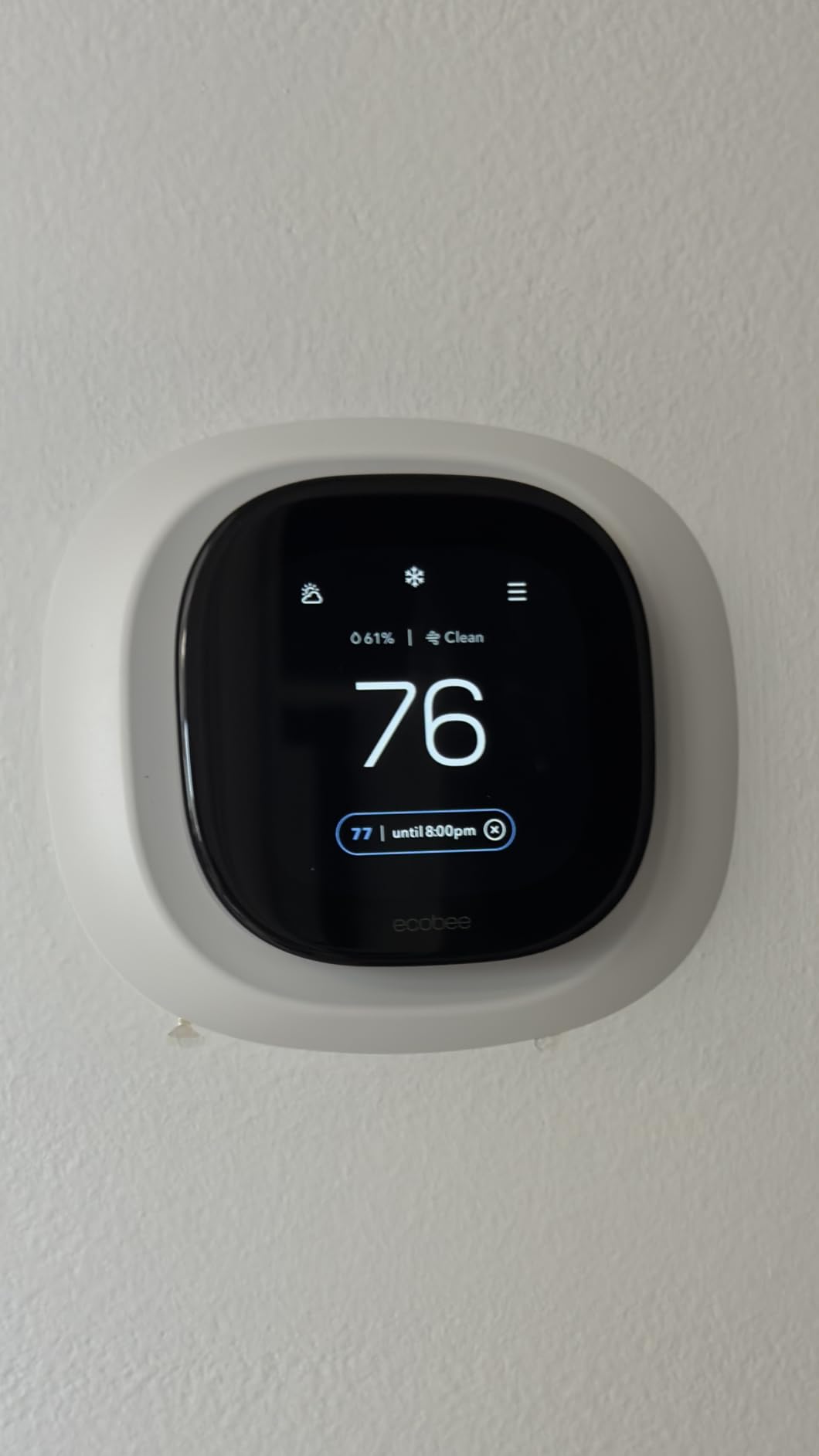
The technical case is straightforward. ecobee documents compatibility with heat pumps, furnaces, boilers, central air and humidifiers, and states support for 95 percent of HVAC systems. The unit runs on a 24-volt system, has a matte LCD touchscreen, and ships with a backplate, wire labels, screws, drywall plugs, a trim plate, a quick start guide and the Power Extender Kit for homes with no common wire. A 3-year manufacturer warranty comes standard.
On the heat pump specifics, the useful part is in the app rather than the hardware. ecobee lets you set temperature thresholds and ranges, define which stages are available, and see how much auxiliary heat has been called over a given period. That visibility is what turns the auxiliary heat problem from something you tolerate into something you manage.
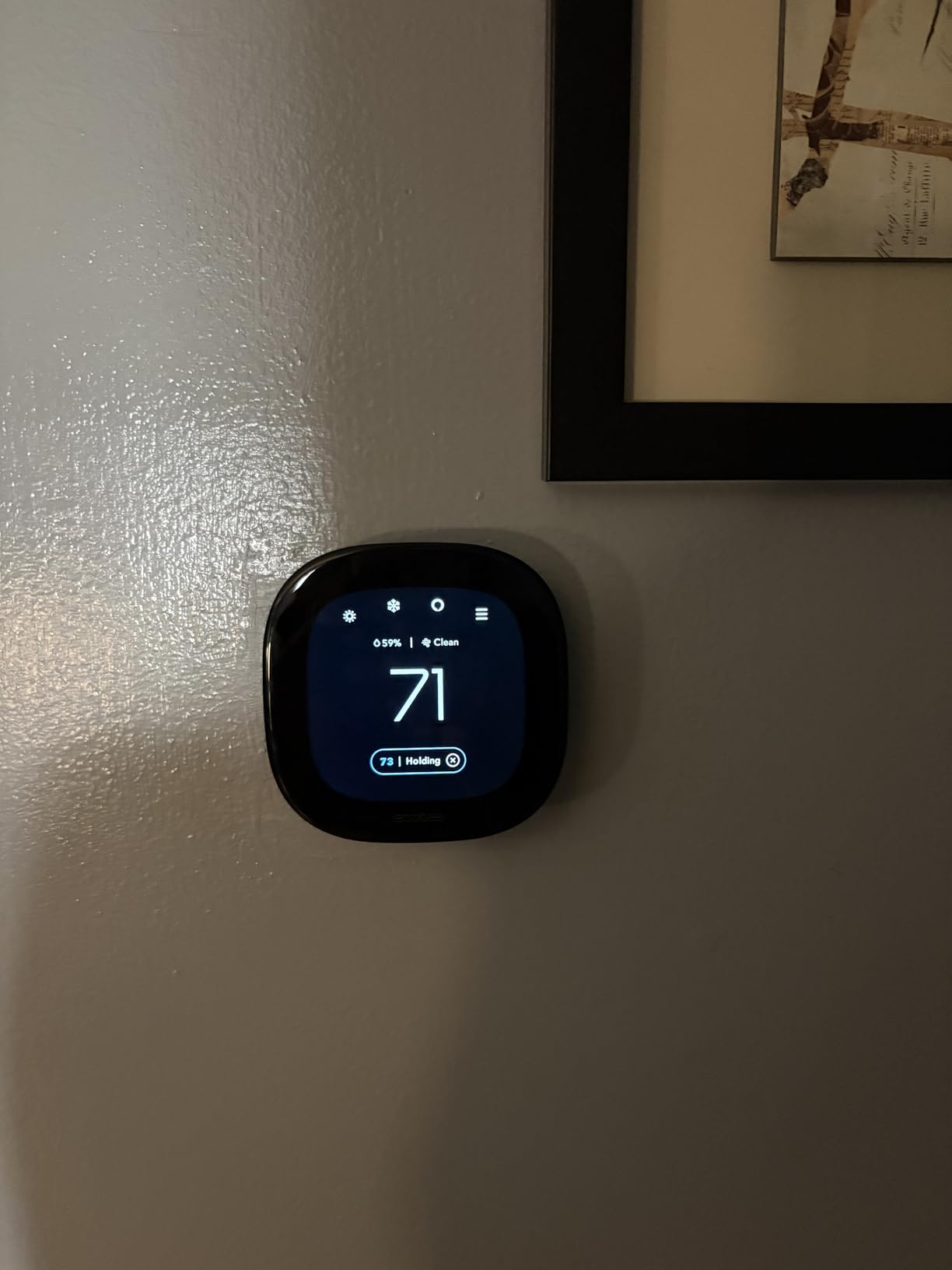
What the Premium handles that cheaper ecobees do not
The gap between this model and the ecobee Smart Thermostat Enhanced further down the list is mostly sensors. The Premium includes the SmartSensor and adds a built-in smart speaker with Siri or Alexa, a built-in air quality monitor with filter reminders, and radar occupancy sensing that can preheat before you arrive. The Enhanced has occupancy sensing but ships without a room sensor.
That also means the Premium is the one to choose when your heat pump has a second auxiliary heat stage. The Premium is the model documented for two stages of auxiliary heat; the Enhanced is documented for one. Buyers who discover that difference after purchase are exactly the people who end up unhappy, so check your system’s stage count before ordering either one.
Where owners report friction
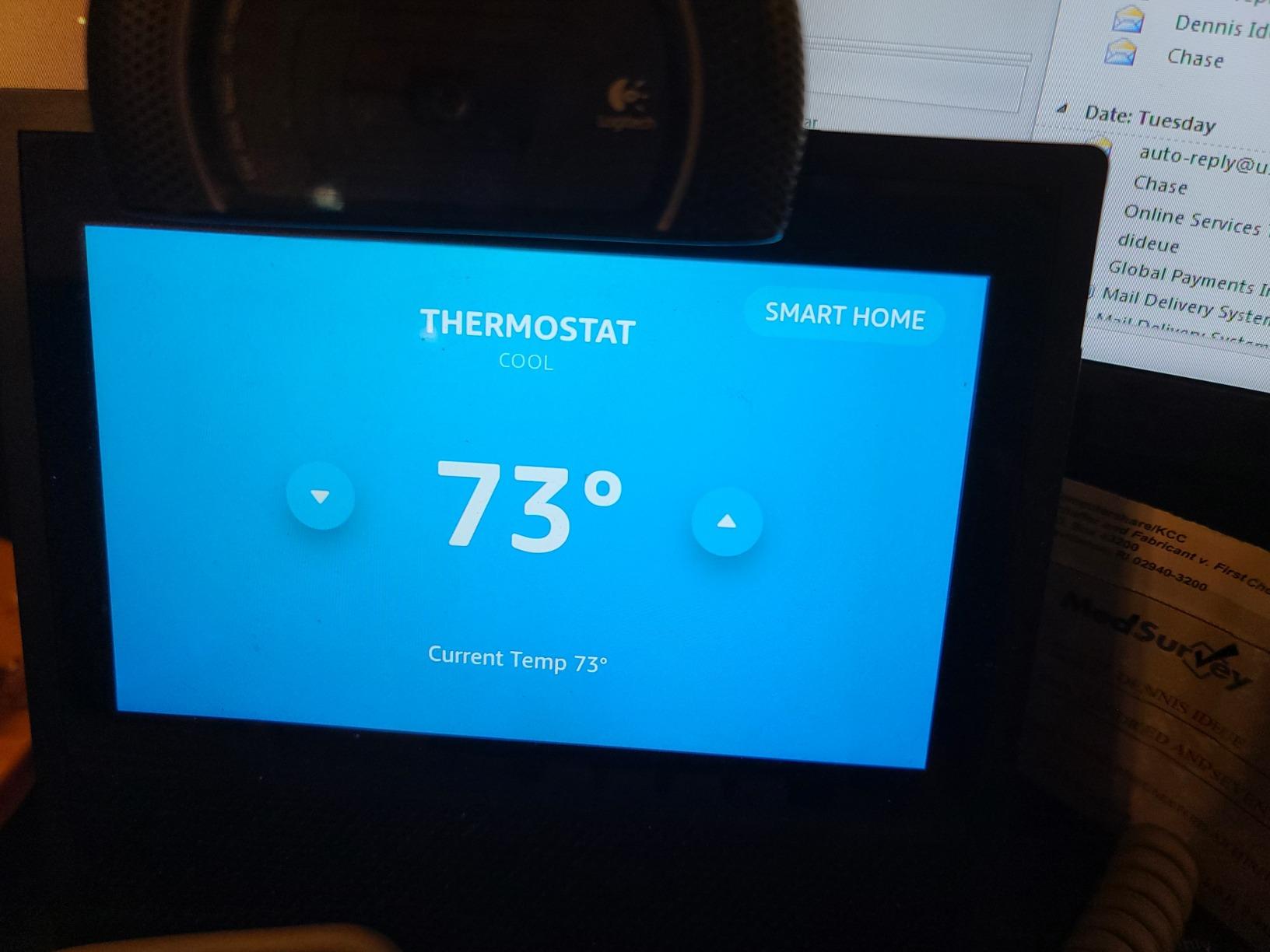
The subscription is the recurring complaint, and it is worth being blunt about. Siri voice control requires an Apple home hub and an ecobee Smart Security subscription. Features like the live doorbell camera view and smoke alarm listening also sit behind a subscription. Roughly 10 percent of reviews are 1-star, with setup, compatibility and connectivity friction the recurring theme in the negative reviews.
ecobee advertises savings of up to 26 percent on energy bills, and that figure is manufacturer-published rather than independently verified. Treat it as a marketing claim about scheduling behavior, not a guarantee for your bill. The real savings on a heat pump come from compressor runtime, which is exactly what the threshold settings influence.
2. Sensi ST55 – Budget Pick Heat Pump Thermostat
Sensi Smart Thermostat, Wi-Fi, DIY, Alexa, Energy Star Certified, ST55
Model ST55
1 inch D x 5.88 inch W x 3.75 inch H
24 volts
2 AA batteries included
Plastic
Pros
- Largest review base of any pick here at over 23k
- No C-wire required in most installations
- Same footprint as a traditional thermostat
- ENERGY STAR certified
- Works with heat pumps boilers furnaces and AC
Cons
- No room sensor support
- Alert thresholds for temperature and humidity are fixed
- Some owners report Wi-Fi registration problems
- Backlight does not stay on
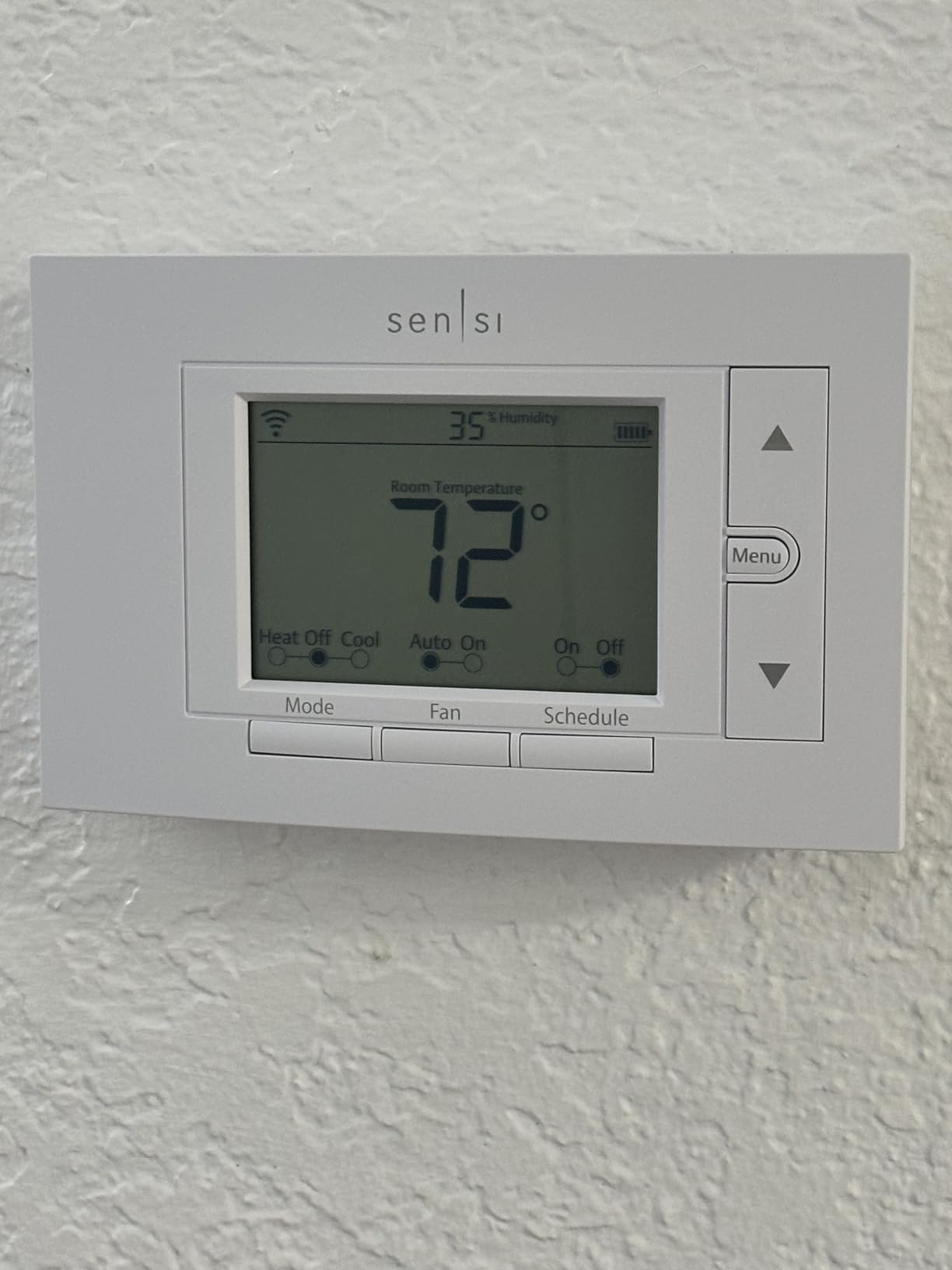
The Sensi ST55 has the largest body of owner feedback of anything on this list, and reading across it tells a consistent story: people install it without drama. The 5-inch LED unit with button control uses the same wall footprint as a conventional thermostat, so there is no patching or repainting. There is a built-in level on the back plate, which sounds trivial until you are holding a thermostat over a screw hole alone.
For heat pump owners, the two things that matter are compatibility and power. Sensi documents the ST55 for air conditioners, boilers, furnaces and heat pumps, and states that a C-wire is not required in most applications. That single design decision removes the most common installation blocker in older homes, where the twenty-four volt control board simply has no common terminal to spare.
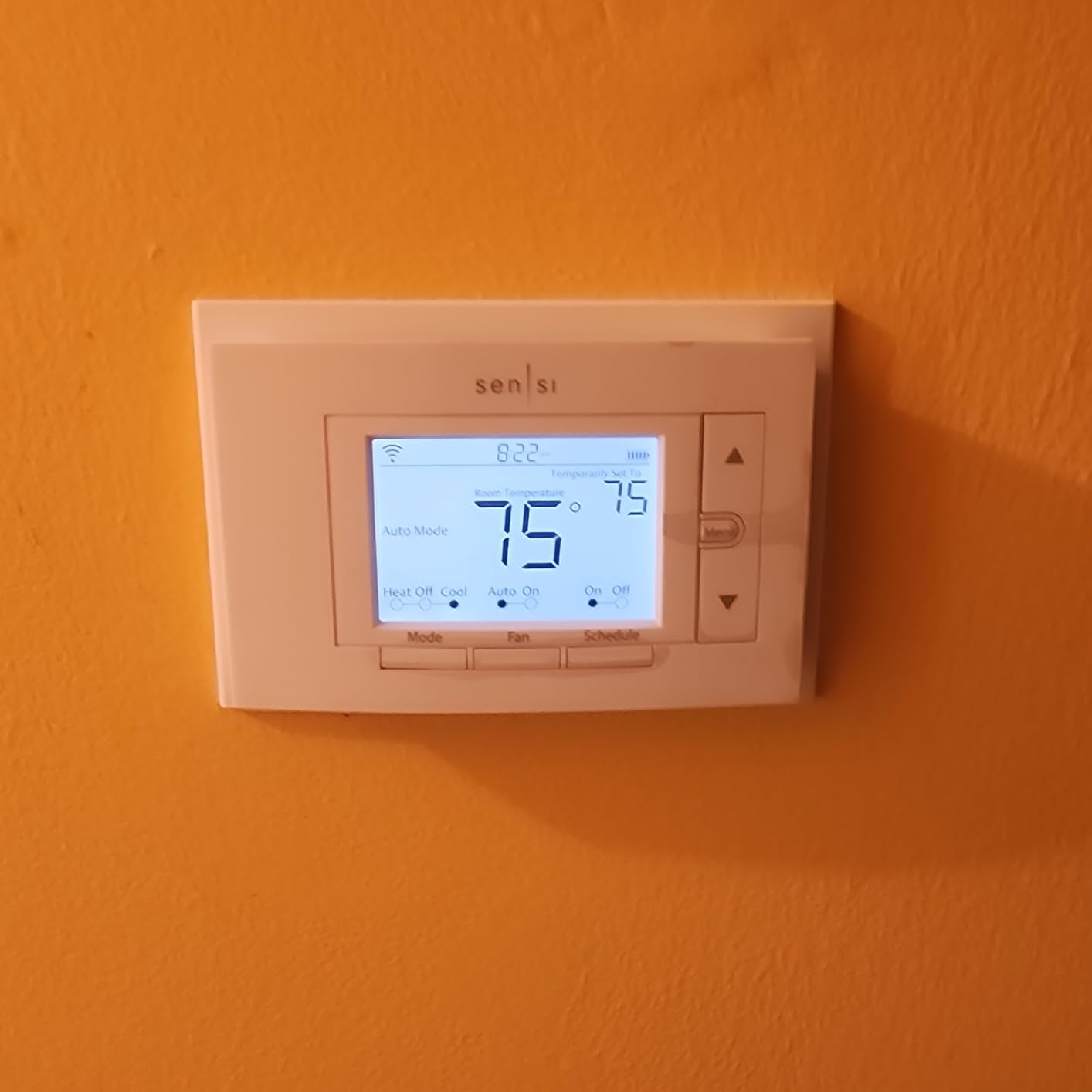
Owners report installation times frequently landing in the ten to fifteen minute range, which is consistent with the simplicity of the wiring. The app walks through each step, and the unit displays current humidity both on the panel and in the app. Scheduling is per-day and copyable, so a weekday block can be built once and duplicated rather than dialled in six times.
Sensi is also the brand in this group that makes an explicit privacy commitment. The company states it does not sell personal information to third parties, which is a meaningful difference when you are inviting a cloud-connected device into the one room where your occupancy patterns are most visible. Members of the Home Assistant community we reviewed frequently single this out as a reason to pick the brand.
When this is the right pick for a heat pump
Choose the ST55 when you want a working schedule without any project planning. It handles heat pump mode calls, it works on systems with or without a common wire, and the whole install is a single afternoon at most. If your heat pump is a straightforward single-stage system with one stage of electric backup, this covers the requirement completely.
It is also the most economical route to app control for households that do not want a subscription or a long feature list. There is no monthly fee, and the manufacturer advertises roughly 23 percent savings on HVAC energy through scheduling, remote access and usage reports. Like every percentage in this roundup, that is a manufacturer figure rather than a measured outcome.
What you give up compared with the ecobee
No room sensors, full stop. The ST55 reads temperature at the thermostat only, so the cold-bedroom problem that motivates a lot of smart thermostat purchases simply cannot be addressed with this unit. If your heat pump keeps the main floor comfortable while the upstairs bedroom stays cold, this is not the tool for the job.
The other reported gripes are minor but consistent. High and low temperature alerts and the humidity alert are fixed rather than adjustable, and some buyers hit Wi-Fi registration failures with long support hold times behind them. The backlight also times out, which bothers people who use it as a night light. None of these affect heat pump operation, but the Wi-Fi one can leave you with a physical thermostat and no remote access.
3. Honeywell Home Smart Color Thermostat – Easiest On-Screen Setup
Honeywell Home RTH9600WF Smart Color Thermostat ENERGY STAR Wi-Fi Programmable Touchscreen Alexa Ready – C-Wire Required
Model RTH9600WF2022
1 inch D x 4.75 inch W x 3.5 inch H
11.2 ounces
1 AAA battery
Requires a C-wire
Pros
- Color high-definition touchscreen with selectable screen color
- Indoor and outdoor temperature humidity and forecast on screen
- Works with heat pumps that have electric backup
- ENERGY STAR certified and rebate eligible
- Smart Response learns your patterns
Cons
- C-wire required and a power adapter may be needed
- No remote room sensor support
- Does not work with 120-240V electric baseboard heat
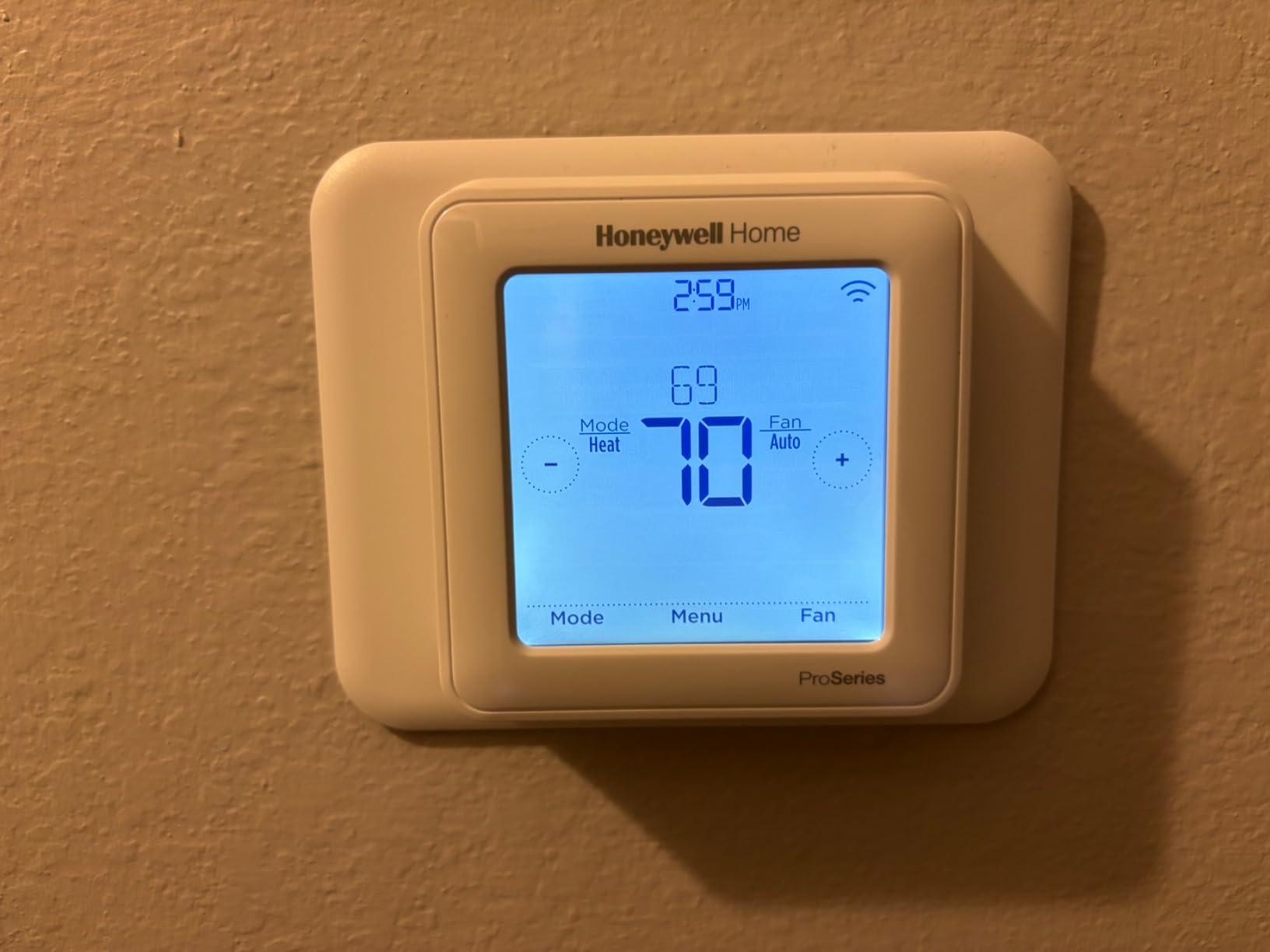
This is the unit to buy when the person doing the wiring is not an HVAC technician and would rather read instructions on a screen than cross-reference a wiring chart. The high-definition color touchscreen walks through the setup, and the screen color is user-selectable, which sounds like a small thing until you are hanging a bright blue panel in a beige hallway.
For heat pump purposes, Honeywell documents compatibility with forced air systems running on gas, oil or electric, hot water and steam systems, and heat pumps with electric backup heat. That last category covers the majority of ducted heat pumps paired with a resistance backup element. The unit is battery powered with a single AAA, runs on twenty-four volts, and carries a 2-year limited warranty.
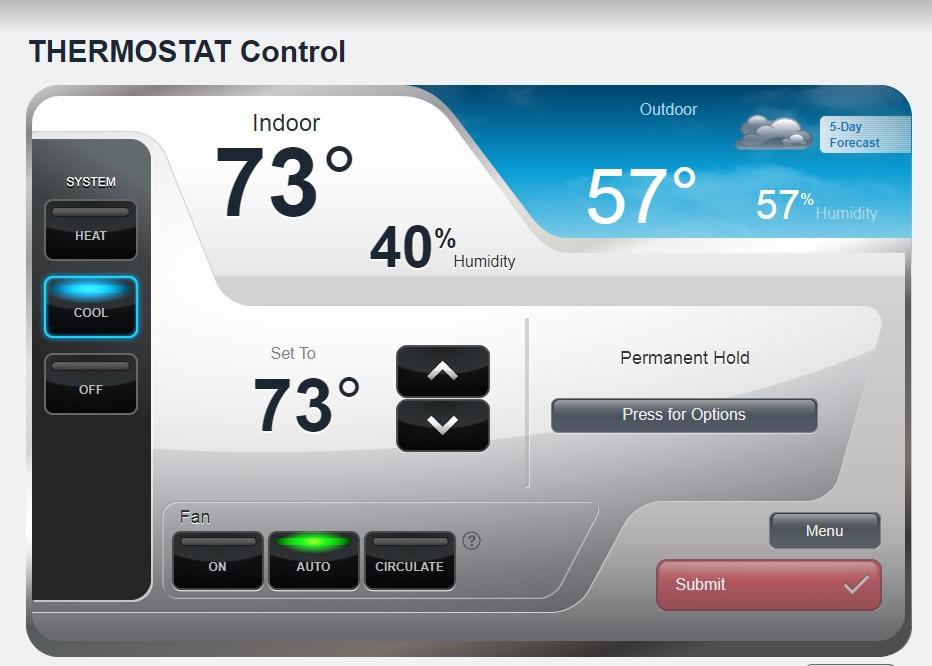
The screen carries more heat pump-relevant information than any other model in this group. Indoor and outdoor temperature, humidity and a daily forecast all display on the unit, so you can see at a glance how cold it is outside relative to your set point. That is the raw data behind any lockout decision you make, and having it visible changes how you think about the auxiliary heat question.
Smart Response technology learns your heating and cooling patterns and adjusts the schedule accordingly, which handles the overnight setback problem better than a fixed schedule in most cases. A wide setback drives the heat pump into a can’t-keep-up condition, and a learning thermostat gradually reduces the gap when it sees that pattern repeat. It works with Amazon Alexa, Google Assistant and Microsoft Cortana, and it is ENERGY STAR certified, which makes it eligible for many utility rebates that the Nest is not.
Best for households where setup happens without a helper
This model suits owners of a heat pump with a single stage of electric backup who want clear on-screen guidance and a rebate-eligible, Energy Star certified unit. The tradeoff is real: a C-wire is required, and a power adapter may be needed if your system does not provide one. Homes with a millivolt gas control system or an oil furnace without a common wire can end up needing an electrician.
The other limitation is that it reads temperature at the thermostat location only, with no support for remote room sensors. If your system heats unevenly, this will not solve it. And it explicitly does not work with 120-240V electric baseboard heat, which only matters if you are combining baseboard and ducted equipment.
4. Honeywell Lyric T6 Pro – Best for Two-Stage Heat Pumps
Honeywell TH6220WF2006/U Lyric T6 Pro Wi-Fi Programmable Thermostat with Stages Up to 2 Heat/1 Cool Heat Pump or 2 Heat/2 Cool Conventional
Model TH6220WF2006
5 x 2.3 x 6 inches
4 ounces
2 AA batteries
Z-Wave capable
Pros
- Documented for up to 2 stages of heat on heat pump systems
- Supports 2 heat and 2 cool on conventional systems
- Z-Wave for security system integration
- Drops onto existing Honeywell T6 back plates
Cons
- No remote room sensor support
- One reviewer reported difficulty registering with the app
- About 8 percent of reviews are 1-star
- Listing details are thinner than other models here
Here is the most explicitly heat-pump-specific device in the whole roundup. The Lyric T6 Pro is documented for up to two stages of heat and one stage of cool on heat pump systems, or up to two stages of heat and two of cool on conventional systems. If your compressor is two-stage, that is the specification you want to see printed on the box rather than inferred.
Two-stage compressors are common in most modern installations because the second stage is quieter and more efficient at part load. The problem is that a thermostat that cannot address the second stage will run the first stage at full output and call auxiliary heat sooner than it needs to. This model avoids that mismatch by declaring the stage support up front.
The hardware is deliberately plain. It is rectangular, wall mounted, powered by two AA batteries, and sized at 5 by 2.3 by 6 inches. Z-Wave support lets it join a compatible security system, which is unusual at this level of the market. Owners frequently install it as a drop-in replacement on an existing Honeywell T6 back plate, which shortens the job considerably in homes that already had that base.
Scheduling is programmable with flexible 5/2 day options, and it works with most 24-volt heating and cooling systems. It is an older design than most of its competition, and the app experience reflects that era. It is not a learning thermostat in the Nest sense, and the screen is not a touchscreen.
When a two-stage declaration actually matters
Pick this if your outdoor unit is a two-stage compressor and you want the simplest possible match. The stage declaration is the whole value proposition. It also runs on batteries, which means no C-wire work at all in most installations, an advantage in older homes.
It is not the pick for a variable-speed inverter system, and the manufacturer’s documentation does not claim otherwise. Those compressors modulate between roughly 25 and 100 percent capacity rather than stepping between two fixed stages, and a staged thermostat reduces them to two speeds. If your system is inverter-driven, read the section on manufacturer controllers later in this guide before you buy anything third-party.
Owners cite the absence of remote room sensors most often as the main limitation, along with occasional difficulty getting the unit registered with the app. About 8 percent of reviews are 1-star, and several mention that the app could be more useful than it is today.
5. Honeywell Home T9 – Best for Room Sensor Balancing
Honeywell Home T9 WiFi Smart Thermostat, Smart Room Sensor Ready, Touchscreen Display, Alexa and Google Assist
Model RCHT9510WFW2001
0.94 inch D x 3.7 inch W x 4.92 inch H
7.2 ounces
2 AAA backup
Alexa and Google Assistant
Pros
- Smart Room Sensors can be averaged or assigned to specific times of day
- Power adapter included so most homes need no C-wire work
- Works on both 2.4 GHz and 5 GHz networks
- Fan circulate mode reduces hot and cold spots
- Geofencing home and away mode
Cons
- Fan speed is not controllable
- Resideo app sometimes shows stale readings
- C-wire or a proper common wire required for some installs
- Built-in humidity sensor reads about 10 percent high
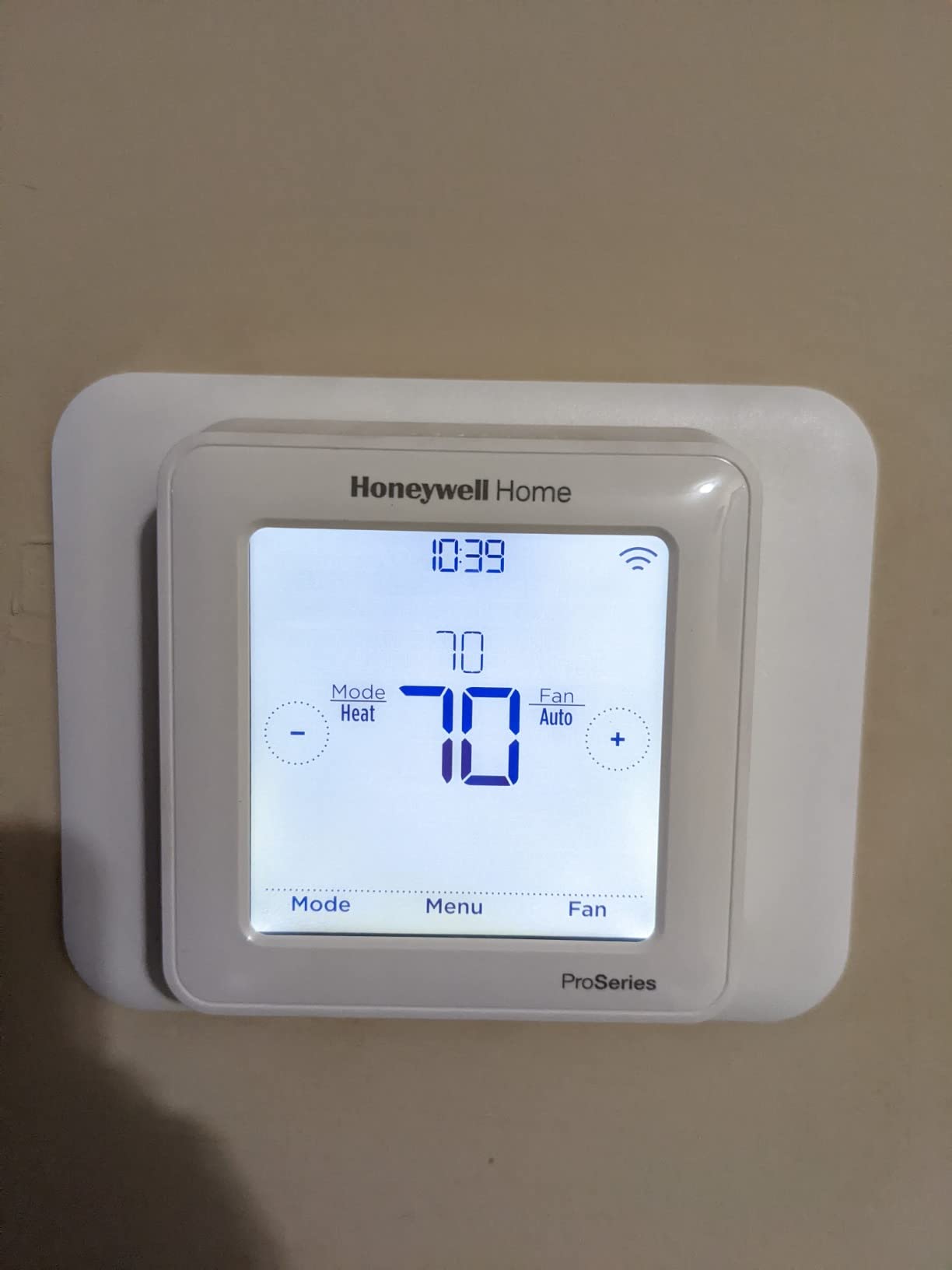
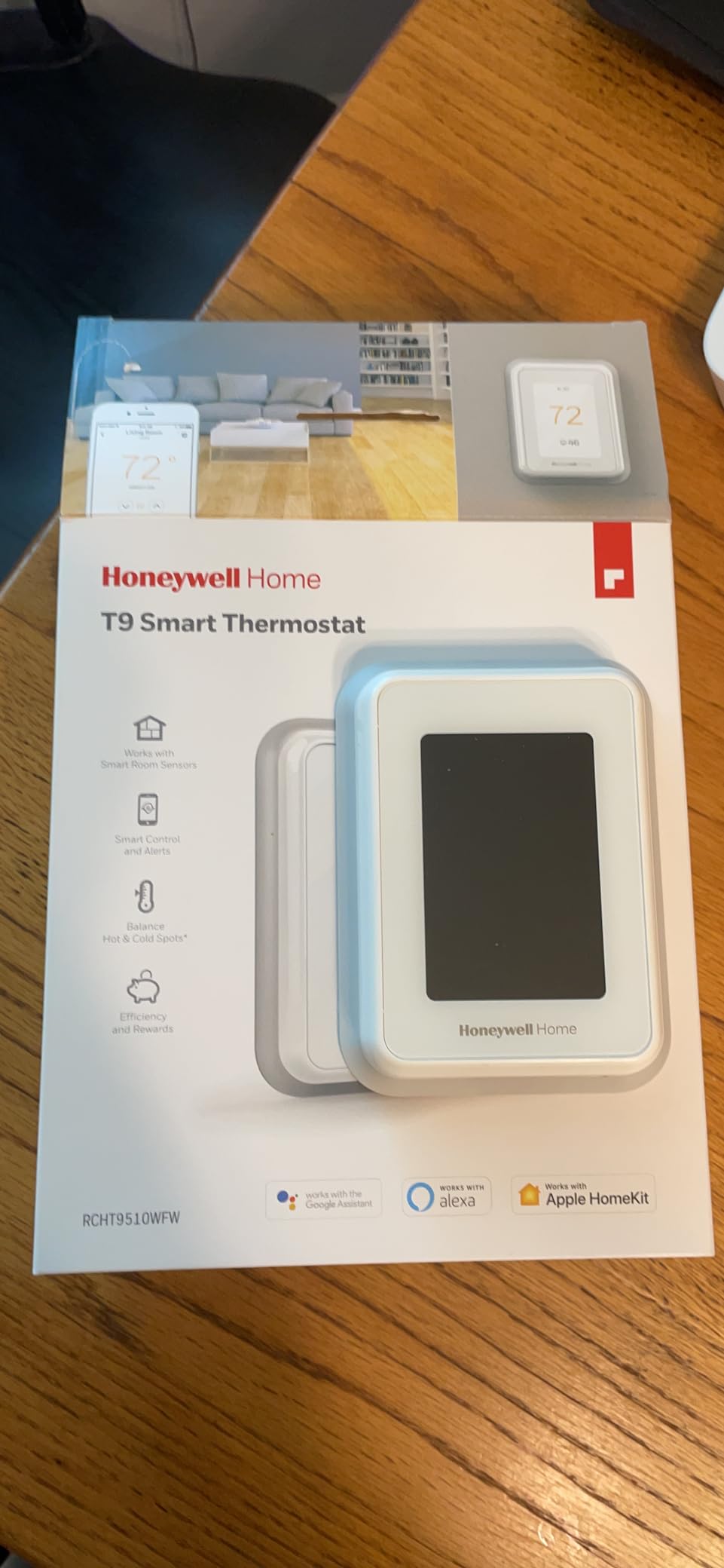
The T9 solves a different problem from the ecobee, and for many heat pump owners it is the more important one. The optional Honeywell Smart Room Sensors can be used three ways: as the sole temperature source, averaged together with the thermostat, or assigned to specific times of day. That scheduling-per-sensor capability is what owners in the reviews call the deciding feature, because it lets a bedroom sensor take over at night and step aside during the day.
On a heat pump this directly reduces auxiliary heat. If the thermostat hallway sensor reads warm while the compressor is actually struggling, the system calls backup heat early. Give it a sensor in the coldest room and the staging decisions get made on real information. Honeywell documents the T9 for forced air on gas, oil or electric, hot water and steam, and heat pumps with electric backup.
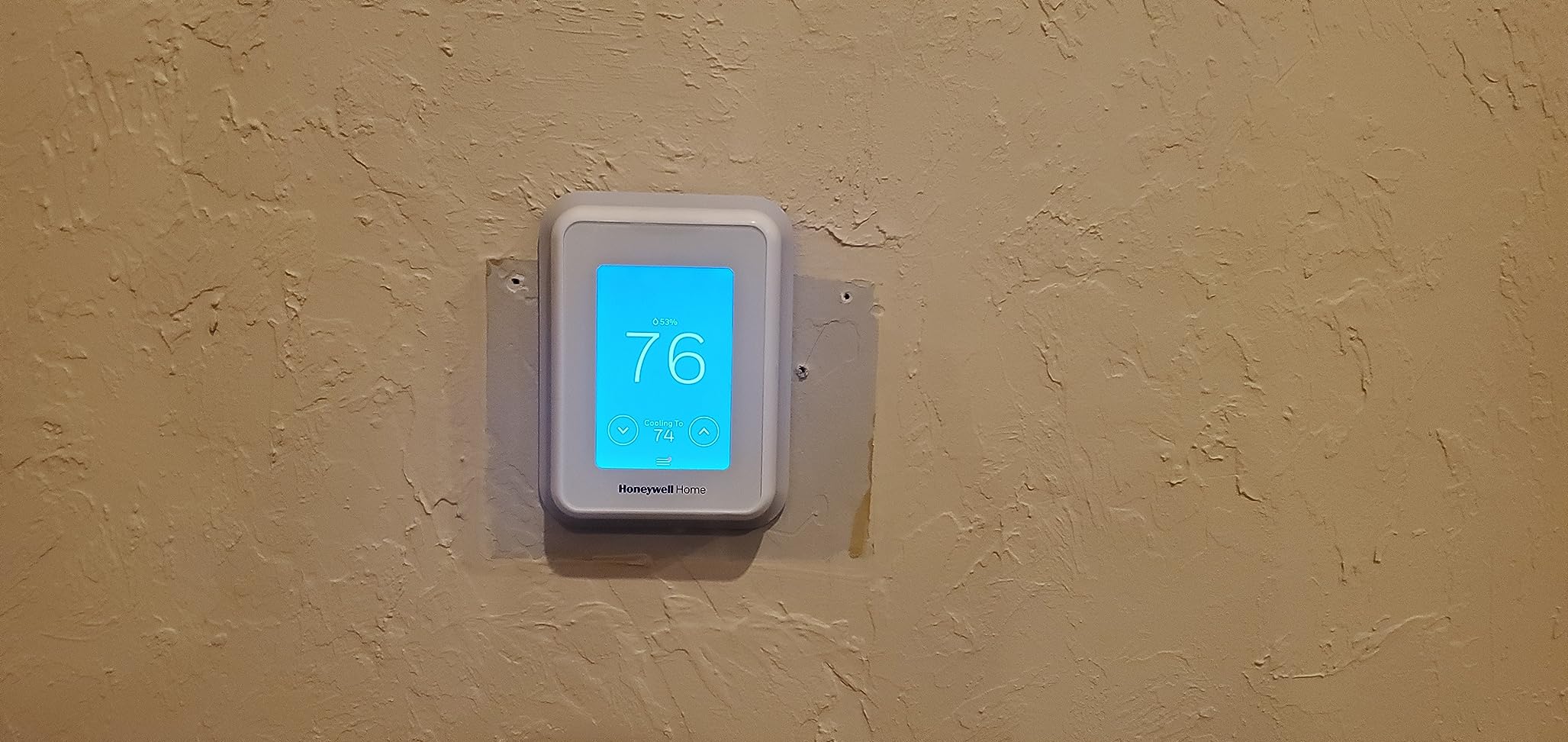
It is also unusually flexible on installation and connectivity. A power adapter is included, so the T9 works in most homes without a C-wire, though the documentation notes a C-wire is required where the system does not provide one. It works on both 2.4 GHz and 5 GHz networks, which matters increasingly in mesh-enabled homes where 5 GHz only is common. Owners with mesh systems report a simple workaround using a 2.4 GHz-only range extender.
Additional details worth knowing: fan circulate mode runs the blower for roughly 30 minutes each hour to even out temperature differences, the backlight stays on and shifts color between heating and cooling, and geofencing in the Resideo app handles home and away detection. Monthly Energy Reports and utility efficiency program integration are both built in.
Why the sensor scheduling matters more on a heat pump
A heat pump is a low-temperature, high-volume system. It moves a lot of air gently rather than heating a narrow stream of air to a high temperature, which means room-to-room balance depends on airflow and duct sizing more than it does with a gas furnace. Sensors that tell the thermostat where the cold spots are give the staging logic something to work with.
If your home is large, has more than one heat pump on separate floors, or has a bedroom that never quite catches up, the T9’s multi-room focus is the feature that will make a measurable difference. Owners of multi-zone homes cite the ability to control several systems from one app as a practical benefit, though the T9 handles a single zone per unit.
Limitations worth planning around
The fan is either off or full speed; there is no variable fan control. Fan circulate cannot be scheduled to a custom window of time, so it runs on a fixed pattern. The Resideo app occasionally shows the wrong inside or set temperature until it is force-restarted, and it does not make it obvious which sensor is driving the current reading without digging into a priority menu.
Two smaller notes: the built-in humidity sensor reads roughly 10 percent high against standalone sensors, and energy usage data takes about three days to appear in the app. Home Assistant users in the communities we read report long-term satisfaction with Honeywell hardware, describing it as dependable in a way that the app sometimes is not.
6. Sensi Touch 2 – Best Touchscreen Heat Pump Thermostat
Sensi Touch 2 Smart Thermostat Wi-Fi, Alexa, Energy Star Certified, ST76
Model ST76
5.6 inch D x 3.25 inch W x 0.77 inch H
9.92 ounces
24V common wire
Black beveled edge
Pros
- App-guided install using universal Bluetooth technology
- Works with separately sold Sensi Room Sensors
- Compatible with heat pumps boilers furnaces and AC
- Sensi does not sell personal information
- 3-year manufacturer warranty
Cons
- A common wire is required unlike the ST55
- Touch-only interface with no physical buttons
- Apple HomeKit and Siri are not in the listed compatibility
- About 10 percent of reviews are 1-star
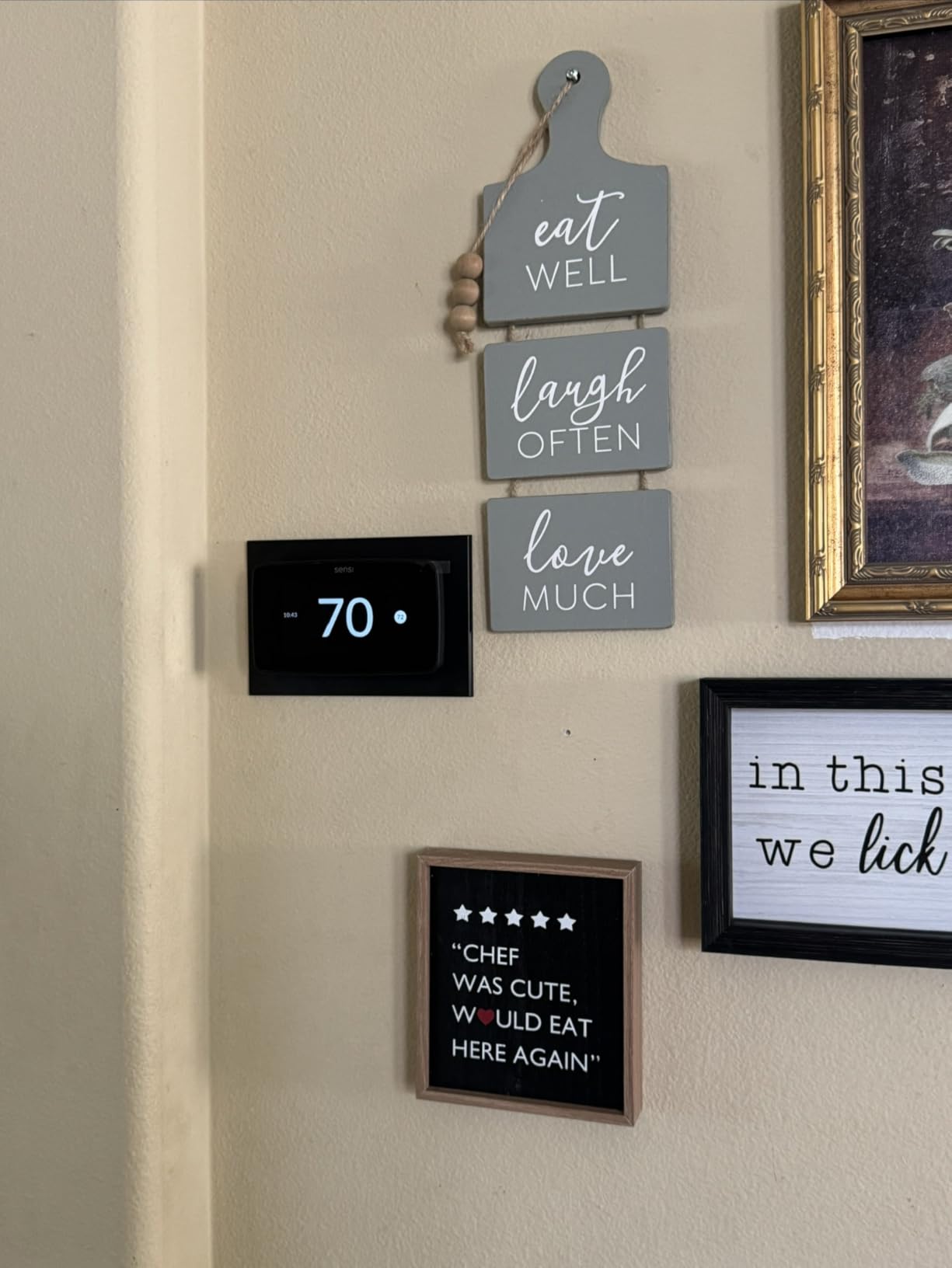
The Touch 2 is the Sensi product for people who want a screen they can read from across a room and an installation process that walks them through itself. The app-guided setup uses universal Bluetooth technology to confirm each connection as you make it, which turns the most error-prone part of a thermostat install, matching wires to terminals, into a guided sequence.
It is compatible with air conditioners, boilers, furnaces and heat pumps, powered from a twenty-four volt common wire, and covered by a 3-year manufacturer warranty. The unit is 5.6 by 3.25 by 0.77 inches in a black beveled edge finish, with an LCD touchscreen. Separate Sensi Room Sensors can be added for room-by-room comfort, though they are sold on their own.
Sensi states it does not sell personal information to third parties, and it is ENERGY STAR certified with an advertised saving of about 23 percent on HVAC energy. The app also provides usage reports, equipment alerts and filter replacement reminders, which is genuinely useful with a heat pump because a clogged filter on a long system shows up as mysterious auxiliary heat runtime.
Compare it directly to the ST55 earlier in this guide. Same brand, same privacy stance, similar app. The differences are the touchscreen rather than physical buttons, room sensor support rather than none, and a common wire requirement that the ST55 does not have in most installations.
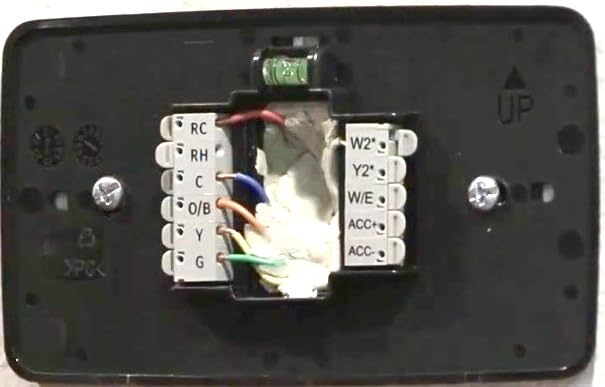
Best for a heat pump with uneven temperatures and a modern wiring setup
This is the Sensi to buy when your home already has a common wire and one room is chronically colder than the rest. Adding room sensors is straightforward, and the guided install is the part owners praise most consistently. The touchscreen gives you a glanceable target temperature without picking up the phone.
It is not the pick for a millivolt gas system or a home without a common wire. The documentation is explicit that a common wire is required, and unlike some competitors, the ST76 does not ship with a power adapter to work around that. If you are unsure whether you have one, check the terminal block before ordering.
Tradeoffs to weigh
A touch-only interface with no physical buttons means every adjustment happens on the screen or in the app. That is fine for most people and frustrating for a few, particularly for adjusting the set point in the dark. Apple HomeKit and Siri are not listed among the compatible controllers here, which is a real gap for HomeKit households.
About 10 percent of reviews are 1-star, pointing to setup, wiring and app connectivity issues. The review base is the thinnest of the Sensi units here at roughly 1,250, so there is less long-run feedback to draw on than the ST55 has accumulated.
7. Google Nest Learning Thermostat – Best for Automatic Scheduling
Google Nest Learning Thermostat (4th gen) + Nest Temperature Sensor (2nd gen) – Obsidian
Model CE911542
161.8 g
Round wall mount
1 CR2 battery included
Polished Obsidian
Pros
- Learns your routine and builds the schedule automatically
- Nest Temperature Sensor 2nd gen included
- Display is 60 percent larger with Dynamic Farsight
- Natural heating and cooling learns outdoor conditions
- Works with Alexa Siri and Google Assistant plus Matter
Cons
- Not ENERGY STAR certified so rebate ineligible
- 4th gen backplate is not compatible with 3rd gen mounts
- Some no-C-wire installs report a no power setup error
- Eco settings can run a little warm while learning converges
The Nest Learning Thermostat is the only pick here that builds its own schedule rather than asking you to write one. It observes when you change the temperature and when the house is empty, then assembles a program from those patterns. For a heat pump household that wants automation without maintenance, that is the entire argument, and the 4th generation has the strongest five-star share of any model we reviewed at 78 percent.
It is documented for most 24-volt systems including gas, electric, oil, forced air, heat pump and radiant, and a C-wire is not required in most homes. The bundle includes the Nest Temperature Sensor 2nd generation, so unlike the ecobee Enhanced you are not buying a sensor separately. Sensor groups and per-sensor scheduling in the Google Home app handle the multi-room problem.
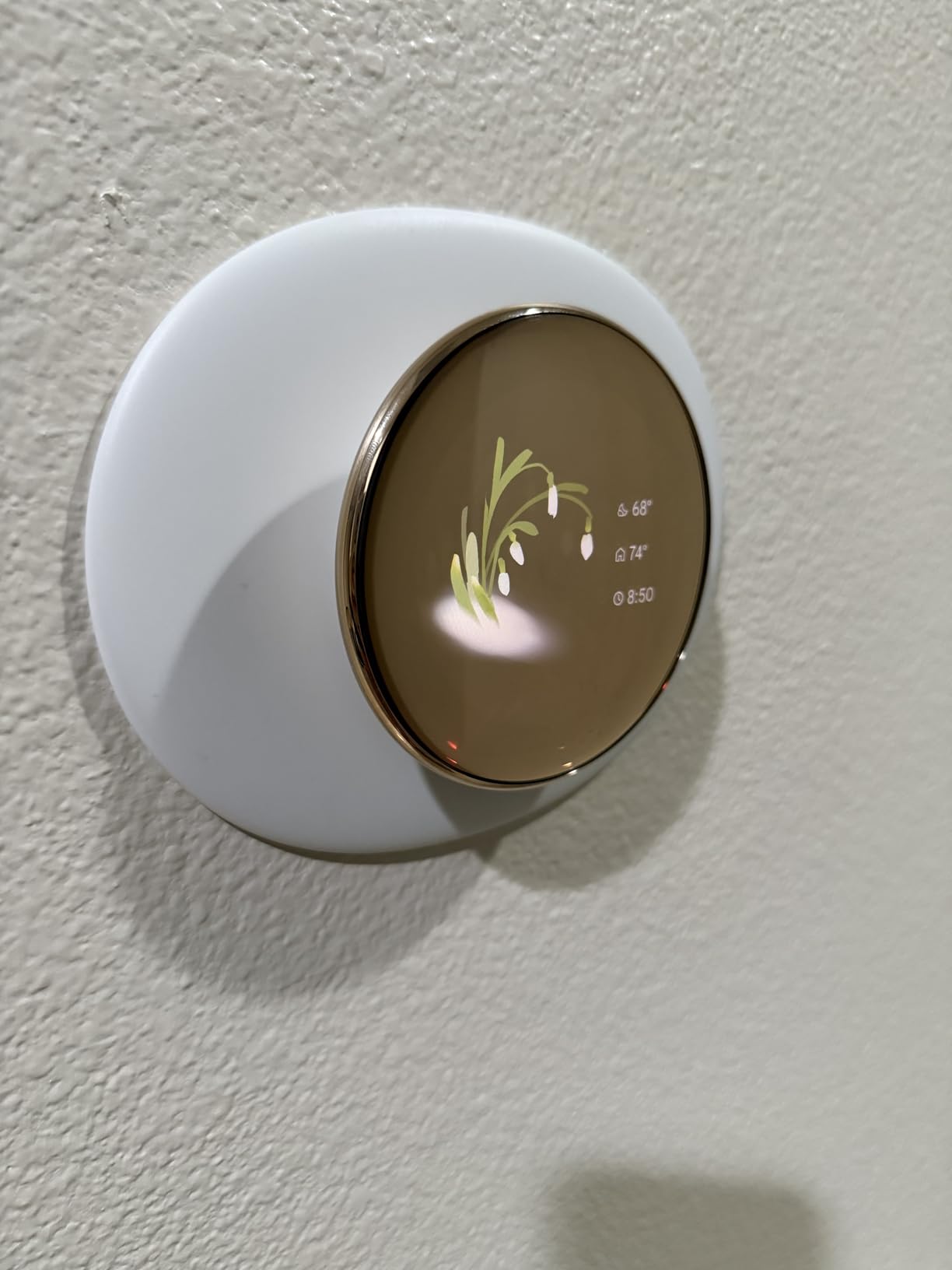
Two features here are aimed straight at heat pump behavior. Natural heating and cooling learns how outdoor conditions affect indoor temperature and pauses the system when it can. Adaptive Eco uses the outdoor temperature to choose an away setting and returns you to comfort within an hour. Both are attempts to keep the compressor working sensibly in weather rather than reacting with a fixed setback.
The display is 60 percent larger than the previous generation, with Dynamic Farsight line-of-sight display and automatic brightness. The unit is round, wall mounted, aluminum, powered by a single CR2 battery, and Matter compatible. It asks permission before changing the schedule, with notifications in the Google Home app to accept or decline, which is a meaningful change from the older learn-and-do-it-anyway behavior.
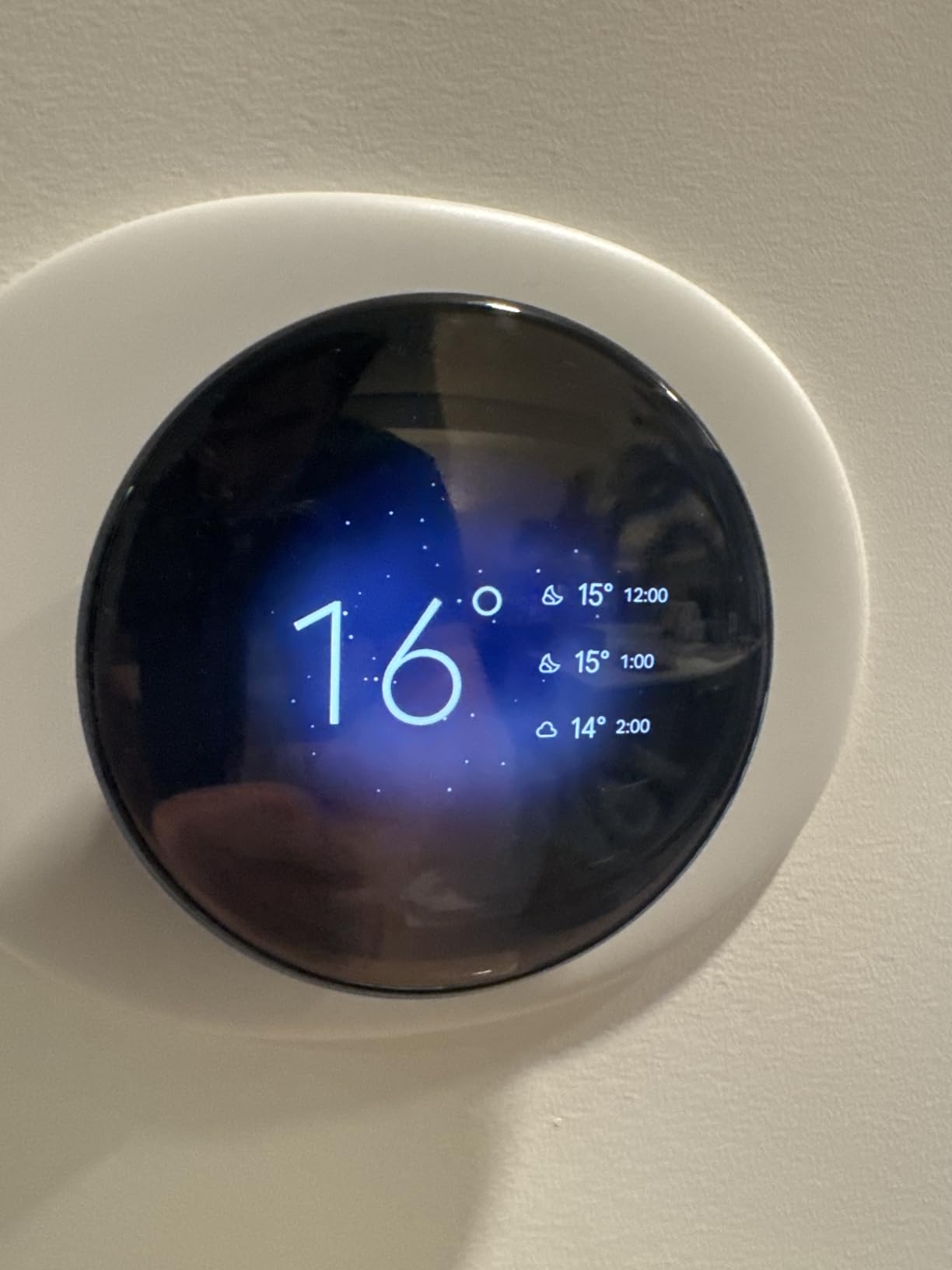
Where the Nest approach fits a heat pump home
If your priority is a schedule that improves without you touching it, this is the strongest option in the roundup. The included sensor means room priority is available on day one. Google Home integration is the most complete here, and Matter support broadens compatibility beyond Google’s own ecosystem over time.
There is one genuinely recurring complaint in the forums about this brand. The Nest remote sensor does not appear in Apple Home or Matter, so a HomeKit household that buys the temperature sensor for its room data will still read it only in Google Home. That is the ecosystem gap that drives a lot of the distrust toward Nest, and it is worth knowing before you buy.
Reasons to pass on it
It is not ENERGY STAR certified, which makes it ineligible for many utility rebates that the Honeywell models qualify for. The 4th generation backplate and wiring connector are incompatible with 3rd generation Nest mounts, so an upgrade from an older Nest means redoing the mounting hardware. Some systems without a C-wire report a no power error during setup even when voltage is measurable.
The learning period is real. Owners report that it can take a month or more to converge, and that Eco temperatures can run slightly warm before then. The minimalist dial takes more steps than arrow buttons for common settings, and the unit is US-market only, with UK buyers reporting it does not work there. If variable-speed capability matters to you, our [variable-speed thermostat discussion](/best-smart-thermostats-for-heat-pumps-in-cold-weather/) explains why this is not the device to install over an inverter system.
8. ecobee Smart Thermostat Enhanced – Best Built-In Occupancy Sensing
ecobee Smart Thermostat Enhanced, Programmable Wifi Thermostat
Model EB-STATE6L-01
0.94 inch D x 4.09 inch W x 4.09 inch H
0.45 kg
24 volts
4-inch LCD
Pros
- Built-in occupancy sensing preheats before arrival
- Power Extender Kit included for homes without a C-wire
- Works with 90 percent of HVAC systems including heat pumps
- Works with Alexa Google Assistant HomeKit and SmartThings
- 3-year manufacturer warranty
Cons
- SmartSensors are not included and must be bought separately
- App control is the primary interface with limited on-device controls
- eco+ works best inside the ecobee ecosystem
The Enhanced is the ecobee answer for people who want ecobee scheduling behavior and threshold control without paying for a built-in speaker. Occupancy sensing is built into the unit itself, so it detects when the house is occupied and preheats or precools before arrival without needing anything else in the room. It learns your temperature preferences and schedule and adjusts for humidity on its own.
Compatibility is documented at 90 percent of HVAC systems, including heat pumps, furnaces, boilers and humidifiers. The box includes a backplate, wire labels, screws, drywall plugs, a power extender kit for homes without a C-wire, a trim plate and a quick start guide, with a 3-year manufacturer warranty. It is ENERGY STAR certified and ecobee advertises savings of up to 26 percent per year.
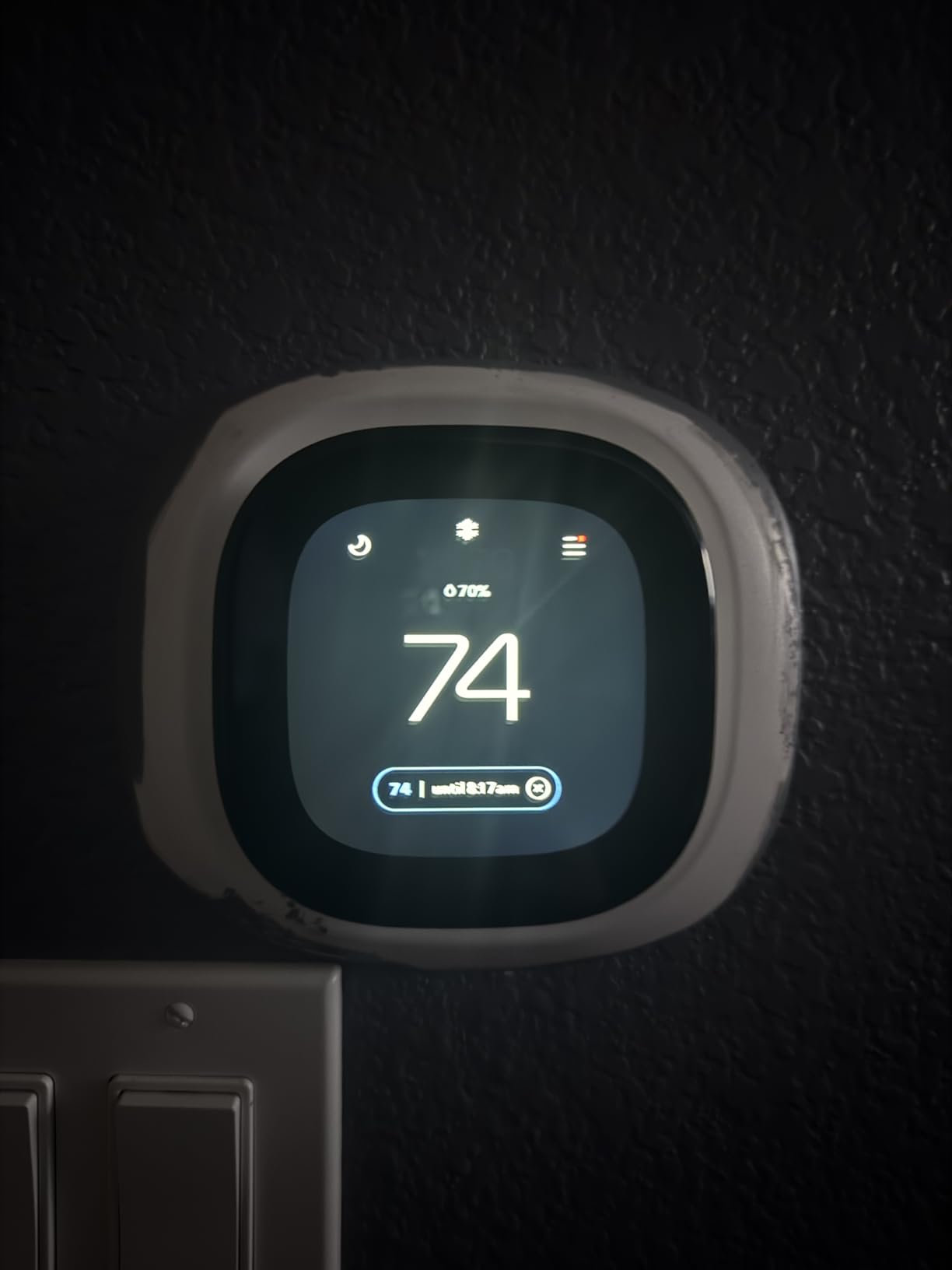
The app is the main interface. On-device controls are limited, and eco+ uses your routine, comfort preferences, local weather and grid activity to improve efficiency, working best when the rest of your setup is also ecobee. Remote control runs from the app on a smartphone, tablet or Apple Watch, and it works with Amazon Alexa, Google Assistant, Apple HomeKit and SmartThings.
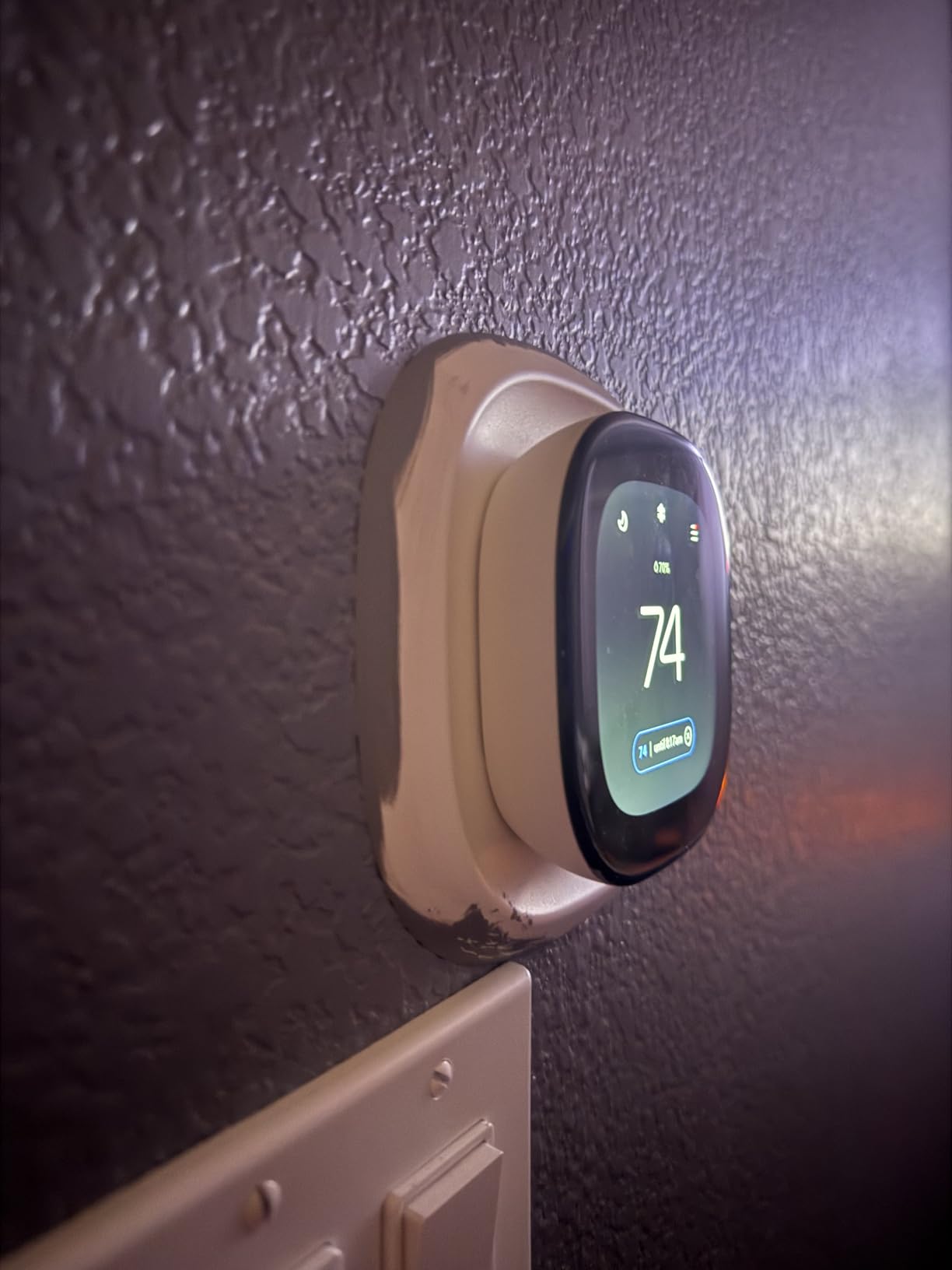
The upgrade path is what makes this model interesting. Add ecobee SmartSensors later, sold separately, and you arrive at roughly the same feature set as the Premium for a lower entry cost, minus the speaker and the air quality monitor. For many heat pump households that is the sensible order of operations: start here, see whether the occupancy sensing is enough, then add sensors if a cold room shows up in winter.
How it stacks up against the Premium
The Enhanced is documented for one stage of auxiliary heat; the Premium covers two. If your system has two stages of backup heat, that difference decides the purchase before any other feature does. Occupancy sensing is present on both, so the Premium’s radar sensor is the additional comfort feature, along with the smart speaker and air quality alerts.
For a single-stage heat pump with one stage of electric backup in a home without uneven temperatures, the Enhanced covers everything that matters. It also carries the same power extender kit, so no-C-wire homes are equally well served. Owners rate the metal finish and the flush wall appearance highly, with a 74 percent five-star share across roughly 3,700 reviews.
Limitations to plan for
The most common reservation by far is that SmartSensors are not included. Buyers expecting the Premium’s bundled sensor are disappointed, and that is a fair criticism of the box contents. The limited on-device controls also mean you are reaching for the app more often than with a button-based unit like the Sensi ST55.
Finally, eco+ and some automation features are tuned for the ecobee ecosystem, so if your home runs on HomeKit or SmartThings the experience is functional but not as integrated as it is inside ecobee’s own app.
Auxiliary Heat vs. Emergency Heat, and Why Lockout Saves You Money
These two get confused constantly, and the confusion is expensive. Auxiliary heat, usually called AUX or backup heat, is the electric strip heat or gas furnace element bundled with your heat pump. It runs on ordinary thermostat calls, at the same time as or instead of the compressor. Emergency heat is a manual mode you select on the thermostat yourself, which forces the backup element and stops the compressor entirely.
Running the heat pump and auxiliary heat at the same time is not harmful to the heat pump. It is simply expensive, and the electric element delivers heat at roughly the efficiency of a resistive space heater. A heat pump moves several times more heat per unit of electricity than resistance heat does, so every hour of unnecessary AUX runtime is money spent at the wrong rate.
So why does AUX heat run so much in the first place? Three reasons, in order of how often we see them. The first is a large overnight setback: dropping to 68F or lower gives the system a big recovery target, the compressor’s capacity at the outdoor temperature falls short, and the control board calls for backup heat immediately. The second is a thermostat that has no idea what the outdoor temperature is, so it cannot tell a mild 55F afternoon from a genuinely cold one. The third is a house with a cold room that the thermostat is not actually measuring.
That third factor is where balance point comes in. Balance point is simply the outdoor temperature at which your heat pump can comfortably meet the demand on its own. Above that number, the compressor should be doing all the work. Below it, the compressor runs flat out and cannot keep up, which is exactly when backup heat belongs. Every thermostat here can be told where that line sits, and the four we would most expect to see it used are the models with granular temperature threshold control.
Lockout is the setting that enforces the line. You set a number, and the thermostat will not call auxiliary heat above that outdoor temperature no matter how far the inside temperature has drifted. Set it too high and you get uncomfortable rooms on a genuinely cold day. Set it too low and you pay strip heat prices in December. Most people find their working number by starting around the point where the house first struggles and adjusting by two or three degrees at a time across a season. If you heat with electric baseboard in part of the house, our [baseboard thermostat guide](/best-smart-thermostats-for-electric-baseboard-heat/) covers the equipment side of that setup.
Before You Buy: The Heat Pump Compatibility Checklist
Do these five checks in order. Each one eliminates a class of returns that no amount of careful shopping would have prevented, and the whole sequence takes about ten minutes with a flashlight and your phone camera.
1. Photograph your wires before you remove anything. The wires themselves tell you what system you own. The R terminal is the 24-volt power supply and is the one you cannot do without. W is first-stage heat call, and on a heat pump system W is a heat pump call rather than a furnace call. Y is the compressor call for cooling. O/B is the reversing valve wire, and its presence is the single clearest sign you have a heat pump, because only a heat pump reverses to switch between heating and cooling. W2 is a second stage of heat, which means either a two-stage compressor or a second stage of auxiliary heat. C is the common wire, and if it is absent you need either a power adapter in the box or a call to an electrician.
2. Confirm your compressor stage count. One stage, two stage, or variable speed. The model number on the outdoor unit’s nameplate usually contains the answer, and the manufacturer publishes a capacity or model number chart that decodes it. A two-stage compressor that gets paired with a single-stage thermostat loses part of its reason to exist. Our [DIY mini split heat pump guide](/best-diy-mini-split-heat-pumps/) covers how stage control works differently on ductless systems.
3. Count your auxiliary heat stages. Electric strip heat is usually one stage. A gas furnace used as backup in a dual-fuel system can be one or two stages. Two stages of AUX is the specification that separates the ecobee Premium from the ecobee Enhanced, and a thermostat documented for one AUX stage will simply never call the second one.
4. Check whether your heat pump is variable speed. If the outdoor unit is an inverter model, it modulates between roughly 25 and 100 percent capacity. A conventional staged thermostat reduces that to two fixed output levels, which reduces efficiency and may disable manufacturer-specific modes. This is a purchase blocker, not a preference, and it is covered properly in the next section.
5. Determine your system type and your C-wire situation. Conventional, heat only, or dual fuel. Dual fuel, meaning a heat pump paired with a gas furnace, is the configuration most worth having professionally installed, because the changeover logic and staging setup are more involved than a simple swap. For the C-wire, count the terminals: if there is no C, your shortlist narrows to the units that ship with a power adapter or power extender kit.
What Variable-Speed Heat Pumps Change
If your outdoor unit is a variable-speed or inverter model, the compatibility question stops being about the thermostat and starts being about the control board. These compressors communicate with the indoor unit’s board using manufacturer-specific signals, and that board is where the capacity data lives. A third-party thermostat installed on top of it typically cannot see the full range of modulation.
This is the single most consistent piece of advice in the HVAC forums we read for this keyword. Owners of cold-climate inverter systems consistently recommend staying with the manufacturer’s own controller rather than replacing it. The reasoning is not brand loyalty; it is that the factory controller is part of how the variable-speed capability is implemented. The same threads note that some third-party installs simply disable or restrict variable operation once the OEM board is bypassed.
There is a middle path worth knowing about. Several manufacturers sell an adapter board that lets their factory control logic remain in the loop while accepting commands from a third-party smart thermostat. Whether an adapter exists for your model is a question for the manufacturer directly, not for a product page. If your system is inverter-driven and you want smart scheduling, contact the manufacturer before you buy anything, and plan on having it installed by an HVAC contractor rather than doing it yourself.
For everyone else on this list, a one-stage or two-stage conventional system, this concern does not apply and you can read the lockout configuration section below.
How to Configure Auxiliary Heat Lockout on Each Thermostat
Owners in the forums ask repeatedly how to stop auxiliary heat from coming on, and the answer is a setting, not a replacement. Here is how the main approaches work, in the brand’s own terms.
ecobee, Premium and Enhanced. The threshold controls in the ecobee app set minimum and maximum allowed temperatures by system mode, and they can be configured per schedule block rather than globally. Set the AUX heat threshold to the lowest number you are willing to tolerate in a cold snap, and check whether auxiliary heat is enabled at all for specific periods. You can also allow or block simultaneous heating from the compressor and the backup element, which answers the question homeowners ask most often about ecobee systems specifically. The energy reports then show how much AUX runtime dropped after you tuned it.
Google Nest. The Nest approach is called Heat Pump Balance, and it lives in the equipment settings rather than in the schedule. You identify which stage is the heat pump and which is backup heat, then set the balance temperature where the thermostat stops calling the backup stage. Because the Nest also supports a manually adjustable compressor maintenance band, you can protect a variable-speed compressor from short cycling by refusing stage calls inside a band around the current temperature. Moving the lockout temperature up or down is done from the same equipment screen.
Honeywell. The lockout lives in the installer configuration menu. The concept is the same: you enter a temperature above which the auxiliary stage will not be called, and Honeywell models that support heat pumps with electric backup expose this directly. On the T9, the same menu holds the staging configuration and the option to assign which room sensors drive the reading. The T6 Pro uses the same two-stage heat pump staging setup, which is why it is our pick when the compressor is two-stage.
One general tip. Whichever brand you choose, change the lockout temperature in small steps and live with it through at least one cold stretch before deciding it is wrong. The number that feels too aggressive early in the season frequently looks correct once winter sets in.
Who Should Skip These Picks
Nobody recommends a third-party smart thermostat for every heat pump, and the reasons are technical rather than aesthetic. If any of the following describe your system, the right answer may be your equipment manufacturer’s own controller.
Variable-speed inverter systems. Covered in detail above. The capability loss is real enough that the forums consistently steer these owners toward the OEM controller or a manufacturer adapter.
Metered or direct-load systems. A thermostat with a powered common wire takes power from the equipment and can interfere with load control or metering schemes in some setups. If your meter or load control device is finicky about control voltage, ask an HVAC contractor before installing anything.
Ductless mini-split systems. None of the eight units here is a mini-split controller. Ductless systems use their own infrared remote or a wall-mounted controller that talks to the indoor unit, not a twenty-four volt low-voltage control board. If you are adding a ductless system, start with a controller designed for it, and our [mini-split heat pump guide](/best-diy-mini-split-heat-pumps/) covers the equipment side.
Multi-zone systems without zone hardware. If you have one heat pump per floor, the honest answer is that this roundup will not unify them for you. Each thermostat controls one system. Homeowners with three systems report managing separate apps as a recurring frustration, and the real solution is a properly designed multi-zone or multi-controller setup rather than a clever app.
And if you are a renter, or your system runs on a millivolt gas control, or you are simply satisfied with the manual dial thermostat on the wall, then none of this matters. The savings from lockout are real, but they are not worth an installer’s visit on a system you do not control.
Frequently Asked Questions
Can you put a smart thermostat on a heat pump?
Yes, provided the thermostat is documented for heat pumps and your system’s compressor stage count and auxiliary heat stage count fall within what the model supports. A 24-volt low-voltage control board is required, which rules out millivolt gas systems and 120-240V baseboard equipment. Check the wiring at the existing thermostat first: an O/B terminal means a heat pump, a W2 terminal means a second stage of heat.
What is the best smart thermostat for a heat pump with auxiliary heat?
The ecobee Smart Thermostat Premium is the strongest overall choice because it includes a room sensor and gives you granular control over when auxiliary heat is allowed to run. The Honeywell Home T9 is the alternative to consider when the bigger problem is one cold room, because its room sensors can be averaged or assigned to specific times of day.
Is it okay to let heat pump and aux heat run simultaneously?
It will not damage the heat pump. It is simply expensive, because electric auxiliary heat delivers heat at roughly the efficiency of a resistive space heater while the compressor delivers several times more heat per unit of electricity. Most thermostats let you permit or block simultaneous operation, and blocking it above a set outdoor temperature is the cheapest saving available on a heat pump system.
Is auxiliary heat bad for my heat pump?
No. Auxiliary heat does not harm the heat pump, but every unnecessary hour of it costs substantially more than the same hour of compressor runtime. The usual causes of excess auxiliary heat are a large overnight temperature setback, a thermostat with no outdoor temperature compensation, and a house whose cold rooms the thermostat is not measuring.
How do I stop auxiliary heat from coming on with a Honeywell thermostat?
Set a lockout temperature in the installer configuration menu. In Honeywell models that support heat pumps with electric backup, you can enter an outdoor temperature above which the auxiliary stage will not be called. On the T9 the same menu also holds the staging configuration and room sensor assignment, and on the T6 Pro it holds the two-stage heat pump setup. Move the number in small steps and test it through a cold stretch.
Which smart thermostat is better, ecobee or Sensi?
For a heat pump with uneven temperatures, ecobee wins because the Premium bundles a room sensor and offers detailed auxiliary heat threshold control. Sensi wins on installation and cost: the ST55 needs no C-wire in most homes, fits the footprint of a conventional thermostat, and Sensi states it does not sell personal information to third parties. Choose ecobee for control, Sensi for a straightforward install.
Why do HVAC guys hate Nest thermostats?
The main objections are technical. On a variable-speed inverter heat pump, replacing the manufacturer control board can restrict or disable the compressor’s modulation, and the Nest Temperature Sensor does not appear in Apple Home or Matter. The 4th generation is also not ENERGY STAR certified, so it is ineligible for many utility rebates, and its 4th gen backplate is not compatible with 3rd gen mounts.
The Bottom Line
The ecobee Smart Thermostat Premium is the best smart thermostat for heat pumps in 2026 because it is the only unit here that pairs a bundled room sensor with fine-grained control over when your compressor works alone and when backup heat is allowed to join. The Sensi ST55 is the sensible second choice when installation simplicity and running cost matter more than room-by-room control, and the Honeywell T9 is the answer to the cold bedroom problem specifically.
Before any of them, spend ten minutes on the wiring at your existing thermostat. The O/B and W2 terminals tell you what system you have, and the answer determines whether a third-party smart thermostat is a good idea at all. Then set your lockout temperature before the first cold snap, and adjust it by a few degrees each time a week until the balance point feels right.