
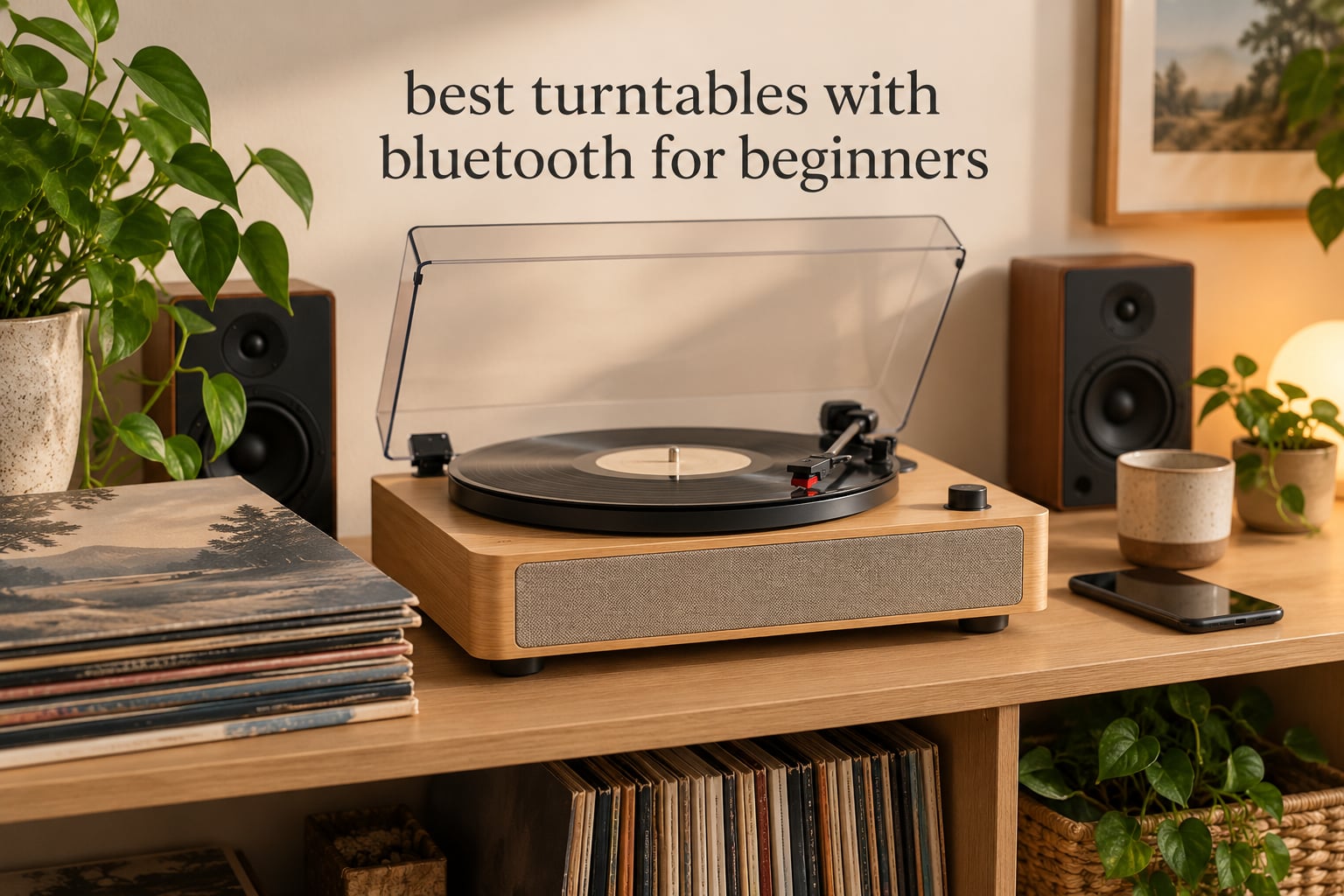
Most people searching for the best turntables with bluetooth for beginners are not trying to become an audio engineer. They have a stack of records somewhere in a closet, or they want one, and they want the whole thing to work when they plug it in. That single expectation shapes every pick below.
Bluetooth is not the reason any of these decks is good. It is the reason you can start on the night you unbox it. Without a wireless module, a first turntable also means buying an amplifier, a phono stage, and a pair of passive speakers before a single note comes out. With one, the deck talks directly to the Bluetooth speaker you already own or to a pair of headphones, and you can move the whole system between rooms without unplugging anything.
The trade is real: Bluetooth adds compression to an already quiet analog signal, so a wired connection into a proper amplifier will always sound better. On r/turntables the consensus lands in the same place, treating Bluetooth as a convenience layer rather than the main event. In practice the ceiling on sound is your speaker or headphones, not the deck.
What follows is a straight ranking of ten decks across the budget, mid-range, and premium tiers, with a note on what each one still needs you to buy. We updated this roundup in 2026, and every product below is listed with its own Bluetooth direction so you can see at a glance whether it streams vinyl out, plays phone audio in, or both.
If you are still working out the basics, start with our beginner turntable guide for the mechanical fundamentals, then come back here once Bluetooth is part of the brief.
Table of Contents
Top 3 Best Bluetooth Turntables for Beginners in 2026
These three cover the three ways most beginners actually start: one box that works out of the box, one box plus real speakers for better sound, and one low-cost deck for a first casual collection.

Victrola Journey
- Three-speed belt drive
- Built-in stereo speakers
- Bluetooth streaming
- Auto-stop
1byone HiFi Turntable System
- Includes 36W bookshelf speakers
- Switchable phono preamp
- Adjustable counterweight
- USB recording
Every Bluetooth Turntable We Recommend in 2026 at a Glance
Ten decks, ranked below. The features column covers speed range, Bluetooth behaviour, and the cartridge situation, because those three decide whether a deck grows with you or stays where it started.
| Product | Specifications | Action |
|---|---|---|
| Victrola Journey Suitcase Record Player |
|
Check Latest Price |
 Victrola Quincy 6-in-1 Music Center Victrola Quincy 6-in-1 Music Center |
|
Check Latest Price |
 Audio-Technica AT-LP60XBT Audio-Technica AT-LP60XBT |
|
Check Latest Price |
| Retrolife R609 Portable Record Player |
|
Check Latest Price |
| 1byone HiFi Turntable System |
|
Check Latest Price |
 Audio-Technica AT-LP120XBT-USB Audio-Technica AT-LP120XBT-USB |
|
Check Latest Price |
 ANGELS HORN Turntable with Built-in Speakers ANGELS HORN Turntable with Built-in Speakers |
|
Check Latest Price |
 Audio-Technica AT-LP70XBT Audio-Technica AT-LP70XBT |
|
Check Latest Price |
 Udreamer UD019 Turntable with Two Speakers Udreamer UD019 Turntable with Two Speakers |
|
Check Latest Price |
 Victrola Century 6-in-1 Music Center Victrola Century 6-in-1 Music Center |
|
Check Latest Price |
1. Victrola Journey Review: the Easiest First Turntable With Bluetooth
Victrola Journey – Bluetooth Suitcase Record Player – Smoky Blue
Three-speed belt drive 33/45/78 rpm
Built-in stereo speakers
Bluetooth streaming
RCA out
Pros
- Works the moment it is plugged in
- Three speeds cover 7 inch 10 inch and 12 inch records
- Bluetooth streaming from a phone pairs easily
- Auto-stop switch protects the record
- Carry handle makes it easy to move between rooms
Cons
- Lightweight plastic build flexes at higher volume
- Fixed tonearm weight suits casual listening only
- Built-in speakers have no real low end
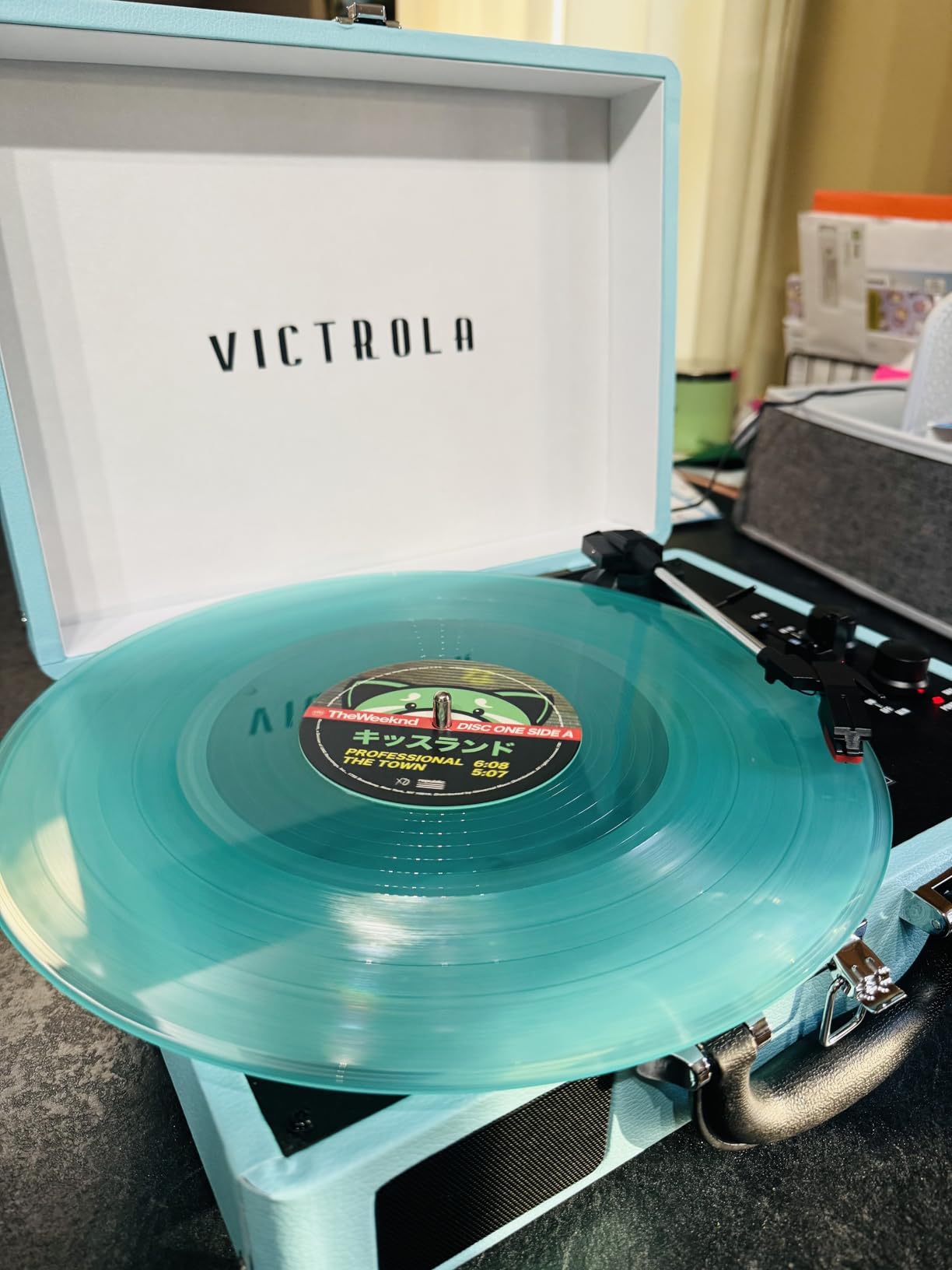
The Victrola Journey is the deck I hand to friends who tell me they want to try vinyl without turning it into a project. You open the box, plug it in, drop the needle, and you are listening. There is no counterweight to balance and no preamp switch to think about, which is the entire point for someone who has never done this before.
It covers all three speeds at 33 1/3, 45, and 78 rpm and plays 7 inch, 10 inch, and 12 inch records. That means it handles singles, your standard LPs, and the older shellac and 78 rpm discs in a bargain bin without any adapter juggling. A 45 rpm adapter is included, and an auto-stop switch lifts the tonearm when a side ends so the record does not sit under the stylus all night.
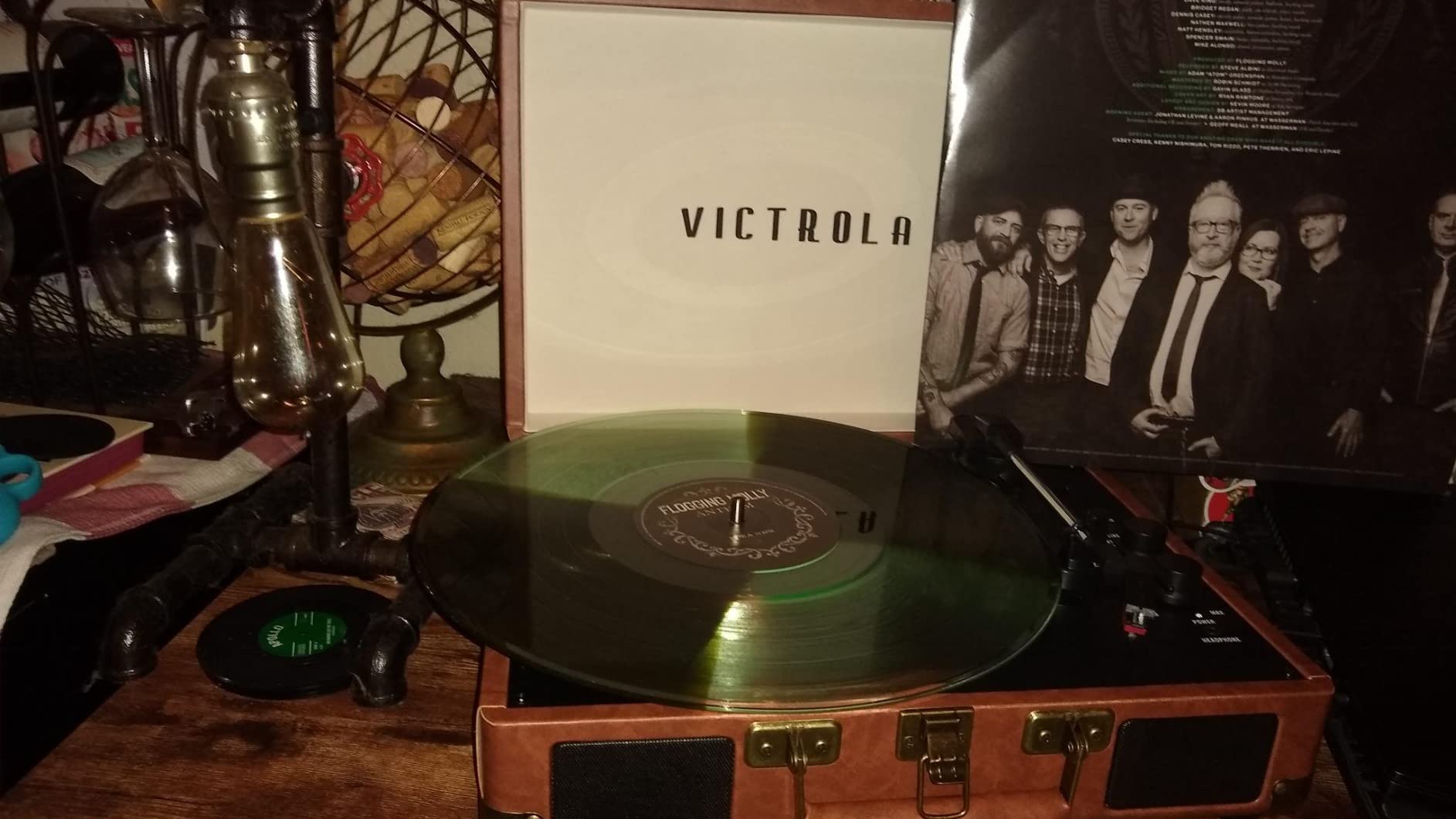
Bluetooth here is a receiver, so your phone becomes a source rather than a destination. Pair a Bluetooth speaker and the Journey will play what is on your phone, and a quick mode switch lets you move between Bluetooth and the RCA line output without unplugging anything. The headphone jack on the front handles private listening at normal volume.
The physical design deserves mention because it affects where you put the thing. At 13.9 inches by 10.1 inches by 5 inches with a carry handle, it lives on a bookshelf, a windowsill, or a dorm shelf and moves easily when you rearrange. Twelve finishes are available, and the suitcase styling is the reason it does not look out of place in a living room.
Who the Victrola Journey suits
It suits anyone buying record number one rather than record number one hundred. Reviewers consistently describe setup as a two-minute job and the Bluetooth pairing as straightforward, which is exactly the friction you want to avoid in a first purchase.
It also suits people who want a second portable deck for a small flat, a summer place, or a friend’s house. Because it weighs very little and closes down to suitcase size, it is the easiest one here to stow away when you are not using it.
Who should skip it
Skip it if you already own decent speakers and a phono-capable amplifier, because you would be paying for built-in speakers you will never use. The line output is there, but the wired path is the one worth taking when you have the gear for it.
Skip it too if you plan to buy serious records in volume. The fixed tonearm weight and non-adjustable tracking are fine for casual listening and a first album, and reviewers report they are not ideal for a growing collection of valuable vinyl.
2. Victrola Quincy Review: the Best All-in-One Music Center With Bluetooth
Victrola Quincy – 6-in-1 Bluetooth Record Player – Walnut
Vinyl CD cassette AM/FM Bluetooth and aux
Built-in stereo speakers
Bluetooth streaming
RCA out
Pros
- Six sources in one cabinet
- Built-in speakers mean zero extra purchases
- Handles three speeds and three record sizes
- Bluetooth pairing is reliable
- Headphone jack for late-night listening
Cons
- Bulky compared with a plain turntable
- CD and cassette decks add moving parts to maintain
- Not the last word in sound quality
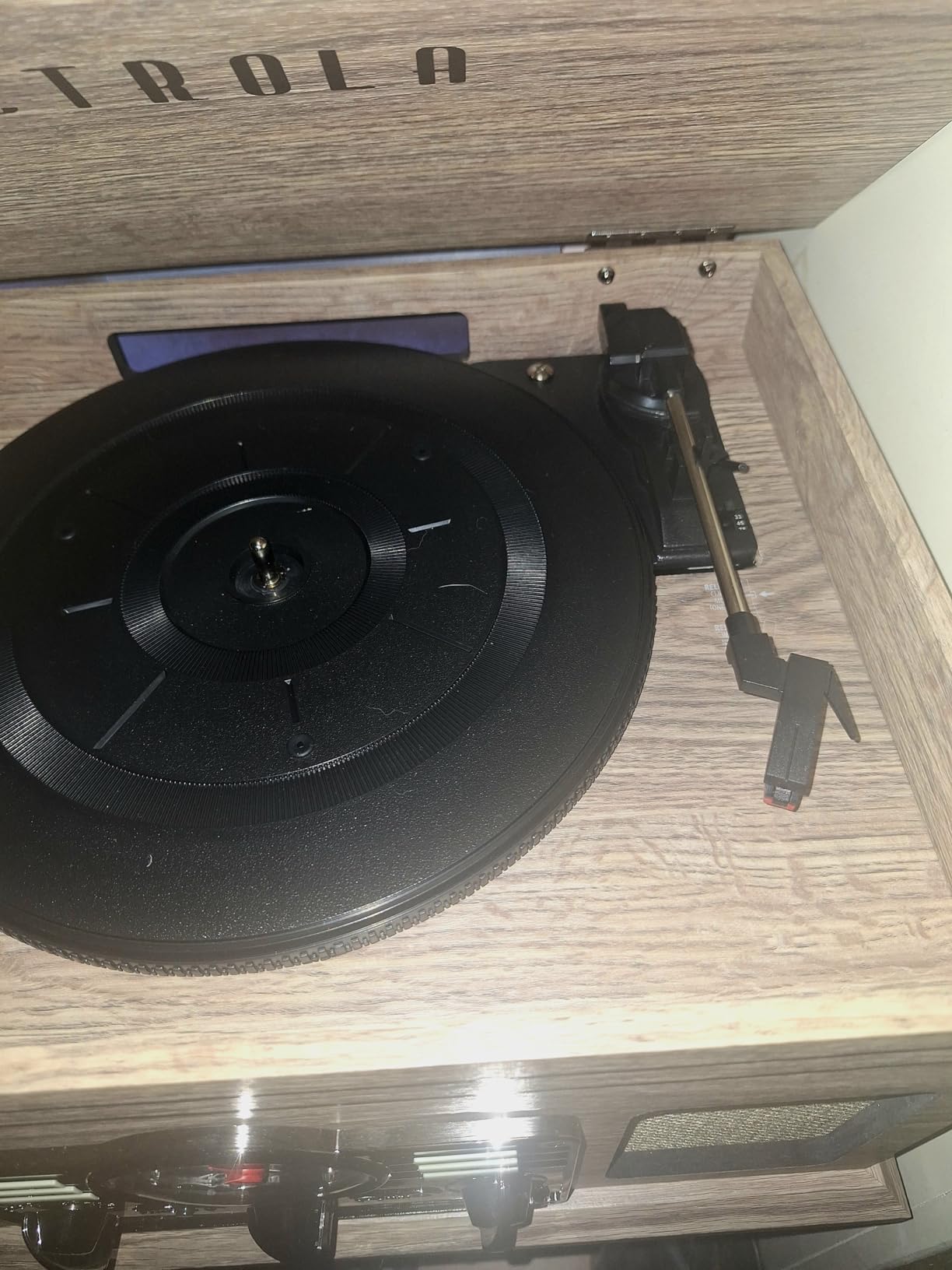
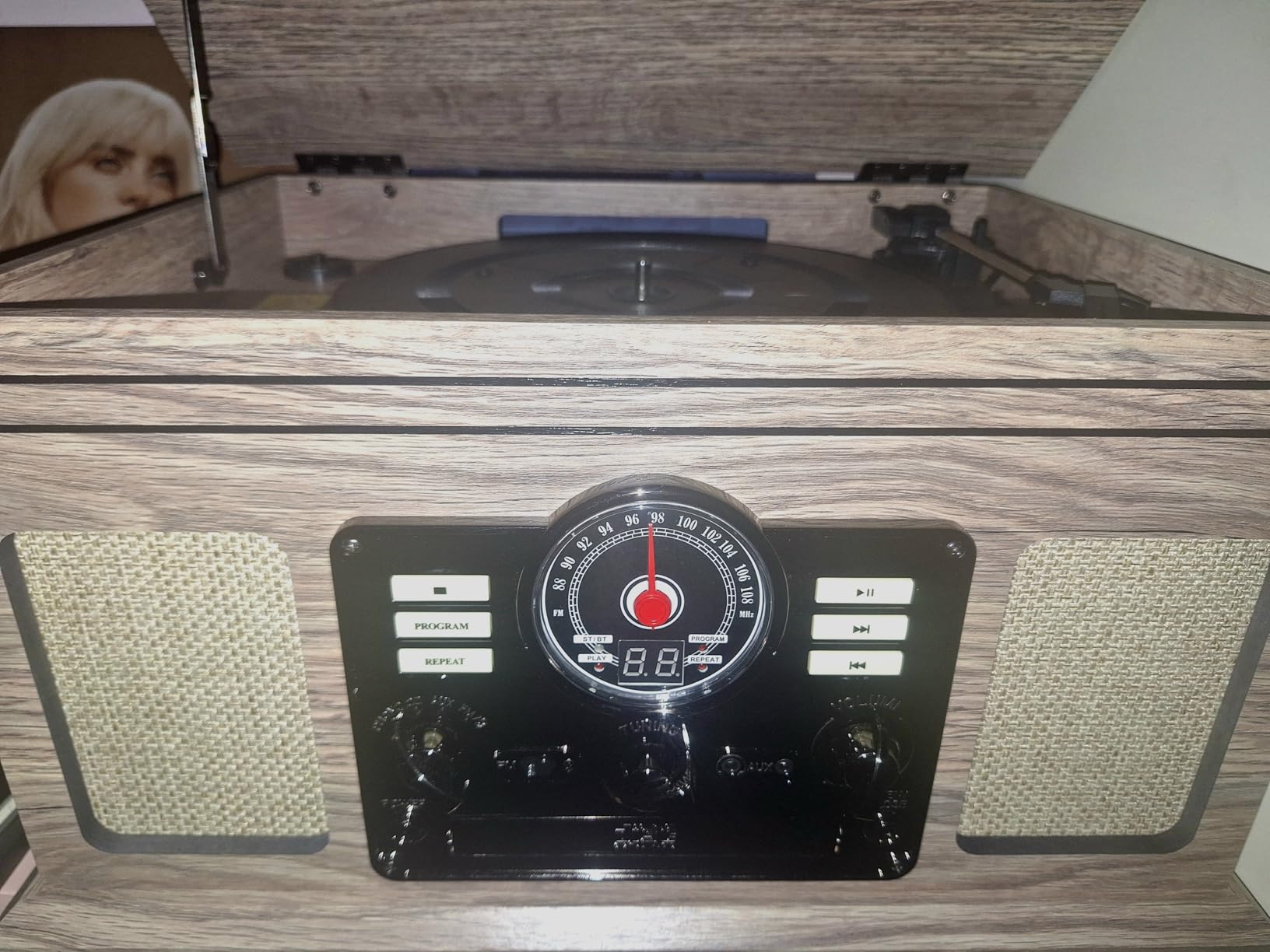
The Victrola Quincy is what you buy when the phrase starter turntable setup means one object on one shelf. It plays vinyl, CDs, cassettes, and AM/FM radio, and it accepts Bluetooth and aux input, all through its own built-in stereo speakers.
That makes it a genuinely different proposition from the rest of this list. If you inherited a box of cassettes or still have a CD player you use daily, the Quincy consolidates three devices into one walnut cabinet at 18.2 inches by 13.19 inches by 10.29 inches. The turntable section is a three-speed belt drive covering 33 1/3, 45, and 78 rpm, with built-in speakers and RCA line outputs if you later add something better.
Sound quality is described by reviewers as good for an all-in-one rather than impressive by hi-fi standards. That distinction matters: at normal listening levels in a small room, it does what you need. Push the volume up and the limit of the cabinet becomes obvious, and the RCA outputs are the way out.
Bluetooth here is a receiver, so it joins the party as a Bluetooth speaker. Play a playlist from your phone through it and it becomes a normal Bluetooth speaker with a record player on top. Seven finishes are offered, and the mid-century styling is the version most people display rather than hide in a cabinet.
Who the Victrola Quincy suits
It suits older listeners or anyone who does not want to manage an app or a separate amplifier. Everything is a knob on the front panel: input select, volume, and FM tuning. If a relative is visiting and wants to put something on, it is hard to get wrong.
It also suits people with a mixed-format collection who would otherwise need three boxes taking up three shelves. One cabinet replaces all of them.
Who should skip it
Skip it if sound quality is your main reason to start buying records. The r/turntables criticism of shared-chassis all-in-one units applies broadly, and the Quincy is no exception: platter vibration couples into the drivers sitting in the same box.
Skip it if space is tight. At just over 18 inches long and 14.9 pounds, it is one of the bulkiest cabinets in this roundup and needs a dedicated shelf rather than a side table.
3. Audio-Technica AT-LP60XBT Review: the Best Sound Per Dollar in This List
Audio-Technica AT-LPGO-BT Fully Automatic Wireless Belt-Drive Turntable (Gun-Metal/Black)
Fully automatic belt drive 33/45 rpm
Bluetooth with aptX codec
Die-cast platter
VM95 cartridge
Pros
- Aluminum platter and a real phono stage at an entry price
- Fully automatic start and stop handles the arm for you
- aptX Bluetooth codec
- External AC adapter keeps noise down
- Two-year manufacturer warranty
Cons
- No built-in speakers so you need a wireless speaker or amp
- Two speeds only with no 78 rpm
- Not a manual deck so there is nothing to fine-tune
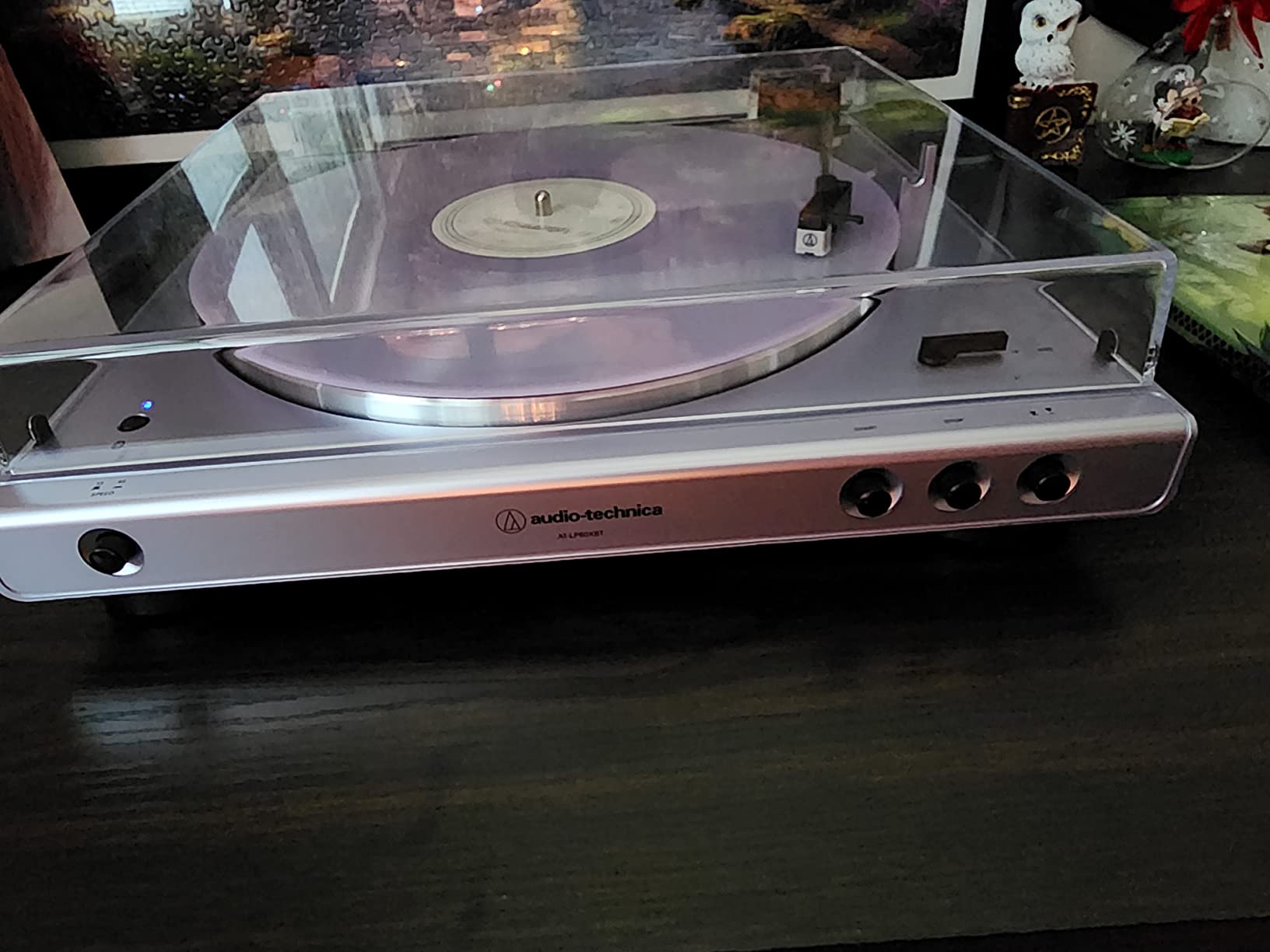
The Audio-Technica AT-LP60XBT is the deck I recommend when someone wants a real turntable rather than a novelty box, and it is the model r/turntables keeps pointing first-time buyers toward. It has a die-cast aluminum platter, an integrated dual moving magnet cartridge, and a built-in phono stage, which is a genuinely different class of hardware from a plastic suitcase player.
Operation is fully automatic. Lift the lever and it drops the arm at the start of the side and returns it at the end, so nothing about handling the record is new to you. Speed selection covers 33 1/3 and 45 rpm through electronic change, and a 45 rpm adapter is in the box. There is no 78 rpm setting, which is a fair trade for a smaller and cheaper mechanism.
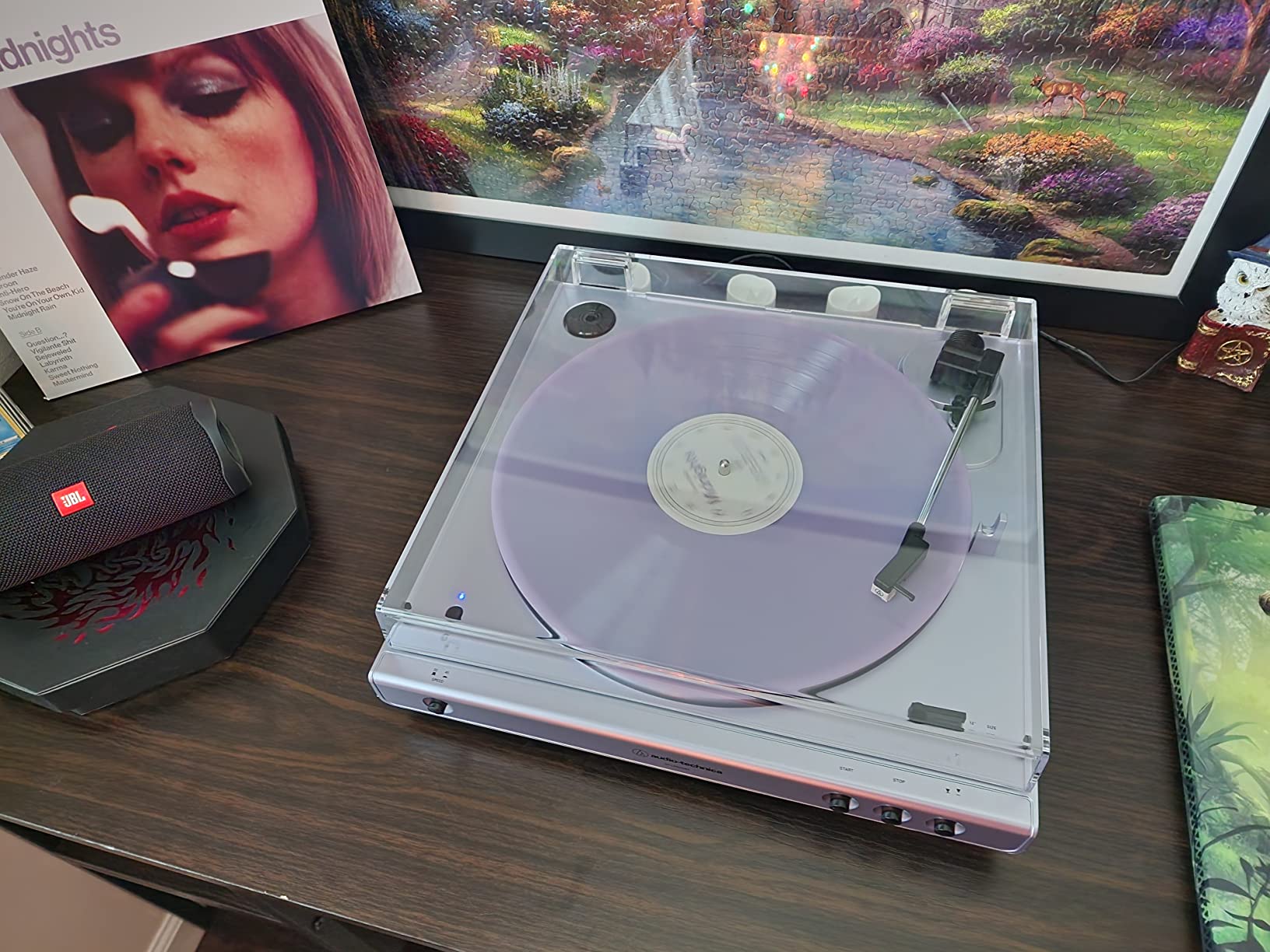
The Bluetooth module is a transmitter, which is the direction most people actually want. Your vinyl goes out wirelessly to Bluetooth speakers or headphones instead of down RCA cables. The codec is aptX rather than the baseline SBC, so on a phone or player that supports it you get a less compressed stream than the entry default. An external AC adapter keeps the power supply away from the signal path, which reduces hum on a deck at this level.
The cartridge is the ATN3600LC, which is part of the VM95 family. When you outgrow it, you can swap in a better VM95 cartridge in a few minutes without changing anything else on the deck. That single feature is what makes this a stepping stone rather than a dead end, and it is the reason the r/turntables community treats this as a default first record player rather than a throwaway.
Who the AT-LP60XBT suits
It suits beginners who want the deck to be simple but do not want to compromise on the parts that make vinyl sound good. Fully automatic operation removes the learning curve, and the aluminum platter and switchable phono stage keep the signal clean.
It also suits anyone who will add a proper amplifier in a year or two. Because the cartridge is upgradeable and the preamp is built in, you can move up a component at a time instead of replacing the whole deck.
Who should skip it
Skip it if you want zero extra purchases. There are no built-in speakers, so you need a Bluetooth speaker, a pair of active speakers, or an amplifier with speakers before anything comes out. Budget for that before you buy the deck.
Skip it if you collect 78 rpm records or want to play with tracking force and alignment. Fully automatic operation means the tonearm is not adjustable, and that removed control is exactly what enthusiasts argue about.
4. Retrolife R609 Review: the Cheapest Way to Start a Collection
Retrolife® Vinyl Record Player with Speakers, Bluetooth Vinyl Player-Black
Three-speed belt drive 33/45/78 rpm
Built-in Bluetooth and aux
Auto-stop
Pros
- Lowest starting outlay of any deck we cover
- Plays three speeds and three record sizes
- Bluetooth and aux both built in
- Auto-stop and a carry handle for moving it
- Sound is clear for the money
Cons
- Lightweight build can wobble on a shared surface
- Non-adjustable tonearm and a basic stylus
- Small drivers give up quickly at volume
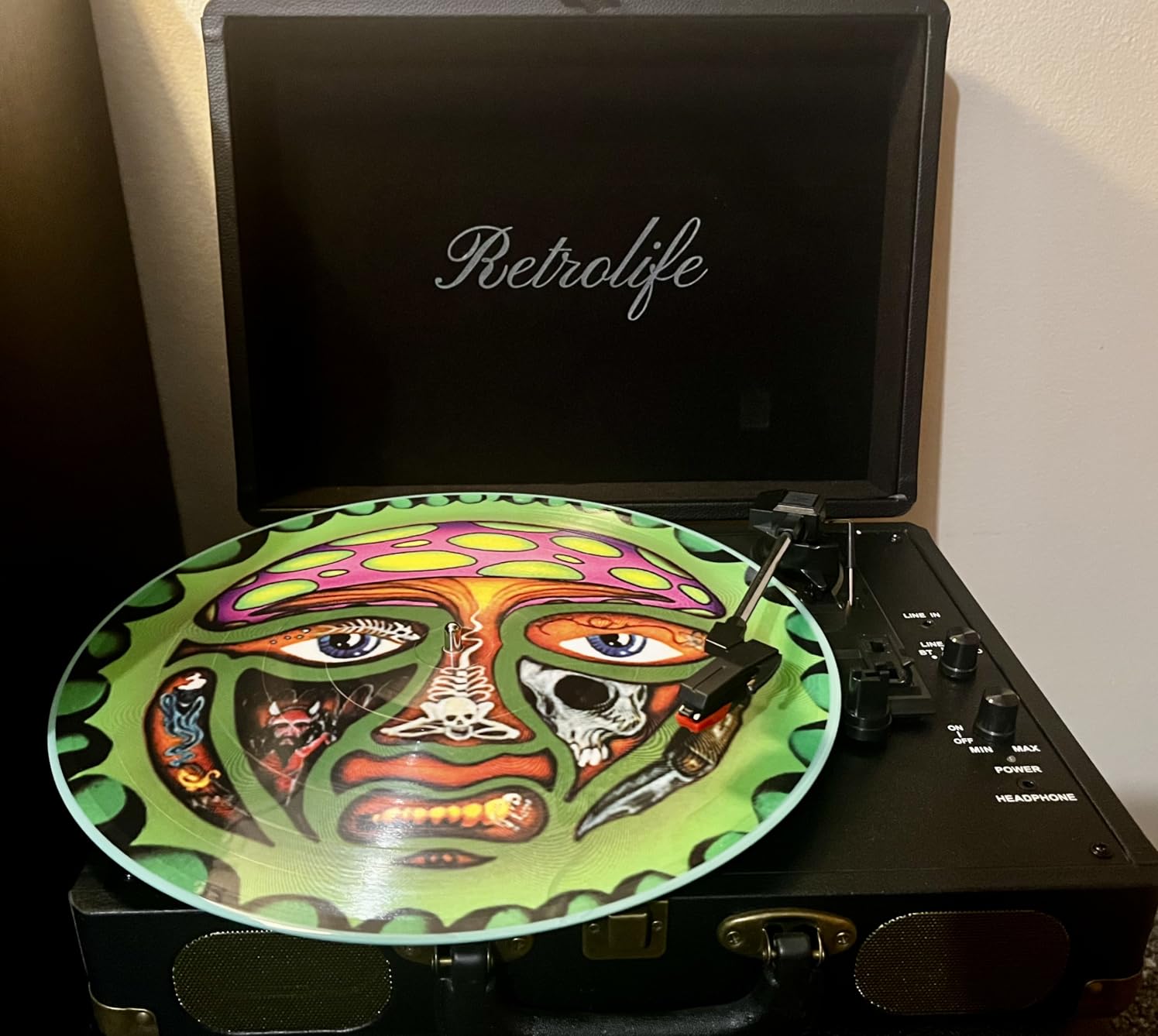
The Retrolife R609 answers a question most first-time buyers do not ask out loud, which is whether the commitment to a hobby should cost more than a dinner. It is a portable belt-drive suitcase deck with built-in Bluetooth, built-in speakers, and three speeds, and it is the least expensive way to find out whether you actually like listening to records.
Speeds cover 33, 45, and 78 rpm across 7 inch, 10 inch, and 12 inch records, so the same range of music works as on the Victrola Journey. There is an RCA line output, an aux input, and a front headphone jack, plus a quick mode switch that moves between Bluetooth, aux-in, and phono without hunting through menus. An auto-stop switch ends the side for you.
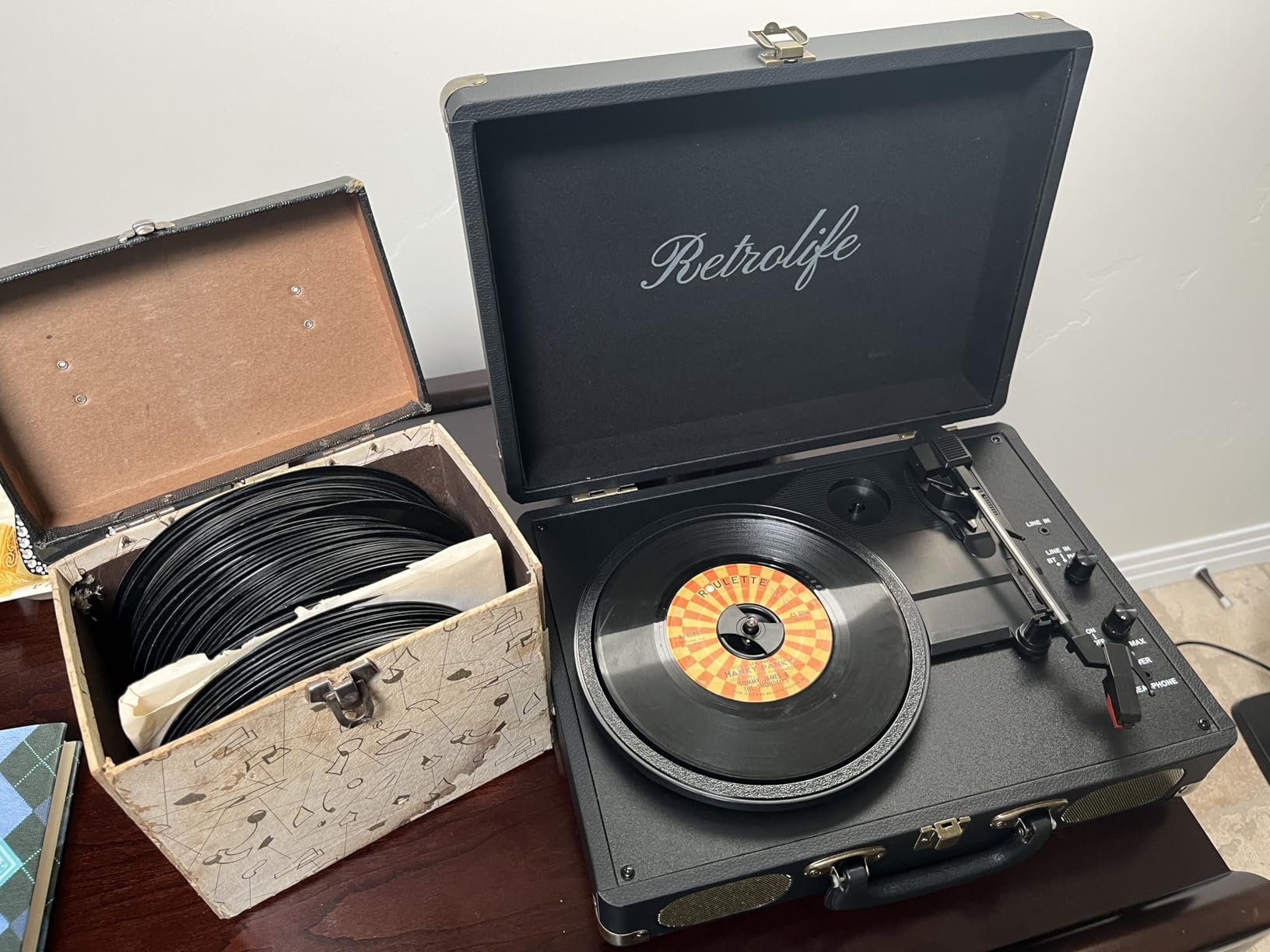
Bluetooth is a receiver, so the R609 works as a Bluetooth speaker when you play audio from a phone. That also makes it a simple bridge: you can play a record through its line output into a Bluetooth transmitter, or play phone audio through its own drivers. Seven colour options are available and the PU leather exterior with bronze accents reads more like a piece of luggage than a component.
What you give up for the low cost is weight and build rigidity. At 2.5 kg with a wood enclosure, reviewers note the housing can feel less than solid, and stability matters on a record player because any wobble shows up as skipping. Put it on a solid surface and it behaves.
Who the Retrolife R609 suits
It suits a first purchase on a tight budget, a second-room or dorm setup, and anyone who wants to test vinyl without committing. It also suits a gift for someone whose taste you are not sure about yet.
It suits people who move often. At 13.97 inches by 10.51 inches by 4.15 inches with a handle, it is one of the easiest to move between a flat, a holiday house, and a shared home.
Who should skip it
Skip it if you already own good speakers. Line output is available, but the cartridge and stylus are basic, so playing through a serious system exposes the deck more than a better one would.
Skip it if bass and volume matter to how you listen. The built-in drivers run out of low end quickly, which is the most common complaint in reviews, and the light build adds vibration at higher levels.
5. 1byone HiFi Turntable System Review: the Best Value When You Also Want Speakers
1 BY ONE Bluetooth Turntable HiFi System with 36 Watt Bookshelf Speakers
Adjustable counterweight
Phono line preamp switch
36 watt speakers included
USB output
Pros
- A pair of 36 watt bookshelf speakers is included
- Adjustable counterweight and anti-skate improve tracking
- Audio-Technica AT3600L cartridge can be upgraded
- Switchable phono stage plus USB recording output
- Solid iron platter resists vibration
Cons
- Tonearm balance and anti-skate need setup attention
- Auto-off can interrupt a long side
- Bluetooth playback is quieter than the wired path
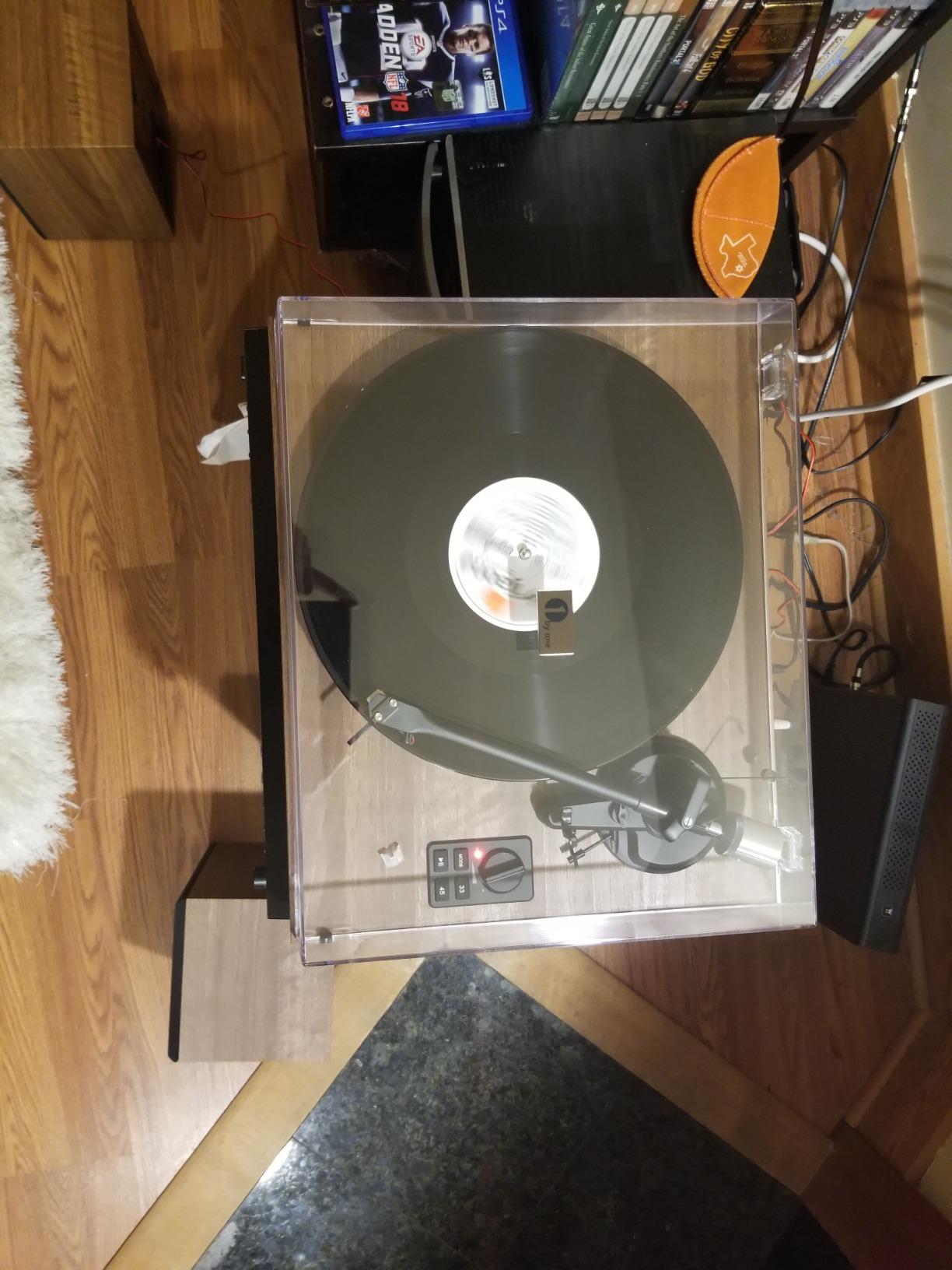
The 1byone HiFi system is the only package in this roundup that hands you a turntable and a proper pair of bookshelf speakers in the same box. The speakers are 36 watts each and connect to passive speaker jacks on the deck, which means you get a complete stereo from a single power socket and a single remote-free setup.
The turntable half is a real step up from the suitcase designs above it. It has an adjustable counterweight and anti-skate control, so you set the tracking force rather than inheriting a fixed one. The cartridge is an Audio-Technica AT3600L, which you can replace with a better model later. The preamp is switchable between phono and line, so the deck works whether you route it through an amplifier later or straight into the included speakers.
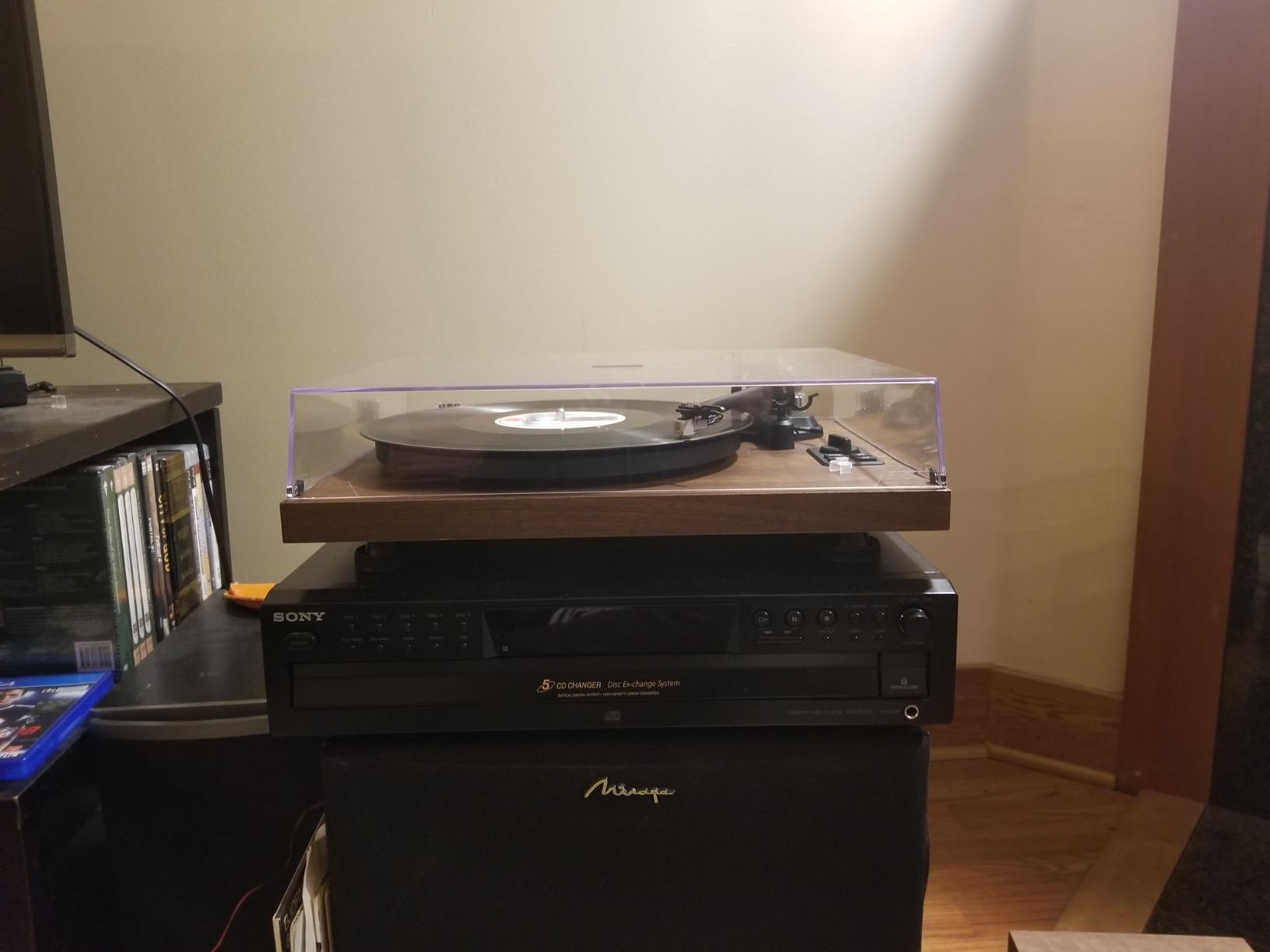
There is also a USB output, which matters more than it sounds. You can connect it to a computer and record your records to digital files as you listen, then play those files on a phone with Bluetooth. That gives this system a complete path from vinyl to wireless playback in the list without a separate capture device.
Bluetooth streams from your phone into the deck at normal quality, though reviewers report the level is a little lower over Bluetooth than over the wired speaker path. The 65 dB signal-to-noise ratio and a solid iron platter do more for clean playback than the wireless step does.
Who the 1byone HiFi system suits
It suits a beginner who has decided to buy proper speakers but does not want to research amplifiers yet. The system is complete on day one, and both parts are usable separately later, so you are not locked into the included speakers forever.
It also suits anyone coming from a suitcase player who has decided the sound was not convincing. Users report the jump from built-in micro-speakers to a real pair of bookshelf speakers as the single biggest audible improvement in the hobby.
Who should skip it
Skip it if setup anxiety is the main concern. There is a counterweight to balance, an anti-skate dial to set, and a phono-line switch to understand. It is more work on day one than any fully automatic deck here, though reviewers note the instruction booklet can be demanding for a complete beginner.
Skip it if the auto-off feature bothers you. Owners report the system shutting down during inactivity, which can interrupt a side if you stop moving. The two-tone speaker wires and the large AC adapter block are smaller annoyances of the same kind.
6. Audio-Technica AT-LP120XBT-USB Review: the Best Deck Here for Long-Term Listening
Audio-Technica AT-LP120XBT-USB-BK Wireless Direct-Drive Turntable (Analog, Wireless & USB), Fully Manual, 3 Speed, Convert Vinyl to Digital, Built-in Pre-Amp, Black
Direct drive DC servo
Bluetooth with aptX Adaptive
USB recording output
78 rpm support
Pros
- Direct drive motor with quartz speed lock is highly accurate
- aptX Adaptive Bluetooth plus USB and RCA outputs
- Switchable phono preamp so it works with any amplifier
- AT-VM95E elliptical stylus in a VM95 upgrade path
- Variable pitch control and stroboscopic speed indicator
Cons
- Fully manual operation has a real learning curve
- No built-in speakers and a large footprint
- Highest outlay of the ten decks covered
The AT-LP120XBT-USB is the one to buy if you expect this hobby to last. It has the highest rating in this roundup, and it is also the least forgiving to a first-time owner, which is why it is not our top pick but is our long-term recommendation.
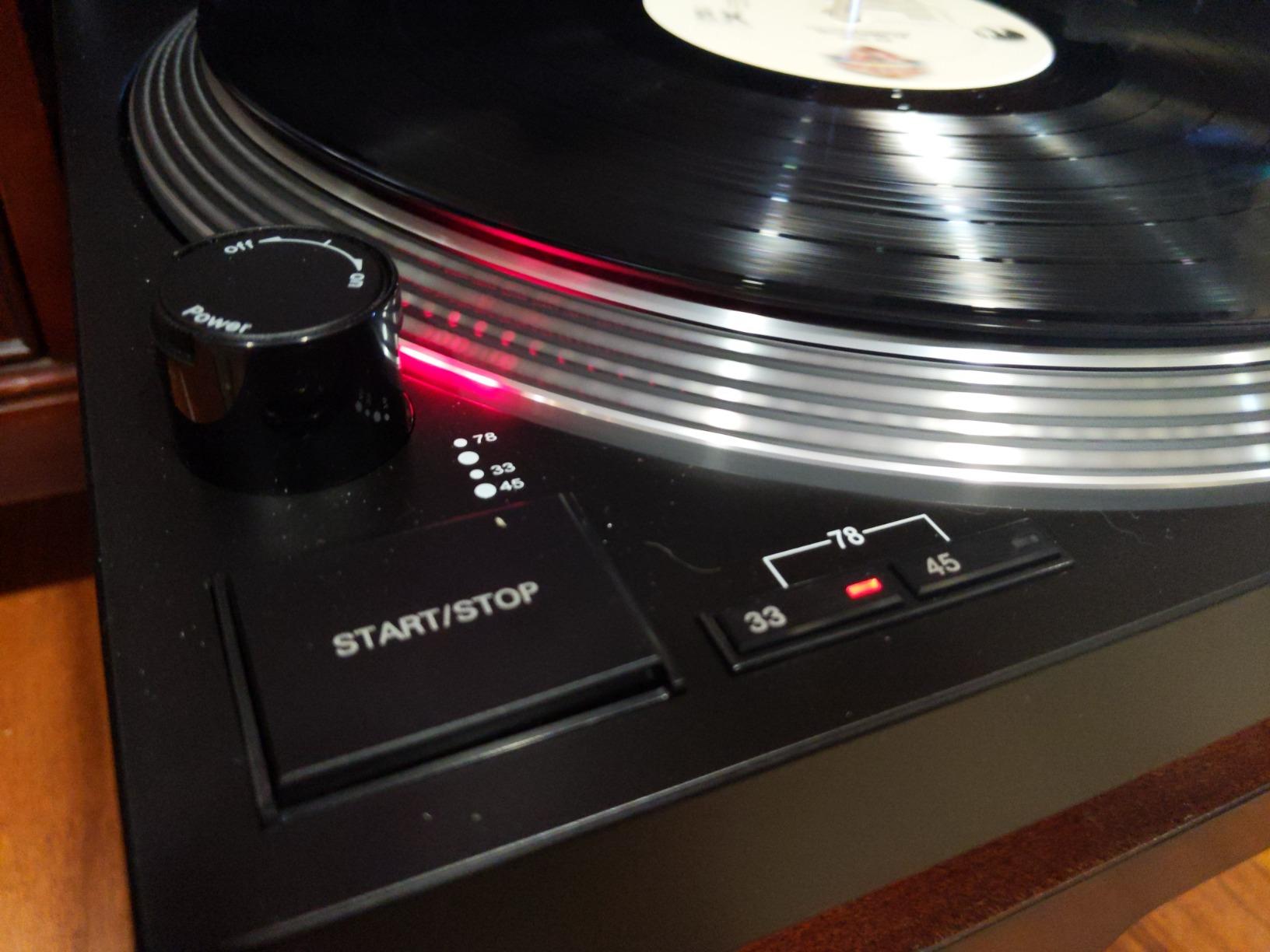
The motor is a direct drive DC servo of the type used for DJ decks, with variable pitch control, a quartz lock that holds the speed exactly, and a stroboscopic speed indicator on the platter rim so you can read accuracy by eye. Three speeds are covered: 33 1/3, 45, and 78 rpm. The tonearm is a balanced S-shape with a hydraulic lift, and anti-skate is adjustable, so you can set the arm the way a record should be tracked.
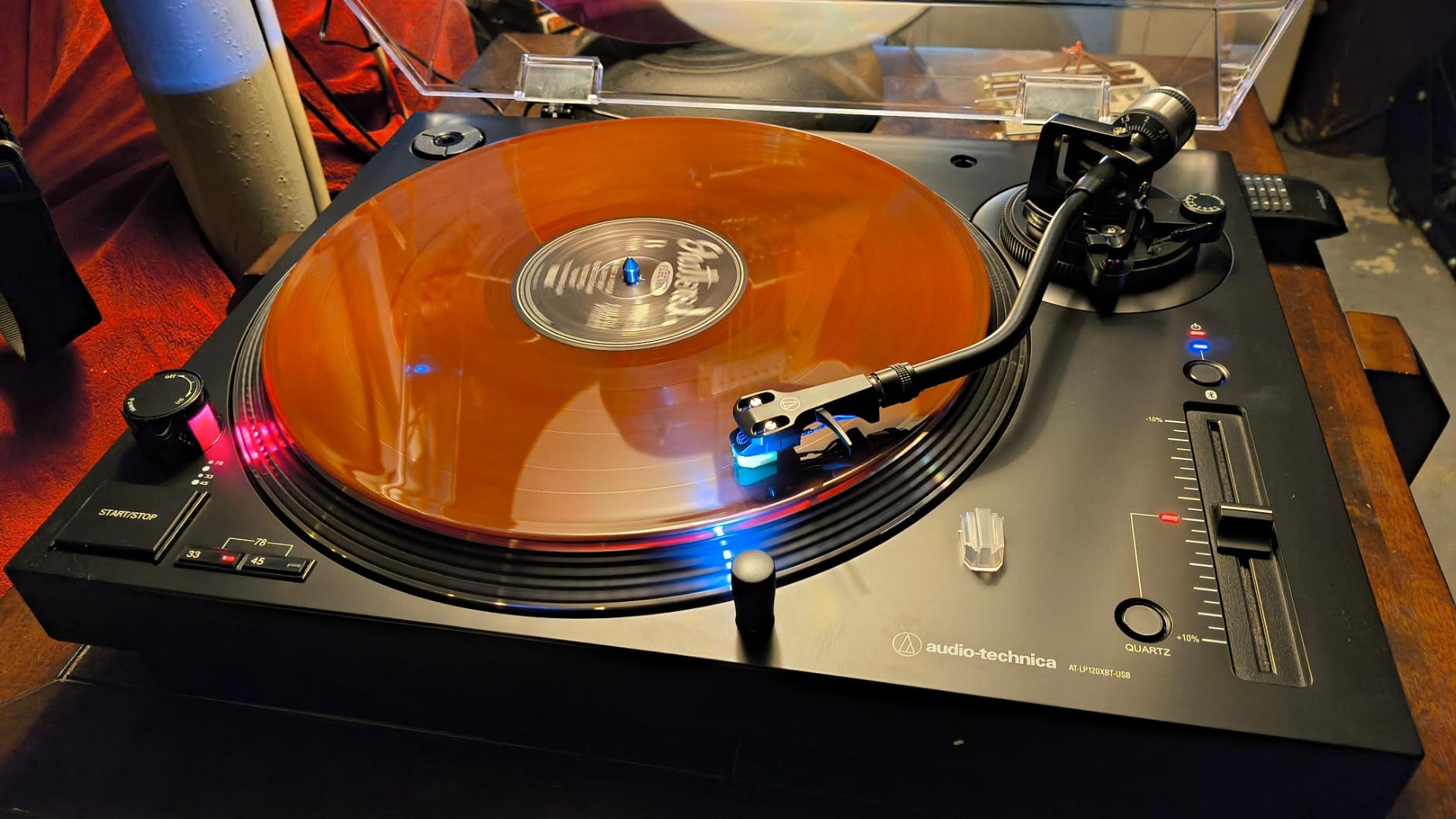
Bluetooth uses aptX Adaptive, which adapts the bitrate to conditions and generally preserves more of the signal than baseline SBC. If you want a digital copy, the USB output records vinyl to computer files directly. RCA line output is present as well, and the built-in phono preamp can be switched off so an amplifier with its own phono stage can take over without doubling the gain.
The fitted cartridge is an AT-VM95E with an elliptical stylus, the only elliptical stylus among the ten decks here. It sits at the top of the VM95 upgrade path, and the headshell is a universal half-inch mount, so any VM95 cartridge swaps in with two screws. The die-cast aluminum platter has a felt mat, and the damped base cuts feedback from nearby speakers.
Who the AT-LP120XBT-USB suits
It suits a beginner who already owns speakers and an amplifier, or who is certain they will within a year. Everything a serious setup offers is here, and you would not need to replace it when your taste grows.
It also suits anyone digitizing a family record collection. The USB output, aptX Adaptive wireless, and 78 rpm support in one deck cover archiving, casual listening, and the occasional shellac transfer.
Who should skip it
Skip it if you want the arm to handle itself. Operation is fully manual, and you are expected to know or learn what tracking force is and how to balance a tonearm. Beginners who buy manual decks and then find cueing and counterweight setup intimidating is a repeating pattern in the forum complaints we read.
Skip it if budget is the main constraint. It is the highest outlay of the ten decks we cover, it has no built-in speakers, and it needs a 22 by 18 inch footprint on a surface with room around it.
7. ANGELS HORN Turntable With Built-in Speakers Review: the Middle Ground Deck
ANGELS HORN Bluetooth Vinyl Record Player with Built-in Speakers, AT-3600L
Four built-in speakers
Switchable phono preamp
Adjustable counterweight
AT-3600L cartridge
Pros
- Four built-in speakers give a fuller sound than most all-in-one decks
- Adjustable counterweight lets you set tracking force
- Universal headshell makes cartridge swaps easy
- Switchable phono and line preamp plus RCA outputs
- Three-year warranty
Cons
- Bluetooth is input only so you cannot stream vinyl out
- No auto-stop and no 78 rpm
- Counterweight calibration takes practice on first setup
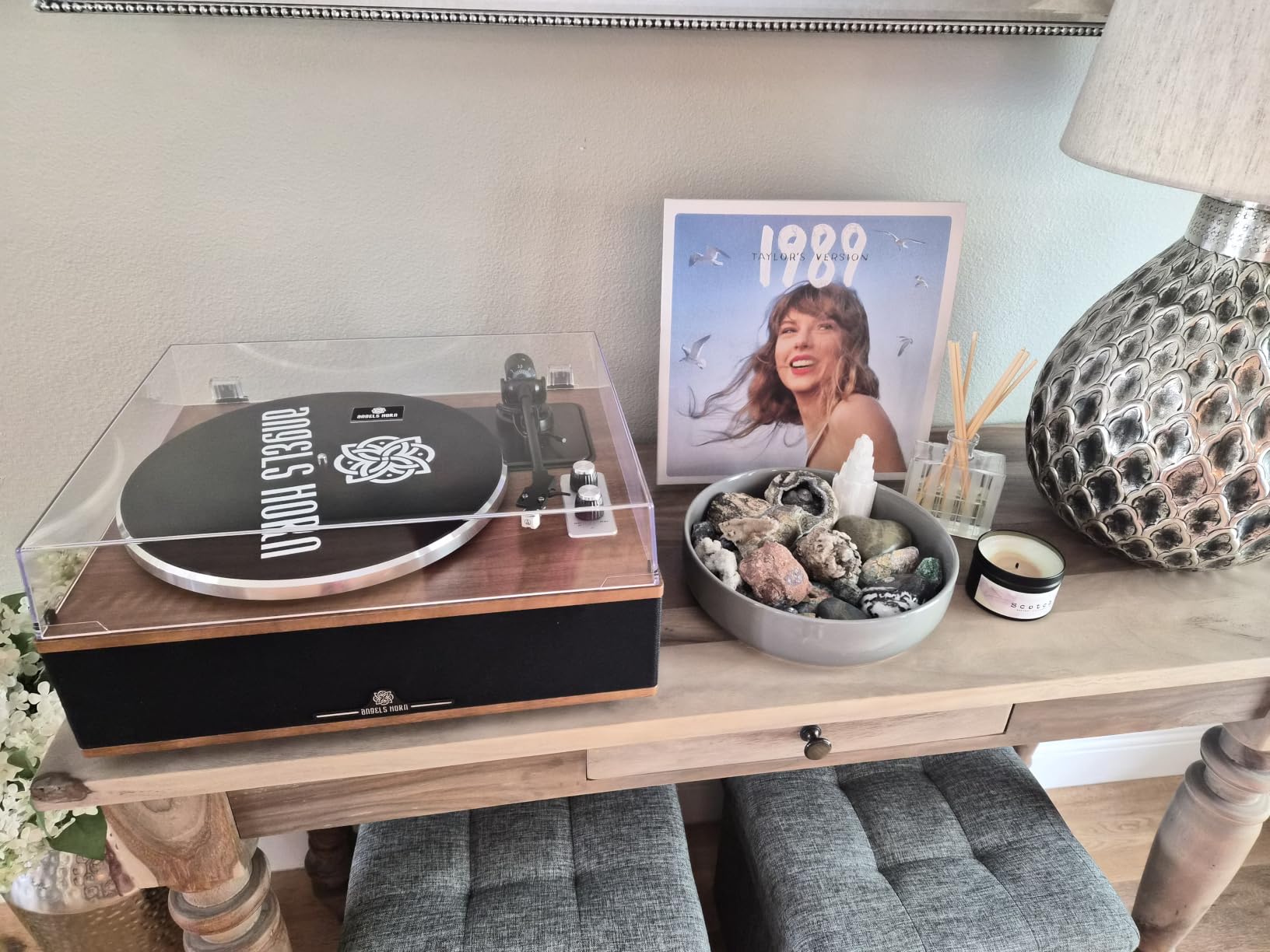
The ANGELS HORN sits between the suitcase players and the serious manual decks, and that positioning is genuinely useful. It is an all-in-one wooden cabinet with four built-in speakers, a die-cast aluminum platter, and a two-speed belt drive at 33 1/3 and 45 rpm.
The significant detail is the adjustable counterweight paired with an AT-3600L magnetic cartridge. That means you set the tracking force yourself rather than accepting a fixed one, and because the headshell is universal, you can replace the cartridge with a better one later without buying a new deck. For a beginner who plans to buy better over time, that combination is the argument for this model.
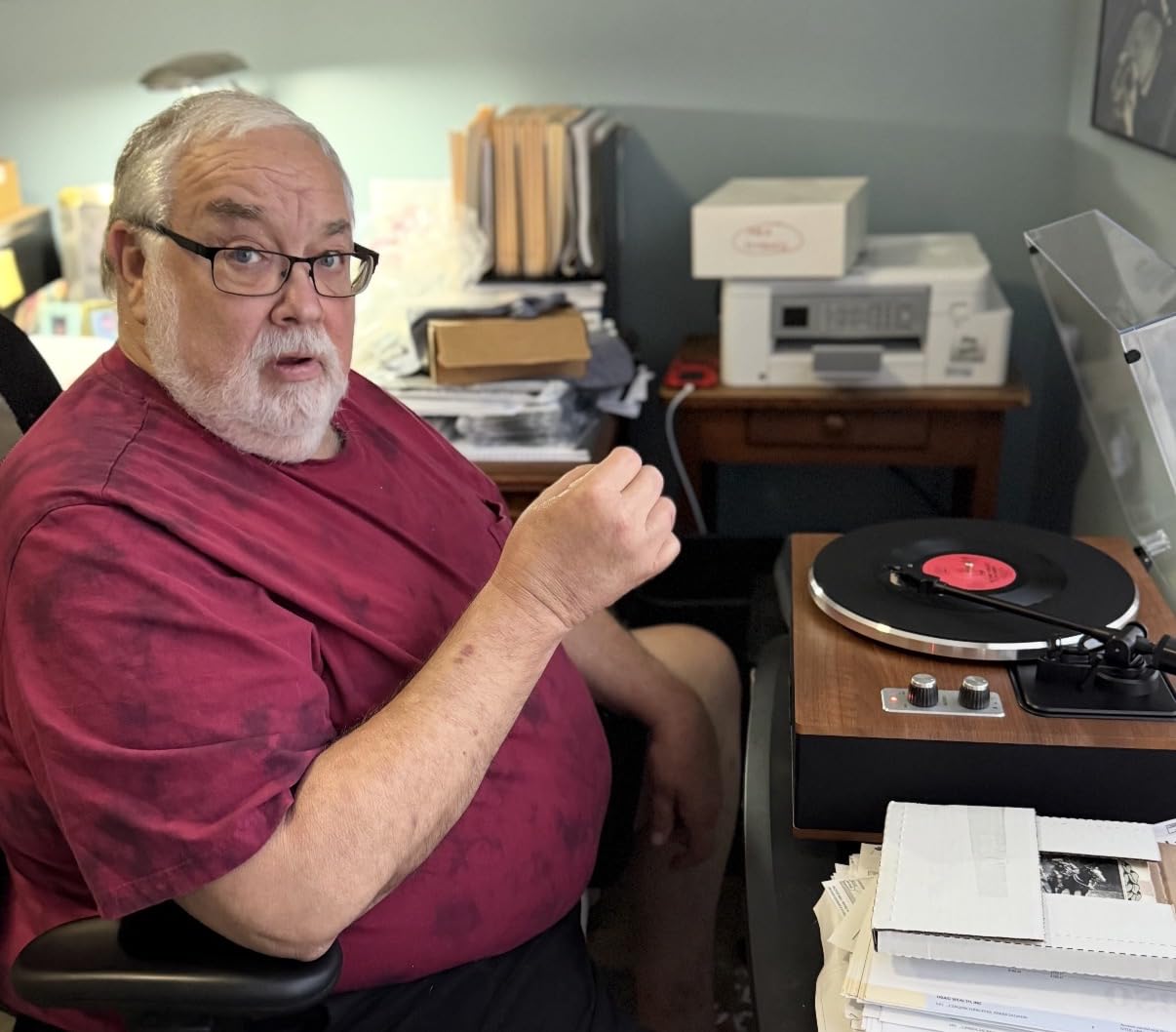
Bluetooth 5.0 here is input only. Your phone streams into the deck and the four built-in speakers play it, but the deck cannot send its own vinyl audio out to Bluetooth headphones or speakers. If streaming vinyl out matters to you, this is not the model, and it is one of the first things to check before buying any all-in-one.
A built-in phono preamp with a phono-line switch means it connects to external speakers or an amplifier without a separate preamp box, and RCA outputs plus an aux input cover the other directions. There is a removable dust cover, a 3-year warranty, and black and walnut finishes.
Who the ANGELS HORN suits
It suits beginners who want a single cabinet with a real cartridge path and room to improve it. The counterweight makes tracking better than fixed-arm designs at a similar price, and the dust cover keeps your records safe on the same shelf.
It also suits anyone with a small listening area who wants fuller sound than two small drivers can produce. Four speakers in a wood cabinet give a bigger, more even presentation than the micro-speakers in a suitcase player.
Who should skip it
Skip it if you want to listen to records through wireless headphones at night. Bluetooth input only rules that out, which is a significant limitation for people in shared flats where the wired headphone jack on the front is not enough.
Skip it if you want the arm to stop on its own, or if you collect 78 rpm records. There is no auto-stop and only two speeds. Some owners also report motor speed drift over long periods and slower support response when something goes wrong.
8. Audio-Technica AT-LP70XBT Review: the Best Fully Automatic Bluetooth Deck
Audio-Technica AT-LP70XBT Wireless Turntable (Black/Bronze)
Fully automatic belt drive 33/45 rpm
J-shaped tonearm
Switchable phono preamp
AT-VM95C cartridge
Pros
- Fully automatic start stop and return with no counterweight setup
- J-shaped tonearm is shaped to reduce tracking errors
- Built-in switchable phono and line preamp
- VM95 cartridge path keeps upgrade options open
- Compact and light at 6.4 pounds
Cons
- No built-in speakers so a separate system is required
- Plastic chassis instead of metal
- Only two speeds and no 78 rpm
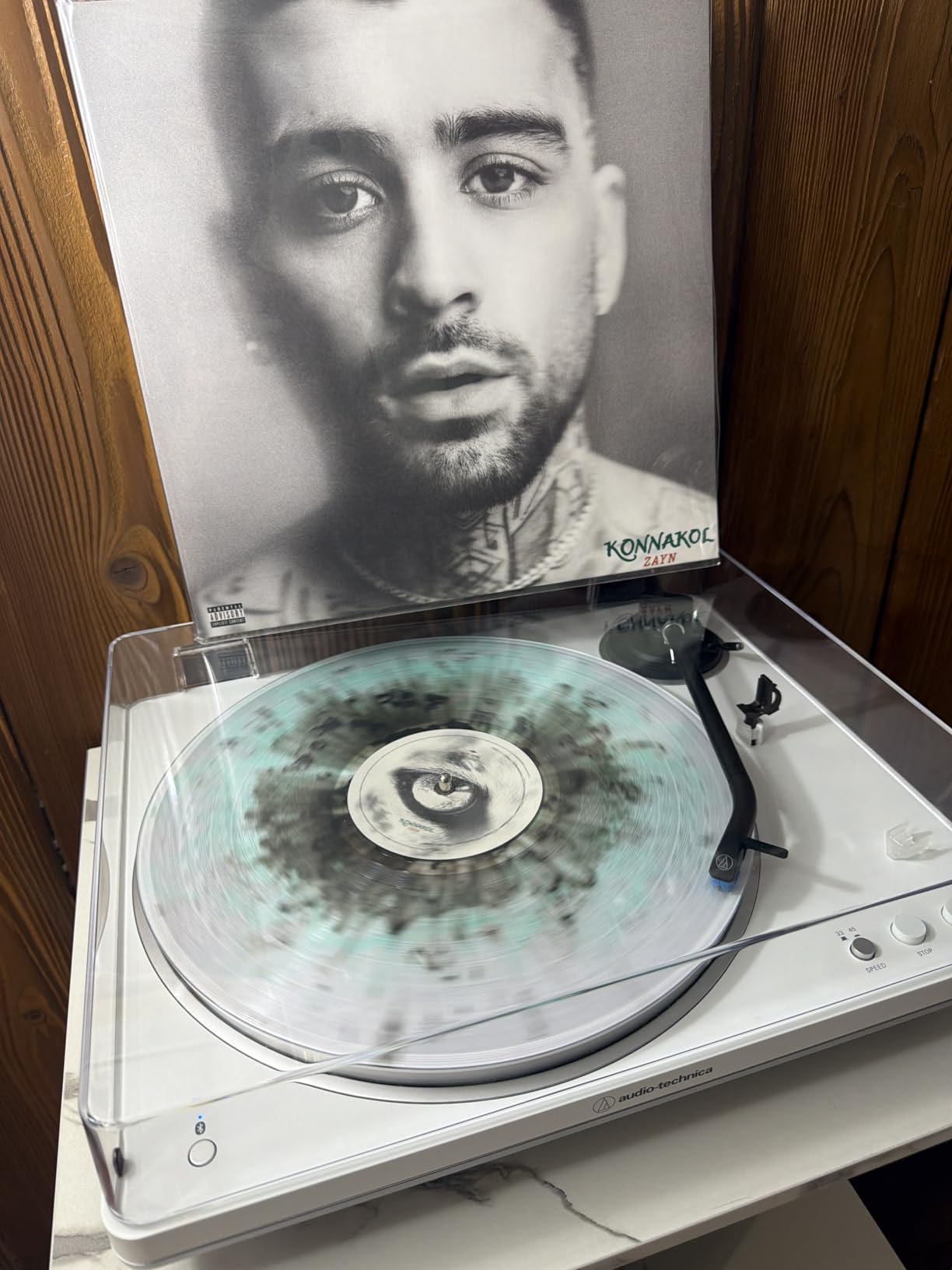
The AT-LP70XBT is the Audio-Technica for someone who wants the deck to do everything itself. It is fully automatic: the arm starts at the beginning of the side and returns at the end, so there is no counterweight to balance and no anti-skate to set. The community view on r/turntables is that this is the sensible plug-and-play automatic option for a total beginner.
Speeds are 33 1/3 and 45 rpm, with a 45 rpm adapter included and a detachable RCA output cable in the box. The tonearm is a J-shape rather than a straight arm, and that geometry is deliberate: it is built to reduce tracking errors on ordinary pressings without any adjustment from you.
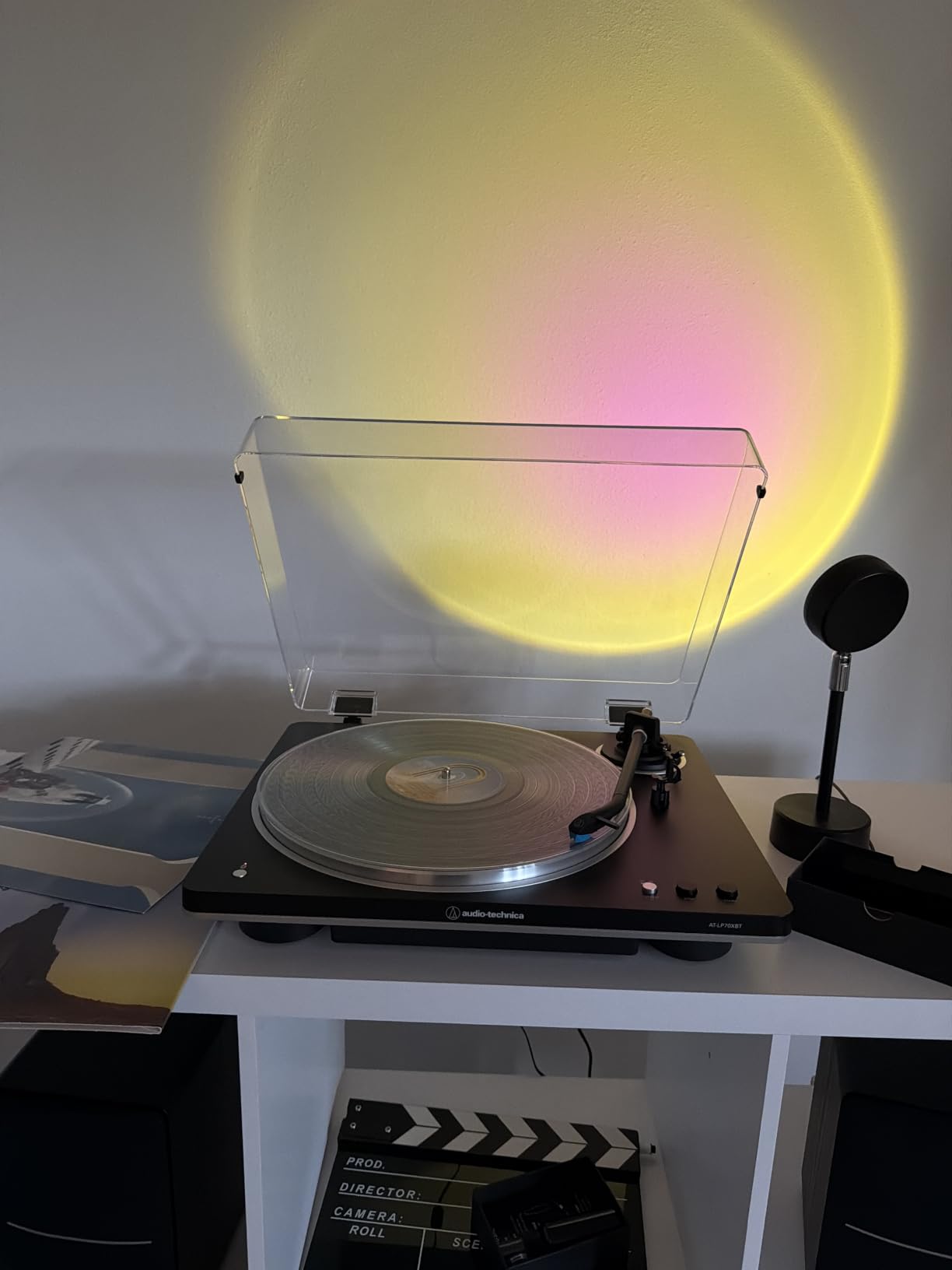
The phono preamp is built in and switchable, which is the feature that saves you money. You can plug straight into powered speakers, or switch it to line level and connect to an amplifier with its own phono stage. Most budget decks force one or the other.
The cartridge is an AT-VM95C, so it shares the same headshell family and upgrade path as the rest of the range. Three-piece chassis construction damps resonance, and at 12.99 inches by 15.75 inches by 4.33 inches and 6.4 pounds, it is compact enough for a small shelf. A detachable dust cover and a 2-year warranty are included, in white-silver, black-silver, and black-bronze.
Who the AT-LP70XBT suits
It suits first-time buyers who find manual decks intimidating. Every mechanical decision has been made for you, and the J-shaped arm is the reason it still tracks cleanly instead of skipping on worn records.
It also suits anyone who wants a compact, light deck they can move easily. The compact footprint and low weight mean it is easy to relocate when you move home, which matters for people who move countries every couple of years and worry about what they can take with them.
Who should skip it
Skip it if you want built-in speakers. There are none, so nothing plays unless you connect a Bluetooth speaker, active speakers, or an amplifier.
Skip it if you want a metal chassis or 78 rpm support. The construction is plastic rather than aluminum, and the extra 78 rpm setting is missing. Enthusiasts who outgrow automatic operation will also find nothing here to adjust.
9. Victrola Century Review: the Best Option for Streaming Vinyl Out Over Bluetooth
Victrola Century – 6-in-1 Bluetooth Record Player – Walnut
VINYLSTREAM Bluetooth output
Bluetooth input too
Three-speed 33/45/78 rpm
CD and cassette playback
Pros
- Streams vinyl out to Bluetooth speakers and headphones
- Also accepts Bluetooth and aux input for phone audio
- Plays 78 rpm records like the other Victrolas here
- CD player and cassette deck in the same cabinet
- Headphone jack and RCA output on board
Cons
- No adjustable counterweight or anti-skate so skipping can occur
- Built-in speakers lose low end at higher volume
- No remote control
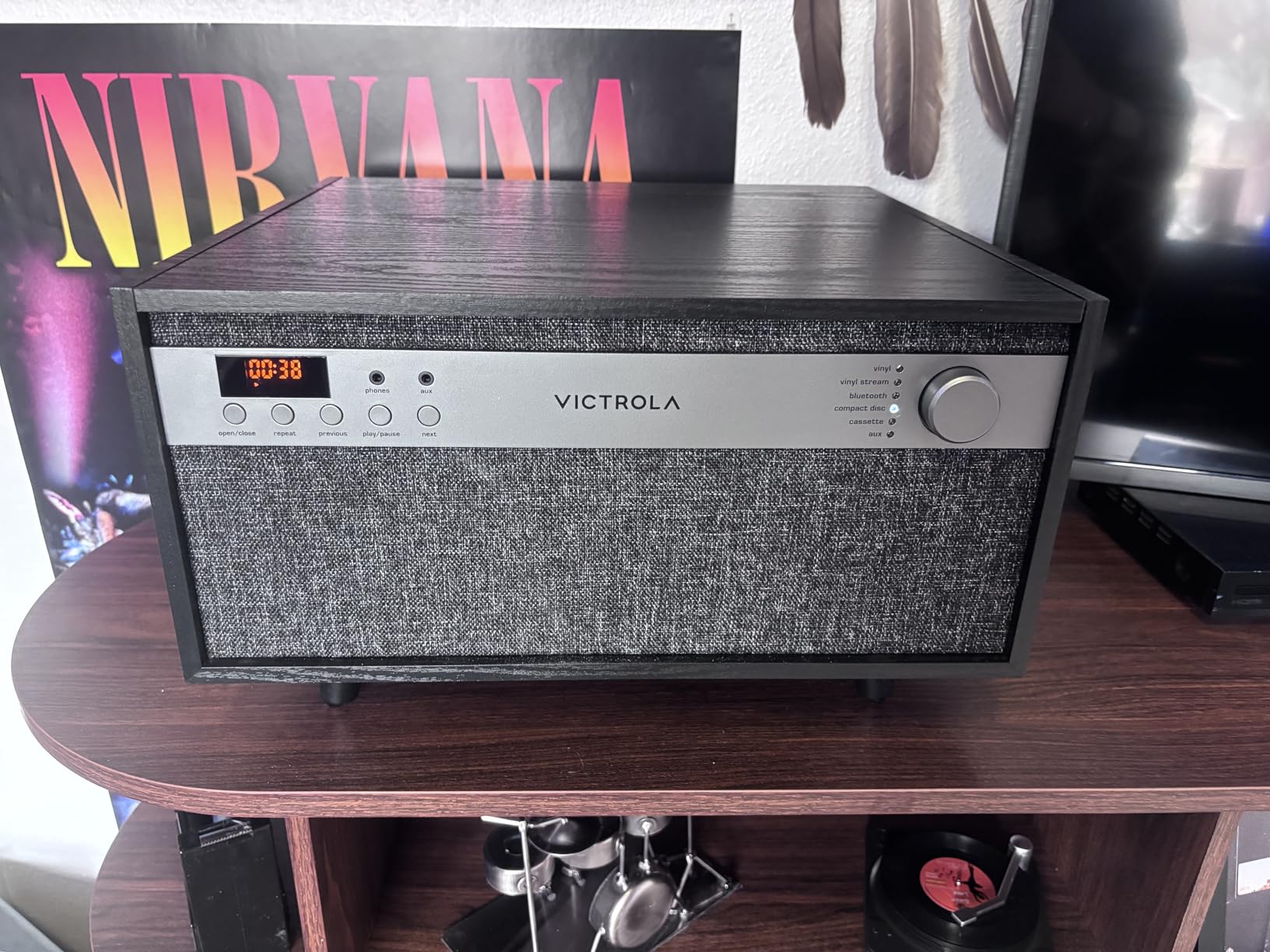
The Victrola Century is the most interesting Bluetooth configuration in this roundup, because it does both directions. VINYLSTREAM sends the record playing on the turntable out to your Bluetooth speakers or headphones, and the same unit also accepts Bluetooth input, so it can play phone audio through its own drivers.
That combination matters in a specific scenario. If you want to listen to records on wireless headphones at night without waking anyone, or you already own good Bluetooth bookshelf speakers and would rather not buy a system, the Century removes the cable and keeps the sound in one box. It is a 6-in-1 unit: three-speed turntable at 33 1/3, 45, and 78 rpm, Bluetooth, VINYLSTREAM output, a CD player, a cassette player, and a 3.5 mm aux input.
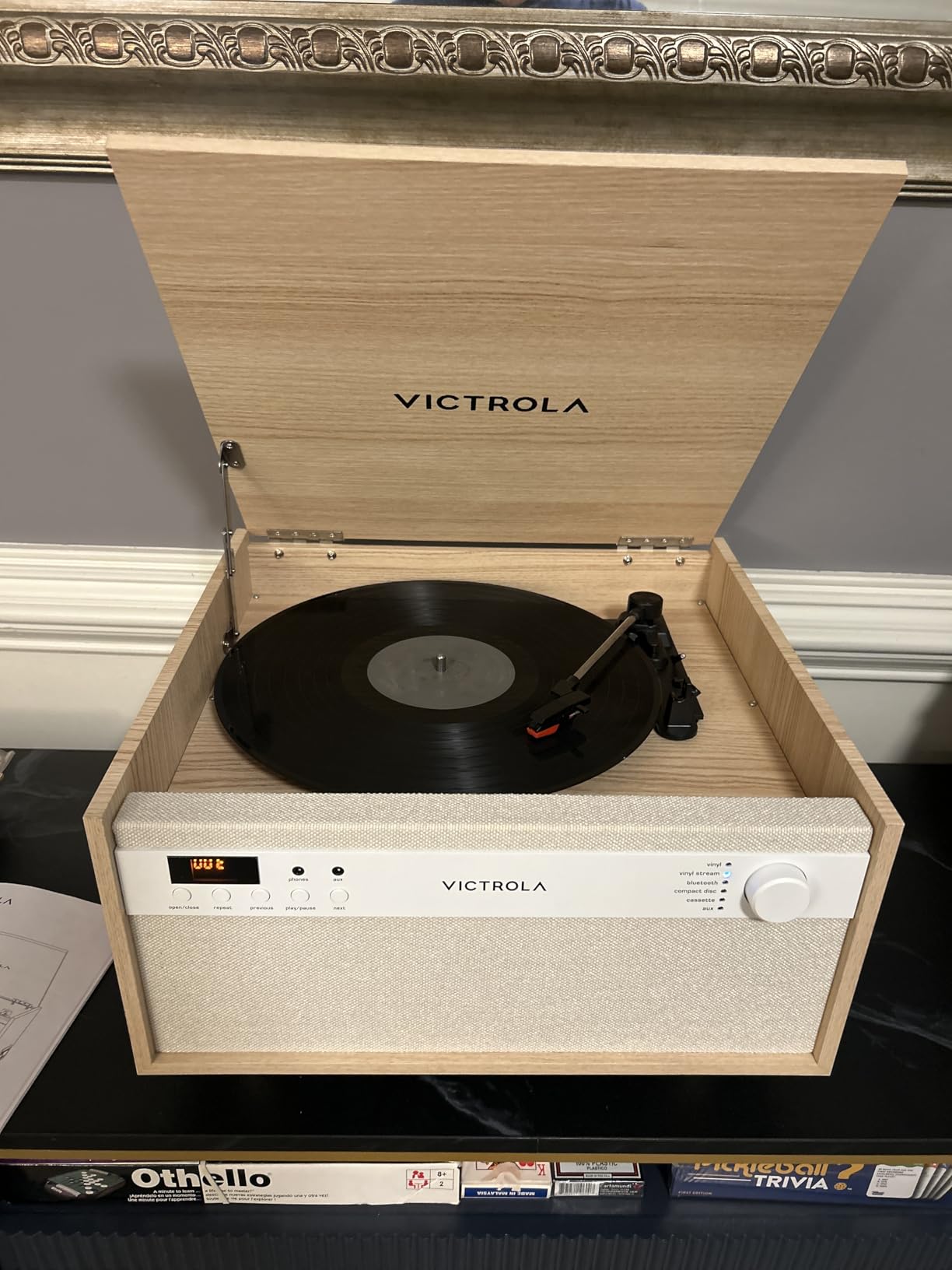
The turntable is a three-speed belt drive with built-in custom-tuned stereo speakers, a headphone jack, and RCA output for a better system later. Eight style and finish combinations are offered, and the mid-century styling is the main reason it gets left out on display.
The limitation is mechanical, not electronic. There is no adjustable counterweight and no anti-skate, so the tracking force is fixed and skipping can show up on worn or heavy records. On well-kept modern pressings it rarely surfaces at all, so test a used record or two before you commit.
Who the Victrola Century suits
It suits anyone whose existing speakers are Bluetooth, because it is the deck here that speaks to them natively. Same for late-night headphone listening through wireless headphones without a cabled jack in the way.
It also suits people with a mixed CD and cassette habit who want one object on the shelf, and anyone who wants 78 rpm support without stepping up in price.
Who should skip it
Skip it if you plan to buy a lot of well-worn records. The fixed tonearm weight with no anti-skate is the single most reported complaint, and skipping is the direct result.
Skip it if volume matters at the low end. Reviewers note the built-in speakers lack bass at higher levels, and the fix is adding external speakers through the RCA output, which then makes the bundled CD and cassette sections feel like dead weight.
10. Udreamer UD019 Review: the Only Deck Here With Two-Way Bluetooth and USB Recording
Viny Record Player with 2 External Speakers and 2 Bluetooth Modes,Turntable with ATN-3600 Stylus,Pitch,USB Recording,RCA and AUTO Stop for Vinyl Records
Bluetooth input and output modes
Two 15 watt speakers
USB recording output
Pitch control
Pros
- Bluetooth input and output modes on the same deck
- Two 15 watt external speakers are included
- USB recording converts vinyl to digital files
- Pitch control lets you correct speed on worn records
- Auto-stop ends the side for you
Cons
- Shortest warranty in the roundup at 30 days
- Smallest review base of the ten models
- Two speeds only with no 78 rpm
The Udreamer UD019 is the sleeper in this list because it pairs two features that rarely appear together: dual Bluetooth in both directions, and a USB recording output. It also includes a pair of 15 watt external speakers, so the box gives you a turntable, two speakers, and a capture path in one purchase.
Dual Bluetooth means you can stream vinyl out to your own Bluetooth speakers or headphones, and separately play audio from your phone into the deck. In practice that means you can go from a record to a playlist without unplugging anything, which is the everyday convenience most people describe when they ask why they wanted Bluetooth in the first place.
The USB output records vinyl to digital files, and there is a pitch control for correcting the small speed variations that show up on older pressings, along with an auto-stop function. The stylus is an ATN-3600 and the drive is belt with RCA outputs and dedicated passive speaker jacks for the included pair.
Two speeds are covered at 33 and 45 rpm, so 78 rpm records are out of reach. The build mixes aluminum, glass, plastic, and wood at 11 pounds, and the styling is more decorative than the Audio-Technica units in this roundup.
Who the Udreamer UD019 suits
It suits a beginner who already owns Bluetooth speakers, since streaming vinyl out removes the need for an amplifier entirely. It also suits anyone starting to digitize a small collection, because the USB output is included at no extra component cost.
It suits people who want pitch control, since it is the only deck here that lets you nudge playback speed when a record sounds slightly fast or slow.
Who should skip it
Skip it if warranty length matters to you. It carries a 30-day return and replacement window, which is far shorter than the two to three years on the other picks, and that gap usually reflects support and parts availability.
Skip it if you want an established brand or a large body of owner feedback. This model has the fewest reviews of the ten in this roundup, so the long-term reliability picture is thinner than the Audio-Technica and Victrola alternatives.
Bluetooth Transmitter vs Receiver: Which Direction Do You Actually Need?
A Bluetooth turntable does one of two jobs, and most first-time buyers cannot tell which one the model they are looking at does. This is the single most common confusion in the category, and it decides whether a deck is useful to you.
A Bluetooth receiver pulls audio in. Your phone streams to the turntable, and the deck plays it through its own speakers or its line output. That makes the turntable a Bluetooth speaker and gives you a way to play playlists on the same system you play records on. Nearly every deck in this roundup has receiver mode, including the Victrola Journey, the Quincy, the ANGELS HORN, and the Retrolife R609.
A Bluetooth transmitter pushes audio out. The record plays on the turntable, and that audio goes wirelessly to your Bluetooth headphones or your Bluetooth speakers instead of down RCA cables. This is the direction most beginners assume they are buying and the one they most often do not get. In this roundup only the Audio-Technica AT-LP60XBT, the AT-LP70XBT, the AT-LP120XBT-USB, the Victrola Century, and the Udreamer UD019 transmit vinyl out.
How to tell without guessing: look for output, transmitter, VINYLSTREAM, or a headphone pairing mention in the specification. If the deck only mentions receiving or playing phone audio through its own speakers, it is input only. The ANGELS HORN is the clearest example of a good deck that will not do what some buyers expect.
If you want both, buy both-capable hardware. Two-way Bluetooth is rare, and the Udreamer UD019 and the Victrola Century are the two models here that cover it.
How to Choose a Bluetooth Turntable for Beginners?
Start with what you already own, not with the deck. The single most common regret among first-time buyers on forums is budgeting for the turntable and forgetting the speakers, so work backwards from the audio chain you will actually use.
If you own Bluetooth speakers, you need a deck with Bluetooth output. If you own active or powered speakers with an aux or RCA input, you need line output and a phono stage in the deck, or you need an amplifier. If you own nothing, an all-in-one such as the Victrola Journey, the Quincy, or the ANGELS HORN is the only way to hear something on day one.
Belt drive or direct drive
Belt drive uses a rubber belt to turn the platter, which absorbs motor vibration and gives a smoother, quieter result at listening distances. Almost every beginner deck here is belt drive, and that is the right default. Direct drive spins the platter from the motor itself, which gives faster start-stop, tighter pitch control, and quartz-accurate speed at higher cost. The Audio-Technica AT-LP120XBT-USB is the only direct drive in this roundup, and it suits a beginner who already knows they want manual control.
Automatic or manual operation
Fully automatic decks start and return the arm themselves, which removes the whole counterweight and cueing lesson. The AT-LP60XBT and the AT-LP70XBT are fully automatic, and community consensus is that they are the right first purchases for people who want the deck to handle itself. Manual decks give you tracking force, anti-skate, and alignment to adjust, which is where the hobby becomes a hobby. Buy manual if you enjoy that, not to prove anything.
Phono stage and cartridge
A phono stage, or phono preamp, takes the tiny signal from the cartridge and raises it to line level so ordinary speakers and amplifiers can play it. Without one, you need an amplifier or a preamp box with a phono input, which is the extra purchase most beginners miss. A switchable built-in phono stage, phono and line, is the flexible option and appears on the AT-LP70XBT, the AT-LP120XBT-USB, the ANGELS HORN, and the 1byone system.
The cartridge is what actually touches the record. A moving magnet cartridge is standard on every deck here and is easy to replace. Audio-Technica’s VM95 series is the upgrade path worth knowing: a VM95C or VM95E on an LP60XBT, LP70XBT, or LP120XBT can be swapped for a better VM95 cartridge in minutes. If a deck is not VM95-compatible, treat cartridge upgrades as a future deck purchase instead.
What else you need to buy
Budget for one of three setups rather than a deck alone. An all-in-one with built-in speakers needs nothing else, which is why the Victrola Journey and the ANGELS HORN are popular first purchases. A deck with a built-in phono stage plus a pair of active speakers is the middle route, and the 1byone HiFi system bundles exactly that. A deck with no built-in speakers plus an amplifier with a phono stage plus passive speakers is the separates route, and it is the one that sounds best and costs most.
For active speakers on a budget, our bookshelf speakers for turntables guide covers the sizes and specifications that pair well with a deck like the AT-LP60XBT. If you are leaning toward the all-in-one cabinets instead, our roundup of turntables with built-in speakers compares that category in detail.
Codecs and pairing
Codecs decide how much audio survives compression. SBC is the baseline and is what nearly everything falls back to. AAC is better on Apple devices. aptX and the higher-capacity aptX HD and aptX Adaptive variants preserve more detail, and aptX Adaptive also adjusts the bitrate to conditions, which the AT-LP120XBT-USB uses. LDAC offers the highest bitrate and requires both ends to support it. The practical effect is smaller than most marketing suggests, because the weakest link is usually the speaker.
On pairing, turn off nearby Bluetooth devices before you pair. A phone in a pocket can hold the first connection and leave the deck appearing to fail. The deck’s pairing mode is often held on a button rather than switched on permanently, so check the manual before concluding it is broken. Our suitcase turntable roundup covers the portable designs in more depth if space is your main constraint.
Frequently Asked Questions
Is it worth getting a Bluetooth turntable?
Usually yes, for a first-time buyer. Bluetooth removes the two biggest barriers to starting vinyl: buying an amplifier and running speaker cables. You can stream records to Bluetooth speakers or headphones you may already own. The trade is that Bluetooth compresses the signal, so a wired connection into a phono-capable amplifier will sound better. For a beginner starting from nothing, that convenience is worth it.
Do Bluetooth turntables sound good?
The deck is rarely the limiting factor. Bluetooth compression removes some fine detail, but the bigger constraint is the speaker or headphones doing the playing. A decent deck into a pair of Bluetooth bookshelf speakers will outperform an expensive deck into built-in micro-speakers every time. If sound quality matters most, keep the records playing and listen over a wired connection.
What is the best turntable with Bluetooth for a first-time user?
The Audio-Technica AT-LP60XBT is our pick for most first-time buyers. It has a die-cast aluminum platter, a built-in phono preamp, aptX Bluetooth output for streaming to speakers or headphones, and fully automatic operation so there is no tonearm setup. If you want zero extra purchases, the Victrola Journey includes speakers and needs nothing else.
Do I need an amplifier for a Bluetooth turntable?
Only if the deck has no built-in phono stage or you want to use wired speakers. All-in-one models such as the Victrola Journey and the ANGELS HORN need nothing extra. A deck like the Audio-Technica AT-LP60XBT has a built-in preamp but no speakers, so you need Bluetooth speakers or active speakers. Wired passive speakers additionally require an amplifier with a phono input.
What is the difference between a Bluetooth transmitter and receiver on a turntable?
A receiver plays phone audio through the turntable, making it act as a Bluetooth speaker. A transmitter streams the record playing on the turntable out to Bluetooth headphones or speakers. Many decks, including the ANGELS HORN, only receive. The Audio-Technica AT-LP60XBT, AT-LP70XBT, and AT-LP120XBT-USB, plus the Victrola Century and the Udreamer UD019, transmit vinyl out.
What is the best entry-level Bluetooth turntable?
The Audio-Technica AT-LP60XBT is the strongest entry option, with an aluminum platter, a built-in phono preamp, an upgradeable VM95 cartridge, and aptX Bluetooth output to speakers or headphones. The Retrolife R609 costs less and includes built-in speakers, which is better if you want nothing else to buy. The Victrola Quincy is the pick if you also want CD and cassette playback in the same cabinet.
Final Verdict: the Best Turntables With Bluetooth for Beginners
The Victrola Journey wins this roundup because it does the one thing beginners cannot easily do themselves: it works immediately. It plays three speeds, streams Bluetooth, stops automatically, and needs no speakers, no amplifier, and no setup lesson. Its 55k reviews are the largest owner base of any deck here, which means the failure modes are known rather than mysterious.
Buy the Audio-Technica AT-LP60XBT instead if you already own Bluetooth speakers and want noticeably better hardware under the record. It is the pick the vinyl community keeps recommending, and its VM95 cartridge path means the deck improves with you. Buy the 1byone HiFi system if you want real speakers in the box, and the Retrolife R609 if the lowest starting cost matters more than anything else.
Whatever you choose, confirm the Bluetooth direction before you pay: transmitter if you want vinyl out to wireless headphones or speakers, receiver if you want phone audio in. That single check prevents the most common disappointment in this category, and everything else about your first turntable is easier than it looks.