
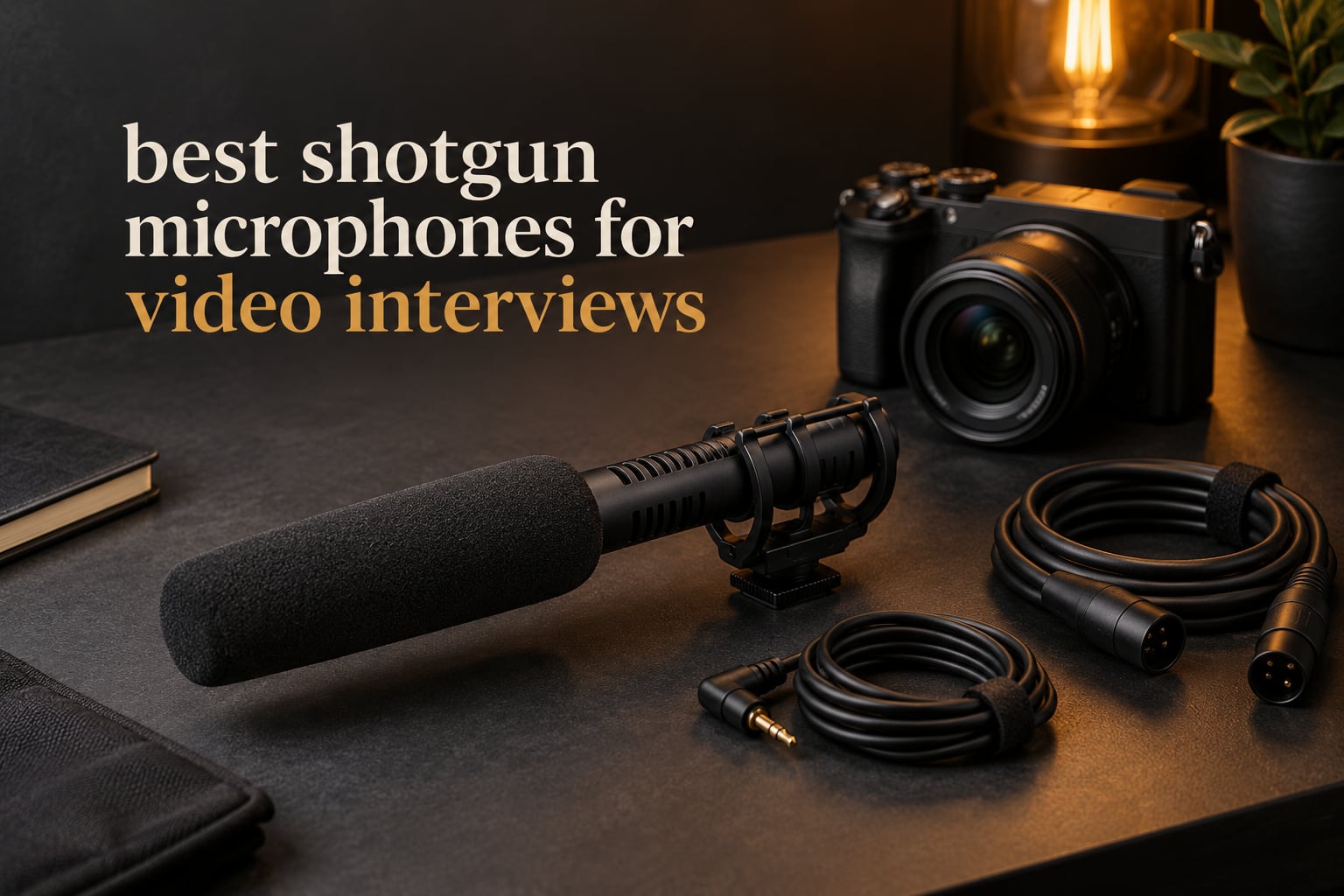
Interview audio decides whether people keep watching. Viewers forgive soft picture and even a slightly crooked horizon, but they click away from dialogue that echoes, hisses or disappears into room tone. The best shotgun microphones for video interviews solve that problem from off-camera, so your subject never has to wear a lavalier or remember to stay still.
We spent weeks reading owner reviews, digging through practitioner threads on Gearspace, CreativeCow and the Blackmagic forum, and comparing the physical specifications that actually matter for talking-head work. What follows covers twelve shotguns for three very different situations: a mic that sits on the camera, a mic that rides a boom pole just out of frame, and everything in between.
If you are still working out the wider audio setup, our USB microphone picks for podcasting cover the desk-mic side of two-person conversations, which is a different problem from a camera-mounted shotgun.
Table of Contents
Top 3 Shotgun Microphones for Video Interviews in 2026

Movo VXR10
- Unidirectional pattern
- Works with any 3.5 mm mic input
- Aluminium body with shock mount
- Fuzzy windscreen and case included

Rode VideoMic NTG
- 20 Hz to 20 kHz response
- Digital switching with pad and high-pass
- Variable gain
- USB with headphone monitoring

Sennheiser MKE 400
- Super-cardioid pickup
- Integrated wind protection
- Headphone output
- Switchable sensitivity
These three cover the realistic range of interview work. The Movo VXR10 is the one we recommend to most people because it connects to almost anything and has the deepest review base of any mic here. The Rode VideoMic NTG is the step up when you want broadcast-grade capture with real switching. The Sennheiser MKE 400 is a discreet option with a metal body, and it monitors through headphones.
Best Shotgun Microphones at a Glance in 2026
| Product | Specifications | Action |
|---|---|---|
| Movo VXR10 Universal Shotgun Mic |
|
Check Latest Price |
 Movo VXR10-PRO with Rycote Lyre Mount Movo VXR10-PRO with Rycote Lyre Mount |
|
Check Latest Price |
 COMICA CVM-V30 LITE COMICA CVM-V30 LITE |
|
Check Latest Price |
 COMICA CVM-VM10II with Deadcat COMICA CVM-VM10II with Deadcat |
|
Check Latest Price |
| Rode VideoMic NTG Camera-mount Shotgun |
|
Check Latest Price |
 Rode VideoMicro II Ultra-compact Rode VideoMicro II Ultra-compact |
|
Check Latest Price |
 Ruittos 11 inch Condenser Shotgun Ruittos 11 inch Condenser Shotgun |
|
Check Latest Price |
 Audio-Technica AT875R Condenser Shotgun Audio-Technica AT875R Condenser Shotgun |
|
Check Latest Price |
 COMICA VM20 Professional Shotgun COMICA VM20 Professional Shotgun |
|
Check Latest Price |
| Sennheiser MKE 400 Directional Shotgun |
|
Check Latest Price |
 VidPro XM-55 13-Piece Shotgun Kit VidPro XM-55 13-Piece Shotgun Kit |
|
Check Latest Price |
 SMALLRIG Shotgun Mic for Camera SMALLRIG Shotgun Mic for Camera |
|
Check Latest Price |
How We Picked These Mics for Interview Work
Every mic here was judged against the same interview checklist. We weighted polar pattern and off-axis rejection first, because a shotgun that hears the air conditioner is not solving the problem you bought it for. Build quality and shock isolation came next, then the practical details that decide whether the mic gets used: what it connects to, how it is powered, and whether the tube fits your framing.
We also cross-checked owner reviews at volume, and read what practitioners say on forums rather than relying on spec sheets alone. Forum consensus is useful for one question above all: is the recorder feeding the mic well? Camera preamps are widely criticised on the Blackmagic forum and elsewhere, which is why several picks below carry their own gain and filtering rather than making you live with whatever the camera does.
1. Movo VXR10 Universal Shotgun Mic for Camera
Movo VXR10 Universal Shotgun Mic for Camera
51 g
3.5 mm jack
Unidirectional pattern
76 dB signal to noise
Pros
- Works with any device that has a 3.5 mm mic input
- Aluminium body with a built-in shock mount absorbs handling noise
- Unidirectional pattern rejects off-axis background noise in an interview room Fuzzy windscreen carrying case and both TRS and TRRS cables included
- Best results when placed 1 to 5 ft from the subject
Cons
- Needs plug-in power and a 3.5 mm mic input
- Phones may need a Lightning or USB-C adapter
- Some Canon Rebel and VIXIA bodies have no external mic input
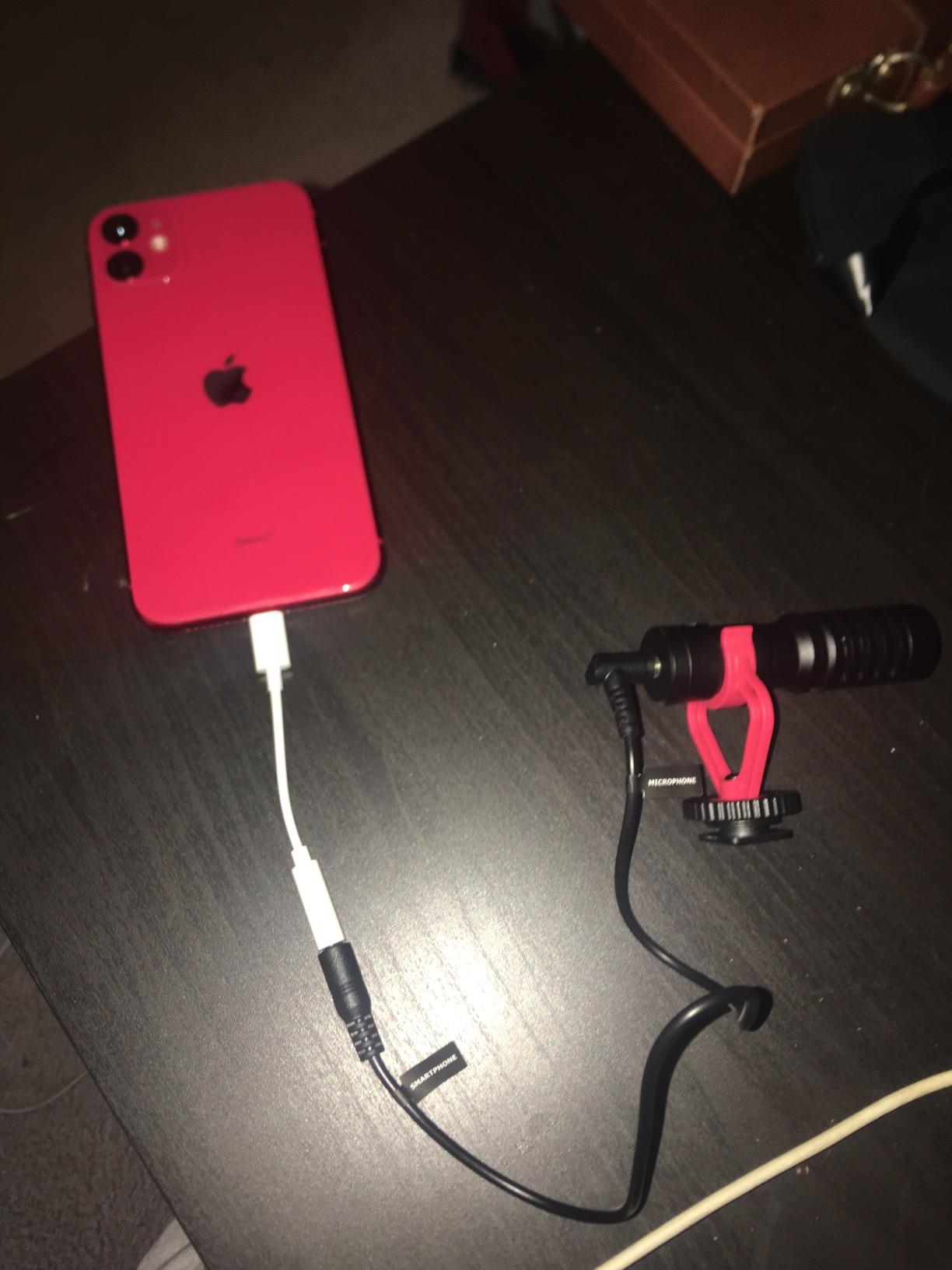
This is the mic we hand to someone filming their first interview. It runs from the camera, from a phone, from a laptop, from a camcorder, and the review base tells you why: more than 15k owners have used it, and roughly two thirds of them gave it five stars. That kind of volume matters when you are buying something you will not troubleshoot yourself.
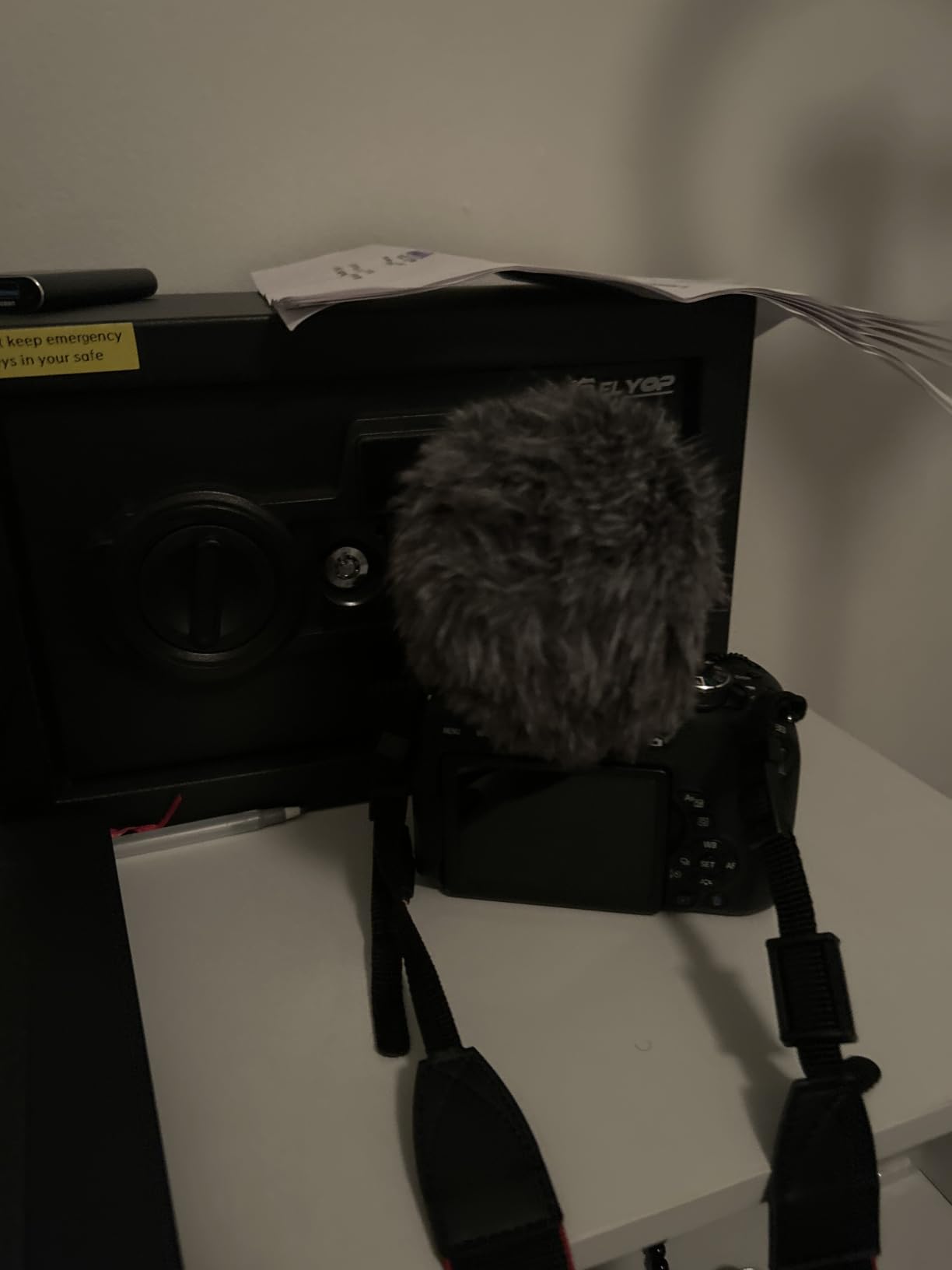
The body is solid aluminium rather than plastic, and the built-in shock mount does a decent job of keeping knuckle knocks and camera handling off the recording. At 51 g it adds almost nothing to the top of a mirrorless body, and the 3.1 by 1.2 inch footprint sits below most lenses in frame.
What it gets right for interviews
Two things. The unidirectional pattern concentrates on the subject instead of the room, and the accessory box means you have a windscreen, a case and both cable types from the first frame you shoot. The maker suggests 1 to 5 ft of working distance, which lines up with how we place a hot-shoe mic for a seated interview.
Where it falls short
It needs a 3.5 mm mic input and plug-in power, so there is no gain control and no headphone monitoring of any kind. If your phone has no headphone jack you will also need an adapter, and some Canon Rebel and VIXIA bodies simply have no external mic input at all. Check your camera before you commit.
2. Movo VXR10-PRO with Rycote Lyre Shock Mount
Movo VXR10-PRO Professional Video Microphone for Camera with Rycote Lyre Shock Mount – Shotgun Mic Compatible with DSLR Cameras and iPhone, Android Smartphones
2.1 oz
3.5 mm jack
Supercardioid pattern
76 dB signal to noise
Pros
- Supercardioid pattern isolates the subject and rejects background noise
- Integrated Rycote Lyre shock mount cuts handling noise and vibration
- Battery-free plug-and-play design powered by the connected device
- Foam and furry windscreens
- TRS and TRRS adapters and a hard case included
Cons
- Smartphone users may need a separate Lightning or USB-C adapter
- Some DSLR models such as the Canon Rebel T6 and T7 lack an external mic jack
This is the VXR10 with a proper professional suspension mount, and that single change is the reason to pick it. The Rycote Lyre uses elastic cord instead of rubber bands, so it keeps rumble out when an operator touches the camera, sets the mic down, or bumps the tripod mid-take.
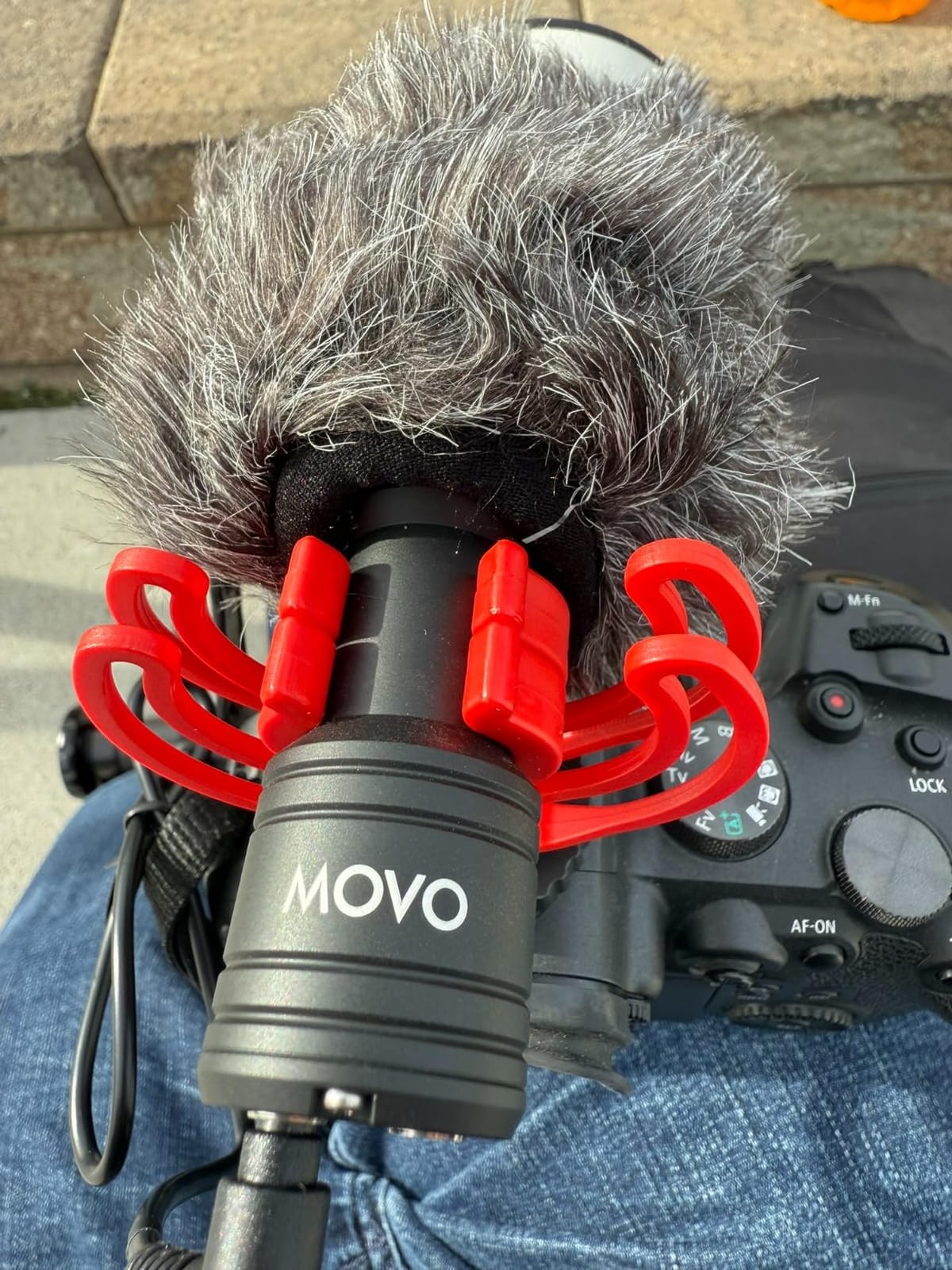
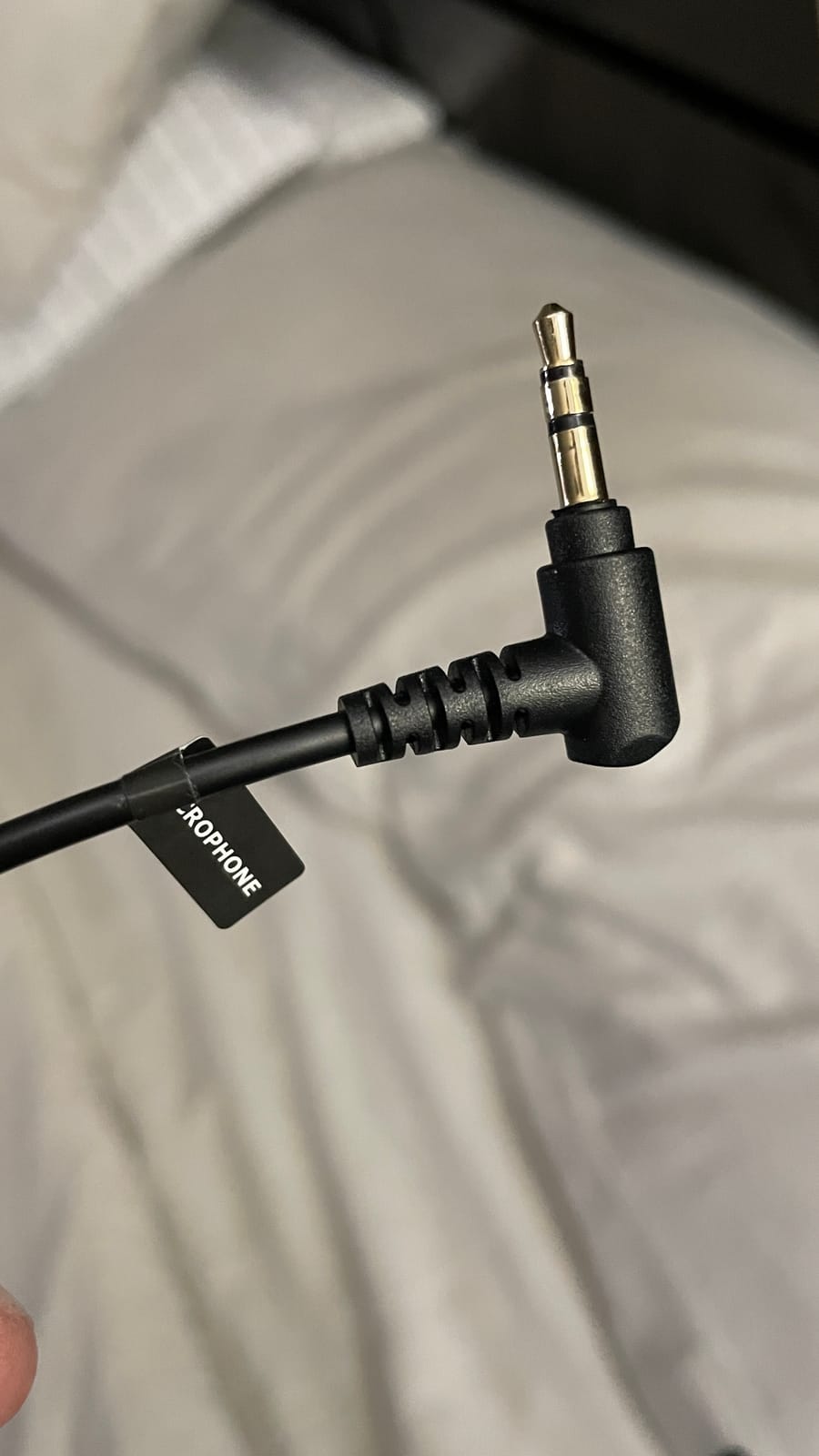
The supercardioid pattern is tighter than the base model’s unidirectional pickup, which matters in an untreated office where a colleague’s chair squeaks. Owners also note real-time headphone monitoring through smartphone apps, which turns the mic into a reasonable podcast tool for two people in a quiet room.
What it gets right for interviews
The isolation mount is the headline. Any shotgun that sits on a camera needs to survive handling, and a Lyre mount does that better than the thin elastic most competitors ship. The full accessory kit means you have windscreens and both adapters before the subject arrives.
Where it falls short
At 2.1 ounces the body is noticeably lighter and thinner-feeling than the aluminium VXR10, and the mix of metal and plastic does not feel as solid in the hand. The same compatibility limits apply: phone adapters cost extra, and entry-level Canon DSLRs have no mic jack. There is no gain switch or monitoring jack on the mic itself.
3. COMICA CVM-V30 LITE Super-Cardioid On-Camera Shotgun
COMICA CVM-V30 LITE Video Microphone,Super-Cardioid Condenser On-Camera Shotgun Microphone for Canon Nikon Sony Panasonic DSLR Cameras,Mic for iPhone Android Smartphone with 3.5mm Jack(Black)
150 g
3.5 mm jack
Super cardioid pattern
78 dB signal to noise
Pros
- Super-cardioid pattern gives strong off-axis rejection for interview dialogue
- Camera or phone switch on the mic body removes the need for a cable adapter
- Shock absorbing mount reduces vibration and handling noise
- Battery-free design runs on plug-in power
Cons
- Does not work with DSLRs that lack a 3.5 mm input such as the Canon Rebel T3
- T5
- T6
- T7 and Nikon D3500 and D3400
- External microphone input must be enabled in the device menu first
The switch on the body is the detail that makes this one easy to recommend. A toggle sets the mic for camera or phone, so you are not hunting for the right TRRS cable in a hotel room at six in the morning, and owners consistently report that the off-axis rejection holds up for a seated conversation in a normal room.
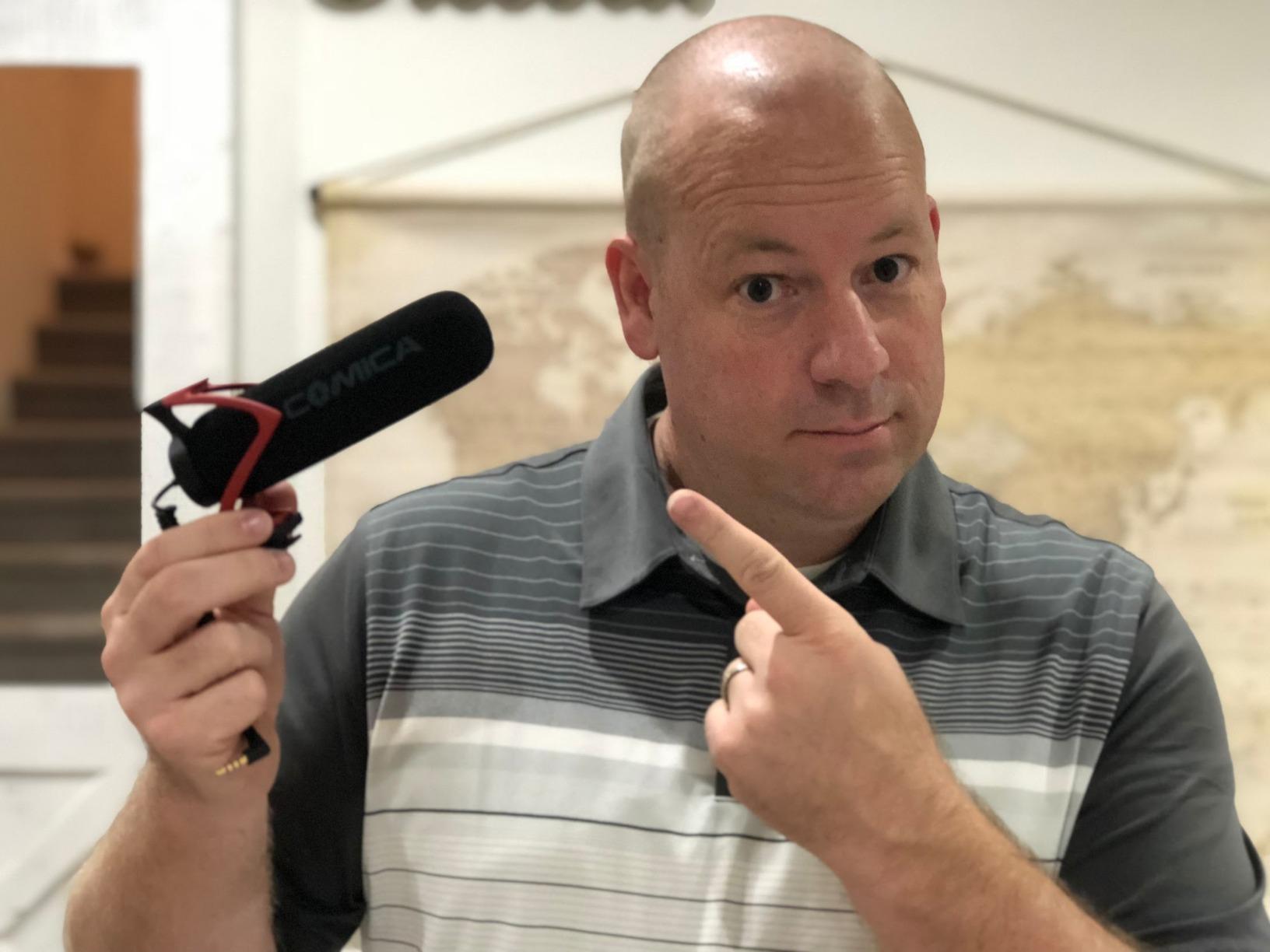
The cold-shoe design with a quarter-inch thread underneath means the same mic moves from a camera top to a small stand without an adapter. At 150 g it is heavier than the other plastic-bodied budget models here, but on a boom pole rather than a camera that weight actually helps it hang still.
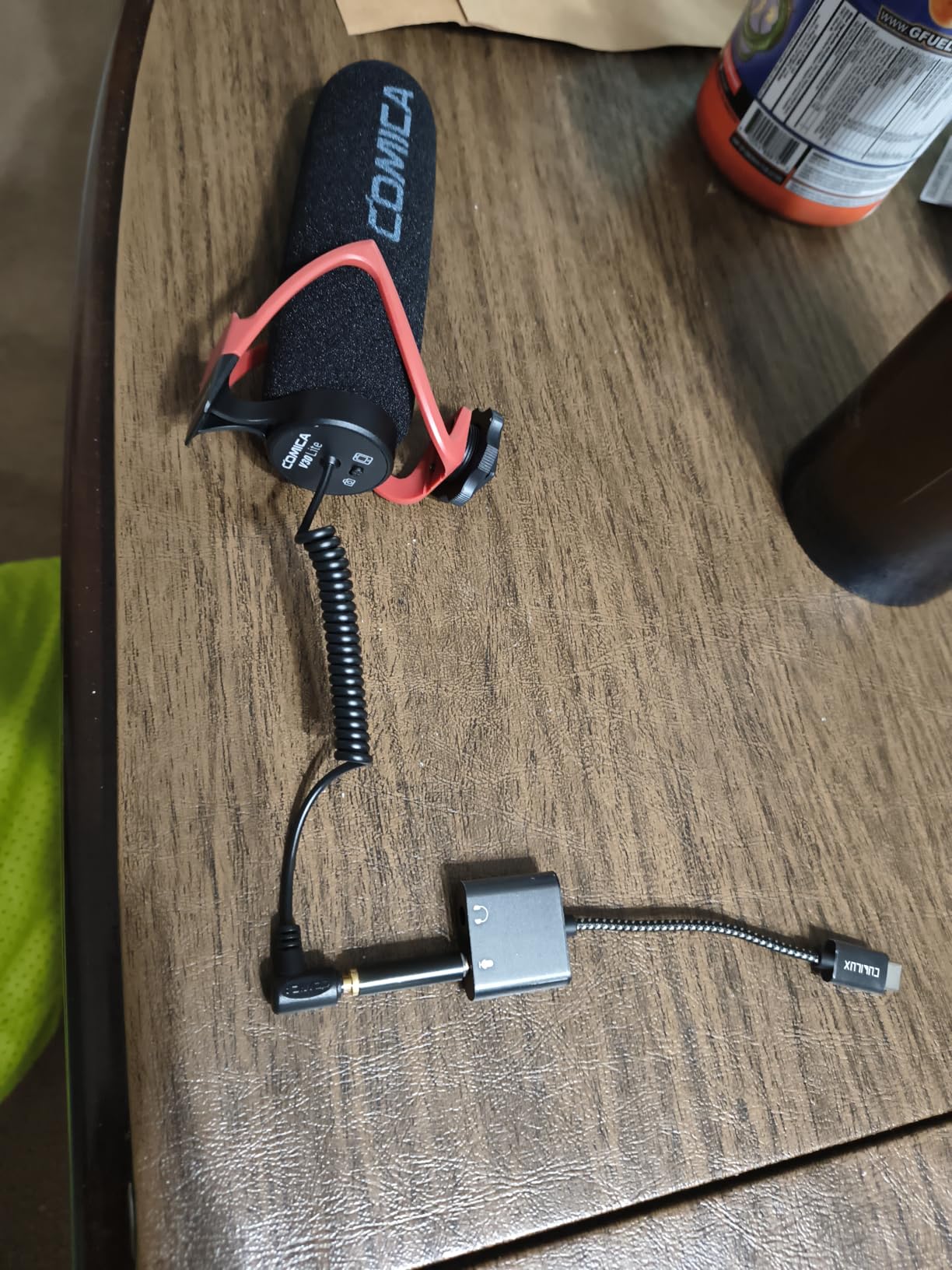
What it gets right for interviews
Off-axis rejection is the selling point and the supercardioid pattern delivers it for a two-person setup when the second speaker is well off axis. The battery-free design also removes the single most common on-camera failure, which is a dead battery halfway through an interview.
Where it falls short
The compatibility list is the honest catch. Entry-level Canon Rebel bodies and some Nikon models have no 3.5 mm input, and some cameras need external microphone input switched on in the menu before audio appears. There is no gain control and no headphone output, so you are trusting the camera preamp completely.
4. COMICA CVM-VM10II Compact Shotgun with Deadcat
Camera Microphone,Comica CVM-VM10II Professional Video Microphone with Shock Mount, Deadcat,Compact Shotgun Mic Compatible with iPhone,DSLR Camera,Android Smartphones- Perfect for TikTok YouTube Vlog
220 g
3.5 mm jack
Unidirectional pattern
75 dB signal to noise
Pros
- Both 3.5 mm TRS and TRRS cables included for broad device support
- Aluminium body plus Rycote Lyre shock mount reduce vibration and handling noise
- Cardioid directional pattern cuts background noise for interview recording
- Deadcat windscreen included for outdoor work
Cons
- Not compatible with Canon Rebel T5
- T5i
- T6
- T7
- T7i or HFR800 without an adapter cord
- Newer Samsung phones need Samsung's own Type-C adapter or recording fails
- Some Android phones limit external microphone recording during video
A deadcat in the box is unusual at this level, and for a video interview shot on a rooftop or a windy street it may be the deciding feature. Most budget shotguns include only a foam ball or a strip of fur, which handles breath but not gusts.
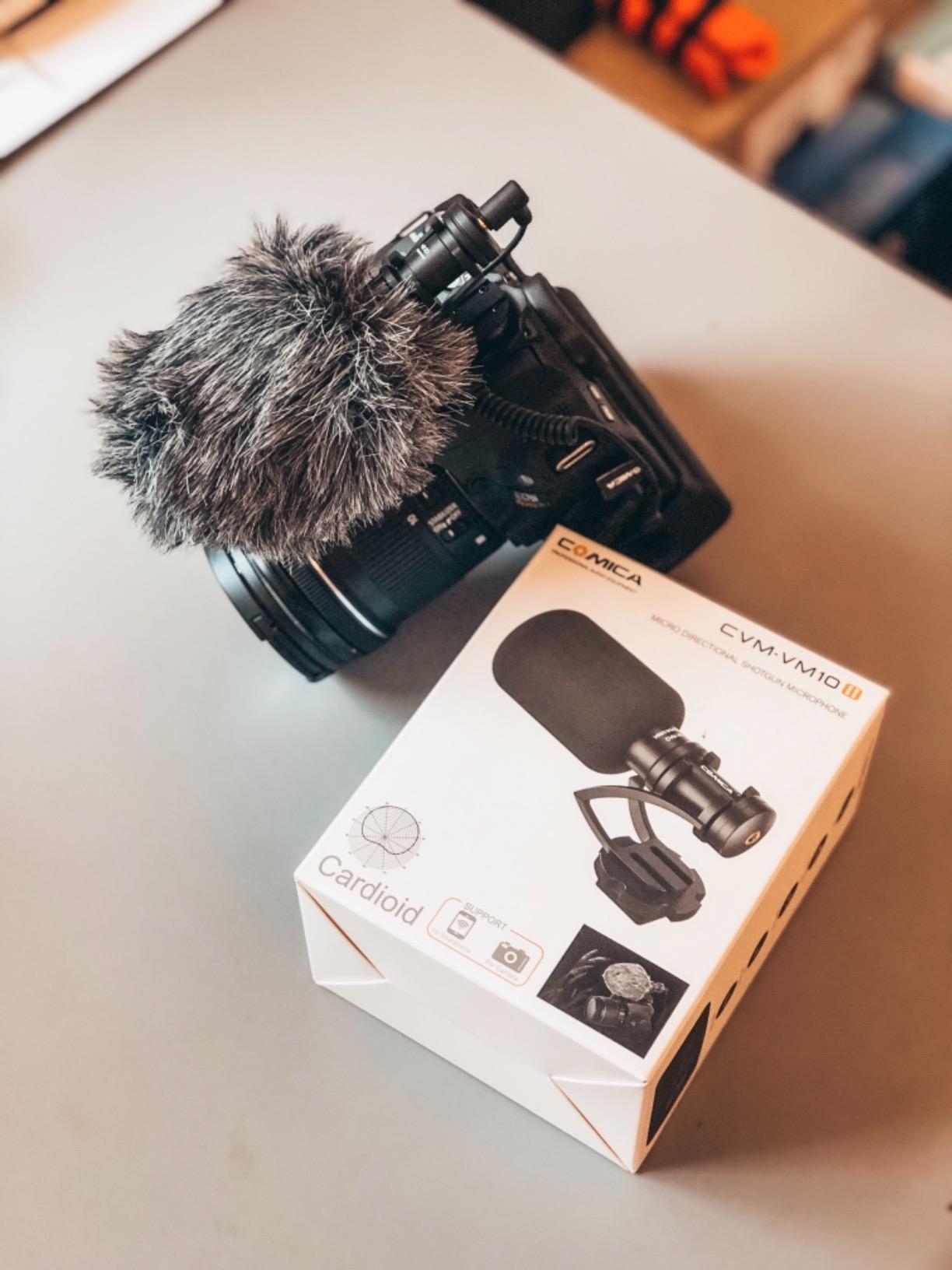
The microphone itself is 100 percent aluminium, and the Rycote Lyre mount keeps touch noise down when the camera is handheld. Signal to noise is listed at 75, the frequency range runs 60 Hz to 20 kHz, and the cardioid pattern is described as smoothing the response for voice.
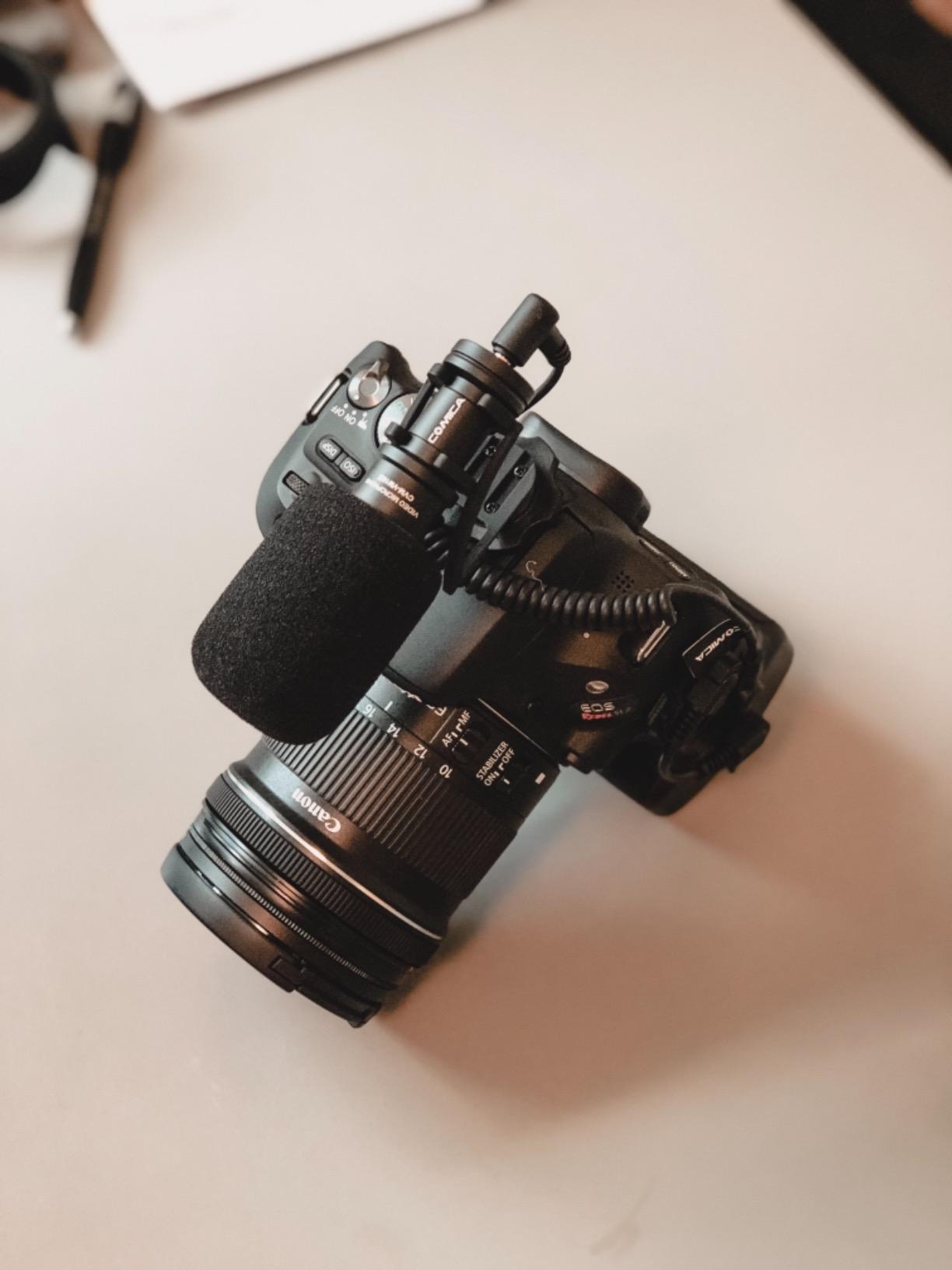
What it gets right for interviews
It is a very complete budget box here for exterior work: mic, both cables, a shock mount and real wind protection. If your interview happens anywhere with weather, that bundle saves a separate purchase and a second trip to the kit bag.
Where it falls short
Phone support is the weak point, and it is a modern one. Newer Samsung models need the manufacturer’s own Type-C adapter, some Androids limit external mics during video, and a long list of Canon Rebel bodies needs an adapter cord. The 60 Hz low end also means less low-end content than the 20 Hz models on this list.
5. Rode VideoMic NTG Camera-mount Shotgun Microphone
Rode VideoMic NTG Camera-mount Shotgun Microphone,Black
94 g
20 Hz to 20 kHz
Metal body
10 year warranty
Pros
- Broadcast-grade acoustic design shared with the NTG5 for natural uncolored sound
- Digital switching gives a high-pass filter
- -20 dB pad
- high frequency boost and a safety channel
- Infinitely variable gain control for matching any camera or recorder
- Auto-sensing 3.5 mm output and USB operation with headphone monitoring
Cons
- Runs on a lithium polymer battery rather than plug-in power
- iOS use requires the SC15 Lightning cable sold separately
This is the one we would actually buy for a paid interview shoot at the entry level. The acoustics come from the same family as the NTG5, and about 76 percent of owners rate it five stars, with very little negative sentiment beyond the battery arrangement.
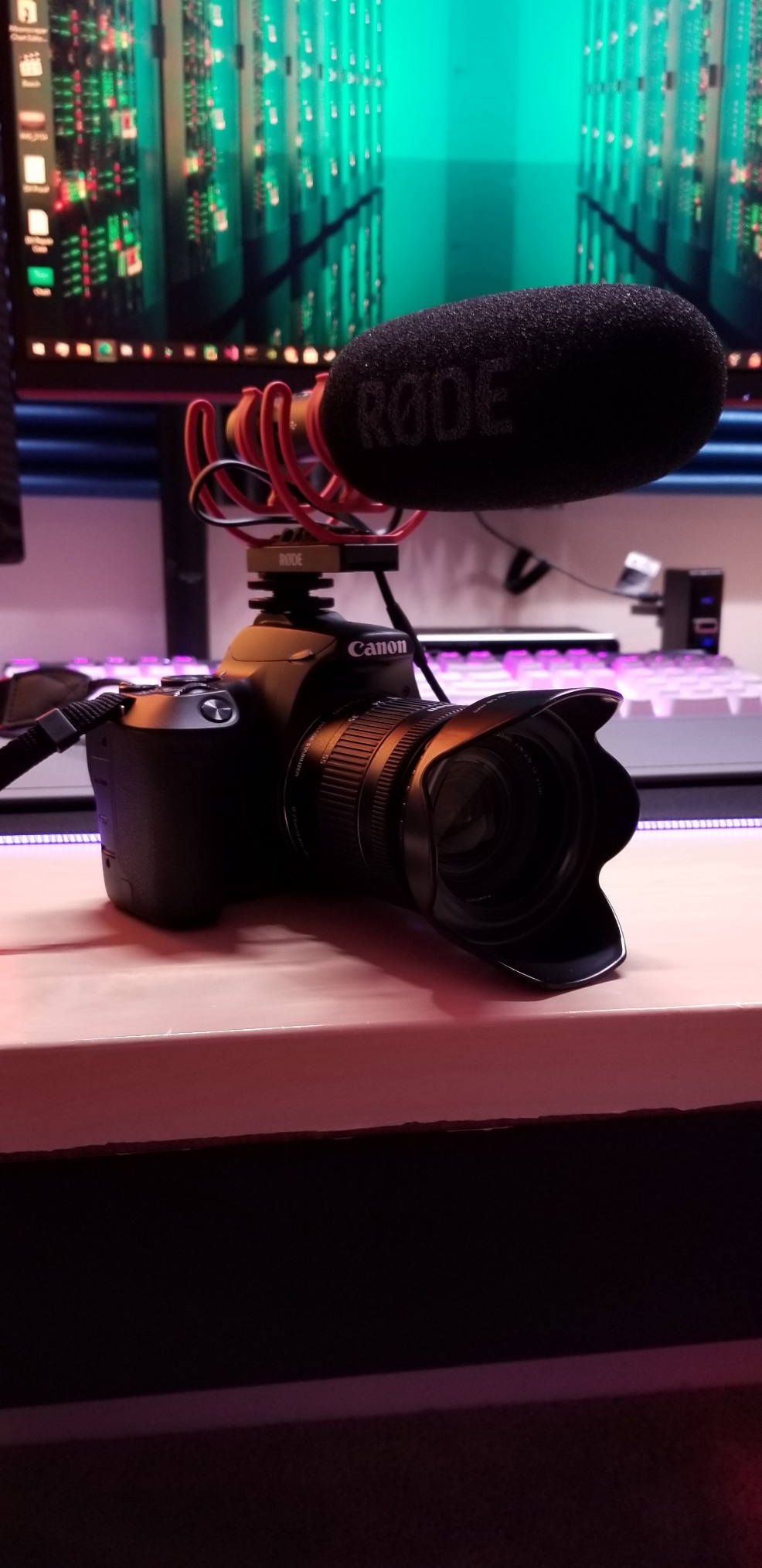
The digital switching is what separates it from every other model on this list. A high-pass filter, a minus 20 dB pad, a high frequency boost and a second safety channel live on the body, and the variable gain control lets you match any camera or recorder rather than guessing at a fixed output level.

What it gets right for interviews
Sound quality and control. The frequency response runs 20 Hz to 20 kHz, the body is metal, and the safety channel gives you a backup track at a lower level when a subject suddenly gets loud. It also works as a USB microphone with a headphone output, which is handy for remote video calls that need better audio than a laptop built-in.
Where it falls short
It needs a lithium polymer battery instead of taking power from the camera, so a long multi-day shoot means charging discipline. Connecting to an iPhone needs the SC15 Lightning cable, sold separately. The auto-sensing 3.5 mm output is convenient but it removes the option to feed an XLR mixer without an adapter.
6. Rode VideoMicro II Ultra-Compact On-Camera Shotgun
RØDE VideoMicro II Ultra-Compact On-Camera Shotgun Microphone for
24 g
3.5 mm jack
Unidirectional
78 dB signal to noise
Pros
- Ultra-compact at 80 mm long and 24 g
- so it fits any camera kit or bag
- Highly directional pickup captures the subject and rejects surrounding sound
- Helix isolation mount protects against knocks
- bumps and handling noise
- Built-in shoe mount and cable management keep the rig tidy
Cons
- Plastic body is a step down from the metal-bodied options in this class
- Battery powered rather than plug-in power so it can cut out mid-shoot
- Highest share of one-star ratings among the Rode models here at 9 percent
Twenty-four grams is the number that matters here. On a gimbal, a drone-adjacent rig or a small travel setup, a full-size shotgun changes the balance, and this one is short enough that it stays out of frame on a wide interview composition.
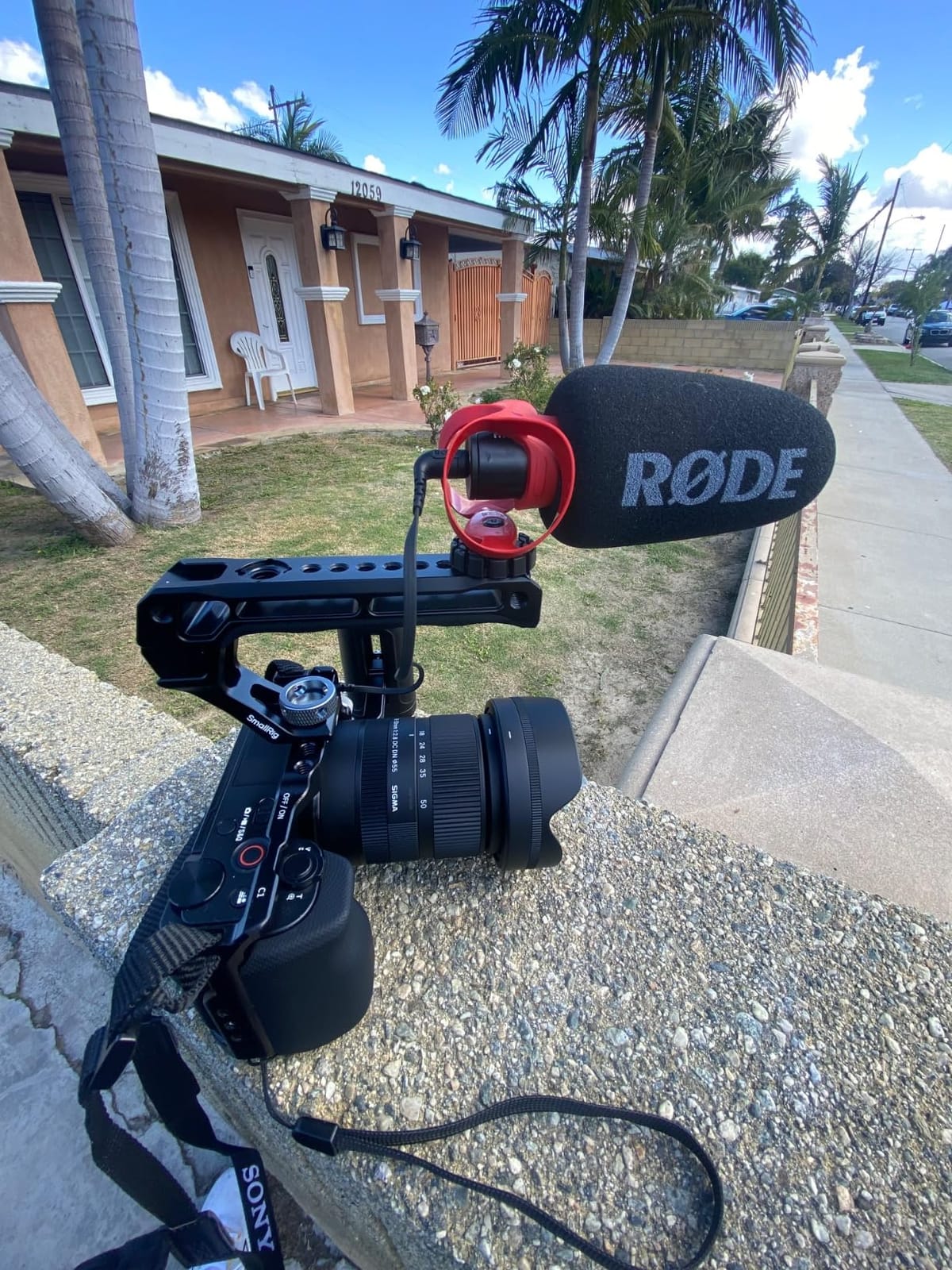
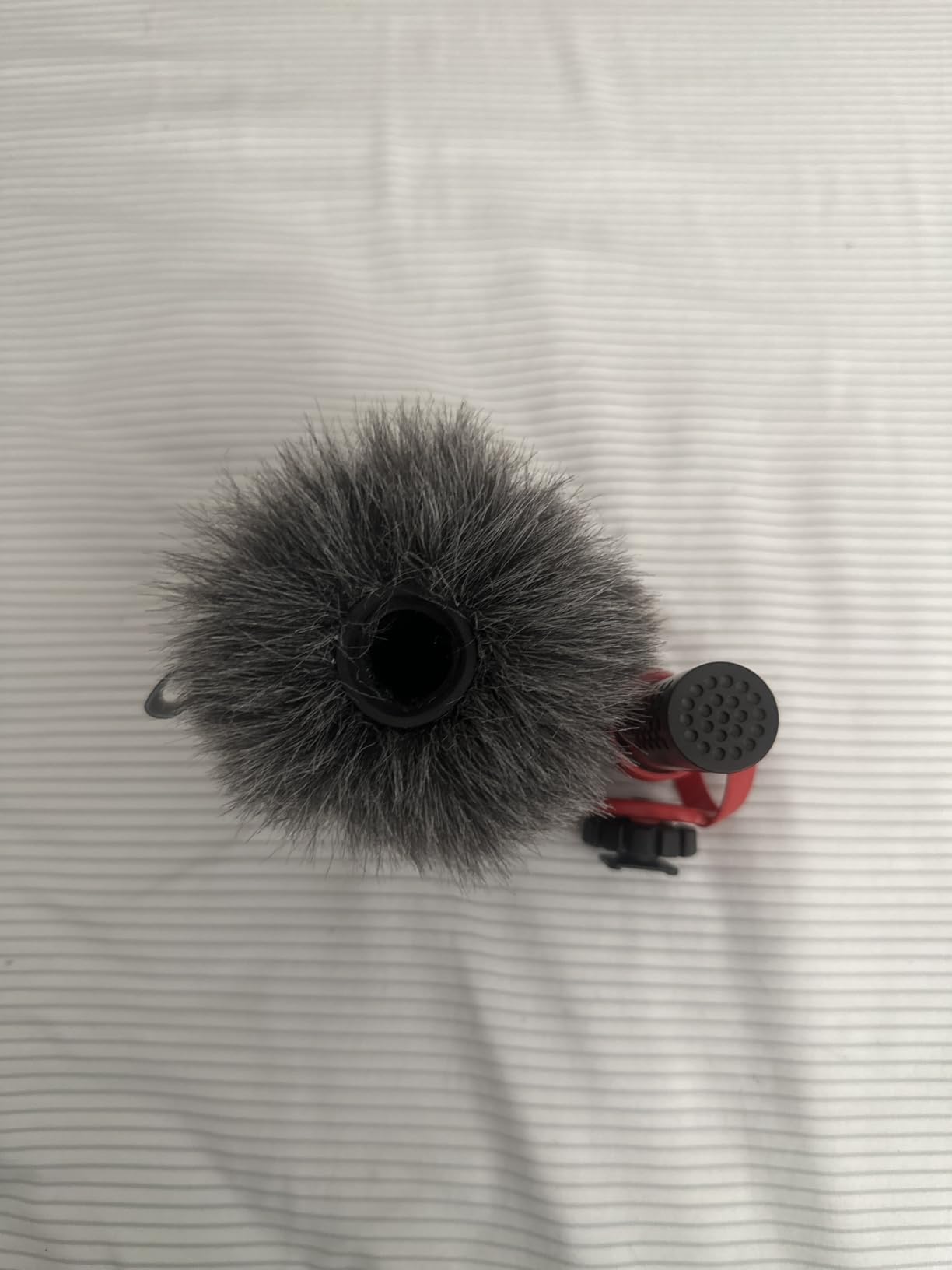
The Helix isolation mount is a mesh-and-ring design that does a good job of killing bumps for its size, and the built-in shoe mount with cable management means the cable does not flap against the body. Signal to noise is listed at 78, which sits alongside the better plastic mics on this list.
What it gets right for interviews
Portability and simplicity. It is a grab-and-go microphone for a run-and-gun interview, it needs no thinking about, and owners like that it disappears from the frame. For a single subject seated a few feet away it does the job without adding bulk.
Where it falls short
The plastic body is the main compromise, and the battery dependence is the practical risk, since a dead cell mid-interview is a lost take. Around 9 percent of owners gave it one star, more than any other Rode model here, so it is not as forgiving under rough handling.
7. Ruittos 11 Inch Condenser Interview Shotgun Mic
Ruittos Condenser Interview Microphone Photography Shotgun Mic for Video Camcorders DSLR DV Camcorder 11 inches/27cm Camera Microphone with Metal Holder, Anti-Wind Foam Cap XLR Cable
11 inch body
3.5 mm and XLR
Cardioid pattern
80 dB signal to noise
Pros
- Cardioid pattern isolates the main source and smooths the response for voice
- Short 11 inch body stays out of frame when mounted on the camera
- Includes a long XLR cable
- a stand and an anti-wind foam cap
- Works without phantom power
- which suits mixers that do not supply it
Cons
- Battery compartment and XLR socket feel light
- with reports of a loose XLR causing intermittent popping
- One reviewer disputes that the directional behaviour is truly shotgun-like
- Runs on a 1.5V or AA battery with no power indicator light
- No hot shoe included
- so Sony and Minolta bodies need an adapter
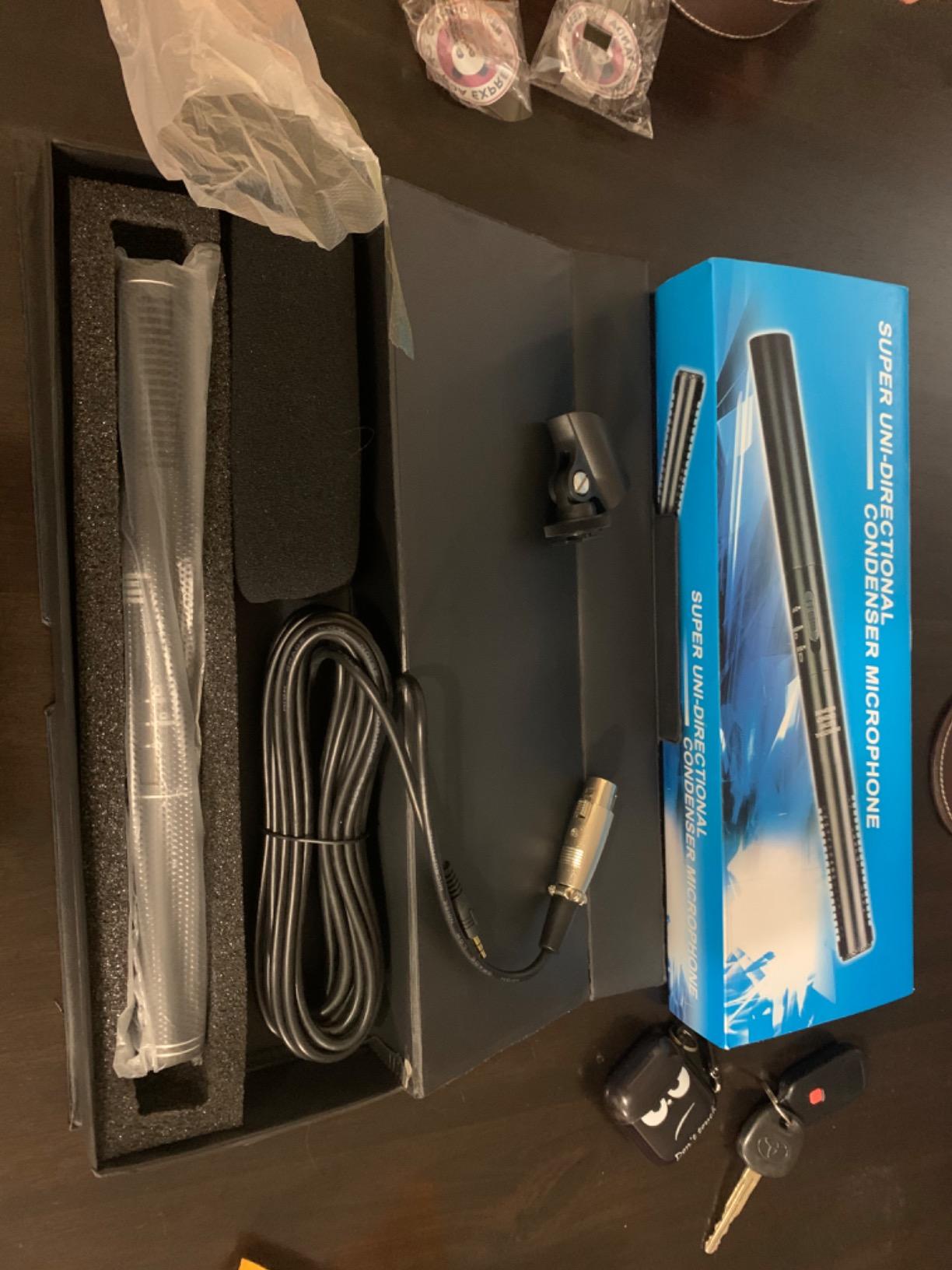
The interesting part of this one is power. Most condenser shotguns need phantom power from a mixer, which rules out a lot of camcorders and field recorders. This one runs on a single AA for roughly 26 hours, and it includes a long XLR cable and a stand.
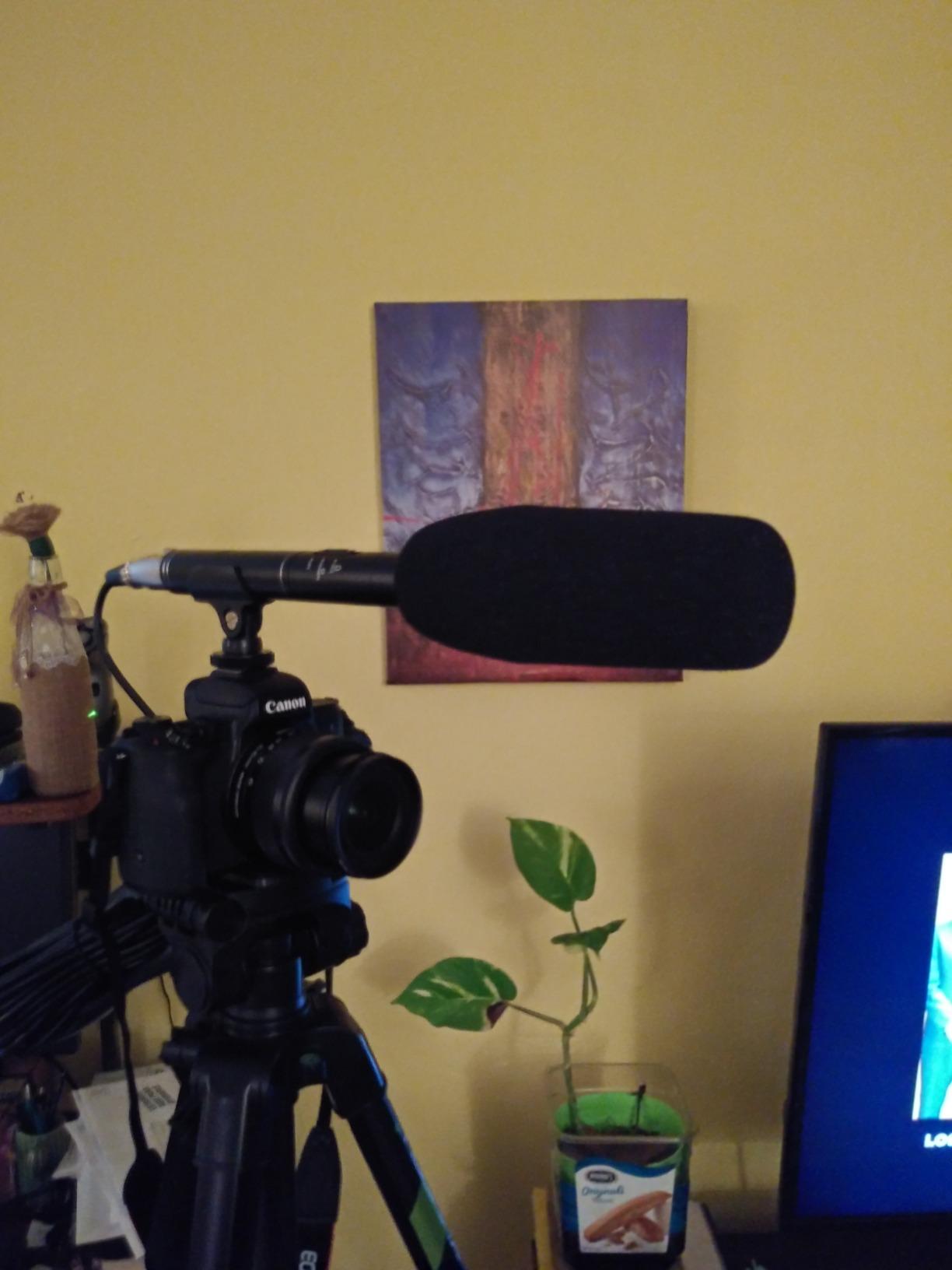
Owners with three-plus years of service report that it has held up, and the listing is aimed squarely at media interviews, conferences, stage work and television, which is the same job list we are working from. The 11 inch length is a real advantage over a long tube on a two-shot interview frame.
What it gets right for interviews
It is one of the few mics here that can go straight to an XLR input without phantom power, and the cardioid pattern with an 80 dB signal to noise ratio produces clear, present voice for press interviews and conference rooms. The short body keeps it out of shot.
Where it falls short
Build quality is the recurring complaint. The battery door and XLR socket feel cheap, some owners report a loose XLR connection producing pops, and there is no power indicator so a flat battery is hard to diagnose. No hot shoe is included, and one reviewer questions whether the directionality is genuinely shotgun behaviour.
8. Audio-Technica AT875R Condenser Shotgun Microphone
Audio-Technica AT875R Condenser Microphone, 9.5 x 5 x 2.75 inches
Under 7 inch body
Requires phantom power
Narrow acceptance angle
2.88 oz
Pros
- 4.6 average rating with 82 percent five-star reviews
- the strongest satisfaction record in this roundup
- Extremely short body stays out of frame on compact cameras
- Narrow acceptance angle gives strong long-distance focus with excellent side and rear rejection
- Tailored response minimises camera and handling noise
Cons
- Requires external phantom power so it cannot plug straight into a camera or phone jack
- Listed dimensions do not match the under-7-inch body length described in the features
- Older listing with a comparatively sparse specification sheet
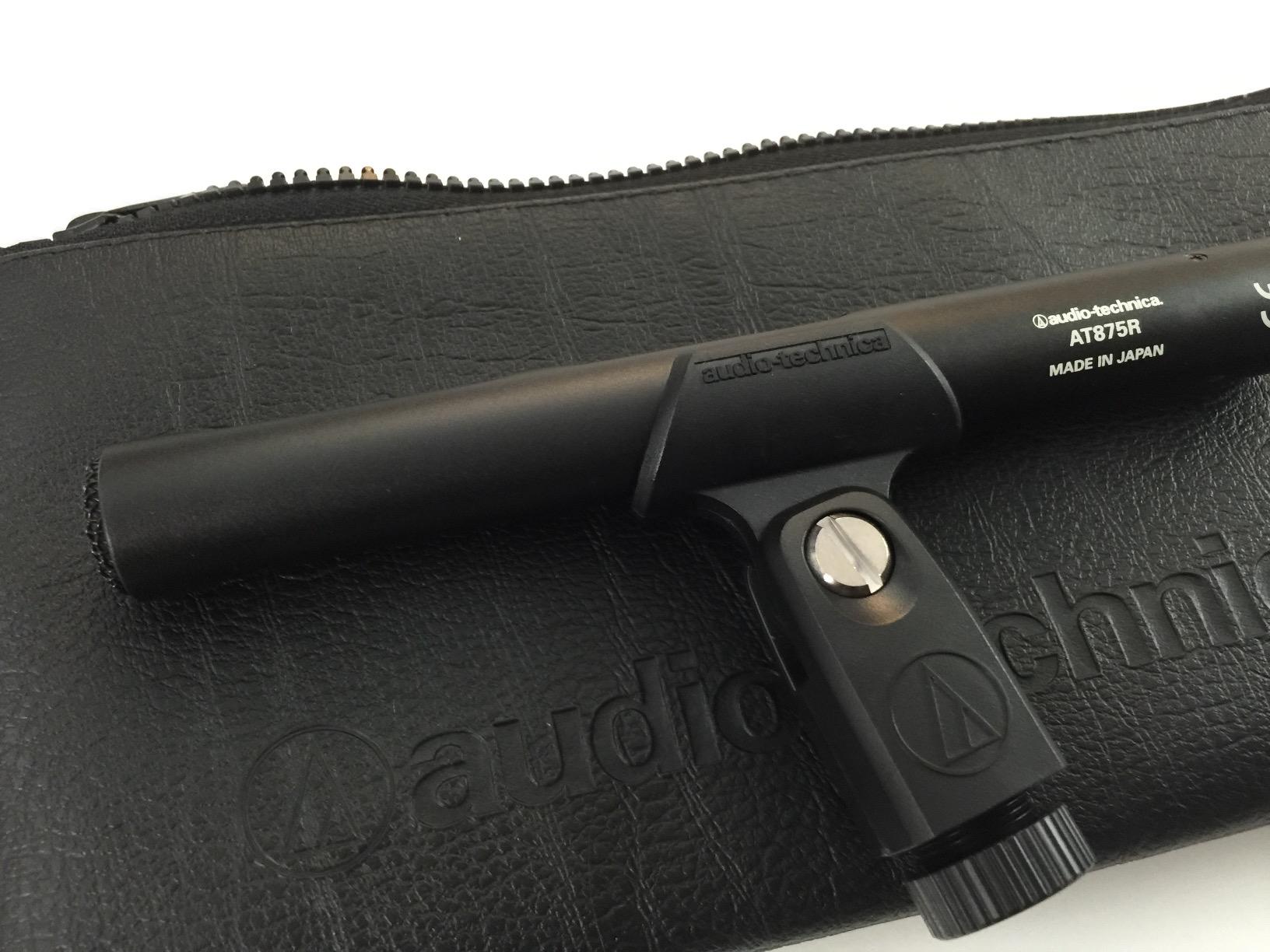
The AT875R is designed for ENG and EFP video production, and it shows in the numbers: a 4.6 average with 82 percent five-star ratings, which is the strongest satisfaction record on this list. In the long-running Gearspace value thread, the AT875R is regularly named alongside the Ambient TinyMike as one of the best small on-camera options, which is exactly the job we needed it for.
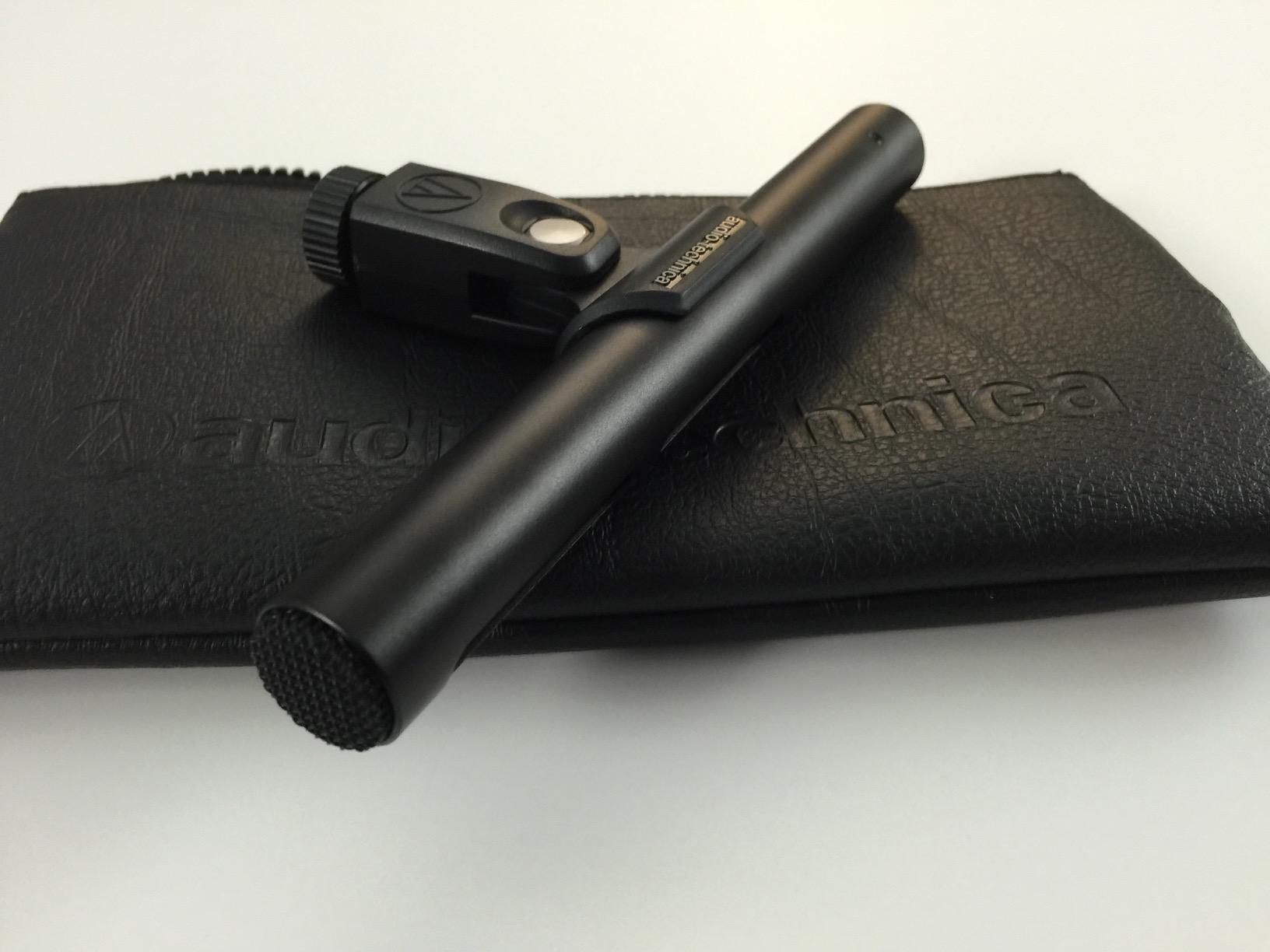
Under 7 inches long and 2.88 ounces, it is the shortest serious condenser shotgun here, so on a wide two-person interview frame it will not creep into the edge of the shot. The narrow acceptance angle is specified for long-distance pickup, and the response is tailored to keep camera and handling noise down.
What it gets right for interviews
Rejection and size. Excellent rejection from the sides and rear means the second speaker, a passing trolley or an air conditioner stays out of the recording, and the compact body solves the framing problem that long tubes create. It is the pick when the interview is off-camera and the subject is at some distance.
Where it falls short
Phantom power is the dealbreaker for casual rigs. It will not plug into a camera mic jack or a phone, so you need a recorder with a proper XLR input, which is exactly the preamp-quality question that comes up on production forums. The listing also has an inconsistent dimension entry and a thin spec sheet.
9. COMICA VM20 Professional Shotgun Microphone
COMICA VM20 Shotgun Microphone for Canon Nikon Sony Camera iPhones Androids
84 g
20 Hz to 20 kHz
Super cardioid
75 dB signal to noise
Pros
- Super-cardioid pattern records the target clearly while rejecting background noise
- Two low-cut modes at 75 Hz and 150 Hz plus ten level gain adjustment from -43 dB to -23 dB
- Built-in rechargeable battery gives up to 60 hours and works while charging over USB-C
- OLED display shows battery status and an adjustable Rycote shock mount controls vibration
- Owners repeatedly praise the flat natural response against more expensive alternatives
Cons
- Non-replaceable internal battery is the main failure point
- with several owners reporting batteries dying within months
- No XLR adapter cable included
- Sound quality is best within about three feet of the subject
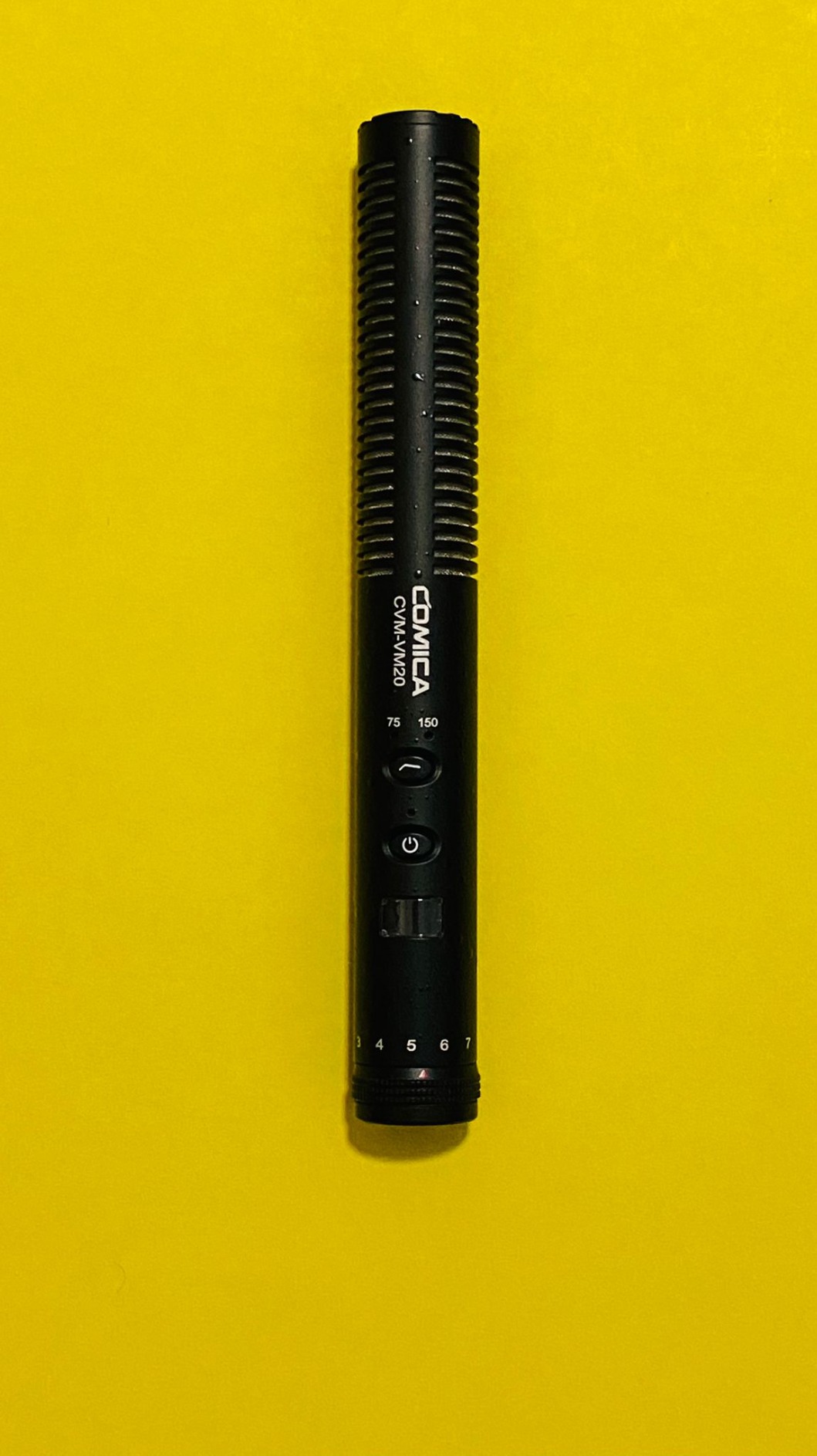
The VM20 is the feature-per-unit pick. A ten-level gain control, two low-cut modes, a live battery readout and a rechargeable cell that works while charging is a lot of hardware for a compact body, and reviewers regularly compare the sound favourably to microphones well above it.
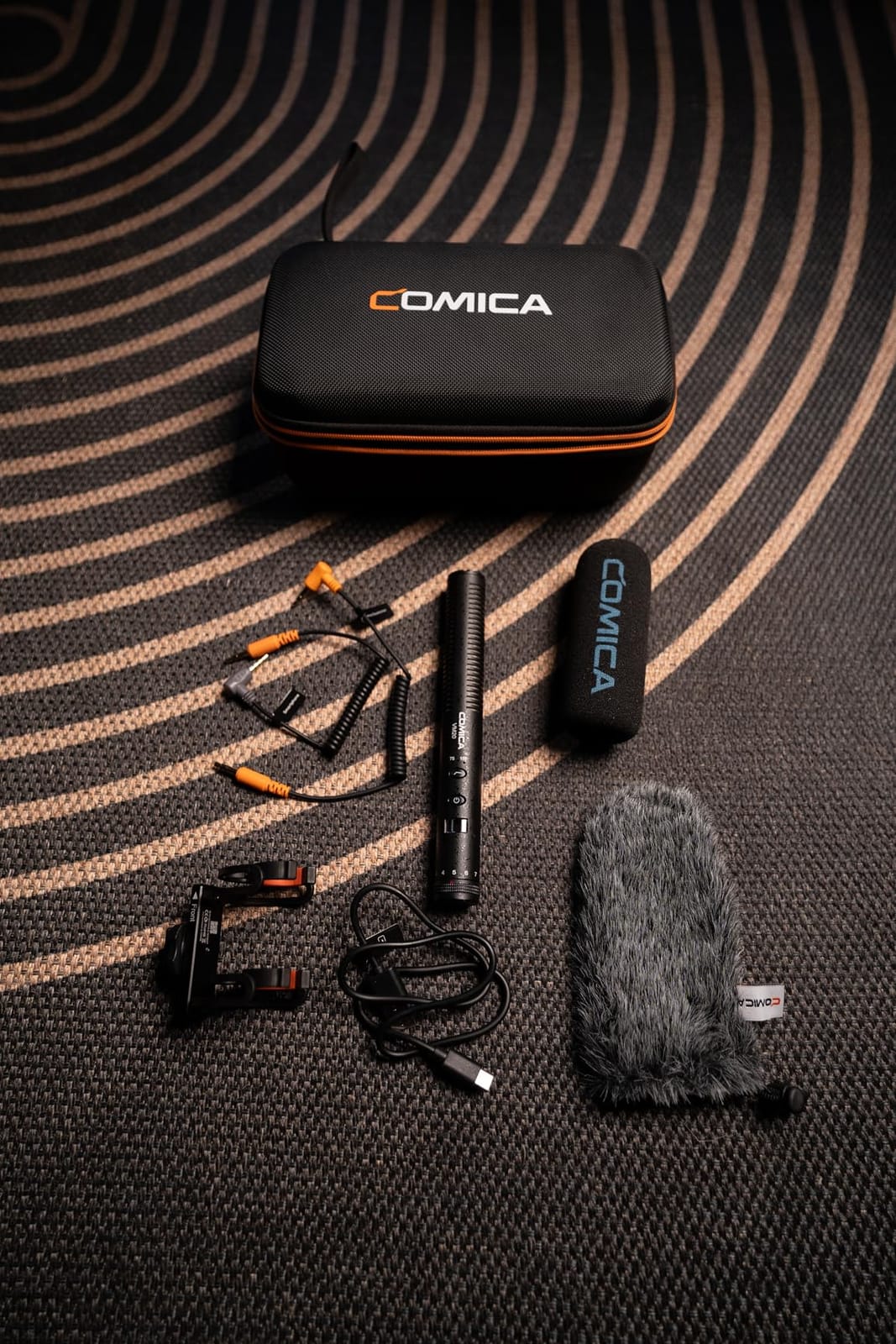
It handles cameras, camcorders, phones, tablets and a PC, and the box includes TRS and TRRS cables, a shock mount, windscreens, a charging cable and a carry case. Signal to noise is listed at 75 across a 20 Hz to 20 kHz range, which is unusual for a small on-camera body.
What it gets right for interviews
Gain control and monitoring options on the mic itself, which removes the need to trust a camera preamp. The low-cut modes are useful in a room with HVAC rumble, and the flat response suits a seated two-person video conversation where you want both voices to match without corrective EQ.
Where it falls short
The battery is sealed inside, and several owners report batteries dying within months and then refusing to charge, even though the manufacturer’s service has replaced some. There is no XLR adapter in the box, and the sound is best within about three feet, so it is not a long-throw interview mic.
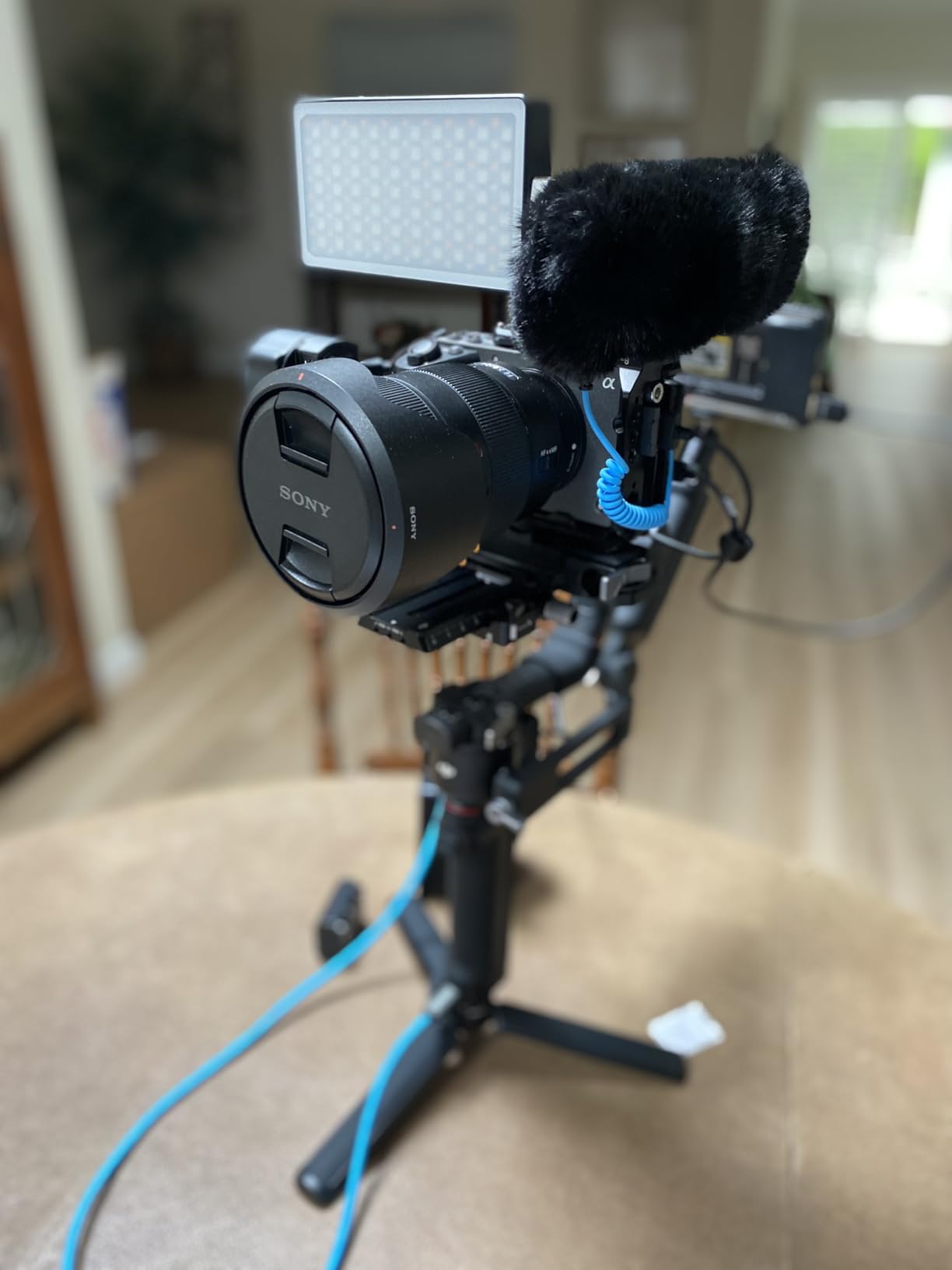
10. Sennheiser MKE 400 Directional On-Camera Shotgun Microphone
SENNHEISER Professional MKE 400 Directional On-Camera Shotgun Microphone with 3.5mm TRS and TRRS Connectors for DSLR, Mirrorless & Mobile , Connects with Auxiliary
344 g
Super-cardioid
Metal body
2 year warranty
Pros
- Super-cardioid pattern delivers isolated in-camera audio with strong side rejection
- Integrated wind protection and an internal suspension mount minimise handling noise
- Built-in low-cut filter plus a three-step sensitivity switch
- Interchangeable TRS and TRRS connectivity covers cameras
- mirrorless and mobile
- Integrated headphone output with volume adjustment
- Low profile on camera with roughly 1.5 hours of recording per AAA
Cons
- Falloff is severe beyond arm's length
- making it poorly suited to studio work at 30 to 32 inches off the capsule
- No automatic on-off so it must be switched off manually to save the battery
- No secondary safety channel
- Cold shoe mount can twist loose
A 4.6 rating with 77 percent five-star reviews puts this in the same satisfaction tier as the AT875R, and the headphone output is a feature very few mics in this roundup offer. Being able to check your levels with your own ears on set is worth a lot.
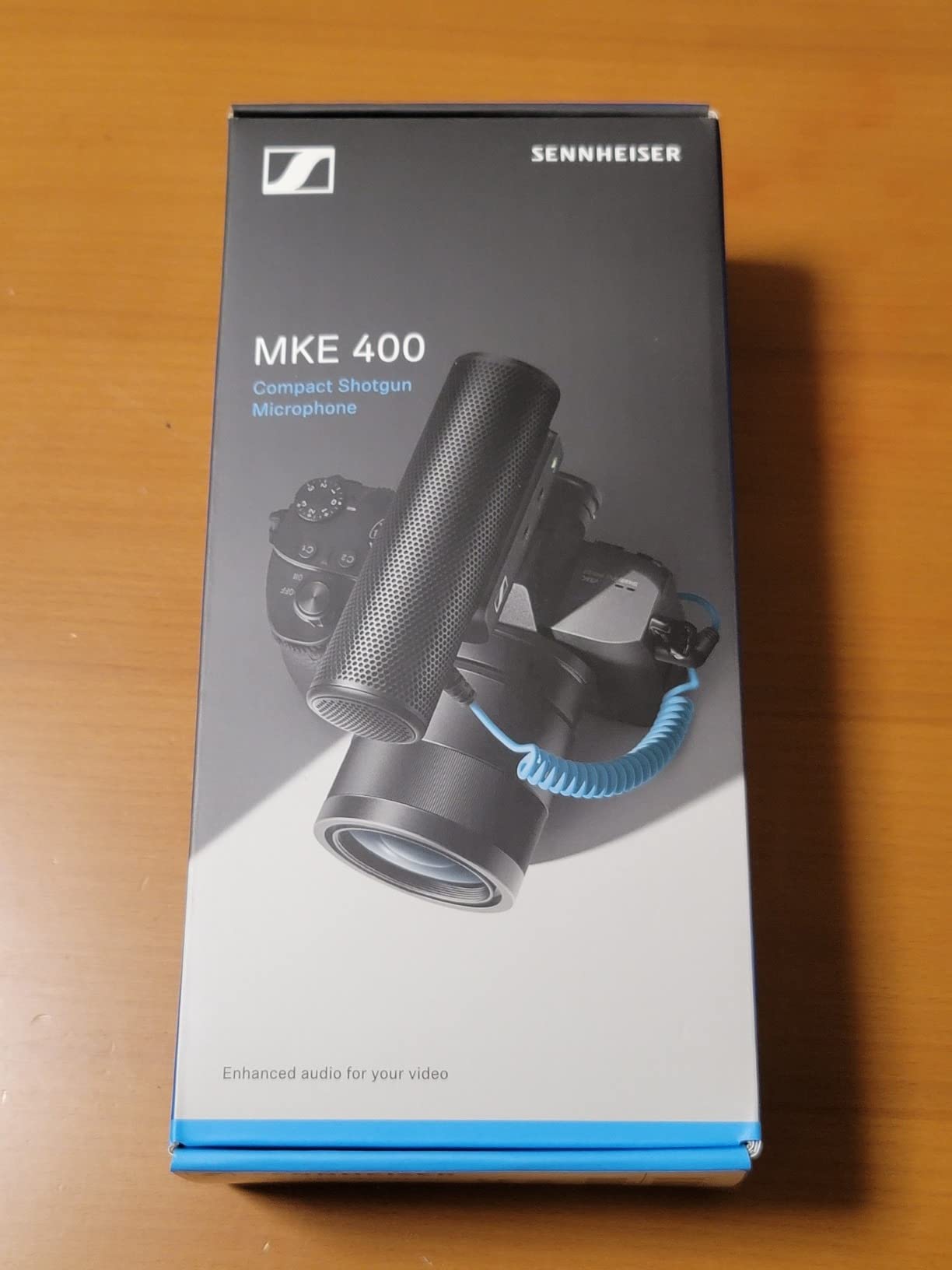
The metal body, integrated wind protection and internal suspension mount are built for a mic that will be handled. A built-in low-cut filter handles rumble, and the three-step sensitivity switch gives you a coarse version of the gain control the VM20 offers more precisely.
What it gets right for interviews
It is a vlogging-first mic, and that is exactly right for the way most video interviews are actually shot: subject a few feet away, camera on a tripod or handheld, no operator dedicated to sound. Monitoring plus switchable sensitivity means you can judge the recording rather than guess.
Where it falls short
Owners are clear that falloff is severe beyond arm’s length, so it struggles in a studio setup at 30 to 32 inches from the subject. There is no safety channel, no auto power-off, and the cold shoe mount can loosen with use. At 344 g it is also among the heavier on-camera options here.
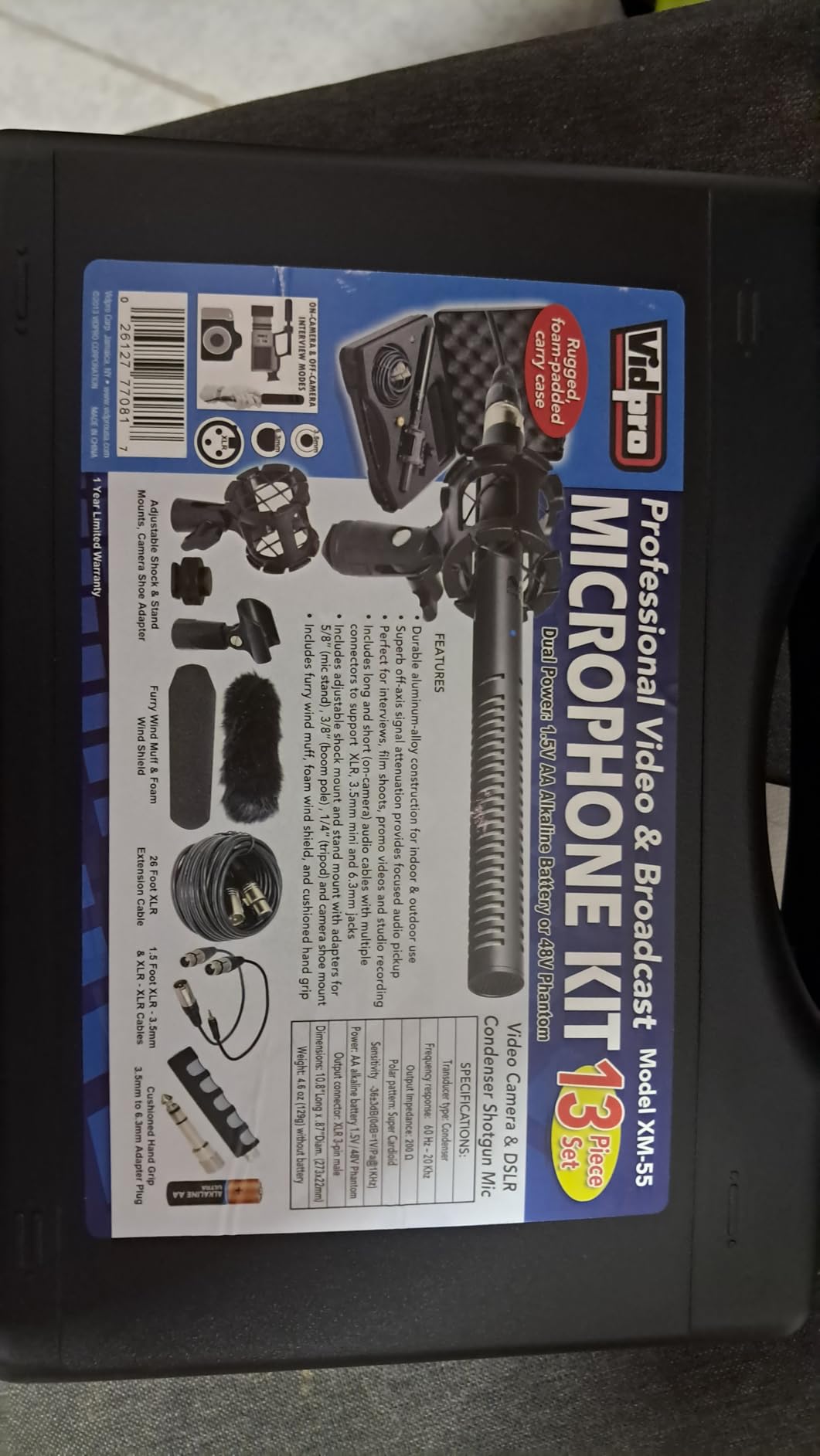
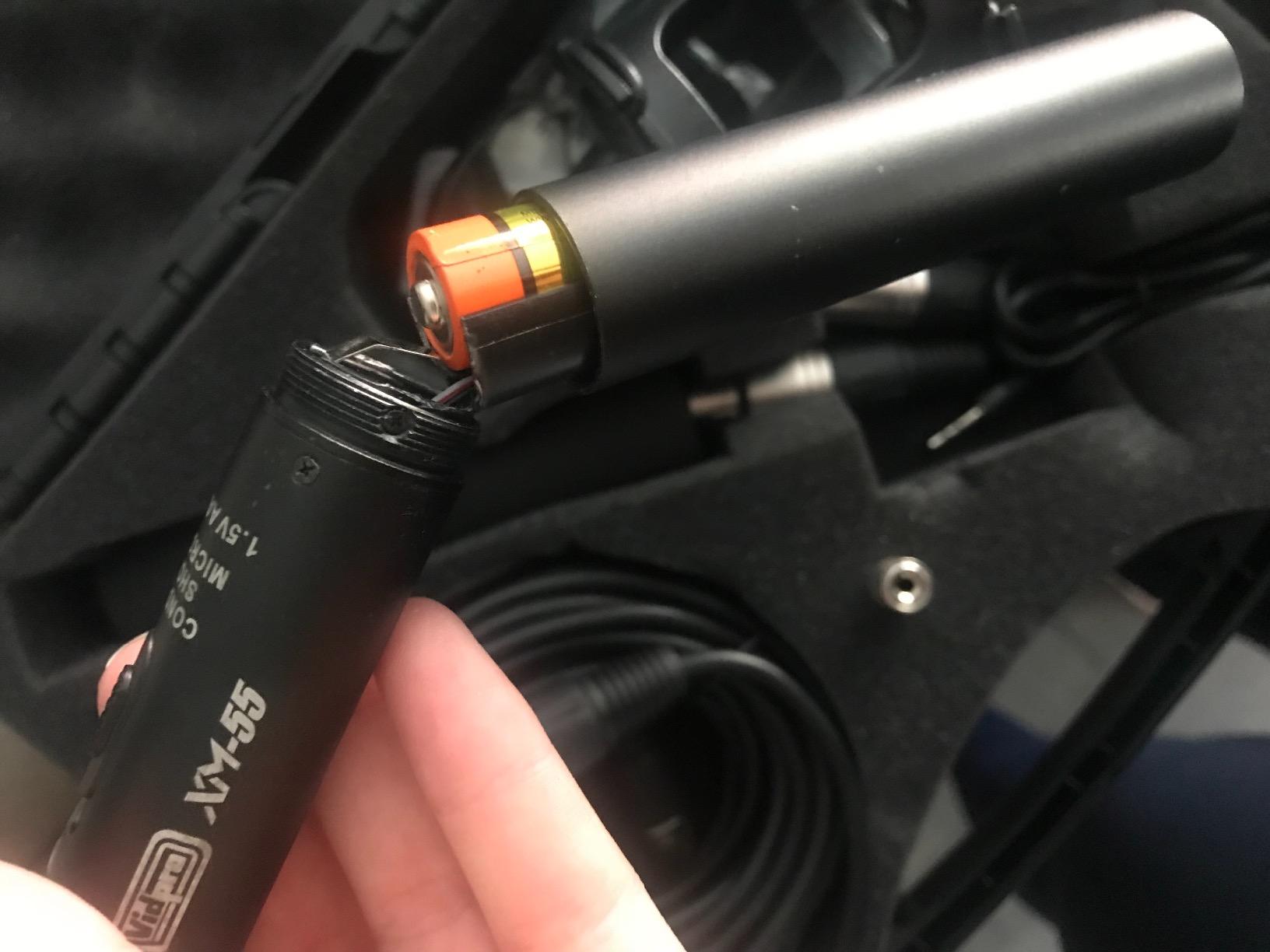
11. VidPro XM-55 13-Piece Shotgun Microphone Kit
VidPro XM-55 13-Piece Professional Video & Broadcast Unidirectional Condenser Shotgun Microphone Kit – Complete Set Includes 2 Mounts Adapters Cables and More Perfect for Indoor and Outdoor Recording
2.4 lb
Aluminium alloy
Super cardioid
XLR, 3.5 mm and 6.3 mm
Pros
- 13-piece kit includes case
- suspension mount
- stand
- camera shoe adapter
- wind muff
- wind shield
- hand grip
- two XLR cables
- an XLR-to-3.5 mm cable
- a 3.5 mm-to-6.3 mm adapter and an AA battery
- Crisp clean mono capture that several owners place near microphones well above this class
- Good off-axis attenuation with a 100 Hz to 16 kHz response for intelligible voice
- Durable aluminium alloy construction for indoor and outdoor work
Cons
- Build quality is not top-tier
- with thin cables and an XLR socket that can pull loose if yanked
- Shock mount rubber bands and the on-off switch have been reported to fail after heavy use
- At 2.4 lb with the full accessory set it is bulky next to slim on-camera mics
- Downgrading to 3.5 mm changes impedance
- so a Tube MP or transformer improves results
This is the odd one out: a wired condenser shotgun kit that mounts on a stand, a boom, a tripod or a camera shoe, and connects by XLR, 3.5 mm or 6.3 mm. If you move between a podcast desk, a camera rig and a field mixer, the adapter list alone makes it convenient.
Owners with long service histories report using it across more than 200 interview shoots, and several place the sound in the neighbourhood of far more expensive microphones. Off-axis attenuation with a 100 Hz to 16 kHz response is more than adequate for intelligible dialogue.
What it gets right for interviews
It is the rare mic that works on a boom pole, a mic stand and a hot shoe with the parts in the box, and it runs from a single AA battery rather than requiring phantom power. For events, conferences and press interviews where you want a wired run to a mixer, that is the whole package.
Where it falls short
The accessories are the weakest point. Cables feel thin, the XLR socket can be pulled out of the body if yanked, and the shock mount bands and on-off switch have needed gaffer tape after heavy use. At 2.4 lb it is heavy for a camera mount, and dropping to 3.5 mm changes the impedance enough to sound worse.
12. SMALLRIG Shotgun Mic for Camera
SMALLRIG Shotgun Mic for Camera, Video Microphone for DSLR & for iPhone
35 g
3.5 mm jack
Cardioid pattern
No battery required
Pros
- Very lightweight at 35 g with a healthy output level and no battery required
- TPE shock absorbing mount reduces vibration and camera handling noise
- Furry windscreen and high-density foam cover included for outdoor use
- Fits both cold shoe mounts and 1/4 inch tripods
- Owners on Sony and Canon bodies report sound close to more expensive microphones
Cons
- The advertised stereo mode is misleading
- since true stereo requires adding the included lavalier
- which itself records noisily
- The included lavalier cord is too short to wear in most setups
- Cardioid pattern still lets in a fair amount of background noise
- Some owners reported a loose input connection producing no audio and distortion on Android via TRS to TRRS
SMALLRIG built this one for people assembling a rig piece by piece. At 35 g, with no battery to manage, a shock mount, a deadcat and a foam cover in the box, and a fitting for both cold shoes and quarter-inch tripods, it is a flexible building block rather than a finished solution.
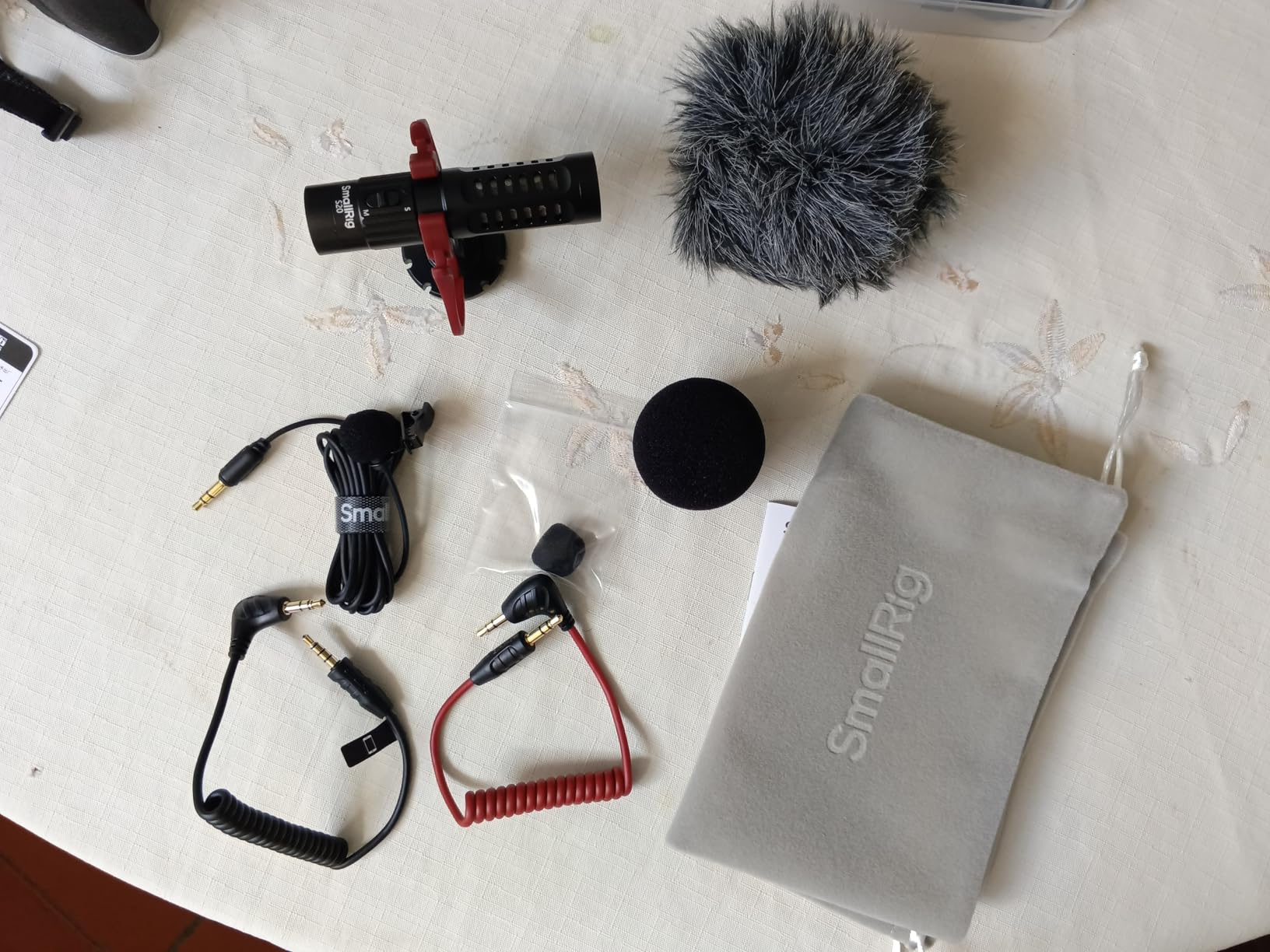
The cardioid pattern reduces background noise and echo, and owners shooting on Sony and Canon bodies report sound quality close to microphones costing considerably more. It is a reasonable backup mic for a second camera on a two-person interview.
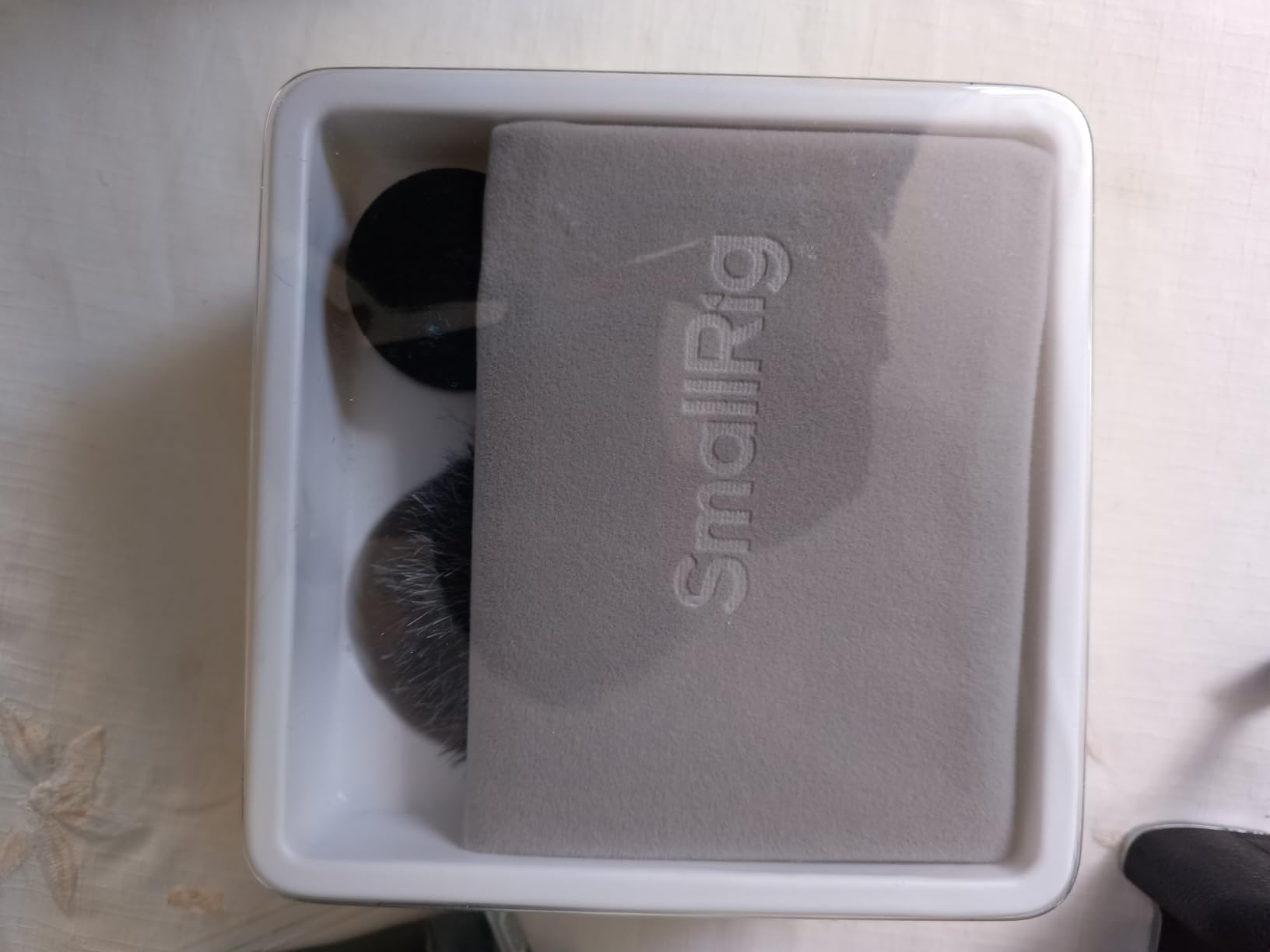
What it gets right for interviews
It is cheap insurance for a second angle, a B-cam, or a rig where the top slot is already taken. Battery-free plug-and-play means it will work the moment it is mounted, and the shock mount takes the sting out of a handheld camera. Our USB microphone guide covers the alternative if you want a wired desktop setup instead.
Where it falls short
The stereo claim is the most criticised thing about it, because real two-channel recording needs the included lavalier attached, and that lavalier is noisy and has too short a cord. The cardioid pattern is also noticeably less selective than a true shotgun, and a few owners reported a loose input that produced no audio.
Shotgun vs Lavalier vs Handheld for Interviews
Shotguns are not automatically the right answer, and this is the question that comes up most often in practitioner threads. A cardioid dynamic handheld such as the Sennheiser MD46 on a Zoom H5 or H4 is what podcast-focused users reach for, and it will handle a moving subject who walks around the room. A lavalier stays with the subject no matter what happens in the frame, but it needs wardrobe, a wireless system or a cable plan, and it rubs against fabric.
A shotgun wins when the subject is stationary but the framing is not, and when you cannot put anything on the person. So the recommendation is simple: a moving subject calls for a handheld; a seated subject with a wardrobe option is better served by a lavalier; a seated subject you want invisible is the ideal shotgun candidate. Our streaming microphone picks cover the desktop end of the same decision for live video.
How to Aim a Shotgun Mic for a Two-Person Interview
Two people in one frame is where a shotgun microphone gets tested, and failure is normal. Off-axis rejection is a real number, not a wall, so the person on the edge of the cone gets quieter and duller rather than silent.
Keep the mic on an axis that passes through both speakers, roughly chest height, and as close to the pair as framing allows.
Angle the tube from below or slightly to the side rather than straight down the line between them, so neither speaker sits in the direct off-axis null.
Stay within the working distance the maker specifies, and remember the rear rejection falls off over distance even more than the front pickup.
Watch the tube in the frame. Long interference tubes creep into wide shots or force the camera in tight, which is the argument for a short body like the AT875R or the Ruittos.
Record ten seconds of each speaker alone before the interview starts, then check levels before rolling.
How to Choose a Shotgun Microphone for Interviews
Polar pattern and the 3 to 1 rule
The 3 to 1 rule applies to any cardioid microphone: put the mic a distance away, then move the source roughly three times that distance to stay within about plus or minus 6 dB. A shotgun changes that arithmetic, because the interference tube narrows the usable cone rather than widening it. Longer tubes reject harder off axis but demand more accurate aiming.
XLR and phantom power, or 3.5 mm and plug-in power
Decide what the recorder can actually do before you buy. XLR shotguns like the AT875R need phantom power and a real preamp, which usually means a separate recorder, and that also answers the most common forum complaint, that camera preamps degrade an expensive microphone. 3.5 mm models with plug-in power are simpler to set up, but you inherit whatever the camera front end does to the signal.
Tube length versus your framing
Length buys rejection and costs headroom in the shot. Under 7 inches, as on the AT875R, or 11 inches on the Ruittos, stays out of a two-shot. The 80 mm VideoMicro II and the small Movo bodies disappear on almost any composition.
Self-noise, gain control and preamp headroom
Self-noise matters in a quiet room with a treated floor, where a noisy preamp becomes audible between sentences. A mic with its own gain control and filtering, such as the Rode VideoMic NTG or the COMICA VM20, lets you set levels before the signal reaches a mediocre preamp. Headroom on paper means little if the recorder clips first.
Wind protection and power
Interviews happen in doorways and on streets. A deadcat, included with the COMICA CVM-VM10II, is the minimum for exterior work, and foam alone handles breath but not gusts. On power, plug-in power removes a failure point entirely, while a rechargeable cell with a runtime readout, as on the VM20, makes a long day predictable.
Where Shotgun Microphones Fall Short
The polar pattern is narrow, so a subject who leans or turns out of the cone gets quieter and duller immediately.
Two speakers close together in one frame cannot both be centred, and the one on the edge of the cone is working against the null.
Handling noise and boom movement leak in unless the suspension mount and the operator are both good.
Long tubes can pick up high-frequency interference and moire at the capsule end, and they creep into wide frames.
Rejection never reaches zero, so room tone and background talk are reduced rather than removed.
Frequently Asked Questions
What is the best shotgun microphone for video production?
For most video interviews the Movo VXR10 is the strongest starting point, because it runs on plug-in power and connects to almost any camera, phone or laptop with a 3.5 mm input. When the budget stretches further, the Audio-Technica AT875R is the best choice for off-camera work on a separate recorder, and the Rode VideoMic NTG is the best on-camera option for its digital switching and variable gain.
What is the best microphone for recording interviews?
It depends on the subject. A cardioid dynamic handheld is best when a subject walks around and cannot be touched. A lavalier is best for a stationary subject with wardrobe flexibility. A shotgun microphone is best when the subject is off camera or you want an invisible mic, since its narrow lobar pattern rejects room noise from several feet away.
What is the 3 to 1 rule for microphones?
The 3 to 1 rule says that for a cardioid microphone, moving a sound source roughly three times further from the mic than your first source reduces its level by about 6 dB, which is often treated as the point where it becomes unusable. A shotgun microphone changes this, because its interference tube narrows the cone instead of widening it, so rejection depends on how accurately you aim.
What are the downsides of using a shotgun mic?
The main drawbacks are a narrow polar pattern, poor behaviour with two speakers in one frame, sensitivity to boom and handling noise, and rejection that reduces background sound without ever removing it. Long tubes also creep into wide shots, and 3.5 mm models usually give you no gain control and no headphone monitoring.
Do shotgun mics work for two people talking?
They work, but only with realistic expectations. A shotgun microphone can hold a two-person conversation when the mic is placed on an axis passing through both speakers and kept within its working distance, with the tube angled so neither person sits in the direct off-axis null. The person nearest the axis sounds best, so dual lavaliers remain cleaner for a two-shot.
Final Verdict
After working through all twelve, the best shotgun microphones for video interviews come down to where the mic lives. On the camera, the Movo VXR10 is the most compatible choice we found, with the VideoMic NTG as the quality upgrade and the MKE 400 when discretion and monitoring matter most. Off camera on a boom, the Audio-Technica AT875R is the one we would carry, and the short bodies on this list are what keep it out of the frame.
Whichever you pick in 2026, buy the wind protection and check your levels for ten seconds before the interview starts. Our condenser microphone guide covers the studio side if the interview moves into a treated room.