
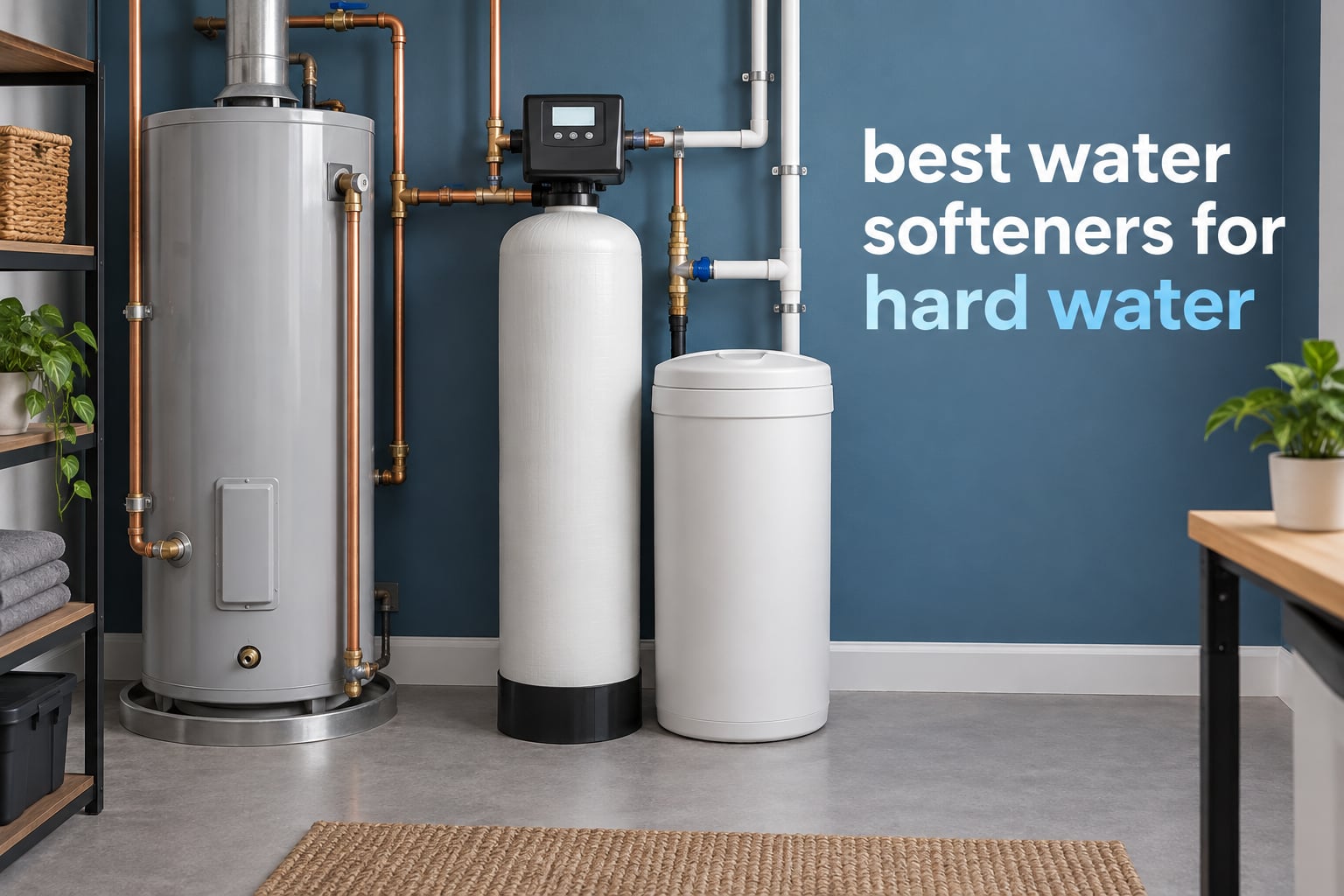
Hard water is the reason your dishwasher leaves white crust on every glass and your shower turns into a lime scale science project. If you have been searching for the best water softeners for hard water, you will find that most of them fall into one of two camps: true ion exchange softeners that swap hardness minerals for sodium, and salt-free scale controls that reduce buildup without softening anything at all. Our top three picks are the Aquasure Harmony Series 48,000-grain for most homes, the AFWFilters Fleck 5600 SXT for buyers who want a proven control valve, and the On The Go 16,000-grain unit for RVs and boats.
We spent six weeks reading through thousands of owner reviews, comparing grain capacity, flow rate, regeneration type and warranty terms, and mapping each system to the household it actually fits. Nothing here is sponsored, and every spec we quote comes from the manufacturer listing. We also explain sizing math, what upflow regeneration really does, and why a salt-free descaler is a different product entirely rather than a cheaper softener.
If you are still narrowing the field, our general water softener roundup covers the same category from a different angle, including guidance on testing your water before you spend anything.
Table of Contents
Top 3 Picks for the Best Water Softeners for Hard Water in 2026
These three earned their spots on rating, review volume and how cleanly they solve a specific problem. The Aquasure Harmony wins on balance: the largest review base in the group, a 48,000-grain capacity and a built-in pre-filter. The Fleck 5600 SXT earns its place for anyone who wants a widely supported control valve and 10% crosslink resin. The On The Go portable takes the top rating in the roundup at 4.7 stars and is the clear answer for RV and boat water.

Aquasure Harmony 48,000 Grain
- 48000 grain capacity
- 12 gpm flow
- Digital metered head
- Sediment carbon zinc prefilter

AFWFilters Fleck 5600 SXT
- Fleck 5600 SXT metered valve
- 1.5 cu ft 10 percent resin
- 14 gpm flow
- 250 lb brine tank

On The Go 16,000 Grain RV
- 16000 grain portable
- Up to 1600 gallons
- Regenerates in under 30 minutes
- No electricity needed
Best Water Softeners for Hard Water at a Glance in 2026
Every system below appears once in this table with the specs that decide whether it fits your home. Grain capacity tells you how much hardness it can remove before a regeneration cycle, and flow rate tells you whether it can keep up when several fixtures run at once.
| Product | Specifications | Action |
|---|---|---|
| Aquasure Harmony Series 48,000 Grain |
|
Check Latest Price |
| AFWFilters Fleck 5600 SXT |
|
Check Latest Price |
| On The Go 16,000 Grain RV Softener |
|
Check Latest Price |
 PRO+AQUA 16,000 Grain Portable PRO+AQUA 16,000 Grain Portable |
|
Check Latest Price |
 A. O. Smith Whole House Scale Control A. O. Smith Whole House Scale Control |
|
Check Latest Price |
 Kenmore 350 32,000 Grain Kenmore 350 32,000 Grain |
|
Check Latest Price |
 Tier1 48,000 Grain System Tier1 48,000 Grain System |
|
Check Latest Price |
 Camco TastePURE 4 GPM Kit Camco TastePURE 4 GPM Kit |
|
Check Latest Price |
 Water Boss 600K Gallon Scale Control Water Boss 600K Gallon Scale Control |
|
Check Latest Price |
 Aquasure 72,000 Grain Bundle with RO Aquasure 72,000 Grain Bundle with RO |
|
Check Latest Price |
1. Aquasure Harmony Series 48,000 Grain: Best Overall Whole House Softener
Aquasure Harmony Series 48,000 Grains Whole House Water Softener w/High Efficiency Digital Metered Control Head (48,000 Grains)
48000 grain capacity
12 gpm max flow
10 x 10 x 62 inch tank
Ion exchange with carbon prefilter
Pros
- 48000 grain capacity suits 3-4 bathroom homes
- Triple purpose sediment carbon zinc prefilter strips chlorine and sediment
- Programmable digital metered head with backlit display
- Fiberglass lined polyethylene tank with durable bypass
- Prefilled resin plus 5 year extended warranty
Cons
- 120 lb weight and 62 inch height need real installation space
- Salt based ion exchange means refills and regeneration water
The Harmony is the model we keep coming back to because it does the unglamorous work well and holds up under real household demand. The 48,000-grain capacity is the sweet spot for a three or four bathroom home, and the 12 gpm maximum flow rate means a shower, a dishwasher and laundry running together will not starve the resin bed.
What sets it apart from bare-bones ion exchange units is the triple purpose pre-filter. It strips sediment, carbon-based contaminants and heavy metals ahead of the resin, which matters on city water where chlorine eats resin beads faster than most people expect. Reviewers report noticeably softer water, less spotting on glassware and appliances that run more efficiently once scale stops building up inside them.
The digital metered control head is the piece you will actually interact with. It meters used water, triggers regeneration only when the bed is spent, and lets you set flush intervals. That metering behavior is what separates a modern system from an old timer-based unit, and it is the reason a household like this uses far less salt and water than the fixed-cycle models.
Owners also point to the fully prefilled premium-grade resin and a five year extended warranty backed by US-based technical support. That support matters more than it sounds, because the first 30 days is when programming mistakes happen and most problems are actually setup problems rather than hardware failures.
Who this softener suits
This is the right pick for a family of four to six in a home with three or four bathrooms, on either municipal or well supply. If your water is in the moderate to high hardness range and you want scale control plus chlorine reduction in a single unit, the combination removes a whole extra component from the plumbing plan.
It also works well as the softener feeding a whole house carbon filter, since the pre-filter stage handles the sediment that would otherwise clog finer media downstream.
Where it falls short
The physical footprint is the main constraint. At 62 inches tall and 120 pounds, it needs floor space near the main shutoff, a drain within reach, and enough vertical clearance that nobody hits it with a lawnmower. Measure first.
It is also a salt-based ion exchange system, which means carrying salt, topping up the brine tank, and a small amount of discharge water each cycle. Owners who want zero ongoing consumables should look at a scale control unit instead.
2. AFWFilters Fleck 5600 SXT: Best Proven Control Valve
AFWFilters Fleck 5600 SXT Digital Water Softener with 10% Crosslink Resin
1.5 cu ft 10 percent crosslink resin
14 gpm max flow
Fleck 5600 SXT digital valve
5 year warranty
Pros
- Fleck 5600 SXT valve is a widely proven control head
- 10 percent crosslink resin resists chlorine attack
- 14 gpm maximum flow handles high demand
- Includes mineral tank brine tank bypass and drain fittings
- USA assembled with decades of water treatment experience
Cons
- Premium pricing among the whole house ion exchange units here
- 62 inch installed height and 130 lb weight need clearance
- Salt refills and regeneration discharge are ongoing tasks
Everything about this system comes down to the valve. The Fleck 5600 SXT is one of the most widely deployed control heads in residential water treatment, and that matters for two reasons: repair parts are easy to source, and any plumber who has worked on water softeners has worked on this valve before.
The resin is the other headline. At 1.5 cubic feet of 10% crosslink resin, it holds more exchange capacity per cubic foot than standard 8% media and stands up better to chlorine oxidation. The 14 gpm maximum flow is among the highest here, which gives it headroom for homes with multiple bathrooms.
Everything needed for the install arrives in one box: the mineral tank, a brine tank sized to hold 250 pounds of salt, the bypass valve and the drain fittings. Connections are 1 inch NPT, which is the standard residential size, so it drops into most existing setups without adapters.
Reviewers rate it 4.6 out of 5 across 541 reviews, with a large share of five-star ratings. The praise lands on straightforward installation, the valve, and the resin. The complaints cluster on price and size rather than performance, which tells you the engineering is doing what it promises.

Who this softener suits
Buy this one if you are a hands-on homeowner or a DIY installer who wants parts that will still exist in ten years. It is also the sensible choice for well water homes with moderate iron, because the higher crosslink resin and the Fleck valve have a long track record in that application.
Anyone with a large household or a busy laundry room will appreciate the flow headroom, since 14 gpm means you are less likely to notice a pressure drop when everything runs at once.
Where it falls short
It sits at the premium end of the whole house ion exchange units in this roundup, and it does not include installation labor. Budget separately for a plumber if you are not comfortable cutting into the main line and setting a proper drain.
At 130 pounds dry and 62 inches installed, it is also one of the heaviest and one of the tallest in this roundup. Plan the location before the box arrives, because repositioning a plumbed mineral tank is a two-person job.
3. On The Go 16,000 Grain Portable: Top Rated for RVs and Boats
OTG4-DBLSOFT-Portable 16,000 Grain RV Water Softener (NOT made in China, assembled by U.S. Workers in Indiana)
16000 grain capacity
Up to 1600 gallons
22 in x 9.5 in body
No electricity required
Pros
- Highest average rating in the roundup at 4.7 stars
- Yields up to 1600 gallons or 40 days per regeneration
- Standard garden hose connection with no tools or electricity
- Large mouth opening makes salt loading easy
- Compact 22 inch body stows in an RV storage bay
Cons
- Not intended for shower or under sink hookups
- Plumbing fittings are plastic rather than brass
- Manual regeneration means remembering the schedule
This is the highest rated product we evaluated, at 4.7 stars across 1,899 reviews, and the reason is simple: it does exactly one job and does it without fuss. It is a portable salt-based softener for RVs, trailers and boats, and it connects to a standard garden hose. No electricity, no tools, no plumbing modifications.
The capacity is the surprise. A single regeneration yields up to 1,600 gallons or roughly 40 days of soft water, and it completes in under 30 minutes using two boxes of ordinary table salt. Users who track hardness with test strips report drops from around 10 or 11 GPG down to 1 or 2 GPG, which is a visible change in shower feel and glassware almost immediately.
The large mouth opening on top takes salt easily, which sounds minor until you have loaded salt in the rain with a funnel in the dark at a campground. A carry handle and a 22 inch tall body make it easy to move between the freshwater tank connection and storage.
A travel cap and plug are included, and they solve a problem most portable softeners ignore. Water sloshing in a tank during transit is the fastest way to end up with a mess in a storage bay, and these fittings stop it at the source.
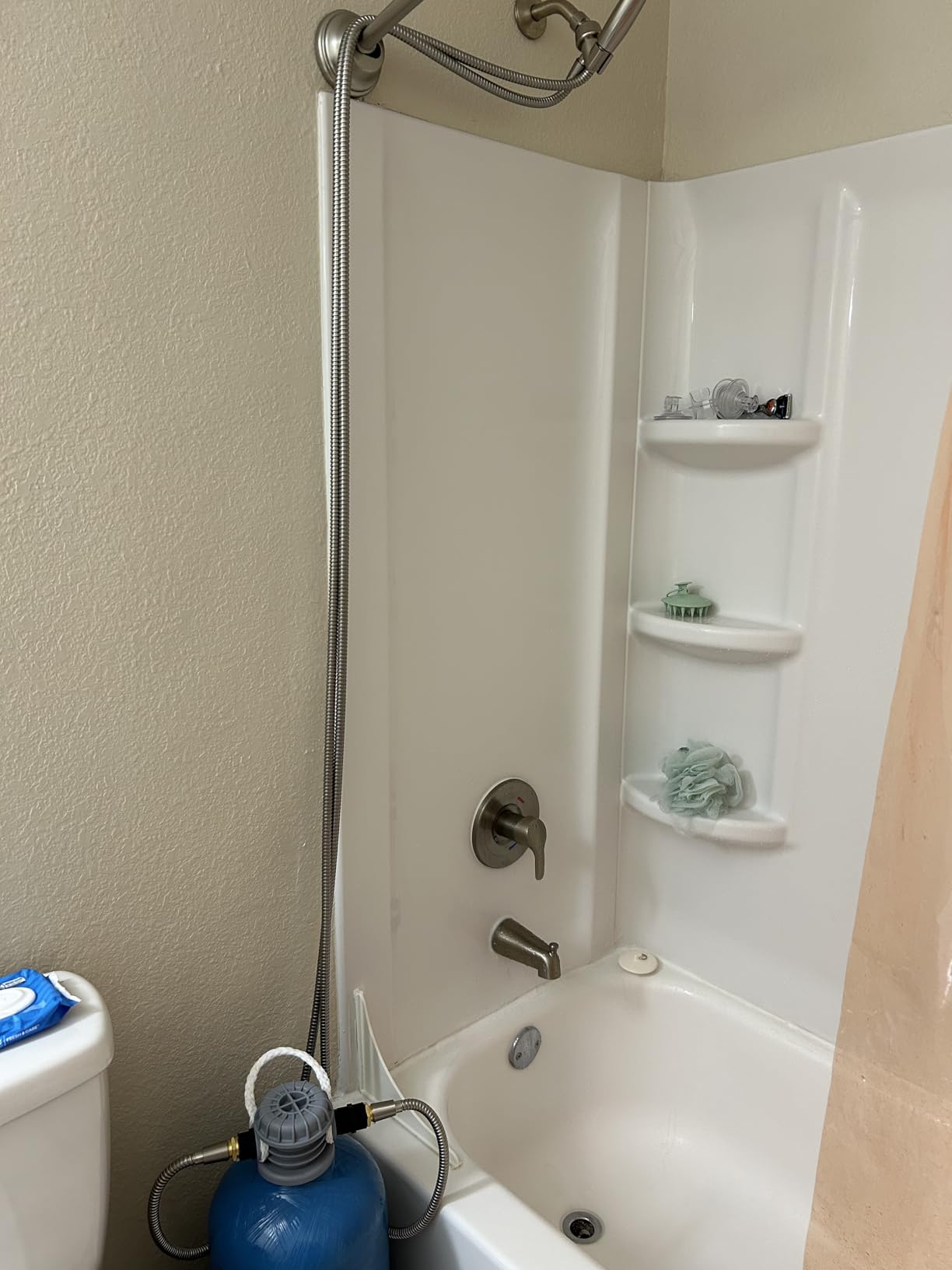
Who this softener suits
Full-time RVers, weekend campers, boaters and anyone drawing from a park or marina supply with hard water. It also works for anyone who wants softened water at one hose bib, a car wash connection or an outdoor spigot, because that is exactly the use pattern it was built for.
Households on well water with very hard supply can use it as a seasonal treatment at the wellhead if the flow rate matches. It is not meant to serve an entire house.
Where it falls short
The manufacturer is explicit that this is not for shower head hookups or under-sink installations, and trying to force it there is the main source of unhappy reviews. Treat it as a hose-connected appliance, not a plumbing fixture.
Regeneration is manual. You drain it, add salt and start the cycle yourself, so a busy travel schedule can quietly stretch past the useful life of the resin. The plastic fittings are another soft spot, and a few owners report the tank not sitting level in the base.
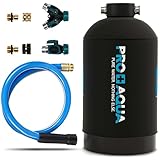
4. PRO+AQUA 16,000 Grain Portable: Best for Boats, Trailers and Mobile Washing
PRO+AQUA 16,000 Grain Portable Water Softener for RV, Trailers, Boats, Mobile Car Wash, Pressure Wash – Protects Water Systems
16000 grain capacity
Up to 60 days or 2000 gallons
10 x 10 x 19.5 inch body
Manual regeneration
Pros
- Ready to use in about 5 minutes with no tools or electricity
- 16000 grain capacity for up to 60 days of soft water
- Compact 10 x 19.5 inch body fits tight RV and boat storage
- Handles city and well water alike
- Fiberglass reinforced tank prefilled with NSF certified resin
Cons
- Included prefilter needs periodic replacement
- Manual regeneration schedule depends on the owner remembering
- Output varies with incoming water hardness
This is the most versatile portable unit here, and the difference from the On The Go is the range of jobs it can do. It is sold for RVs, trailers, boats, spas, mobile car washing and pressure washing, and the kit includes a pre-filter, regeneration kit, brine hose and quick-connect fittings.
Owners like the setup speed. From unboxing to running softened water is about five minutes because the in and out ports are 3/4 inch high-flow garden hose fittings and the tank arrives prefilled. At 35 pounds and 19.5 inches tall, it tucks into storage compartments where a 62 inch system would never fit.
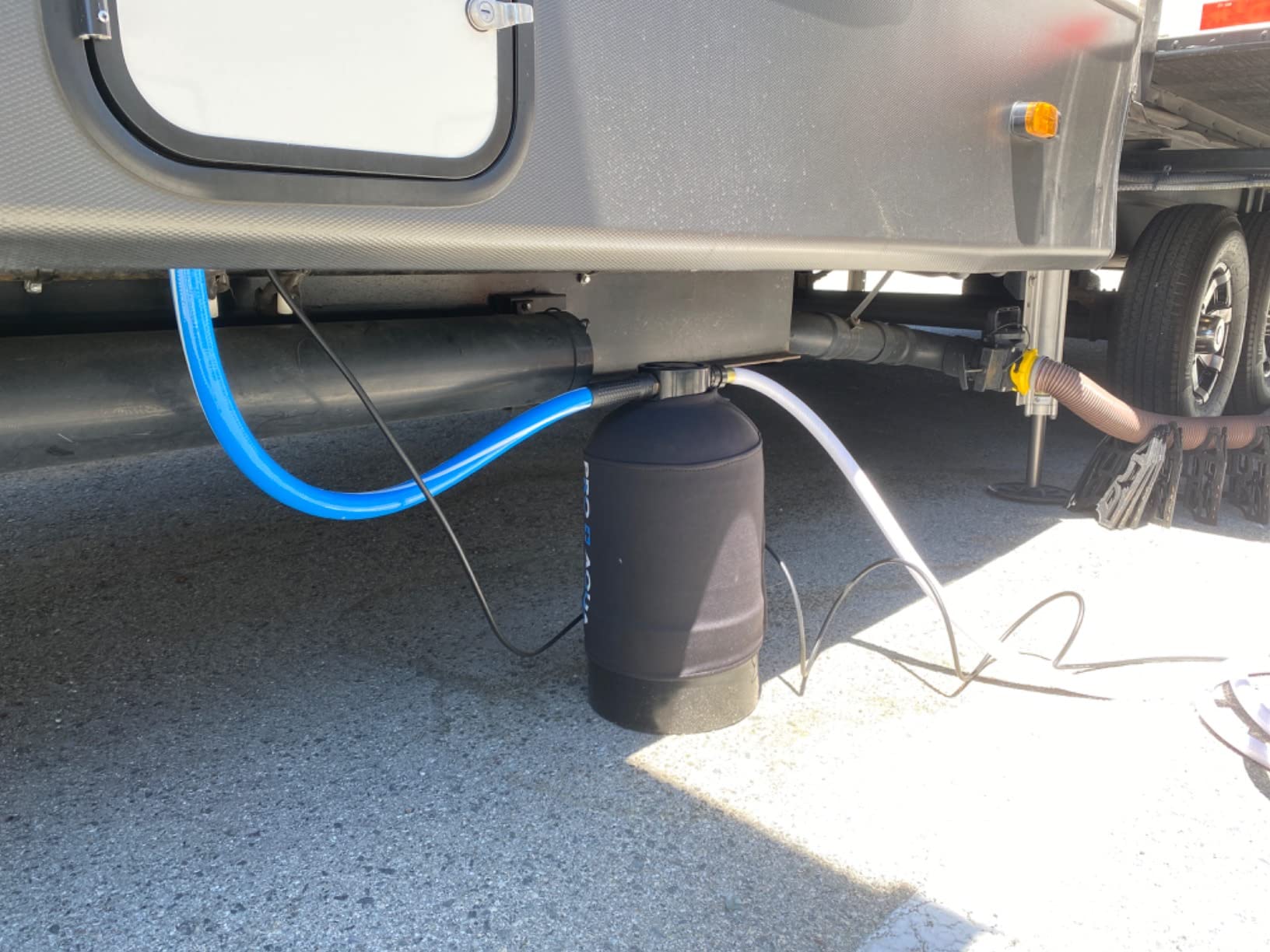
The claim reviewers repeat most is longevity of use per load. Sixteen thousand grains delivers up to 2,000 gallons or 60 days depending on how hard the source water is, which is a longer interval between regenerations than most competitors at this size.
It works on well water as well as city supply, and the fiberglass reinforced polyethylene tank with NSF-certified resin gives it a feel closer to a permanent unit than a throwaway camping accessory. The kit includes everything needed to regenerate with two boxes of table salt in under 30 minutes.
Who this softener suits
Boat and marina owners who want drinking and wash water without a permanent installation. It also suits mobile detailers and pressure washers who need to protect equipment from scale while working from different locations.
Anyone with genuinely hard well water who only needs one outlet softened, rather than a whole house, gets a good balance of capacity and portability here.
Where it falls short
The included pre-filter is a consumable and needs replacing on a schedule, which adds a small ongoing cost people often forget at purchase. The manual regeneration cycle is the second recurring annoyance, since nothing triggers it for you.
Real output also swings with incoming hardness. On very hard supply you will cycle far more often than the 60-day figure, so factor that in before assuming this will cover a full season without a salt run.
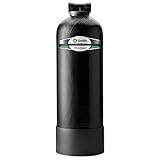
5. A. O. Smith 600K Gallon Scale Control: Best Salt-Free Whole House Option
A. O. Smith Whole House Salt-Free Scale Control | 600K Gal | AO-WH-DSCLR
Salt-free scale control media
Up to 600000 gallon service life
7 gpm flow
6 year limited warranty
Pros
- Salt-free and chemical-free with no bags to carry
- Rated for up to 600000 gallons or 6 years
- Keeps protecting during a power outage
- Compact 12 pound 30 inch body
- Works on both city and well water
Cons
- Does not soften water or reduce hardness minerals
- Only rated under 15 GPG hardness 250 mg/L alkalinity pH under 8.3 and iron under 0.3 ppm
- Warranty service can be difficult to obtain for leak issues
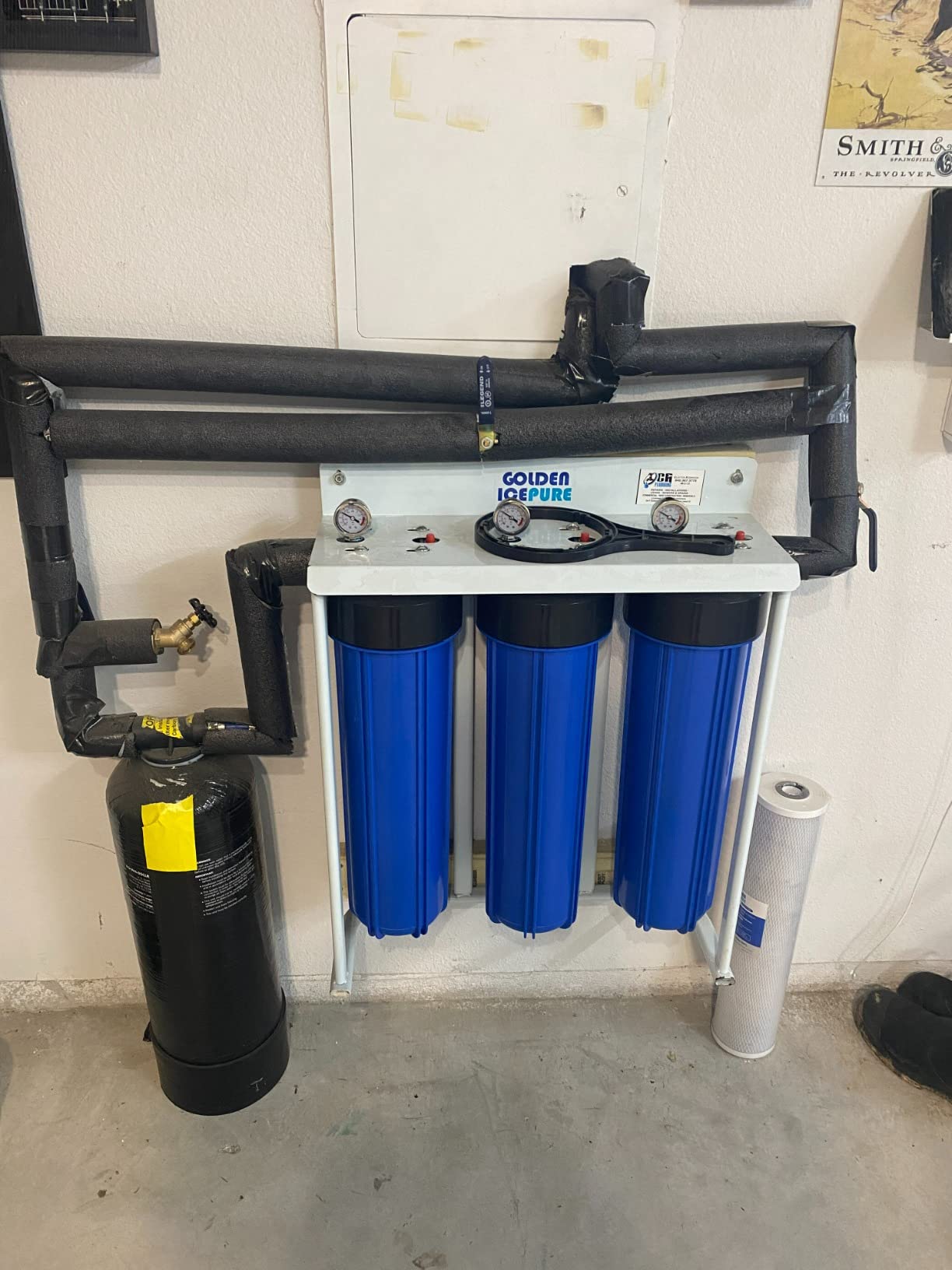
This unit does not soften anything, and that distinction matters more than any spec on this list. It uses scale control media to keep scale from forming inside pipes, water heaters and appliance heating elements. If your goal is protecting plumbing and reducing spotting, it can genuinely work. If you want soap to lather better and hair to feel different, it will not deliver that.
The appeal is the absence of ongoing work. No salt bags, no backwashing schedule, no electricity and no brine tank. It carries a six year limited warranty and a service life rating of up to 600,000 gallons or six years, and it keeps doing its job through a power outage, which rules out most electronic descalers.
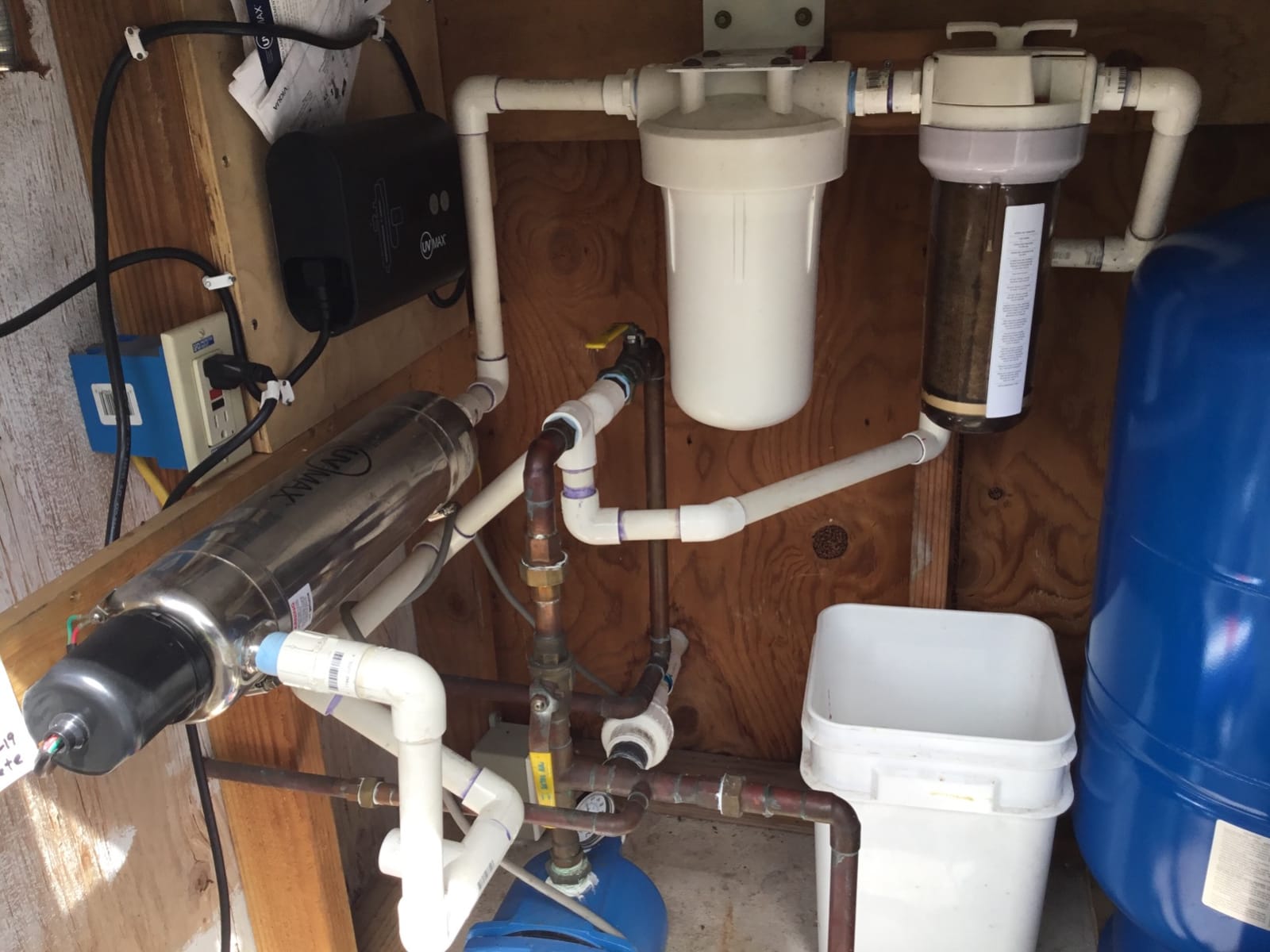
Reviewers measuring before and after report roughly 80 to 85% scale reduction on city water in the 17 to 18 GPG range, which is a useful reality check because it is less than a true softener accomplishes on the same supply.
The limits are explicit in the specifications. It is designed for hardness under 15 GPG, alkalinity under 250 mg per liter, pH under 8.3 and iron under 0.3 ppm. Push past those numbers, especially with iron or sulfur, and performance falls off quickly.
Who this fits
This is the right call for homeowners who cannot discharge brine to a sewer or drain, live in an area with salt restrictions, or simply refuse to haul salt. It also suits rentals, apartments and short-term properties where a minimal maintenance profile beats maximum softening.
If you have water in the moderate hardness range and your main complaint is scale in the water heater and faucets rather than soap consumption, the zero-salt profile is a genuine advantage.
Where it falls short
It leaves hardness in place. Your water will still test hard, dishwasher glassware will still spot, and you will still use more soap than with an ion exchange unit. Nobody who expects softening should buy this.
There is also a recurring report of a slow drip at the tank-to-fitting junction after many months of service, and some owners describe warranty claims as a frustrating process. In a tight installation space, the 30 inch height is generous compared with slim competitors.
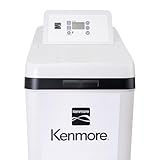
6. Kenmore 350 32,000 Grain: Best for Tight Installation Spaces
Kenmore 350 Whole House Water Softener System, 32,000 Grain, 1-4 People
32000 grain capacity
48 inch installed height
7.2 gpm max flow
IntelliSoft on-demand regeneration
Pros
- IntelliSoft learns usage and regenerates only when needed
- Digital display shows flow rate and salt level
- Compact 48 inch footprint for tight spaces
- High flow 3/4 inch valve holds pressure
- 10 year tank warranty plus clear water iron reduction
Cons
- 4.2 star average trails most whole house units here
- About 10 percent of reviews are one star
- Electronics warranty is only 3 years
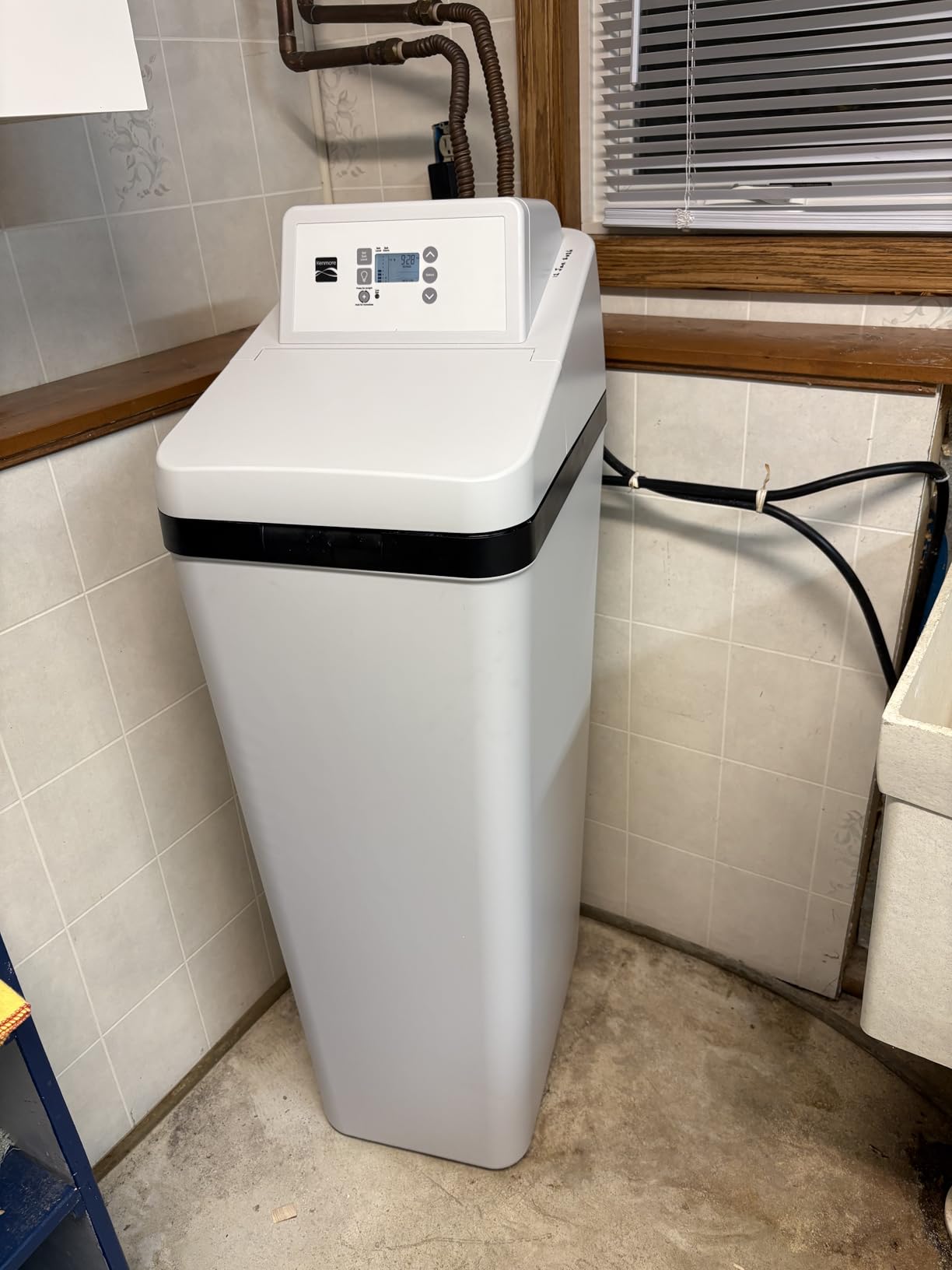
The Kenmore 350 solves a problem most listings ignore, which is vertical space. At 20.5 by 15 inches and 48 inches tall, it is roughly 14 inches shorter than the tall mineral tanks common in this category, and at 80 pounds it is one of the easier systems to set into a cramped mechanical corner.
Its control logic is genuinely modern. IntelliSoft learns how the household uses water and regenerates on demand rather than on a fixed clock, and the digital display reports flow rate and salt level so you can see when a bag is running low instead of guessing.
Beyond softening, it reduces clear water iron up to 0.3 milligrams per liter through its 0.83 cubic foot resin bed, and a built-in sediment shield adds a bit of filtration before the water reaches your appliances. That combination is useful on wells that carry light iron staining.
The warranty structure is worth reading carefully. It carries one year full coverage, ten years on the tank and three years on the control board. The tank coverage is among the longest in this roundup, while the electronics term is the shortest, and those are the parts most likely to fail first.
Who this softener suits
Small households of one to four people in homes where a full height mineral tank simply will not fit, such as crawlspaces, basements with low joists or compact condos. The 3/4 inch high-flow valve is designed to hold pressure in exactly those tight locations.
It also makes sense for anyone who prefers a single-brand appliance with straightforward warranty terms and does not want to assemble a system from separate tanks and valves.
Where it falls short
At 4.2 stars from 448 reviews, it sits below most whole house units here, with about 10 percent of reviews at one star compared with 2 to 5 percent for peers. The critical reviews concentrate on installation and valve problems and on customer service experiences, so budget time for commissioning.
The 7.2 gpm maximum flow rate is the lowest among the ion exchange units in this roundup, which is fine for a small home but tight for a busy one. And it still demands salt refills plus regeneration water, just like any other ion exchange system.
7. Tier1 48,000 Grain: Best for High Flow and Large Homes
Tier1 48,000 Grain Water Softener System for 4-5 Bathroom Homes
48000 grain capacity
18 gpm max flow
Ceramic disk valve
10 inch x 59 inch tank
Pros
- Highest maximum flow rate in the roundup at 18 gpm
- Ceramic disk valve removes seals and rebuild kits from the equation
- 10 year limited warranty on the resin and brine tanks
- Prefilled with 1.5 cu ft of NSF/ANSI 44 certified resin
- Very quiet operation reported by owners
Cons
- Regeneration follows a fixed roughly 30 day schedule rather than pure on-demand
- Not rated for outdoor installation
- Some owners report a drip at the filter after installation
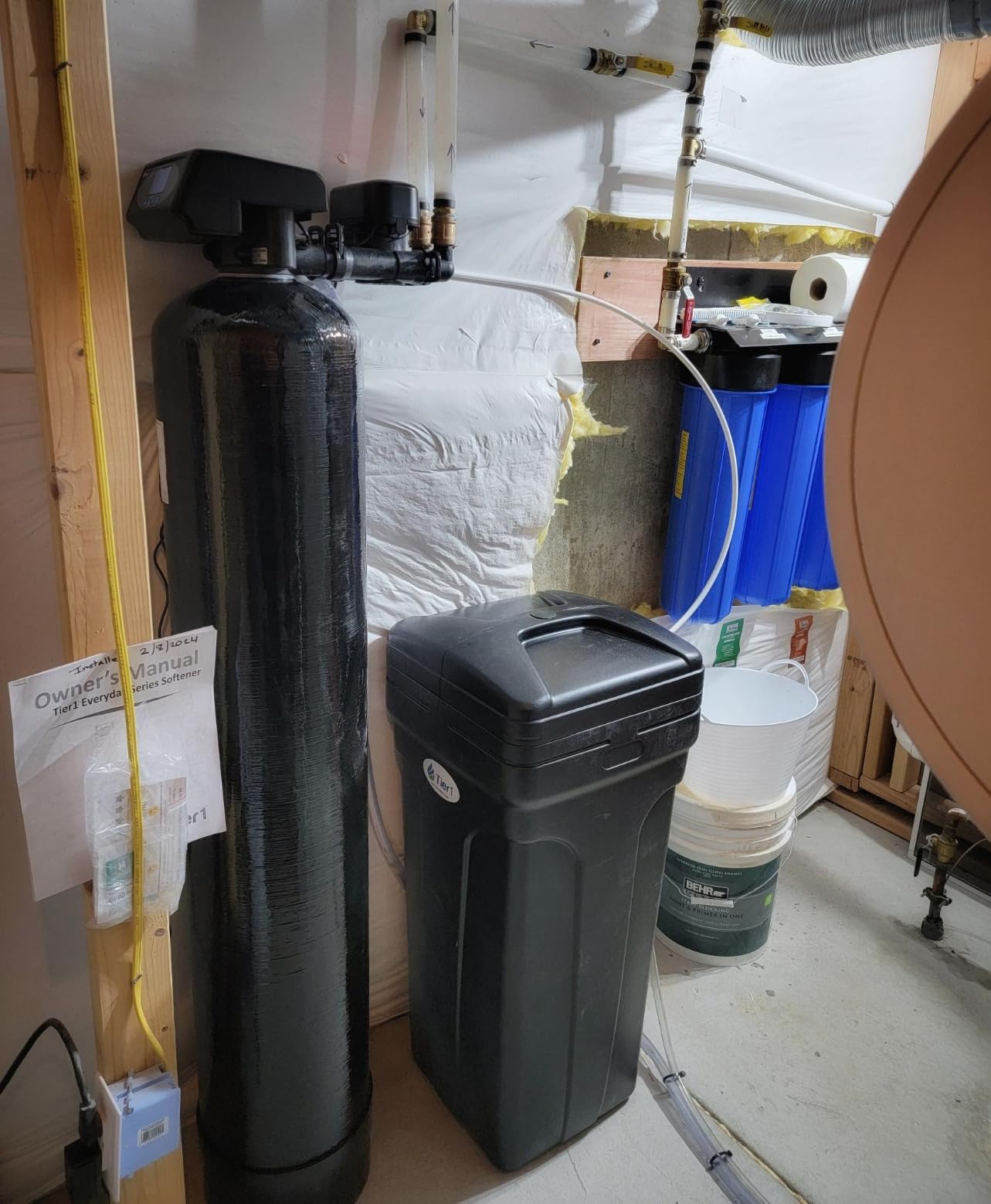
The Tier1 is built for volume. At 48,000 grains sized for four to five bathroom homes and an 18 gpm maximum flow rate, it is the highest flow figure in this roundup, and that headroom is the point. It keeps pressure up when a shower, a tub, a dishwasher and laundry all run together.
The valve design is genuinely different from the Fleck-style heads elsewhere on this list. It uses a patented ceramic disk mechanism, which removes the elastomer seals and rebuild kits that normally define the maintenance life of a control valve. Fewer wear parts means fewer reasons to service the head.
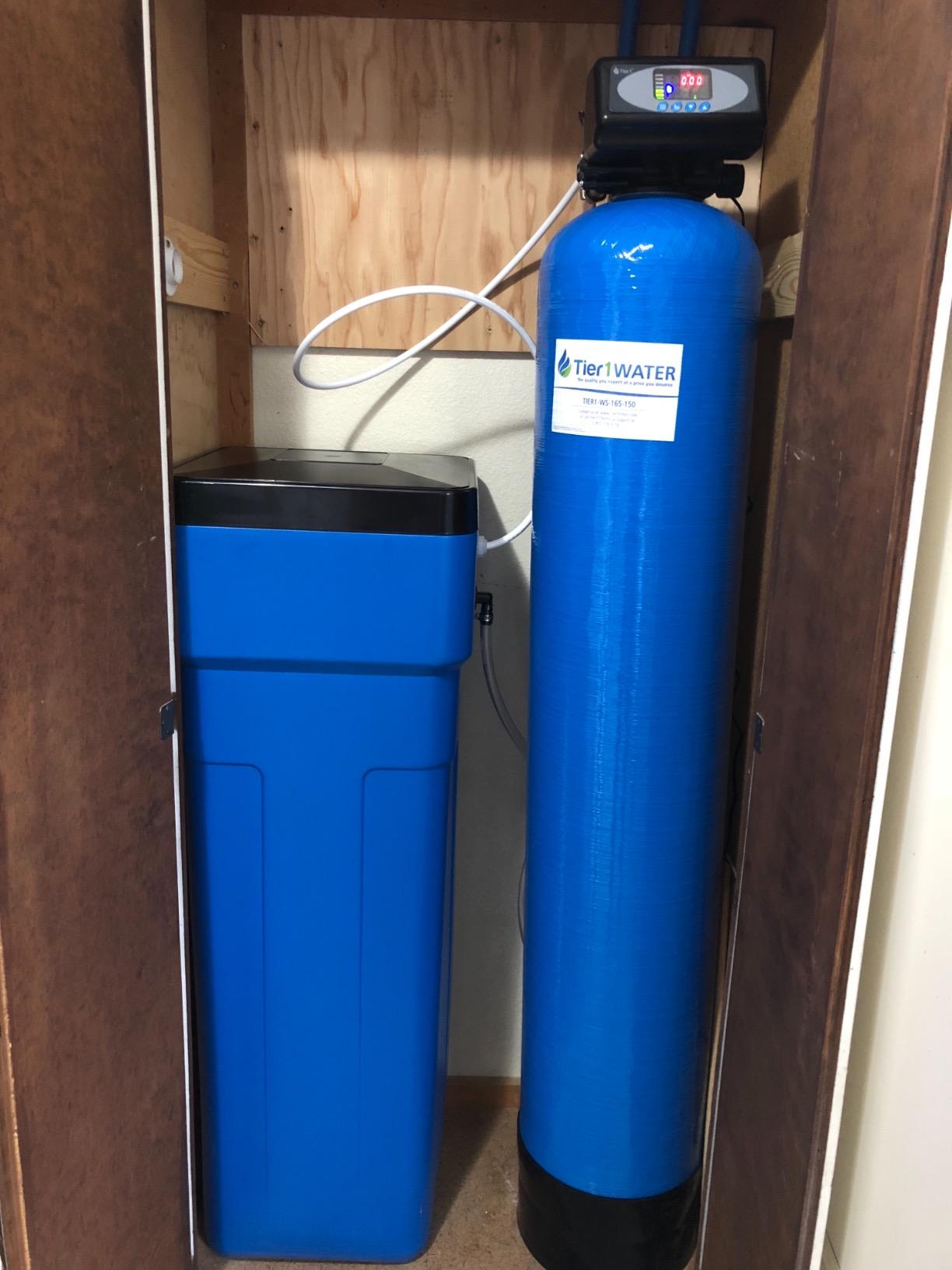
The tank arrives prefilled with 1.5 cubic feet of NSF/ANSI 44 certified cation resin plus a sediment prefilter, so there is no media to pour on the floor. Warranty coverage runs ten years on the fiberglass resin and brine tanks, with one year on the valve and electronics that extends to five years when registered.
Owners frequently mention how quiet it runs and how quickly Tier1 technical support answers the phone and troubleshoots in real time. Those two details do more for satisfaction with a whole house system than any spec on the label.
Who this softener suits
Large households, four to five bathrooms, or anyone with high peak demand such as a busy laundry room, a soaking tub or multiple water-using appliances. If you have ever watched pressure sag when everything runs at once, this is the capacity that solves it.
It is also appealing for owners who do not want periodic seal replacement work on a control valve, since the ceramic disk design removes that service item from the schedule.
Where it falls short
The most important caveat is about regeneration control. The manufacturer confirms regeneration follows a fixed schedule of roughly 30 days rather than true on-demand operation, which means more salt and water use than a properly metered system. Set expectations accordingly if efficiency is your priority.
It is also not rated for outdoor installation, and that restriction is not always obvious in listings. The tall 59 inch tank at 120 pounds is genuinely hard to move once it is plumbed, and a few owners report a drip at the filter if the install is not checked carefully.
8. Camco TastePURE 10,000 Grain Kit: Best Budget Portable Kit
Camco TastePURE Portable Compact 4 GPM Hard Water Softener Kit with Carry Handle, 4′ Hose, and 50 Test Strips for Boats and RVs
10000 grain capacity
4 gpm flow rate
21.5 x 9 x 8.75 inch body
Hose and strips included
Pros
- Complete kit ships with hose test strips fitting and storage caps
- Screw-on garden hose setup takes seconds with no tools
- Owners report softer water less spotting and better drinking taste
- Carry handle makes transport between fittings easy
- Compact body suits tight RV and boat storage
Cons
- 10000 grain capacity is the smallest in the group
- 4 gpm flow rate is low for heavy washing use
- Instructions are sparse and the cap seal can be tricky to seat
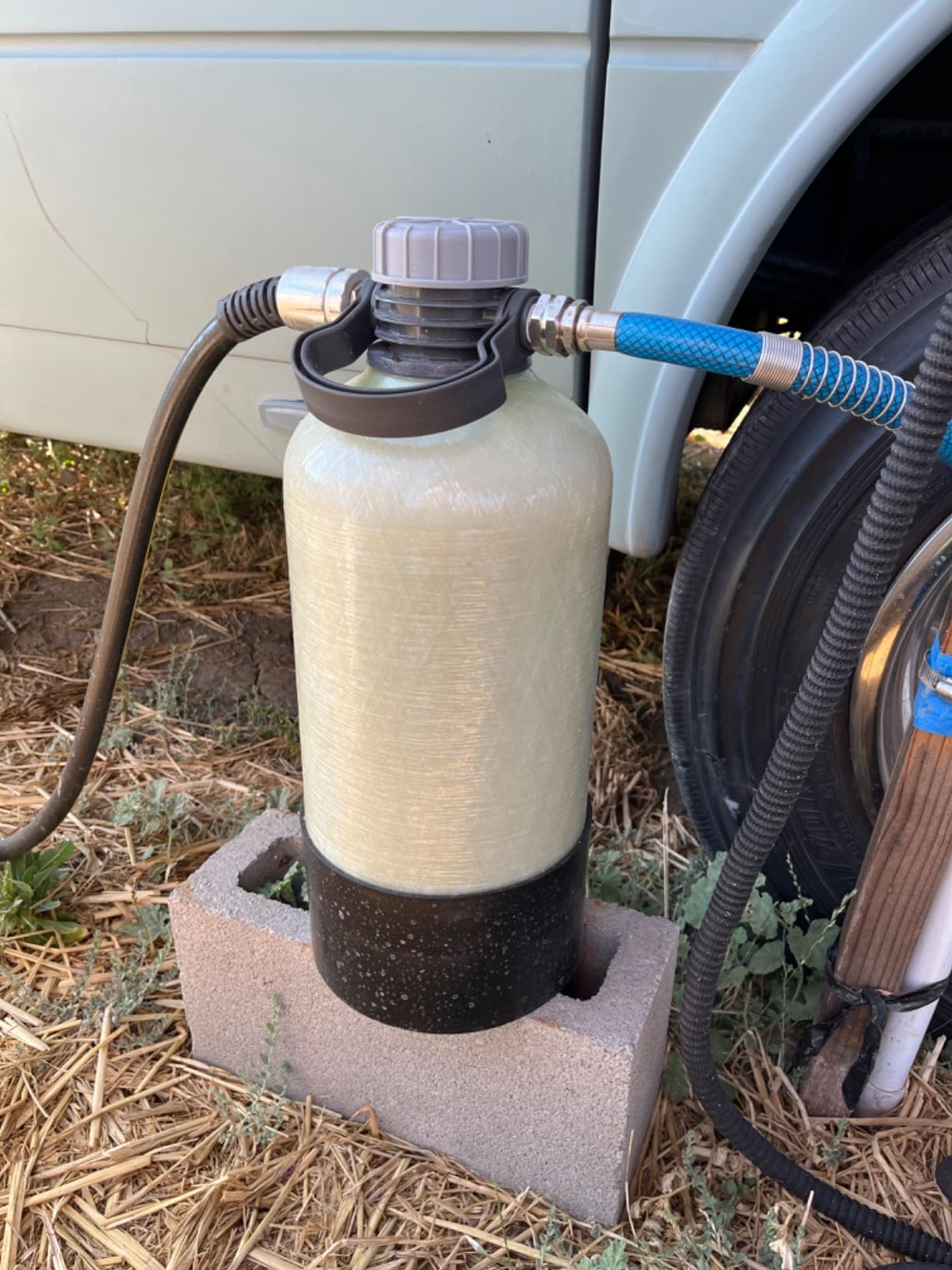
The Camco arrives as a complete kit, which is the appeal. In the box you get the portable softener, a four foot hose, a male-to-male fitting for running the regeneration cycle, two garden hose storage caps and a strip of 50 test strips. Nothing else needs buying before first use.
Setup is genuinely fast because it is all screw-on hose fittings. Owners who added it before a trip report seeing a visible difference in the shower, at the sink and in the taste of drinking water within a few uses.
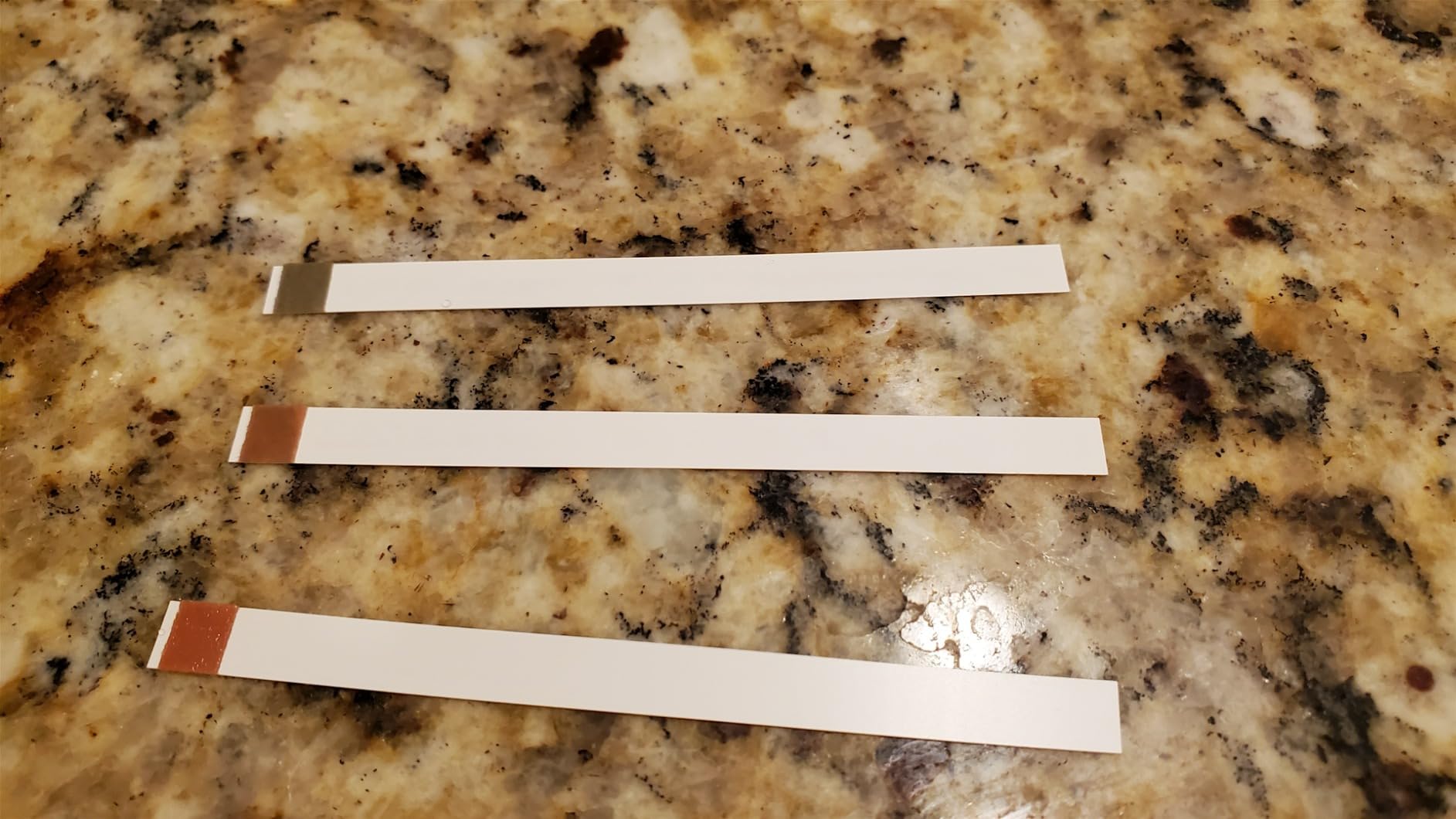
That bundle of test strips deserves credit. Being able to confirm your hardness before and after is the only way to know whether a portable softener is doing anything, and having 50 of them included removes the excuse to skip that step.
At 25 pounds with a carry handle and roughly 8.5 by 8.5 by 20.5 inches, it stores without ceremony. The large mouth opening on top takes the two boxes of common table salt needed for regeneration, though salt itself is not included.
Who this kit suits
Occasional campers and boat owners who need softened water for a few weeks at a time rather than year-round treatment. It suits anyone who wants a first look at soft water without committing to a permanent install or a large unit.
Because it is external use only and hose-connected, treat it as seasonal gear. It pairs naturally with a campground or marina supply that reads hard on a test strip.
Where it falls short
Capacity and flow are both the smallest here. At 10,000 grains and 4 gpm, it will not keep up with heavy washing demand and will run out of usable capacity faster than the 16,000-grain portable options.
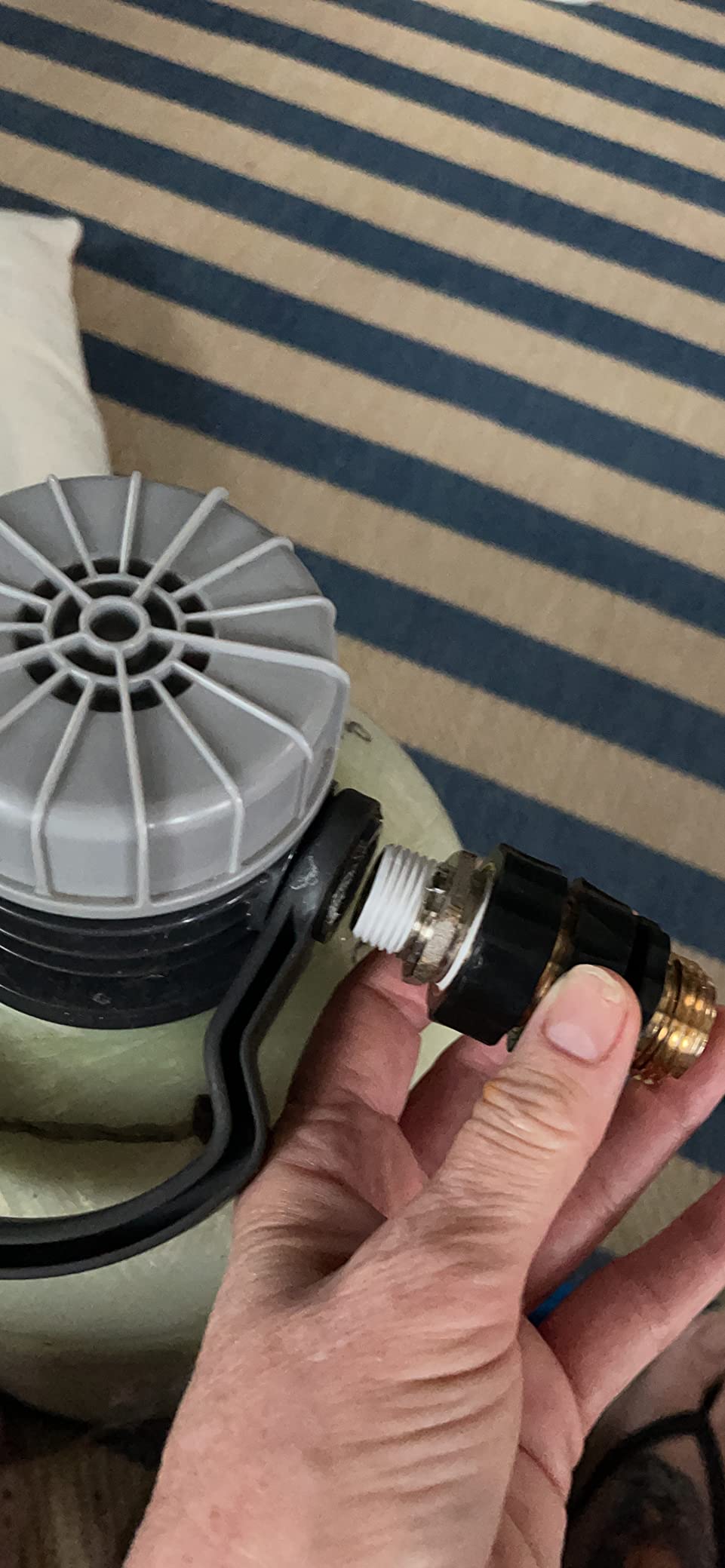
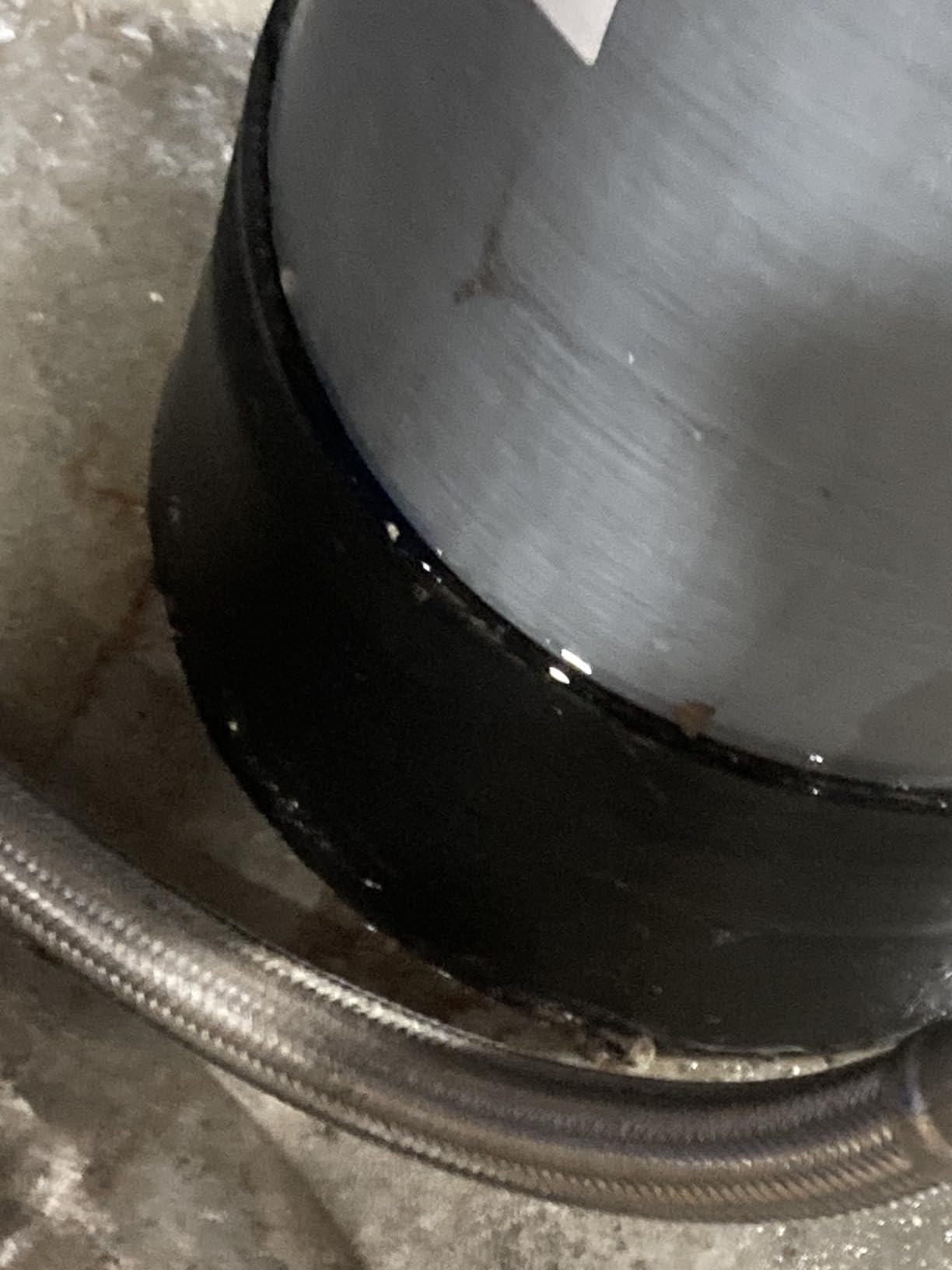
First-time setup is where most complaints sit: resin needs to settle, the cap seal can be hard to seat evenly, and the instructions are thin. A small number of owners report resin displacement or a cracked top after a couple of months, so inspect the cap seal before every trip.
9. Water Boss 600K Gallon Scale Control: Best Low-Maintenance Alternative
Water Boss Whole House Salt-Free Scale Control | 600K Gal | WB-WH-DSCLR
Salt-free scale control media
600000 gallon capacity
7 gpm flow
27 inch slim body
Pros
- Salt-free and chemical-free with no maintenance or electricity
- Six year and 600000 gallon scale protection capacity
- Sustains 7 gpm with no noticeable pressure drop
- Slim 8.75 inch diameter body suits tight installs
- Designed engineered and assembled in the USA
Cons
- Does not soften water or remove hardness minerals
- Limited to hardness under 15 GPG and iron under 0.3 ppm
- Lowest average rating in the roundup at 4.0 stars
This is the same category of device as the A. O. Smith unit, with the same core limitation: it manages scale and does not soften. Where it differs is physical size. At 8.75 inches in diameter and 27 inches tall, it fits under counters and in narrow mechanical spaces where a 30 inch body will not go.
The zero-consumables pitch is the whole argument. No salt, no backflushing, no cleaning schedule and no electricity, with a six year limited warranty and a service life rated to 600,000 gallons. It runs at 7 gpm with no noticeable pressure change, so it stays out of the way of daily household demand.
Owners whose water stays inside the moderate hardness envelope report steady, boring scale reduction, which in a whole house device is exactly the outcome you want. The media is designed for hardness under 15 GPG, alkalinity below 250 mg per liter, pH under 8.3 and iron under 0.3 ppm.
It was designed, engineered and assembled in the US, which matters somewhat for parts availability over a six year service life when there is no electronics to fail.
Who this fits
Homeowners in moderate hardness who want scale protection without carrying salt, and who live somewhere a brine discharge would be unwelcome. It works for rentals and seasonal homes where maintenance visits are difficult to arrange.
Anyone who needs it to function during outages will like that it needs no power at all. If your priority is protecting a water heater and appliance internals rather than changing how your skin and hair feel, it fits.
Where it falls short
It has the lowest average rating in this roundup at 4.0 stars from 204 reviews, with roughly 14 percent of reviews at one star. Critical reviews focus on how little benefit users see on harder water and on the fact that hardness stays in the water.
It does not reduce TDS, sulfur or iron, and it does not soften. If your water runs above 15 GPG or carries meaningful iron, this category of device is the wrong tool no matter how well built it is.
10. Aquasure 72,000 Grain Bundle with 75 GPD RO System: Best All-in-One Package
Aquasure Whole House Water Filtration Bundle w/Water Softener, 75 GPD RO System & Dual Purpose Sediment/GAC Pre-Filter (72,000 Grains)
72000 grain softener
75 GPD four stage RO system
Sediment GAC zinc prefilter
160 lb complete bundle
Pros
- Combines a 72000 grain softener with a 75 GPD RO drinking system
- Automatic metered regeneration with programmable flush intervals
- GAC zinc prefilter strips chlorine odors VOCs and sediment
- Owners report softer water cleaner dishes and softer laundry
- 5 year extended warranty with lifetime tech support
Cons
- Most involved install in the roundup and needs plumbing work for the RO tee
- RO faucet and feed water adapter are not always included
- RO filters need changing every 6 to 12 months
- Salt is purchased separately
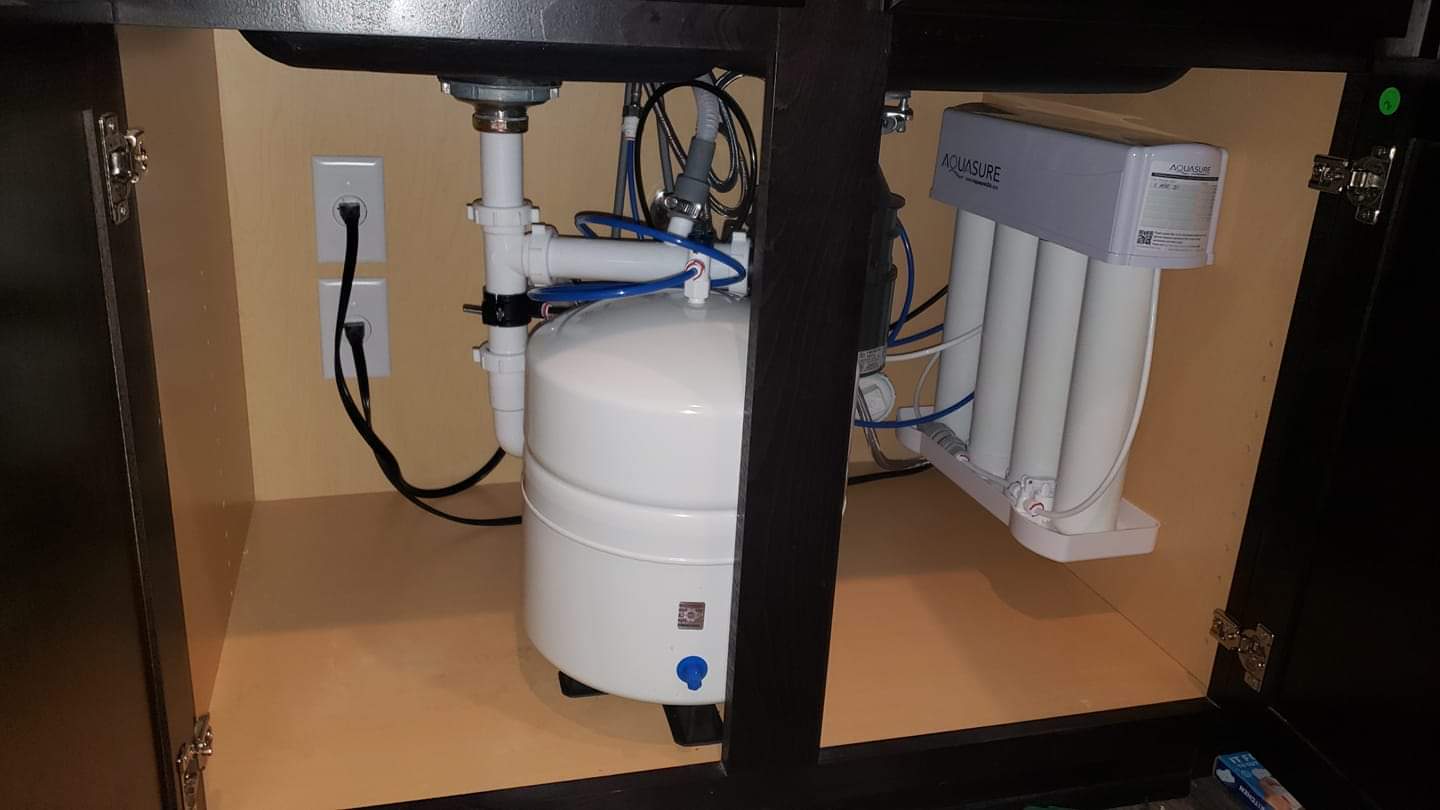
This bundle pairs a 72,000-grain whole house softener, a 75 GPD four stage reverse osmosis drinking system and a triple purpose sediment, GAC and zinc pre-filter in one package. At 160 pounds it is the heaviest item here, and it is the only option that softens the whole house while also producing purified drinking water at the sink.
The 72,000-grain capacity is the highest in this roundup, sized for one to six bathrooms, which makes it a fit for large homes or anyone combining whole house softening with a serious drinking water concern. The programmable backlit digital control head meters regeneration and sets flush intervals, and the GAC and zinc stage takes out chlorine, odors, VOCs and sediment before the water reaches the resin.
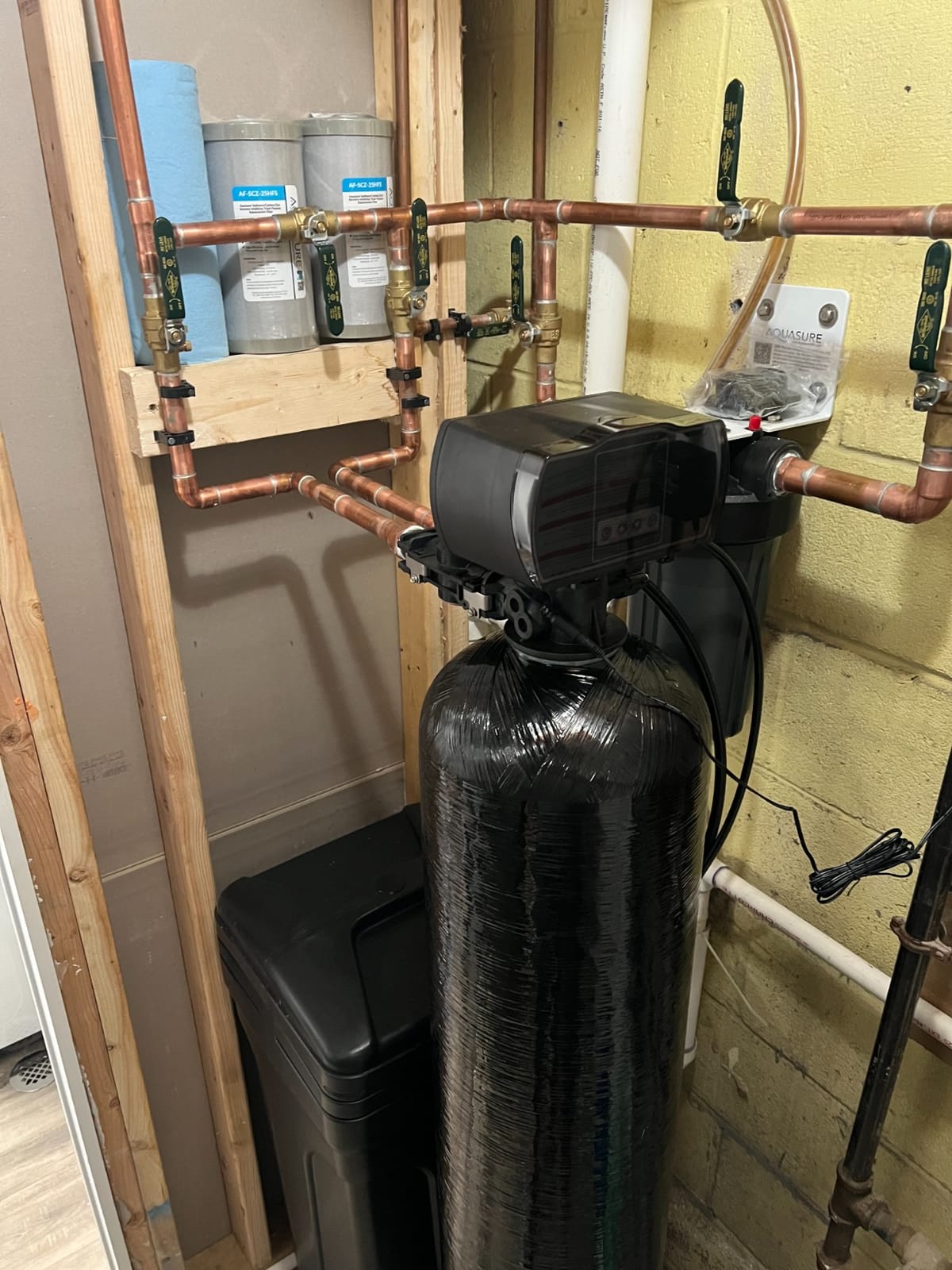
Owners highlight the value argument: getting soft water everywhere plus reverse osmosis drinking water from one bundle rather than assembling a commercial-style setup piece by piece. Reports of softer laundry, cleaner dishes and dramatic improvement at the drinking tap come up repeatedly in reviews.
Video installation guides and responsive replacement part support are the details that make a package this complicated manageable, backed by a five year extended warranty with lifetime technical support once you activate online within 60 days.
Who this bundle suits
Large households that want a single purchase order covering whole house softening, chlorine and sediment removal, and purified drinking water. It also suits anyone whose well water carries both hard mineral content and something they do not want to taste.
If you have been putting together a softener, a carbon filter and an under-sink RO as separate purchases, this bundle covers the same ground with one control head to program and one warranty to track.
Where it falls short
It is the most involved installation in this roundup. The RO tee requires plumbing work, and this is not a weekend DIY project for most people. Budget for a plumber who has installed an under-sink RO before.
The bundled RO hardware is also where the complaints concentrate. The faucet and feed water adapter are not always included, some buyers received an adapter that did not fit, and reverse osmosis filters need changing every 6 to 12 months on top of salt. Those costs belong in your mental total from day one.
How to Choose a Water Softener for Very Hard Water?
Choosing well means answering four questions in order: how hard is your water, how many people use it, what is your drain situation, and how much maintenance do you want to own. Get these right and the product choice narrows quickly.
Test your hardness before you buy anything
Hardness is measured in grains per gallon, or GPG. Roughly 60 to 80 ppm equals 1 GPG, and most plumbers will run a test for free if you ask while they are working on your house. A home test kit or hardness strip gives you a reasonable starting point.
Below about 3.5 GPG you rarely need a softener. Between 3.5 and 7 GPG you are in moderate territory where a compact system handles a small home. Above 8 GPG you should size up deliberately, and above 15 GPG you need to plan for a larger capacity and check whether your brine discharge route can handle the load.
Test the water at the point where it enters the house, not at a faucet downstream of a softener. And if you are on a well, test more than hardness.
Size grain capacity with a simple formula
The common sizing rule is: number of people multiplied by 80, multiplied by the grains per gallon of hardness, multiplied by a safety factor. For a family of four on 10 GPG water, that is 4 x 80 x 10 = 3,200 grains per day, and most households land somewhere between 4,000 and 6,000 grains of daily capacity.
From there, match to the nearest available tank size. A 48,000-grain unit with 1.5 cubic feet of resin comfortably handles three to four bathrooms, which is why systems that size appear repeatedly in this roundup. A 32,000-grain unit fits one to four people. Do not oversize dramatically, because an oversized tank regenerates against weak brine and wastes salt.
Add one more consideration: if you plan to put an RO drinking system on the same line, buy the larger softener. Reverse osmosis membranes are sensitive to hardness and need softened feed water to last.
Decide between softener and scale control
This is the single biggest fork in the category. An ion exchange softener actually removes hardness by swapping calcium and magnesium for sodium, so soap lathers better, hair and skin feel different, and glassware stops spotting. It costs salt and water to run.
A salt-free scale control uses media that keeps minerals from forming scale on surfaces. It uses nothing, needs no electricity and discharges nothing, but your water still tests hard and no hardness is removed. Scale control media such as template-assisted crystallization only makes sense inside a softener, so do not treat it as a competitor technology.
Choose the scale control route if you cannot legally or practically discharge brine, if you refuse to carry salt, or if your hardness sits in the moderate range and plumbing protection is the real goal. Choose a softener if anything about lather, spotting, hair or soap consumption bothers you.
Understand regeneration types
Demand-initiated regeneration means the valve counts gallons and regenerates only when the resin is spent. Metered regeneration is the same idea and is the most efficient setup available. Timer regeneration runs on a clock whether the water was used or not, and it wastes salt on empty cycles.
Upflow regeneration pushes brine through the resin bed from bottom to top, then settles the beads back down afterward. It uses less salt and water but needs a drain and electricity, and the settled bed is more compact for the next cycle. Downflow regeneration pulls brine down through the bed, leaving a correctly settled bed immediately after but using noticeably more salt and water.
If you can only have one, choose a metered valve. Then consider two-tank systems, which hold one tank in reserve so you have soft water during regeneration, though they cost more and take up more space.
Check certifications, warranty and drain rules
Look for NSF/ANSI 44 certification on the resin and an NSF-certified control valve, and treat WQA certification as a bonus. On warranty, read the fine print carefully because brands quote the longest term they have, which is usually the tank rather than the valve or electronics.
A ten year resin tank warranty with three years on electronics is a common structure, and the valve is the part that fails first. Five year non-prorated valve coverage is a good benchmark, and warranty coverage that excludes labor is typical.
Finally, confirm where the drain line goes. You need a floor drain, a sump, or an approved air gap discharge route, and some regions limit brine discharge for a reason. Check before you buy, because moving a system after it is plumbed is expensive.
Handle well water and city water differently
City water needs chlorine removal and sediment filtration more than anything else. The Aquasure Harmony and the 72,000-grain bundle both include a carbon and zinc stage for exactly this reason, and chlorine left in place in contact with resin shortens its life.
Well water needs testing for iron, manganese, sulfur and pH before you buy a softener. Light clear water iron up to about 0.3 ppm can be handled by some resin beds, as the Kenmore 350 does. Higher iron, manganese or a sulfur smell needs a dedicated pre-filter ahead of the softener, because fouling the resin is how people end up with an unhappy system and no idea why.
Dropping water softener salt into a drinking water system is a normal part of life for most households, but anyone on a sodium-restricted diet should look into a potassium chloride alternative. It softens the same way and works in most brine tanks, with the only drawback of costing more per bag than sodium chloride.
Plan for installation and maintenance
Salt-based systems need a monthly salt check, a brine tank inspection a few times a year, and a full cleaning every 8 to 12 months. A clean brine tank and a properly cleaned injector extend resin life noticeably, and both are cheap jobs if you do them on schedule.
On installation, a DIY job saves meaningful money compared with hiring a plumber if your plumbing is accessible, a floor drain is within reach and you have basic copper or PVC skills. Hire a pro if your supply is in an awkward location, you need to run a new drain line, or you are combining the softener with a carbon filter or RO system. Budget the drain line as a separate line item either way.
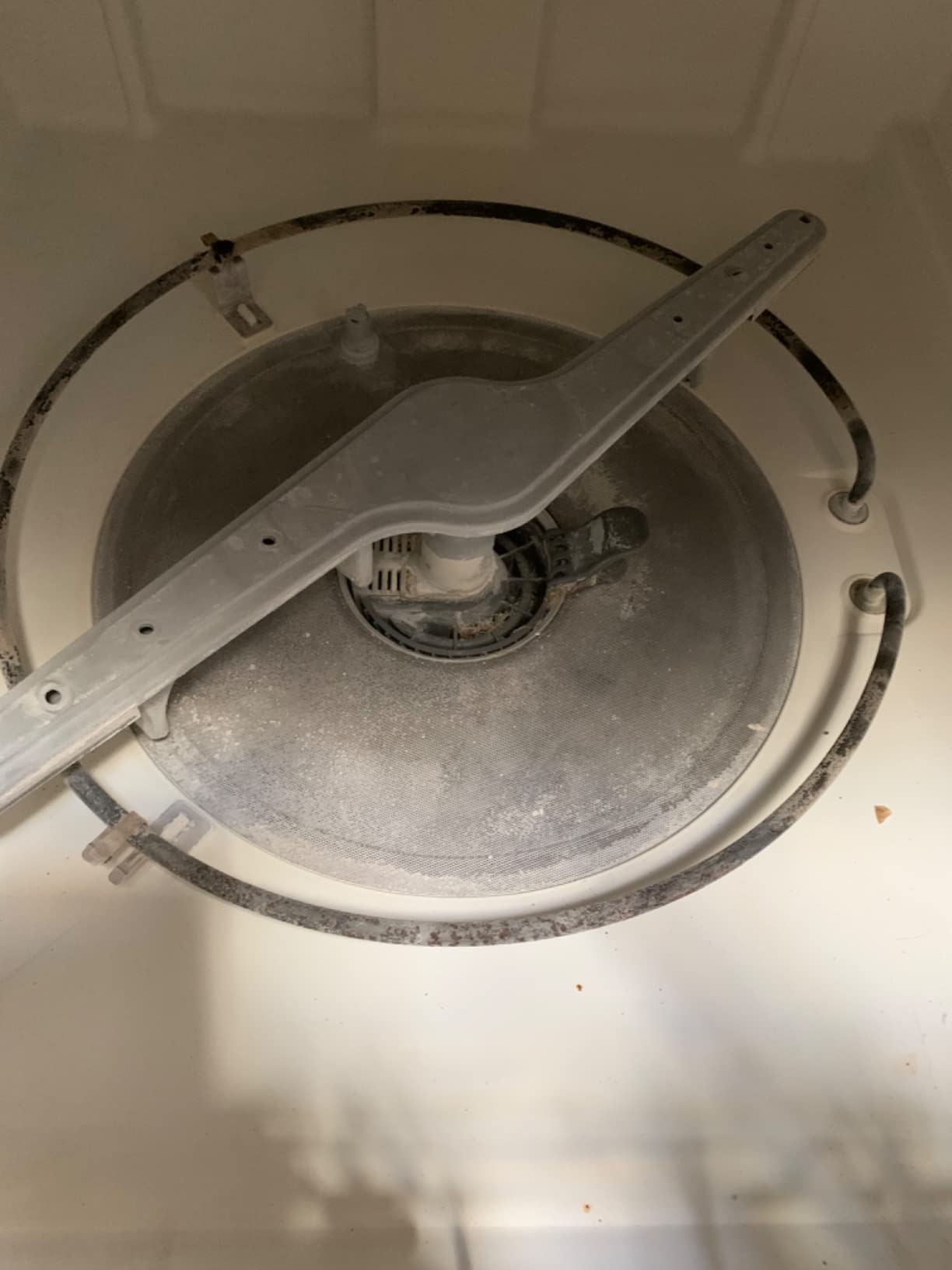
If you are replacing a softener that is already softening your water, check a machine for dishes before you buy anything new. A dishwasher that is working through hard water will shorten its life, and that is covered in our guide to the best dishwashers for hard water.
Frequently Asked Questions
What is the best hard water softener for a home?
For most homes with three or four bathrooms, the Aquasure Harmony Series 48,000-grain is the best all-around choice. It pairs a digital metered control head with a triple purpose sediment, carbon and zinc pre-filter, and its 3199 owner reviews give it a 4.4 star average. If you want a proven valve instead of a bundled pre-filter, the AFWFilters Fleck 5600 SXT is the alternative.
How much should a good water softener cost?
It depends on whether you are buying portable or whole house equipment. Portable RV and boat units sit at the low end of the range, whole house ion exchange systems with digital metered heads sit in the middle, and large bundles that add reverse osmosis filtration sit at the top. Add installation labor if you cannot do the plumbing yourself, and remember that salt, filter changes and brine tank cleaning are ongoing costs on top of the purchase.
Why is my water so hard even with a water softener?
The usual causes are an undersized unit for your household and hardness level, a resin bed that has lost capacity with age, a salt bridge formed in the brine tank, or a salt level that has run low. Another possibility is that you are testing at a faucet downstream of the bypass valve, which has been switched to bypass position. Finally, if the valve is set to a long fixed timer cycle, it may not be regenerating often enough for how much water you actually use.
What is the best system to get rid of hard water?
A true ion exchange softener is the only system that actually removes hardness. It swaps calcium and magnesium for sodium, so soap lathers better, hair and skin feel different and glassware stops spotting. Salt-free scale control units reduce buildup inside pipes and heaters but leave hardness in the water. On well water, add a pre-filter for iron, manganese or sulfur ahead of the softener.
Do I need a salt-free softener or a salt-based one?
Choose salt-based if you want the water itself softened and you have a place to discharge brine. Choose salt-free scale control if you cannot discharge brine, live under salt restrictions, refuse to carry salt, or only need plumbing protection at moderate hardness. Be clear that salt-free units reduce scale, they do not reduce hardness or total dissolved solids.
Final Verdict on the Best Water Softeners for Hard Water
After weighing capacity, flow rate, valve design and real owner ratings across ten systems, the Aquasure Harmony Series 48,000-grain wins this roundup for most households. Its 4.4 star average across 3199 reviews, a digital metered head and a built-in chlorine and sediment pre-filter cover the widest range of real problems without turning into a plumbing project.
Pick the Fleck 5600 SXT if long-term parts availability matters most, the On The Go or PRO+AQUA units if your water comes from an RV, boat or trailer, and a salt-free scale control only if you accept that your water will still test hard. Test your hardness first, size it to your household, and the rest is straightforward.
We cover the hardware side of hard water in more detail in our broader water softener roundup if you want a second look before you commit.