
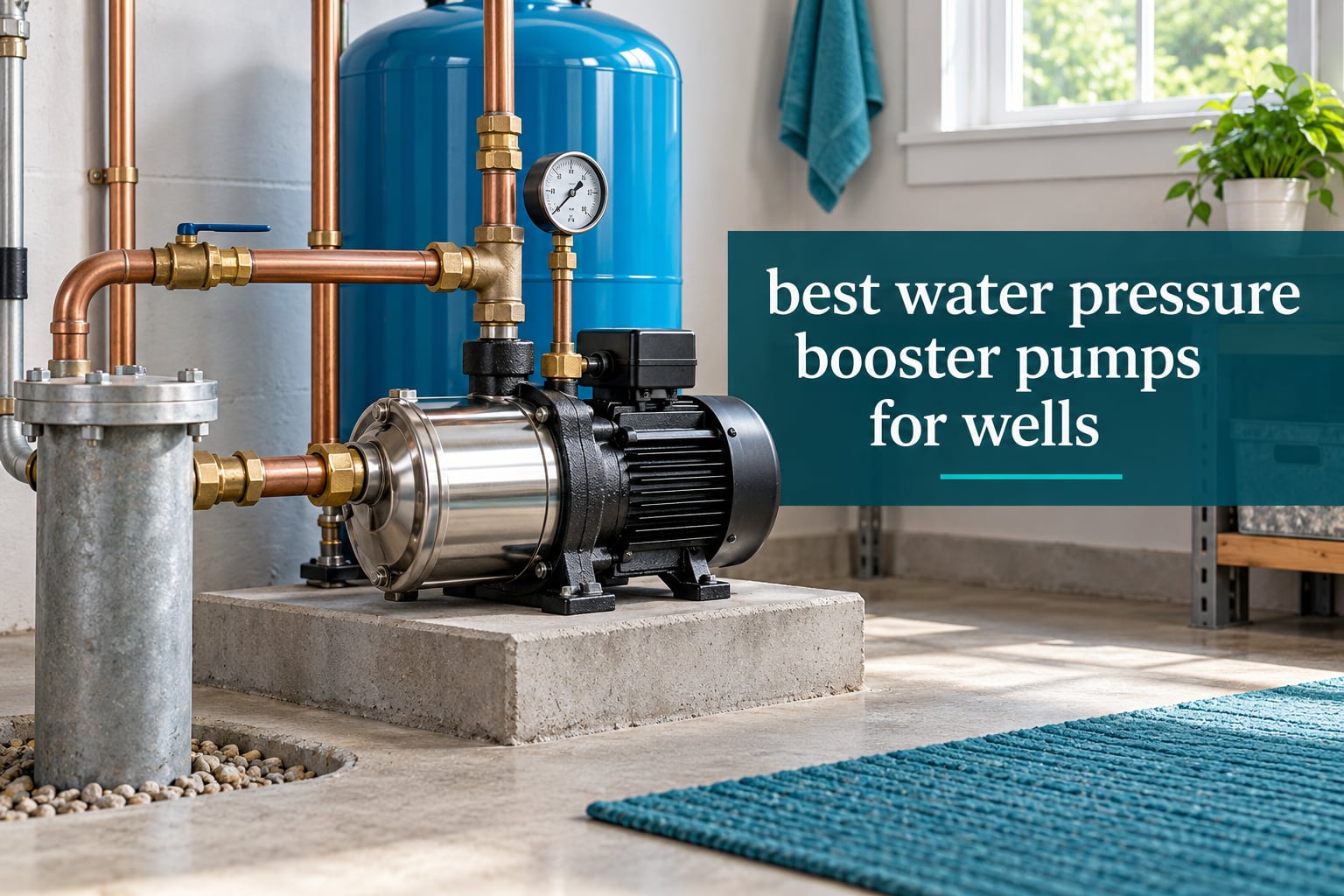
Low pressure on a well is one of those problems that hides the real cause. The well pump is working, the tank holds air, and the faucets still sag the moment a hose and a shower run together. Owners usually respond by shopping for the best water pressure booster pumps for wells, and half the time that money solves a problem that lives in the pipe between the well and the house.
So let us answer the first question plainly, because it comes up constantly: yes, you can put a booster pump on well water. A booster adds pressure to water your well pump has already lifted, typically taking a system from a 30-to-50 PSI swing up to a steadier 50 to 90 PSI at the fixtures. What it cannot do is create water. If the well is producing 3 GPM and your house wants 8, no booster on the market fixes that.
Below, we compare eight booster and well pumps built for pressure problems on private wells, plus the diagnostic steps that tell you which one you actually need. We also explain the short-cycling trap that kills most boosters, and why a bigger pressure tank often beats a more powerful pump. If you are starting from scratch rather than fixing low pressure, our whole-house booster pump guide covers the city-main side of the category.
Table of Contents
Top 3 Best Well Water Pressure Booster Picks in 2026
These three cover the widest range of real well situations: a convertible pump that handles shallow and deep wells, a complete kit that arrives with a pressure tank already plumbed in, and a cast iron unit that shows up pre-set for 50 PSI service.

Acquaer CJE100-1 Convertible Jet Pump
- Convertible 0-25 ft or 26-90 ft wells
- 115V/230V dual voltage
- Auto 20/40 PSI pressure switch
- Cast iron volute
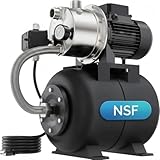
AQUASTRONG PGA150SAN 1.6 HP Kit
- Pump plus 5 gallon pressure tank
- 20/40 PSI switch and gauge
- 26 ft suction lift
- NSF stainless casing
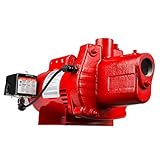
Red Lion RJS-75-PREM 3/4 HP Jet Pump
- Factory 30/50 PSI switch and gauge
- 16 GPM and 65 PSI max
- 115/230V with start capacitor
- Cast iron volute
Do You Actually Need a Booster Pump?
Most low-pressure complaints on well systems are not caused by a weak pump. They are caused by friction loss in undersized or over-long pipe, by elevation gain between the pump and the house, or by a pressure tank too small to bridge the demand. A four-step check takes about twenty minutes and will save you from buying the wrong machine.
Step 1: compare static and flowing pressure. Put a gauge on the hose bib with nothing running. That number is static pressure and it flatters you. Then open the tap fully and read it again. That is flowing pressure, and it is the only number that describes what your fixtures feel like. A system that reads 55 PSI static and 18 PSI flowing has a distribution problem, not a pump problem.
Step 2: measure your actual demand in GPM. Fill a known container, usually a 5 gallon bucket, and time it. Five gallons in one minute is 5 GPM. A typical household running a shower and a laundry cycle lands somewhere between 4 and 6 GPM. Two showers, a dishwasher and a hose spigot can push past 10 GPM.
Step 3: compute the friction loss in your well-to-house line. This is where most money gets wasted. One owner on a plumbing forum described a 30 ft shallow well delivering a healthy 55 PSI, paired with 180 ft of 3/4 inch pipe to the house. A professional calculated roughly 37 PSI of loss at 10 GPM through that 3/4 inch line. The same run in 1 inch pipe loses about 11 PSI, in 1-1/4 inch about 4 PSI, and in 1-1/2 inch about 2 PSI. Upsizing the line removed the need for a booster entirely.
Flow rate, not distance, dominates this calculation. At 5 GPM, a 200 ft run of 3/4 inch pipe loses only about 4.3 PSI. The same run at 10 GPM loses about 15.5 PSI. And every 2.31 ft your house sits above the pump costs you one more PSI before a single fixture opens.
Step 4: confirm what the well actually produces. If flowing pressure collapses the moment you open a second tap, your well pump or storage tank is undersized, and a downstream booster will just stall. Rural owners running a ground-level storage tank often need a booster that fills pressure tanks continuously rather than one that triggers on demand, which is why the demand-activated designs sit further down our list.
One caution from the forums worth repeating: cheap tankless flow controllers on existing well pumps are widely distrusted by pump professionals, who argue that repeatedly starting and stopping the well pump degrades the motor windings. If your problem is cycling rather than low flow, fix the tank before you add a booster.
Best Water Pressure Booster Pumps for Wells in 2026
Every pump below is rated for well water duty, and the table shows the headline specs that decide whether a given model fits your lift, flow and wiring.
| Product | Specifications | Action |
|---|---|---|
| Acquaer CJE100-1 Convertible Jet Pump |
|
Check Latest Price |
| AQUASTRONG PGA150SAN 1.6 HP Kit |
|
Check Latest Price |
 AQUASTRONG SPRK150 1.5 HP Centrifugal AQUASTRONG SPRK150 1.5 HP Centrifugal |
|
Check Latest Price |
 Simer 4075SS-01 3/4 HP Booster Simer 4075SS-01 3/4 HP Booster |
|
Check Latest Price |
| Red Lion RJS-75-PREM 3/4 HP Jet Pump |
|
Check Latest Price |
 Goulds J5S 1/2 HP Shallow Well Jet Pump Goulds J5S 1/2 HP Shallow Well Jet Pump |
|
Check Latest Price |
 Lanchez 1.6 HP Kit with Pressure Tank Lanchez 1.6 HP Kit with Pressure Tank |
|
Check Latest Price |
 Lanchez JGP11007 1.6 HP 1500 GPH Pump Lanchez JGP11007 1.6 HP 1500 GPH Pump |
|
Check Latest Price |
1. Acquaer CJE100-1 Convertible Jet Pump for Shallow and Deep Wells
Acquaer Shallow/Deep Well Jet Pump, Cast Iron Convertible Pump with Ejector Kit, Well Depth Up to 25ft or 90ft, 115V/230V Dual Voltage, Automatic Pressure Switch
1 HP cast iron jet pump
Convertible 0-25 ft or 26-90 ft
115V/230V dual voltage
36.5 pounds
Pros
- Convertible ejector design covers shallow and deep well installs
- Dual voltage motor adds wiring flexibility
- Automatic 20/40 PSI switch needs no controller
- Cast iron volute built for long service
Cons
- Tied for the lowest star rating here at 4.1
- Some buyers report failure after about a year
- Heavy at 36.5 pounds to handle and mount
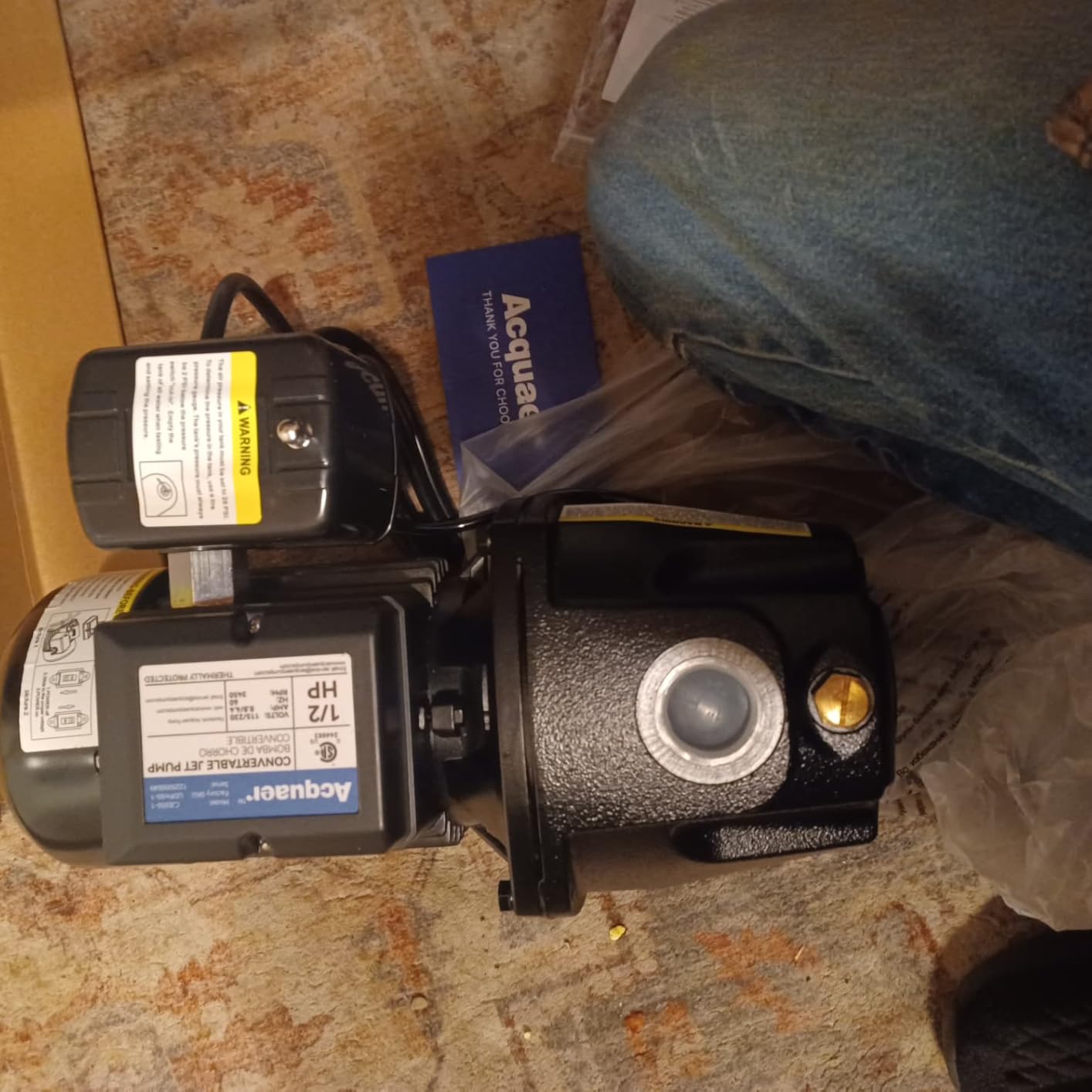
This is the pump we would put at the top of the list, and the reason is the review count. More than 1200 owners have run this unit, the deepest owner history in this group, and the design covers the single scenario that trips up most buyers: a well that is not as shallow as the paperwork says.
The convertible system is the clever part. Install it as a single-pipe shallow well pump for depths from 0 to 25 ft, or add the supplied venturi ejector kit and it handles two-pipe wells from 26 to 90 ft. The motor runs on 115 or 230 volts, factory set for 230, and an automatic pressure switch starts the pump below 20 PSI and shuts it down above 40 PSI, so it works as a booster without any separate control box.
Thermal overload protection with automatic dry-run shutoff is built in, which matters on a well that occasionally produces air. The cast iron volute is the right material for a pump that will sit in a damp pit and take thousands of starts.
One caution. Its 4.1 star average is tied for the lowest here, and about 12 percent of reviews are one star. Buyers report the unit holding up for years, and buyers also report it dying near the one-year mark with no visible mechanical fault. If you install it properly, primed and protected from freezing, the long-run numbers are the deepest in this group.
At 36.5 pounds, this is not a pump you want to lift over a pit rim alone. Budget a second pair of hands for the install.
Check the convertible depth range before you buy
The ejector kit changes the plumbing, not just the parts list. A single-pipe shallow install is one pipe down the well casing. The 26-to-90 ft configuration needs a two-pipe setup with the ejector assembly, and some casings will not take it. Measure your static water level and the pump depth before ordering.
Who should pass on this pump
Skip it if you need more than 40 PSI at the tap. A 20/40 switch means the pump never pushes past 40 PSI before cutting out, so this is a flow and lift machine rather than a high-pressure machine. It also makes more sense as the primary well pump on a shallow or mid-depth well than as a secondary booster behind an existing submersible and pressure tank.
2. AQUASTRONG PGA150SAN 1.6 HP Shallow Well Kit with Pressure Tank
Aquastrong 115V Shallow Well Garden Pump, Stainless Steel, 1320 GPH, Automatic Water Booster Jet Pump for Home, Garden, Lawn,Irrigation,1.6 HP with Pressure Tank
1.6 HP stainless steel jet pump
26 ft suction and 1340 GPH
164 ft max head
20/40 PSI switch
Pros
- Pump plus 5 gallon tank and gauge ship as one package
- 26 ft suction and 1340 GPH max flow
- NSF certified stainless casing for drinking water
- Owners report quiet operation
Cons
- Several owners report motor failure between 6 weeks and 2 years
- Replacement motors not sold separately
- Some pumps leak from the start
- 20/40 PSI range is low for some irrigation work
This kit exists because a standalone jet pump is only half a well system. You also need a pressure tank, a switch and a gauge, and this package ships with all of them pre-matched, so the plumbing is a two-job rather than a four-job.
The numbers are strong for a 115 volt unit: suction to 26 ft, 1340 GPH maximum flow, and 164 ft maximum head. The casing is NSF certified stainless steel, which matters if you are drinking the water. A carbon ceramic mechanical seal reduces leakage, temperature sensing triggers an automatic overload stop, and the ports are 1 inch NPT with garden hose adapters and PTFE tape included.
What gives us pause is the motor longevity pattern in the reviews. Several owners report failures ranging from about six weeks to two years, and the company does not sell a replacement motor on its own, so a failure means replacing the whole pump. Buyers also report units that leaked from the first fill despite correct priming.
Warranty handling is the bright spot. Multiple reviewers describe fast replacement service, and there is a two-year warranty behind it. One practical note: the pump needs a check valve to stop water cycling back into the pressure tank, and the 20/40 PSI cut-in and cut-out sits low if you are running a sprinkler zone that wants more than 40 PSI.
Why the included tank matters for cycling
The 5 gallon tank is the part that makes this kit usable as a booster. Every motor start draws an inrush of current that heats the winding and slowly degrades the insulation, which is why pump professionals treat repetitive cycling as the main cause of premature failure. A pump that cycles against a bare line runs constantly. A pump that cycles against 5 gallons of stored water runs far less.
Who should pass on this kit
Skip it if you already own a code-compliant pressure tank, because you would be paying twice for storage. It is also the wrong choice for anything deeper than 26 ft of lift, and the 20/40 PSI switch means you are buying flow and lift capability rather than high pressure.
3. AQUASTRONG SPRK150 1.5 HP Centrifugal Pump for High Volume
AQUASTRONG 1.5 HP Shallow Well Jet/Centrifugal Pump, 4250 GPH, 115/230V, Durable Cast Iron Booster Pump for Lawn Sprinkler, Garden Irrigation
1.5 HP cast iron centrifugal
4250 GPH and 108 ft head
2 inch suction and 1-1/2 inch discharge
115/230V dual voltage
Pros
- Very high throughput for sprinkler and irrigation duty
- Large 2 inch suction and 1-1/2 inch discharge ports
- Reinforced impeller and diffuser
- Automatic thermal overload protection
Cons
- 108 ft max head is lower than the other jet pumps here
- Smallest review base of the eight at 250
- Factory set to 230V needs rewiring for 115V
When someone says their well pressure drops every time they turn on the irrigation, the usual cause is volume, not PSI. This pump is built for volume. Maximum flow is 4250 GPH with a 108 ft maximum head, and the ports are genuinely large: 2 inch NPT suction and 1-1/2 inch NPT discharge.
The reinforced impeller and diffuser are the right call for a pump that will chew through sand and grit from a shallow well, and the cast iron volute handles rough treatment. An automatic thermal overload protector shuts the motor down if it runs hot.
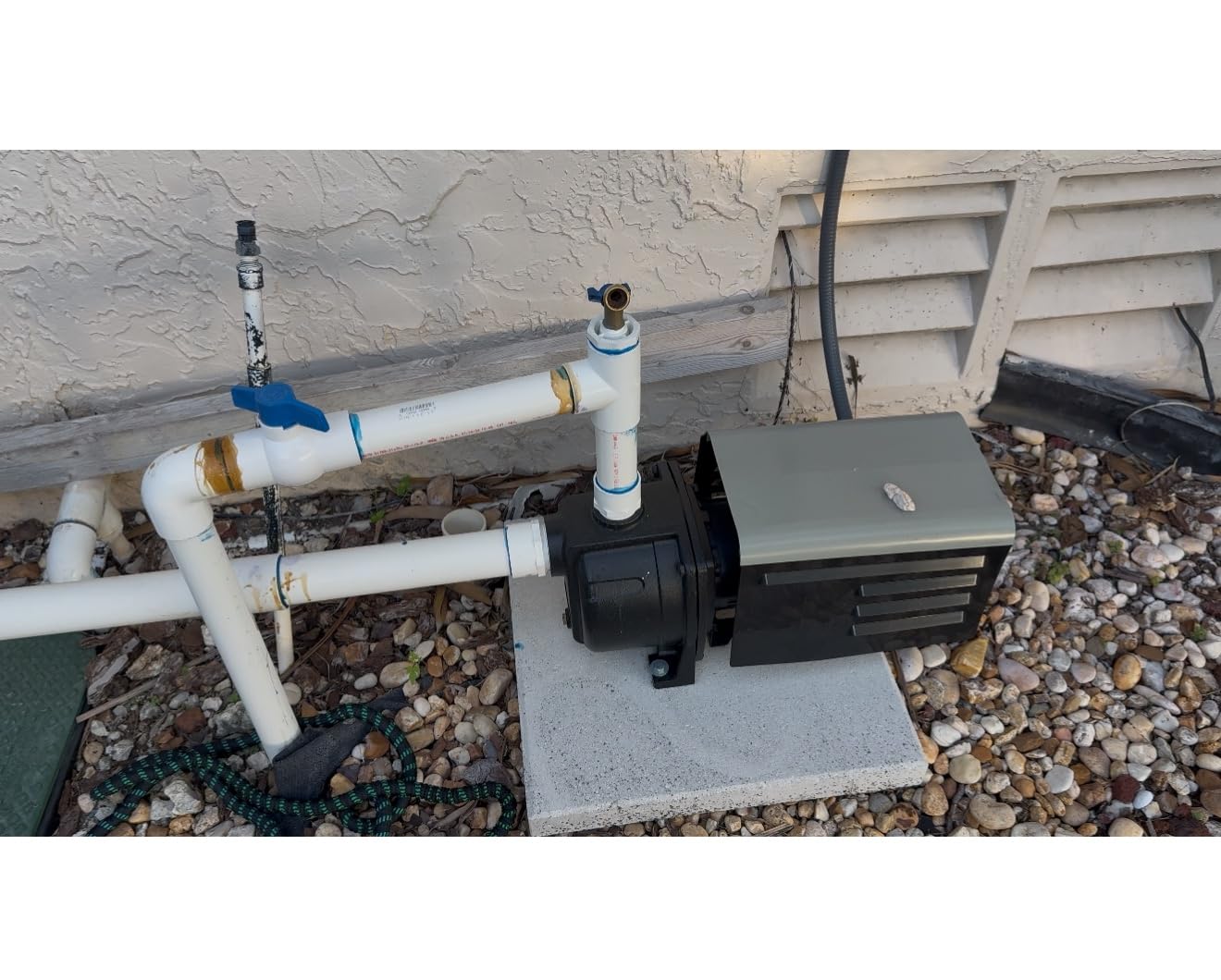
The tradeoff is head. A 108 ft maximum lift is lower than several other pumps in this group, so this is the wrong choice if you are trying to pull from a deep casing or lift water to a second story. The dual voltage motor is factory set at 230 volts, so running it on a 115 volt circuit means rewiring the terminal block.
Review volume is the smallest here at 250, so long-term owner data is thinner than for the pumps above it. Buyers consistently value the throughput and the port sizing, and the ceiling they hit is vertical lift rather than horizontal volume.
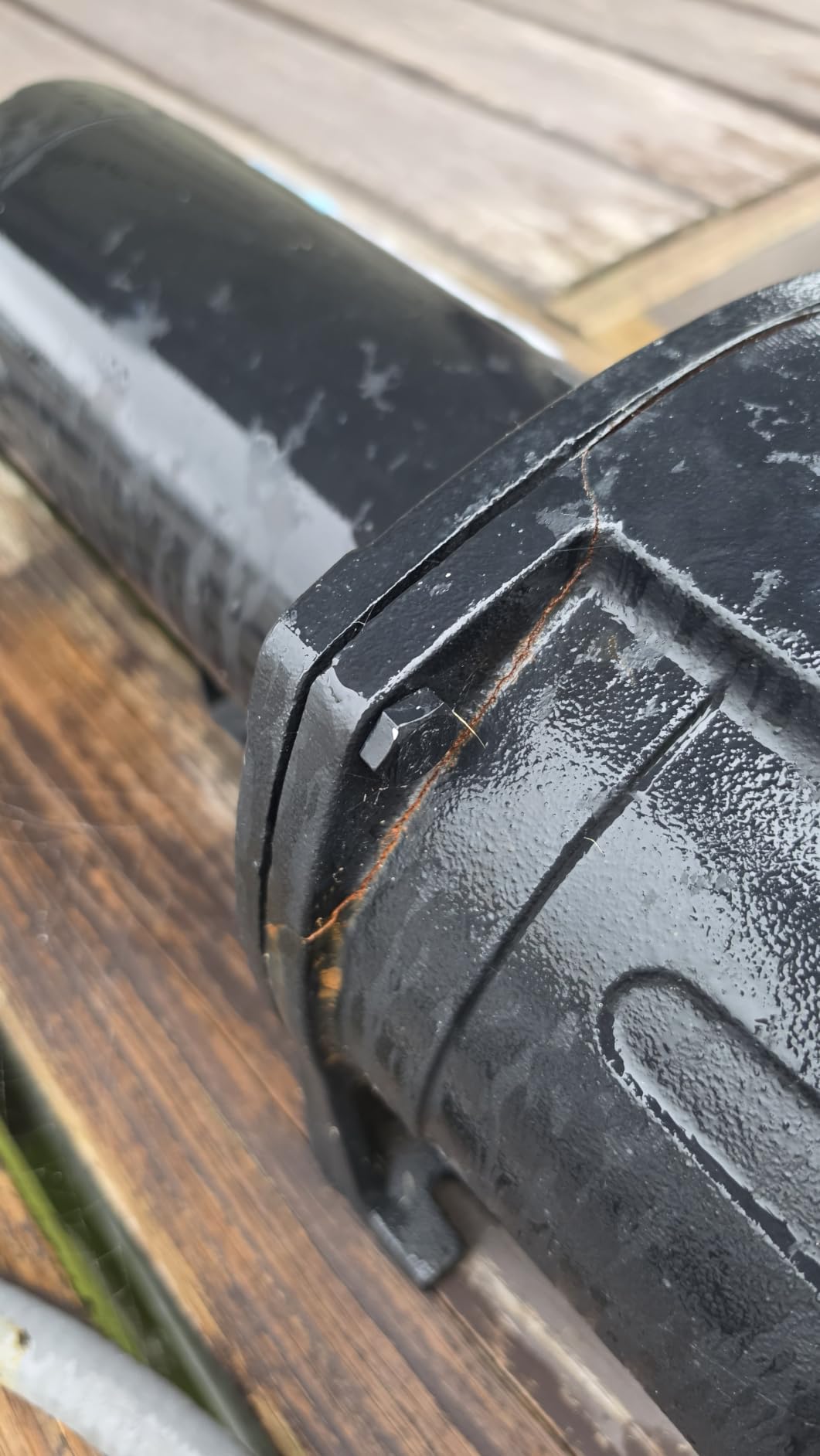
Where a 4250 GPH pump actually pays off
Open a home’s total fixture demand and it rarely exceeds 10 GPM. An irrigation zone is a different animal, because a pop-up sprinkler zone can pull far more water than any single fixture in the house. This pump is sized for that case, and pairing it with a large diameter supply line is the only way the flow rating means anything at the sprinkler head.
Who should pass on this pump
Skip it for household drinking water pressure work. The 108 ft ceiling rules out deep lift, the large ports mean it will not drop into a standard 1 inch service line without reducers, and the 230 volt factory setting means the pump expects a 230 volt supply, which many well systems do not have.
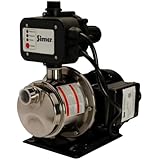
4. Simer 4075SS-01 3/4 HP Inline Pressure Booster Pump
Simer 4075SS-01 3/4 HP Pressure Booster Pump
3/4 HP inline booster
Adds up to 40 PSI
Stainless steel housing
22.2 pounds
Pros
- Purpose built inline booster adding up to 40 PSI
- Automatic activation when demand is detected
- Stainless steel housing resists corrosion
- Lightest listed design at 22.2 pounds
- Three year manufacturer warranty
Cons
- 24 GPM flow is below the highest capacity options
- Demand activation rules out continuous transfer duty
- 115 volt cord means no 230 volt option
This is the only true inline booster in the group, and it behaves differently from the jet pumps above it. The 3/4 HP motor adds up to 40 PSI of supplemental pressure and activates automatically when it detects water demand, which makes it the right shape for raising weak incoming pressure before it reaches the fixtures.
Owners use it specifically to lift weak municipal or well pressure rather than to draw from a well casing, and the stainless steel housing holds up against corrosion in a damp pump pit. It ships factory set and ready for installation, with a 6 foot 115 volt power cord attached, and it is the lightest design we reviewed at 22.2 pounds.
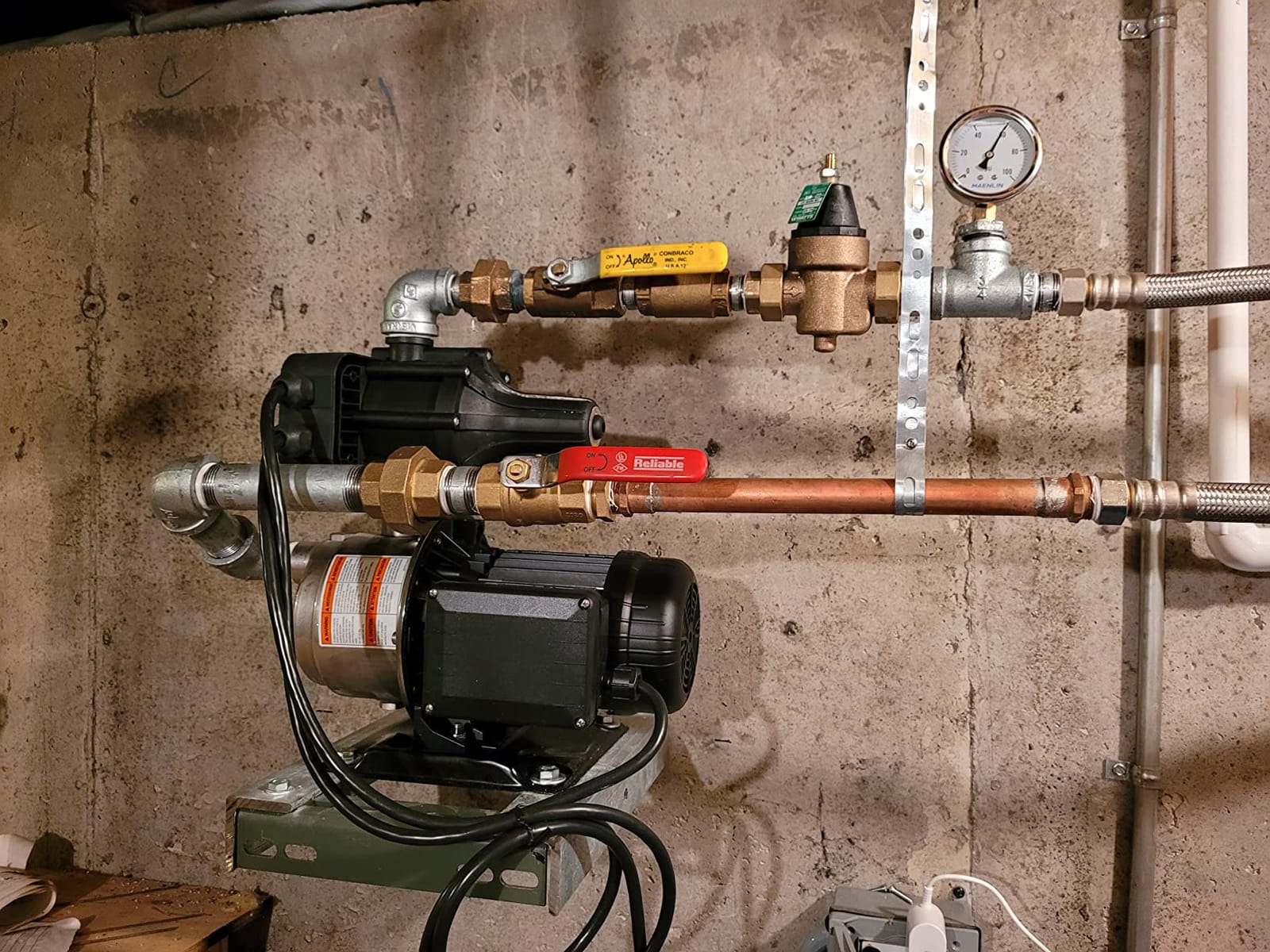
Two constraints define this pump. Flow caps at 24 GPM, which is below the highest capacity options here, and demand-triggered activation means it will not run continuously for storage or transfer duty. If your well is fed from a ground-level storage tank and you need constant movement into pressure tanks, this is the wrong architecture.
The three-year manufacturer warranty matches the longest published term among the pumps we reviewed, which matters for a pump that sees frequent starts. There is no 230 volt version, so a 115 volt supply is required.
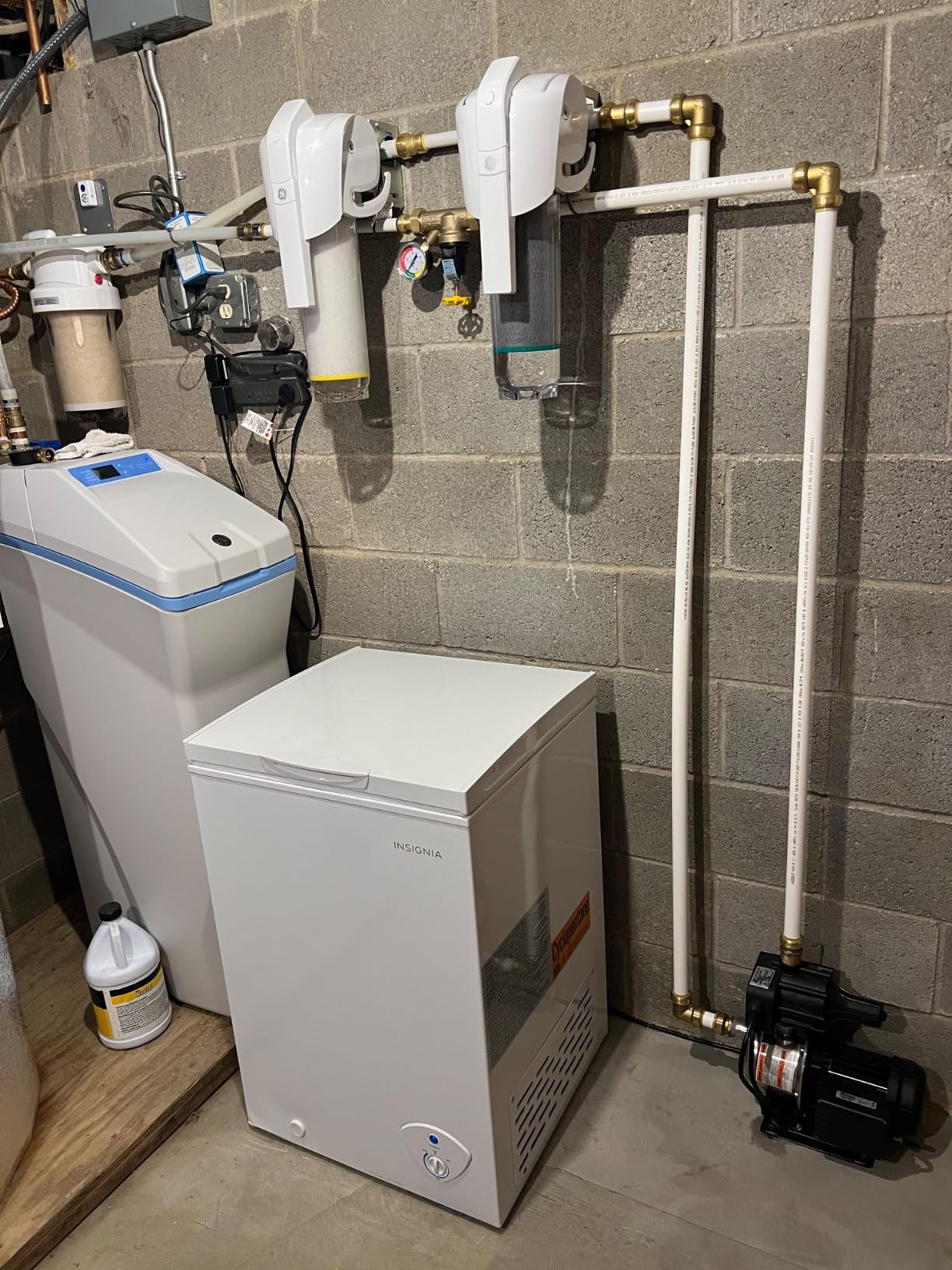
Decide between an inline booster and a jet pump
An inline booster treats water that has already been lifted. It sits after the pressure tank and pushes toward the house, and it cannot pull from a casing or a storage tank. A jet pump does both: it can suction from a shallow well or a tank and it builds its own pressure with a switch. Choosing the wrong one is the most common reason a booster install underperforms.
Who should pass on this pump
Pass if your problem is at the well end rather than the house end. This pump adds pressure to an existing line, so it does nothing if the well pump cannot supply enough gallons in the first place, and it does nothing for wells deeper than a shallow suction lift.
5. Red Lion RJS-75-PREM 3/4 HP Premium Cast Iron Jet Pump
Red Lion RJS-75-PREM 115/230V, 3/4 HP, 16 GPM, Shallow Well Jet Pump
3/4 HP cast iron jet pump
16 GPM and 65 PSI max
30/50 PSI switch preset
38.2 pounds
Pros
- Factory preset 30/50 PSI switch makes it booster ready
- Cast iron casing and volute feel premium
- 115/230V operation with start capacitor included
- Three year manufacturer warranty
- CSA listed for the USA and Canada
Cons
- 16 GPM is among the lowest flows here
- Heavy at 38.2 pounds
- Voltage must be manually matched to the supply
Red Lion ships this pump with a 30/50 PSI pressure switch and a pressure gauge already installed and set, and that detail is the whole reason to buy it. If your goal is a working 50 PSI boost, there is no field adjustment to make on day one.
The build matches the setup: a rugged cast iron casing and volute, a glass-filled thermoplastic impeller and diffuser, and a start capacitor for extra starting torque. Ports are 1-1/4 inch FNPT suction and 1 inch FNPT discharge, and it carries a three-year manufacturer warranty with CSA listing in the USA and Canada.
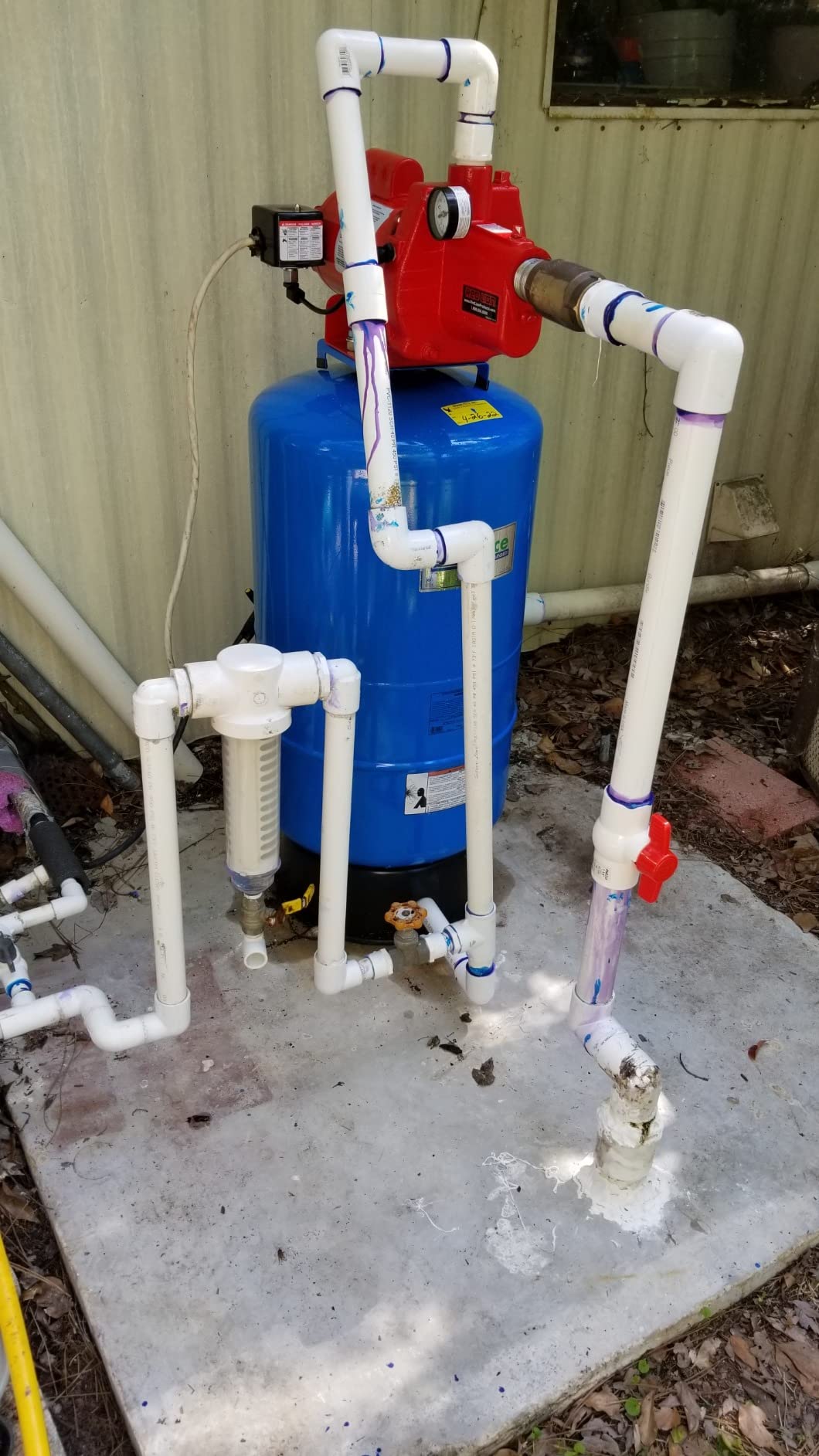
Flow is the trade-off: 16 GPM is the ceiling on this pump, with a 150 ft max head and a 65 PSI maximum. Draw figures are 14.4 amps at 115 volts and 7.2 amps at 230 volts, so the 115 volt configuration needs a 20 amp circuit.
One install note that catches people: the pump runs on 115 or 230 volts but the voltage has to be manually matched to your incoming supply at the terminal block. Get that wrong and you will trip the breaker the first time it starts. At 38.2 pounds it is a two-person lift.
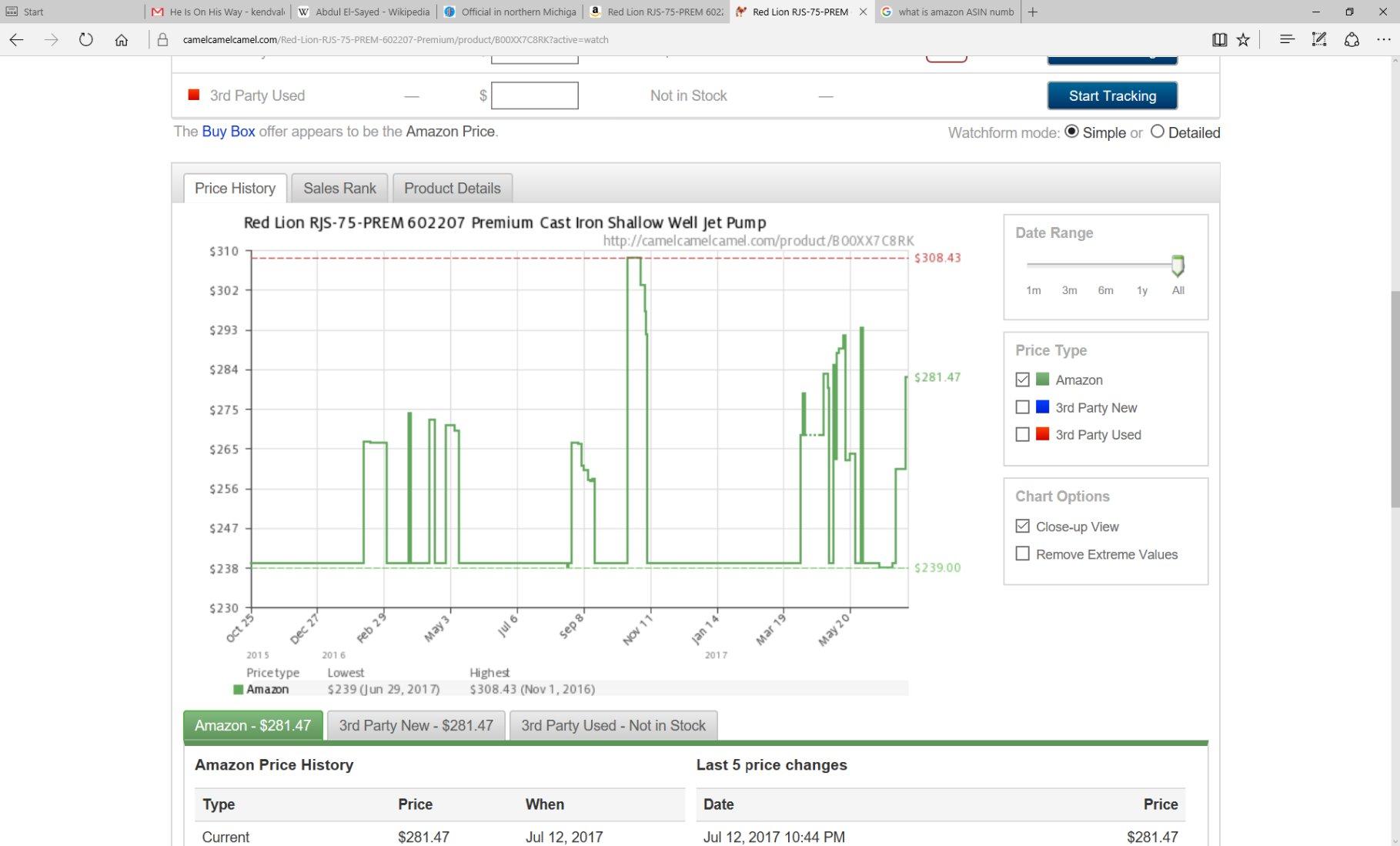
Why a 30/50 switch beats a 20/40 switch for indoor use
The difference shows up in the shower. A 20/40 switch cuts in at 20 PSI and out at 40, so a fixture may see anywhere from 20 to 40. A 30/50 switch gives you a 30 PSI floor, which is the threshold most people describe as normal household pressure. For indoor fixtures the higher cut-in setting is simply better, while irrigation zones usually want the opposite.
Who should pass on this pump
Pass if you run multi-zone irrigation, because 16 GPM will not keep several zones pressurised. It is also the wrong choice for a well shallower than about 8 ft where you would be paying for lift capacity you will never use, and the manual voltage selection is a real consideration if you are not comfortable with a terminal block.
6. Goulds J5S 1/2 HP Cast Iron Shallow Well Jet Pump
Goulds Pump J5S Shallow Well Jet Pump, 115/230 volt, 1/2 hp
1/2 HP cast iron jet pump
16.5 GPM and 25 ft max lift
30-50 PSI switch preset
40.9 pounds
Pros
- Highest star rating in this group at 4.4
- Cast iron construction with a stainless steel shaft
- Built-in overload with automatic reset
- Pressure regulator and 30-50 PSI switch included
Cons
- Heaviest design reviewed at 40.9 pounds
- May arrive containing water from factory testing
- 16.5 GPM is modest for large irrigation
The Goulds J5S carries the highest star rating of any pump we reviewed, and the owner reports behind that number follow a familiar pattern: people buying it after cheaper pumps could not build pressure. The motor is a NEMA standard 1/2 HP capacitor start single phase unit running at 3500 RPM on 115 or 230 volts, with a built-in overload that resets itself automatically.
A stainless steel shaft and cast iron construction are the two details that matter for service life, since a shaft that will not corrode and a volute that will not crack are what a well pump needs in year three. The pump arrives with a pressure regulator and a pressure switch preset to 30-50 PSI, and it is UL 778 listed.
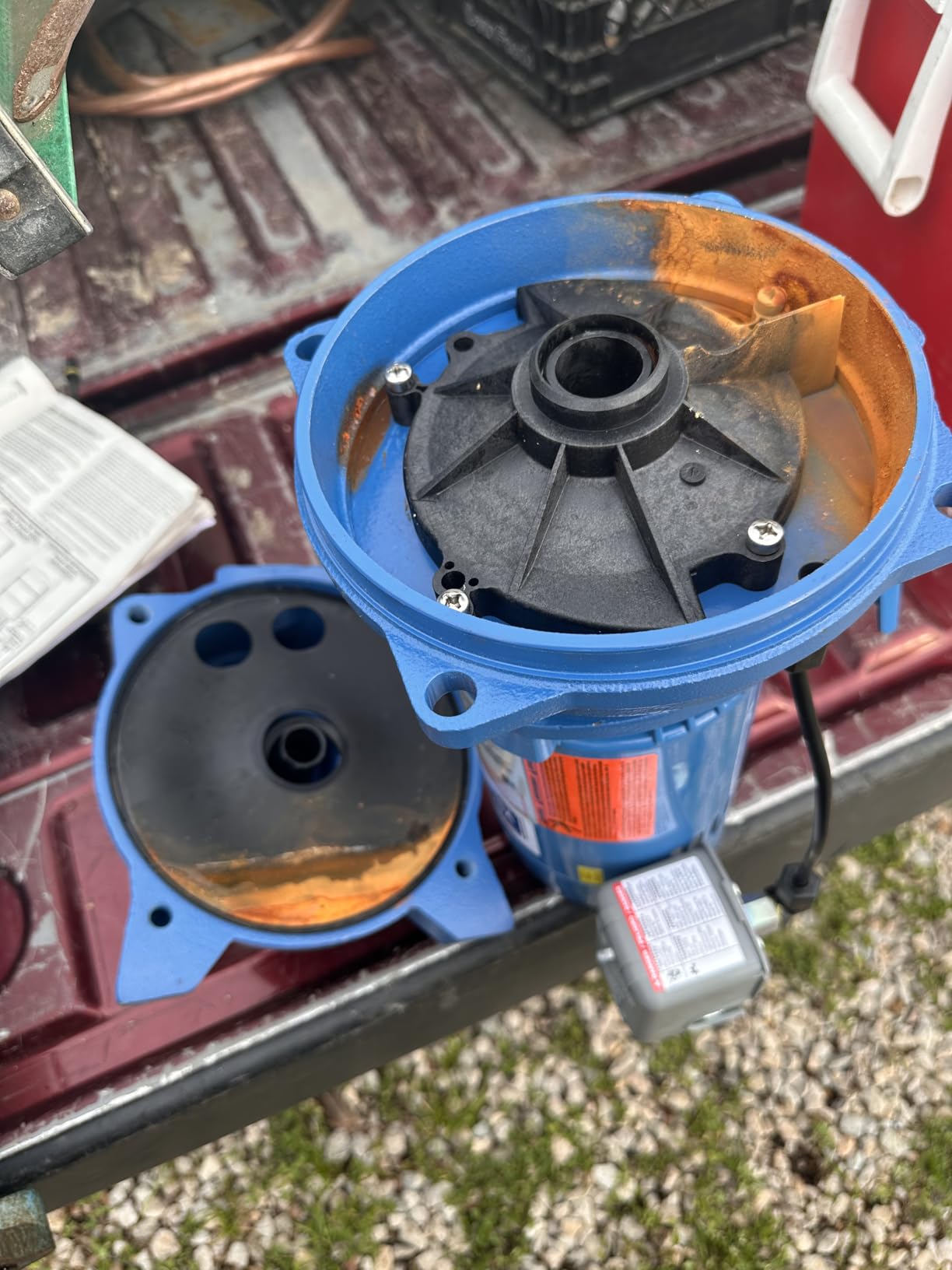
There are two practical catches. First, weight: at 40.9 pounds this is the heaviest design in the group, and it needs a planned lift. Second, the manufacturer notes that pumps are tested before shipping and may contain water from testing, so expect to drain and prime it before it ever sees your well.
One buyer received a seized pump with no recourse, which is an isolated report rather than a pattern, but it is worth knowing if you are relying on this for an emergency replacement. Flow is 16.5 GPM with a 25 ft maximum lift, and ports are 1.25 inch NPT suction and 1 inch NPT discharge.
What a 25 ft maximum lift means for your well
Lift is measured from the water surface in the well to the pump, not from ground level. A 25 ft rating means the water level has to drop below that figure or the pump loses prime and cavitates. If your static water level sits at 22 ft, a 1/2 HP unit is marginal. If it sits at 8 ft, you have plenty of margin and could step down in size.
Who should pass on this pump
Pass if you need irrigation volume, because 16.5 GPM will not feed multiple zones. It is also a poor emergency install for anyone without help, given the 40.9 pound weight, and the preset 30-50 PSI switch is not adjustable enough for a system that needs a 60 PSI ceiling for a high-head irrigation zone.
7. Lanchez 1.6 HP Stainless Steel Kit with 5 Gallon Pressure Tank
Lanchez 1.6HP Shallow Well Garden Pump, Stainless Steel Irrigation Pump, 1340 GPH, Automatic Water Booster Jet Pump for Home, Garden, Lawn,Irrigation, 115V, Glossy black
1.6 HP stainless steel pump
26 ft suction and 1340 GPH
150 ft max head
20/40 PSI with tank
Pros
- Complete kit with pressure tank switch and gauge
- Multiple irrigation owners report steady strong pressure
- Very quiet running
- Three year warranty with fast replacements
- Handles transfer and fire water reserve duty
Cons
- Must be primed with water before first use
- Needs protection from freezing
- One review reports an undersized power cord
- Fittings are NPS straight thread rather than NPT
This is the kit we would put behind a well that already works but loses pressure, because the included 5 gallon pressure tank, switch and gauge mean the pump has somewhere to store water between demand cycles. A 1.6 HP motor moves 1340 GPH with a 150 ft maximum head, and suction reaches 26 ft.
Owners consistently report quiet running, and multiple irrigation users describe strong steady pressure. The stainless steel casing resists corrosion, a carbon ceramic mechanical seal limits leakage, and temperature sensing triggers an automatic overload stop for dry-run protection. A waterproof on and off switch and a 6.5 ft grounded cord round out the electrical side.
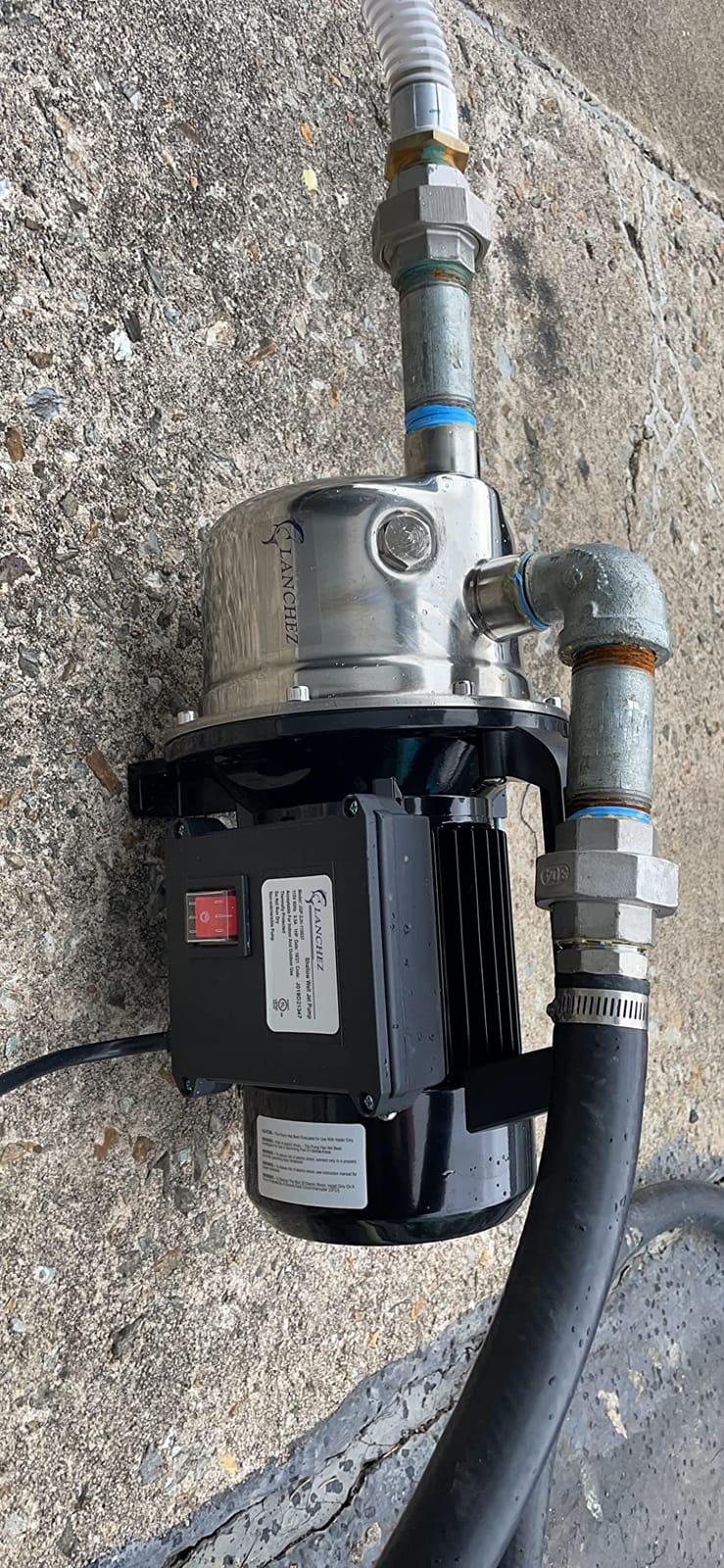
There is a specific install sequence here. The pump must be primed with water before first use or the seal can be damaged, and it needs protection from freezing temperatures if it lives outdoors. One detailed review flags the power cord as undersized for the pump current draw, which is worth checking against your run length.
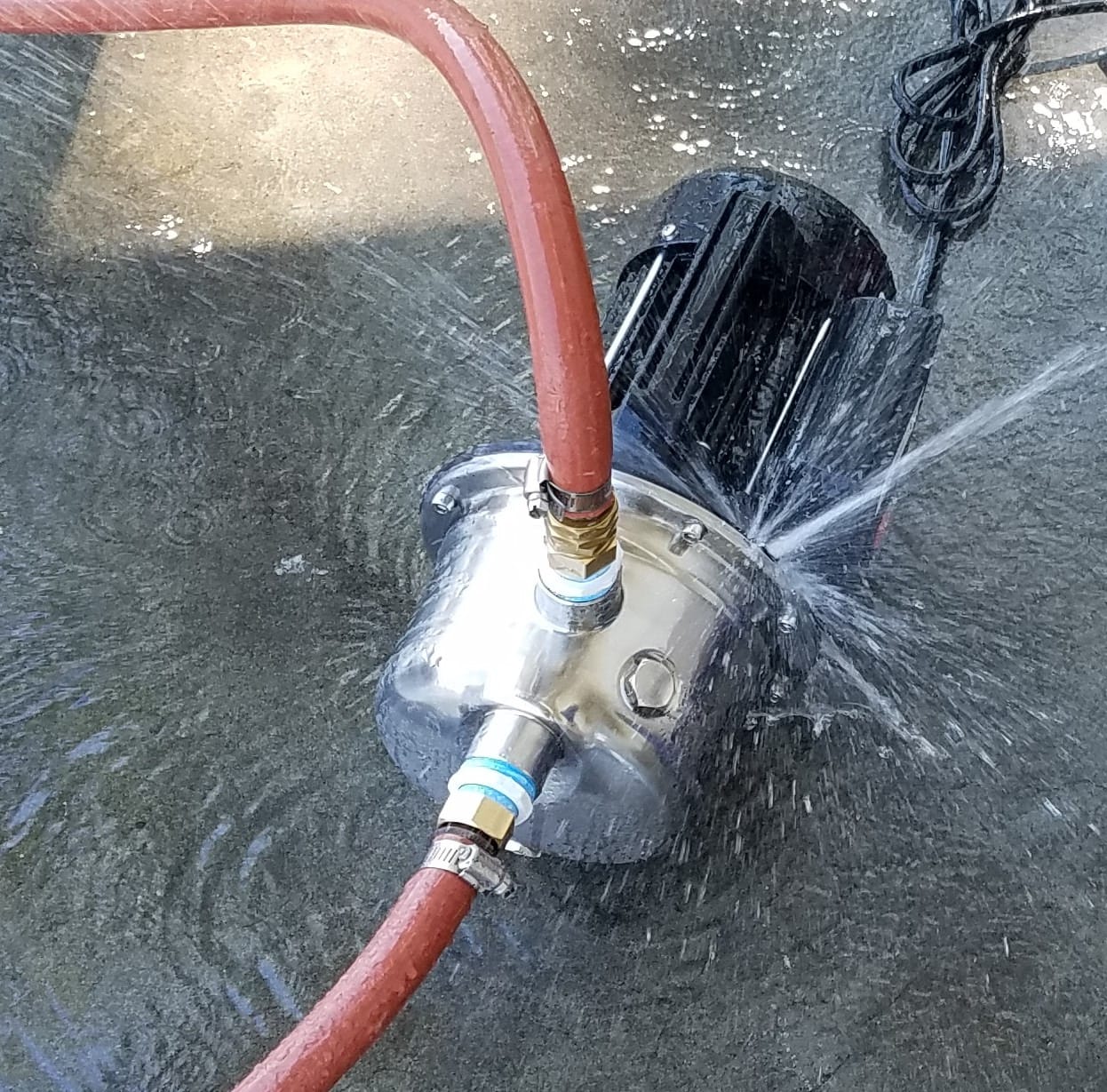
The fittings are NPS straight thread rather than NPT, and that distinction trips up people assembling their own fittings. Replacement impeller and diffuser parts are hard to source, so plan on replacing the pump rather than rebuilding it. The three-year warranty and the fast replacement handling are genuine strengths.
Decide between 20/40 and 30/50 for a storage tank system
The 20/40 switch is the right choice for a pump that fills a ground-level storage tank, because it keeps drawing while there is water to move and it can afford to shut in early. For a pump boosting straight into a house pressure tank, a 30/50 switch holds a higher floor at the fixtures. Matching the switch to the job matters more than the pump horsepower in most of these systems.
Who should pass on this kit
Pass if you already have a serviceable pressure tank, since the included one is redundant, and pass if you are on a well deeper than 26 ft. The NPS straight thread fittings also make it a poor choice for anyone who prefers to reuse existing NPT pipe and fittings rather than rebuild the connections.
8. Lanchez JGP11007 1.6 HP 1500 GPH Stainless Steel Transfer Pump
LANCHEZ 1.6 HP Shallow Well Pump, 1500 GPH Stainless Steel Water Transfer Pump, 115V Garden Irrigation Pump, Water Booster Jet Pump for Home Garden Lawn Farm, Silver
1.6 HP stainless steel pump
1500 GPH and 147 ft head
62.25 PSI max pressure
115V with 16 ft cord
Pros
- Strong lift and flow in a compact package
- One owner reports four years of continuous outdoor service
- Holds roughly 40 PSI over long discharge runs
- Includes gauge plus thread seal tape and a 16 ft cord
- Dry run auto shutoff with thermal overload
Cons
- Pressure drops with two or more sprinklers running
- Some pumps seized after a couple of months
- Manual priming required after storage
- Clean water only
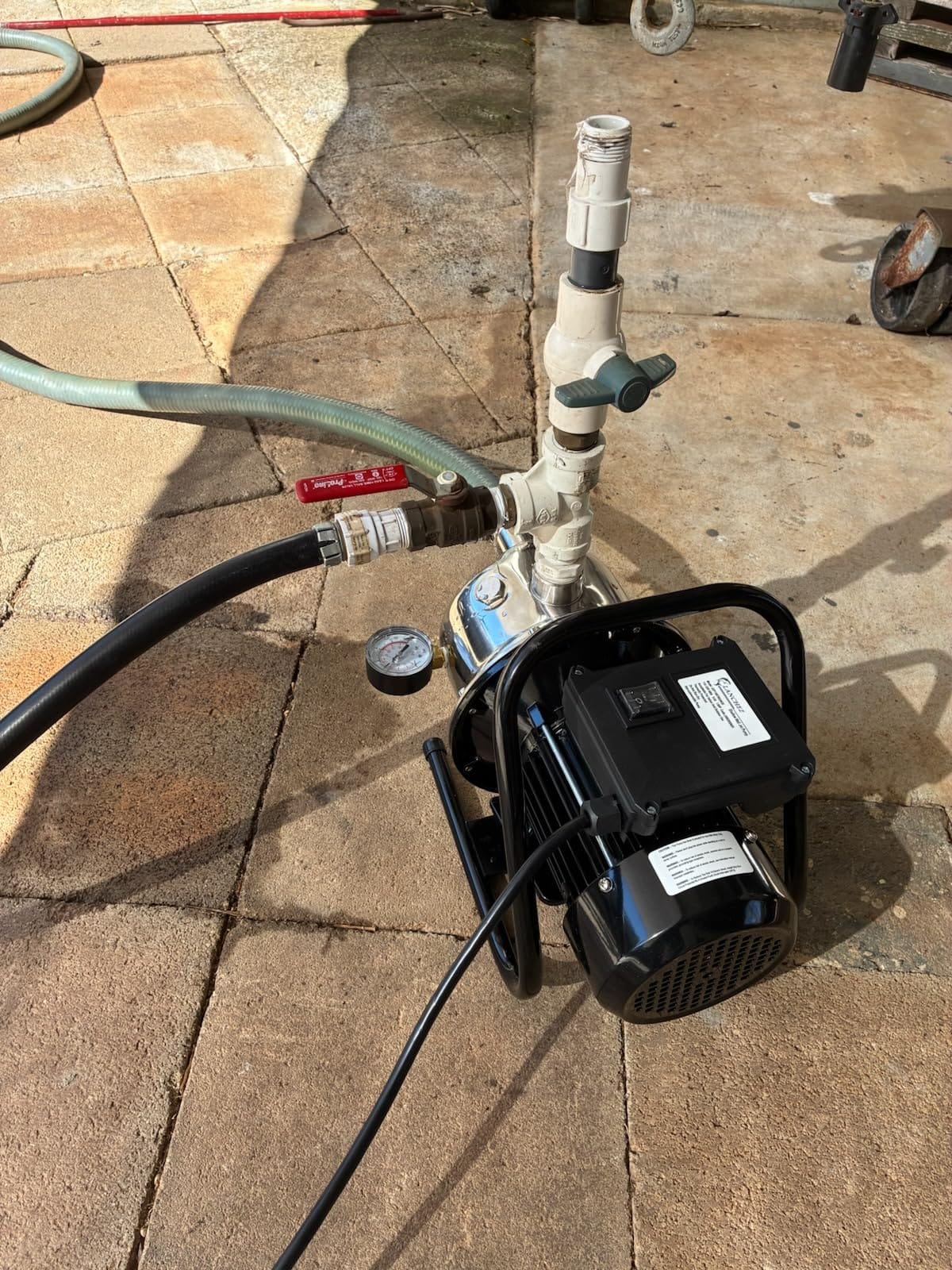
We end on the simplest machine here, and it earns its place for transfer duty. A 1.6 HP motor delivers 1500 GPH with a 147 ft maximum head and a 62.25 PSI maximum working pressure. Ports are standard 1 inch NPT on both inlet and outlet.
Owners treat it as a practical pump for ponds, cisterns and single-sprinkler lawn watering, and one reports four years of continuous outdoor service. Another maintains roughly 40 PSI over long discharge runs. It runs quietly, and the package includes a pressure gauge, thread seal tape and a 16 ft power cord, with three-year technical support behind it.
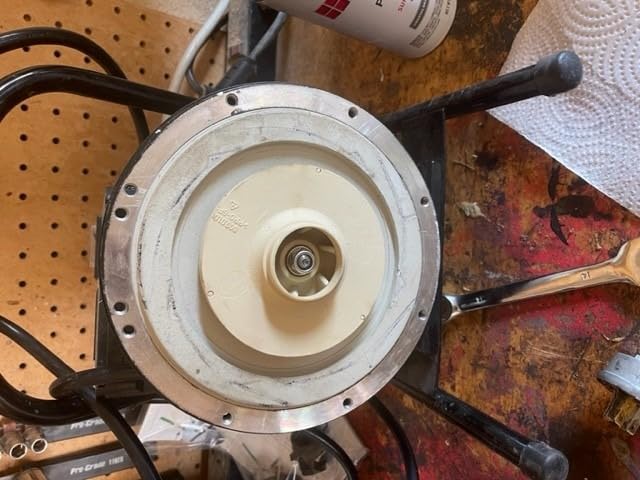
Where it falls short is sustained multi-fixture demand. Owners report pressure dropping significantly once two or more sprinklers run, which is exactly what the friction loss maths predicts. A minority report pumps seizing after only a couple of months of light use, and one unit arrived with a mis-located port, though function was unaffected.
Two more conditions: it requires manual priming with clean water before first use after storage, and it is rated for clean water only with no dirty water capability. Thermal overload protection and an auto-shutoff against dry running are both built in, which is a meaningful safeguard when the supply is a pond or a cistern that can run low.
Know the difference between GPH and GPM
Manufacturers quote both and they are not interchangeable for sizing. GPH is gallons per hour, and 1500 GPH equals 25 GPM, which is the figure on the spec sheet. Most household sizing conversations happen in GPM because fixture demand is measured in GPM, and 25 GPM is more than any house draws. Check that your demand is below the pump’s flow at the pressure you actually need, not at zero pressure.
Who should pass on this pump
Pass for in-ground irrigation with several zones running at once, and pass for anything involving sediment or dirty water. It is also the wrong choice as a primary well booster on a deeper casing, since the single-suction configuration is not built for the lift a deep well requires.
How to Choose a Well Water Booster Pump?
Buying the wrong booster is expensive and common, because the same symptoms come from four different problems. Start by picking the architecture, then size it, then match the tank and switch to the demand, and only then look at features.
Pick one of three architectures first
A shallow well jet pump with a pressure tank and a switch is the traditional dependable arrangement, and pump professionals on plumbing forums consistently recommend it as the route that lasts. A tankless variable speed booster runs a permanent magnet motor and ramps pressure up and down smoothly with no tank, which is quiet and efficient but depends entirely on the flow switch and controller electronics. A multistage centrifugal pump is a heavier duty design for storage tank and high-head work.
All eight pumps in this roundup fall into the first and third categories, with one inline booster in the second. That is not a gap. Variable speed booster systems are a different purchasing decision with different installation requirements, and the well pumps we reviewed are the models actually turning up in well owner feedback.
Shallow well or deep well: know your ceiling
Most consumer booster pumps self-prime to roughly 26 ft and will not work on a deep well. If your well is deeper than that, a booster is the wrong tool entirely. The right answer is a submersible pump sized for the well depth, with a proper pressure tank and switch on the discharge side.
Measure your static water level before anything else. If the pump needs to sit within 25 ft of that water level, a jet pump works. If not, you need a submersible and you should read our submersible pump guide instead.
Size horsepower from flow, not from pressure
The rule that comes up most often from professionals is that the more volume a pump produces, the less pressure it can produce. A larger pipe only reduces the pressure drop on the way to the house, which is why upsizing the well-to-house line is often the cheaper fix. Size to the gallons you need, then check that the pump still reaches the PSI you want at that flow rate.
Match the tank and switch to your demand
The rule of thumb is roughly 1 GPM of stored capacity for every gallon per minute of household demand, so a family hitting 5 GPM wants at least a 5 gallon tank, and 10 GPM wants 10. Undersized tanks cause short cycling, and short cycling is what kills motors. A 30/50 switch suits indoor fixtures, a 20/40 switch suits pumps filling a storage tank or feeding irrigation.
Get the electrical side right before you buy
Check the voltage the pump is factory set to, because several models here ship set to 230 volts and will not run as intended on a 115 volt supply until you move the terminal block. Look at the amp draw too: 14.4 amps at 115 volts on a 3/4 HP pump means a 20 amp circuit, not a 15 amp one.
On GFCI protection, owners report nuisance tripping with certain whole-house boosters on GFCI-protected circuits, and mention needing a specific Leviton GFTR2-W GFCI outlet or a non-GFCI circuit to resolve it. If you are unsure, an electrician is cheaper than a tripped breaker at 2 a.m.
Treat noise claims skeptically
Owners describe a turbine-like sound and a noticeable click on startup even from pumps advertised as quiet. The most reliable noise measures are the ones that describe a water-cooled motor and a permanent magnet motor, since those reduce the whine that comes from air-cooled conventional motors. If noise matters in your house, plan the pump location as carefully as the pump.
Installation and First Startup Checklist
Work through this before you call the system finished, and log the baseline numbers so you have something to compare against later.
1. Mount the pump where air can reach it and where it cannot freeze. A pump pit in a region with hard winters needs heat or a drain-down strategy.
2. Fill the pump casing with clean water and prime it before the first start. Dry starting is the fastest way to destroy a mechanical seal, and several pumps in this group are documented as vulnerable to exactly that.
3. Confirm the voltage at the terminal block matches your supply before energising anything.
4. Open a faucet, run the pump, then bleed air from the pressure tank and the piping until the gauge holds steady with the pump off.
5. Set the switch cut-in and cut-out, then confirm the pump shuts down before it can run dry.
6. With the pump off, open a faucet and let the tank drain down. Then note the switch settings and the gauge reading, and write them down.
7. Test under real demand. Run the shower and a hose spigot together and record the flowing pressure. That reading, not the static one, is the number you will compare against next year.
Troubleshooting: What the Symptom Is Telling You
Most booster complaints fall into a handful of repeating patterns, and each one points at a specific cause rather than a bad pump.
No boost at all when several fixtures run
That pattern almost always means friction loss, not pump weakness. Take the friction numbers to your own line before you shop. Recalculate with the flowing GPM and pipe diameter you actually have. If the number is large, the fix is a larger supply line, and a 1 inch line costs far less than a pump you do not need.
Short cycling and rapid on and off
A tank too small for your demand, a waterlogged tank, or a defective bladder all cause it. Check the tank pre-charge pressure first, since a tank that has lost air looks exactly like a pump that is failing. The tell for a failing switch is a pump that cycles with no faucet open at all.
Noise that starts suddenly
A hum that never stops usually means a leak somewhere downstream, so the pump is chasing a leak and never reaching shutoff pressure. A click on startup is normal for a pressure switch. A loud turbine whine that grows with demand is the impeller or diffuser wearing, and it is worth replacing before it fails outright.
The pump will not start at all
Work outward from the basics: confirm the breaker or GFCI has not tripped, confirm the switch is getting power, and confirm the tank holds air. Owners running storage tank fed systems report running a multistage booster dry six to eight times in nine years by losing track of the tank level, and dry running is the fastest route to a burned motor.
Frequently Asked Questions
Can you put a booster pump on well water?
Yes. A booster can be added to a well system, but it only adds pressure to water the well pump has already lifted. It cannot create water, so if the well produces 3 GPM and the house wants 8, the booster simply stalls. Most consumer boosters also self-prime to roughly 26 ft, so they are for shallow wells and storage tank systems, not deep wells.
How much pressure can a booster pump add?
It depends on the pump and on the flow. The inline booster in this roundup is rated to add up to 40 PSI of supplemental pressure, and another unit here carries a 65 PSI maximum. The catch is that a pump produces less pressure as flow rises, so advertised PSI is usually measured at low flow rather than at the rate your house actually draws.
What is the best booster pump for increasing water pressure?
For a working shallow well that loses pressure at the fixtures, the Acquaer CJE100-1 convertible jet pump is the strongest all-round pick, with more than 1200 reviews behind it. If the low pressure comes from an irrigation zone rather than household fixtures, choose for flow instead, and the AQUASTRONG SPRK150 handles 4250 GPH.
What are the downsides of using a water booster pump?
The main risks are short cycling, noise and power draw. A booster without a properly sized pressure tank cycles constantly, and every start draws inrush current that heats the motor and degrades the winding insulation. Boosters also add a failure point, and a motor that runs dry from a failed switch can be destroyed in a single afternoon.
Why is my pressure switch short cycling?
Almost always the tank, not the switch. Check the air pre-charge in the pressure tank first, since a tank that has lost its air or has a punctured bladder behaves exactly like a pump that is cycling too fast. If the pump cycles with every faucet closed, the switch itself is the likely culprit, and the signs of a bad switch are rapid chatter and a pump that never settles.
The Best Water Pressure Booster Pump for Your Well
There is no single best water pressure booster pump for wells, because the right answer depends on which of the four causes is actually behind your low pressure. Measure static and flowing pressure first, compute your friction loss, and confirm what the well produces before you spend anything.
With that done, the Acquaer CJE100-1 is our pick for most shallow and mid-depth wells, and its convertible ejector design covers the 0-to-25 ft and 26-to-90 ft cases in one package. Choose the AQUASTRONG PGA150SAN when you want a pump, a 5 gallon tank, a switch and a gauge delivered as one matched kit. The Simer 4075SS-01 is the pick when the water is already lifted and you simply need up to 40 PSI added to an existing line.
For irrigation and high volume, size for flow rather than pressure, and remember the two hard limits: roughly 26 ft of suction lift for consumer jet pumps, and roughly 2.31 ft of elevation per PSI you lose on the way to the house. Get those two numbers right in 2026 and the rest of the decision is straightforward.