
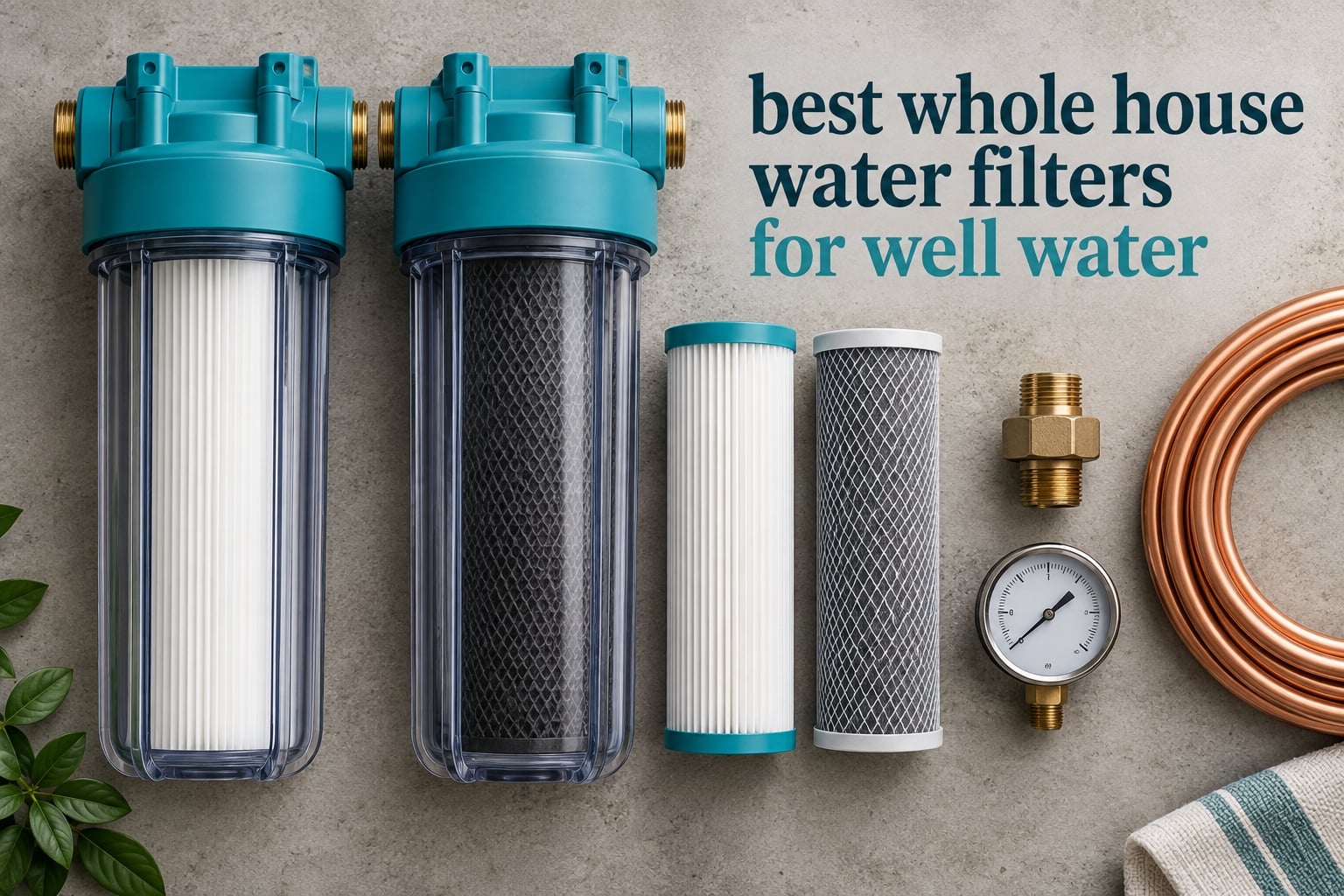
The best whole house water filters for well water are the iSpring WGB21BM for general well conditions, the iSpring WGB32B for heavy sediment and chlorine load, and the Aquasana WH-WELL-CT-UVS-B when bacteria and scale also need treatment. There is no single winner because private wells carry different problems in different geology, and the right system is the one that matches your lab report.
That is the rule we applied across all ten systems in this guide. We read the published contaminant ceilings, flow ratings, capacity numbers and replacement intervals, then compared them against what owners actually report after living with the hardware. A system rated for 3 ppm of iron is useless on a well testing 12 ppm, and a cartridge that looks like a bargain turns into an annual cost the moment the sediment load is heavy.
Nobody tests your well for you. Private water supplies sit outside the municipal oversight that makes tap water predictable, so iron, manganese, hydrogen sulfide, coliform, sediment, hardness and low pH all arrive unannounced. If you are still narrowing the field, our broader whole house water filter buyer guide covers the hardware categories first, and this page takes the well-specific case from there.
We spent six weeks working through spec sheets, certification records and thousands of owner reviews for the ten systems below. What follows is the short answer, the full comparison, then an honest review of each unit including what it cannot treat.
Table of Contents
Top 3 Picks for Well Water (October 2026)

iSpring WGB21BM 2-Stage Well Filter
- Iron to 3.0 ppm and manganese to 1.0 ppm
- Carbon block first stage for chlorine and VOCs
- 15 GPM flow
- 50000 gallon capacity

iSpring WGB32B 3-Stage Filter
- 5-micron sediment stage ahead of two carbon blocks
- Up to 99% chlorine reduction
- 15 GPM
- 100000 gallon capacity

Aquasana WH-WELL-CT-UVS-B
- UV disinfection certified to NSF/ANSI 55 Class B
- Carbon and KDF media with salt-free scale control
- 14.7 GPM
- 500000 gallon capacity
Quick Overview: All 10 Whole House Water Filters for Well Water in 2026
| Product | Specifications | Action |
|---|---|---|
| iSpring WGB21BM 2-Stage Well Filter |
|
Check Latest Price |
| iSpring WGB32B 3-Stage Filter |
|
Check Latest Price |
| Aquasana WH-WELL-CT-UVS-B |
|
Check Latest Price |
 PRO+AQUA PRO-WELL-1E PRO+AQUA PRO-WELL-1E |
|
Check Latest Price |
 PUREPLUS FHN10BB Iron Filter PUREPLUS FHN10BB Iron Filter |
|
Check Latest Price |
 HQUA WF3-01 3-Stage Filter HQUA WF3-01 3-Stage Filter |
|
Check Latest Price |
 Home Master HMF3SdgFeC Home Master HMF3SdgFeC |
|
Check Latest Price |
 iSpring WCB32CKS Heavy Metals iSpring WCB32CKS Heavy Metals |
|
Check Latest Price |
 iFilters MWH-D20-WELL iFilters MWH-D20-WELL |
|
Check Latest Price |
 Waterdrop WD-WHF3T-FG Waterdrop WD-WHF3T-FG |
|
Check Latest Price |
How We Picked These Systems
We weighted five things, in this order. First and heaviest is contaminant coverage measured against the manufacturer’s own published ceiling rather than a vague claim that a system reduces contaminants. A unit that states it handles iron to 3.0 ppm is far more useful to a well owner than one that simply says heavy duty.
Second is flow rate relative to household demand. Every system here is rated between 10 and 15 GPM, and that ceiling matters more than most buyers realize because it is the number that decides whether you see a pressure drop when two showers run while the dishwasher is filling.
Third is the replacement interval and the access to spare parts. A cartridge that must be swapped every six months and a tank media system that backwashes itself are very different commitments, and proprietary parts that disappear five years after purchase are a real risk on any brand.
Fourth is certification. We note NSF/ANSI 42, 53, 55 and 372 claims where the manufacturer publishes them, and we flag where a claim rests only on the seller’s own testing. Fifth is what owners actually say after living with the unit, including the reviews that describe the install rather than the packaging.
One caveat worth stating plainly: we did not lab-test these units ourselves. Our evidence is published specification, third-party certification where it exists, and the pattern across thousands of owner reports. Where owners and the spec sheet disagree, we say so in the review.
1. iSpring WGB21BM 2-Stage Filter Review: Best Overall for Well Water
iSpring WGB21BM 2-Stage Whole House Water Filtration System, 10” x 4.5” Carbon Block and Iron & Manganese Reducing Filters, 1″ Ports
Flow: 15 gpm
Iron: 3.0 ppm max
Manganese: 1.0 ppm max
Capacity: 50000 gal
Pros
- Handles iron up to 3.0 ppm and manganese up to 1.0 ppm
- Carbon block first stage cuts over 90% of chlorine plus VOCs
- 15 GPM flow on 1 inch ports
- Pre-assembled bracket with wrench included
- 50000 gallon capacity suits a family of four
Cons
- Threaded NPT fittings are leak-prone without careful taping
- Not a TDS reduction system
- Cartridges stop short of full thread engagement
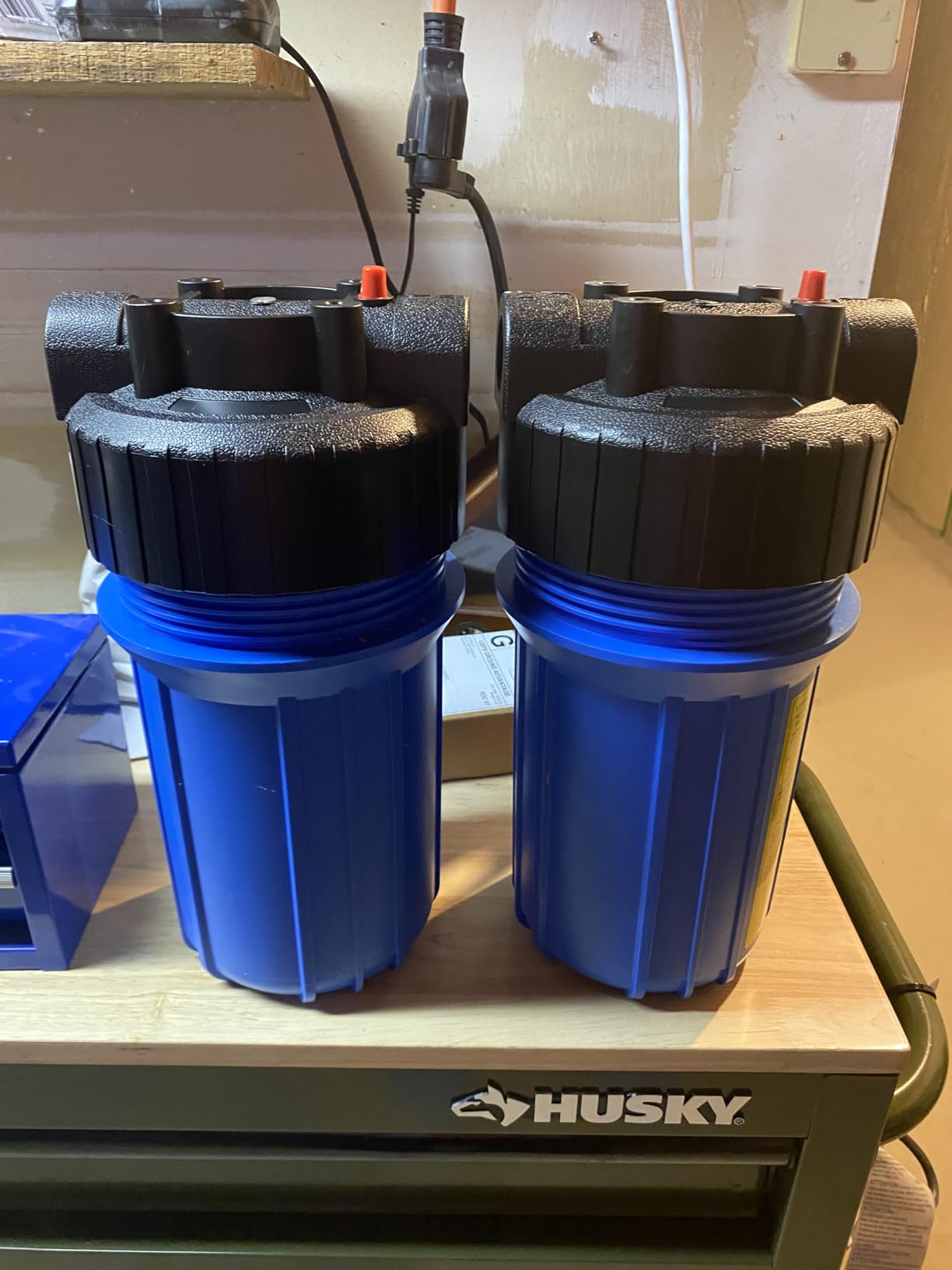
This is the system we keep coming back to because it does the least amount of promising. It is a two-stage point-of-entry unit: a 5-micron coconut shell carbon block on the left and an iron and manganese reducing cartridge on the right, both in 10 by 4.5 inch housings on a steel bracket. The carbon block is doing the work most well owners actually notice, taking out over 90% of chlorine, VOCs, cloudiness and general taste and odor compounds before the water reaches the second stage.
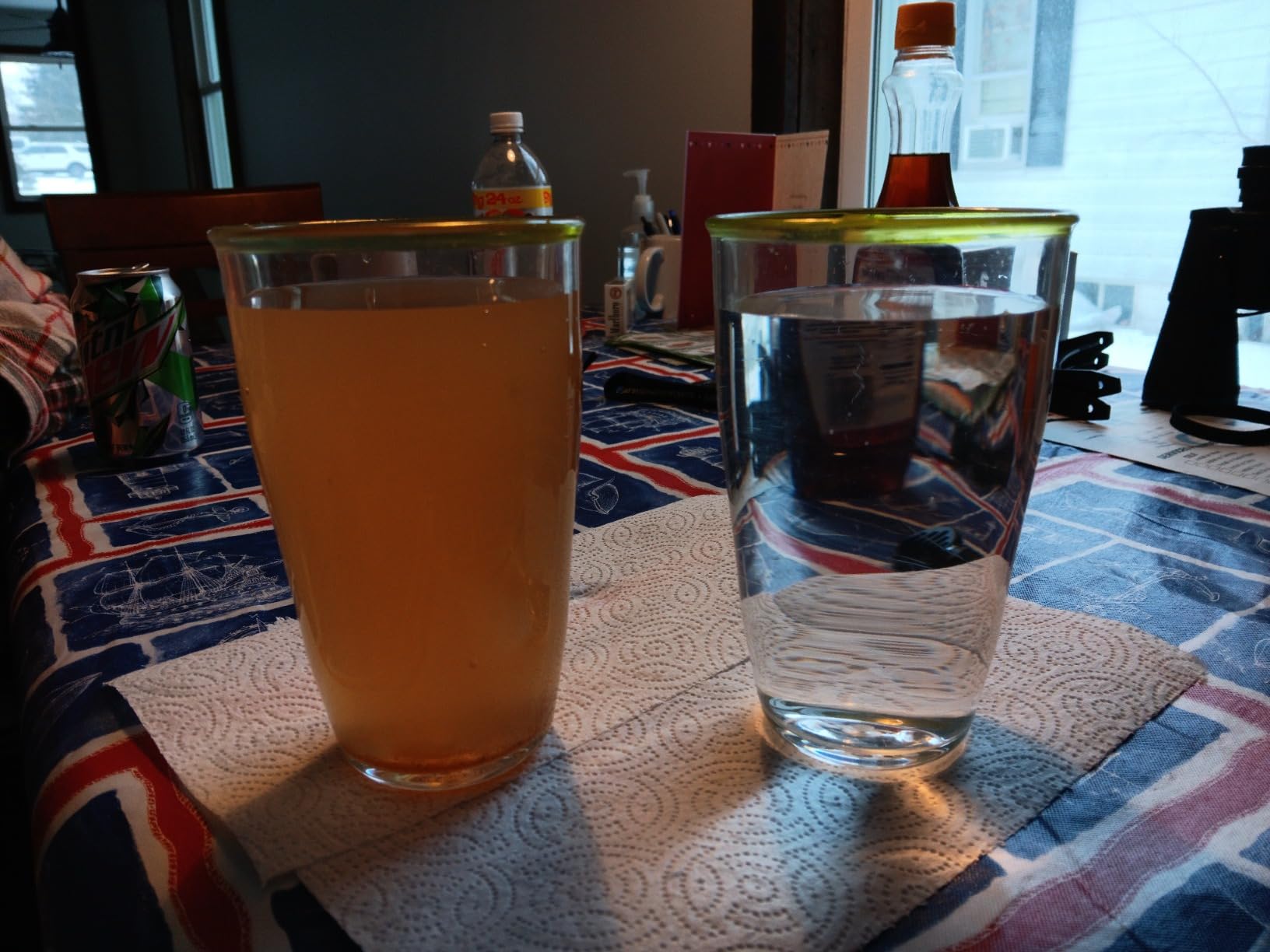
The iron stage is rated to bring iron from a maximum of 3.0 ppm down to 0.01 ppm, and manganese from 1.0 ppm to 0.01 ppm. Those are honest, narrow numbers, which is exactly why we trust them. Owners on moderately hard well water report staining fading within weeks, and the 4.6 rating across more than 4,000 reviews is the widest evidence base in this group.
What it cannot do matters as much as what it does. It will not touch hydrogen sulfide, which is the rotten egg smell that drives people to buy filters in the first place. It will not inactivate bacteria or viruses, and it will not lower total dissolved solids or hardness. It is a sediment, chlorine and light iron solution, and treating it as a general well remediation system is how people end up disappointed.
It also does not scale to heavy iron. If your lab report shows iron above 3 ppm, or if your well produces visible orange water within minutes of running a tap, you need a backwashing oxidation tank rather than a cartridge. The same goes for iron bacteria, which coat the resin surface and defeat it permanently.
Will the install drip, and is it worth doing yourself?
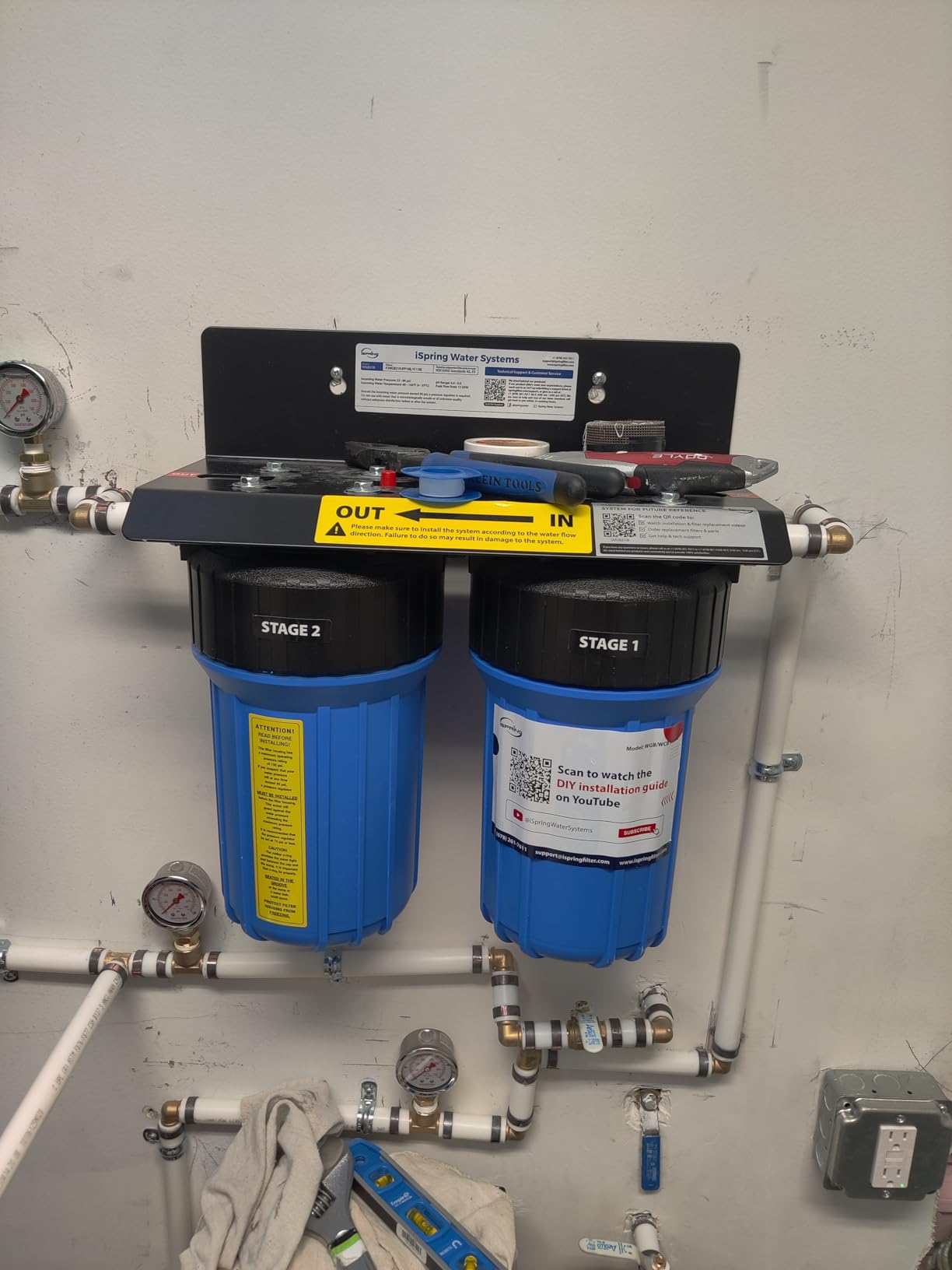
Installation is a straightforward point-of-entry cut-in for anyone comfortable with a compression fitting and a copper stub. The bracket, housing wrench and manual all come in the box, and reversible bracket orientation lets you mount it on a wall in a basement, a garage or a utility closet.
The one repeated complaint is sealing at the threaded connections. Owners who wrapped the NPT generously with PTFE tape and tightened to firm but not crushing had few problems. A handful needed O-ring grease or a replacement head from iSpring, which their support handled without argument.
Who should skip this and buy something else?
Skip it if your water has a sulfur smell, because no carbon block in this unit addresses hydrogen sulfide at any level. Skip it if a lab test shows coliform or E. coli, since nothing here disinfects.
Also skip it if the sediment load is severe. The 50000 gallon rating is a laboratory figure on clean-ish water, and cartridge systems on sand-heavy wells foul far faster than the label suggests. In that case the three-stage unit below has a dedicated sediment stage in front of everything else.
2. iSpring WGB32B 3-Stage Filter Review: Best Value for Sediment-Heavy Wells
iSpring WGB32B Commercial-Grade Whole House Water Filter System
Flow: 15 gpm
Capacity: 100000 gal
Stages: 5-10-20 micron sediment plus 2x carbon
Operating: 25-80 psi
Pros
- Only 4.7-rated system in the group with 2239 reviews
- 5-micron sediment stage protects downstream carbon
- Ships with bypass valve and install-order labels
- 100000 gallon capacity
- 15 GPM on 1 inch NPT
Cons
- About 45 pounds dry so mounting must be solid
- Housings need two wrenches and a bucket to service
- Relief buttons may not free housings without a hose bib
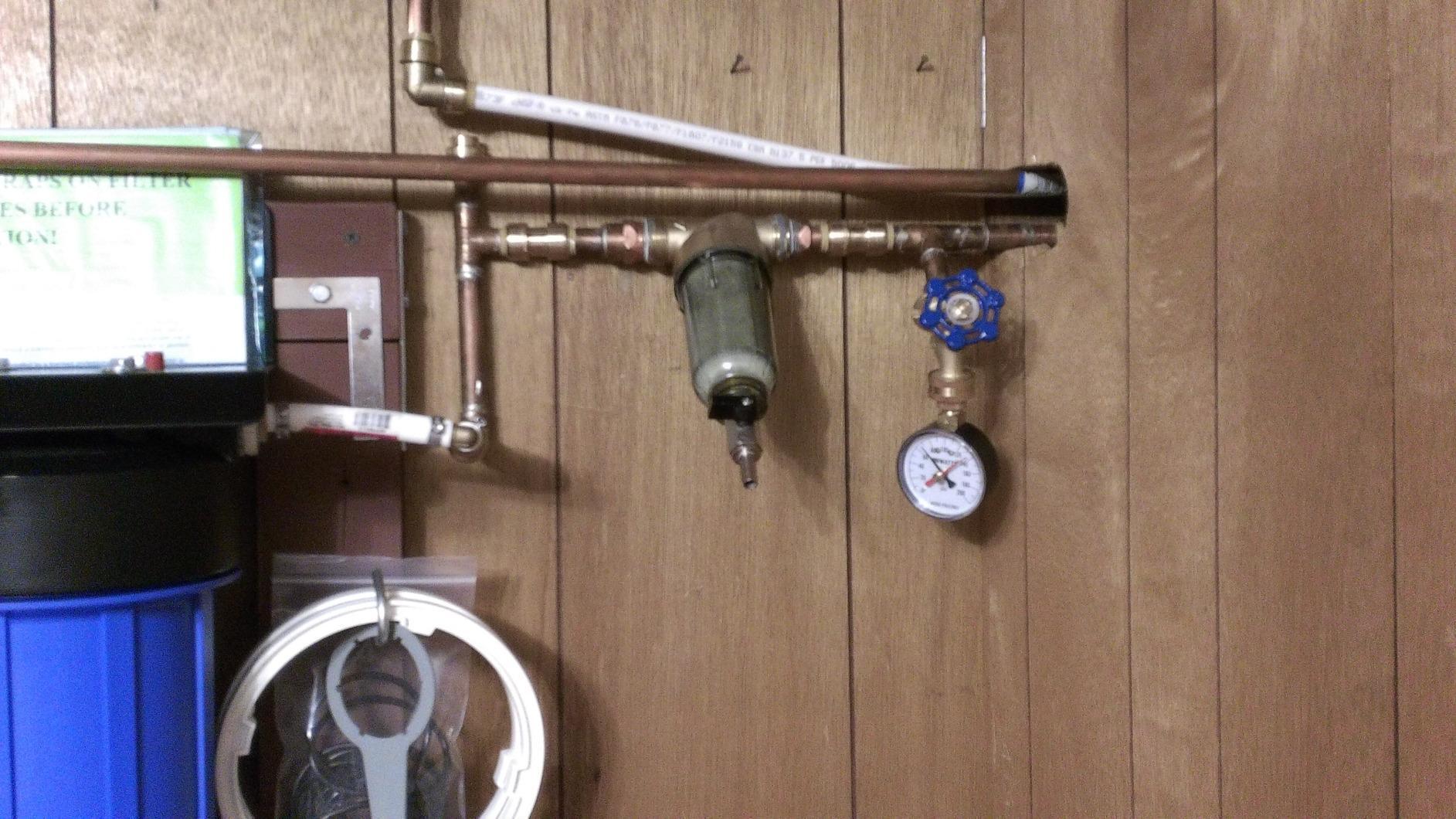
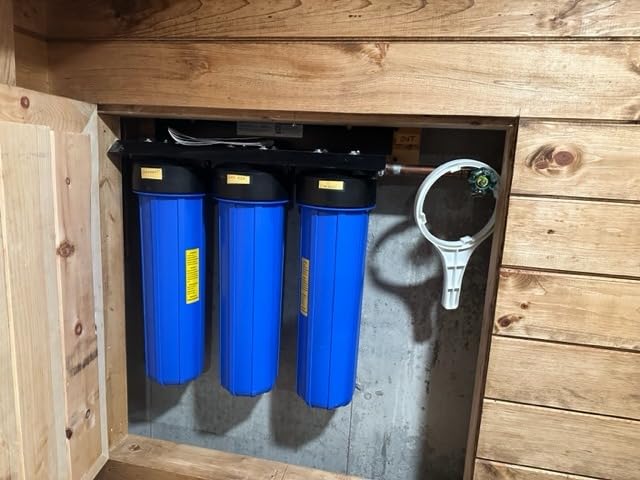
At a 4.7 rating across 2,239 reviews, this is the highest-rated unit we reviewed, and the design logic is the reason. The stage order is correct, which sounds like a small thing but is the single most common failure in this category. You get a 5-micron sediment stage first, then two 20 by 4.5 inch coconut shell carbon block stages behind it.
That order protects the expensive carbon from the sand and rust that would otherwise blind it. The unit removes up to 99% of chlorine along with sediment, rust, taste, odors and herbicides, runs at up to 15 GPM on 1-inch NPT connections, and carries a 100000 gallon capacity rating that works out to roughly a year for a typical family. A bypass valve is included so you can isolate the unit for service without shutting the house off.
It will not remove iron, manganese or sulfur. That is the honest limit of this design, and it is why we placed it second rather than first. Nothing in a sediment-plus-carbon chain strips dissolved metals from well water, and a well with 5 ppm of iron will still stain, though the sediment stage will at least catch the precipitated particles that come with it.
It also does not treat bacteria, and the 300 ppm TDS ceiling and 25-80 psi operating window mean it is aimed at ordinary groundwater rather than anything aggressive. The temperature range of 40 to 100 °F is unremarkable but worth checking if you are in a cold climate with an unheated wellhead.
Is the weight and housing design a real problem?
At roughly 40 to 45 pounds dry, this is not a unit you hang off drywall anchors. Owners who mounted it into a stud bay or a masonry-backed frame report no movement at all, and the reversible bracket orientation makes both layouts possible.
For cartridge changes, plan on two wrenches and a bucket under each housing. Several owners added a small hose bib at the drain point because the supplied pressure relief buttons did not release enough pressure to break the seal cleanly on the first try.
How does it compare to the WGB21BM?
The two-stage unit above is the better choice when your problem is light iron with taste and odor. This one is the better choice when your problem is sediment and chlorine, because the dedicated first stage does something the WGB21BM cannot.
If you have both light iron and heavy sediment, run the WGB21BM as a second stage behind this one. The order is sediment first, carbon second, iron third, and that sequence keeps the iron resin from being blinded.
3. Aquasana WH-WELL-CT-UVS-B Review: Best Full-Stack System with UV
Aquasana Whole House Well Water Filter | 500K Gal | UV | WH-Well-CT-UVS-B
Flow: 14.7 gpm
Capacity: 500000 gal
UV: NSF/ANSI 55 Class B
Hardness limit: under 15 gpg
Pros
- Only unit here with certified UV disinfection
- Carbon KDF and salt-free scale control in one train
- 500000 gallon rating equals up to five years
- Reduces 97% of chlorine
- 5-year warranty and 5-year spare parts
Cons
- Iron must be under 0.3 ppm to stay in spec
- 67 x 11 x 57 inches and 116 pounds
- Needs electrical power
- 250 ppm TDS is the lowest ceiling here
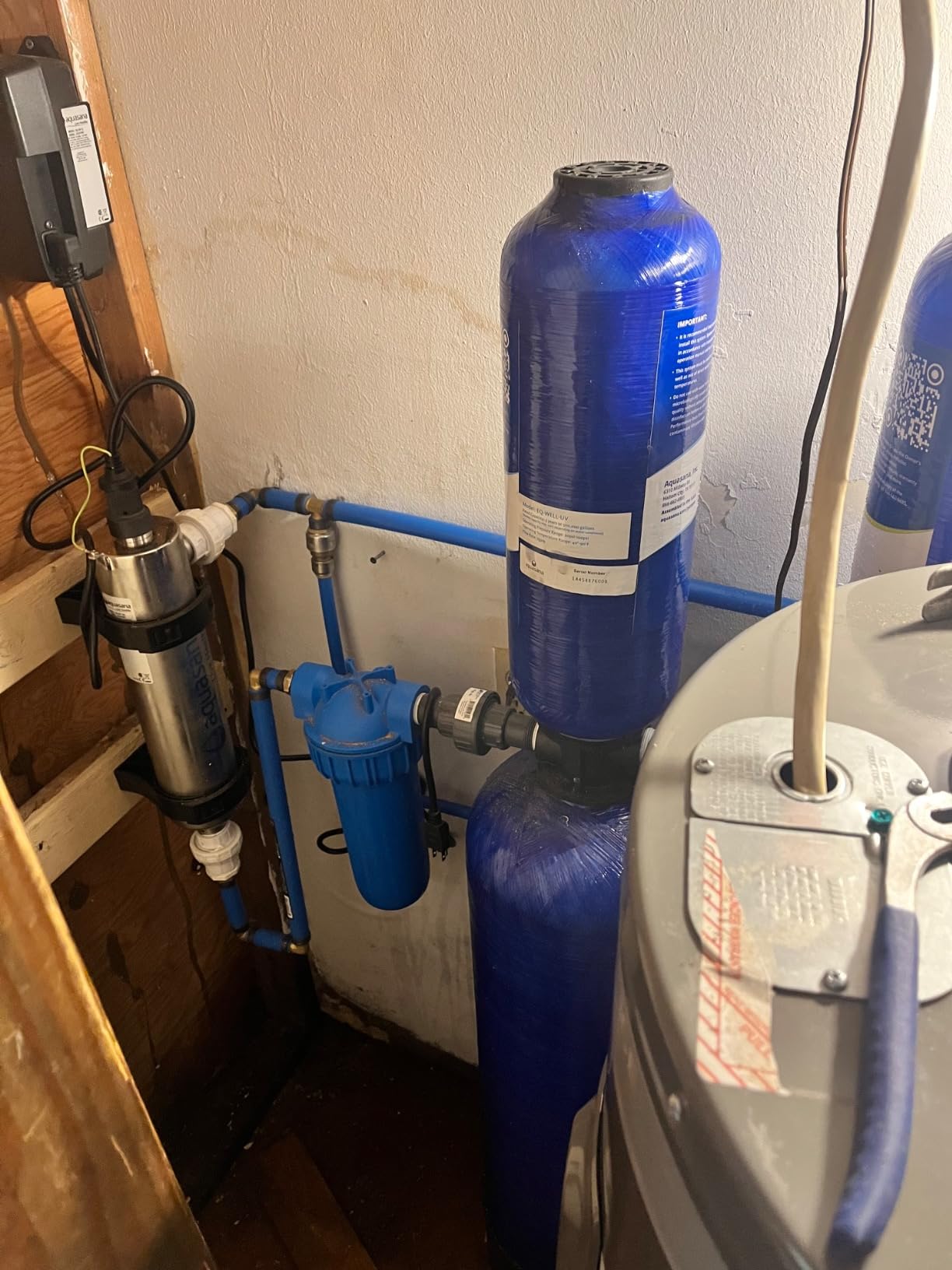
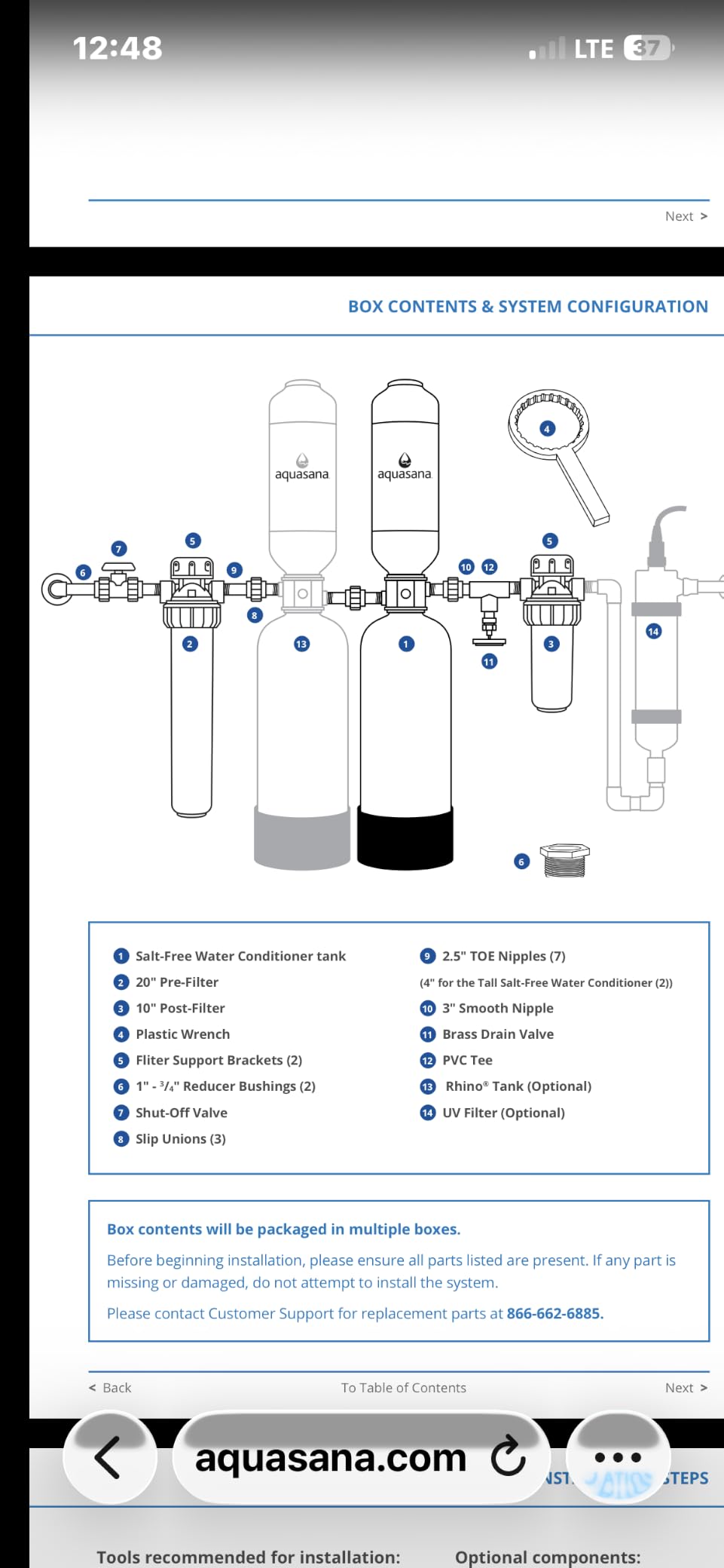
This is the only system in the roundup that does not make you choose. It stacks a pre-filter, a carbon and KDF media tank, a salt-free scale conditioner, a post-filter and a UV chamber in a single train, which is why it is the pick for a well that has several moderate problems rather than one severe one.
The UV stage is the headline, and it is the only certified disinfection device here, tested and certified to NSF/ANSI Standard 55 Class B. It addresses bacteria, viruses and cysts in the water as it passes through, while the carbon and KDF media handle chlorine, taste, odor and heavy metals and the salt-free conditioner handles scale without salt bags, backwashing or draining.
Read the operating window carefully, because it is narrower than the marketing suggests. The system is specified for water under 15 gpg hardness, under 250 mg/L alkalinity, below pH 8.3 and with iron under 0.3 ppm. On a harder or ironier well, the resin fouls and performance drops well before the UV chamber is the problem.
It also will not remove hydrogen sulfide. The rotten egg smell is a common reason people buy a system this size, and carbon and KDF media do not strip dissolved gas. That requires an oxidation tank ahead of this unit, and the added cost and footprint should factor into the decision.
Will it physically fit in your utility room?
Budget the space before you order. The assembly is about 67 inches long, 11 inches wide and 57 inches high, and it weighs 116 pounds, which makes it the largest and heaviest unit here by a wide margin. Owners in tight mechanical rooms report this is the deciding factor more than any performance claim.
It also needs a dedicated electrical outlet for the UV stage, plus the standard drain line and bypass clearances. Plan for floor space under the tanks to pull them out for media replacement rather than overhead clearance only.
Is the five-year interval realistic on a well?
The 500000 gallon rating assumes a household using several hundred gallons a day with moderate sediment. On a well with a heavy load, media replacement lands earlier, and the five-year figure is a ceiling rather than a schedule.
At 4.2 across 686 reviews it holds the lowest average rating in this group, with a one-star share of 10% that mostly reflects the operating window and the install logistics. On a well that genuinely fits inside those limits, the breadth of treatment is unmatched in this list.
4. PRO+AQUA PRO-WELL-1E Review: Best for Set-It-and-Forget Backwashing
PRO+AQUA Heavy Duty Whole House Well Water Filter System
Flow: 10 gpm
Tank: 1 cubic foot
Control: programmable digital display
Warranty: 5 years registered
Pros
- Automatic backflush removes the manual flushing chore
- Programmable backlit digital display with custom intervals
- Fiberglass-lined polyethylene tank with prefilled resin
- Three connection options for flexible install
Cons
- 10 GPM is modest for larger homes
- 57 inch tall footprint needs dedicated vertical space
- Lowest average rating here at 4.1
The defining feature of the PRO+AQUA is the control head. Instead of a manual flush lever, you get a programmable backlit digital display with customizable automatic flush intervals, which means the media cleans itself on a schedule you set rather than one you remember.
Underneath is a 1 cubic foot fiberglass-lined polyethylene tank with a durable bypass valve, prefilled premium-grade resin and three connection options for install flexibility. The manufacturer claims 99% reduction of chemicals, heavy metals, VOCs, pesticides, iron, hydrogen sulfide, manganese, lead, uranium, radium and radionuclides, which is a broad claim list rather than a specific ceiling, so treat it as directionally useful and ask for a number.
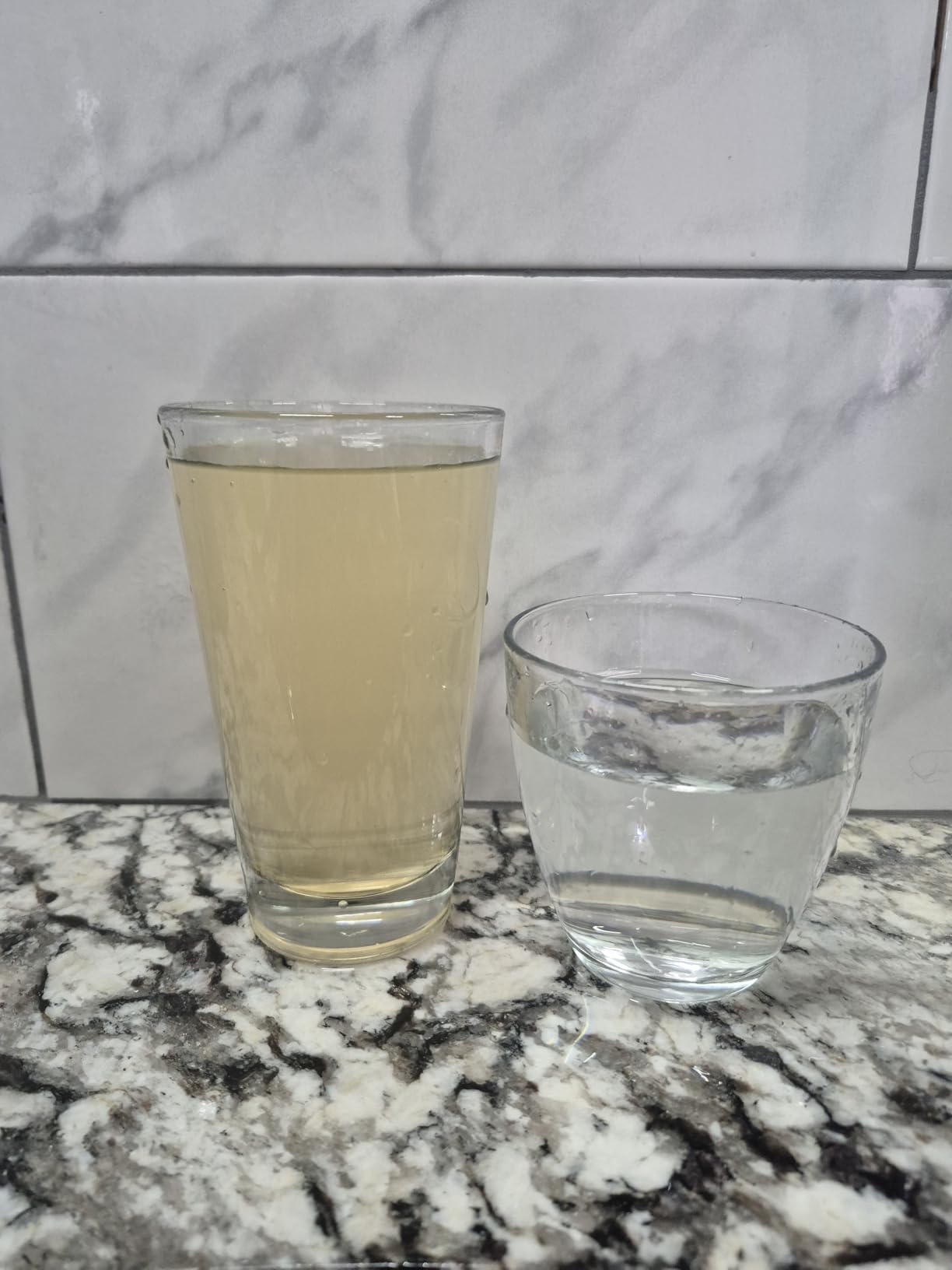
There is no published ppm ceiling anywhere in the specification, and that is the weakness. Buyers who filter out claims without numbers are right to do so on this one. Without a stated iron or hydrogen sulfide capacity you cannot tell whether the resin is oversized for your well or will channel within a year.
It does not reduce TDS, and at 10 GPM it has the lowest flow rating among the tank-based systems in this roundup. Homes with four or more bathrooms are the stated target, and in a house where two showers and a laundry cycle overlap, that ceiling is felt.
How much of a headache is the automatic control?
Owners who stay with it consistently name the digital controller as the reason maintenance stops being a chore. It removes the mental load of remembering to flush and lets you push backwash timing to match a heavier sediment period.
Several buyers describe a longer learning curve than expected on the programming, so expect an afternoon with the manual before it runs the way you want. It is programmable rather than self-learning, which means it does not adapt to seasonal changes on its own.
Who should choose this over a cartridge system?
Choose it if you do not want to schedule cartridge changes or you have had a cartridge system foul up repeatedly. Backwashing media suits sustained iron load better than replaceable resin because it regenerates instead of exhausting.
Pass on it if your mechanical space cannot spare 57 inches of vertical clearance, or if you need more than 10 GPM. Also weigh the 4.1 rating with a 13% one-star share, the widest spread of any unit here, against the fact that its review count sits near the middle of this group.
5. PUREPLUS FHN10BB Review: Best Budget Single-Stage Whole House Filter
PUREPLUS 1-Stage Whole House Water Filter System, Iron & Manganese Reduce
Flow: point-of-entry single stage
Housing: 10 x 4.5 inch
Cartridge: PPW10BB-SZ iron resin
TDS: up to 1000 ppm
Pros
- Lowest cost point-of-entry unit in the roundup
- PPW10BB-SZ cartridge cuts up to 99% of sand silt rust dirt and scale
- Brass threaded junction seals better than plastic threads
- Pressure gauge and release valve included
- Universal housing fits standard cartridges
Cons
- Single stage means no carbon polishing for taste or chlorine
- No redundancy so the house runs unfiltered during changes
- Some listings arrive with a damaged housing
Sometimes a well needs less than you think. If your lab report shows modest iron and ordinary sediment and nothing else, this single-housing unit gets the water noticeably better for a fraction of what a multi-stage system costs, and the included hardware means nothing extra needs buying.
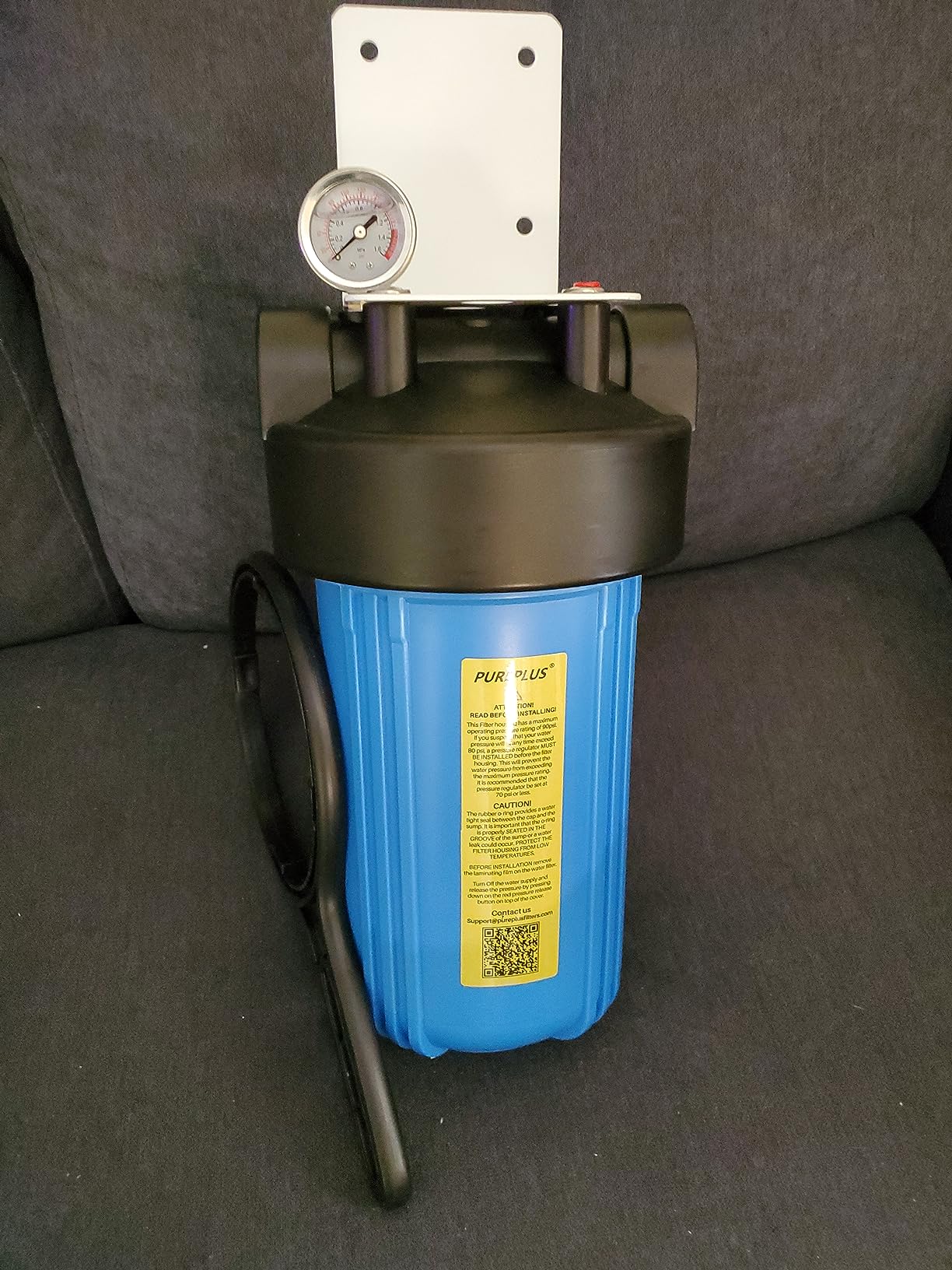
The PPW10BB-SZ cartridge is an iron and manganese reducing resin built for well water, rated to cut up to 99% of sand, silt, rust, dirt and scale. The housing is food-grade polypropylene with a brass threaded junction rather than plastic threads, and it comes with a steel mounting bracket, wrench, screws, O-rings, a pressure gauge and a red pressure release valve for fast cartridge swaps.
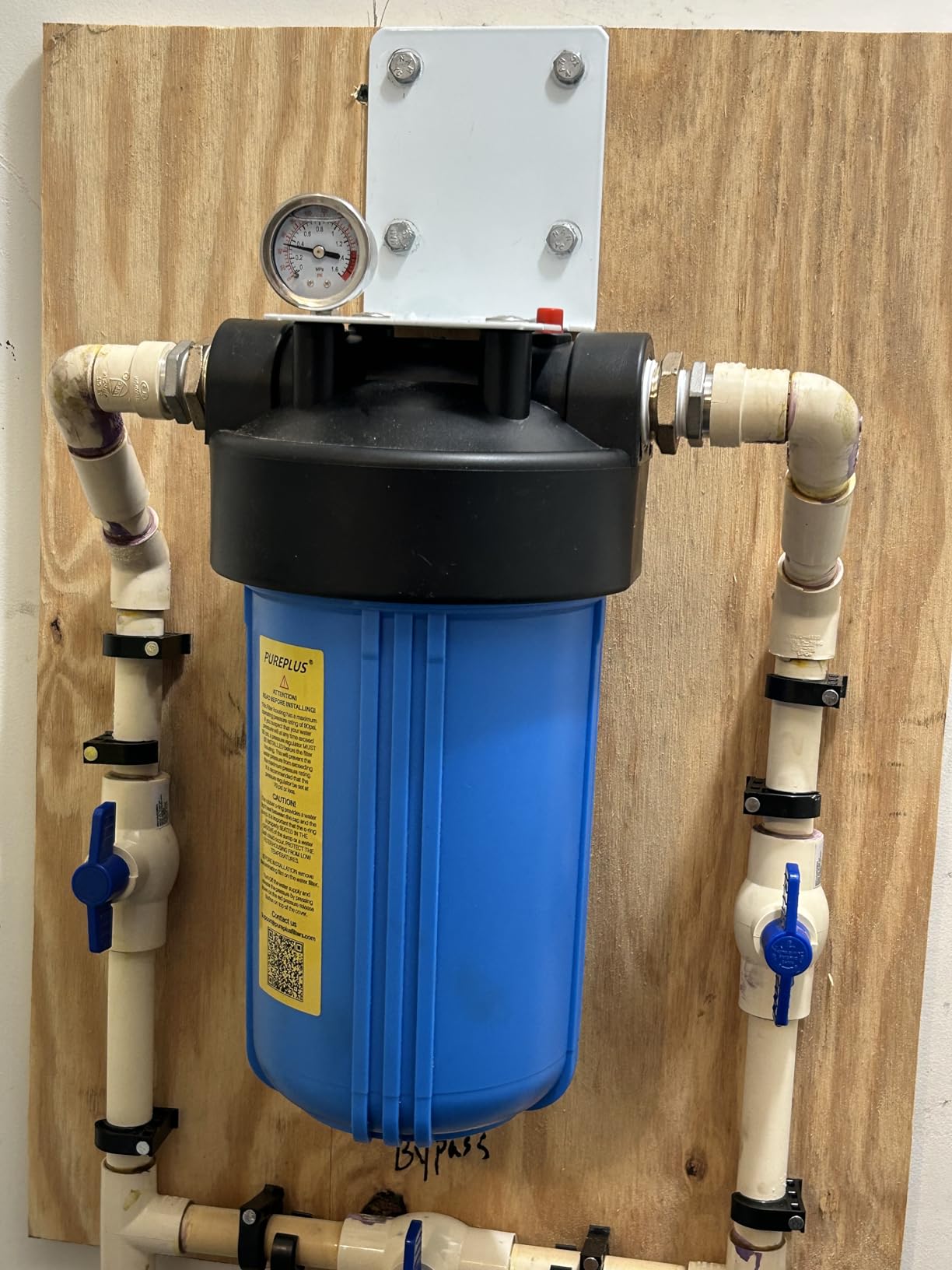
The limitation is structural rather than fixable. One stage means no carbon stage, so chlorine taste, VOCs and general odor pass through untouched. On a well that already tastes fine but stains orange, that is a good trade. On a well with a taste problem, you will be buying a second housing later anyway.
There is also no redundancy. While you change the cartridge the entire house runs on unfiltered water, and the universal 10 by 4.5 inch housing accepts standard sediment, carbon, pleated and CTO cartridges from other brands, so adding a second stage later is straightforward. A minority of buyers report housings arriving damaged or leaking out of the box, and replacement O-rings are a non-standard size.
Is one housing enough for a family?
For a household using a few hundred gallons a day on a well with light iron, yes, and owners report running these for years. The 1000 ppm TDS ceiling is the highest in the group apart from the Home Master, so the constraint is not what is dissolved but what is precipitating.
Watch the change interval rather than a calendar. The clear bowl and included pressure gauge make it easy to see when the media is loaded, and pressure drop across the gauge is a more reliable trigger than any fixed schedule.
What are the honest reasons to pass?
Pass if you have any sulfur smell, since a sediment and iron cartridge will not touch hydrogen sulfide. Pass if a lab test showed coliform, because nothing here disinfects.
Also pass if you are not comfortable with a no-redundancy setup. Some buyers add a bypass loop during install to solve that, and the housing’s universal fit makes a second stage easy to bolt on later.
6. HQUA WF3-01 3-Stage Filter Review: Best for Heavy Metals
HQUA WF3-01 3-Stage Whole House Water Filtration System, Reduces Heavy Metals (Lead, Mercury, Arsenic, Cadmium, Chromium), Chlorine, Sediment, Odor, and VOC’s
Flow: 15 gpm
Capacity: 100000 gal
Stages: sediment plus GAC and KDF plus carbon
Pressure: 25-116 psi
Pros
- GAC and KDF stage targets lead mercury arsenic cadmium and chromium
- Brass threaded ports instead of leak-prone plastic
- Oil-filled gauges on every housing show which stage is loading
- Per-housing drain and relief valves allow staged servicing
- Filter life timers and maintenance card included
Cons
- Leaks at threaded connections persist even with tape and dope
- Manual shows one O-ring when each housing needs two
- Bulky 22 x 9.5 x 28 inch assembly
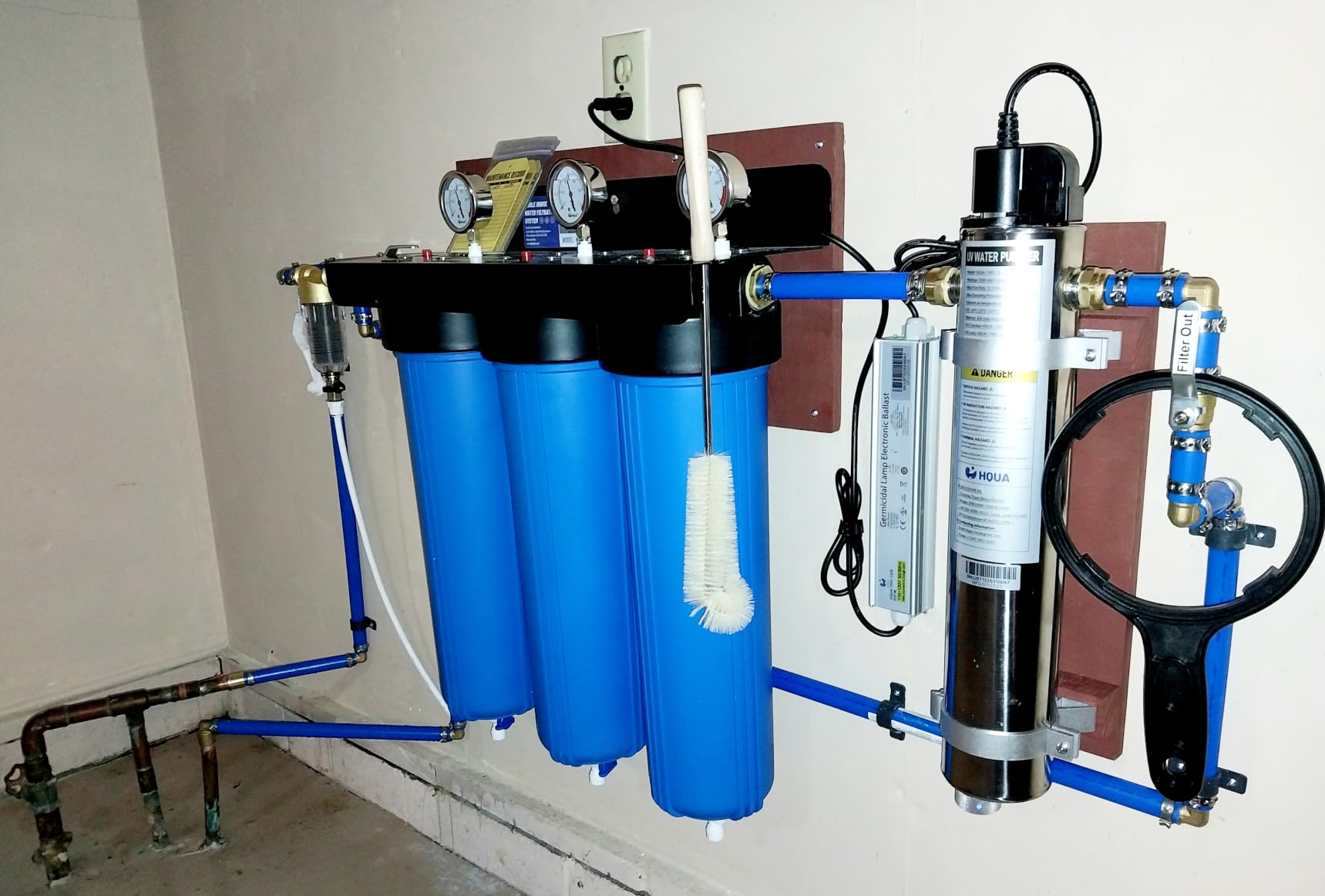
This is the one to look at if arsenic, lead or other metals appear on your lab report, because the middle stage is a compound GAC and KDF media bed rather than plain carbon. The chain runs 25-10-5-1 micron sediment first, then the heavy metals stage, then a carbon block for chlorine, odor and VOCs.
Three 20 by 5.5 inch Big Blue housings give it 15 GPM and a 100000 gallon capacity with room to handle 500 ppm TDS, and the reversible flow direction plus included adapters let you convert inlet and outlet to 3/4 inch or 1 inch NPT depending on your line size. Owners on well water report the sulfur odor disappearing and a real taste improvement soon after install.
It will not remove iron or manganese as a primary function, and it does not disinfect. Arsenic and metal removal is the specialty here, and the sediment stage in front is protecting the GAC and KDF bed from blinding rather than treating dissolved iron.
If your well has visible iron staining, put a sediment pre-filter ahead of this assembly rather than behind it. The carbon stages in this unit are not designed to hold precipitated iron, and fouling them is the fastest way to shorten cartridge life dramatically.
Why do owners keep mentioning the O-rings?
Each housing needs two O-rings, one at the cap seal and one at the base, and the printed instructions show only one. Several owners discovered the second on their own during a first service and treated it as a defect in the product rather than the manual, which is a fair complaint about the documentation.
Spare gaskets and a silicone lubricant are included in the box, and a long housing cleaning brush comes with the kit. Keep the spares, because the housing seals are consumables and the included 180-day countdown timers only cover the first change cycle.
Is the threaded port design actually better?
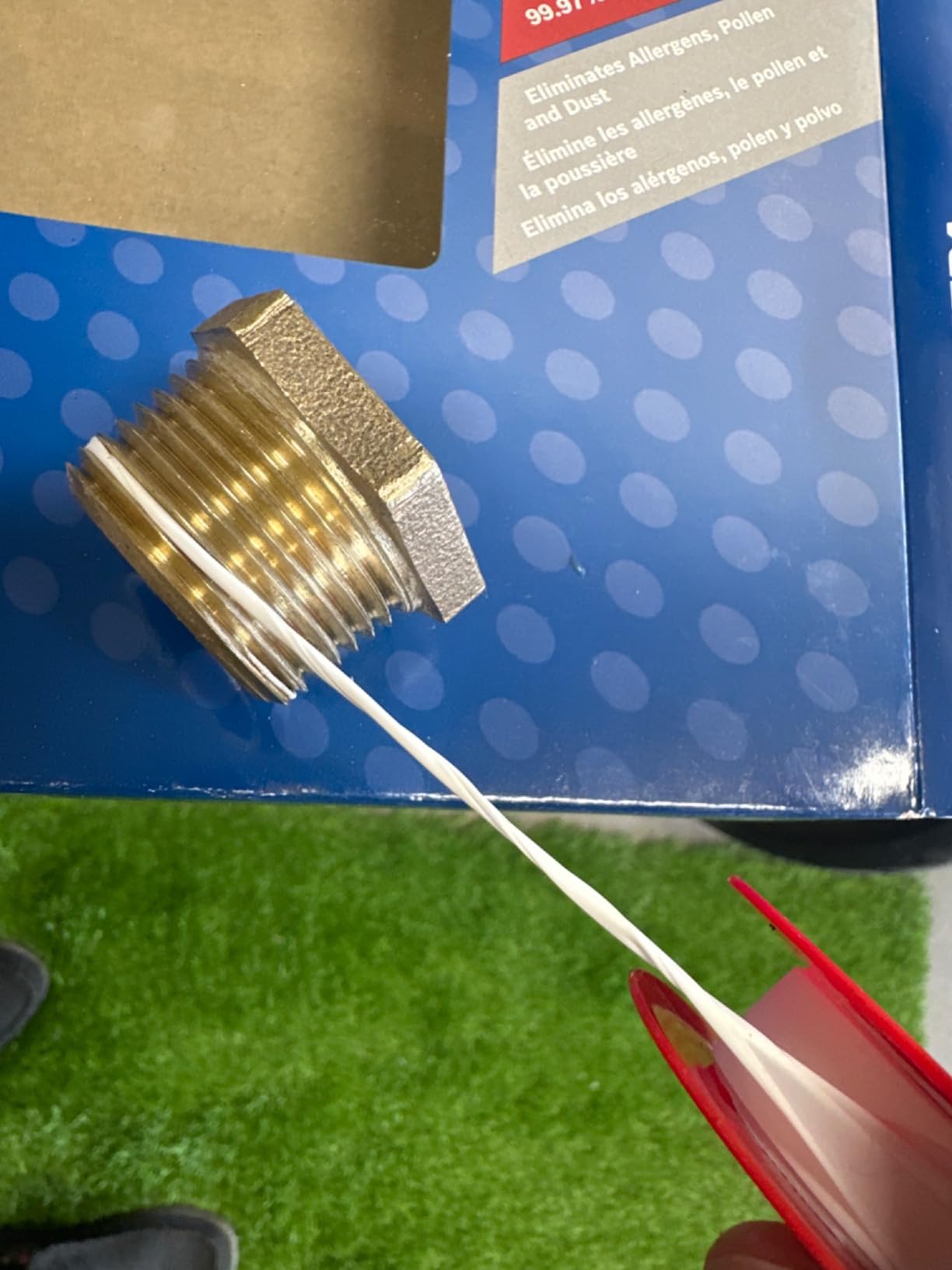
Brass is the right material here, and it is the reason we recommend this unit over plastic-threaded competitors for anyone doing a permanent install. The trouble is the leak reports: some owners fought repeated drips at the connections with both PTFE tape and pipe dope.
Several resolved it permanently by crimping brass or PEX instead of using the supplied plastic fittings. The 25 to 116 psi operating range also means high line pressure pushes against those threads harder, so check your household pressure before mounting.
7. Home Master HMF3SdgFeC Review: Best for Iron and Sediment Together
Home Master Whole House Three Stage Water Filtration System with Fine Sediment, Iron and Carbon, Blue
Flow: 15 gpm
Iron and manganese and sulfur: 3 ppm combined
TDS: up to 2000 ppm
Warranty: 2 years parts
Pros
- Engineered specifically for well water
- Handles up to 3 ppm combined iron manganese and sulfur
- Four-layer 25-10-5-1 micron sediment cartridge
- Highest TDS ceiling here at 2000 ppm
- Long owners publish detailed maintenance playbooks
Cons
- Sediment cartridge can load in as little as 2.5 months on hard wells
- Plastic threads can leak or melt if soldered near
- Warranty claims need inspection by a certified plumber at buyer cost
The Home Master is the most explicitly well-focused unit in this roundup, and its rating of 4.4 across 207 reviews comes from a specific group: owners on high-iron wells who saw measurable results. The claim is 95% removal of iron, manganese and sediment plus taste and odor chemicals, with a combined load ceiling of 3 ppm across iron, manganese and sulfur.
The fourth stage is a four-layer 25-10-5-1 micron replaceable sediment cartridge, which is finer than most rivals use and gives noticeably better dirt holding. Oversize housings with 1-inch ports sustain 15 GPM with consistent pressure, and the 2000 ppm TDS ceiling is the highest here by a factor of four, which matters on saline or coastal wells.
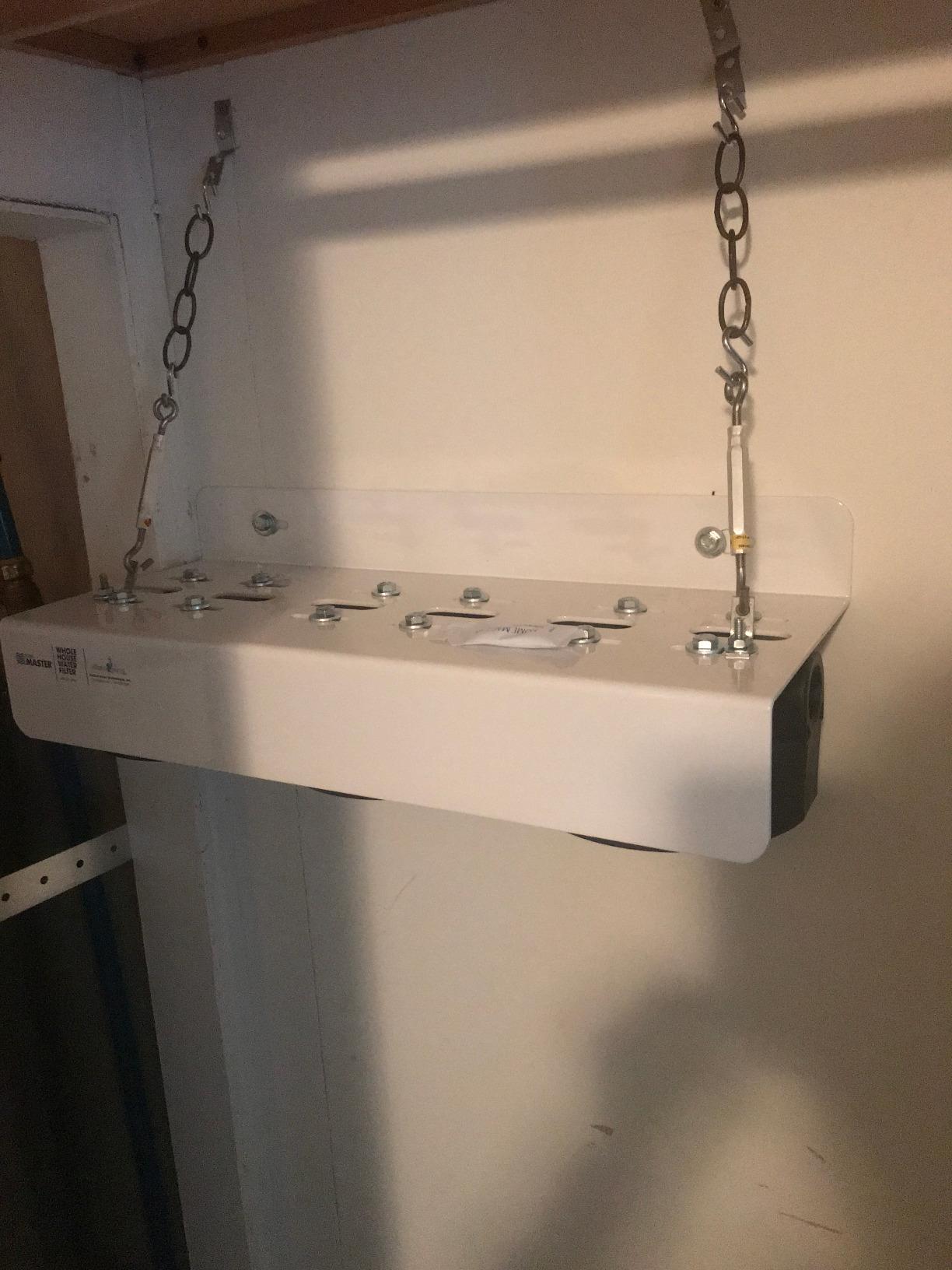
It does not disinfect, and a cartridge system cannot be backwashed. That is the central limitation on a well with sustained iron, because replaceable resin exhausts and has to be swapped on a schedule that tightens as the load rises. Several owners report the sediment cartridge loading in as little as 2.5 months on very hard well water, which is well short of any annual estimate.
It will not address hydrogen sulfide at meaningful levels, and the plastic threads on the copper fittings can leak or melt if a torch comes close during the install. Long-term owners on this unit converge on the same playbook: a separate pre-sediment filter, gauges on both sides, a bypass loop and spare O-rings kept on hand.
How much does maintenance reality differ from the label?
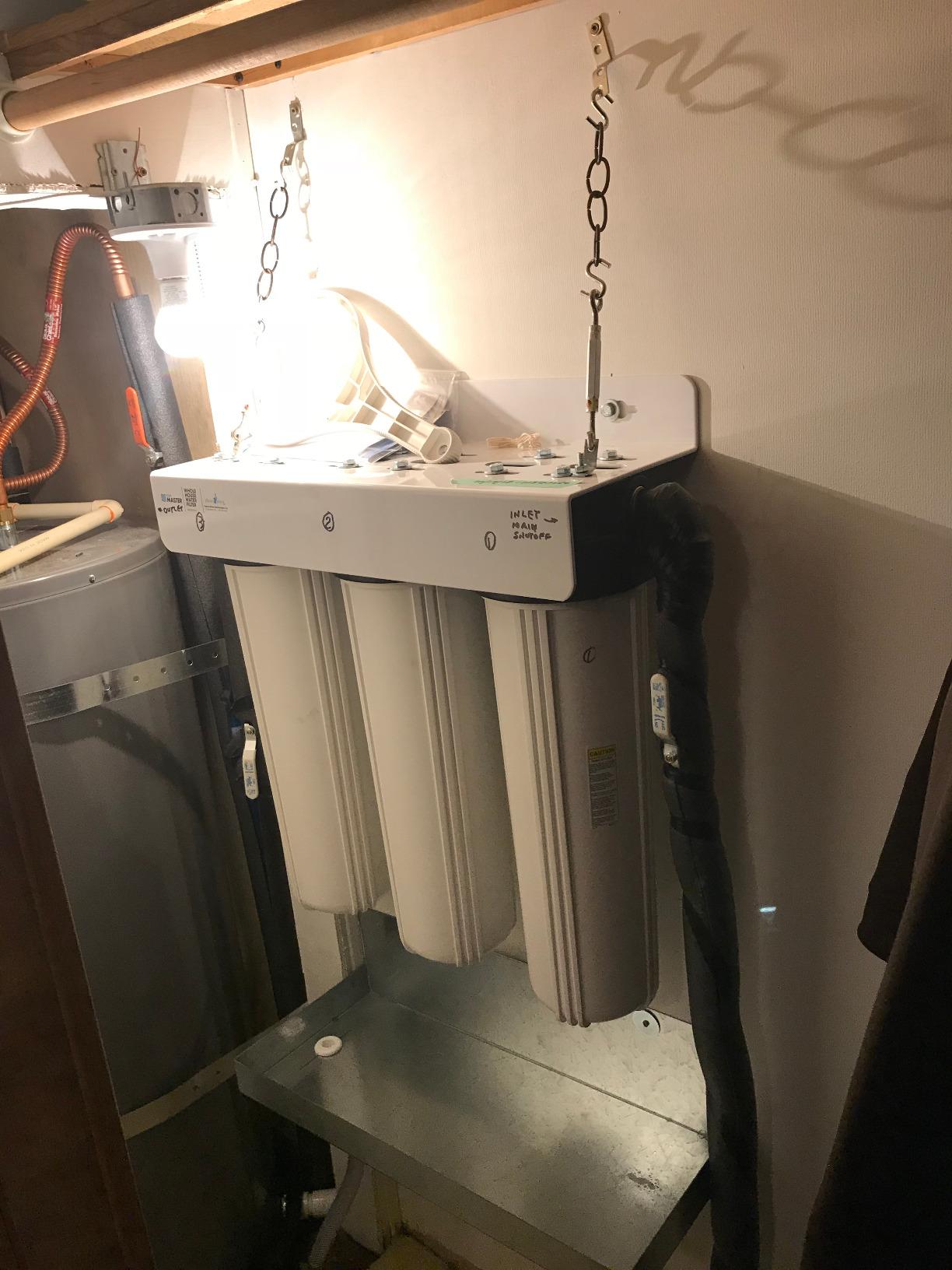
More than most labels suggest on a hard well. The 100000 gallon capacity assumes a moderate load, and owners with iron-heavy water measure change frequency by pressure drop rather than by calendar, which can mean three or four changes a year rather than one.
The O-rings are the other recurring maintenance item. They lose diameter after use and can pop out of the housing groove, so owners who keep a spare set and lubricate them report far fewer nuisance leaks. Budget for a full day of PVC work if you are installing this yourself.
What should you check before ordering?
Measure the clearance first, because the assembly is 24 by 9 by 27 inches and 48 pounds, and it needs solid mounting rather than drywall anchors. The 20-95 psi operating range covers most homes comfortably.
Then read your lab report against the 3 ppm combined ceiling. Above that number, this unit is the wrong tool, and a backwashing oxidation tank will outlast it by years. Also note that warranty claims require an inspection by a Home Master certified plumber at the buyer’s expense, which is a real cost to factor in.
8. iSpring WCB32CKS Review: Best for PFAS and Radon Coverage
iSpring Heavy Metals Whole House Water Filter System w/Clear Housing
Flow: 12 gpm
Capacity: 30000 gal
Stage 2: GAC and KDF composite
Ports: 3/4 inch
Pros
- GAC and KDF composite targets PFAS lead radon chloramine and H2S
- Transparent first stage shows sediment loading at a glance
- Lightest 3-stage unit here at 21.5 pounds
- Users report longer softener resin life when installed ahead of it
Cons
- Threaded female housing connections leak even with heavy tape
- Smallest capacity of the multi-stage systems at 30000 gallons
- 12 GPM is modest for larger homes
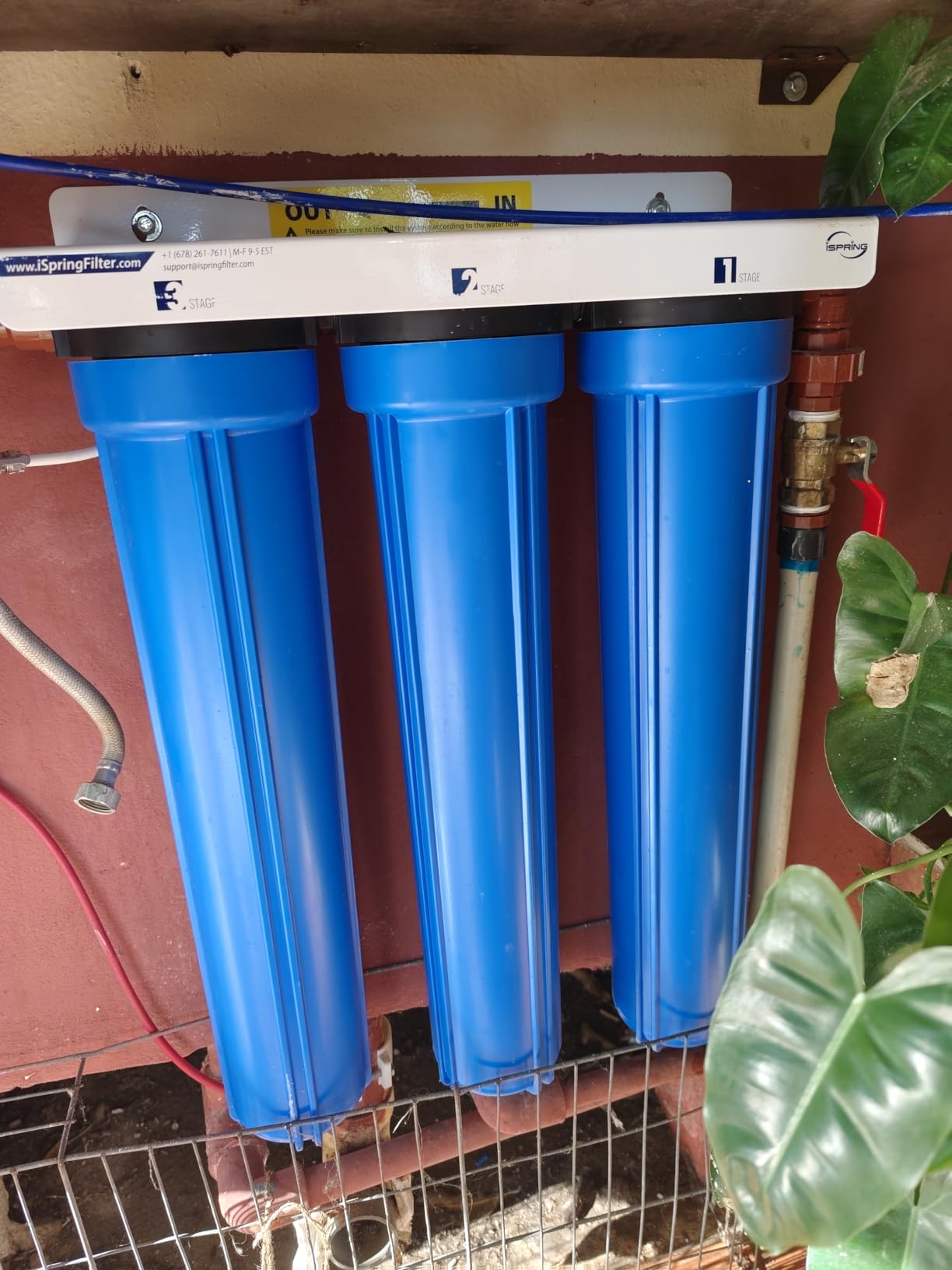
This is the unit to consider when your concern is emerging contaminants rather than rust. The second stage is a GAC and KDF composite rated against lead, PFAS, radon, chloramine and hydrogen sulfide, which is a broader claim list than any other cartridge in this roundup makes.
The chain is sensible: a 5-micron polypropylene sediment stage to protect the downstream media, the GAC and KDF composite in the middle, and a CTO carbon block at the end for residual chlorine, fine impurities and lingering odors. The first housing is transparent, so you can see exactly when the sediment filter needs changing rather than guessing from a gauge reading.
Understand what this is not. It is not a substitute for a certified point-of-use reverse osmosis system when PFAS is the specific concern, because 30000 gallons of capacity across the whole house dilutes any point-of-use benefit enormously. It is a broad reduction system, and a lab test after install is the only way to know how much it actually removed.
It will not remove iron or manganese as a designed function either, and the 30000 gallon capacity is the smallest here, which works out to roughly six months for a family of four rather than a full year. The 3/4 inch ports mean extra fittings if your supply line is 1 inch.
Should it go before or after a water softener?
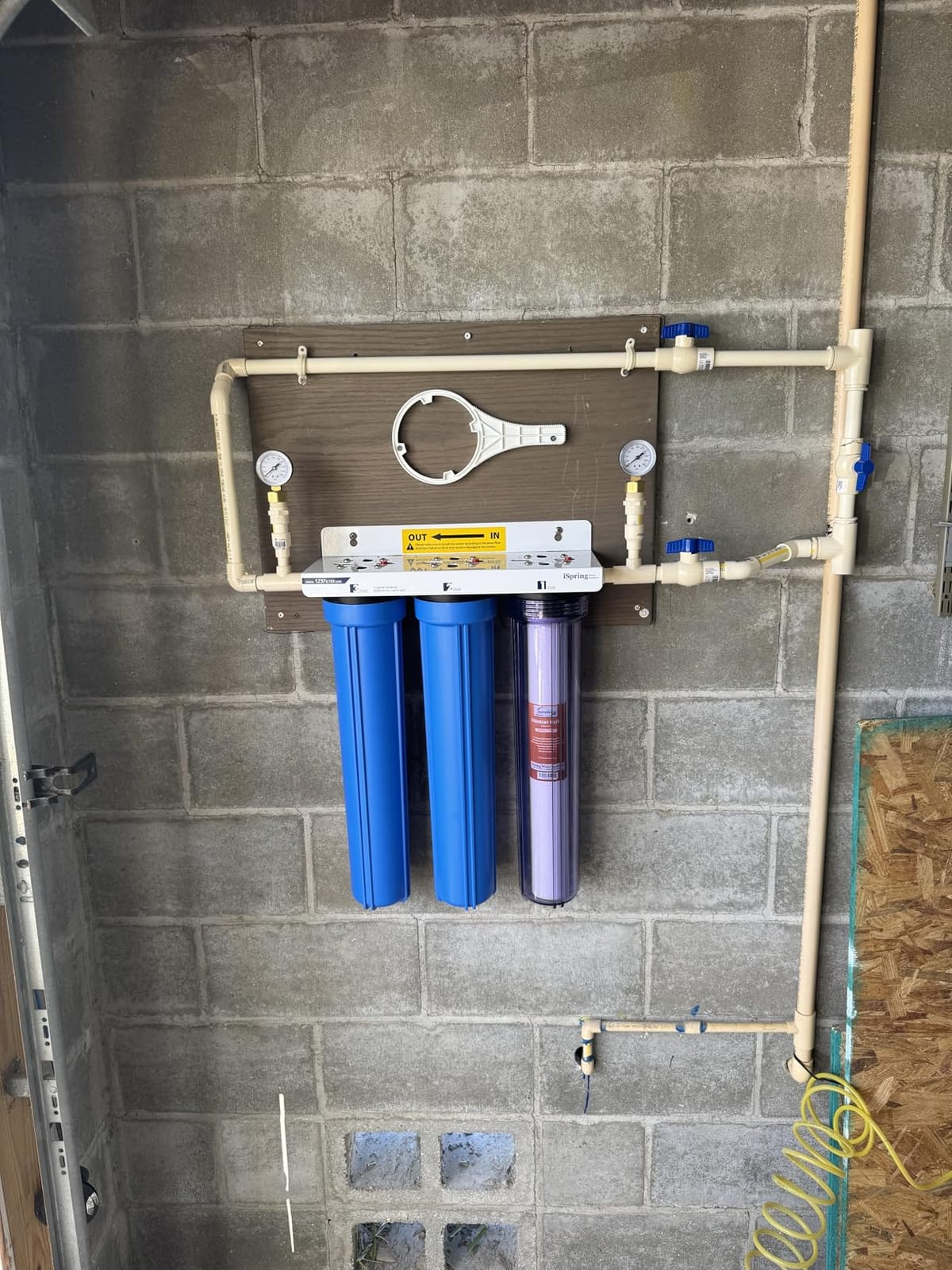
Before. Owners running this system ahead of their softener report noticeably longer resin life, because the sediment and carbon stages catch the particulate that would otherwise foul the softener resin bed. Getting the order wrong is what produces brown water shortly after install.
The rule generalizes: pre-filtration first, then the stage that addresses your primary contaminant, then the softener or conditioner, then disinfection last if you need it. Any stage placed downstream of another is working on water that is already cleaner.
How do I deal with the leak complaints?
The threaded female housing connections are the dominant complaint across reviews, with owners reporting repeated attempts using triple-thick PTFE tape and pipe dope. Most of those reviewers still end up at five stars because iSpring replaced the head unit or the parts at no charge.
At 21.5 pounds this is the lightest three-stage system here, which makes it far easier to mount and service than the 45 to 49 pound units. Plan on adding a small hose bib for draining if the supplied relief valves do not release pressure cleanly.
9. iFilters MWH-D20-WELL Review: Best Reusable Pre-Filter for Well Water
iFilters 4.5 x 20 Sediment CTO Heavy Metals Well Water Filtration System
Housing: 4.5 x 20 inch x2
Stage 1: washable pleated sediment
Stage 2: GAC and KDF
Cartridge: SP30-KDF2-4520
Pros
- Washable anti-bacterial pleated pre-filter can be rinsed and reused
- Pleated surface area holds strong flow on sediment-heavy wells
- GAC and KDF second cartridge combines two stages in one housing
- Commercial grade housings with 1 inch ports
- Up to 100000 gallon capacity
Cons
- Amazon flow field lists 1 gpm so sizing needs care
- Factory close nipple between stages can arrive untightened
- O-ring replacement response was slow in one case
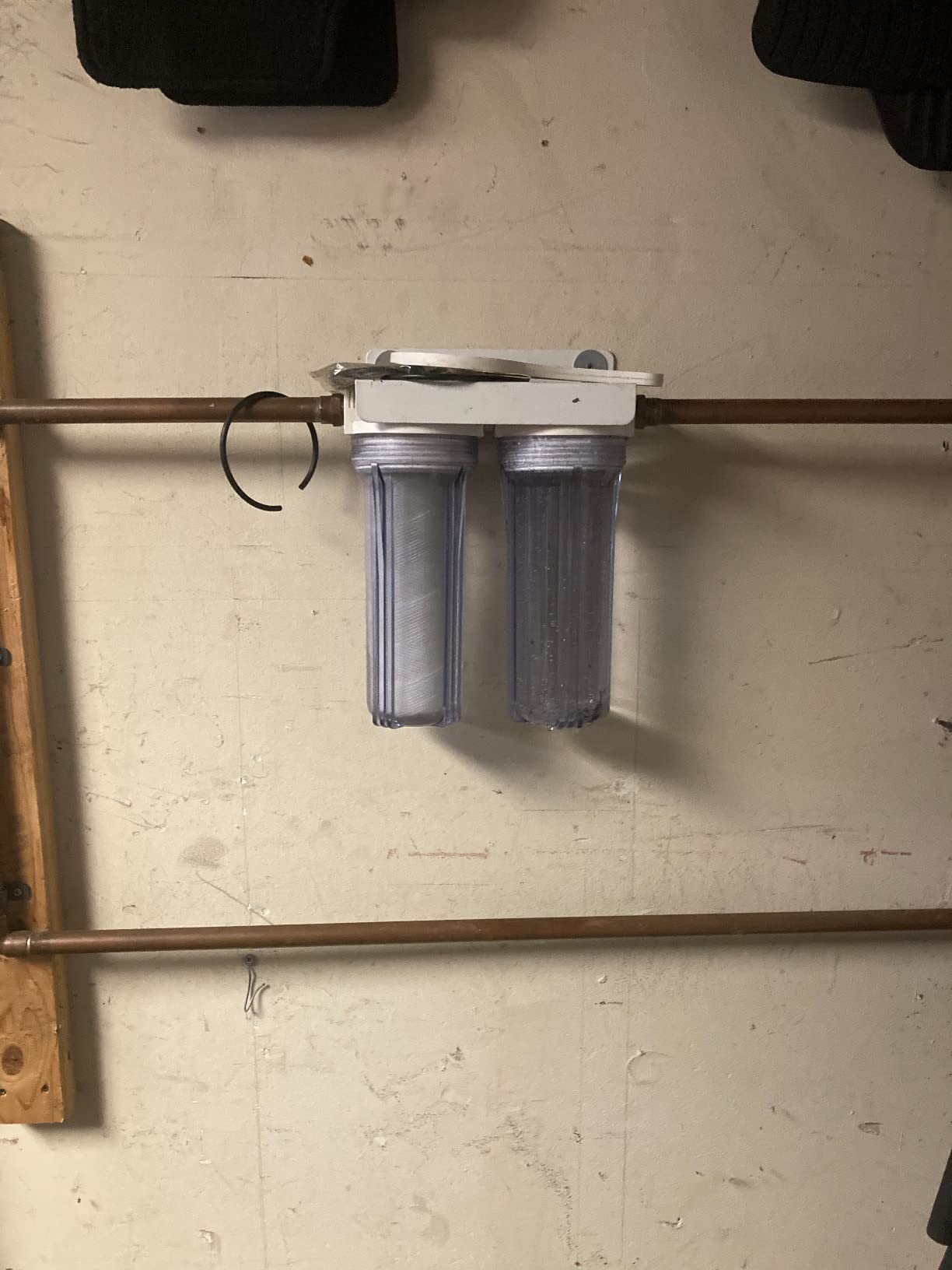
The iFilters is built around an idea the other cartridge units skip: make the first stage reusable. The 4.5 by 20 pleated pre-filter is washable and anti-bacterial, so you rinse it and put it back instead of buying a replacement every few months. On a well where sediment is the main wear item, that changes the long-term cost calculation.
The second housing holds a GAC and KDF cartridge that combines two filtration functions in one body, handling chlorine taste and odor, VOCs, iron, sulfur and heavy metals. The 4.5 by 20 commercial grade housings have 1-inch ports, and the powder coated white mounting bracket is a small quality touch that several owners single out.
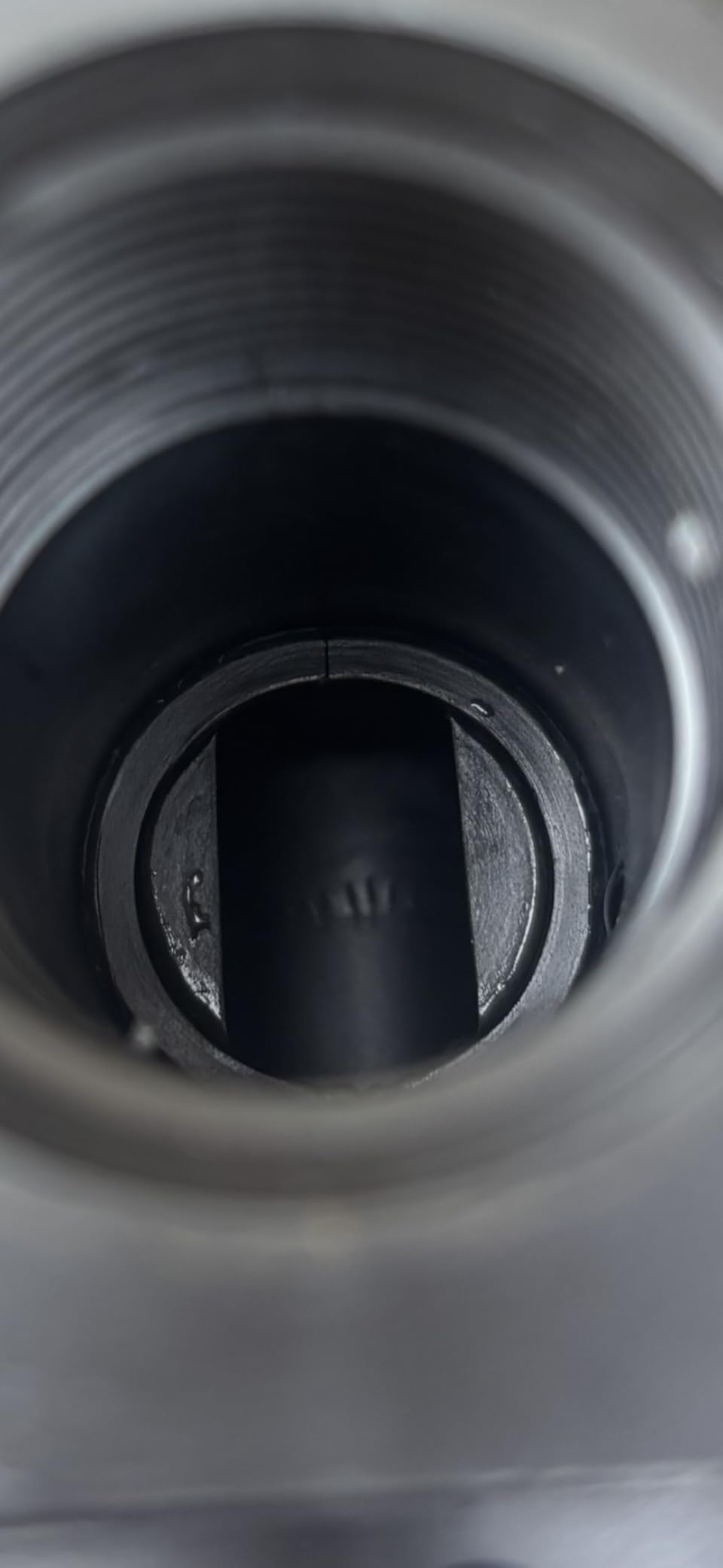
Owners on iron and sulfur wells report the transition from orange, odorous water to clear and clean after about 20 gallons of flush, which is a real result. But one review reports persistent orange staining on fixtures and landscaping four weeks after install, so the treatment should be verified with a follow-up test rather than assumed.
The flow rating published on the Amazon listing is 1 gpm, which is far below what the 4.5 by 20 housings and 1-inch ports would physically support. Treat that number as a data error and size from the port size and housing capacity, but confirm with the manufacturer if peak household flow matters to your decision.
What does the reusable stage actually save?
It removes the most frequent expense in a cartridge system. Owners on sediment-heavy wells report rinsing the pleated element and getting more service out of it than a disposable cartridge would have delivered, and the 300 ppm TDS ceiling and 12-month life cycle are stated in the specs.
The second cartridge is a consumable and the replacement part is the iFilters SP30-KDF2-4520, so model that cost separately rather than assuming the whole system is maintenance-free. One owner reported a slow O-ring replacement response that required a local plumbing store run, so keep spares.
Is it right for a two-bathroom home?
The housing footprint of 4.5 by 4.5 by 20 inches per stage is compact, which makes this an easy unit to fit in a tight mechanical room where a 22-inch-wide three-stage assembly will not go. At 27.8 pounds it is manageable to service solo.
One practical check before you order: inspect the close nipple between the two stages on arrival. A factory fitting that shipped loose caused a drip in at least one report, and it takes thirty seconds with a wrench to confirm it is tight before you close the wall.
10. Waterdrop WD-WHF3T-FG Review: Best Certified Iron Reduction
Waterdrop WHF3T-FG 3-Stage Whole House Water Filter System for Well Water
Flow: 15 gpm
Capacity: 100000 gal
SGS tested: 95.9% iron
Certification: NSF/ANSI 372 lead-free
Pros
- Only unit here with published SGS figures for iron and manganese
- NSF/ANSI 372 certified for lead-free materials
- Passed 100000 plus water hammer tests
- 15 GPM steady flow on 1 inch ports
- Iron and manganese cartridges rated 6-12 months
Cons
- Smallest review base here at 88 ratings
- 49 pounds needs solid mounting
- 37.8 degrees C upper temperature rating is the lowest listed
- Two stages go to the same contaminant pair
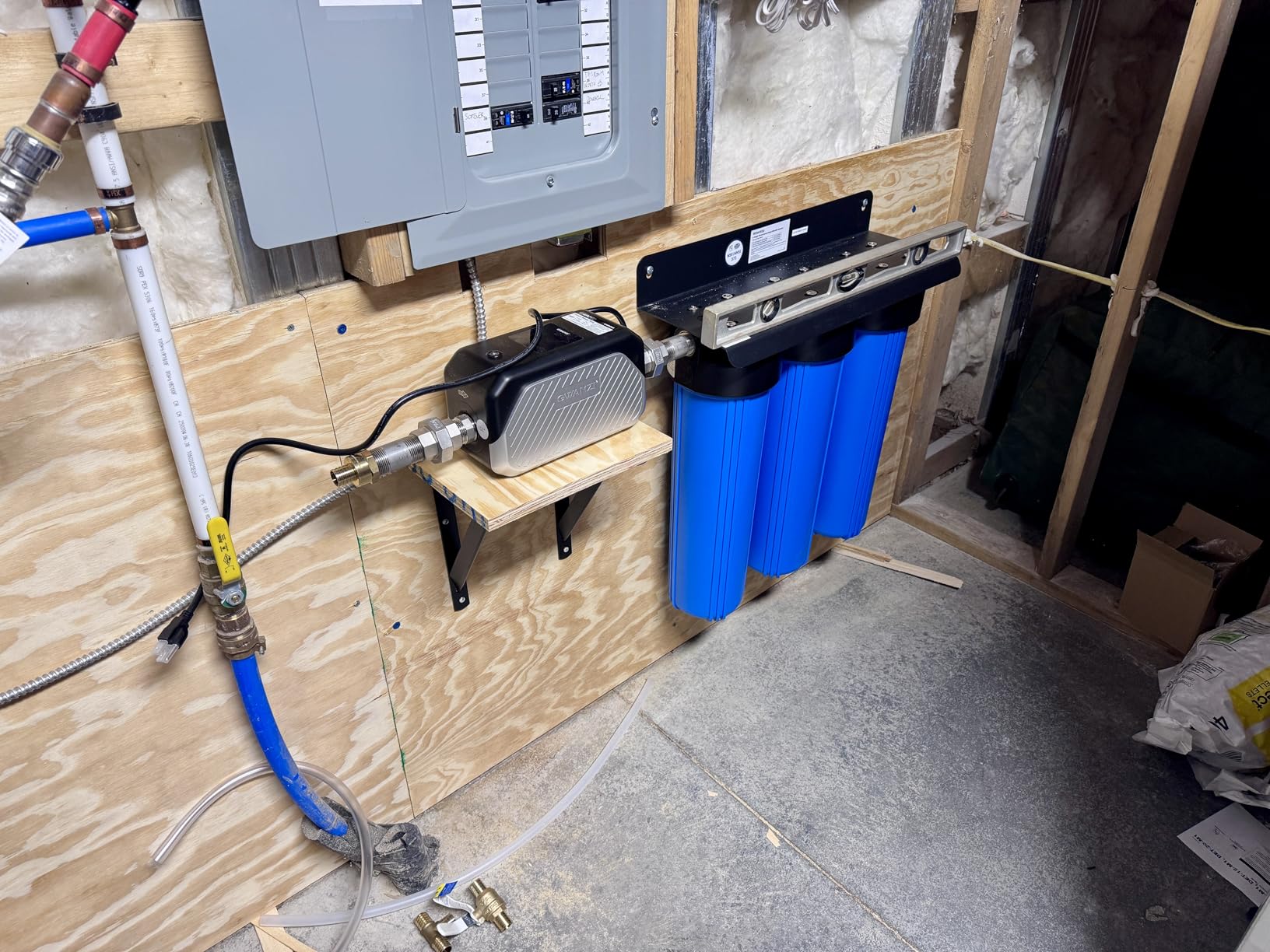
The Waterdrop is the only system here with independent third-party performance numbers rather than a manufacturer’s claim. SGS testing reports 95.9% iron reduction and 99.7% manganese reduction, and that published figure is the reason this unit is on the list despite having the smallest review base in the group.
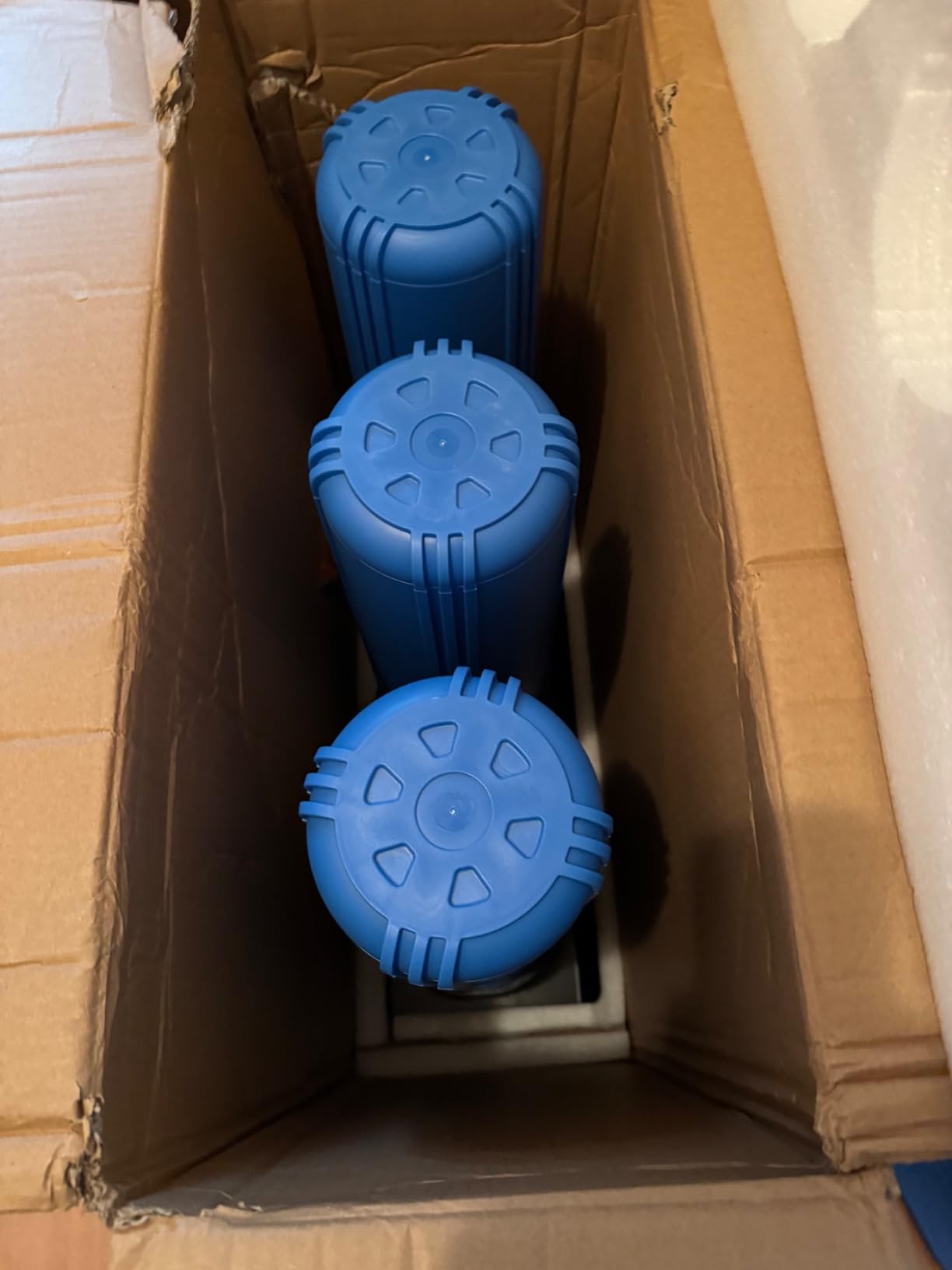
Inside three housings you get a seven-stage filtration chain: dual iron and manganese cartridges and a carbon fiber filter, all in 20-inch housings with 1-inch ports. It holds 15 GPM steady flow and protects downstream appliances from scale and blockage, and it works on both well and municipal supplies.
Two of the three stages are dedicated to the same contaminant pair, iron and manganese, which leaves less capacity for chlorine and sediment polishing than rivals with the same number of housings. On a well where sediment and taste are also problems, budget for a separate pre-filter upstream.
The 300 ppm TDS ceiling and 37.8 °C upper temperature rating are the tightest limits in the roundup, and the latter matters if your wellhead is exposed in a hot climate. With 88 ratings, long-term durability is less well documented than for the other nine systems.
Does the SGS testing change the buying decision?
It should carry real weight. An independent reduction figure is the single most useful piece of evidence a well owner can get, because it removes the guesswork from the most common complaint about cartridge systems, which is that they fall short of their rated capacity on real water.
The NSF/ANSI 372 lead-free certification and 100000-plus water hammer tests are the other differentiators. Certification to 372 verifies the materials themselves are lead-free, which matters on any plumbing where the filter is the first component after the pump.
What should you watch after install?
Watch the change interval rather than the calendar. The iron and manganese cartridges are rated 6 to 12 months and the GAC filter about 12 months, but on a heavy well the iron cartridges will give out first and you will need to swap them sooner.
Because the review base is small, plan to test your water about a month after install. If the staining has not moved, the cartridges are not rated for your iron load and you need an oxidation tank instead of another cartridge change.
What Your Well Water Test Has to Show?
You cannot pick a filter without a lab report, and the specific tests you order matter as much as the results. A basic well panel should include total coliform and E. coli, iron, manganese, copper, zinc, pH, alkalinity, total hardness, total dissolved solids, nitrates, arsenic, lead and hydrogen sulfide. Ask whether the lab is certified for the state you live in, and sample at the cold tap after letting the line run, not from a hose bib.
Match the symptom to the cause before you shop. Orange staining in a toilet tank or on a soap dish points to iron. Black or dark brown staining on fixtures points to manganese. A rotten egg smell that gets worse when a tap has been unused points to hydrogen sulfide. Cloudy water that clears after a minute points to sediment. A gray film on a glass and scale on the kettle head point to hardness.
Two symptoms overlap in ways that confuse people. Sulfur smell plus reddish slime in the toilet tank is not simply a sulfur problem, it is a strong sign of sulfur bacteria, and that changes your plan entirely. Similarly, metallic taste with no visible staining can be iron below the level that discolors fixtures, and a test is the only way to know.
Test results also move. A wet year or a dry year changes the water table, which changes how much sediment and how much iron your well delivers, and treatment sized on a high-water-table result can be oversized in a dry year and undersized in a wet one. Re-test every few years and after any major change in your landscape or well use.
What Whole House Filters Cannot Do
No system in this roundup lowers total dissolved solids, and that is by design rather than a defect. Filters remove suspended and particle-bound contaminants, while dissolved salts pass straight through. If your concern is TDS, the answer is a point-of-use reverse osmosis system, not a whole house filter.
Nitrates are the same story. They are dissolved ions, so they pass through carbon, KDF and sediment media untouched, and treating them properly needs ion exchange or reverse osmosis at the tap. Arsenic has a similar caveat: the KDF stages in two systems here are rated against it, but a dedicated certified system is the more reliable route if arsenic appears on your report.
Iron bacteria are the failure mode that quietly defeats otherwise good equipment. These bacteria form a slime that coats media, plugs housings and produces that reddish film, and no amount of filtration capacity overcomes a biofilm coating. The fix is disinfection of the well itself, not a bigger filter.
Also worth saying plainly: a whole house filter does not make municipal-grade safety guarantees, and none of these units stops everything. They address a defined list of contaminants within a defined range. Anything beyond that range, and anything requiring a laboratory confirmation, belongs to a system designed specifically for that contaminant.
Buying Guide: How to Size and Sequence a Well Water System
Flow rate is the first number to get right, and the useful figure is not the one printed on the box. It is the flow your well can actually deliver during peak demand, because a backwashing media tank needs a specific backwash flow rate to clean itself, and a well that cannot supply it will never recover between cycles.
As a rough starting point, a one to two bathroom home needs about 5 to 8 GPM, three to four bathrooms needs 8 to 12 GPM, and five or more bathrooms or a home with irrigation needs 12 GPM or more. Measure it rather than assume it, because a well drilled into a low-yield formation may not deliver its rated capacity under load.
Next, decide between a cartridge system and a backwashing tank. Cartridges are cheaper, simpler and quiet, and they work well on light sediment and low iron. Tanks are larger, need a drain line and a control valve, and they are the right choice for sustained iron load, hydrogen sulfide or any situation where you do not want to open a housing twice a year.
Order of operations matters more than most buyers expect. The universal sequence is: spin-down or sediment pre-filter, then the carbon stage, then the iron or oxidation stage, then a softener or conditioner, and disinfection last. Putting a sediment stage after an iron stage defeats the purpose of both, because precipitated iron then blinds the sediment cartridge.
If you need more than one function, count the housings you have rather than the functions you want. A three-stage system in which two stages are dedicated to iron and manganese has one stage left for everything else, which is why the two-stage iSpring above can be paired with the three-stage unit behind it and cost less than a single bespoke stack.
Finally, be honest about maintenance. Tank systems ask for a drain line and periodic backwashing. Cartridge systems ask for a wrench and a schedule. UV systems add an annual lamp change and an electrical outlet. Choosing a system you will actually service beats choosing a slightly better one you will leave running past breakthrough.
For households comparing against a broader shortlist or weighing a point-of-use alternative, our whole house water filter guide covers the hardware categories and the certification standards in more depth.
Iron Bacteria: Shock Chlorinate Before You Install Anything
If your well shows iron bacteria, the order of operations is not optional. Shock chlorinating the well before installing any iron filter kills the organisms in the formation and in the casing, and it is the only step that stops them from recolonizing new media within months.
The symptoms are specific enough to diagnose. Look for a reddish or orange slime in the toilet tank, a viscous film on shower heads and faucet aerators that feels slippery rather than merely stained, and staining that returns within days of cleaning. Ordinary iron bacteria produce staining that wipes off; slime does not.
The mistake we see repeatedly is installing an oxidation tank first and treating the odor with a chemical feed afterward. The media then becomes a substrate, the biofilm grows through the tank, and within a year the system fouls so badly that media replacement costs more than the original install.
Shocking is a straightforward procedure but it is disruptive, and it needs to happen on a schedule rather than once. Most households in this situation work with a treatment professional to set an annual or biennial program, because the alternative is replacing filter media on a schedule that gets shorter every year.
Installation: DIY or Professional
Most of the cartridge systems here are genuinely within reach of a competent DIYer. They cut into the main line, need a bypass or shutoff for service, and require careful PTFE taping on threaded connections. The recurring theme in owner reviews is that sealing, not plumbing, is where self-installs go wrong.
Measure before you mount anything. The units in this roundup range from a compact 7.5-inch single housing to a 67-inch assembly weighing 116 pounds, and clearance for cartridge or media removal is what people underestimate. Every system also needs a drain line within reach for backwashing, and the UV-equipped system needs a dedicated outlet.
Call a plumber when the work involves cutting into galvanized or cast iron pipe, when your pressure is outside the stated operating range, when you need to add a softener, or when a warranty requires a certified inspection at your expense. The certified-plumber requirement on at least one warranty in this list is worth reading before you buy, not after.
After install, verify. Run the water for several minutes and then retest for your primary contaminant, and check the pressure gauge before and after to know what your system costs you in head. A follow-up test is the only reliable confirmation that the treatment matched the water.
Frequently Asked Questions
What is the best well water filter system for home use?
For most well owners the iSpring WGB21BM is the best starting point, because it combines a carbon block stage with an iron and manganese reducing cartridge at 15 GPM in a two-stage bracket-mounted unit. The right pick always depends on your lab report rather than on brand. Match the system to the contaminant and its published ceiling before you compare flow rates.
What is the best whole house sediment filter for well water?
The iSpring WGB32B is the strongest sediment-first choice here, with a 5-micron stage ahead of two carbon blocks, a 100000 gallon rating and up to 15 GPM of flow. A spin-down or washable pleated pre-filter ahead of any cartridge system also extends everything downstream. The sediment stage should always be first in the train.
How much does a whole house water filtration system cost for a well?
Across the ten systems in this roundup, total cost depends on whether you choose a cartridge train or a backwashing tank. Cartridge systems sit at the low end with annual consumables, while UV-equipped and multi-media tank systems sit at the high end with a much longer service interval. Add installation labour and a follow-up lab test to either figure before you decide.
Does a whole house water filter remove bacteria?
Almost none of them do. Filtration physically strains particles out of water, and bacteria are small enough to pass through most media. Disinfection is a separate step, and the only certified device in this roundup is the UV stage in the Aquasana system, tested to NSF/ANSI 55 Class B. If your lab report shows coliform or E. coli, treat disinfection first and filtration second.
What is the difference between a whole house water filter and a water softener?
A filter removes contaminants such as iron, manganese, sediment, chlorine and heavy metals, and it leaves the calcium and magnesium in the water alone. A softener exchanges calcium and magnesium for sodium, which means it cannot remove iron, bacteria or most other contaminants. Many well owners run both, with filtration installed ahead of the softener to protect the resin.
What are the main disadvantages of a whole house water filter?
The main drawbacks are ongoing cartridge cost, added pressure drop at the main line, and a floor or wall space commitment that can be substantial on multi-stage systems. No single unit treats every contaminant, so a well with several problems may need more than one stage. And none of these systems lowers total dissolved solids, nitrates or most dissolved salts.
Conclusion
The best whole house water filters for well water are the ones that match your lab report, and for most households that means starting with the iSpring WGB21BM for light iron plus taste and odor, adding the iSpring WGB32B in front of it when sediment is heavy, and treating bacteria separately with the UV stage in the Aquasana system or a professional disinfection step.
None of these systems removes everything, and the ones that claim to are the ones to be most careful with. Get the test first, match the published ppm ceiling to the number on your report, confirm your well can actually deliver the backwash flow the system needs, and sequence the stages with sediment in front.
Whatever you order, retest a month after install. It is the only way to know whether the system you bought is doing the job you paid it to do.