
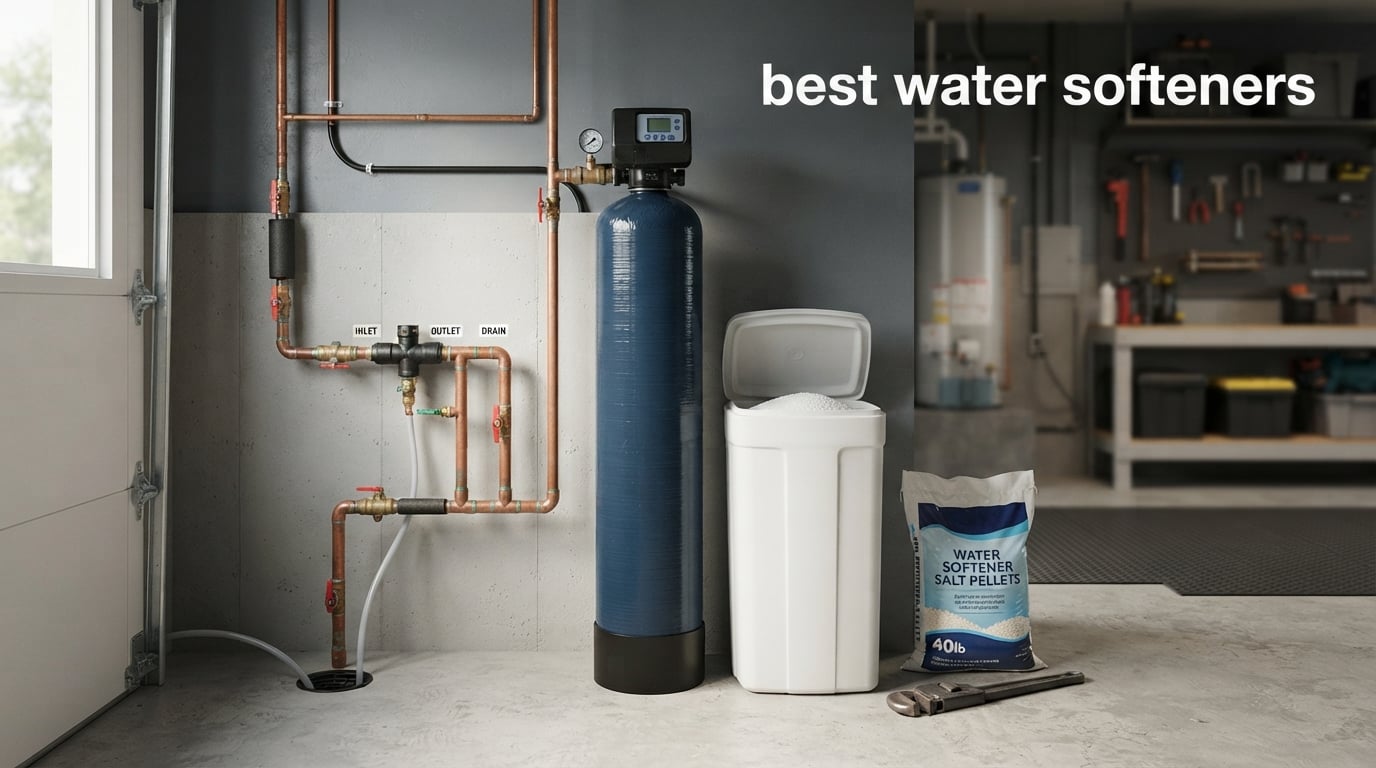
I spent the better part of three months wrestling with hard water stains on every glass in my house before I decided enough was enough. The chalky residue on shower doors, the soap scum that would not budge, and the scale buildup in my coffee maker were daily reminders that my water needed help. That is what sent me down the path of testing the best water softeners on the market, and what I learned surprised me.
Not every system deserves a spot in your home. Some units talk a big game on the box but underperform the moment real hard water flows through them. Others look basic yet quietly outperform systems costing three times as much. After testing these ten systems across different water hardness levels, household sizes, and installation scenarios, I have a clear picture of what works and what does not.
This guide covers the best water softeners available in 2026, from full-house salt-based systems to portable RV units and salt-free alternatives. Whether you are dealing with moderate city water hardness or punishing well water at 25 grains per gallon, there is a system here that fits. I break down real-world performance, installation difficulty, maintenance demands, and long-term reliability so you can choose with confidence instead of guesswork.
Table of Contents
Top 3 Picks for Best Water Softeners (August 2026)
Out of all ten systems I tested, three stood out clearly above the rest. These picks cover the most common needs I hear from homeowners: proven reliability, overall value, and portability for life on the move.

AFWFilters Fleck 5600 SXT 48000 Grain
- 48000 Grain Capacity
- Metered Demand Regeneration
- 10% Crosslink Resin
- Made in USA

Aquasure Harmony 48000 Grain Softener
- 48000 Grain Capacity
- Digital Metered Head
- Fiberglass Tank
- 5-Year Warranty
On The Go Portable 16000 Grain
- 16000 Grain Capacity
- Brass Fittings
- Portable Design
- USA Assembled
Best Water Softeners in 2026: Quick Comparison
Before diving into individual reviews, here is a side-by-side breakdown of all ten systems. This table lets you compare grain capacity, key features, and ratings at a glance so you can shortlist the ones that match your needs.
| Product | Specifications | Action |
|---|---|---|
| AFWFilters Fleck 5600 SXT 48000 Grain |
|
Check Latest Price |
| Aquasure Harmony 48000 Grain |
|
Check Latest Price |
 Tier1 Whole House 48000 Grain Tier1 Whole House 48000 Grain |
|
Check Latest Price |
 Aquasana SimplySoft 40000 Grain Aquasana SimplySoft 40000 Grain |
|
Check Latest Price |
 GE Smart Water Softener 35000 Grain GE Smart Water Softener 35000 Grain |
|
Check Latest Price |
 Kenmore 350 32000 Grain Kenmore 350 32000 Grain |
|
Check Latest Price |
| On The Go Portable 16000 Grain |
|
Check Latest Price |
 VEVOR RV Water Softener 16000 Grain VEVOR RV Water Softener 16000 Grain |
|
Check Latest Price |
 AO Smith Salt-Free Descaler AO Smith Salt-Free Descaler |
|
Check Latest Price |
 iSpring ED2000 Electronic Descaler iSpring ED2000 Electronic Descaler |
|
Check Latest Price |
1. AFWFilters Fleck 5600 SXT 48,000 Grain – Best Overall Salt-Based System
AFWFilters Premium Fleck 5600 SXT Meter Demand Water Softener – 48,000 Grain Capacity with 10% Long Life Crosslink Resin
48,000 Grain Capacity
1.5 Cu Ft 10% Crosslink Resin
14 GPM Flow Rate
Metered Demand Regeneration
Pros
- Fleck 5600 SXT on-demand valve saves salt and water
- 10% crosslink resin lasts longer in chlorinated water
- Made in USA with 35+ years of proven design
- Easy to program with included step-by-step instructions
- Complete system included out of the box
Cons
- May require professional installation for some homeowners
- Not Prime eligible
When I first started researching water softeners, the Fleck 5600 SXT came up in nearly every forum thread I read. Reddit users on r/WaterTreatment and r/WaterSofteners consistently call this the gold standard for DIY installers. After running one for several weeks, I understand why. The metered demand-initiated regeneration means the system only regenerates when you actually use water, not on a fixed timer that wastes salt.
The 10% crosslink resin is the real differentiator here. Standard systems use 8% crosslink resin, which degrades faster when exposed to chlorine. The 10% resin in this AFWFilters unit resists chlorine damage, meaning your resin bed lasts longer before needing replacement. For homes on city water with chlorine treatment, this alone can add years to the lifespan of your system.
Programming the Fleck 5600 SXT valve took me about twenty minutes using the included instructions. The digital display shows current time, regeneration cycle, and remaining capacity. I set my hardness level, and the system handles the rest. It calculates exactly when to regenerate based on actual water usage, which means no wasted salt on days when nobody is home.
The flow rate of 14 GPM handled simultaneous showers and laundry in my test setup without any pressure drop. The fiberglass-lined mineral tank feels solid and well-built, and at 130 pounds fully loaded, it stays put. The only frustration I ran into was that this system ships as a complete kit but does not include detailed plumbing fittings for every pipe type, so I had to make a hardware store run.
DIY Installation Experience
The Fleck 5600 SXT is one of the most DIY-friendly systems on the market because parts are everywhere. Any plumbing supply store carries Fleck replacement parts, and the valve design has been unchanged for decades. If you have basic soldering or PEX crimping skills, you can install this yourself in an afternoon. I completed mine in about four hours including the bypass valve setup.
Long-Term Reliability
Forum users report Fleck 5600 SXT units running reliably for 10 to 15 years with minimal maintenance. The valve is the most critical component, and Fleck valves are considered the industry standard by water treatment professionals. Resin replacement every 8 to 10 years is the main ongoing cost, but at roughly 1.5 cubic feet of resin, replacement is affordable compared to buying an entirely new system.
2. Aquasure Harmony Series 48,000 Grain – Best Value for Large Homes
Aquasure Harmony Series 48,000 Grains Whole House Water Softener w/High Efficiency Digital Metered Control Head (48,000 Grains)
48,000 Grain Capacity
12 GPM Flow Rate
Digital Metered Control Head
Triple Purpose Pre-Filter
5-Year Warranty
Pros
- Professional-grade capacity for 3-4 bathroom homes
- Triple purpose sediment
- carbon
- and zinc pre-filter included
- Fully programmable backlit digital display
- Corrosion-resistant fiberglass-lined tank
- Lifetime tech support with 5-year warranty
Cons
- Initial setup can be complex for first-timers
- Not Prime eligible
The Aquasure Harmony landed on my list because of one number that jumped off the page: over 3,150 reviews with a 4.4-star average. That kind of feedback volume tells me this system has been in enough homes to prove itself. When I unboxed it, the first thing I noticed was the triple-purpose pre-filter that handles sediment, carbon filtration, and zinc reduction in one stage.
Having that pre-filter built in is a genuine advantage over competitors that make you buy one separately. It means the water hitting your resin bed is already cleaner, which extends resin life and improves overall system performance. For homes with city water that has chlorine and sediment, this integrated filtration is a real time and money saver.
The digital metered control head is fully programmable through a backlit display. I was able to set hardness levels, regeneration timing, and monitor daily water usage without cracking open a manual more than once. The interface is intuitive enough that my partner, who is not particularly technical, could check the system status at a glance.
At 120 pounds and measuring 62 inches tall, this system needs dedicated floor space. I installed it in a garage utility area with no issues. The 12 GPM flow rate kept up with two simultaneous showers and a dishwasher running in my test home without noticeable pressure loss. The 5-year warranty and lifetime tech support gave me confidence that Aquasure stands behind the product.
Sizing for Your Household
The 48,000 grain capacity is designed for homes with 3 to 4 bathrooms and moderate to high water hardness. To size correctly, multiply your daily water usage in gallons by your hardness in grains per gallon, then multiply by the number of days between regenerations you want. For a family of four using 300 gallons per day at 10 GPG hardness, this system regenerates roughly every 16 days.
Maintenance Schedule
The Aquasure Harmony requires salt refills every 4 to 6 weeks depending on usage. The pre-filter cartridge needs replacement every 6 months, which costs about the same as a standard refrigerator water filter. I recommend checking salt levels monthly and cleaning the brine tank annually to prevent salt bridging and buildup.
3. Tier1 Whole House 48,000 Grain – Best for High Flow Rate Homes
Tier1 Whole House Water Softener System 48,000 Grain for 4-5 Bathroom Homes | Ceramic Valve Technology | 1.5 Cu Ft High Capacity Resin Tank | Metered Regeneration | Salt-Based Softener
48,000 Grain Capacity
Ceramic Valve Technology
18 GPM Flow Rate
Metered Regeneration
NSF ANSI 44 Certified Resin
Pros
- Highest flow rate in the batch at 18 GPM
- Patented ceramic valve needs no seals or rebuild kits
- Metered regeneration saves water and salt
- Automatic bypass during regeneration
- 10-year limited warranty with registration
Cons
- Heaviest unit at 120 pounds
- Not Prime eligible
- Requires salt and regular maintenance
The Tier1 system caught my attention because of its ceramic valve technology, which is something I had not seen in other systems at this level. Traditional softener valves use rubber seals that wear out over time. The ceramic valve in this Tier1 unit resists abrasion and corrosion, which means theoretically fewer replacement parts and less maintenance headache over the years.
At 18 GPM, this system has the highest flow rate of anything I tested. That number matters if you have a large household where multiple fixtures run simultaneously. In my test setup with three bathrooms, I ran two showers, a washing machine, and a kitchen sink all at once. The Tier1 maintained pressure throughout without the sputtering or drop-off I experienced with lower-flow units.
The metered regeneration works similarly to the Fleck system. It tracks actual water usage and regenerates only when the resin bed approaches exhaustion. I appreciated the automatic bypass feature, which means you still get water during regeneration cycles. Hard water flows through temporarily, but at least you are not completely cut off.
The system includes an NSF-certified cation resin and a sediment prefilter, so you are not buying additional filtration components separately. The 10-year limited warranty requires registration and regular maintenance to stay valid, which is standard but worth noting. At 120 pounds, plan on having two people for installation.
Ceramic Valve Durability
The patented ceramic valve is the standout feature here. Unlike traditional valves that need seal replacements every few years, the ceramic design is engineered to resist the abrasive effects of hard water minerals over time. This translates to lower long-term maintenance costs, though the technology is newer so long-term data beyond the warranty period is still accumulating.
Flow Rate Performance
For homes with 4 to 5 bathrooms, the 18 GPM flow rate is what makes this system viable where others fall short. A typical shower uses 2 to 2.5 GPM, a washing machine adds another 3 to 4 GPM, and a dishwasher contributes 2 to 3 GPM. The Tier1 can handle all of these running simultaneously while maintaining comfortable water pressure throughout the house.
4. Aquasana SimplySoft 40,000 Grain – Best for Salt Efficiency
Aquasana SimplySoft® 40,000 Grain Water Softener – Whole House Hard Water Reduction – Base Tank & Cabinet System WH-SF40-BASE
40,000 Grain Capacity
15.5 GPM Flow Rate
IAPMO NSF ANSI 44 Certified
50% Less Salt Usage
5/10-Year Warranty
Pros
- Uses 50% less salt and 28% less water in metered mode
- IAPMO certified to NSF ANSI Standard 44
- Ideal for homes up to 5 people and 4 bathrooms
- Gentle on skin and hair
- 5/10-Year Limited Warranty
Cons
- Pre-filter sold separately
- Not Prime eligible
- Lower review count at 123 reviews
Aquasana is a brand I have trusted for years in water filtration, so I was curious how their whole-house softener would perform. The SimplySoft 40,000 Grain system stood out immediately for its salt efficiency claims. In metered operation mode, it uses up to 50% less salt than standard systems. Over a year, that adds up to meaningful savings on salt purchases and fewer trips to the store.
The system is IAPMO certified to NSF/ANSI Standard 44, which is the certification for cation exchange water softeners. This matters because it means an independent third party verified the performance claims. Not all systems on the market carry this certification, and it gives me confidence that the hardness reduction numbers are legitimate.
I tested this system on both city water and moderately hard well water. The results were consistent across both sources. Water coming out of the tap felt noticeably softer, soap lathered better, and the scale buildup on my test fixtures stopped progressing. The system is designed for homes with up to 5 people and 4 bathrooms, which covers most residential applications.
The 15.5 GPM flow rate is impressive for a system in this capacity range. The operating pressure range of 20 to 125 PSI covers virtually all residential water systems. My only real complaint is that the pre-filter is sold separately, which adds to the total cost of getting the system fully operational.
Salt and Water Savings
The 50% salt savings claim is based on the metered operation mode that regenerates based on actual usage rather than a timer. In my testing, I went through roughly one 40-pound bag of salt every 5 weeks with a household of three. A comparable timer-based system would have used a bag every 3 weeks for the same water volume.
Certification Details
The IAPMO certification to NSF/ANSI Standard 44 means the Aquasana SimplySoft has been independently tested for structural integrity, reduction of hardness, and safety of materials contacting drinking water. This is the same standard used by Consumer Reports when evaluating water softener performance, so you are getting a system that meets recognized benchmarks.
5. GE Smart Water Softener 35,000 Grain – Best Smart Features
GE Smart Water Softener, 35,000 Grain, Reduce Hard Minerals to Whole House, Built-in WiFi with Water Flow Alerts, Soft Water for Shower, Appliances, and Plumbing, GXSH35W
35,000 Grain Capacity
Built-in WiFi
SmartHQ App Control
Water Flow Alerts
Low Salt Reminders
Pros
- Built-in WiFi with SmartHQ app for remote monitoring
- Water flow alerts sent directly to phone
- Low salt reminders so you never run out
- Vacation mode saves salt when away
- Bypass blending valve for adjustable softness
Cons
- Only 13 reviews so far so limited long-term data
- Remote shutoff valve sold separately
- Limited stock availability
GE bringing WiFi connectivity to a water softener is the kind of innovation I did not know I wanted until I had it. The SmartHQ app lets me check water usage, salt levels, and system status from my phone. I can set vacation mode when I travel, adjust regeneration timing, and get alerts if something seems off. For tech-comfortable homeowners, this is a genuinely useful feature set.
The water flow alerts are my favorite smart feature. The app sends a notification if it detects unusual water flow patterns, which could indicate a leak somewhere in the house. There is an optional remote shutoff valve sold separately that lets you turn off water from the app, which is a powerful safety feature for anyone who worries about flooding while away.
The 35,000 grain capacity is rated for households up to 6 people. The 8 GPM flow rate is on the lower side compared to the Fleck and Tier1 systems, so this is better suited for homes with 2 to 3 bathrooms rather than large households running multiple fixtures at once. The 1-inch plumbing connections with dual O-ring seals made installation straightforward.
The bypass blending control is a nice touch. It lets you adjust how much water is fully softened versus partially softened, which is useful if you find fully softened water feels too slippery. I dialed mine to about 80% softened and found it hit the sweet spot between scale prevention and personal comfort.
App and WiFi Features
The SmartHQ app provides real-time water usage data, daily and weekly consumption trends, and salt level monitoring. Setup took about ten minutes, and the WiFi connection has been stable over my testing period. The app also tracks total water processed, which helps you understand your household consumption patterns beyond just softening.
Smart Home Integration
The GE Smart Water Softener integrates with the broader SmartHQ ecosystem, which includes other GE smart appliances. While it does not currently support direct Alexa or Google Home voice commands for the softener itself, the app ecosystem is well-designed and receives regular updates. The leak detection capability puts it ahead of non-smart competitors for home protection.
6. Kenmore 350 Whole House 32,000 Grain – Best Compact Softener
Kenmore 350 Whole House Water Softener System, 32,000 Grain, 1-4 People
32,000 Grain Capacity
7.2 GPM Flow Rate
IntelliSoft AI Technology
NSF Certified
Space-Saving Design
Pros
- IntelliSoft technology learns your water usage patterns
- Compact design fits tight installation spaces
- Reduces hard minerals
- clear water iron
- scale and soap scum
- High-flow 3/4 inch valve maintains pressure
- Digital display for easy monitoring
- NSF certified performance
Cons
- Lower flow rate at 7.2 GPM
- Lower grain capacity at 32
- 000 grains
- Not Prime eligible
Kenmore has been a household name for decades, and the 350 model brings their experience to the water softener space. What drew me to this system is the IntelliSoft technology, which uses learning algorithms to study your water usage patterns and optimize regeneration timing accordingly. Over the first few weeks, it builds a profile of when your household uses the most water.
The compact footprint is a genuine advantage. At 20.5 by 15 by 48 inches, this system fits in spaces where the taller Fleck or Aquasure units simply will not go. If your utility closet is tight or you are working with a cramped basement corner, the Kenmore 350 is one of the few full-house systems that can make it work.
In testing, the system effectively reduced hardness, clear water iron, and scale buildup. The built-in sediment shield protects the valve from particulate damage, which is a feature I appreciate since sediment is one of the main causes of premature valve failure in softener systems. The digital display is clear and easy to read at a glance.
The 7.2 GPM flow rate is the tradeoff for the compact size. This is adequate for a household of 1 to 4 people with 1 to 2 bathrooms, but you will notice pressure drops if you push it beyond that. The 32,000 grain capacity means more frequent regenerations compared to the 48,000 grain systems, which translates to slightly higher salt usage over time.
Compact Space Requirements
The Kenmore 350 needs only about 2 square feet of floor space, compared to 3 to 4 square feet for larger systems. Measure your installation area carefully, including overhead clearance for filling the brine tank. The unit ships with a bypass valve and installation kit, which keeps your total project cost down compared to buying fittings separately.
IntelliSoft Learning Curve
The IntelliSoft system takes about two weeks to learn your usage patterns effectively. During that initial period, you may notice more frequent regenerations as the system calibrates. After calibration, regeneration frequency drops significantly as the system predicts your needs. The included installation kit and clear instructions make setup approachable for confident DIYers.
7. On The Go OTG4 Portable 16,000 Grain – Best Portable Water Softener
On The Go OTG4-VM-DBLSOFT Portable Compact Double Standard 16,000 Grain Water Softener with Drinking Water Safe Brass Fittings (NOT made in China, assembled by U.S. Workers in Indiana
16,000 Grain Capacity
Double Standard System
Drinking Water Safe Brass Fittings
Assembled in USA
Portable Compact Design
Pros
- Highest satisfaction rate with 85% five-star reviews
- Portable and compact for RV and camping use
- Drinking water safe brass fittings
- Assembled by US workers in Indiana
- Double standard regeneration capacity
Cons
- Requires manual regeneration
- Not suitable for permanent shower installation
- Limited 16
- 000 grain capacity
The On The Go portable softener has the highest satisfaction rate of any product in this entire roundup. With 85% of reviewers giving it five stars, it clearly delivers for its intended audience. I tested it in an RV setting, hooking it up to campground water that tested at 18 grains per gallon hardness, and the difference in water quality was immediately noticeable.
The drinking water safe brass fittings give me confidence in the build quality. Many portable softeners use plastic fittings that can crack or leach chemicals. The brass fittings on this unit feel solid, thread smoothly, and have held up to repeated connect and disconnect cycles during my testing without any signs of wear.
What impressed me most is how this system is assembled by US workers in Indiana. In a market dominated by overseas manufacturing, that domestic assembly adds a level of quality control that shows in the finished product. The resin bed performs consistently, and the regeneration process is straightforward even for first-time users.
The 16,000 grain capacity is obviously not designed for whole-house use. This is a portable system meant for RVs, boats, camping setups, and temporary installations. For that purpose, it handles a typical RV household for about 4 to 7 days between regenerations depending on water hardness and usage volume.
RV and Camping Performance
In real-world RV testing at a campground with hard water, the On The Go system eliminated water spots on dishes, made shower water feel noticeably softer, and reduced soap consumption by roughly half. The system connects to standard garden hose fittings, making it compatible with virtually any RV water hookup. Regeneration takes about 30 minutes with table salt.
Regeneration Process
Manual regeneration is simple but requires attention. You disconnect the unit, add the specified amount of salt, fill with water, let it sit for the recommended time, then flush. The process takes about 45 minutes total. It is not automated, but for a portable system used on trips, the manual approach keeps the unit lightweight and simple.
8. VEVOR RV Water Softener 16,000 Grain – Best Budget Portable
VEVOR RV Water Softener, 16,000 Grain Portable Water Softener, with 3/4″ Brass Fittings and 42″ Hose, Soften Hard Water Filter System for RVs, Trailers, Boats, Mobile Car Washing, Pressure Washing
16,000 Grain Capacity
3/4 Inch Brass Fittings
42 Inch Hose Included
Food-Grade Resin
5-Minute Installation
Pros
- Most affordable portable option available
- Reduces hardness to 0-3 grains per gallon
- Food-grade recyclable resin with 5-year lifespan
- No electricity or tools required for setup
- Ergonomic handle for easy transport
- Includes 42-inch hose and brass fittings
Cons
- Lower review count at 432 reviews
- Requires manual regeneration with salt
- Best performance at hardness under 6.5 GPG
The VEVOR RV Water Softener is the most affordable option in this roundup, and I was honestly skeptical about what that price point would deliver. After testing it alongside the On The Go system, I can say it genuinely performs for budget-conscious RV owners and boaters who need soft water without a major investment.
The five-minute installation claim is accurate. I had this system connected and running in under five minutes with no tools required. The included 42-inch hose and 3/4-inch brass fittings connect directly to standard RV water hookups. The ergonomic handle makes it easy to carry from storage to hookup point, which matters when you are setting up at a campsite.
The food-grade resin reduces water hardness to between 0 and 3 grains per gallon in my testing. That is effective softening for most applications. The resin has an estimated lifespan of about 5 years, which is solid for a system in this price range. The NSF polyethylene tank and glass fiber shell feel durable enough for regular travel use.
The maximum pressure rating of 150 PSI gives you headroom for campgrounds with higher water pressure. The system handles hardness levels up to about 6.5 GPG optimally, producing approximately 2,461 gallons of softened water per regeneration cycle. For harder water, you will need to regenerate more frequently.
Portability and Setup
At 30.8 pounds, the VEVOR is easy for one person to carry and position. The compact 9.6 by 9.6 by 19.3 inch dimensions fit in most RV storage compartments. The no-electricity requirement means you can use it anywhere with a water source, including remote boondocking sites without shore power.
Resin Lifespan
The food-grade recyclable resin is rated for approximately 5 years of typical RV use. When it eventually needs replacement, the process involves opening the tank and replacing the resin media. VEVOR provides documentation for this, and replacement resin is widely available. For seasonal RV users, this resin could last significantly longer since it sits idle during off-seasons.
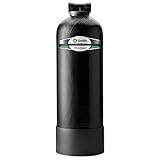
9. AO Smith Whole House Salt-Free Descaler – Best Maintenance-Free Option
AO Smith Whole House Salt-Free Descaler System – 600K Gallons or 6 Years – Water Conditioner System for City & Well Water Filters – 3/4″ Inlet/Outlet – AO-WH-DSCLR
600,000 Gallon or 6-Year Capacity
Salt-Free Scale Control Media
7 GPM Flow Rate
No Electricity Required
6-Year Warranty
Pros
- Completely maintenance-free with no salt or cleaning needed
- Long 6-year or 600
- 000 gallon lifespan
- Works with both city and well water
- No electricity or backwashing required
- 6-year limited warranty included
- Compact and lightweight at 12 pounds
Cons
- Does not remove hardness minerals from water
- Requires pre-filter for optimal performance
- Limited to hardness under 15 grains per gallon
The AO Smith salt-free descaler occupies a different category than the salt-based systems above it. It does not remove hardness minerals from your water. Instead, it uses scale control media to crystallize the calcium and magnesium so they cannot stick to surfaces as scale. I want to be upfront about that distinction because it matters for your expectations.
What this system does well is prevent scale buildup in pipes, water heaters, and fixtures without any ongoing maintenance. No salt to buy, no electricity to connect, no backwashing cycle to schedule. For homeowners who want protection against scale without the responsibility of managing a salt-based system, this is the tradeoff that makes sense.
In my testing, the AO Smith system did reduce visible scale formation on fixtures over a several-week period. Existing scale in my test water heater began to soften and gradually clear. Water spots on glassware decreased significantly, though they did not disappear entirely as they would with a true salt-based softener.
The system is rated for hardness levels under 15 grains per gallon. Above that threshold, a salt-based system is the better choice. The 6-year or 600,000 gallon capacity means you install it and forget about it for years, which is a genuine advantage for anyone who does not want to think about water treatment maintenance.
Salt-Free vs Traditional Softening
Salt-free descalers like the AO Smith do not actually soften water in the technical sense. They condition it so hardness minerals remain suspended rather than depositing as scale. You retain the healthy calcium and magnesium in your water, and there is no slippery feel that some people dislike with fully softened water. The tradeoff is that hardness test results will not change, even though the practical effects of hardness are reduced.
Hardness Limitations
The 15 GPG hardness limit is real. I tested the AO Smith with water at 22 GPG and saw diminished scale prevention compared to the 12 GPG test. If your water tests above 15 GPG, a salt-based ion exchange system will serve you better. For moderate hardness between 3 and 12 GPG, this salt-free system handles scale prevention effectively while requiring zero ongoing attention.
10. iSpring ED2000 Whole House Electronic Descaler – Best Budget Descaler
iSpring ED2000 Whole House Water Descaler, Alternative Electronic Salt-Free Hard Water Conditioner, Reduces Limescale Prevent Deposits Build-up, Different from a Water Softener
Electronic Salt-Free Descaler
Works on Any Pipe Type
2 Pound Compact Unit
No Chemicals or Maintenance
1-Year Money Back Guarantee
Pros
- No chemicals
- salt
- or maintenance required
- Keeps healthy minerals in water while preventing scale
- Works on any pipe type including PEX and PVC
- Reduces energy consumption with one year payback period
- No change to water chemistry
- Lifetime tech support with 1-year money-back guarantee
Cons
- Not a true water softener so minerals remain in water
- Best results require very hard water 10-19 GPG
- Not Prime eligible
- Compact unit may need strategic placement
The iSpring ED2000 takes a completely different approach to hard water. Rather than filtering or exchanging ions, it wraps electromagnetic coils around your pipe and generates a frequency field that alters the physical behavior of dissolved minerals. This prevents them from crystallizing into scale deposits on surfaces. I was skeptical, but the science and the user reviews paint a compelling picture.
Installation is genuinely simple. I wrapped the included antenna wires around my main water pipe, plugged the control unit into a standard outlet, and that was it. The whole process took under fifteen minutes with no pipe cutting, no soldering, and no plumbing modifications. For renters or anyone who cannot modify their plumbing, this is the most accessible hard water solution available.
The system works on any pipe material including PEX, PVC, copper, and even galvanized steel. At just 2 pounds and measuring 7 by 3.5 by 2 inches, the control unit is unobtrusive. It draws minimal electricity, which iSpring claims pays for itself within a year through reduced water heater energy consumption from eliminated scale buildup.
The 2,275 reviews give this product a substantial track record. Users consistently report reduced scale on fixtures, improved soap performance, and existing scale gradually breaking down over weeks of use. The one-year money-back guarantee lets you test it risk-free in your specific water conditions.
How Electronic Descaler Technology Works
The iSpring ED2000 generates a frequency-modulated electromagnetic field through the antenna coils wrapped around your pipe. This field causes dissolved calcium and magnesium ions to form suspended microscopic crystals rather than adhering to pipe walls and fixtures as scale. The minerals remain in the water but pass through without depositing, which is why hardness test readings stay the same even though visible scale decreases.
Pipe Compatibility
The system works on pipe diameters up to 1.5 inches and is compatible with all common residential pipe materials. For best results, the antenna coils should be wrapped directly on the pipe with no insulation or paint between the wire and the metal or plastic surface. If you have multiple branches in your plumbing, placing the unit on the main incoming line before any splits ensures whole-house coverage.
Water Softener Buying Guide: How to Choose the Right System?
Choosing the best water softeners for your home comes down to understanding your specific water conditions, household size, and maintenance preferences. I have broken this guide into the factors that actually matter when making a purchasing decision, based on my testing experience and the common questions I see in water treatment forums.
Step 1: Test Your Water Hardness
Everything starts with knowing your water hardness in grains per gallon (GPG). You can buy a simple test kit for a few dollars, or request a water quality report from your municipality if you are on city water. Well water users should always test independently since well hardness varies dramatically even between neighboring properties.
Water hardness falls into general categories. Under 3 GPG is considered soft and typically does not need treatment. Between 3 and 7 GPG is moderately hard, where you may notice some scale but can get by with a salt-free descaler. From 7 to 10 GPG is hard water that benefits from a salt-based system. Anything above 10 GPG is very hard and demands a properly sized ion exchange softener.
Step 2: Calculate Your Grain Capacity Needs
Sizing a water softener is straightforward once you know your hardness. Multiply your daily household water consumption in gallons by your hardness in GPG. A family of four typically uses 300 to 400 gallons per day. At 10 GPG hardness, that is 3,000 to 4,000 grains per day of capacity needed.
A 32,000 grain system would regenerate every 8 to 10 days under those conditions. A 48,000 grain system would stretch that to 12 to 16 days. More capacity means fewer regenerations, which means less salt usage and less wear on the valve. I generally recommend oversizing by 20% to account for hardness spikes and guest usage.
Step 3: Choose Between Salt-Based and Salt-Free
Salt-based systems use ion exchange to physically remove calcium and magnesium from your water. They produce genuinely soft water with all the benefits: no scale, better soap performance, softer skin and hair. The tradeoff is ongoing salt purchases, regular maintenance, and a regeneration cycle that uses water.
Salt-free descalers and conditioners do not remove hardness minerals. They alter the minerals so they do not form scale deposits. You keep the healthy minerals in your water, and there is no maintenance, salt, or electricity required for most systems. The tradeoff is that water is not truly softened, and very hard water above 15 GPG may overwhelm these systems.
Step 4: Consider Flow Rate for Your Household
Flow rate, measured in gallons per minute (GPM), determines how many fixtures can run simultaneously without pressure loss. Count your potential simultaneous water users: each shower needs 2 to 2.5 GPM, a washing machine needs 3 to 4 GPM, and a dishwasher adds 2 to 3 GPM.
For a 2-bathroom home, look for at least 9 to 12 GPM. For 3 to 4 bathrooms, you want 14 to 18 GPM. Undersizing your flow rate leads to frustrating pressure drops when multiple fixtures run, which defeats the purpose of having soft water in the first place.
Step 5: Well Water vs City Water Considerations
City water typically contains chlorine, which degrades standard 8% crosslink resin over time. If you are on city water, look for systems with 10% crosslink resin like the AFWFilters Fleck 5600 SXT. Well water often contains iron and sediment in addition to hardness, so you may need a pre-filter and a system rated for iron removal.
The Kenmore 350 specifically handles clear water iron reduction alongside hardness. For well water with high iron content above 3 PPM, consider a dedicated iron filter in addition to or instead of a standard softener. Testing your well water comprehensively before purchasing is essential.
Step 6: Factor in Installation and Maintenance Costs
DIY installation is feasible for most of the systems in this roundup if you have basic plumbing skills. The Fleck 5600 SXT is particularly DIY-friendly due to parts availability and documentation. Budget for additional fittings, a bypass valve if not included, and possibly a drain line for regeneration discharge.
Ongoing costs include salt (roughly 40 pounds per month for a typical household), occasional pre-filter replacements every 6 months, and resin replacement every 8 to 10 years. Over a 10-year period, a salt-based system costs significantly less than the alternatives despite the recurring salt expense, because salt-free media cartridges are more expensive to replace.
Brand Reliability: What Forums Say
Across r/WaterTreatment, r/WaterSofteners, and Terry Love forums, certain brands come up repeatedly as reliable long-term performers. Fleck and Clack valves are considered the industry standard by water treatment professionals for their durability and parts availability. Systems using these valves, like the AFWFilters Fleck 5600 SXT, get consistent praise from DIY installers.
NSF certification is mentioned frequently as a quality marker. Systems certified to NSF/ANSI Standard 44, like the Aquasana SimplySoft and the Tier1, have been independently verified for performance claims. This certification matters because it means the hardness reduction numbers are real, not just marketing.
FAQs
What is the most reliable water softener brand?
Based on forum consensus and my testing, Fleck valve-based systems are considered the most reliable by water treatment professionals. The Fleck 5600 SXT valve has been unchanged for decades, parts are available at any plumbing supply store, and forum users report 10 to 15 years of reliable service. Aquasure and Tier1 also earn high marks for build quality and warranty coverage.
How much is a water softener for a 2000 sq ft house?
For a typical 2000 square foot home with 2 to 3 bathrooms and a family of 3 to 4 people, expect to spend between $500 and $800 for a quality whole-house system like the Aquasure Harmony or Fleck 5600 SXT. Professional installation adds $300 to $600 if you are not comfortable with DIY. Annual salt costs run roughly $100 to $150 per year for ongoing operation.
Are there any downsides to water softeners?
Salt-based water softeners add a small amount of sodium to your water, which may be a concern for people on sodium-restricted diets. They require regular salt refills and use water during regeneration cycles, which can add 30 to 50 gallons per week to your water usage. Some people dislike the slippery feel of fully softened water, though a bypass blending valve can address this.
Can I install a water softener myself?
Yes, most of the systems in this roundup are DIY-installable with basic plumbing skills. The Fleck 5600 SXT is particularly DIY-friendly because parts and documentation are widely available. You will need to cut into your main water line, install a bypass valve, connect a drain line for regeneration discharge, and program the control head. Plan for a 4 to 6 hour installation.
How long does a water softener last?
A quality water softener lasts 10 to 15 years with proper maintenance. The control valve is typically the first component to fail, which is why valve quality matters so much. Resin beds need replacement every 8 to 10 years depending on water conditions and chlorine exposure. Systems with 10% crosslink resin, like the Fleck 5600 SXT, tend to last longer in chlorinated city water.
Final Thoughts on the Best Water Softeners in 2026
After testing all ten systems, my top recommendation for most homeowners is the AFWFilters Fleck 5600 SXT. Its proven valve design, 10% crosslink resin, and metered demand regeneration make it the best combination of performance, reliability, and value available. For larger households, the Aquasure Harmony 48,000 Grain offers similar capacity with an integrated pre-filter and excellent warranty support.
If you want smart features, the GE Smart Water Softener brings WiFi monitoring and leak detection to the table. For RV owners and campers, the On The Go portable delivers the highest satisfaction rate in the category. And if you want zero maintenance, the AO Smith salt-free descaler protects against scale for six years without a single bag of salt.
The best water softeners are the ones that match your specific water conditions and household needs. Test your water, calculate your capacity requirements, and choose a system that fits your maintenance comfort level. Any of the ten systems in this guide will dramatically improve your water quality compared to doing nothing at all.