
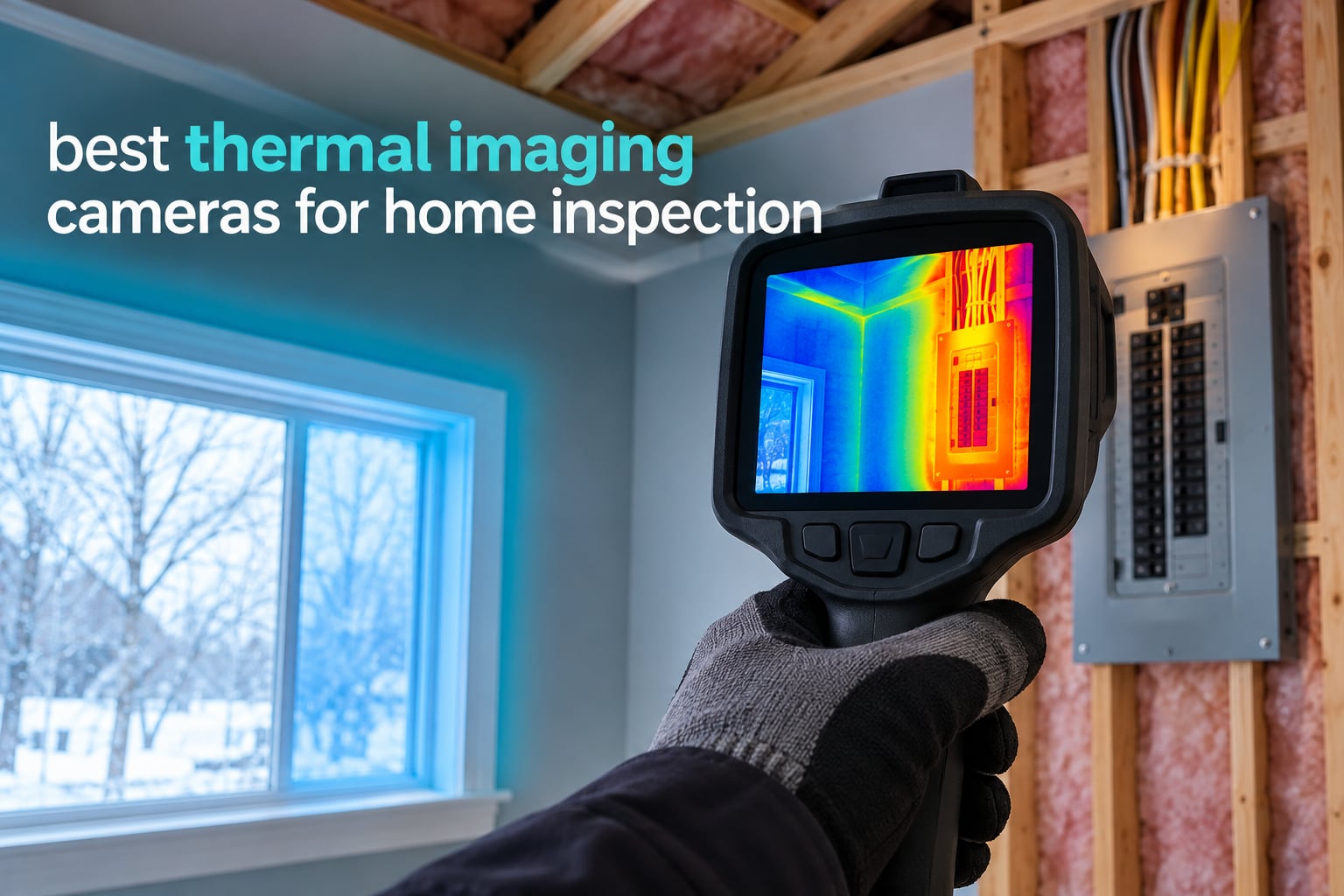
A thermal imaging camera turns a guess into evidence. Point it at a bedroom ceiling after a hard rain and the soaked insulation shows up as a cold blue patch you cannot see with a flashlight. Sweep a live electrical panel under load and a loose lug announces itself as a hot spot long before anyone smells burning plastic.
That is why the best thermal imaging cameras for home inspection have moved from a specialist tool to a standard piece of kit for inspectors, HVAC technicians, and serious DIY buyers. The catch is that the market is now crowded with almost identical-looking boxes, and the spec that matters most is not the one printed on the front.
We spent weeks going through the specs, the user reports, and the field notes behind the ten cameras below, then sorted them by what they actually do on a job site. The result is a list that covers every real budget, from a bare-bones imager for a pre-purchase walkthrough to a high-resolution unit for professional panel work.
While you’re reading, it helps to have the wider picture. If you also work outdoors, our guide to the best thermal imaging drones for hunting covers the airborne end of the spectrum, and the thermal window coverings in our thermal door curtain and blackout thermal shade guides deal with stopping heat rather than finding it.
Table of Contents
Top 3 Picks for Home Inspection in 2026
Three units pull ahead for residential work. The FLIR C5 is the pick if you want a professional report trail. The FLIR TG165-X is the value choice when you need something durable that fits in a pocket. The MiLESEEY TR10 scores highest among the sub-mid units for raw sensor quality per dollar.
FLIR C5 Compact Thermal Camera
- 160x120 MSX sensor
- -20 to 400C range
- FLIR Ignite cloud reports


All 10 Thermal Imaging Cameras Compared in 2026
Everything in this roundup sits within a range that a homeowner or a working inspector can justify. Read the table below as a screening tool, then use the individual reviews for the detail that decides your purchase.
| Product | Specifications | Action |
|---|---|---|
| FLIR C5 |
|
Check Latest Price |
| FLIR TG165-X |
|
Check Latest Price |
 HSFTOOLS HP96 HSFTOOLS HP96 |
|
Check Latest Price |
 AMPBANK H128 AMPBANK H128 |
|
Check Latest Price |
| MiLESEEY TR10 |
|
Check Latest Price |
 HSFTOOLS HF96V HSFTOOLS HF96V |
|
Check Latest Price |
 Flagfront 240×240 Thermal Camera Flagfront 240×240 Thermal Camera |
|
Check Latest Price |
 Thermal Master Thor002 Thermal Master Thor002 |
|
Check Latest Price |
 FOXWELL RT280 FOXWELL RT280 |
|
Check Latest Price |
 FOXWELL HT280 FOXWELL HT280 |
|
Check Latest Price |
1. FLIR C5 Compact Thermal Imaging Camera – Best Overall for Inspectors
Flir C5 Compact Thermal Imaging Camera, WiFi, 160×120 MSX, Ignite
160x120 MSX sensor
-20 to 400C (-4 to 752F)
190 g
3.5 inch display
Wi-Fi Ignite
Pros
- MSX overlay blends thermal and visual detail
- Compact body fits tight electrical and mechanical spaces
- FLIR Ignite cloud produces client ready reports
- Ten year detector coverage
Cons
- Lowest native thermal resolution in this group at 160x120
- Fixed focus limits close range detail
- Small 3.5 inch screen
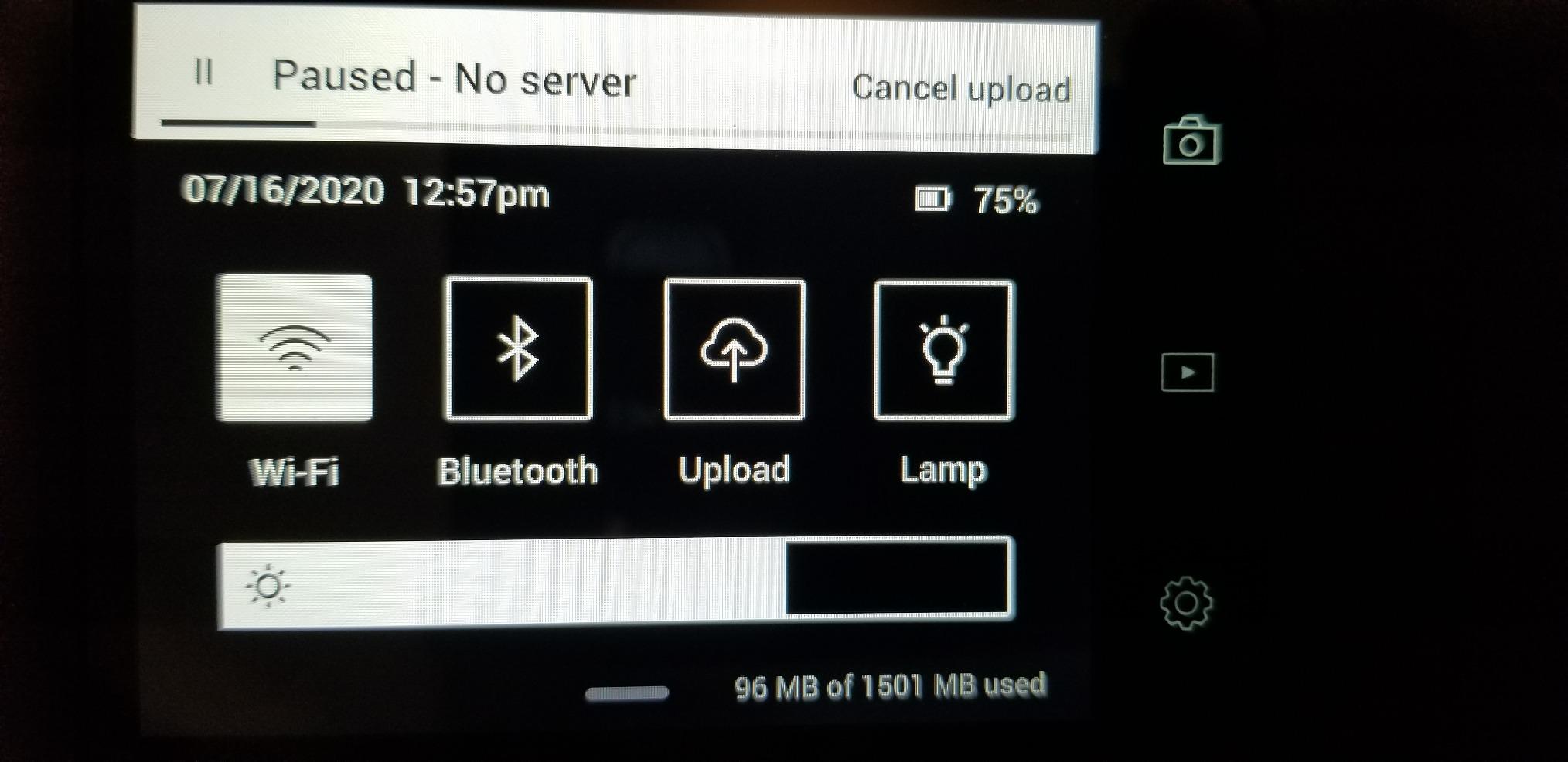
The FLIR C5 has been the default recommendation in inspector circles for years, and the reason has less to do with raw specifications than with the software wrapped around them. Every capture uploads to FLIR Ignite, you build a report in the browser, and the client receives a branded document with images, spot temperatures, and notes attached. For a professional who bills for a written report, that workflow is worth more than another tier of sensor resolution.
Weighing in at 190 g and measuring just 5.4 inches wide, it disappears into a tool bag and fits between a breaker panel and a wall where nothing else will go. The measurement range of -20 to 400 degrees Celsius covers attic work, plumbing, and warm-running equipment without switching modes.
MSX is the feature that separates FLIR from cheaper boxes. Rather than replacing the visible image, it embosses edges and texture from the visible camera into the thermal frame, so pipe runs, panel labels, and framing members stay readable when you save a screenshot for a report.
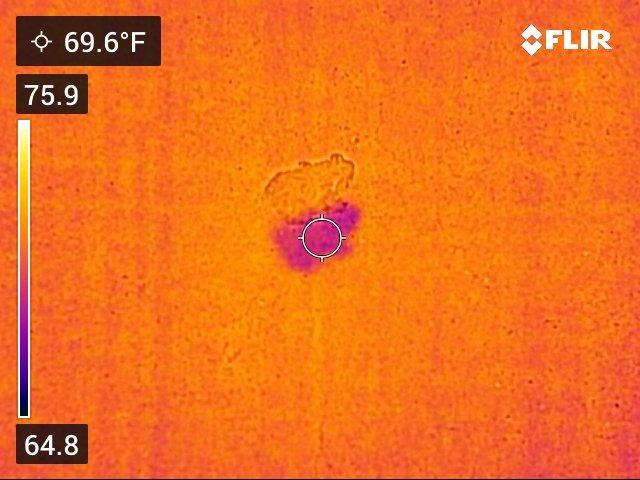
The honest weakness is the sensor. At 160 x 120 with 19,200 pixels, this is the lowest native resolution in the group, and it is genuinely the reason the average rating sits at 4.2 rather than higher. In a crowded panel with fourteen breakers, the individual hot spots can blur together, and you end up walking closer to separate one conductor from the next.
Fixed focus compounds that. There is no fine-focus ring, so very close work on a recessed receptacle or a small junction box loses sharpness. The 3.5 inch display is also small next to the 4.3 inch and larger screens some competitors now fit, which matters if you are reviewing images on site rather than uploading them.
Warranty terms are among the strongest here: two years of parts and labour plus ten years of detector coverage. The included kit covers the camera, printed documentation, a lanyard, a USB cable, and a pouch, so nothing else needs buying to get started.
Who the FLIR C5 suits best
This is the camera to buy if you write a formal infrared inspection report for paying clients. The Ignite pipeline handles the image naming, thumbnails, and PDF assembly that would otherwise eat an evening after every inspection. Owners working electrical panels and attic scans consistently point to MSX clarity and the cloud report as the reasons they keep reaching for it.
It also works well as a secondary camera for an inspector whose main unit is a higher-resolution handheld. The low weight makes it easy to carry for quick verification shots.
Where the FLIR C5 falls short
It is the wrong tool when you need to separate individual conductors in a dense panel or document very small anomalies. For fine diagnostic work, a 256 x 192 or 512 x 384 sensor will show detail this one simply cannot resolve. Buyers focused purely on image quality should weigh those options instead.
At 160 x 120, it is also not ideal for thin-gauge insulation scans across large open areas, where pixel count determines how much of the wall you cover in a single frame.
2. FLIR TG165-X Thermal Imaging Camera – Best Value Pocket Unit
Flir TG165-X Thermal Imaging Camera with Bullseye Laser, Spot IR
4800 pixel IR sensor
-25C to 300C
13.92 oz
IP54 sealed
LCD display
Pros
- Laser pointer speeds up targeted measurement
- Pocket sized and simple to operate
- MSX makes anomalies easy to read on screen
- IP54 sealed and drop tested
Cons
- Very low 4800 pixel resolution suits gross anomalies only
- No visible light camera for scene context
- Smaller LCD than competing models
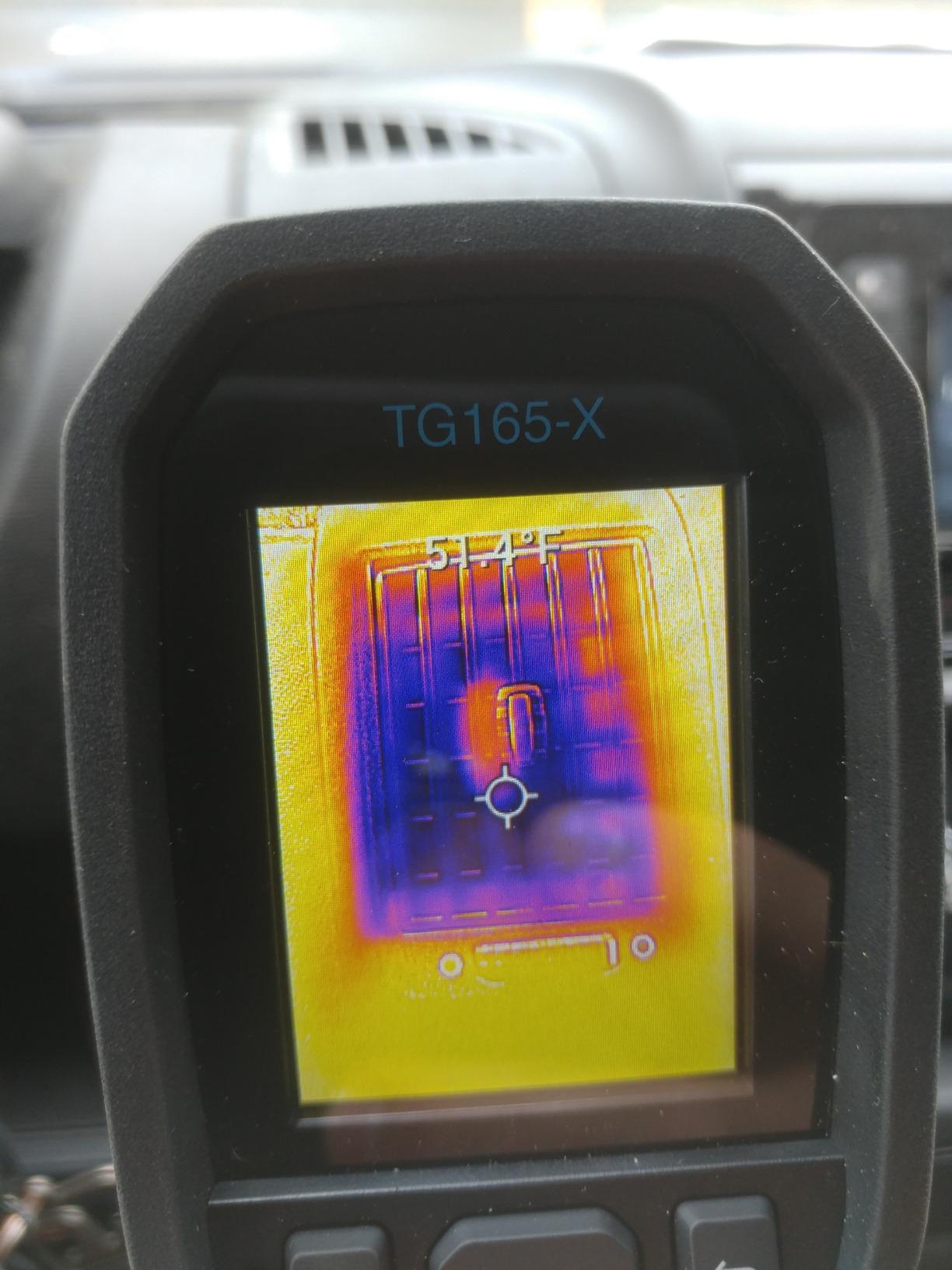
Ask an experienced inspector what they carry in a shirt pocket and the TG165-X comes up more often than almost anything else. It does one job: put a number on whatever you point the laser at. The Bullseye laser pointer projects a ring around the exact measurement area, which removes the guesswork of trying to hold a spot temperature on a small target while moving the camera.
The measurement range of -25 to 300 degrees Celsius is narrower than many of the budget cameras here, but it comfortably covers electrical hot spots, duct and plumbing work, and envelope inspections. Response time of three seconds means you are not waiting on the display to settle before reading a value.
At roughly 14 ounces with an IP54 enclosure and drop testing, it survives a job-site life that would end a phone-plug imager. The two-year camera and ten-year detector warranty matches the FLIR C5.
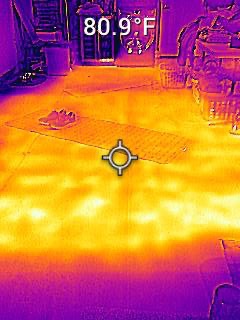
The specification that limits it is the 4,800 pixel sensor. That is the coarsest resolution in the group, and it shows the moment you try to work at distance. Reviewers describe it accurately: this camera is for spotting large temperature differences, not for fine diagnostics or for counting individual defects across a wide wall.
There is no visible light camera, so images lack scene context. When you return to a report two weeks later, a thermal frame of a plain wall tells you very little about where it was taken. MSX helps, but it is working from a limited internal visual reference.
The LCD is also smaller than what most competing models now carry. For a quick sweep that is fine. For reviewing a stored image on site, it is a mild annoyance.
Who the TG165-X suits best
It suits inspectors who want a dependable, always-in-the-bag camera for confirmation shots and quick electrical sweeps, and anyone working in an attic, crawlspace, or panel where a phone-plug model would be dropped or disconnected. The laser pointer is the feature owners mention most often as the reason it beats larger cameras for quick checks.
Homeowners doing a single pre-purchase walkthrough will find it plenty capable for locating cold drafts and obvious insulation gaps.
Where the TG165-X falls short
It cannot resolve small anomalies at distance, so it is a poor choice for thermographic documentation where a client expects a defensible finding tied to a specific defect. Anything requiring a wide, fast scan of a large open space also exceeds what a 4,800 pixel sensor can keep up with.
Buy it as a companion tool rather than as your only camera if report quality is part of your service.
3. HSFTOOLS HP96 Thermal Camera – Best Touchscreen Experience
HP96 Thermal Imaging Camera,3.5″ Touch Screen, Intelligent Scene Detection
96x96 to 240x240 super resolution
3.5 inch touchscreen
Below 50 mK
4 hour battery
Pros
- Large responsive touchscreen works without a laptop
- Five imaging modes including fusion with a 640x480 visible camera
- Users report it turned a single RV inspection into repeatable documentation
- Live super resolution looks clearer than the base sensor
Cons
- No battery strength indicator on screen
- Some early units had battery charging issues
- Does not take moisture readings despite leak detection modes
- Bundled cable will not connect to iOS devices
The HP96 is built around a 3.5 inch touchscreen with a phone-style interface and swipe gestures, and that changes how you work. You can review captured images, switch between modes, and label findings without opening a laptop or waiting for a card to transfer. For inspectors who document on site, that is a bigger practical gain than an extra tier of sensor resolution.
Five imaging modes are offered: thermal, visual, fusion, picture-in-picture, and blending, with eight colour palettes. The dual camera pairing a 96 x 96 IR sensor with a 640 x 480 visible sensor means fusion mode can put a clear reference image beside the thermal one, which makes client reports far easier to read.
IntellFault is the marquee feature: deep-learning scene recognition that flags likely water leaks and insulation gaps. Thermal sensitivity sits below 50 mK and the temperature range spans -4 to 662 degrees Fahrenheit with accuracy within two percent. The rechargeable lithium-ion battery runs up to four hours of continuous use.
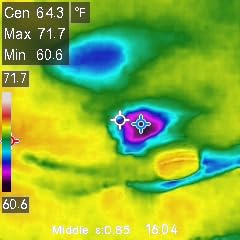
Storage is built in, with eMMC holding roughly 30,000 images and about 20 hours of video, plus microphones for voice notes. The body passed a 6.6 foot drop test and carries an IP54 rating with a standard tripod hole on the base. Dimensions of 2.76 by 4.72 by 7.48 inches keep it pocketable at about 1.5 pounds.
Live super resolution lifts the 96 x 96 sensor to a 240 x 240 display in real time. Owners generally find the result clearer than the native panel, though it is enhancement rather than additional measurement data, and you should treat the base resolution as the true figure when judging fine detail.
The weak points are practical rather than optical. There is no battery strength indicator on screen, which is unsettling on a long attic crawl. A number of early units shipped with charging problems, though the manufacturer’s customer service is repeatedly described as resolving failures with free replacements. The bundled cable also will not connect to iOS devices without an alternative cable.
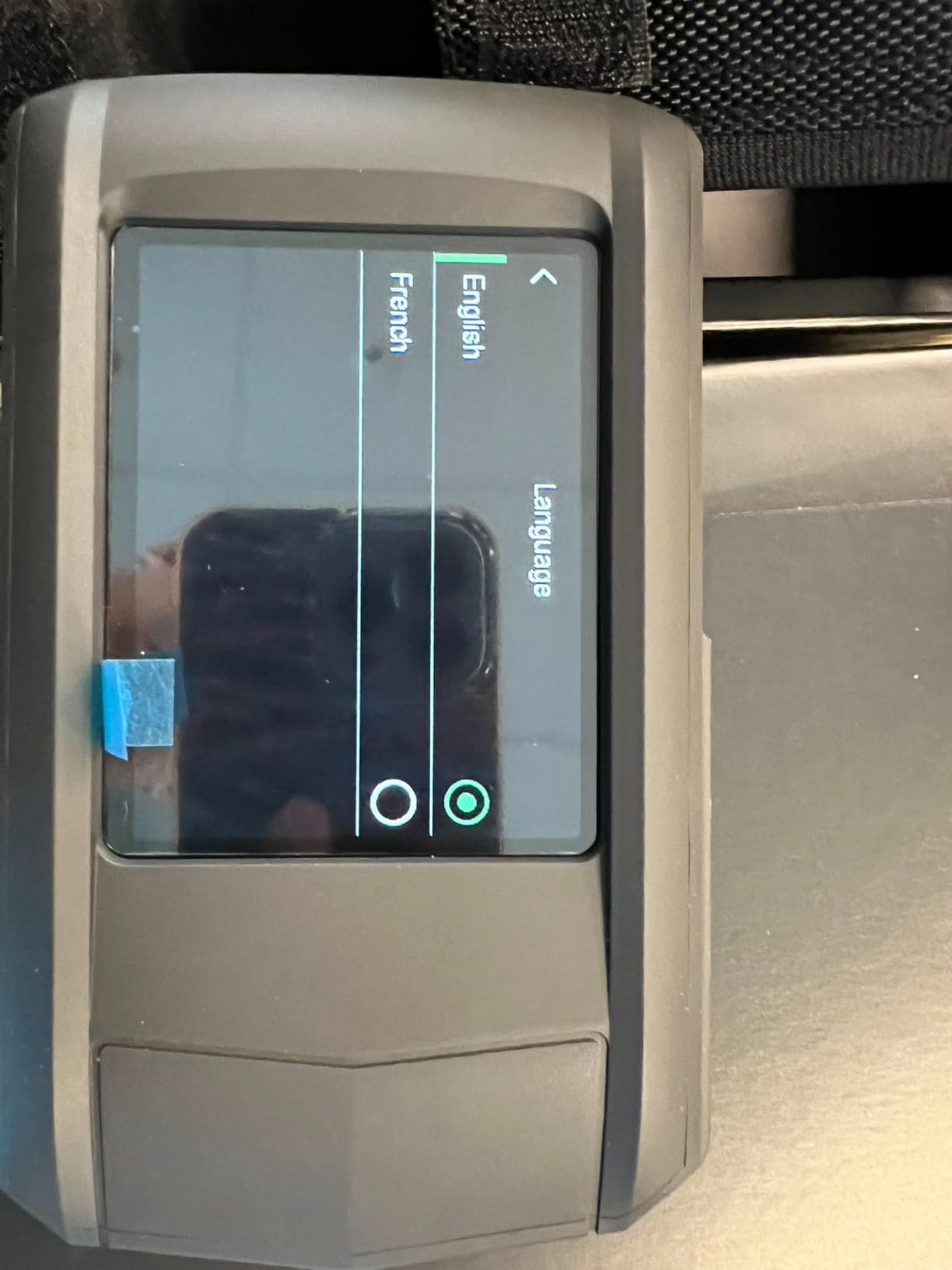
Who the HP96 suits best
It suits inspectors and field technicians who want to review and label images in the field without a laptop, particularly in RV, mobile-home, and small commercial work where documentation has to be repeated consistently. Anyone who finds menu-driven buttons on competing units confusing will appreciate the phone-like interface.
It also works well for homeowners who want a screen large enough to show a family member what the cold streak above a window means.
Where the HP96 falls short
It is a weak tool for quantitative moisture work. Despite having a leak-detection scene mode, the camera has no moisture measurement capability, and treating an anomaly flag as proof of water would be a mistake in a professional report.
Four hours of battery is the shortest runtime among the larger-screen units here, and the super resolution output is not a substitute for true pixels when you need to separate two adjacent defects.
4. AMPBANK H128 Thermal Camera – Longest Battery in the Group
H128 Handheld Thermal Camera, 240 x 240 TISR Resolution, 24h Battery Life Thermal Imaging Camera, 25 Hz Infrared Camera with Temperature Alarm, -4℉~ 842℉ Temp Range, IP65 Protection Level
128x128 to 240x240 TISR
40 mK sensitivity
24 hour battery
-4F to 842F
IP65
Pros
- Marked a roof leak and a failing breaker in owner reported use
- Exceptionally sensitive at 40 mK showing fine detail such as a handprint
- Solid build quality and usable out of the box
- 24 hour runtime supports full day work
Cons
- Display quality is below photo quality and lacks fine detail
- Absolute temperature accuracy reported off by roughly 5 to 7 degrees
- You must approach closely to separate objects
The H128 is the camera you charge once and forget about. Up to 24 hours of continuous working time on a rechargeable cell, plus an intelligent auto-shutdown mode, is the longest runtime in this roundup by a wide margin. If your work involves remote farm buildings, large attics, or a full day of on-site calls, that removes charging from your planning entirely.
Thermal sensitivity of 40 mK is among the most sensitive figures here, and owners report that it picks up extremely fine signals. One reviewer describes seeing a handprint left on a wall, which tells you the sensor resolves small surface temperature differences well rather than only obvious hot and cold zones.
TISR technology elevates the base 128 x 128 panel to a 240 x 240 display. As with all interpolated figures, judge it as a display convenience rather than a measurement claim. Frame rate is 25 Hz, so panning across a room stays smooth, and automatic tracking locks onto the maximum, minimum, and centre temperatures with an audible temperature alarm.
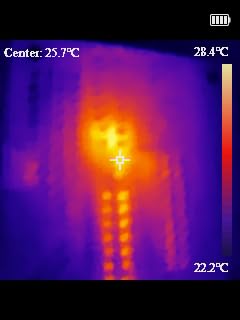
The -4 to 842 degree Fahrenheit range covers most residential work including hot attic conditions, and accuracy is quoted at three percent with 0.1 degree resolution. Build quality is solid, the body carries an IP65 rating which is a higher ingress rating than most of the IP54 units in this list, and it is drop rated to 6.56 feet with a tripod mount for fixed-position scans.
The recurring criticism concerns the display rather than the sensor. Owners consistently say the screen falls short of photo quality and lacks fine detail, which makes on-site review of stored images frustrating even when live capture looks good.
Absolute accuracy is also reported to run roughly 5 to 7 degrees off in some conditions. For residential work that matters less than people expect, because the finding is almost always a temperature difference against the surrounding surface rather than an exact value. But it is a real reason not to use this camera to certify a specific electrical temperature against a code threshold without corroboration.
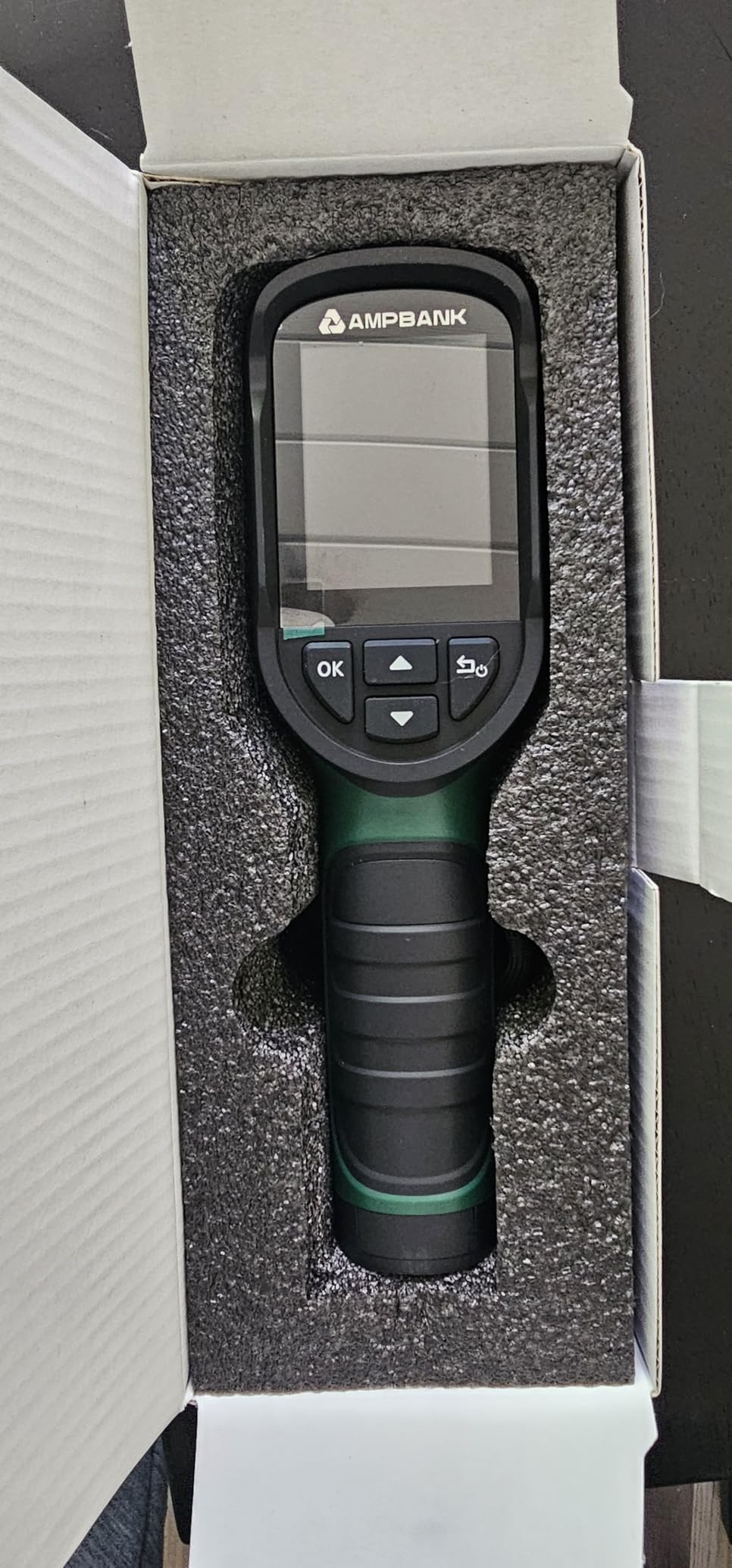
Who the H128 suits best
It suits inspectors and technicians who cover long days away from a charger, and users report it finding roof leaks, insulation gaps, and overheating breakers in real jobs. At 1.06 pounds with a tripod mount, it also works as a fixed camera when you want to watch a temperature differential over time rather than take a single reading.
It is a strong first thermal camera for a homeowner who wants one tool for a whole property walkthrough rather than a short task.
Where the H128 falls short
Because the 128 x 128 base panel is small, you have to walk close to a target to separate two distinct objects. That makes it a poor fit for scanning a large open-plan room or a high attic from the hatch, where a wider sensor would cover more surface per frame.
Combined with the sub-par screen and the accuracy drift, it is better suited to finding patterns than to producing precise numbers for a report.
5. MiLESEEY TR10 Thermal Camera – Best True Sensor Under Mid Tier
MILESEEY TR10 Thermal Imaging Camera, 192 × 192 IR Resolution, 25Hz
192x192 native sensor
NETD below 50 mK
25Hz refresh
8GB storage
-4F to 1022F
Pros
- Genuine 192x192 native resolution
- Strong 4.5 average across 482 reviews
- High and low alarms plus auto spot readouts speed anomaly spotting
- 8GB onboard storage removes the need for external cards
Cons
- 8 hour battery is shorter than the 24 hour class leader
- Wired connection only for file transfer
- No visible light camera or scene detection
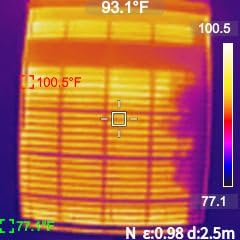
Most cameras at this tier advertise an enhanced resolution figure produced by software. The TR10 does not. It carries a genuine 192 x 192 sensor, and combined with a NETD below 50 mK that makes it the sharpest genuinely native panel among the more affordable units here. That distinction matters more than it sounds, because interpolation smooths edges but cannot invent thermal detail.
The 25 Hz refresh rate keeps live scanning smooth, which directly addresses the most common complaint in owner feedback about entry-level cameras: a low frame rate makes it hard to pan across a room and spot what you are looking for. Here, moving from wall to wall produces continuous imagery rather than a stuttering sequence.
Spot measurement is automatic. The unit locks and displays the maximum, minimum, and centre point temperatures, and a high and low alarm fires when an anomaly crosses a threshold, so you can sweep a large surface quickly without stopping to check the display. Emissivity is adjustable by material, which is the single most useful setting for accurate readings on painted or coated surfaces.
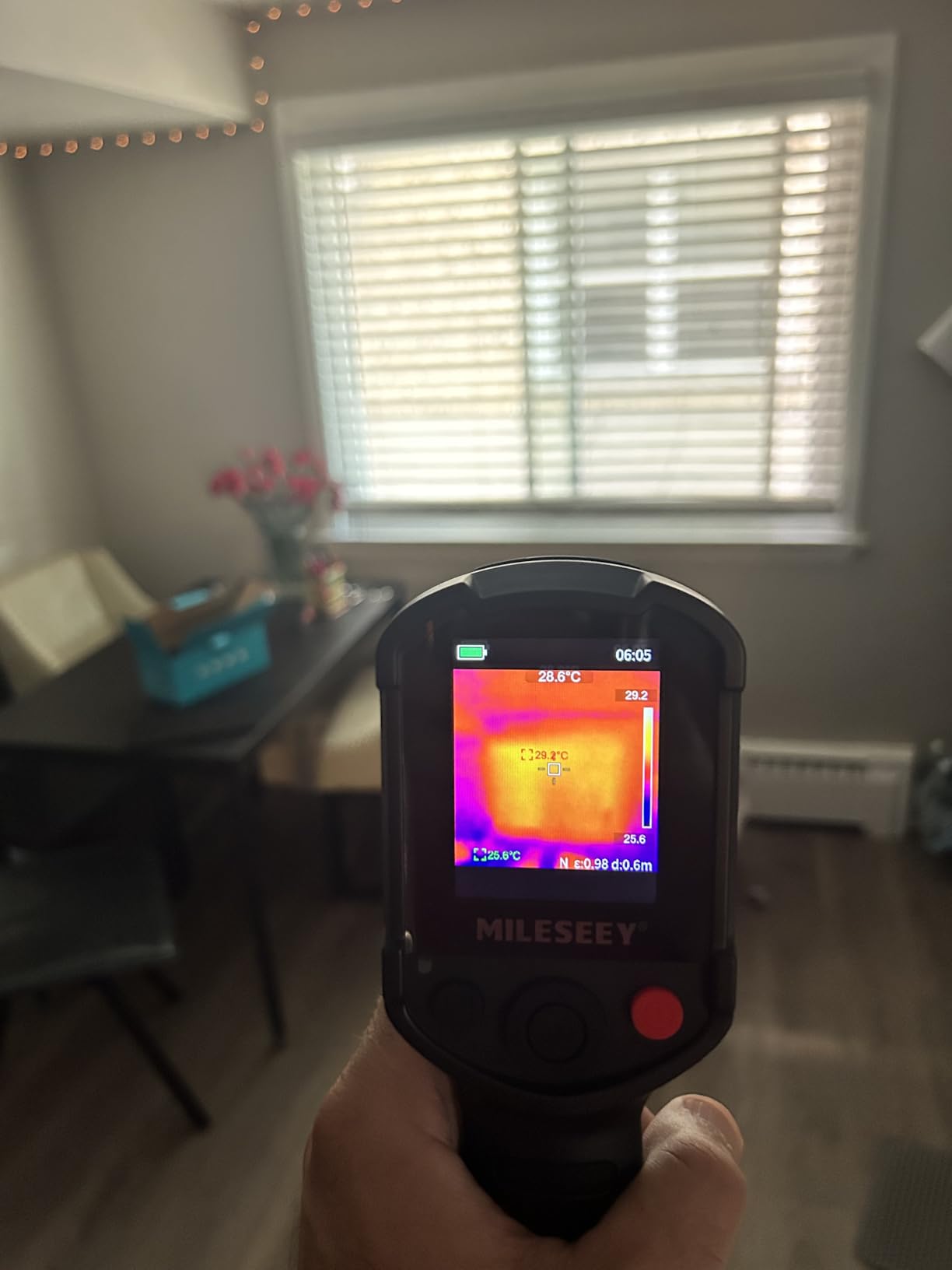
The measurement range is wide, from -4 to 1022 degrees Fahrenheit, with accuracy quoted at two degrees Celsius. Storage is 8GB built in, holding more than 30,000 pictures, and the body passed a 6.6 foot drop test with a recessed lens for protection. Connectivity is wired, and the box includes a charger, instruction manual, and the imager itself.
Rating is the other story here. The 4.5 average across 482 reviews is among the strongest results in this group, and reviewers single out the genuine panel and the temperature alarm as the features they use most.
The trade-offs are honest ones. An eight hour battery is roughly a third of what the H128 delivers, and wired-only file transfer means more cable management than a Wi-Fi model requires. There is also no visible light camera, so there is no fusion view and no scene-detection assistance.
Who the TR10 suits best
It suits inspectors and energy auditors who want real sensor detail and a fast sweep without paying for a large display or a cloud platform. The alarm-driven workflow is genuinely productive in an attic or crawlspace where lighting is poor and you need your attention on the ceiling rather than the screen.
For a homeowner buying one camera to use for years on a range of properties, the native resolution and long measurement range make it a safer long-term choice than an interpolated model.
Where the TR10 falls short
Wired-only transfer is a genuine friction point if you want to review images on a phone or tablet, and the eight hour battery limits full-day remote work. Without a visible camera, the images also carry less scene context, which makes them harder to explain to a client.
If your workflow depends on annotated cloud reports, you will need to handle that in separate software rather than in a companion app.
6. HSFTOOLS HF96V Thermal Camera – Best for HVAC and Refrigeration Work
HF96V Thermal Camera with Visual Camera & Laser Pointer, Intelligent Scene Detection, 240 * 240 Super Resolution Thermal Imaging Camera,25 Hz, 50° FOV, -4°F to 1022°F, IP54 Infrared Camera
96x96 IR plus 640x480 visible
Laser pointer
25Hz and 50 degree FOV
11 hour battery
IP54
Pros
- Maintenance technicians use it to document fridges
- HVAC units and water intrusion
- Button controls are straightforward with the manual
- Laser pointer locates the exact spot in dark or confined spaces
- Fusion view shows the object alongside its temperature
Cons
- Base IR sensor is only 96x96 limiting fine detail
- Screen resolution is low which softens the image
- Will not charge from most third-party USB-C cables
- Weak or inconsistent on-screen interface
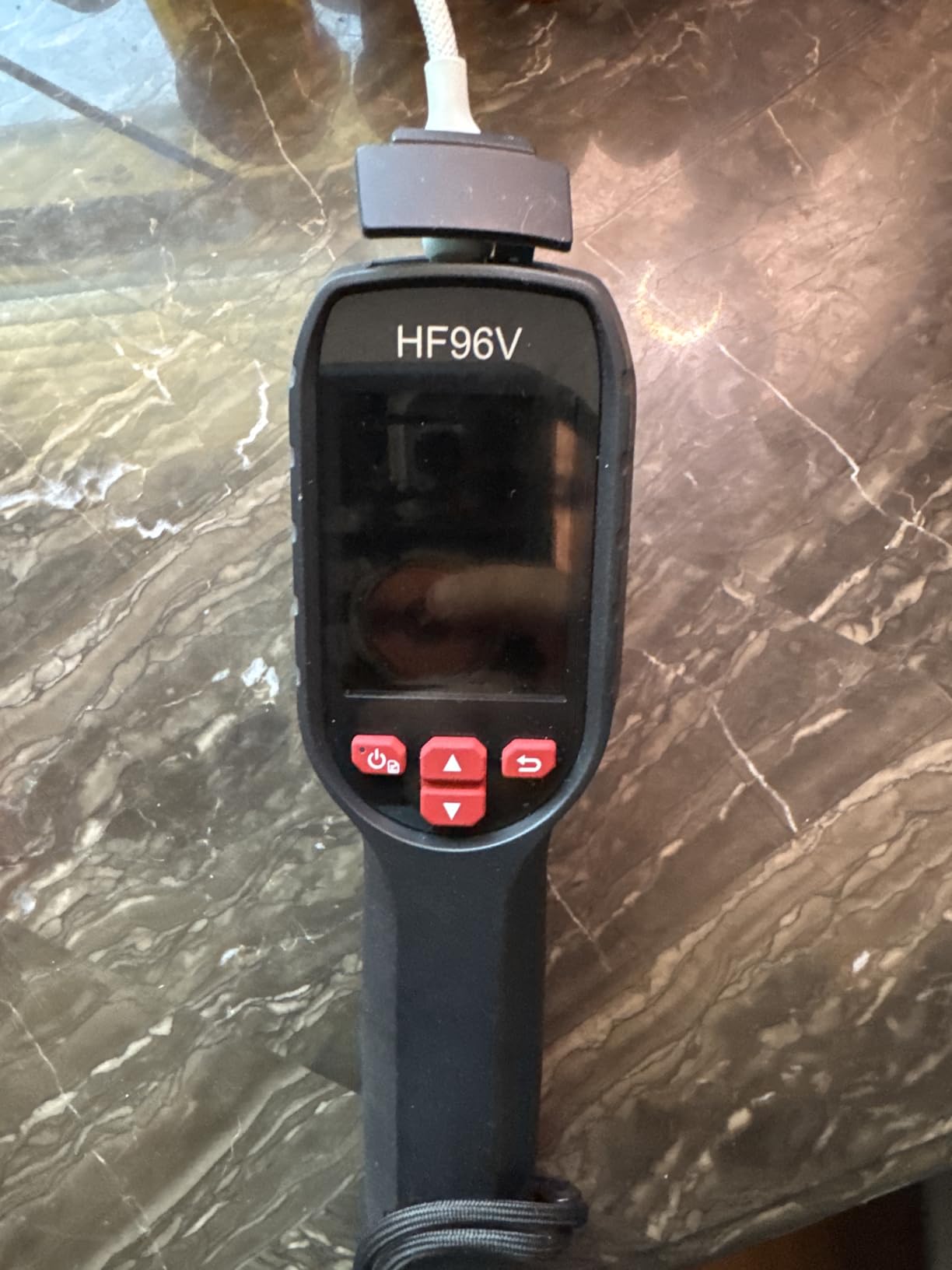
The HF96V is a camera built around a simple premise: put a thermometer, a thermal sensor, a visible camera, and a laser pointer in one handheld. Electricians, plumbers, and maintenance technicians use it to document fridges, HVAC units, and water intrusion with photographs, and the 50 degree field of view covers a meaningful area per sweep.
IntellFault deep-learning scene detection flags likely water leaks and insulation gaps, and the same three imaging modes as the larger HSFTOOLS model are provided: fusion, thermal, and visual, across seven selectable colour palettes. The -4 to 1022 degree Fahrenheit range with accuracy within 3.6 degrees is wide enough for both cold supply lines and warm equipment.
HSF Studio for Windows handles analysis, screen projection, and three-dimensional plotting, which is a genuinely useful addition when you need to show a client how heat is moving through a duct run. Storage is 4GB internal, enough for over 30,000 images and 14 hours of video.
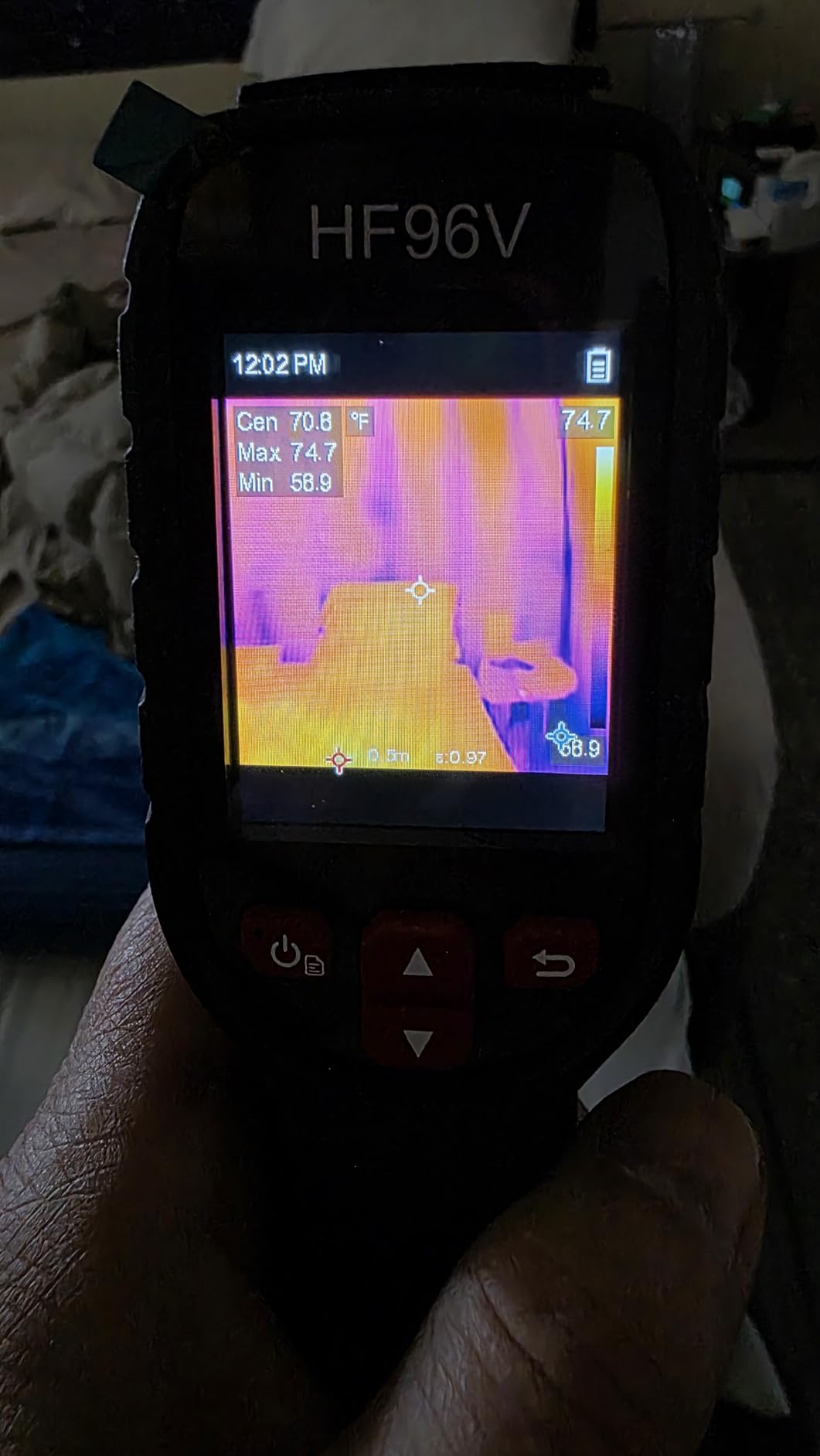
The 11 hour rechargeable battery is a step up from most competitors in this band. The enclosure passed a 6.6 foot drop test and carries IP54 protection, with a tripod hole for fixed setups. Weight is around 1.32 pounds, and dimensions of 3.8 by 6.3 by 10.4 inches make it larger than the pocket units but manageable in one hand.
Two practical quirks catch people out. It will not charge from most third-party USB-C cables, only the included one, so a spare cable from your phone bag will do nothing. The on-screen interface is also described by owners as weak and inconsistent, which is the main argument for preferring the HP96 touchscreen if you are doing a lot of on-site review.
And the base infrared panel is 96 x 96, lifted to 240 x 240 by live super resolution. That is fine for the gross anomalies HVAC work produces, since a leaking duct or a failed contactor is not a subtle finding. It is not fine for fine diagnostics.
Who the HF96V suits best
It suits HVAC and refrigeration technicians who need to document equipment, and inspectors who want a laser pointer for dark attics and closed panels. The button-based controls are straightforward with the manual, which makes it a good choice for anyone who finds touchscreen menus fussy on a cold or gloved hand.
Owners report uploading screenshots directly into client reports, which is a practical advantage when HSF Studio is more than you need.
Where the HF96V falls short
The 96 x 96 base sensor and low screen resolution together mean you should not expect to separate adjacent small anomalies, and the picture looks softer than the live sensor count would suggest. The USB-C charging restriction is an avoidable annoyance that will cause a dead camera on a long day if you forget the original cable.
For residential envelope work where subtle insulation defects are the target, the TR10 or the Thermal Master Thor002 will serve you better.
7. Flagfront Thermal Camera – Best for Homeowner Walkthroughs
Flagfront Thermal Camera, 240 x 240 TISR Resolution for Home Inspection
240x240 TISR imaging
25Hz frame rate
Temperature alarm
6.6 ft drop and IP54
Pros
- Homeowner used it to find ceiling heat loss
- roof leaks and computer overheating
- Temperature alarm and spot readouts focus attention on anomalies fast
- Survives repeated drops and holds charge through long sessions
- Bright screen and simple menus usable without training
Cons
- Lens cover will not stay propped open and can block the sensor
- 240x240 TISR output is interpolated leaving images soft
- No protective carry case included
The Flagfront is the simplest way to get a working thermal imager for a pre-purchase walkthrough or for tracking down heat loss in your own home. Reviewers report using it to find ceiling heat loss, roof leaks, and an overheating computer, which covers the three things most homeowners actually want to know about a property.
Operation requires almost no learning. The screen is bright, the menus are straightforward, and the built-in temperature alarm flags abnormal high and low readings while the on-screen readout tracks the highest, lowest, and centre points. That combination lets a non-specialist sweep a room quickly and still come away with something actionable.
Adjustable distance and emissivity settings are both present, which is more than many cameras in this price band offer, and they are the two settings that most affect whether a reading means anything. The measurement range runs from -4 to 1022 degrees Fahrenheit with accuracy within two percent, across six colour palettes and a 50 degree field of view.
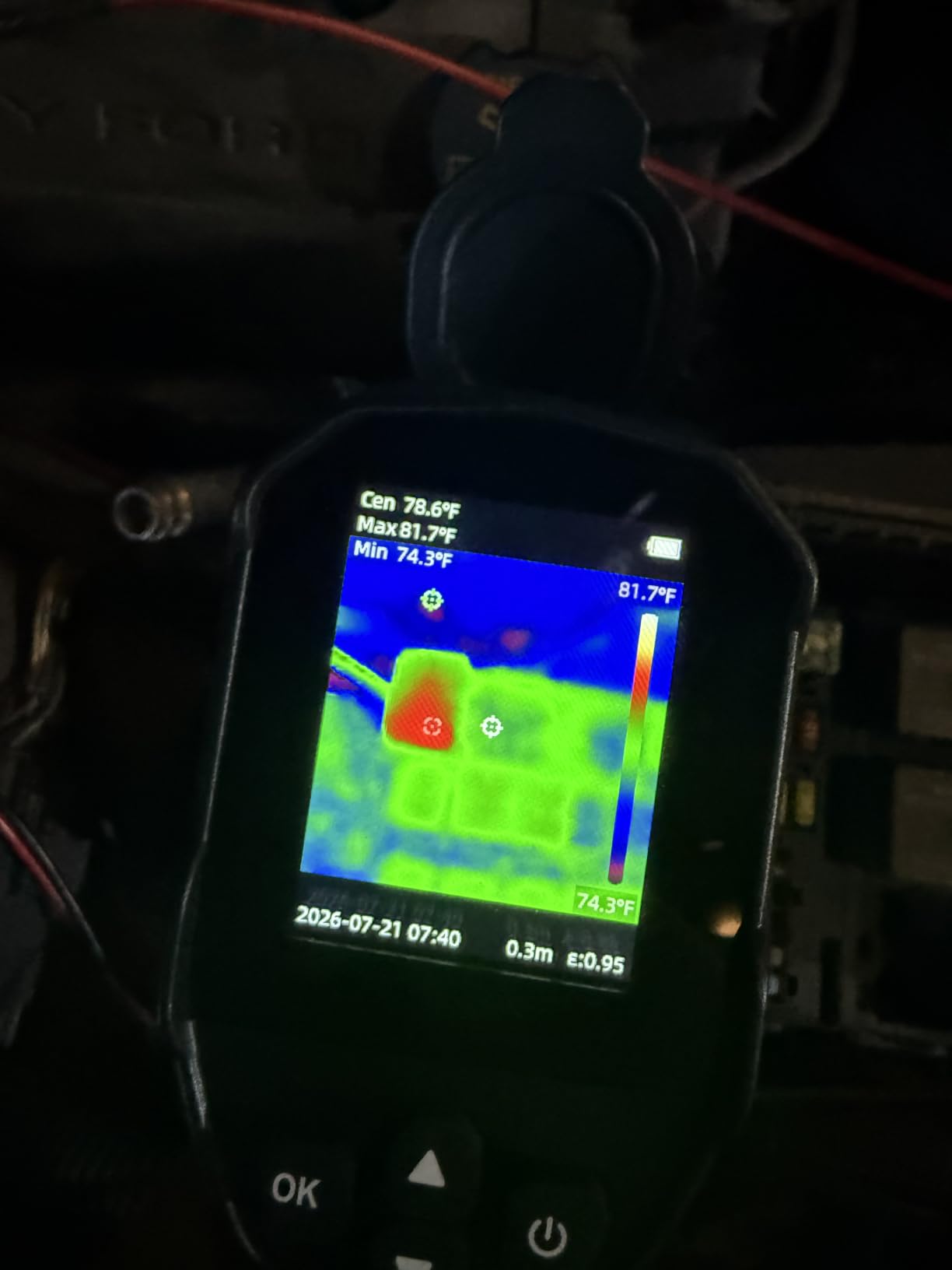
Durability is handled: a 6.6 foot drop rating and IP54 dust and water resistance, with a rechargeable battery that holds up through extended sessions. It ranks strongly in its category, which is consistent with how often owners report it being the first thermal camera they buy.
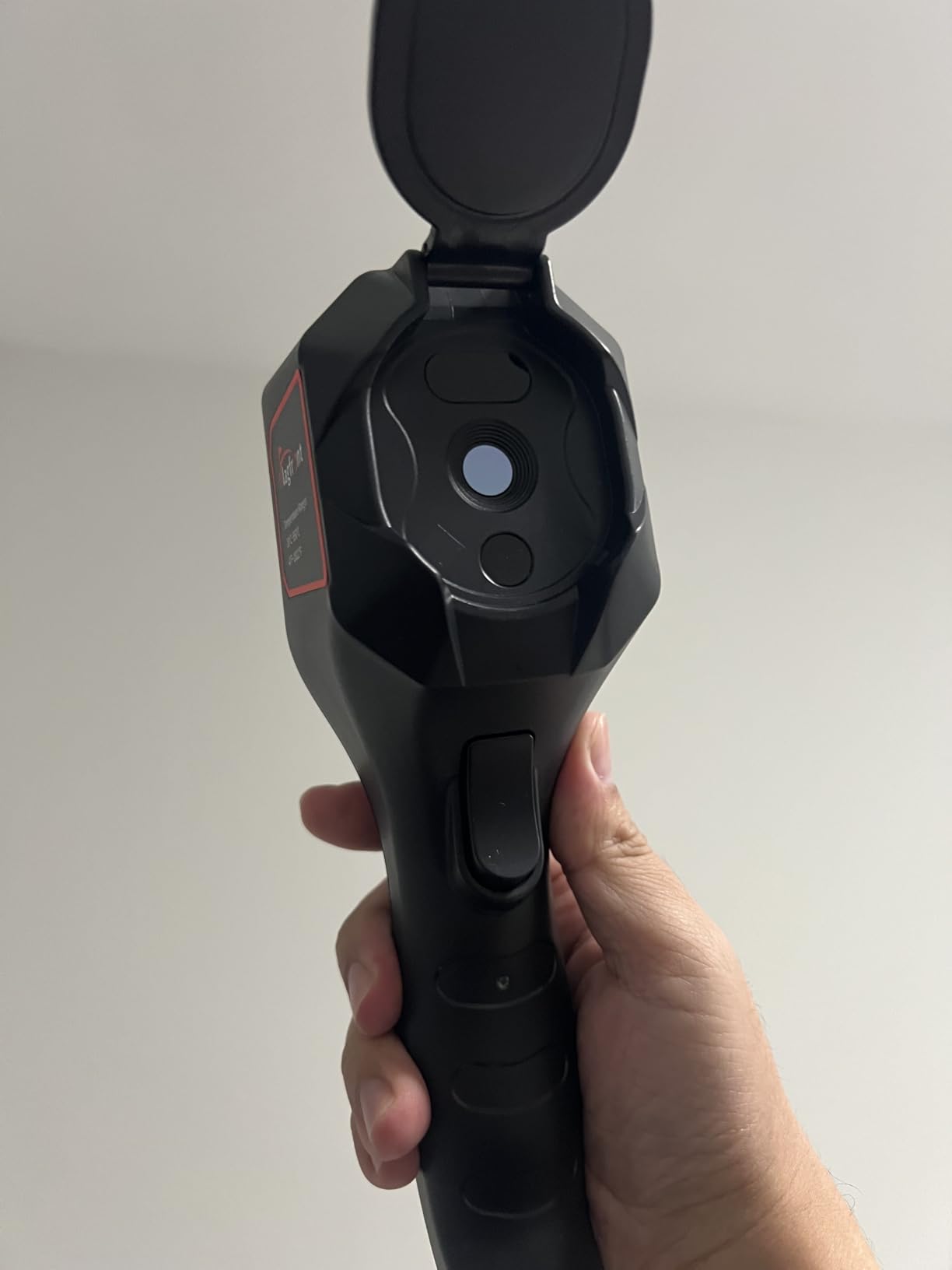
The lens cover is the flaw to know about. It will not stay propped open, and if it swings shut while you point the camera downward, it can block the sensor and produce a blank or misleading frame. Several owners mention it specifically, so treat it as a handling habit rather than a defect: check the image before you walk away from a spot.
As with most units at this level, the 240 x 240 figure is TISR interpolation, so images come out soft or fuzzy when you look closely. And there is no carry case in the box, which you will notice the first time it needs protecting in a truck.
Who the Flagfront suits best
It suits a homeowner doing a pre-purchase walkthrough, checking a rental for cold drafts, or monitoring an older property for insulation problems. It also works as a secondary tool for an inspector who wants an inexpensive unit for quick roof leak and HVAC checks on a budget.
The bright screen and obvious menus mean it can be handed to a family member or a buyer without a training session, which is unusual at this level.
Where the Flagfront falls short
It is not a reporting tool. With no Wi-Fi workflow and interpolated imagery, images are fine for your own notes and weak as evidence in a professional document. The lens cover problem also makes it a poor choice for repeated overhead work where you are constantly tilting the camera downward.
If you want documentation rather than diagnosis, step up to the TR10 or the FOXWELL models instead.
8. Thermal Master Thor002 – Best True Resolution for Professional Work
Thermal Master Thor002 Handheld Thermal Camera, 512 × 384 X³ Resolution
512x384 X3 enhanced sensor
40 mK sensitivity
3.5 inch 640x480 IPS
10.5 hour battery
Pros
- Highest true thermal resolution in this group with 40 mK sensitivity
- Brighter 640x480 IPS screen makes subtle anomalies easier to see
- Six point measurement plus WiFi and USB transfer support professional reporting
- Long 10.5 hour battery with fast charging
Cons
- Heaviest camera here at 3.12 pounds and noticeably bulky
- Costs several times more than entry-level 240x240 units
- High resolution does not add moisture meter capability
Everything else in this roundup runs a 96 x 96, 128 x 128, 160 x 120, or 192 x 192 panel, several of them upscaled in software. The Thor002 is the outlier. Its X3 enhanced output of 512 x 384 comes from a 256 x 192 native sensor, which is still the largest genuine panel here, and the resulting images hold detail on individual conductors that nothing else in the list can match.
Thermal sensitivity of 40 mK matches the most sensitive units available, which is what lets it resolve small differences across a loaded panel rather than only the obvious failures. The 3.5 inch 640 x 480 IPS display is bright enough to work in an unlit attic, and a 2 MP visible camera covers the scene context that budget cameras lack.
Measurement is professional grade. Six-point measurement includes the centre point, the hottest point, the coldest point, and three user-defined spots, so you can capture a complete delta-T picture in a single frame instead of stepping around the component taking separate readings.
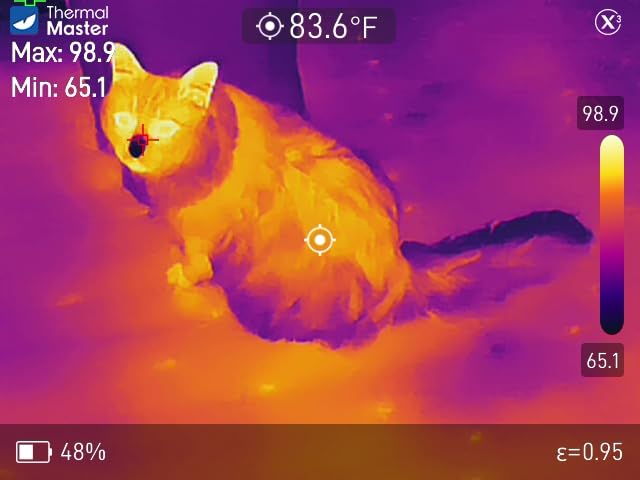
The 4.3mm lens extends detection range by 34.4 percent with 4x digital zoom, which matters when you want to stay back from a hot surface or scan a high ceiling from the hatch. A smooth 25 Hz refresh rate keeps live panning clean, and a 5000 mAh battery runs up to 10.5 hours with 18W fast charging.
For reporting, USB real-time streaming to a PC and Wi-Fi pairing with smartphones and tablets are both supported. Voice notes and QR code file management are included, and both are the kind of detail that only shows its value once you have written several reports. Protection is IP54 with a 2 metre drop rating, plus laser positioning.
At 3.12 pounds and 10.24 by 4.33 by 4.13 inches, it is by far the heaviest camera here, and the price sits well above the entry-level 240 x 240 units. That is the trade for real pixels, and it is a trade worth making if thermography is a significant part of your work rather than an occasional check.
Who the Thor002 suits best
It suits professional inspectors, electricians, and energy auditors who scan electrical panels under load and need to separate individual hot spots in a crowded enclosure. Owners praise the brighter screen for spotting subtle anomalies and the six-point measurement for making a report defensible without repeated shots.
If you are building toward Level 1 thermography certification, a camera that shows you real detail is a better foundation than one that interpolates it.
Where the Thor002 falls short
It is a large, heavy instrument. A full day of attic and crawlspace work with it on a lanyard is tiring in a way a 190 g camera is not, and the resolution advantage is wasted on gross findings you could read on a budget unit.
And no amount of resolution turns it into a moisture meter. If your work involves confirming water intrusion, you still need a separate tool.
9. FOXWELL RT280 Thermal Imaging Camera – Best for DIY Energy Scans
FOXWELL RT280 Thermal Imaging Camera, 320 x 240 2.8″ LCD, 240 x 180 TISR
120x90 native with 240x180 TISR
2.8 inch 320x240 LCD
25Hz
Windows report software
Pros
- Intuitive enough to use straight from the box
- Laser pointer and LED work light are useful in attics and dark panels
- Users traced radiant heat pipework and dryer exhaust paths through walls
- Ample 8GB storage for documentation
Cons
- Advertised 240x180 is software upscaled from a 120x90 sensor
- Image can judder when panning quickly
- Bundled PC software is basic and Windows-only
- Bright and reflective surfaces can register as false heat
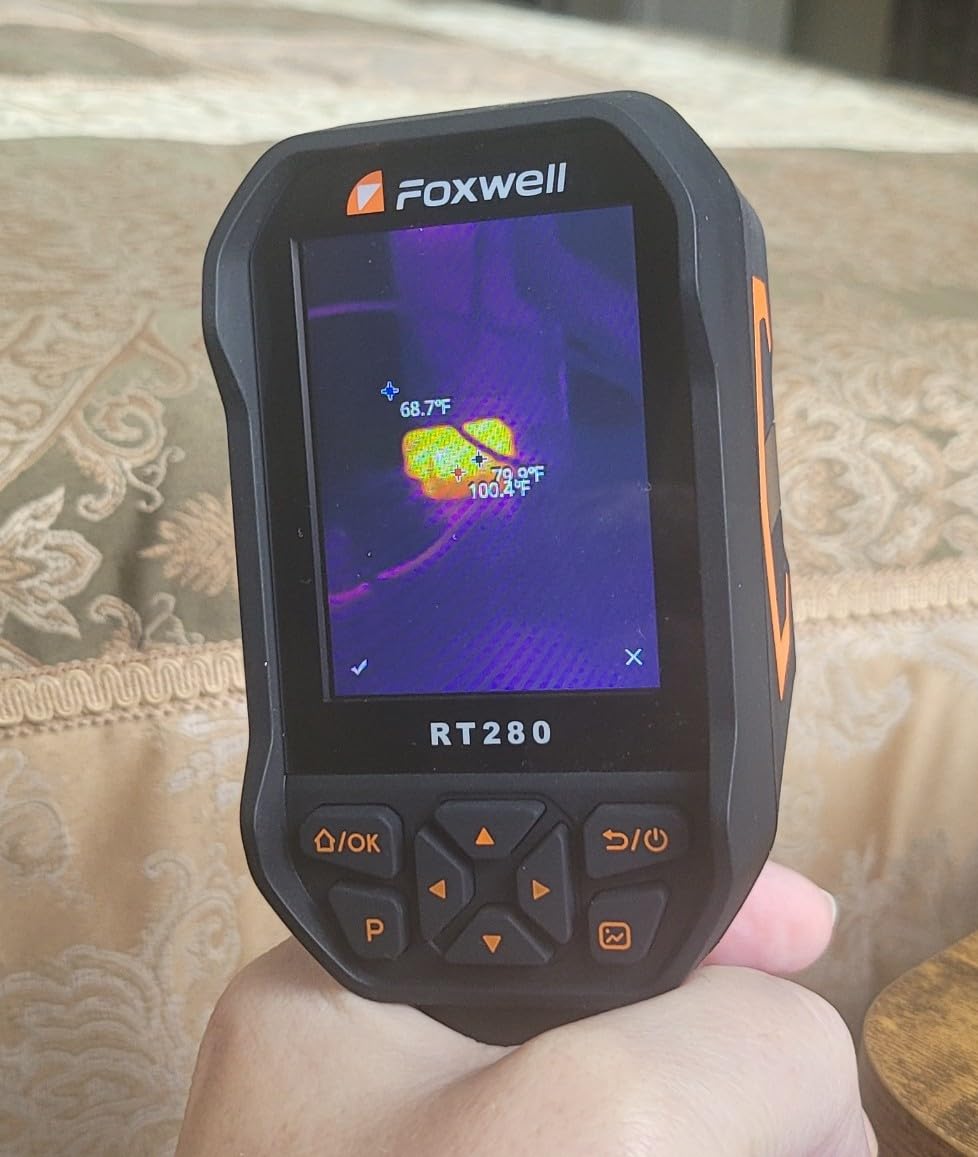
The RT280 covers more bases than its sensor suggests. The headline 240 x 180 output is TISR enhancement from a 120 x 90 native panel, so treat the true resolution as modest, but the package around it includes a laser pointer, an LED work light, nine colour palettes, and PC software that does point, line, and area analysis with two and three-dimensional imaging and report generation.
That combination suits tracing heat through a building. Users report following radiant heat pipework and dryer exhaust paths through walls with it, which is exactly the kind of investigation that pays for itself during a pre-purchase walkthrough. The laser and LED combination earns its place in attics and dark panels where the screen is the only light source anyway.
The 2.8 inch 320 x 240 LCD is small but sharp, the 25 Hz frame rate is adequate, and automatic detection of the highest, lowest, and centre points with high and low alarms keeps the sweep fast. The 50 by 38 degree field of view is a little narrower than some alternatives, and storage is 8GB eMMC holding more than 20,000 images.
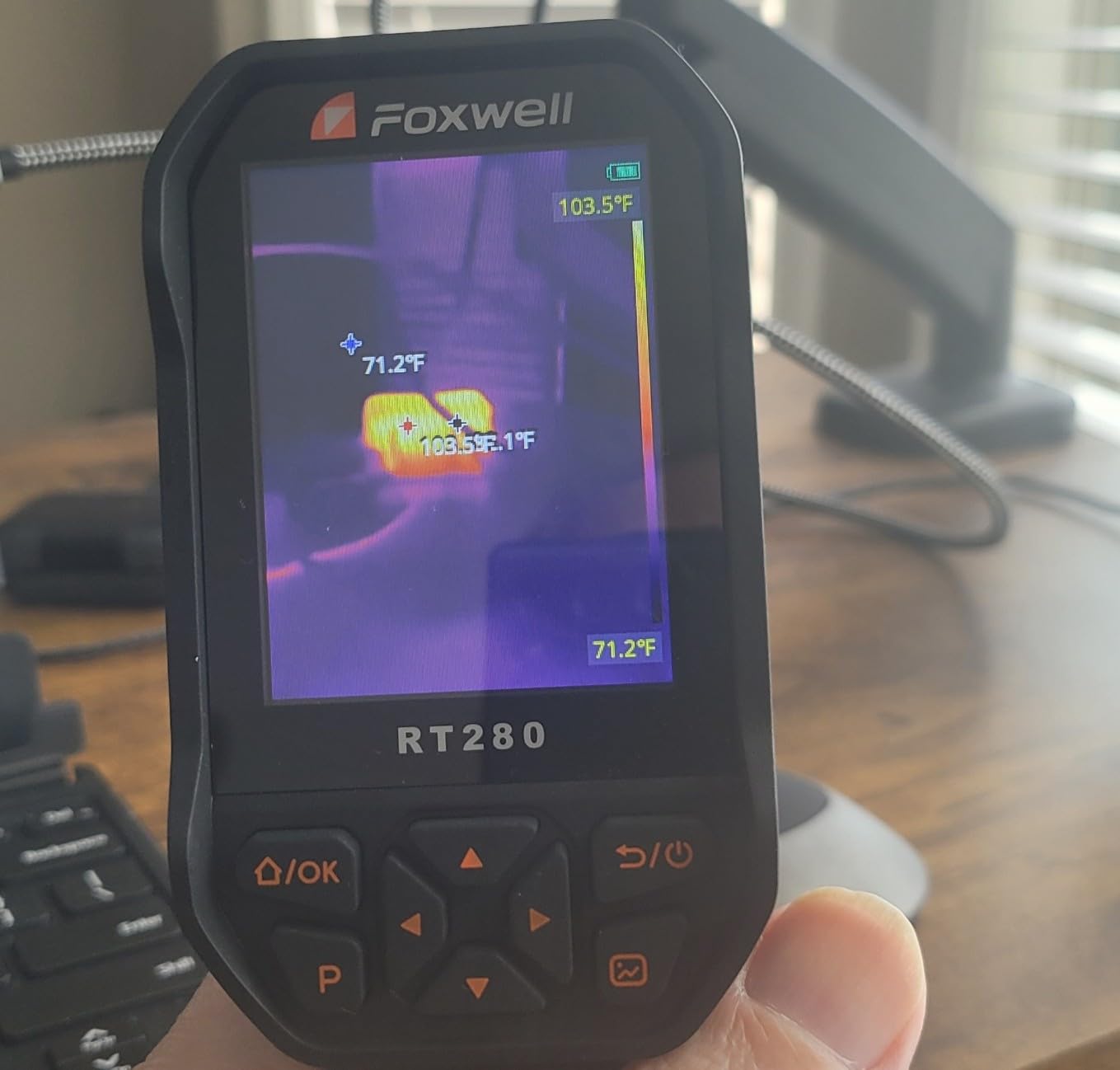
Accuracy is quoted at 3.6 degrees or two percent, with a -4 to 1022 degree Fahrenheit range. The body passed a 6.6 foot drop test and carries an IP54 rating, and owners describe a robust feel that matches a camera they can toss in a truck without a case.
The honest limitation is the interpolated resolution. When you look at a 320 x 240 screen showing 240 x 180 of enhanced data from a 120 x 90 sensor, the softness shows up at distance, and the 25 Hz rate can judder when you pan quickly across a large space.
The bundled software is Windows-only and basic. It produces a report, but it is not the cloud workflow that FLIR Ignite provides, so expect to do the client-facing formatting yourself. Bright light sources and reflective surfaces, such as a window or a polished floor, can also register as false heat if you do not account for reflected apparent temperature.
Who the RT280 suits best
It suits homeowners and tradespeople who want to understand where heat moves through a property. Tradespeople and homeowners alike call it intuitive enough to use without reading a manual first, and the laser plus LED combination makes it practical in the dark spaces where energy problems usually hide.
It is also a reasonable second camera for an inspector who wants on-device 2D and 3D analysis without a recurring software subscription.
Where the RT280 falls short
The interpolated sensor means it should not be used to identify small or closely spaced defects, and Mac users get no bundled software at all. Anyone building a client-facing report pipeline will find the basic Windows tool limiting compared with a cloud platform.
If image quality drives your decision, the Thor002 gives you real pixels for a similar kind of money at the top of the range.
10. FOXWELL HT280 Thermal Imaging Camera – Widest Field of View
FOXWELL HT280 Thermal Imaging Camera, 320 X 240 2.8″ LCD, 260 x 260 TISR
260x260 TISR enhancement
50 by 50 degree FOV
50 mK sensitivity
8 hour battery
Pros
- Highest average rating in the group with 80 percent five-star reviews
- Largest enhanced resolution among the FOXWELL models
- Wider 50 by 50 degree field of view covers more area per sweep
- Configurable auto power-off supports full inspection days
Cons
- Smallest review base at 91 ratings so long-term reliability is less proven
- Narrower temperature ceiling than models reaching 1022F
- Software analysis is Windows-only
- Tripod supported but not included
The HT280 is the newest camera in this group and carries the highest average rating at 4.7, with 80 percent of reviewers giving it five stars. That score rests on the smallest review base here at just 91 ratings, so treat the rating as encouraging early feedback rather than a long-term reliability record.
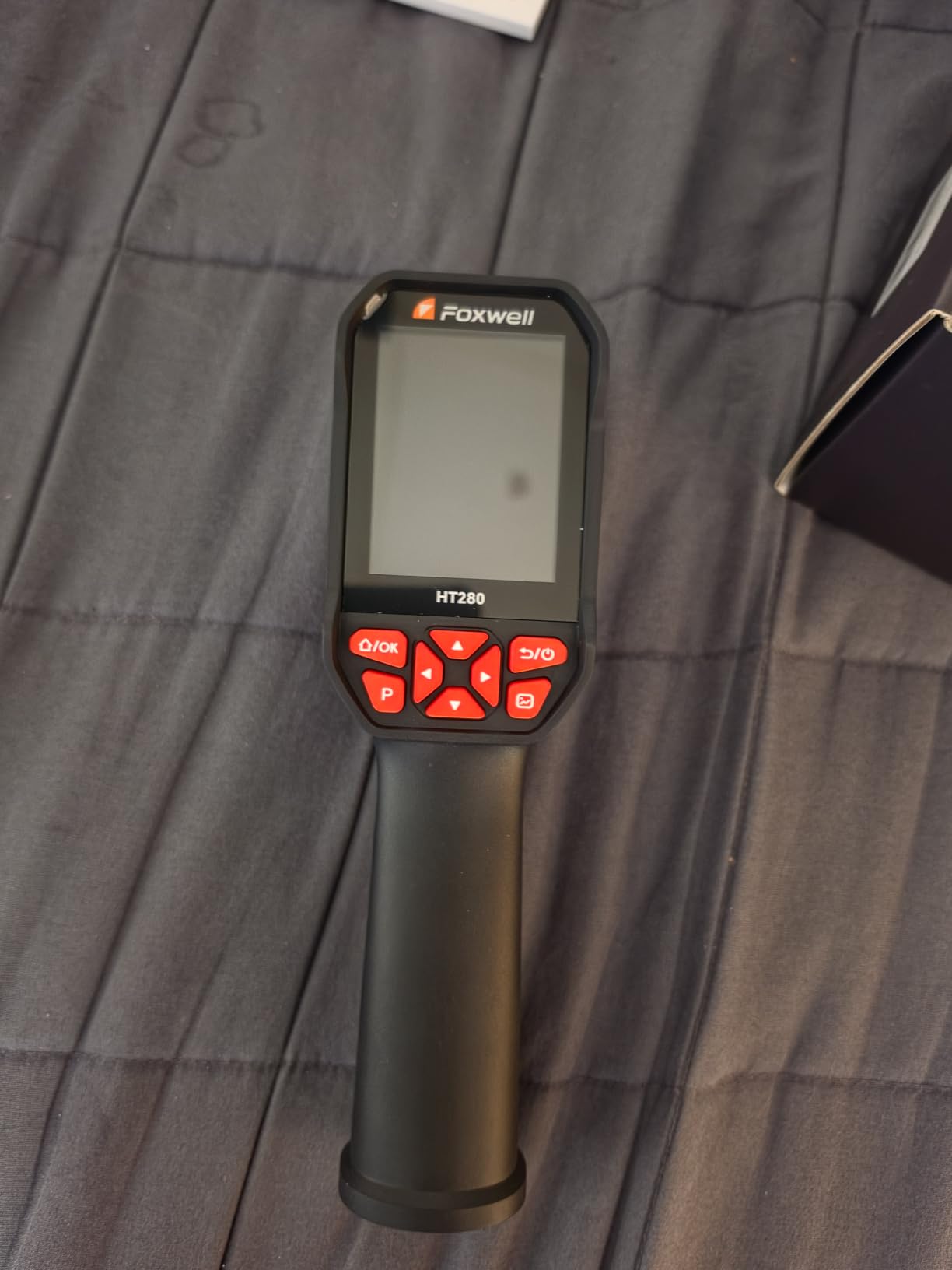
What it does well is coverage. A 50 by 50 degree field of view is the widest in this roundup, which means each frame captures more of a wall, ceiling, or mechanical room, and a 260 x 260 TISR enhancement gives a clearer result than the RT280 beside it. For building envelope work where you are trying to cover a large area quickly, that combination is a real practical advantage.
Thermal sensitivity is 50 mK at a 25 Hz frame rate, and the range runs from 14 to 932 degrees Fahrenheit with accuracy of 3.6 degrees or two percent. Automatic detection of the highest, centre, and lowest points is supported alongside preset temperature alarms, and there are nine colour palettes with adjustable distance and emissivity.
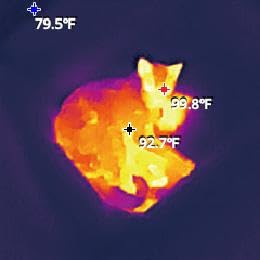
Automatic power-off is configurable at 5, 10, 30, or 60 minutes, and the eight hour battery covers a full inspection day for most users. Storage holds more than 20,000 images or videos, and the interface is available in eleven languages. The body is drop rated to 6.6 feet with an IP54 rating.
The Windows PC software again provides point, line, and area analysis with two and three-dimensional views and report generation, so the analysis side is identical to the RT280. There is no Mac support.
Two limitations stand out. The temperature ceiling of 932 degrees Fahrenheit is lower than the 1022 degree maximum on several cheaper models, which occasionally matters on very hot attic conditions. And although the body accepts a tripod, none is included, so a fixed-position scan requires buying one separately.
Who the HT280 suits best
It suits building and HVAC inspection work where covering area quickly matters more than isolating tiny anomalies. Early owner feedback centres on clarity from the 260 x 260 enhancement and the wide field of view for envelope and mechanical room scans.
It is also a reasonable choice for an inspector who wants a second, higher-rated unit for large-area work alongside a more sensitive camera for panel diagnosis.
Where the HT280 falls short
Ninety-one ratings is a thin base, and newer camera designs do sometimes need a firmware revision or two before they settle. If reliability over a long career is your priority, the review count on the FLIR units is a meaningful difference.
At 50 mK it is also less sensitive than the 40 mK units here, and the lower temperature ceiling plus Windows-only software narrow its appeal for anyone working very hot spaces or on a Mac.
What Thermal Imaging Finds in a Home Inspection?
Thermal imaging earns its place in an inspection by converting invisible differences into a picture a client can understand. Understanding what it finds, and what it physically cannot find, prevents the most common failure: reporting an anomaly as a defect when it is an artifact.
On roofs and in attics, wet or missing insulation reads as a cold patch against a warm deck. On electrical panels under load, a high-resistance connection reads hot, as does an overloaded conductor or a multi-phase imbalance. HVAC and duct work shows up as temperature banding along a trunk line, and plumbing leaks appear as a cool trail along a run or behind a wall finish.
For the envelope, thermal imaging finds insulation defects, missing air sealing around penetrations, and cold bridges at framing members, plus failed window seals that produce a distinct cold edge pattern. Bathroom exhaust fans that are not venting outside leave a telltale warm plume in the ceiling cavity.
To slow heat escaping a home rather than find it, our picks for insulated thermal door curtains and cellular blackout thermal shades target the same drafts from the other direction.
Now the limits, which matter as much as the applications. A thermal camera cannot see through a wall. It reads surface temperature only, so moisture inside framing is invisible until it wets the surface or shows as a thermal pattern consistent with one. Solar loading can make a shaded wall read as a defect that disappears the next day, and wind strips heat from a surface in ways that mimic air leakage.
Emissivity is the other big source of error. Shiny metal, glass, and some painted surfaces reflect the environment and return a reflected apparent temperature rather than the true surface temperature, which is why every camera here offers an adjustable emissivity setting and why you should set it before you trust a number.
Thermal Camera vs Pin Moisture Meter: When to Use Which
Direct answer: use a thermal camera to find where a problem might be across a large area quickly, and use a pin moisture meter to confirm whether water is actually present. The two tools answer different questions, and the most common inspection error is using only one of them.
A thermal imager measures surface temperature across thousands of points at once. It is excellent at screening a wall, ceiling, or floor in seconds and pointing you toward the area that deserves a closer look. It will happily show you a cold anomaly caused by an air gap, a failed seal, a cold water pipe, or a missing section of insulation, and it cannot tell you which of those it is.
A pin moisture meter gives you a numeric moisture content reading at a specific point, which is what you need to confirm a leak or elevated moisture before you write it into a report as a defect. It is slow, it only tells you about the spot you pushed into, and it requires you to already suspect where to push.
For evidence in a report, a radiometric image with spot temperatures and a defensible temperature differential carries far more weight with a client than a sentence describing dampness. That is the main reason to choose a camera that saves real measurement data rather than plain images.
Set the emissivity correctly, wait for the building to reach a steady state, and control your load conditions before you capture. A panel scanned with no load on it tells you nothing, and an exterior wall read within a few hours of sunset can mislead you entirely. The camera is a measurement instrument, not a camera, and treating it like a camera is where false positives come from.
How to Choose a Thermal Camera for Home Inspection?
Resolution matters, but not the way most listings imply. What you are really comparing is native sensor pixels against a headline number that may be software interpolation. The TR10 runs a genuine 192 x 192 panel while several cheaper cameras advertise 240 x 240 through upscaling, and the Thor002 uses a 256 x 192 native sensor behind a 512 x 384 enhanced figure. Check the native figure first.
Thermal sensitivity, measured in millikelvins, tells you how small a temperature difference the sensor can resolve. The best units here sit at 40 mK, with most others below 50 mK. Lower is better, and the gap between 40 and 50 mK is far less significant than the gap between a 96 x 96 sensor and a 256 x 192 one.
Frame rate turns out to matter more than buyers expect. A 25 Hz camera pans smoothly, which makes scanning a room for anomalies practical. Low refresh rate is the single most common complaint about entry-level models, because you cannot spot what you cannot follow across the image.
The report workflow is the deciding factor for professionals. If you invoice for written reports, a cloud platform such as FLIR Ignite saves hours per month by naming, annotating, and assembling images into client documents automatically. Windows desktop software is the middle option. A camera with no software is fine for a homeowner and useless for a business.
Temperature range matters less for residential work than listings suggest. Nearly every unit here reaches at least 300 degrees Celsius, and most cover -20 to 400. What does matter is emissivity adjustability, since without it your readings on painted or coated surfaces will be wrong.
Battery and build quality decide whether you keep using it. The H128 runs up to 24 hours, the Thor002 about 10.5 hours, and several others stop near eight. For attic and crawlspace work, an IP54 or IP65 rating and a drop rating of around 6.5 feet are worth more than an extra palette.
Finally, be realistic about budget tiers. Below roughly the two-hundred mark you are choosing between a genuine low-resolution sensor and an interpolated one, and the difference in usability is real. In the middle range you gain true 192 x 192 class panels, Wi-Fi, and 25 Hz scanning. Higher up you gain 256 x 192 native resolution, multi-point measurement, and professional transfer options. Above that you are buying the Thor002 class of instrument, where the return depends on how much of your work is thermography.
One last point that forum consensus repeatedly raises: a mid-range camera used by someone who understands load conditions, emissivity, and reflected apparent temperature produces better findings than an expensive camera used by someone who does not. Budget for training. A Level 1 thermography course changes how you read every image more than any spec on this list, and the inspectors who get the most out of these tools treat learning as part of the purchase.
Frequently Asked Questions
What thermal camera do home inspectors use?
Most professional home inspectors use a handheld camera with a 256 x 192 or larger thermal sensor, 25 Hz frame rate, and a report workflow. The FLIR C5 is common because its FLIR Ignite cloud builds client reports automatically, while the Thermal Master Thor002 is chosen when true resolution matters most for electrical panel work. Budget models like the MiLESEEY TR10 cover basic sweeps well.
What is the best thermal camera for building inspections?
For building envelope and mechanical inspections, the Thermal Master Thor002 leads this group with a 256 x 192 native sensor enhanced to 512 x 384, 40 mK sensitivity, six-point measurement, and USB and Wi-Fi transfer. Its 3.5 inch 640 x 480 IPS screen also stays readable in unlit attics and mechanical rooms.
What is the best thermal imaging camera for homeowners?
For homeowners, the Flagfront camera is the most approachable: a bright screen, simple menus, a built-in temperature alarm, and a rechargeable battery that survives long sessions. It is easy to hand to a buyer without instruction. Homeowners wanting a sharper genuine sensor for the same general use can step up to the MiLESEEY TR10 with its true 192 x 192 panel.
Is thermal imaging worth it for home inspection?
Yes, when the camera is used with proper technique. It turns speculation about missing insulation, air leakage, roof leaks, and overheating electrical connections into client-ready evidence with images and spot temperatures. It is not a moisture meter, it cannot see inside walls, and results can be distorted by solar loading, wind, or an incorrect emissivity setting, so findings still need confirmation.
What resolution thermal camera do I need for home inspection?
For general residential scanning, a genuine 160 x 120 to 192 x 192 sensor is enough to spot missing insulation, drafts, and gross electrical hot spots. For electrical panel work where you must separate individual breakers, step up to 256 x 192 native resolution. Be wary of advertised figures produced by software upscaling, since interpolation smooths edges without adding thermal detail.
Can someone see inside my house with thermal or night vision?
No. A thermal camera reads infrared energy emitted from surfaces you can already see, and a night vision camera amplifies available light. Neither can reveal what is behind drywall, inside a closed cavity, or beyond a wall. Thermal imaging shows the surface temperature pattern, which may hint at a concealed issue but cannot confirm what is there.
Which Thermal Camera Should You Buy?
The best thermal imaging cameras for home inspection come down to what you will actually do with them. If you write client reports, the FLIR C5 earns its place with the Ignite workflow and the largest review base in the group, even though its 160 x 120 sensor is the coarsest here.
For panel work where you need real pixels, choose the Thermal Master Thor002 and accept the weight. For a first serious thermal camera that stays sharp for years, the MiLESEEY TR10 gives you a genuine sensor and 25 Hz scanning at a mid-tier cost. And for a pre-purchase walkthrough or a cold-draft hunt, the Flagfront camera is enough.
Whatever you choose, set the emissivity, control your load conditions, and confirm anomalies with a second tool before writing them into a report. Techniques matter more than price here, and the cameras in this roundup updated through 2026 remain the strongest options we found for residential work.