
Yes, in-ground trampolines are worth it, but only for a specific yard and a specific household. The format removes the raised frame entirely: the jumping surface sits flush with your lawn, there is no ladder, and nothing to climb down off. That single design choice is why families in small suburban lots keep choosing them over above-ground models, and why the [best in ground trampolines for backyards](https://www.pwice.com/best-trampolines/) are worth a serious look before you buy anything else.
The catch is the hole. An in-ground trampoline is a landscaping project as much as a toy, and the digging is the part most buyers underestimate. We compared six genuine in-ground models that ship to the US, looked at what the frames are actually made of, how deep the pits run, what the warranties cover, and what owners say after living with them.
Below you will find the six models worth your attention, the specifications that actually matter below ground level, and the drainage and cost details that no brand brochure leads with. We also flag the models where replacement parts are the weak point, because an in-ground trampoline is a fifteen-year commitment and a mat you cannot replace is a serious problem.
Table of Contents
Top 3 In-Ground Trampolines for Backyards in 2026
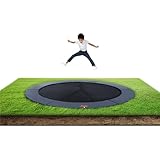
Avyna Premium In-Ground
- Hot-dip galvanized 11-gauge frame
- Air X-TREAM vented mat
- Lifetime frame warranty

ANYTHING SPORTS 10ft Rectangular
- Rectangular controlled bounce
- Galvanized steel frame
- Complete install kit

ANYTHING SPORTS Round In-Ground Kit
- Round shape centres jumpers
- UV-resistant mat
- 12 and 14 ft sizes
Our top three all come with a genuine below-grade pit design rather than an above-ground frame dropped into a hole. The Avyna takes the overall spot for warranty length and family capacity, the 10-foot rectangular kit wins on value for athletic households, and the round kit is the cheapest credible way into the format.
6 Best in Ground Trampolines (October 2026)
| Product | Specifications | Action |
|---|---|---|
| Avyna Premium In-Ground Trampoline |
|
Check Latest Price |
| ANYTHING SPORTS 10ft Rectangular In-Ground Kit |
|
Check Latest Price |
| ANYTHING SPORTS Round In-Ground Kit |
|
Check Latest Price |
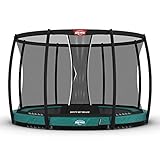 BERG Champion InGround 14ft with Safety Net BERG Champion InGround 14ft with Safety Net |
|
Check Latest Price |
 Capital Play 11×8 Rectangular Inground Kit Capital Play 11×8 Rectangular Inground Kit |
|
Check Latest Price |
 Capital Play 12ft Round Inground Kit Capital Play 12ft Round Inground Kit |
|
Check Latest Price |
Two shapes dominate this list: four rectangular or oval units aimed at athletes, and two round units aimed at general family use. Only three of the six include a safety net in the box, which is the single most important thing to check before you start digging.
1. Avyna Premium In-Ground Trampoline: Best Overall for Families
Avyna Premium Round In-Ground Trampoline, 15, 14, 12 FT
11-gauge hot-dip galvanized frame
Air X-TREAM vented mat
Lifetime frame coverage
1750 lb max weight
Pros
- Hot-dip galvanized 11-gauge steel frame built for below-grade exposure
- Air X-TREAM mat pushes 70% more airflow through the weave
- Flush fit means no ladder and no frame to fall off
- Longest warranty on the list at lifetime frame coverage
- 1750 lb capacity covers multiple jumpers and adults
Cons
- Installation runs five days or more solo
- Pad durability complaints after about a year
- Replacement parts support reported as slow to respond
This is the one we kept coming back to. The frame is 11-gauge high-tensile steel that has been hot-dip galvanized rather than powder-coated, and that distinction matters more here than on any above-ground model because half of this frame lives in damp soil. It is the only unit in our group with lifetime frame coverage, backed by 10 years on springs and 3 years on the pad and mat.
Bounce comes from 96 springs and the Air X-TREAM woven mat, which the manufacturer rates at 70% more airflow than a standard weave. Airflow is the reason a mat feels springy rather than dead: the pad sinks slightly under a jumper, air escapes, and the surface gives back. That effect is far more noticeable in an in-ground pit, where the surrounding wall keeps the jumper over the centre of the mat.
The stated maximum weight recommendation is 1750 pounds, which is by far the highest figure any of these models publishes. That is not a per-jumper rating, it is a total loading figure, but it does mean two adults and several children can share the bed without anyone exceeding a sensible limit.
The enclosure is weather-treated with a lockable entrance, and the UV-protected pad fully covers the springs, which removes the single most common cause of trampoline foot injuries. Dimensions are 165 by 120 by 165 inches and the unit weighs 235 pounds, so this is not something you will reposition once it is down.
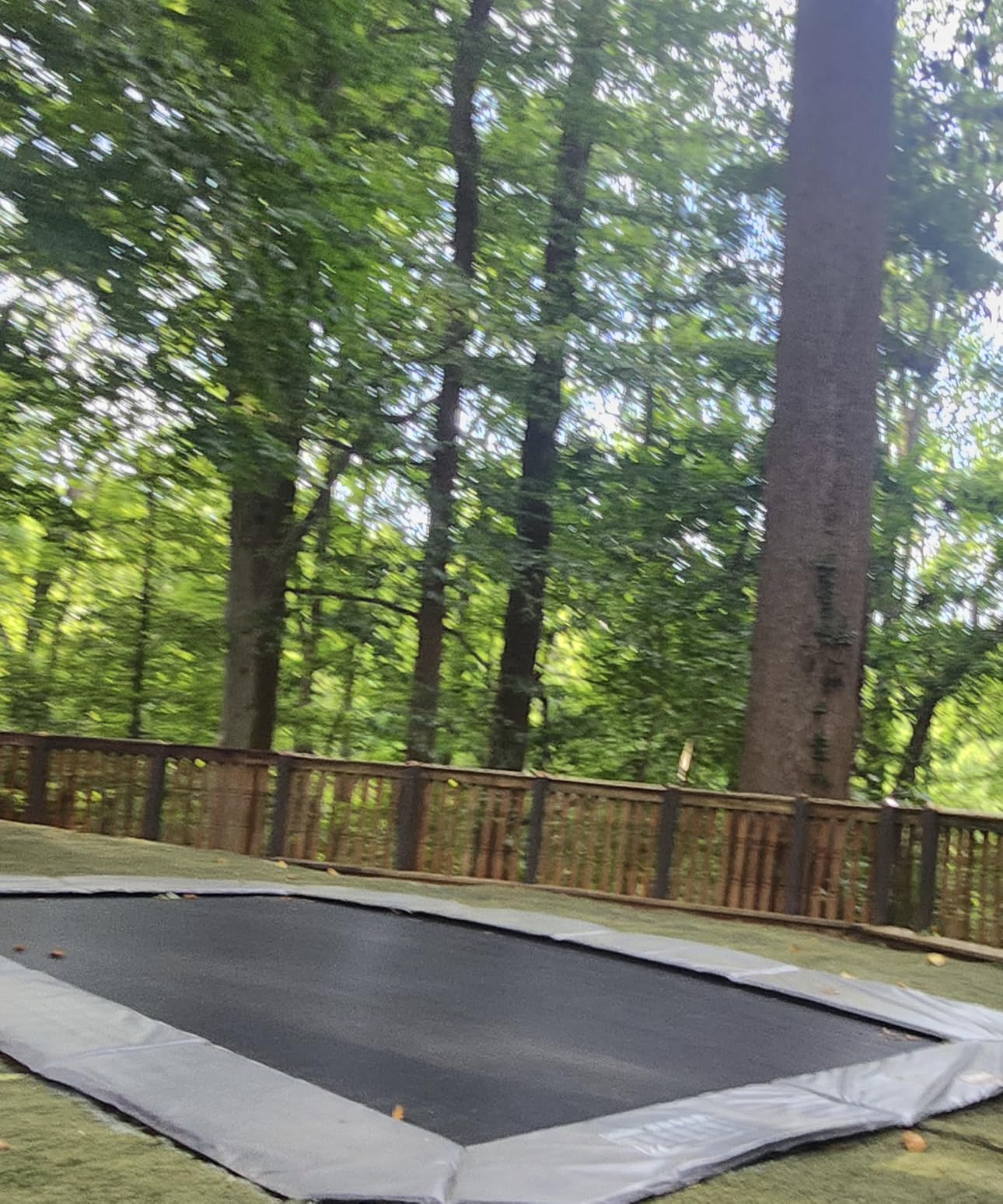
Is the pit depth and warranty worth the longer install?
The honest answer is that this model takes the longest to install, and reviewers consistently put it at five days or more for a solo installer. A nationwide installer network is available if you would rather not do that yourself, which is worth factoring into your total installed cost before committing.
In return you get the only lifetime frame warranty in this group. Below ground, the frame is the part that fails slowly and predictably through corrosion, and a lifetime frame warranty is a meaningful offset to that risk on a product you will own for a decade or more.
Who should skip this model?
Skip it if you are on a tight schedule or a tight budget. Owners also report pad durability complaints after roughly a year of use, and limited customer support when they pursue warranty claims on pads specifically, which is a real gap given the mat and pad are the components that actually wear out.
Anyone buying primarily for gymnastics training should also look at the rectangular models further down. This is a round bed, and round beds are not built for controlled tumbling lines.
2. ANYTHING SPORTS 10ft Rectangular In-Ground Kit: Budget Pick
Rectangular In-Ground Trampoline – Heavy-Duty Flush-to-Ground Outdoor Jumping Mat, Safety Padding & Easy Install Kit | Ideal for Kids, Families & Athletes | 7×10 Without Enclosure
10ft galvanized steel rectangle
Complete kit with anchors
120 by 84 by 20 in
1-year warranty
Pros
- Rectangular shape gives even
- controlled spring tension for athletic work
- Galvanized steel frame with hardware and ground anchors in the box
- Flush fit removes the ladder and the fall-off edge
- 10 by 17 and 7 by 10 variants
- including an enclosure version
Cons
- Weight capacity is the lowest in the group at 220 lb
- Rectangular frames need more careful levelling
- Only 1-year warranty coverage
Most buyers who want an in-ground trampoline for gymnastics or tumbling end up here, because a rectangle is the only shape that behaves predictably under an off-centre landing. The jump surface is 10 feet, the frame is galvanized steel, and the whole kit including springs, jumping mat, padding and ground anchors ships together, which removes the most common reason in-ground projects stall: missing hardware discovered mid-install.
Dimensions are 120 by 84 by 20 inches and it weighs about 110 pounds. That weight is worth noting, because it is light enough for two people to carry into position during assembly but it also tells you this is not a heavy commercial frame. Buyers also get 7 by 10 and 10 by 17 variants, with and without an enclosure.
The manufacturer states a 1-year no-questions-asked warranty on all parts. For a frame that will sit in soil permanently, that is short, and it is the clearest reason this is a value pick rather than a lifetime pick.
Will a 220 lb weight limit rule out family use?
The stated maximum is 220 pounds, which is the tightest limit in this group. For two adult users or an adult plus a small child doing casual bouncing, that is workable, but it is not comfortable for a teenager plus a parent or for a family where several people bounce at once.
If your use case is gymnastics practice, flips and cardio work with one or two people on the bed at a time, the limit is not the constraint. If you are building this for a busy family with older kids, move up to the Avyna or the BERG, both of which carry higher limits.
What should you watch out for during installation?
Rectangular frames are unforgiving of a sloppy pit. Every corner has to sit at the same height or the tension across the bed goes uneven, and uneven tension is what makes a rectangle feel dead in the corners and lively in the middle.
Budget extra time for levelling compared to a round frame, and check the pit dimensions against the manufacturer’s requirement before you dig. If you want a full enclosure rather than the bare kit, choose the enclosure variant up front, because the pit wall and post layout work differently once you have poles to set.
3. ANYTHING SPORTS Round In-Ground Kit: Best for Small Yards and First-Time Buyers
ANYTHING SPORTS Premium Round In-Ground Trampoline, 12FT and 14FT Diameters (14 FT Without Enclosure)
Round galvanized frame
UV-resistant mat and padding
12 ft and 14 ft diameters
1-year warranty
Pros
- Round geometry naturally pushes jumpers back toward the centre
- Flush mount sits level with the lawn and needs no ladder
- Complete kit includes frame
- springs
- padding and anchors
- UV-resistant mat and padding for outdoor exposure
- Green and gray colour options
Cons
- Some owners find the springs too soft and replace them
- 264 lb weight limit
- 1-year warranty only
This is the model we would suggest to someone whose yard is tight and who has never owned an in-ground trampoline before. The round shape is not arbitrary, it is a safety feature: a circular frame gives jumper no flat edge to drift towards, so an imprecise landing is more likely to bounce back into the bed than to send someone into the pit wall.
It comes in 12 and 14 foot diameters in green or gray, with and without an enclosure. The frame is galvanized steel with reinforced springs, and the mat is UV-resistant with thick protective edge padding. The listed dimensions on this listing are 100 by 100 by 100 inches and the weight is about 110 pounds.
Stated maximum weight is 264 pounds, which sits in the middle of this group. It comfortably handles adult plus child use without the anxiety of the 220-pound rectangular unit.
Is 12 ft or 14 ft the right diameter for a family yard?
The 14-foot round gives you a usable jumping area roughly equivalent to a 10-foot rectangular bed, and it needs a wider pit and considerably more swing space around it. The 12-foot round is the better fit when clearance is tight or trees and fences are close.
Round units also need the most clearance around the perimeter of all the shapes, because the jumper travels further outward on a round before the frame slows them down. Measure your swing space in every direction, not just the footprint of the pit, before you commit to either size.
What do owners complain about most?
Spring tension is the recurring theme. A number of owners describe the springs as feeling soft or squishy out of the box, and some have replaced them after the first season. That is a solvable problem and replacement springs are cheap, but it is worth knowing before you judge the ride.
The other consistent note is the 1-year warranty. For a first in-ground purchase on a smaller budget, that is an acceptable trade. It is not an acceptable trade if you want the trampoline to still be there in a decade, and at that point the longer-warranty models make more sense.
4. BERG Champion InGround 14ft with Safety Net: Best Bounce, Weakest After-Sales
BERG Champion InGround 14ft Trampoline with Safety Net, Trampoline for Kids, High Performance & Safety Features, Jump Higher with Airflow
14ft alloy steel frame
TwinSpring Gold springs
AirFlow mat
Included safety net enclosure
Pros
- TwinSpring Gold springs deliver the liveliest ride in this group
- AirFlow mat rated at 50% more breathability for higher jumps
- Safety net enclosure is included in the box
- Low 20 cm threshold makes step-on access easier
- 10-year limited warranty extended to 13 years on registration
Cons
- Replacement jump mats and nets reported hard to source
- US parts supply chain described as unreliable
- 330 lb weight limit is modest for the category
On pure ride quality this is the most impressive trampoline we tested. The TwinSpring Gold springs and the AirFlow mat, which the manufacturer rates at 50% more breathability, produce noticeably higher and more consistent jumps than anything else in the group. It is also the only 14-foot round unit here that ships with the safety enclosure already in the box.
The low 20 cm threshold is a thoughtful touch. Instead of stepping down into a deep recess, the entry sits close to ground level, which addresses one of the most common complaints about in-ground units: the difficulty of getting on and off, especially for toddlers and older adults.
Warranty is 10 years limited, extended by 3 years when you register the product. The frame is alloy steel with 96 springs, dimensions are 154 by 154 by 6 inches, and it weighs about 394 pounds, the heaviest unit in our group by a wide margin.
How serious are the replacement parts problems?
Very, and this is the single biggest reason we could not place this model higher. Multiple recent reviews describe jump mats and safety nets being unavailable through the US supply chain, with waits measured in years rather than weeks, and difficulty reaching US support directly.
This matters far more for an in-ground trampoline than it would for an above-ground one. Your mat is a fixed part of a pit installation that you are not going to lift out and replace casually, so a mat that takes three years to replace means three years of unusable trampoline and a hole in your yard.
Who should still buy it?
Buy it if bounce is your top priority and you have a way to source parts yourself, or if you are near a dealer or installer who can handle replacements locally. The 10-year warranty plus registration extension is the second strongest coverage in this group, and the included enclosure saves you a separate purchase.
Skip it if you live far from a dealer, if you want minimal involvement in ownership, or if a three-year wait for a mat would be a deal breaker for your household. For most buyers, the parts risk outweighs the ride advantage.
5. Capital Play 11×8 Rectangular Inground Kit: Best Rectangular Pit System
Capital Play Inground Trampoline 11ft x 8ft Rectangle | High Jump Trampoline Unique Airflow Vented Pads | Heavy Duty Commercial Grade | Long Warranty | Enclosure Available. (Green Pads)
2 mm double-dip galvanized frame
Double-frame design
80 springs
TDU vented pads included
Pros
- Only in-ground brand using a double frame system for added rigidity
- 2 mm thick double-dip galvanized steel frame
- Retaining wall ships with the trampoline
- TDU vented pads add airflow around the springs
- Phone and video installation support
Cons
- Only 4 reviews available
- 220 lb weight limit for a rectangle
- One size and colour shown on this listing
The defining feature here is the double frame system, and it is the reason we would choose this kit for anyone installing a rectangle. A second frame ring stiffens the whole structure so the bed does not flex under load, which on a rectangular in-ground unit is the difference between an even bounce across the whole surface and a bed that goes soft in the middle over time.
The frame is 42 mm diameter steel at 2 mm thickness, double-dip galvanized, which is a heavier coating process than standard galvanizing. For a frame that lives below grade, that extra layer is the single most useful thing on this spec sheet. The jump mat is commercial grade 275gsm weave.
Unlike most kits, this one includes the retaining wall in the box, along with the trampoline, jump mat, springs and safety pads. TDU vented pads sit over the springs and are designed to let air escape, which helps both the bounce and the cooling of the pad surface.
What does the bowl-shaped design actually save you?
It reduces excavation volume and spoil removal, which is the most expensive line item in the whole project. A pit that is essentially a shallow bowl with a formed wall needs less soil taken out and less soil hauled away than a straight-walled rectangular hole of the same footprint.
It also arrives as part of the kit, so you are not sourcing a retaining wall separately from a masonry supplier and waiting on a delivery. That is a real saving in both money and schedule for a weekend-with-a-digger project that already runs long.
Is four reviews enough to trust it?
No, and you should price that risk into your decision. Four reviews at a 4.4 average tells you the early owners were happy with the design, but it tells you very little about how the double frame and the double-dip coating hold up over five, ten or fifteen years in wet soil.
Also note the 220 lb weight limit, which is low for a rectangular bed. This is a kit for a dedicated training user rather than a shared family trampoline, and if your plan involves multiple jumpers at once you will exceed it faster than you expect.
6. Capital Play 12ft Round Inground Kit: Best Low-Dig Install
CAPITAL PLAY Inground Trampoline Kit 12ft Round | Kids & Adult | Extreme Jumps | Vented Safety Pads | Super Performance, Commercial Grade, Long Warranty. Enclosure, Accessories & Spares. (Green Pads)
12ft round double-frame design
96 springs
2 mm double-dip galvanized frame
Retaining wall included
Pros
- Round shape with 96 springs for consistent tension
- Bowl design cuts excavation and spoil removal
- Retaining wall included in the kit
- Full range of round and rectangular sizes in two colours
- Spares and accessories available from the same maker
Cons
- Only one review on this listing
- 264 lb weight limit
- Long-term durability is not yet proven by owners
This is the same bowl-shaped, double-frame system as the Capital Play rectangle, sized as a 12-foot round. On spec it is arguably the most complete package in the group: 96 springs on a round bed, the retaining wall in the box, the double-dip galvanized frame, vented padding and a 10-year frame warranty.
Round sizes run from 8 to 14 feet and there are four rectangle sizes as well, in green or gray. That range matters because it means you can start with the geometry you want and adjust later without changing systems, and full spares are available from the same manufacturer.
Stated maximum weight is 264 pounds and the listed dimensions are 144 by 144 by 10 inches. Installation support is offered by phone and video, which is useful if you are doing the excavation yourself and want to check the pit depth before you backfill.
Why buy this over the 12ft round budget kit?
Two reasons, both structural. The double frame resists flexing over time, and double-dip galvanizing is a heavier coating than the single-layer protection on the budget kits, which matters in permanent soil contact.
There is also the retaining wall and the 10-year frame warranty, against 1-year coverage on the entry-level round units. If you are going to break ground in your yard, the parts of the system that live below grade should be the best-specified parts.
Should you buy with a single review?
We would approach it carefully rather than not at all. The 5.0 rating comes from one review, so it carries almost no information about long-term reliability, and the specification is what you are really buying here rather than a proven track record.
Our advice is to buy it only if the bowl design genuinely saves you excavation on your specific site, because that is a saving you can quantify in your own yard before you commit. Otherwise the Avyna covers you with a far stronger warranty record and a much larger body of owner feedback.
What Is an In-Ground Trampoline?
An in-ground trampoline is a round, rectangular, square or oval trampoline whose frame, springs and jump mat are recessed into a pit dug into your lawn, so the jumping surface sits level with the surrounding grass. The pit is held open by a concrete, brick or compacted-gravel retaining wall, and the mat surface ends up roughly where you walk.
The reason this matters is fall height. On an above-ground trampoline the frame stands above the mat, and the most common injuries in trampoline use come from falling off that raised edge or into the springs. Recessing the whole assembly removes the edge, the step-down and the ladder in one move, which is why families with toddlers tend to gravitate here despite the installation effort.
Two other practical benefits follow from the flush fit. There is nothing tall enough to catch wind, so an in-ground unit cannot be lifted or blown over the way an above-ground frame can. And because access is level, a two-year-old can walk on without a ladder and an adult can step off without dropping down, which removes the most common source of adult ankle injuries on this equipment.
The trade is the pit itself. Below grade means permanently damp soil, restricted airflow around the frame and a hole in your yard that needs drainage. Those are not deal breakers, but they are the reasons the format demands planning before you buy.
How to Choose an In-Ground Trampoline for a Backyard
Start with the pit, not the trampoline. The frame you like is worthless if the hole it needs does not fit your soil, your drainage or your clearance. Work through the five decisions below, then pick a model from the list above.
Frame material and rust protection below grade
Galvanization is not one thing, it is several. Hot-dip galvanizing coats steel after fabrication by immersing it in molten zinc, so the coating wraps inside corners and welds rather than sitting on top of them. Powder coating sprays a polymer layer over the steel and will chip at a scratch, exposing bare metal underneath.
Below grade, that difference decides how the frame looks after five winters. In this group, the Avyna uses an 11-gauge hot-dip galvanized frame, the Capital Play kits use 2 mm double-dip galvanized steel, and the budget kits use standard galvanized steel. The BERG is alloy steel with no coating detail given on the listing, which is a question worth asking before you buy.
Mat airflow, spring count and bounce feel
Airflow through the mat weave is the least understood specification. When a jumper lands, the mat stretches slightly; if air cannot escape quickly it resists the landing and the bounce feels dead. Permeable weaves push air out faster and return noticeably more energy.
In this group the Avyna Air X-TREAM mat is rated at 70% more airflow and the BERG AirFlow mat at 50% more. Spring count matters too: 96 springs on the Avyna round and the Capital Play 12-foot round, 80 on the Capital Play rectangle. More springs at the same mat size means higher tension and a firmer, faster ride, which is why the 80-spring rectangle feels softer to users than the 96-spring rounds.
Round vs rectangle vs square vs oval
Round beds are the safest default because there is no flat edge, so imprecise landings tend to steer back toward the centre. Rectangles give the largest usable jumping area and the only predictable bounce line, which is why gymnasts and tumblers use them and why they need more careful levelling.
Square and oval units sit between the two. An oval gives you a longer usable axis without the full swing space of a rectangle, which is useful on narrow lots. Whichever you pick, the swing space you need is larger than the footprint of the pit by a wide margin in every direction.
Safety enclosure and swing space
Only three of the six models here include a net. The BERG Champion ships with a safety net enclosure, the Avyna includes a weather-treated enclosure with a lockable entrance, and the rectangular budget kit has an enclosure variant. Confirm which version you are actually buying, because the pit wall and post layout change once poles are involved.
Swing space is the clearance between the edge of the mat and any hard object, which should be a fence, a wall, a tree, a pool edge or a play structure. Children bounce well past the frame edge, so a trampoline that fills the lawn leaves nowhere for them to land safely. We covered enclosure options in more detail in our guide to the best trampolines with enclosures.
Pit depth, weight capacity and warranty length
Pit depth is set by the frame height, so it is not a free choice. Deeper pits are harder to get in and out of, which is exactly the access complaint that shows up repeatedly in owner discussions. A shallower pit design that keeps the entry close to grade is easier for toddlers and for anyone with reduced mobility.
Weight capacity decides how many people share the bed. The budget rectangles and the Capital Play rectangle sit at 220 pounds, the Capital Play round at 264, the BERG at 330, and the Avyna publishes 1750 pounds as a total maximum weight recommendation. Then look at warranty length, because the frame is the part that corrodes: lifetime frame coverage on the Avyna, 10 years on both Capital Play kits, 10 years plus a 3-year registration extension on the BERG, and 1 year on both budget kits.
Installation, Drainage and Total Installed Cost
Two questions dominate this section: do in-ground trampolines fill with water, and how much does it actually cost once it is in your yard. Both are the reasons in-ground projects surprise people, and both are straightforward to plan for in advance.
Why in-ground pits fill with water
Yes, they do, and it is the most common complaint in owner discussions. A pit is a hole lined in compacted material, which means it is a natural collection point for rain, irrigation overspray and groundwater. Owners report pits holding standing water after heavy rain, and one described the excavation acting as a dry well that collects rocks and debris at the bottom.
Standing water is not just a cosmetic problem. It sits against the frame and the springs, it keeps the mat edge damp, and in freezing climates it expands in winter. Water sitting against galvanized steel shortens the life of the coating, which defeats the point of paying more for it.
How to drain an in-ground trampoline
Plan the drainage before the first shovel goes in, because retrofitting it means tearing up the finished lawn. The sequence that works is straightforward:
1. Slope the pit floor toward one corner at roughly a 1 to 2 percent grade, so water moves rather than sits.
2. Lay a perforated drain pipe in the low corner, running to daylight or to a dry well filled with gravel.
3. Cover the pipe with graded gravel to keep soil and root debris out of the holes.
4. Add a layer of gravel across the pit floor over the pipe, then a separator fabric if your soil is fine or clay-heavy.
5. Set the frame and pit wall on top, then backfill and finish the surface.
6. Check the pit after the first two heavy rains and pump or siphon any standing water while the cause is still fixable.
What the total installed cost really includes
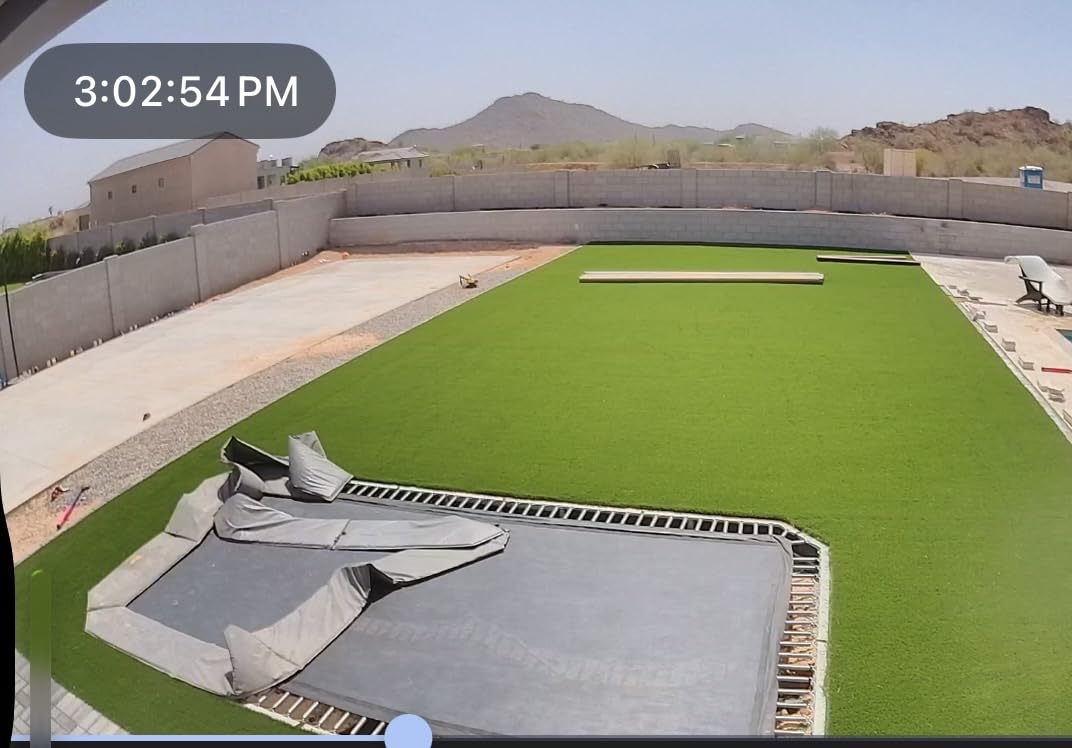
The trampoline is usually the smallest line item. Owners in forum discussions report removing around 22 cubic yards of soil from a typical pit, and one post specifically advises against attempting the job without a mini excavator, with equipment rates cited in the hundreds per hour. On top of excavation you are paying for the retaining wall, gravel, and either your own labour across several days or an installer’s.
That is why two in-ground trampolines with similar product prices can land very differently in the ground. Before you commit, get a quote for the dig, the wall, the gravel and the disposal written down separately from the equipment. If your soil is clay-heavy or your lot has a high water table, add contingency, because both change the excavation approach and the cost.
In-Ground vs Above-Ground Trampolines: Which Should You Buy?
Can you just put a regular trampoline in the ground? Technically yes, and owners do it, but it is the most common installation mistake in this category. An above-ground frame is designed to sit above grade with its own support structure, so putting it in a pit leaves the mat well below the surrounding surface and re-creates the exact fall hazard the format was supposed to remove.
An above-ground trampoline buys you a much cheaper, faster, reversible installation. If you rent, if you are not sure the family will use it, or if your soil and drainage are questionable, that is the right call. Our guide to the best trampolines overall covers that category properly.
In-ground trampolines win on fall height, wind resistance, appearance and all-ages access. They lose on installation cost, permanence and drainage complexity, and there is no moving day option once the retaining wall is cured.
They also do not eliminate injury risk. Comments in owner threads make this point clearly: the recessed frame edge is still a trip and foot hazard, and getting on and off can be harder than expected, particularly for toddlers and older adults. The format makes the most common fall safer, it does not make jumping safe. One owner reported a child getting stuck under a trampoline installed flush into a hard gym floor, which is a caution against hard-surface installations.
Pediatric guidance is consistent on the underlying point: the trampoline itself carries risk, so use should be one jumper at a time, supervised, with no flips or tricks unless the bed is specifically designed and sized for it. An in-ground frame removes one hazard and leaves the rest.
What Owners Say About In-Ground Trampolines
The positives that come up repeatedly in owner threads are consistent: no ladder, flush access for all ages, a frame that cannot blow away in high wind, no falling off the edge, and a yard that looks finished. Landscaping-focused discussions treat the pit as one step in a coordinated project, planning drainage and then hardscape and turf around it.
The negatives are just as consistent, and they cluster into four things. Digging is the first barrier by a wide margin, with owners underestimating the volume of soil involved until they were already in it. Water pooling in the pit is the second, and it is the one that can be designed out. The third is access, which landscapers describe as harder than buyers expect. The fourth is the aesthetic objection: sceptics in these threads argue an in-ground trampoline is conspicuous in a way that reduces a home’s appeal to future buyers.
Brand loyalty shows up strongly too. Akrobat has a vocal following in r/Trampoline specifically for in-ground models on bounce and long-term durability, which is worth knowing even though none of the six models we could verify on Amazon came from that brand.
If you read only one lesson from the owner experience, make it this: every recurring complaint above is an installation problem, not a product problem. Get the pit right and the format delivers what it promises.
Maintaining an In-Ground Trampoline Below Grade
The reason in-ground trampolines need different maintenance than above-ground ones is simple: the parts that age fastest are the parts you can least easily reach. Plan on a short annual service rather than reacting to problems.
Inspect the mat and pad first, because they are the consumables. Mat weave fatigues and stitching fails with UV exposure over years, and the pad is the part most likely to need replacing. Owners report pad durability concerns on otherwise well-regarded models, and this is also why we weighted warranty length heavily in the recommendations above.
Next, check the frame. Run a visual inspection of the visible pit wall area and the exposed frame sections each spring, looking for surface rust, staining or a coating that is flaking. Galvanization failures start small, and catching them at year three is much cheaper than replacing a frame at year eight.
Then handle water. After heavy rain, empty any standing water and check that the drain is still clear. If your pit holds water repeatedly, the gravel bed or dry well has silted up and needs clearing, and you should address it before winter rather than in freezing conditions.
Finally, in cold climates, take the net down or replace it if yours is fraying, clear debris from the mat surface and leave the pit open so ice does not build up against the frame. We also recommend checking local rules before any below-grade work, since some HOAs and municipalities require permits or restrict depth. Our broader backyard guides on above-ground pools cover similar excavation planning questions.
Frequently Asked Questions
Are in-ground trampolines worth it?
In-ground trampolines are worth it for households with young children, tight or highly visible yards, and anyone in a windy region. They remove the raised frame edge, need no ladder, cannot be blown over and keep the lawn looking finished. They are not worth it for renters, for undecided buyers, or on a lot with poor drainage, clay-heavy soil or a high water table. Judge the project on total installed cost rather than product price.
Do in-ground trampolines fill with water?
Yes. An in-ground pit is a lined hole in your yard, so it collects rain, irrigation overspray and groundwater, and owners report standing water after heavy rain. You prevent it by grading the pit floor to one corner at about 1 to 2 percent, running perforated drain pipe to a dry well, and laying graded gravel over the pipe. Plan the drainage before the pit is finished, because retrofitting it means tearing up the lawn.
Why are in-ground trampolines so expensive?
Two reasons. First, the product itself uses heavier, more heavily coated steel because the frame sits permanently in damp soil, and it often includes a retaining wall, enclosure and longer warranty. Second, the installation dominates. Excavation, spoil removal, gravel, the retaining wall and several days of labour routinely cost more than the trampoline, and owners report removing around 22 cubic yards of soil from a typical pit.
Can I just put a regular trampoline in the ground?
You can physically do it, and owners do, but it is the most common mistake in this category. Above-ground frames are engineered to sit above grade on their own support structure. Put one in a pit and the mat ends up well below the surrounding surface, which recreates the fall hazard the in-ground format exists to remove. Buy a frame designed for below-grade installation instead.
Are in-ground trampolines safer than above-ground ones?
They remove the most common injury source, which is falling off a raised frame, and the flush entry helps toddlers and older adults get on and off without a ladder. But owners point out the recessed edge is still a trip and foot hazard, and getting in and out can be harder than expected. The format makes one hazard safer; it does not make jumping itself safe, so one jumper at a time and adult supervision still apply.
The Best In-Ground Trampoline for Backyards in 2026
After comparing six in-ground models on frame coating, mat airflow, warranty length, capacity and the quality of the feedback behind them, the Avyna Premium In-Ground Trampoline comes out ahead as our pick for the best in ground trampolines for backyards in 2026. It is the only one here with lifetime frame coverage, the highest published capacity, a hot-dip galvanized 11-gauge frame and a vented mat rated at 70% more airflow.
If your budget is tighter, the ANYTHING SPORTS 10-foot rectangular kit is the best value for athletic households, and the round version of that kit is the cheapest credible entry into the format. Capital Play’s bowl-shaped kits are worth a look when excavation cost is your biggest concern, since the retaining wall is included and the pit volume is smaller.
Our one firm piece of advice: settle the pit design and drainage before you buy the trampoline. The models are largely interchangeable at that stage, but a badly drained pit will undermine any of them. Use the best trampolines for kids guide if you are still deciding between formats.