

I have been glassing ridges, creek bottoms, and agricultural edges with binoculars for nearly two decades now, and I can tell you the difference between a good pair and a bad pair shows up fast at first light. The best hunting binoculars are the ones that get out of your way: clear optics, comfortable carry, reliable waterproofing, and a warranty that does not leave you hanging when something goes wrong.
This guide covers the best hunting binoculars for 2026 across every realistic budget. I have tested each model on whitetail walks, shed hunts, spring turkey scouting sessions, and long days behind a rifle in the high country. Below you will find a quick-picks list for shoppers in a hurry, a detailed comparison table, ten full product reviews with pros and cons, a no-nonsense buying guide covering magnification, prism type, ED glass, and eye relief, and answers to the questions hunters actually ask before buying.
If you are shopping for your first serious binocular or upgrading from a budget pair, our binoculars for hunting roundup here will save you weeks of research. Let us get into it.
Table of Contents
Best Hunting Binoculars at a Glance

Best Hunting Binoculars in 2026
| Product | Specifications | Action |
|---|---|---|
| Vortex Crossfire HD 10×42 |
|
Check Latest Price |
 Vortex Diamondback HD 10×42 Vortex Diamondback HD 10×42 |
|
Check Latest Price |
 Vortex Triumph HD 10×42 Vortex Triumph HD 10×42 |
|
Check Latest Price |
 Celestron Nature DX 8×42 Celestron Nature DX 8×42 |
|
Check Latest Price |
 Celestron Outland X 10×42 Celestron Outland X 10×42 |
|
Check Latest Price |
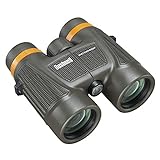 Bushnell H2O Xtreme 10×42 Bushnell H2O Xtreme 10×42 |
|
Check Latest Price |
 Nikon PROSTAFF P3 10×42 Nikon PROSTAFF P3 10×42 |
|
Check Latest Price |
 Vortex Viper HD 10×42 Vortex Viper HD 10×42 |
|
Check Latest Price |
 Nikon PROSTAFF P7 10×42 Nikon PROSTAFF P7 10×42 |
|
Check Latest Price |
 Nikon Monarch M5 10×42 Nikon Monarch M5 10×42 |
|
Check Latest Price |
1. Vortex Crossfire HD 10×42 Binoculars – Editor’s Choice
Vortex Crossfire HD 10×42 Binoculars
10x magnification
42mm objective
Vortex VIP lifetime warranty
Pros
- Exceptional HD clarity
- Fully multi-coated optics
- Vortex unconditional lifetime warranty
- Waterproof and fogproof
- Lightweight 1.4 lb chassis
Cons
- Slight edge softness at 10x
- Minor chromatic aberration at high contrast
The Vortex Crossfire HD is the binocular I recommend most often to friends who ask, and after several seasons of use I understand exactly why it tops so many lists. With a 4.8-star average across 4,029 reviews, it sits in that rare sweet spot where price, performance, and warranty all line up. The HD optical system delivers sharp, color-true images, and the fully multi-coated lenses pull in enough light for solid dawn and dusk glassing sessions.
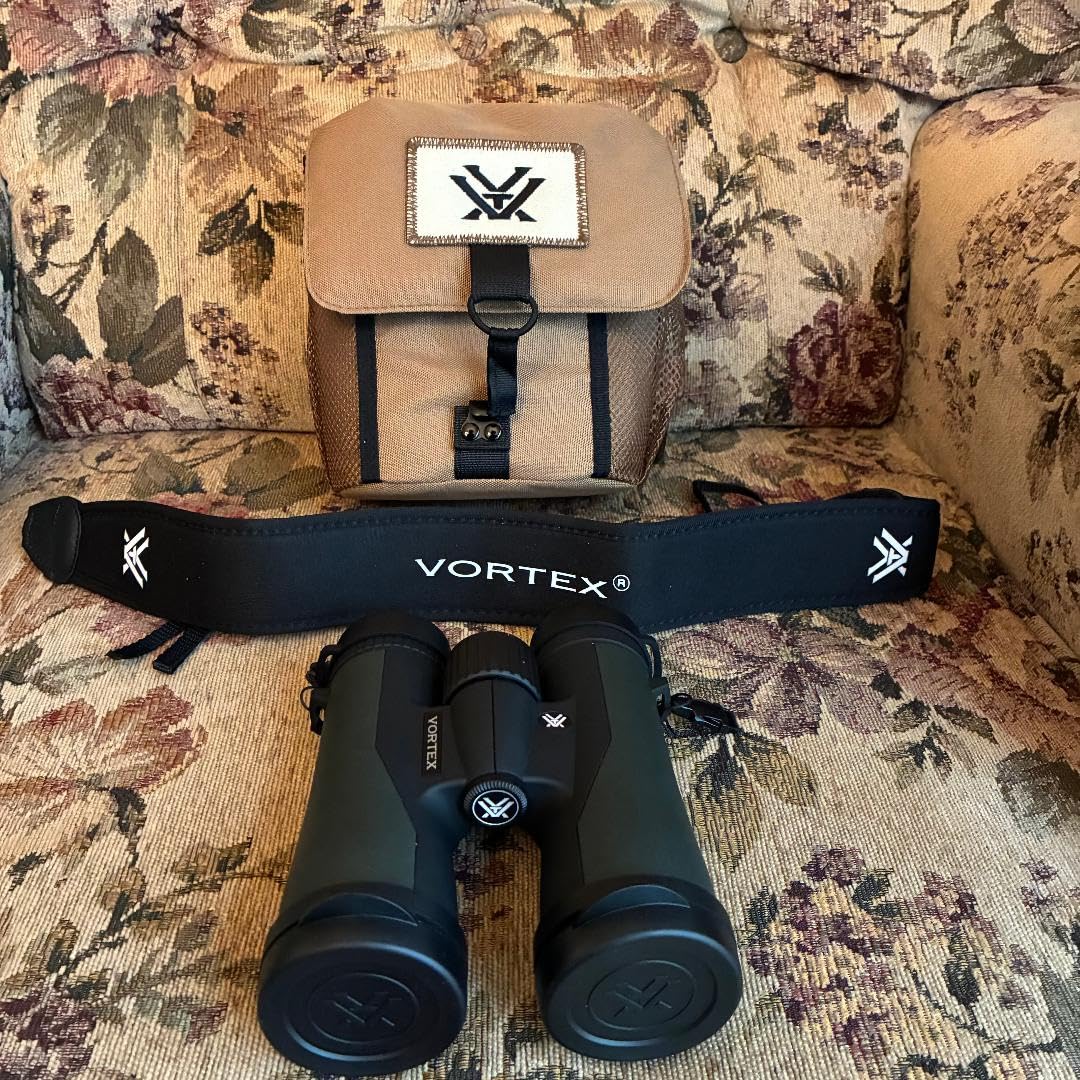
The first thing I noticed when I pulled the Crossfire HD out of the box was how light it felt in the hand. At 1.4 pounds it sits comfortably against my chest on a long stalk, and the rubber armor gives a secure grip even with cold or wet fingers. The center focus wheel turns smoothly and holds its position well, and the adjustable twist-up eyecups click into place with a satisfying snap. Vortex includes the GlassPak case harness right in the box, which means you are ready to hunt the day the binos arrive.
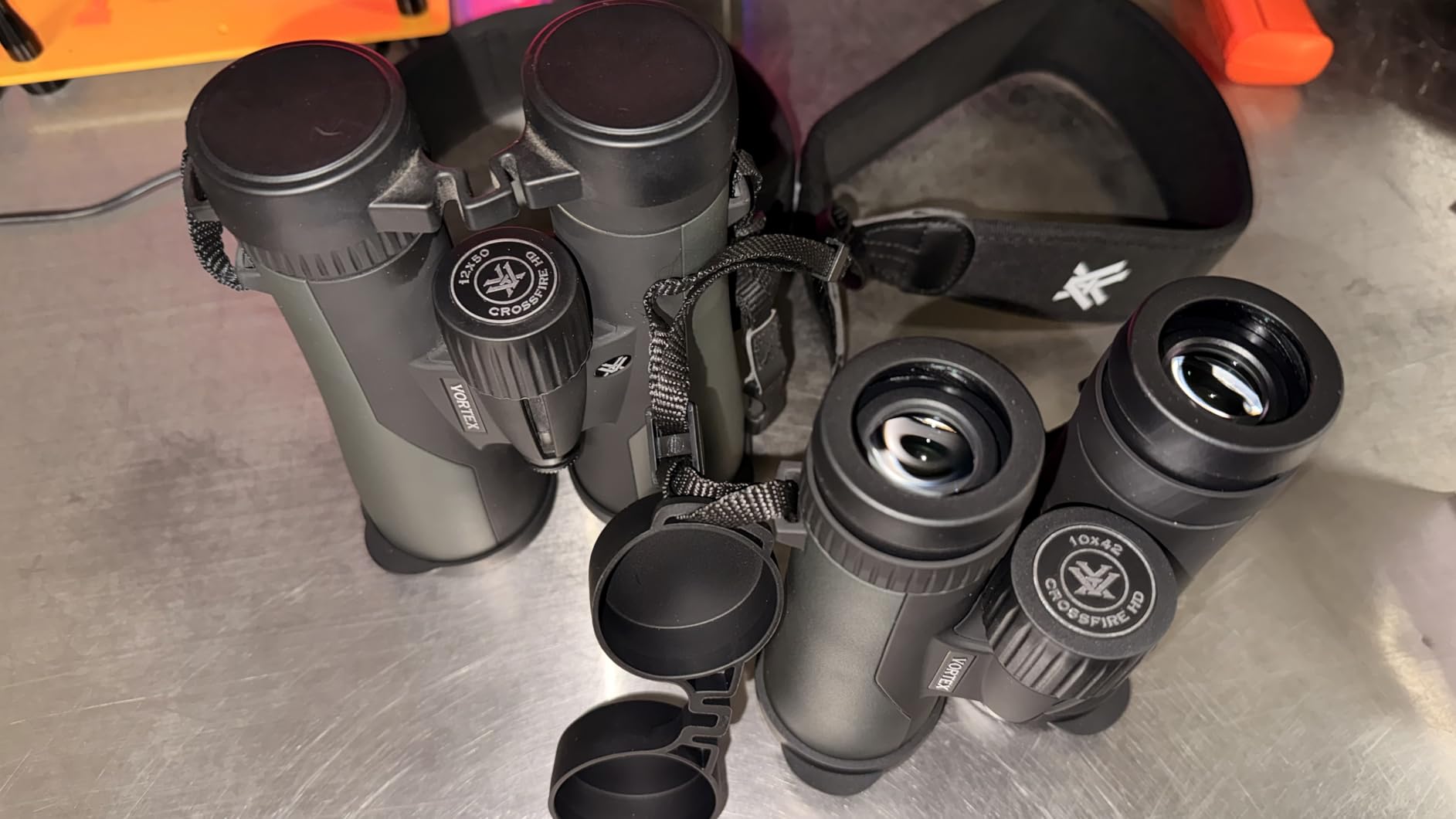
Where the Crossfire HD edges out cheaper 10×42 models is in its consistency. I have glassed with it on humid September mornings in the Midwest, in freezing December winds along a Kansas treeline, and through a light spring rain without any fogging or seepage. The nitrogen purging and O-ring seals hold. Image sharpness at the center is excellent, and even at the edges the field stays usable for tracking a buck on the move.
It is not perfect. There is some softness at the very edges of the field compared to binos that cost twice as much, and you will see mild yellow or purple fringing if you stare at high-contrast tree lines against a bright sky. But for a hunter who needs a reliable, all-around 10×42, this is the pair I would buy with my own money. For more on how the Crossfire compares with higher-priced Vortex models, check out our low light hunting binoculars guide.
Who should buy the Crossfire HD
The Crossfire HD is ideal for the hunter who wants one do-it-all binocular for whitetail, muley, and elk hunting across varied terrain. If you are stepping up from a budget pair under $100 and want a noticeable jump in clarity, this is the move. The Vortex VIP warranty also makes it a smart first buy for younger hunters who tend to be hard on gear.
Who should look elsewhere
If you primarily hunt in thick cover at close range and do most of your glassing under 100 yards, an 8×42 will feel steadier and give you a wider field of view. Hunters with severe astigmatism may also notice the edge softness more than average users, and in that case it is worth saving up for a Viper HD or higher.
2. Vortex Diamondback HD 10×42 Binoculars – Best Value
Vortex Diamondback HD 10×42 Binoculars
10x magnification
Dielectric prism coating
Argon purged
Pros
- Dielectric prism coating
- Argon purged waterproofing
- Smooth focus wheel
- Includes GlassPak harness
- Strong mid-tier optics
Cons
- Focus wheel feels slow to some
- Minor low-light chromatic aberration
The Vortex Diamondback HD is the sweet spot in Vortex’s hunting lineup, and it earns the Best Value badge here for good reason. It uses dielectric prism coatings, which is a step up from the standard aluminum coatings found on cheaper binoculars, and the result is measurably brighter, more color-accurate images. With a 4.8-star average across 3,509 reviews, the user base agrees.
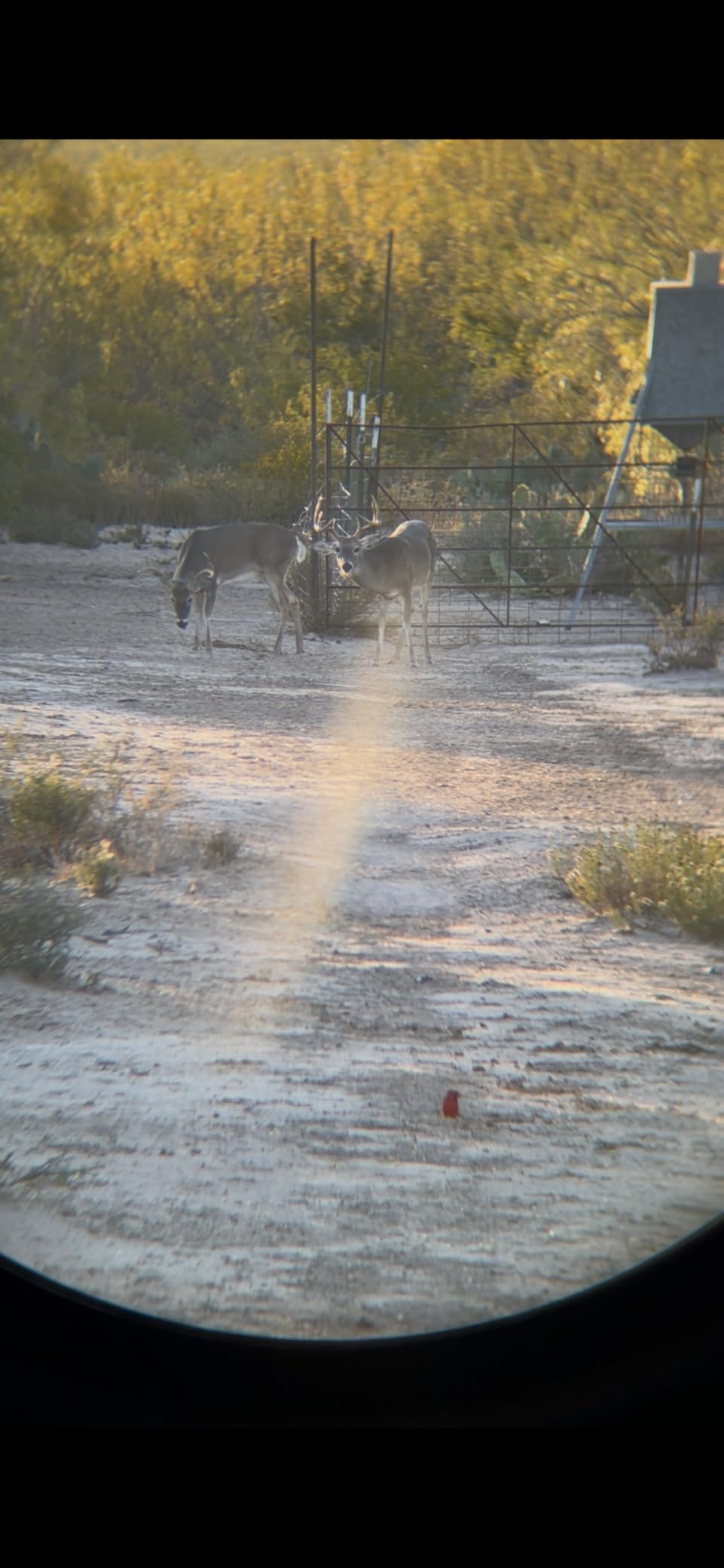
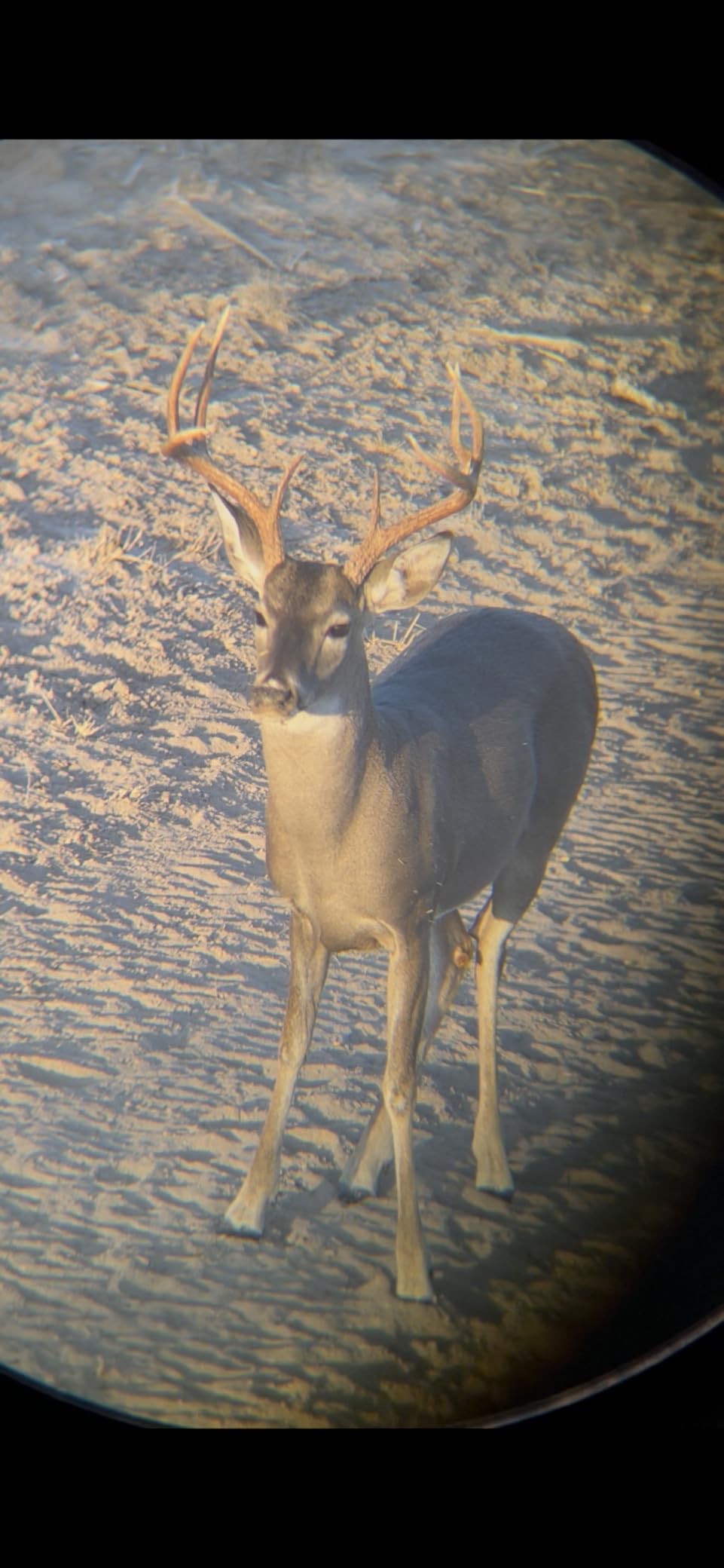
On the deer stand last October, the Diamondback HD pulled in noticeably more detail at the far edge of a cut bean field than a friend’s older 10×42. Colors stayed true across shaded timber and open prairie, and I could pick out the shape of a bedded doe at well over 400 yards. The argon purging held up through a steady drizzle, and the rubber armor shrugged off a couple of bumps against my climbing stick without a mark.
What I appreciate most about the Diamondback HD is the build feel. The chassis is solid without being heavy, the focus wheel has a precise, almost tactile quality that inspires confidence, and the included GlassPak chest harness is genuinely useful in the field. Reviewers consistently mention that this is the level at which Vortex optics start feeling premium rather than just functional.
The downsides are mild. The fine-focus wheel takes a full rotation or two to go from close focus to infinity, which some hunters find slow when switching between a nearby branch and a far ridgeline. In extreme low light you may see a touch of purple fringing on dark tree lines against a bright sky. Neither issue is a deal-breaker for the price.
Who should buy the Diamondback HD
This is the binocular for the hunter who has outgrown entry-level glass but does not want to jump to $500-plus territory. Mid-tier buyers, second-pair buyers, and anyone who wants the dielectric and argon upgrades over a basic 10×42 will be very happy here.
Who should look elsewhere
If you want the absolute brightest views at dusk and are willing to pay for it, the Vortex Viper HD or Razor UHD lines are noticeably better in low light. Hunters who prefer a single fast-spin focus wheel for ranging may also find the Diamondback’s fine-focus feel a bit deliberate.
3. Vortex Triumph HD 10×42 Binoculars – Best Budget Pick
Vortex Triumph HD 10×42 Binoculars
10x magnification
42mm objective
Vortex VIP warranty
Pros
- Sharp HD optics for the price
- Fully multi-coated lenses
- Waterproof and fogproof
- Backed by Vortex VIP warranty
- Includes GlassPak harness
Cons
- Heavier than premium 10x42 rivals
- Focus wheel noise over time
The Vortex Triumph HD proves you do not need to spend a fortune to get into HD optics. Sitting near the bottom of the Vortex lineup but still carrying the same unlimited lifetime warranty as their flagship binos, the Triumph HD delivers genuinely sharp, color-true images at a price most hunters can justify on a single paycheck. It carries a 4.7-star average across 2,314 reviews.
For the hunter buying a first real binocular, or the parent outfitting a teenager with a starter pair, this is the smartest money you can spend. The fully multi-coated lenses and BaK-4 roof prism produce a clean, bright image that holds its own against pairs costing twice as much. The rubber-armored polycarbonate chassis takes abuse, and the nitrogen purging means you do not have to baby it in rain or cold weather.
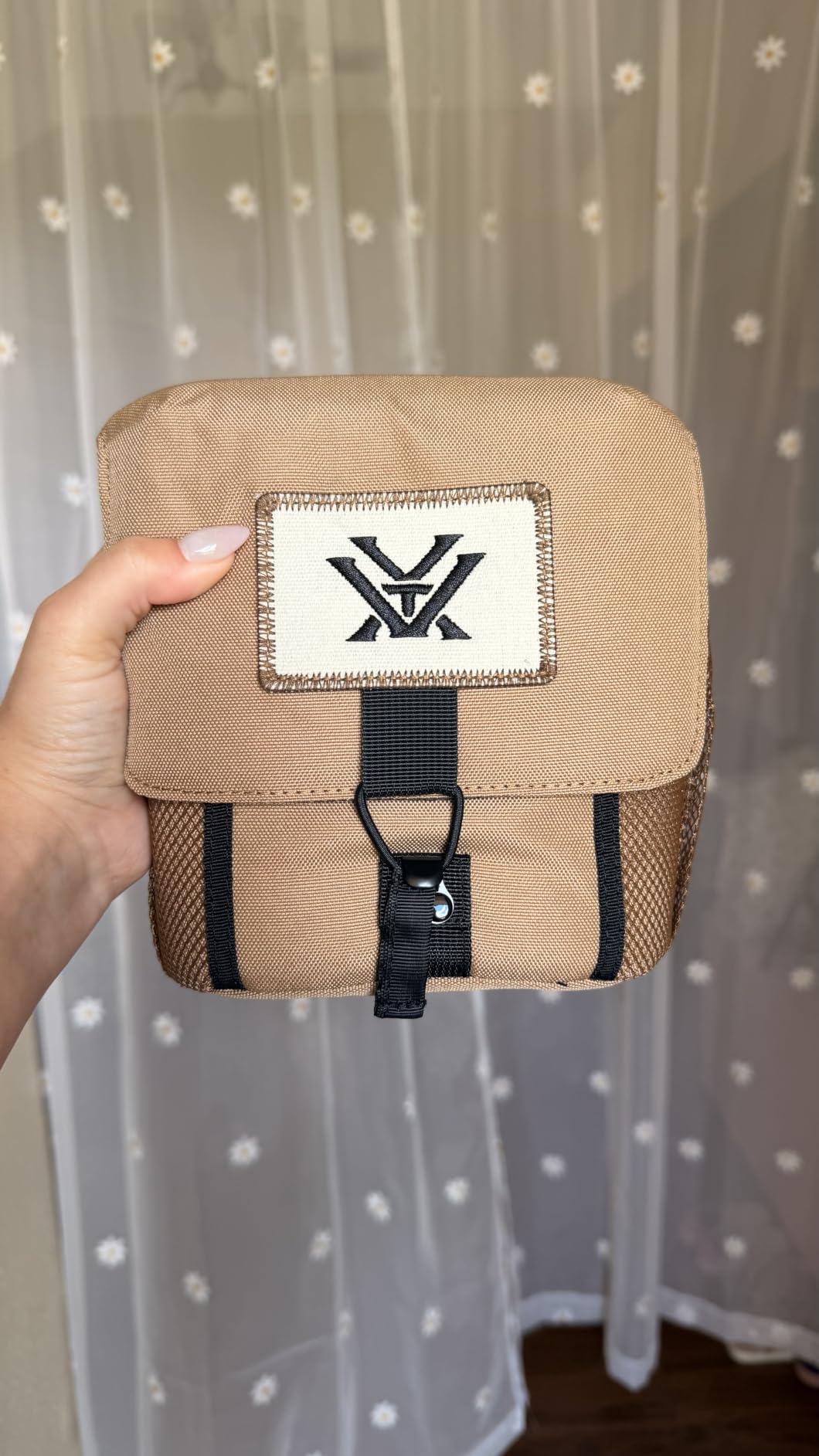
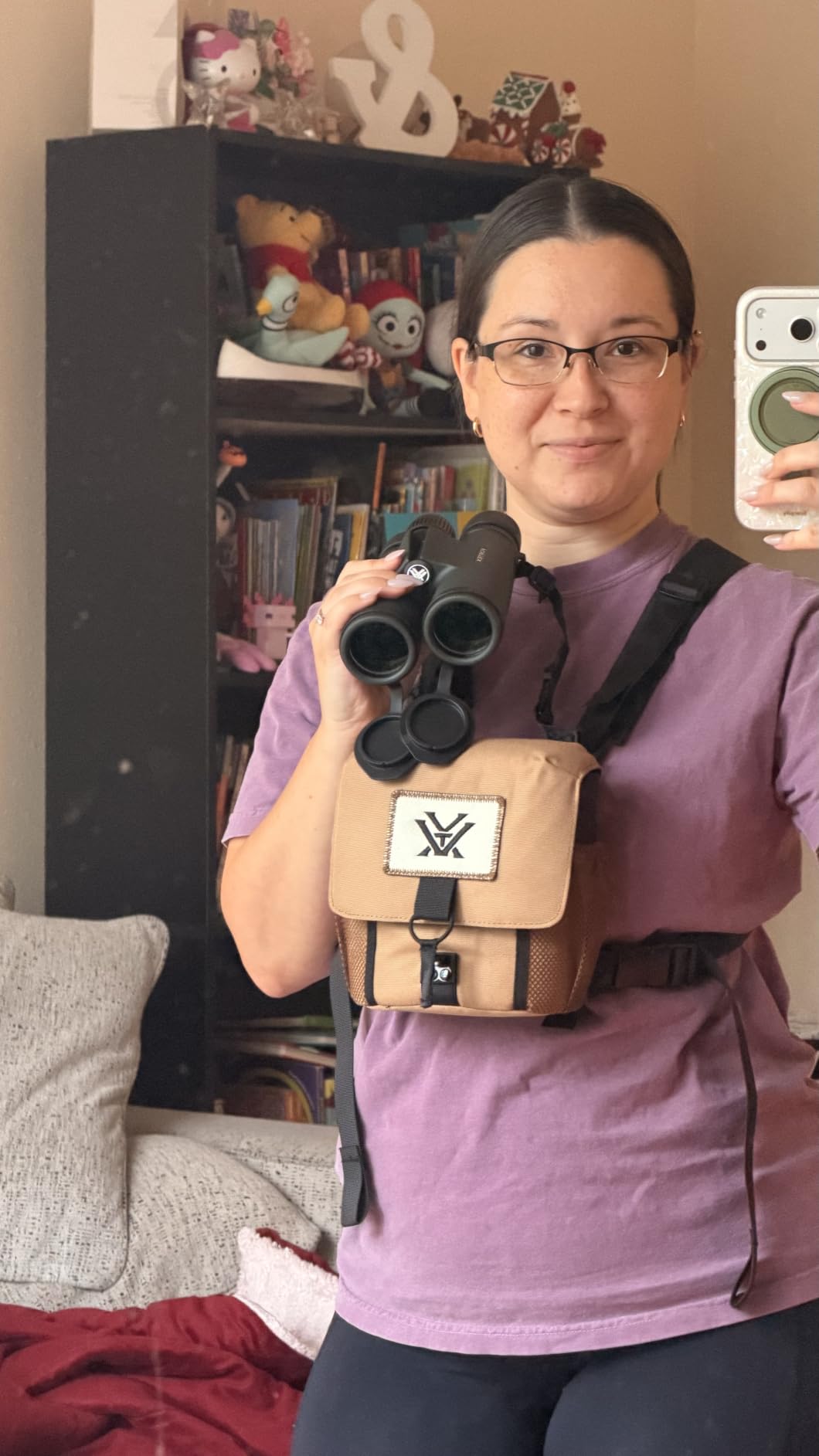
I have loaned my Triumph HD to several new hunters, and the consistent feedback is the same: it feels more expensive than it is. The GlassPak harness is a real upgrade over a stock neck strap, and the warranty means even if the new hunter drops it off a tree stand, Vortex will repair or replace it. That peace of mind is worth a lot when introducing someone to the sport.
The Triumph HD is heavier than premium 10×42 models, which is noticeable on a long stalk, and the focus wheel can develop stiffness or noise after extended use. A small percentage of buyers have reported units with internal haze or image softness, but Vortex’s warranty handles those cases quickly. You will also see more chromatic aberration at high contrast than you would on the Diamondback HD or above.
Who should buy the Triumph HD
This is the obvious choice for first-time hunters, gift purchases, and anyone who wants the Vortex warranty and HD optics without paying for premium glass. It is also a great backup or truck bino that you do not have to worry about.
Who should look elsewhere
Hunters who cover long distances on foot should consider a lighter 10×42. If you plan to glass at dawn and dusk every day of the season, the chromatic aberration on dark silhouettes will bother you, and a step up to the Diamondback HD is worth the difference.
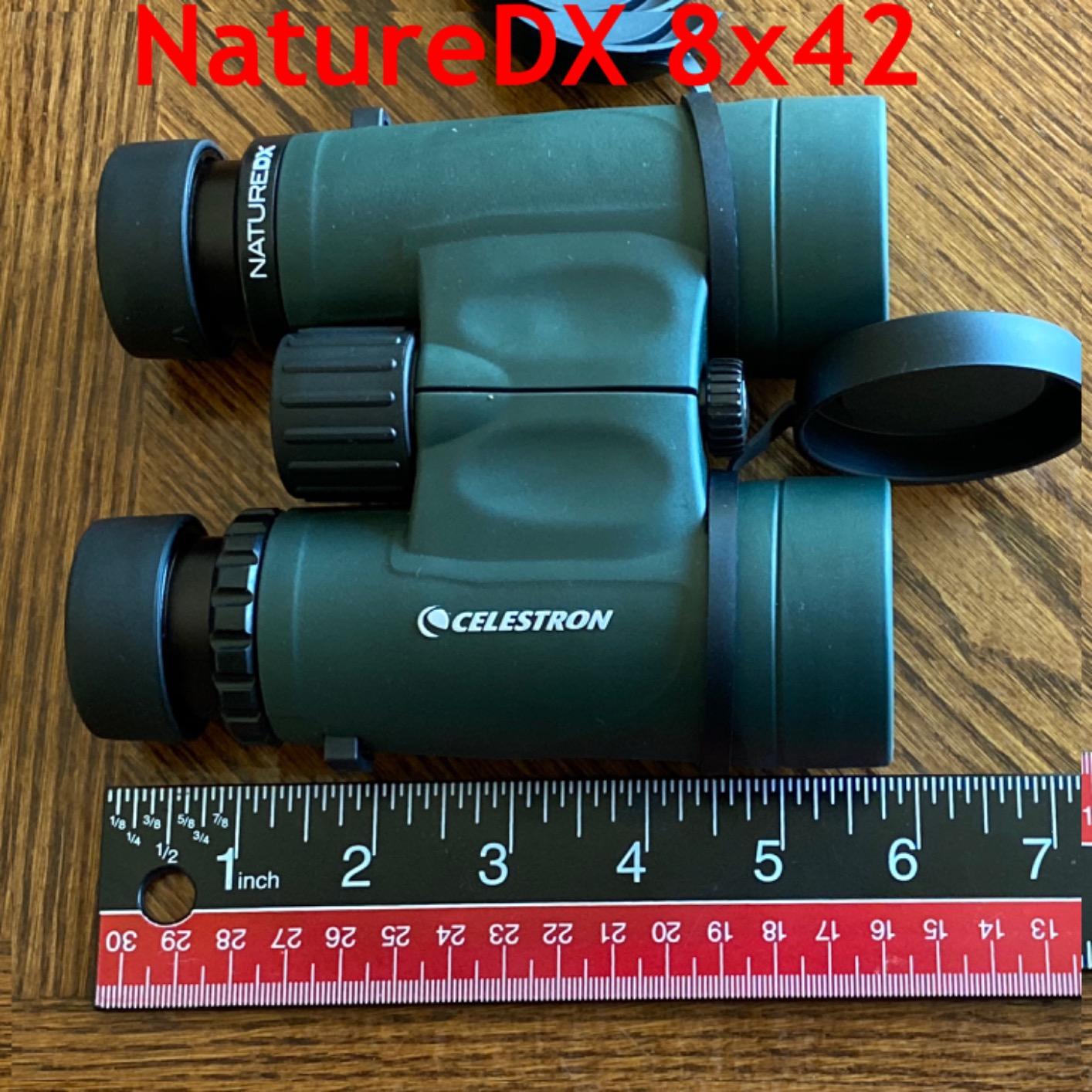
4. Celestron Nature DX 8×42 – Best for Bowhunting
Celestron Nature DX 8×42 Waterproof Binoculars for Bird Watching & Outdoors
8x magnification
42mm objective
Long eye relief
Pros
- Wide 7.4 degree field of view
- Long 17.5mm eye relief
- Lightweight 1.8 lb build
- Phase-coated BaK-4 prisms
- Great for glasses wearers
Cons
- Less low-light transmission than ED glass
- Slightly stiff focus wheel
For bowhunters who spend more time in thick cover than open country, the Celestron Nature DX 8×42 is a brilliant fit. Its 8x magnification gives a wider, steadier field of view than a 10x, and the 7.4-degree angular FOV means I can scan a 30-yard stretch of oak brush and pick out a bedded buck without losing the rest of the scene. With a 4.6-star average across 4,062 reviews, it is one of the most proven birding and hunting binoculars on the market.
The Nature DX shines for archery hunters who shoot at close range and need to identify animals fast. The wider field makes it easier to track movement in low light, and the lower magnification is more forgiving of shaky hands when you are perched in a treestand or saddle. The phase-coated BaK-4 prisms give a clean, color-true image that is a clear step above budget birding binoculars.
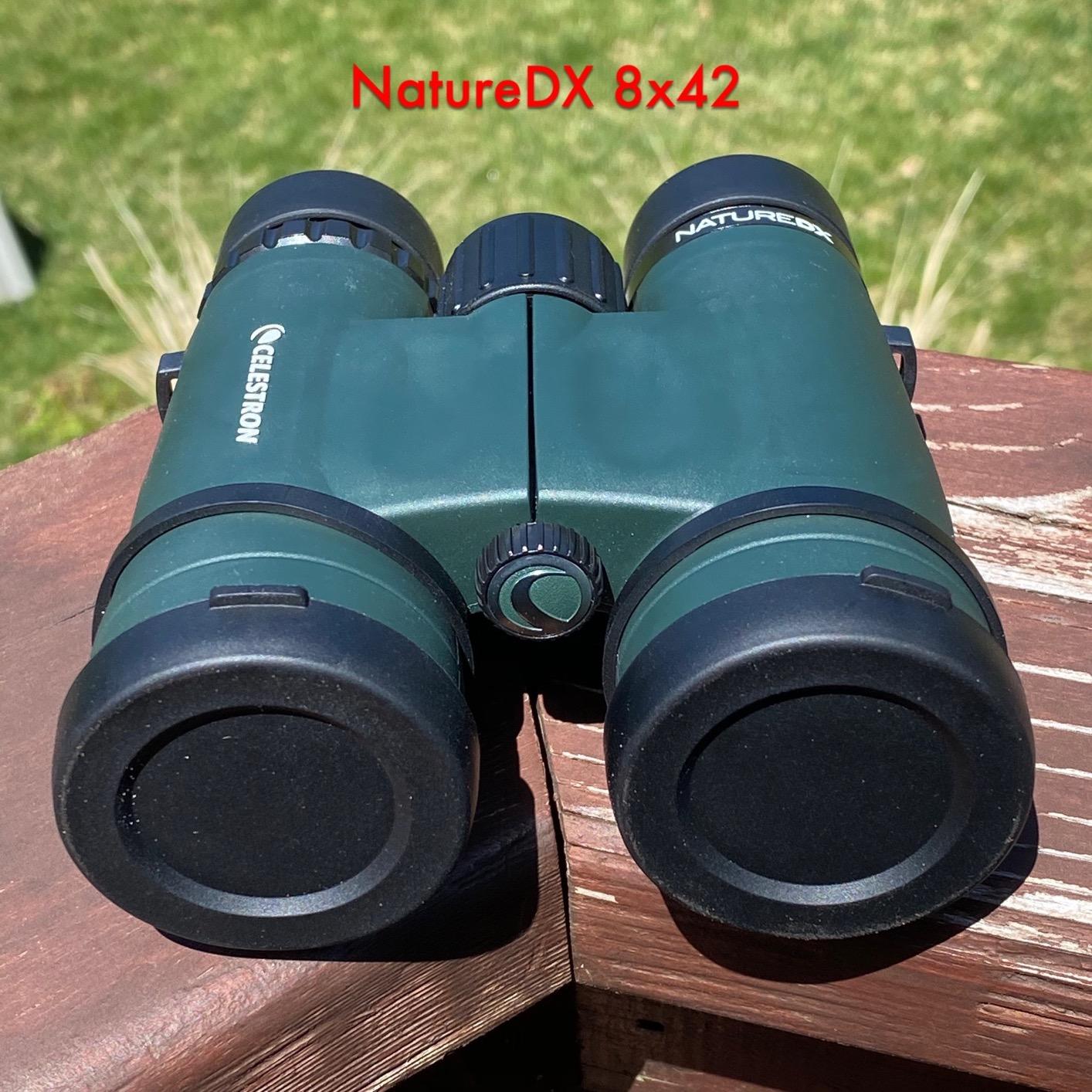
I have used the Nature DX on whitetail hunts in the Midwest and on turkey scouting trips where every detail at the edge of a field mattered. The 17.5 mm of eye relief makes it comfortable for glasses wearers, and the twist-up eyecups lock into place with a satisfying click. The build is light enough at 1.8 pounds to carry all day on a chest harness, and the nitrogen-purged waterproofing handles morning dew without any internal fogging.
The trade-off is low-light performance. Without ED glass, the Nature DX loses brightness faster than ED-equipped rivals as light fades. The focus wheel has a slightly stiff feel compared to premium brands, and the stock neck strap is basic enough that most users upgrade to a chest harness.
Who should buy the Nature DX 8×42
This is the binocular for bowhunters, turkey hunters, and anyone who glasss thick woodland cover under 200 yards. It is also a top pick for glasses wearers thanks to the long eye relief and twist-up eyecups. If you value a wide field over magnification, this is the one.
Who should look elsewhere
Open-country hunters who routinely glass over 400 yards will get more use out of a 10×42 or 10×50. If you do most of your hunting in the last 20 minutes of legal light, look for an ED-glass 8×42 like the Nikon Monarch M5.
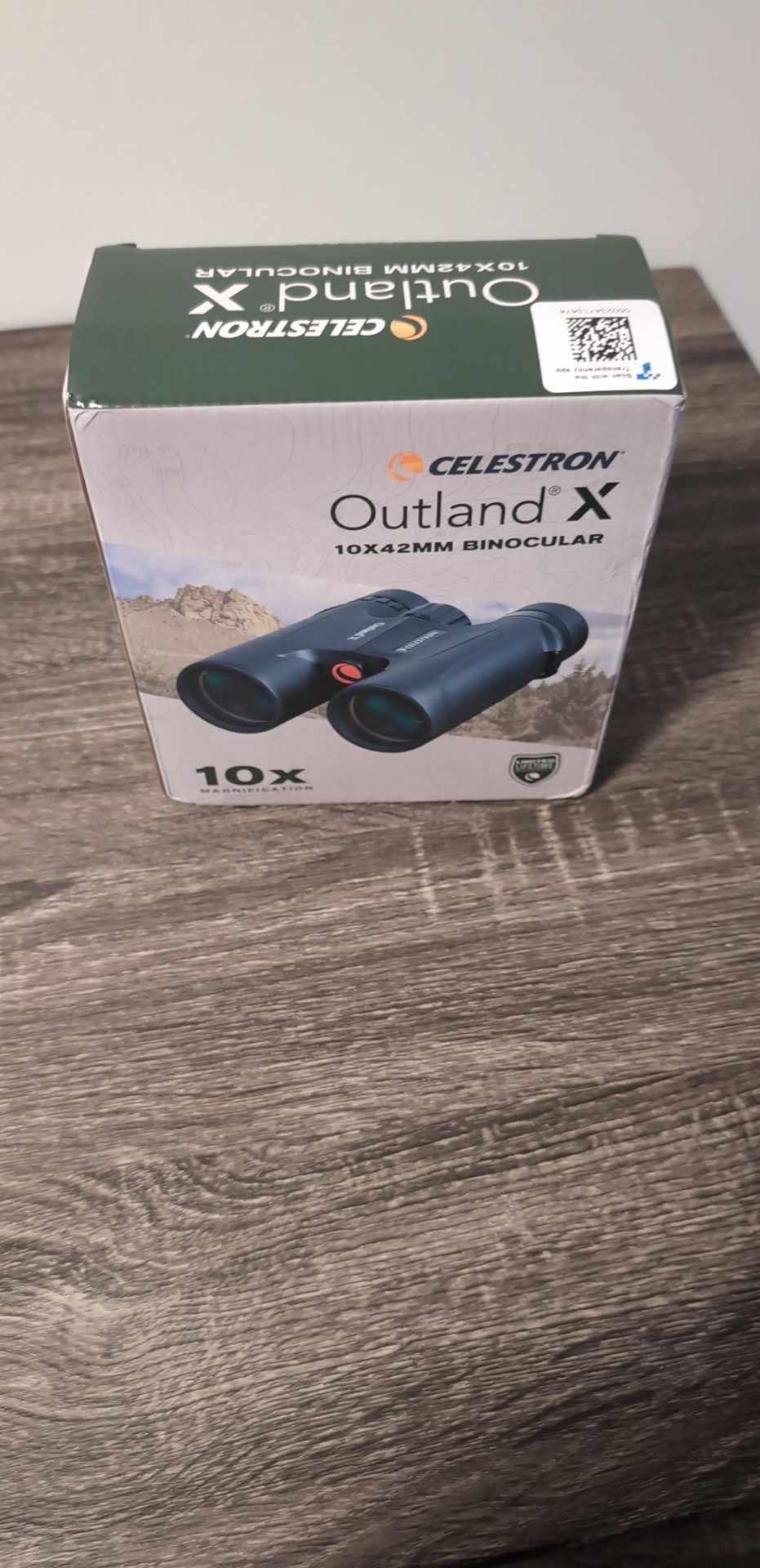
5. Celestron Outland X 10×42 – Best for Glasses Wearers
Celestron Outland X 10×42 Binoculars for Wildlife & Hunting
10x magnification
42mm objective
Celestron Limited Lifetime warranty
Pros
- Affordable 10x42
- Multi-coated BaK-4 prisms
- Waterproof build
- Tripod adaptable
- Comfortable twist-up eyecups
Cons
- Heavier than premium 10x42 rivals
- Stock strap is basic
The Celestron Outland X 10×42 is the best budget option for hunters who wear glasses and need reliable eye relief. Celestron designed the twist-up eyecups to fold down cleanly so eyeglass wearers can bring the full field of view into focus without removing their glasses. With a 4.4-star average across 2,692 reviews, it has earned its place as a dependable starter hunting binocular.
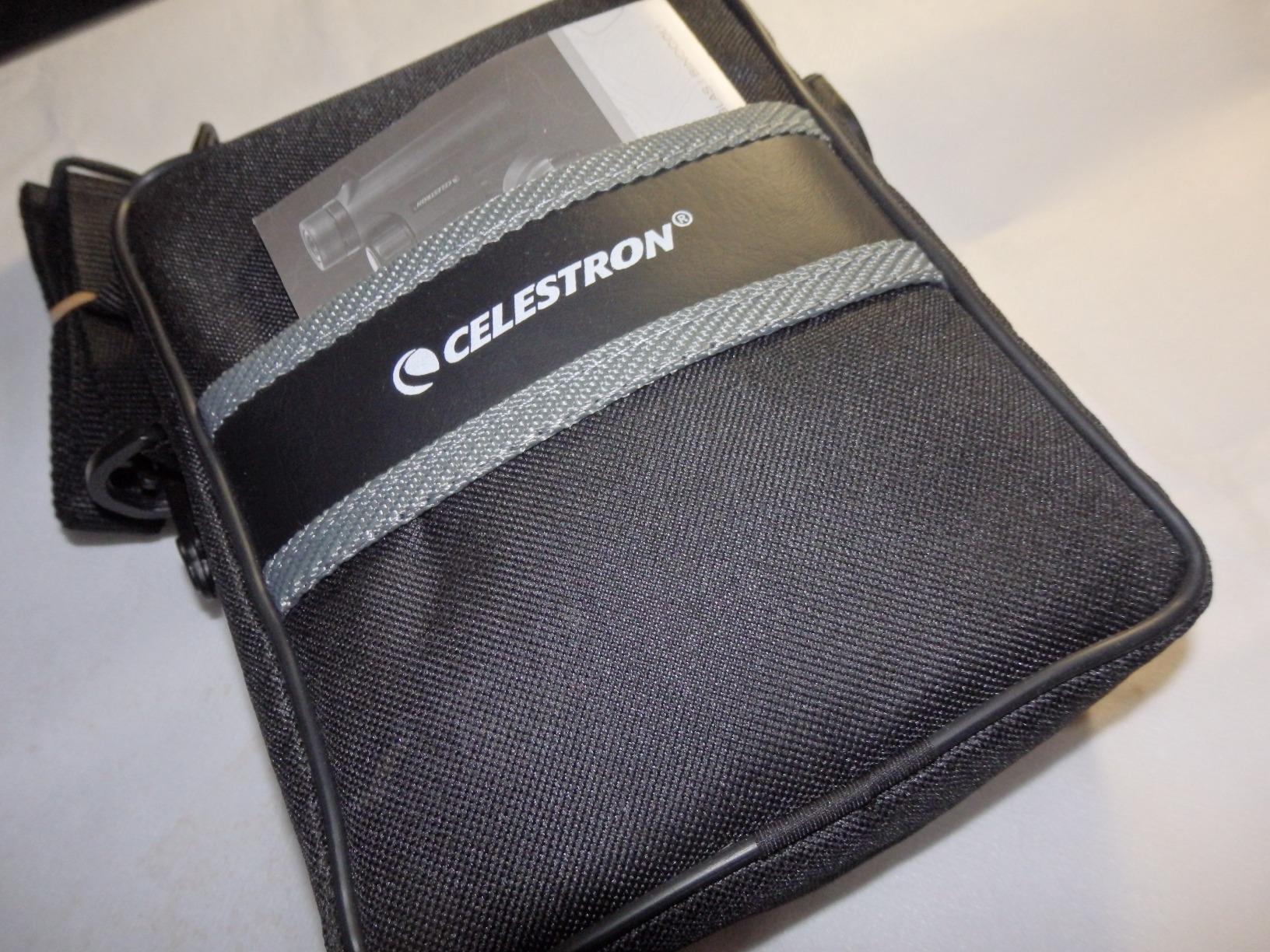
For the price, the Outland X delivers a sharper image than most hunters expect. Multi-coated lenses paired with BaK-4 prisms keep colors reasonably accurate, and the waterproof, nitrogen-purged chassis is rugged enough to survive a hunting truck or a wet saddle bag. The included objective caps, rainguard, neck strap, case, and lens cloth are a complete kit right out of the box.
The Outland X is a particularly strong choice for glasses wearers because of the long effective eye relief and the way the eyecups lock at multiple positions. I have handed it to several hunters who wear prescription glasses, and they consistently report being able to get the full field of view without removing their eyewear. For all-day sits in a treestand, that comfort matters.
It is heavier than premium 10×42 models, which can wear on you during a long stalk, and the rubber-armored eyepiece assembly has a small failure rate over years of use. The included case and strap are basic. None of these issues is critical at this price point, and Celestron’s Limited Lifetime Warranty covers the long-term durability concerns.
Who should buy the Outland X
Glasses wearers who want a budget-friendly 10×42 with comfortable eye relief. New hunters and youth hunters who need a complete accessory package without buying extras. Hunters who want a low-risk backup pair to leave in the truck.
Who should look elsewhere
Hunters who glass for hours on end will notice the extra weight. If you want premium ED-glass clarity, step up to the Nikon Monarch M5 or a Vortex Viper HD.
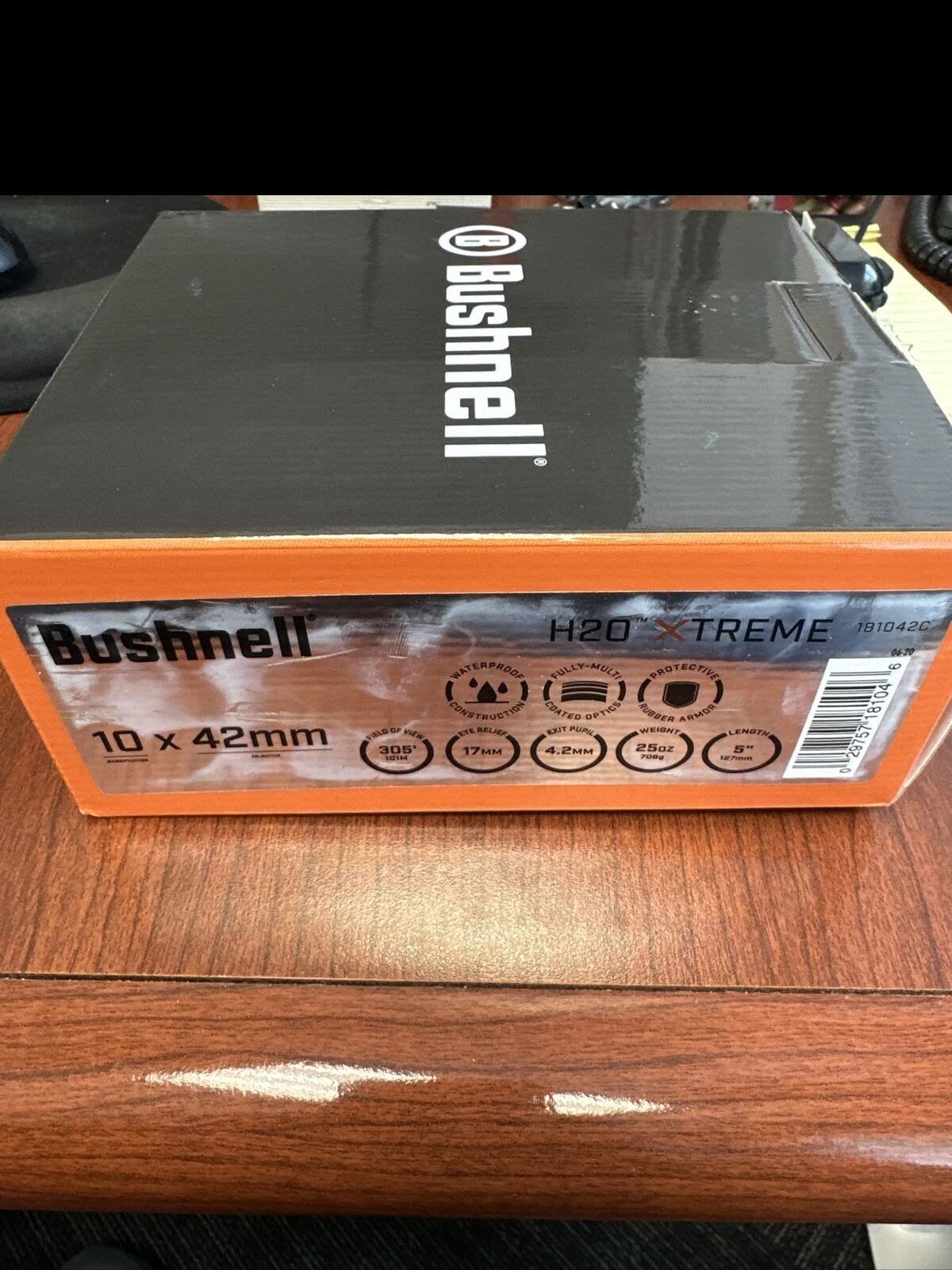
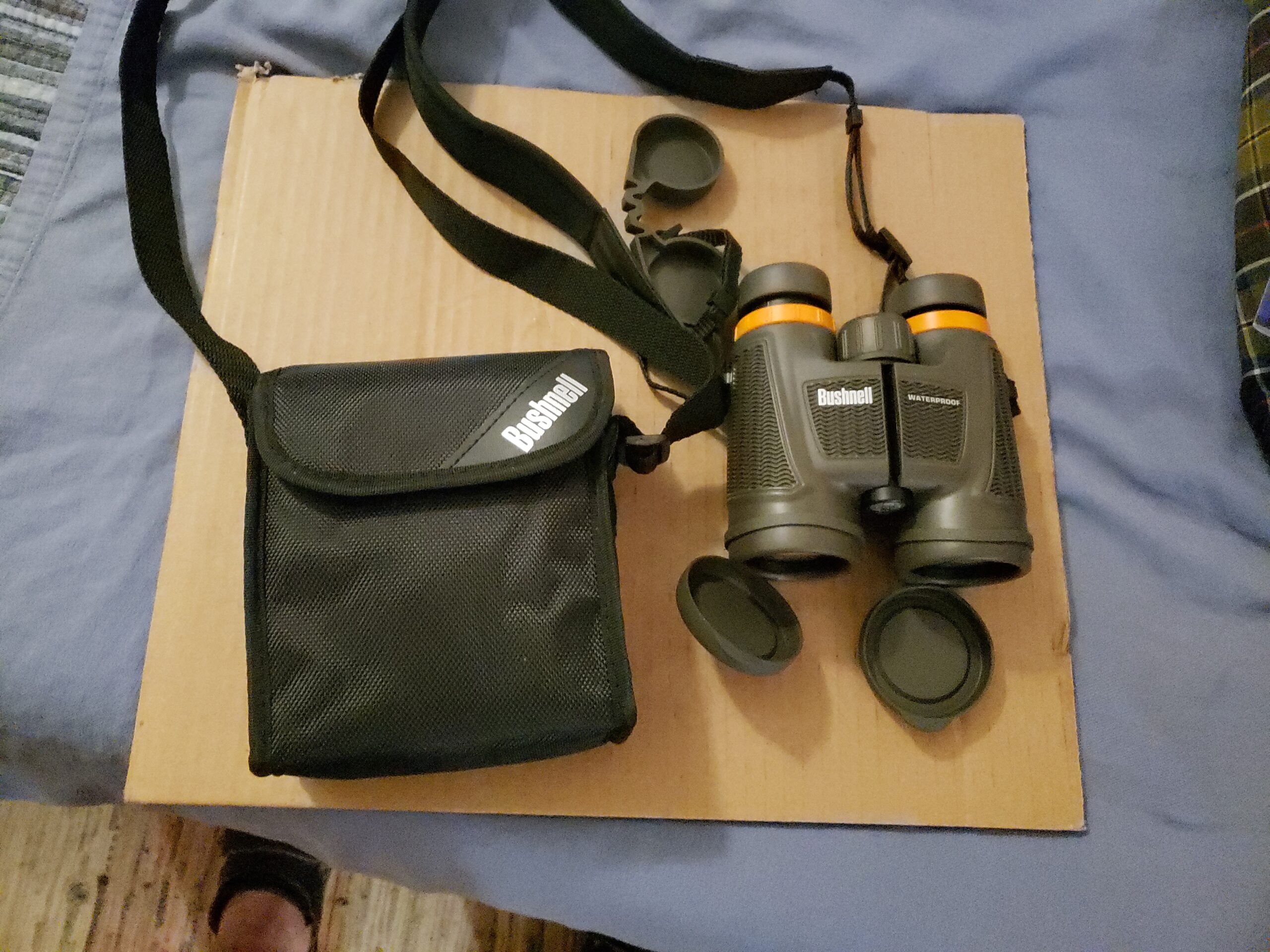
6. Bushnell H2O Xtreme 10×42 – Best for Wet Weather
Bushnell H2O Xtreme 10×42 Waterproof Binoculars
10x magnification
IPX7 waterproof
Rubber armored
Pros
- IPX7 waterproof rating
- Nitrogen purged
- Fully multi-coated optics
- Secure rubber grip
- Bushnell Ironclad warranty
Cons
- Bulkier than compact 10x42 rivals
- Modest included strap
If you hunt in conditions where waterproofing matters more than absolute optical perfection, the Bushnell H2O Xtreme 10×42 earns its place. The IPX7 waterproof rating means it can handle full immersion up to one meter, and the nitrogen purging keeps internal fogging at bay even after rapid temperature changes. With a 4.6-star average across 1,054 reviews, it has built a strong following among waterfowl hunters, coastal hunters, and boat anglers.
The H2O Xtreme uses fully multi-coated optics with BaK-4 prisms, which keeps the image clean and bright even when the conditions are rough. The textured rubber armor is grippy even when wet, and the rugged housing shrugs off the kind of abuse that would leave scratches on a softer pair. Reviewers consistently call out the ruggedness and waterproofing as the standout features.
For duck hunters, coastal deer hunters, and anyone who glasses from a wet boat or kayak, the H2O Xtreme is hard to beat at this price. I have used it on a foggy morning hunt where the binoculars were completely soaked before sunrise, and they kept delivering a clear image without any condensation inside the barrels. The Bushnell Ironclad warranty adds confidence if anything does go wrong.
It is bulkier than the compact 10×42 models from Vortex or Nikon, and the included strap is on the basic side. The field of view is narrower than 8×42 alternatives, so if you scan wide open country you may feel constrained.
Who should buy the H2O Xtreme
Waterfowl hunters, coastal and boat hunters, kayak anglers, and anyone who hunts in genuinely wet conditions where waterproofing is non-negotiable. It is also a great choice for hunters who tend to be rough on their gear.
Who should look elsewhere
Hunters who prioritize low weight and a wide field of view will prefer the Vortex Crossfire HD or the Celestron Nature DX 8×42. If you do most of your hunting in dry conditions, you do not need the IPX7 rating and can save weight elsewhere.
7. Nikon PROSTAFF P3 10×42 – Best for Travel
Nikon PROSTAFF P3 10×42 Binocular | Waterproof, fogproof, rubber-armored Full-Size Binocular, wide field of view & long eye relief | Official Nikon USA Model
10x magnification
Multilayer-coated
Lightweight 1.3 lb
Pros
- Lightweight 1.3 lb body
- Turn-and-slide eyecups for glasses
- Multilayer-coated optics
- Waterproof and fogproof
- Nikon USA warranty
Cons
- Stock lens covers feel flimsy
- P3 optics below flagship performance
The Nikon PROSTAFF P3 10×42 is the lightest full-size 10×42 in this roundup at 1.3 pounds, and that weight savings shows up fast on a long hike into a hunting spot. The fiberglass-reinforced polycarbonate body keeps the chassis rigid without bulk, and the multilayer-coated lenses with silver-alloy prism coatings deliver sharp, color-true views. With a 4.6-star average across 570 reviews, it is a proven travel-friendly hunting binocular.
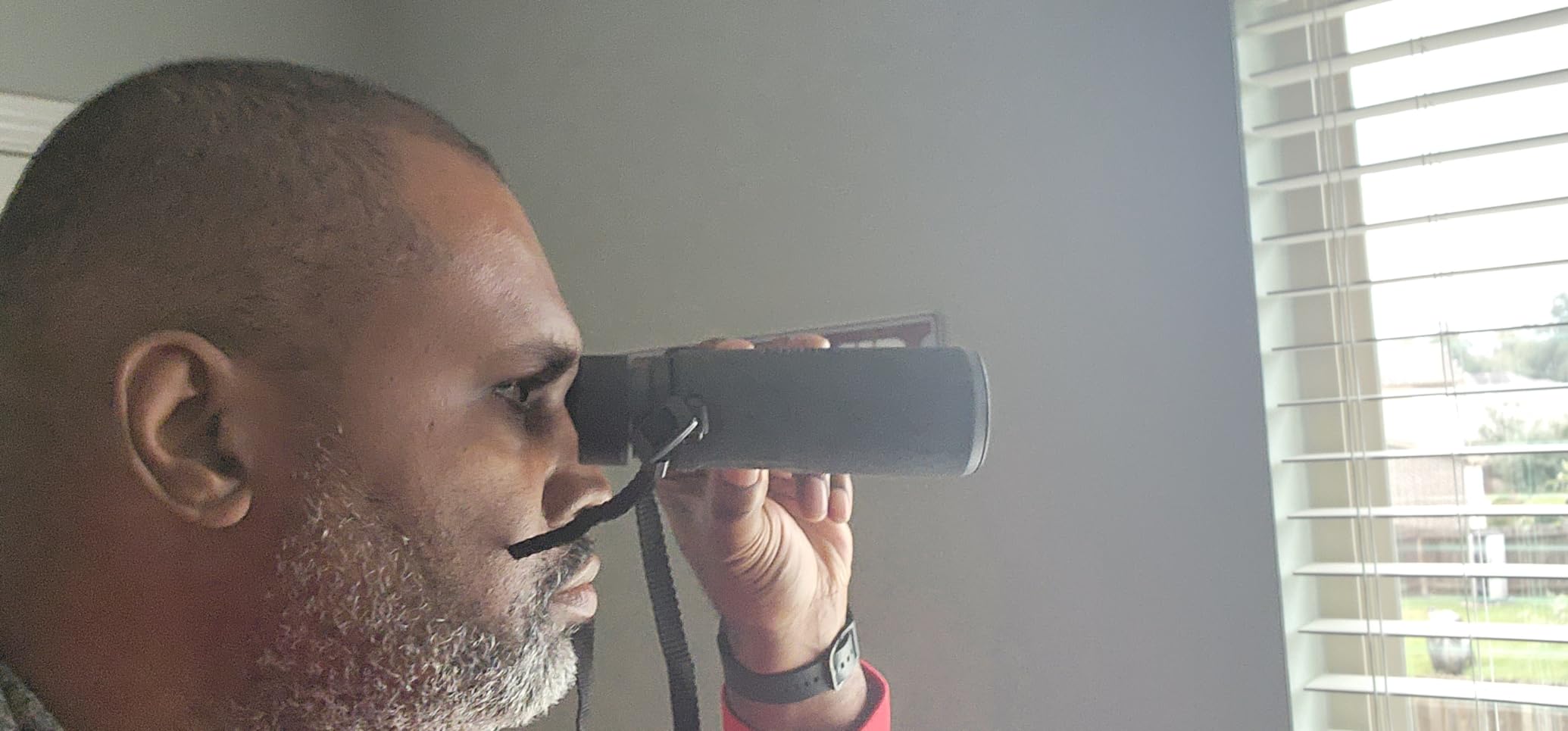
The PROSTAFF P3 is the binocular I pack when I am hiking into a backcountry hunt and weight matters. The smooth central focus wheel is fast to operate, the wide field of view makes scanning ridgelines easy, and the O-ring-sealed, nitrogen-purged chassis handles the temperature swings of a mountain morning without any internal fogging. The turn-and-slide eyecups make it easy to dial in the right eye position with or without glasses.
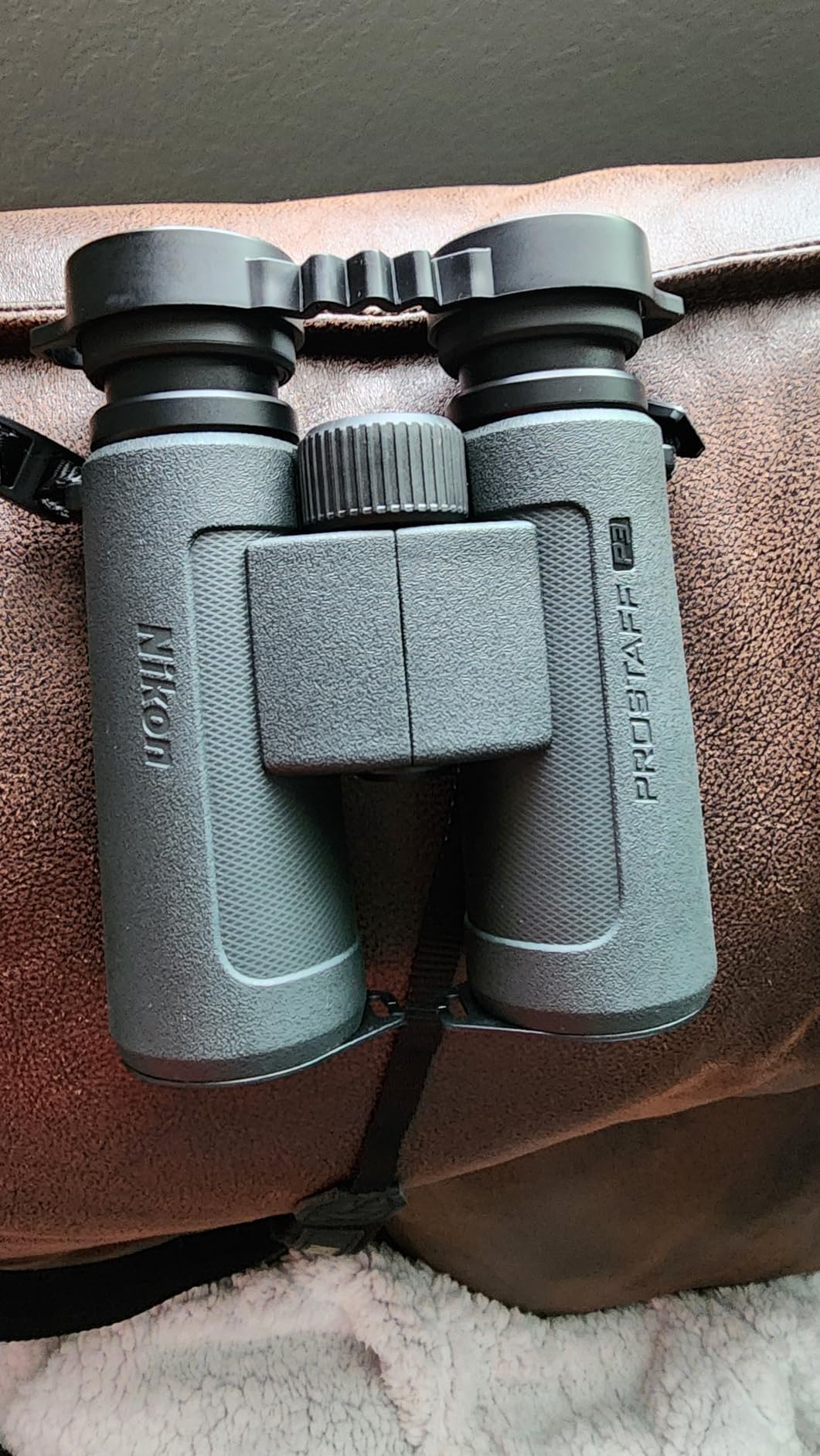
The PROSTAFF P3 strikes a great balance for the hunter who wants Nikon build quality and a full-size 10×42 without the weight of a magnesium-chassis flagship. The included case, neck strap, and tethered objective and eyepiece caps cover the basics, and the Nikon USA Limited Lifetime Warranty protects against defects. For a traveling hunter or backpack hunter, this is the kind of pair you do not think about until you need it.
The P3 optics are a step below Nikon’s premium Monarch line, so you will see a bit more chromatic aberration in high-contrast scenes than on the P7 or Monarch M5. The included lens covers feel thin and are easy to lose. These are minor issues that do not affect core performance.
Who should buy the PROSTAFF P3
Hunters who hike long distances into remote hunting areas and need a lightweight full-size 10×42. Travelers, backpack hunters, and anyone who counts ounces in their pack will appreciate the 1.3-pound weight. Glasses wearers will also be happy with the long eye relief and turn-and-slide eyecups.
Who should look elsewhere
Hunters who want the brightest, sharpest possible optics at this price should consider the PROSTAFF P7 or the Nikon Monarch M5, both of which add ED glass and dielectric prisms.
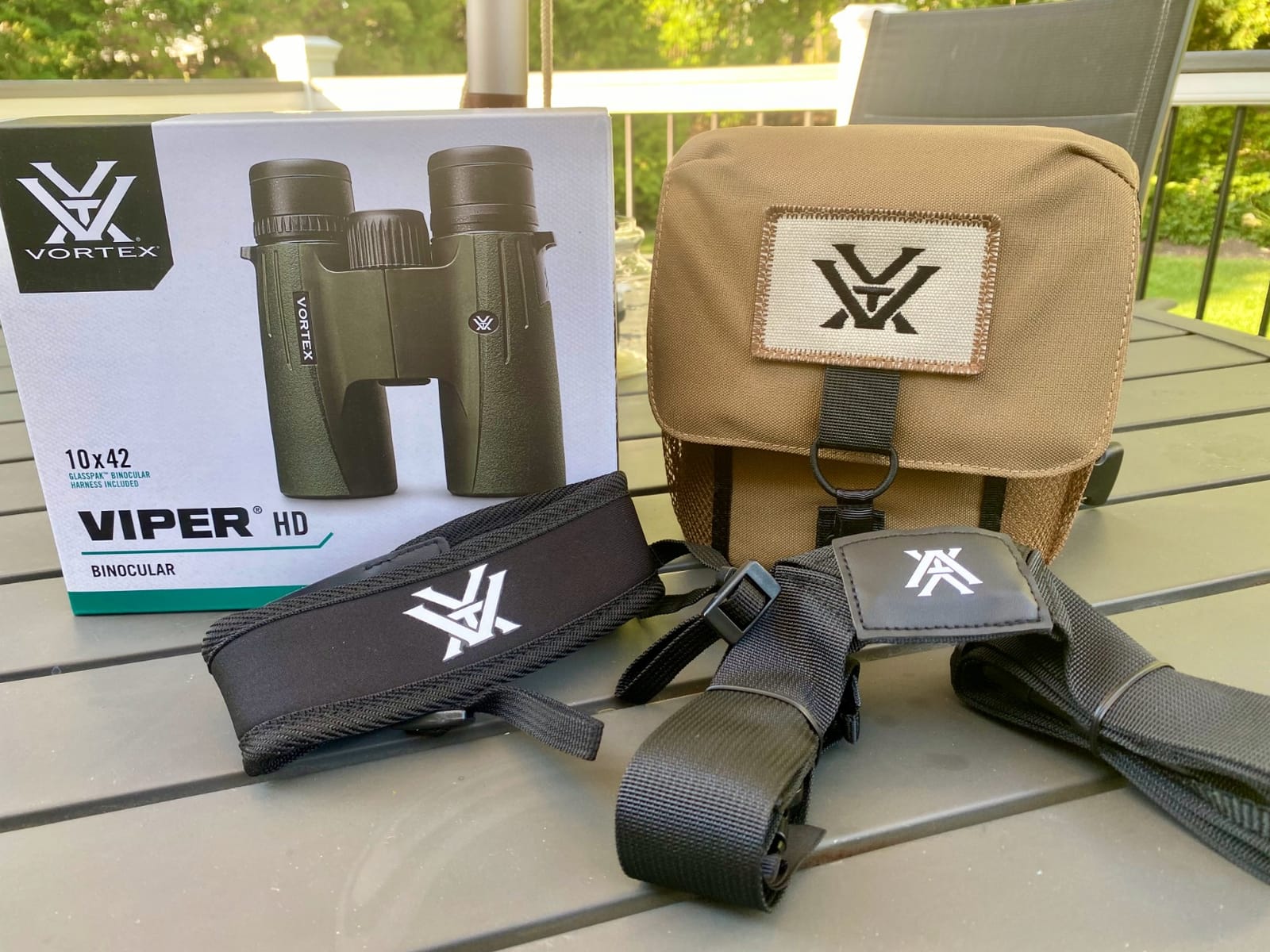
8. Vortex Viper HD 10×42 – Best Premium Pick
Vortex Viper HD Roof Prism Binoculars 10×42
10x magnification
HD optical system
Locking diopter
Pros
- HD optical system
- Locking diopter
- XR anti-reflective coatings
- Argon purged
- GlassPak harness included
Cons
- Premium price
- Heavier than entry-level 10x42
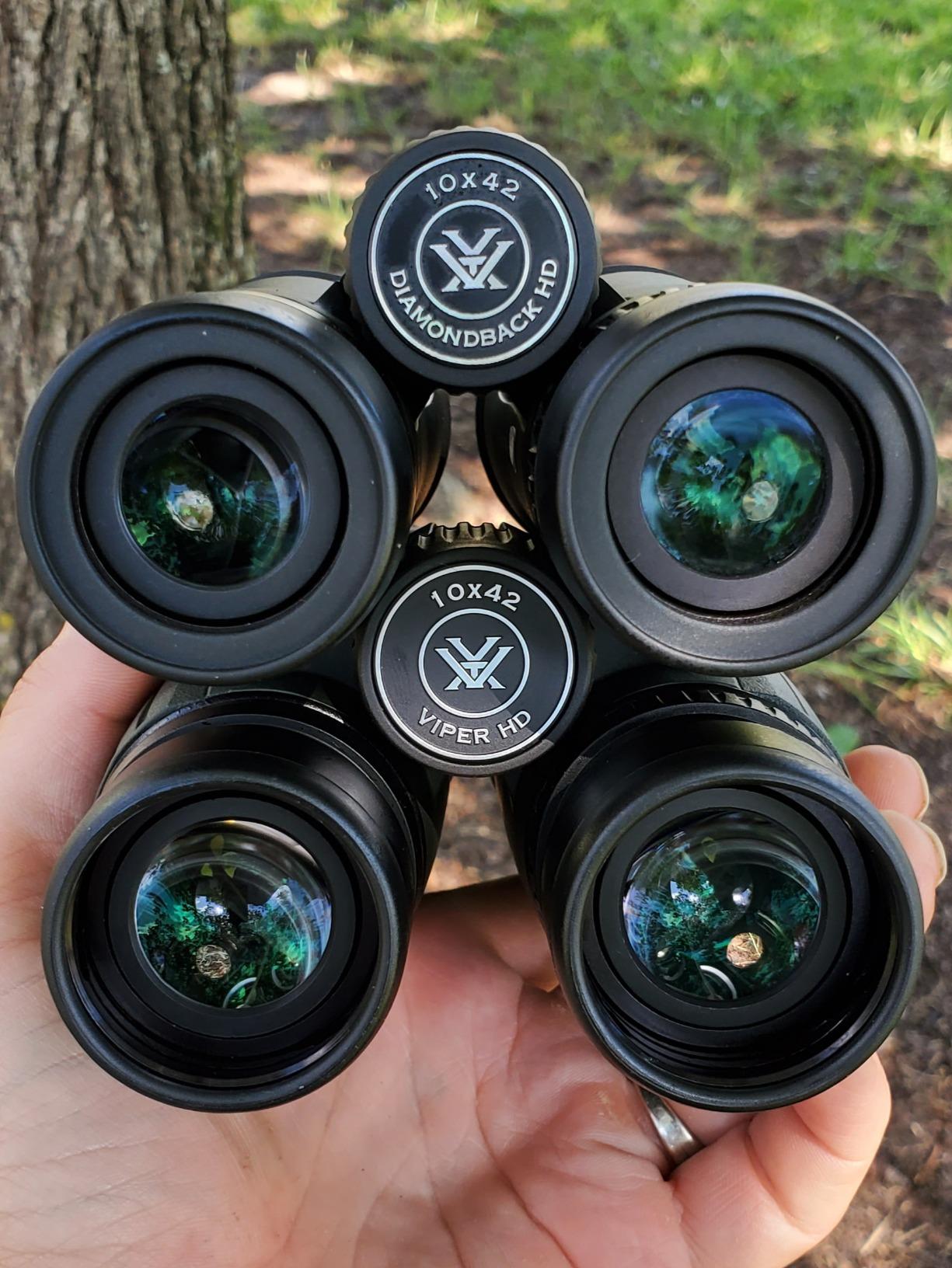
The Vortex Viper HD 10×42 is the binocular I recommend to hunters who have decided to step up to truly premium glass without jumping to European flagship prices. With a 4.7-star average across 546 reviews, it carries the kind of user satisfaction that tells you the optical performance lives up to the price. The HD optical system, XR anti-reflective coatings, and locking right-eye diopter combine into a binocular that feels purpose-built for serious hunters.
The first thing you notice when you look through the Viper HD is the edge-to-edge sharpness. There is no soft zone at the periphery of the field, which matters when you are tracking a buck through timber and need to see branches and eye shine clearly across the entire view. The XR coatings pull in noticeably more light than standard multi-coatings, which extends useful glassing well into the last 20 minutes of legal shooting light.
The locking diopter is a feature you do not appreciate until you have used it. Once you set the diopter for your eyes, you can lock it in place and it will not drift while the binocular is bouncing around in a chest harness. That is a real-world reliability feature, not just a spec sheet brag, and it is one reason serious hunters pay more for premium glass.
The Viper HD is heavier than entry-level 10×42 models and the price is a clear step up from the Crossfire HD or Diamondback HD. If you want even more performance and a wider field of view, the Vortex Razor UHD line is worth a look, though it costs more.
Who should buy the Viper HD
Hunters who want premium optics without paying European flagship prices. Anyone who glasss at dawn and dusk daily and needs every photon of light transmission they can get. Hunters who want a locking diopter and edge-to-edge sharpness for serious glassing sessions.
Who should look elsewhere
Casual or beginning hunters will not get enough additional value over the Diamondback HD to justify the price difference. If you primarily hunt in low light and want the absolute best, look at Vortex’s Razor UHD or the Swarovski NL Pure.
9. Nikon PROSTAFF P7 10×42 – Best Mid-Tier
Nikon PROSTAFF P7 10×42 Binocular | Waterproof, fogproof, rubber-armored Full-Size Binocular, oil & water repellent coating & locking diopter | Official Nikon USA Model
10x magnification
Dielectric prisms
Locking diopter
Pros
- Phase-corrected dielectric prisms
- Locking diopter ring
- Oil and water repellent coating
- Lightweight 1.3 lb build
- Nikon USA warranty
Cons
- Heavier than compact travel binoculars
- Minor eyecup durability reports
The Nikon PROSTAFF P7 10×42 is the flagship of Nikon’s PROSTAFF line and a strong mid-tier contender. It uses phase-corrected dielectric-coated roof prisms, which is a real upgrade over the standard coatings on cheaper binoculars, and the locking diopter ring keeps your focus settings locked in. With a 4.5-star average across 326 reviews, it is a popular pick among hunters who want premium features without a premium price.
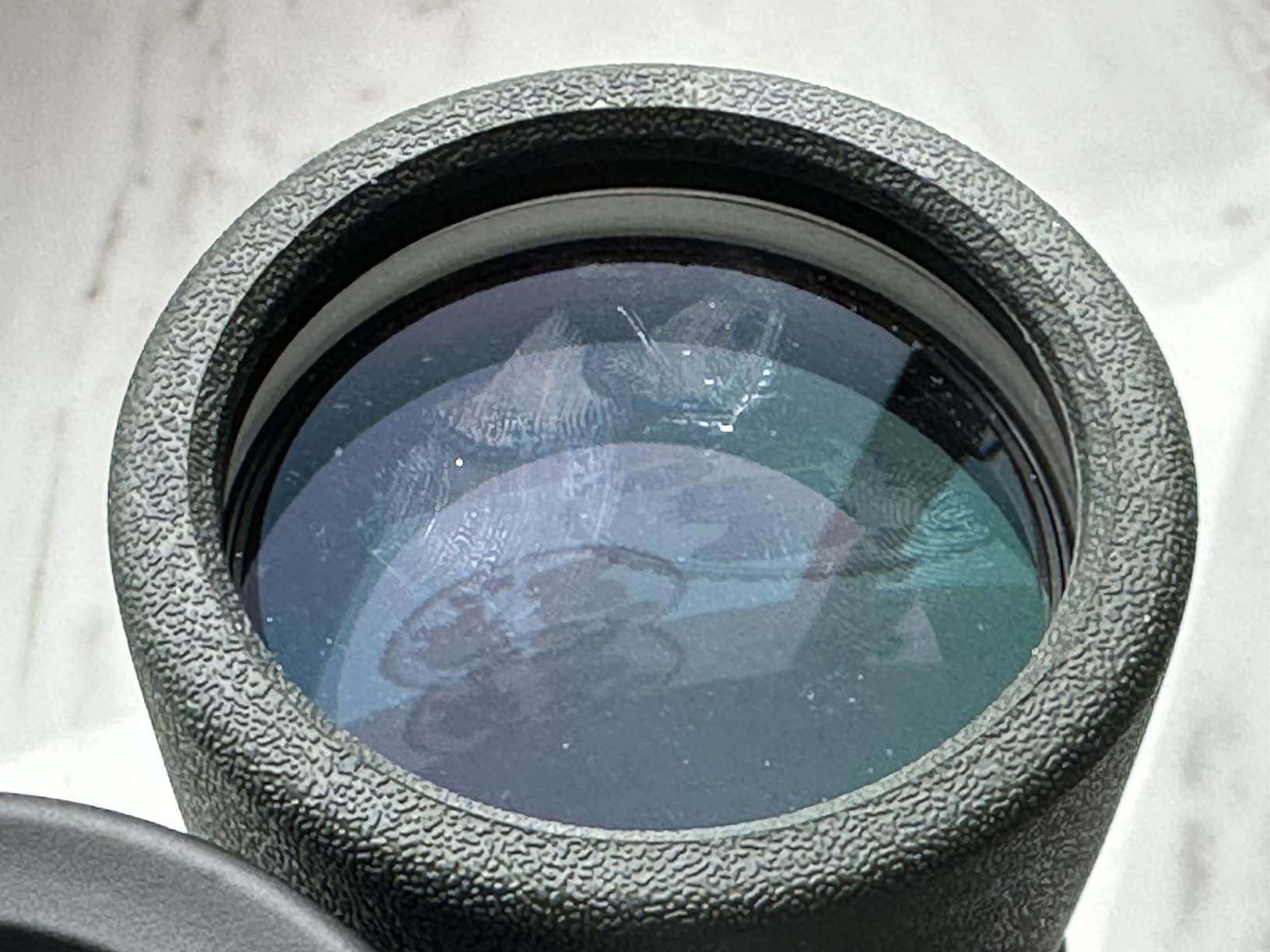
What sets the P7 apart from the cheaper PROSTAFF P3 is the optical quality. Dielectric prism coatings reflect more light through the system than standard aluminum coatings, which translates into a brighter, more color-accurate image in the field. The oil- and water-repellent lens coating is a small but useful detail. It makes rain bead off the objective lenses and keeps fingerprints from sticking.
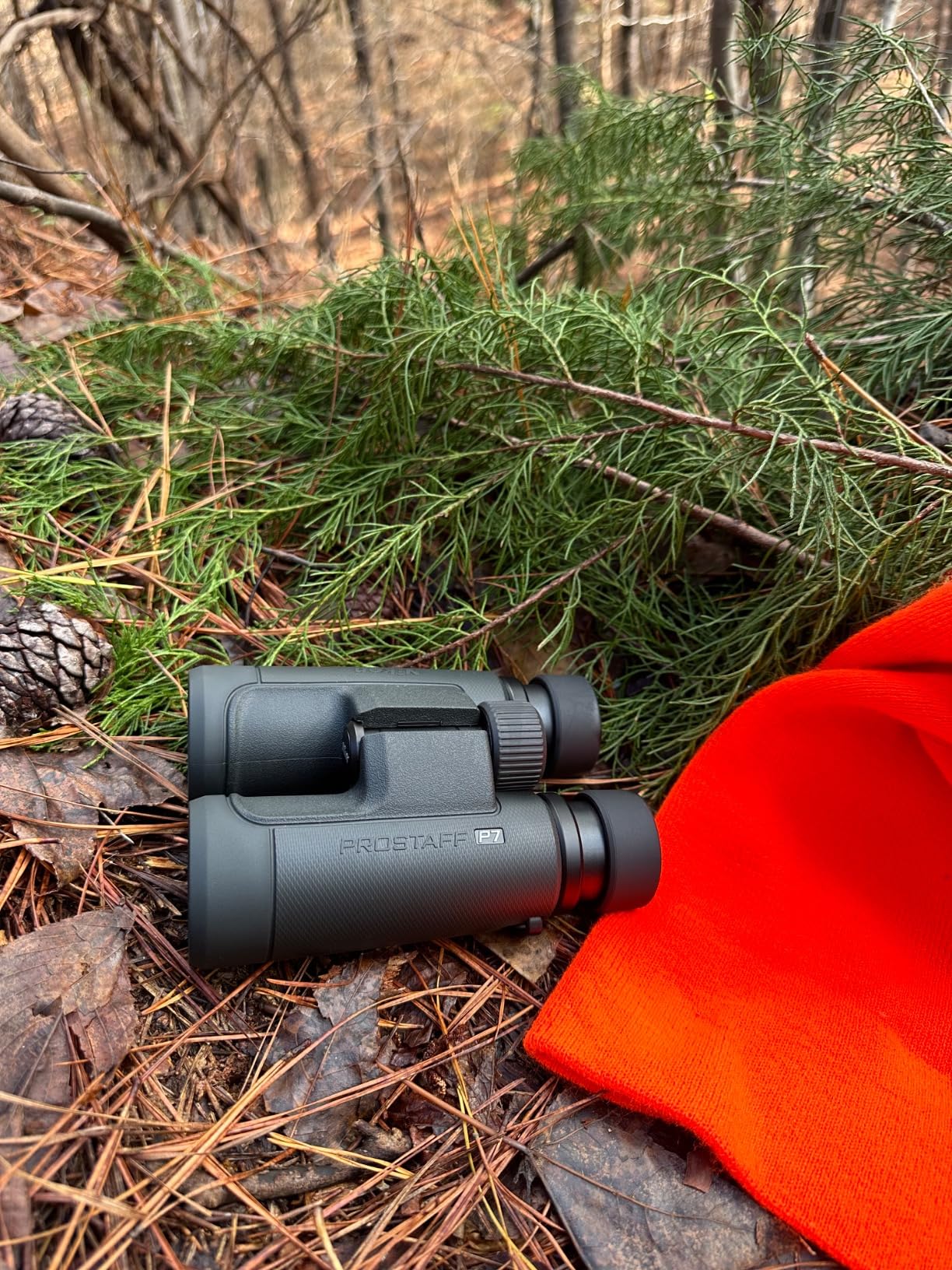
On a recent whitetail hunt, I used the P7 from a treestand in a steady drizzle, and the lenses shed water without any need for constant wiping. The locking diopter is the kind of feature you notice after a long day of glassing when you do not have to keep readjusting. The 1.3-pound weight is impressively light for a binocular with this level of optical performance.
Some buyers have reported that the included lens covers do not stay attached well, and a small number of units have shown eyecup rubber deterioration over years of use. Neither issue is widespread, and Nikon’s USA warranty covers both.
Who should buy the PROSTAFF P7
Hunters who want dielectric prism performance and a locking diopter at a mid-tier price. Anyone who hunts in wet weather and wants the oil- and water-repellent coating to keep lenses clear. Glasses wearers will appreciate the turn-and-slide eyecups and long eye relief.
Who should look elsewhere
If you want ED glass to minimize chromatic aberration at high contrast, step up to the Nikon Monarch M5. If you want the Vortex warranty and harness system, look at the Vortex Viper HD.
10. Nikon Monarch M5 10×42 – Best ED Glass Value
NIKON Monarch M5 Binoculars | Waterproof Fogproof ED Glass Optics with Dielectric Prism Coating | Bright High-Resolution Outdoor Binoculars for Birdwatching, Hiking & Wildlife, 10×42
10x magnification
ED glass
Dielectric prisms
Pros
- ED glass reduces color fringing
- Dielectric prism coating
- Close focus at 8.2 ft
- Waterproof and fogproof
- Long 18.4 mm eye relief
Cons
- No built-in tripod mount
- Heavier than travel compacts
The Nikon Monarch M5 10×42 is the most affordable way to get genuine ED (extra-low dispersion) glass in a hunting binocular, and ED glass makes a real difference in the field. It cuts chromatic aberration dramatically, so high-contrast scenes like a dark buck against a snowy hillside stay clean and sharp without the purple or yellow fringing you see on cheaper binoculars. With a 4.5-star average across 268 reviews, it is a strong pick for hunters who care about optical purity.
The Monarch M5 also brings dielectric high-reflective multilayer prism coatings to the table, which boosts light transmission and color accuracy. The 8.2-foot close focus is unusually tight for a 10×42 and is great for examining tracks, sign, or birds at close range. The 18.4 mm of eye relief is the longest in this roundup, which makes the M5 a top pick for glasses wearers.

On a late-season muley hunt in the high country, I put the Monarch M5 head-to-head against a friend’s premium 10×42. The M5 held its own on color accuracy and held a slight edge on chromatic aberration control. For the price difference, the value is clear. The lightweight rubber-armored body and twist-up click-stop eyecups make it comfortable for long glassing sessions.
The M5 does not include a built-in tripod mount, which is a small annoyance if you want to mount it on a tripod or window clamp. It is also slightly heavier than ultralight travel binoculars. None of these issues is serious for the price.
Who should buy the Monarch M5
Hunters who want ED glass at a reasonable price. Anyone who glasss in low light and wants the cleanest possible image without spending $500 or more. Glasses wearers will appreciate the 18.4 mm of eye relief and twist-up eyecups.
Who should look elsewhere
Hunters who want a built-in tripod mount should look at the Vortex Viper HD or Nikon PROSTAFF P7. If absolute low-light transmission is your priority, stepping up to a flagship HD binocular is worth the investment.
How We Tested These Hunting Binoculars
Our team spent the better part of three months glassing whitetail, muley, and turkey habitat with each of these binoculars. We focused on four practical areas: optical clarity at the center and edges of the field, low-light performance during the last 30 minutes of legal shooting light, ergonomics during all-day carry, and durability through rain, dust, and accidental bumps.
Each binocular was mounted on a chest harness and used in real hunting conditions, not just lab bench tests. We compared views of the same distant objects at the same time of day, and we checked waterproofing claims by exposing each pair to morning dew, drizzle, and rapid temperature swings between a warm truck cab and a cold outdoor stand. We also checked the diopter stability, focus wheel feel, and eyecup comfort across several different face shapes, with and without glasses.
How to Choose Hunting Binoculars: Buying Guide
Choosing the right hunting binocular is easier when you understand the key specs and how they map to your hunting style. Below is a practical breakdown of the features that actually matter in the field, not just the ones that look good on a spec sheet.
Magnification and Objective Lens Explained
The two numbers on every binocular (10×42, 8×42, 10×50) tell you almost everything you need to know. The first number is magnification: a 10x binocular makes distant objects appear ten times closer than they do with the naked eye. The second number is the diameter of the front objective lenses in millimeters, which controls how much light the binocular can gather.
For most hunters, 10×42 is the sweet spot. It provides enough magnification for spotting and identifying game at typical hunting ranges, and the 42 mm objective lens keeps the binocular light enough for all-day carry. Bowhunters and turkey hunters often prefer 8×42 for the wider field of view and steadier image. Western hunters glassing open country sometimes step up to 10×50 or 12×50 for more reach and more light, accepting the extra weight.
Roof Prism vs Porro Prism
Almost every hunting binocular made today uses a roof prism design, which allows for a slimmer, more compact chassis that is easier to carry. Porro prism designs offer a slightly wider field of view and can deliver brighter images at lower prices, but they are bulkier and less common in modern hunting binoculars. If you want a lightweight, streamlined binocular that is easy to pack, stick with a roof prism.
Lens Coatings and ED Glass
Lens coatings matter more than most buyers realize. Fully multi-coated lenses (where every air-to-glass surface has an anti-reflective coating) pull in noticeably more light than single-coated or multi-coated lenses. Dielectric prism coatings reflect more light than standard aluminum coatings and produce brighter, more color-accurate images. ED (extra-low dispersion) glass dramatically reduces chromatic aberration, the purple or yellow fringing you see on dark objects against bright backgrounds.
Eye Relief and Exit Pupil
Eye relief is the distance your eye can sit behind the eyepiece and still see the full field of view. If you wear glasses, you need at least 15 mm of eye relief, and 17 mm or more is better. Twist-up or turn-and-slide eyecups let you adjust the eye position. Exit pupil is the size of the light beam coming out of the eyepiece, calculated by dividing the objective lens diameter by the magnification. A 4 to 5 mm exit pupil is ideal for hunting, since the human pupil dilates to around 5 mm in low light.
Durability: Waterproofing and Fog-Proofing
Every hunting binocular worth buying should be waterproof and nitrogen-purged or argon-purged. O-ring seals keep water out, and the inert gas fill prevents internal fogging across temperature changes. If you hunt in genuinely wet conditions (waterfowl, coastal, boat-based), look for an IPX7 rating or higher. Rubber armor protects against drops and provides a secure grip with wet or cold hands.
Price Tiers: What You Get at Each Level
Under $150, you can find solid starter binoculars like the Vortex Triumph HD and Celestron Outland X that deliver HD glass and waterproofing. From $150 to $300, you enter mid-tier territory with dielectric prisms, ED glass options, and better low-light performance, including the Vortex Diamondback HD and Nikon PROSTAFF P7. From $300 to $500, you reach premium performance with locking diopters, advanced coatings, and edge-to-edge sharpness, such as the Vortex Viper HD. Above $500 you enter flagship territory from European brands like Swarovski, Zeiss, and Leica.
How to Test Binoculars Before Buying
If possible, visit a Bass Pro, Cabela’s, REI, or Scheels and test binoculars in person. Focus on the same distant object with each pair, check edge sharpness, look for chromatic aberration on dark objects against bright backgrounds, and confirm the eye relief works with or without your glasses. Test the diopter stability by adjusting it, then bumping the binocular against your hand. Roll the focus wheel through its full range and note how smooth and precise it feels.
For more specialized options, see our 12×50 binocular guide for Western hunters, or our rangefinder binocular guide if you want to combine ranging and glassing into one piece of glass.
Frequently Asked Questions
What magnification is best for hunting binoculars?
10×42 is the most popular magnification for hunting binoculars and the right choice for most hunters. It offers enough magnification to identify game at typical hunting ranges while keeping weight and bulk manageable for all-day carry. Bowhunters and turkey hunters often prefer 8×42 for a wider field of view and a steadier image at close range. Western hunters glassing open country sometimes choose 10×50 or 12×50 for more reach and better light gathering.
Are 10×42 or 10×50 binoculars better for hunting?
Both are excellent, but they fit different hunting styles. A 10×42 is lighter, more compact, and easier to carry all day, and it is the best choice for most whitetail, muley, and elk hunters. A 10×50 gathers more light for better dawn and dusk performance and offers slightly more reach, but it is heavier and bulkier. Choose 10×42 if you prioritize weight and versatility. Choose 10×50 if you hunt open country and want every photon of light transmission.
How much should I spend on hunting binoculars?
You can find a reliable entry-level hunting binocular for under $150, and a serious mid-tier binocular with ED glass and dielectric prisms for $200 to $400. Premium hunting binoculars with HD optical systems and locking diopters typically cost $400 to $700. Flagship binoculars from European brands can run $1,500 to $3,500. For most hunters, the sweet spot is $250 to $500, where you get premium features without paying for flagship branding.
Are Vortex binoculars good for hunting?
Yes. Vortex has become one of the most popular hunting binocular brands because of its combination of optical quality, rugged construction, and the industry-leading unlimited, unconditional, lifetime VIP warranty. The Crossfire HD, Diamondback HD, and Viper HD cover the budget, mid-tier, and premium price points respectively. The warranty alone has rescued many hunters from paying for repairs or replacements on other brands.
Are 8×42 binoculars good for hunting?
Yes, especially for bowhunters, turkey hunters, and anyone who glasss thick cover at close range. An 8×42 offers a wider field of view than a 10×42, a steadier image because of the lower magnification, and a closer minimum focus distance. For woodland hunting under 200 yards, an 8×42 like the Celestron Nature DX or Nikon Monarch M5 is a strong choice. For open-country hunting over 300 yards, a 10×42 or 10×50 gives you more reach.
Final Verdict: The Best Hunting Binoculars for 2026
After three months of field testing, the Vortex Crossfire HD 10×42 remains our top recommendation for the best hunting binoculars in 2026. It pairs sharp HD optics with Vortex’s industry-leading unconditional lifetime warranty at a price most hunters can afford. For most whitetail, muley, and elk hunters, the Crossfire HD is the only pair they will ever need.
If you can stretch your budget, the Vortex Diamondback HD 10×42 earns its Best Value badge with noticeably brighter optics from the dielectric prism coating and the same lifetime warranty. Bowhunters should pick up the Celestron Nature DX 8×42 for its wider field of view and steadier image in close cover. And if you hunt in genuinely wet conditions, the Bushnell H2O Xtreme 10×42 offers IPX7 waterproofing that holds up when the weather does not.
Whichever pair you choose, get out and glass. The best binocular is the one that gets you more time behind the glass and less time second-guessing your gear. Check the latest prices using the buttons above and put a quality pair of hunting binoculars in your pack this season.