
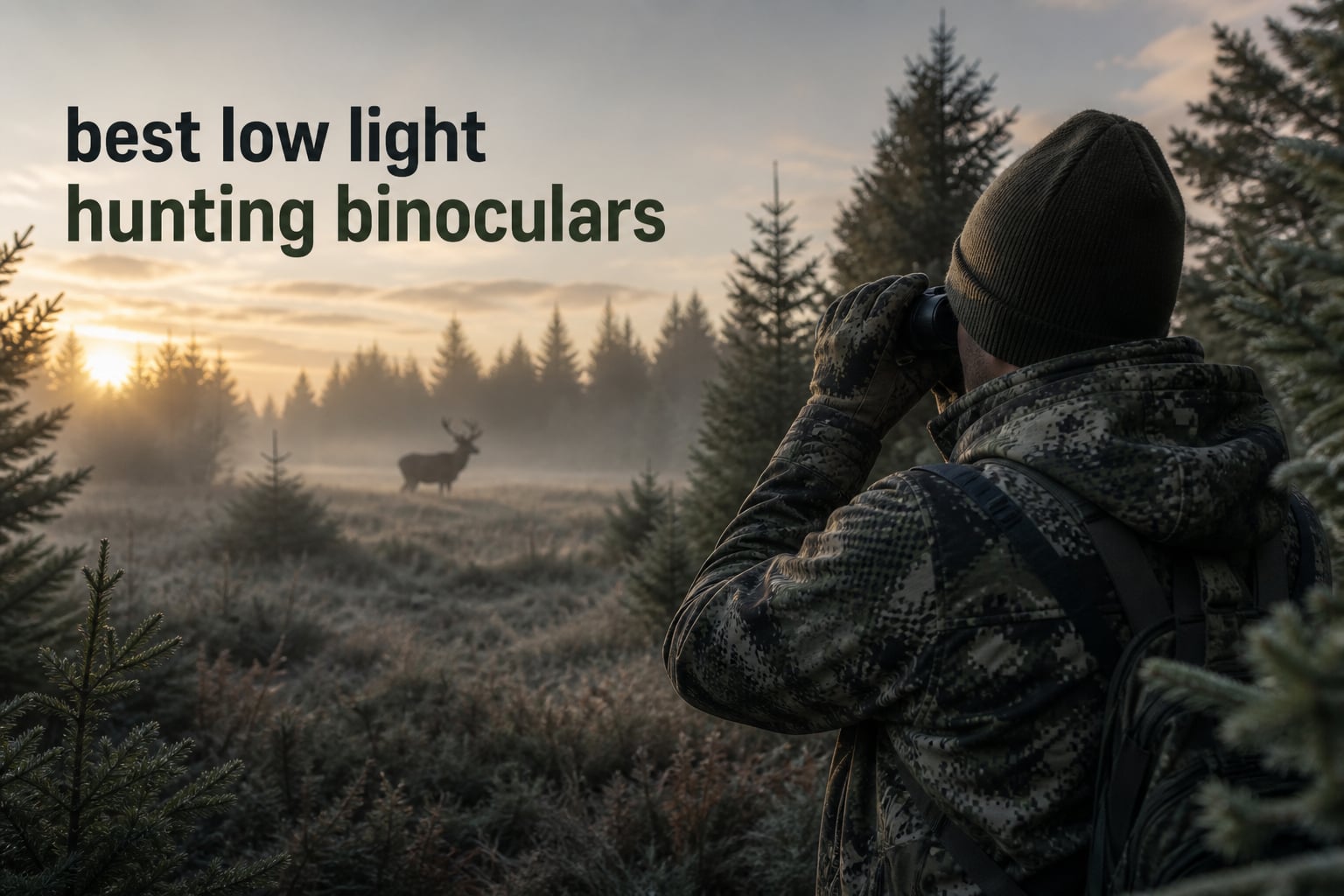
The best low light hunting binoculars help you make out a deer’s body line, antler detail, and the edge of a trail when the woods are losing contrast. The useful combination is not simply a large objective lens: it is a hand-holdable format, enough exit pupil, effective coatings, dependable focus, and weather protection.
For most deer hunters, 8×42 and 10×42 are the starting point because they balance brightness, field of view, and carry comfort. I would move toward 15x or 20x only for distant, supported glassing, since magnification also makes hand shake harder to control and reduces the exit pupil on the models in this list.
This guide covers all 12 available options, from youth-friendly glass to large-objective models for longer looks. If frozen mornings are part of your season, also see our guide to cold weather hunting binoculars; stand hunters may also want our picks for hunting parkas for tree stand sitting.
Table of Contents
These are the top three low-light hunting choices
The Nikon Monarch M5 8×42 is the most low-light-focused all-around format here because its 5.3 mm exit pupil, ED glass, and 19.5 mm eye relief address the things that matter in timber. The Vortex Crossfire HD 10×42 is the practical 10x choice for hunters who want tripod adaptability and a supplied GlassPak harness, while the Vortex Triumph HD 10×42 brings the same broadly useful 10×42 format with HD optics and a lifetime warranty.
- Editor’s choice: Nikon Monarch M5 8×42 for an 8×42 format, ED glass, and long eye relief.
- Best value: Vortex Crossfire HD 10×42 for fully multi-coated optics, weather sealing, and a GlassPak harness.
- Budget pick: Vortex Triumph HD 10×42 for a durable, tripod-adaptable HD system.

These are the best low-light hunting binoculars in 2026
Use this quick overview to identify the format before reading the full notes. An 8×42 produces a 5.25 mm exit pupil, while a 10×42 produces 4.2 mm; that simple division explains why the 8x choices deserve a close look for darker timber.
| Product | Specifications | Action |
|---|---|---|
 Vortex Crossfire HD 10×42 Vortex Crossfire HD 10×42 |
|
View on Amazon |
| Vortex Triumph HD 10×42 |
|
View on Amazon |
 Nikon Monarch M5 8×42 Nikon Monarch M5 8×42 |
|
View on Amazon |
 Vortex Bantam HD 6.5×32 Vortex Bantam HD 6.5×32 |
|
View on Amazon |
 Nikon MONARCH M7 8×42 Nikon MONARCH M7 8×42 |
|
View on Amazon |
 Aurosports 15×56 Aurosports 15×56 |
|
View on Amazon |
 usogood 12×42 usogood 12×42 |
|
View on Amazon |
 innhom 12×42 innhom 12×42 |
|
View on Amazon |
 FLYANT 20×50 FLYANT 20×50 |
|
View on Amazon |
 GIGAPENGUIN 15×52 GIGAPENGUIN 15×52 |
|
View on Amazon |
 Pankoo 20×56 Pankoo 20×56 |
|
View on Amazon |
 AcePath 15×56 AcePath 15×56 |
|
View on Amazon |
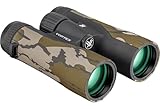
1. The Vortex Crossfire HD 10×42 is the balanced all-around choice
Vortex Crossfire HD 10×42 Binoculars (Mossy Oak Bottomland)
10x42
4.2 mm exit pupil
Tripod adaptable
Pros
- HD optics
- GlassPak harness
- Waterproof and fogproof
- Tripod adaptable
- Lifetime warranty
Cons
- 4.2 mm exit pupil
- Limited stock noted
The Crossfire HD is the sensible starting point for a hunter who wants 10x reach without buying a specialized long-range binocular. Its 10×42 layout creates a 4.2 mm exit pupil, which is less forgiving than an 8×42 at the darkest part of a sit but remains a familiar compromise for mixed woods and field edges.
Vortex lists select glass elements, fully multi-coated lenses, and a roof-prism body intended to improve resolution, color fidelity, edge-to-edge sharpness, and light transmission. The central focus wheel controls both barrels, while the right-eye diopter lets you match the view to differences between your eyes.
I like that the product data calls out tripod adaptability and an included GlassPak harness, since both reduce the nuisance of managing binoculars on longer walks. Nitrogen purging and O-ring seals support waterproof and fogproof performance when a damp dawn turns into a wet climb back to the truck.
Rubber armor is useful for a secure grip, and twist-up eyecups make this option workable with or without glasses. The listed unlimited, unconditional lifetime VIP warranty is another reason this is a low-risk general-purpose choice.
It fits hunters who want steady 10x reach from timber to field edges
Choose this format if you scan across a cut field, food plot, or ridge and still need a binocular that can ride in a harness all day. A tripod adapter matters most when you stop for extended looks rather than using the binocular for quick identification.
It asks dusk-focused hunters to accept a smaller exit pupil than 8×42
At 4.2 mm, the exit pupil is not the largest in this group. Hunters whose whole decision is built around shadow detail at dawn and dusk should compare it directly with the 5.3 mm Nikon 8×42 options below.
2. The Vortex Triumph HD 10×42 is the straightforward full-size choice
Vortex Triumph HD 10×42 Binoculars
10x42
17 mm eye relief
Tripod adaptable
Pros
- HD optical system
- GlassPak harness
- Waterproof and fogproof
- Shockproof
- Lifetime warranty
Cons
- 4.2 mm exit pupil
- No listed locking diopter
The Triumph HD uses the same practical 10×42 format and 4.2 mm exit pupil as the Crossfire, so its strength is flexibility rather than a maximum-brightness claim. It is a sound option for a hunter who wants a full-size binocular for general deer, turkey, and trail-edge observation.
Its HD optical system uses fully multi-coated lenses and optimized glass elements, with the listing highlighting resolution, color fidelity, edge sharpness, and light transmission. The 17 mm eye relief and adjustable rubber eyecups are details I would prioritize if you sometimes glass with sunglasses or prescription eyewear.
The polycarbonate chassis has full rubber armor and is described as shockproof, while nitrogen purging supports waterproof and fogproof use. It also ships with a neck strap and GlassPak harness, so you have two carrying choices from the outset.
Forum discussions often call out loose focus feel and drifting diopters as aggravating field problems. This model lists a center focus arrangement and adjustable diopter, so check both controls in your hands before the season rather than discovering a fit issue in a stand.
It works for hunters who need one uncomplicated binocular for many outings
The 10x magnification gives enough detail for farther field edges while staying far easier to hand-hold than 15x and 20x models. Its tripod-ready mount is a useful backup for long sessions from a blind or a fixed glassing point.
It leaves the largest low-light advantage to the 8×42 models
The 10×42 layout cannot produce the 5.3 mm exit pupil of an 8×42 with the same objective diameter. If your main view is dense timber during the last usable minutes, an 8×42 deserves priority over extra magnification.
3. The Nikon Monarch M5 8×42 is the timber-friendly low-light pick
NIKON Monarch M5 Binoculars | Waterproof Fogproof ED Glass Optics with Dielectric Prism Coating | Bright High-Resolution Outdoor Binoculars for Birdwatching, Hiking & Wildlife, 8×42
8x42
5.3 mm exit pupil
ED glass
Pros
- ED glass
- 19.5 mm eye relief
- 335 ft field of view
- Phase-corrected prisms
- Waterproof
Cons
- 8x gives less distant detail
- Limited lifetime warranty
The Monarch M5 is one of the clearest answers for a hunter whose priority is a relaxed view in dark woods. An 8×42 format produces about a 5.3 mm exit pupil, and the lower magnification usually makes it easier to keep a deer in view while it moves through cover.
Nikon specifies ED glass to limit chromatic aberration, plus dielectric high-reflective multilayer prism coatings for brighter, more natural color. Its phase-corrected dielectric-coated prisms and fully multi-coated optics are the kind of technical details I want to see before assigning a binocular to a dawn-and-dusk role.
The 19.5 mm eye relief is notably generous, and the 335-foot field of view helps with tracking. A large, smooth central focus knob, turn-and-slide eyecups, and a close-focus distance of 8.2 feet add useful handling range outside the deer stand too.
Nitrogen purging with O-ring seals gives the M5 waterproof and fogproof protection, and the rubber-armored body is listed at 22.2 ounces. That is a manageable match for a harness when you are still-hunting or walking timber all day.
It gives timber hunters a bright, wide, easy-to-hold 8×42 format
For a hunter who regularly loses animals behind brush, 8x can be a better working tool than 10x because it provides a wider view and calmer hand-held image. The M5 pairs that format with ED glass and a long eye-relief specification.
It gives open-country hunters less magnification for distant scoring
Eight power is excellent for locating and following game, but it will not show distant details as large as a 10x, 12x, or 15x binocular. Hunters who glass broad basins may prefer more magnification and accept tripod support for the longer look.
4. The Vortex Bantam HD 6.5×32 is the youth-friendly hunting option
Vortex Bantam HD 6.5×32 Youth Binoculars
6.5x32
4.92 mm exit pupil
XR coatings
Pros
- Wide field of view
- Lightweight youth fit
- XR lens coatings
- Waterproof and fogproof
- Lifetime warranty
Cons
- 32 mm objective
- Less detail at distance
The Bantam HD is designed for youth, and that purpose makes more sense than trying to hand a young hunter an oversized 10×42. Its 6.5x magnification and stated 4.92 mm exit pupil should offer a steadier, more forgiving view than high-power models, particularly when a new user is learning to find game.
Vortex describes an HD optical system with select glass elements and XR anti-reflective coatings on air-to-glass surfaces. Those coatings are intended to support light transmission, while the wide field of view makes it simpler to reacquire a moving deer or locate a bird in a treeline.
The body is described as lightweight, ergonomic for youth, rubber armored, shockproof, and eyeglass friendly. It is also tripod adaptable and nitrogen purged for water- and fog-proof use, so the optical learning tool is not limited to perfect weather.
Adults with especially small hands may also find the simple controls appealing, though this is not a distant-antler-scoring binocular. I would see it as a confidence-building companion for a young hunter rather than a substitute for a full-size timber optic.
It helps young hunters find game without fighting magnification shake
Lower power and a wide view reduce the frustration of searching through a shaky, narrow image. A parent or mentor can then explain focus and diopter setup without rushing the user through complicated controls.
It limits detail when a long look across open ground is required
A 32 mm objective and 6.5x power are intentionally compact, not intended for faraway identification. Put a full-size 8×42 or 10×42 in an adult’s harness when the hunt calls for more reach or more late-light detail.
5. The Nikon MONARCH M7 8×42 is the wide-view premium option
NIKON MONARCH M7 Binoculars | Lightweight Waterproof Fogproof Binoculars with ED Glass & Multilayer Coatings | Wide View, Smooth Focus & Long Eye Relief for Birdwatching, Wildlife & Outdoor Use, 8×42
8x42
5.3 mm exit pupil
435 ft field of view
Pros
- ED glass
- 435 ft field of view
- Oil-repellent coatings
- Long eye relief
- Waterproof
Cons
- 8x has less reach
- Limited lifetime warranty
The MONARCH M7 takes the same 8×42, roughly 5.3 mm exit-pupil formula that makes the M5 compelling in timber and adds an especially broad stated field of view. Nikon lists up to 435 feet at 1,000 yards, which is a meaningful advantage when you are trying to follow an animal across a brushy opening.
ED glass and multilayer lens and prism coatings are listed for resolution, color, and brightness, while phase-corrected dielectric-coated prisms support contrast. These are not abstract checkboxes in low light: contrast retention is what helps a brown animal separate from a brown background.
The M7 has high-eyepoint, turn-and-slide eyecups, a smooth central focus knob, and 17.1 mm eye relief. Its oil- and water-repellent exterior lens coatings are a practical differentiator for a rainy day, dusty truck ride, or the fingerprints that build up on shared binoculars.
The compact, rubber-armored housing is nitrogen filled and rated waterproof and fogproof. At 23.6 ounces, it remains a realistic all-day harness candidate instead of a dedicated tripod optic.
It gives moving-game hunters a very broad 8×42 viewing window
The stated 435-foot field of view is the headline specification for this model. It suits a hunter who scans timber lanes, watches a buck cross cover, or needs to keep an animal in sight while bringing a rifle into position.
It suits hunters who value view quality over extra magnification
This is an 8x binocular, so it gives up some distant image scale to gain steadiness, field width, and a larger exit pupil. That trade is often correct in wooded country, but not always for expansive western basins.
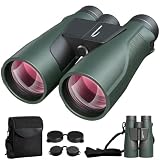
6. The Aurosports 15×56 is the supported long-distance choice
Aurosports 15×56 Binoculars for Adults – High Powered Bird Watching Clear Low Light Vision BAK4 & FMC – Large Lens Clear Low Light Vision Hunting, Cruise Ship Travel Men Gift
15x56
3.73 mm exit pupil
BAK4 prism
Pros
- 15x reach
- 56 mm objectives
- BAK4 prism
- Adjustable IPD
- Twist-up eyecups
Cons
- Manual focus
- Water resistant only
- Larger body
The Aurosports 15×56 makes sense only when the hunt includes longer looks and a stable rest, because 15x magnification amplifies every heartbeat and hand movement. Its 56 mm objective produces a stated 3.73 mm exit pupil, so the large lenses do not automatically make it brighter at your eye than an 8×42.
The specification sheet lists BAK4 prisms, anti-reflective treatment, 15×56 optics, and an adjustable interpupillary distance range of 59 to 77 mm. It also has manual individual focus, a setup that may take longer to adjust when a deer steps out suddenly.
Twist-up eyecups and rugged rubber armor are welcome details, and the binocular is described as water resistant. I would not treat water resistance as interchangeable with the waterproof, nitrogen-purged construction listed on several other models in this guide.
A larger 56 mm objective adds physical bulk, so this is a model to carry with a supportive harness or pack rather than a thin neck strap. Use it from a blind rail, truck window, tripod, or other stable support when possible.
It rewards hunters who glass distant clearings from a supported position
Fifteen power can make a distant animal easier to inspect when the binocular is braced. The 56 mm objectives and BAK4 prism design give this model a long-range role, not an all-day hand-held timber role.
It asks quick-action hunters to work around manual focus and higher shake
Individual manual focus can be slower when distance changes quickly, and high magnification exposes small movements. If the deer woods demand instant acquisition, choose a lower-power center-focus model instead.
7. The usogood 12×42 is the higher-power daylight compromise
Usogood Professional 12×42 HD Binoculars – High Powered Large View with Clear Low Light Vision – Adults Binoculars for Bird Watching, Hunting, Hiking, Travel, Cruise, Green, AT66V3
12x42
3.5 mm exit pupil
Phase-corrected BAK4
Pros
- 12x reach
- 18 mm eye relief
- Phase-corrected BAK4
- Center focus
- Two-year warranty
Cons
- Water resistant only
- 3.5 mm exit pupil
The usogood 12×42 sits between the common 10×42 and the harder-to-hold 15x formats. That extra image scale can help with daytime observation at distance, but its listed 3.5 mm exit pupil means it is not my first choice when low-light brightness is the deciding factor.
It lists fully multi-coated lenses, phase-corrected BAK4 prisms, a central focus wheel, and an 18 mm eyepiece. Phase correction is especially relevant in roof-prism designs because it helps preserve contrast and fine detail that can otherwise look muted.
The 18 mm eye-relief figure is favorable for many glasses wearers, and the non-slip ABS rubber housing should give a controlled grip. It is described as water resistant rather than waterproof, so that distinction should guide a hunter who spends long mornings in wet cover.
I would treat this as a magnification-forward choice for good visibility, scouting, and longer field edges. The two-year warranty and stated customer support offer a defined support period rather than the lifetime terms found on some Vortex and GIGAPENGUIN models.
It gives daylight hunters more distant detail without moving to 15x
Twelve power can be a reasonable middle ground for a hunter who finds 10x insufficient but does not want the instability of 15x or 20x. A rest, trekking pole brace, or tripod remains helpful for making that extra power count.
It gives low-light and wet-weather hunters clear trade-offs to weigh
The 3.5 mm exit pupil is smaller than the 4.2 mm 10×42 options and the 5.3 mm 8×42 options. Pair that with water resistance rather than a waterproof rating, and the intended role becomes more selective.
8. The innhom 12×42 is the lightweight waterproof 12x option
innhom 12×42 HD Waterproof Binoculars for Adults, High Powered Low Light Vision Binoculars BAK4 Prism FMC Lens, Compact Binocular for Bird Watching Hunting Travel Sports World Cup Games
12x42
4.2 mm exit pupil
22 mm eyepiece
Pros
- 22 mm eyepiece
- Waterproof body
- BAK4 prism
- 1.2 lb weight
- Center focus
Cons
- Lower review count
- 16 mm eye relief
The innhom pairs 12x magnification with a 42 mm objective, which should calculate to a 3.5 mm exit pupil; the supplied listing separately reports a 4.2 mm exit pupil, so I would confirm the manufacturer specification before making a low-light decision on that number. The reliable format facts are 12x power and 42 mm objectives, both of which point toward more reach than an 8×42 but less hand-held steadiness.
Its BAK4 prisms, fully multi-coated green-film lenses, and 22 mm large eyepiece are intended to support a wide, clear view. The listing also names a built-in diopter ring and center focus, which are useful controls to set carefully for your eyes before entering the woods.
The 1.2-pound weight is modest for a full-size 12x binocular, and the shock-absorbing rubber body is listed as waterproof. That weather protection is a better fit for damp hunting conditions than a water-resistant-only designation.
The stated 16 mm eye relief is less generous than the Nikon 8×42 choices and may require more careful fit testing with glasses. It also has a smaller review base than several other products in this lineup, so hands-on inspection is particularly worthwhile.
It gives hunters a waterproof 12x format that remains fairly light to carry
This is the model for a hunter who prioritizes higher magnification but still wants a listed waterproof body and center focus. The 22 mm eyepiece may appeal to users who prefer a larger viewing window.
It requires buyers to verify fit and the conflicting exit-pupil detail
For glasses wearers, eye relief and blackout resistance are personal fit issues rather than numbers alone. The exit-pupil mismatch in the listing is also a reason to check the current manufacturer documentation before purchase.
9. The FLYANT 20×50 is the high-magnification tripod-oriented option
20×50 High Powered Binoculars for Adults, Waterproof Compact Binoculars with Low Light Vision for Bird Watching Hunting Camping Travel Cruise Hiking Sports Stargazing, Christmas Birthday Gifts for Men
20x50
2.5 mm exit pupil
BAK4 Porro prism
Pros
- 20x reach
- 26 mm eye relief
- BAK4 Porro prism
- Waterproof body
- Tripod mount
Cons
- High hand shake
- 2.5 mm exit pupil
- Not a dusk-first format
The FLYANT 20×50 is built around distance rather than hand-held low-light use. Divide its 50 mm objective by 20x magnification and you get a 2.5 mm exit pupil, the smallest stated low-light allowance in this guide.
It has a BAK4 Porro prism, green fully multi-coated anti-reflective optics, and a listed 26 mm eye relief. The extra eye relief is a promising figure for eyewear, but the high magnification still demands careful eye placement and a stable setup.
A waterproof rubber-coated body and tripod mount are meaningful features for its intended use. The listing also calls it smartphone compatible, though I would first concentrate on a solid tripod and a correctly adjusted diopter before attempting phone photos through a 20x binocular.
This model has a large review count and a 4.4 rating in the provided product data. That visibility does not change the optical math: it can be useful in strong daylight from support, but it is not a first-choice answer for a dark deer stand.
It gives long-range observers the image scale that 20x provides
Twenty power is useful for inspecting distant terrain, watching a far ridgeline, or identifying animals from a fixed point. A tripod mount is not an accessory afterthought here; it is the practical way to see what the magnification can show.
It sacrifices dusk brightness and quick hand-held acquisition for reach
A 2.5 mm exit pupil has much less margin when ambient light drops than the 4.2 mm and 5.3 mm formats. Hunters scanning close cover at legal-light edges should select an 8×42 or 10×42 instead.
10. The GIGAPENGUIN 15×52 is the phone-adapter long-range choice
15×52 HD Binoculars for Adults High Powered with Upgraded Phone Adapter
15x52
3.47 mm exit pupil
Phone adapter included
Pros
- 15x reach
- Phase-corrected BAK4
- Phone adapter
- Waterproof
- Lifetime warranty
Cons
- 3.47 mm exit pupil
- High power needs support
The GIGAPENGUIN’s 15×52 specification produces a 3.47 mm exit pupil, putting it in a more demanding low-light position than any 8×42 or 10×42 in this group. Its purpose is clear: add image scale for longer-range observation while keeping a 52 mm front lens.
The product details list 22 mm large eyepieces, 18 mm BAK4 dielectric-coated prisms, fully multi-coated lenses, and phase-corrected BAK4 roof prisms. That is a solid feature set for contrast and viewing comfort, provided the hunter supports the binocular enough to read fine detail.
An upgraded universal smartphone adapter is included, and twist-down rubber eyecups are listed for glasses wearers. The body is waterproof and has a stated unlimited, unconditional lifetime warranty, both worth considering for a gear piece that may live in a hunting pack.
The phone adapter is useful for documentation or casual wildlife photos, but it will not correct a shaky hand-held image. I would value a tripod socket or a stable rest first, then add the phone as a secondary feature.
It gives long-range glassers a feature-rich 15x system for supported viewing
Choose this model when your hunts include open terrain, long food-plot views, or a fixed blind where support is easy to arrange. The 22 mm eyepiece and glasses-friendly eyecups improve its fit potential.
It gives dusk hunters less brightness margin than lower-power formats
The 3.47 mm exit pupil is simply smaller than the 4.2 mm exit pupil of a 10×42 and the 5.3 mm exit pupil of an 8×42. A large objective cannot cancel the effect of 15x magnification on the exit-pupil calculation.
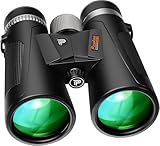
11. The Pankoo 20×56 is the large-objective distant-glassing option
Pankoo 20×56 Binoculars for Adults High Powered – Large View Waterproof Binoculars with Clear Low Light Vision – Compact Binocular Essentials for Hunting Camping Cruise Travel Bird Watching Sports
20x56
2.8 mm exit pupil
Tripod compatible
Pros
- 20x reach
- 56 mm objectives
- Tripod compatible
- Waterproof
- 1.2 lb
Cons
- 2.8 mm exit pupil
- Manual focus
- High magnification shake
The Pankoo offers 20x magnification with 56 mm objectives and a listed 2.8 mm exit pupil. That format gives more distant image scale than 15x, but it still belongs in a support-first category because a large objective does not make 20x easy to hold steady or especially forgiving after sunset.
Its feature list includes BAK4 roof prisms, fully multi-coated lenses, a precision center focus wheel, and a right-eye diopter ring. A center focus wheel is more practical for changing distances than individual focus, though high-power glass still rewards deliberate adjustment.
The 1.2-pound specified weight is surprisingly manageable for 20×56 optics, while O-ring sealing and rubber armor support waterproof use and a secure grip. It is tripod mount compatible, which should be central to the buying decision rather than a detail at the end of the specification list.
A portable box, neck strap, lens covers, and cleaning cloth are included in the stated kit. For a long walk, I would still choose a harness over a neck strap, since a high-power binocular can swing and pull at your neck when carried for hours.
It gives open-country hunters a tripod-compatible 20x view in a listed 1.2-pound package
This is for someone who wants maximum magnification from a fixed glassing position and values a center focus wheel. Its large lenses and long-range aim are better suited to observation than rapid close-cover action.
It gives hunters little exit-pupil margin as evening light fades
At 2.8 mm, the exit pupil is not comparable to the 8×42 models for dusk use. If low light is the non-negotiable priority, choose a lower-power binocular and use a spotting scope or supported optic for distant daytime detail.
12. The AcePath 15×56 is the one-pound Porro-prism long-range option
AcePath 15×56 Binoculars for Adults High Powered – Large View Binoculars with Clear Low Light Vision – Waterproof Compact Binocular for Hunting Camping Cruise Travel Bird Watching
15x56
4 mm exit pupil
BAK4 Porro prism
Pros
- 15x56 format
- 4 mm exit pupil
- IPX7 waterproof
- 1 lb weight
- Adjustable eyecups
Cons
- Manual focus
- Porro body is less compact
- 13.6 mm eye relief
The AcePath is a more interesting high-power low-light compromise than the 20x models because its 15×56 formula produces a stated 4 mm exit pupil. That remains smaller than a 10×42 and well below an 8×42, but it gives a little more low-light margin than the 2.5 mm and 2.8 mm high-magnification choices.
It uses BAK4 Porro prisms, fully multi-coated lenses, and a 315-foot field of view at 1,000 yards. Porro prism binoculars can be physically wider than roof-prism alternatives, so try its body shape with your harness and pack straps before committing to it for long carries.
The listing specifies adjustable eyecups, a precision-machined center wheel, textured focus knob, IPX7 waterproofing, and shockproof construction. At one pound, it is also comparatively light for a 15×56, which helps when a tripod is not immediately at hand.
Its stated 13.6 mm eye relief is not as generous as the M5, M7, Triumph, or usogood figures in this list. I would make eyeglass fit a deliberate test, since blackouts are a common complaint when eye relief and eyecup position do not match the user.
It gives supported glassers 15x reach with more exit pupil than 20x options
For a hunter choosing between long-range formats, 15×56 is more forgiving in dim conditions than 20×50 or 20×56 based on the reported exit-pupil figures. The one-pound weight and waterproof rating add practical appeal for mobile scouting.
It asks glasses wearers to check eye position before choosing it
The 13.6 mm listed eye relief is a personal-fit concern, particularly with glasses. Test for a full circular image without shadows, then make small eyecup adjustments before deciding whether this is comfortable enough for extended glassing.
The right format and field checks decide low-light performance
Low-light performance starts with exit pupil: divide objective lens diameter by magnification. A 42 mm objective at 8x gives about 5.25 mm, at 10x gives 4.2 mm, and at 12x gives 3.5 mm; that is why extra magnification can work against a hunter as light falls.
Exit pupil is not a guarantee of quality because lens coatings, prism quality, glare control, optical alignment, and focus accuracy also affect what you see. It is still a fast first filter that prevents the mistake of assuming every large-objective binocular is designed for dark woods.
An 8×42 is the best answer for most low-light timber hunting
An 8×42 combines a roughly 5.3 mm exit pupil with a wide field of view and easier hand holding. It is a strong choice for deer trails, thick cover, stand hunting, and any situation where you need to locate and follow an animal rather than inspect a distant hillside.
The Nikon Monarch M5 and MONARCH M7 are the two 8×42 entries here, and both list ED glass, dielectric coatings, phase-corrected prisms, waterproof and fogproof construction, and long eye relief. The M7 adds a stated 435-foot field of view, while the M5 lists 19.5 mm eye relief.
A 10×42 is the best all-purpose format when distance matters too
A 10×42 gives more image scale for field edges and mixed terrain while retaining a manageable 4.2 mm exit pupil. The Vortex Crossfire HD and Triumph HD fit this role with fully multi-coated optics, center focus, tripod adaptability, weather protection, and included carrying equipment.
Choose 10x if you often alternate between woods and open ground, but do not pick it solely because more magnification sounds better. In the final dim minutes, an 8×42 can be the more useful view because it is brighter at the eye and steadier in the hands.
A 12×42 or 15×56 is the answer for longer looks with support
Twelve and 15 power suit scouting, open-country glassing, and fixed locations, but they have less exit-pupil margin in the products listed here. A rest, tripod, truck window, blind rail, or pack can reveal more detail than trying to force a shaky high-power view.
The usogood and innhom 12×42 models are a middle ground, while the Aurosports, GIGAPENGUIN, and AcePath 15x models are better seen as reach-first choices. The AcePath’s reported 4 mm exit pupil is the most forgiving of those 15x entries.
A 20x binocular is the answer only for deliberate daylight glassing
The FLYANT 20×50 and Pankoo 20×56 give substantial distant image scale, but their 2.5 mm and 2.8 mm exit pupils place them at the bottom of this group for dusk flexibility. A tripod is the correct companion, and a lower-power binocular can still be the better primary tool for a hunt that starts or ends in darkness.
Do not let an outsized magnification claim override the way you hunt. A steady 8×42 that shows a complete, contrasty image is more useful than a 20x view that shakes, narrows your field, and fades too soon.
Fully multi-coated lenses and phase-corrected prisms protect contrast in dim cover
Fully multi-coated optics apply anti-reflective coatings across air-to-glass surfaces to reduce light loss. Phase-corrected prisms matter particularly in roof-prism binoculars because they help retain fine detail and contrast, which are often the first things to disappear against a shadowed treeline.
ED glass, listed on the Nikon M5 and M7, is designed to reduce color fringing. BAK4 prisms appear on several other models, but prism labels alone cannot tell you how the entire optical system will handle glare, edge sharpness, or focus behavior.
Weather protection and fit are the field features that decide whether you carry the binocular
Morning fog, wet brush, and sudden temperature changes make waterproof, fogproof construction valuable. Nitrogen purging and O-ring seals are explicitly listed on the Vortex and Nikon models, while other entries are described as waterproof or water resistant; read that distinction closely for your conditions.
Long eye relief and adjustable eyecups are similarly practical, not cosmetic. Glasses wearers should check for blackouts while looking at the full field, then set the diopter after focusing one barrel so both eyes see the same sharp image.
A harness and tripod solve different carry and viewing problems
A harness keeps binoculars from swinging, spreads the carry load, and makes quick access easier during a walk or stand hunt. A neck strap is adequate for short use, but a harness makes more sense for heavier optics and long days; pack space matters too, so see our related guide to hunting backpacks for cold weather.
A tripod does not replace a harness. It is for extracting detail from a fixed view, especially with 12x, 15x, and 20x binoculars, while the harness is for carrying and instantly accessing the tool that is already set to your eyes.
These five field checks reveal more than a spec sheet can
- Compare shadow detail: Near sunset, look at a dark treeline and ask which binocular separates branches, bark, and an animal-shaped shadow most clearly.
- Check backlight: Aim near a bright opening without looking at the sun and see whether glare washes out the edge detail you need.
- Work the focus wheel: Shift from a close branch to a distant edge repeatedly; it should be smooth enough for control without drifting or binding.
- Set the diopter and test both eyes: A correct diopter setting prevents the false impression that one barrel is soft or that your eyes are tiring too quickly.
- Wear your real hunting layers: Try the harness over a parka, reach for the binocular from a sitting position, and confirm that gloves can operate the wheel and eyecups.
Give a new binocular a short break-in period before an important hunt. Repeatedly work the focus wheel, learn the diopter position, clean the exterior lenses with a blower and lens cloth, and practice moving it from harness to eyes without catching a sleeve or pack strap.
These FAQ answers settle the common format questions
Is 8×42 or 10×42 better for deer hunting?
An 8×42 is usually better for deer hunting in dark timber because it gives a roughly 5.3 mm exit pupil, a wider view, and steadier hand-held viewing. A 10×42 gives more distant image scale and a 4.2 mm exit pupil, making it a better mixed-terrain choice when field edges and longer looks matter. Choose based on your cover, not magnification alone.
What binoculars do the Navy Seals use?
There is no single publicly confirmed binocular model that every Navy SEAL uses, and military-issued equipment can vary by mission and contract. That question does not identify the right hunting binocular. For dawn and dusk hunting, compare exit pupil, coatings, weather sealing, eye relief, focus control, and whether the binocular fits your hunting terrain.
What are the best small lightweight binoculars?
The Vortex Bantam HD 6.5×32 is the compact, youth-oriented option in this group, with a stated 4.92 mm exit pupil, XR coatings, wide field of view, and a lightweight ergonomic design. For an adult hunting binocular that remains practical to carry, the 22.2-ounce Nikon Monarch M5 8×42 offers a larger 42 mm objective and a 5.3 mm exit pupil.
What is better, 10×42 or 12×50 for hunting?
A 10×42 is usually better as an all-purpose hunting binocular because it is easier to hold steady, has a wider view, and provides a 4.2 mm exit pupil. A 12×50 provides more distant image scale and a roughly 4.2 mm exit pupil, but it is larger and benefits more from support. Pick 10×42 for mobile mixed terrain and higher power for fixed long-range glassing.
The right pick depends on your cover and glassing distance
The best low light hunting binoculars for most timber hunters are the Nikon Monarch M5 8×42 or MONARCH M7 8×42 because their format gives a 5.3 mm exit pupil and an easier hand-held view. The Vortex Crossfire HD and Triumph HD are sensible 10×42 choices when your hunt moves between woods and more distant field edges.
Pick a 15x or 20x model only when you can support it and the hunt calls for distant observation. In 2026, the most useful choice is the one you will carry, focus quickly, and trust when the deer woods turn dark.