
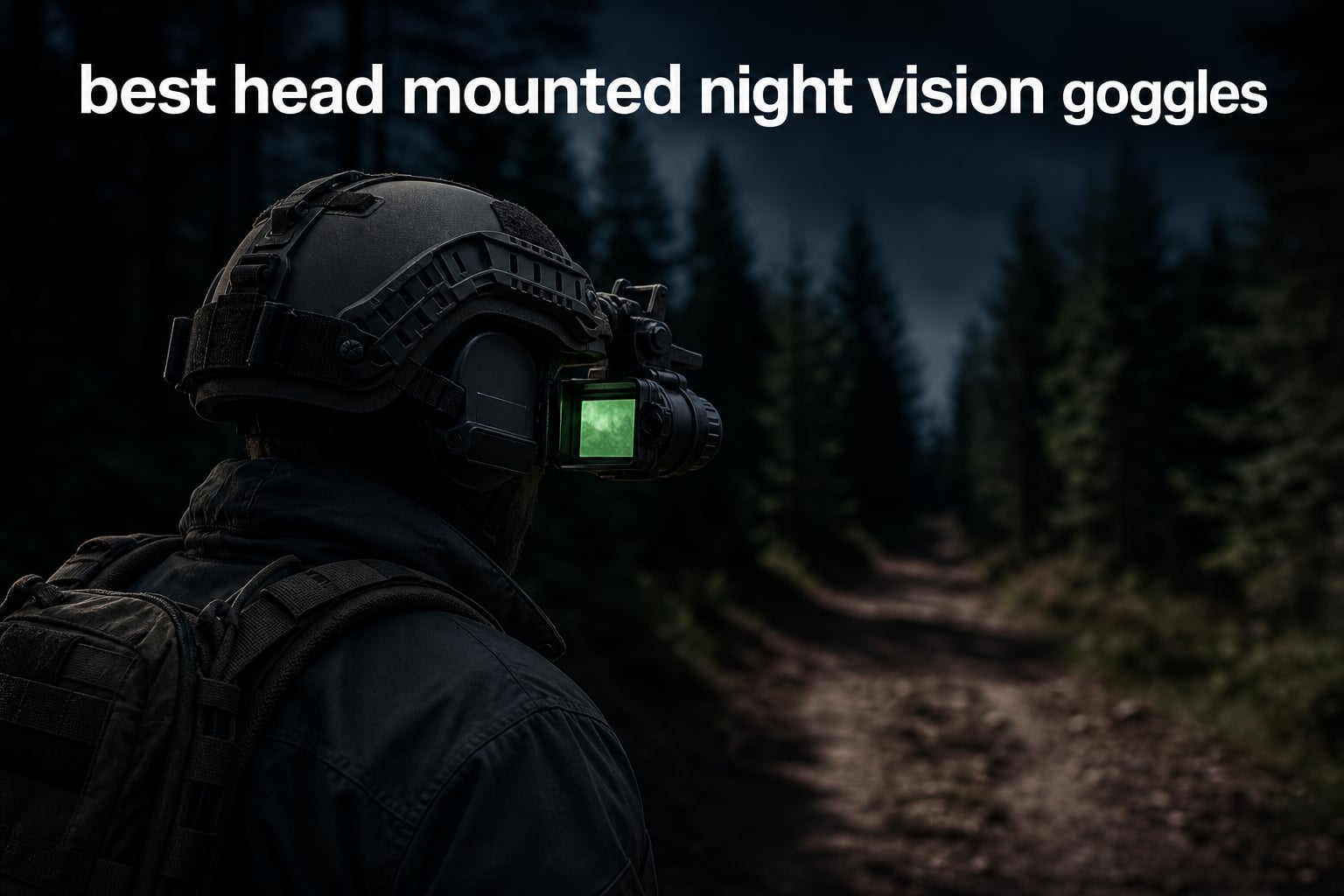
The best head mounted night vision goggles give you hands-free visibility, but the phrase covers two very different kinds of equipment. The 12 models here are consumer digital night-vision devices that use sensors, screens, and infrared illumination; they are not analog image-intensifier systems such as a PVS-14.
That distinction matters before you buy. Digital goggles can record video, show a screen in color modes, and work with an IR illuminator in total darkness, while analog tubes amplify available light and are typically chosen when natural low-light performance and movement matter most.
I compared the available listings feature by feature: mounting method, sensor and display claims, stated viewing range, weight when listed, weather protection, battery details, review volume, and customer-reported limitations. My short list favors the GOYOJO GNG2K for its 45-degree field of view and 60Hz display, the GOYOJO 4K model for its flexible wear options, and the Weochi for its built-in compass and stated 984-foot detection distance.
For hunting, camping, wildlife observation, or static security observation, this category can be a practical way to keep both hands free. For fast foot travel in uneven terrain, do not treat digital head mounted NVG gear as a substitute for trained use of analog night vision; screen latency, IR dependence, and a narrow view can change how safely you move.
Table of Contents
Top 3 picks answer the most common head-mounted needs
Choose the GOYOJO GNG2K when a wider stated view and a helmet-oriented monocular matter most. Choose the GOYOJO 4K Head-Mounted model when you want binocular-style viewing plus headband, handheld, and helmet options, or the Weochi if a compass and dark-operation button backlight fit your plan.
Best head mounted night vision goggles in 2026 at a glance
This overview makes the important tradeoffs visible without treating advertised range as a promise. Ambient conditions, target contrast, IR level, focus, weather, and the amount of digital zoom all affect what you can actually identify.
| Product | Specifications | Action |
|---|---|---|
 HUVIOVED NV8300 HUVIOVED NV8300 |
|
Check Latest Price |
 Weochi 4K NVG Weochi 4K NVG |
|
Check Latest Price |
 VOTJPYS 4K NVG VOTJPYS 4K NVG |
|
Check Latest Price |
 GOYOJO GNG2K GOYOJO GNG2K |
|
Check Latest Price |
 GOYOJO 4K NV8300 GOYOJO 4K NV8300 |
|
Check Latest Price |
 GOYOJO NVG10 GOYOJO NVG10 |
|
Check Latest Price |
 Dsoon NV8161-A Dsoon NV8161-A |
|
Check Latest Price |
 GOWWPUN NV8100 GOWWPUN NV8100 |
|
Check Latest Price |
 PEIKETAO P-NV8160 PEIKETAO P-NV8160 |
|
Check Latest Price |
 AILNJUC NV8160 AILNJUC NV8160 |
|
Check Latest Price |
 GOYOJO CYF-E+ GOYOJO CYF-E+ |
|
Check Latest Price |
 VERYMODEL NVG-01 VERYMODEL NVG-01 |
|
Check Latest Price |
1. GOYOJO GNG2K is the strongest choice for a wide digital view
Pros
- 45 degree field of view
- 60Hz refresh rate
- 940nm IR
- helmet mount
- 2 year warranty
Cons
- Monocular view
- 39 reviews
The GNG2K stands apart because its listed 45-degree field of view is much wider than the 8- to 10-degree figures attached to several binocular-style units here. I would put that advantage ahead of headline zoom for a person who expects to scan a campsite, observe wildlife, or walk slowly with a helmet-mounted device.
Its 2K 2688 by 1520 display and 60Hz refresh rate are meaningful digital specs, and the 0.0001-lux sensor claim suggests an effort toward low-light sensitivity before IR is added. It also offers Night Green, black and white, white phosphor, and color display modes, plus 1X to 4X digital zoom.
The built-in electronic compass and quick-release helmet mount suit a deliberate outdoor setup. The 940nm illuminator is described as stealth IR, but any IR-assisted image depends on the setting, and this is still a single-eye monocular rather than a dual-tube analog system.
A wide field of view makes this GOYOJO easier to place in context
A 45-degree stated view gives more peripheral scene information than narrow digital binoculars. That can reduce the urge to swing your head constantly, though it does not remove the need to move carefully in darkness.
A helmet mount makes this model best for a prepared setup
The listing includes a quick-release helmet mount, but confirm the interface fits your own helmet before ordering. Balance the device with a counterweight if your helmet feels front-heavy during longer observation sessions.
2. GOYOJO 4K NV8300 is the most flexible binocular-style option
GOYOJO 4K Head-Mounted Night Vision Goggles & Binoculars – Infrared NVG with 4 Color Vision, Manual Focus & 8X Digital Zoom for Hunting, Camping, and Outdoor Surveillance
4K video
Dual screen
Handheld or helmet
Pros
- 4K video with audio
- dual display
- manual focus
- three wear options
- 32GB card
Cons
- Narrow stated view
- complete-darkness video complaints
This GOYOJO NV8300 works as a handheld, headband-worn, or helmet-mounted device, which is the clearest reason to choose it. I like that flexibility for a buyer who wants to use one device for a stationary wildlife watch and then convert it to hands-free use.
The listing claims 4K video with audio, 36MP photos, an 850nm illuminator, adjustable IR and screen brightness, and 8X digital zoom. Its dual screens have adjustable interpupillary distance from 60 to 72mm, a useful fit feature that is not common in this group.
Customer feedback is substantial relative to this roundup, with 276 reviews and a 4.3 rating. Reports praise the head mounting and general capability, while some mention weaker video quality in total darkness, which is a reminder to test focus and IR settings before a trip.
Multiple wear modes make this NV8300 practical beyond helmet use
The headband, handheld, and helmet-compatible formats give you a chance to learn the controls before mounting it. That is a sensible route for beginners who are unsure whether head mounting will suit their activity.
Manual focus makes this model better for deliberate observation
Manual focus lets you tune the scene instead of accepting a fixed setting. It asks more of the user, so stop and focus before recording or identifying an animal at distance.
3. Weochi 4K goggles offer navigation features in a compact package
Head-Mounted Night Vision Goggles, 4K Binoculars 8X Zoom 850nm Stealth IR for All Black Observation– Hands-Free Hunting Gift with Compass & Button Backlight, 32GB TF Card, IP54 Waterproof
4K video
850nm IR
Compass and IP54
Pros
- Built-in compass
- button backlight
- helmet or harness mount
- 984 foot claim
- 32GB card
Cons
- 15 reviews
- fixed focus
The Weochi model has a compelling feature set for a simple head-mounted digital setup: 850nm IR, 8X zoom, a compass, and a button backlight intended for operation in complete darkness. I would favor it for slower outdoor observation where the compass is more useful than a wide view.
It weighs 300 grams and has a listed 32mm objective lens, a 984-foot detection claim, and IP54 protection. Its listing calls the device fixed focus, so it may be less forgiving when targets shift between close brush and more distant open ground.
The 4.5 rating is encouraging but rests on only 15 reviews. Read that as an early signal rather than the certainty supplied by a larger feedback pool, and test the head strap adjustment at home before depending on it outside.
A built-in compass gives this digital unit a useful orientation aid
A compass can help you keep a planned bearing when you are standing still or moving slowly. It should complement, not replace, a known route, map skills, and daylight familiarity with the area.
Fixed focus makes this Weochi better for consistent-distance viewing
Fixed focus reduces one control to manage in the dark. In return, it can be less adaptable for scanning both nearby obstacles and far targets during the same session.
4. HUVIOVED NV8300 emphasizes glasses-free 3D viewing
HUVIOVED NV8300 Head-Mounted Night Vision Goggles for Adults, 4K 3D Visual Digital Night Vision Binocular with Head Strap and 32GB Memory Card, 7 Gear Infrared, 8X Digital Zoom
4K 3D display
7-level IR
IP54
Pros
- Dual screens
- diopter adjustment
- headwear mount
- 7-level brightness
- IP54 rating
Cons
- 10 degree view
- 36 reviews
HUVIOVED’s NV8300 is built around a dual-screen, naked-eye 3D presentation and independent binocular adjustment. The listed plus or minus 3.5 diopter adjustment is especially relevant if you need vision compensation rather than relying on one generic viewing position.
It combines 7X magnification, 8X digital zoom, seven IR levels, and a 1.4-inch 390 by 390 screen for each eye. At 363 grams, it is not the lightest option here, but it is still compact at a listed 6.06 by 5.28 inches.
The product claims a 250- to 300-meter full-dark observation distance and IP54 protection. Its 10-degree field of view is narrow, so I see it as a stop-and-observe device, not the model I would pick for navigating unfamiliar uneven ground.
Diopter adjustment makes the NV8300 friendlier to different eyesight needs
Independent adjustment can help bring both displays into usable focus for an individual wearer. Take time to set it in a controlled low-light environment rather than making the adjustment when you need quick identification.
Dual displays make this a binocular viewing experience rather than dual sensors
Two screens can feel more natural to view than a monocular screen. They do not turn this digital device into a dual-tube image-intensifier system, so keep expectations tied to its sensor and IR design.
5. VOTJPYS goggles pair a large screen with rechargeable power
Night Vision Goggles Head Mounted for Adults, 1312FT Rechargeable Infrared Digital Binoculars, 2.7″Large Screen, 8X Digital Zoom, 7-Level Infrared, Night-Vision Goggles with 32GB TF Card, Head Strap
2.7 inch screen
1312 foot claim
3000mAh
Pros
- Large screen
- rechargeable battery
- 7-level IR
- FAST MICH compatible
- 32GB card
Cons
- 12 reviews
- helmet compatibility needs checking
VOTJPYS puts a 2.7-inch display and a 3000mAh rechargeable battery at the center of its design. I would look here if you want a large on-device viewing surface and do not want to manage separate disposable batteries.
The listing claims a CMOS starlight sensor, seven adjustable IR levels, 36MP stills, 4K video, 8X digital zoom, and a 1312-foot viewing range. It also says the adjustable headband is compatible with FAST and MICH helmets, which needs a physical fit check with your particular helmet and mounting hardware.
At 10.6 ounces, its stated weight is reasonable for this class. The review base is just 12 ratings, so the high 4.5 average should be considered alongside the limited number of owners reporting back.
A rechargeable 3000mAh battery makes trip preparation simpler
Rechargeable power is convenient when you can charge before leaving. Bring a compatible backup power plan for longer outings because infrared operation usually draws more power than daytime use.
A 2.7-inch screen makes detail easier to inspect while stationary
A larger display can make menus and recorded clips easier to see. It does not increase the sensor’s ability to resolve a distant target, especially after digital zoom is applied.
6. GOYOJO NVG10 is the weather-focused helmet monocular
Pros
- IP66 rating
- 280 gram weight
- helmet-compatible
- adjustable IR
- built-in compass
Cons
- Helmet not included
- 25.5 degree view
The GOYOJO NVG10 is the clearest fit for someone who prioritizes the listed IP66 water-resistance rating. I would choose it over an IP54 option if rain and dusty conditions are a regular part of your planned use, while still following the manufacturer’s care instructions.
This is a 280-gram helmet-compatible monocular with OLED viewing, a 25.5-degree field of view, manual focus, and three advertised zoom modes. It records HD video and photos, has three image color modes, and uses an 850nm IR illuminator with three adjustment levels.
Its compass and helmet-oriented layout are appealing, but the helmet is not included. Several user communities stress that a comfortable helmet, stable shroud, and secure mount matter as much as the device when you intend to wear it for hours.
An IP66 rating makes this model the better match for exposed outdoor use
IP66 is a stronger listed environmental rating than the IP54 markings found on several alternatives. It is still good practice to dry the unit after wet use and protect lenses from grit and scratches.
A monocular layout leaves one eye free but changes depth perception
Single-eye viewing can leave one eye unassisted, which some users prefer for awareness. It can also make depth judgment feel unfamiliar, so start with slow tasks in a safe, clear area.
7. Dsoon NV8161-A offers long stated battery use and recording controls
Dsoon Night Vision Goggles, Upgraded Rechargeable Head-Mounted Night Vision Binoculars with 32GB TF Card, Hands Free, Tactical Flashlight, 1312FT, 8X Digital Zoom
4K and 36MP
3000mAh
Three wear modes
Pros
- Type-C charging
- time stamps
- 7 IR levels
- 2.7 inch screen
- helmet capable
Cons
- Headband limits movement
- card listing conflict
Dsoon’s NV8161-A is an appealing all-purpose digital unit because it lists handheld, headband, and helmet-mounted use, along with a 3000mAh battery and Type-C charging. I also like the time-and-date stamp feature when recorded clips need a basic reference.
The stated battery figures are three to five hours with IR and as much as 12 hours in daytime use, with a 2.5-hour full charge. It adds a 2.7-inch display, seven brightness levels, seven IR levels, 8X zoom, 4K recording, and 36MP photo capture.
There is a listing conflict around the TF card: one part says 32GB is included, while the analyzed cons say it is not. Verify the current box contents before relying on recording from the first night.
Type-C charging makes the Dsoon easier to support with common gear
A Type-C cable can simplify a field charging kit when your other electronics use the same connection. Check output compatibility and charge the battery fully before any planned night session.
Time stamps make recorded observations easier to sort later
Time and date stamps can help sequence observations after a hunt, patrol, or wildlife watch. Set the clock correctly first, or the recorded reference will not be useful.
8. GOWWPUN NV8100 is the 3D option for close observation
3D Head-Mounted Night Vision Goggles White Light Supplemental Lighting Infrared Night Vision Binoculars Stealth 850nm IR NVG Manual Focus & 8X Digital Zoom 10°FOV,TF Card Included
Glasses-free 3D
White fill light
7-level IR
Pros
- Dual eyepieces
- 4K recording
- white fill light
- FAST MICH compatible
- 2 year warranty
Cons
- Not water resistant
- 3D works best close
The GOWWPUN NV8100 emphasizes a glasses-free 3D effect through dual screens and dual eyepieces. Its own listing says the best 3D effect is at roughly 10 meters or 32 feet, so I would treat it as a close-range viewing feature rather than a long-distance navigation claim.
It also includes 4K video, 36MP photos, four color modes, seven IR levels, a white fill light, and 8X optical zoom according to the listing. The device can be worn hands-free and is described as compatible with FAST and MICH helmets.
The major limitation is explicit: it is not water resistant. Keep it for dry conditions and use a protective case when it is not on your head, especially because its plastic housing and coated optics need care.
White fill light makes this unit useful when you need conventional illumination
White light can help with close tasks or color viewing where concealment is not a concern. It can also disturb wildlife and reveal your position, so use it intentionally rather than as a default.
Close-range 3D viewing makes this better for observation than travel
The stated best 3D distance points toward stationary viewing of nearby scenes. For long walks, a broader field of view and weather protection should carry more weight in your decision.
9. PEIKETAO P-NV8160 suits FAST and MICH helmet owners
Night Vision Goggles(2nd Generation Upgrade)-Night Vision Binoculars,1312FT Digital Infrared Head Mounted Night Vision,Compatible with Military Tactical FastMICH Helmet
1080P
1312 foot claim
FAST MICH compatible
Pros
- Rechargeable 3000mAh
- 7 IR levels
- 2.7 inch screen
- 32GB card
- helmet compatibility
Cons
- Focus may need readjustment
- 8.5 degree view
The PEIKETAO P-NV8160 is a sensible option to examine if you already own a FAST or MICH helmet, because the listing specifically names those styles. I would still inspect the included bracket and your helmet’s rail, shroud, and clearance before assuming a direct fit.
It pairs 1080P video and 12MP photos with a 2.7-inch LCD, 8X digital zoom, 10X magnification, seven IR levels, an 850nm illuminator, and a 3000mAh rechargeable battery. It also includes a 32GB card according to the listing.
There are 241 ratings behind its 4.2 average, one of the larger feedback pools in this list. The narrow stated 8.5-degree field of view and reports that zooming may require lens adjustment both suggest slowing down rather than relying on it while moving.
Named FAST and MICH compatibility makes helmet checking more straightforward
Specific helmet names are more useful than a generic claim of helmet readiness. They are not a guarantee across every shell and accessory combination, so test retention and tilt adjustment before leaving home.
A 2.7-inch LCD makes this an accessible choice for screen-based viewing
A large LCD can make it easier to monitor the digital image. Keep screen brightness low enough to preserve your unaided night adaptation when you remove the goggles.
10. AILNJUC NV8160 brings a long-range claim and flexible mounting
AILNJUC Night Vision Goggles Head Mounted, 1312FT Night Vision Binoculars Compatible with Military Tactical Helmet, Infrared Long Focus 8X Digital Zoom/32GB SD Card
1080P and 12MP
3000mAh
Helmet compatible
Pros
- Headband or helmet use
- 7-level IR
- 32GB card
- rechargeable battery
- 1300 foot claim
Cons
- Fixed focus
- water resistant only
The AILNJUC NV8160 is listed for handheld, adjustable-headband, and helmet-mounted use, making it another flexible model for buyers who do not want a dedicated helmet-only device. Its 0.9-pound stated weight is worth considering if you plan extended head-worn sessions.
Its core claims are 1080P HD video, 12MP photos, 8X digital zoom, 10X optical zoom, a 3000mAh battery, seven levels of 850nm IR, and more than 1300 feet of game-spotting range. It includes a 32GB card and says a FAST/MICH compatible mount comes with it.
The focus is listed as fixed, and its weather description is water resistant rather than waterproof. That pairing places it best in controlled, dry conditions where you can choose a consistent observation distance.
Flexible mounting makes the AILNJUC a useful transition device
Moving from handheld to headband to helmet use lets you find your preferred setup. Start with a short, stationary session to judge comfort before trying a longer activity.
Fixed focus keeps operation simple but narrows the ideal use case
Fixed focus can make controls easier to manage with gloves. The tradeoff is less flexibility when subjects move from near cover to a distant clearing.
11. GOYOJO CYF-E+ is the straightforward fixed-magnification monocular
Pros
- Head strap included
- manual focus
- 300 meter effective range
- low delay display
- one year warranty
Cons
- No helmet included
- no manual zoom
- weight unspecified
The GOYOJO CYF-E+ is the simplest monocular in this roundup: a head strap, default 7X magnification, manual focus, and a 1.54-inch HD display. I would consider it for a buyer who wants hands-free digital viewing without a bulky binocular housing.
It uses an 850nm IR wavelength and a CMOS SONY307 starlight sensor, with a stated effective distance of 200 to 300 meters and visibility up to 500 meters in total darkness. The listing also claims 320 by 320 screen resolution and less than 0.01 second video delay.
The device does not include a helmet or mount and does not support manual zoom. Its compact, stripped-down approach can be helpful for a simple camp or observation tool, but it offers fewer mounting choices than the helmet-ready models above.
Fixed 7X magnification makes this best when you know your viewing distance
A fixed magnification simplifies the controls and keeps the image presentation consistent. It can feel restrictive in dense woods or other places where targets appear at very different ranges.
An elastic head strap makes this a head-mounted rather than helmet-mounted setup
The included strap supports hands-free use without buying a helmet. It will not provide the protection, mounting stability, or counterbalance options of a properly fitted helmet system.
12. VERYMODEL NVG-01 offers a complete accessory-oriented package
VERYMODEL Night Vision Goggles Head Mounted, [2025 Upgrade] 1312FT Night Vision Binoculars, FHD Hands Free Nightvision Goggles for Helmet, Long Rang Infrared Goggles Night
FHD display
1312 foot claim
3000mAh
Pros
- FHD display
- 7 IR levels
- rechargeable power
- 32GB card
- IP54 rating
Cons
- 2.25 pound weight
- helmet not included
The VERYMODEL NVG-01 includes a head strap, neck strap, carry bag, 32GB card, card reader, and a 3000mAh battery according to its listing. I see that as convenient for a person who wants the basic supporting pieces in one package rather than sourcing them separately.
Its listed capabilities include a 2.7-inch FHD display, 1080P video, 12MP images, 8X digital zoom, 10X optical zoom, 850nm IR with seven levels, and a 1312-foot viewing claim. The device has IP54 protection, but its stated 2.25-pound weight is the standout tradeoff.
It can be worn via headband, neckband, or helmet mounting, though the helmet and mount are not included. A device that heavy deserves a careful fit test; strain at the front of the head can make a promising spec sheet unpleasant in actual use.
A complete included kit makes this model easier to start using
Having a card, straps, bag, and card reader in the listed package reduces the number of initial accessories to check. Confirm contents on arrival and charge the battery before your first night out.
A 2.25-pound stated weight makes fit the deciding question
Weight matters more when a device is mounted forward of your face. Use short sessions first and consider a balanced helmet configuration if you plan to wear it for long periods.
Choosing head-mounted digital night vision starts with your actual movement plan
The first decision is not resolution or zoom; it is whether you will be mostly stationary or moving. A narrow-screen digital unit can work well for wildlife observation, a blind, a campsite, or security viewing, but it provides less situational information than a wide-view analog system when walking.
Forum discussions repeatedly flag limited field of view as a navigation problem, and that matches the specifications here. Several models list 8 to 10 degrees, while the GOYOJO GNG2K lists 45 degrees; field of view often tells you more about comfort while scanning than a large digital zoom figure.
Digital night vision works by converting a sensor image into a screen view
Digital night vision goggles collect light with an objective lens, capture it with an electronic sensor, process the signal, and display it on an LCD or OLED screen. In complete darkness, an infrared illuminator projects IR light that the sensor can detect, producing a usable monochrome or false-color image.
Analog night vision follows a different path. A photocathode converts available light into electrons, an image intensifier tube multiplies them, and a phosphor screen displays the amplified scene; high-end systems may add autogating and manual gain control.
Night-vision generations describe analog tubes, not these digital listings
Gen 1 through Gen 4 labels refer to analog image-intensifier technology. A PVS-14 monocular with GEN 3 night vision is an analog tube system, while the products above make digital claims such as 4K recording, refresh rate, sensor sensitivity, screen size, or infrared levels.
Do not buy a digital device expecting white-phosphor analog performance, a 40-degree analog field of view, or the low-light mobility associated with an image intensifier. Conversely, do not expect an analog tube to inherently offer the video recording features common in these digital models.
Helmet mounting requires matching the device, bracket, shroud, and balance
Start by confirming whether the product includes a helmet bracket, names FAST or MICH compatibility, or simply says helmet-compatible. “Helmet-ready” is not a universal specification because different shrouds, rails, mounts, and helmet geometry can change the fit.
Mount the device low enough for a natural viewing position, then test the flip-up or release mechanism and retention at home. A counterweight at the rear can improve balance, while a head strap may be enough for low-motion use but can shift during faster activity.
Infrared wavelength and output determine how a digital device sees in darkness
Most units here use 850nm IR, which usually offers strong sensor visibility but can show a faint red glow at the illuminator. The GOYOJO GNG2K lists 940nm IR, commonly selected when reduced visible glow matters, though useful range can differ by conditions and implementation.
Begin with a lower IR setting, focus the lens, and raise illumination only as needed. Branches, fog, rain, dust, and nearby reflective surfaces can create glare or wash out the image, so more IR is not always a better result.
Battery planning matters more than a headline battery capacity
A listed 3000mAh battery is useful information, yet run time changes sharply when infrared is active, screen brightness is high, or video recording is running. Devices with rechargeable packs are convenient, while Type-C charging on the Dsoon can simplify a shared charging kit.
Charge completely, carry a compatible backup power method where allowed, and turn the unit off between observations. Cold conditions can also reduce battery performance, so do a short night test before an important outing.
Safe practice makes hands-free night vision more useful than rushing into a long outing
Start in a familiar, obstacle-free area and practice fitting the device, locating each button, adjusting focus, changing IR levels, and lifting the device away from your eyes. Move slowly and use a partner or normal light for setup until the controls feel routine.
Do not drive, climb, handle tools, or perform any risky task based only on a new digital night-vision view. These devices help observation, but screen images, restricted fields of view, and altered depth perception call for a conservative approach.
Legal and export rules deserve a check before travel or resale
Local rules can affect night hunting, illumination, recording, and where a device can be used. Analog military-pattern night vision can also face export restrictions, including ITAR-related controls, so check official rules before traveling internationally or shipping equipment across borders.
The products in this roundup are consumer digital devices, but responsible ownership still means following local wildlife, property, and privacy laws. The same restraint applies to any observation near other people or private land.
Frequently asked questions give direct night-vision answers
What is the best night vision for helmet mount?
The GOYOJO GNG2K is the strongest helmet-mount choice in this list because it pairs a quick-release helmet mount with a stated 45-degree field of view, 2K 60Hz display, 940nm IR, and built-in compass. Confirm that its included interface fits your helmet before ordering.
What company makes the best night vision goggles?
There is no single best company for every user. In this digital roundup, GOYOJO has the broadest range of listed head-mounted options, including the wide-view GNG2K, NV8300 binoculars, NVG10 monocular, and CYF-E+ head-strap monocular. Choose based on mounting, field of view, weather rating, and controls.
What NVGs do Navy Seals use?
Military night-vision systems vary by unit, mission, and procurement, and public descriptions can be incomplete. They are generally professional analog systems, often using image-intensifier tubes, not the consumer digital goggles in this guide. Do not assume a civilian digital listing matches military-issued equipment.
What brand of night vision does the military use?
Military organizations use equipment from different contracted manufacturers rather than one universal retail brand. Common military-style categories include PVS-14 monoculars and binocular night-vision devices using analog image-intensifier tubes. The key distinction is the tube specification, mounting system, and procurement standard, not a single brand name.
The best choice is the one that fits your mounting and movement needs
For the best head mounted night vision goggles in 2026, I would start with the GOYOJO GNG2K when a wide stated view and helmet mounting are priorities. The GOYOJO 4K NV8300 makes more sense when you want a flexible binocular-style unit, while the GOYOJO NVG10 is the weather-focused monocular choice with its IP66 rating.
Before committing, verify the included mount, actual helmet compatibility, current box contents, battery plan, and the conditions you expect to face. A well-fitted device that you have practiced with will serve you better than the most ambitious specification list.