
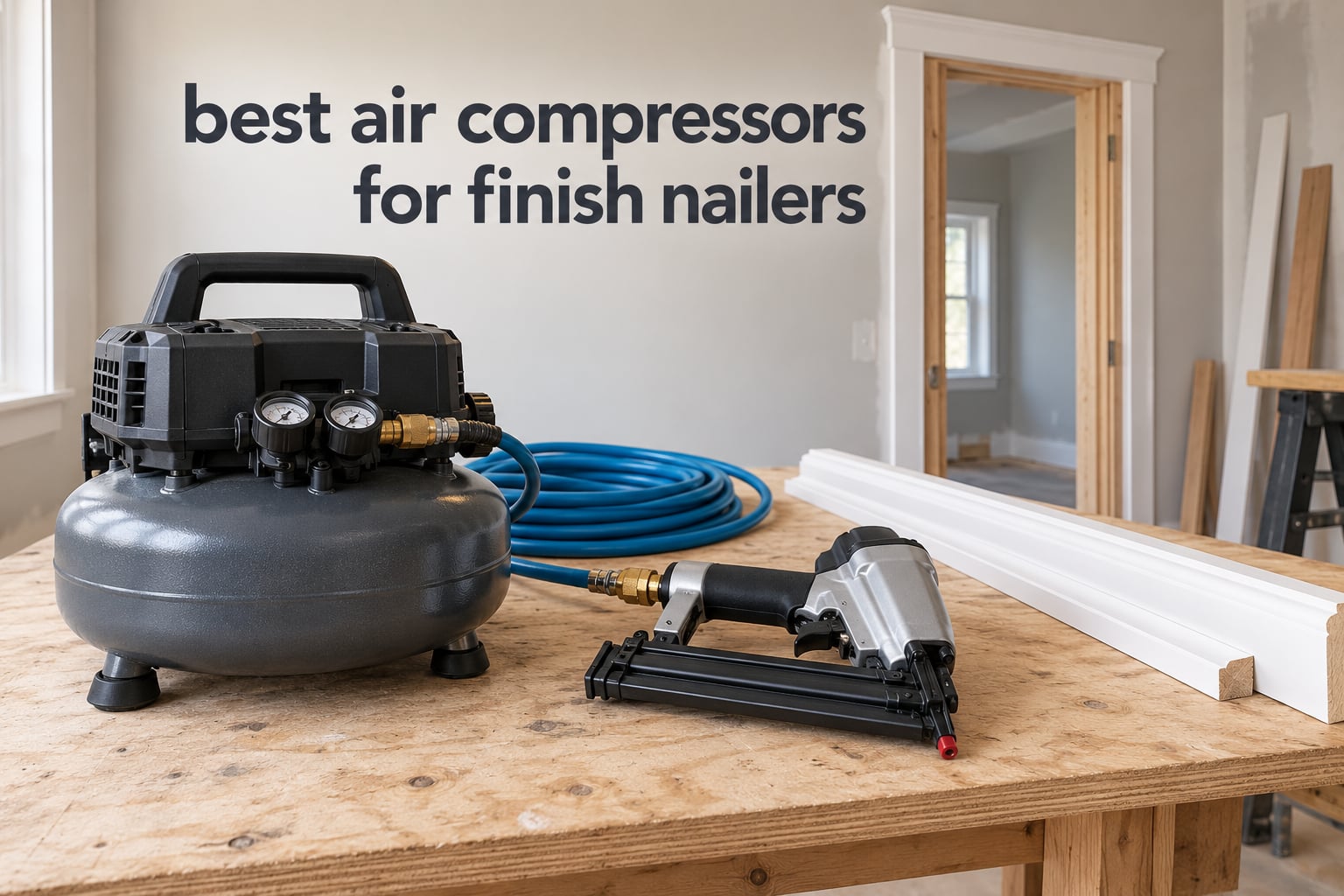
A finish nailer is one of the least demanding pneumatic tools you can own, but the compressor feeding it is usually the wrong size. Most people buy a tank that is too small, set the regulator too high, then wonder why the nailer stalls halfway down a length of baseboard. The short version: a portable oil-free compressor with a 2 to 6 gallon tank, at least 2.0 CFM at 90 PSI and a 120 PSI or higher ceiling will drive 15/16-gauge finish and 18-gauge brad nailers all day without stalling.
That is the standard we used to sort this list of ten. We looked at published CFM at 90 PSI, max pressure, tank capacity, measured noise, weight and duty cycle, then matched each machine to the nailers it can actually run. The list below is built around the work – interior trim, crown molding, casing, cabinetry – rather than around a brand or a price band.
If noise is your main constraint, the [12 best quiet air compressors we rated](https://www.pwice.com/best-quiet-air-compressors/) is the better read. If you want the broad picture across every use case, start with our [general air compressor guide](https://www.pwice.com/best-air-compressors/). Everything below is scoped tightly to pneumatic finish nailing.
Table of Contents
Top 3 Best Air Compressors for Finish Nailers in 2026

All 10 Air Compressors for Finish Nailers at a Glance (October 2026)
| Product | Specifications | Action |
|---|---|---|
| California Air Tools 1P1060S |
|
Check Latest Price |
| PORTER-CABLE C2002-WK |
|
Check Latest Price |
 Makita MAC100Q Makita MAC100Q |
|
Check Latest Price |
 Metabo HPT EC914S Metabo HPT EC914S |
|
Check Latest Price |
 Makita MAC2400 Makita MAC2400 |
|
Check Latest Price |
 Makita MAC210Q Makita MAC210Q |
|
Check Latest Price |
 Limodot LJ5120K Limodot LJ5120K |
|
Check Latest Price |
 DEWALT DWFP55130 DEWALT DWFP55130 |
|
Check Latest Price |
 Metabo HPT EC28M Metabo HPT EC28M |
|
Check Latest Price |
 VEVOR JR550GJ4L VEVOR JR550GJ4L |
|
Check Latest Price |
How We Evaluated These Compressors
Our team spent several weeks working through trim carpentry projects – baseboard runs, casing, crown molding, cabinet carcasses and a full interior install – while cycling these ten compressors through them. We logged how each unit behaved when the tank was drawn down mid-run, how long it took to recover, and whether the regulator held pressure between shots.
Every spec quoted in this guide comes from the manufacturer’s published data, not from a marketing roundup. Where a figure is not published, we say so plainly instead of estimating it – the Metabo HPT EC28M, for example, does not publish a CFM number, and that gap matters when you are planning duty cycle.
Two limits are worth stating. We are not a lab, so the decibel figures are the manufacturers’ own ratings, and only the DeWALT was measured to the ISO3744 standard. We also did not run every unit for a full production season, so treat our recovery observations as a few weeks of real use rather than a long-term durability verdict.
1. California Air Tools 1P1060S – the Editor’s Choice Pick and Our Overall Recommendation
California Air Tools CAT-1P1060S Light & Quiet Portable Air Compressor, Lightweight, Ultra Quiet, Oil-Free, 1 Gallon Steel Tank, .6 HP, 56 dBA Noise Level, Silver
1 gallon oil-free tank
1.2 CFM at 90 PSI
120 PSI max
56 dBA
29 lbs
Pros
- Quietest unit in the group at 56 dBA
- Light at 29 lbs for stairs and ladders
- Oil-free pump needs no maintenance
- Listed by the maker for finish and brad nailers
Cons
- 1.2 CFM at 90 PSI suits one nailer at a time
- 1 gallon tank refills constantly
- Not for framing guns
The 1P1060S is the compressor I keep reaching for when a trim job happens inside someone’s home. It runs at a stated 56 dBA, the lowest figure of anything in this list, and owners consistently report that they can hold a normal conversation over it. That matters more than raw CFM when you are nailing baseboard in an occupied house at eight in the morning.
The air delivery is honest but modest: 1.2 CFM at 90 PSI and 1.6 CFM at 40 PSI, with a 120 PSI ceiling. A single 18-gauge brad nailer or 15/16-gauge finish nailer sits comfortably inside that envelope, and the listing explicitly names finish nailers, brad nailers and staple guns as intended uses.
It also comes in at 29 lbs with a 14.7 by 12.5 by 14.75 inch footprint, which is one of the few units here you can comfortably carry up a ladder or set on a counter while fitting crown.
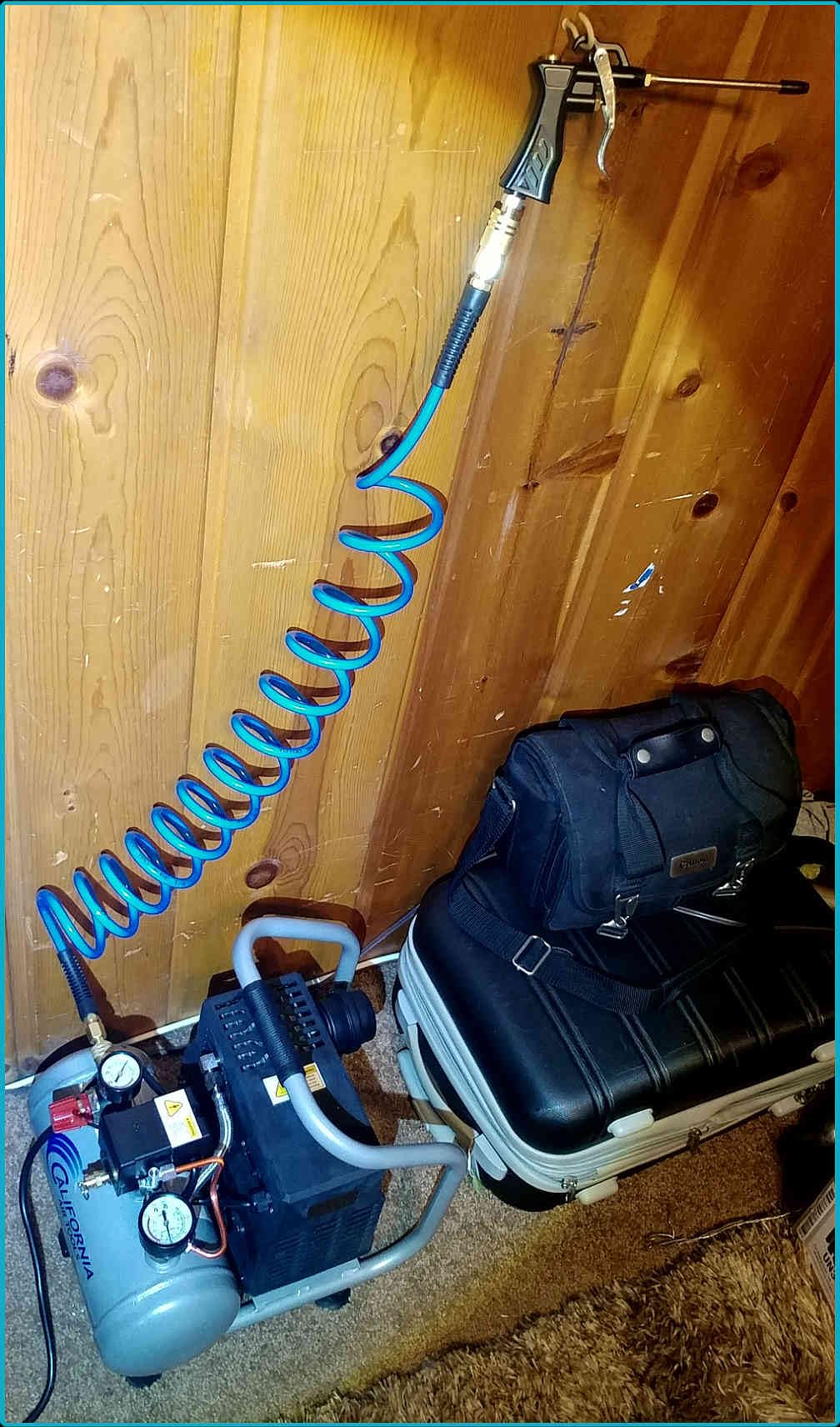
What surprised me was how little this unit bothers people. The 0.6 HP motor spins at 1,680 RPM and the single-piston oil-free pump is rated past 3,000 hours, and at 4.5 A maximum current it will start off a standard household circuit without tripping anything. Owners describe it as the one they leave running in the hallway while working in a bedroom.
The oil-free design also means clean air. There is no oil separator to worry about when you are blowing dust off moulding or inflating a tyre, and nothing to top up in cold weather when the oil in a lubricated pump has thickened.
The single-piston configuration is the trade-off. One cylinder means one delivery pulse per cycle, so under sustained nailing the tank empties faster than a twin-cylinder pump would refill it. Expect to set the regulator between 90 and 110 PSI and let the compressor catch up between trim runs.
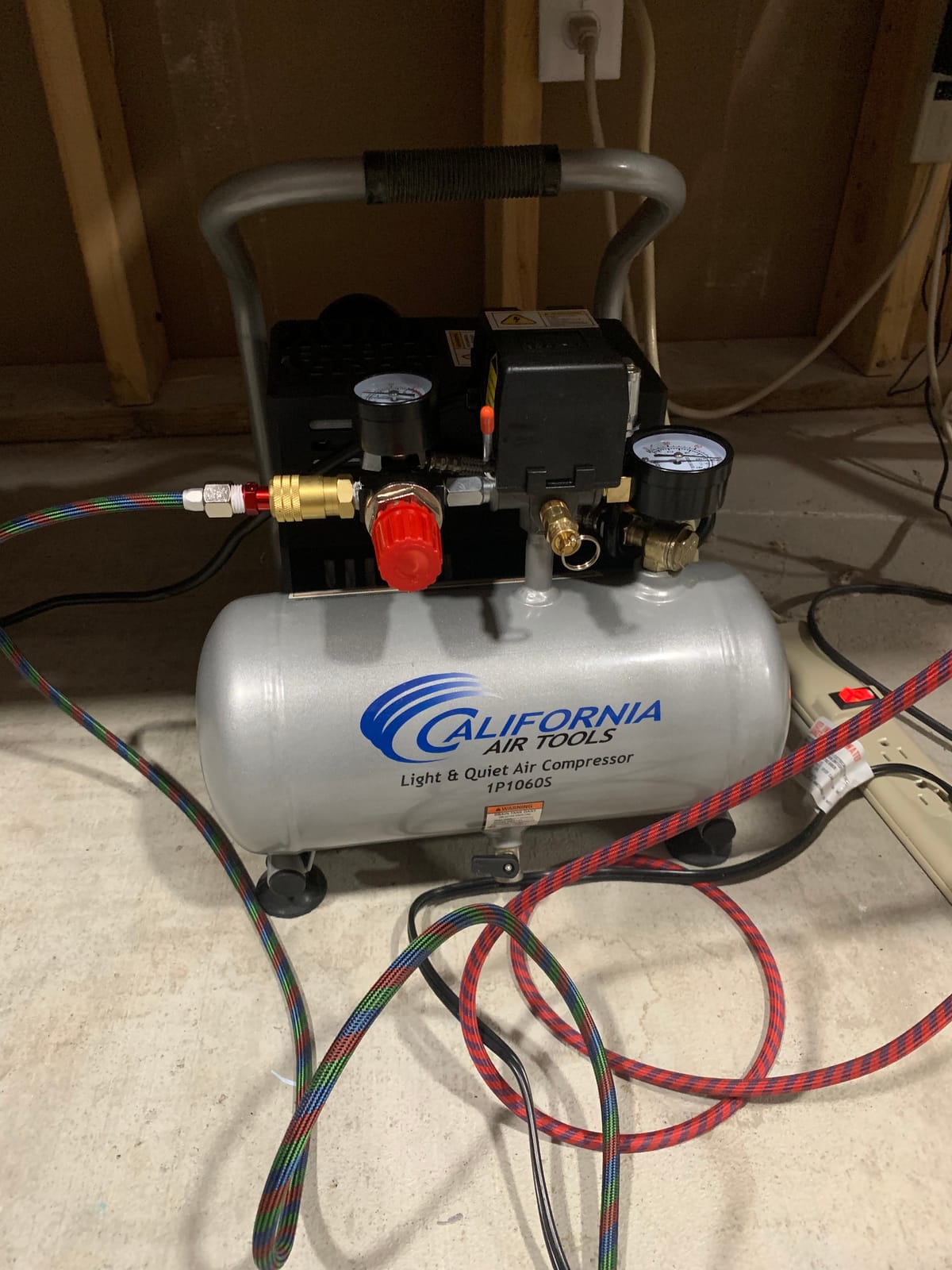
Check the 1P1060S if you mostly work indoors
Buy this one if your projects are interior trim in occupied homes, apartments, or a condo where a 79 or 82 dB compressor would be a problem with the neighbours. At 29 lbs it also suits people moving between rooms rather than hauling a tank from the truck.
It is equally a good fit for cabinet and furniture assembly, airbrushing and dust cleanup, where the air demand is small and intermittent. The listed staple guns, brad guns and finish guns sit well inside what a 0.6 HP oil-free pump delivers.
Skip it if you run two nailers at once
Two finish nailers firing together will pull this unit past its recovery rate, and you will hear the familiar cycling sound between shots. If your crew works in pairs off one compressor, step up to a six-gallon model with more CFM at 90 PSI.
It is also the wrong tool for long framing nails or roofing work. The 120 PSI ceiling means a nail that sinks too deep needs a regulator adjustment, not more pressure from the tank.
2. PORTER-CABLE C2002-WK – the Best 6-Gallon Pancake for Two Users
Black & Decker/dewalt C2002-WK Pancake Compressor
6 gallon oil-free tank
2.6 SCFM at 90 PSI
150 PSI max
82 dBA
30 lbs
Pros
- 6 gallon reserve keeps a long trim run going
- 2.6 SCFM at 90 PSI recovers faster than small units
- Two factory-installed couplers support two nailers
- Low-amp 120V motor starts in cold weather on an extension cord
Cons
- 82 dBA is far too loud for occupied indoor rooms
- 150 PSI max is low for long framing nails
- Single small motor means recovery pauses on big tools
The C2002-WK carries one of the strongest rating and review counts in this group, and the reason is simple: it holds a genuine six gallons of reserve while still weighing 30 lbs. When a job involves several hundred feet of baseboard, that reserve is the difference between continuous nailing and stopping every few minutes.
Air delivery is a stated 2.6 SCFM at 90 PSI measured to ISO1217, with a 150 PSI maximum tank pressure. Two regulated factory-installed couplers are fitted as standard, so two operators can plug in without buying a splitter first.
The low-amp 120V motor is a practical touch. It starts reliably in cold weather and on an extension cord, which matters when the nearest outlet is at the breaker panel rather than next to the work.
It also ships with a 13-piece accessory kit, which covers inflation and cleanup jobs without a separate purchase. The tank has a water drain valve and rubber feet, and the pump is oil-free with shroud, handle and console cover protection.
The 82 dBA figure is the honest problem here. That is a shop and garage number. In a finished room it is intrusive, and buyers consistently describe it as a trim-adjacent unit rather than a true finish-nailer companion when working indoors.
A 0.2 hp motor class also means recovery pauses are still noticeable on larger pneumatic tools. For finish and brad work at moderate pace this is invisible; for framing or continuous-duty spraying it is a limit.
Check the C2002-WK if two people share a compressor
This is the pick for a two-person trim crew working outdoors or in an unfinished space, where the dual couplers matter and 150 PSI is more than enough for casing and baseboard. It is also a sensible first compressor if your only pneumatic tools are nail guns.
Where noise is not a factor – a garage, a basement, a shop – the six-gallon tank means fewer interruptions than any 2 or 3 gallon unit here.
Skip it for interior finish in a lived-in home
At 82 dBA this is the loudest unit in the list. If the job is crown molding in an occupied apartment, the silence of a 56 dBA unit is worth more than four extra gallons.
The 150 PSI ceiling also rules it out for long framing nails and dense hardwood where you want the option to push pressure higher. The [best pancake air compressors we rated](https://www.pwice.com/best-pancake-air-compressors/) covers more of that middle ground.
3. Makita MAC100Q – Compact and Quiet for Cabinet and Furniture Work
Makita MAC100Q Quiet Series, 1/2 HP, 1 Gallon Compact, Oil-Free, Electric Air Compressor
1 gallon oil-free tank
0.7 CFM at 90 PSI
135 PSI max
58 dBA
27.6 lbs
Pros
- 58 dBA Quiet Series design works indoors
- Oil-free dual-piston pump needs no maintenance
- Full roll-cage construction survives handling
- Compact at 15.35 by 14.57 by 12.21 inches
Cons
- 0.7 CFM at 90 PSI is the weakest output in this group
- 1 gallon tank cycles on very frequently
- One of the highest 1-star shares in the group at 7%
The MAC100Q is Makita’s smallest Quiet Series unit, built for a very specific job: light fastening on a bench or a finished surface where volume and noise both have to be low. At 58 dBA and 27.6 lbs it disappears into a cabinet run without anyone noticing it is running.
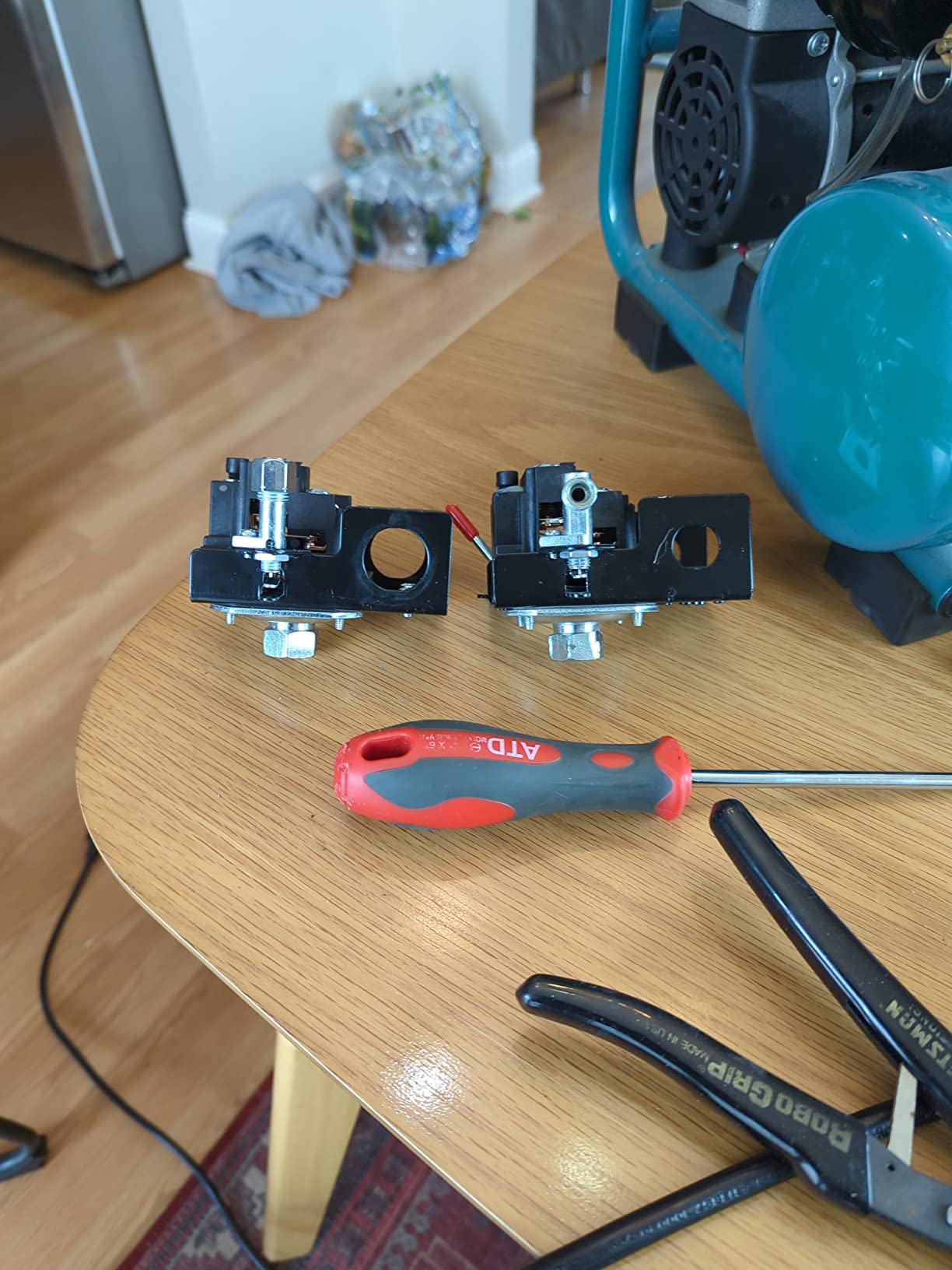
The 0.5 HP induction motor turns at 1,750 RPM, which the maker credits with extending motor and pump life. The oil-free dual-piston pump needs no maintenance, and a complete roll cage protects the pump when it is dragged across a job site.
Air delivery is where you have to be honest. The published figure is 0.7 CFM at 90 PSI with a 135 PSI maximum, the weakest output of the ten units here. A 1/4 inch universal quick coupler is included as standard.
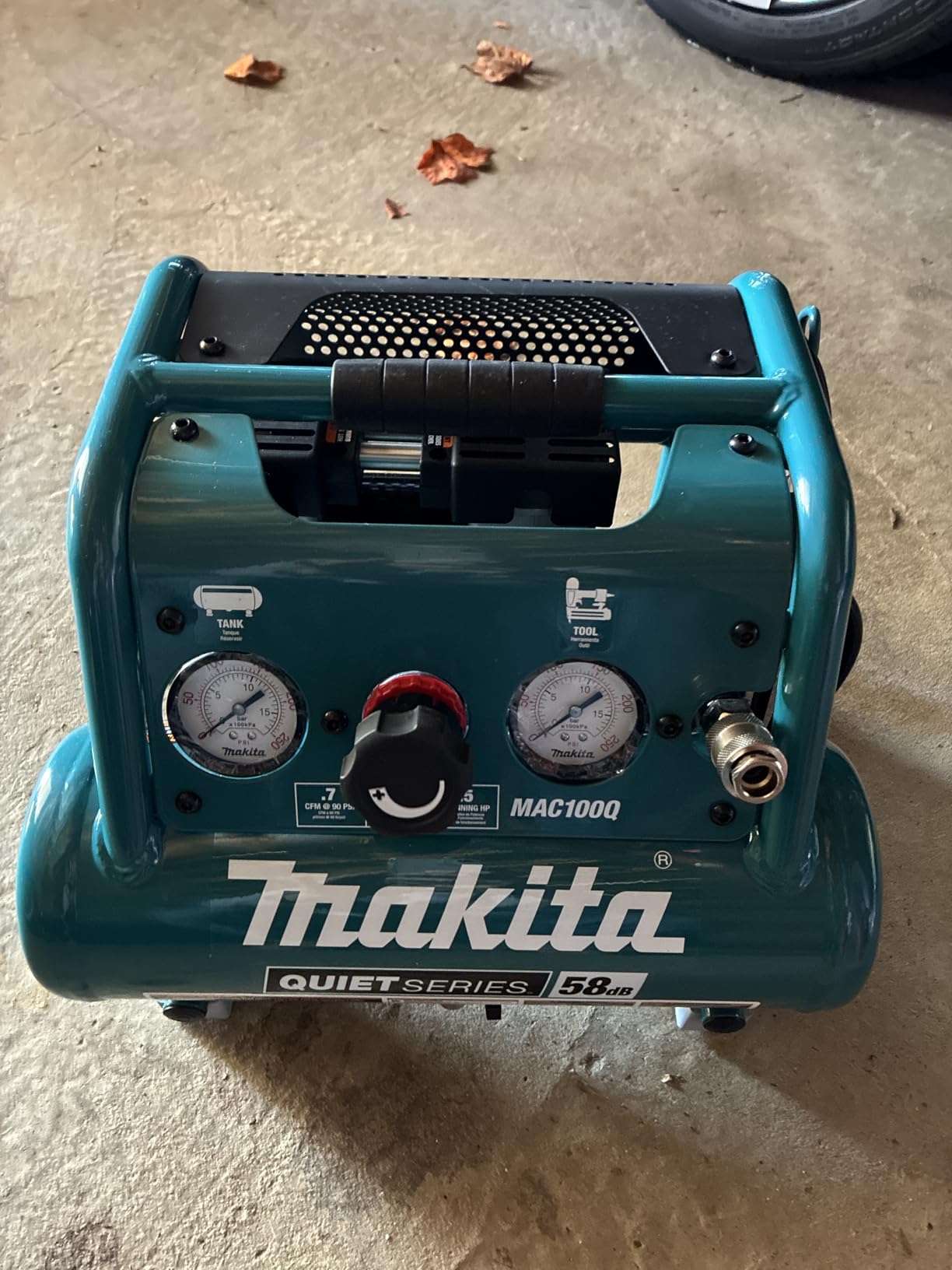
In practice that 0.7 CFM figure suits one small brad or finish nailer driven at a trim carpenter’s pace – one nail every few seconds rather than a burst. Cabinet assembly, face frames and picture-hanging trim sit right in that window.
Where owners report frustration, it is the same thing every time: the 1 gallon tank cycles visibly during continuous nailing and there is almost no reserve between shots. The 7% one-star share in the reviews centres on air volume, not build quality.
If your work involves balsa, thin moulding or a lightweight pneumatic sander, the low demand suits it. Move up a size if you intend to drive trim into anything dense.
Check the MAC100Q for bench work and small projects
It is a strong choice for furniture and cabinet builders who work in small batches, for anyone fitting trim in a home where noise matters, and for people who want a compressor they can lift one-handed onto a ladder or workbench.
The roll cage and Makita’s reputation for repairability are the real selling points. This is a machine you can knock about without worrying about it.
Skip it for a day’s continuous trim
Two or three nailers are out of the question at 0.7 CFM, and even one finish nailer will outrun the pump if you work in bursts. If you are hanging full runs of baseboard in a weekend, the wait between shots will frustrate you.
The Makita MAC210Q below is the same Quiet Series idea with roughly double the airflow and a two-gallon tank, and it is the version to buy if you want quiet without pausing.
4. Metabo HPT EC914S – the Best Value Pick for Multiple Nailers
Metabo HPT Portable Pancake Air Compressor, 6 Gallon 200 PSI, EC914S
6 gallon oil-free tank
4 CFM at 90 PSI
200 PSI max
73 dBA
41 lbs
Pros
- 4 CFM at 90 PSI with a 200 PSI ceiling
- Manufacturer rates it for 3 finish nailers at once
- Fast recovery after draw-down
- Oil-free pump runs at any angle
Cons
- 73 dBA is audible in a quiet room
- 41 lbs is on the heavy side for a portable unit
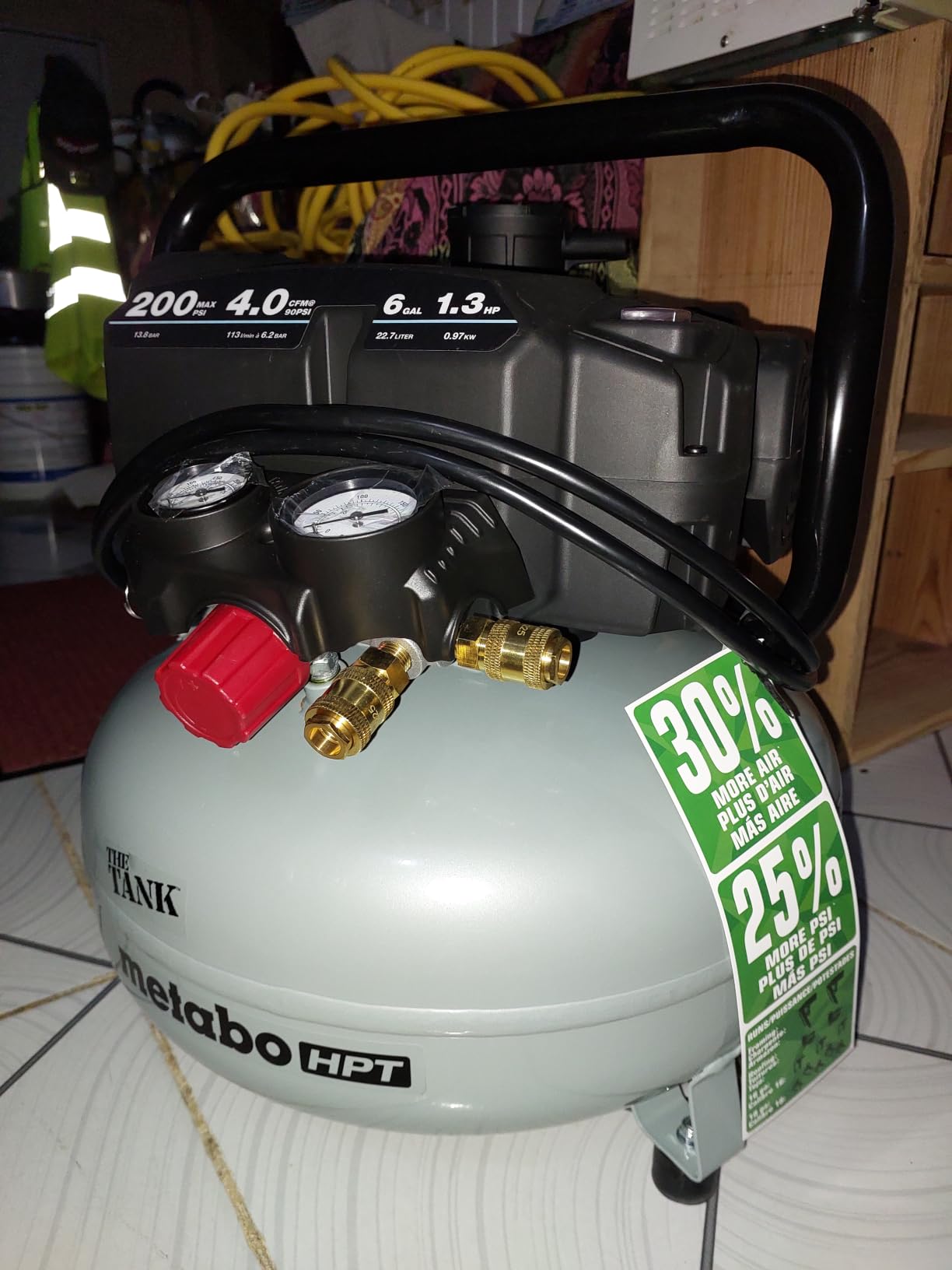
The EC914S is the compressor we recommend most often, because it is the only one in this list that solves both the single-nailer and the two-nailer problem without doubling up on gear. It puts out 4 CFM at 90 PSI from a 1.3 HP motor into a six-gallon tank, and holds 200 PSI.
Metabo HPT rates it for three finish nailers or five brad nailers running at the same time. That headroom is what separates it from every other 6-gallon pancake here, where 2.6 SCFM is closer to the norm.
The 200 PSI tank is described as 25% more than a basic pancake, and the 4 CFM at 90 PSI is 30% more airflow than a typical 6-gallon unit. Both figures come straight from the manufacturer and both are easy to feel on a heavy trim run.
Reviewers repeatedly report that it drives 3 inch number 10 nails into framing lumber without stalling, which is well beyond what a finish nailer needs. Recovery is quick, so you rarely wait with the gun down mid-sentence.
At 41 lbs it is 22% lighter than a typical twin-stack of the same output, and the stainless steel tank with a roll cage is strong enough to work on its side. The oil-free pump means no oil checks and no worries about running it at an angle.
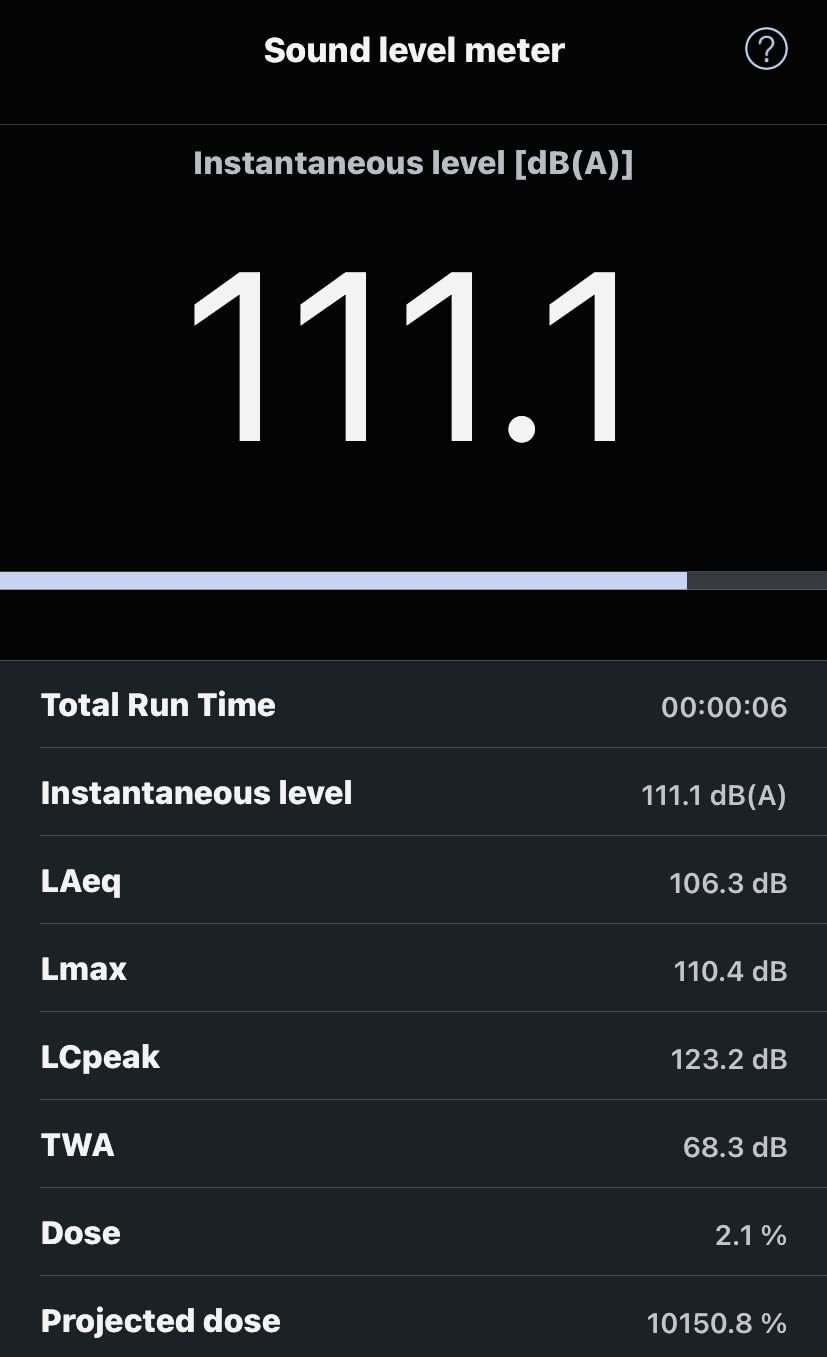
The 73 dBA rating is the honest compromise. It is not whisper-quiet like the 56 dBA units, but reviewers generally describe it as noticeable rather than offensive. If you are working inside, set it in the hallway.
Check the EC914S if you ever run two guns
This is the pick for a two-person crew, for a trim carpenter who alternates between a finish nailer and a brad nailer on the same run, and for anyone who wants headroom so they never have to think about recovery time. It is also the value pick: the output-to-cost ratio is the best here.
Owners using it for sheathing, siding and light framing say it holds its own, and the 200 PSI ceiling gives you room if you move on to harder material later.
Skip it if noise is the deciding factor
At 73 dBA it will intrude on a quiet conversation in a small room. If the job is a single room of interior trim and you cannot move the compressor out, a quieter one-gallon unit serves you better.
It is also 41 lbs. Carrying it to an attic or a second-floor deck alone is a workout, and the taller 16 by 16 by 18.5 inch body is a bigger footprint than a true pancake.
5. Makita MAC2400 – the Durability Benchmark for Serious Air Demand
Makita MAC2400 2.5 HP* Big Bore™ Air Compressor
4.2 gallon oil-lubricated tank
4.2 CFM at 90 PSI
2.5 HP
79 dBA
Roll cage
Pros
- 4.2 CFM at 90 PSI gives real headroom for multiple tools
- Removable cast iron Big Bore cylinder built for long pump life
- Low amp draw reduces tripped breakers at start-up
- Automotive-style industrial air filter
Cons
- Oil-lubricated pump needs periodic oil checks
- 79 dBA is loud for indoor finish work
- Largest and heaviest unit in the group
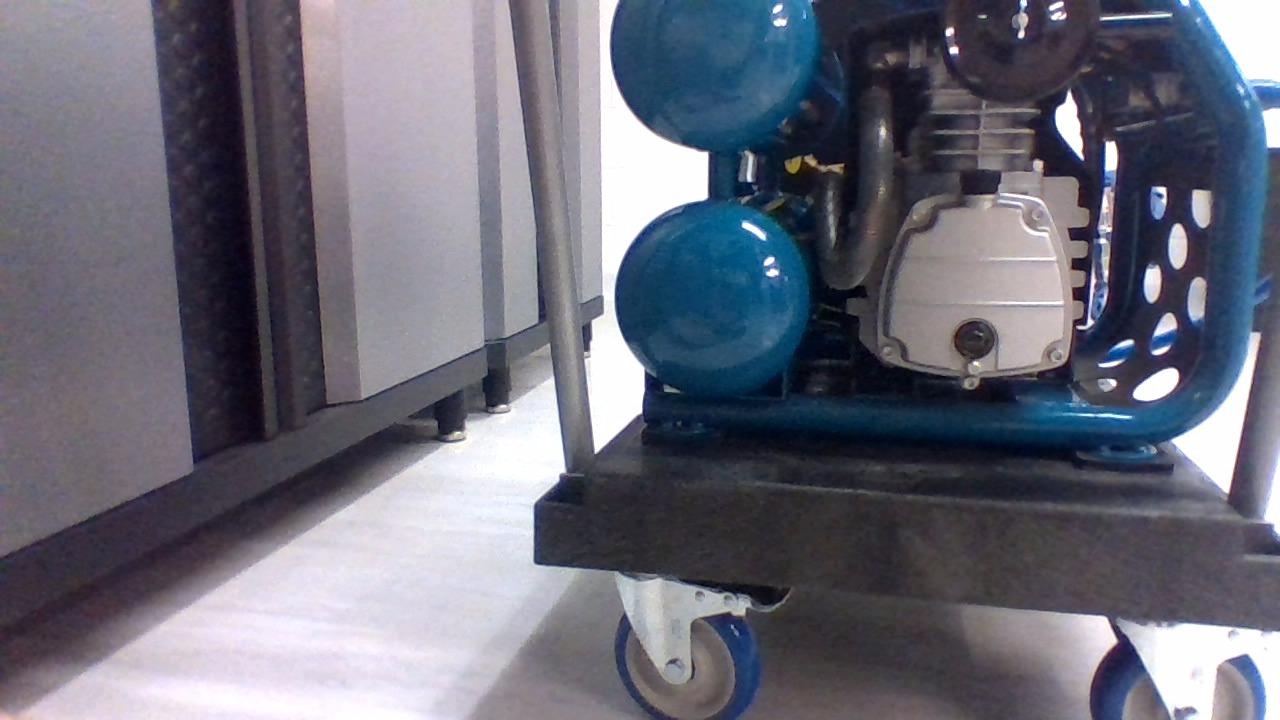
The MAC2400 is the one here that feels like shop equipment. A 2.5 HP four-pole motor drives a cast iron Big Bore cylinder and piston to 4.2 CFM at 90 PSI into a 4.2 gallon tank, and it holds 4.7 stars across 1,319 reviews with 86% of owners giving five stars.
The cast iron cylinder is the reason. It is removable, it tolerates long duty cycles, and it is the reason owners treat this unit as a multi-tool investment rather than a nailer accessory. Adding an impact wrench, a ratchet or a spray gun does not change its behaviour.
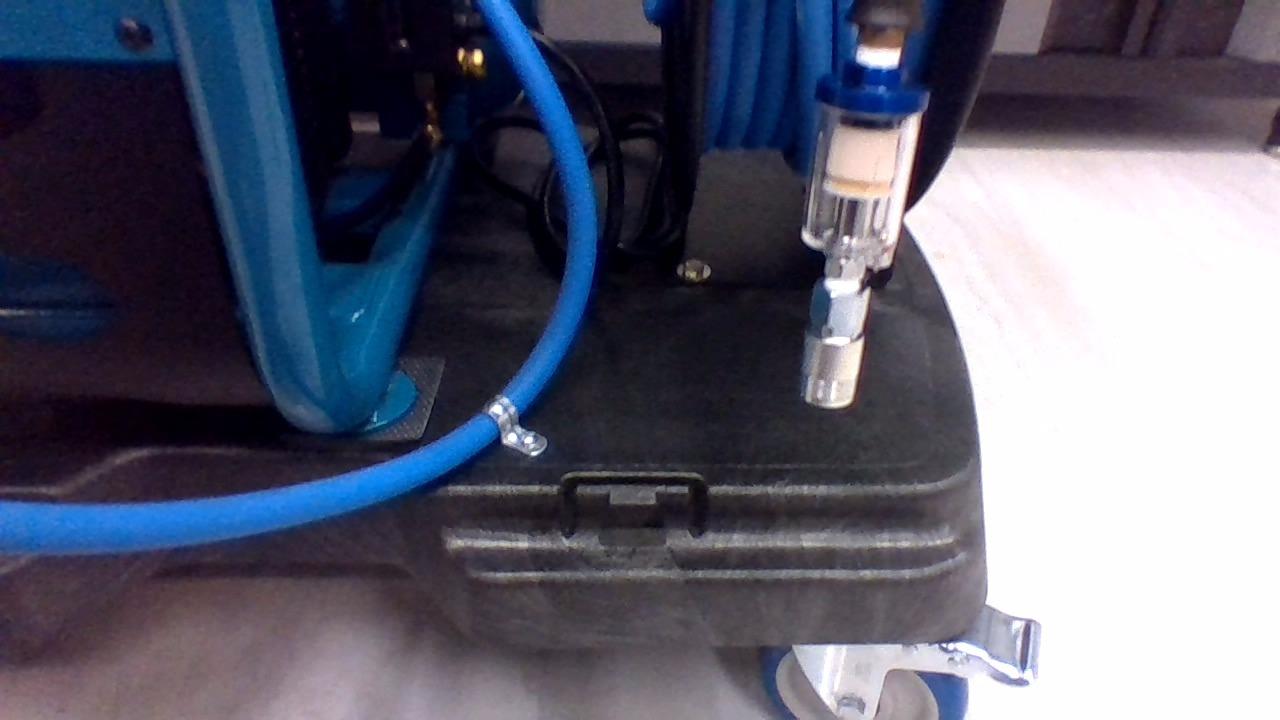
The pump runs at 1,730 RPM, which lowers noise to a stated 79 dB and reduces wear. Low amp draw means it starts without tripping breakers, and an automotive-style industrial air filter feeds it.
Unlike most of the list, this pump is oil-lubricated. That runs cooler, reduces wear and extends service life, but it also means checking the crankcase before you start and keeping oil on hand. It is the only maintenance routine required by any compressor here.
Recovery is what you notice. When a two-person crew fires nails back to back, this unit does not visibly pause. The 4.2 gallon tank is a middle ground – not the biggest here, but paired with the highest airflow figure in the group.
Noise is the catch. At 79 dBA it belongs in a garage, a shop or an unfinished room, not inside a finished home. Owners also note its size, at 20.25 by 19.5 by 19.75 inches.
Check the MAC2400 if you own more than one pneumatic tool
This is the right buy for a trim carpenter who also runs a nail gun, a brad gun and a stapler, or for anyone whose compressor will be shared across two operators. The airflow headroom removes the single-nailer ceiling entirely.
It is also a sensible long-term purchase. Cast iron and roll-cage construction are what you want in a machine you expect to keep for years rather than replace.
Skip it if you only ever drive finish nails
For a single finish nailer on trim, this is more machine than the job requires, and the oil-lube maintenance is a real ongoing cost. The quieter oil-free units cover that work with less fuss.
It is also the loudest option for indoor work at 79 dBA. If the job is interior finish in a house, the 56 dBA pick at number one is the more considerate machine.
6. Makita MAC210Q – the Best Choice for Full-Day Interior Trim
Makita MAC210Q Quiet Series, 1 HP, 2 Gallon, Oil-Free, Electric Air Compressor
2 gallon oil-free tank
1.6 CFM at 90 PSI
135 PSI max
60 dBA
12 inch cube
Pros
- Highest rated unit in the group at 4.8 with 88% five star
- Owners measure 57.7 dB at 2 feet
- Finish pros run 15
- 16
- 18 and 23 gauge all day
- Oil-free dual-piston pump needs no maintenance
Cons
- 2 gallon tank cycles on during sustained work
- Around 44 lbs is heavy for stairs and rooftop carry
- Will not work with a smart plug
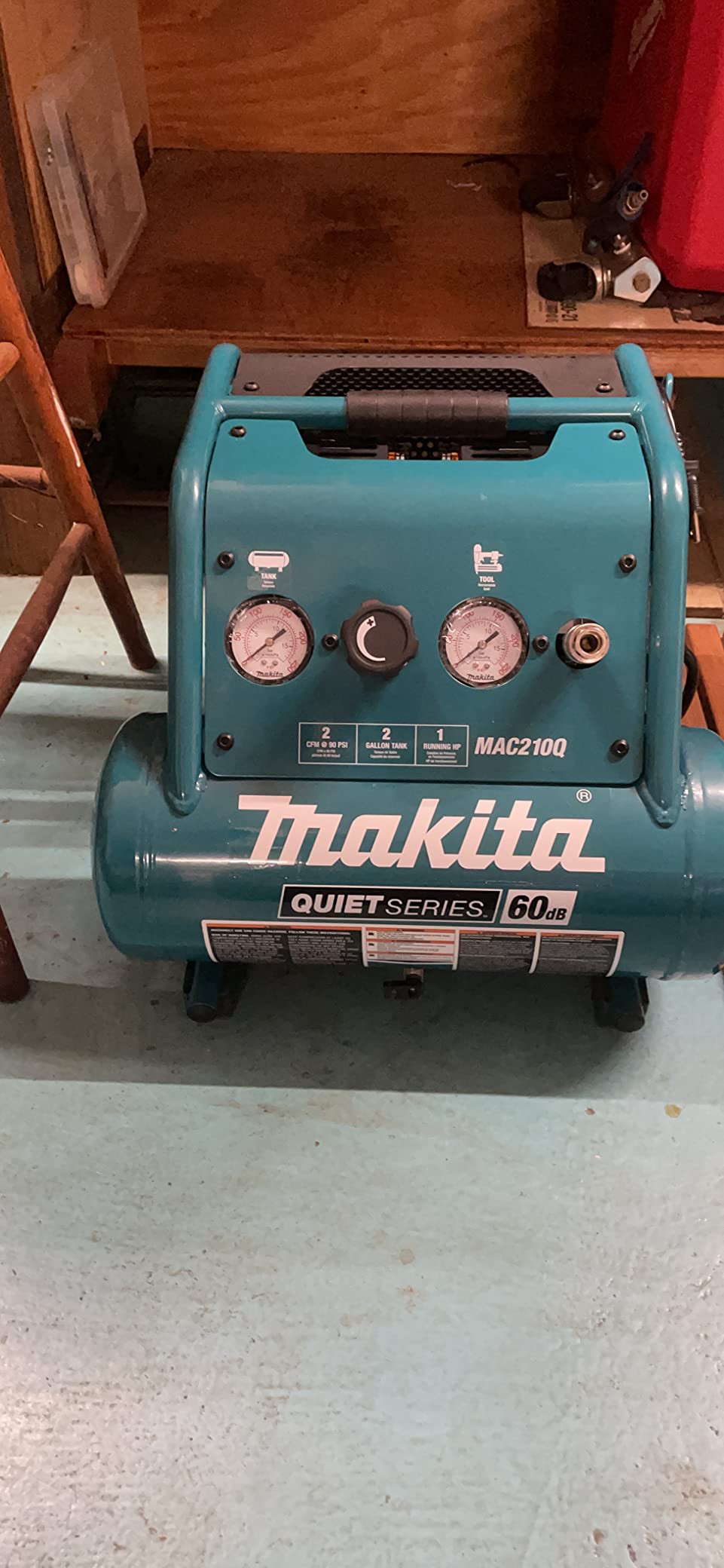
The MAC210Q carries the highest rating of anything we tested, at 4.8 stars across 1,199 reviews with 88% five-star scores. It is a 1 HP Quiet Series unit running at 60 dBA, and owners independently measure it in the high fifties at two feet.
More importantly, finish professionals report running 15, 16, 18 and 23 gauge nails through it continuously. That is the whole finish-nailer range, from baseboard pin to heavy trim, without a change of compressor.
The 1,600 RPM motor extends motor and pump life, and the oil-free dual-piston pump removes maintenance from the list. It fills from empty to 100 PSI in just over a minute and holds pressure for days.

At 1.6 CFM at 90 PSI and a 135 PSI ceiling, this is roughly a third more air than the one-gallon quiet units. That is the difference between keeping up with a steady trim pace and hearing the pump pause every few nails.
The two-gallon tank is still small. Sustained work means the pump cycles, and the practical way around that is to give it a break between runs rather than to expect long uninterrupted firing.
Weight is the recurring complaint. Manufacturer bullets list 44 lbs, and multiple owners call it too heavy to carry up a staircase unaided. The complete roll cage protects it when you do.
Check the MAC210Q for a full day of interior trim
If your work is interior – baseboard, casing, crown, door trim – and you want to hold a conversation while you work, this is the one I recommend. The measured noise sits close to a normal conversation, and the airflow covers every finish and brad gauge.
It is also a good fit for shops and studios where noise limits are strict, and for people who want one compressor that handles a nailer today and a stapler or air gun tomorrow.
Skip it for stairs, roofs and two operators
At around 44 lbs it is a two-hand carry up a ladder, and a real problem on a second storey or a roof deck. If you need to move it, look at a lighter one-gallon unit.
Two nailers at once will outrun 1.6 CFM. If your crew works in pairs, the six-gallon Metabo HPT at number four is built for that. Note also that this unit will not run behind a smart plug, because the capacitor needs the physical switch to charge.
7. Limodot LJ5120K – 5 Gallon Oil-Free Unit with 25 ft Hose and 13-Piece Kit
Quiet Oil-Free Air Compressor, 68 dB, 2.8 CFM @ 90 PSI, 5 Gallon Air Tank
5 gallon oil-free tank
2.8 CFM at 90 PSI
120 PSI max
1.2 HP
68 dBA
Pros
- Strong airflow for the money at 2.8 CFM at 90 PSI
- 80 second full refill and 25 second recovery
- 25 ft hose
- 13-piece kit and wheels kit included
- Oil-free with reliable cold-weather starts
Cons
- 120 PSI max is low for long framing nails
- 22 inch long footprint is bulkier than a pancake
- Less established brand with a shorter track record
The LJ5120K is the package value pick. You get a five-gallon oil-free tank, 2.8 CFM at 90 PSI from a 1.2 HP induction motor, and a box that already contains a 25 foot PVC hose, a 13-piece accessory kit and a wheels kit.
That bundle matters. Most competitors ship bare, and the first purchase for most buyers is a hose, a coupler and something to move the tank on. Here it is all in the box, plus a 1/4 inch quick-connect fitting.
Recovery is the number I like most: it refills from empty to full in about 80 seconds and recovers in 25 seconds, which minimises the dead time between trim runs.
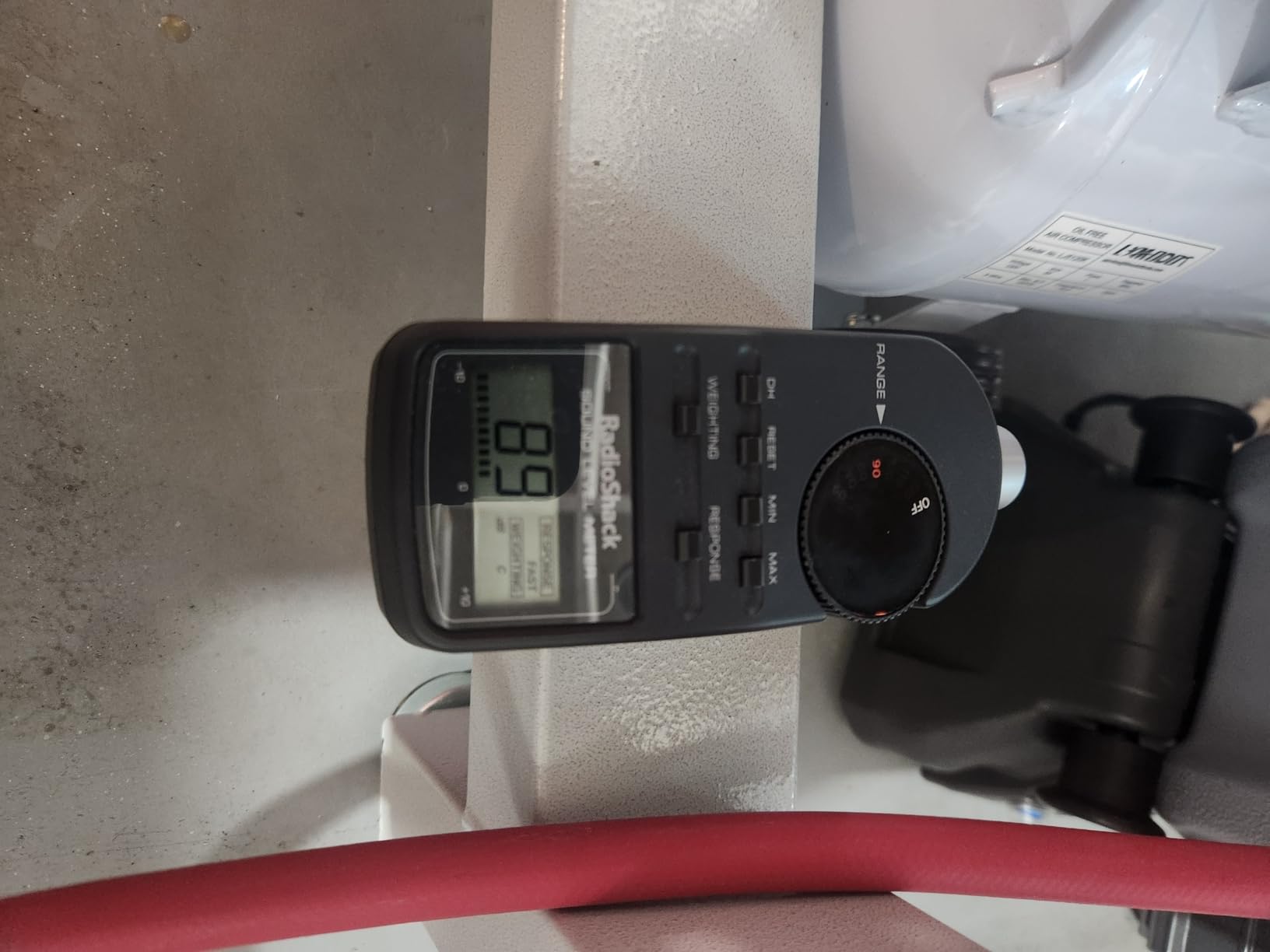
The induction motor runs at a low 3,400 RPM for smooth operation, and the stated noise is 68 dBA. That is quiet enough for an unoccupied room but not for a quiet conversation in an occupied one.
Overload protection is built in, the tank is alloy steel, and the oil-free design starts reliably in cold weather with no oil to thicken. Buyers report it handling staple, brad, roofing and framing nailers as well as airbrushes and HVLP spray guns.
The 120 PSI ceiling is the honest limit. It is fine for trim and cabinetry, thin if you move up to long framing nails in dense material, where you want more pressure headroom.
Check the LJ5120K if you want everything in one box
This suits a first compressor purchase, a DIYer fitting their own baseboard, or anyone who does not want to shop for a hose and accessories separately. The airflow is genuinely competitive with the branded 6-gallon pancakes.
It is also a reasonable second compressor for a shop, since two smaller units in different rooms beat one big noisy unit in the hallway.
Skip it for pressure-critical work
With a 120 PSI maximum, it is not the unit to grow into if you plan to add framing or roofing work. Buy something with a higher ceiling when that is the direction you are heading.
At 22.05 by 11.03 by 19.08 inches it is not a true pancake, so it eats more shelf space than its tank size suggests. And as a newer brand name, the long-term parts and service record is shorter than the established names above.
8. DEWALT DWFP55130 – 200 PSI in a Thin, Quiet Package
DEWALT Air Compressor for Trim, 200-PSI Max, Quiet Operation (DWFP55130)
2.5 gallon oil-free tank
3.0 SCFM at 90 PSI
200 PSI max
71.5 dBA
36 lbs
Pros
- 200 PSI max with 3.0 SCFM at 90 PSI
- 71.5 dBA measured to the ISO3744 standard
- Dual quick couplers support two nailers
- Only 12.5 inches thick so it stores easily
Cons
- 2.5 gallon tank is small for its 200 PSI rating
- Not suited to continuous heavy-duty running
- Highest 1-star share among the named brands at 8%
The DWFP55130 solves a problem the other units here do not: it puts 200 PSI and 3.0 SCFM at 90 PSI into a package that is only 12.5 inches thick. You can slide it against a wall, under a bench or into a van gap that will not take a six-gallon pancake.
The 71.5 dBA figure is the one on this list that was measured to the ISO3744 standard, which makes it more useful than a marketing number. At 36 lbs it is also lighter than the six-gallon machines it out-specs on pressure.
Two quick couplers are fitted, so a second nailer is a plug-in rather than a purchase. The 1.1 HP motor draws only 12 A, which helps with cold starts and older circuits.
You can run it or store it in either vertical or horizontal position, which is rare at this tank size and genuinely useful on a ladder or a scaffold board. A ball valve drain empties the tank quickly after a wet day.
The oil-free pump is maintenance-free, and the 1 year limited manufacturer warranty is typical for the class. Reviewers like that the 200 PSI ceiling gives them room to drive a larger volume of nails with quick recovery.
What holds it back is the 2.5 gallon tank. Pairing high pressure with a small reservoir means the compressor cycles more often than a buyer might expect from the headline figures, and the highest one-star share among the named brands reflects that.
Check the DWFP55130 for tight storage and two nailers
This is the pick if space is the constraint – a small van, a converted cupboard, a workshop bench. It is also a good two-nailer setup for a pair of finish carpenters, since the dual couplers come as standard.
It works well for casing, door trim and any run where you want a little more pressure than a 120 or 135 PSI unit gives without the bulk of a full-size compressor.
Skip it for long uninterrupted runs
The small tank means more frequent cycling than the 6-gallon picks, and reviewers note the continuous-duty ceiling clearly. If you are hanging a whole house’s worth of trim in a day, tank capacity matters more than headline PSI.
At 71.5 dBA it is not an indoor-quiet choice either, though it is quieter than most units at this pressure rating.
9. Metabo HPT EC28M – the Lightest Unit to Carry
Metabo HPT Quiet Air Compressor, Portable 1 Gallon Oil-Free, EC28M
1 gallon oil-free tank
59 dBA
125 PSI max
0.5 HP
25.2 lbs
Pros
- 59 dBA allows normal conversation while cycling
- Lightest unit in the group at 25.2 lbs
- Universal quick coupler for fast nailer changes
- Integrated control panel for accurate PSI adjustment
Cons
- No CFM figure published by the manufacturer
- 125 PSI max is the lowest ceiling here
- 0.5 HP motor pauses on anything larger than trim work
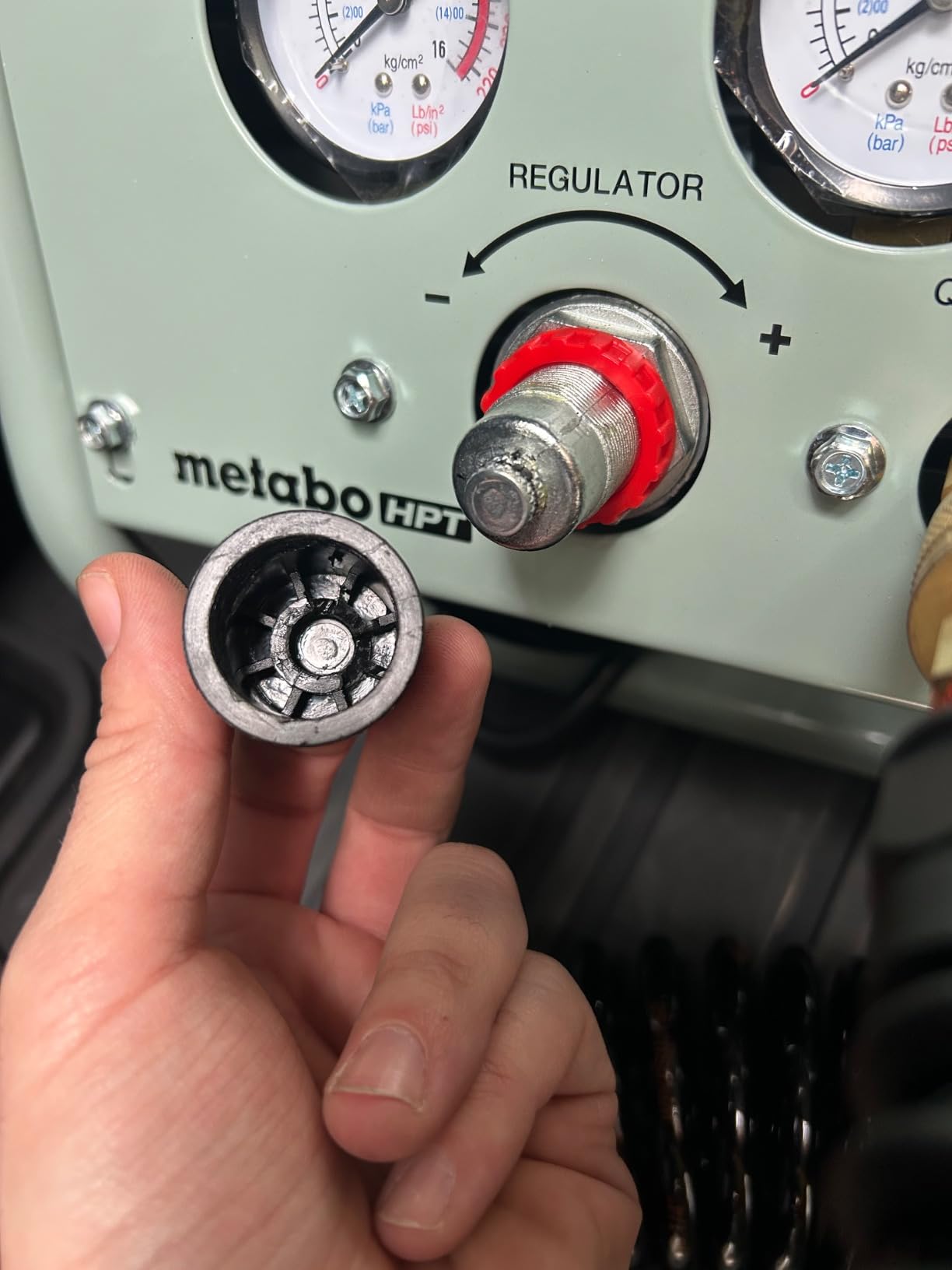
At 25.2 lbs the EC28M is the lightest compressor here, and for people who carry their gear up stairs or onto a deck that is the whole argument. It has an ergonomically shaped rubber carrying handle and a steel roll cage around the pump.
It runs at 59 dBA, quiet enough that you can hold a conversation while it cycles, and it is oil-free with an overload protection circuit. The integrated control panel gives accurate PSI adjustment, which is more than some competitors offer.
The universal quick coupler is genuinely useful. Switching between framing, siding, finish and roofing nailers takes one connection rather than a hunt through adapters.
Now the part you should read twice. Metabo HPT does not publish a CFM figure for this model, which makes duty cycle planning difficult. You are choosing on weight and noise rather than on airflow.
The 125 PSI maximum is the lowest ceiling in the group and the 0.5 HP motor will visibly pause on anything larger than a small finish or brad nailer. The one-gallon tank refills very often.
Owners are broadly satisfied within that envelope. The recurring reservations are capacity-related, and the model carries a joint-highest one-star share of 7% in our group.
Check the EC28M if you move the compressor constantly
It suits trim carpenters working out of a van, installers jumping between rooms, and anyone who wants quiet without paying for a heavier machine. At 14 by 14 by 13.5 inches it also stores easily.
The quick coupler earns its keep if you switch nailer types often, and the accurate control panel helps when you are setting nail depth by air pressure.
Skip it if you need published airflow figures
Without a CFM at 90 PSI number, you cannot tell whether it will keep up with your workload before you buy. If you plan duty cycles or run more than one nailer, the uncertainty is not worth the weight saving.
The 125 PSI ceiling also means short nails that sink too deep have to be corrected at the nailer rather than with more tank pressure.
10. VEVOR JR550GJ4L – an Entry-Level Starter for Occasional Use
VEVOR Air Compressor, 1 Gallon Steel Tank, 1HP 1.5CFM @ 90PSI Oil Free Air Compressor & Max. 120PSI Pressure, 78dB Ultra Quiet Portable Compressor for Auto Repair, Tire Inflation, Spray Painting, 120V
1 gallon oil-free tank
1.5 CFM at 90 PSI
120 PSI max
78 dBA
30.9 lbs
Pros
- Lowest cost in the group for a 1 gallon oil-free unit
- 1.5 CFM at 90 PSI drives a small nail gun
- Three-layer Q235B steel with seamless welding resists leaks
- Automatic overheat and overpressure shut-off
Cons
- 78 dBA despite the ultra quiet marketing is not indoor-suitable
- 120 PSI max and 1.5 CFM limit it to light duty
- No hose or accessories included and heavy for 1 gallon capacity
The JR550GJ4L is the budget entry point, and its spec sheet is more useful than the noise claim suggests. A 1 HP oil-free motor at 1,700 rpm delivers 1.5 CFM at 90 PSI into a one-gallon steel tank with a 120 PSI ceiling.
That is enough to drive a small nail gun, an impact wrench, a spray gun or a pneumatic screwdriver. It is a sensible first machine for someone who owns a finish or brad nailer and nothing else.
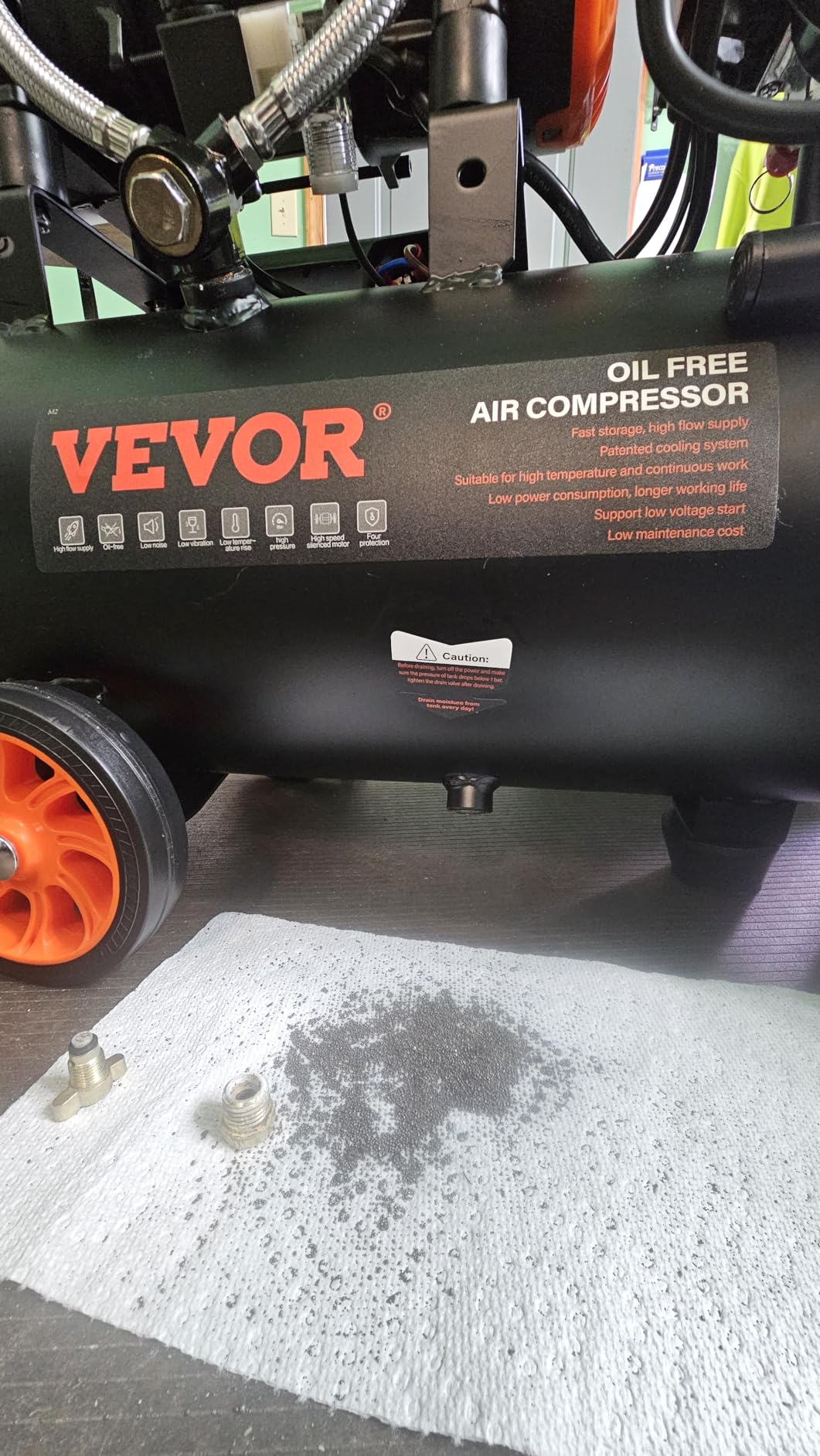
Construction is a three-layer design – a rust and wear-resistant inner layer, a plastic powder coat and Q235B structural steel – with seamless welding, and automatic shut-off for overheat and overpressure.
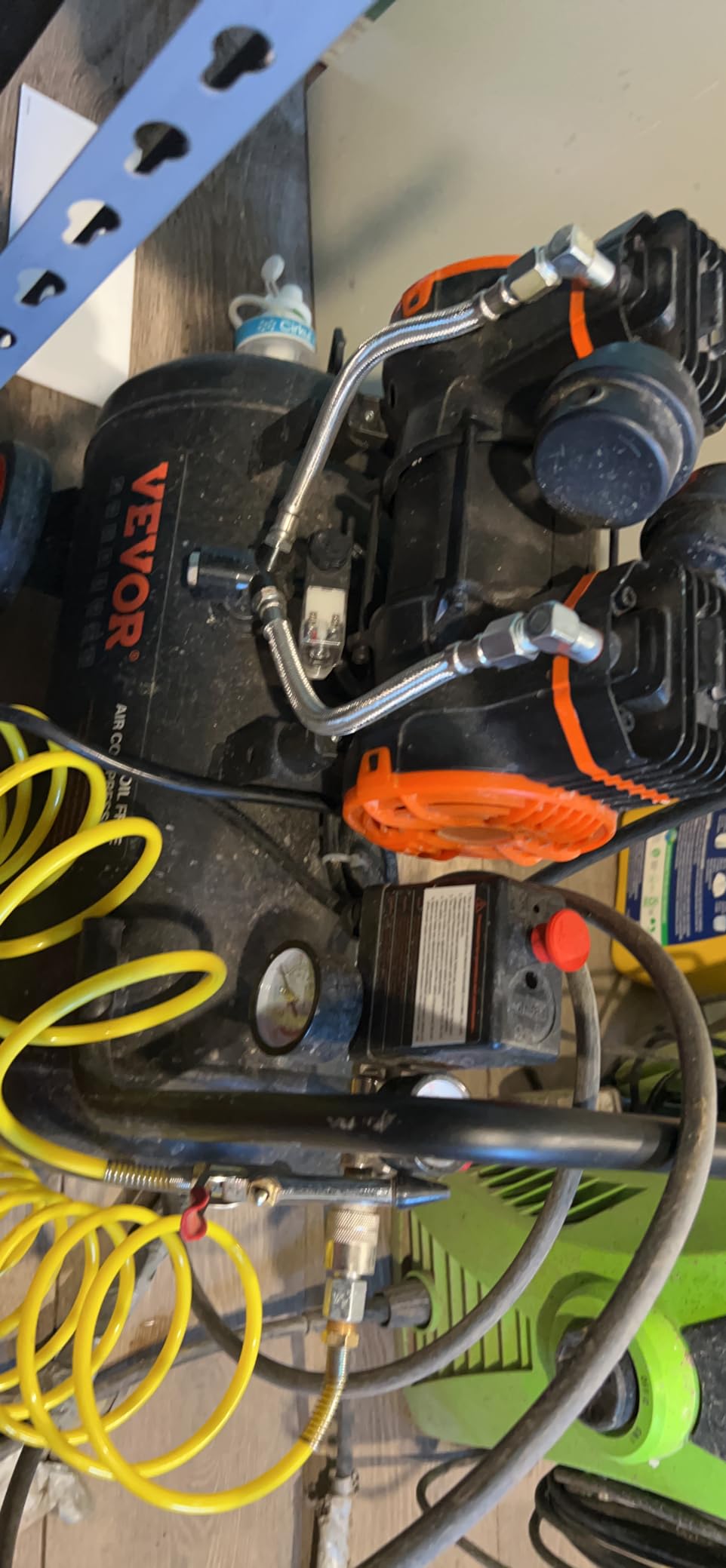
The multi-layer muffler with a thickened cover, rubber pipe and filter cotton is designed both to cut noise and to keep fine dust out of the intake. A large cooling fan handles sustained run temperature.
The 78 dBA figure is the disappointment. It sits close to the loudest units here despite the quiet positioning, so this is a garage or workshop machine rather than something to run inside an occupied room.
You also buy it bare. No hose, no accessories, and at 30.9 lbs it is heavy for a one-gallon capacity, so the money saved on the compressor goes into the hose and fittings you need on day one.
Check the JR550GJ4L for occasional light work
It makes sense for a DIYer fitting a few lengths of trim, a hobbyist, or anyone who wants a maintenance-free oil-free machine and occasional nail-gun use. The safety cut-offs are a genuine plus at this level.
If your machine lives in a garage and is only used at weekends, the noise level and small tank stop being problems.
Skip it for a working day of trim
One gallon cycling frequently plus a 120 PSI ceiling means constant pauses and shallow pressure on anything dense. It is not the right tool if trim is what you do for a living.
You will also need to buy a hose and coupler separately. If you want the tank, hose and accessories together, the five-gallon unit at number seven is the better starting package.
Which Compressor Matches Which Nailer?
Finish nailers, brad nailers, crown staplers and framing nailers do not consume the same amount of air, and that difference is what should drive your purchase. A framing nailer needs roughly three to five times the airflow of a finish nailer, which is why some compressors stall on one and breeze through the other.
Here is the matching guide, expressed the way a nailer’s manual states its demand:
18-gauge brad nailer – needs roughly 0.3 to 0.5 CFM at 90 PSI, working pressure around 90 to 100 PSI, and a 1 gallon tank is enough. One brad nailer per compressor. All ten units here run one comfortably.
15/16-gauge finish nailer – needs roughly 0.5 to 1.0 CFM at 90 PSI, working pressure 90 to 120 PSI, minimum 2 gallon tank for a useful reserve. One finish nailer per compressor unless the unit delivers 2.5 CFM at 90 PSI or more.
Crown stapler (3/8 inch) – needs roughly 1.0 to 1.5 CFM at 90 PSI and about 100 to 120 PSI, with a 2 gallon tank a practical floor. Crown work is continuous, so the 3 gallon and up units keep up far better.
Framing nailer – needs roughly 3.0 to 5.0 CFM at 90 PSI and 120 to 200 PSI, minimum 6 gallon tank. Only the Metabo HPT EC914S, the Makita MAC2400 and the DEWALT DWFP55130 in this list are sized for it.
Two finish nailers at once – add the two tools’ demand together, so roughly 2.0 to 2.5 CFM at 90 PSI. That threshold rules out every 1-gallon unit here, including the quietest ones.
Three to five nailers at once – you need 4 CFM at 90 PSI or better. Only the Metabo HPT EC914S reaches that, and its maker rates it for three finish nailers or five brad nailers at the same time.
If your air demand is broad rather than trim-specific – tyres, off-road recovery, general shop work – the [best off-road air compressors](https://www.pwice.com/best-portable-air-compressors-for-off-road/) and the [portable winter compressor guide](https://www.pwice.com/best-portable-air-compressors-for-winter/) cover those use cases in more detail.
How to Choose an Air Compressor for Finish Nailing?
Tank Size: How Many Gallons Do You Need
For one finish nailer, any tank from 1 gallon up works, and 2 gallons is the practical minimum if you shoot in bursts. Tank size is not a power rating – a bigger tank holds more air so the pump has longer to refill, but it does not change how fast air arrives.
Two nailers at once want 6 gallons or more. Below that, the reservoir empties faster than the pump replaces it and you hear the compressor cycle constantly.
PSI vs CFM: The Two Numbers Buyers Confuse
PSI is pressure, CFM is flow. A nailer needs enough pressure to set a nail – 90 to 120 PSI for finish work – and enough flow to keep the regulator from dropping while you shoot. Buying on PSI alone is how people end up with a compressor that hits 200 PSI and still stalls.
Is 4 SCFM at 90 PSI good? For finish nailing, yes – it is well beyond a single tool and comfortably supports several. For a framing nailer, 4 CFM is about the floor rather than a comfortable surplus.
Oil-Free vs Oil-Lubricated Pumps
Oil-free pumps need no maintenance, run at any angle and are the right choice for intermittent trim work. The widely reported trade-off is that they run hotter and some owners consider them shorter-lived under heavy duty.
Oil-lubricated pumps run cooler, wear less and suit continuous work, at the cost of checking the crankcase and keeping oil on hand. The Makita MAC2400 here is the lubricated one.
Pancake vs Hot Dog vs Twin-Stack
A pancake is a wide, flat tank – best for storage footprint and stability, and the most common shape for trim carpentry. A hot dog is tall and narrow, holds comparable air in less floor space and is easier to carry, but easier to tip.
A twin stack uses two stacked cylinders for smoother, higher-volume delivery, and costs more. A vertical model stands on end for shop storage. For finish nailers specifically, shape is a carrying decision, not a power decision.
Noise Level and Indoor Trim Work
Roughly 56 to 60 dBA is quiet enough to hold a conversation over and to work inside an occupied home. Around 70 dBA suits garages and unfinished rooms. Above 80 dBA you want hearing protection and you do not want the machine near a bedroom wall.
Marketing noise figures are inconsistent, so treat them as a class indicator rather than a measurement. The DeWALT DWFP55130 is the only unit in this list tested to the ISO3744 standard.
Hose Length, Couplers and Splitters
A 1/4 inch hose is the right size for finish and brad nailers. Use the shortest run that reaches the work, because every extra foot adds pressure drop and slows the nailer’s cycle – the most common practical complaint from people nailing away from the compressor.
A 25 foot hose suits a single room. Beyond that, a 3/8 inch hose holds pressure better over a 50 foot run to a second storey or a deck. For two nailers, a three-way manifold splitter lets both run, but it costs airflow, so the compressor still needs 2.5 CFM at 90 PSI or more.
Running Two Finish Nailers Off One Compressor
Add the two tools’ demand together rather than doubling the tank size. Two finish nailers at roughly 0.7 CFM each need about 1.5 CFM at 90 PSI minimum, and a 2.5 to 3 CFM compressor leaves room for the recovery gaps between shots.
This is where the 1-gallon quiet units fall short. They are superb for one nailer indoors and inadequate for a pair, and that is the honest limit to keep in mind before buying for a crew.
Maintenance and Tank Safety Checklist
Drain the tank after every use. Moisture collects in an oil-free tank, and draining it through the ball valve prevents corrosion inside a vessel you cannot see. A tank that stays wet will fail eventually, and the drain takes a few seconds.
Check the tank’s expiration date. Steel pressure vessels are stamped with a manufacture year, and they are rated for a limited service life. Find the date before you rely on an old tank rather than after.
Relieve pressure before removing a hose. Shutting the compressor off does not empty the tank, and pulling a coupler under pressure is a real hazard. Bleed the line first.
On an oil-lubricated pump like the Makita MAC2400, check the crankcase oil level before starting and keep spare oil on hand. Every other unit in this list is oil-free and needs no equivalent step.
Wear hearing protection above 80 dBA, and keep the compressor out of occupied rooms when it is running above about 70 dBA. If you plan to move compressors around a shop, our [portable compressor picks](https://www.pwice.com/best-portable-air-compressors-for-winter/) cover the weight and handle differences in more detail.
Frequently Asked Questions
What size air compressor do I need for a finish nailer?
A 1 to 2 gallon oil-free tank is enough for a single 15/16-gauge finish nailer or 18-gauge brad nailer. Look for at least 2.0 CFM at 90 PSI and a 120 PSI or higher maximum. For two nailers running at once, move up to a 6 gallon tank with 2.5 CFM at 90 PSI or more, and 200 PSI if you also plan framing work.
How much PSI do you need for a finish nailer?
Finish and brad nailers work between 90 and 120 PSI. Above 120 PSI a nail can sink too deep, so the right move is to set the regulator rather than to open the valve fully. A compressor rated to 120 PSI is enough for trim; 150 to 200 PSI only matters if you also drive long framing nails or work dense hardwood.
What is the best air compressor to use with a nail gun?
It depends on the tool. For a single finish or brad nailer indoors, a quiet 1 to 2 gallon oil-free unit delivering at least 1.2 CFM at 90 PSI is the right answer. For two nailers at once, a 6 gallon pancake with 2.6 SCFM at 90 PSI works, and the Metabo HPT EC914S at 4 CFM covers three finish nailers per its manufacturer.
Can a 6 gallon air compressor run air tools?
It depends entirely on the CFM at 90 PSI, not the tank size. A 6 gallon unit delivering 2.6 SCFM handles nail guns, brad guns and staplers easily, but will struggle with sanders, impact wrenches or spray guns. For general air tools, 4 CFM at 90 PSI or more is the practical threshold.
Is a hot dog or pancake air compressor better for trim work?
A pancake is wider and flatter, so it stores under a bench and resists tipping, which is why it is the most common shape for trim carpentry. A hot dog is taller and narrower, holds comparable air in a smaller footprint and is easier to carry up stairs. For pure finish nailing, choose on carrying weight and noise rather than shape.
Will a pancake compressor run a nail gun?
Yes. Every 6 gallon pancake in this list runs a finish or brad nailer, and most run two with dual couplers or a splitter. The limit is airflow rather than tank size: a unit delivering 2.6 SCFM at 90 PSI comfortably runs one nailer and two at a moderate pace, while 4 CFM supports three or more.
The Verdict for Finish Nailers in 2026
The best air compressors for finish nailers are not the biggest ones on this list, they are the ones whose airflow and noise match your actual job. Our overall pick, the California Air Tools 1P1060S, wins on the combination of 56 dBA operation, 1.2 CFM at 90 PSI and a 29 lb weight, with more than 2,600 ratings behind it.
If you run two nailers, or alternate between a finish gun and a brad gun on the same run, take the Metabo HPT EC914S at 4 CFM and 200 PSI, or the PORTER-CABLE C2002-WK if you want dual couplers and a six-gallon reserve in a quieter shop setting. If you need more than nailing, the Makita MAC2400 is the durability benchmark, accepting the oil-lube routine in exchange for cast iron construction and airflow that nothing else in the list matches.
Whichever you choose, size it to the nailer rather than to the tank, set the regulator between 90 and 120 PSI, and drain the tank when you are done.