
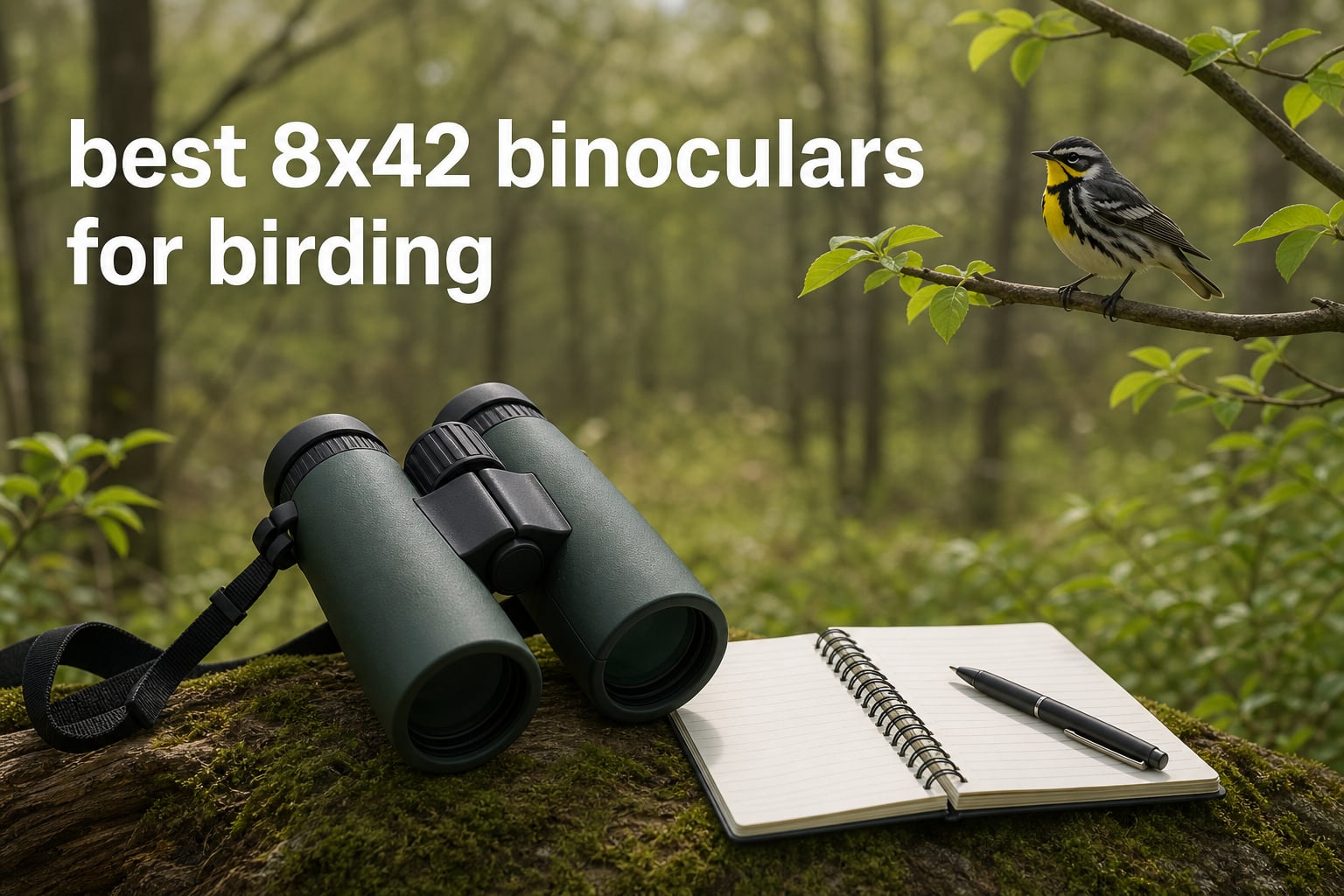
The best 8×42 binoculars for birding put enough detail on a warbler without making it hard to find that warbler in the first place. Eight-power magnification is steadier than 10x for most hands, while 42 mm objective lenses gather enough light for a bright view during the early and late parts of a bird walk.
I built this 2026 guide from the published specifications, feature sets, warranty details, and customer-review data for 12 current 8×42 models. I did not treat a long feature list as a substitute for field use: eye relief, field of view, close focus, weather protection, weight, and the focusing setup all affect whether bird watching stays enjoyable after an hour outdoors.
There is no single right pair for every birder. The Athlon is my all-around starting point, the Nikon Prostaff P7 stands out for glasses wearers, and the Vortex Razor UHD is for birders who want a premium optical package and warranty; the individual notes below help match the rest of the field to your habits.
Table of Contents
Top 3 picks answer the fastest birding decisions
These three choices cover the most common routes: a broadly capable ED-glass pair, a feature-rich value-minded option, and a high-end wide-field choice. The ratings and review counts shown here come from the analyzed product listings.
All 12 birding binoculars give you a quick comparison
This overview keeps the decision at the level that matters before you read the fuller reviews. Look at field of view if you often track moving birds, eye relief if you wear glasses, and optical glass and coatings if fine feather detail is the priority.
| Product | Specifications | Action |
|---|---|---|
 Athlon Midas UHD 8×42 Athlon Midas UHD 8×42 |
|
Check Latest Price |
 Nikon Prostaff P7 8×42 Nikon Prostaff P7 8×42 |
|
Check Latest Price |
 Celestron Nature DX ED 8×42 Celestron Nature DX ED 8×42 |
|
Check Latest Price |
 Celestron Nature DX 8×42 Celestron Nature DX 8×42 |
|
Check Latest Price |
 Nikon Monarch M5 8×42 Nikon Monarch M5 8×42 |
|
Check Latest Price |
 Celestron TrailSeeker ED 8×42 Celestron TrailSeeker ED 8×42 |
|
Check Latest Price |
 ZEISS Terra ED 8×42 ZEISS Terra ED 8×42 |
|
Check Latest Price |
 Kowa BD II XD 8×42 Kowa BD II XD 8×42 |
|
Check Latest Price |
 Nikon Monarch M7 8×42 Nikon Monarch M7 8×42 |
|
Check Latest Price |
 Vortex Razor HD 8×42 Vortex Razor HD 8×42 |
|
Check Latest Price |
 Vortex Razor UHD 8×42 Vortex Razor UHD 8×42 |
|
Check Latest Price |
 Bushnell R3 8×42 Bushnell R3 8×42 |
|
Check Latest Price |
1. Athlon Midas UHD is the best all-around 8×42 choice
Athlon Optics 8×42 Midas UHD Gray Binoculars with ED Glass for Adults and Kids, High-Powered Binoculars for Hunting, Birdwatching, and More
ED glass
17.2 mm eye relief
Argon purged
Pros
- ED glass reduces color fringe
- Bright dielectric coating
- Long eye relief
- Waterproof magnesium body
- Transferable lifetime warranty
Cons
- Manual focusing takes attention
- Full-size body
The Athlon Midas UHD makes the strongest general case because its specification sheet does not leave an obvious birding gap. It combines ED glass, a 144-meter field of view at 1,000 meters, 17.2 mm eye relief, and argon purging in a magnesium body.
Its 4.8 rating across 1,675 reviews is the highest rating in this group. The listing also specifies dielectric ESP coating that reflects more than 99% of light, which is relevant when color separation and contrast matter in shadowy branches.
Its fit is friendly for eyeglass wearers and all-day walks
Seventeen-point-two millimeters of eye relief clears the practical 15–16 mm starting point many glasses wearers look for. At 1.56 pounds, it is not a tiny travel pair, but the weight is reasonable for a full-size 8×42 and the tripod mount adds another viewing option.
Its best use is mixed habitat birding rather than ultralight travel
This is the pair I would put in front of a birder who moves between woodland, wetlands, and open trails and wants one capable instrument. The focus is manual, as it is on many binoculars here, so take a minute to set the diopter before judging sharpness.
2. Nikon Prostaff P7 is the best value choice for glasses
Nikon PROSTAFF P7 8×42 Binocular | Waterproof, fogproof, rubber-armored Full-Size Binocular, oil & water repellent coating & locking diopter | Official Nikon USA Model
20.2 mm eye relief
377 ft field
Locking diopter
Pros
- Exceptional eye relief
- Wide 377 ft field
- Phase-corrected prisms
- Repellent coatings
- Locking diopter
Cons
- Full-size dimensions
- Availability can vary
The Nikon Prostaff P7 has a feature that can decide the purchase for glasses wearers: 20.2 mm of eye relief. That generous spacing gives room to see the image without pressing eyeglasses into the eyecups, and the turn-and-slide eyecups allow a personal setup.
The 377-foot field of view at 1,000 yards is broad enough for scanning a treeline or keeping a flying bird in view. Nikon also lists phase-correction and dielectric prism coatings, plus oil- and water-repellent lens coatings that make sense for damp trail conditions.
Its viewing setup suits birders who keep their glasses on
A locking diopter is a small but useful detail because it helps hold a carefully set left-right eye correction. The 20.8-ounce body sits toward the lighter side of the full-size models in this guide, which helps when binoculars stay on a strap for a long walk.
Its broad field helps with quick targets in brush
I would favor this model for newer birders who lose birds while searching through a narrow view. It has manual center focus, so it rewards a light touch on the wheel rather than expecting a fixed-focus view to handle every distance.
3. Celestron Nature DX ED is the accessible ED-glass step-up
Celestron Nature DX ED 8×42 Premium Waterproof Birding Binoculars
ED glass
17.8 mm eye relief
Tripod adaptable
Pros
- ED glass controls color fringe
- Phase-coated BaK-4 prisms
- Waterproof fogproof build
- Tripod adaptable
- Limited lifetime warranty
Cons
- Manual focus
- 950 gram stated weight
The Nature DX ED brings extra-low dispersion glass and phase-coated BaK-4 prisms into a straightforward full-size format. ED glass is designed to reduce chromatic aberration, the purple or green edging that can show around a dark bird against a bright sky.
Celestron lists 17.8 mm eye relief, waterproof nitrogen-purged construction, and built-in tripod threads. The 4.5 rating is based on 675 reviews, a meaningful body of feedback compared with models represented by only a few dozen reviews.
Its optical design favors birders learning to see fine detail
For a first move into ED birding optics, the combination of ED objectives and fully multi-coated BaK-4 prisms gives a sensible set of fundamentals. I would use it for identification work where feather edges, eye rings, and color boundaries are more important than the smallest possible pack size.
Its tripod socket helps with stationary observation
The stated weight is 950 grams, so a tripod can make an extended watch from a feeder, shore, or overlook more comfortable. This is not a substitute for a spotting scope at long range, but the adapter threads give a practical rest when holding fatigue becomes the limiting factor.
4. Celestron Nature DX is the simple full-size starter pair
Celestron Nature DX 8×42 Waterproof Binoculars for Bird Watching & Outdoors
388 ft field
BaK-4 prisms
Nitrogen purged
Pros
- Wide 388 ft field
- Phase-coated BaK-4 prisms
- Waterproof fogproof
- Tripod socket
- 4k+ reviews
Cons
- Individual-focus listing
- No ED glass
The standard Nature DX 8×42 is a no-frills entry for someone who wants the familiar 8×42 format and a wide view. Its listed 388-foot field of view at 1,000 yards is one of the wider figures in this comparison, and its 4.6 rating comes from more than 4,000 reviews.
Fully multi-coated lenses and phase-coated BaK-4 roof prisms form the optical core. The product data identifies nitrogen purging and waterproofing, so rain and temperature changes are less likely to end a morning outside.
Its wide view makes locating birds less frustrating
A wide field of view gives you more room around a perched bird, which helps when branches interrupt the sightline. This is especially helpful for a beginning birder who is still developing the sequence of finding a bird with naked eyes, then raising binoculars without losing it.
Its focus setup deserves a hands-on check before purchase
The listing identifies individual focus rather than center focus, a meaningful distinction for birding at shifting distances. If you expect to switch often from nearby songbirds to distant raptors, compare the feel of that system against the center-focus models in this guide.
5. Nikon Monarch M5 is the comfortable close-focus mid-range pick
NIKON Monarch M5 Binoculars | Waterproof Fogproof ED Glass Optics with Dielectric Prism Coating | Bright High-Resolution Outdoor Binoculars for Birdwatching, Hiking & Wildlife, 8×42
ED glass
19.5 mm eye relief
8.2 ft close focus
Pros
- Long 19.5 mm eye relief
- ED glass
- Close focus to 8.2 ft
- Large focus knob
- Waterproof fogproof
Cons
- 335 ft field is moderate
- Compact fit may not suit all hands
The Nikon Monarch M5 is a logical choice when comfortable viewing and close work rank high. Its 19.5 mm eye relief gives glasses wearers plenty of margin, while its 8.2-foot close-focus capability lets you inspect nearby butterflies, flowers, and feeder visitors as well as birds farther away.
Nikon specifies ED glass, fully multi-coated optics, dielectric high-reflective prism coatings, and a nitrogen-purged waterproof and fogproof housing. The central focus knob is described as large and smooth, an ergonomic point that matters more than it sounds when birds move quickly.
Its close focus is useful beyond distant birds
Close focus is not just a number for nature binoculars. It determines whether a nearby dragonfly or woodland flower can be examined sharply instead of forcing you to take a step back, and 8.2 feet is notably close for a 42 mm binocular.
Its field is suited to deliberate birding rather than the widest scanning
The listed 335-foot field is narrower than the Prostaff P7, Monarch M7, Kowa, and Razor UHD figures here. I would choose the M5 when eye relief and close-focus versatility outweigh the need for the largest possible slice of sky or marsh.
6. Celestron TrailSeeker ED is a well-equipped field-use option
Celestron TrailSeeker ED 8×42 Binoculars for Birding & Nature – ED Glass
ED glass
142 m field
Carry harness included
Pros
- ED glass controls chromatic aberration
- 142 m field
- Large focus knob
- Twist-up eyecups
- Harness and case included
Cons
- Manual focus
- Close-focus listing needs checking
The TrailSeeker ED pairs ED objectives with phase-coated BaK-4 prisms and fully broadband multi-coated optics. Those elements aim at reducing color errors and retaining brightness, which is the combination birders notice when a bright patch of sky sits behind a dark subject.
The stated field of view is 142 meters at 1,000 meters, and the body weighs 23.5 ounces. Celestron includes a carry harness, neck strap, and case, so there is less accessory hunting before a day on the trail.
Its included harness helps distribute full-size weight
A 42 mm pair can feel much different after several miles than it does in a store aisle. A harness spreads the load more evenly than a neck strap alone, making this a practical package for birders who hike or spend long stretches waiting at a migration site.
Its large focus controls work best for active bird watching
Celestron calls out large focus knobs and twist-up eyecups, both useful when you are changing position or sharing binoculars with another person. The product data says manual focus, so this is built for an engaged user who wants to set focus precisely rather than a hands-off fixed-focus experience.
7. ZEISS Terra ED is the weather-conscious premium-brand option
ZEISS Terra ED Binoculars 8×42 Waterproof, Fast Focusing for Bird Watching
ED glass
18 mm eye relief
Hydrophobic coating
Pros
- 88 percent light transmission
- 18 mm eye relief
- Fast center focus
- Hydrophobic coating
- Transferable optics warranty
Cons
- 3.2 pound listed weight
- Smaller housing may not suit all hands
The ZEISS Terra ED is for birders who want a recognizable optics brand paired with ED glass and a stated 88% light transmission figure. Its 18 mm eye relief and 375-foot field of view give it a balanced specification set for general outdoor observation.
ZEISS lists a large central focus wheel, hydrophobic multi-layer anti-reflective coating, and waterproof construction. The lens coating is designed to shed water and keep the view usable when mist, drizzle, or wet vegetation become part of the route.
Its fast central focus favors changing distances
A large focus wheel is worth prioritizing when a bird suddenly moves from a close branch to a far shoreline. I would consider this model for a birder who likes a direct, center-focus control and needs a pair that can face mixed weather without much fuss.
Its listed body measurements call for a comfort check
The analyzed listing calls the Terra compact while also reporting a 3.2-pound item weight, an unusual combination among these data points. That makes a personal handling check especially sensible; fit, balance, and the eyecup position should settle the question rather than a label alone.
8. Kowa BD II XD is the best choice for the widest close-up nature view
Kowa BD II XD 42mm Binoculars (8×42)
XD glass
8.2 degree field
1.8 m close focus
Pros
- Wide 8.2 degree field
- XD ED-rich glass
- Close focus to 1.8 m
- Magnesium chassis
- KR protective coating
Cons
- One-year warranty
- 20-review sample is small
The Kowa BD II XD has two standout numbers: an 8.2-degree field of view and close focus down to 1.8 meters. That pair of capabilities makes it compelling for birders who alternate between finding fast-moving birds and studying small wildlife close to the trail.
Kowa describes its XD optics as high-grade ED glass rich in fluorite crystal, and it pairs them with a 22.5-ounce magnesium-alloy chassis. The KR coating is intended to repel dirt and moisture, while nitrogen filling addresses internal fogging.
Its 8.2-degree view is made for quick target acquisition
On a practical level, a wider angular field gives more context around the bird and makes it easier to relocate a subject after a branch blocks it. I would put the Kowa high on the shortlist for woodland birding, where birds appear briefly and often close.
Its warranty and review sample deserve extra consideration
The listing provides a one-year limited warranty and only 20 reviews, although the rating is 4.4. Those facts do not rule it out, but they mean a buyer should pay closer attention to retailer support, personal fit, and the brand’s published coverage before committing.
9. Nikon Monarch M7 is the best Nikon for a very wide birding view
NIKON MONARCH M7 Binoculars | Lightweight Waterproof Fogproof Binoculars with ED Glass & Multilayer Coatings | Wide View, Smooth Focus & Long Eye Relief for Birdwatching, Wildlife & Outdoor Use, 8×42
ED glass
435 ft field
Repellent coatings
Pros
- Very wide 435 ft field
- ED glass
- Phase-corrected prisms
- Waterproof fogproof
- Oil and water repellent lenses
Cons
- 17.1 mm eye relief is less generous
- Manual focus
The Nikon Monarch M7 earns attention for its 435-foot field of view at 1,000 yards, the largest stated linear field in this roundup. It joins that wide view with ED glass, phase-corrected dielectric-coated prisms, and 42 mm objectives for a bright, full-size birding view.
Its rubber-armored, nitrogen-filled housing is waterproof and fogproof. Nikon also specifies oil- and water-repellent lens coatings, a useful feature when rain spots, fingerprints, and spray from a wetland hide fine contrast.
Its wide field works especially well for birds in motion
The M7 makes sense for tracking swallows, scanning a shore, and following a bird that refuses to hold still. A wide field does not increase magnification, but it lowers the chance that you raise the binoculars and see only an empty patch of sky.
Its eye relief should be checked with your own glasses
The M7 lists 17.1 mm eye relief, which is workable for many eyeglass wearers but less spacious than the M5 or Prostaff P7. If your frames sit far from your eyes, test whether you can take in the full field with the twist-up eyecups set down.
10. Vortex Razor HD is the durable open-hinge high-end alternative
Vortex Razor HD Roof Prism Binoculars 8×42
HD optics
388 ft field
Open-hinge magnesium
Pros
- Hand-selected HD prisms
- Open-hinge magnesium chassis
- 17.5 mm eye relief
- Argon waterproofing
- Unlimited lifetime warranty
Cons
- Full-size form
- Availability may vary
The Vortex Razor HD is a strong option for someone who values ergonomics and warranty coverage as much as image quality. It uses hand-selected prisms, high-density glass, anti-reflective coatings, a 388-foot field of view, and a true open-hinge magnesium chassis.
Vortex lists 17.5 mm eye relief, multi-position eyecups, argon purging, O-ring seals, and exterior ArmorTek lens protection. Its unlimited, unconditional lifetime warranty is a major confidence point for an item expected to see years of wet trails and dusty travel.
Its open hinge gives hands more room to find a secure grip
Ergonomics are personal, but an open-hinge body gives many users a more natural place to wrap their fingers. At 24.2 ounces, the Razor HD remains within a manageable full-size weight, and the supplied GlassPak case and harness add carrying support.
Its warranty suits buyers who expect hard outdoor use
Forum discussion repeatedly highlights support and long-term ownership when people move beyond entry-level binoculars. I would look at the Razor HD when a transferable, unconditional lifetime warranty and protected external lenses have equal weight with the optical specification list.
11. Vortex Razor UHD is the premium wide-field specialist
Vortex Razor UHD 8×42 Binoculars & GlassPak Pro Harness
UHD optics
420 ft field
Magnesium chassis
Pros
- UHD Abbe Koenig optics
- 420 ft field
- Magnesium open hinge
- Argon waterproofing
- Unlimited lifetime warranty
Cons
- 16.7 mm eye relief
- Weight not specified in listing
The Vortex Razor UHD is the high-end choice for a birder looking for the most ambitious optical design in this list. Its Abbe-Koenig prism system, index-matched lenses, XR Plus coatings, and 420-foot field of view target high resolution, color correction, and a broad view.
The magnesium chassis and open-hinge format combine strength with an ergonomic grip. As with the Razor HD, argon purging, O-ring seals, ArmorTek protection, and Vortex’s unlimited, unconditional lifetime warranty are part of the package.
Its optical package targets demanding identification conditions
When tiny field marks, low contrast, or a dim understory make identification hard, better control of color and light transmission matters. I would reserve this model for the serious observer who already knows that a full-size premium pair suits their hands and their regular birding locations.
Its eye relief requires an eyeglass compatibility check
The listed 16.7 mm eye relief is above the baseline that works for many glasses wearers, but it is not as roomy as Nikon’s 20.2 mm Prostaff P7. Try the eyecups and confirm that the full 420-foot field remains visible through your own spectacles.
12. Bushnell R3 is the weather-ready harness-included option
Bushnell R3 8×42 Binoculars – Waterproof, Multi-Coated Optics with EXO Barrier Lens Protection for Bird Watching & Wildlife Viewing, Includes Chest Harness & Neck Strap
HD optics
IPX7 waterproof
Vault Lite harness
Pros
- HD optical system
- EXO Barrier coating
- IPX7 waterproofing
- Harness included
- Shockproof rubber armor
Cons
- Fixed focus limits control
- 95-review sample is limited
The Bushnell R3 focuses on a weather-resistant package and included chest harness. Its HD optical system and fully multi-coated lenses are paired with EXO Barrier, a permanent coating intended to repel water, oil, fog, dust, and debris from the exterior lens surfaces.
It is IPX7 waterproof, meaning the sealed body is specified to handle rain, splashes, and accidental submersion. At 21.3 ounces, it is a manageable full-size carry, and the Vault Lite chest harness helps keep it secure when moving through brush.
Its protection package suits wet and dirty trails
This model is a practical consideration for a birder who often contends with rain, muddy paths, or coastal spray. The rubber overmold adds shock resistance and grip, while the harness keeps the binoculars from swinging against your chest on an active walk.
Its fixed focus is best for users who prefer simplicity
Fixed focus is the tradeoff that needs a clear-eyed decision: it can feel simple, but it gives less control when a bird changes distance. The 4.6 rating reflects 95 reviews, so read current owner feedback and assess the fixed-focus behavior against your usual birding distances.
The right 8×42 binocular depends on field of view, fit, and glass
Start by choosing the optical behavior you need, then confirm that the binocular sits comfortably in your hands and works with your eyes. Specification sheets narrow a shortlist, but the final choice should feel stable, focus naturally, and show you the entire field without black crescents at the edges.
Eight power is better for most birders who need a steady, wide view
An 8×42 magnifies a bird eight times and uses 42 mm objective lenses. The 42 divided by 8 calculation creates a 5.25 mm exit pupil on the models here, which helps explain why this configuration is popular for bright, relaxed viewing in variable light.
Compared with 10×42, 8×42 is usually easier to hold still and offers a wider field of view, making it easier to find active birds. Choose 10×42 only when you regularly watch more distant subjects in open country and can accept more visible hand shake and a narrower view.
Forty-two millimeters is better than 32 mm when brightness and comfort matter
An 8×32 is smaller and lighter, so it can be excellent for travel or a compact daypack. An 8×42 generally offers a larger exit pupil and a more forgiving view in shaded woods, overcast conditions, and dawn or dusk outings.
That does not make 8×42 automatically superior. If you leave a heavier pair at home, a smaller binocular is less useful; select the size you will actually carry on your regular bird walks.
ED glass helps preserve clean edges against bright backgrounds
ED, or extra-low dispersion, glass is designed to bring colors to focus more closely together. In bird watching, that can reduce colored fringes along high-contrast edges, such as a dark wing against bright cloud, and may make fine plumage borders easier to read.
ED glass is not the only determinant of image quality. Prism coatings, lens coatings, alignment, focus accuracy, and your own eyesight also shape what you see, which is why an ED label should start a comparison rather than end one.
A wider field of view makes moving birds easier to find
Field of view is the width of the visible scene at a stated distance, commonly feet at 1,000 yards or meters at 1,000 meters. Bigger figures are particularly useful when scanning foliage, tracking birds in flight, or getting binoculars onto a bird you first spotted without optics.
In this guide, the Nikon Monarch M7 lists 435 feet at 1,000 yards, the Vortex Razor UHD lists 420 feet, and the Kowa lists 8.2 degrees. Numbers are useful comparisons only when they are stated in like units, so do not compare degrees directly with feet without conversion.
Eye relief above 15 to 16 mm is the practical glasses-wearer starting point
Eye relief is the distance from the eyepiece at which you can see the full image. People who wear glasses usually need more of it because lenses move their eyes farther from the oculars; the forum research consistently points to at least 15–16 mm as a sensible minimum.
Use the twist-up eyecups properly during a test. With glasses on, retract them; without glasses, extend them until the view is full and free of dark shadowing, then compare the Nikon Prostaff P7’s 20.2 mm and Monarch M5’s 19.5 mm figures with tighter models.
Close focus matters when birds and insects appear at your feet
Close focus is the nearest distance at which the binocular can focus sharply. It matters for feeder birds, butterflies, dragonflies, flowers, and the surprising near encounter on a woodland path, while it matters less if your birding is always at distance on open water.
The Kowa BD II XD reaches 1.8 meters and the Nikon Monarch M5 reaches 8.2 feet according to their respective listings. Treat a listed close-focus feature as one part of the decision, not a reason to ignore eye relief or handling.
Waterproofing, fogproofing, and coatings support real outdoor birding
Waterproof housings and internal nitrogen or argon purging help protect binoculars when weather changes and reduce internal fogging. Exterior water-repellent coatings, such as the ZEISS hydrophobic treatment, Nikon’s oil- and water-repellent coatings, or Bushnell’s EXO Barrier, help droplets and grime interfere less with the view.
For winter marshes, snowy trails, and cold rain, consult our cold weather binocular guide for a related weather-focused comparison. Dry lenses with a clean microfiber cloth, avoid harsh cleaners, and store your binoculars only after they have aired out.
A short hands-on test is the best final filter
Birding forums repeatedly make the same sensible point: try binoculars before buying if you can. Visit a specialty retailer, a birding festival, or a local event, then compare how quickly you find a sign, whether the focus wheel feels natural, and whether the barrel shape supports your hands.
Set the diopter, look from shade into bright sky, wear the glasses you use outdoors, and keep the pair up for several minutes. This simple test reveals more about comfort than a specification list can, and it reduces the chance of buying birding gear that looks right but feels wrong.
A beginner-to-expert path starts with use frequency rather than status
New birders usually benefit from a durable, weatherproof center-focus 8×42 with enough eye relief and a generous field, such as the Athlon Midas UHD, Nikon Prostaff P7, or Celestron models that fit their budget and hands. Spend time learning to locate birds and adjust the diopter before assuming a more expensive binocular will fix a technique issue.
Frequent birders can justify a move toward higher-grade coatings, more refined mechanics, wider fields, and stronger warranty coverage when those differences solve a real problem in their typical habitat. The Vortex Razor lines and the Nikon Monarch M7 illustrate what that step can look like, while the Kowa highlights the appeal of close focus and a wide angle.
Common birding questions have straightforward 8×42 answers
Are 8×42 or 10×42 better for birding?
8×42 binoculars are better for most birders because they are easier to hold steady and usually provide a wider field of view for finding moving birds. Choose 10×42 when you commonly view distant birds in open terrain and are comfortable with a narrower, less steady image.
Are 8×42 binoculars good for bird watching?
Yes. An 8×42 binocular combines manageable eight-power magnification with 42 mm objectives that gather ample light. This format is a popular birding choice because it provides a bright, forgiving view, useful field of view, and enough detail for many identification situations.
Who makes the best 8×42 binoculars?
The best maker depends on the features you need. Athlon offers the Midas UHD with ED glass and long eye relief, Nikon has wide-field and glasses-friendly options, Vortex emphasizes premium optics and lifetime warranty coverage, while Kowa and ZEISS bring their own optical and weather-focused strengths.
Is 8×32 or 8×42 better for birding?
An 8×42 is generally better for birders who want a brighter, more forgiving view in woods and low light. An 8×32 is better when low weight and smaller pack size matter most. Choose the pair that you can carry comfortably for the duration of your birding outings.
The Athlon Midas UHD is the best starting point for most birders
For the best 8×42 binoculars for birding, begin with the Athlon Midas UHD if you want ED glass, long eye relief, a wide field, weather protection, and transferable lifetime coverage in one balanced model. Pick the Nikon Prostaff P7 for its 20.2 mm eye relief, the Monarch M7 for a very wide view, or a Vortex Razor if premium optics and an unconditional lifetime warranty matter most.
Use 2026 as the year to choose based on the birds and places you actually watch, then give the finalists a real handling test. The right binocular is the one you reach for often, focus quickly, and trust when the bird finally appears.