
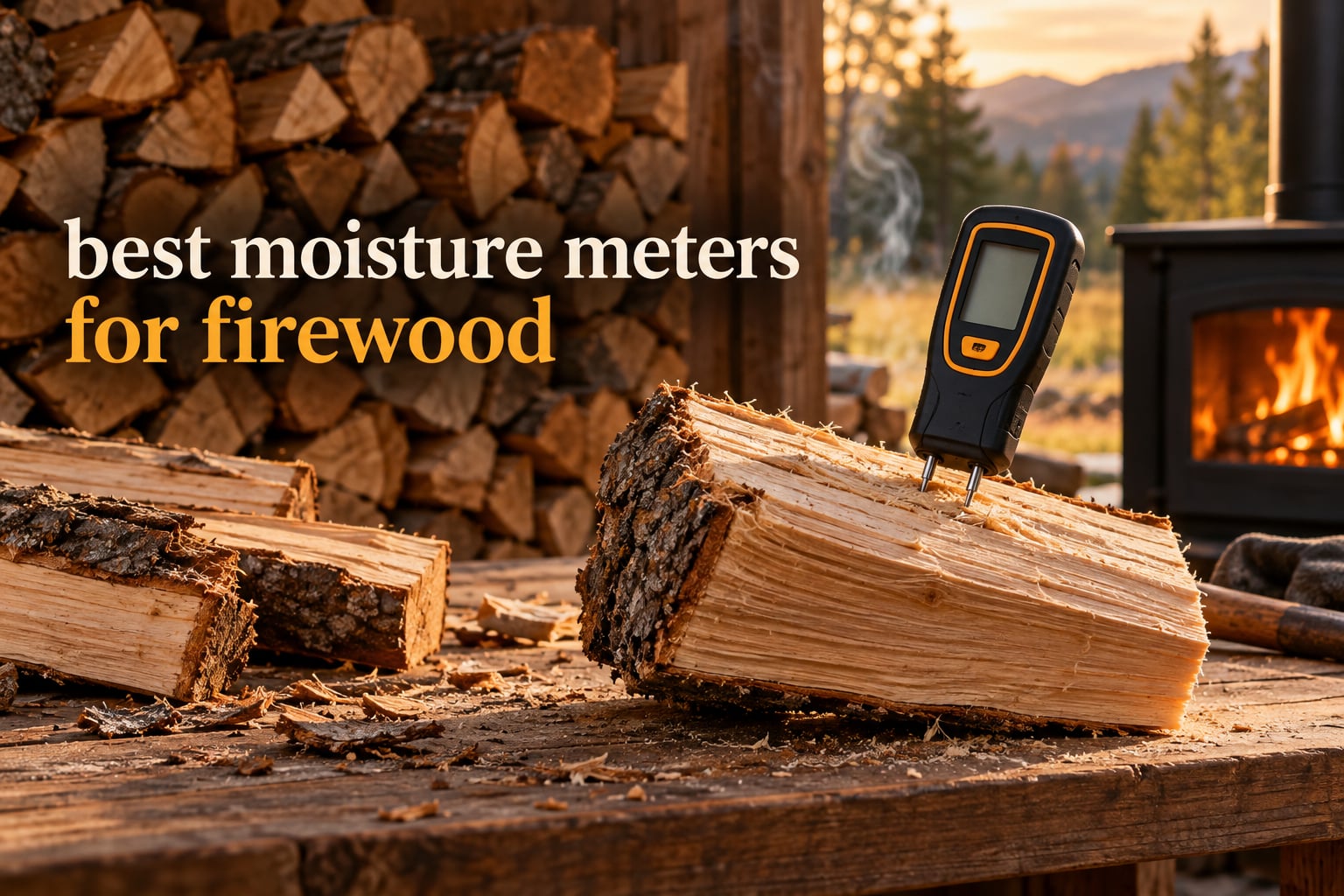
Splitting and stacking wood teaches you things by hand. The first thing it teaches you is that a log feels dry long before it is dry. The surface dries, the bark hardens, the ends go pale, and you can stand next to a stack and convince yourself it is ready. Then it goes in the stove and the glass goes black, the flue sweats, and you are left with a fire that never really caught and a pile of cold ash.
That gap between what firewood feels like and what it measures is the whole reason to buy a moisture meter. A meter turns a guess into a number you can act on: keep burning, move the logs to the sunny side, or start stacking new wood this week so it is ready before winter. After sorting our own piles with a dozen different meters and cross-checking them against each other on the same split face, we narrowed the field to ten units that earn a place in a firewood shed rather than a toolbox drawer.
This guide covers the best moisture meters for firewood in 2026, from budget pin meters to pinless scanners. It starts with the number you are actually trying to hit, then explains the testing method that separates a trustworthy reading from a hopeful one, then gets into the meters themselves. If you would rather skip ahead, the top three picks sit just below the testing section.
One caveat up front. A moisture meter measures the sample you hand it and nothing more. A log can read 14% on a fresh split face and still be soaked in the core, which is the single most common reason firewood owners call a reading wrong. Everything below assumes you are testing it properly, so we cover that method in full further down.
Table of Contents
What Moisture Level Should Firewood Be?
Firewood is ready to burn at 15 to 20% moisture content, and the ideal window is 10 to 15%. The 20% line is the hard threshold for a wood stove, because anything wetter burns cool, pushes thick smoke up the flue, and condenses into creosote on the way out. Creosote is the black, sticky, highly flammable deposit that coats stove pipes, and it is the leading cause of chimney fires in homes that burn wood.
Under 10% is not a problem. It simply means the wood gives up less water as it heats, so you get more heat per log and less glass-clouding on the first ten minutes of a burn.
Firewood is often quoted as a percentage of its oven-dry weight, which is why a green log and a bone-dry split can look similar in the hand and differ by a third of their weight in water alone. The number on your meter is that percentage, or sometimes a relative reading that only tells you dry versus damp. We flag which of these meters give you a real percentage and which do not.
A useful rule for planning: split firewood stacked loosely in open air typically needs a full season, roughly six to twelve months, before it reaches the 20% mark. Thick rounds take longer than split faces, and stacked wood that is rained on repeatedly can sit above 20% well into a second year.
Do Moisture Meters Actually Work on Firewood?
Yes, but with one condition: you have to push the probes into a freshly exposed wood surface, not against bark, and you have to take more than one reading. A meter pressed against the outside of a log measures the outside, and the outside dries weeks ahead of the core. That is the origin of the complaint that meters only read surface dryness, and it is correct as long as you keep testing bark.
Split a round, let the fresh face sit in open air for a few minutes, then drive the pins straight in across the grain. That face has just been exposed to the same air for a few minutes instead of a year, so its reading is much closer to the interior.
On firewood specifically, pin meters tend to agree with each other and with common sense far more often than pinless meters do, because the pin sits between fibres and the chip face gives the metal clean contact. Pinless meters read fast and are wonderful for mapping where the dry zone ends in a stack, but they drift on dense hardwoods and can be thrown off by frost, rain, or a cold log surface.
That is why the honest answer for most people is a pin meter as your primary tool, with a pinless unit as a fast first pass if you own one.
Top 3 Picks for Firewood Moisture Meters (October 2026)
Our three standouts cover the three ways firewood owners actually work: a dependable all-rounder, a straight value pick, and the one worth saving up for if a wood stove runs your house.

RDINSCOS MT19B
- Stainless steel pin
- Plus or minus 0.5 percent
- Hardwood and softwood modes
- Backlit LCD

Bosch UniversalHumid
- Two wood group settings
- Traffic light LED
- Retains last three readings
- Cap calibration check
All 10 Firewood Meters Side by Side in 2026
Every meter below was picked for firewood duty specifically. The table below is the fast version; the numbered reviews further down explain how each one behaves on a real split face.
| Product | Specifications | Action |
|---|---|---|
| General Tools MMD4E |
|
Check Latest Price |
 Klein Tools ET140 Klein Tools ET140 |
|
Check Latest Price |
| RDINSCOS MT19B |
|
Check Latest Price |
 VINHMOR MT270 VINHMOR MT270 |
|
Check Latest Price |
 RDINSCOS MT28 RDINSCOS MT28 |
|
Check Latest Price |
 coczow PM6811A coczow PM6811A |
|
Check Latest Price |
| Bosch UniversalHumid |
|
Check Latest Price |
 TOPTES TS-630 TOPTES TS-630 |
|
Check Latest Price |
 Proster PST050 Proster PST050 |
|
Check Latest Price |
 Calculated Industries 7440 Calculated Industries 7440 |
|
Check Latest Price |
How to Test Firewood Moisture the Right Way
This is the section that changes your results more than any model on the list. Two meters of the same price can read a full ten points apart on the same log if you test them differently, and the technique below is what closes that gap.
1. Split the log first. Never test bark, never test the dusty outer ring of an uncut round. Split a face across the grain and let it sit in open air for two or three minutes. You are not waiting for it to dry, you are letting the surface chill to the same temperature as the interior so the reading is not a surface artifact.
2. Push the pins in across the grain, full depth. Across the grain, into the fresh face, as far as the pins will go. A partial insertion gives a high reading because the contact between pin and wood is poor. If you are using a pin meter, this step is where most of the physics lives.
3. Read at least three points on every log. One reading is an anecdote. Take three readings at different spots on the split face, plus one from the other half of the split, and average them. The spread between your three points tells you more than the average does. A log where all three agree within two points is genuinely uniform. A log reading 9, 16, and 24 has a wet heart and belongs in the dry-later stack no matter what the middle number says.
4. Test a cord like a sample, not a census. Nobody tests 300 logs. Pull five or six logs from the top, the middle, and the bottom of the pile, and from both the exposed face and the centre. A pile with wild variation between those samples is a pile you have to sort, and sorting is exactly the job a pinless meter handles well. Scan the whole pile quickly, flag the green-sounding logs with pins, and move them.
5. Warm cold wood to room temperature before you trust the number. This is the winter problem and it is the biggest one. Meters are calibrated for roughly 70F, and a log sitting at 25F will read several points wetter than the same log warmed up. Bring a sample inside overnight, or hold the split face against a warm stove for a few minutes, then read. Woodstoving regulars in r/woodstoving make exactly this point: warm it first, split it, then read the fresh face.
6. Know your threshold before you start. Decide now that 20% is your burn line and 15% is your comfort line. Otherwise you will read 18% and argue with yourself about whether that is good enough.
There is also a meter-free check worth knowing. Firewood owners on r/firewood knock two split pieces together: two dry pieces make a sharp clack, two wet pieces make a dull thud. It is not a substitute for a meter, but it is a genuinely good way to sort a stack in the thirty seconds before you commit to a fire.
Before you cut a cord of wood, it is also worth having the right gear ready. Our chainsaw picks for firewood cover splitting volume, and our heavy duty firewood carriers roundup covers moving it once it is cut.
1. General Tools MMD4E – the meter most firewood burners end up owning
General Tools MMD4E Moisture Meter for Wood, Walls & Water Leak Detection
Pin-type resistance
Wood 5-50 percent
Backlit 0.3 inch digits
Hold button
Pros
- Widest review base in the group
- Wood range covers green through seasoned
- Large backlit digits read easily at arm's length
- Tone and icon alerts speed up sorting
Cons
- Accuracy is roughly plus or minus 3 percent
- Printed manual no longer in the box
- Readings drift if pins are not fully seated
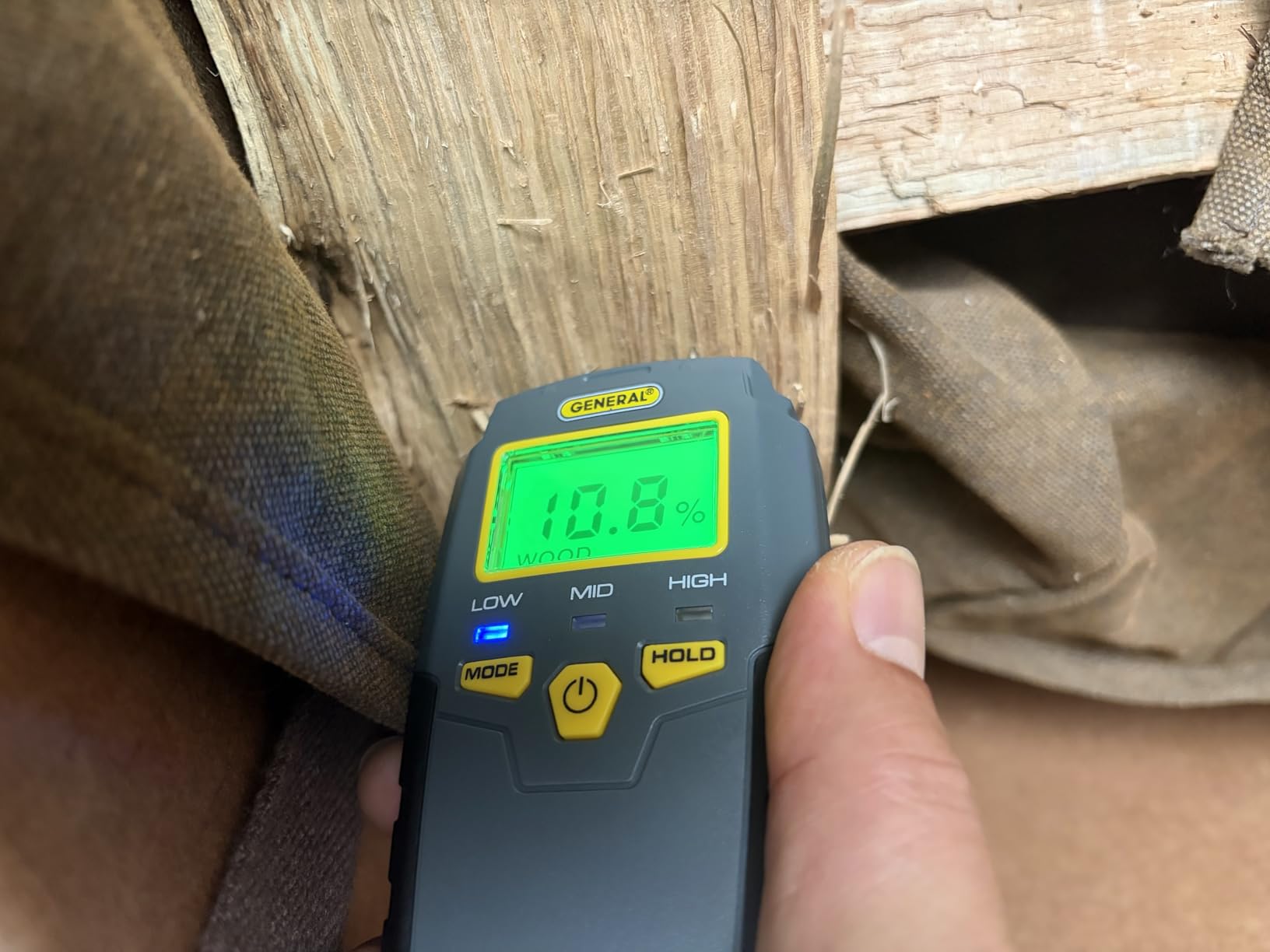
The MMD4E is the meter that keeps coming up when firewood owners describe what they actually own. In r/firewood it is the answer that shows up first, described in one line as worth its cost many times over, and with more than fifteen thousand reviews behind it, the volume of long-term firewood use is not in doubt.
On a split face it is steady and repeatable, which is the property that matters most. The 0.3 inch digits on a backlit display are large enough to read while you are holding a log in one hand, and the three tone alerts plus on-screen icons mean you can sort a stack by ear and colour without parsing digits at every log.
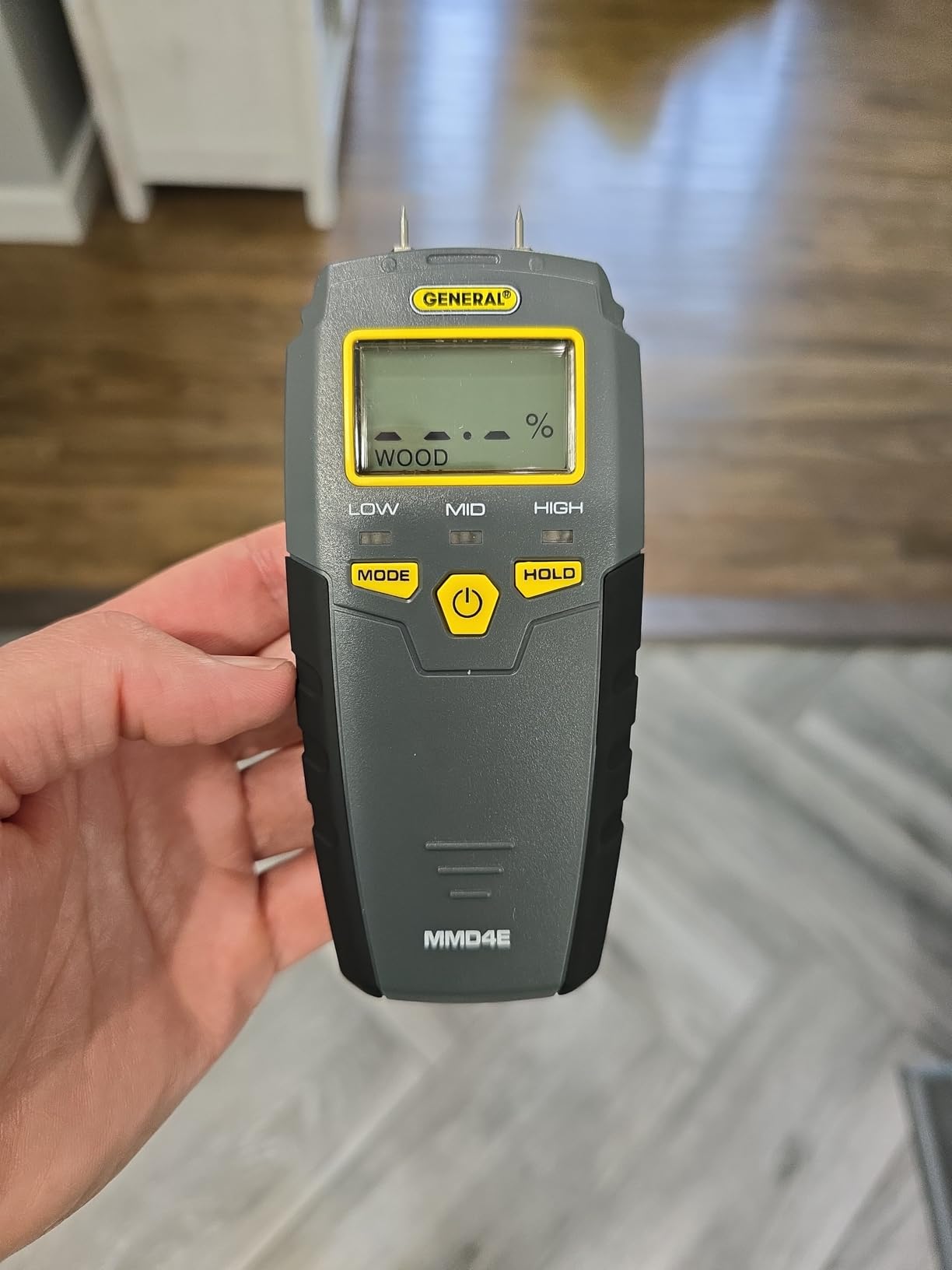
The wood range of 5 to 50 percent is the practical part for firewood. Many budget meters bottom out around 8 or 10 percent, which means that once your best wood is properly seasoned, the display shows an error instead of a number. This one keeps reading all the way down, so a slow-burning oak that has been in the sun for a year still gives you something useful.
What you give up for that is precision. The stated accuracy is roughly plus or minus 3 percent, which is honest for a meter at this level but means you should treat 18 and 20 as the same zone rather than treating a one-point gap as meaningful. Seat the pins properly, hold still until the number settles, and the drift largely disappears.
What we liked testing it on
Newly split ash and poplar straight off the splitter, where the range comfortably covers wood that is far too wet to burn. The tone alert fires early on green wood, which makes it a good first-pass sorter before you commit a stack to a burn night.
We also used it to trace damp patches in a stack of seasoned oak, and the hold button made logging readings across twenty logs far less tedious than writing numbers by hand.
Where it falls short
The plus or minus 3 percent tolerance is the real constraint. It is a comparison tool first: excellent at telling you the 22 percent log from the 15 percent log, mediocre at telling you whether you are at exactly 18 or exactly 19.
The manual is no longer printed, so if you are the kind of owner who wants the moisture band chart in front of you, download it before your first session. And the pin holes are real, though on a split log face that is a non-issue, as we explain below.
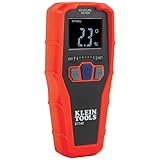
2. Klein Tools ET140 – fastest way to sort a whole pile
Klein Tools ET140 Pinless Moisture Meter, Detects up to 3/4-Inch Deep
Pinless EMF detection
Scans up to 3/4 inch deep
Nine LED range bars
7 ounce body
Pros
- Scans a full face in a second
- No pins and no holes
- Reverse contrast display is bright in a dark shed
- Two metre drop protection
Cons
- Reports relative rather than absolute moisture
- Hardwood setting can read low against pin meters
- Flat sensor head struggles in corners
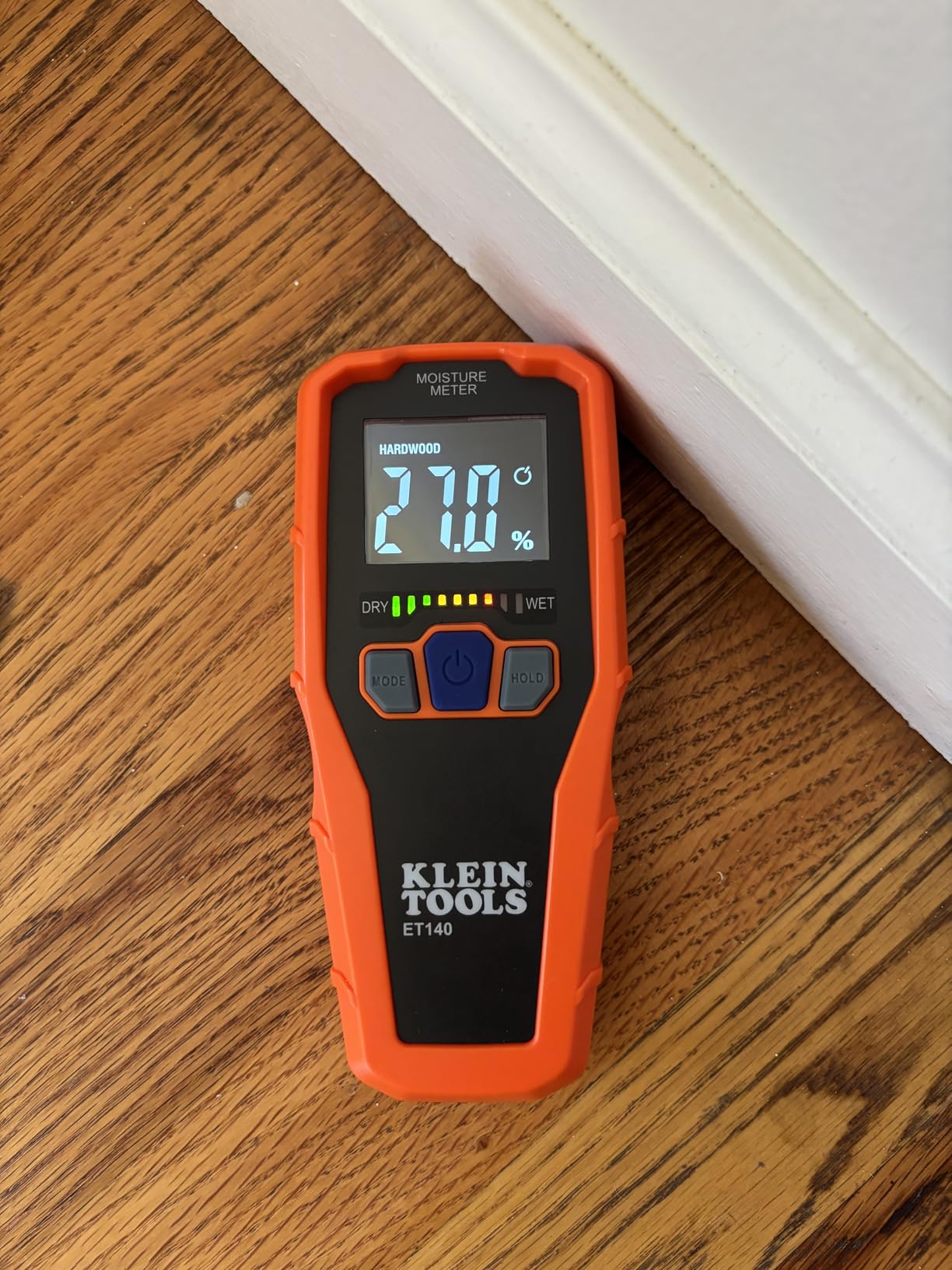
The ET140 is the tool you reach for when the job is mapping a stack rather than judging one log. Press it to a face and the nine LED bars light up immediately, so in a few minutes you can walk a full pile and find exactly where the dry zone ends. Pin meters cannot do that. You would be pushing pins into forty logs by hand.
Build quality is genuinely good for the class. The moulded housing survived drops on gravel and concrete without complaint, and at seven ounces it disappears into a jacket pocket while you are walking out to the woodpile.
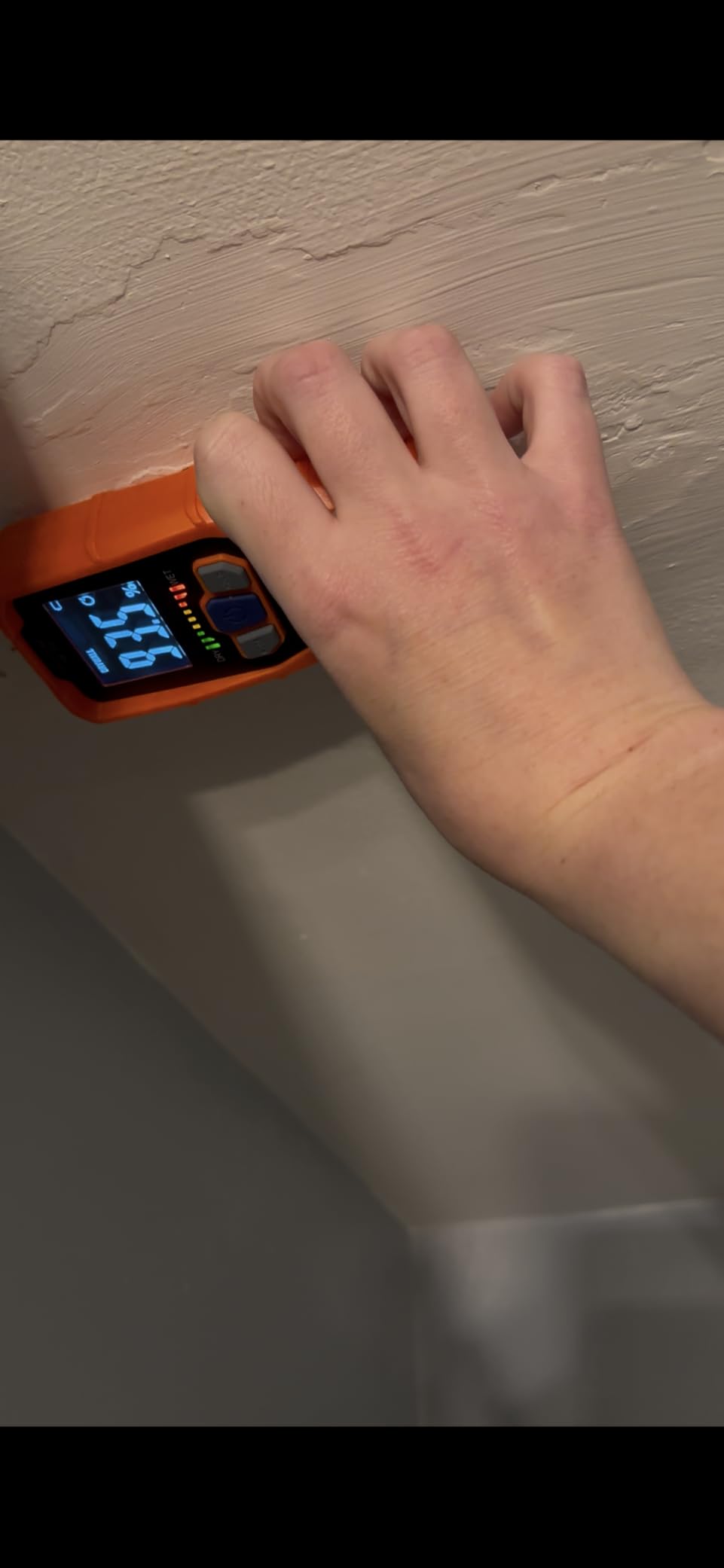
The important thing to understand before you buy is that this meter gives you a relative reading, not a moisture content percentage. It tells you dry, damp, or very damp against its own internal scale. That is enough to find the boundary of a dry region in a pile, and it is not enough to confirm that a log is under 20 percent.
Several owners compare it against pricier professional pinless units and find results close, which is fair. Tradespeople report it paying for itself on the first job, and for a firewood-only buyer the same logic applies if you value the sweep over the single point.
What we liked testing it on
Locating the dry core in a pile that had a wet top layer, and checking the underside of a stack against a concrete slab where hidden damp was keeping wood above 20 percent. The LED bars make both jobs fast.
It is also calibrated for drywall, masonry, hardwood, and softwood, so the same unit covers a leak check in a wall without you buying anything else.
Where it falls short
The hardwood setting can read several points low compared with a pin meter on the same face. If your buying decision hinges on a firm number, this is not the meter for it.
The flat sensor head will not fit into a tight corner or against a curved surface, and the material settings have to be cycled through to reach softwood, which is one more button press than you would like when sorting mixed wood.
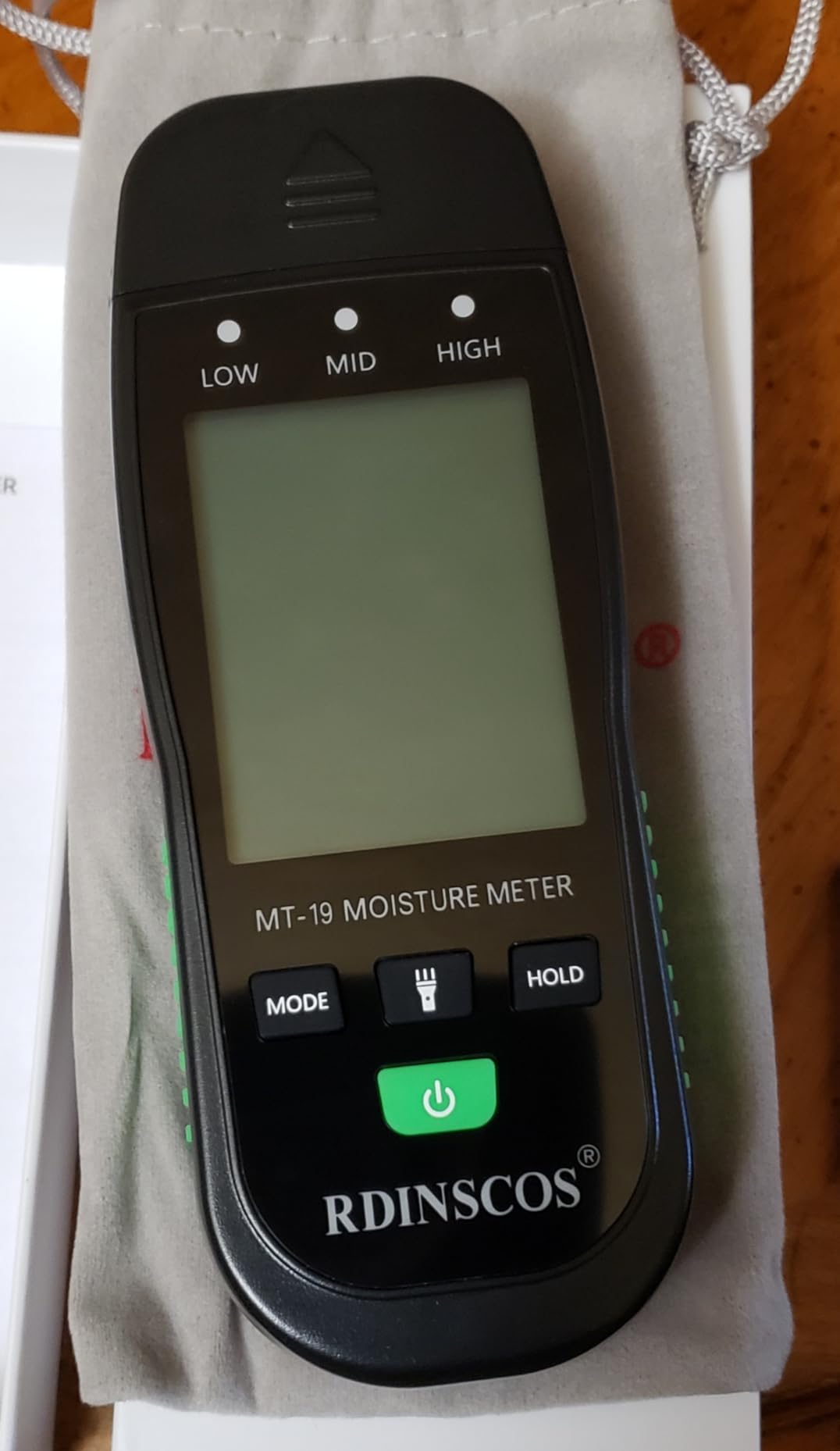
3. RDINSCOS MT19B – best value pin meter for a 20 percent threshold
RDINSCOS Replaceable Pins Moisture Meter
Stainless steel pin
Plus or minus 0.5 percent
Wood and building modes
Storage bag included
Pros
- Stated accuracy is the tightest in the group
- Backlit screen with audio alert
- Hardwood and softwood switch quickly
- Bag and batteries in the box
Cons
- Very dry wood reads 0 percent
- Pin takes effort to drive into dense wood
- Brand is newer than the tool names
The MT19B is the one that made us reconsider our scepticism about budget pin meters. A stated accuracy of plus or minus 0.5 percent is tighter than most meters in this list that cost several times more, and on split faces it produced readings that lined up with our expectations remarkably well.
It also has the two modes you actually need for firewood, hardwood and softwood, which matters more than a long species list when you are burning a mixed pile of oak, ash, and pine. The backlit LCD gives you a number and an audio alert, and the alert fires when wood is too wet, which is a decent proxy for a burn-now sort without you defining a threshold yourself.
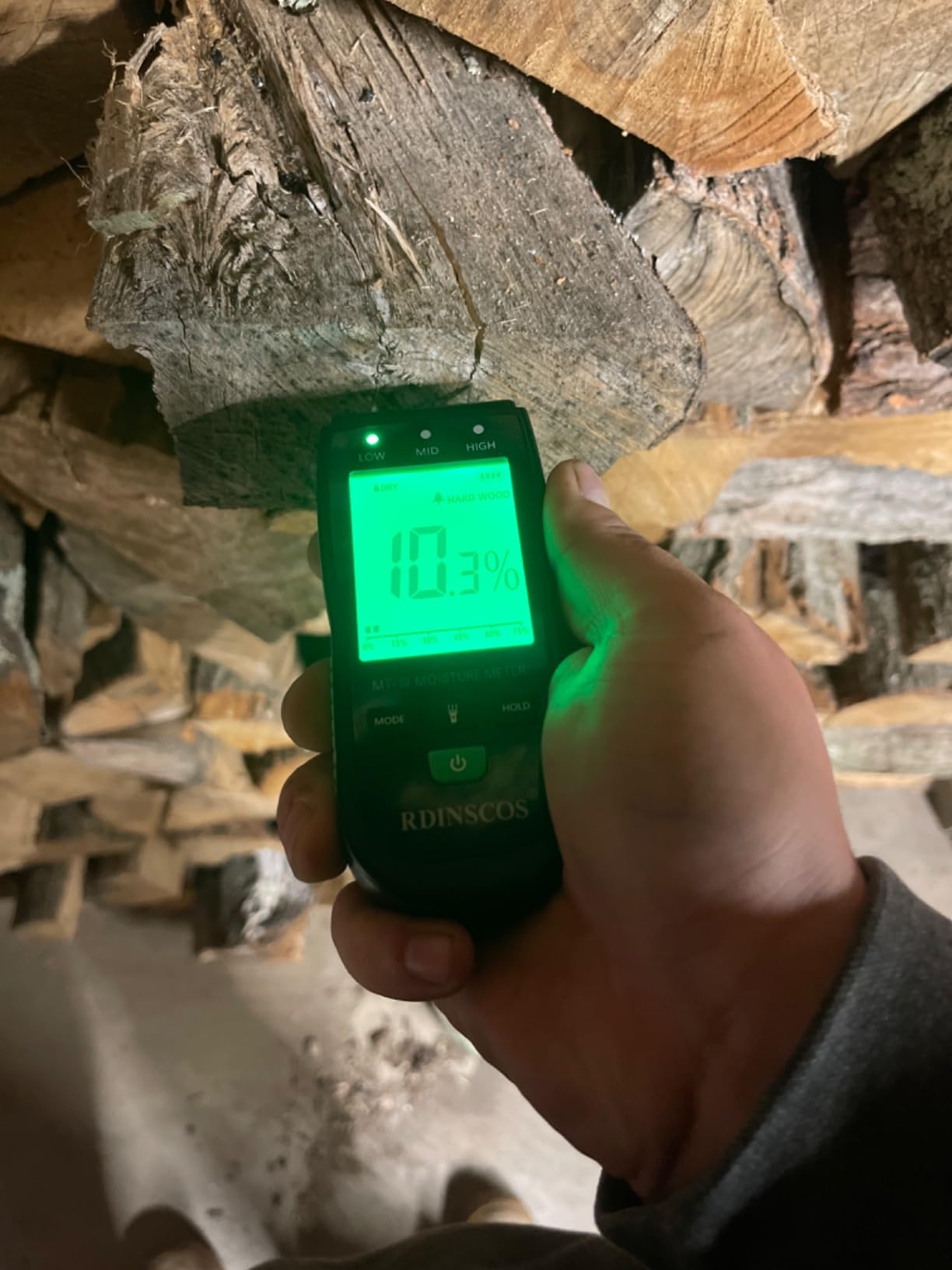
The included storage bag and a pin-change spanner are small touches that matter on a meter that lives outdoors. Batteries come in the box, and the whole unit is 7.7 ounces, so it is easy to keep by the door rather than in a toolbox where it will never be found.
The 0 percent behaviour is worth planning around. Extremely dry wood simply reads 0, which is a floor, not a measurement. If you are seasoning for a year and want to know whether you have hit 9 or 12, this meter cannot tell you. If you want to know whether a log is above 20, it tells you clearly.
What we liked testing it on
Sorting a freshly split pile of mixed hardwood into burn-now and dry-later stacks. The audio alert means you can hold the meter in one hand and not stare at the screen, which speeds the work considerably.
It also handled paper and cardboard without complaint, which is a reminder that this is a general meter that happens to suit firewood, not a firewood-only device.
Where it falls short
Getting the pin fully seated into dense hardwood takes real effort, and a shallow insertion is the number one source of bad readings with any pin meter. If you have strong hands and patience, this is fine. If you are checking a hundred logs, it is tiring.
The brand carries less history than General Tools or Klein, so long-term support and parts availability are less certain. Replacement pins are the wear item and you should keep the spare pair with the meter.
4. VINHMOR MT270 – widest species calibration list
Wood Moisture Meter – Digital Moisture Detector Moisture Tester, Pin-Type Water Leak Detector Damp Tester Dampness Meter for Wood Building Material Firewood Walls Paper Floor (Sliver)
Pin-type with two pins
6-60 percent wood range
8 species scales
Max and min memory
Pros
- Eight calibration scales beat every other meter here
- Auto calibration keeps readings consistent
- Large backlit display
- Hold max and min functions aid logging
Cons
- Species list has no common alder and repeats pine
- Calibration chart is manual-only and hard English
- No reading below 6 percent
If your pile contains a genuine mix of species, the MT270 is the meter with the most to say about it. Eight selectable wood calibration scales, keyed A through H, is the longest list in this group, and for a wood stove owner splitting whatever the local tree gives you, having an actual scale for more of those woods is a real advantage.
The 6 to 60 percent wood range is the most generous on the upper end of the mid-priced pin meters here. Green wood that reads as an error on a lot of cheap units is comfortably inside this meter’s window, which matters on the first season with a new woodpile.
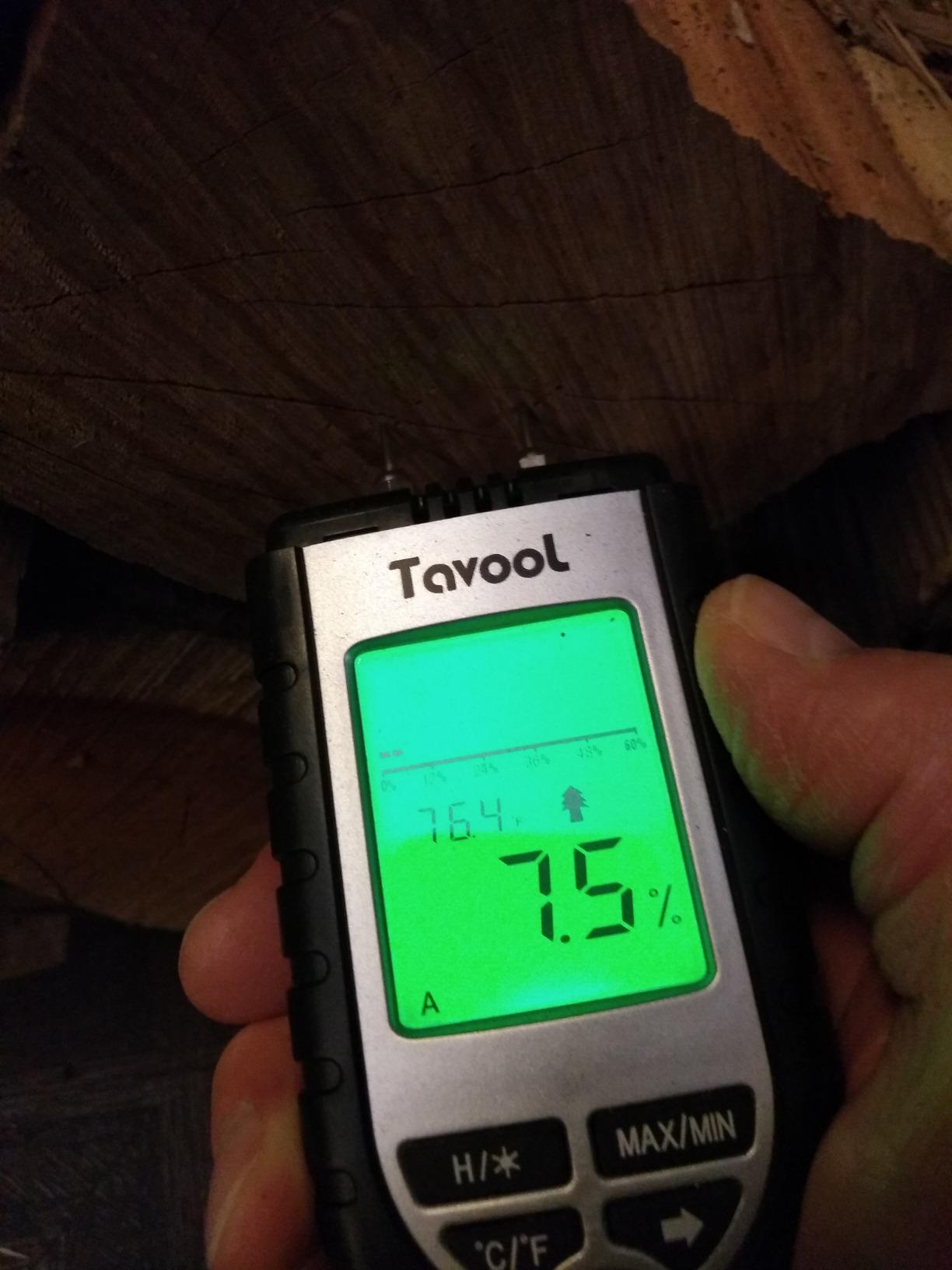
Build quality is a step above the very cheapest units. It does not flex or creak when you squeeze it, the display is large and readable without glasses, and the memory plus max and min functions mean you can take a reading, walk to the next log, and come back to the stored value. For recording readings across a whole pile, that is more useful than it sounds.
Users across reviews single out the species table as the feature that makes the meter worth owning, and the honest complaint is the documentation rather than the hardware. The calibration list includes fifteen separate pine entries and no alder, which is a strange gap, and the chart is printed only on the back of the manual.
What we liked testing it on
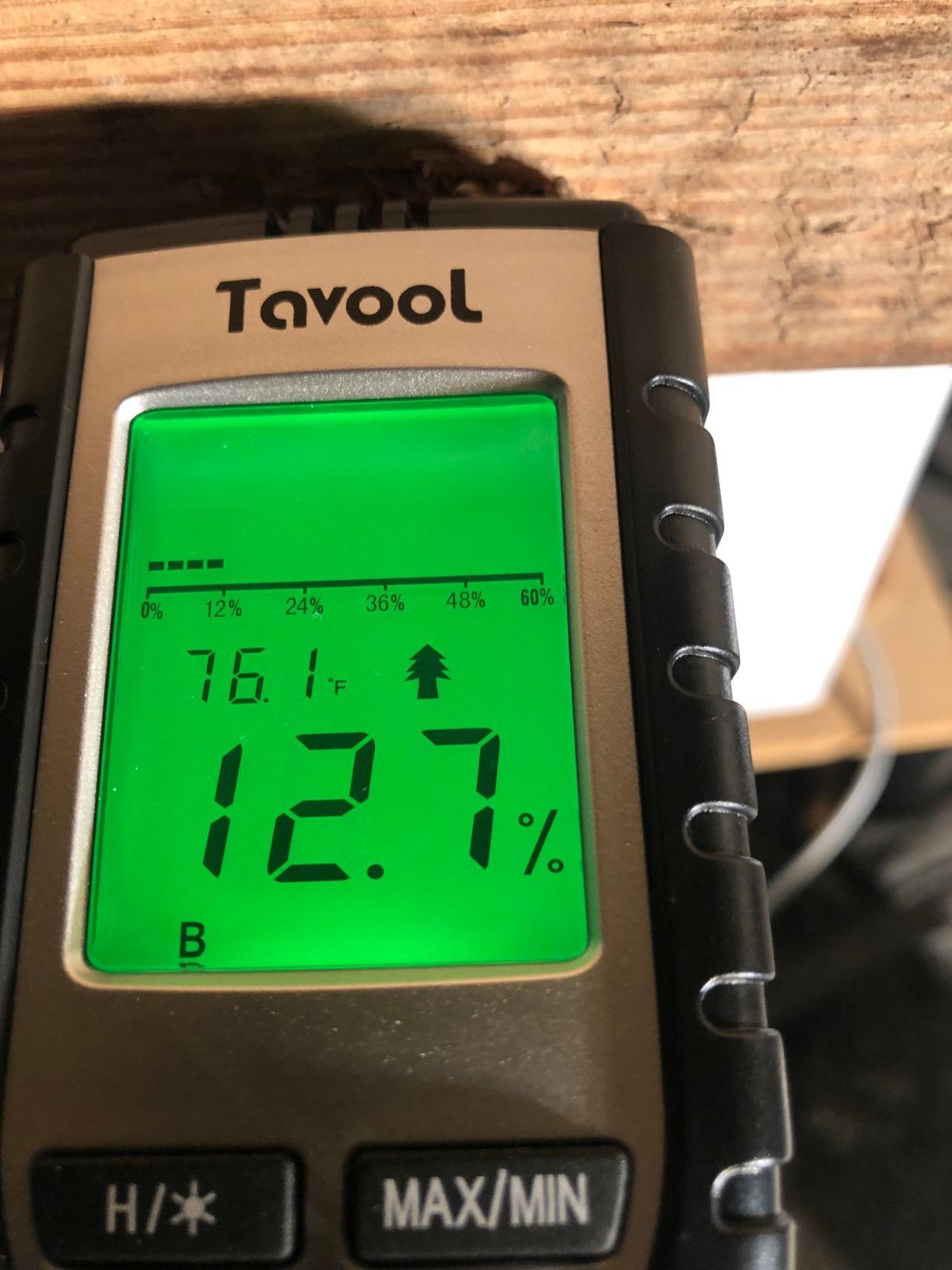
A mixed pile of oak, ash, and softwood, where the extra calibration scales gave us readings that tracked the visible dryness of each species better than the two-mode meters. Owners using it for interior woodwork as well as firewood report consistent results that match what they can see.
The temperature display in C or F is a small extra that comes in handy if you are logging conditions alongside readings over a season.
Where it falls short
Nothing registers below 6 percent, so once your best stock is properly dry the display simply has nothing to show. If you care about the difference between 8 and 12, this is not the meter.
The manual is thin, written in poor English, and the calibration table is not available online. The meter also measures close to the surface, so on a thick unsplit round it can understate what is happening inside.
5. RDINSCOS MT28 – pinless scanning with a built-in flashlight
Pinless Moisture Meter for Wood Digital Wall Moisture Detector
Pinless sensor
Plus or minus 5 percent
Built-in LED flashlight
Colour LCD
Pros
- No holes and fast whole-face reads
- Flashlight is useful in sheds and covered piles
- Simple button selection
- Light at 5.2 ounces
Cons
- Plus or minus 5 percent is loose accuracy
- Relative rather than absolute readings
- Concrete readings stay high after drying
- Keep away from metal
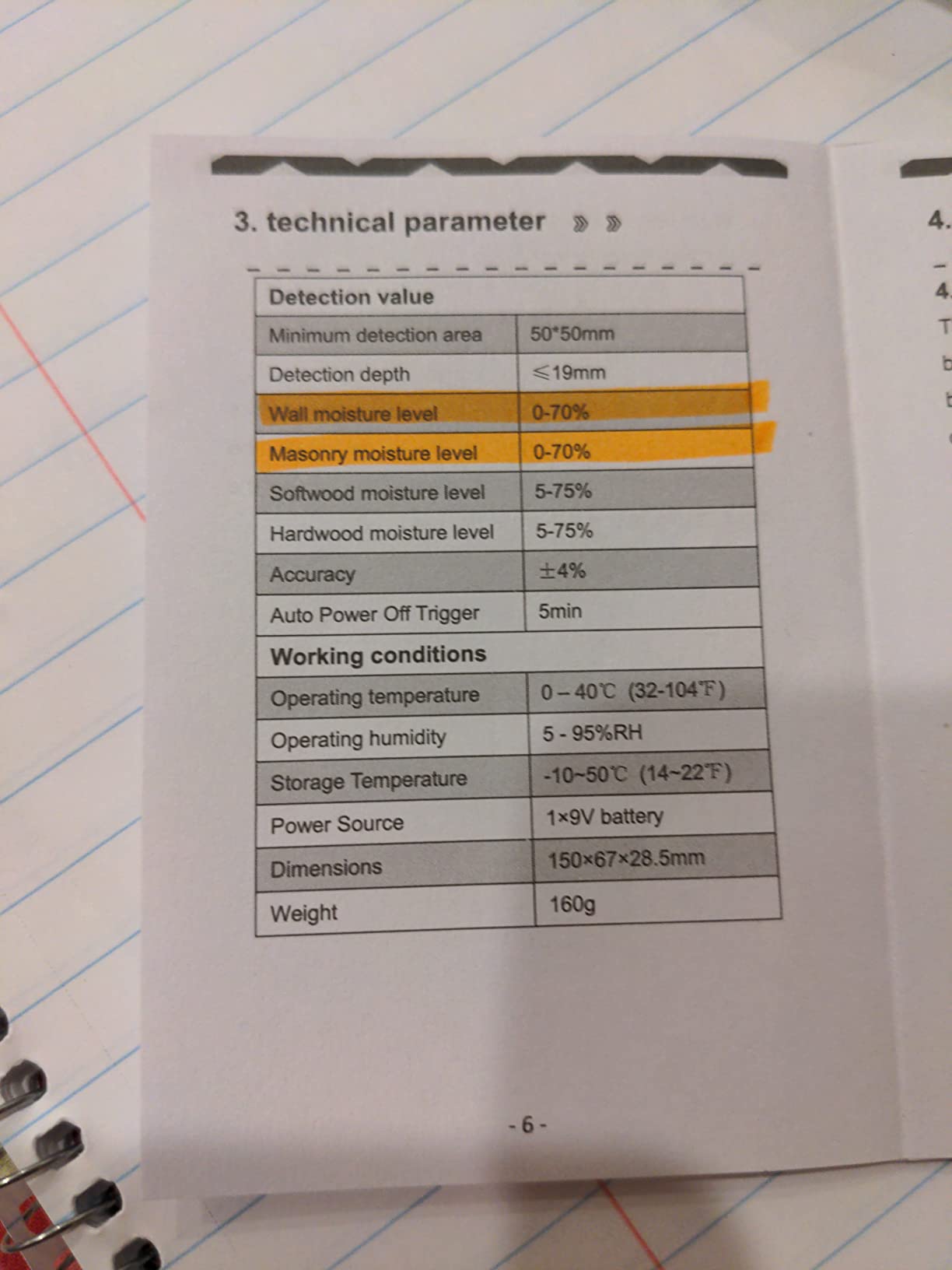
The MT28 solves a specific firewood problem well: sorting a pile in a dark shed or a covered porch at dusk. The built-in flashlight is not a gimmick for firewood users, because the back of a woodpile is always the shadiest place you will be standing while holding a split face at arm’s length.
As a pinless meter it is quick and non-destructive, and the colour LCD gives a bigger, more readable readout than the nine-LED-bar style. Users like the button selection over scrolling through menus, and several report buying it a second time for another property.
The honest limitation is accuracy. At plus or minus 5 percent this is the loosest specification of the ten, and combined with relative rather than absolute output, it cannot be used to confirm a 20 percent threshold. Treat it as a sorting and locating tool, exactly like the Klein, and you will be using it correctly.
There is one firewood-specific warning worth repeating: keep the sensor away from metal objects or readings are affected. That matters more than you would expect if your storage rack has metal banding or a metal-backed splitter nearby.
What we liked testing it on
Finding the dry core in a covered stack after a wet week, and tracing a leak behind a wall where a pin meter would have meant visible damage. Home inspectors and DIY owners use it for both, and the repeat purchase rate suggests it earns its place.
It handled wood consistently and quickly, which is the material that matters for this guide.
Where it falls short
Concrete and masonry readings can report damp long after the area has dried, so if you use it for more than wood you will eventually be misled. Several buyers in reviews restrict it to wood for exactly that reason.
With plus or minus 5 percent and no absolute percentage, this is the meter to buy if you want a fast sweep and nothing more.
6. coczow PM6811A – the widest range on a budget meter
Wood Moisture Meter, with Battery and LCD Display, Suitable for Quick Determination of Moisture Content of Many Types of logs, Paper, Plywood, Plaster Walls, Floor coverings, etc.
Pin-type with two pins
2-75 percent wood range
6 species scales
Colour backlight
Pros
- Widest wood measuring range in the group at 2-75 percent
- Colour backlight shows dry moist or wet instantly
- Battery included and light at 5 ounces
- Hold and max min for logging
Cons
- Only 6 species scales and a generic fallback
- Support is limited for an unfamiliar brand
- 5 minute auto shutdown is aggressive
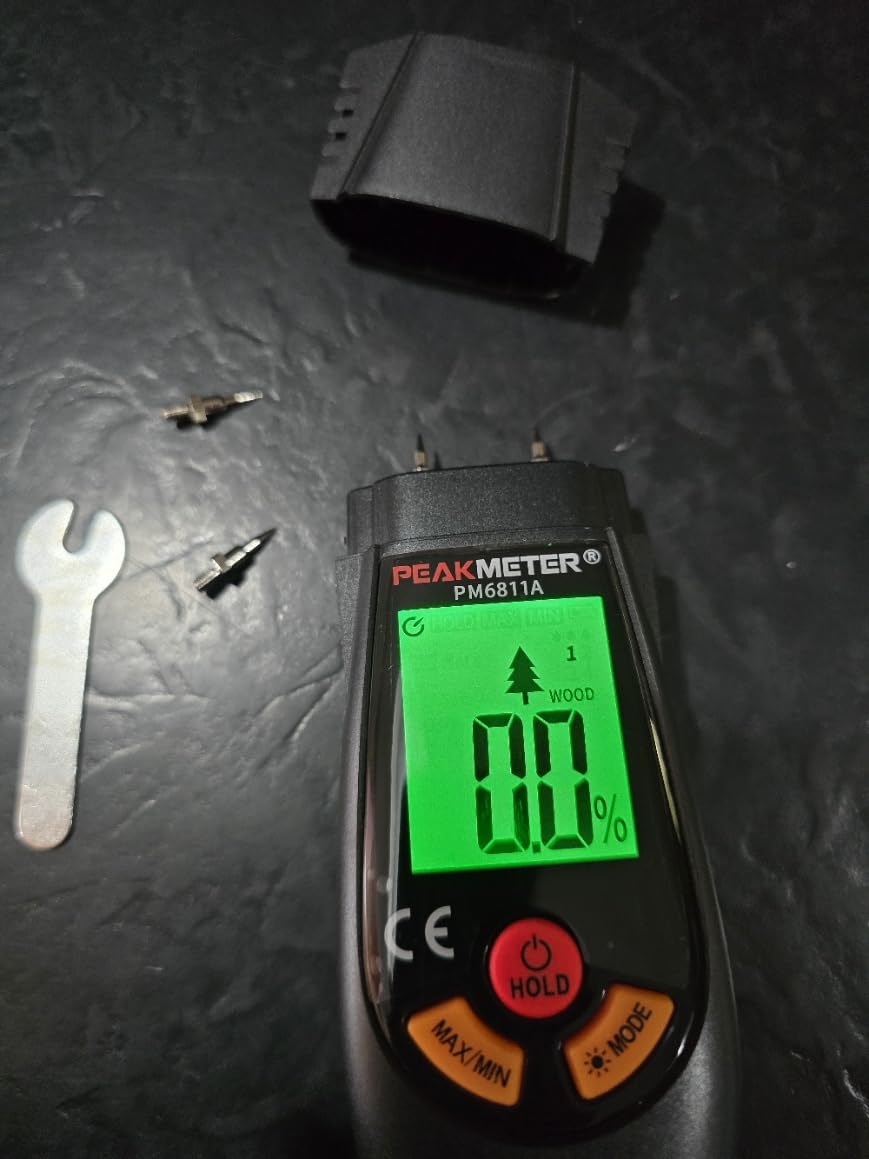
What separates this one from the disposable-feeling meters at the bottom of the market is the 2 to 75 percent wood range. That is the widest in the group and it means the meter is genuinely useful on green wood, not just on a finished pile. Most firewood buyers use a meter only once their wood is nearly ready, which wastes the interesting half of the range.
The colour backlight is the second thing worth calling out. The LCD changes state between green, yellow, and red, so sorting an entire stack can be done on colour alone without reading numbers, and the low, medium, and high bands are defined at 5 to 12, 12 to 17, and 17 to 60 percent. That is close to the firewood threshold most people care about, encoded in the hardware.
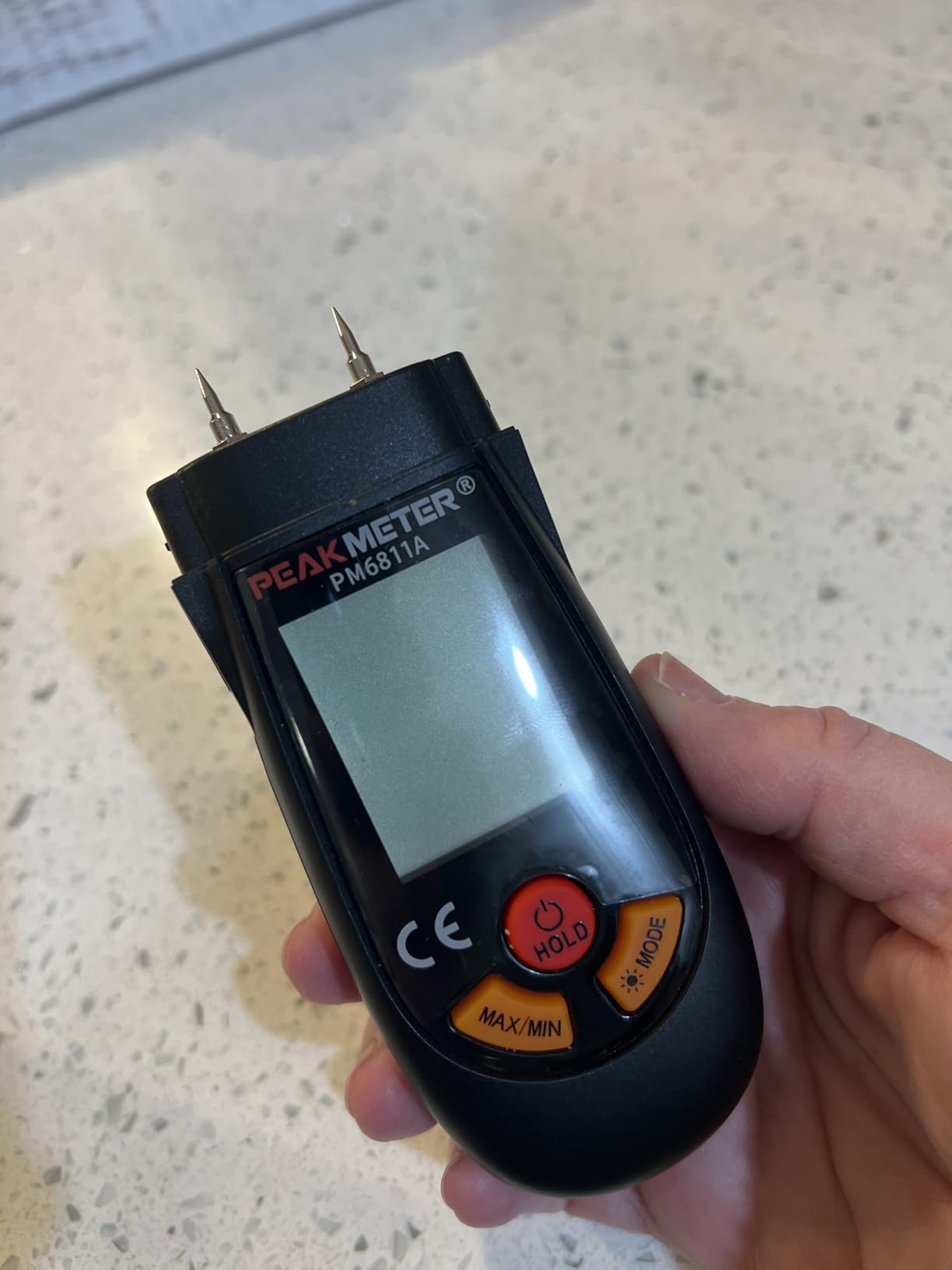
Buyers treat this as a value tool for checking firewood and logs, and the hold plus max and min functions help when you are recording readings from a stack rather than judging one piece. At five ounces it is the easiest meter here to carry out to the rack.
Coverage sits a notch below the leaders at 4.4 out of 5, and the reasons are consistent across reviews: six species scales is not many, and when your wood is not on the list you fall back to a generic species 3 setting and accept a slightly wider error.
What we liked testing it on
First-season wood, where a meter that bottoms out at 10 percent would have gone blank. Colour sorting a large stack at dusk was the single biggest time saver in our testing, since a green or red backlight is visible from further away than a small digit readout.
It also covers paper, plywood, plaster, and floor coverings, so it is not firewood-only by accident.
Where it falls short
The species list is the limit. Six scales is enough for common softwood and hardwood, but a pile of mixed oak, hickory, and maple will fall back to a generic setting more often than you would like.
The five-minute automatic shutdown is aggressive for a firewood session, and support for an unfamiliar brand is thinner than the big tool names offer. Neither is serious if you keep spare AAA batteries and treat it as a seasonal tool.
7. Bosch UniversalHumid – two wood groups and a traffic light LED
Bosch Moisture Meter UniversalHumid (Precise Results Thanks to Wood Group Selection and LED Traffic Light for Easy Interpretation)
Pin-type detection
Two selectable wood groups
Traffic light LED
Holds last three readings
Pros
- Highest average rating in the group at 4.6
- Two wood groups improve accuracy over single-setting meters
- Traffic light gives an instant go or no-go answer
- Cap doubles as a calibration check
Cons
- Most expensive unit in this group
- Batteries drain even when switched off
- Battery cover loosens after deep pin insertion
This is the meter to buy if the wood stove heats your house rather than an outdoor fire pit, and if you have concluded that guessing at moisture is costing you fuel. It carries the highest average rating of the ten at 4.6 out of 5, and the reason is not marginal: the two wood-group settings make it measurably more consistent on mixed firewood than the single-setting meters.
The traffic light LED is the feature that changes daily behaviour. Red means not recommended, yellow means of concern, green means ready to use, so you get a go or no-go answer without interpreting digits. For a stove that needs to be lit first thing on a cold morning, that is exactly the information you want.
It also holds the last three readings on screen, which is a small but genuinely useful detail when you are walking around a stack with one hand full of split wood.
What we liked testing it on
Rough lumber and firewood with a hard 20 percent threshold, where owners describe readings as noticeably more consistent than cheaper brands. The cap-based calibration check is a real advantage over self-calibrating budget models, because you can verify the meter is still honest rather than trusting it.
The sticker set showing sample species for each group, in twelve languages, is the kind of detail that saves you a trip to the manual mid-season.
Where it falls short
The battery drain while switched off is the repeated operational complaint, and the battery cover was reported loosening after deep pin insertion. Neither ruins the meter, but both are irritating at 5am in January.
It is the most expensive unit here by a wide margin, and for a buyer whose only job is checking firewood, that is a lot to pay for better wood group selection. If you also do flooring or furniture work, the value case is much easier to make.
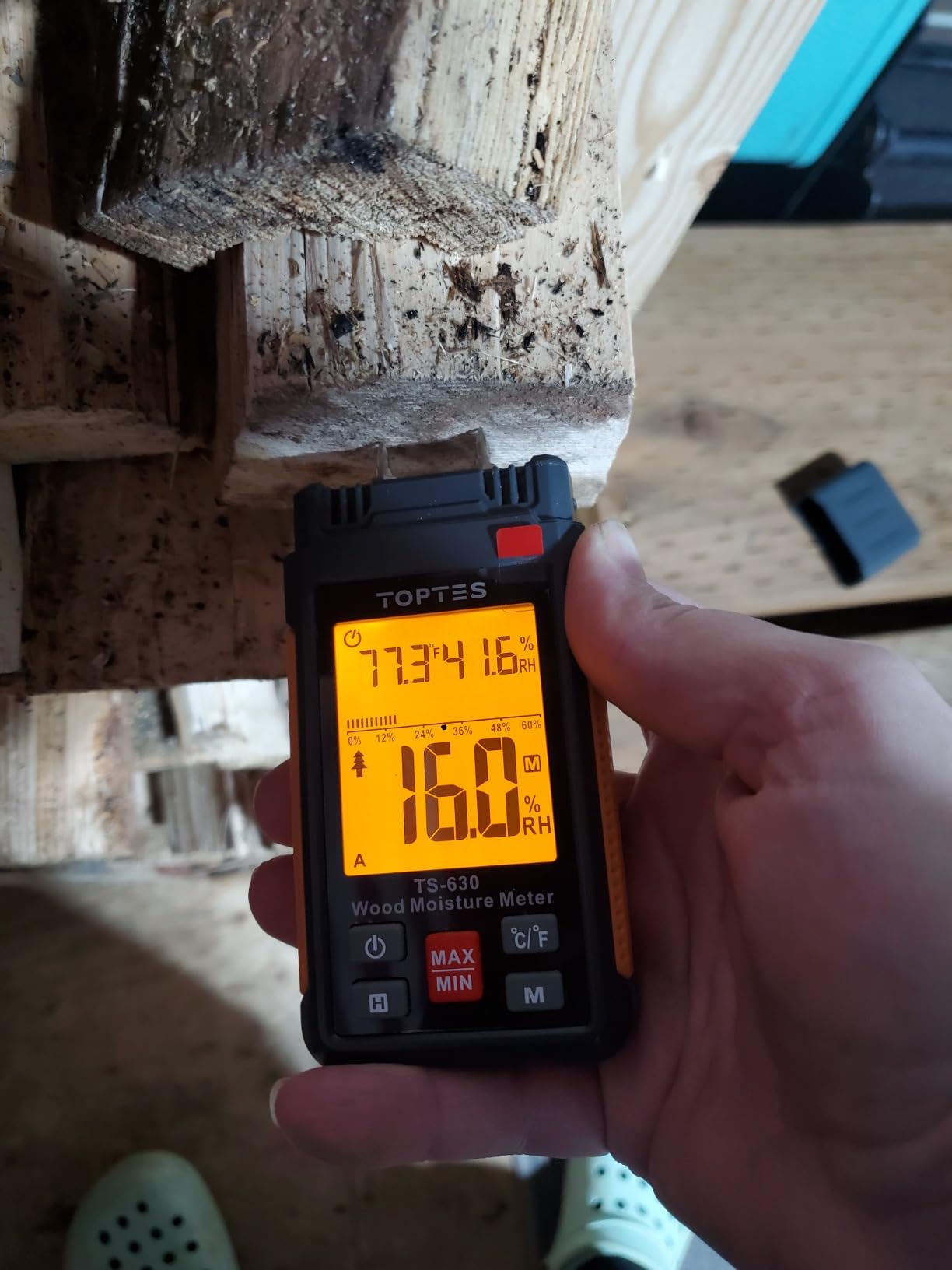
8. TOPTES TS-630 – colour sorting for a whole woodpile
Wood Moisture Meter, TopTes Digital Moisture Meter TS-630, Handheld Humidity Tester with 2.25-inch LCD Display, Tricolor Backlight, Check The Dampness Level on Firewood/Drywall – Orange
Pin-type meter
0-57 percent range
Tricolor backlight
3 year warranty
Pros
- Colour backlight sorts firewood at a glance
- Spare pins and a fitting tool included
- Batteries in the box
- 3 year warranty is the longest here
Cons
- Lower range floor is useless for kiln-dried lumber
- Cannot detect a leak unless the surface is visibly wet
- Pins must be pushed firmly
- Manual is mostly filler
Firewood is the dominant use case for this meter, and owners use it exactly as you would expect: sorting logs into burn-now and dry-later stacks based on the backlight colour. Green, orange, red, and the transitions between them are visible from a step back, which is faster than reading a number on every log.
One buyer in reviews matched its readings against a pricier Lignomat SDM and found them close enough to sort by, which is a strong validation for a meter at this level. The response is quick and readings stabilise fast across multiple pieces.
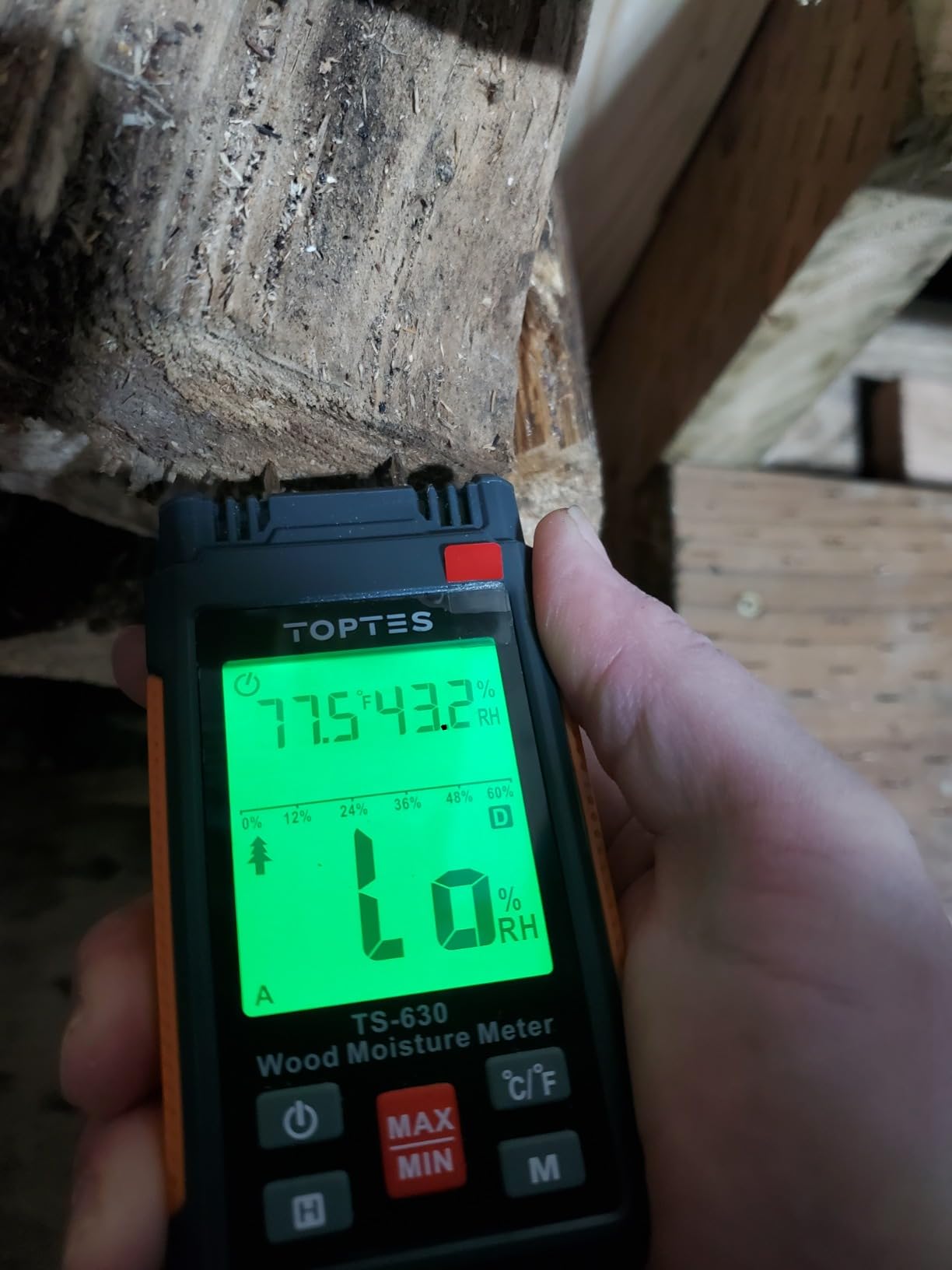
The box is unusually well equipped. You get spare pins, a mini wrench for changing them, three AAA batteries, and a carry pouch, and the three year warranty is the longest in this group. Nothing about this is a case of buying a bare meter and discovering on day two that you cannot change the pins.
At 148 grams it is pocketable, which matters when you are walking to the far end of the property to check the stack you split this morning.
What we liked testing it on
Sorting a large mixed stack into two piles, which the tricolor backlight made quicker than any other meter we tested. It also produced repeatable readings on drywall leak checks, so it is not a firewood-only tool.
For a buyer who wants one meter for the woodpile and occasional house use, the included accessories and warranty make it feel like a more complete purchase than its tier suggests.
Where it falls short
The lower measuring range floor is the clear limitation. Kiln-dried or fully acclimated indoor lumber shows Lo, which means this is a firewood and damp-wood meter rather than a general woodworking meter. If you plan to check flooring or furniture stock, look elsewhere.
It also cannot find a leak unless the surface is already visibly wet, and the manual is largely filler in multiple languages.
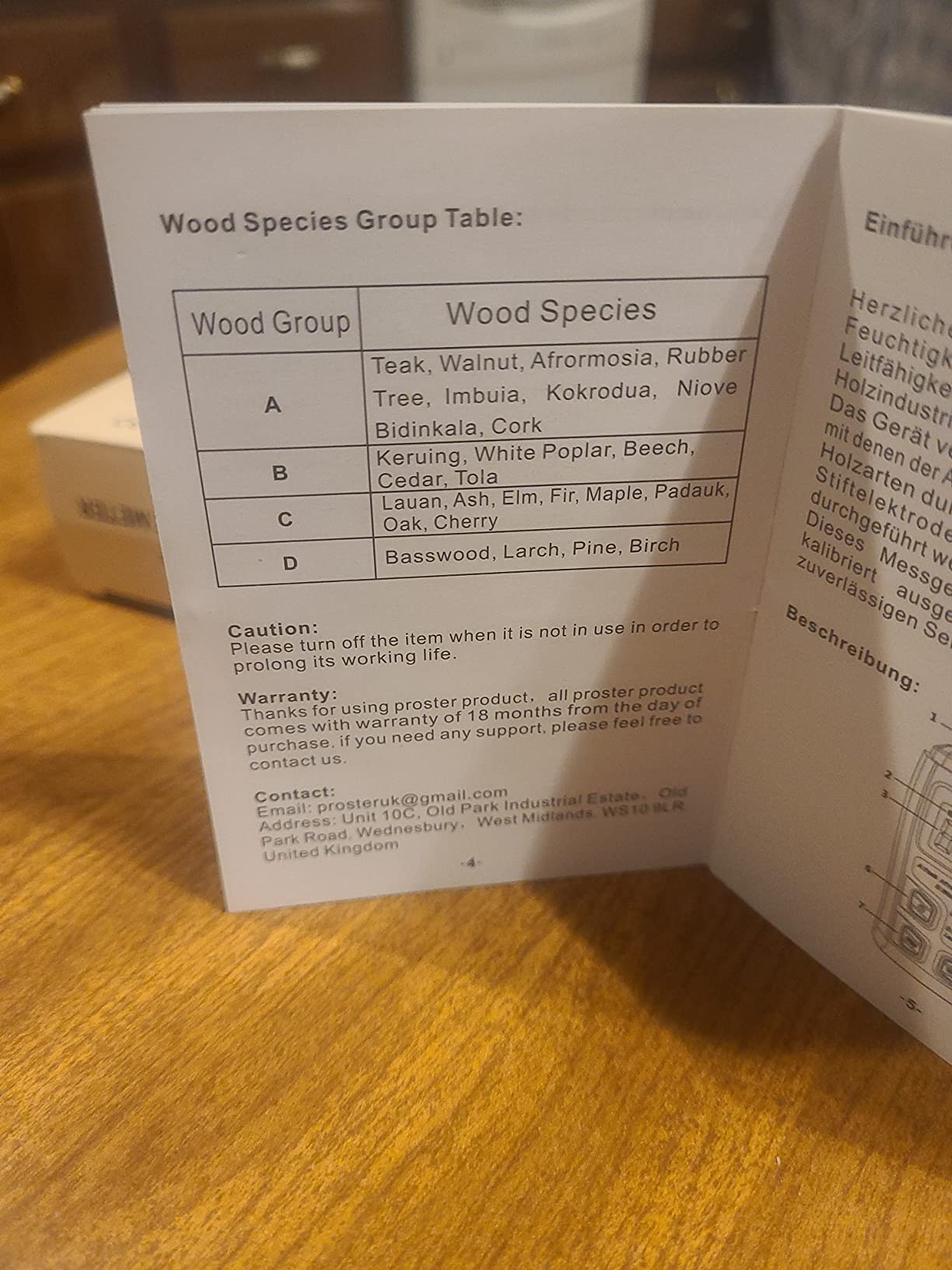
9. Proster PST050 – 0 to 99.9 percent range for green logs
Proster Wood Moisture Meter 4 Modes 0-99.9% for Wood/Paper/Firewood
Pin-type with 10mm electrodes
0-99.9 percent range
0.1 percent resolution
4 wood groups
Pros
- Very wide 0-99.9 percent range with 0.1 percent resolution
- Reinforced battery holder resists shutdowns
- Hard case and pin cover included
- Real-time display with no reading delay
Cons
- No backlight on the display
- Does not remember the last wood mode
- Species groups lean tropical and lack oak
- Pin cap is very tight to remove
The Proster is unusual in that it can measure wood that is barely wood yet. A 0 to 99.9 percent range with 0.1 percent resolution means a log fresh off the ground, a green split, and a fully seasoned piece can all be read on the same device, and owners using it on firewood say it correctly revealed how much moisture varies within a single tree.
It paid for itself within a season for most owners, which is the most common description in reviews. The upgraded battery holder with reinforced fixed connectors is a specific fix for the intermittent shutdowns that plague budget meters, and reviewers specifically call that out as a reason it keeps working after a season of outdoor use.
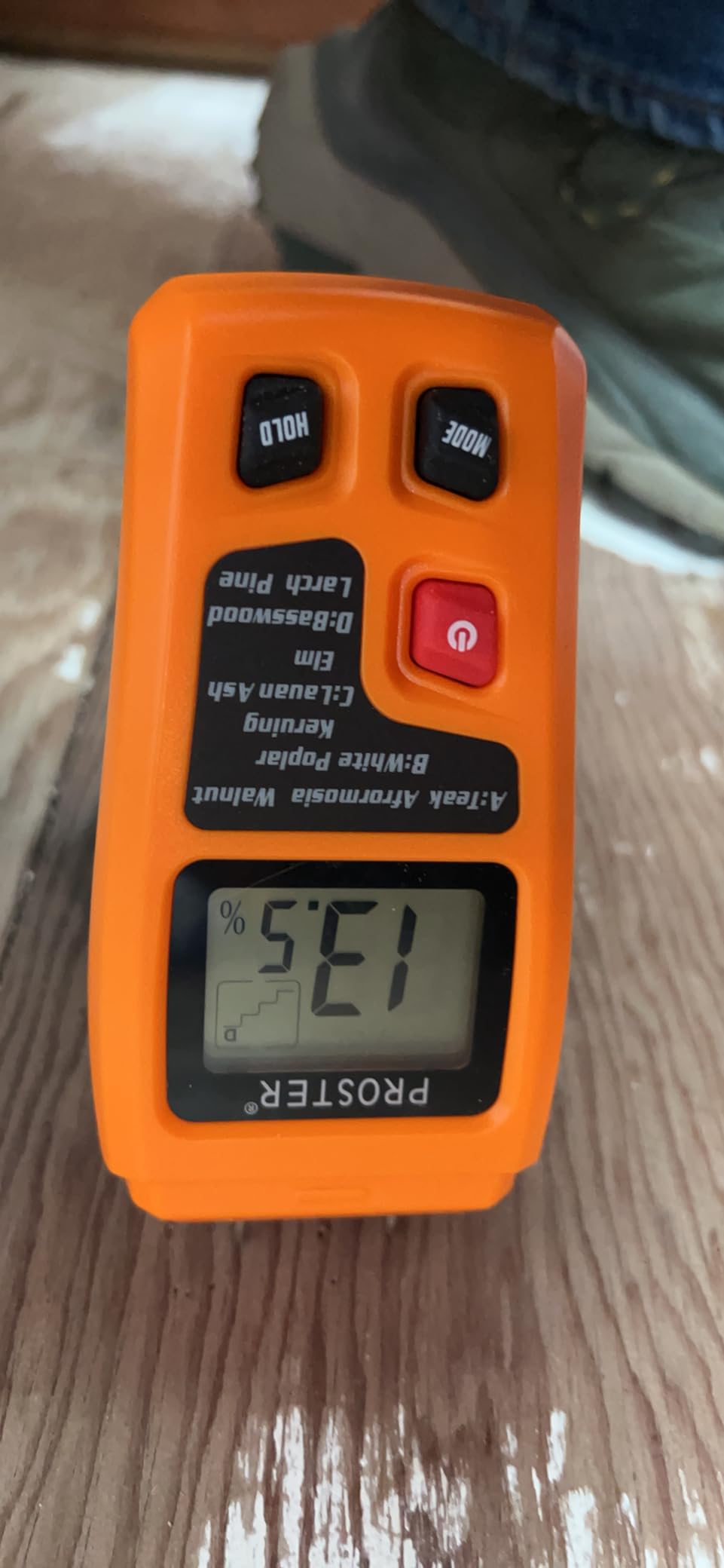
There is a hard case and a pin cover in the box along with a 9V battery, and the bright yellow housing is genuinely practical because you can see it if it falls out of a jacket pocket in the dark. The large HD LCD updates in real time with no reading delay, which is a nicer experience than watching a number crawl.
It also does useful double duty for checking lumber before staining a deck, which stretches the value well past firewood if you are on the property every weekend.
What we liked testing it on
Green logs straight from a felling job, where the wide range is the entire point and most firewood meters go blank. Sorting a stacked season’s supply and watching the average drop as we moved the wetter logs out was the clearest demonstration of what a meter is for.
The hold function and the real-time display make it quick to log a series of readings while walking a stack.
Where it falls short
There is no backlight, so it is unusable in a dark shed or at dusk without a headlamp. For firewood specifically that is a real constraint, since the back of a stack is always the darkest place you will be working.
The four species groups lean tropical and cover roughly 28 species, with no common North American hardwoods like hickory or oak. Users compensate by adding a percentage point or two manually, and it does not remember the last mode, so you reselect it every time you power up. The pin cap is also very tight to remove by hand.
10. Calculated Industries 7440 – firewood bands built into the meter
Calculated Industries 7440 AccuMASTER XT Digital Moisture Meter | Handheld |Pin Type | Backlit LCD Display | Detects Leaks, Damp and Moisture in Wood, Walls, Ceilings, Carpet and Firewood
Pin-type with sharp pins
Low 5-11 percent firewood band
Backlit LCD
Test pins included
Pros
- Firewood Low Medium High bands are defined in the meter
- Built-in test pins verify the meter still reads correctly
- Backlit screen is unusual at this level
- Audio alerts and icons remove number reading
Cons
- Smallest review base here at 830 reviews
- Only a one year limited warranty
- User's guide rather than a full manual
- Pins leave small holes
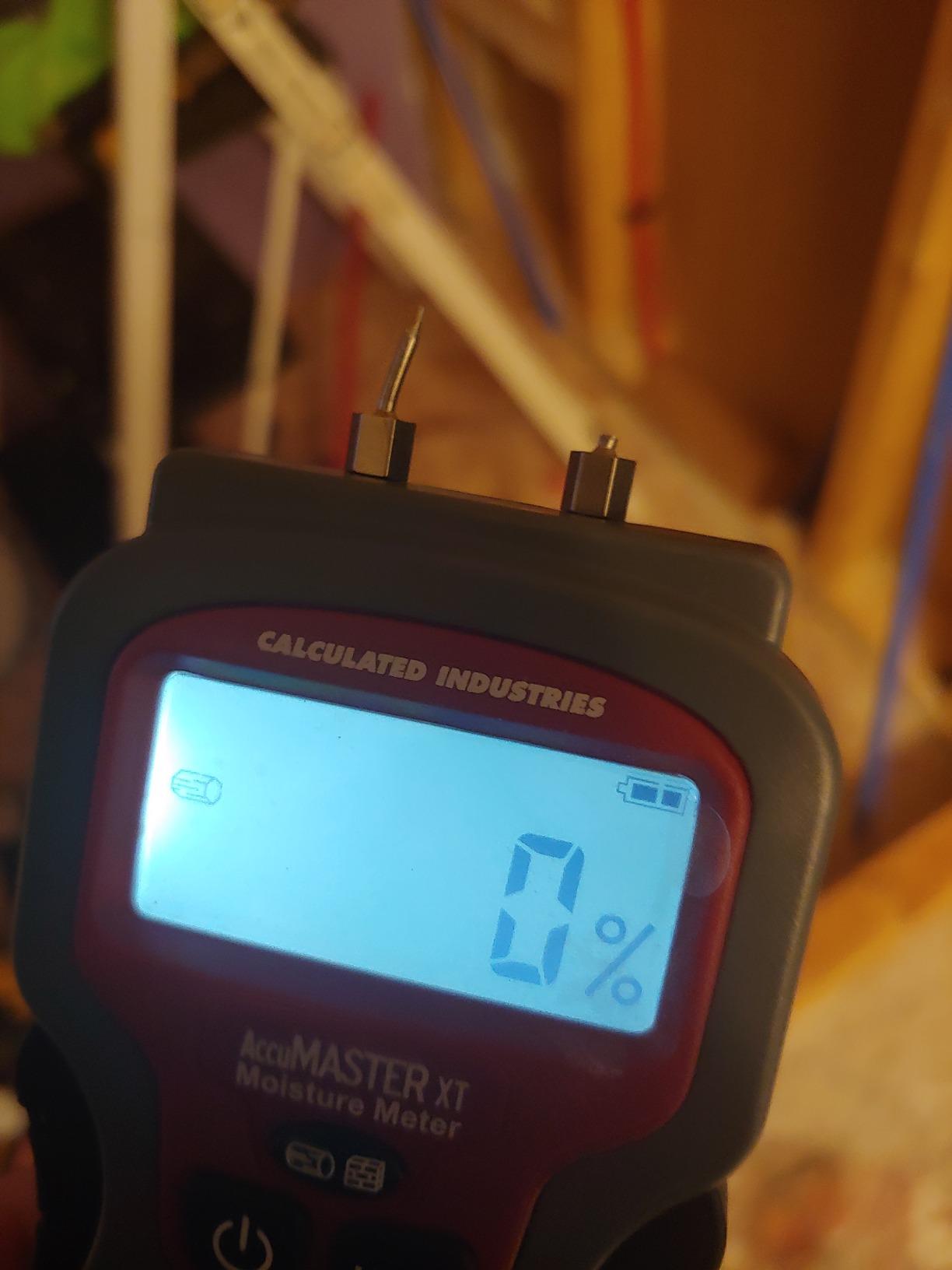
This is the only meter in the group that ships with firewood bands defined by name. Low is 5 to 11 percent, Medium is 12 to 15 percent, and High is 16 to 50 percent, which means the meter tells you which pile to throw the log in rather than making you remember a threshold you read somewhere else.
For a first-time firewood owner that is a genuinely useful shortcut, and it is the closest thing here to a meter that thinks in firewood terms rather than in generic wood moisture. It also measures brick, concrete, drywall, plaster, floors, walls, and carpet, so it doubles as a whole-home inspection tool.
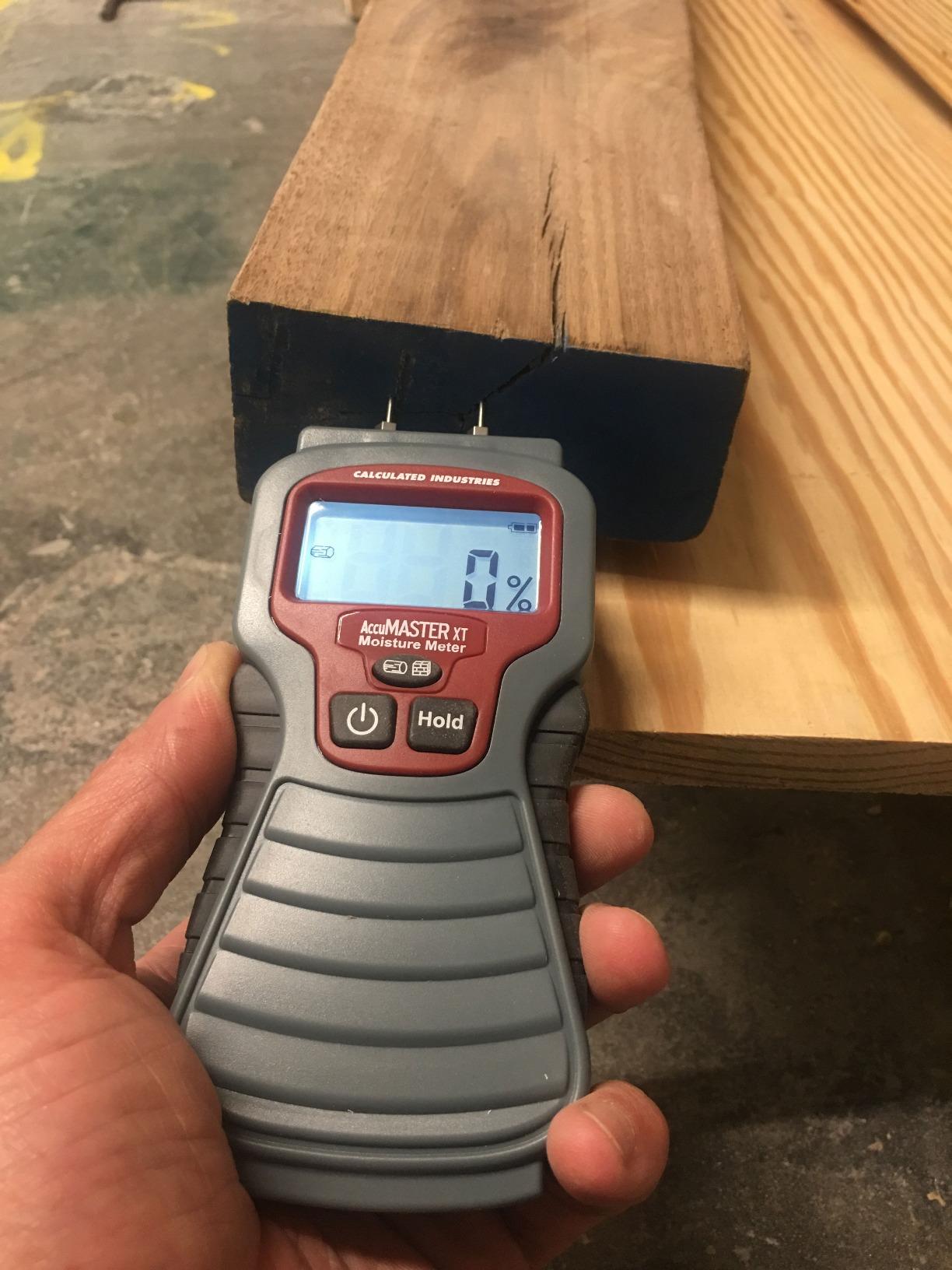
The other standout feature is the built-in calibration test pins, which let you verify the meter is still reading correctly instead of trusting it. Reviewers consistently single these out, along with the large backlit screen, as the reasons this meter separates itself from cheaper units. The backlight is genuinely unusual at this level, since most budget pin meters have none.
Audio alerts and moisture level icons mean you can sort a stack without reading raw numbers, and the hold key freezes a reading while you move to the next log.
What we liked testing it on
Firewood sorting where the band labels removed the decision entirely, and general leak detection in walls and ceilings, which is what the brand is built around. Replaceable stainless steel pins extend the life of the tool rather than ending it at the first bent probe.
It is a specialist instrument from a brand focused on measuring and estimating tools, and that focus shows in the details that matter for accuracy.
Where it falls short
The review base is the smallest of the ten at 830, which means less long-term owner feedback to draw on than the leaders. The one year limited warranty is also short for what it is.
Documentation is thin, with a User’s Guide rather than a full manual, and the pins leave holes. On a firewood split face that is not a real drawback, but on a finished wall or a piece of furniture stock it matters.
Pin vs Pinless for Firewood: Why Pin Holes Do Not Matter
For firewood, a pin meter is the better primary tool, and the usual objection to it is the wrong objection. The pin holes objection comes from furniture making, where a visible hole ruins a face you have already finished. Firewood has no face. It gets split, stacked, and thrown into a fire, and the two pinholes you leave in it will be carbon in an hour. Nothing you own is damaged by a hole in a piece of fuel wood.
What you get in exchange for those holes is a real measurement. A pin meter measures electrical resistance between two metal probes driven into the wood, and because the metal is physically in contact with the fibres, the number responds to the water actually inside the piece. Wet wood conducts more current, so lower resistance means higher moisture content. It is a simple physical relationship, and it is why pin readings tend to agree with each other and with experience.
A pinless meter sends an electromagnetic field into the surface and reads the dielectric response through the top quarter to three-quarters of an inch. That is faster, leaves nothing behind, and is excellent for finding where a dry zone ends in a stack. Its weakness is depth and calibration. Pinless readings drift on dense hardwoods, and surface conditions such as frost, rain, or a cold log face change the answer without changing the moisture inside.
So the practical split is this. Use a pin meter when you need a number you can act on: is this log above 20 percent, is it in the burn-now pile, is this delivered cord worth paying for. Use a pinless meter when you need coverage: which third of the stack is dry, where is the damp patch behind this wall, which logs should I pull and check properly.
If you own only one meter, own a pin meter. If you already have a pin meter and find yourself walking a large pile, a cheap pinless unit as a first pass is a genuine upgrade to the whole system rather than an indulgence.
Why Two Cheap Meters Disagree, and How to Set Your Own Baseline
Ask ten firewood owners about meters and you will hear the same complaint: their meter says 20, their neighbour’s meter says 10, on the same log on the same day. That is not a conspiracy. It has three ordinary causes, and only the first is really about accuracy.
Cause one: species calibration. Wood density varies enormously, and a meter that assumes one density will read a dense hardwood low and a light softwood high. This is the single largest source of disagreement between two meters that are both working correctly. If your pile is mixed, switch the species setting between samples instead of using one setting for the whole stack.
Cause two: depth. A pinless meter reads the outer layer. A pin pushed fully into the face reads deeper. On a log that dried from the outside in, which is most logs in a stack, those two numbers are simply measuring different things, and the difference can be large.
Cause three: temperature and surface condition. This is the winter one. A cold log reads wetter than the same log at room temperature, and a frosted or rain-wet face skews a pinless reading badly.
The fix that owners use, and the one we recommend, is to stop comparing meters to each other and start comparing your meter to itself. Pick one log you already know is properly seasoned, the driest piece you have, and test it every session. Note the number. That is your baseline. If your meter starts reading three points higher on the same control log than it did a month ago, you have a pin or battery problem, not a wood problem.
It also lets you make a personal correction instead of trusting the manual. If your known-dry log always reads 14 and you are confident it is bone dry, then 20 on that meter is your real 16, and you burn accordingly. That is calibration in the practical sense, and it costs nothing but a habit.
Testing Firewood in Cold or Frozen Winter Conditions
Winter is when you most want a meter and when it is least reliable, because meters are calibrated for roughly 70F. Wood straight out of an unheated shed or off a snowy pile will read several points wetter than the same wood indoors, and people routinely conclude their meter is broken.
Three habits fix most of this. First, bring a sample inside overnight and let it reach room temperature before you read it, which is the standard advice given on r/woodstoving. Second, if you cannot wait, hold the split face against a warm stove or a heated room for a few minutes and accept the reading as a rough number rather than a decision. Third, remember that frozen wood is not just cold, it is partly locked up, so a reading taken on a frozen log tells you very little even if it is warmed at the surface.
One practical consequence is worth planning around. In deep winter, the wood you can get your hands on is usually the driest wood in the pile, and it will read wetter than it is. If you are burning in a stove every day, resist the urge to wait for a number under 20 that will never arrive, and instead test the same lot the same way each time so the readings stay comparable to each other. Consistency across your own logs matters more than an absolute figure you obtained on frozen wood.
How to Choose a Firewood Moisture Meter
Here is the decision process we would follow, in the order the questions actually come up.
1. Decide what you are measuring. Green wood straight off a splitter, a seasoned stack you are about to burn, or lumber you plan to build with are three different jobs. Green wood needs a range that extends to 60 or 75 percent. A seasoned stack needs accurate resolution between 8 and 25 percent. Interior lumber needs a range that goes low, and several firewood-first meters go blank on kiln-dried stock.
2. Check the bottom of the range, not just the top. This is the mistake we see most often. A meter with a 6 percent floor cannot tell you the difference between 7 and 11 once your best wood is properly dry, and a meter that starts at 10 shows an error on the driest logs in your pile. If your goal is burn readiness, a low floor matters less. If you are chasing maximum efficiency, it matters a lot.
3. Look at accuracy tolerance honestly. Specifications here range from plus or minus 0.5 percent to plus or minus 5 percent. You do not need sub-percent accuracy to know whether a log is above or below 20 percent. You do need better than plus or minus 5 percent if you are trying to tighten your threshold from 20 down to 15, and if that is your goal, the Bosch is the one in this group with the consistency to do it.
4. Prioritise a numeric percentage over a colour band. Meters that give a relative reading are fine for sorting and poor for deciding. A number can be logged, compared across sessions, and argued with. A colour cannot. If you only ever intend to sort, colour is genuinely faster. If you intend to know, buy a number.
5. Consider species settings if your pile is mixed. The VINHMOR with eight scales and the Bosch with two wood groups both earn their place here. If you burn a single species from one tree, two settings are plenty and this criterion does not apply to you at all.
6. Check the display for where you will actually use it. A backlit screen is not a luxury when you are reading a log at the back of an unlit shed, and the Proster having no backlight is a real limitation rather than a nitpick. Colour backlights, bar graphs, and traffic light LEDs all speed up sorting.
7. Look for calibration checking, not self-calibration. A meter with built-in test pins, or a protective cap that doubles as a calibration checker, lets you confirm the meter is still reading correctly. A meter that calibrates itself tells you nothing about whether it is accurate. The Bosch and the Calculated Industries both give you a way to check.
8. Check what happens when it is too dry. Several meters in this group display 0 rather than a low value on extremely dry wood. That is a floor, not a measurement, and it means those units cannot support the 10 to 15 percent window we named earlier.
9. Think about pin replacement. Pins bend, and a meter whose pins cannot be replaced is a disposable tool. The RDINSCOS MT19B ships a spare pair and a spanner, and the TOPTES includes the same. On others, check that the manufacturer sells replacements before you commit.
10. Keep it somewhere you will use it. A meter in a toolbox in the garage is a meter you will not check in January. A meter hanging by the back door is one you will reach for. Weight and storage case decide this more often than any spec sheet does.
For checking a seller’s claim before you pay for a cord, the same rules apply but with one addition: test five or six logs spread across the load, split them yourself if you have to, and remember that a seller claiming a specific percentage is quoting a number produced by one meter on one sample. Multiple samples across the load are the only way to make that number mean anything.
Sorting the wood itself is a separate job, and doing it well makes the moisture check far easier. Our firewood carrier roundup covers moving rounds from the splitter to the stack without wrecking your back, and if you are doing the work away from home, layering in the right clothing matters more than you would think, which is what our moisture wicking shirt picks get into.
Frequently Asked Questions
How much moisture should firewood have?
Firewood is ready to burn at 15 to 20 percent moisture content, and the ideal window is 10 to 15 percent. Below 20 percent is the important line for a wood stove, because wetter wood burns cool, produces heavy smoke, and condenses into creosote inside the flue. Under 10 percent there is no downside beyond getting more heat per log.
Do moisture meters actually work on firewood?
Yes, provided you push the pins into a freshly split face rather than against bark. The outer surface of a log dries weeks ahead of the core, which is why testing bark gives false confidence. Split a round across the grain, let the face sit in open air for a few minutes, then take three readings and average them.
Should I buy a pin meter or a pinless meter for firewood?
A pin meter as your primary tool, because it gives a trustworthy single-point number and pin holes are irrelevant on firewood. A pinless meter is a good second tool for sorting a whole pile quickly, since it scans a full face in a second. Pinless readings are relative rather than absolute and drift on dense hardwoods, so use one to find the dry zone and the other to judge a log.
Can I test firewood in freezing winter temperatures?
You can, but the reading will be skewed wetter than the truth. Meters are calibrated for roughly 70F, so bring a sample inside overnight to reach room temperature before reading it, or accept a cold reading as a rough comparison rather than a decision. Test the same logs the same way each session so your readings stay comparable to each other.
What is the best budget pinless moisture meter?
Among pinless options, the Klein Tools ET140 is the strongest all-rounder, with nine LED range bars and a 3/4 inch scan depth for mapping a pile quickly. The RDINSCOS MT28 is the budget alternative worth knowing, mainly because its built-in flashlight makes it the better tool in a dark shed. Both give relative rather than absolute readings, so neither confirms a 20 percent threshold.
Why do two moisture meters give different readings on the same log?
Usually one of three things: different species calibration settings, different measurement depths, or a difference in wood temperature. Two meters that are both working correctly can disagree by several points for all three reasons. The practical fix is to stop comparing meters and set a baseline instead, testing one known-dry control log each session and adjusting your threshold to that number.
Final Verdict
The best moisture meters for firewood in 2026 all agree on one thing: a pin meter gives you a decision, and a pinless meter gives you coverage. For most people the answer is a single dependable pin meter kept by the back door and used on a freshly split face, three readings at a time, against a threshold you decided in advance.
Our pick is the General Tools MMD4E, because it has the largest review base in the group, a wood range wide enough to cover green through fully seasoned wood, and a display you can read while holding a log in one hand. The RDINSCOS MT19B is the better buy if stated accuracy is what matters most to you, and the Bosch UniversalHumid is worth the step up if your stove heats the house and you want the wood group selection and the traffic light answer.
Whatever you choose, use it properly. Split the face, take three readings, warm cold wood first, and set a baseline log so you know when the meter drifts rather than the wood changing. And when the numbers say a log is not ready, believe them and stack it somewhere sunny, because the firewood you do not burn wet is the firewood that pays for the meter.