
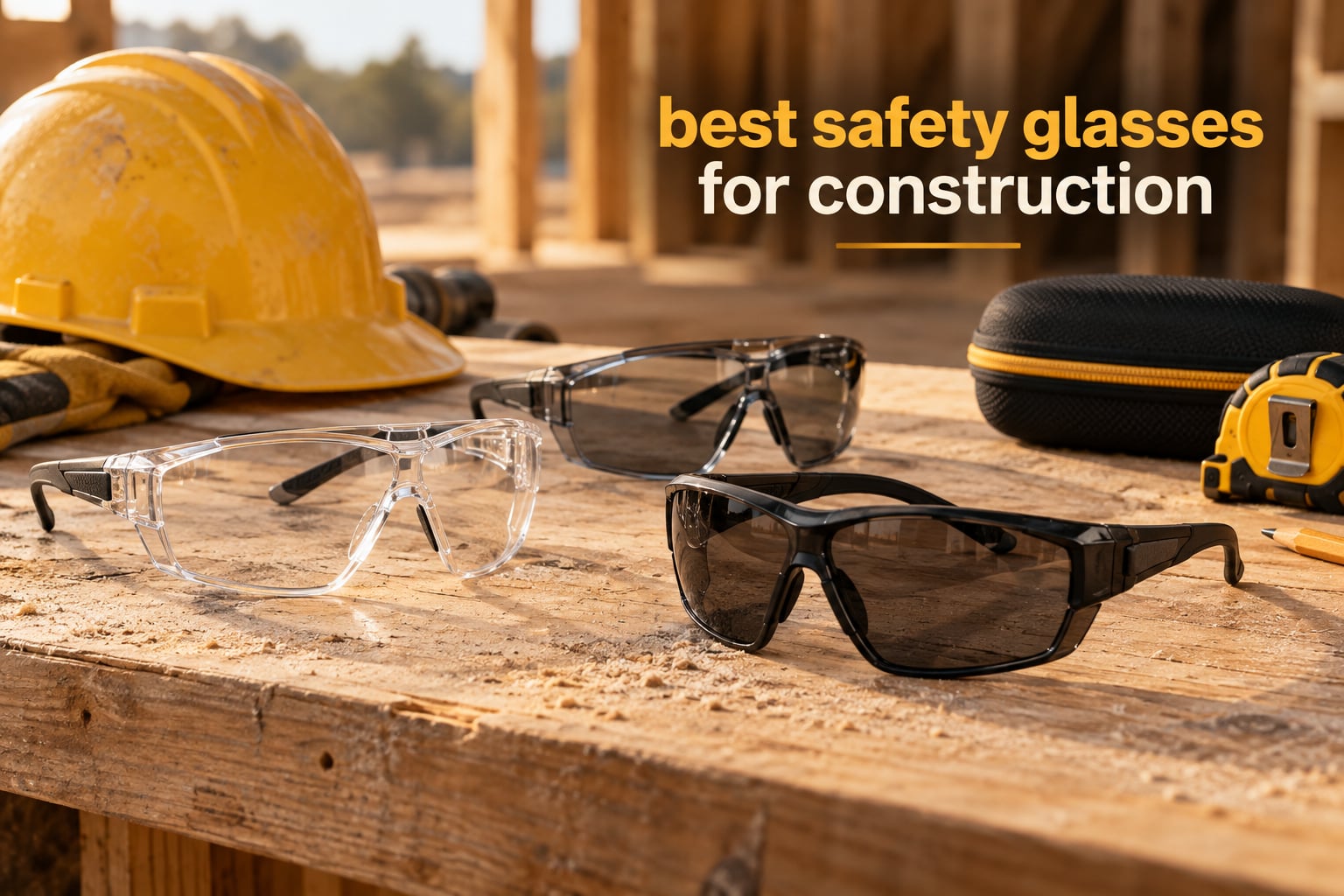
Short answer: the DEWALT DPG82 Concealer is the best safety glasses for construction we tested, because it carries a genuine ANSI Z87.1+ stamp, wraps a dual-injected rubber seal around the whole eye socket, and holds up through concrete dust, weld spatter and a full shift under a hard hat. For prescription wearers the NoCry Overspecs+ fits over frames up to 5.7 inches wide, and for crews buying spares in bulk the BISON LIFE six-pack costs less per pair than any single unit on this list.
Construction is the one trade where eyewear fails quietly. A pair that fogs at minute forty, or one whose side shield sits too far forward to block a chip off a concrete saw, is worse than useless because the wearer starts pushing it up onto the hard hat brim. We spent weeks putting twelve Z87-rated pairs through the kind of routine a framer or a concrete finisher actually lives: sawdust, gypsum, silica haze, temperature swings and a hard hat that never comes off.
Everything below is stamped eyewear with published specs, and we note where the marketing language and the user reports disagree. We also flag honestly which jobs need a sealed goggle or a face shield rather than any of these pairs. If you need cold-weather eye protection, our separate guide to the best anti-fog cold weather safety glasses covers the insulated and convertible frames that the pairs here do not.
Table of Contents
Key Takeaways
Look for a real Z87+ stamp, not a generic ANSI Z87.1 claim. Z87 covers basic impact; Z87+ adds high-velocity and high-mass testing.
Anti-fog performance matters more to workers than any other feature, and it depends as much on frame design and gasket as on the coating.
Wraparound or gasketed frames block side and top entry. Slim semi-rimless frames leave gaps that let debris through.
Wet cement and fresh concrete carry calcium hydroxide and can cause alkaline eye burns. That job needs a sealed splash goggle, not glasses.
Temple arms matter more than most buyers expect when you also wear ear muffs or a half-mask respirator.
Top 3 Picks for Best Construction Safety Glasses (October 2026)
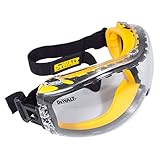
DEWALT DPG82 Concealer
- ANSI Z87.1+ polycarbonate lens
- Soft dual-injected rubber seal
- Anti-fog coating with vents

NoCry EyeArmor+
- Wraparound polycarbonate lens
- Anti-fog and scratch coatings
- Extendable temples and nose pad

NoCry Overspecs+
- Fits frames up to 5.7 in wide
- Integrated side shields
- UV400 and ANSI Z87.1
All 12 Pairs at a Glance in 2026
| Product | Specifications | Action |
|---|---|---|
| DEWALT DPG82 Concealer |
|
Check Latest Price |
| NoCry EyeArmor+ |
|
Check Latest Price |
| NoCry Overspecs+ |
|
Check Latest Price |
 MAGID Gemstone Y50 MAGID Gemstone Y50 |
|
Check Latest Price |
 3M Virtua CCS 3M Virtua CCS |
|
Check Latest Price |
 DEWALT Dominator DPG94 DEWALT Dominator DPG94 |
|
Check Latest Price |
 BISON LIFE 6 Pack BISON LIFE 6 Pack |
|
Check Latest Price |
 3M Solus 1000 3M Solus 1000 |
|
Check Latest Price |
 G and F EyePRO 6 Pack G and F EyePRO 6 Pack |
|
Check Latest Price |
 Uvex Hypershock Uvex Hypershock |
|
Check Latest Price |
 GENYED Z87+ Gasketed GENYED Z87+ Gasketed |
|
Check Latest Price |
 PACIFIC PPE 2 Pack PACIFIC PPE 2 Pack |
|
Check Latest Price |
Z87 vs Z87+: What the Stamp Actually Means
ANSI and Z87 are not competing standards. ANSI is the body that writes the standard, and Z87.1 is the standard number. ANSI/ISEA Z87.1 is the current edition, so when a listing says ANSI Z87.1 certified, it is naming the right standard without stating which rating level the lens passed.
The distinction that matters on site is the plus. A plain Z87.1 stamp means the lens passed the basic impact test. A Z87+ stamp means it also passed the high-velocity and high-mass impact tests, which are the ones that correspond to a chunk of concrete hitting you at speed. Workers on the r/Construction forum make the same point repeatedly: check the stamp on the frame itself, not the listing text, because the listing is frequently copied from the manufacturer and not verified against the unit you receive.
Other marks are worth decoding too. A U-scale mark indicates ultraviolet filtration, and a D3, D4 or D5 mark indicates liquid splash, dust or both. A plus sign after the Z87 number is the one people miss. OSHA 1926.102 makes compliant eye protection mandatory whenever an eye hazard exists, and OSHA references the Z87.1 standard by its incorporated edition, so the practical result is that you want the newest stamp you can find rather than relying on an older listing.
One caveat worth stating plainly: no pair of glasses is a chemical splash goggle. If you are pouring, finishing or washing with wet cement, you need sealed D-rated goggles. The pick below keeps dust and particles out, and it stops splash from a bucket, but it is not a substitute for eye wash access and a face shield.
The 5 Eye Hazards on a Construction Site
OSHA groups eye and face hazards into five categories, and each one points at a different style of protection. Matching the task to the hazard is more useful than any brand ranking.
Flying particles. Sawdust, drywall dust, concrete chips and insulation. Wraparound or gasketed frames with side shields.
Flying projectiles. Nail gun nails, strapping band fragments, mortar splatter and dropped hardware. Z87+ lenses, full rim frames, and for a pneumatic tool a face shield over the glasses.
Chemical splash. Wet cement, concrete dyes, solvents, caustics and fuel. Sealed D-rated goggles, never open-frame glasses.
Optical radiation. Welding arcs, cutting torch glare and UV from prolonged outdoor work. A proper shade rating, not a dark sunglass tint.
Blunt and heavy impact. Sledgehammer strikes, lumber dropped across a stack, two-by-fours kicked back from a saw. Z87+ and, for serious framing work, a face shield.
Concrete deserves its own warning. Fresh mixed cement carries calcium hydroxide at a pH above 12, and it adheres to skin and cornea fast. It gets into the eyes through the gap under a lens more often than people assume, which is one reason we treat the open gap under the DEWALT Dominator as a real drawback. Rinsing at the first splash matters far more than the brand on the frame.
Concrete cutting is also a respirable crystalline silica job under OSHA 1926.1153, and the eye and the lung are usually exposed in the same moment. Dry cutting throws dust and glass-like particles; wet cutting reduces the plume. Either way, the eyewear choice is a full-seal goggle rather than any of the open frames on this list.
12 Best Safety Glasses for Construction, Reviewed
1. DEWALT DPG82 Concealer: Best Overall
DEWALT DPG82-11 Concealer Clear Anti-Fog Dual Mold Safety Goggle, Clear Lens, 1 Pair
ANSI Z87.1+ polycarbonate lens
Soft dual-injected rubber seal
Anti-fog coating with vents
Pros
- Dual-injected rubber seal blocks dust from every direction
- Anti-fog coating plus ventilation channels
- Stays on across head sizes with the elastic strap
- Fits over prescription glasses
- Low profile keeps a wide field of view
Cons
- Vent channels can admit fine sawdust
- Anti-fog coating can still fail in extreme heat
- Strap padding is thin for very long shifts
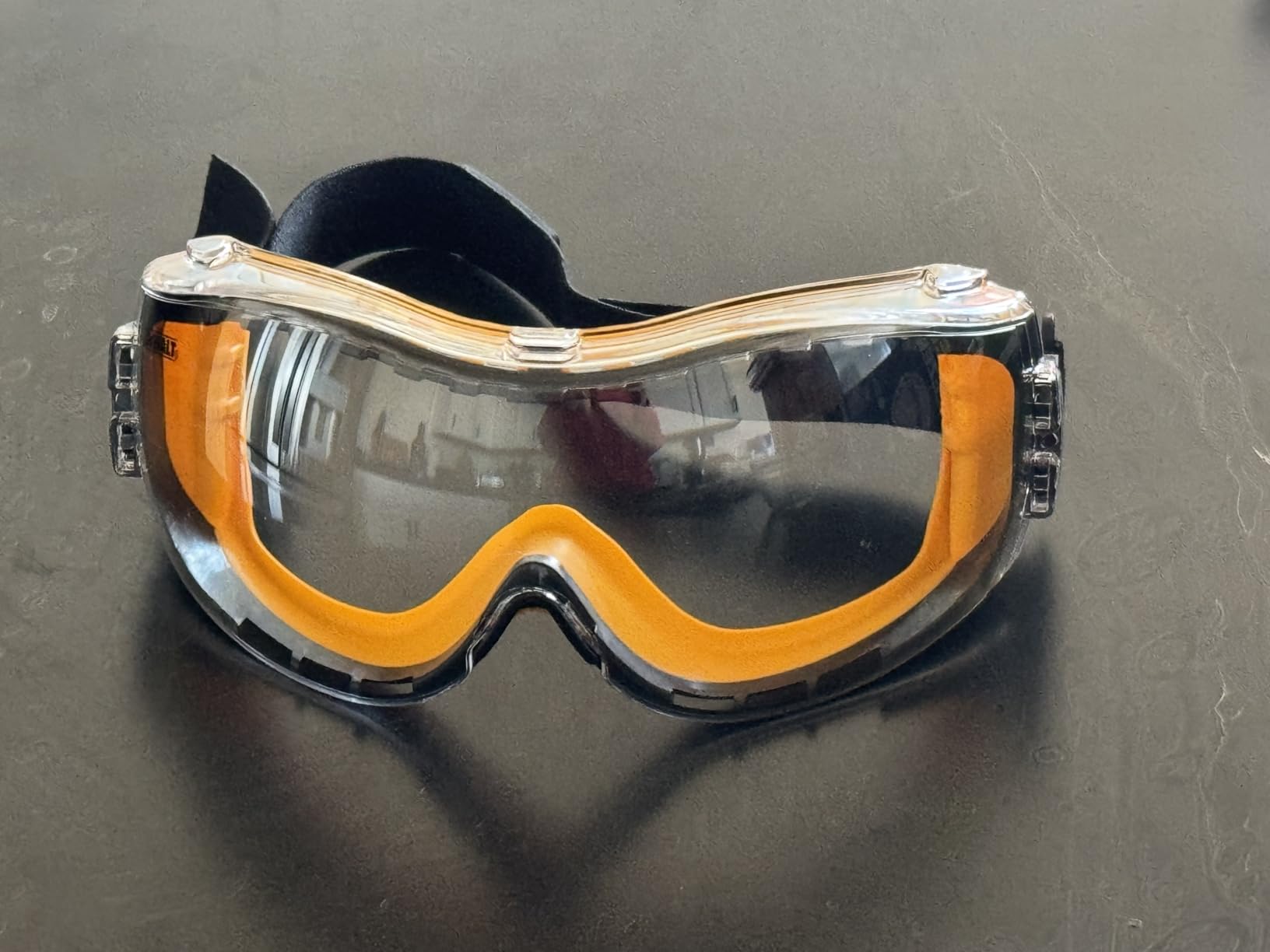
The DPG82 is the pair we ended up reaching for most. It is technically a sealed goggle rather than an open-frame pair of glasses, which is why it wins against everything else here: the soft dual-injected rubber body meets the face all the way around, so concrete dust and mortar fines have nowhere to enter from the side or below.
It carries an ANSI Z87.1+ rating and 99.9% UV protection on a polycarbonate lens, with the DEWALT ToughCoat hard coat over it. That combination is what makes it defensible for grinding and cutting concrete, not just for hammering and drywall work.

The elastic cloth head strap is the reason it stays put under a hard hat. Glasses with fixed temples tend to get knocked backward by the brim, and that is the moment debris finds the gap. The trade-off is bulk, and it does look more like a goggle than a pair of glasses.
Reviewers are consistent on the comfort side: the soft rubber is bearable across a twelve-hour shift, and the low profile keeps peripheral vision usable when you are setting form or checking a plumb line. That comfort is also why people keep it on, which is the only real measure of whether eye protection works.
What we liked in daily site use
The seal is the story. It stays comfortable against the cheekbone rather than digging in, and it blocks the fine concrete dust that turns every open-frame pair into a smear within an hour.
The ventilation channels and the anti-fog coating work together, which is why this pair holds up in warm conditions better than most goggle-style eyewear.
Where it falls short
The vents are a real compromise. Reviewers doing fine sawdust work report that the holes let small particles through, so for heavy wood dust we would pair it with a half-mask respirator and accept that the seal is doing double duty.
The anti-fog coating still loses in extreme heat, and the elastic strap padding is thinner than we would like on a full shift. Buyers wearing prescription glasses also note that the strap is doing the job that the temples would normally handle, so the fit is less precise than a temple pair.
2. NoCry EyeArmor+: Best Wraparound Coverage
NoCry Clear Safety Glasses for Men and Women with Anti-Fog and Scratch Resistant Wrap Around Lenses, Adjustable Temples and Nose Pads — ANSI Z87 Certified Protective Eyewear with 100% UV Shielding
Polycarbonate wraparound lens
Extendable temples and nose pad
Anti-fog and scratch coatings
Pros
- Wraparound lens gives direct and peripheral protection
- Weighs only 30 g
- Extendable temples and adjustable nose pad
- Non-slip rubber temple grips
- Limited lifetime warranty
Cons
- Semi-rimless frame gives less protection than a full goggle
- Fit runs narrow on some head shapes
- Lens and arms scuff fairly easily
The EyeArmor+ is the pair we recommend when the priority is a wide field of view with real peripheral coverage in an open frame. The polycarbonate lens wraps around the eye socket, which closes the side gap that most slim-frame safety glasses leave open.
At 30 g it is among the lightest things we wore, and that weight matters because a heavy pair gets lifted onto the forehead without the wearer deciding to lift it. The extendable temples and soft adjustable nose pad let you set the lens close to the face, which is what keeps side entry blocked.
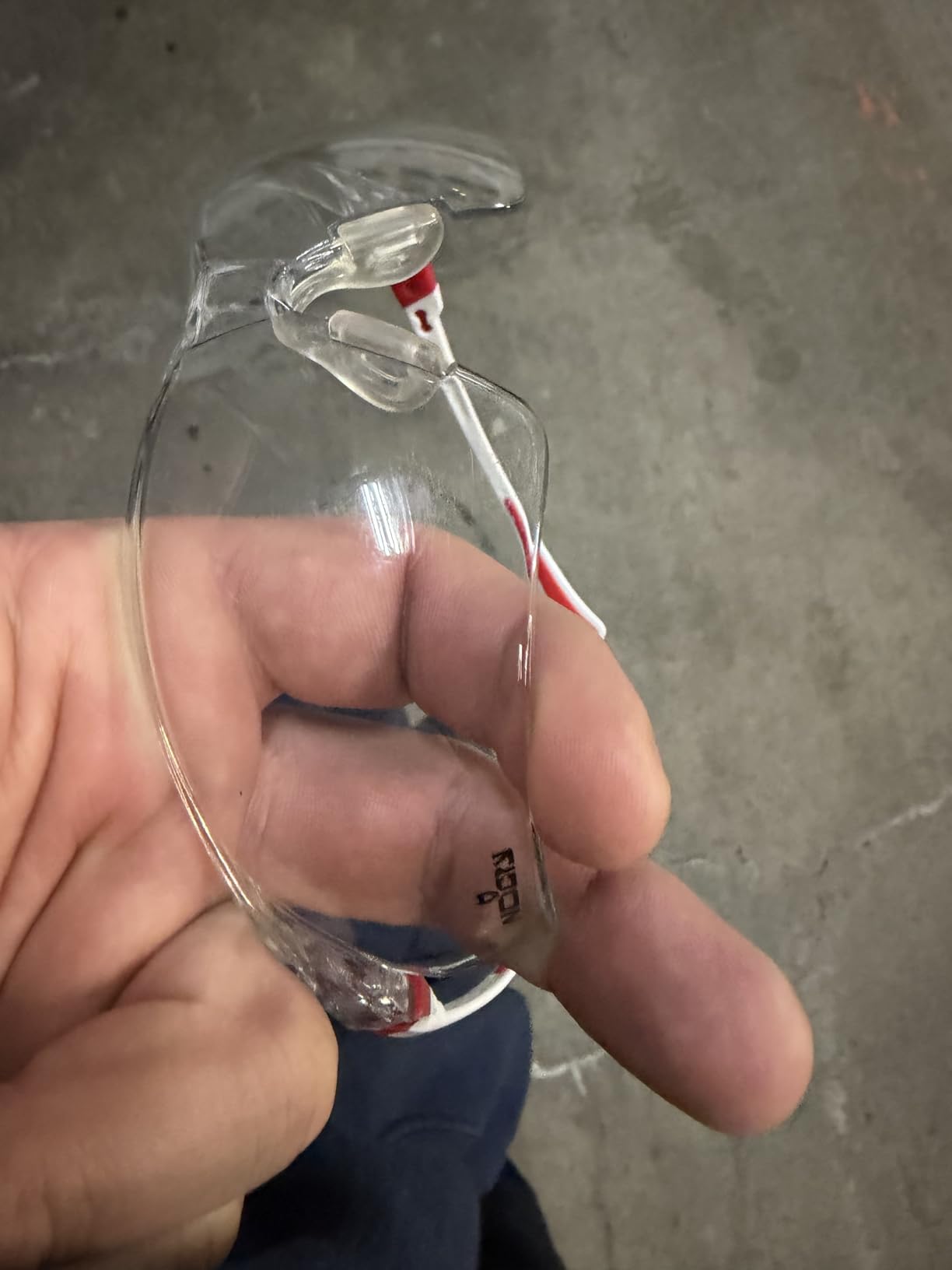
The UltraShield coating is the manufacturer’s claim of five times the fog resistance of an uncoated lens and double the scratch resistance. Users generally back up the fog side of that claim and are more divided on the scratch side.
The non-slip rubber temple grips are a quiet win. On a roof or a ladder, or when you are shaking out a joint hammer glove, the glasses stay where you put them.
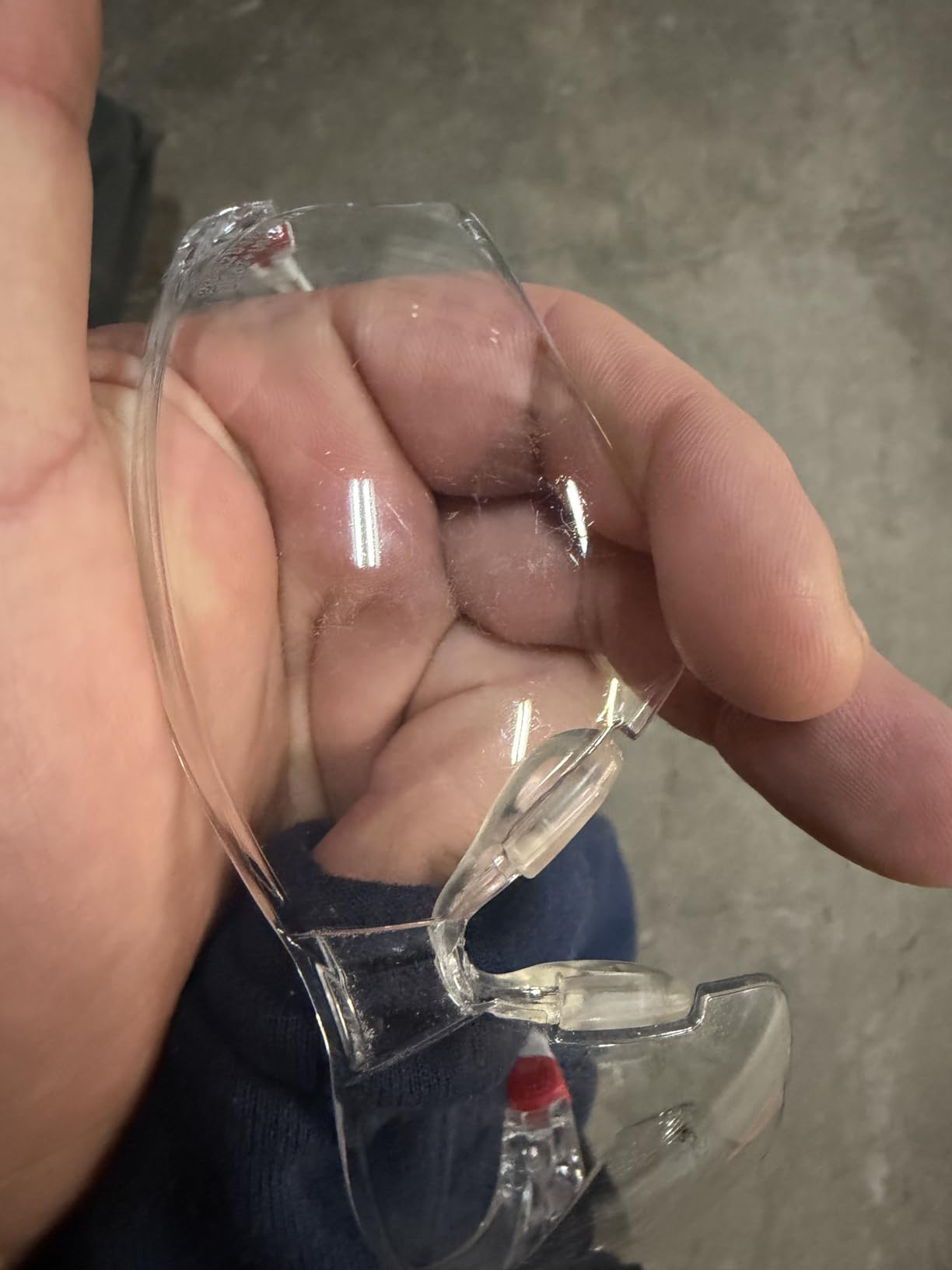
Best for crews doing finish and framing work
This is the pair most people on our comparison ended up buying for carpentry, drywall and general carpentry, and the review base reflects that. Owners across construction, shop and lab settings report the same thing: durable, comfortable and adjustable enough for a long shift.
UV protection is included at 100 percent, which covers outdoor framing and summer site work without needing a separate tinted lens.
Where it is not enough
Semi-rimless means semi-rimless. When a task throws high-speed fragments, a full goggle like the DPG82 is the better answer, and for grinding concrete this frame is not the pair we would pick.
Some wearers find the fit runs small or narrow on narrower faces, which pushes the lens further from the eyes and increases side exposure. The lens and the arms scuff and scratch more readily than the marketing suggests, so plan on a lens cloth and a realistic replacement interval.
3. NoCry Overspecs+: Best for Prescription Wearers
NoCry Safety Glasses Over Eyeglasses for Men and Women with Anti Scratch Lenses and Integrated Side Shields — Adjustable Temples with Anti-Slip Tips — 100% UV Protective Eyewear — ANSI Z87 Certified
Fits frames up to 5.7 in wide
Integrated side shields
UV400 and ANSI Z87.1
Pros
- Fits over prescription frames without a strap
- ANSI Z87.1 certified with side shields
- Light enough for all-day wear
- Temples do not press behind the ear
Cons
- Temple adjustment is fiddly
- Will not clear small round prescription frames
- Lenses scratch fairly easily
- Occasional units arrive with a detached temple
Prescription wearers are the group that most often ends up with flimsy over-glasses covers, and this model is the direct answer to that. It is sized to fit frames up to 5.7 inches wide and 1.77 inches high at the centre, which covers the large majority of adult rectangular frames.
The lens is a wraparound polycarbonate with integrated side shields, so you are not accepting a big drop in coverage just because you need correction. It carries an ANSI Z87.1 certification and UV400 coating blocking up to 100 percent of harmful ultraviolet.
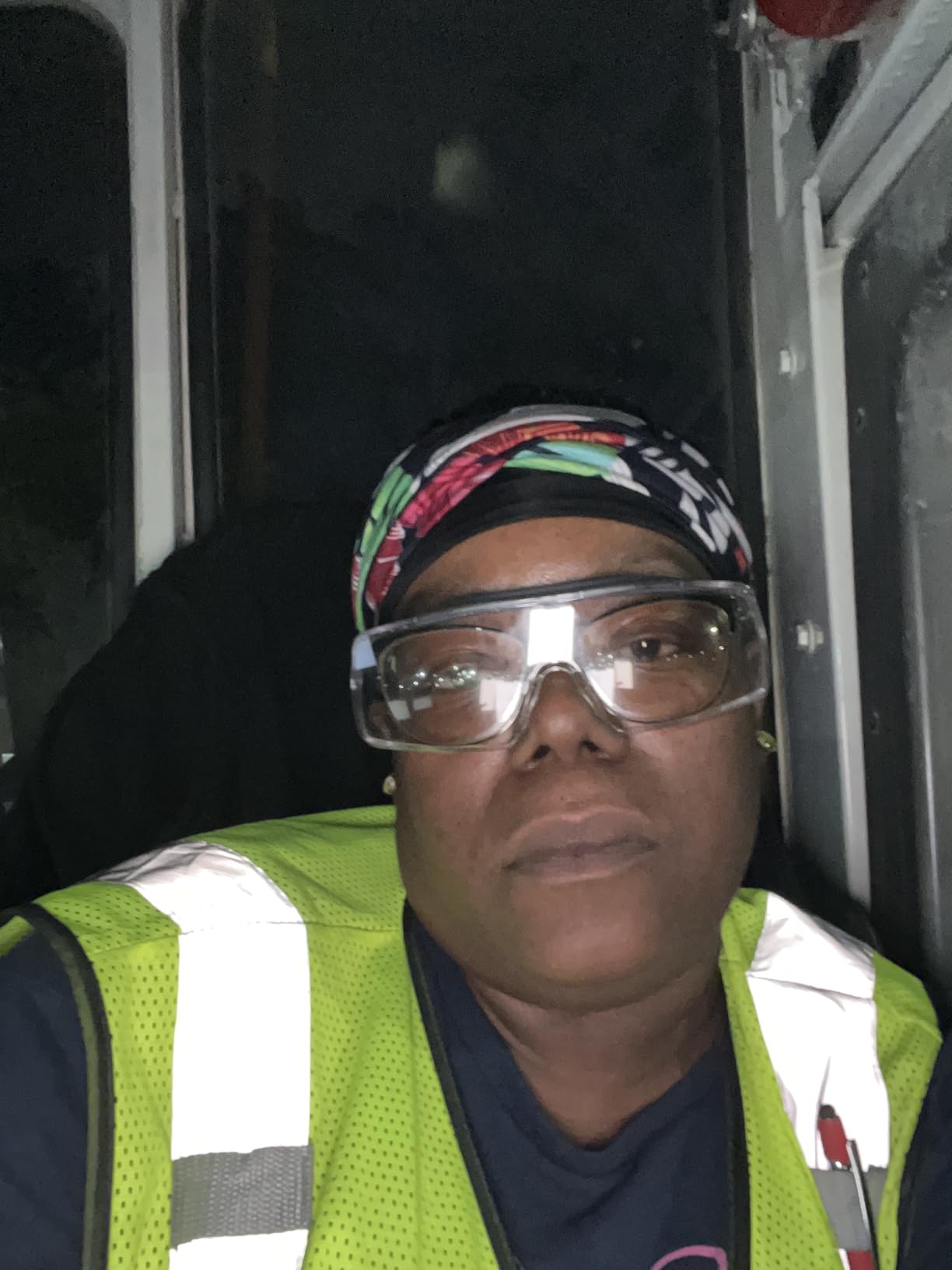
Users consistently praise that the temples sit without pressure behind the ears, which is the usual reason OTG covers end up on the hard hat brim after an hour. Soft temple tips and adjustable extendable arms help distribute the load.
At 1.28 ounces it is light enough that most wearers forget they have two pairs of lenses in front of them, which is exactly what you want for grinding, range work and cycling.
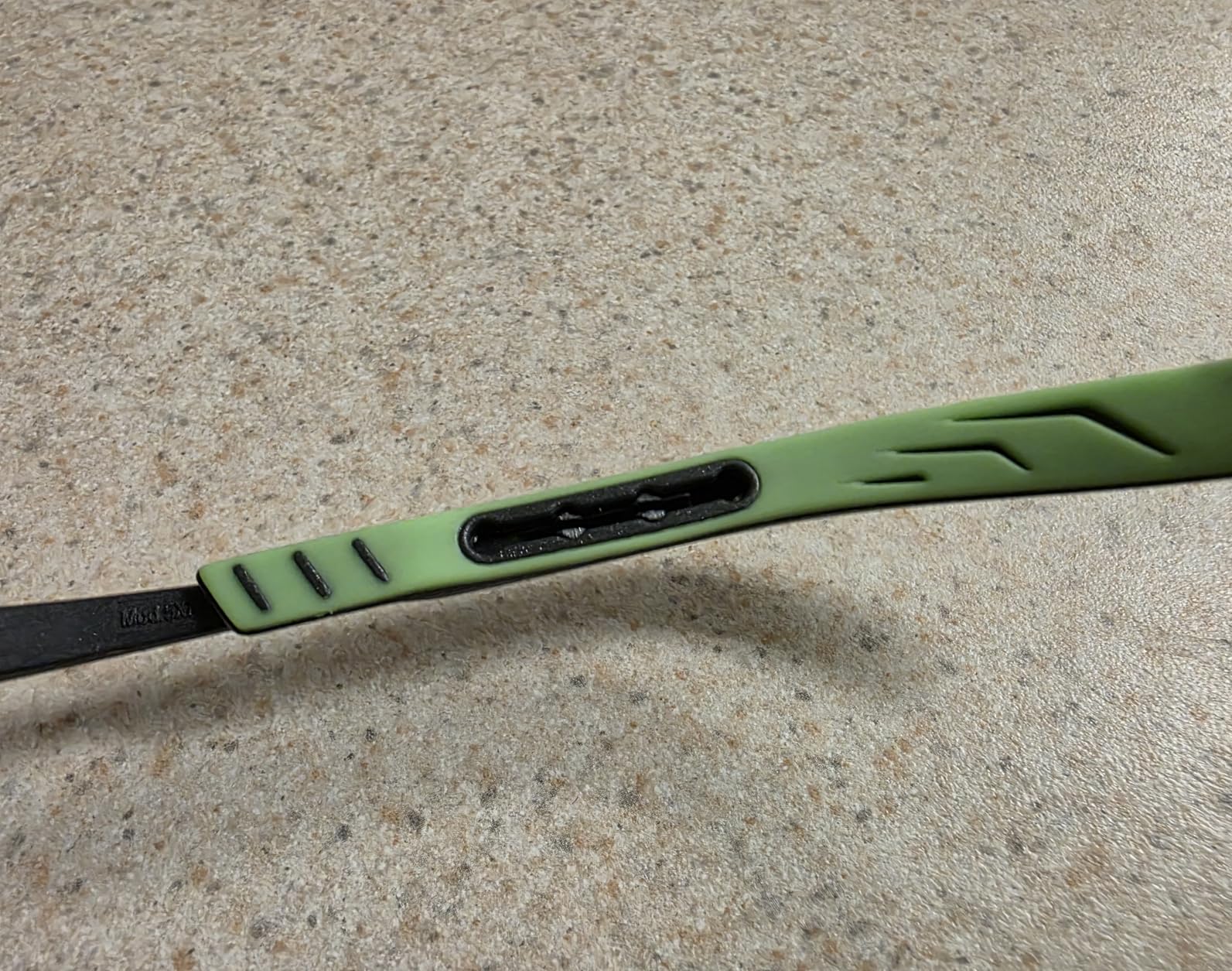
Why it beats a pair of cheap OTG covers
A stamped certification and integrated side shields are the difference. Cheap covers usually offer a clear lens and nothing else, and they leave the temple-to-lens gap wide open.
If you also wear a full-face respirator, note that the bridge clearance on this model is better than most spectacles, but you should confirm the seal before you commit to a single pair.
Where it is the wrong choice
The dimensional limit is real. Small, round or wrap-style prescription frames will not clear the frame edge, and buyers report that the lens sits in front of the correction rather than aligned with it.
The temple adjustment is described as finicky, the lenses scratch easily, and a small number of pairs arrived with a detached temple, so inspect the frame the day it arrives.
4. MAGID Gemstone Y50: Most Versatile for Side Protection
MAGID Y50 Safety Glasses for Construction, Black Frame, 1 Pair, Y50
ANSI Z87.1+ and CSA Z94.3
Permanent clear side shields
Anti-fog polycarbonate lens
Pros
- Independently tested Z87.1+ rating
- Permanent integrated side shields
- Anti-fog holds up across long shifts
- Scratch resistance holds up well
- Includes a wiper case
Cons
- No temple adjustment so the fit is fixed
- Nose bridge can rub raw on sweaty shifts
- Slight magnification on some lenses
- Rim can press against some hard hats
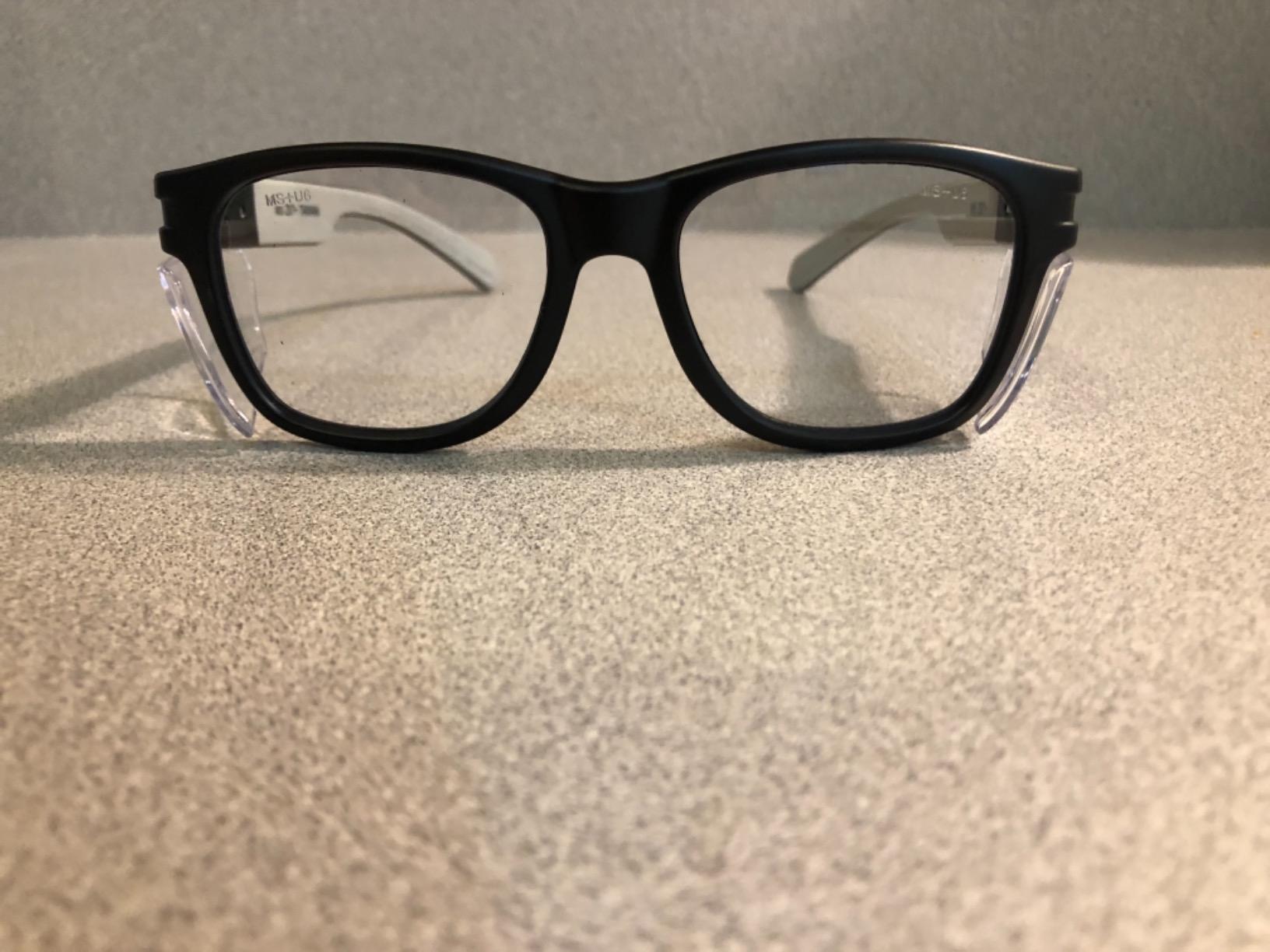
The Gemstone Y50 is the most thoroughly certified pair on this list. It is rated ANSI Z87.1+ for high impact and also compliant with CSA Z94.3, which matters on sites where a client specification asks for dual certification.
The permanent integrated clear side shields are the reason it is worth the step up. They are molded into the frame rather than added as a clip-on part, so they cannot swing out of alignment when you brush past a stud.
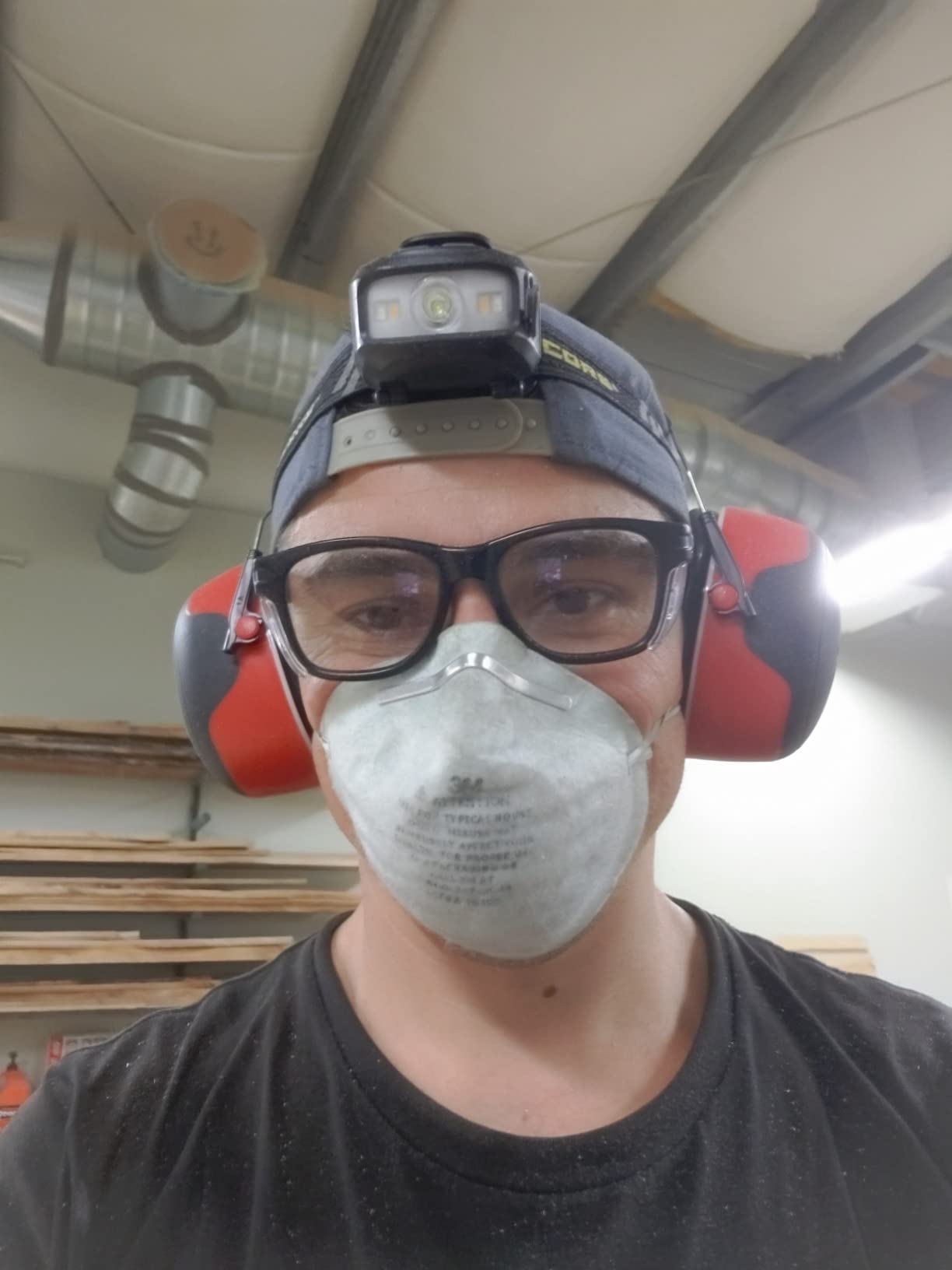
Owners report that the lenses rarely fog across a long shift, and the flexible black nylon frame with soft gray temple pads stays comfortable through physically demanding work. The 99.9% UV rating covers outdoor site time.
A wiper-style carrying case with a microfiber interior is included, which sounds minor until you are trying to keep a scratched lens clean on a dusty site.
Best for crews buying identical pairs
Buyers frequently order multiple of these for a whole crew, because the identical frame and fixed sizing make a uniform issue trivial to manage. For a foreman handing out eyewear at the morning toolbox talk, that simplicity counts.
It also wears well enough for years of site use, which several mechanics and fabricators report.
Where it is not adjustable
There is no temple adjustment at all, so the fit is whatever the fixed geometry gives you. On a wider face the temples can press, and the nose bridge can rub raw during a sweaty shift.
Some buyers notice slight magnification in the lens, which bothers sensitive eyes, and the rim can press uncomfortably against certain hard hat shells. Test it with your hat on before committing the crew to it.
5. 3M Virtua CCS: Best for Dusty and Humid Sites
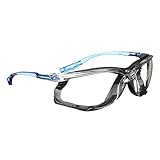
3M Safety Glasses, Virtua CCS, Anti-Fog Clear Lens, Blue Frame, ANSI Z87
Removable foam gasket
Wraparound lens with vents
Ear plug control system
Pros
- Foam gasket forms a near-seal against dust
- Wraparound lens covers the whole eye socket
- Easy to put on and remove one-handed
- Fits a half-mask respirator
- Reader versions in plus 1.5 to plus 2.5
Cons
- Gasket traps sweat that streaks the lens in hot work
- Anti-fog coating is not scratch resistant
- No carrying case included
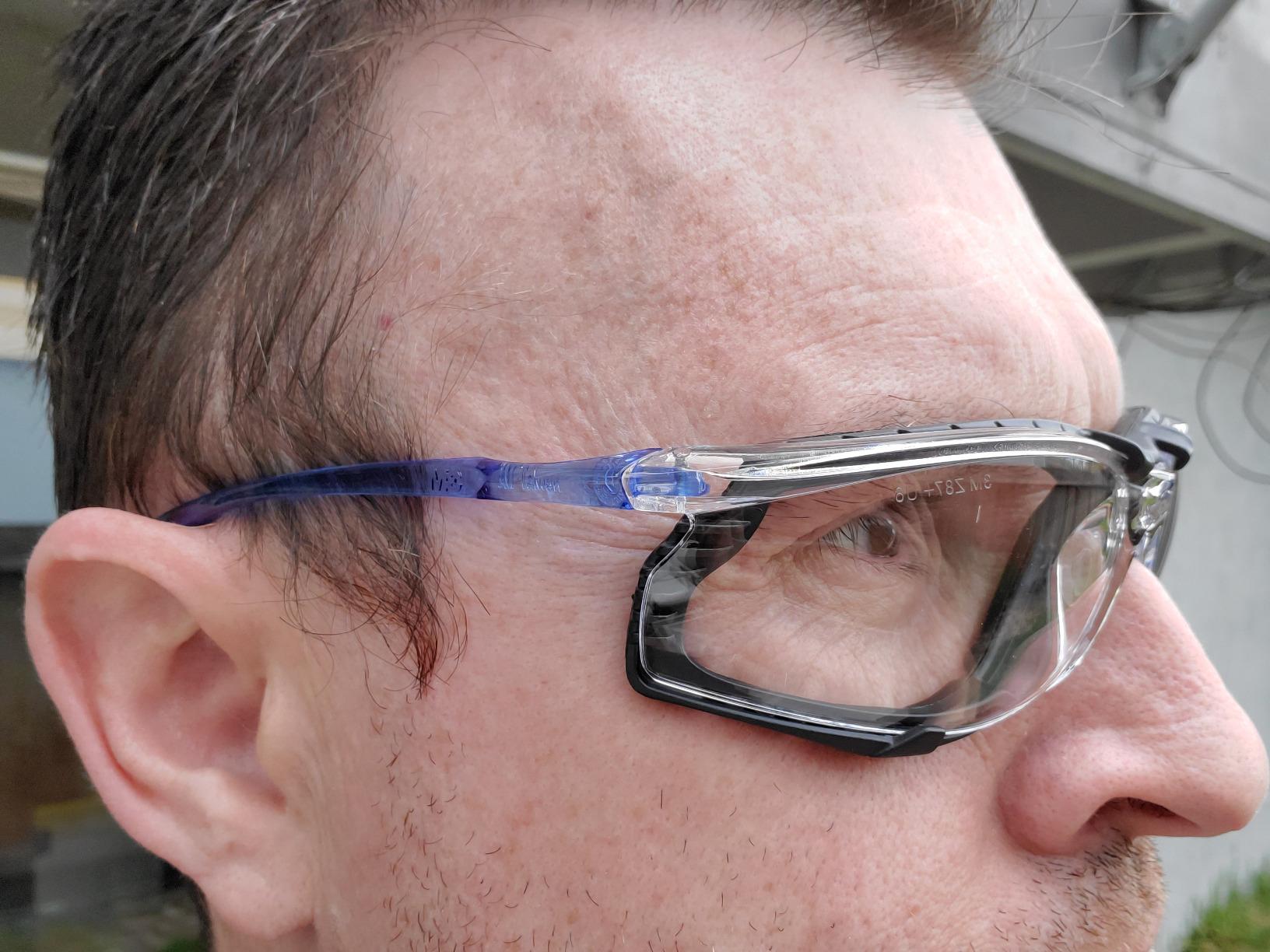
The Virtua CCS is the fog-control specialist of this group. The removable foam gasket limits dust exposure and adds cushioning, and in cooler conditions it is regularly described as the best fog solution available in a spectacle-style frame.
It meets ANSI Z87.1-2020 and CSA Z94.3-2007 high impact requirements, so it is a legitimate Z87-class pair rather than a comfort frame. The wraparound design gives extended eye protection and an unobstructed view.
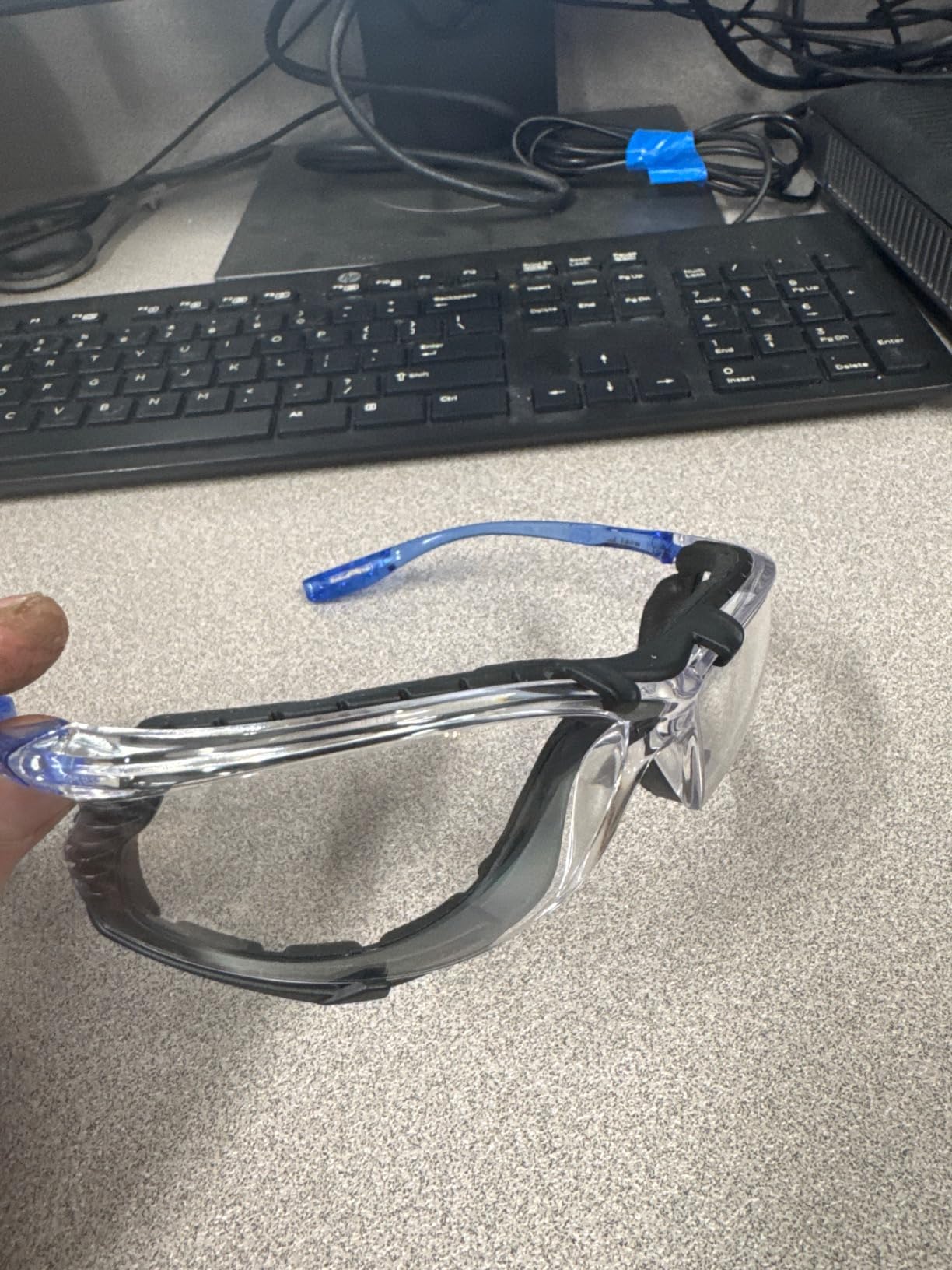
Readers are a genuinely useful detail for site work. Versions are available in plus 1.5, plus 2.0 and plus 2.5 diopters, which lets a presbyopic electrician or installer skip the over-glasses workaround entirely.
The corded ear plug control system on the temples keeps plugs attached and untangled, and users report it fits large heads well alongside a half-mask respirator.
Where the gasket earns its keep
In dusty or humid work, the gasket is the reason the lens stays readable. Wearers in those conditions consistently rate it as the best anti-fog performance they have had in a safety frame.
At 1.12 ounces it disappears on your face, and it is easy to put on and remove with one hand, which matters when you are gloving up.
Where heat defeats it
The gasket collects perspiration in hot work, and that moisture streaks and blurs the lens just when visibility matters most. That single complaint accounts for most of the gap between its rating and the higher-rated pairs.
The anti-fog coating is not scratch resistant, so rinse rather than wipe, and the lens will mark quickly if you treat it like a shop rag. There is no case included.
6. DEWALT Dominator DPG94: Rugged Full Rim
DEWALT DPG94-1D Dominator Z87+ Safety Glasses
Full rim wraparound frame
Ansi Z87.1 high impact rated
99.9 percent UVA UVB UVC
Pros
- Durable build that survives drops and impacts
- Clear lenses with no distortion or glare
- Rubber temple tips and nosepiece grip well
- Comfortable for extended wear
Cons
- Open gap under the lens admits upward debris
- Bulky styling
- No case included
- Still fogs occasionally
The Dominator is the most mechanically rugged pair here. It is built on a wide frame with extended temples and wraparound lenses, with rubber-tipped temples and an integrated rubber nosepiece for grip, and at 2.12 ounces it still feels substantial rather than flimsy.
It is ANSI Z87.1 high impact rated with 99.9 percent UVA, UVB and UVC protection. That is the basic Z87 rating rather than Z87+, so it is appropriate for general site work and not the choice for a framing crew taking high-speed impacts.
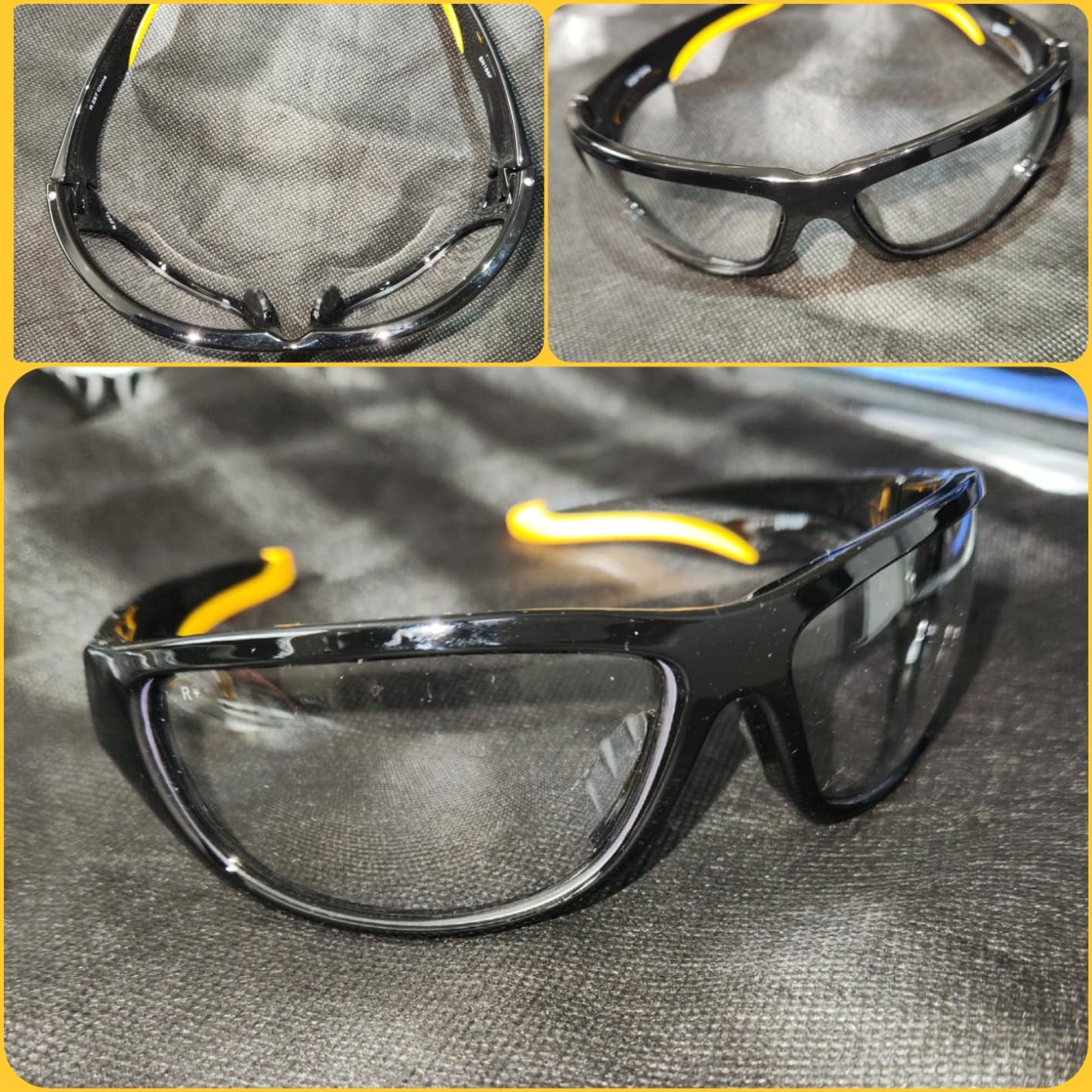
Optical clarity is the standout feature. Owners repeatedly note clear lenses with no glare and no optical distortion, which matters if you are checking a plumb line or reading a conduit take-off.
Users also report it does not fog often for most wearers, and the soft-touch temple tips stay comfortable through a long shift.
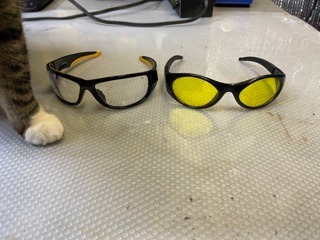
Best for rough handling
Reviewers describe dropping them, sitting on them and throwing them in a truck bed, and they keep working. That durability is why they tend to last rather than get replaced every season.
The full rim is the right shape for general site wear because it protects the lens edge from the impact that cracks corner-first frames.
Where the open bottom is a problem
There is a gap between the bottom of the lens and the face, and users doing yard work report that debris thrown upward can pass through it. For that reason we would not pick this pair for digging, trenching or anything throwing material from below.
The styling is bulky and unflattering for some wearers, and there is no case included, so the lens takes the punishment.
7. BISON LIFE Six Pack: Best Value for Crews
BISON LIFE Clear Safety Glasses for Men & Women, ANSI Z87.1 Certified, 6 Pk
Six pairs per pack
ANSI Z87.1 embossed on temple
Deep side shields
Pros
- Six pairs in one pack
- Embossed ANSI Z87.1 marking on the frame
- Light enough to wear for hours
- Deep side temples block side entry
- Lenses stay distortion free
Cons
- Lenses scratch and scuff easily
- Occasional defective pairs in a pack
- Fixed temples with no adjustment
- Cheap-feeling plastic
The reason to buy this one is arithmetic. Six pairs per pack means a foreman can hand out a full set of ANSI Z87.1 certified eyewear to a small crew without tracking anyone down, and the per-pair cost works out well below anything else here.
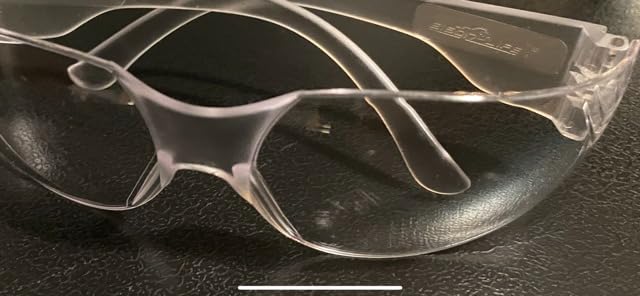
Each pair is ANSI Z87.1 certified with the mark embossed on the temple, so the compliance stamp is on the frame where an inspector can see it. The 180-degree wraparound protection and deep side temples give more side coverage than the price suggests.
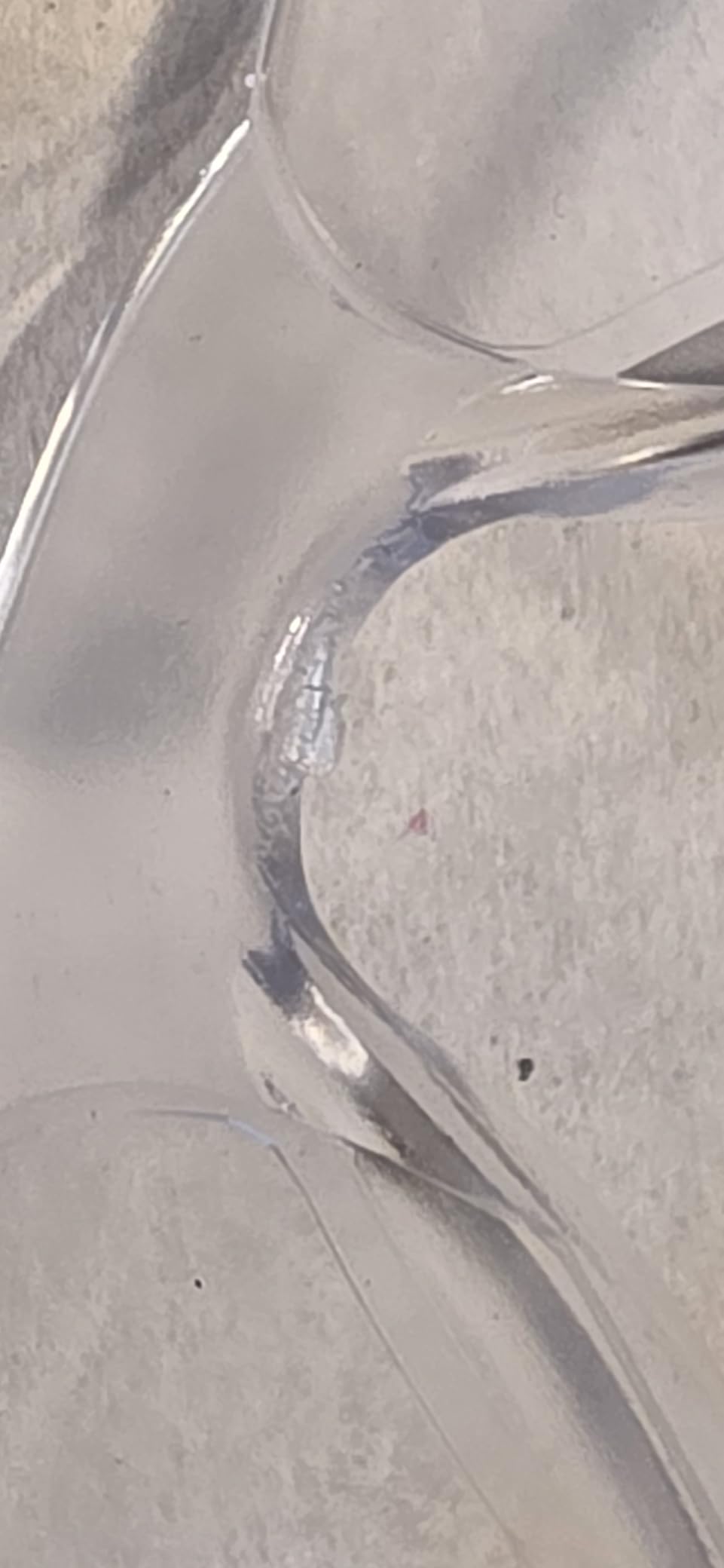
The clear polycarbonate lens is continuous with an anti-scratch coating, and reviewers report distortion-free clarity across most pairs in the pack. The universal-fit ergonomic temples cover a 5.5 inch temple-to-temple width.
They are light enough to wear for hours without fatigue, which matters if the goal is getting everyone actually to wear them.
Best as spares and visitors
Reviewers treat these as spares kept in a toolbox, a truck and a job trailer, plus a pair for anyone who walks onto the site without protection. That is the honest use case for a multipack.
They also hold up well when tossed in a backpack or a toolbox, which is more than can be said for a lot of lightweight safety frames.
Where the trade-offs show
The fixed temples mean there is no fit adjustment, so they can gap slightly on a medium or larger face, and that gap is where dust and chips find their way in.
Lenses scratch and scuff fairly easily, the plastic feels cheap in the hand, and a small share of reviewers received a defective or distorted pair inside an otherwise good pack. Inspect each pair before it goes into circulation.
8. 3M Solus 1000: Best Anti-Fog in Hot Weather
3M Safety Glasses, Solus 1000, Scotchgard Clear Lens, Blue/Black Frame
Scotchgard anti-fog coating
Soft nose bridge and padded temples
ANSI Z87.1-2020 rated
Pros
- Scotchgard coating bonded to the lens
- Light at 1.12 ounces
- Grips well while sweating
- Low distortion optics
- 99.9% UV absorption
Cons
- No temple adjustment
- Sits close to the face which can cause sweating
- Rough handling can scratch the lens
The Solus 1000 is the pair to look at if fogging is the problem that ruins every other pair you have owned. Its Scotchgard anti-fog coating is bonded to the lens rather than sprayed on, which is the difference between a coating that survives months of site abuse and one that does not.
It meets ANSI Z87.1-2020 and CSA Z94.3-2007 high impact requirements, and the polycarbonate lenses absorb 99.9 percent of UV rays. The low-profile design sits close to the face without feeling heavy.
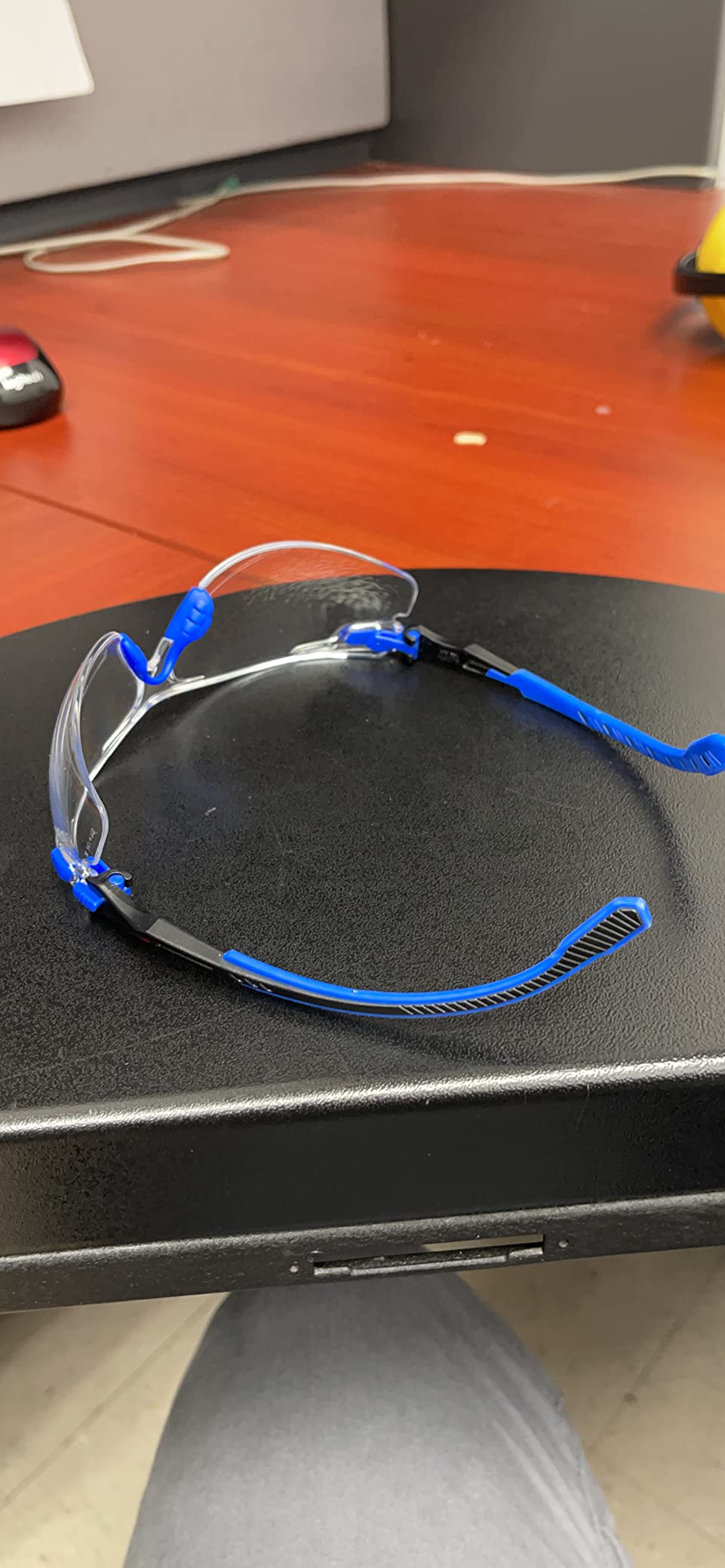
Wearers in hot and humid conditions rate the fog performance very highly, and long-term owners note that the scratch resistance outlasts cheaper pairs. The soft nose bridge and padded temples keep it bearable through a physically demanding shift.
The lens clarity is good, with little to no distortion, and at 1.12 ounces it is easy to forget you are wearing it.
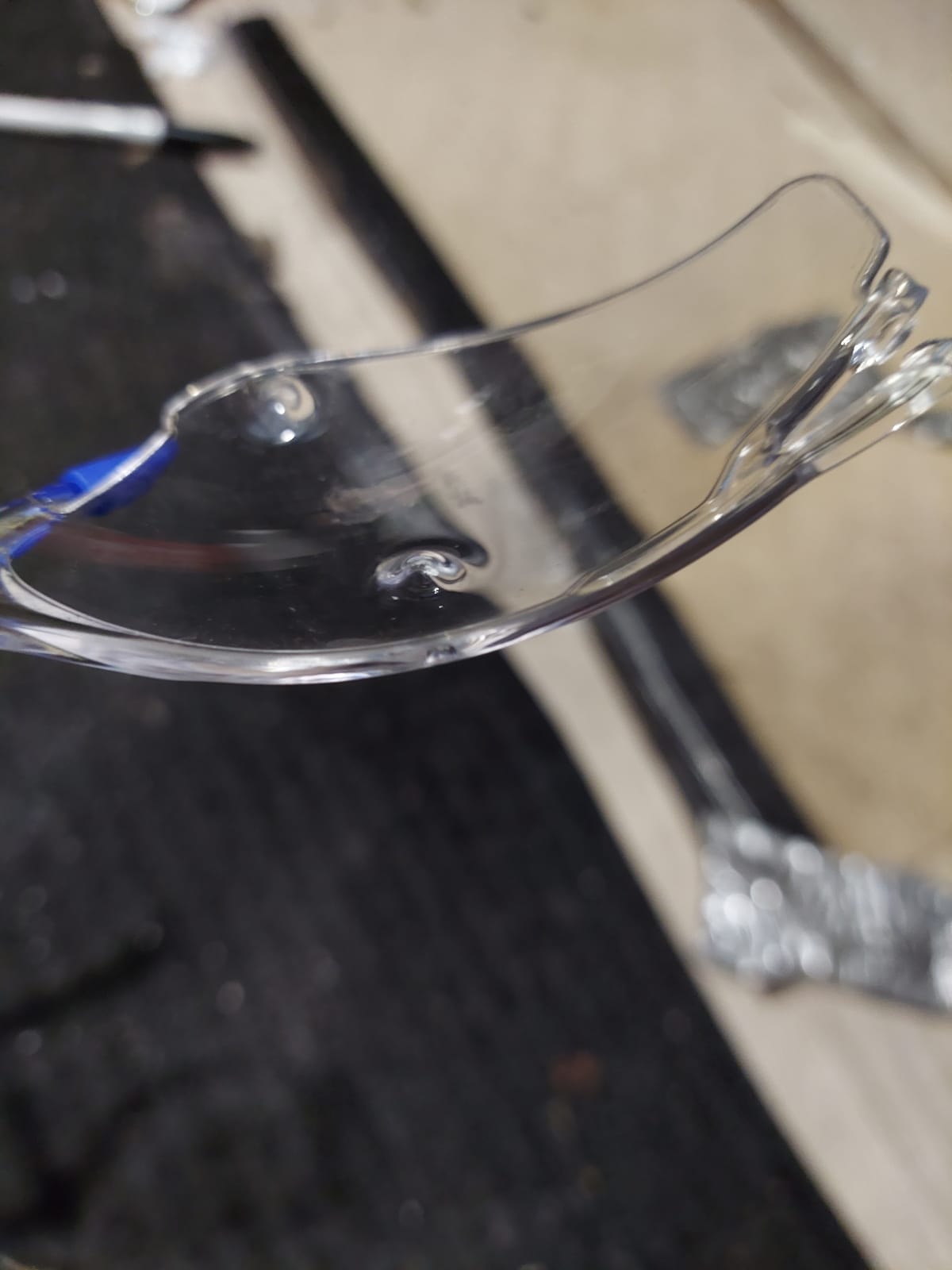
Best for outdoor summer work
This is the pair we would pick for a roof deck in July or an interior crew working in an unconditioned building. The bonded coating plus airflow through the frame keeps the lens readable where a coated-but-unbonded lens gives up.
It grips well when you are sweating, which is the other half of the fog equation, since a slipping frame and a wet lens usually arrive together.
Where the close fit bites back
There is no temple adjustment, so for some face shapes the lens sits too close and contributes to sweating and condensation instead of preventing it.
The coating is not the same as impact scratch resistance, so treat it carefully, and note that the pair costs more than comparable models.
9. G and F EyePRO Six Pack: Best for Occasional and Light Duty
G & F Products EyePRO Safety Glasses, Impact Resistant, UV400 Protection, Clear Polycarbonate Lenses, Scratch & Anti-Fog, ANSI Z87.1 Certified, Adjustable Temples, Unisex, 6/12 Pack
ANSI Z87.1 certified
Adjustable temples and nose pad
UV400 protection
Pros
- Six or twelve pairs per pack
- Adjustable temples fit a range of head sizes
- Lenses stayed scratch free through long shifts
- Lightweight for long wear
- Clear anti-fog lenses
Cons
- Adult fit can run loose on larger faces
- Lenses scratch and scuff easily
- Some fogging when worn with a mask
- Thin plastic build
The EyePRO is the budget multipack on this list, and it is the one most often described as disposable spares. Buyers use it for grass cutting, grinding, cycling and keeping a spare in the glovebox, and the adjustable temples mean one pack can cover a range of head sizes.
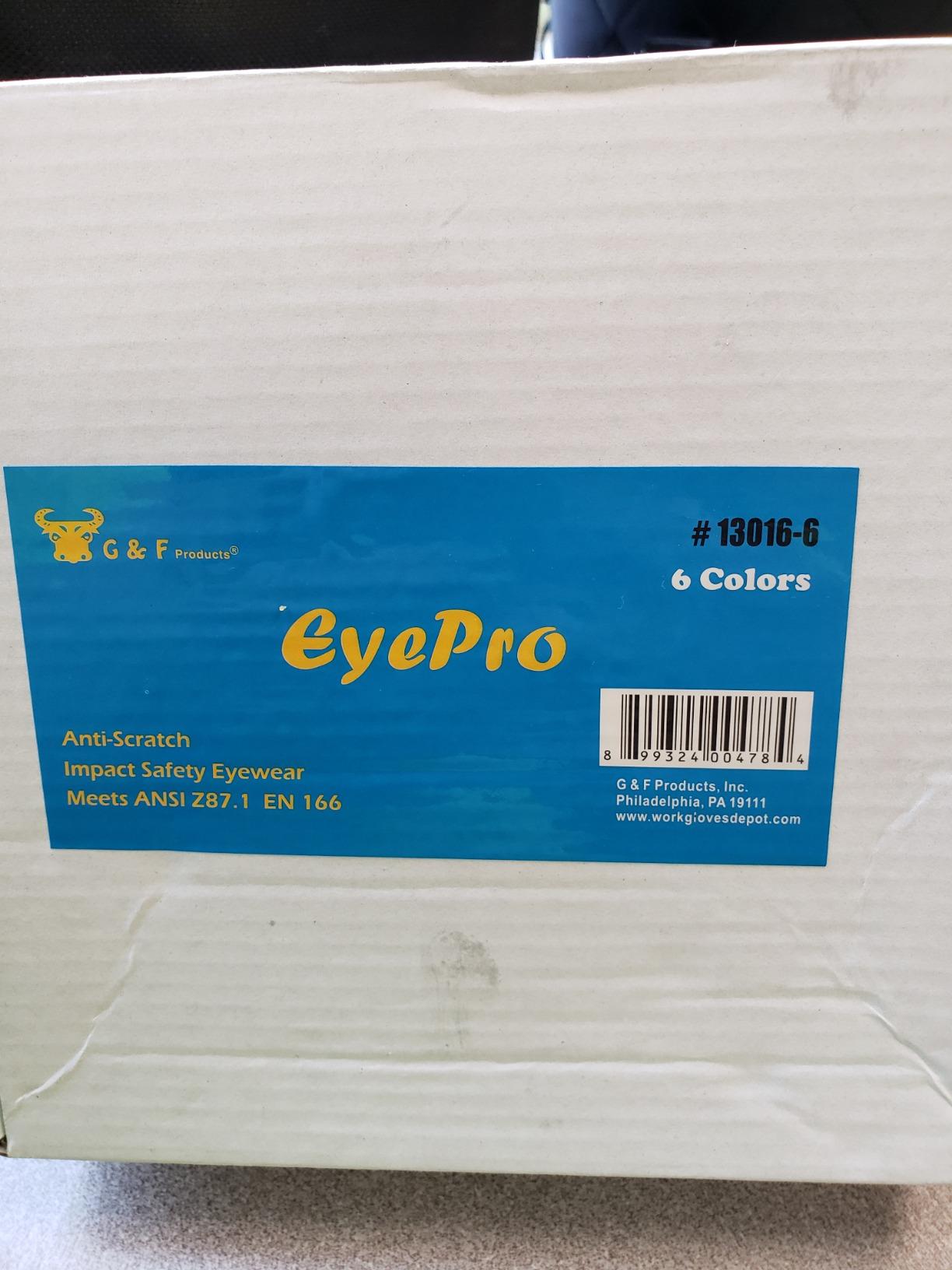
It is ANSI Z87.1 certified for impact resistance with UV400 protection, and the rimless polycarbonate frame keeps the weight down at 6.4 ounces for six pairs. The lens carries both scratch-resistant and anti-fog coatings.
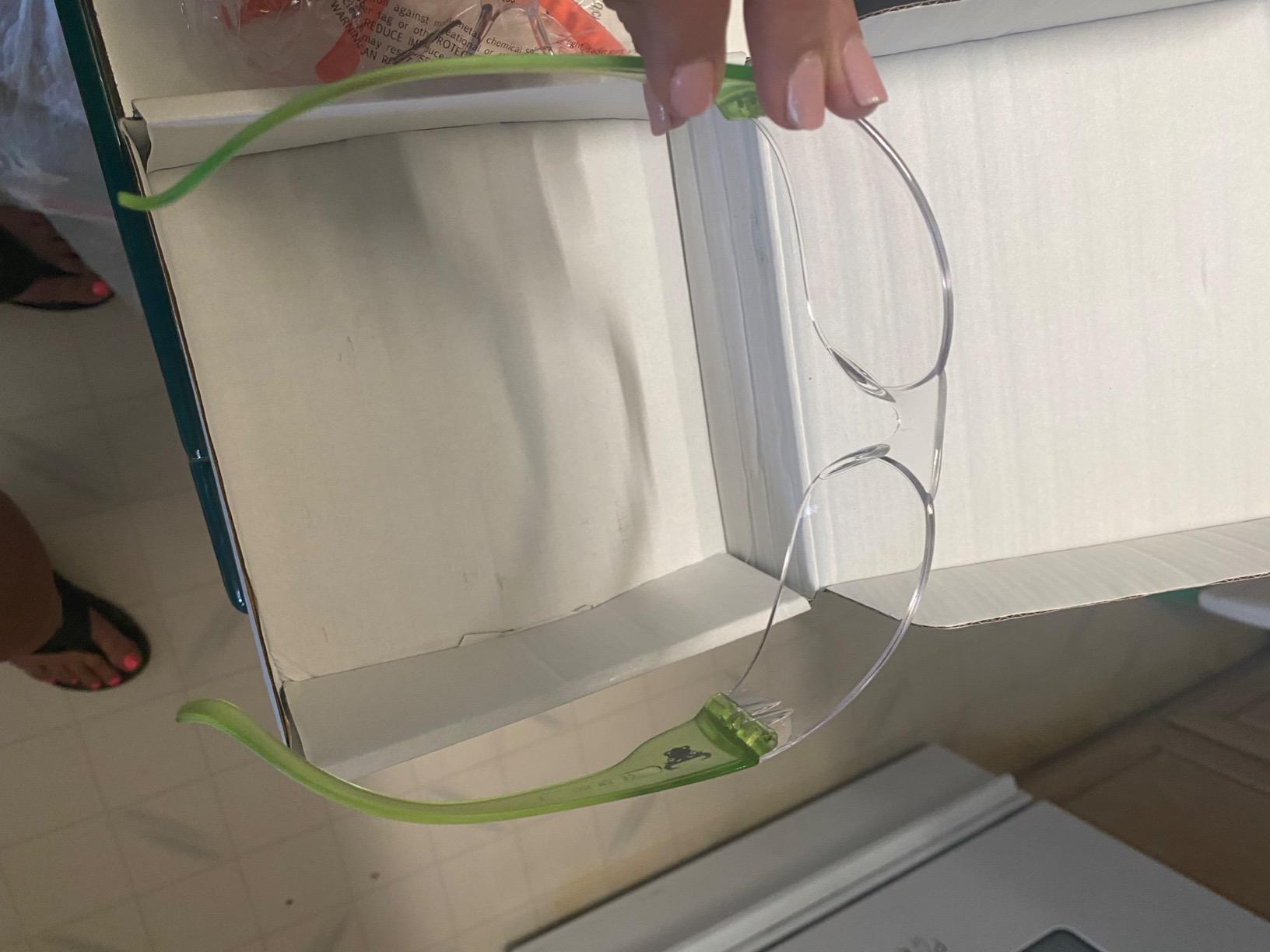
Reviewers report that the lenses stayed scratch free through twelve-hour shifts and that they are light and comfortable enough for long wear. Protection is described as adequate for sawing, grinding concrete and yard work.
The flexible nose pad is the feature that lifts it above a pure novelty pair, because it stops the frame sliding down during a task.
Best for occasional and weekend work
If your exposure is a few hours a week rather than a full shift, this is a defensible purchase. The certification is real, the coating stack is more than a bare lens, and the spare-pair logic is genuinely useful.
It is also the easiest way to fit eyewear to a whole household for one weekend of work.
Where it is not a full-shift frame
Reviewers report the fit can run loose on adult faces, with smaller sizes suiting better, and a loose frame is a poor match for a hard hat brim.
The plastic is thin, the lenses scratch and scuff easily, and there is some fogging when worn with a mask. Treat it as a spare rather than your primary pair.
10. Uvex Hypershock: Best Under a Hard Hat
Uvex Hypershock Safety Glasses, Black Frame with Clear Lens & HydroShield Anti-Fog Coating (S2940HS)
Permanent bonded anti-fog and anti-scratch
Ansi Z87.1-2015 rated
Slim side profile
Pros
- Permanent bonded coatings that do not wash off
- Wraparound side protection and good peripheral vision
- Slim temples leave clearance under a hard hat
- Secure fit across long shifts
- Durable enough for multi-year service
Cons
- Opaque temples create a blind spot
- Temple hinges can detach if handled roughly
- Plastic frame feels cheap
- Needs a break-in period
The Hypershock is the frame that understands a hard hat. Its slim side profile is specifically designed to leave clearance under a shell, which is the single most common reason glasses get pushed up onto a brim on a construction site.
The anti-fog and anti-scratch coatings are permanently bonded to the lens, so they do not wash off or wear off the way a sprayed coating does. It meets ANSI Z87.1-2015 high impact standards with wraparound protection for the sides.
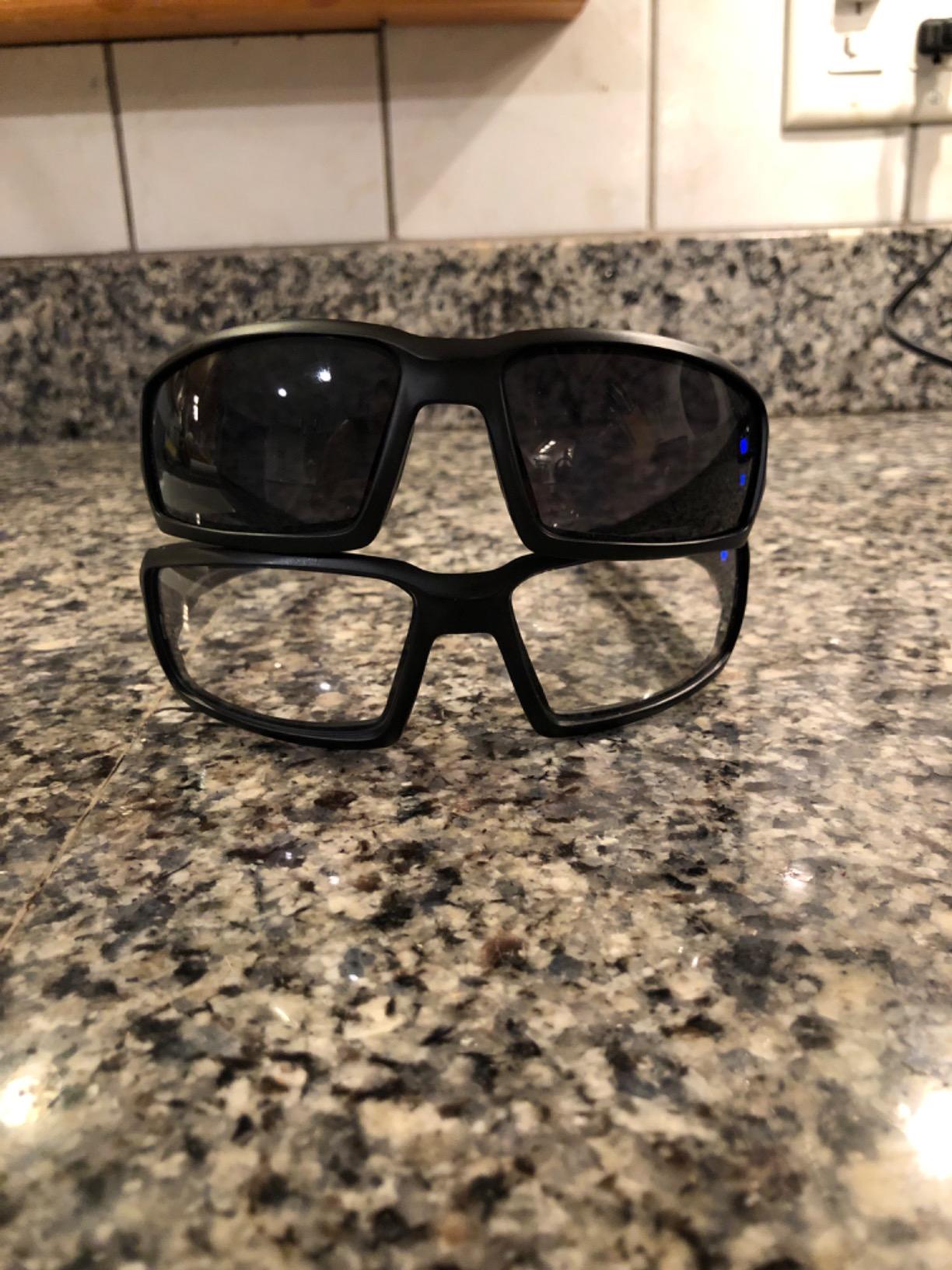
At 1.6 ounces it is light, and reviewers report a secure fit that stays in place through long shifts, plus an unobstructed field of view and good peripheral coverage. Mechanics and plant workers report multi-year durability.
The molded nose piece and soft temple inserts are comfortable enough to wear continuously, which is the goal.
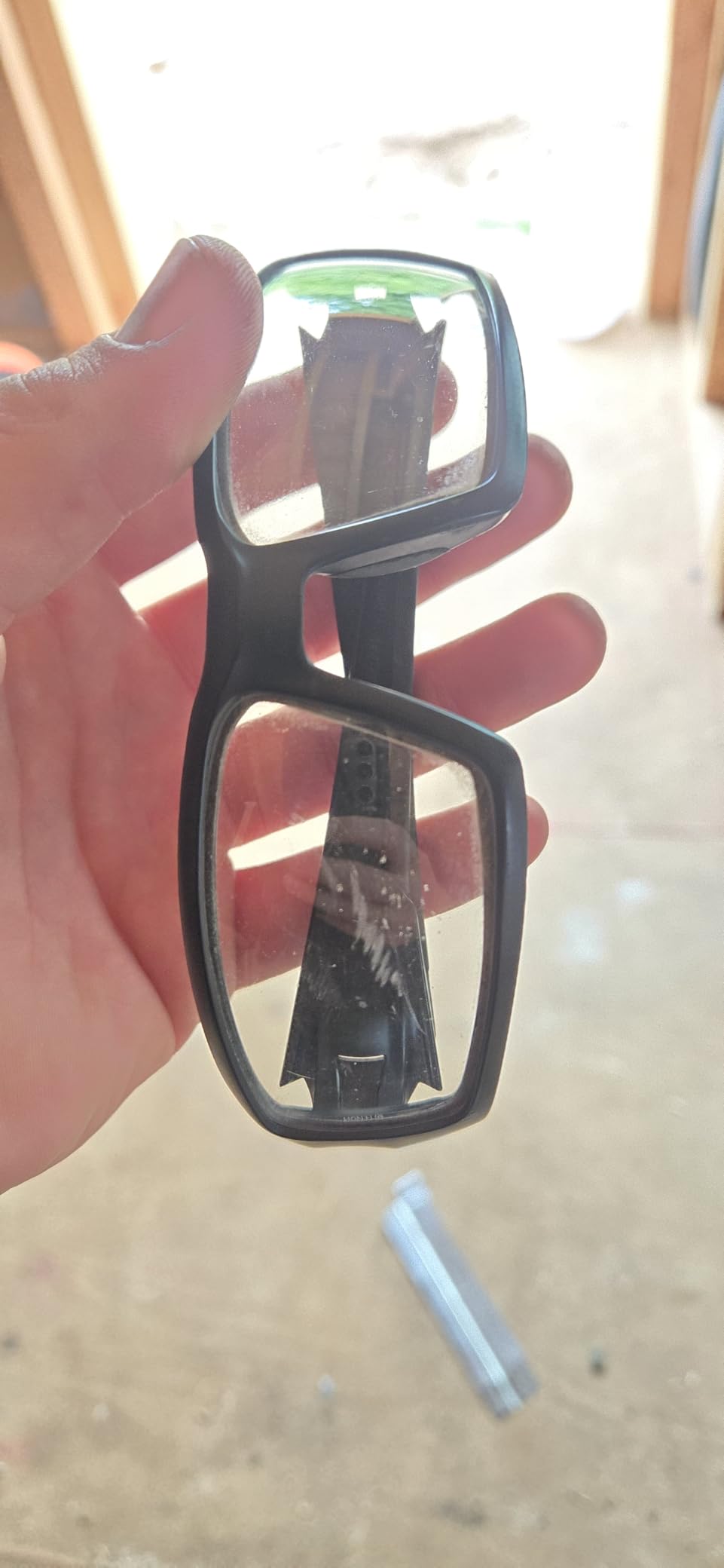
Best for hard hat and dual hearing protection
The slim temples are the reason this frame works with ear muffs, because thin arms slide under the muff cushions without lifting them off the ear. That conflict is the most common complaint people have with prescription safety glasses on site.
The wraparound lens also gives the peripheral coverage you want when you are working around equipment rather than reading a drawing.
Where it falls short
The opaque temples create a blind spot, which reviewers who drive forklifts flag as a real concern on a multi-employer site.
The hinges can detach if the frame is handled roughly, the plastic feels cheap, and the lens scratches relatively quickly. The fit also needs a break-in period because it starts tight.
11. GENYED Z87+ Gasketed: Best Lightweight Gasket Upgrade
GENYED Safety Glasses ANSI Z87+ with Removable Foam Gasket, Clear Lens, Anti-Fog, Scratch-Resistant, UV400 Wraparound Protective Eyewear for Work, Construction & DIY
ANSI Z87.1-2020 Z87+ rating
Removable soft foam gasket
1.27 oz with gasket
Pros
- Removable gasket installs in seconds
- Very light at 1.27 oz with the gasket
- Sports-eyewear styling instead of a utilitarian look
- Wraparound lens gives broad coverage
- Anti-fog anti-scratch and UV400 coatings
Cons
- Foam gasket adds bulk compared with open frames
- Seal varies across different nose shapes
The GENYED is the modern take on the gasketed frame, and the reason it is on this list is the removable foam gasket. It blocks dust, wind and fine particles, and it installs or removes in seconds so you can open the frame up for indoor finish work.
It is built and tested to ANSI/ISEA Z87.1-2020, which is the Z87+ high impact rating, with clear polycarbonate lenses carrying anti-fog, anti-scratch and UV400 coatings on a wraparound frame.
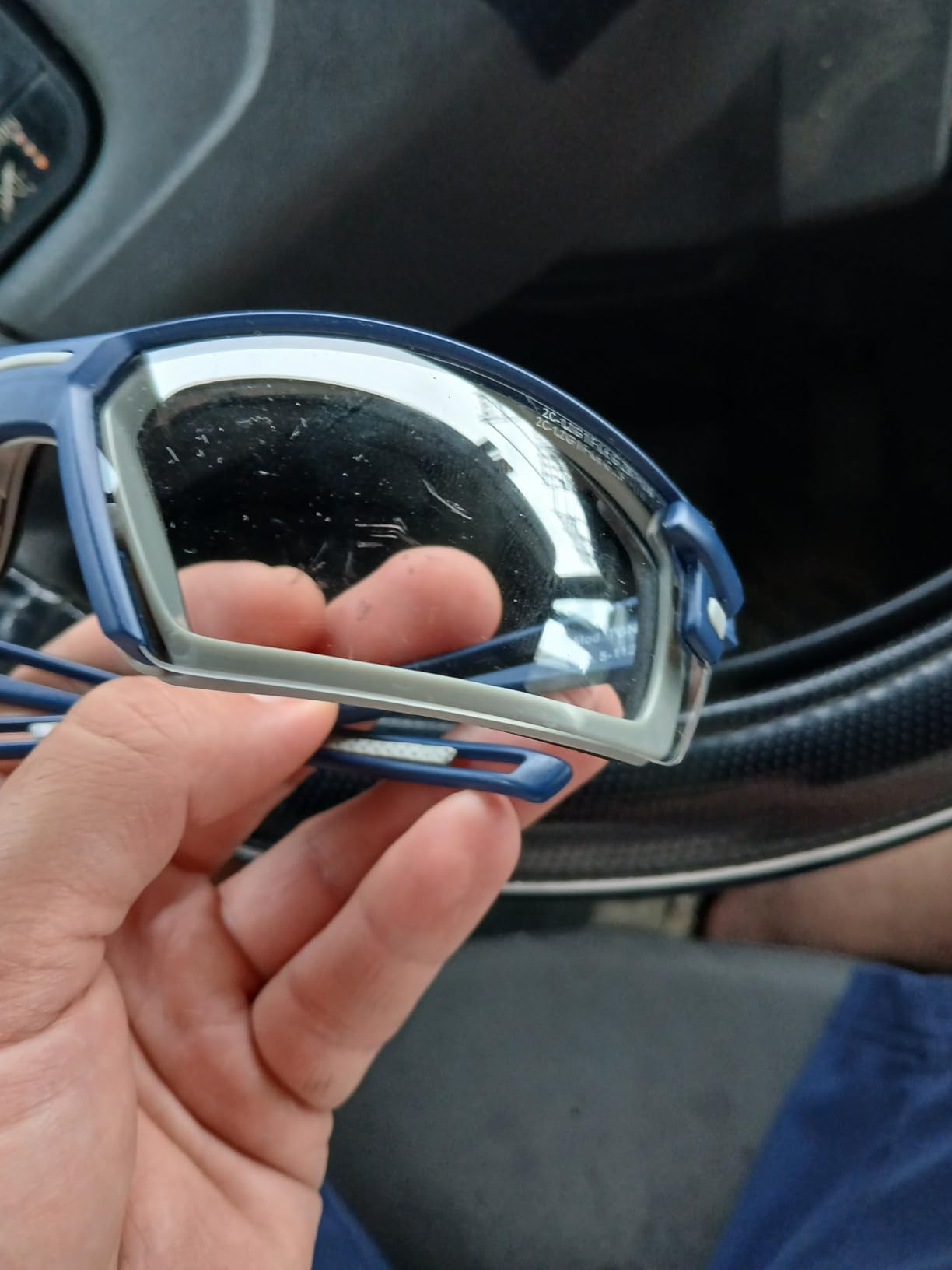
The styling looks more like sports eyewear than site-issue safety glasses, and buyers mention that directly as a purchase reason. At 1.27 ounces including the gasket, it is one of the lightest sealed options available.
Ratings skew strongly positive, with 68 percent of reviews at five stars and 16 percent at four.
Best for site presence and switchable protection
The gasket-off mode is genuinely useful. On a day of tape and layout with no dust, the frame works as light wraparound eyewear, and on a demolition day you snap the gasket on and close the side gaps.
It is a good choice for younger crews who are more likely to keep wearing eyewear that does not look like industrial equipment.
Where the gasket falls short
The foam adds bulk compared with a non-gasketed pair, and buyers report that the seal does not sit equally well across different nose shapes, so it is worth checking on your own face.
As with any foam-sealed frame, hot work inside the seal produces condensation, and this pair is not a chemical splash goggle.
12. PACIFIC PPE Two Pack: Best Spare Pair
PACIFIC PPE 2 Pack Safety Glasses for Men and Women, ANSI Z87 Safety Goggles with Scratch Resistant Clear Wraparound Lenses, Adjustable Lab Goggles, UV Protection Lab Glasses
Edge-to-edge wraparound lens
Ansi Z87.1 compliant
Acid and alkali resistant coating
Pros
- Two pairs so a spare lives in a tool bag
- Edge-to-edge lens gives a wide clear field of view
- Adjustable temples and nose pad fit pressure free
- Scratch and acid alkali resistant coating
- Polycarbonate lens and frame
Cons
- No anti-fog coating
- Frame may not sit flush on some faces
- Semi-rimless gives less side shielding
- Not designed to fit over prescription glasses
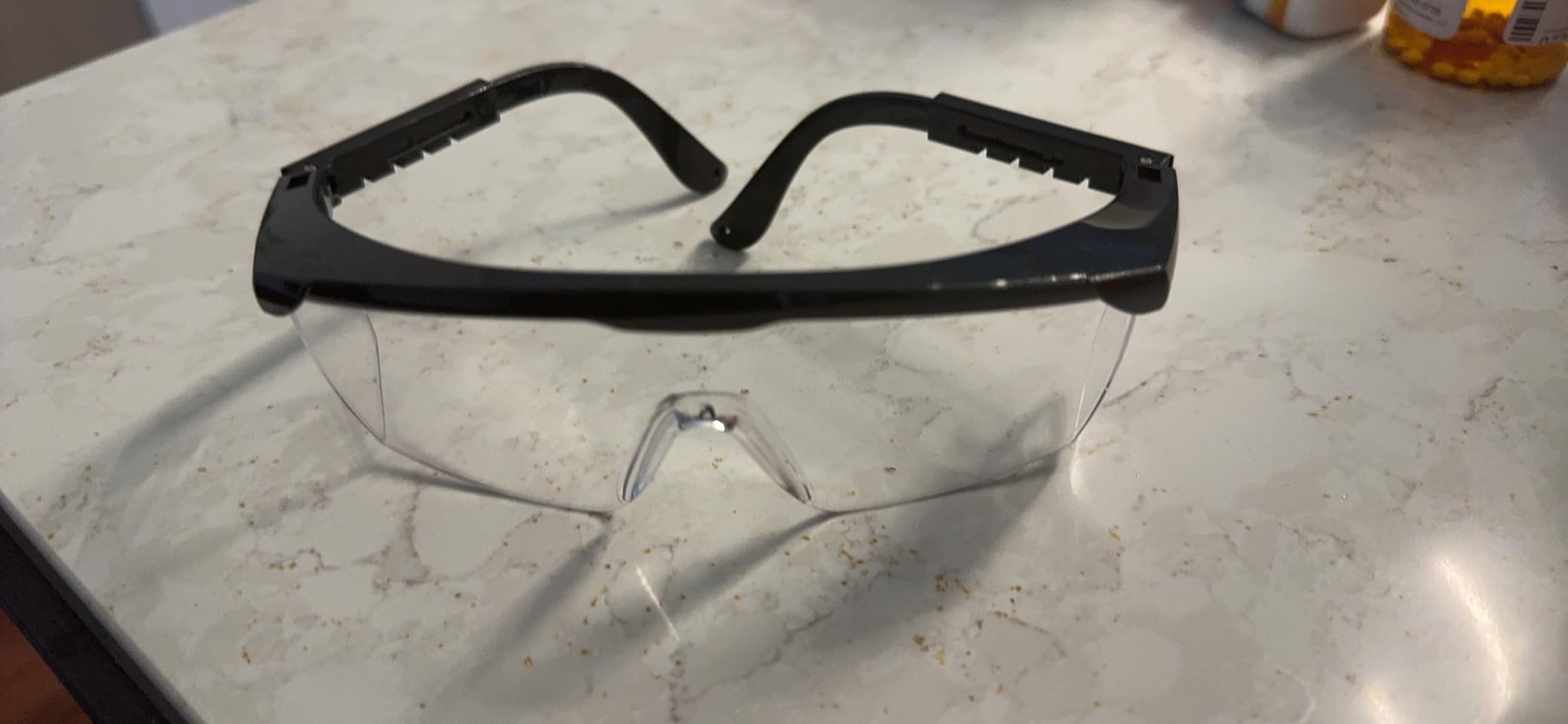
The PACIFIC PPE pair is listed as a two-pack, and that is the whole argument. It means a second certified pair lives permanently in the truck, the tool bag or the trailer, which is the cheapest insurance against a scratched lens and a shrug.
The lens is an edge-to-edge wraparound polycarbonate with a scratch-resistant coating that is also acid and alkali resistant, plus a UV protection coating. That chemical resistance on the lens surface is a modest but real bonus around cement work.
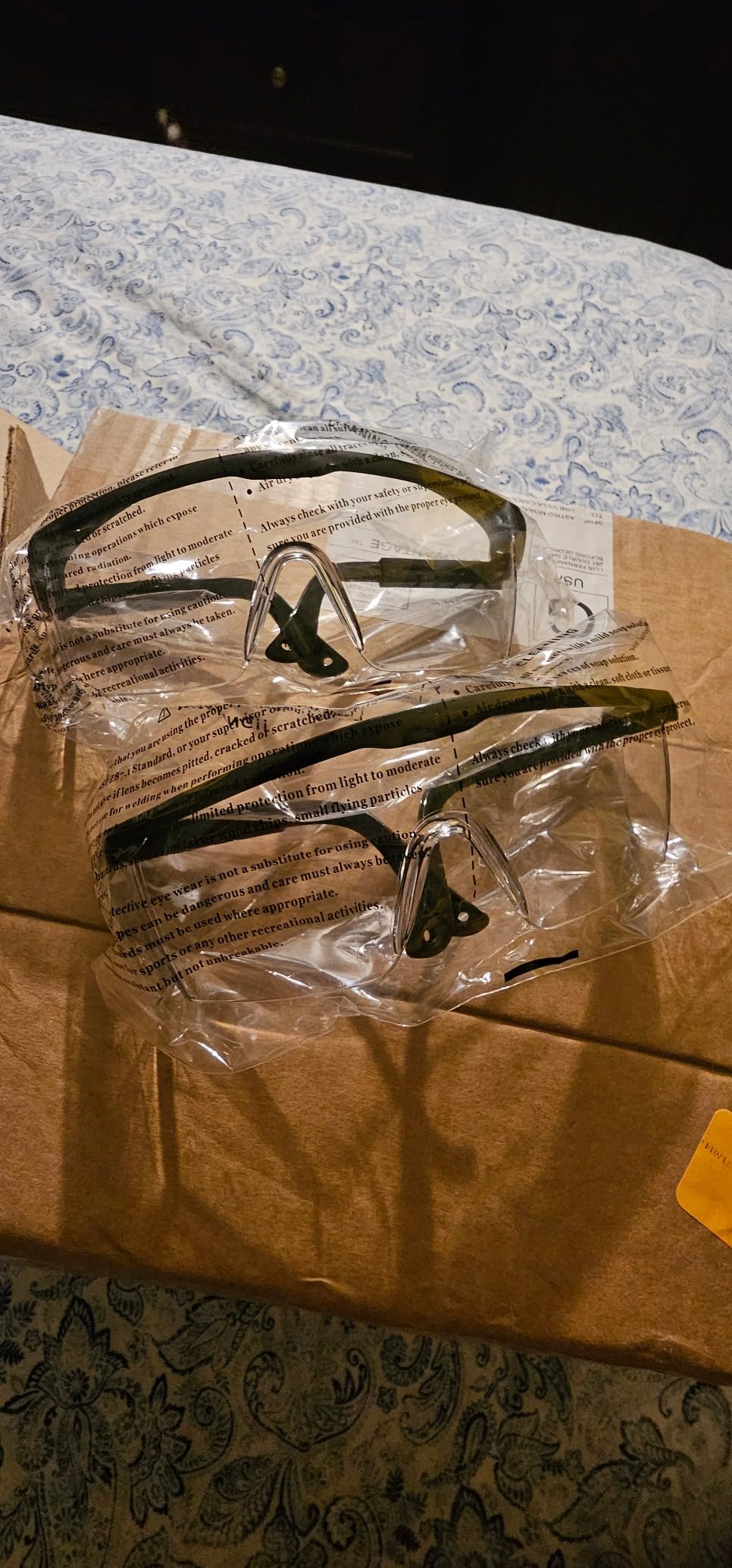
Adjustable temples and a comfortable nose pad give a snug, pressure-free fit on an average adult head, and reviewers report good light transmission with minimal glare and no colour distortion under bright lighting.
Ratings skew strongly positive, with 76 percent of reviews at five stars.
Best as a backup and a mixed bag
This is the pair to buy if you divide your time between construction, carpentry, power sawing, lab work and yard work. Reviewers use it across all of those, and the coating stack covers more of them than a bare polycarbonate frame would.
Two pairs also makes it a reasonable buy for a household or a two-person crew that needs a spare on hand at all times.
Where it is the wrong tool
There is no anti-fog coating, so it fogs in humid conditions or during exertion, which rules it out for long grinding sessions in the heat.
The sizing suits average adult heads, so it is not recommended for children, petite adults or very wide faces, and one reviewer reported the frame not sitting flush enough to deflect small fragments past the lens. It is also not designed to fit over prescription glasses, and the semi-rimless frame gives less side shielding than a full goggle.
How to Choose Safety Glasses That Survive a Full Shift?
Start with the mark, then work outward. Find the Z87 or Z87+ stamp on the frame or lens, not just in the listing, and check that the frame shape closes the side gap. Then decide whether the coating stack matches the job, and only then think about price.
Z87 or Z87+. If anything on site can throw a fragment at speed, pay for the plus. The high-velocity and high-mass tests are the difference between a frame that survives a dropped conduit strap and one that does not. For pure framing, drywall and general carpentry, a basic Z87.1 stamp is adequate.
Lens material. Polycarbonate appears on every pair here, and that is correct for construction. It is far lighter than glass and will not shatter into fragments when it is struck. Skip glass lenses on a site.
Coatings that earn their keep. Anti-fog matters more to workers than any other feature, and bonded or permanent coatings such as the 3M Scotchgard treatment on the Solus 1000 outlast sprayed ones. Never dry-wipe an anti-fog lens. Rinse it with water, or use the wiper case style of cleaning that the MAGID includes, because the grit on a dusty lens is what turns a wipe into a scratch.
Fit for smaller faces. Most brands sell one size, and it is modelled on a large adult face. If you need a genuinely narrow fit, the adjustable temples on the NoCry EyeArmor+ and the G and F EyePRO are the practical answer, and a wraparound lens that reaches past the corner of the eye solves more problems than any adjustment. Try frames on with your hard hat on, not next to it.
Prescription options. There are three routes. OTG over-glasses like the NoCry Overspecs+ put a certified lens in front of your everyday frames, which works if your frames stay within the fit dimensions. Prescription inserts clip into a goggle frame, which works well under a full-face respirator. A built-in Z87-2+ prescription lens is the most comfortable long-term answer and the one most buyers skip because of cost, but it is worth pricing if you wear glasses every workday.
PPE compatibility. Test the combination before the shift starts. Ear muffs need slim or slim-core temples, and the Uvex Hypershock is built around that. A half-mask respirator changes the face geometry and can break the temple seal, which is exactly when a foam gasket like the 3M Virtua CCS helps. A hard hat brim needs a low profile or an elastic strap, since temple frames get pushed backward. If you also need head protection, our guide to the best heated construction safety helmets assumes compatible eyewear fit.
Cleaning, inspection and replacement. Rinse lenses with clean water, blot with a microfiber cloth, and never use a sleeve or a paper towel. Check each pair at the start of a shift for lens cracks, lens clouding, and temple or hinge play, and pull any damaged pair from circulation. Realistically, budget for replacement roughly every 12 months on a general site and sooner if you grind concrete, where the abrasive dust will haze the lens before it cracks it.
Budget and premium tiers. Multipacks such as the BISON LIFE six-pack and the G and F EyePRO six-pack cover spares, visitors and occasional work at a fraction of the per-pair cost. In the middle, the NoCry and MAGID pairs cover daily wear with better coatings and fit. The premium spend is really only justified by bonded or permanent anti-fog coatings, permanent side shields and multi-year durability, and on a humid or hot site it is the coating that earns the money.
For the rest of the kit, our picks for the best winter construction safety boots and the best high-vis insulated construction jackets cover the rest of a cold-weather shift, and our heated work jackets guide covers layering underneath.
Frequently Asked Questions
Is ANSI the same as Z87?
ANSI is the standards body and Z87.1 is the number of the standard it publishes for occupational eye and face protection. So a listing marked ANSI Z87.1 is naming the correct standard. The detail that matters on site is the plus: a Z87+ mark means the lens also passed the high-velocity and high-mass impact tests, while plain Z87.1 covers the basic impact test only.
What will standard safety glasses protect against?
Standard construction safety glasses are built for flying particles, chips and dust, plus UV exposure. A Z87+ pair is rated for higher-speed impacts from fragments such as mortar, concrete chips or nail gun debris. They are not designed for liquid splash, welding arc or optical radiation, or heavy blunt impact, which need a sealed splash goggle, a proper shade-rated welding lens and a face shield respectively.
Do I need goggles for concrete cutting?
For dry cutting or grinding, a full-seal goggle is the correct answer because respirable silica dust and high-speed fragments reach the eye at the same time. Wet cutting reduces the dust plume but still throws wet slurry and chips. Open-frame safety glasses are not adequate here because the gap under the lens lets material enter from below. Seal the goggles against the face and pair them with a half-mask respirator.
How do I stop safety glasses fogging on site?
Start with a bonded or permanent coating rather than a sprayed one, since sprayed coatings wash off within weeks on a dusty site. Then rinse the lens with cool water instead of dry-wiping it, because the grit on the lens is what creates scratches. A foam gasket or a wraparound frame improves airflow and limits fog, and a clean microfiber cloth kept in your pocket matters more than any product.
Can I wear safety glasses over prescription glasses?
Yes, if you buy a model designed for it. An OTG or over-glasses frame is sized to clear prescription lenses, and you should check the stated frame width and height against your own frames before buying. Small round and wrap prescriptions often do not clear. The other routes are a prescription insert that clips into a goggle frame, or a built-in Z87-2+ prescription lens for all-day comfort.
How often should safety glasses be replaced?
Plan on roughly every twelve months for general site work, and sooner if you grind or cut concrete, where abrasive dust hazes and scratches the lens long before the frame fails. Replace any pair immediately if the lens is cracked, badly hazed, the gasket is torn or the temples play at the hinge. Keep a spare pair in the truck, because most sites treat a scratched lens as a reason to stop wearing the eyewear altogether.
Which Safety Glasses Should You Buy?
The best safety glasses for construction, for most crews, is the DEWALT DPG82 Concealer. It is the only pair here that seals against the face from every direction while still carrying a Z87+ rating and an anti-fog coating, and it holds up through dust, heat and a full shift without being pushed up onto the hard hat.
Buy the NoCry EyeArmor+ instead if you want the lightest wraparound coverage for framing and finish work, the NoCry Overspecs+ if you wear prescription glasses and your frames stay within 5.7 inches wide, and the 3M Solus 1000 if fogging is the specific problem you keep fighting. For a crew or a pile of spares, the BISON LIFE six-pack is the straightforward answer, and the Uvex Hypershock is the frame that fits under a hard hat and over ear muffs.
Whichever you choose, verify the Z87 mark on the frame itself, fit it with your hard hat and respirator on, and replace it when the lens hazes. That last habit matters more than the model you picked in 2026.