
If you are new to hockey, you have probably found yourself staring at the ice wondering what all those painted lines actually mean. I remember my first game – I kept hearing the announcer mention “offsides” and “icing” without understanding why those calls were being made. The truth is, every single line on a hockey rink serves a specific purpose, and once you understand them, watching hockey becomes infinitely more enjoyable.
This guide answers the question what are the lines on a hockey rink by breaking down each marking, explaining its purpose, and connecting it to the rules that govern gameplay. Before we dive in, here is a quick clarification: this article is about the painted lines and markings on the ice surface, not the “player lines” (which refer to the forward rotation groups).
By the end of this guide, you will understand exactly what each line does, why refs blow the whistle when they do, and how these markings shape the strategy you see on the ice.
Table of Contents
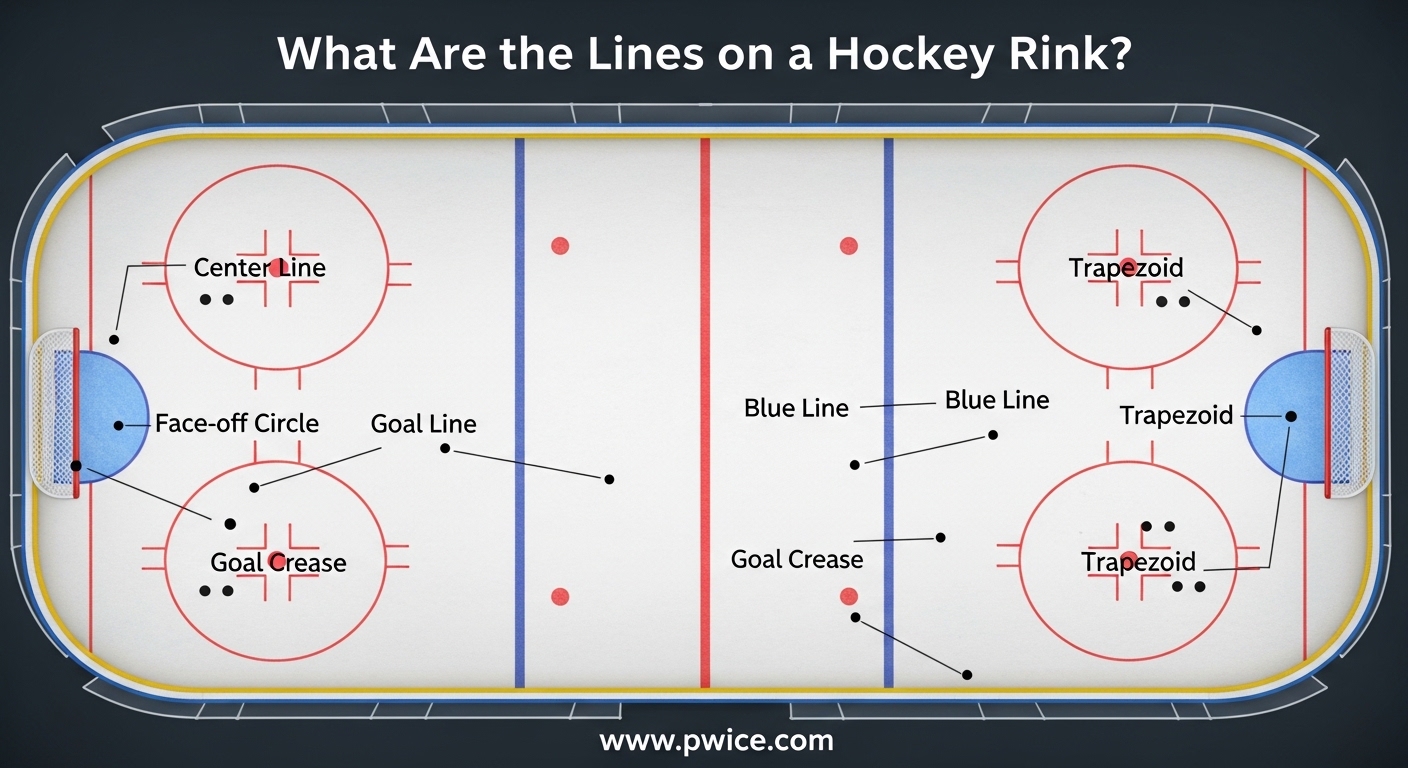
Quick Reference Guide: The 5 Main Lines and Markings
A standard hockey rink features five major types of lines and markings that divide the ice and govern gameplay:
- Center Red Line – Divides the rink into two equal halves. Essential for determining icing calls and was historically used for the two-line pass rule.
- Blue Lines (2) – Create the three zones of the ice (defensive, neutral, and offensive). These determine offside violations.
- Goal Lines (2) – Mark the opening of each goal and are used to judge goals and certain icing situations.
- Face-Off Circles and Dots (9 total) – Designated spots where play restarts after stoppages.
- Goal Crease and Trapezoid – Protected areas that define where goalies can play the puck and where attacking players cannot interfere.
Think of these lines as the boundaries of a strategic battlefield. Each one triggers specific rules that coaches plan around and players must constantly monitor during play.
The Red Line (Center Line): Dividing the Rink
The center red line runs across the width of the ice exactly at the 100-foot mark in an NHL rink, dividing the 200-foot playing surface into two 100-foot halves. This line is 12 inches wide and painted solid red.
How the Red Line Creates the Icing Rule
The red line plays a critical role in one of hockey’s most important rules: icing. When a player shoots the puck from behind the center red line and it crosses the opponent’s goal line without being touched, icing is called.
This rule prevents teams from simply firing the puck down the ice to relieve pressure. When icing occurs, play stops and a face-off happens in the offending team’s defensive zone. In most leagues, the team that iced the puck cannot change players before the face-off, which adds a significant strategic penalty.
The Two-Line Pass Rule History
If you watch classic hockey games from before the 2004-2005 season, you will notice a major difference: the two-line pass rule. Before 2026, a pass that crossed both the center red line and a blue line in one motion was illegal and resulted in a stoppage.
The NHL eliminated this rule to increase scoring and speed up the game. Today, players can make long stretch passes from their own end all the way to the offensive blue line, creating exciting breakaway opportunities that were previously forbidden.
Line Changes and the Red Line
The center red line also serves as a reference for legal line changes. Players can change on the fly when the puck is in the neutral zone or when their team is in possession. Understanding where the red line sits helps coaches time their substitutions to get fresh legs on the ice at the right moments.
The Blue Lines: Defining Hockey’s Zones
The blue lines are arguably the most important markings on the ice. Two blue lines run across the rink, each 12 inches wide, positioned 25 feet from each center red line. These lines create the three zones that define hockey strategy.
The Three Zones Explained
Between the two blue lines sits the neutral zone, a 50-foot wide area where teams transition between offense and defense. The area from the blue line to the goal line behind your own net is your defensive zone. The area from the blue line to the opponent’s goal line is the offensive zone (also called the attacking zone).
Each zone demands different tactics. In the defensive zone, teams collapse around their net and look for breakout passes. In the neutral zone, speed and transition matter most. In the offensive zone, teams set up structured attacks looking for scoring chances.
Understanding the Offside Rule
The blue lines determine offside, one of hockey’s fundamental rules. An attacking player is offside if both skates completely cross the attacking blue line before the puck fully crosses it.
This rule prevents teams from camping players near the opponent’s goal waiting for long passes. It forces teams to carry or pass the puck into the zone together, creating a more structured and fair game.
There is an important nuance: the blue line is part of whichever zone the puck is in. If the puck is in the neutral zone touching the blue line, an attacking player can have one skate on the blue line and one in the attacking zone without being offside.
Tag-Up Offside
Modern hockey uses “tag-up offside” rules. If all attacking players clear the offensive zone (touching the neutral zone with both skates) before the puck is shot back in, the offside is negated. This allows teams to regroup without a stoppage, keeping the game flowing faster than the old immediate whistle system.
Blue Line Strategy: The Hold and the Pinch
Defensemen live at the blue lines. When defending, they stand at their own blue line to prevent opponents from entering the zone with speed. When attacking, they pinch down the boards to keep pucks in the offensive zone.
If a defenseman misreads a pinch and the puck gets past him, a 2-on-1 or breakaway often results. The blue line represents a critical decision point dozens of times every game.
The Goal Lines: Judging Goals and Icing
The goal lines are red lines that run across the ice 11 feet from each end board, marking the plane of each goal mouth. These lines serve two critical functions: determining goals and enforcing icing.
How Goals Are Judged
A goal is scored when the puck completely crosses the goal line between the goal posts and under the crossbar. Video replay officials scrutinize whether the puck fully crossed that red line, often using camera angles parallel to the ice surface.
The goal line “extended” concept helps refs determine if a puck shot behind the net crossed an imaginary continuation of the goal line. This matters for goals banked in from sharp angles.
Icing and the Goal Line
For icing to be called, the puck must cross the opponent’s goal line. However, hybrid icing rules now allow linesmen to blow the whistle early if they determine a defensive player would reach the puck first at the end boards.
This safety rule prevents dangerous races into the boards where players might crash at high speed. The goal line remains the theoretical end point, but judgment calls now factor in player positioning.
Face-Off Circles and Dots: Where Play Restarts
Hockey features nine designated face-off spots marked by red circles 30 feet in diameter with blue dots at their centers. Each spot has a specific purpose based on where play stopped.
Center Ice Face-Off Circle
The main face-off circle dominates center ice, 30 feet across with a 15-foot radius blue spot in the middle. Every period begins here, and play restarts at center ice after a goal or when the cause of stoppage cannot be determined.
End Zone Face-Off Circles
Four end zone circles sit 20 feet from each goal line and 22 feet from the side boards, two in each offensive zone. These host face-offs after goalie freezes, goals scored from the attacking zone, and many penalties.
Hash marks perpendicular to the goal line extend 5 feet on each side of the circle. These marks show where players not taking the face-off must stand during the drop, keeping lanes clear for wingers.
Neutral Zone Face-Off Dots
Four smaller red dots appear in the neutral zone, 5 feet inside each blue line and 44 feet apart. Play restarts here after icings, pucks shot out of play from the neutral zone, and certain penalties.
The strategic importance of face-off location cannot be overstated. Coaches practice face-off plays constantly because winning a draw in the offensive zone leads directly to scoring chances.
The Goal Crease: The Goalie’s Protected Territory
The goal crease is a blue semi-circular area in front of each net, extending 4 feet from each goal post and forming a 6-foot radius arc connecting them. A red line outlines this protected space.
Goalie Interference Rules
The crease exists to protect goaltenders from contact while making saves. Attacking players cannot enter the crease and make contact with the goalie without penalty. If a goal is scored while an attacking player is in the crease (even without contact), the goal is typically disallowed.
Defensemen, however, may enter their own crease to support their goalie. The crease belongs to the goaltender alone when opponents are attacking.
Crease Dimensions and Variations
NHL creases feature rounded corners, while international (IIHF) creases have square corners extending further from the net. Youth hockey often uses smaller creases appropriate to the age group.
The crease line matters for determining when a goalie has frozen the puck and when play should stop. Refs watch for pucks held long enough to warrant a whistle.
The Trapezoid: The Goalie’s Restricted Area
Behind each net, a red trapezoid-shaped area defines where NHL goalies may legally handle the puck. The trapezoid extends 8 feet from each goal post along the goal line, then angles outward to 28 feet wide at the end boards.
The “Martin Brodeur Rule” History
The trapezoid was introduced in the 2005-2006 season specifically because of goaltender Martin Brodeur. His exceptional puck-handling skills allowed his team to play a defensive system where he retrieved pucks anywhere behind the net and cleared them before opponents could establish forecheck pressure.
Brodeur’s dominance prompted the NHL to restrict goalie puck-handling to the trapezoid area, preventing goalies from venturing far behind their net to neutralize dump-in plays.
Trapezoid Violations
If a goalie touches the puck behind the goal line but outside the trapezoid, a two-minute delay of game penalty is assessed. This forces goalies to let pucks go when they cannot reach them within the restricted area, giving forechecking teams a better chance to recover those pucks.
Not all leagues use the trapezoid. International play and many minor leagues allow goalies to play the puck anywhere behind the net, making NHL trapezoid rules unique to that league.
NHL vs International Rink Dimensions
Not all hockey rinks are identical. Understanding the two main standards helps explain differences you might notice watching different leagues.
- NHL Rinks: 200 feet long by 85 feet wide with corner radius of 28 feet
- International (IIHF/Olympic) Rinks: 200 feet long by 100 feet wide with corner radius of 28 feet
The 15 extra feet of width on international rinks significantly changes how the game plays. There is more room to maneuver, which benefits skilled European-style players. The neutral zone is wider, making trap defenses less effective than on narrower NHL ice.
Youth and high school rinks vary even more. Some use “Olympic” size while others use “NHL” size, and some fall somewhere in between. The lines function the same way regardless of rink width, but the extra space changes strategic priorities.
How Hockey Rink Lines Are Made
Have you ever wondered how those perfectly straight lines get on the ice? The process is more complex than simply painting over the surface.
Fabric Tape Under the Ice
Professional rinks actually embed the lines in fabric tape placed on the concrete floor before any ice is made. Facilities paint or embed lines into special fabric tape that sits on the rink bed, then freeze water over it. This places the lines inside the ice rather than on top.
Because the markings are embedded, they remain visible even after heavy use and Zamboni resurfacing. You cannot simply wash them away or scrape them off.
Building a Backyard Rink
If you are building a backyard rink and want authentic lines, several options exist. Special ice paint formulated for cold temperatures works well on backyard surfaces. Some builders use thin wooden strips painted white as physical guides. Others simply sprinkle snow or use thin tape temporarily frozen into the surface.
For casual backyard rinks, perfection is not necessary. A simple center line and approximate goal crease is enough for pickup games. Save the precise measurements for serious practice sessions.
Frequently Asked Questions
What do all the lines on a hockey rink mean?
A hockey rink has five main types of lines and markings: the center red line (for icing and dividing the rink), two blue lines (creating three zones and determining offside), two goal lines (marking the goal mouth), face-off circles and dots (9 total spots where play restarts), and the goal crease with trapezoid (protected areas for goalies). Each line serves a specific purpose in governing gameplay and strategy.
What are the blue lines on a hockey rink for?
The blue lines create hockey’s three zones: defensive zone (between your goal line and blue line), neutral zone (between the two blue lines), and offensive zone (between the opponent’s blue line and goal line). They primarily determine the offside rule – attacking players must have the puck cross the blue line before they fully enter the offensive zone. The blue lines are 12 inches wide and sit 25 feet from the center red line.
What is the red line in hockey?
The red line runs across the center of the rink, dividing the 200-foot playing surface into two equal 100-foot halves. It is 12 inches wide and primarily used for the icing rule – a shot from behind the red line that crosses the opponent’s goal line without being touched results in an icing call. Before 2005, the red line was also used for the two-line pass rule, which the NHL eliminated to increase scoring.
How many lines are on a hockey rink?
There are five main lines on a hockey rink: one center red line, two blue lines, and two goal lines. Additionally, there are numerous markings including nine face-off dots with circles, two goal creases, two trapezoids behind the nets, and hash marks at the face-off circles. The blue and red lines are each 12 inches wide, while goal lines are 2 inches wide.
What is the trapezoid in hockey?
The trapezoid is a restricted area behind each net where NHL goalies may legally handle the puck. It extends 8 feet from each goal post along the goal line, then angles outward to 28 feet wide at the end boards. If a goalie touches the puck behind the goal line but outside the trapezoid, a delay of game penalty is called. The rule was introduced in 2005 to limit goalie puck-handling after Martin Brodeur’s dominance. International leagues do not use the trapezoid.
Conclusion
Now that you understand what the lines on a hockey rink are and what they do, you will never watch a game the same way again. The red line governs icing, the blue lines create zones and determine offside, the goal lines judge scores, and the face-off dots restart play thousands of times each season.
These markings are not just decorations – they are the framework that makes hockey strategy possible. Every dump-in, every line change, every stretch pass is influenced by where these lines sit on the ice. The next time you watch a game, pay attention to how players navigate the zones and watch for that moment when a defenseman pinches at the blue line or a forward tags up to avoid an offside call. You will appreciate the beautiful complexity hiding in plain sight on that frozen surface.