
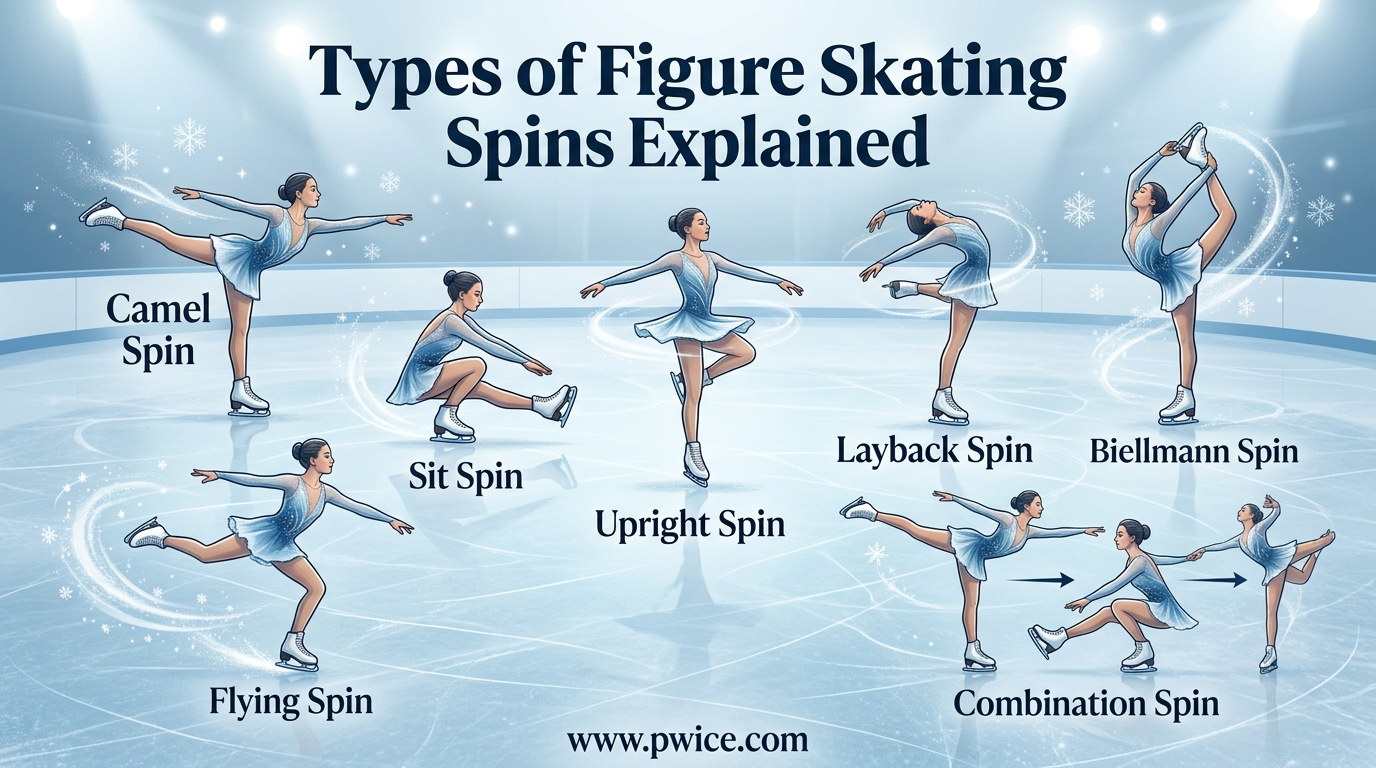
When I first started watching figure skating competitions, I found myself mesmerized by the spins. Skaters would launch into these incredible rotations, holding positions that seemed to defy physics while spinning so fast they became a blur. Understanding types of figure skating spins explained properly opened up a whole new appreciation for this beautiful sport.
There are three basic spin positions in figure skating: the upright spin, the sit spin, and the camel spin. Within each category, skaters perform multiple variations that range from beginner-friendly to incredibly advanced. These spins, along with flying spins and combinations, form essential elements in competitive programs.
Whether you are a beginner skater trying to learn your first one-foot spin, a parent supporting a child in learn-to-skate classes, or a spectator who wants to understand what they are watching at the Olympics, this guide covers everything you need to know about figure skating spins.
Table of Contents
The Three Basic Spin Positions in Figure Skating
The International Skating Union recognizes three fundamental spin positions. Every other spin variation builds from these core foundations. Mastering these basics provides the foundation for all advanced spinning.
Upright Spins: Standing Tall on the Ice
The upright spin is often the first one-foot spin skaters learn. In this position, the skater rotates while standing on one foot with the skating leg nearly straight and the free leg extended or positioned in various ways.
The scratch spin represents the classic upright variation most people picture. The skater pulls their free leg and arms in tight, creating a tucked position that generates tremendous speed. I have seen skaters achieve 200+ revolutions per minute in a well-executed scratch spin.
The layback spin adds dramatic flair. The skater arches their back and head, dropping their upper body backward while maintaining the rotation. This position showcases flexibility and core strength. Skaters like Michelle Kwan made the layback spin iconic through their graceful execution.
The Biellmann spin stands as one of the most difficult and visually striking upright spins. Named after Swiss skater Denise Biellmann, this spin requires the skater to pull their free leg up and over their head, grabbing the blade with both hands while maintaining rotation. The flexibility required is extraordinary.
Other upright variations include the sideways leaning spin, where the skater tilts their upper body to one side, and the I-spin or Y-spin, where the skater holds their free leg straight up in a vertical split position. The Y-spin creates a Y shape with the body, while the I-spin creates a straight vertical line.
Sit Spins: The Art of the Knee Bend
The sit spin requires the skater to lower their body into a sitting position while rotating. The thigh of the skating leg must be parallel to the ice or lower, creating that characteristic crouched appearance.
The basic sit spin starts with the skater on a back inside edge. They lower into the sitting position with the free leg extended forward. Getting the thigh parallel to the ice requires significant quad strength and flexibility.
The back sit spin rotates in the opposite direction. This spin travels backward across the ice while maintaining the same low sitting position. Many skaters find back spins more challenging initially because they cannot see where they are going.
The broken leg sit spin adds complexity. Instead of extending the free leg straight forward, the skater bends the free leg at the knee and allows it to drop to the side. This creates an asymmetrical position that judges recognize as a difficult variation.
The pancake spin takes the sit spin to an extreme. The skater tucks their body forward, wrapping their arms around the skating leg while the free leg extends to the side. The torso folds down toward the thigh, creating a flat, pancake-like silhouette.
The cannonball spin pulls both knees into the chest. The skater hugs their legs tightly while spinning, creating a compact ball shape. This position demonstrates excellent core control and centering ability.
Camel Spins: Grace in Motion
The camel spin creates a beautiful horizontal line. The skater rotates with their upper body parallel to the ice and their free leg extended behind them, forming a T-shape or arch with the body.
The basic camel spin requires excellent back flexibility and balance. The skater enters from a forward outside edge, pushing onto the spinning foot while extending the free leg back and lowering the upper body forward. The goal is creating a flat back position with the free leg at hip height or higher.
The catch-foot camel adds an extra challenge. While maintaining the camel position, the skater reaches back to grab their free foot or blade with one or both hands. This requires exceptional flexibility in the hamstrings and lower back.
The donut spin creates a circular shape. The skater pulls their free leg around to the front, bending at the knee to bring the foot toward their head while maintaining the camel position. The body forms a circular donut shape when executed correctly.
The illusion spin adds movement within the spin. The skater alternates between a higher upright position and a lower camel position, creating an undulating motion. Viewed from the side, this looks like the skater is disappearing and reappearing, hence the name.
Flying Spins and Combination Spins
Once skaters master the basic positions, they progress to more complex elements. Flying spins and combinations add difficulty and visual excitement to programs.
Flying Spins: Taking Flight Before You Rotate
Flying spins begin with a jump. The skater launches into the air, performs a half-rotation or more, then lands directly into a spinning position. This requires precise timing and control.
The flying camel is the most common flying spin. The skater jumps from a forward outside edge, performs a half-rotation in the air, and lands on a back outside edge in the camel position. Dick Button popularized this spin and made it a staple of competitive skating.
The death drop creates a dramatic effect. The skater jumps high, performs a full rotation in the air, then drops into a sit spin position. The name comes from the quick, plunging descent into the low sitting position immediately upon landing.
The flying sit spin follows a similar pattern but lands in a sit position rather than camel. The skater must control their descent precisely to hit the proper sitting angle immediately upon landing.
Combination Spins: Linking Positions Together
Combination spins connect different positions without stopping the rotation. A skater might start in a camel spin, transition to a sit spin, then finish in an upright scratch spin, all in one continuous element.
The most valuable combinations include changes of position and changes of foot. A change of foot means the skater switches from rotating on one foot to the other without stopping. This requires perfect centering and timing to maintain speed through the transition.
Competitive skaters aim for combinations with three or more positions. These complex spins earn higher base values under ISU rules. The key is making transitions smooth and maintaining rotation speed throughout.
Pair Skating and Ice Dance Spins
Pair skating spins involve both partners rotating together. Common positions include the pair sit spin, where both skaters sit low while holding hands or facing each other, and the death spiral, which combines rotation with a dramatic pivot motion.
Ice dance has specific spin rules that differ from singles and pairs. Dancers perform stationary dance lifts and dance spins that emphasize continuous flow and partner connection rather than individual rotation positions.
How to Execute and Improve Your Spins In 2026?
After analyzing hundreds of forum discussions from adult skaters and coaching resources, I have identified the most common challenges and solutions for learning spins.
The Physics of Spinning: Angular Momentum Explained
Spins work through the conservation of angular momentum. When a skater pulls their arms and free leg closer to their body, they decrease their moment of inertia. This causes their rotational speed to increase automatically.
Think of it like a figure skater starting a spin with arms wide open, then pulling them in tight. The spin visibly accelerates as the arms come in. This is not the skater pushing harder. It is physics doing the work.
Centering is crucial for a quality spin. A centered spin rotates in one spot on the ice. A traveling spin moves across the ice while rotating. Judges prefer centered spins because they demonstrate better control.
Most skaters enter spins from a three-turn or from a direct edge. The entry sets up the rotation. A clean entry on the correct edge makes centering much easier.
Common Mistakes and How to Fix Them
Traveling spins plague many beginners. The most common cause is leaning too far forward or back during the spin. Keep your weight directly over the ball of your skating foot. Think about pressing down through the front of the blade.
Another cause of traveling is arm position. As one forum coach explained, keep your arms very level at all times and only move them smoothly and gradually. Never jerk your arm or free leg. Sudden movements throw off your center of balance.
Dizziness affects many skaters, especially beginners. The solution involves spotting techniques and gradual adaptation. Some skaters pick a fixed point and snap their head around to find it each revolution. Others simply train their vestibular system through progressive exposure.
Weak sit spin position usually means the thigh is not parallel to the ice. This requires building quad strength through off-ice exercises like squats and wall sits. Flexibility work for the hips also helps achieve a deeper position.
Square hips matter enormously for upright spins. Many beginners let their free side hip open up, creating a twisted position. Focus on keeping both hips facing the same direction throughout the rotation.
Beginner to Advanced: The Learning Progression
Most skaters start with a two-foot spin. Both feet stay on the ice while the skater rotates. This teaches the feeling of rotation without the balance challenge of lifting one foot.
The first one-foot spin usually comes from an outside edge. As one experienced skater noted, go into your spin from an outside edge. That way you are already on one foot and you will not have to go through the scary bit of lifting your foot.
After mastering basic upright spins, skaters typically progress through sitting spins, then camel spins. Each position builds different muscle groups and balance skills. Rushing this progression leads to sloppy technique.
Adult skaters especially should be patient with their learning curve. Many forum posts emphasize that adult bodies take longer to adapt to the balance and flexibility demands of spinning. Consistent practice matters more than age.
How Spins Are Judged in Competition
Understanding the technical side helps spectators appreciate what judges look for and helps skaters set training priorities.
ISU Technical Requirements and Levels
The International Skating Union assigns each spin a base value based on its difficulty. Simple spins have lower base values. Spins with difficult variations, flying entries, or multiple position changes earn higher base values.
Judges award GOE (Grade of Execution) points from -5 to +5 based on quality. A well-centered, fast spin with excellent positions can earn positive GOE. A traveling, slow spin with weak positions receives negative GOE.
Spins are classified by levels from 1 to 4. Higher levels require specific features like difficult variations, change of foot, or change of edge. To earn a Level 4 spin, skaters must include multiple difficult features.
Required revolutions vary by position. Most spins need a minimum number of rotations to count. Falling short results in the element receiving no value or being marked as a lower level spin.
What Judges Look For in a Quality Spin
First and foremost, judges want to see centered rotation. The spin should stay in one spot. Traveling across the ice suggests poor technique and control.
Speed matters significantly. A fast spin with many revolutions demonstrates mastery of angular momentum control. Slow, labored spins suggest the skater is struggling.
Position quality includes fully extended free legs in camel spins, proper knee bend in sit spins, and clean body lines in upright spins. Sloppy positions reduce the GOE score.
The entry and exit should be controlled and graceful. A wobbly entrance or awkward dismount detracts from the overall quality of the element.
Frequently Asked Questions About Figure Skating Spins
What are the different types of figure spins?
There are three basic spin positions in figure skating: upright spins (including scratch spins, layback spins, and Biellmann spins), sit spins (including basic sit spins, pancake spins, and cannonball spins), and camel spins (including catch-foot camels and donut spins). Additionally, there are flying spins like the death drop and flying camel, plus combination spins that link multiple positions together.
What’s the hardest spin in figure skating?
The Biellmann spin is widely considered among the most difficult due to the extreme flexibility required to pull the leg over the head while spinning. The pancake spin and death drop also rank highly for difficulty. However, difficulty is subjective and depends on individual skater strengths. What is hardest for one skater may feel natural to another.
What are the spins called in figure skating?
The three main categories are upright spins, sit spins, and camel spins. Popular variations include the scratch spin, layback spin, Biellmann spin, pancake spin, cannonball spin, donut spin, flying camel, and death drop. Each has distinct body positions that make them identifiable.
What are the different types of turns in figure skating?
Turns differ from spins. While spins rotate around a fixed point with the skater staying on one foot, turns are transitions between edges. Common turns include three-turns, brackets, counters, rockers, and choctaws. Turns connect skating elements while spins are elements in themselves. Many spins use three-turns as entry techniques.
How does Ilia Malinin not get dizzy when spinning?
Elite skaters like Ilia Malinin manage dizziness through spotting techniques and years of training adaptation. The vestibular system can adapt to repeated spinning exposure. Many skaters pick a visual focus point and snap their head to find it each revolution. Additionally, controlled breathing and core engagement help maintain balance and reduce disorientation during and after spins.
How fast could Ronnie Robertson spin?
Ronnie Robertson was legendary for his spinning speed. During the 1950s, he reportedly achieved rotational speeds that made him appear as a blur to audiences. While exact RPM measurements were not taken with modern precision, estimates suggest he reached 200-300 revolutions per minute in his signature scratch spins, earning him the nickname ‘Spinning Thunderbolt.’
What is the forbidden move in figure skating?
The ‘forbidden move’ refers to the backflip, which is banned in competition by ISU rules for safety reasons. While not a spin, this banned element sometimes gets confused with spinning discussions. In terms of spins, certain pair spin positions are prohibited if they lift the woman above the man’s shoulders while rotating. ISU technical rules specify all illegal elements.
Conclusion
Understanding types of figure skating spins explained transforms how you watch and appreciate this sport. The three basic positions, upright, sit, and camel, provide the foundation for everything else. From these fundamentals, skaters build an incredible vocabulary of variations, flying spins, and combinations.
Whether you are stepping onto the ice for your first two-foot spin or watching the World Championships from your living room, the physics and artistry of spinning remain the same. Centered rotation, beautiful positions, and controlled speed separate good spins from great ones.
Keep practicing, stay patient with your progress, and remember that even Olympic champions started with basic upright spins. The journey from your first rotation to advanced combinations is part of what makes figure skating such a rewarding sport to learn and watch.