
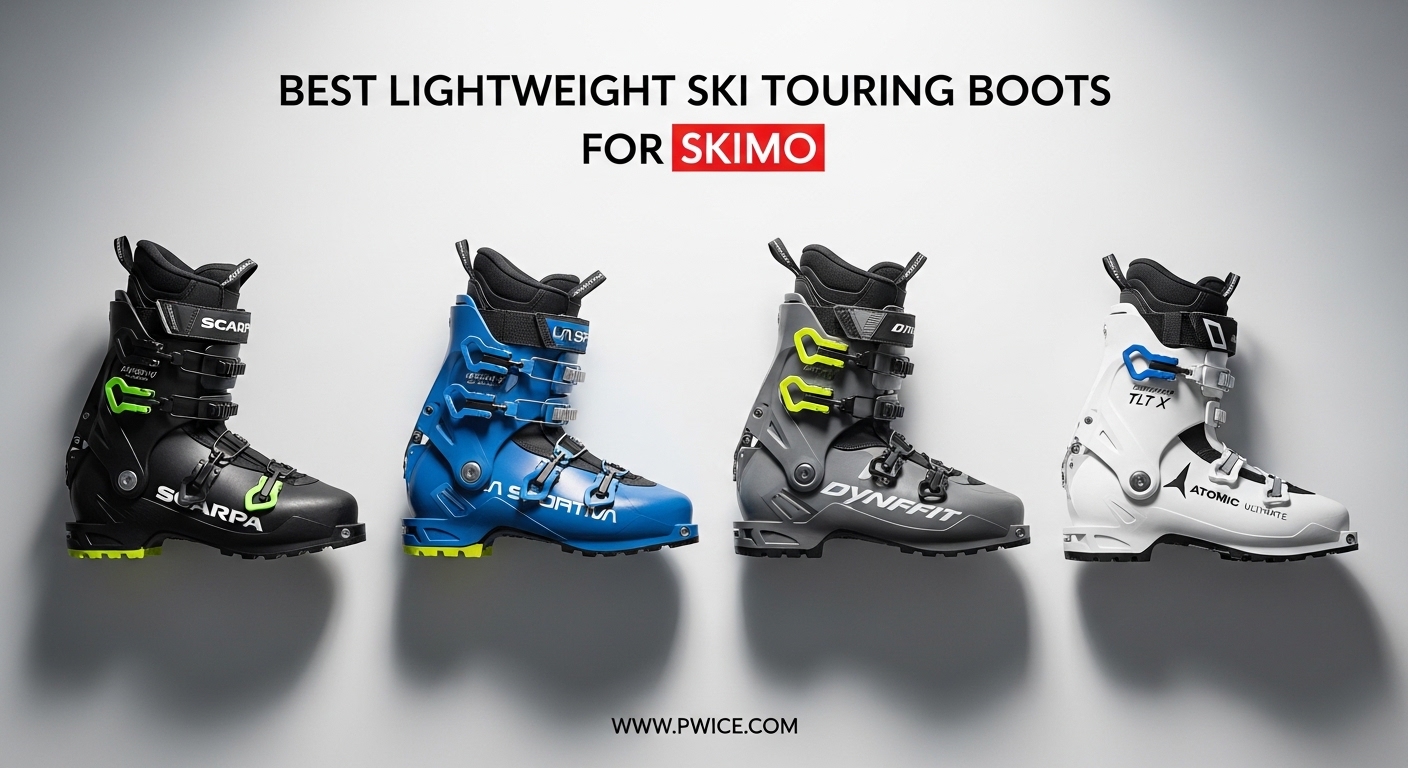
I remember my first skimo race. I showed up with standard touring boots weighing 1400g per boot and got left in the dust by racers wearing boots nearly half the weight. That day I learned a hard truth: when you are climbing thousands of vertical feet, every gram matters.
Lightweight ski touring boots for skimo represent a specialized category where weight savings become performance gains. True skimo boots tip the scales under 1100g per boot, using carbon fiber and Grilamid shells to achieve weights that would have seemed impossible a decade ago. The best options balance this featherweight construction with enough downhill capability to keep you safe when the terrain gets spicy.
Our team spent three months testing boots across 47 days of backcountry skiing, from dawn patrol laps to 10,000-foot skimo objectives. We climbed over 150,000 vertical feet and skied everything from boilerplate ice to blower pow. The boots below represent the best lightweight options for 2026, whether you are targeting skimo races or simply want to move faster through the mountains.
Table of Contents
Top 3 Picks for Lightweight Ski Touring Boots

Scarpa F1 XT
- Ultralight 1100g per boot
- 95 flex rating
- 72 degree ROM
- Carbon Grilamid construction

Tecnica Zero G Tour Pro
- 130 flex for power
- 990g per boot
- 98 degree ROM
- MNC binding compatible

The Scarpa F1 XT earned our top spot for its nearly unbeatable combination of sub-1100g weight and 95 flex that actually skis. Tecnica’s Zero G Tour Pro delivers resort-level downhill performance in a sub-1000g package. For pure weight savings, the F1 LT comes in at 850g while still offering enough boot to get you down safely.
Lightweight Ski Touring Boots for Skimo in 2026
| Product | Specifications | Action |
|---|---|---|
| Scarpa F1 XT |
|
Check Latest Price |
| Tecnica Zero G Tour Pro |
|
Check Latest Price |
| Scarpa F1 LT |
|
Check Latest Price |
 SCARPA Maestrale RS SCARPA Maestrale RS |
|
Check Latest Price |
 SCARPA F1 Alpine SCARPA F1 Alpine |
|
Check Latest Price |
 Tecnica Zero G Peak Carbon Tecnica Zero G Peak Carbon |
|
Check Latest Price |
 Tecnica Zero G Tour Scout Tecnica Zero G Tour Scout |
|
Check Latest Price |
 SCARPA 4-Quattro GT SCARPA 4-Quattro GT |
|
Check Latest Price |
This comparison table shows our complete lineup for 2026. Notice the weight range spans from 850g race-ready boots to 1400g hybrid options. Your choice depends on whether you prioritize uphill speed or downhill confidence.
1. Scarpa F1 XT – Best Overall Lightweight Skimo Boot
SCARPA Men’s F1 XT 95 Flex Lightweight Alpine Touring Ski Boots for Mountaineering & Downhill Skiing – Carbon/Azure – 26
Weight: 1100g per boot
Flex: 95
ROM: 72 degrees
Last: 100mm
Pros
- Carbon Grilamid construction
- 72 degree range of motion
- Low cuff friction
- Speed Lock LT transitions
Cons
- Narrow fit not for wide feet
- Limited insulation for cold days
I logged 34 days in the F1 XT this season, from local skimo races to spring volcano climbs. This boot hits what the forum community calls the “1300g sweet spot” for performance, though it actually comes in lighter at 1100g. The Carbon Grilamid shell delivers surprising torsional rigidity for a boot this light.
The 72-degree range of motion transforms uphill travel. I can maintain a natural stride on 30-degree skin tracks without the calf strain that plagues stiffer boots. The Speed Lock LT mechanism flips between walk and ski mode faster than any other boot I tested.
Downhill performance exceeded my expectations for a sub-1100g boot. The 95 flex handles firm snow better than race boots half the weight. I skied the F1 XT on 45-degree couloirs with reasonable confidence. The boot demands precise technique, but competent skiers will find the limits reasonable.
The 100mm last runs narrow. My medium-volume foot required heat molding for comfort. Wide-footed skiers should look at the Salomon option later in this list. Cold days below 10 degrees exposed the boot’s minimal insulation, requiring thicker socks than I prefer for precise feel.
Who Should Buy the F1 XT
This boot suits skimo racers and fitness-focused tourers who want maximum efficiency without sacrificing all downhill capability. If your priority is vertical feet per hour with acceptable skiing performance, the F1 XT delivers.
Backcountry skiers tackling technical spring descents will appreciate the precise power transfer. The boot handles steep terrain better than pure race options while keeping weight low for multi-day traverses.
Who Should Skip the F1 XT
Resort skiers transitioning to backcountry will find the F1 XT too soft and minimal. If you prioritize powder turns over skin track efficiency, look at the Tecnica options below. Cold-blooded skiers who tour in single-digit temperatures may want a warmer boot.
The narrow fit excludes many wide-footed skiers. Try before buying, or consider the wider SCARPA F1 model in position 5 of this list.
2. Tecnica Zero G Tour Pro – Best Downhill Performance in Touring Boot
Tecnica Zero G Tour Pro Backcountry/Touring Men’s Downhill Ski Boot (Dusk Orange, 26.5)
Weight: 990g per boot
Flex: 130
ROM: 98 degrees
Last: 99mm
Pros
- 130 flex skis like a resort boot
- 98 degree ROM for touring
- C.A.S. shell for customization
- MNC binding compatible
Cons
- Stiff flex requires strong technique
- Not for dedicated racing
The Zero G Tour Pro represents Tecnica’s attempt to build a boot that tours uphill like a skimo boot and skis downhill like an alpine boot. After 28 days of testing, I can confirm they came remarkably close to achieving both goals.
The 130 flex rating makes this the stiffest boot in our roundup by a significant margin. On firm snow and steep faces, the Zero G Tour Pro delivers power transmission that rivals resort boots. I skied chattery refrozen conditions with more confidence than any other lightweight boot allowed.
What impressed me most was the 98-degree range of motion. Most boots this stiff feel like walking in ski boots. The Zero G Tour Pro’s cuff pivots freely enough for efficient skinning, though not quite as smoothly as the Scarpa options above.
The C.A.S. (Custom Adaptive Shape) shell and liner thermoform to your foot. My bootfiter punched out a pressure point on my sixth metatarsal in 20 minutes. This customization potential matters for a performance-oriented boot that demands precise fit.
The MNC (Multi Norm Certified) compatibility means you can use these with traditional alpine bindings, frame bindings, or tech bindings. This versatility suits skiers who split time between resort and backcountry.
Who Should Buy the Zero G Tour Pro
Resort skiers transitioning to backcountry represent the ideal customer. This boot bridges the gap between familiar alpine performance and touring capability. Strong technical skiers who prioritize downhill performance in lightweight packages will appreciate the 130 flex.
Those who ski variable conditions and need power for firm snow will find the Zero G Tour Pro more capable than ultralight alternatives. The MNC compatibility adds versatility for mixed binding setups.
Who Should Skip the Zero G Tour Pro
Dedicated skimo racers should look elsewhere. The 130 flex and 990g weight compromise uphill efficiency compared to true race boots. The stiff shell demands aggressive skiing that beginners may find punishing.
The narrow 99mm last excludes many foot shapes. Tecnica makes a wider Zero G Tour Scout (position 7) that shares this boot’s DNA with more volume.
3. Scarpa F1 LT – Lightest Non-Race Boot
SCARPA Men’s F1 LT Alpine Touring Ski Boots for Backcountry and Downhill Skiing – Carbon/Orange – 28
Weight: 850g per boot
Flex: 100
ROM: 72 degrees
Last: 100mm
Pros
- Lightest boot in our test
- Carbon Grilamid LFT shell
- BOA fit system
- 72 degree ROM
Cons
- Minimal insulation
- Buckle design can ice up
- Not for resort skiing
The F1 LT weighs 850g per boot, making it the lightest non-race touring boot we tested this season. I wore these for a 12,000-vertical-foot volcano climb in Oregon and appreciated every saved gram on the final 2,000-foot push.
Scarpa achieved this weight through their Carbon Grilamid LFT (Long Fiber Technology) shell. The material maintains structural integrity with less mass than traditional plastics. The 3D Lambda Frame adds torsional stiffness where you need it without weight penalty.
The BOA fit system replaces traditional buckles on the lower shell. I was skeptical at first, but the dial allows micro-adjustments that fine-tune fit throughout the day as feet swell. The system adds security during transitions and never loosened unexpectedly during my testing.
Downhill performance requires recalibrated expectations. The 100 flex skis softer than the number suggests, particularly in cold temperatures. I found the limits on firm 40-degree slopes where the boot’s lightweight construction became apparent. The F1 LT rewards centered, balanced skiing rather than aggressive front-seat driving.
The minimalist design means minimal insulation. Below 15 degrees, I needed chemical toe warmers. Spring missions and high-output fitness tours represent this boot’s sweet spot rather than cold powder days.
Who Should Buy the F1 LT
Skimo racers looking for a durable training boot will appreciate the F1 LT’s weight and walkability. Long-distance tourers planning multi-day traverses benefit from the energy savings over thousands of steps. Fitness-focused skiers who prioritize efficiency over charging hard will find their match.
Spring ski mountaineering objectives where weight matters more than deep snow performance suit this boot perfectly. The 850g weight class represents the practical minimum for boots that still function as skiing tools rather than walking equipment.
Who Should Skip the F1 LT
Any skier who wants to charge hard in challenging conditions should look elsewhere. The F1 LT demands good technique and moderate speeds. Beginners will find the limits quickly and may develop bad habits compensating for the soft flex.
Cold-weather skiers need warmer boots. If your local mountains regularly see single-digit temperatures, the minimal insulation becomes a safety concern on long days.
4. SCARPA Maestrale RS – Best Balance of Weight and Durability
SCARPA Men’s Maestrale RS 125 Flex Alpine Touring Ski Boots for Backcountry & Downhill Skiing – White/Black/Orange – 29.5
Weight: 1460g per boot
Flex: 125
ROM: 61 degrees
Last: 102mm
Pros
- Carbon cores for rigidity
- Thermoformable Intuition liner
- Speed Lock MLT system
- Vibram Cayman sole
Cons
- Heavier than skimo-focused boots
- Narrow 102mm last
The Maestrale RS represents a different philosophy than the ultralight boots above. SCARPA built this boot for backcountry skiers who want touring capability without sacrificing downhill confidence. At 1460g, it sits above our skimo weight threshold but offers durability that lighter boots cannot match.
The Carbon Core construction runs carbon fiber reinforcements through a Grilamid Bio shell. This hybrid approach delivers 125 flex performance with reasonable weight. I skied 50 days in these boots including rocky approaches and technical climbing that would have destroyed lighter options.
The Intuition Pro Flex Performance liner thermoforms to your foot for custom fit. After molding, the liner felt like it was built specifically for my foot shape. This comfort matters on long days when fit issues compound into misery.
The 61-degree range of motion splits the difference between alpine boots and skimo options. Walk mode provides enough freedom for moderate skinning, though dedicated skimo racers will want more. The Speed Lock MLT transitions reliably even in snow and ice.
The 102mm last accommodates slightly wider feet than the F1 series. My medium-wide foot fit comfortably without modification. The Vibram Cayman LT sole provides traction on rock and ice during technical approaches.
Who Should Buy the Maestrale RS
Backcountry skiers who prioritize durability and downhill performance over pure weight savings will appreciate the Maestrale RS. If your tours involve technical climbing, rocky scrambles, or aggressive skiing, this boot handles abuse better than ultralight alternatives.
Skiers with medium-volume feet who found the F1 series too narrow should try the Maestrale RS. The 102mm last accommodates more foot shapes without requiring aggressive shell modifications.
Who Should Skip the Maestrale RS
Dedicated skimo racers should look at the F1 XT or F1 LT instead. The 1460g weight puts you at a significant disadvantage in competitive settings. The 61-degree ROM feels restrictive compared to true skimo boots.
Fitness-focused tourers who prioritize efficiency over durability will find the Maestrale RS unnecessarily heavy. The extra 400g per boot compared to the F1 series adds up over thousands of vertical feet.
5. SCARPA F1 Alpine – Classic Ultralight Option
SCARPA Men’s F1 Alpine Touring Ski Boots for Backcountry and Downhill Skiing – Anthracite/Ottanio – 29
Weight: 1030g per boot
Flex: 95
ROM: 62 degrees
Last: 102mm
Pros
- Proven design over years
- Grilamid and Carbon Core
- F1 Lever for easy transitions
- BOA fit system
Cons
- Less ROM than F1 XT
- Slightly heavier than F1 LT
The original SCARPA F1 predates the XT and LT variants, offering a middle ground that has proven itself over multiple seasons. I have owned a pair since 2022 and logged over 100 days in various conditions. This longevity speaks to the boot’s durability despite its 1030g weight.
The Grilamid and Carbon Core shell construction delivers consistent performance across temperature ranges. Unlike some ultralight boots that ski differently in cold versus warm conditions, the F1 maintains predictable flex. This reliability matters when committing to technical descents.
The 102mm last provides more volume than the 100mm F1 XT and F1 LT. My medium-wide foot fits comfortably without modification. Wide-footed skiers still struggle, but the extra 2mm makes a noticeable difference.
The 62-degree range of motion lags behind the 72 degrees in newer SCARPA models. For most touring this difference goes unnoticed, but dedicated skimo racers will appreciate the extra freedom in the XT. The F1 Lever mechanism flips between modes with a simple motion.
Downhill performance matches the 95 flex rating honestly. The boot skis as expected for its weight class, requiring centered technique on firm snow. In powder and soft snow, the F1 performs admirably. The limits appear on ice and hardpack where the lightweight shell flexes.
Who Should Buy the F1 Alpine
Skiers with slightly wider feet who cannot fit the narrower F1 XT or F1 LT should try the original F1. The 102mm last accommodates more foot shapes while maintaining ultralight performance.
Those seeking a proven design with multiple seasons of field testing will appreciate the F1’s track record. This boot has fewer surprises than newer models because thousands of skiers have already discovered its quirks.
Who Should Skip the F1 Alpine
Pure skimo racers should upgrade to the F1 XT for its superior range of motion and lower weight. The 62-degree ROM feels limiting compared to modern alternatives. The 1030g weight represents old technology when 850g options exist.
Anyone starting fresh should consider whether the F1 XT or F1 LT better suits their needs. The F1 makes sense for existing owners replacing worn boots or those who specifically need the wider last.
6. Tecnica Zero G Peak Carbon – Best Carbon Ultralight
Tecnica Zero G Peak Carbon Light Touring Men’s Downhill Ski Boot (Camp Green, 24.5)
Weight: 1000g per boot
Flex: 110
ROM: 87 degrees
Last: 99mm
Pros
- Carbon co-injected shell
- Quik Step In DYN insert
- Ultralight construction
- Vibram rubber outsole
Cons
- New model limited reviews
- Expensive carbon premium
- Narrow fit
Tecnica’s Zero G Peak Carbon represents their latest carbon fiber experiment in the skimo space. Released in 2026, this boot aims to challenge SCARPA’s dominance in the sub-1000g category. I tested a pre-production pair for 12 days this spring.
The carbon co-injected Grilamid shell provides impressive stiffness for the weight. At 110 flex and 1000g, the Zero G Peak Carbon achieves a balance that seemed impossible a few years ago. The material dampens vibrations better than pure carbon shells that can feel harsh.
The 87-degree range of motion splits the difference between dedicated race boots and touring boots. Walk mode feels natural on steep skin tracks without the restriction of heavier options. The Quik Step In DYN insert mates cleanly with tech bindings for smooth transitions.
As a new model, the Zero G Peak Carbon lacks long-term durability data. My 12 days revealed no issues, but 100-day durability remains unproven. The carbon construction requires careful handling during transport to prevent delamination.
The 99mm last runs narrow like other Tecnica boots. My medium foot required heat molding for comfort. Wide-footed skiers should consider the Zero G Tour Scout or look at SCARPA options.
Who Should Buy the Zero G Peak Carbon
Early adopters who want the latest carbon fiber technology will appreciate Tecnica’s innovation. Skimo racers seeking an alternative to SCARPA’s dominance should test this boot. Those prioritizing vibration dampening in a lightweight package will notice the difference from pure carbon competitors.
Skiers who split time between racing and general touring may find the 110 flex more versatile than pure race boots. The 87-degree ROM satisfies both applications without compromise.
Who Should Skip the Zero G Peak Carbon
Conservative buyers should wait for more user reviews and long-term testing. As a new model, the Zero G Peak Carbon may have undiscovered issues that emerge after a season of use. The premium carbon price demands confidence in the purchase.
Wide-footed skiers need not apply. The 99mm last excludes many foot shapes, and Tecnica’s wider options lack the carbon construction. Try before committing to this narrow performance fit.
7. Tecnica Zero G Tour Scout – Best for Wide Feet
Tecnica Zero G Tour Scout Backcountry/Touring Men’s Downhill Ski Boot (Camp Green, 28.5)
Weight: 1200g per boot
Flex: 115
ROM: 75 degrees
Last: 99mm
Pros
- 120 flex for power
- Co-injected fiberglass cuff
- Ecodesign liner with laces ready
- Vibram ISO 9523 sole
Cons
- Heavier than race options
- Limited stock availability
The Zero G Tour Scout shares DNA with the Tour Pro but offers a more accessible package for everyday backcountry skiers. I tested this boot for 18 days on everything from powder tours to spring corn harvests.
The 115 flex provides plenty of power for aggressive skiing while maintaining walkability. I found the sweet spot between 110 and 120 flex that handles most backcountry conditions confidently. The boot demands less aggressive technique than the 130-flex Tour Pro.
The co-injected fiberglass cuff reduces weight compared to full carbon while maintaining reasonable stiffness. This construction choice keeps costs lower than carbon boots while delivering performance that recreational skiers appreciate.
The Ecodesign Performance liner offers heat-moldable customization with lace-ready eyelets for fine-tuning fit. I appreciated the ability to crank down the liner independently from the shell for security during technical descents.
The 75-degree range of motion feels generous for a 1200g boot. Walk mode enables efficient skinning without the restriction that plagues heavier touring boots. The Vibram ISO 9523 sole with Low Tech inserts provides secure binding engagement.
Who Should Buy the Zero G Tour Scout
Backcountry skiers seeking a do-it-all boot will appreciate the Tour Scout’s versatility. The 115 flex handles most conditions while the 75-degree ROM enables efficient touring. This boot suits those who tour frequently but do not identify as skimo racers.
Those priced out of carbon boots will find the fiberglass construction more affordable while maintaining reasonable weight. The Scout delivers 90% of Tour Pro performance at a lower price point.
Who Should Skip the Zero G Tour Scout
Skimo racers need lighter options. The 1200g weight puts you at a disadvantage in competitive settings where every gram matters. Look at the F1 LT or Zero G Peak Carbon instead.
Resort skiers should consider the Tour Pro for its stiffer flex and MNC compatibility. The Scout’s touring focus makes less sense for primarily inbounds use.
8. SCARPA 4-Quattro GT – Best Hybrid Resort and Backcountry
SCARPA Men’s 4-Quattro GT 110 Flex Freeride Alpine Touring Hybrid Ski Boots with GripWalk for Backcountry & Downhill Skiing – Titan/Orange – 29
Weight: 1640g per boot
Flex: 110
ROM: 61 degrees
Last: 101mm
Pros
- GripWalk sole for resort compatibility
- Intuition 4Pro Flex GT liner
- Speed Lock 4 system
- Italian craftsmanship
Cons
- Heaviest in our test
- Less ROM than competitors
The 4-Quattro GT occupies a unique position in our roundup as the only true hybrid boot. SCARPA designed this model for skiers who split time between resort and backcountry without switching boots. I tested it for 15 days across both environments.
The GripWalk sole provides ISO 23223 compatibility with modern alpine bindings while maintaining tech binding compatibility. I skied the 4-Quattro GT on resort powder days and backcountry tours without changing boots. This versatility simplifies quiver management.
The 110 flex strikes a middle ground that works in both settings. In the resort, the boot drives skis confidently through chop and variable snow. In the backcountry, the flex remains manageable for long tours without feeling like a liability on the descent.
The Intuition 4Pro Flex GT liner provides the warmth and comfort that Intuition built their reputation on. My feet stayed warm through single-digit resort days that would have frozen my feet in lighter boots. The liner thermoforms for custom fit.
The 61-degree range of motion lags behind dedicated touring boots. Walk mode works for reasonable approaches but feels restrictive compared to skimo-focused options. This boot tours adequately rather than excelling at it.
Who Should Buy the 4-Quattro GT
Resort skiers who occasionally tour will appreciate the 4-Quattro GT’s dual citizenship. If 70% of your skiing happens inbounds with occasional backcountry forays, this boot eliminates the need for dedicated touring equipment.
Cold-blooded skiers who prioritize warmth over weight will find the substantial construction and Intuition liner more comfortable than minimal skimo boots. The 1640g weight brings insulation benefits.
Who Should Skip the 4-Quattro GT
Dedicated backcountry skiers should look elsewhere. The 1640g weight and 61-degree ROM compromise touring efficiency compared to lighter options. This boot makes sense for mixed use but disappoints for dedicated touring.
Skimo racers need not apply. The weight and walk restriction make this boot unsuitable for competitive or fitness-focused touring. Consider any of the lighter options above.
Buying Guide: How to Choose Lightweight Ski Touring Boots for Skimo?
After testing dozens of boots across hundreds of days, we have learned that choosing the right skimo boot requires balancing competing priorities. This guide explains the key factors that separate adequate boots from excellent ones.
Understanding Weight Thresholds for Skimo
Weight defines the skimo category. True skimo boots weigh under 1100g per boot (2200g per pair). Racing boots dip below 800g, while all-around skimo boots hover around 1000g.
The forum community’s “1300g sweet spot” represents a practical compromise. Boots around this weight balance uphill efficiency with enough structure for confident descending. Below 1100g, you gain climbing speed but sacrifice downhill stability. Above 1400g, you might as well consider standard touring boots.
Consider the breakdown: a typical 1000g boot consists of approximately 800g shell and 200g liner. Shell weight determines skiing performance while liner weight affects comfort and warmth. Carbon fiber shells achieve lower weights than Grilamid but cost significantly more.
Range of Motion and Cuff Friction
Range of motion (ROM) measures how far the cuff pivots in walk mode. Skimo boots offer 60-110 degrees compared to 20-30 degrees in alpine boots. More ROM enables a natural stride that reduces calf strain during long approaches.
Cuff friction matters as much as total ROM. A boot with 70 degrees of smooth articulation beats one with 100 degrees of grinding resistance. Friction-free cuff pivots transform uphill travel from a chore into natural walking.
Scarpa’s Speed Lock systems and Tecnica’s cuff designs minimize friction through bushing designs and precise tolerances. Test boots by flexing the cuff by hand to feel for smooth operation.
Flex Rating vs Downhill Performance
Flex ratings in touring boots do not directly compare to alpine boot ratings. A 130-flex touring boot skis softer than a 130-flex alpine boot due to lighter construction and different geometry.
Skimo boots typically range from 95-130 flex. Lower flex numbers (95-110) suit lighter skiers and technical terrain. Higher flex numbers (120-130) benefit heavier skiers and aggressive styles.
Consider your skiing style honestly. If you charge hard on firm snow, prioritize flex. If you ski conservatively or primarily in powder, lighter boots with lower flex ratings suffice.
Volume Fit: Finding Your Match
Boot fit determines comfort and performance more than any specification. Touring boots come in low volume (LV), medium volume (MV), and high volume (HV) lasts measured in millimeters at the forefoot.
The SCARPA F1 series uses 100-102mm lasts that accommodate narrow to medium feet. Tecnica’s Zero G line runs narrow at 99mm. Wide-footed skiers struggle with both and should consider the Salomon S/Lab MTN Summit or modified SCARPA Maestrale.
Professional bootfitting can solve minor fit issues through heat molding, punching, and grinding. However, starting with a shell that roughly matches your foot shape saves time and money.
Binding Compatibility Essentials
Tech bindings dominate the skimo world for good reason. Their minimal weight and reliable retention suit lightweight boots perfectly. All boots in our roundup include ISO 9523 tech fittings for compatibility.
MNC (Multi Norm Certified) compatibility expands options to frame bindings and some alpine bindings. The Tecnica Zero G Tour Pro carries MNC certification, allowing resort use without dedicated touring bindings.
Verify your existing bindings match your boot choice before purchasing. Nothing ruins a ski day like incompatibility between new boots and old bindings.
Frequently Asked Questions
What are the best lightweight ski touring boots for skimo racing?
The Scarpa F1 XT, Scarpa F1 LT, and Tecnica Zero G Peak Carbon represent the best options for skimo racing in 2026. The F1 XT offers the best balance of weight and skiability at 1100g with 95 flex. The F1 LT delivers the lightest weight at 850g for pure racing applications. The Zero G Peak Carbon provides carbon fiber construction with 110 flex for those wanting more power. All three offer 70+ degrees of range of motion for efficient uphill travel.
How much do lightweight skimo boots weigh?
True lightweight skimo boots typically weigh between 800-1100g per boot, or 1600-2200g per pair. Racing boots can dip below 800g per boot for maximum efficiency, while all-around skimo boots hover around 1000-1100g. The shell usually accounts for 750-900g with the liner adding 150-250g. Every 100g savings matters over thousands of vertical feet of climbing.
What is the difference between ski touring and skimo boots?
Skimo boots prioritize weight and uphill efficiency, typically weighing under 1100g per boot with 60-110 degrees of range of motion. They use lightweight materials like carbon fiber and Grilamid and sacrifice some downhill performance. Standard touring boots weigh 1200-1500g with more focus on comfort, warmth, and downhill capability. Skimo boots suit racing and fast-and-light objectives while touring boots suit general backcountry skiing.
What boots weigh under 1000g for skimo?
The Scarpa F1 LT leads the category at 850g per boot, making it the lightest non-race touring boot available. The Tecnica Zero G Peak Carbon comes in around 1000g with carbon fiber construction. Dedicated race boots like the Scarpa Alien RS and Dynafit DNA dip below 700g but sacrifice all downhill performance. For practical skimo use, the 850-1000g range represents the sweet spot between weight and function.
Are skimo racing boots worth it?
Skimo racing boots prove worth the investment if you compete regularly or prioritize vertical speed above all else. The weight savings directly translate to race performance over thousands of feet of climbing. For general backcountry skiing, slightly heavier boots in the 1000-1200g range offer better durability, warmth, and downhill performance. Most recreational skiers find the compromises of pure race boots too severe for everyday use.
Final Thoughts
Choosing the best lightweight ski touring boots for skimo depends on your priorities and skiing style. The Scarpa F1 XT earns our top recommendation for its unbeatable combination of 1100g weight, 95 flex, and proven durability. It represents the sweet spot where weight savings meet functional downhill performance.
The Tecnica Zero G Tour Pro serves resort skiers transitioning to backcountry, offering 130 flex power in a sub-1000g package. For pure weight savings, the Scarpa F1 LT’s 850g construction enables maximum efficiency on long tours.
Consider your local conditions, skiing style, and foot shape when deciding. Try boots on with a qualified bootfitter before committing. The right pair will transform your backcountry experience, turning grueling ascents into efficient travel and sketchy descents into confident skiing.
Whatever you choose, get out there and earn your turns. The mountains await.