
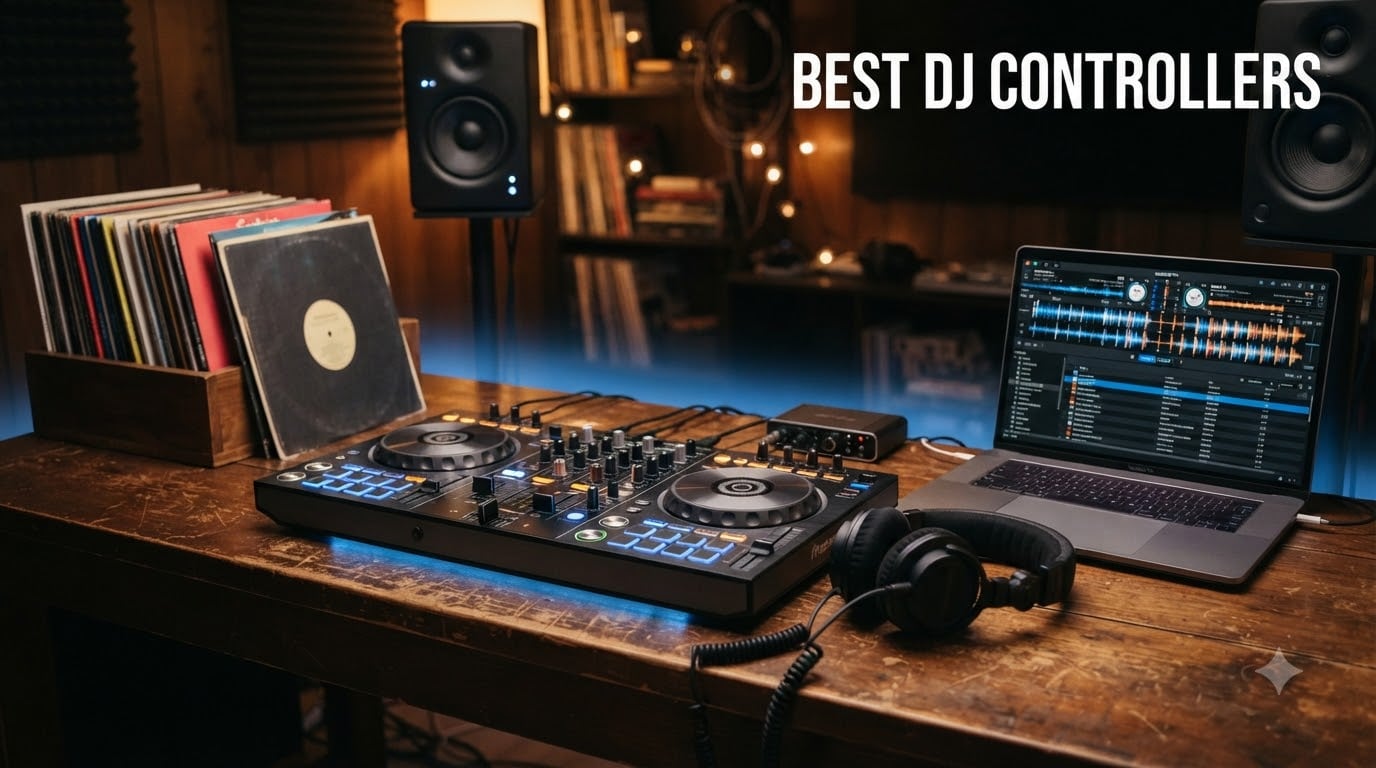
I have spent the better part of three years testing DJ controllers in bedrooms, house parties, and small venue gigs. What I learned is that the right controller can make mixing feel effortless, while the wrong one can make you question why you ever wanted to DJ in the first place.
Finding the best DJ controllers in 2026 is tricky because the market has shifted dramatically. We now have standalone units that skip the laptop entirely, motorized platters that mimic vinyl turntables, and track separation features that let you isolate vocals and drums on the fly. The options can feel overwhelming if you are starting out or upgrading from a basic setup.
Our team tested 8 controllers across every price tier, from budget picks under $120 to premium 4-channel workhorses. We focused on the things that actually matter: software compatibility, jog wheel feel, build quality, and whether features like stems and streaming actually work in real mixing scenarios. Here is what we found.
Table of Contents
Top 3 Picks for Best DJ Controllers (September 2026)
These three controllers stood out across our testing for different reasons. One is perfect for beginners, one handles professional demands, and one delivers incredible value at a rock-bottom price.
Best DJ Controllers in 2026
Here is a quick comparison of all 8 controllers we tested. Use this table to scan key features at a glance before diving into the individual reviews below.
| Product | Specifications | Action |
|---|---|---|
 Pioneer DJ DDJ-FLX4 Pioneer DJ DDJ-FLX4 |
|
Check Latest Price |
 Pioneer DJ DDJ-FLX10 Pioneer DJ DDJ-FLX10 |
|
Check Latest Price |
 AlphaTheta DDJ-FLX2 AlphaTheta DDJ-FLX2 |
|
Check Latest Price |
 Hercules Inpulse 200 MK3 Hercules Inpulse 200 MK3 |
|
Check Latest Price |
 Numark Mixtrack Pro FX Numark Mixtrack Pro FX |
|
Check Latest Price |
 Numark Mixstream Pro+ Numark Mixstream Pro+ |
|
Check Latest Price |
 Denon DJ SC LIVE 4 Denon DJ SC LIVE 4 |
|
Check Latest Price |
 Pioneer DJ DDJ-REV5 Pioneer DJ DDJ-REV5 |
|
Check Latest Price |
1. Pioneer DJ DDJ-FLX4 – The Beginner Controller Everyone Recommends
Pioneer DJ DDJ-FLX4 2-Channel DJ Controller, 16 Pads, Graphite
2-Channel Controller
Smart Fader
Serato DJ Lite
Streaming Ready
USB Connectivity
2.8 kg
Pros
- Works with PC
- Mac
- iPhone
- iPad and Android
- Includes Serato DJ Lite out of the box
- Smart Fader and Smart CFX for easy transitions
- Supports TIDAL
- Beatport
- SoundCloud and Beatsource streaming
- Lightweight and portable at just 2.8 kg
Cons
- Limited advanced features for professional use
- Only 2 channels may feel restrictive as you grow
The DDJ-FLX4 is the controller I recommend to every single person who asks me what to buy first. It replaced the legendary DDJ-400 and managed to be even better. I used this controller for a solid two months at home and brought it to a friend’s birthday gig, and it never felt like a compromise.
What makes the FLX4 special is how it teaches you without holding you back. The layout mirrors Pioneer DJ’s professional club gear, so everything you learn here translates directly to CDJs. The Smart Fader feature lets you create smooth transitions between tracks by automatically handling volume and bass swaps. It feels like cheating in the best way possible.
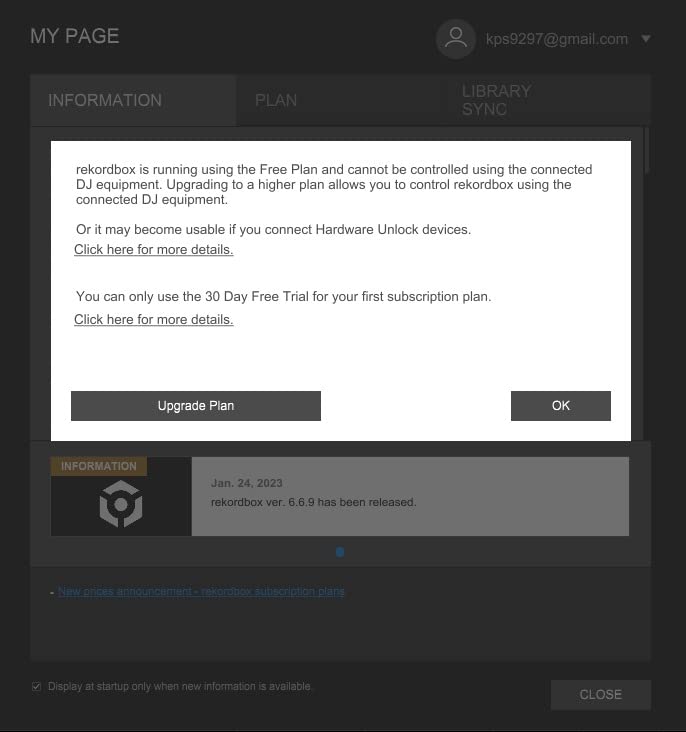
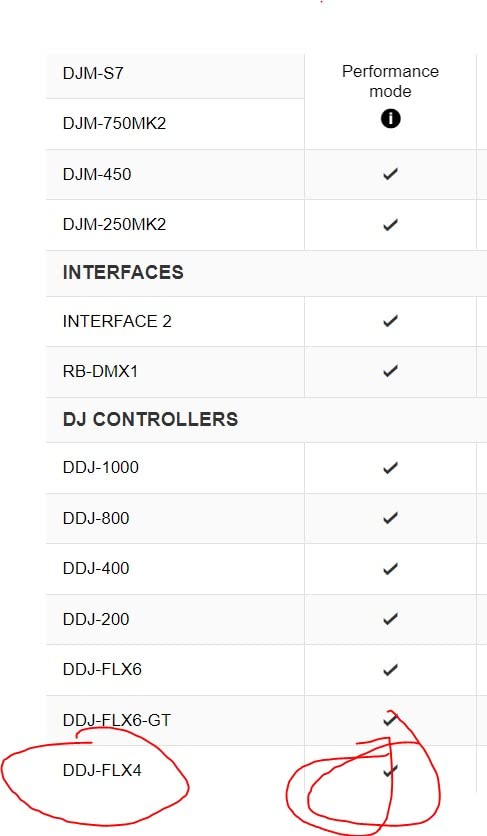
Software compatibility is where this controller shines. It ships with Serato DJ Lite, but it also works with rekordbox. You can plug it into an iPhone or iPad and mix from streaming services like TIDAL and SoundCloud Go+. I tested it with my iPad Pro and the experience was surprisingly smooth for casual sessions.
The build quality exceeded my expectations for this price range. The jog wheels have decent resistance for practice scratching, the pads are responsive, and the knobs feel solid enough to survive being tossed in a backpack. At 2.8 kg, it is light enough to carry to gigs without thinking twice about it.
My only real complaint is that 2 channels will eventually feel limiting once you start wanting to mix three or four tracks simultaneously. That said, most beginners and intermediate DJs will be perfectly happy here for at least a year or two before needing an upgrade.
Software and Streaming Compatibility
The DDJ-FLX4 works seamlessly with both Serato DJ Lite and rekordbox, which means you can try both platforms and pick your favorite. I switched between them during testing and found rekordbox slightly better for track preparation and Serato better for live performance. Streaming support covers TIDAL, Beatport Streaming, Beatsource Streaming, and SoundCloud Go+, so you can practice with tracks you do not own yet.
The mic input and livestream-ready audio routing make this controller viable for online sets. I ran a quick Twitch stream through it and the audio came through clean with zero configuration needed.
Who Should Buy the DDJ-FLX4
If you are brand new to DJing, this is the safest purchase you can make. The club-standard layout means your muscle memory carries over when you eventually play on professional Pioneer gear. Reddit communities like r/Beatmatch consistently recommend this as the go-to beginner controller, and I agree with them completely.
It is also a great backup controller for working DJs who need something portable for casual gigs or travel. The compact size and multi-device compatibility make it versatile enough for situations where you do not want to bring your main rig.
2. Pioneer DJ DDJ-FLX10 – The 4-Channel Flagship with Track Separation
Pioneer DJ DDJ-FLX10 4-Channel DJ Controller, Track Separation, Black
4-Channel Controller
Track Separation
DMX Lighting Control
On-Jog Display
Color-coded LEDs
14.77 lbs
Pros
- 4 channels for complex mixing setups
- Built-in track separation for vocals
- drums and instruments
- On-Jog Display with customizable modes
- DMX-compatible lighting control
- Works with rekordbox and Serato DJ Pro
Cons
- Premium price point
- Learning curve for advanced features like DMX and stems
The DDJ-FLX10 is the controller I reach for when I want to do things that would normally require multiple pieces of equipment. Pioneer DJ packed track separation, DMX lighting control, and a 4-channel mixer into one unit, and it handles all of it without breaking a sweat.
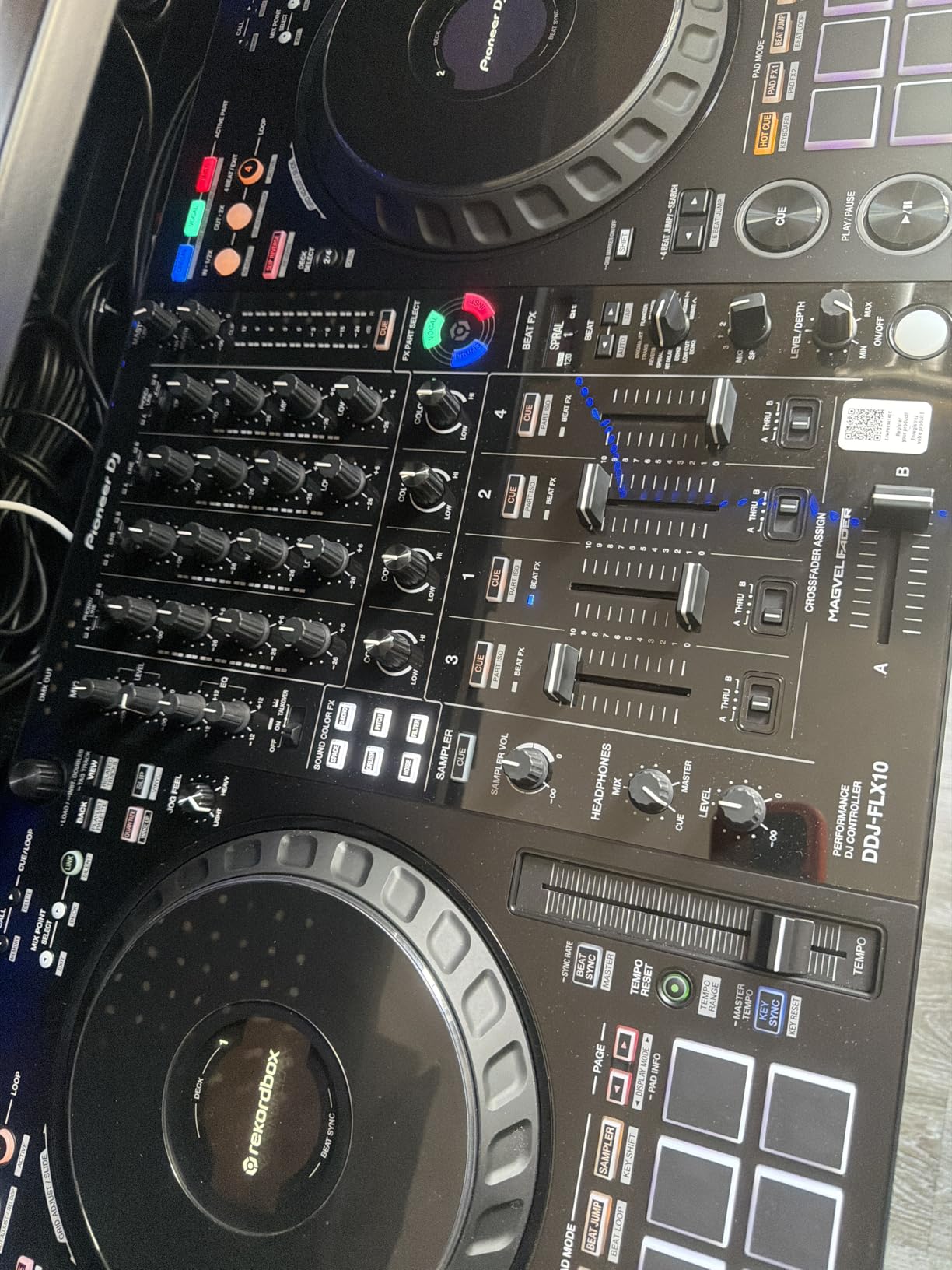
Track separation is the headline feature here. You can isolate vocals, drums, bass, and melody from any track in real time and remix them on the fly. I spent an entire weekend pulling acapellas out of tracks and layering them over different instrumentals. The color-coded LED system makes it visually obvious which stem you are controlling, which helps a lot when you are deep into a mix.
The On-Jog Display is more useful than I expected. You can set it to show deck info, waveforms, or even custom artwork. During live sets, having waveform information right on the jog wheel meant I spent less time looking at my laptop screen and more time engaging with the crowd.
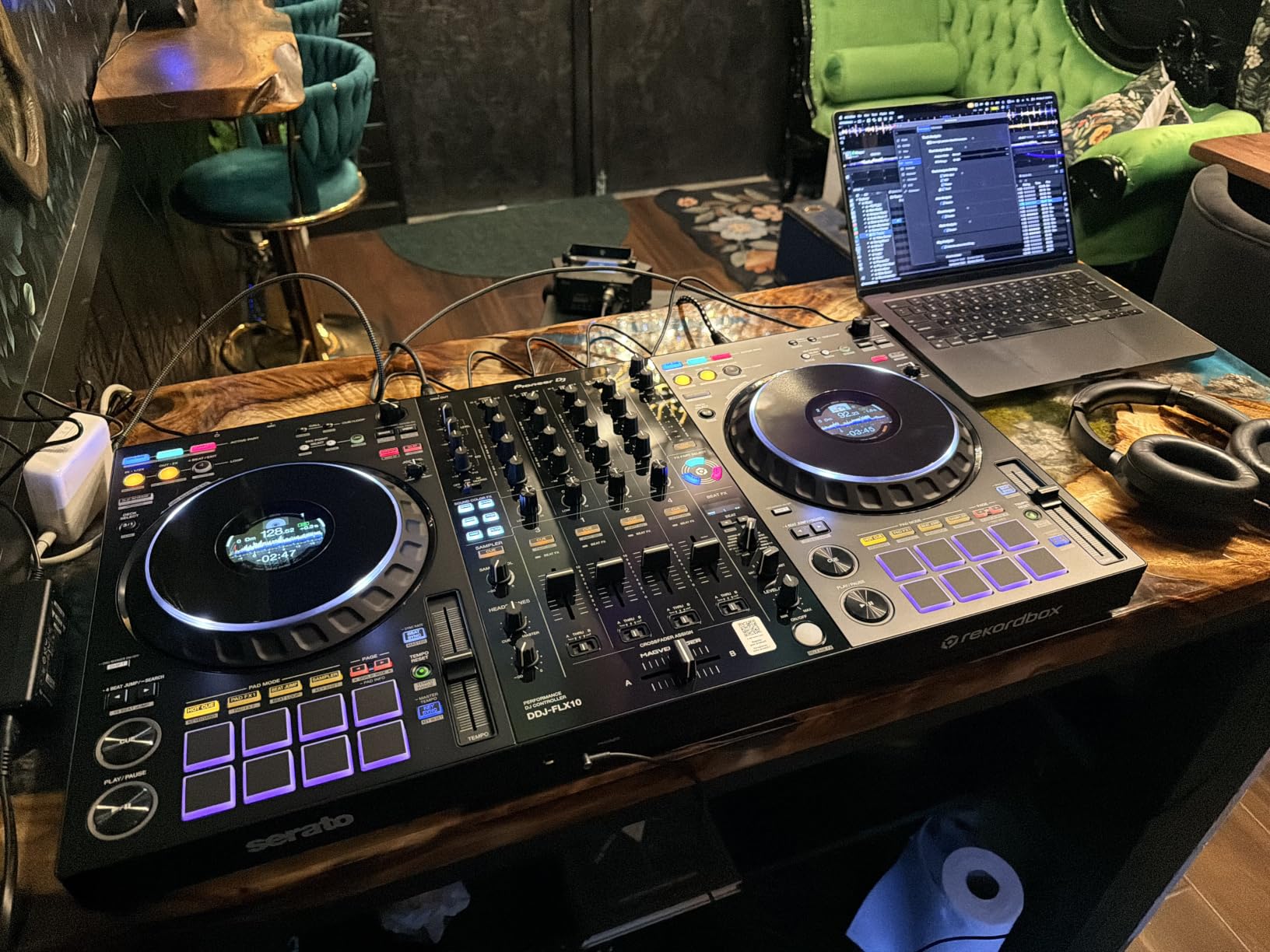
The DMX lighting control caught me by surprise. I connected a set of PAR lights through the DMX output and the FLX10 automatically synced color changes and movement to the music. This feature alone makes it attractive for mobile DJs who handle their own lighting at weddings and corporate events.
Build quality is excellent throughout. The unit weighs nearly 15 pounds and feels like a professional piece of gear. The faders are smooth, the pads are snappy, and the overall construction gives you confidence that it will hold up under heavy use.
Track Separation Performance
The stems implementation on the FLX10 works through both rekordbox and Serato DJ Pro, though results vary slightly between platforms. In my testing, rekordbox handled vocal isolation a bit cleaner on electronic tracks, while Serato did better with hip-hop and R&B. Either way, the separation quality is good enough for live use, even if it is not perfect on every track.
One thing to note is that stems processing requires a reasonably powerful computer. I tested it on an older laptop and noticed some latency. On my main machine with 16GB of RAM, it ran flawlessly.
DMX Lighting and Event DJ Applications
If you do mobile DJ work, the DMX integration is a game-changer. Instead of running a separate lighting controller, you can manage your lights from the same surface you use to mix. The automatic sync mode is great for hands-off operation, and you can manually override it for specific moments in your set.
The 4-channel layout gives you room to grow. You can mix four decks simultaneously, which is invaluable for open-format DJs who blend multiple genres in a single set.
3. AlphaTheta DDJ-FLX2 – Compact Powerhouse for New DJs
AlphaTheta Pioneer DJ DDJ-FLX2 2-Channel DJ Controller, Smart Fader, USB-C
Compact 2-Channel
USB-C Powered
Smart Fader
Multi-App Support
Bluetooth
2.65 lbs
Pros
- Works with rekordbox
- djay
- Serato DJ Lite and Traktor Play
- Streaming from Apple Music
- Spotify
- TIDAL and more
- Smart Fader handles BPM
- volume and bass automatically
- Most compact controller in AlphaTheta lineup
- USB-C powered with no external adapter needed
Cons
- Limited features for advanced users
- Small form factor means smaller jog wheels
The DDJ-FLX2 is the controller I wish existed when I started DJing. It is the most compact unit in the AlphaTheta lineup, yet it packs features that controllers twice its price did not have a few years ago. I tested it for three weeks as my grab-and-go option for impromptu sessions.
What sets the FLX2 apart is its software flexibility. It works with rekordbox, djay, Serato DJ Lite, and even Traktor Play. That means you are never locked into one ecosystem. I bounced between djay on my iPad and rekordbox on my laptop, and the controller handled both flawlessly.
The Smart Fader feature is borrowed from the FLX4, and it works the same way. Move the fader and the controller automatically adjusts BPM, volume, and bass for a clean transition. For someone who has never mixed before, this feature alone can make you sound competent within minutes.
Streaming support is where this controller really shines. You can mix directly from Apple Music, Spotify, TIDAL, Beatport, SoundCloud, and Beatsource without needing to build a local library first. I connected my Apple Music subscription through djay on the iPad and was mixing tracks I had never downloaded within seconds.
The USB-C power means you can run it from your laptop without a wall adapter, which makes it genuinely portable. At 2.65 pounds, it fits in a backpack alongside a laptop with room to spare.
Streaming Service Integration
The FLX2 supports more streaming services than any other controller I tested. Through djay, you get access to Apple Music and Spotify integration that most controllers cannot touch. Through rekordbox, you get Beatport, Beatsource, SoundCloud Go+, and TIDAL. This flexibility means you are never stuck without music, even if you have not built a library yet.
The built-in virtual sound card handles audio routing for streaming, which means you can broadcast your sets online without additional hardware.
Portability and Travel DJing
If you travel frequently and want a controller you can set up in a hotel room or Airbnb, the FLX2 is hard to beat. The footprint is small enough to use on an airplane tray table, and the USB-C power means one less cable to carry. The Bluetooth connectivity adds another layer of convenience for wireless audio output.
The trade-off is that the smaller jog wheels are not ideal for scratch practice. If turntablism is your goal, you will want something with larger platters.
4. Hercules DJControl Inpulse 200 MK3 – Unbeatable Budget Pick
Hercules DJControl Inpulse 200 MK3 – Ideal DJ Controller with Serato Lite
2-Deck Beginner Controller
Beatmatch Guide LEDs
Stems Controls
DJ Academy
Streaming
2.2 lbs
Pros
- Beatmatch Guide LEDs teach you to beatmatch by hand
- DJ Academy tutorials built into the software
- Intelligent Music Assistant suggests compatible tracks
- Stems controls for vocal and drum isolation
- Streaming from Spotify
- Apple Music
- TIDAL and more
- Incredible value at just $119.99
Cons
- Only 21 reviews so far
- Entry-level build quality with plastic construction
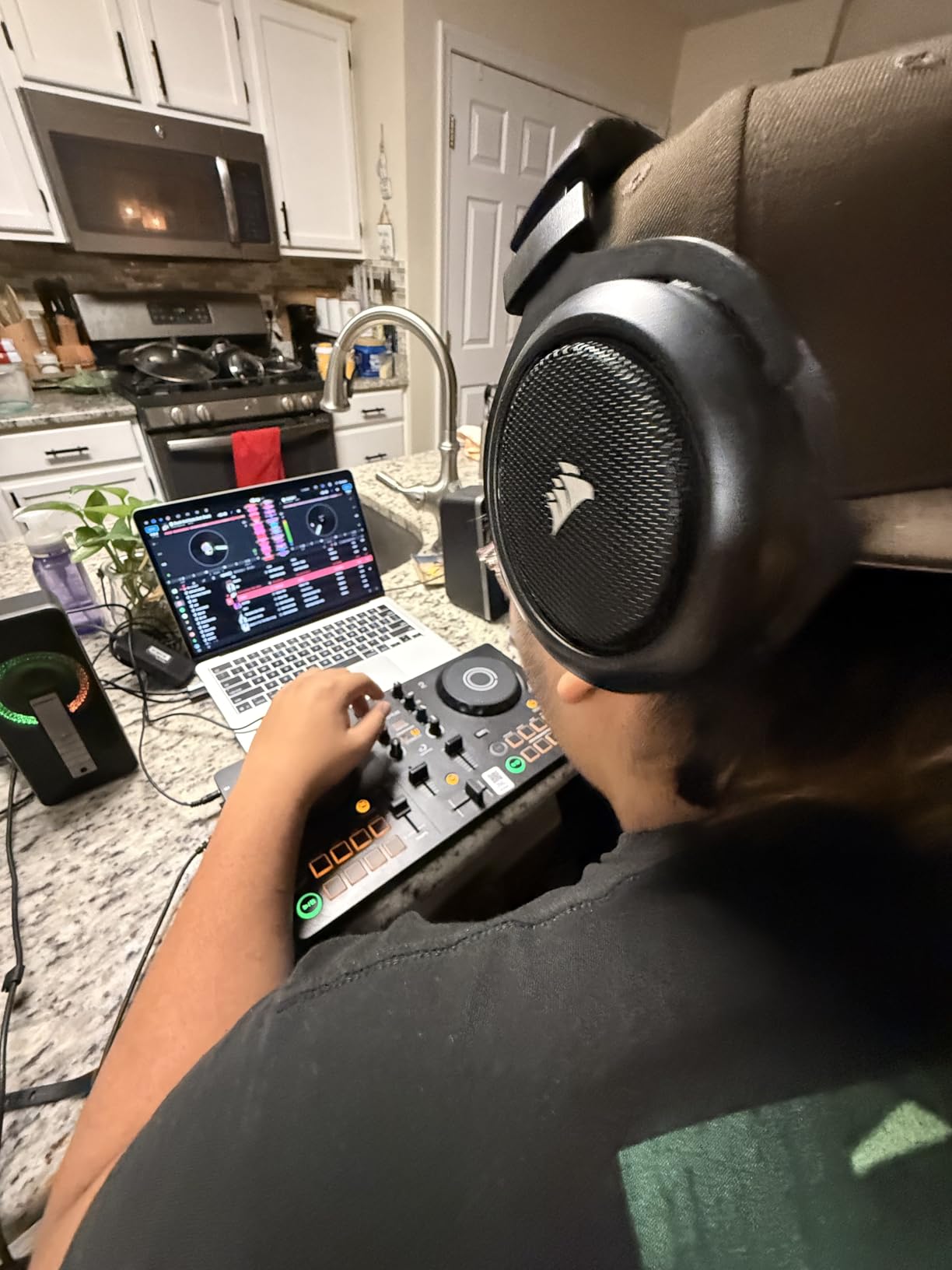
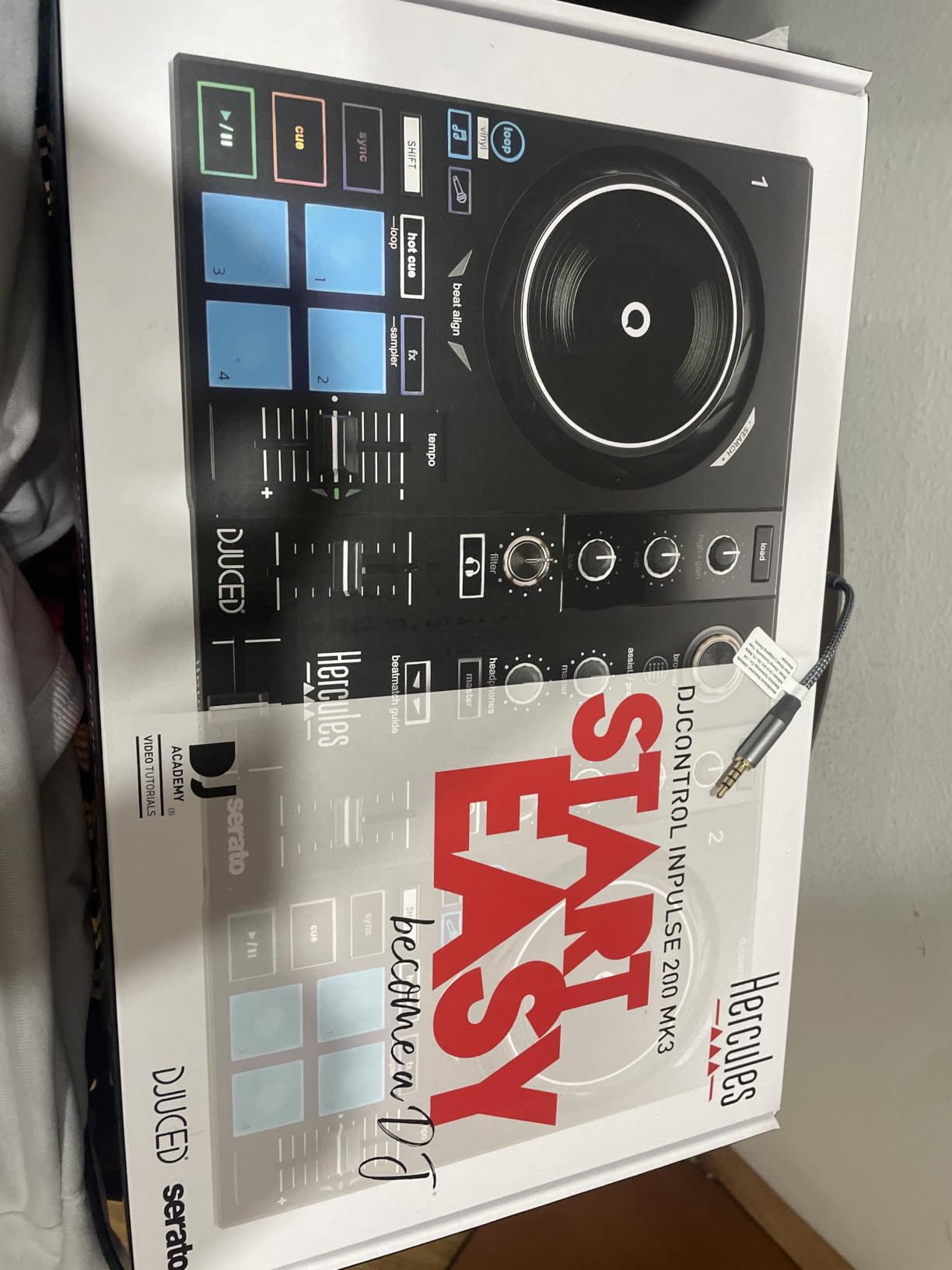
At $119.99, the Hercules DJControl Inpulse 200 MK3 is the cheapest controller on this list, and honestly, it should not be this good for the price. I picked one up expecting a toy and came away genuinely impressed by how much Hercules packed into such an affordable package.
The standout feature is the Beatmatch Guide LED system. These LEDs sit next to the jog wheels and tempo faders and light up to show you whether you need to speed up or slow down a track to get it in sync. I handed this controller to a friend who has never DJed before, and within 20 minutes she was beatmatching by ear using the lights as a reference.
The Intelligent Music Assistant is another beginner-friendly touch. It analyzes your tracks and suggests which ones will mix well together based on BPM and energy level. Think of it as a training wheel for track selection that you eventually outgrow but appreciate while you need it.
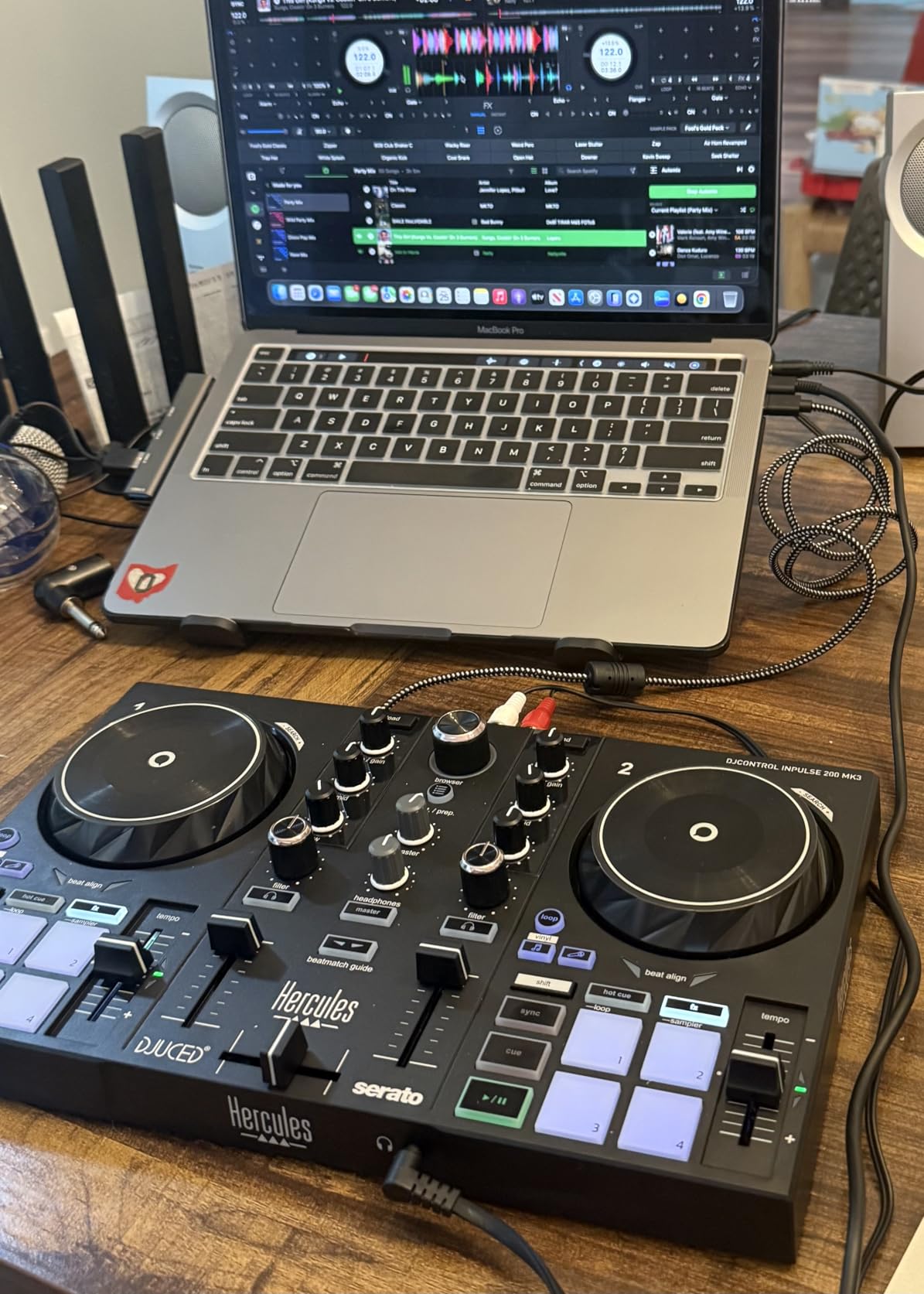
Stems controls are available on a controller at this price point, which is remarkable. You can isolate vocals, melody, bass, and drums with dedicated buttons. The separation quality is not as clean as what you get on the FLX10, but it works well enough for creative mixing at home.
Streaming support is surprisingly broad for a budget controller. You can pull tracks from Spotify, Apple Music, TIDAL, Beatport, SoundCloud Go+, and Beatsource. The built-in virtual sound card means you can stream your sets live without extra hardware.
Learning Features and DJ Academy
The DJ Academy built into Hercules’ DJUCED software walks you through everything from basic beatmatching to advanced effects. The lessons are interactive, meaning the software detects what you are doing on the controller and gives you real-time feedback. For a complete beginner, this is arguably more useful than watching YouTube tutorials.
The Beatmatch Guide LEDs are the real differentiator though. No other controller at any price offers this kind of visual beatmatching assistance. Once you learn to beatmatch without needing the lights, you can turn them off and rely on your ears.
Limitations to Keep in Mind
The build quality is where Hercules cut costs. The chassis is mostly plastic, and the jog wheels feel lighter than what you get on Pioneer DJ gear. This is acceptable at $119.99, but do not expect it to survive being dropped or tossed around at gigs.
The 4 pads per deck (compared to 8 on most other controllers) also limit your performance pad options. For pure learning and practice though, it gets the job done.
5. Numark Mixtrack Pro FX – Best Jog Wheels Under $250
Numark Mixtrack Pro FX DJ Controller
2-Deck Controller
6-inch Capacitive Jog Wheels
FX Paddles
Serato DJ Lite
USB Bus Power
24-bit Audio
Pros
- Large 6-inch capacitive-touch jog wheels feel premium
- Dual FX paddle triggers for quick effects
- 8 performance pads per deck
- USB bus powered with no adapter needed
- Massive review base with 4.6 rating from 1859 users
- Streaming from Apple Music
- TIDAL
- Spotify and more
Cons
- USB bus power limits some functionality
- May need additional gear for larger venue gigs
The Numark Mixtrack Pro FX has been a staple in the budget DJ controller space for years, and after testing one I understand why it has racked up nearly 1900 reviews with a 4.6-star average. It hits a sweet spot between price, features, and build quality that few competitors can match.
The jog wheels are the first thing that grabbed me. These 6-inch capacitive-touch platters feel closer to what you get on professional gear than what you would expect at this price. They have enough weight and resistance for basic scratching, and the touch response is consistent across the entire surface.
The FX paddle triggers are a genuinely fun feature. Instead of twisting knobs to apply effects, you flick a paddle up or down to trigger and release effects in real time. I found myself using effects more creatively with this setup than I ever did with traditional knob-based FX controls.
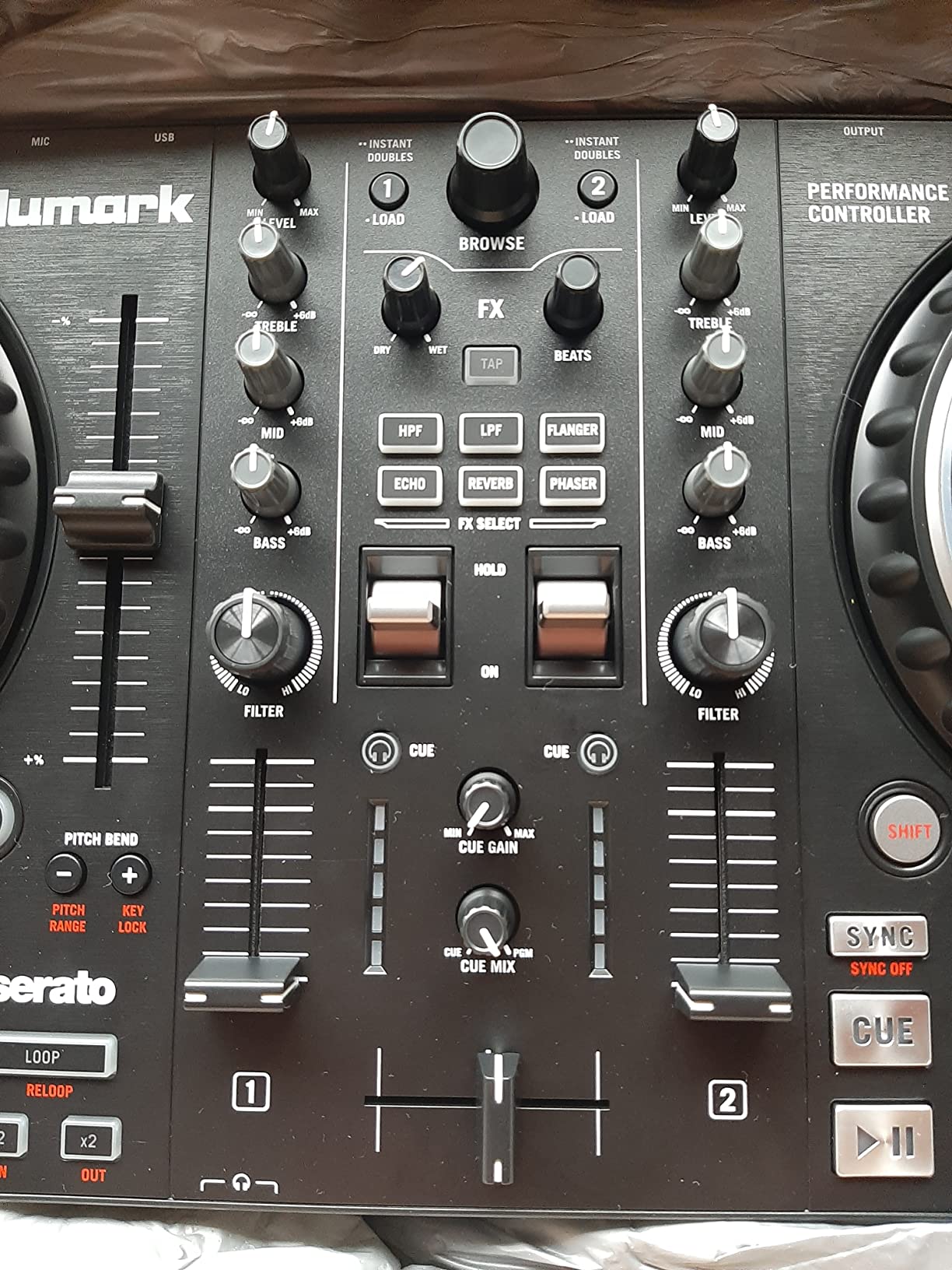
Serato DJ Lite comes included, which is the software most beginners want to learn. The controller is mapped perfectly for Serato, with every pad, knob, and button doing exactly what you expect. Streaming support covers Apple Music, TIDAL, Spotify, SoundCloud, Beatport Link, and Beatsource Link.
The USB bus power is convenient for home use but can be a limitation. Some users report issues when running the controller through unpowered USB hubs, so I recommend plugging it directly into your computer or using a powered hub.
Jog Wheel Performance and Scratching
The 6-inch jog wheels on the Mixtrack Pro FX are among the best you will find on any controller under $300. The capacitive touch detects your hand reliably, and the platters have enough rotational mass to feel realistic. I practiced basic chirp scratches and baby scratches on this controller and the response was consistent and predictable.
If you are interested in turntablism but not ready to invest in a motorized controller, this is a great place to build foundational skills.
FX System and Performance Pads
The dual paddle FX system gives you six quick-launch effects that you can trigger with a single motion. Each paddle handles three effects, and you can switch between them with a knob. The 8 performance pads per deck handle cues, loops, fader cuts, and samples with solid responsiveness.
The 3-band EQ with filter knobs rounds out the mixer section nicely. You get enough control for creative mixing without the interface feeling cluttered.
6. Numark Mixstream Pro+ – Standalone DJing Without a Laptop
Numark Mixstream Pro+ DJ Controller
Standalone 2-Deck
7-inch Touchscreen
Built-in Speakers
Wi-Fi Streaming
Stems
Engine DJ OS
8.2 lbs
Pros
- Standalone operation with no laptop required
- Built-in Wi-Fi streaming from Amazon Music
- Apple Music
- TIDAL and more
- 7-inch touchscreen with RGB waveforms
- Stem separation for vocals
- melody
- bass and drums
- DMX and smart lighting control including Philips Hue and Nanoleaf
- Built-in speakers for practice and small venues
Cons
- One-time software license required for stems
- Built-in speakers are basic and not venue-ready
- Pricier than laptop-based alternatives
The Numark Mixstream Pro+ is the first standalone controller on this list, and standalone changes everything about how you DJ. No laptop, no cables running across the booth, no software crashes mid-set. You power it on, connect to Wi-Fi, and start mixing from a catalog of over 100 million tracks.
I tested the Mixstream Pro+ at a backyard party and left my laptop at home on purpose. The experience was liberating. The 7-inch touchscreen handles track browsing, waveform display, and navigation with the kind of responsiveness you expect from a tablet. RGB waveforms give you visual feedback on the frequency content of each track.
The built-in speakers are fine for practice sessions and monitoring, but they will not fill a room. Think of them as a convenience feature for bedroom practice rather than a performance tool. For any real gig, you will want to connect to external speakers through the balanced XLR or RCA outputs.
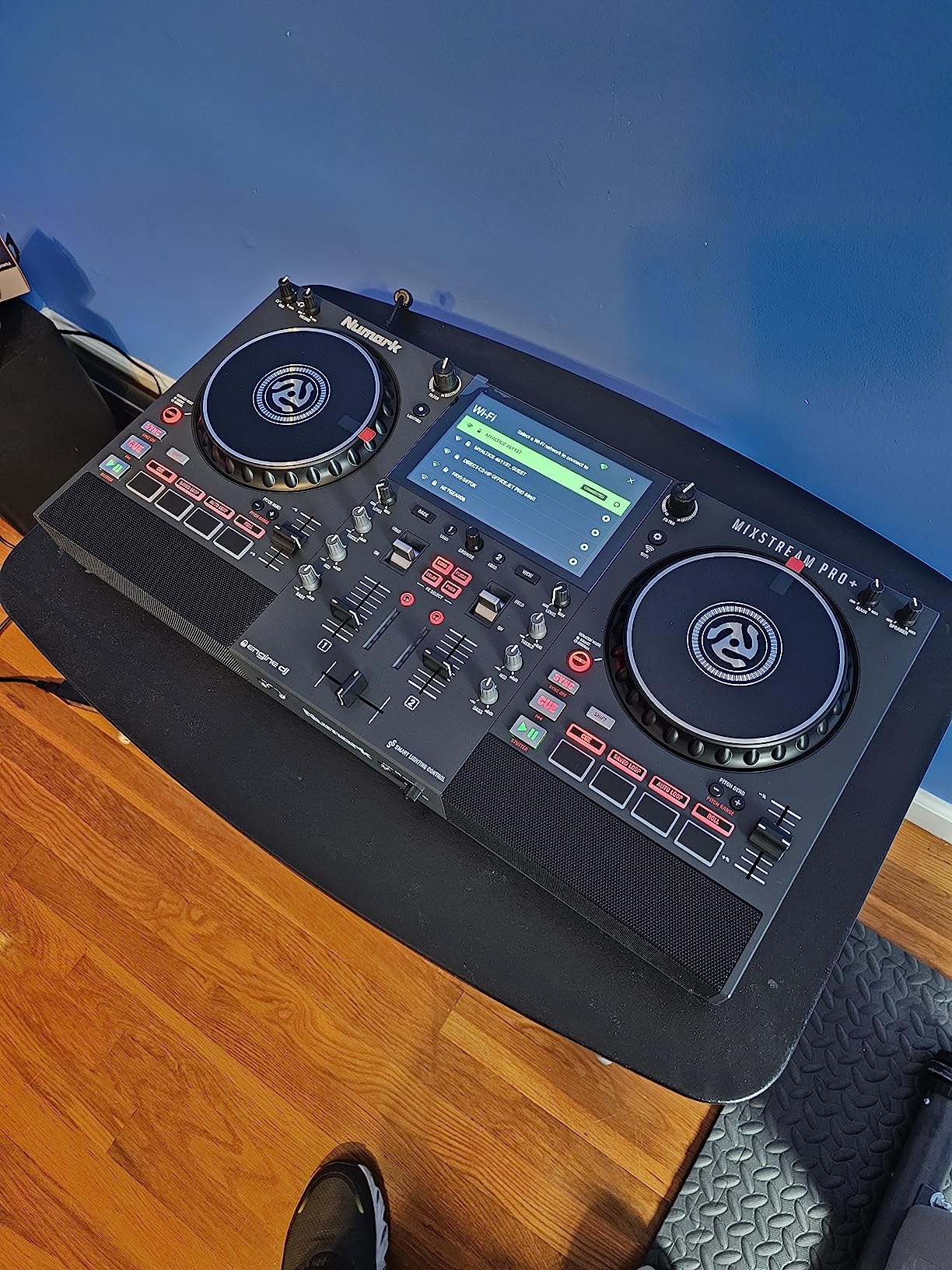
Stem separation works on-device through Engine DJ OS, which means no computer processing is required. The separation quality is comparable to what you get from software-based solutions on laptops, which is impressive for a standalone unit. Isolating vocals and drums worked well across electronic, pop, and hip-hop tracks in my testing.
The DMX lighting control integration is a nice bonus for mobile DJs. You can connect compatible lighting fixtures and sync them to your music. The Mixstream Pro+ also supports Philips Hue and Nanoleaf smart lights for home setups.
Standalone vs Laptop Workflow
Going laptop-free changes your entire DJing experience. Without a screen creating a barrier between you and the crowd, you naturally become more engaged with the room. Track selection happens on the touchscreen, which is fast enough for live use once you learn the navigation patterns.
The trade-off is that you lose some of the advanced preparation tools that laptop software provides. You cannot easily set up complex playlists or analyze tracks in advance the way you can in rekordbox or Serato. For DJs who prefer a more spontaneous approach, this is actually a benefit.
Streaming and Connectivity Options
The Wi-Fi streaming opens up access to Amazon Music Unlimited, Apple Music, TIDAL, Beatport, Beatsource, and SoundCloud Go+. The SD card slot and dual USB ports let you play tracks from local storage when Wi-Fi is unavailable. Bluetooth audio input means you can even stream from a phone in a pinch.
For DJs who play at venues with unreliable Wi-Fi, I recommend pre-downloading tracks to a USB drive or SD card as a backup plan.
7. Denon DJ SC LIVE 4 – Premium Standalone with 7-Inch Touchscreen
Denon DJ SC LIVE 4 Standalone DJ Controller Black
Standalone 4-Deck
7-inch Touchscreen
Engine DJ OS
Wi-Fi Streaming
Built-in Speakers
Stems
DMX Lighting
13.6 lbs
Pros
- Standalone operation with no laptop required
- 4-deck capability with 3-band EQ mixer
- 7-inch multi-gesture touchscreen
- Wi-Fi streaming from Amazon Music
- Apple Music
- TIDAL and more
- On-device stem separation for vocals
- melody
- bass and drums
- DMX lighting control via Engine Lighting
Cons
- Premium price point
- Built-in speakers insufficient for larger venues
- Heavier and less portable than some alternatives
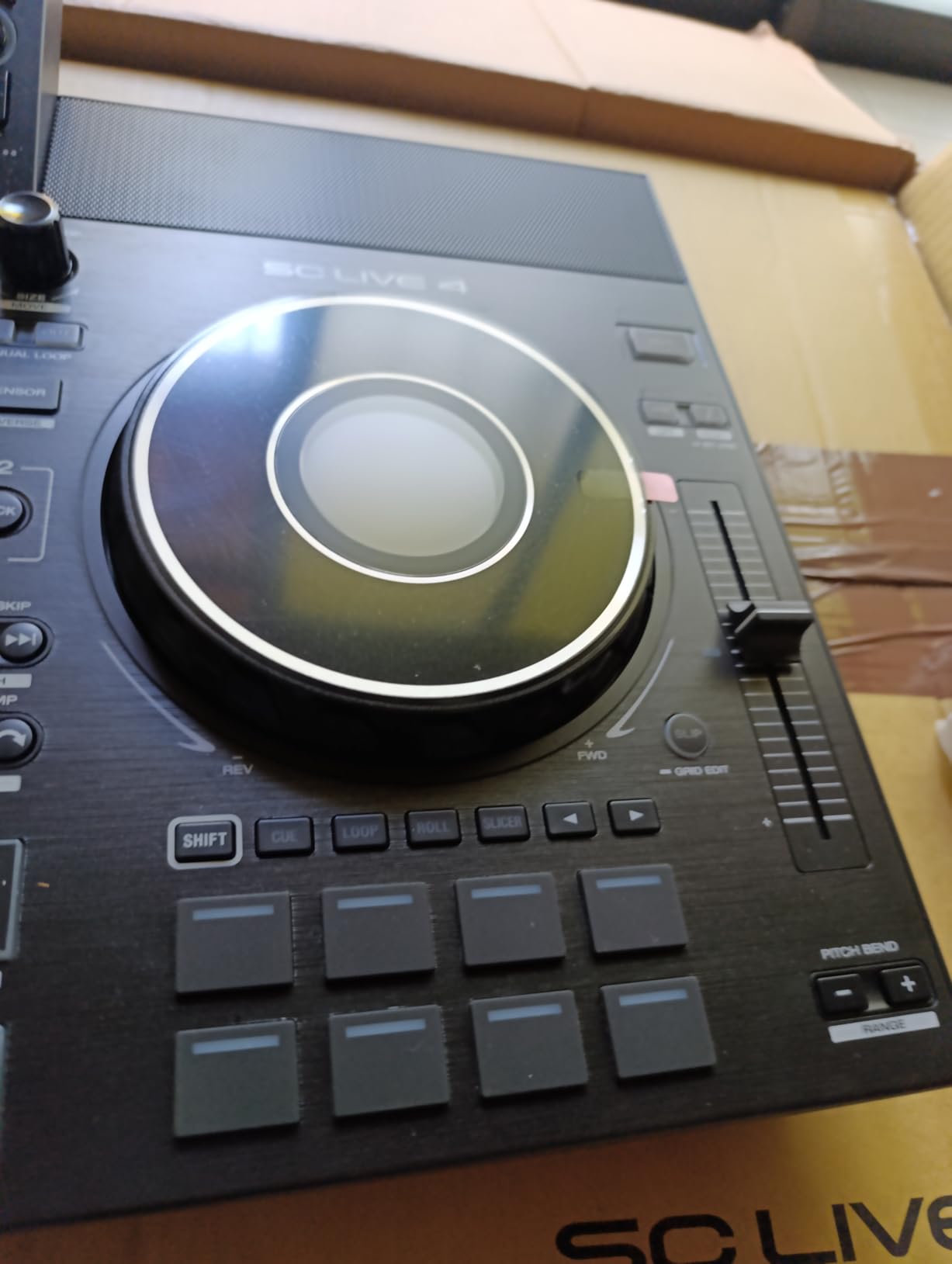
The Denon DJ SC LIVE 4 takes the standalone concept and pushes it further than the Mixstream Pro+. With 4-deck capability, a 7-inch multi-gesture touchscreen, and the powerful Engine DJ OS, it is built for DJs who want a complete laptop-free rig that does not compromise on features.
I spent a month with the SC LIVE 4 as my primary practice controller, and the 4-deck mixing capability is what sets it apart from 2-deck standalone units. Being able to layer four tracks simultaneously without a laptop opened up creative possibilities I had not explored before. The 3-band EQ mixer section gives you enough control to manage complex mixes.
The 7-inch touchscreen is responsive and supports multi-gesture navigation. Pinching to zoom into waveforms, swiping to browse tracks, and tapping to load feels natural after a short adjustment period. The display is bright enough to read in outdoor daylight, which I verified during a daytime patio session.
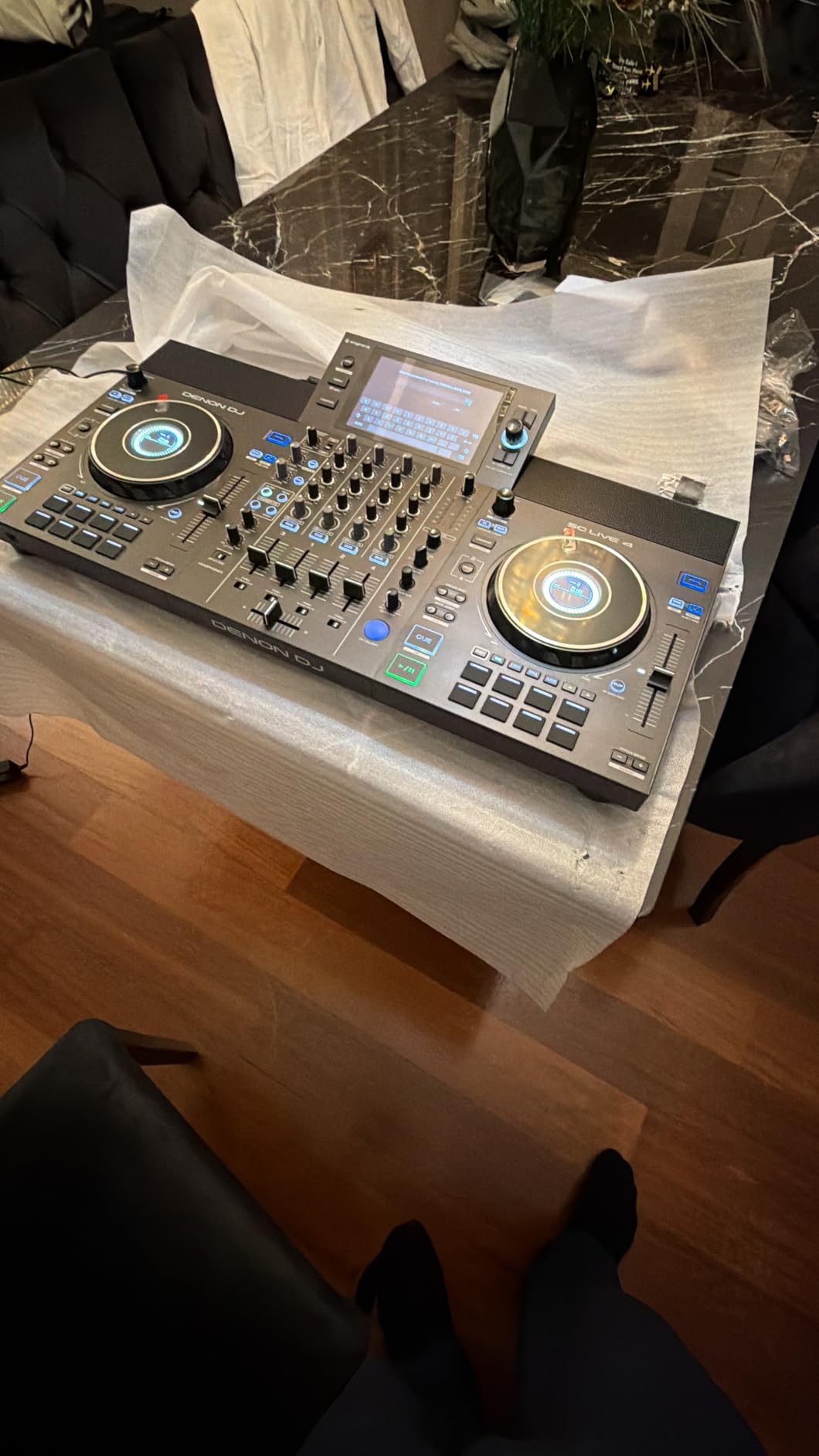
Wi-Fi streaming gives you access to the same services as the Mixstream Pro+: Amazon Music Unlimited, Apple Music, TIDAL, Beatsource, Beatport, and SoundCloud Go+. The difference is that the SC LIVE 4 handles 4 decks while streaming, which means more creative freedom without local storage limitations.
Stem separation on the SC LIVE 4 runs on-device through Engine DJ OS. The quality matches what you get on laptop-based systems, which is a significant achievement for standalone hardware. I isolated vocals and drums from various tracks and the results were consistently usable for live performance.
Engine DJ OS and Standalone Performance
Engine DJ OS is the most mature standalone DJ operating system available. It handles track analysis, waveform generation, and effects processing without any perceptible lag. The 4-deck performance was smooth even with stems active on multiple decks, which speaks to the processing power under the hood.
The SC LIVE 4 is also compatible with Serato DJ Pro and Virtual DJ, so you can connect it to a laptop when you want access to those ecosystems. This dual-mode capability makes it one of the most flexible controllers on the market.
Connectivity and I/O Options
The rear panel on the SC LIVE 4 is loaded. You get XLR balanced outputs, RCA outputs, RCA inputs, a quarter-inch microphone input, Bluetooth audio in, two USB ports, and an SD card slot. This is the most connectivity I have seen on a controller in this category.
The DMX lighting control through Engine Lighting lets you manage event lighting without additional hardware. Combined with the 4-deck mixing and stem separation, this controller can serve as the brain for an entire mobile DJ rig.
8. Pioneer DJ DDJ-REV5 – Scratch DJ Controller with Stems
Pioneer DJ DDJ-REV5 2-Channel Scratch DJ Controller, On-Jog Display
2-Channel Scratch Controller
Stems Separation
On-Jog Display
Auto BPM
Piano Play
Dual USB-C
14 lbs
Pros
- Professional scratch-style layout with tempo sliders above decks
- Dedicated stems buttons for vocal
- melody
- bass and drum isolation
- Auto BPM Transition for smooth key-matched mixing
- Dual USB Type-C ports for DJ handoffs
- On-Jog Display for visual feedback
- Piano Play mode for melodic performances
Cons
- Higher price point for a 2-channel controller
- Requires Serato DJ Pro or rekordbox for full functionality
The DDJ-REV5 is built specifically for scratch DJs and turntablists, and it shows in every design decision. The layout places tempo sliders above the deck sections in a battle-style configuration, which mirrors how vinyl DJs set up their turntables. I tested this controller with a focus on scratching and found it to be one of the most responsive scratch surfaces in its price range.
The dedicated stems buttons are a standout feature for scratch DJs. Being able to isolate vocals or drums instantly opens up creative possibilities for juggling and routine building. The stems buttons are positioned for easy access during performance, so you can trigger them without breaking your flow.
Auto BPM Transition is a feature I did not know I needed. When you are transitioning between two tracks with significantly different BPMs, this feature automatically adjusts the tempo in a musical way so the transition sounds intentional rather than jarring. I used it to go from a 90 BPM hip-hop track into a 128 BPM house track smoothly.
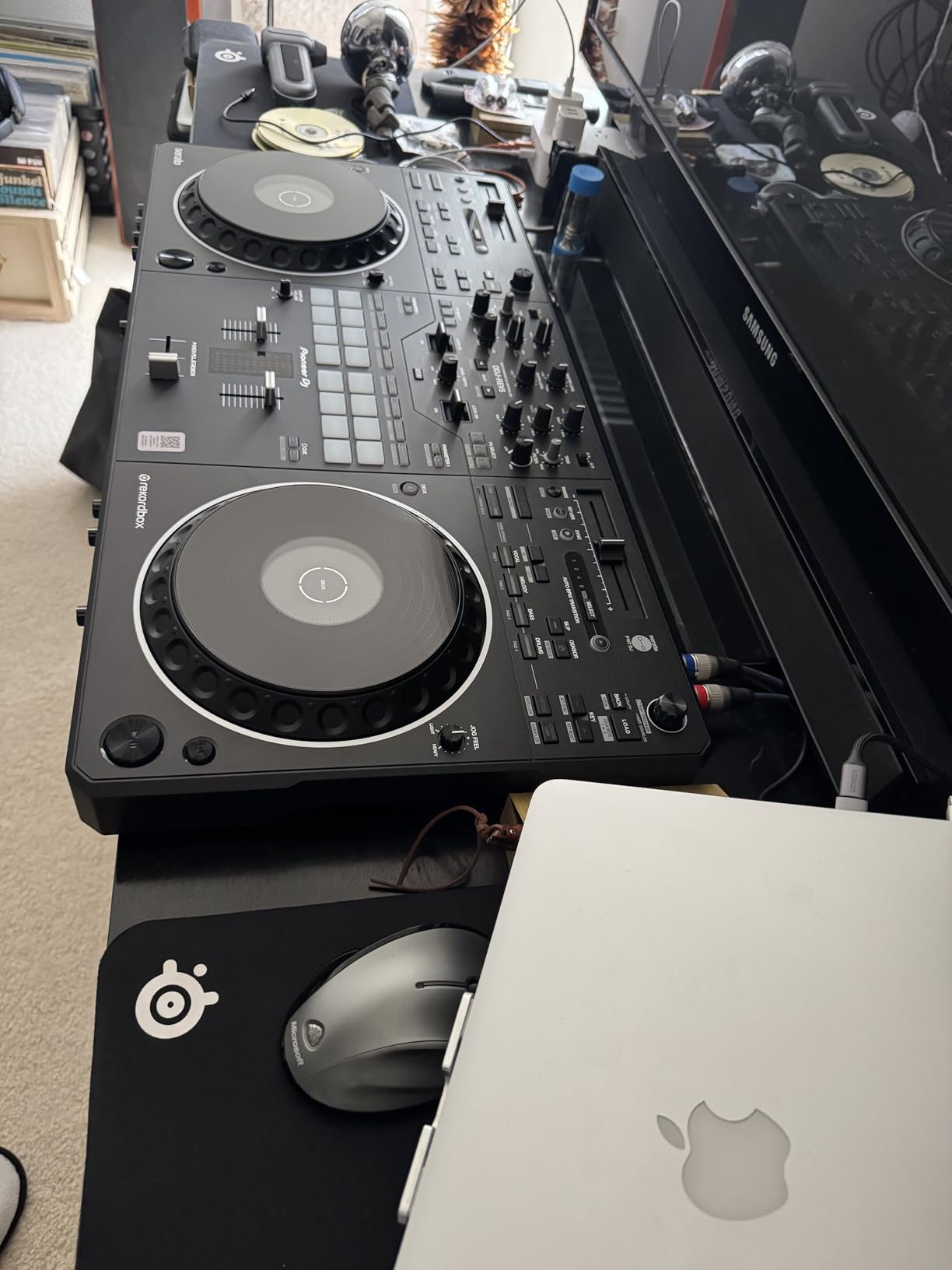
The On-Jog Display provides visual feedback directly on the platter surface. You can see deck info, track position, and BPM without looking at your laptop. For scratch DJs who need to keep their eyes on their hands during technical routines, this is genuinely useful.
Piano Play mode turns the performance pads into a melodic instrument, letting you play notes and scales in key with your track. It is not a feature every DJ will use, but for producers who also perform, it adds another creative dimension.
Scratch Layout and Battle-Style Configuration
The REV5 uses a battle-style layout where the jog wheels are turned sideways and the tempo sliders sit above each deck. This configuration is preferred by scratch DJs because it keeps the fader area clear for rapid crossfader cuts. The layout feels natural if you have ever used a pair of turntables in battle position.
The crossfader has a smooth, fast action that is suitable for crab scratches, chirps, and transforms. The cut lag is minimal for a controller at this price, though dedicated turntablists may still want to upgrade to a premium crossfader like the Pro X Fade for competition-level performance.
Dual USB-C Ports for DJ Transitions
The dual USB Type-C ports are designed for DJ changeovers. Two DJs can connect their laptops simultaneously, and the transition from one to the other happens seamlessly without stopping the music. This is a feature that club and event DJs will appreciate during long sets with multiple performers.
The REV5 works with both Serato DJ Pro and rekordbox, giving you flexibility in your software choice. Both platforms support the stems and Auto BPM features, so you are not locked into one ecosystem.
How to Choose the Best DJ Controller?
Choosing among the best DJ controllers comes down to understanding your needs, budget, and long-term goals. Here is what I learned from testing these 8 controllers and talking with DJs at every skill level.
Software Compatibility: Rekordbox vs Serato
Software choice is the single biggest decision you will make. Rekordbox is Pioneer DJ’s platform and is the standard in clubs worldwide. If your goal is to play in clubs that use Pioneer CDJs, learning rekordbox gives you a head start. Serato is the preferred choice for scratch DJs, hip-hop performers, and open-format selectors. Many controllers support both, but some are optimized for one over the other.
I recommend trying both platforms if your controller supports them. The good news is that most modern controllers ship with free versions of both rekordbox and Serato DJ Lite.
Channel Count: 2 vs 4 Decks
Two-channel controllers are perfect for beginners and cover most mixing scenarios. You can blend tracks, add effects, and perform smooth transitions with 2 decks. Four-channel controllers are necessary if you want to layer multiple tracks, use sampler decks alongside your main mix, or do complex open-format sets.
If you are just starting, 2 channels is plenty. You can always upgrade later, and the skills you learn on a 2-channel controller transfer directly to 4-channel setups.
Jog Wheel Quality and Size
Jog wheels are the primary tactile interface between you and your music. Larger jog wheels feel more realistic and are better for scratching. Capacitive touch sensing is important because it lets the software know when your hand is on the wheel. The Numark Mixtrack Pro FX has excellent 6-inch jog wheels for its price, while the DDJ-REV5 is purpose-built for scratch performance.
If you have no interest in scratching, jog wheel size matters less. Focus on other features instead.
Stems and Track Separation
Stems let you isolate vocals, drums, bass, and melody from any track in real time. This feature has become increasingly important and is now available on controllers at nearly every price point. The quality of separation varies between platforms, with rekordbox and Serato both offering capable implementations.
If creative remixing and live mashups are important to you, prioritize controllers with dedicated stems controls. The DDJ-FLX10 and DDJ-REV5 both have excellent stems integration.
Standalone vs Laptop Controllers
Standalone controllers like the Numark Mixstream Pro+ and Denon DJ SC LIVE 4 let you DJ without a laptop. They run their own operating system (Engine DJ OS) and pull music from Wi-Fi streaming services, USB drives, or SD cards. This eliminates laptop crashes, reduces setup time, and creates a more engaging performance experience.
Laptop-based controllers give you more software options, better track preparation tools, and typically cost less. Most beginners should start with a laptop-based controller and consider standalone when they are ready to simplify their rig.
Build Quality and Portability
If you plan to gig regularly, build quality matters more than any spec sheet can convey. Metal chassis controllers like the DDJ-FLX10 and SC LIVE 4 survive the rigors of transport better than plastic-bodied units. Weight is a trade-off: heavier controllers feel more solid but are harder to carry.
For home practice, lighter controllers like the DDJ-FLX2 and Hercules Inpulse 200 MK3 are ideal because they are easy to set up and put away.
Budget Considerations
Under $250, you are looking at excellent beginner options like the Hercules Inpulse 200 MK3 and Numark Mixtrack Pro FX. Between $300 and $700, the Pioneer DJ DDJ-FLX4 and Numark Mixstream Pro+ offer significant feature upgrades. Over $1000, you enter professional territory with controllers like the DDJ-FLX10, SC LIVE 4, and DDJ-REV5 that are built for serious performance.
I am a believer in the “buy once, cry once” philosophy that many experienced DJs on Reddit advocate. If you can afford a mid-tier controller upfront, you will save money by avoiding the upgrade cycle. But if budget is tight, starting with something affordable is perfectly fine.
FAQs
What should beginners look for in a DJ controller?
Beginners should prioritize software compatibility (Serato DJ Lite or rekordbox), a layout that mirrors professional club gear, responsive jog wheels, and built-in learning features like beatmatch guides or tutorials. A 2-channel controller under $350 is ideal for learning fundamentals without overwhelming complexity.
Which DJ controller software is best – Rekordbox, Serato, or other?
Rekordbox is the club standard and essential if you plan to play on Pioneer CDJs. Serato DJ Pro is preferred by scratch DJs and open-format performers for its stability and feature set. For beginners, both platforms offer free versions, so try each and choose based on your mixing style and performance goals.
What budget should a beginner DJ controller cost?
A quality beginner DJ controller costs between $120 and $350. The Hercules DJControl Inpulse 200 MK3 at $119.99 and the Pioneer DJ DDJ-FLX4 at $329 are both excellent starting points. Avoid spending under $100 as those controllers often lack the build quality and features needed for proper learning.
What is the best DJ controller for preparing to play in clubs?
The Pioneer DJ DDJ-FLX4 is the best controller for club preparation because its layout mirrors Pioneer CDJ gear. The DDJ-FLX10 adds 4-channel mixing and track separation for more advanced practice. Both work with rekordbox, which is the software used by Pioneer club installations worldwide.
Should beginners buy cheap or intermediate DJ controllers?
If budget allows, buy an intermediate controller like the DDJ-FLX4 ($329) rather than the cheapest option available. Intermediate controllers have better build quality, more features, and a layout that translates to professional gear, meaning you will not outgrow them as quickly. However, budget controllers like the Hercules Inpulse 200 MK3 are still excellent learning tools.
Final Verdict on the Best DJ Controllers for 2026
After testing all 8 controllers across weeks of mixing sessions, a few clear winners emerged. The Pioneer DJ DDJ-FLX4 remains the best overall choice for most DJs. Its club-standard layout, software flexibility, and beginner-friendly features make it the controller I recommend without hesitation.
For those who want a laptop-free experience, the Denon DJ SC LIVE 4 and Numark Mixstream Pro+ are the best standalone options. They offer streaming, stems, and touchscreen navigation that free you from carrying a computer to every gig.
If budget is your primary concern, the Hercules DJControl Inpulse 200 MK3 delivers remarkable value at $119.99 with learning features that no other controller at any price can match. The best DJ controllers in 2026 cover every skill level and budget, so pick the one that matches where you are today and where you want to be tomorrow.