
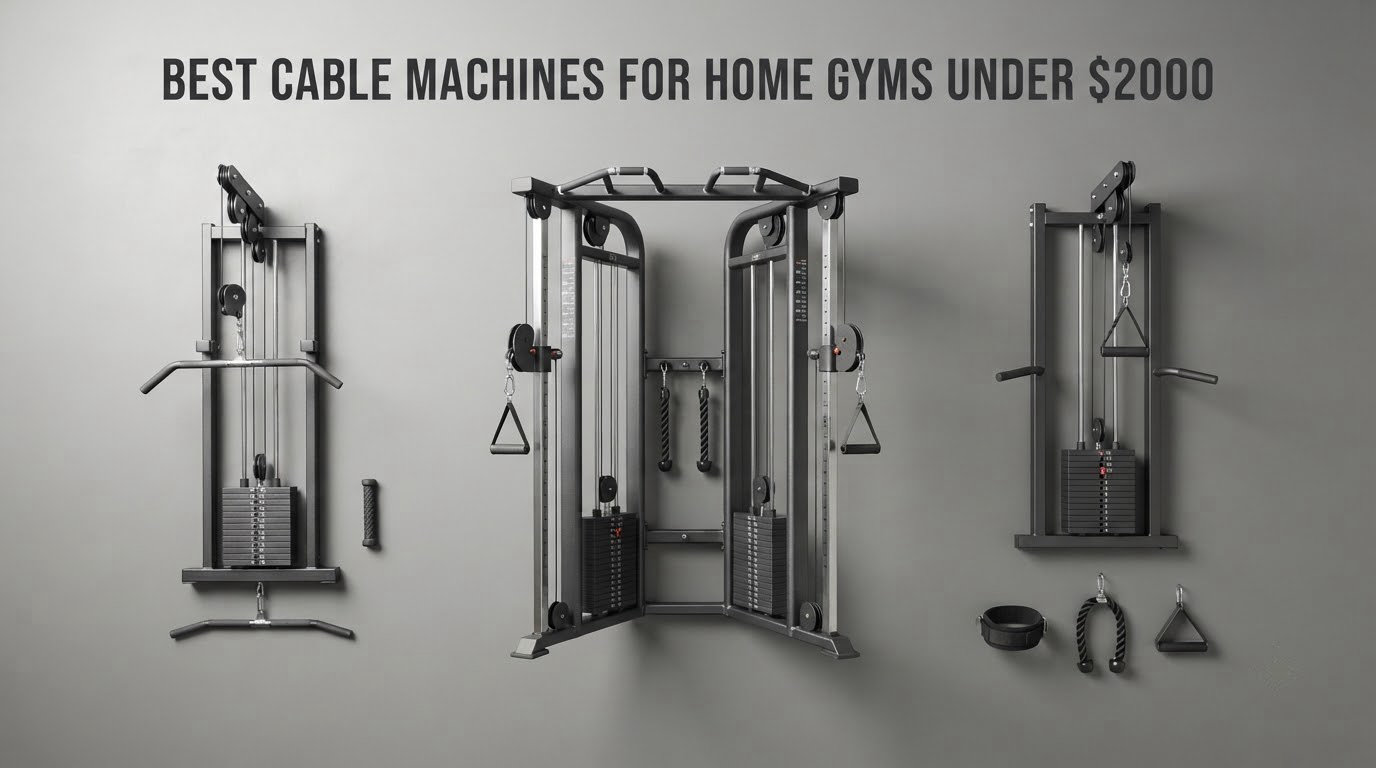
If you have been reading cable machine roundups and wondering why almost none of them ever quote a lower number, there is a simple reason. Most guides in this category start above three thousand dollars and work upward, because the machines they love were built for commercial gyms and priced accordingly. The shelf below two thousand dollars is real, it is crowded, and it is where almost every home gym owner actually buys.
We spent the last few months sorting that shelf for this roundup of the best cable machines for home gyms under 2,000. Ten products made the cut, and they fall into four clearly different groups. Dual-stack selectorized functional trainers give you two independent weight stacks and constant tension. All-in-one stack machines pack dozens of movements into a single frame. Rack-integrated systems bolt cable work onto a power cage. And a plate-loaded tower is the bare-bones entry point that fits in a corner and a modest budget.
Understanding those four groups matters more than any single spec number. A dual-stack functional trainer running a 2:1 cable ratio, a plate-loaded wall tower running 1:1, and a compact 150 lb stack machine solve completely different problems. A buyer who treats them as interchangeable often ends up with a unit that cannot do the two movements they care about most, which are lat pulldowns and triceps pushdowns.
We scored every unit on the things that decide whether a home gym owner is still happy with it a year later: effective resistance per cable, the number of adjustment positions, steel gauge and frame stability, footprint and ceiling clearance, which attachments actually ship in the box, warranty length, and how the machine behaves over long ownership. Prices in this category move by several hundred dollars between sale cycles, so read each label as an archetype rather than a promise about a particular day, and confirm the current figure before you order.
If you are still at the stage where you are not sure you need a cable machine at all, our broader cable machine roundup covers the full price range from wall-mounted singles to premium dual-stack trainers. This page stays focused on what fits beneath the two thousand dollar ceiling.
Table of Contents
Top 3 Picks for Best Cable Machines for Home Gyms under $2000 (October 2026)

Body-Solid PFT100 Cable Crossover
- Two independent 160 lb weight stacks
- 50 percent mechanical ratio
- Ten year frame warranty
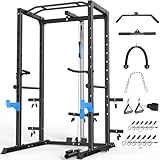
ULTRA FUEGO Power Cage with Pulley System
- Pulley system bundled with cage
- 1002 lb capacity
- Full accessory set included

GDLF Lat Pull Down and Low Row
- Lat station and low row combined
- Four position thigh rollers
- Compact 26 inch width
The Body-Solid PFT100 takes the top slot because it is the only true dual-stack functional trainer in this price band, and it has been building a track record for years rather than months. The ULTRA FUEGO cage wins on value for anyone who wants a complete rack with cables instead of a dedicated cable machine. The GDLF is the honest entry point for a first cable station in a small room.
Best Cable Machines for Home Gyms under $2000 (October 2026)
| Product | Specifications | Action |
|---|---|---|
| Body-Solid PFT100 Cable Crossover |
|
Check Latest Price |
 Mikolo LAT and Lift Pulley System Mikolo LAT and Lift Pulley System |
|
Check Latest Price |
| GDLF Lat Pull Down and Low Row |
|
Check Latest Price |
 Marcy MWM-988 Multifunction Machine Marcy MWM-988 Multifunction Machine |
|
Check Latest Price |
 DONOW Smith Machine with Dual Weight Stacks DONOW Smith Machine with Dual Weight Stacks |
|
Check Latest Price |
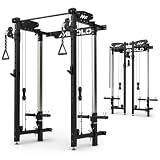 Mikolo Folding Squat Rack with Crossover Mikolo Folding Squat Rack with Crossover |
|
Check Latest Price |
 MAJOR FITNESS F22 Power Rack MAJOR FITNESS F22 Power Rack |
|
Check Latest Price |
 Mikolo Home Gym 150 lb Stack Mikolo Home Gym 150 lb Stack |
|
Check Latest Price |
 SincMill Multifunctional Home Gym SincMill Multifunctional Home Gym |
|
Check Latest Price |
| ULTRA FUEGO Power Cage with Pulley System |
|
Check Latest Price |
Two details in that table decide more purchases than any other. The first is stack weight, because a stack is the ceiling on what you can pull, not what you can feel at the handle once the pulley ratio is applied. The second is unit height, because a machine that does not clear your garage ceiling is a machine you will not use.
1. Body-Solid PFT100 Cable Crossover: Best True Dual-Stack Trainer Under 2,000
Body-Solid Powerline (PFT100) Cable Crossover Exercise Machine for Home & Commercial Gym, Functional Training Center with Dual 160lbs. Weights Stack for Cable Workout
Two 160 lb stacks
1/2 to 1 ratio
42.3 by 62.6 by 83 inch
476 lb unit
10 year frame warranty
Pros
- Genuine dual independent weight stacks
- Smooth and quiet cable travel over the full range
- Freestanding frame needs no wall anchoring
- Very wide high and low pulley exercise coverage
- Pull-up station and accessory hooks included
Cons
- Assembly runs three to five hours and the instructions are uneven
- Two people are strongly recommended to build it
- 160 lb stack is light for advanced lifters
This is the machine we kept coming back to. The PFT100 is the rare piece of equipment under two thousand dollars that behaves like something you would find in a commercial gym, and after comparing all ten units in this roundup it was the one with the fewest compromises that mattered. Body-Solid has been building this style of machine for decades, and the PFT100 shows that in the details that are hard to fake.
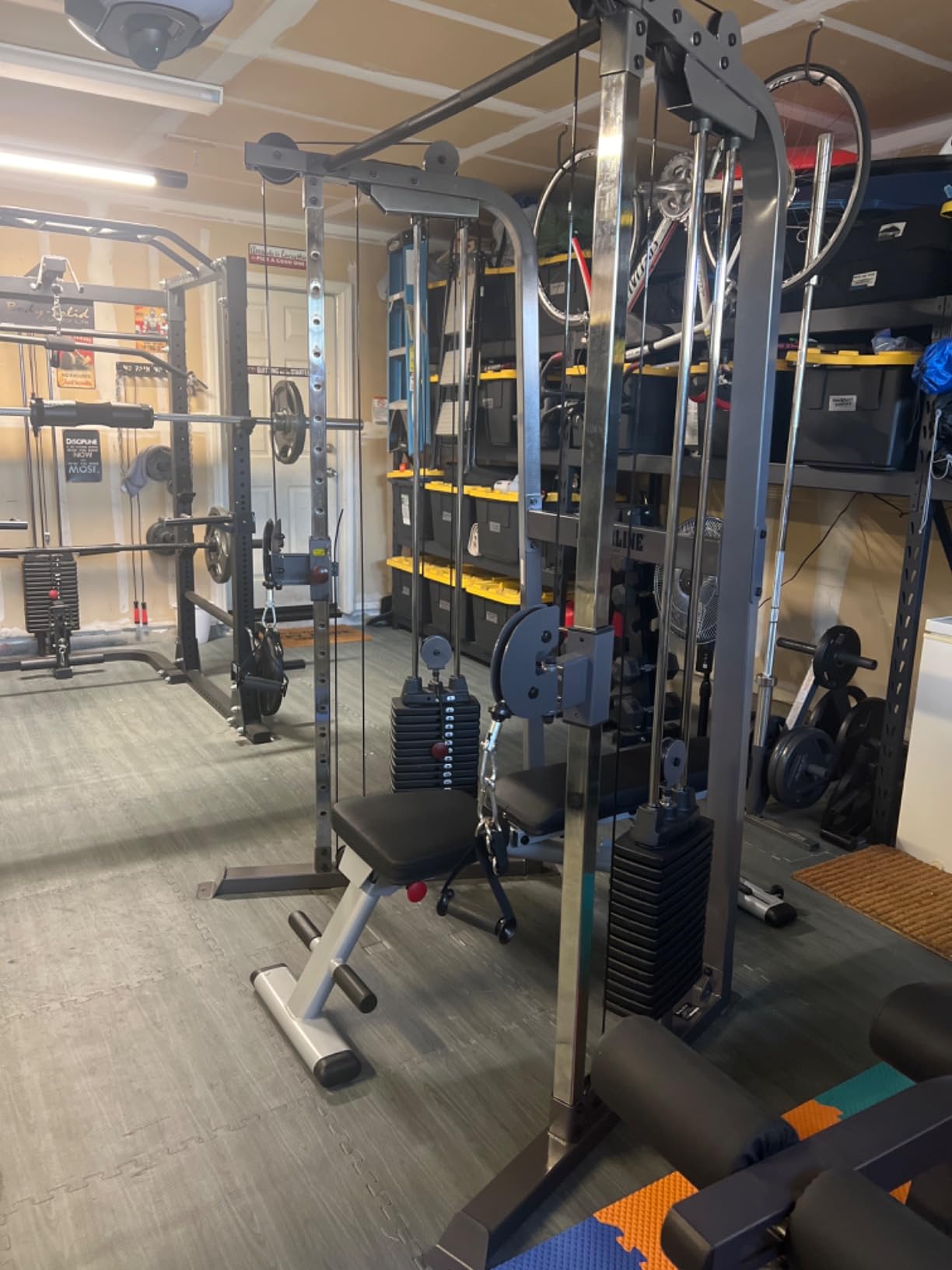
The frame is alloy steel, powder-coated, and it stands 83 inches tall with a footprint of 42.3 by 62.6 inches. Owners consistently describe the cable travel as smooth and quiet, with no friction or grinding, which is the single best indicator of a well-built pulley system you will find in customer reviews. There is no wall anchoring required, so it can sit in the middle of a garage floor rather than being pinned to a stud wall.
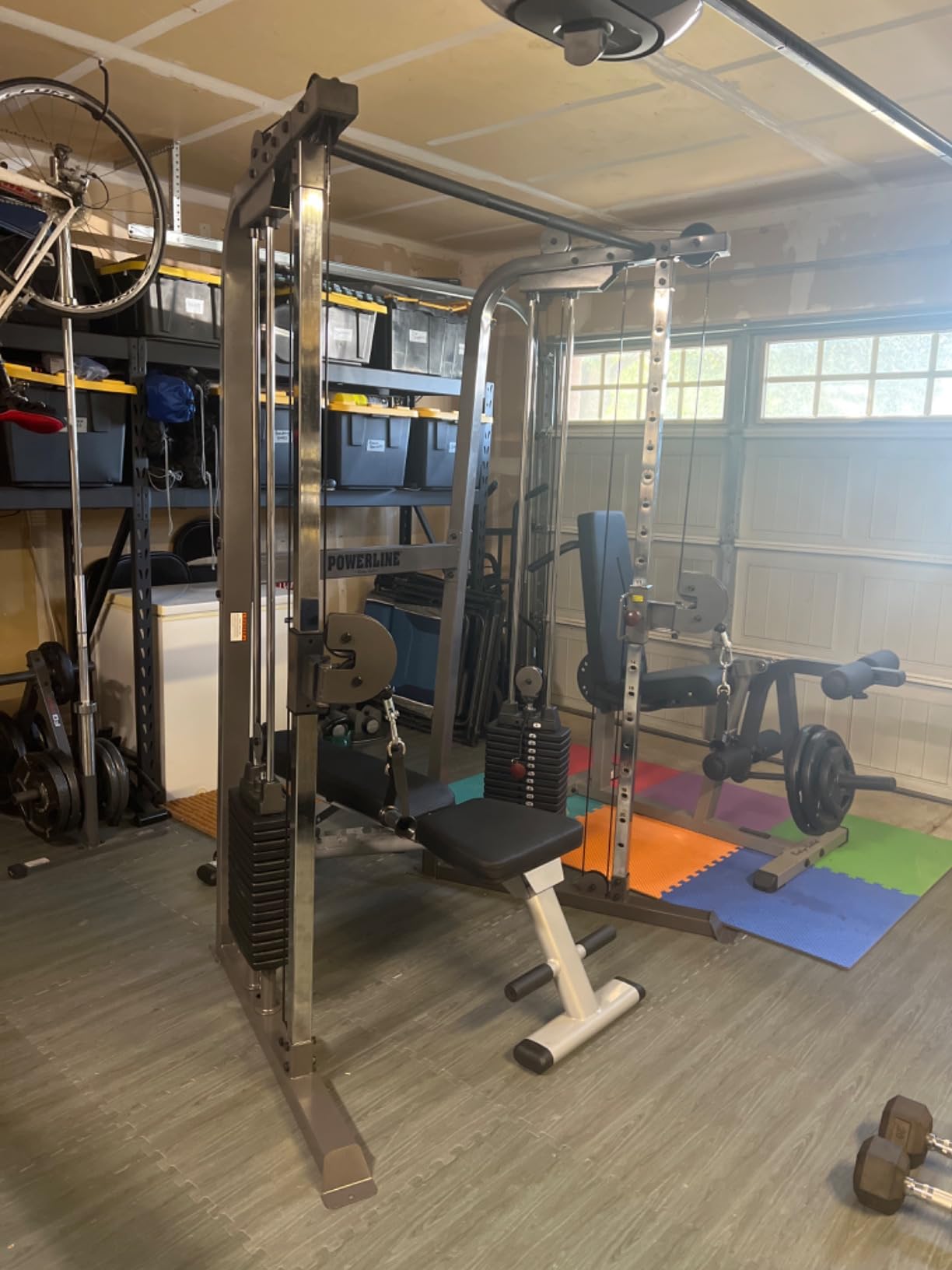
The exercise list is the longest in this roundup. The same two stacks drive pec fly, bench press, incline press, crossover, upright row, deltoid raise, shoulder press, close-grip lat pulldown, bent-over row, seated row, ab crunch, oblique bend, triceps pressdown, thigh abduction and adduction, calf press, reverse fly, and glute kickback. For a home gym owner who wants to cover the upper body without buying a rack full of single-purpose machines, that is genuinely impressive coverage from one frame.
The important number buried in the spec sheet is the half to one weight ratio. Each independent stack weighs 160 lb, and the pulley arrangement halves what reaches the handle, so you get roughly 80 lb of usable resistance per side. That sounds modest until you work through the movements: nearly every accessory exercise in the list tops out well below that. A 210 lb stack is also available for anyone who outgrows the base configuration.
Why we picked it over cheaper dual-stack options
Three things separated it from the alternatives. First, the two stacks are fully independent, which means you can set one side heavier than the other for unilateral work, supersets, and drop sets without swapping anything. Second, the build quality and hardware tolerances hold up under load in a way that lighter-gauge frames with the same headline spec do not.
Third, and this matters for a machine you will own for years, the warranty is ten years on the frame with one year on parts. In a category where one year is common, that coverage is a real difference. Body-Solid support is also responsive; owners report replacement cables arriving at no charge.
Where it falls short
Assembly is the honest weak point. Owners budget three to five hours, the instruction diagrams are described as vague in places, and two people are strongly recommended. At 476 lb this is the heaviest unit in the roundup, so it is not a casual solo build.
There is also the parts list issue that shows up in reviews, where some listings reference pieces that were not clearly included or not pre-installed, and the cable end has to be stripped and finished during assembly. If you are not comfortable with basic tools, budget for a paid assembly visit.
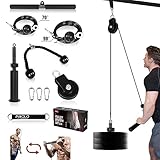
2. Mikolo LAT and Lift Pulley System: Best Cable Add-On for Rack Owners
Mikolo Fitness LAT and Lift Pulley System, Dual Cable Machine(70” and 90”) with Upgraded Loading Pin for Triceps Pull Down, Biceps Curl, Back, Forearm, Shoulder-Home Gym Equipment(Patent)
Loads to 280 lb
Includes 70 and 90 inch cables
10 by 11 by 10 inch
2.85 kg
Patent pending design
Pros
- Adds real pressdown and liftup capability to a rack
- Breakproof ball-ended cables and alloy buckles
- Loads up to 280 lb with standard plates
- Two cable lengths suit different anchor heights
- Straight bar and triceps rope included
Cons
- Not a standalone machine and needs a rack or beam
- Resistance depends entirely on the plates you own
- The 90 inch cable is rarely needed on a home rack
This is the most-reviewed item in the entire roundup by a wide margin, and for a good reason. If you already own a power cage, a squat rack, or even a sturdy ceiling beam, this is the cheapest credible way to add genuine lat pulldowns, seated rows, and triceps pressdowns to your setup. It is a fraction of what any of the machines below cost, and it does not take up any floor space at all.
The mechanism is straightforward. A steel pulley housing clamps to your upright, a rope runs through it, and the other end of the rope clips to a loading pin with a barbell clamp that holds standard or Olympic plates. Switch the hoist buckle connection and the same unit works as a pressdown or as a liftup, which covers the two directions a high pulley normally gives you.
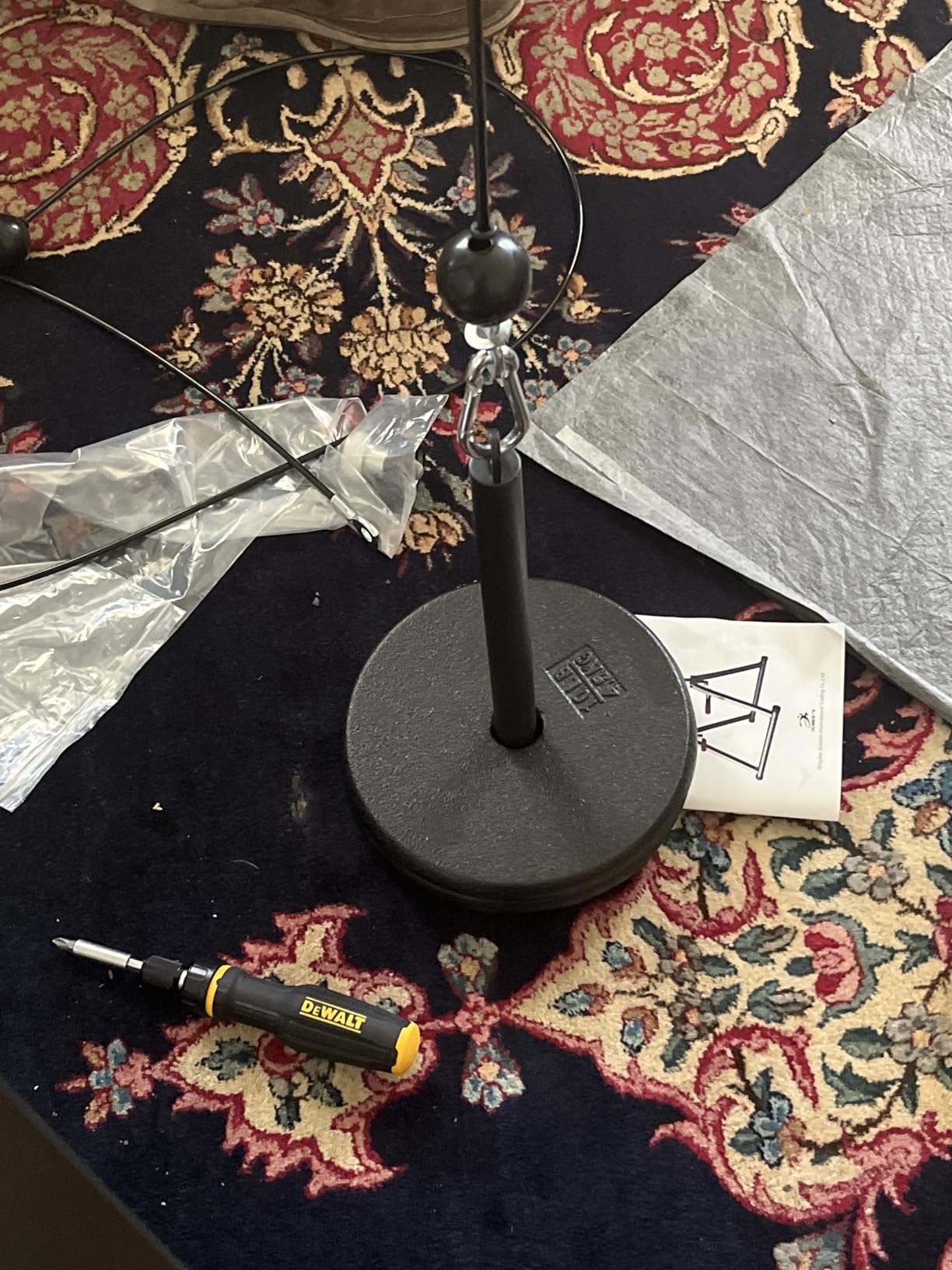
What makes it durable rather than flimsy is the cable and hardware spec. The ball-ended cables are described as breakproof in customer reviews, the buckles are heavy alloy, and the pulleys are silent steel rather than the plastic wheels found on cheap pulley kits. Both 70 inch and 90 inch sheathed cables are included so you can match the run to your anchor height.
At 280 lb of stated capacity, it holds more than most home racks will ever need. Owners use it for rows, pulldowns, pressdowns, curls, face pulls, and even reverse fly work, and the straight bar and triceps rope are in the box rather than being an upsell.
Why it makes sense for most buyers
It solves the two movements forum buyers worry about most, lat pulldown and cable triceps, and reviewers consistently call the pulley action smooth and the plate loading easy. The whole assembly is small enough to pack for travel if you train away from home occasionally.
It is also the cheapest way to test whether you actually like cable training before committing to a two thousand dollar machine. If you add this to a rack and find yourself doing pressdowns and rows three times a week, you have learned what you want from a bigger unit.
What it is not
It is not a cable machine. It needs an anchor point, it has no weight stack, and it offers no adjustment positions, no frame stability of its own, and no stand. If you do not already own a rack or have a solid beam, this product does nothing for you.
Resistance is also only as good as your plate inventory. A beginner with two twenty-five pound plates will find the usable range narrow until they buy more, so factor incremental plate cost into the decision.
3. GDLF Lat Pull Down and Low Row Machine: Best Budget Standalone Station
GDLF LAT Pull Down Machine, Low Row Cable Machine for Home Gym
Plate loaded
59 by 26 by 77 inch
71.9 lb unit
High and low pulley stations
Pros
- Compact 26 inch width fits small rooms and apartments
- LAT station and low row in one freestanding frame
- Four position thigh rollers and four position seat height
- Light enough at about 72 lb to reposition easily
- Good build quality for the money
Cons
- Resistance depends on the plates you own
- Fixed handle only with no rope or bar in the listing
- Progression requires adding plates rather than turning a pin
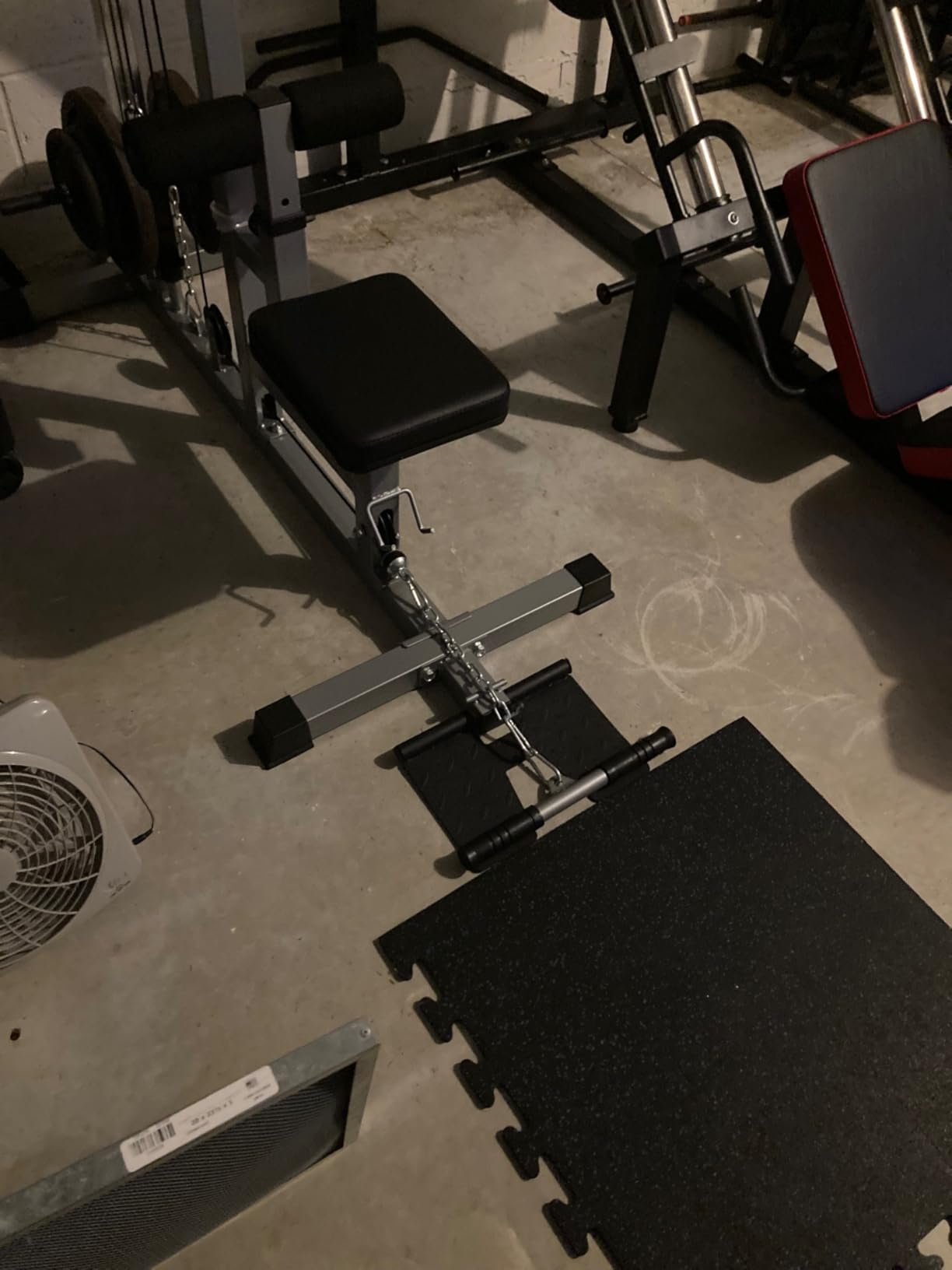
If your gym is a corner of a basement rather than a full garage, footprint is the first thing to check and this machine wins it. At 26 inches wide and 59 inches deep, it is the narrowest standalone machine in this roundup, several sizes smaller than the multi-station frames, and it still delivers both a high pulley for pullovers and a low pulley for rows on the same frame.
The frame is a 77 inch tall alloy steel structure with four position adjustable foam thigh rollers and a seat that adjusts through four positions, which is what allows a single machine to serve a wide range of user heights. Total unit weight is about 72 lb, so you can move it, flip it, or take it out of the way when you need the floor for something else.
Customer reviews describe the value simply and consistently. The recurring themes are value for money, the small footprint, and adjustability that works for more than one person in the household. In practice that means the same machine handles a teenager and a parent without a rebuild.
It is not a full weight stack unit, so resistance is whatever you load onto the carriage. If you own a full set of bumper plates, the ceiling is high. If you own a pair of dumbbells, you are working in a narrow band and will be adding plates sooner rather than later.
Where this budget tier works best
It is a strong pick for a first home gym, a rental property gym, or a shared garage where floor space is the binding constraint. The lat station is the station most people care about, and adjustable rollers make it usable rather than a gimmick at this size.
It also works well as a rehab or general conditioning tool, where the goal is consistent low to moderate tension across a long range rather than progressive overload to failure.
Its limits are obvious
The fixed handle is the biggest one. Listings for this machine do not include a rope or a lat bar, so cable curls, triceps pressdowns, and crossover work are limited until you buy your own attachments. At this price, that is a reasonable trade, but it should be an informed one.
There is also no isolation of the two cable lines in a functional trainer sense, no guide rods to keep a stack aligned, and no adjustment positions on the carriage. This is a plate-loaded station, and treating it like a selectorized trainer will disappoint you.
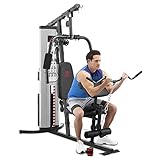
4. Marcy MWM-988 Multifunction Machine: Best Starter All-in-One
Marcy Home Gym System with 150 lb Weight Stack Multifunction Machine MWM-988
Selectorized 150 lb stack
68 by 78 inch
280.5 lb unit
Two year limited warranty
Pros
- Dozens of movements from one machine
- Selectorized stack means no plate loading
- Sturdy frame that does not wobble during use
- Smooth and fairly quiet pulley operation
- Support sends replacement parts quickly and free
Cons
- Assembly runs three and a half to five hours
- Short cable travel on pec fly and bench press
- 150 lb stack is outgrown by anyone progressing past beginner work
The Marcy MWM-988 has been on the market long enough that its review history is a genuine asset, and with close to two thousand ratings it is one of the better-documented budget machines in this category. For someone building a first home gym and wanting cables plus pressing stations plus leg work in a single footprint, it remains a logical starting point.
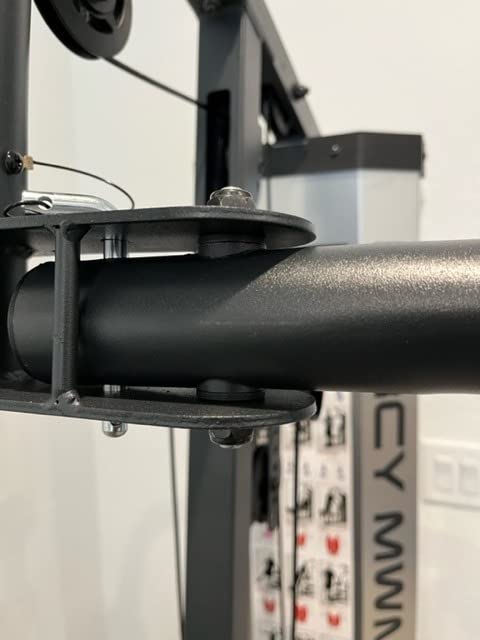
The stack is a selectorized 150 lb unit with a safety lock pin, which means you change resistance by moving a pin rather than loading plates. Reinforced guard rods hold the plates in place, and the press arms switch between a chest press and a vertical butterfly action. A removable, adjustable preacher curl pad rounds out the arm work.
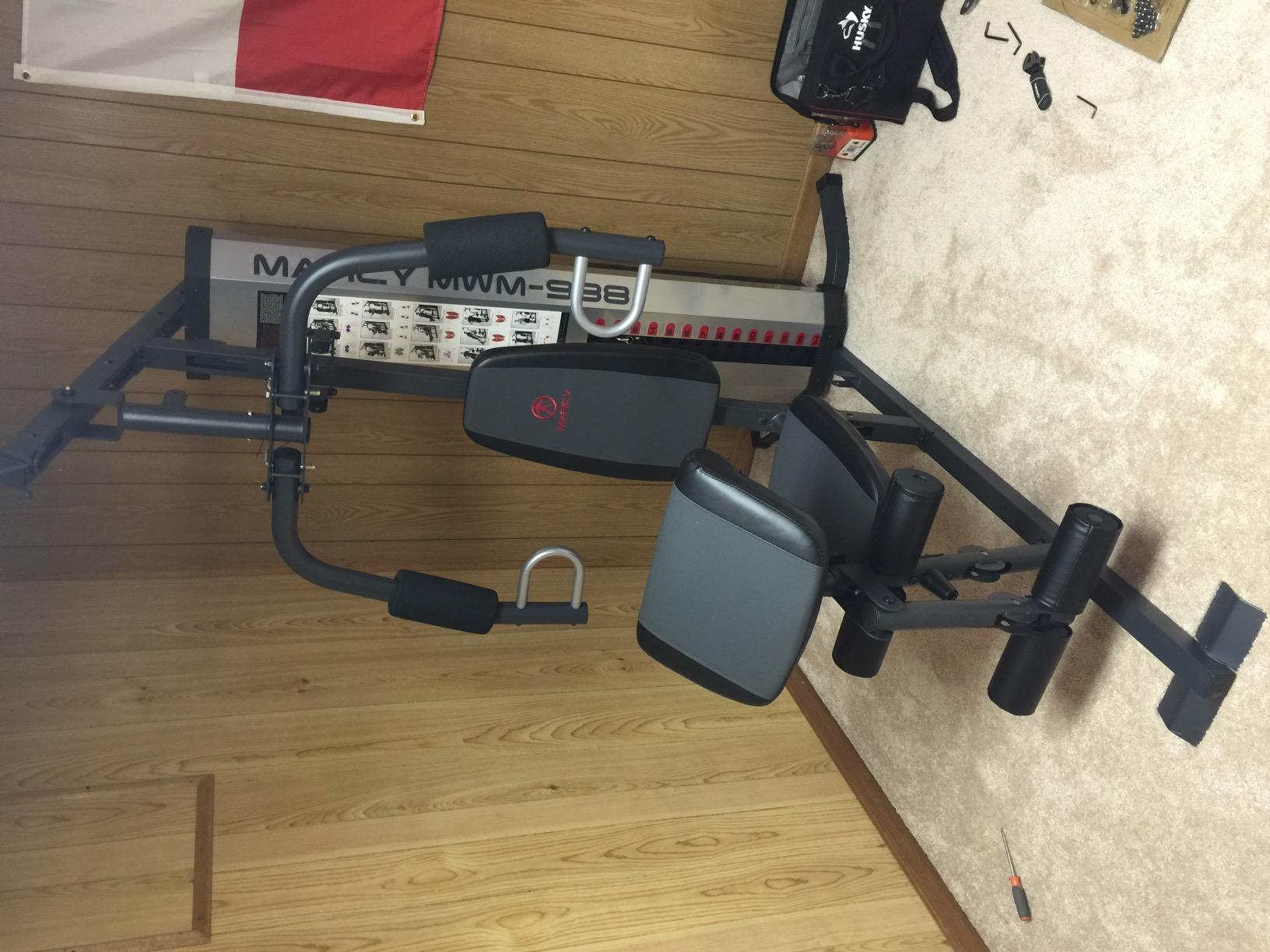
What reviewers like most is the number of usable exercises and the fact that it does not teeter or wobble once built. Pulley operation is described as smooth and reasonably quiet, and the lat station in particular is singled out as the standout, particularly when paired with carabiners and foam grips.
Support is a genuine strength here. Owners repeatedly report Marcy sending replacement sheet metal covers, frayed cables, and other parts quickly and at no charge, which matters on a machine with a two year limited manufacturer warranty and a lot of cable contact points.
Why it suits a beginner gym
Selectorized resistance is the deciding factor. A beginner does not have to own a matched set of plates to use it, and the increments are small enough to make progression feel like progress rather than a stall. Nothing else in the sub-five-hundred-dollar range gives you that.
It also covers more of the body than a pure cable machine, so a buyer who is not sure whether they want cables at all can get pressing, rowing, pressing down, leg extension, leg press, and curl stations from one unit.
Where progression stops
The 150 lb stack is the ceiling, and for the cable work that means the top end is modest once you factor in the pulley reduction. Most owners describe it as a machine you outgrow within a year of training seriously, which is exactly the window in which a stack upgrade path would help, and Marcy does not sell one.
There are also two mechanical complaints worth knowing about. The swinging leg bar can contact the frame during standing leg pulls, and the bench press arm path can impinge the shoulder, which limits the safe load on pressing movements. Cable travel is short on several stations, and the manual is not sufficient on its own for the cable tension step, so allow extra assembly time.
5. DONOW Smith Machine with Dual Weight Stacks: Best All-in-One for Heavy Cable Work
DONOW Smith Machine with Weight Stacks Home Gym System Cable Crossover
Two 352 lb stacks
2 to 1 cable ratio
54.7 by 78.6 by 88 inch
Arrives in eight boxes
Pros
- Smith machine
- rack
- crossover and pull-up station in one footprint
- Two 352 lb stacks give far more resistance than most units in this price band
- Selectorized stacks avoid walking around to load plates
- Enclosed steel stack covers keep cables secure
- Linear-bearing Smith bar moves smoothly
Cons
- Very large footprint at 78.6 inches wide and 88 inches tall
- Arrives in eight boxes so a dedicated room is needed
- Assembly is a major project needing a second person
This machine does something none of the others do: it pairs real barbell stations with genuinely heavy dual weight stacks in one frame. If you want a Smith machine and a cable crossover and you only have room and budget for one large purchase, the DONOW is the only option in this roundup that resolves that conflict.
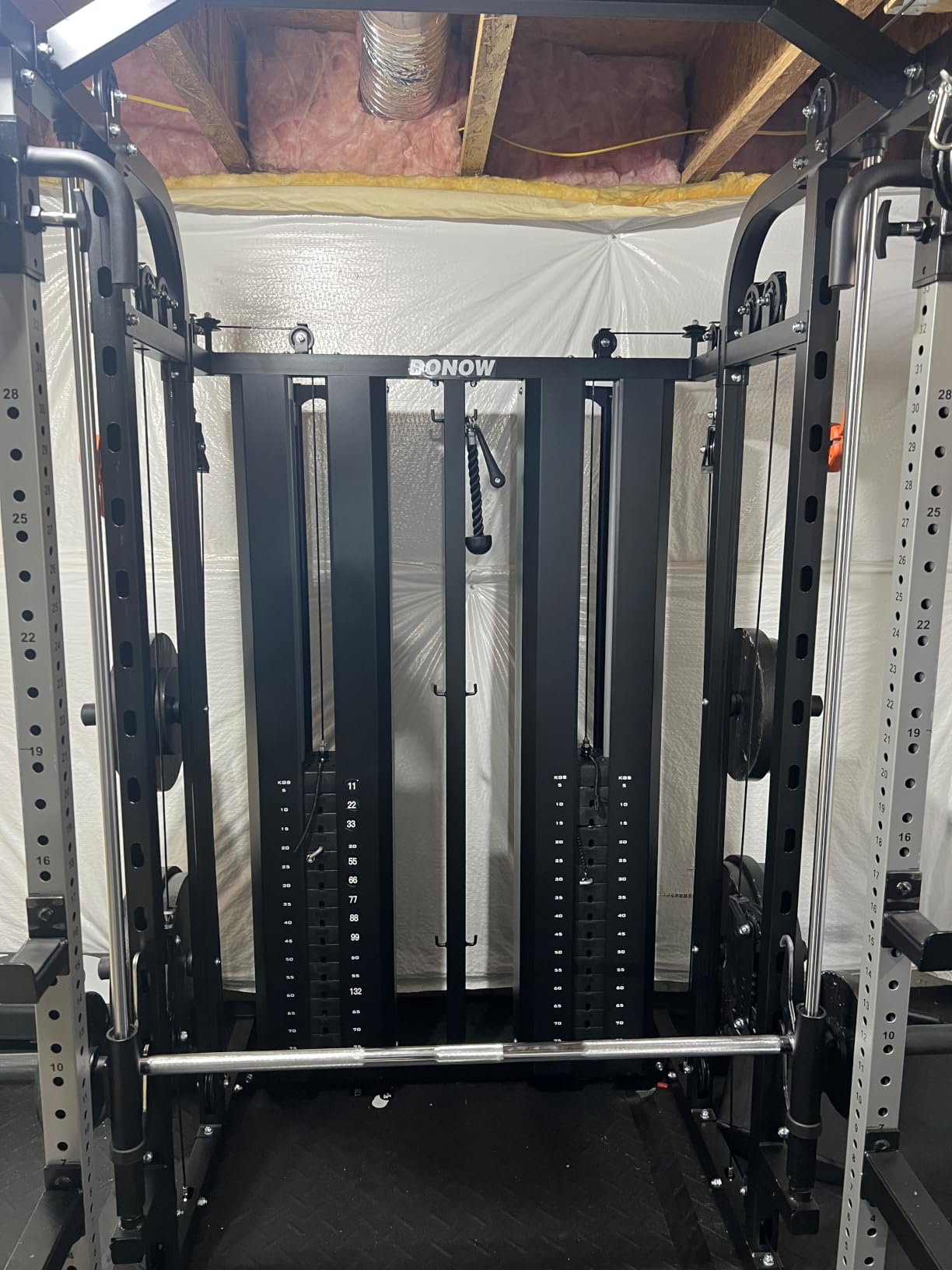
The headline spec is the two 352 lb weight stacks running a 2:1 cable ratio, which works out to roughly 176 lb of effective resistance per side before any adjustment. That is far beyond what any other machine here delivers, and it is the reason advanced lifters looking past the two thousand dollar ceiling should look at this frame first.
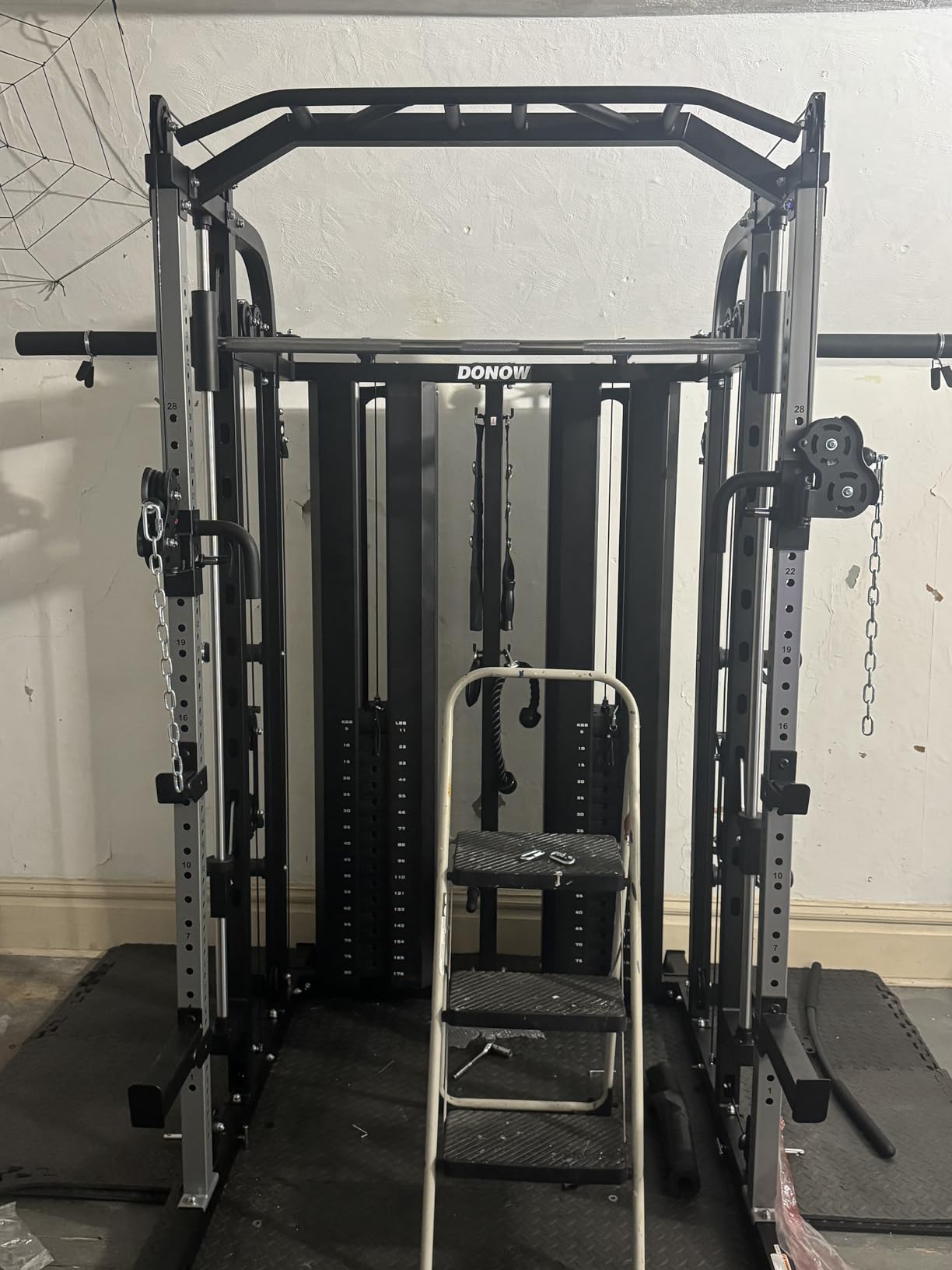
The rest of the package is substantial. You get a linear-bearing Smith bar for smooth vertical travel, a 2 by 2 inch steel frame with safety arms, and a multi-grip pull-up station. The weight stacks sit inside steel covers, which keeps the cables contained and the machine looking far tidier than an exposed stack, and it is a detail that matters in a room you also use for something else.
The box contents are unusually complete: a leverage bar, a pair of cable handles, a lat pulldown bar, a cable bar, a bicep rope, and an ankle strap are all included in the box. The warranty is two years, which is mid-range for the category.
When the DONOW is the right buy
Choose it when your floor space is large enough to host a full power rack and cable system as a permanent installation, and when you want heavy resistance without adding another machine. Two people can work on the independent cable lines at once, which also makes it a good choice for a shared household gym.
Buyers consistently highlight the unusual combination and the enclosed stack covers as the reasons they are happy. The cable travel is described as smooth with quality pulleys rather than the sticky feel common to lighter builds.
What it costs you in space and effort
The footprint is the trade-off, and it is not a small one. At 78.6 inches wide, 54.7 inches deep, and 88 inches tall, this is a full-size multi-machine footprint rather than a compact cable unit. The unit also arrives in eight boxes, so you need a staging area before you start.
Assembly is a major project that owners describe as needing a second person and a fair amount of time. Finally, with 247 reviews it has the thinnest long-term documentation of anything in this roundup, so you are buying on current owner experience rather than a decade of history.
6. Mikolo Folding Squat Rack with Cable Crossover: Best for Small Spaces and Basements
Mikolo Folding Squat Rack, Wall Mounted Power Rack with Cable Crossover Machine & LAT Pull Down, Functional Trainer with 5 Adjustable Function Modes, for Home Gym and Space Saving(Black)
Folds to 3 sq ft
30 by 68 by 86 inch
150 lb unit
15 pulley height positions
Pros
- Folds down to roughly 3 sq ft which solves basement floor space problems
- Five configurations from one frame including rack and crossover
- Wall mounts and adjustable feet give real stability
- 15 pulley height positions with a single-handed adjuster
- Independent pulleys allow two people to train
Cons
- Requires a solid wall for the mounting system
- Folding and unfolding takes real effort
- 1 to 1 pulley ratio gives lighter resistance than a 2 to 1 unit
Basement gym builders and anyone with a low ceiling will recognize the problem this solves immediately. The rack expands to about 9.5 square feet when you are using it and collapses to roughly 3 square feet when you are not, which is the difference between a gym you keep and a gym you avoid.
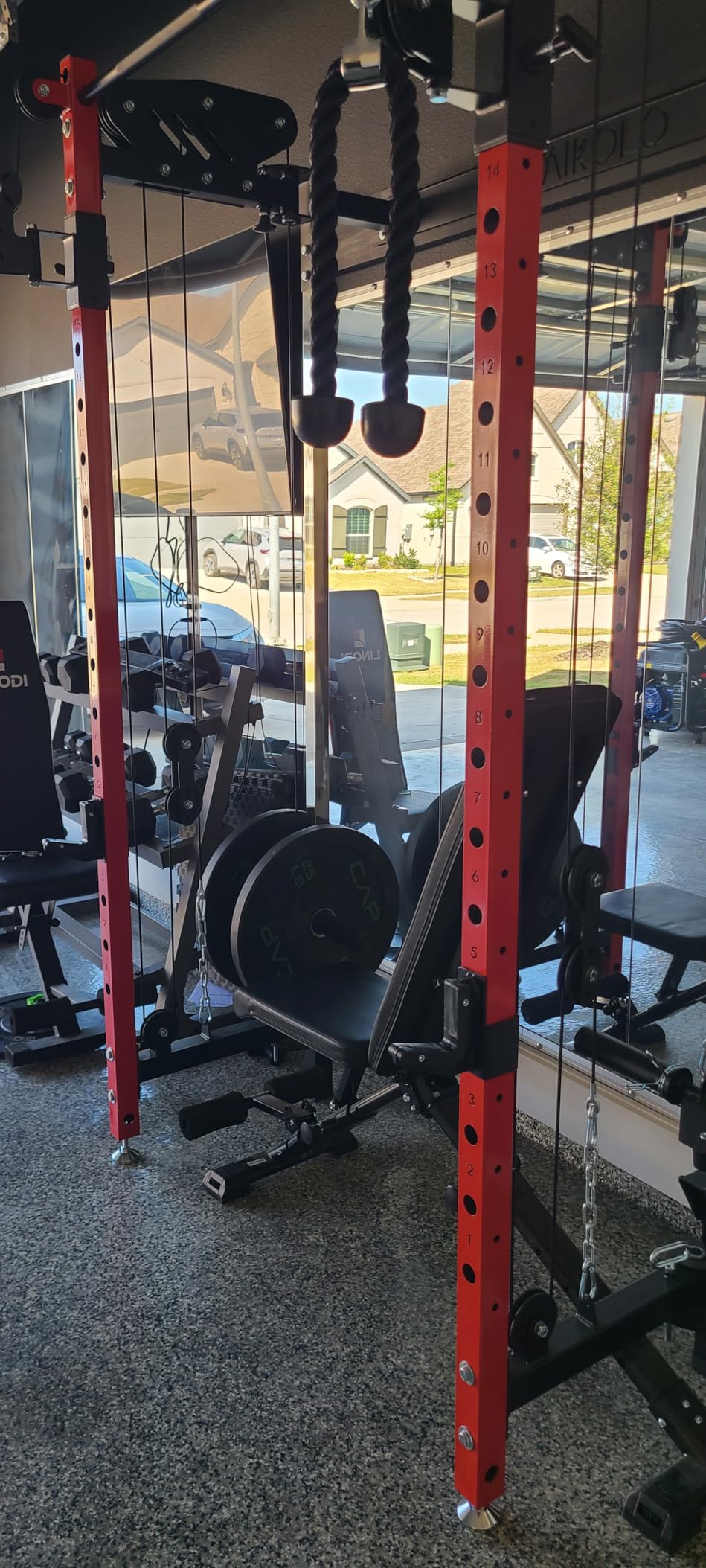
The frame is 2 by 2 inch 14-gauge steel with reinforced screw-in wall mounts and four adjustable ground support feet, rated to 1000 lb. Five settings give you a folded mode, a semi-open mode, a power rack mode, a functional trainer mode, and a cable crossover mode, so the same frame covers squatting, pressing, rows, cable flyes, curls, and kickbacks across more than 80 movements.
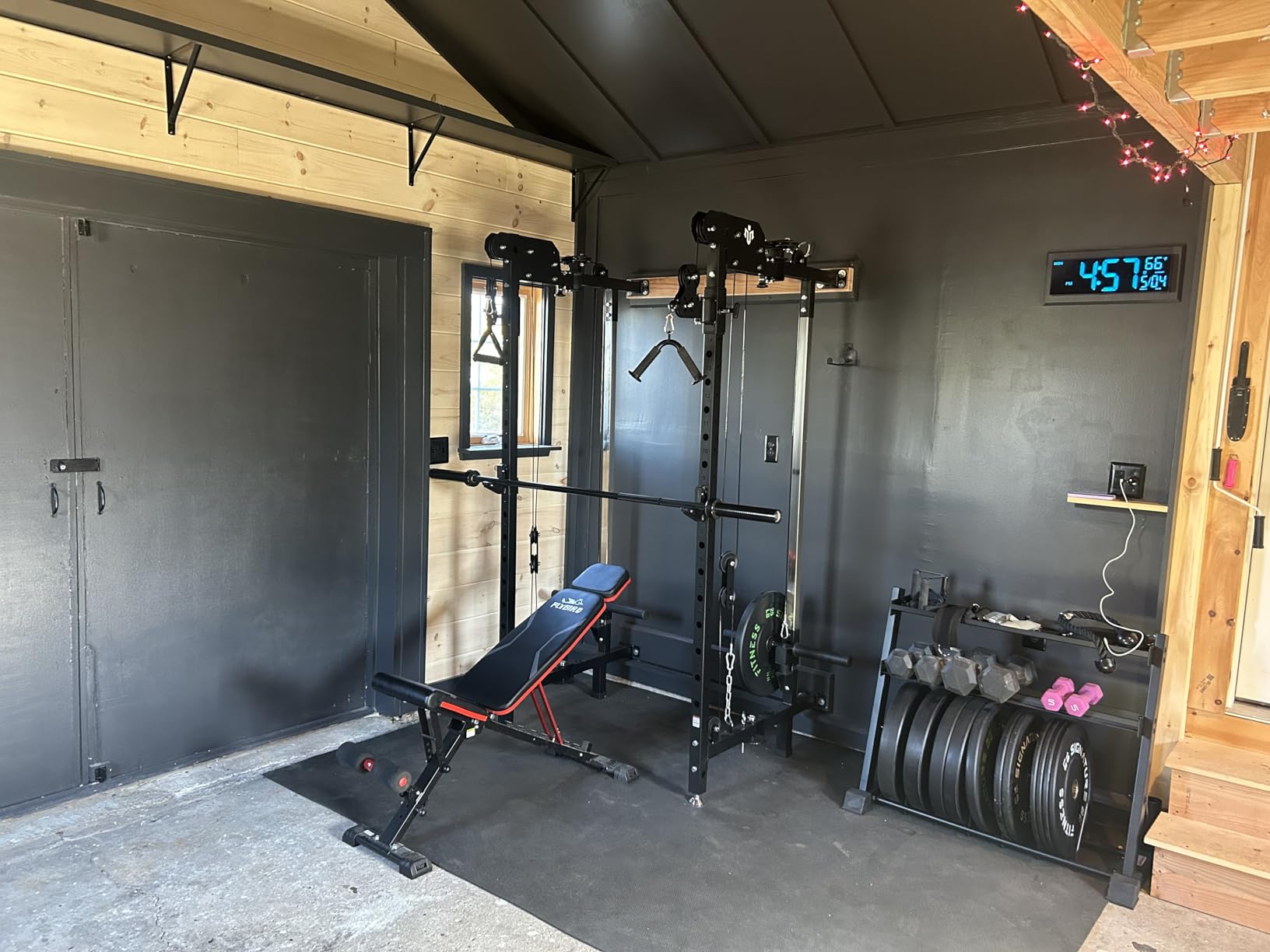
The pulley carriage has 15 height positions adjusted with a single-handed mechanism, and the two pulleys move independently, which is what allows supersets, drop sets, or two people training at once. Owners like that stability comes from a combination of wall anchors and adjustable feet rather than a single weak point, and they report it does not flex during heavy barbell work.
A detachable pull-up bar and J-hooks are included. The frame is 86 inches tall, which is worth checking against your ceiling before you order, and the warranty is one year, tied for the shortest coverage among the products here.
Why it earns the small-space label
No other machine here converts a full training rig into something that stores against a wall. If your usable floor is limited and you train barbell work as well as cables, this is the only product in the roundup where footprint is a solved problem rather than a compromise.
Buyers report that the single-handed pulley adjustment and the five mode changes make daily use straightforward once the frame is mounted, and the capacity rating means it is not a compromise machine for beginners only.
The two real limitations
First, it needs a solid wall. Owners who rented, or whose wall is not structural, describe the mounting system as the main point of friction, and this is the single biggest reason the model is not universally applicable.
Second, the pulley ratio is 1:1 rather than 2:1, so resistance is lighter and rougher across heavy pulling movements than a commercial cable unit would give you. Folding and unfolding also takes effort, so it is not instant between sets even though it collapses well between days.
7. MAJOR FITNESS F22 Power Rack: Best Steel Frame with 2:1 Dual Pulley Cables
MAJOR FITNESS F22 Power Rack, 1600lbs All-in-One Squat Rack with Cable Crossover, Dual Pulley System, Heavy-Duty Steel Frame, Attachments & Storage for Home Gym Strength Training, Black
1600 lb capacity
2 to 1 pulley ratio
68.9 by 55.5 by 82.5 inch
243 lb unit
Pros
- Replaces a cage
- squat rack and dual cable crossover in one footprint
- 2 by 3 inch commercial grade steel rated to 1600 lb
- Dual triangle base stays grounded without bolting down
- 2 to 1 ratio gives smooth travel and precise resistance
- Large and well rounded attachment package
Cons
- At 243 lb and 68.9 inches deep it needs a real corner of a room
- LAT pulldown attachment needs extra depth behind the rack
- Not a weight stack machine so cables need plates
The F22 is the answer to the question garage gym owners keep asking: why buy a cage and a cable machine when one frame does both. It is a squat rack and a weight cage with an independent dual pulley system built in, and at 2 to 1 the cables behave more like a commercial unit than most plate-loaded racks in this price range.
The steel is the headline. It is 2 by 3 inch commercial grade 14-gauge steel described as 2 mm thick on 50 by 70 mm uprights, rated to 1600 lb of static capacity, and owners consistently single this out as the reason the rack feels like commercial equipment rather than a lightweight import.
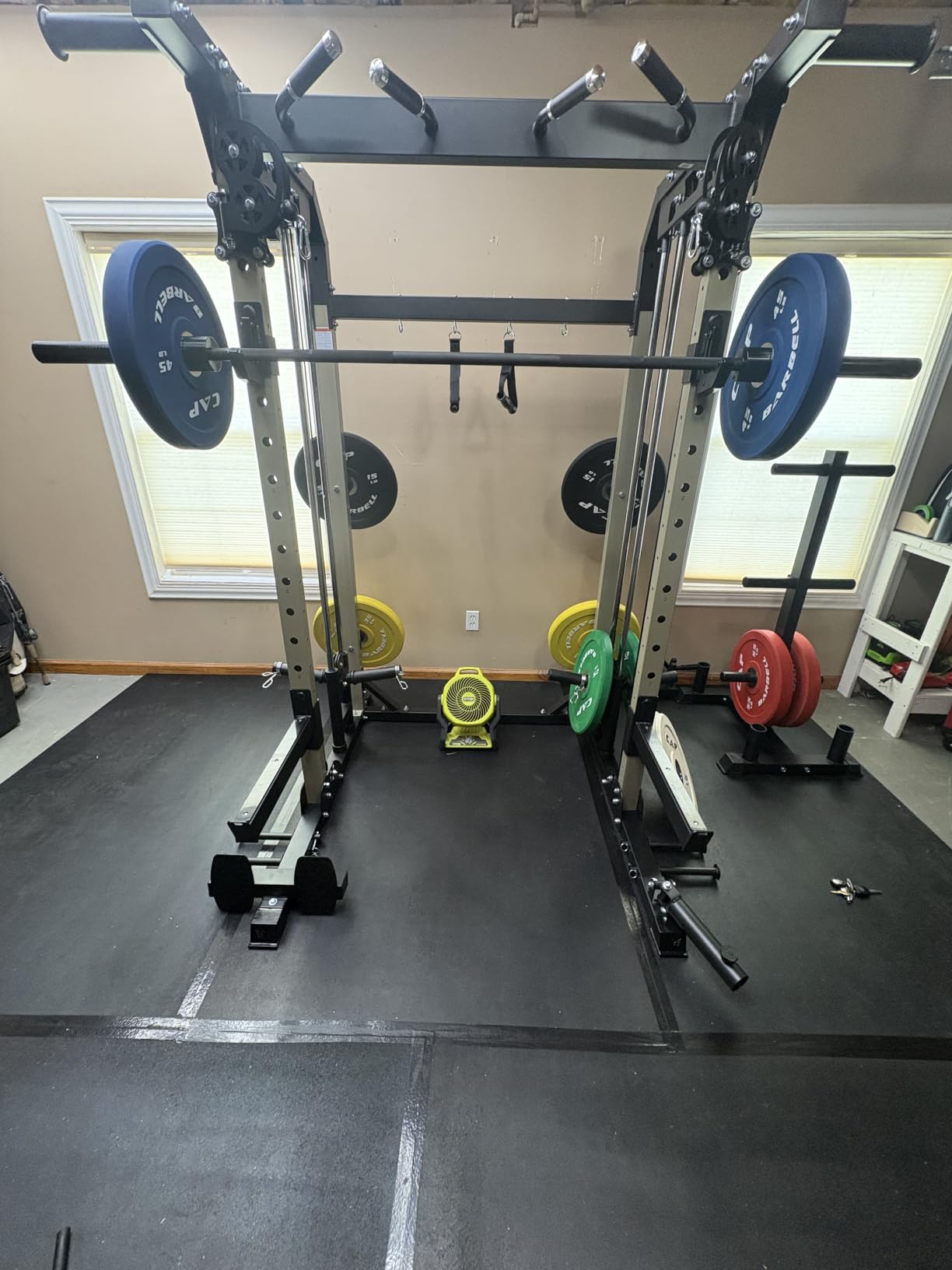
The base design matters more than it sounds. A dual triangle base spreads the load across the floor for stability without any need to bolt the rack down, and reviewers point to the absence of sway and wobble as the most noticeable difference against lighter racks. Two people can train on the independent pulley lines at the same time.
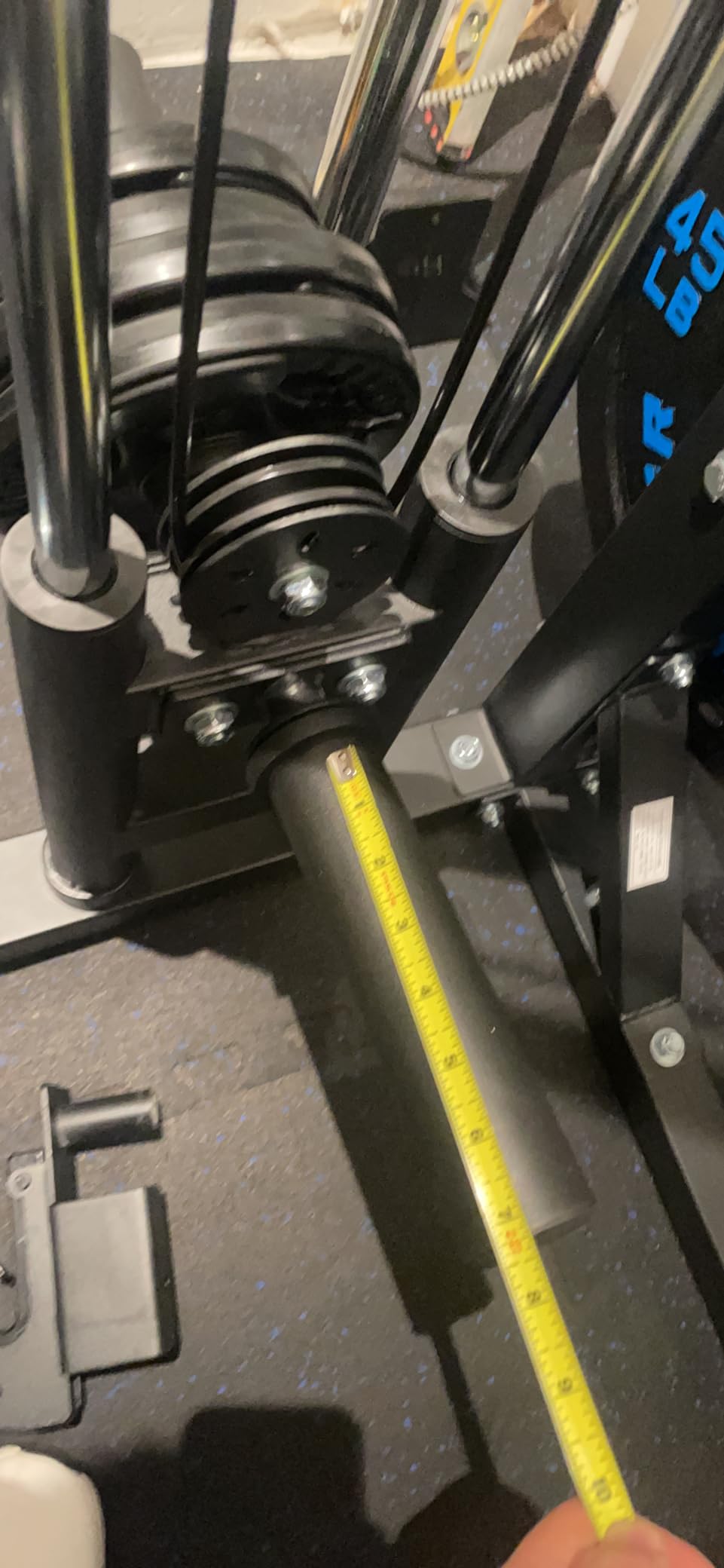
The attachment package is genuinely generous: J-hooks, safety arms, foot pedals, a landmine, a T-bar attachment, dip bars, a lat pulldown, cable bars, and band pegs, with accessory hooks and storage built into the frame.
Who should buy the F22
Buy it if your priority is barbell lifting with cable access as a benefit, rather than cable work as the priority. The steel, the capacity, and the non-swaying base are what make it a primary piece of equipment instead of an accessory, and the 2 to 1 ratio gives smoother cable travel and more precise resistance control than a 1:1 plate rack.
It is also a good multi-user gym, since two people can work the pulley lines at once while someone else racks.
Its qualifications
It needs space. At 243 lb and 68.9 inches deep, it wants a dedicated corner of a garage or basement, and the lat pulldown attachment requires additional clearance behind the rack, which is where buyers most often underestimate the space needed.
Most importantly, these cables are plate-loaded. There is no weight stack and no selector pin, so resistance is only as good as your plate inventory, and you are changing weight by walking to the plate tree. Parts coverage is one year, which is the weakest warranty in the roundup and worth factoring in on a machine this heavy.
8. Mikolo Home Gym with 150 lb Stack: Best Attachment Bundle for the Money
Mikolo Home Gym, Workout Station with 152LBS Weight Stack, Multifunctional Home Gym Equipment with Pulley System for Full Body Strength Training
154 lb stack over 12 levels
75 by 36.3 by 80 inch
300 lb unit
Lifetime frame warranty
Pros
- Over 90 exercise variations in one 300 lb frame
- Does not wobble once assembled and stays put during use
- Attachments for essentially every station ship in the box
- Customer service sends replacement bushings and panels
- Weight increments extend with an optional 5 lb adder
Cons
- 80 inch height is short for users around 5 ft 11 and taller
- Seat and preacher curl pads feel light and are held by two bolts
- Chest press arms do not lock and can rotate under uneven force
This is the machine we would put in a garage for someone who wants a full workout with zero accessory shopping. Where a lot of budget machines come with a bare bar and a rope, Mikolo puts D-handles, a short cable bar, a lat pulldown bar, a tricep rope, and a fitness chain attachment in the box, along with an assembly video and an exercise sheet.
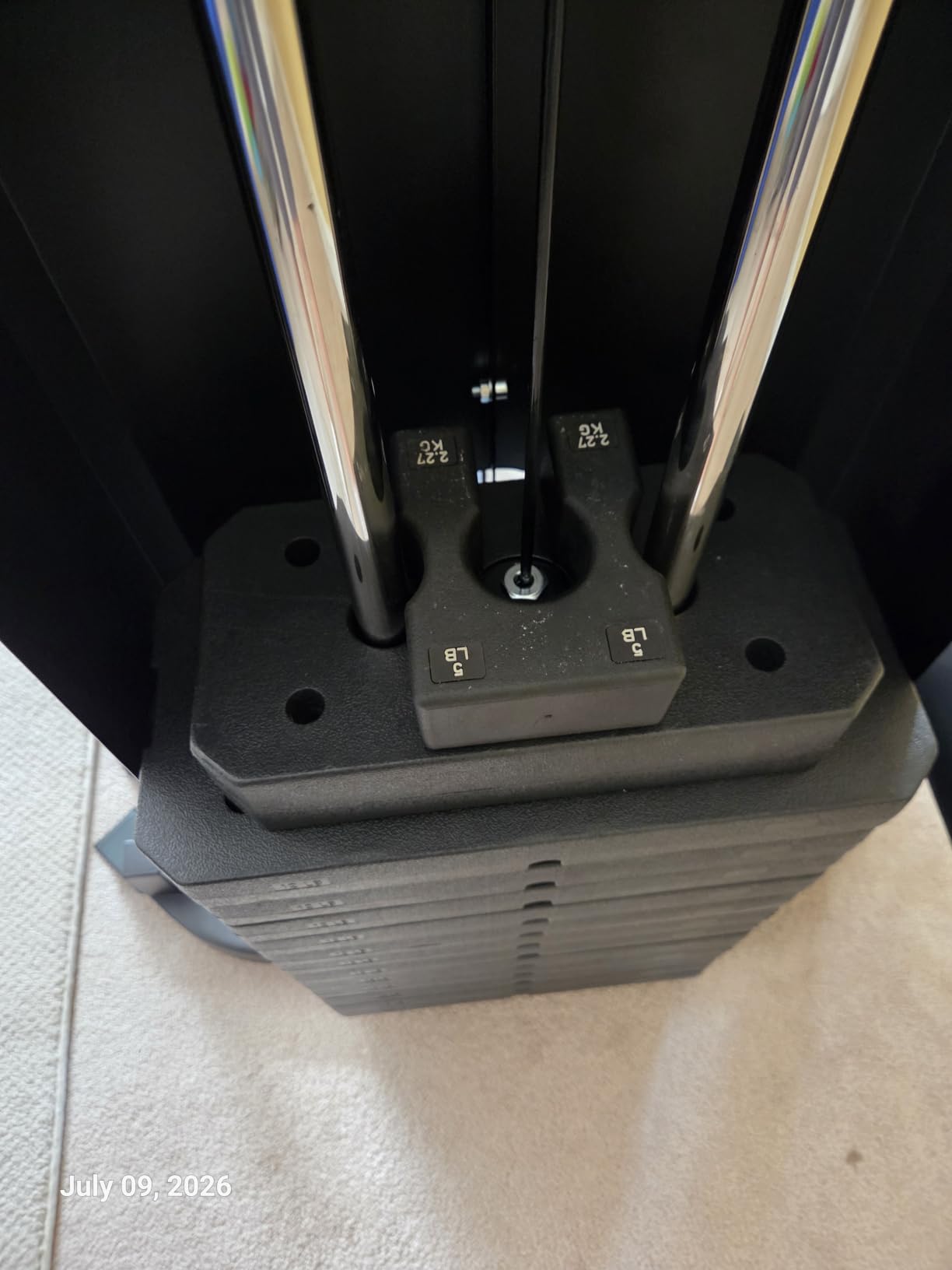
The stack is 154 lb across 12 levels, marketed as a 150 lb stack, and you can extend the increments with an optional 5 lb adder if the 12 lb steps feel too coarse. The frame is 14-gauge steel with a sheet steel protected counterweight block, and at 300 lb total the unit is heavy enough that reviewers describe it as stable and immovable once assembled.
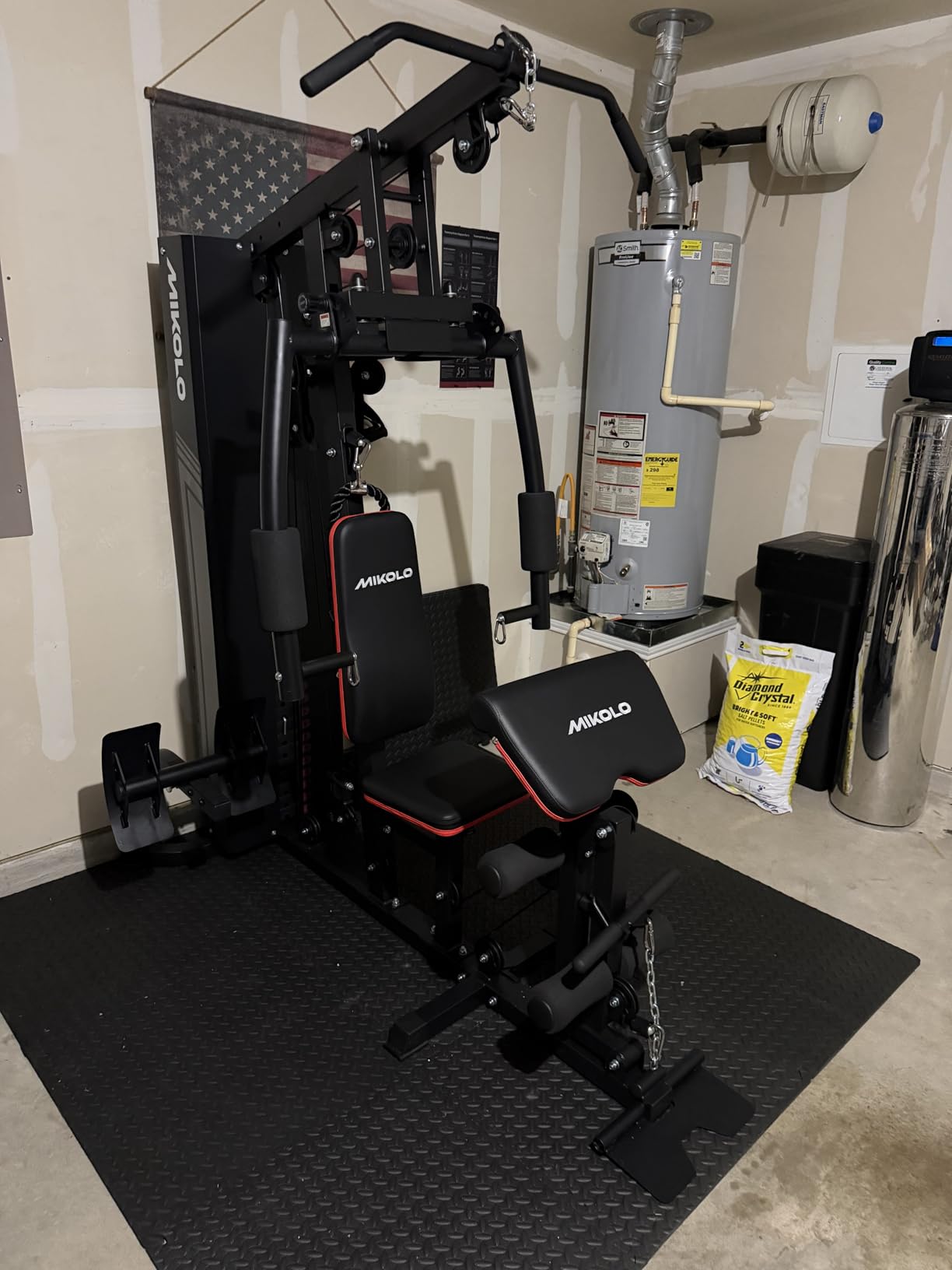
Exercise coverage is the headline number: more than ninety variations including pec fly, lat pulldown, low row, chest press, leg extension, leg press, preacher curl, calf raise, seated row, and back extension, with high, mid, and low pulley stations plus a chest press and fly station. The warranty is the best in this roundup, a lifetime frame warranty paired with one year on components.
Support is a real strength. Owners report Mikolo resolving issues quickly and shipping replacement bushings and dented panels, and the packaging with corner boards and labeled hardware cards is described as unusually good for a machine at this level.
Why the attachment bundle matters
Attachment costs are the hidden expense in this category. When a machine ships with one bar, you will end up buying a rope, a pair of D-handles, an ankle strap, and a lat bar within a few months, and that total can rival the machine’s own price on entry-level units. This one removes that cost entirely at the start.
Reviewers also compare the feel favourably to commercial cable machines, which tells you the pulley system is doing real work rather than just moving the stack up and down.
The height problem is real
At 80 inches tall, the frame is short for taller users. Owners around five foot eleven and above report that the lat pulldown travel is not enough to fully extend, and that is the single most important thing to check against your own height before buying this machine.
Several secondary complaints are worth knowing: the seat, back pad, and preacher curl attachments feel inexpensive and are held by two bolts each, the chest press arms do not lock and can rotate during a press if the force is uneven, and the lat bar grips are reported to slip during use. The 12 lb stack increments are also coarse for someone training light accessory work.
9. SincMill Multifunctional Home Gym: Best Warranty in the Class
Home Gym SCM-1148L 148LB Multifunctional Full Body Home Gym Equipment for Home Workout Equipment Exercise Equipment Fitness Equipment SincMill
148 lb stack
69 by 40.7 by 80 inch
26.76 kg unit
Ten year warranty
Pros
- Over 25 usable exercises in a compact 40.7 inch wide footprint
- Well welded frame that does not shift during use
- Smooth and quiet cable actuation once lubricated
- Excellent packaging with all four boxes intact
- Numbered hardware cards and an assembly video make the build manageable
Cons
- Range of motion is short for users around 5 ft 10 and taller
- Requires silicone lubricant that is not supplied
- Effective weight feels heavier than labeled because of pulley ratios
With more than fourteen hundred reviews behind it, the SincMill has one of the more reliable evidence bases in this roundup, and a ten year warranty that is longer than almost anything else in this price band. If warranty length is your top filter, start here.
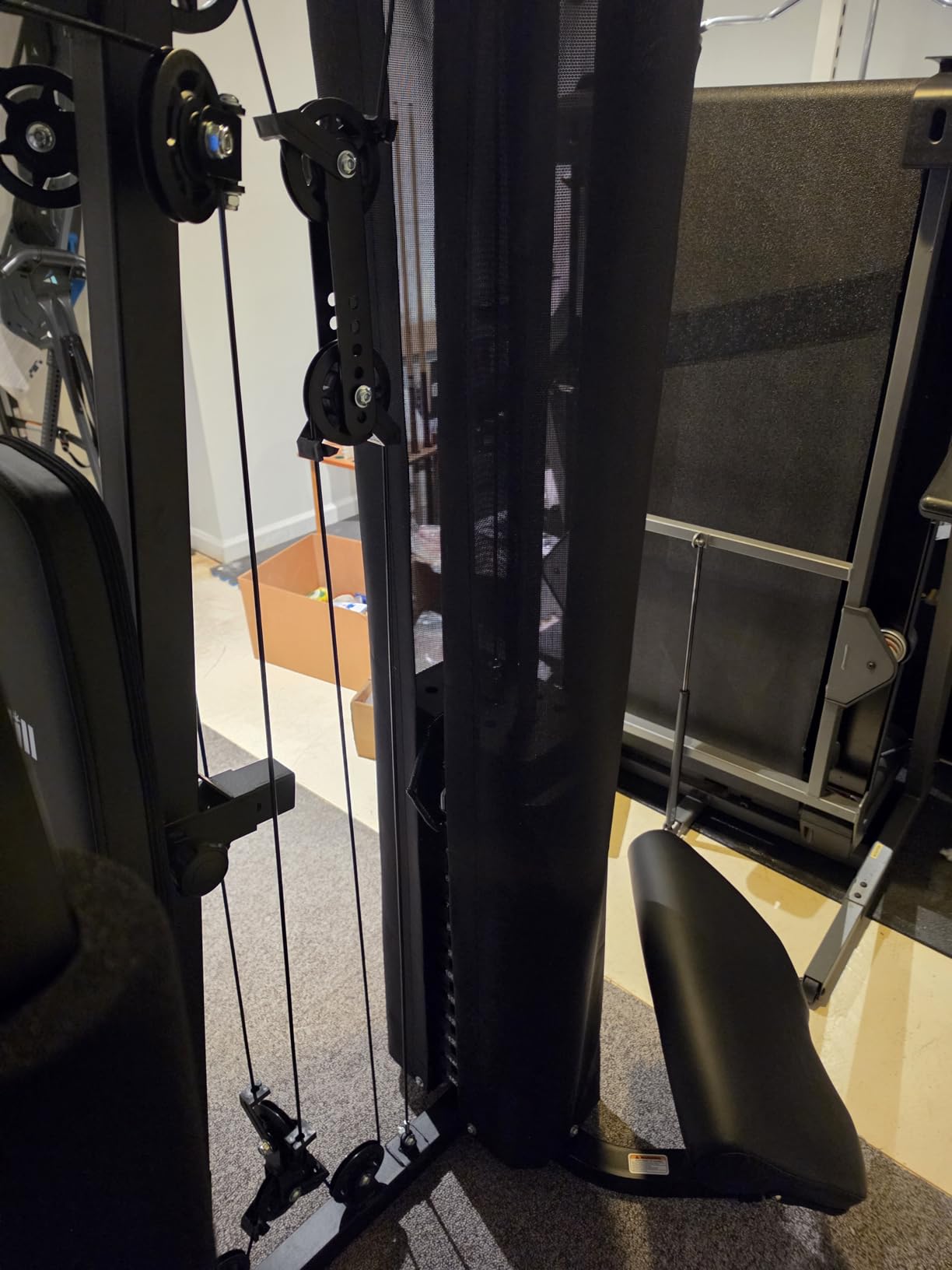
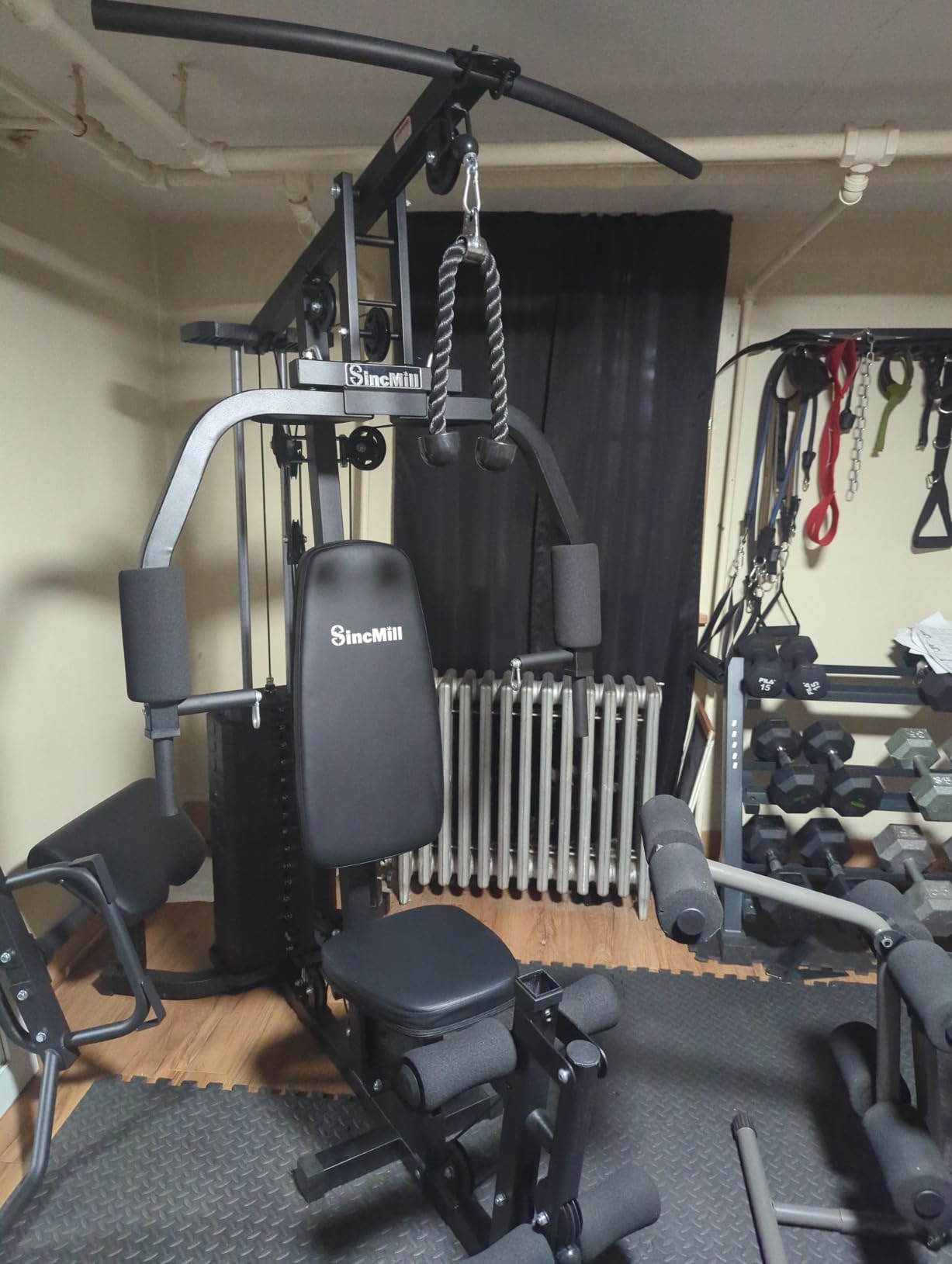
Mechanically it is a 148 lb selectorized stack in a thick steel frame with weight guards, measuring 69 inches deep, 40.7 inches wide, and 80 inches tall. Reviewers praise the welding and the fact that the frame does not shift during use, and the redesigned leg exercise pedal adds lower body stations beyond the standard leg extension and curl.
Assembly is the standout story here. Hardware is grouped onto numbered cards that match the assembly steps, and a 3D installation video ships alongside the manual, which owners say makes a three to six hour build manageable by yourself. Packaging is also singled out repeatedly, with all four heavy boxes arriving intact and no missing parts.
Once assembled and lubricated, cable actuation is described as smooth and quiet. Customer service replaced a faulty part immediately for at least one owner, which is a good sign for a direct-to-consumer brand.
Where it earns its place
It gives you over twenty-five usable exercises in a footprint narrower than most of the multi-station machines here, which makes it a good basement option. The warranty also means that if a cable or guide component fails in year six, the risk falls on the manufacturer rather than on you.
The compact width and the number of stations make it a reasonable first all-in-one for a couple sharing a small room, provided neither user is particularly tall.
Fit and finishing notes
Height is again the recurring theme. Multiple reviewers between five foot nine and six foot report that the frame is too short for full range of motion, particularly on leg press, chest fly, and lat pulldown. If you are at the taller end of that range, look elsewhere or plan to check the published dimensions against your own reach.
Two smaller items are worth knowing before assembly. The cables and rollers need silicone lubrication, which is not supplied, and pulley routing errors during the build cause rapid cable wear if you do not follow the path carefully. The effective weight also feels heavier than the label because of the pulley ratio, and the ankle strap hook and loop is reported to fray with regular use.
10. ULTRA FUEGO Power Cage with Pulley System: Best Value Cable and Rack Combo
ULTRA FUEGO Power Cage, Multi-Functional Power Rack with J-Hooks, Dip Handles, Landmine Attachment and Optional Cable Pulley System for Home Gym
1002 lb capacity
63 by 47 by 82.7 inch
Two year warranty
50 by 50 mm uprights
Pros
- Laser cut powder coated 1.5 mm steel with reinforced tabs
- Stays solid without being bolted down
- Unusually complete accessory set including pulley system
- Large walk-in space for side to side movement
- Compact enough for most garages
Cons
- Included J-hooks are weak at roughly 220 to 225 lb and many buyers replace them
- Only one carabiner is included so swapping attachments is awkward
- Rack and pulley system arrive as two separate deliveries
With over a thousand reviews and a large share of five-star ratings, this cage has the volume of real-world use behind it that most budget equipment never reaches. Reviewers routinely load it with three hundred to six hundred pounds of barbell work without concern, which tells you more about the frame than any spec sheet can.
The construction is 1.5 mm steel on 50 by 50 mm uprights, laser cut and powder coated, with extra reinforcing tabs at the joints and wide heavy base plates that resist tipping. Rated capacity is 1002 lb. Adjustment runs to ten levels on the J-hooks and safety bars and five levels on the dip handles, with holes at four inch spacing as standard.
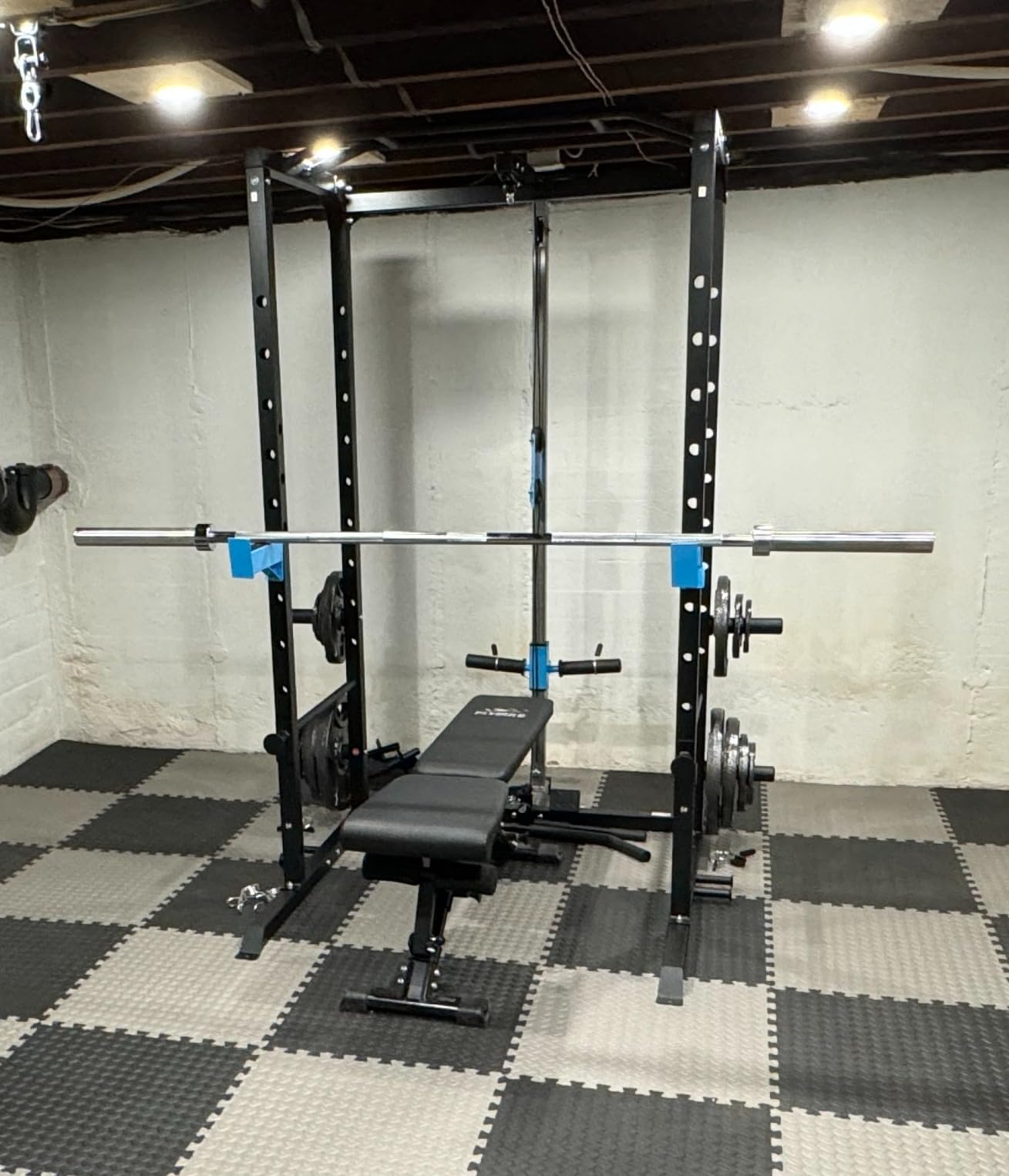
The accessory list is what makes it a cable product as well as a rack. The box includes the pulley system, a lat pulldown bar, a tricep rope, a 360 degree landmine attachment, dip handles, J-hooks, safety bars, band pegs, and plate storage pegs, with a T-bar and ankle strap listed among the set. Owners repeatedly call the cable pulley system smoother and more capable than expected at this level.
Dimensions are 63 inches deep, 47 inches wide, and 82.7 inches tall to the top of the pull-up bar, with a large walk-in space for side-to-side movement. The warranty is two years from the manufacturer.
Why it took the value slot
Nothing else in this roundup gives you a full cage, a landmine, dip bars, and a working cable pulley system for the money this one costs. If your home gym needs to cover squatting, benching, pulling, and cable work without buying three separate frames, the math here is difficult to argue with.
Reviewers treat it as the best value power cage in its class, and the absence of wobble under heavy barbell loads without any floor anchoring is the most commonly repeated positive.
Know these before you build it
The J-hooks are the weak link. They are rated around 220 to 225 lb and many buyers replace them within weeks, so treat the hook upgrade as part of the real cost of this machine rather than an optional extra. The steel can also bend if bolts are over-tightened during assembly, which is a build caution rather than a defect.
Two more practical notes. Only one carabiner is included, which makes swapping attachments a nuisance, and the rack and the pulley system arrive as two separate deliveries, so plan for both. Finally, check your ceiling clearance against the real 82.7 inch height, since some listings state a slightly lower figure.
Why the Famous Cable Machines Are Not on This List
Search results for this topic lean heavily on premium brands, and you will notice several famous names missing from our picks. The reason is simple and worth stating plainly: their entry points sit above the two thousand dollar ceiling, and no configuration we could verify brings them under it.
The REP Fitness Ares 2.0 is the machine most often named as the best overall cable machine for a home gym, and it is an excellent unit. It is also well above this budget, with its entry configuration starting in the high two thousands and rising from there. For a buyer under our ceiling, the Body-Solid PFT100 is the closest genuine substitute, because it gives you the same core benefit, two independent stacks with a reduced ratio.
The REP Arcadia is a premium dual-stack machine that also starts above our range. If you are set on REP specifically, the price is the deciding factor and there is no sub-two-thousand configuration of it.
Titan Fitness functional trainers, the Force USA G12, the Rogue INDY, and the Life Fitness G7 all sit in the same higher bracket, and the Force USA Tandem Tower lands just above our ceiling too. Tonal 2 is a different category entirely, a smart unit that also carries a recurring subscription, which is a cost most home gym buyers in this tier would rather avoid.
Beyond Power’s Voltra line and the Centr 2 both start above the range as well. The Centr 3 is the interesting one, because it has been discussed by owners as a genuinely good value when it drops near two thousand dollars, and price volatility of several hundred dollars between sale cycles is normal across this whole category.
Our advice is to check the current figure on whichever machine interests you before ruling it in or out, and to read the archetype label on each pick above rather than the brand name. What changes between tiers is rarely the movement list, which is surprisingly similar across all of them. What changes is the resistance ceiling, the frame, and how long the machine lasts.
How to Choose a Cable Machine Under 2,000
Work through these five questions in order and the choice usually makes itself. The most common mistake is starting with brand or price, when the two things that actually decide satisfaction are the cable ratio and the available floor space. If you are still assembling the rest of the gym first, start with a trap bar and a rack, then size the cable unit to the space those leave behind.
Understand the cable ratio before you compare stacks
A cable ratio tells you how much of the stack weight actually reaches your hands. A 2:1 ratio means the pulley system gives the load a mechanical advantage of two to one, so a 200 lb stack produces about 100 lb of pull at the handle. A 1:1 ratio passes the full weight through, so a 200 lb stack gives you 200 lb at the handle.
This is the number most buyers misread, and getting it backwards leads to buying a machine that is far too light or far too heavy. Here is the useful part: for most accessory work, 80 to 100 lb per cable is genuinely enough. A seated cable row, a lat pulldown with a bar, a chest-supported row, a cable pressdown, and a face pull all sit well inside that range for almost every lifter. You only need more than that if you are pulling heavy weight for high-rep hypertrophy sets on rows, or you are working very advanced techniques.
So the practical advice is the reverse of what the marketing implies. A smaller stack at 2:1 will serve most home gym owners better than a large stack at 1:1, because the low end matters more for a machine that must work for beginners, for the person training beside you, and for warm-ups. In this roundup, the Body-Solid PFT100 delivers roughly 80 lb per cable from its base stacks, the DONOW delivers roughly 176 lb per cable, and the MAJOR FITNESS F22 and ULTRA FUEGO cables run at a true 2:1 with plates.
Decide between selectorized stacks and plate-loaded towers
This is the second big fork, and it comes down to how you like to change resistance. A selectorized or pin-loaded machine has a weight stack and you move a pin. The benefits are speed, safety, and a small increment, which is why the Marcy and SincMill units suit beginners and shared gyms so well. The costs are a fixed ceiling you cannot raise, and a heavier frame with guide rods that can develop alignment issues over years.
A plate-loaded tower or rack-mounted system takes standard plates. You get an unlimited ceiling and a lighter, cheaper frame, and you can load exactly the increment you want. You also give up the ability to change resistance in one movement, and a single carabiner or two mismatched plates is the whole system. This is the right choice if you already own a good plate set and want the same movements available with heavier loads.
Plate-loaded designs are also the right answer for anyone who wants to stay under the ceiling with a very small footprint, since there is no stack tower taking up depth. That is the GDLF’s whole premise, and it works.
Measure the footprint and the ceiling before anything else
This is where more home gym purchases fail than anywhere else. Two measurements decide whether a machine is viable. First, the ceiling height, because the tallest units in this roundup reach 86 to 88 inches, and a typical finished garage ceiling is not much above eight feet. Add pulley clearance on top of the unit height, and anything over roughly 84 inches needs a low ceiling checked carefully rather than optimistically.
Second, the usable floor area, and not the machine’s own footprint. You need room to stand beside the machine, to get on and off a bench, and to move through a full range of motion. A reasonable rule is an eight by eight foot minimum of clear floor, with ten by ten preferred if the machine is deep. The MAJOR FITNESS F22 at nearly 69 inches deep and the DONOW at nearly 79 inches wide both assume a dedicated room rather than a corner.
If your space is genuinely tight, the two answers are a narrow plate-loaded station such as the GDLF, or a folding rack such as the Mikolo unit that collapses to about 3 square feet when you are not using it. If your ceiling is low, look specifically at shorter units and check the published height rather than the marketing. Our guide to home gyms for small spaces covers the layout side of the problem in more detail.
Test the machine against the movements you actually do
Two movements decide more purchases than any other: the lat pulldown and the triceps pushdown. Home gym buyers consistently name those two as the movements they need a cable machine to deliver properly, and they are the right test. If a unit cannot perform a full overhead pulldown and a full pressdown with a rope, it is not really a cable machine regardless of what the listing says.
After those, the sequence to check is seated row, face pull, cable crossover, and some form of unilateral work. Face pull in particular needs enough carriage positions to hit shoulder height, which is exactly why the number of adjustment positions matters more than buyers expect. Fifteen to thirty positions is where adjustment starts to pay for itself.
Also check what attachments actually ship. The Mikolo 150 lb stack and the ULTRA FUEGO cage include a broad set, so you are not buying your way to a full workout over a year of small purchases. A machine that ships with a single bar will need a rope, a pair of D-handles, an ankle strap, and a lat bar eventually, and that is money the sticker price does not show.
Budget for assembly, anchoring, and the real total
The last thing to account for is everything that is not the machine. The heaviest machines here run from about 240 to 476 lb, and owners consistently describe three to five hours of assembly with two people, or longer on the largest frames. Professional assembly is worth pricing into your decision for the heavy options, because a paid build is cheaper than a damaged frame or a mis-routed cable.
Anchoring is the other line item. The Mikolo folding rack needs a solid wall for its mounting system, which is a real constraint in a rental or a finished basement. Floor protection matters too, since a 476 lb frame with steel feet will mark concrete and can work into it over years. And on plate-loaded designs, the J-hooks are consumables in practice, since the ones supplied with the ULTRA FUEGO cage are widely replaced within weeks.
One more honest note about this category. Prices here move by several hundred dollars between sale cycles, so a figure you see this week is not a guarantee for next week. Check the current price at the point of purchase, read recent reviews rather than the overall rating alone, and treat the ratings on this page as a guide rather than a promise.
Frequently Asked Questions
What is the best all-in-one cable machine for a home gym?
Under the two thousand dollar ceiling, the DONOW Smith Machine with dual weight stacks is the closest thing to a genuine all-in-one, combining a Smith bar, a power rack with safety arms, a multi-grip pull-up station, and two 352 lb stacks running a 2:1 cable ratio in one frame. The trade-off is footprint, at 78.6 inches wide and 88 inches tall, plus a multi-box delivery and a long build. If a dedicated room is not available, a compact all-in-one stack machine is the better answer.
Is a cable machine good for a home gym?
Yes, and it is usually the first thing home gym owners add after a rack and a bench. Cable work provides constant tension across the entire range of motion, which free weights cannot replicate, and it covers the back, shoulders, and arms in a way that a rack does not. It also needs far less floor space than a machine-based gym, and the exercises adapt to any height and joint capacity, which makes it as useful for beginners and rehab work as for advanced training.
Is a cable machine the same as a functional trainer?
Not exactly. A cable machine is the broad category, defined by resistance coming through a cable over pulleys. A functional trainer is the specific form where two independent weight stacks serve two adjustable pulleys, so each side moves separately and the carriage changes height through many positions. That dual-stack design is why a true functional trainer costs more, and why a single-stack unit marketed as a functional trainer is a different product class. Under two thousand dollars, the Body-Solid PFT100 is the only true dual-stack option in our roundup.
Which is better for a home gym, a functional trainer or a power rack?
If you already own a power rack, add cable capability to it rather than buying a second large frame. Rack-integrated options such as the MAJOR FITNESS F22 or the ULTRA FUEGO cage combine both in one footprint, and a standalone pulley system can be added to a rack you already have. Buy a dedicated freestanding functional trainer only if cable work is your primary training focus and you have floor space and ceiling clearance for a unit that is often 80 to 88 inches tall.
How much weight stack do I need for a home gym?
Less than most buyers expect, once you account for the pulley ratio. A 150 lb stack at a 2:1 ratio delivers roughly 75 lb per cable, which covers nearly every accessory movement a home lifter performs. For most people, anything from about 80 to 100 lb of effective resistance per cable is enough for rows, pulldowns, pressdowns, flyes, and face pulls. Buy a heavier stack only if you plan high-rep heavy rowing or advanced techniques, and consider whether the machine can be upgraded later.
Conclusion: The Best Cable Machines for Home Gyms Under 2,000
For most home gym owners, the Body-Solid PFT100 is the right answer to the search for the best cable machines for home gyms under 2,000. It is the only true dual-stack functional trainer in this price band, the frame is the heaviest and most rigid in the roundup, the exercise coverage is unmatched, and a ten year frame warranty protects a purchase most buyers keep for a decade.
Choose differently if your constraints are different. If you own a rack already, the Mikolo pulley system adds pressdowns and pulldowns for a fraction of any machine. If floor space is the problem, the GDLF gives you a lat station and low row in a 26 inch width. If a wall you can anchor to is available and the floor is tight, the Mikolo folding rack collapses to about 3 square feet.
If you are buying the whole gym at once, the ULTRA FUEGO cage and the MAJOR FITNESS F22 give you a rack, dip bars, a landmine, and working cables in one purchase, while the DONOW covers heavy dual-stack cable work for anyone who has a dedicated room. For a starter all-in-one at a lower outlay, the Marcy and SincMill units remain well reviewed, well supported machines, and the Mikolo 150 lb stack is the best of the group for attachment coverage and warranty.
Whichever one you land on, check your ceiling height and your clear floor area first, confirm the current figure at the point of purchase, and then get it built properly. A well-built machine with basic care will still be training you in a decade, and a poorly placed one will not get used at all.