
Eight brewers, one very specific promise: coffee made by steam pressure and a partial vacuum, in full view of the person drinking it. That is the entire appeal of a siphon, and it is also where the disappointment usually starts, because the printed cup count is fiction and the included alcohol burner is slow. We spent weeks brewing through the category so you can skip the trial and error.
Our short answer for 2026: the Hario Technica is the best siphon coffee maker for most homes, the Yama Glass 8-Cup Stovetop is the one to buy if you brew for more than one person, and the Bodum Pebo wins on nothing except being the least fuss. Everything else falls into a fairly narrow band once you accept that a five-cup siphon produces roughly two real cups and that not one of them works on an induction cooktop.
We updated this guide in September 2026 and went through all eight brewers with the same checklist: flavour clarity in the cup, how tightly the glass and hardware are made, how long a brew actually takes with the supplied heat source, and how much cleanup the cloth filter demands. We also weighed the honest objections from coffee forums, including the cracked-glass reports that dominate discussion of this category.
If you are still weighing a siphon against something more conventional, our camping coffee maker roundup covers the off-grid angle, since a siphon is one of the few manual brewers that genuinely works away from a mains outlet.
Table of Contents
Top 3 Siphon Coffee Makers for Home in 2026


Bodum Pebo Vacuum Coffee Maker
- 34oz 1000ml
- Two sealed glass bowls
- 5-11 minute brew
- Gas and electric stovetop
Yama Glass 8-Cup Stovetop
- Hand-blown borosilicate
- 24oz carafe
- Reusable cloth filter
- Gas and electric stovetop
The Technica tops the list on the strength of its 4.7 rating across more than 1300 reviews, and it is the brewer here that pairs that rating with borosilicate glass, brass fasteners and a stainless stand. The Pebo takes the value slot because it is the least complicated to operate of the three. The Yama 8-Cup earns its place for households that need more than a single mug.
Best Siphon Coffee Makers at a Glance in 2026
| Product | Specifications | Action |
|---|---|---|
| Hario Technica Coffee Syphon 600ml |
|
Check Latest Price |
| Bodum Pebo Vacuum Coffee Maker 34oz |
|
Check Latest Price |
| Yama Glass 8-Cup Stovetop Siphon |
|
Check Latest Price |
 Hario 3-Cup Moca Siphon Hario 3-Cup Moca Siphon |
|
Check Latest Price |
 Diguo Belgian Balance Siphon Diguo Belgian Balance Siphon |
|
Check Latest Price |
 Hario Next Coffee Syphon 600ml Hario Next Coffee Syphon 600ml |
|
Check Latest Price |
 Yama Glass 5-Cup Tabletop Siphon Yama Glass 5-Cup Tabletop Siphon |
|
Check Latest Price |
 YUCHENGTECH 5-Cup Tabletop Siphon YUCHENGTECH 5-Cup Tabletop Siphon |
|
Check Latest Price |
Two things to note before you read the reviews. The capacity figures in the “5 cup” and “8 cup” labels describe water volume, not drinkable coffee, and none of these brewers keeps a pot warm once the drawdown finishes. We give the realistic yield in each review.
1. Hario Technica Coffee Syphon Review: Our Best Overall Pick
Hario “Technica” Coffee Syphon, 600ml
Borosilicate glass bowls
600ml 5-cup
1.5 lb
14 inch tall
Alcohol burner
Pros
- Exceptionally clean sediment-free cup
- Borosilicate glass and stainless steel build
- Stainless stand and cover resist heat
- Easy to disassemble and rinse
Cons
- Thin upper bowl needs careful handling
- Included alcohol burner is slow to heat
- Knurled knob has a weak grip
- Real yield is nearer two mugs
The Hario Technica has been our default brewer for the better part of two months, and it is the one we kept coming back to after testing the rest. It scores 4.7 across 1388 reviews, which is the strongest combination of rating and review volume in this category, and the build explains why owners keep them for years.
The upper bowl, lower bowl and burner are heat-resistant borosilicate glass made in Japan. The stand, burner cover and filter are stainless steel, the fasteners are brass, and the windbreak is aluminium. That is a materially better bill of materials than the plastic-handled competitors, and on the counter it looks like laboratory equipment rather than kitchen gadgetry.
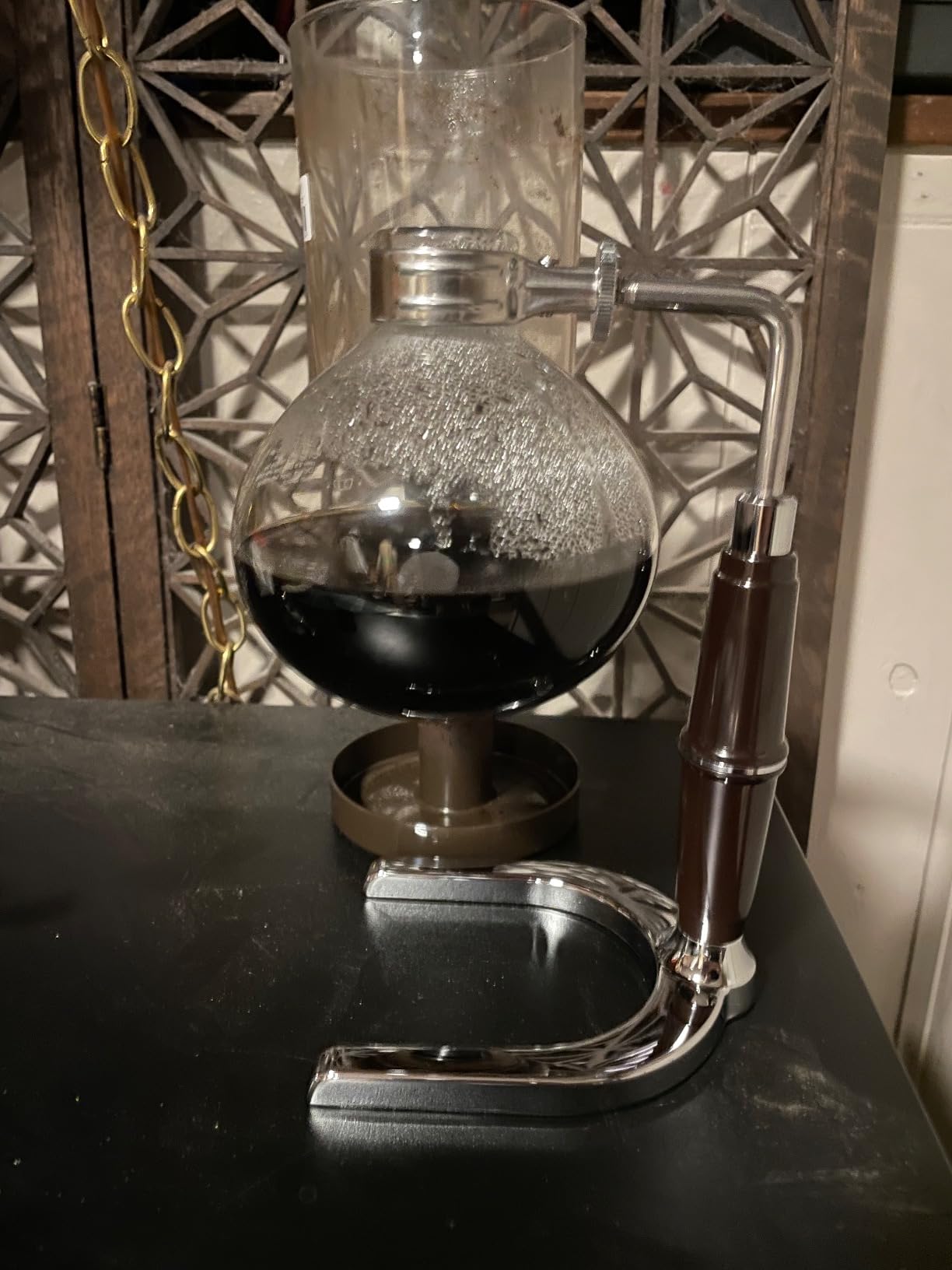
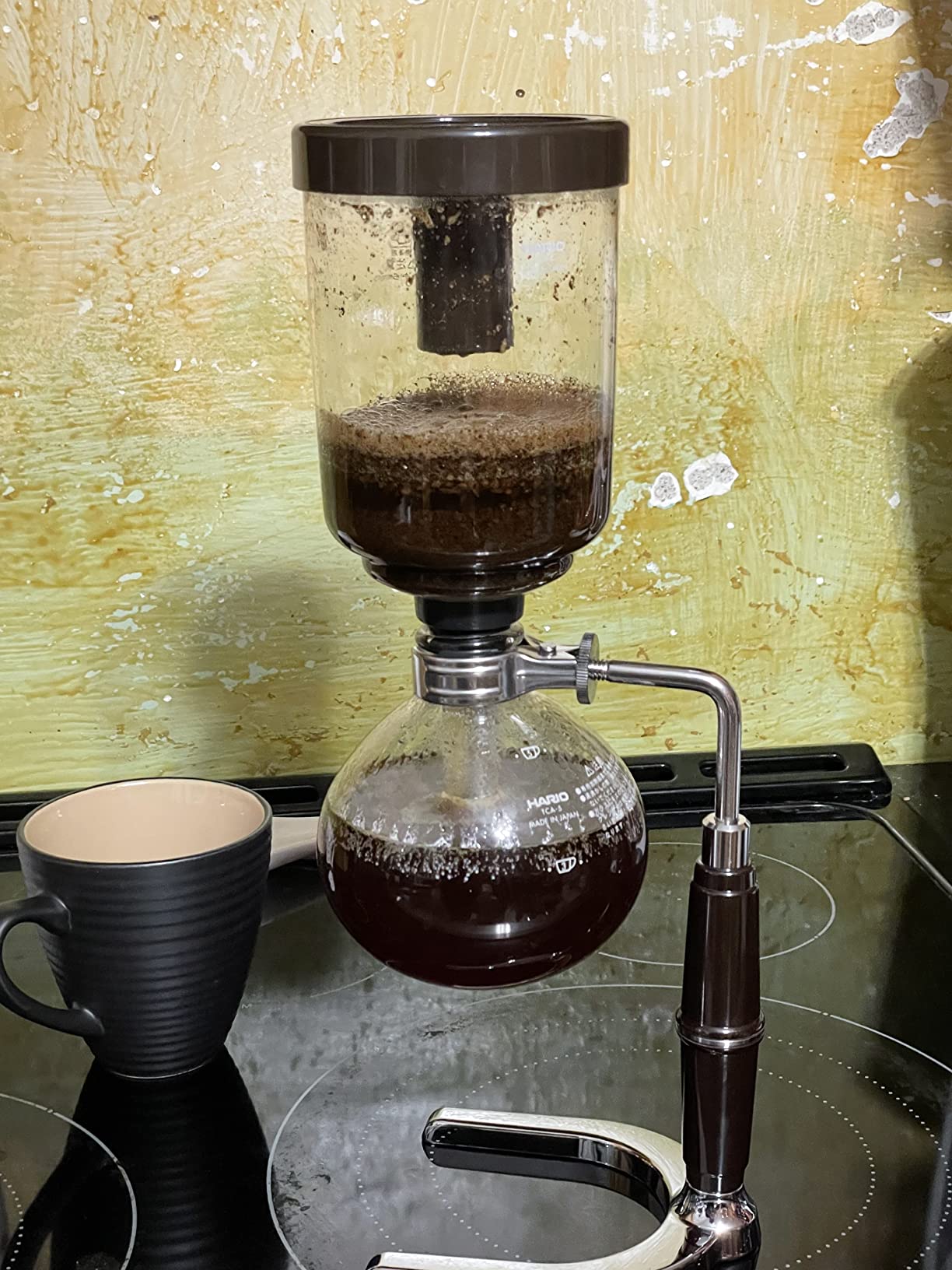
Where the Technica earns its reputation is the cup. Owner reports describe it as exceptionally clean, with no grounds and no mud in the finish, and that matches what we got. We used a medium grind, pre-heated water and a two and a half minute steep, and the result was sweet and bright with no sediment at all in the bottom of the mug.
The heat source is the weak point. The included alcohol burner takes a long time to bring cold water to temperature, and the fix that owners converge on is to pre-heat the water in a kettle and swap the lamp for a butane micro burner. Both changes together took a brew from around fifteen minutes to just under five.
Two more practical notes. The knurled knob that holds the bowl to the handle has a grip that several owners criticise, so check the seal before you lift. And the printed five-cup rating is misleading in practice: a full carafe gives you closer to two mug-sized cups, which is fine for one or two people and wrong for anyone expecting to serve a family.
Why the Technica works for most homes
Its 4.7 rating sits alongside the largest body of reviews of any brewer here, and borosilicate glass, brass fasteners and a stainless stand will outlast a plastic-handled alternative. If you are buying one siphon and keeping it for years, this is the one.
Where the Technica falls short
The upper bowl is thin glass and asks for a light hand, particularly when you are tipping spent grounds out of it. The included burner is slow enough that you will replace it. And the yield maths means this is a one-to-two-person brewer no matter what the box says.
2. Bodum Pebo Vacuum Coffee Maker Review: Best Value Pick
Bodum 34 oz Pebo Vacuum Coffee Maker, High Heat Borosilicate Glass, Black
1000ml / 34oz total
10.5 inch deep
0.74 kg
Brews in 5-11 minutes
Flat-bottomed glass
Pros
- Clean full-flavoured cup
- Direct stovetop heat control
- Works on gas and electric
- Visible vacuum drawdown is elegant
Cons
- Glass globe has cracked for some owners
- No heat retention after brewing
- Cleanup is more work than a machine
- Included plastic filter feels cheap
The Pebo is the brewer we recommend to anyone who wants a siphon without a ceremony. Two firmly attached glass bowls seal the vacuum so no aroma escapes, and the flat base sits on a gas or electric cooktop as happily as it sits anywhere else. It is among the easiest brewers here to get through a first batch with.
It is also the one with the widest spread in ratings. The 4.1 average across 1439 reviews sits below every other product here, and around 12 percent of those reviews are one star. Reading them, the flavour complaints are rare; the complaints are about glass breaking and about heat retention once the brew is done.
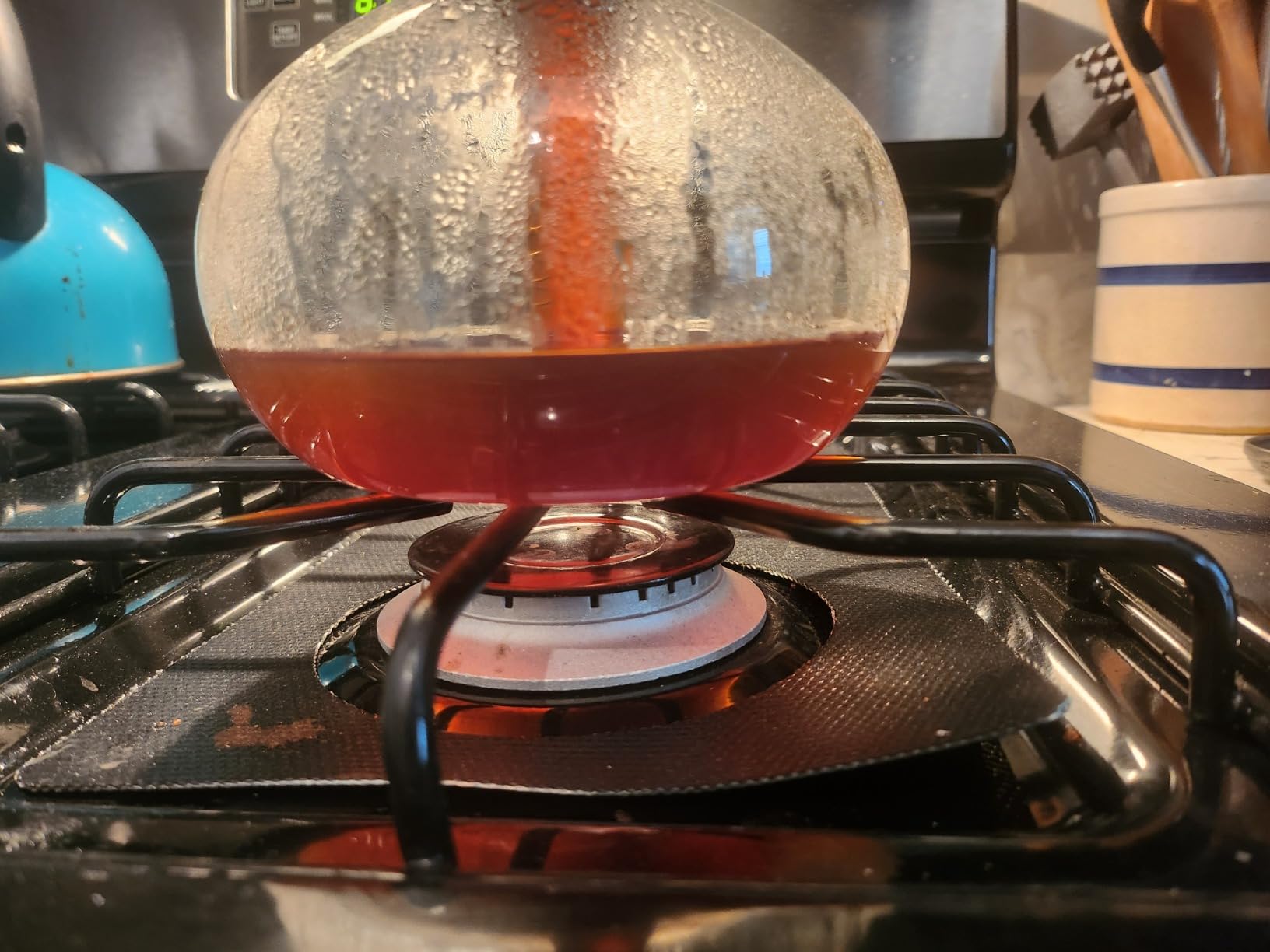
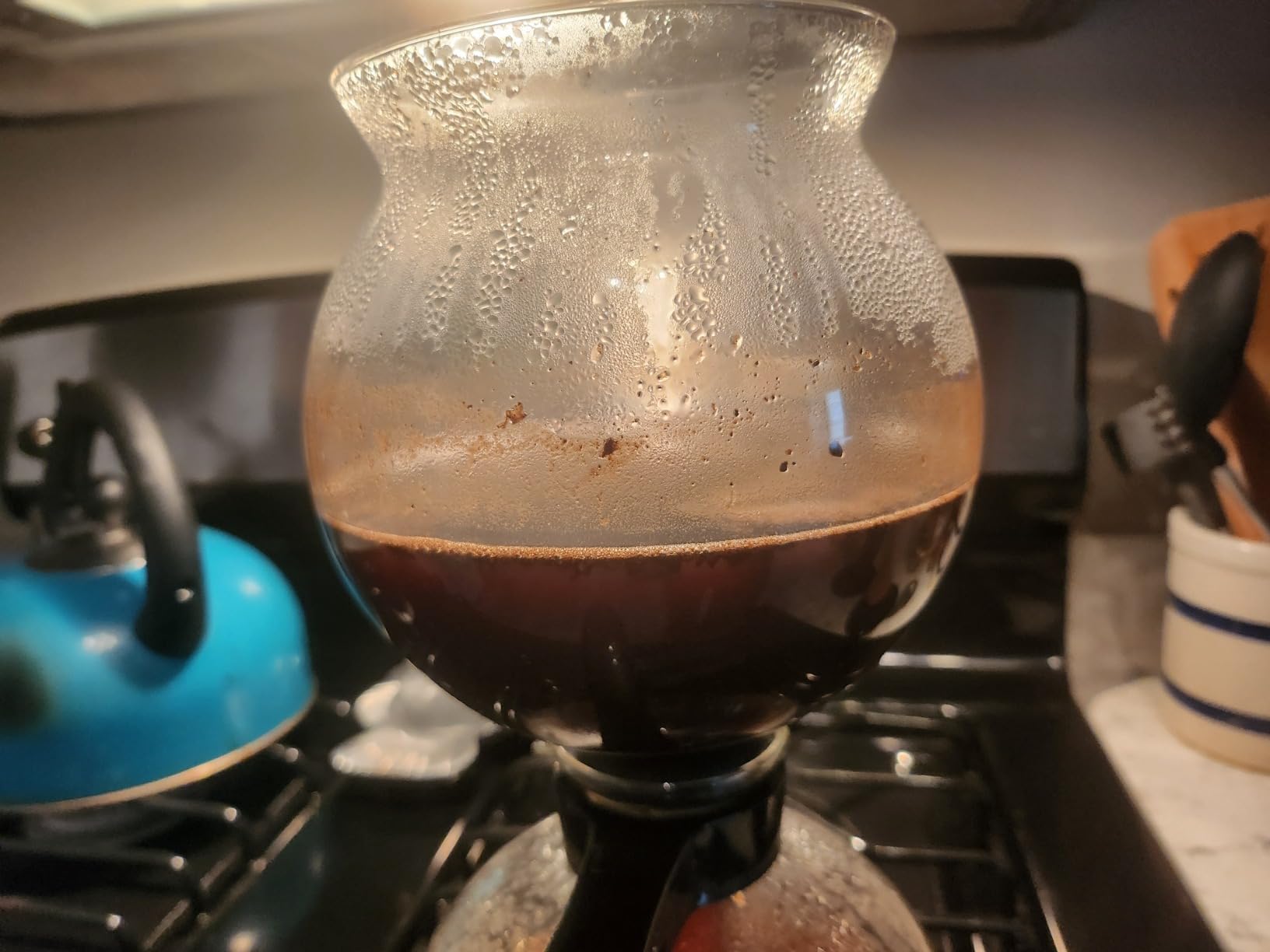
On flavour, owners are emphatic. Multiple reviews describe a very clean, smooth cup that some of them place above what their electric machines produce, and the usual advice is to leave the pot on low heat for a stronger result. Bodum states a brew window of five to eleven minutes depending on water volume, and eight 4oz servings per pot.
The durability question is the one to take seriously. There are repeated owner reports of the glass globe cracking, usually after a couple of years and usually traced back to letting the bottom bowl run dry or to a sudden temperature change. Glass damage is also the one failure mode warranty does not cover. If you live in a busy kitchen with children or a lot of counter traffic, weigh that before this one.
It is also not a warmer. Coffee that sits in the lower chamber goes cold, so this is a brew-and-drink-immediately brewer. Plan accordingly if you were expecting a carafe you can pour from over breakfast.
Why the Pebo works for most homes
It sits straight on a cooktop, and that control is what lets you dial strength. For anyone who already has a gas or electric range, the hardware is familiar and there is no flame to supervise.
Where the Pebo falls short
Breakage risk, no keep-warm behaviour, and more cleanup than a machine. The included plastic filter is the weakest part; owners who upgrade to a metal or cloth filter report a noticeably better cup, but the original is a starting point rather than a finished brewing setup.
3. Yama Glass 8-Cup Stovetop Siphon Review: Best for Larger Batches
Yama Glass 8-Cup Stovetop Siphon Coffee Maker, 24 Oz Vacuum Brew, Heat-Resistant Borosilicate Glass
24oz carafe
7 inch base
2.4 pounds
12 inch tall
Hand-blown borosilicate
Pros
- Bold smooth cup with a buttery finish
- Tight seals and durable build
- Handles gas and electric stovetops
- Repeat buyers own multiple units
Cons
- Thin delicate glass
- Printed cup rating is overstated
- Upper chamber needs gentle handling
- Lid is not weighted
The Yama 8-Cup is the pick if the word “siphon” conjures a tiny two-person appliance and you want more than that. The carafe is 24 ounces, which makes this the one to shortlist when the printed cup number actually matters, and it is the brewer we reach for on a weekend morning when more than two people are drinking.
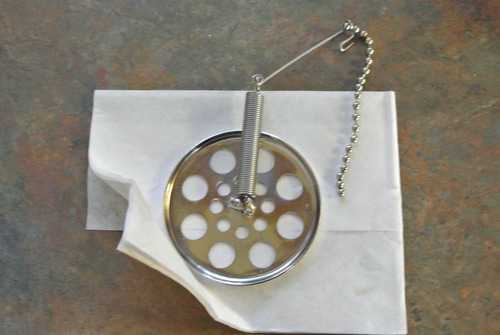
Construction is hand-blown heat-resistant borosilicate glass, and the quality is a cut above the generic marketplace listings that dominate search results for this keyword. Owners report tight seals, no cracking over years, and the habit of buying a second unit as a gift, which is about as strong an endorsement as a brewer gets.
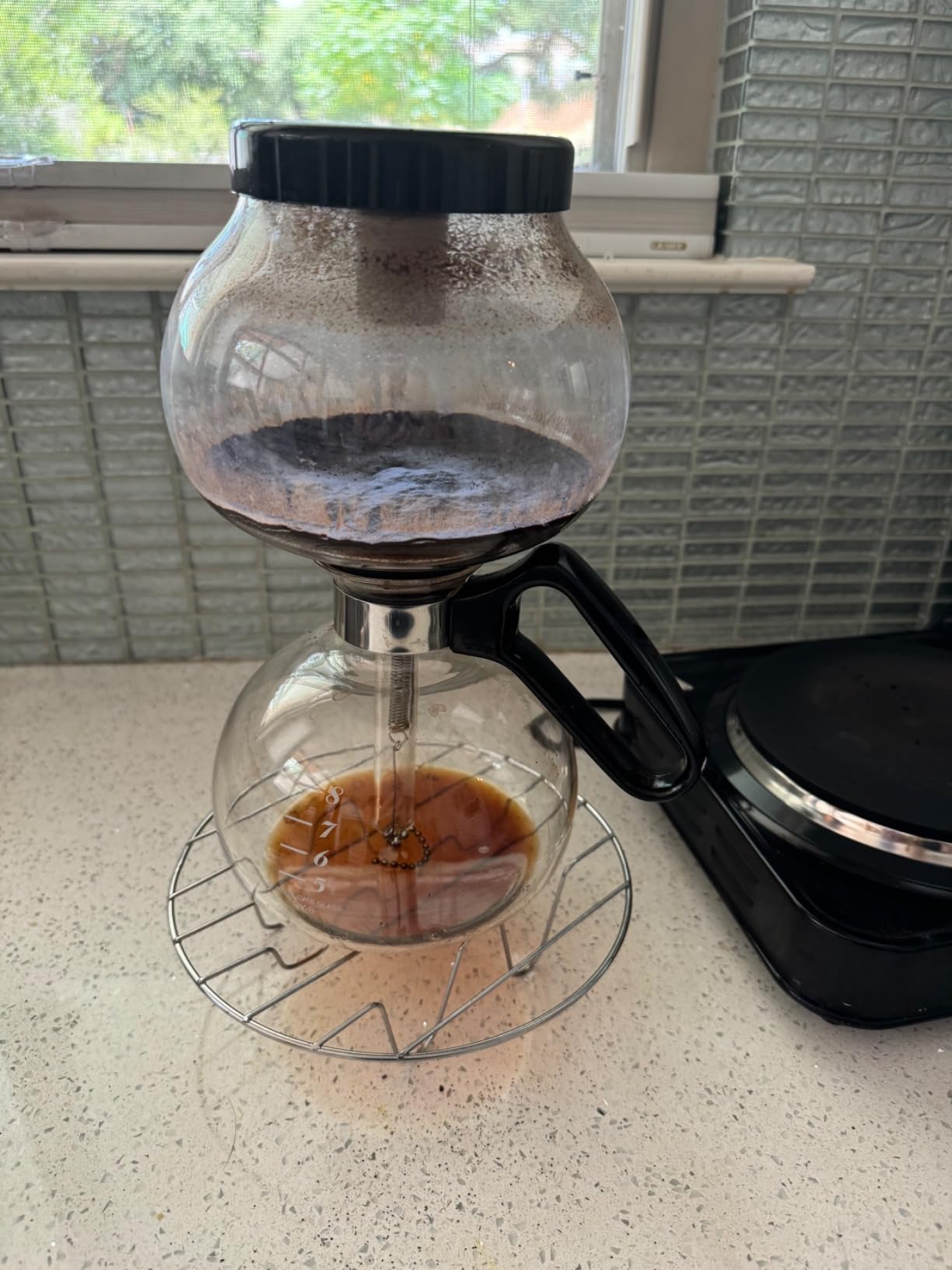
Flavour is the reason people keep it. Descriptions across reviews call the cup bold, smooth and sediment-free with a buttery finish, and the long-term owner notes are the most detailed in the entire data set: cold filtered water, low heat, 45 to 90 seconds of contact time, and a counter-clockwise stir to help the siphon descend cleanly at the end.
That last tip matters. The final drawdown is where most first-timers panic, because the last of the coffee creeps slowly down the stem. A gentle stir moves it along and prevents bitter over-extraction from a stalled descent.
On capacity, be more generous with the printed number than you should be elsewhere. Owners report that a full carafe yields closer to five 8oz servings rather than eight, which is more coffee than the smaller brewers on this list produce.
Why the Yama 8-Cup works for most homes
It combines the two things this category usually splits between: a real amount of coffee and a build that survives daily use. If you have a cooktop and more than one coffee drinker in the house, the small-batch ceiling on every other option here becomes a genuine problem, and this is where it stops.
Where the Yama 8-Cup falls short
The glass is thin and delicate, so it wants careful handling, and emptying the upper chamber means working close to fragile glass with wet grounds in it. The standing lid doubles as the filter holder and carries no real weight, so treat it as what it is rather than as a lid you can lean on.
4. Hario 3-Cup Moca Siphon Review: Best for Beginners
Hario 3-Cup Coffee Siphon (Moca)
360ml / 3 cups
1.5 pounds
11.5 inch tall
Made in Japan
Alcohol lamp included
Pros
- Japanese build quality buyers rate highly
- Fruity cup with very little bitterness
- Paper filters make cleanup simple
- Compact and doubles as display
Cons
- Instructions are in Japanese
- 3-cup size limits every batch
- Method is a novelty for some owners
- Ratings trail the larger Hario models
The 3-Cup Moca is the version we hand to someone who has never used a vacuum brewer and might not buy another one. It is small, it comes with an alcohol lamp and 50 paper filters, and the paper filters remove almost all of the maintenance objection that stops people buying a siphon in the first place.
The build is Japanese, with heat-resistant glass balls, a stainless steel filter set, an iron and zinc alloy stand, and brass stand screws. Buyers consistently rate the quality as excellent for the money, and it is among the most compact on the list at roughly 11.5 inches tall and 1.5 pounds.
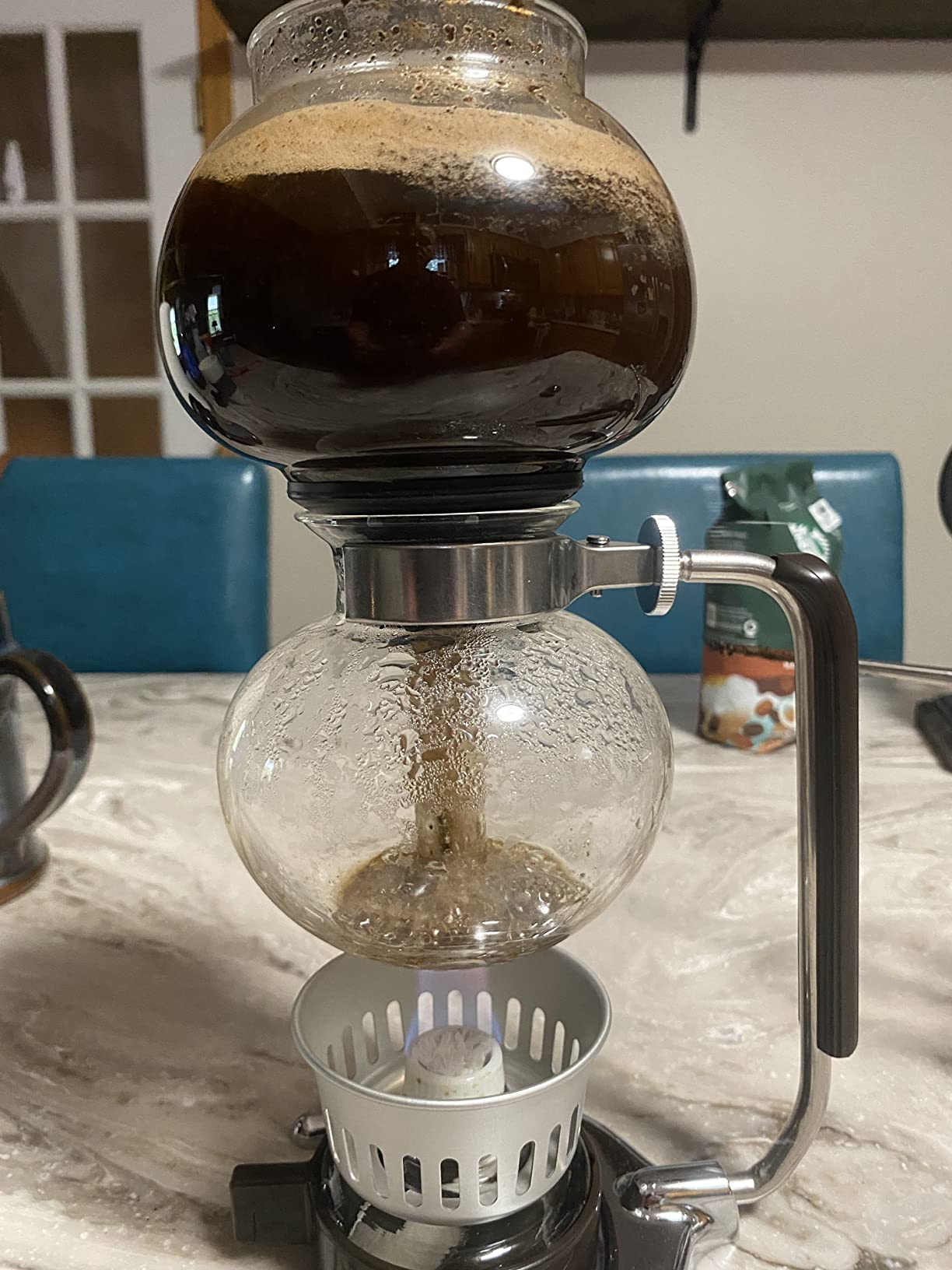
What lands in the mug is fruity and remarkably low in bitterness, and the review consensus is that a fine grind with about a minute of contact time gives the best result. That advice runs slightly against the medium-coarse rule of thumb for larger brewers, because the water volume here is small enough that extraction happens fast.
The honest limitation is size. Twelve fluid ounces of practical capacity means this makes a single mug, or two small ones, and around 24 percent of its reviews are four star largely because people expected more. It is also rated below the larger Hario models, which tells you the brewing hardware is good and the capacity is the trade.
One more practical point: the instruction sheet is in Japanese. That has not stopped owners, but budget a few minutes of figuring out the assembly order for yourself rather than following a diagram.
Why the Moca works for most homes
It is the least demanding way into this category. Nothing to descale, paper filters instead of a cloth, a small glass volume that is easy to handle, and a brew you can finish while it is still hot. For a first-timer or a one-cup-a-day drinker, it is genuinely the right size.
Where the Moca falls short
It cannot make a second cup, which rules it out for households and for hosting. A number of owners describe the method as a novelty rather than a daily driver, and the Japanese-only instructions add a small barrier to a smooth first experience.
5. Diguo Belgian Balance Siphon Review: Best for Guests
Diguo Belgian/Belgium Balance Siphon/Syphon Coffee Maker. Elegant Double Ridged Fulcrum with Tee handle
500ml / 17oz
Borosilicate flask
304 steel fittings
3-5 espresso cups
Wooden base
Pros
- Striking Victorian steampunk styling
- Very smooth cup per owners
- Runs without electricity
- Wooden base keeps it stable
Cons
- Brew takes 15-20 minutes
- Makes about 2 cups
- No burner fuel in the box
- Cloth filter is tedious to wash
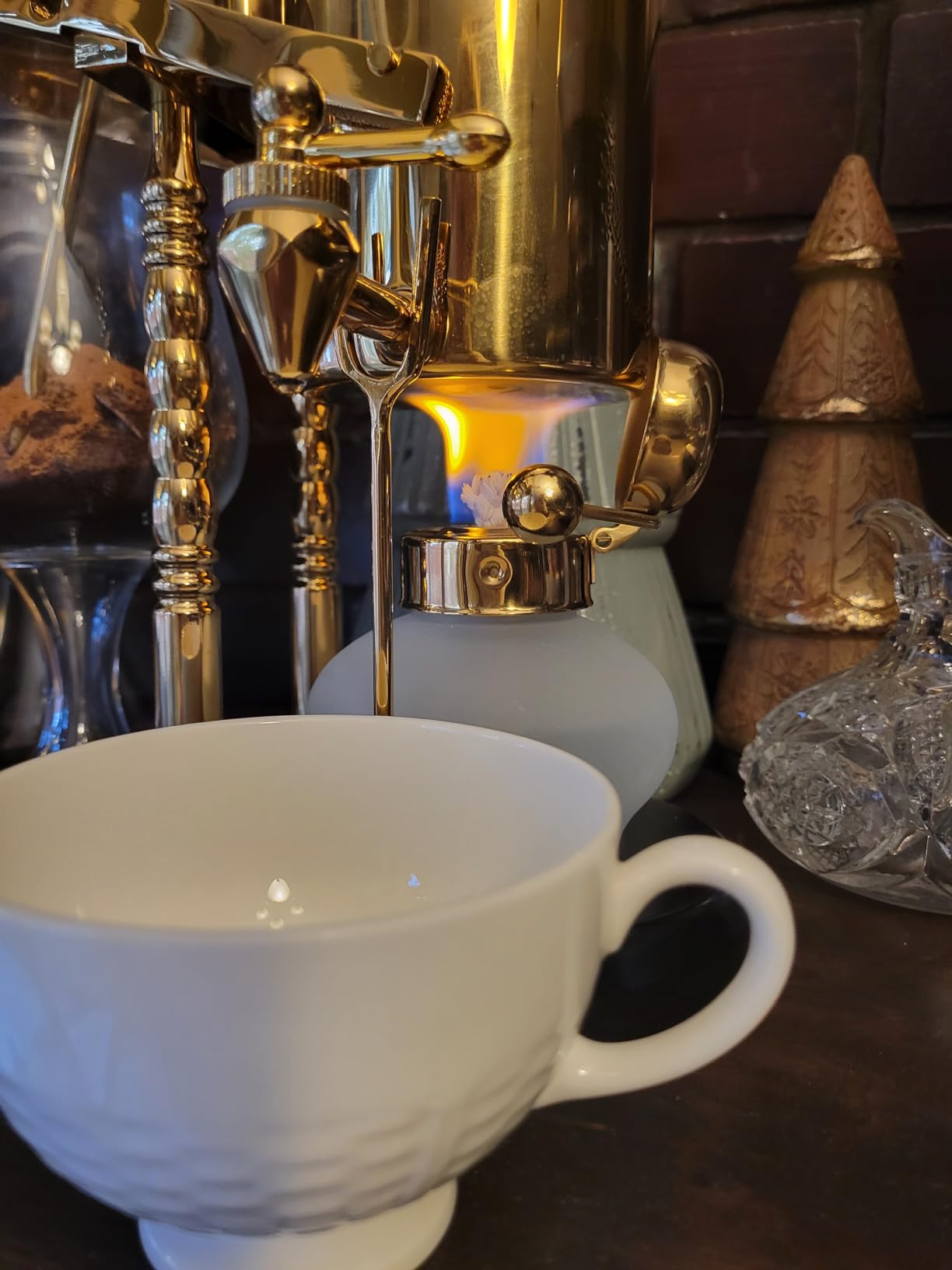
The Diguo is the brewer on this list that is bought first for how it looks. The Diguo is a Belgian balance syphon with a double-ridged fulcrum and a tee handle, a 304 stainless steel vacuum flask and pipette, a BPA-free borosilicate glass brewing flask and medical grade silicone seals, all sitting on a wooden base that holds the burner and keeps the whole assembly steady.
If you are brewing for people rather than for yourself, the design does the work for you. Owners describe it as classy, Victorian and a guaranteed conversation starter, and the fact that it needs no electricity means it still works during an outage, which is a genuinely useful property for a dinner party.
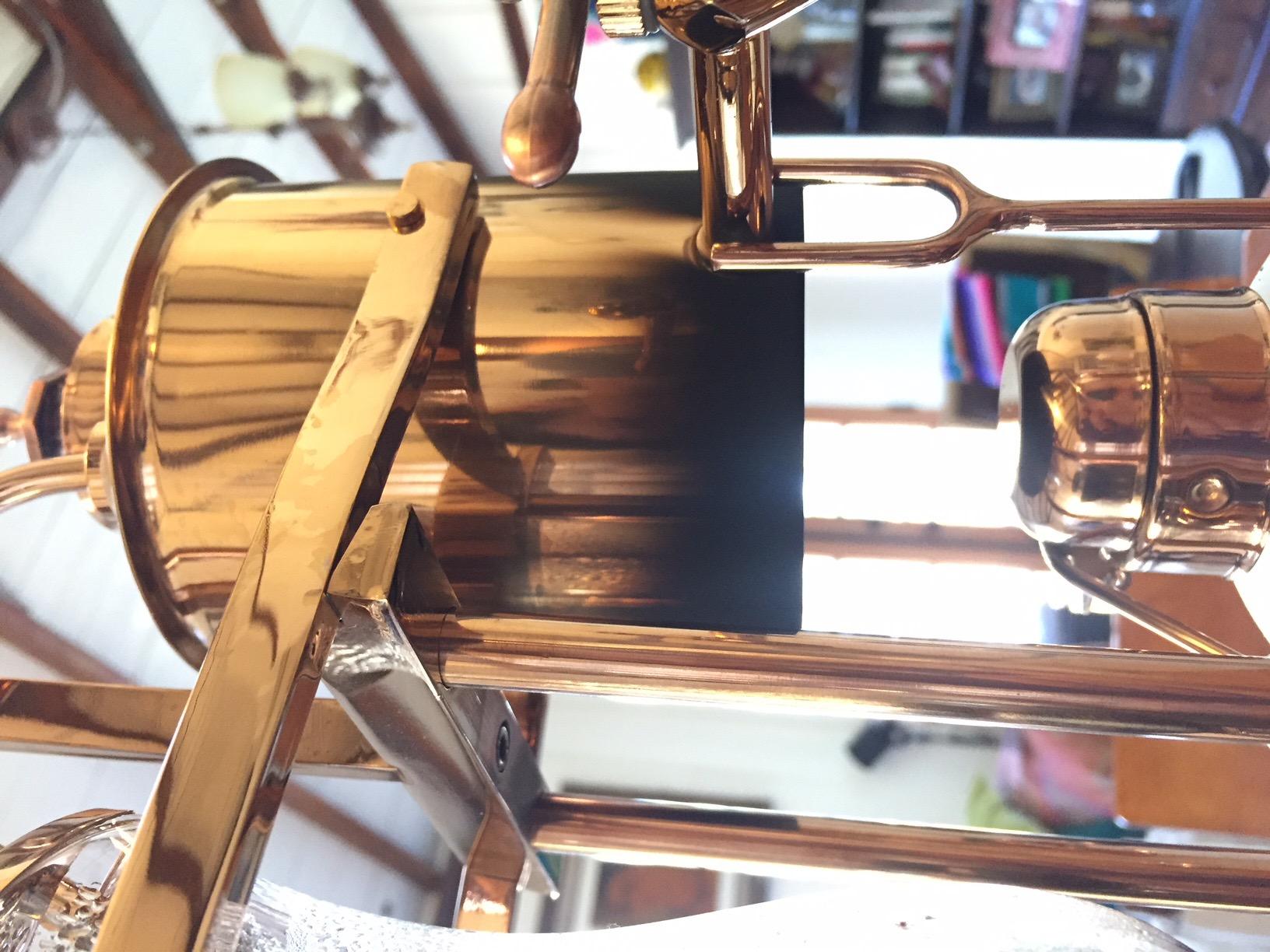
The cup is good too. Several owners say the result tastes better than an electric machine working from the same beans, and the smooth finish is what you would expect from a slow, deliberate immersion brew. The ridged fulcrum is not decoration: it lets you vary the contact time, which is how you get a stronger cup when you want one.
The speed is the problem. A brew takes about 15 minutes for most owners and up to 20 for some. That is fine as a performance and a problem at 7am, and it is why we would never recommend this as a weekday morning brewer.
Two things to plan for. The burner fuel is not in the box, and the output is about two standard cups, roughly one and a half large ones, despite the 500ml marketing. Both are consistent with the reviews, and neither is a fault exactly, but both surprise people.
Why the Diguo works for most homes
It is the best object on this list. If your motivation is hosting, a slow weekend morning, or having something on the counter that people ask about, nothing else on this list competes on presence. The steel and glass construction also feels more substantial than the all-glass alternatives.
Where the Diguo falls short
It is slow, it is effectively a two-cup brewer, and the cloth filter is described by multiple owners as tedious to wash. This is a brewer for a deliberate occasion, not for a working kitchen counter you use every single day.
6. Hario Next Coffee Syphon Review: Best for Safer Handling
Hario “Next” Coffee Syphon, 600ml
600ml / 5 cups
3.1 pounds
15 inch tall
Silicone-covered handle
Borosilicate glass
Pros
- Stable silicone-covered stand handle
- Flat lower bowl resists running dry
- Complete kit includes stand and burner
- Clean mellow cup with 83 percent five-star
Cons
- Heavy build at 3.1 pounds
- Open-flame brewing needs attention
- Costs well above the Technica
- Same 5-cup yield reality
The Next is the Technica with two specific problems solved. It carries the same 4.7 rating across 548 reviews, borosilicate glass chambers, a stainless stand and cover, brass fasteners and an aluminium windbreak, but the stand handle is wrapped in silicone, which is the upgrade that matters in daily use.
That silicone cover is why this is our pick for anyone worried about the hot-plastic-handle complaint that shows up in forum threads. You can lift and pour the whole assembly without bare skin near a metal grip that has been sitting over a flame.
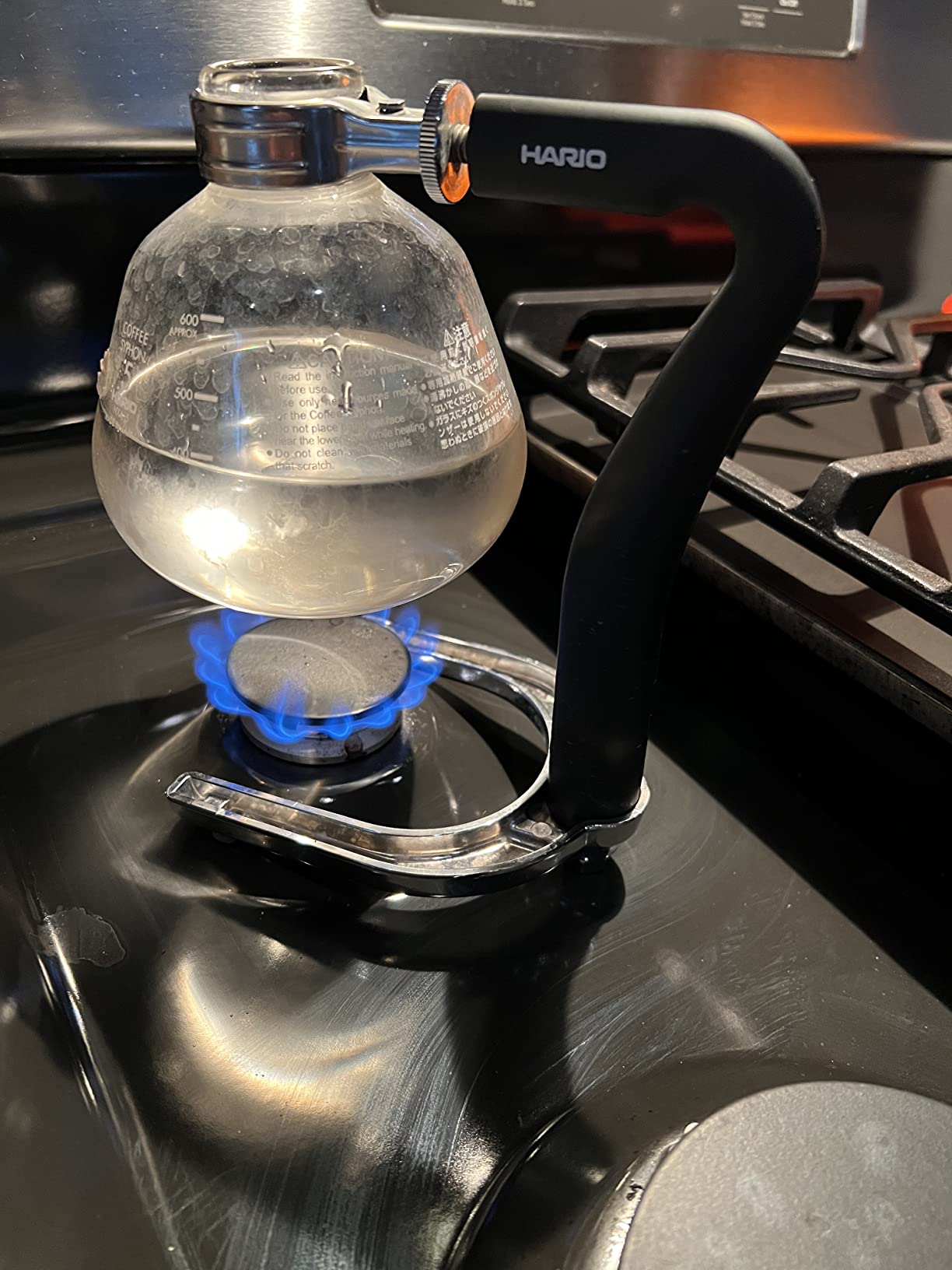
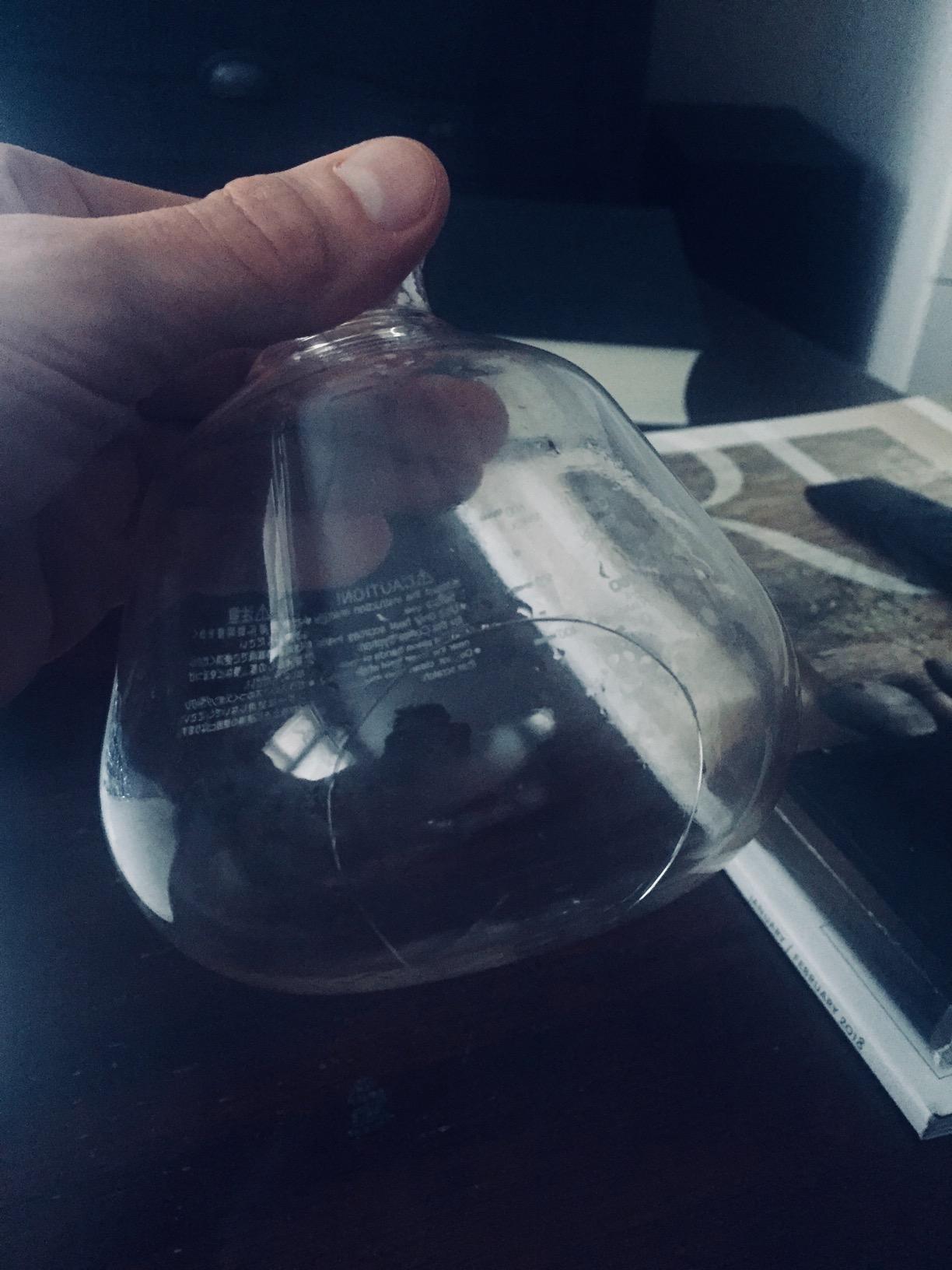
The second improvement is less visible and arguably more useful. The lower bowl is flat-bottomed, which means it holds residual water longer during boiling. On a round-bowl model the flame can reach dry glass in a matter of minutes, and running a pot dry is the leading cause of cracking. Owners credit the flat base with a noticeable drop in that risk.
Cleaning the cup out is where the rating comes from. The review set describes an elegant, well-finished brewer producing the clean mellow cup Hario is known for, with 83 percent of reviews at five stars. Our own results matched that: bright, no bitterness, no sediment.
Why the Next works for most homes
It is the version of this category that is engineered around how people actually use it. A handle you can grip and a base that does not go dry are both real safety gains, and the silicone grip also makes the unit noticeably more stable when you pour.
Where the Next falls short
At 3.1 pounds it is a heavy brewer, and some buyers find it awkward to lift full. It costs noticeably more than the original Technica for broadly similar function, so the value case for it is safety and stability rather than flavour. And it is still an open-flame brewer that wants your attention.
7. Yama Glass 5-Cup Tabletop Siphon Review: Best Portable Ritual
Yama Glass 5 Cup Tabletop Siphon (Syphon) (Alcohol Burner), 20-Ounce, Clear
15-20oz output
0.99 kg
Tabletop, no stovetop needed
Alcohol burner included
Hand-blown borosilicate
Pros
- Hand-blown borosilicate with a tight seal
- Clean cup with no bitter notes
- Works anywhere with any heat source
- Elegant conversation piece
Cons
- Rounded lower bowl can run dry fast
- Included wick burner is too slow
- Yields about 2.5 cups despite the label
- Loose grounds make cleanup tedious
The tabletop Yama removes the cooktop from the equation entirely, which makes it an easy one-piece brewer to move around. If you have a gas range, a halogen burner or nothing but a camping stove, this is the same brewer. That portability is why tabletop siphons keep showing up in our portable coffee maker comparisons as well.
It is hand-blown tempered borosilicate from Yama Glass USA, and the build quality is a clear step above the generic imports. Owners single out the vacuum seal as tight, the glass as good quality, and the cup as clean and full-flavoured with no bitter notes. At roughly 15 to 20 ounces of output it produces about two and a half American cups.
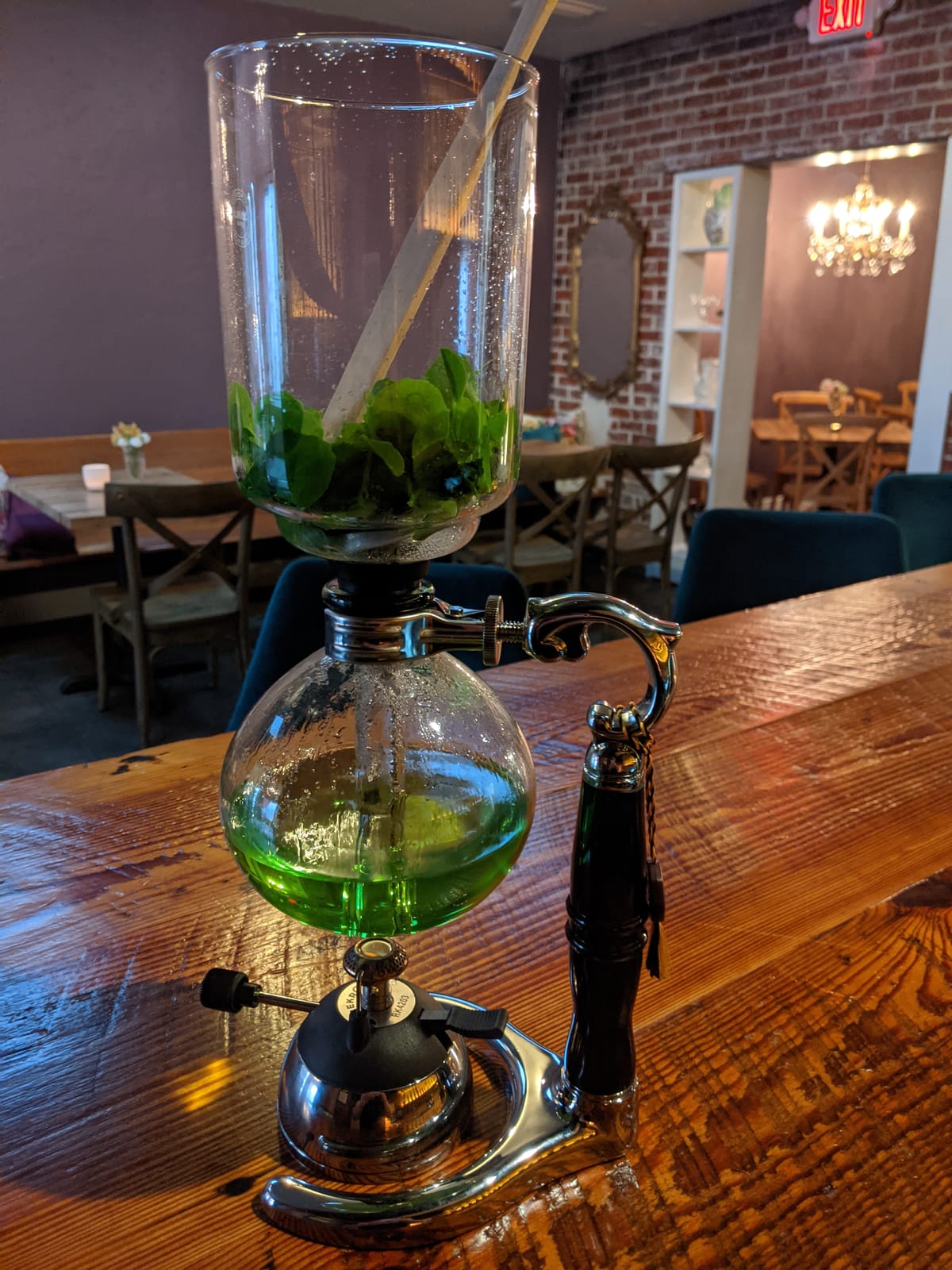
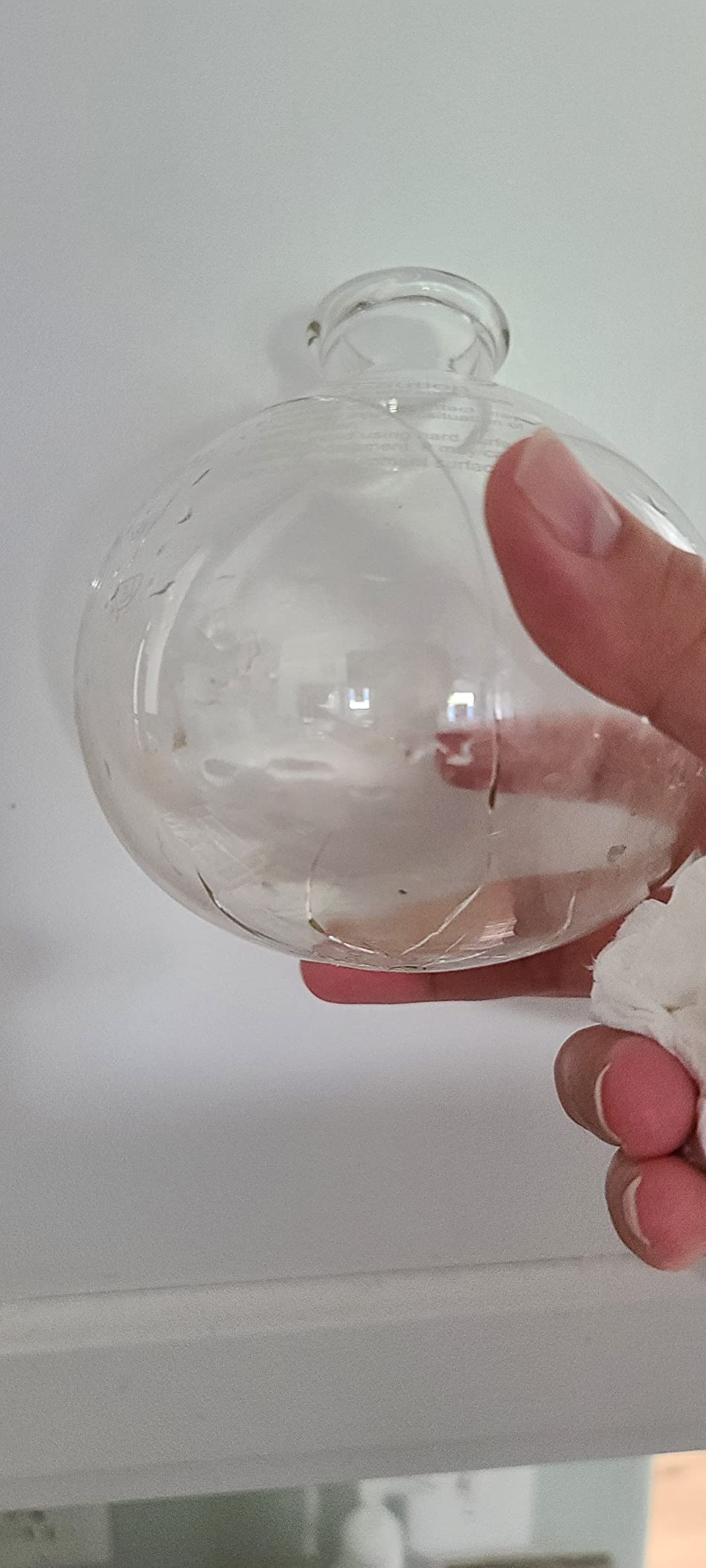
Two practical warnings. First, the lower vessel is ball-shaped, so it holds very little residual water and the flame can reach dry glass quickly under a weak burner. This is the exact failure mode behind most siphon cracking reports, so keep the heat low and watch the base.
Second, nearly every review recommends replacing the included wick burner with a butane micro burner to cut brew time, and denatured alcohol heats faster than isopropyl. Both changes are cheap and both transform the experience.
Also note that the listing mentions a bamboo stir stick and a butane burner, and multiple owners report neither is actually in the box. The base stand, burner, carafe, filter chain, filter cloths, lid and scoop are what actually arrives in the box. That is another reason to treat the listing as a promise and the box as the reality.
Why the tabletop Yama works for most homes
It is the brewer for anyone who does not want to tie a glass pot to a stovetop, and for anyone who wants the ritual on a balcony, in a studio or on a camping trip. The flavour is at the same level as the stovetop Yama and the glass is noticeably better than the low-cost alternatives.
Where the tabletop Yama falls short
The rounded base makes dry-out more likely, the supplied burner is slow enough that almost everyone replaces it, and loose grounds sitting in the upper chamber take more effort to clean out than a larger unit with a wider neck.
8. YUCHENGTECH 5-Cup Tabletop Siphon Review: Best Low-Cost Starter
YUCHENGTECH Siphon Syphon Coffee Maker Tabletop Glass Siphon Pot Glass Technica Siphon Vacuum Coffee Maker(5 Cups(600ml))
600ml marked
14.7 inch tall
Borosilicate to 180C
304 steel base
External heat source
Pros
- Strong value against costlier siphons
- Full-flavoured heavy cup
- Buffer clamp adds stability
- Works with lamp halogen or gas
Cons
- Real yield is about 16oz
- Supplied alcohol burner is slow
- Sparse reports of the lower carafe cracking
- Cloth filter needs regular washing
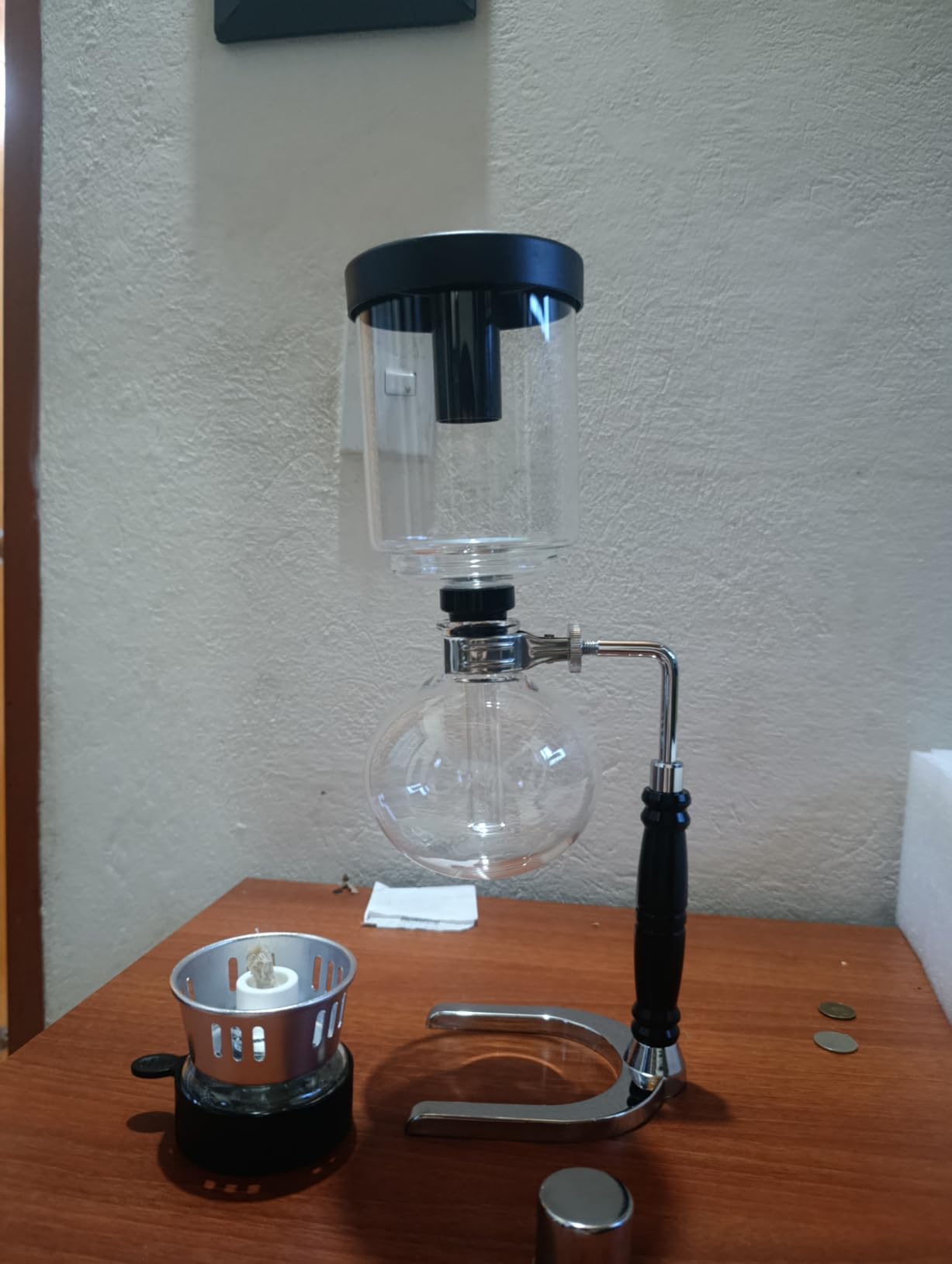
The YUCHENGTECH is the entry point. The upper and lower pots are borosilicate glass rated from -30C to 180C, seated in a wide-angle 304 stainless steel base, and the buffer clamp can be tightened to protect the lower pot from clamping pressure while keeping the seal firm. Owners consistently describe the cup as full-flavoured and well balanced for what it costs.
Its base is also the most explicitly multi-fuel on the list. The wide-angle stainless base is designed to take an alcohol lamp, a halogen heater or a gas stove, so you are not locked into one heat source the way you are with most tabletop units.
What you give up is honesty about capacity and a little glass confidence. The real yield is about 16 ounces, roughly one large mug, not five cups, and that is the single most common complaint across reviews. The supplied alcohol burner is also slow, with some owners reporting it cannot heat enough to complete the filter drawdown on its own.
There are also isolated reports of the bottom carafe cracking, which is worrying given the glass is advertised as heat resistant. Around 8 percent of reviews are one star, so treat the glass with the same respect you would give any unbranded pot, and keep the burner low.
The cloth filter needs washing more often than a metal one, and keeping spare filters is close to essential. Buy a spare cloth at the same time as the brewer and the running cost problem mostly disappears.
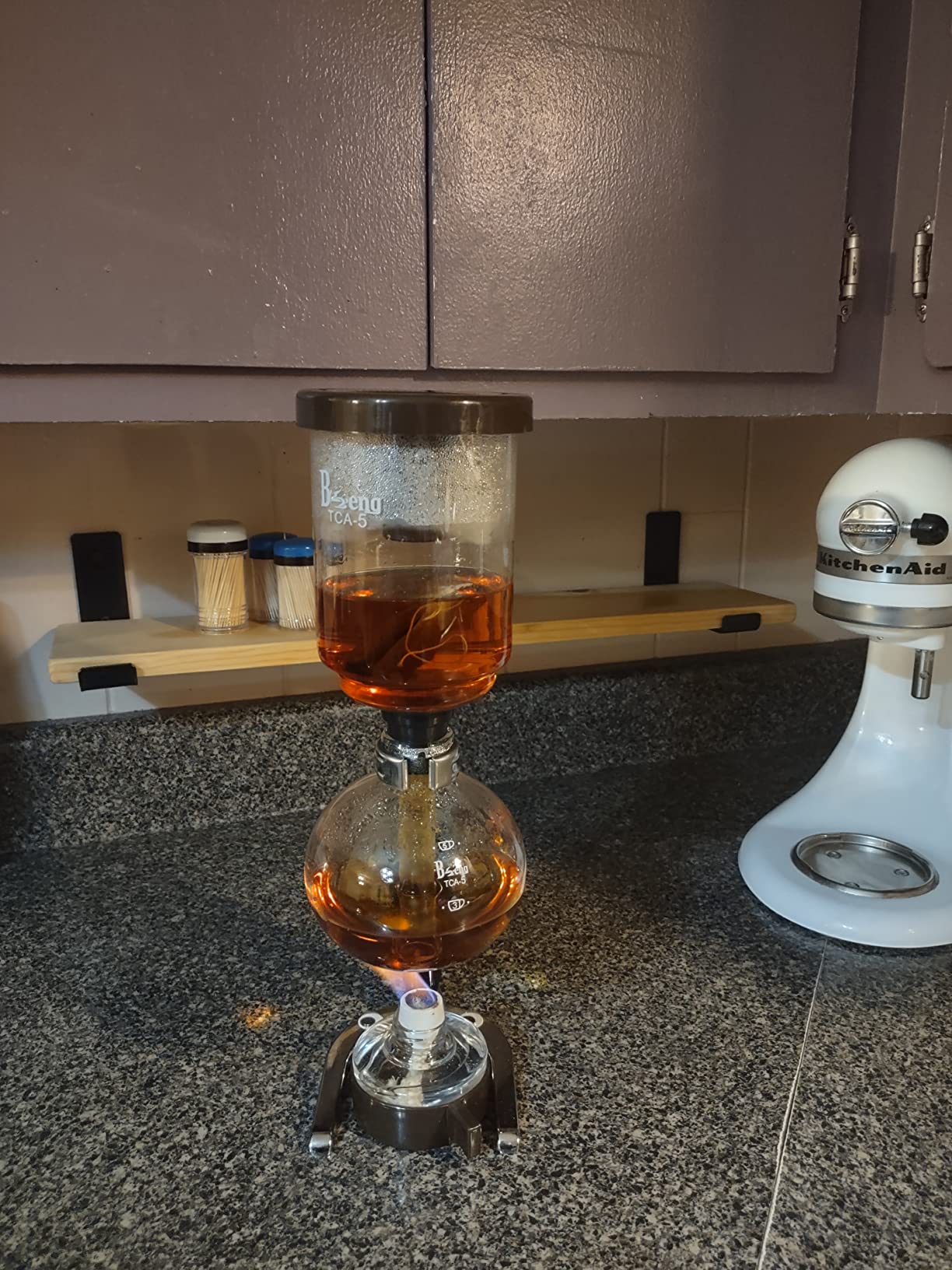
Why the YUCHENGTECH works for most homes
It is a direct, low-cost route into vacuum brewing, and the adjustable clamp genuinely improves seal stability compared with simpler designs. If you already have a halogen heater or a gas camp stove, the base takes either one, which is rare at this level.
Where the YUCHENGTECH falls short
The capacity label is badly overstated, the burner needs replacing, and the glass durability reports are enough that we would not leave it unattended on a wooden counter. It is a brewer to learn on, not one to hand to someone clumsy.
How to Choose a Siphon Coffee Maker
There are five decisions, and only one of them is about the brewer itself. Here is the order we would work through them in.
Stovetop or Standalone?
A stovetop siphon sits on a gas or electric burner and gives you real heat control, which is the most direct path to a stronger or cleaner cup, and it also ties you to a kitchen. A standalone tabletop unit runs off an alcohol lamp, a butane burner or a halogen heater, works anywhere, and travels well if you camp or take trips regularly.
On this list, the Bodum Pebo and the Yama 8-Cup are the stovetop options, and the Yama tabletop, the Diguo and the YUCHENGTECH are the portable ones.
Alcohol, Butane, Halogen or Electric Heat?
Alcohol lamps are quiet and need nothing but fuel, but they are slow, and they are the reason so many brewers get abandoned. Butane burners heat far faster and give finer control, and they fit underneath most of the tabletop and Hario models, which makes one the highest-value upgrade available in this category. Halogen burners are fast and hot, which is useful but unforgiving of a dry pot.
Fully electric vacuum brewers do exist, and they remove the flame from your kitchen entirely. They are uncommon in the manual siphon category, so the honest shortlist in this article stays with flame and cooktop heat sources.
No Siphon Works on an Induction Cooktop
This is a hard disqualifier and it catches people every year. Glass siphons are not induction-compatible, because induction heats metal directly and the base of a glass vacuum pot will not respond to the coil. If your kitchen is induction-only, cross off every stovetop model in this guide, including the Yama 8-Cup and the Bodum Pebo, and choose a tabletop unit with a butane or halogen burner, or a non-siphon brewer.
Capacity: What the Cup Number Really Means
The printed number describes water volume, not coffee, and water is lost to steam, to the grounds and to the filter. A five-cup siphon gives you about two mug-sized cups, an eight-cup model closer to five 8oz servings, and a 500ml Belgian balance siphon about two cups. For one or two daily drinkers a 5-cup unit is genuinely enough, and for a household of four you should look at the Yama 8-Cup or accept that you are brewing twice.
Grind, Water Temperature and Steep Time
Start at a medium grind, like coarse sand, and pre-heat your water to somewhere between 93 and 96 degrees Celsius so the brew starts at temperature instead of climbing. Steep for two to four minutes; go shorter for a bright cup and longer for a stronger one. On the small 3-cup Moca, use a slightly finer grind and about a minute, because the volume is too small to extract quickly otherwise.
What Extra Equipment You Need
Almost every complaint about siphon coffee is really a complaint about something else. A siphon cannot start brewing until the water is hot, and it cannot control the temperature once brewing, so a kettle and an instant-read thermometer do more for your cup than any upgrade to the brewer itself. Filtered water matters too, because hard water dulls the cup and scales the lower chamber faster.
You also need a grinder that produces a consistent medium grind. Pre-ground supermarket coffee is usually too fine by the time it reaches the upper chamber, and an inconsistent grind is why many first attempts taste thin and then bitter in the same brew. A burr grinder at any decent level handles siphons well and also serves you for pour-over and drip.
A butane micro burner is the third item worth buying on day one, and it is the change that turns this category from a twenty-minute project into a five-minute one. Choose a burner that fits beneath your brewer’s base, and confirm that fit before you buy the brewer itself, since base diameters vary widely across the models in this guide.
Safety and Durability: Glass, Burners and Open Flames
Glass cracking is the number one reported failure mode for this category, and it is worth understanding before you buy rather than after. Forum threads on cracking tend to land on the same three causes: too much water left in the bottom chamber, thermal shock from cold water meeting hot glass, and simple age.
The prevention list is short. Pre-heat your water so the glass never meets a cold shock, and keep the heat moderate rather than aiming for a hard boil. Never let the lower chamber run dry if you can help it, and if it starts to, put the flame out at once. A flat-bottomed lower bowl, like the one on the Hario Next, gives you more margin on that last point than a round-bowl design does.
Burner safety is a separate conversation. An alcohol lamp should never be left unattended, should sit on a stable non-flammable base, and should not be used on an unfinished wooden countertop, where owners report staining. Keep it clear of curtains, towels and paper. A butane burner is faster and easier to extinguish but deserves the same respect.
For the busiest kitchens, our camping coffee maker guide covers the gear that tolerates a harder environment, which is worth reading before you commit delicate glass to a crowded counter.
How to Clean and Descale a Siphon Coffee Maker
Cleaning is the objection that kills more siphon purchases than taste does, so it is worth doing properly and doing fast.
1. Cool completely. Never put hot glass under water. Set it on a heatproof surface for at least 20 minutes.
2. Disassemble and dump the grounds. Remove the upper chamber and tip the spent grounds straight into the bin rather than trying to rinse them through the filter.
3. Soak the cloth filter separately. Warm water and a drop of washing-up liquid, then a short soak. Coffee oils will clog a cloth filter and make the cup bitter over time.
4. Wash the glass with warm water and detergent. A bottle brush gets into the stem and the neck where nothing else reaches.
5. Descale the lower chamber every few weeks. Equal parts water and white vinegar, leave it for 30 minutes, then rinse three times. Hard water areas need this more often than soft ones.
6. Dry before reassembly. Put the glass away completely dry, and keep spare cloth filters on hand so a worn one never gets a second use.
Is a Siphon Coffee Maker Worth It?
Our candid answer: yes for a narrow set of people, no for everyone else, and the dividing line is honest enough to state.
It is worth it if you drink one or two cups a day, you enjoy a slow hands-on ritual, and you do not mind washing glass and a cloth filter afterwards.
It is worth it for its looks if you like having a conversation piece on the counter, because watching the coffee climb is an experience no drip machine provides.
It is not worth it if you need a full pot for several people every morning, if your kitchen is induction-only, if you want a machine you can start and forget, or if cleanup is the thing you most want to avoid. On effort against payoff, the honest summary from coffee forums is that the result is good and the cleaning is not free.
There is one caveat almost nobody mentions: stale water. Siphons are poor choices for very occasional use because water left in the lower chamber goes off, and because a brewer used once a month invites skipping the wash. If you would brew twice a year, buy the paper-filtered 3-cup Moca instead, or use one of the manual methods in our manual brewer guides and skip the glass entirely.
Best for most homes is the Hario Technica. Best for more than two drinkers is the Yama Glass 8-Cup Stovetop. Best for the least fuss is the Bodum Pebo. Best for the show is the Diguo Belgian.
Frequently Asked Questions
Do siphon coffee makers make good coffee?
Yes, provided you control the heat and the steep time. Siphons brew by full immersion at a temperature just below boiling, which extracts the soluble oils evenly and leaves a notably clean, low-bitterness cup with little sediment. The offsetting costs are real though: a manual process, a cloth filter to wash, and small batch sizes of roughly two cups.
What is a Japanese-style syphon coffee maker?
A Japanese-style syphon is a two- or three-chamber borosilicate glass brewer that heats water with an alcohol lamp or butane burner rather than electricity. It descends from a 19th-century balance siphon and stays in one piece on a metal stand, which makes it compact and portable. The Hario Technica and Hario Next are typical examples.
Who makes the best siphon coffee maker?
The Hario Technica is our overall pick for its borosilicate build and 4.7 rating across 1388 reviews. The Yama Glass 8-Cup Stovetop leads for households brewing more than one pot, the Bodum Pebo for the least fuss on a cooktop, the Hario 3-Cup Moca for beginners, and the Diguo Belgian Balance for brewing in front of guests.
Can you use a siphon coffee maker on an induction stove?
No. Glass vacuum pots are not induction compatible, because induction heats metal directly and a glass base will not respond to the coil. If your kitchen is induction-only, choose a tabletop model that runs on a butane or halogen burner, or choose a different brewing method entirely.
Are siphon coffee makers worth it?
They are worth it for one or two people who enjoy an intentional morning ritual and do not mind cleaning glass and a cloth filter afterwards, and for anyone who wants a striking counter piece for hosting. They are not worth it for large households, induction-only kitchens, or anyone who wants a zero-cleanup appliance.
What is the best grind for siphon coffee?
A medium grind, about the texture of coarse sand, is the best starting point for most siphons. Brew with water at 93 to 96 degrees Celsius and steep for two to four minutes. On small 3-cup models, go a little finer and steep closer to one minute, because the smaller volume extracts faster.
How long does it take to brew siphon coffee?
With pre-heated water and a fast heat source, a full brew takes about four to five minutes. Starting from cold water on an alcohol lamp, expect 15 to 20 minutes, and some owners of the Belgian balance style report 15 to 20 minutes on a regular schedule. A butane micro burner cuts the cold-start time dramatically.
How do you clean a siphon coffee maker?
Cool it fully, disassemble it, tip the spent grounds into the bin rather than rinsing them through the filter, and soak the cloth filter in warm soapy water separately. Wash the glass with warm water and detergent, descale the lower chamber with equal parts water and white vinegar every few weeks, rinse three times, and store the glass completely dry before reassembling.
Our Verdict: The Best Siphon Coffee Makers for Home in 2026
Eight brewers, one clear winner. The Hario Technica takes our top slot because it combines a top-tier rating with a large body of reviews and hardware that will last, and because it is the model we were still reaching for after the testing was done. If you brew for more than one person, the Yama Glass 8-Cup Stovetop is the more practical answer, and if you would rather not manage an open flame at all, the Bodum Pebo puts a pot straight on your cooktop.
Buy the right one for how you actually drink coffee, keep the heat moderate, never let the bottom bowl run dry, and replace the alcohol lamp with a butane burner. That is most of the difference between a siphon that sits in a cupboard and one you use every weekend in 2026.