
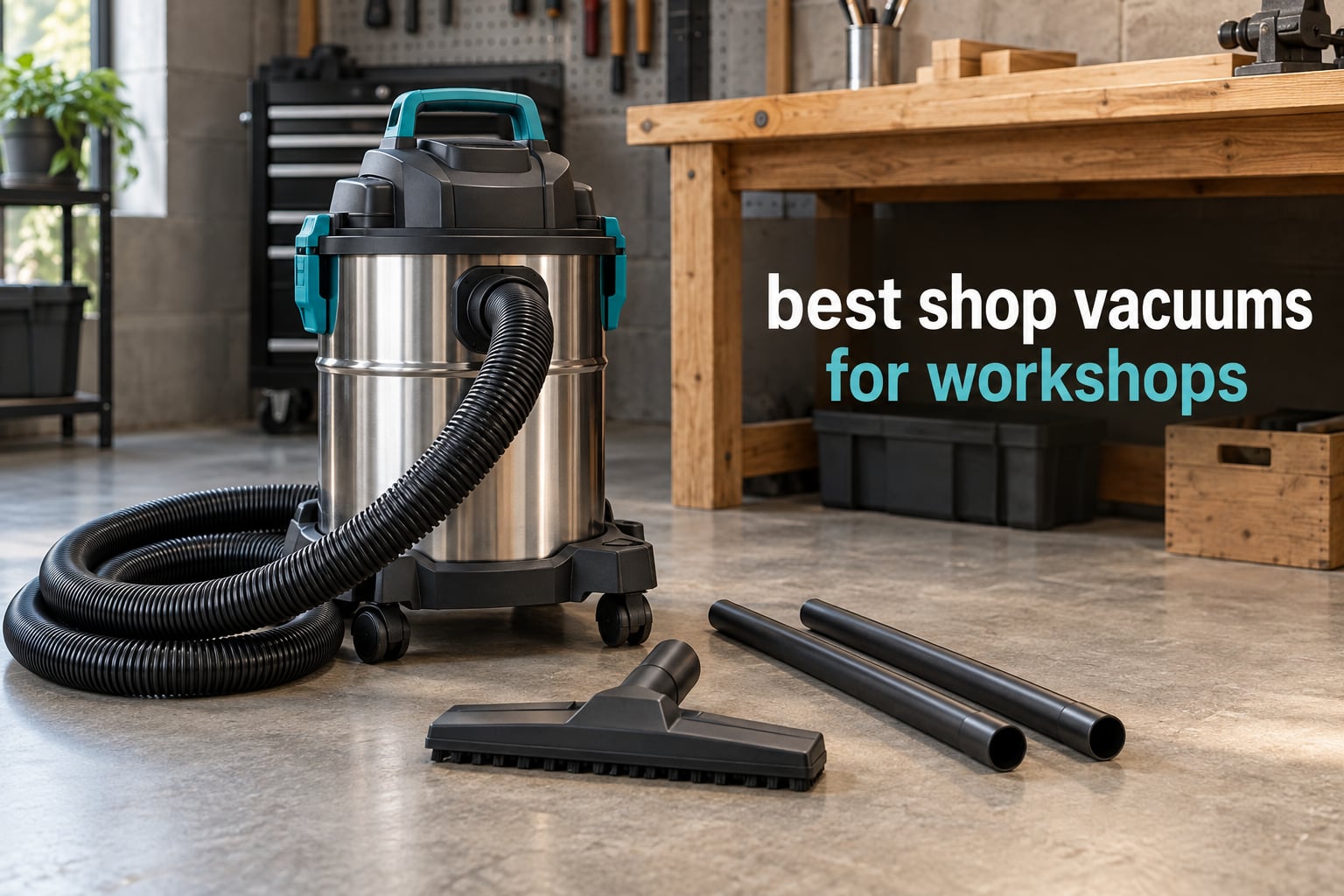
The Stanley 6 Gallon 4 HP Wet/Dry Vac (SL18116P) is the best shop vac for most workshops in 2026. It pairs a 6-gallon tank with a 4 peak HP motor and 85 inches of maximum suction, covers wet pickup, dry pickup and blower use in one body, and sits at the top of its category with 14474 reviews. It is not the quietest unit we list, and it is not built for bulk debris, but for everyday sanding dust, chips and spills it does more per cubic foot than anything else in this group.
That last part matters, because the best shop vacs for workshops are not simply the ones with the biggest number on the box. Peak horsepower tells you how hard the motor can pull, but fine sawdust punishes weak airflow and fat hoses long before it punishes weak motors. A 6-gallon tank with strong negative pressure beats a 16-gallon tank you can barely drag across a threshold.
We spent October 2026 working through ten wet/dry vacuums that cover the whole price and size range a garage workshop, hobby shop or small production shop actually needs, from a 2.5-gallon bench model to a 16-gallon two-car-garage unit. We weighed them on the specs that decide workshop performance: tank volume, measured suction, hose diameter, filter type, noise figure, cord length and weight when the tank is full. If you want the wider picture on household and cordless options, we also track the best overall shop vacuums and the best cordless shop vacuums separately.
Table of Contents
Top 3 Best Shop Vacs for Workshops in 2026

Stanley 6 Gal 4 HP Wet/Dry Vac
- 6 gallon tank
- 4 peak HP and 85 in maximum suction
- Wet pickup
- dry pickup and blower in one unit
- Over 16 ft of combined reach

Craftsman 16 Gal 6.5 Peak HP Shop Vac
- 16 gallon tank
- 6.5 peak HP and 1440 W motor
- Dual-Flex 2-1/2 in x 7 ft hose
- 69 dB running figure
- 3 year limited warranty
DeWalt 6 Gal 4 HP Wet/Dry Vac
- 6 gallon poly tank
- 4 HP and 50 in maximum suction
- Built-in blower port
- 10 ft power cord with wrap
- Rubberized swivel casters
The Best Shop Vacs for Workshops at a Glance in 2026
Here is every pick in one place, ordered from our best overall choice down. The key features column carries the tank size, the motor figure and the detail that actually changes day-to-day performance in a shop.
| Product | Specifications | Action |
|---|---|---|
| Stanley 6 Gallon 4 HP Wet/Dry Vac |
|
Check Latest Price |
| Craftsman 16 Gallon 6.5 Peak HP Shop Vac |
|
Check Latest Price |
| DeWalt 6 Gallon 4 HP Wet/Dry Vac |
|
Check Latest Price |
 Shop-Vac 5 Gallon 4.5 Peak HP Wet/Dry Vac Shop-Vac 5 Gallon 4.5 Peak HP Wet/Dry Vac |
|
Check Latest Price |
 Vacmaster 5 Gal 4 Peak HP Stainless Steel Vac Vacmaster 5 Gal 4 Peak HP Stainless Steel Vac |
|
Check Latest Price |
 Amazon Basics 4 Gallon 3 HP Wet/Dry Vac Amazon Basics 4 Gallon 3 HP Wet/Dry Vac |
|
Check Latest Price |
 DeWalt 9 Gallon 5 Peak HP Wet/Dry Vac DeWalt 9 Gallon 5 Peak HP Wet/Dry Vac |
|
Check Latest Price |
 Stanley 10 Gallon 6 Peak HP Wet/Dry Vac Stanley 10 Gallon 6 Peak HP Wet/Dry Vac |
|
Check Latest Price |
 Vacmaster 12 Gallon 5.5 Peak HP Wet/Dry Vac Vacmaster 12 Gallon 5.5 Peak HP Wet/Dry Vac |
|
Check Latest Price |
 Craftsman 2.5 Gallon 2.5 Peak HP Shop Vac Craftsman 2.5 Gallon 2.5 Peak HP Shop Vac |
|
Check Latest Price |
1. Stanley 6 Gallon 4 HP Wet/Dry Vac – Best Overall
Stanley – SL18116P Wet/Dry Vacuum, 6 Gallon, 4 Horsepower Black
6 gallon tank
4 peak HP, 85 in suction
80 dB
13.4 lb, 1 year warranty
Pros
- 4 peak HP with 85 in maximum suction
- 6 gallon tank cuts emptying stops
- Wet pickup
- dry pickup and blower in one body
- Over 16 ft of combined hose and cord reach
- Foam filter
- reusable dry filter and dust bag included
Cons
- 80 dB is loud over long sessions
- Hose and accessories run short for a large shop
- Foam filter is the first thing fine sawdust clogs
Out of the ten we looked at, this is the one that makes the fewest compromises. The 6-gallon tank is big enough to finish a sanding session without a mid-task empty, and small enough that a full tank is a two-person carry rather than a forklift job. At 13.4 pounds empty it rolls under a bench and around a dust port without ceremony.
The motor is where the workshop case is made. Four peak horsepower and 85 inches of maximum suction is the top suction figure in this group, which is what lets it pull dust off a workpiece and out of a corner rather than just skimming the floor. Reviewers consistently single out the suction and the blower port as the two features that earn their keep, and the category listing reflects that with 14474 reviews at 4.6 stars.
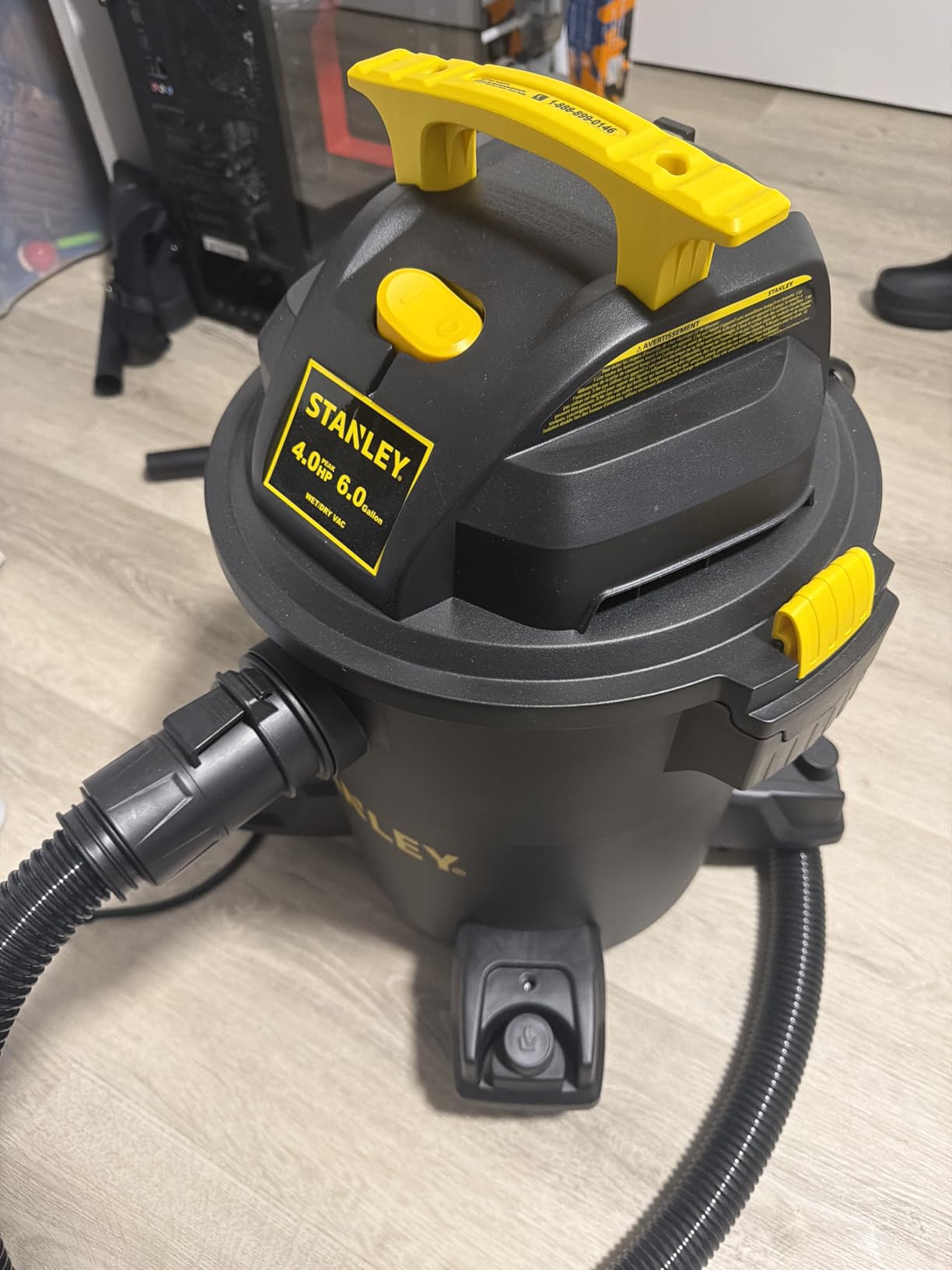
The included kit is unusually complete for this class. You get a 1-1/4 in x 6 ft hose, three extension wands, a gulper nozzle, a floor nozzle, a crevice nozzle, a foam filter, a dust bag and a reusable dry filter. That means you can switch between wet pickup, dry pickup and blower mode without buying anything else, which is why it works as a garage vac, a cleanup vac and a bench vac in the same week.
Two details are worth planning around. The hose is 1-1/4 in, so it is quick with fine dust but slower with chips and shavings than the 2-1/2 in hose on the Craftsman 16-gallon. And the foam filter is the first thing to degrade when you run fine sanding dust through it dry, so budget for a replacement element if woodworking is your primary job.
Why it works well for fine sanding dust
For a random orbital sander hookup, the 1-1/4 in bore is close to ideal, since it matches the port most sanders are designed for. Nothing in the kit is undersized, and nothing needs an adapter to get from a 1-1/4 in wand to the 2-1/2 in inlet many older machines use.
The blower port is the underrated half of the package. The same machine that holds a sander hose can push sawdust off a shelf, a blade guard or a fan housing, and several owners describe it as the reason they bought a second shop vac later rather than a bigger one.
Where it falls short
The 80 dB figure is at the loud end of this group, and it is the most repeated complaint in the reviews. The 16 ft of combined reach is honest but modest, so in a two-car garage you will move the unit more than you would with a 27 ft setup.
The 1-year warranty is also the shortest here, against 3 years on the CRAFTSMAN and Shop-Vac models. For a machine you expect to keep for a decade, buying a spare filter element early is cheaper than a replacement.
2. Craftsman 16 Gallon 6.5 Peak HP Shop Vac – Best for Large Workshops
CRAFTSMAN CMXEVBE17595 16 Gallon 6.5 Peak HP Wet Dry Shop Vacuum
16 gallon tank
6.5 peak HP, 1440 W
69 dB
26 lb, 3 year warranty
Pros
- 16 gallon tank is the largest in the group
- 2-1/2 in Dual-Flex hose swivels 180 degrees at both ends
- One of the lowest noise figures here at 69 dB
- Oversized built-in drain and rear blowing port
- 3 year limited warranty
Cons
- 26 lb with the biggest footprint here
- 46 in maximum suction trails the 85 in units
- Cartridge filters add up on a heavy sanding schedule
This is the one to buy if your workshop produces more debris than you want to carry out by hand twice a shift. Sixteen gallons is the largest tank in the group, and at 6.5 peak HP with a 1440 watt motor it has the power to back that volume up. Reviewers put 84% of their ratings at five stars and lead with power, tank size and hose flexibility.
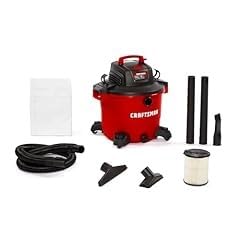
The Dual-Flex 2-1/2 in x 7 ft POS-I-LOCK hose is the feature that changes real shop behavior. A 2-1/2 in bore moves coarse sawdust, plaster and chips that would stall a 1-1/4 in line, and the swivel at each end plus the kinking resistance means you are not fighting the hose every time you pull it around a bench leg. That is why it is our pick for a two-car garage or a small production shop.
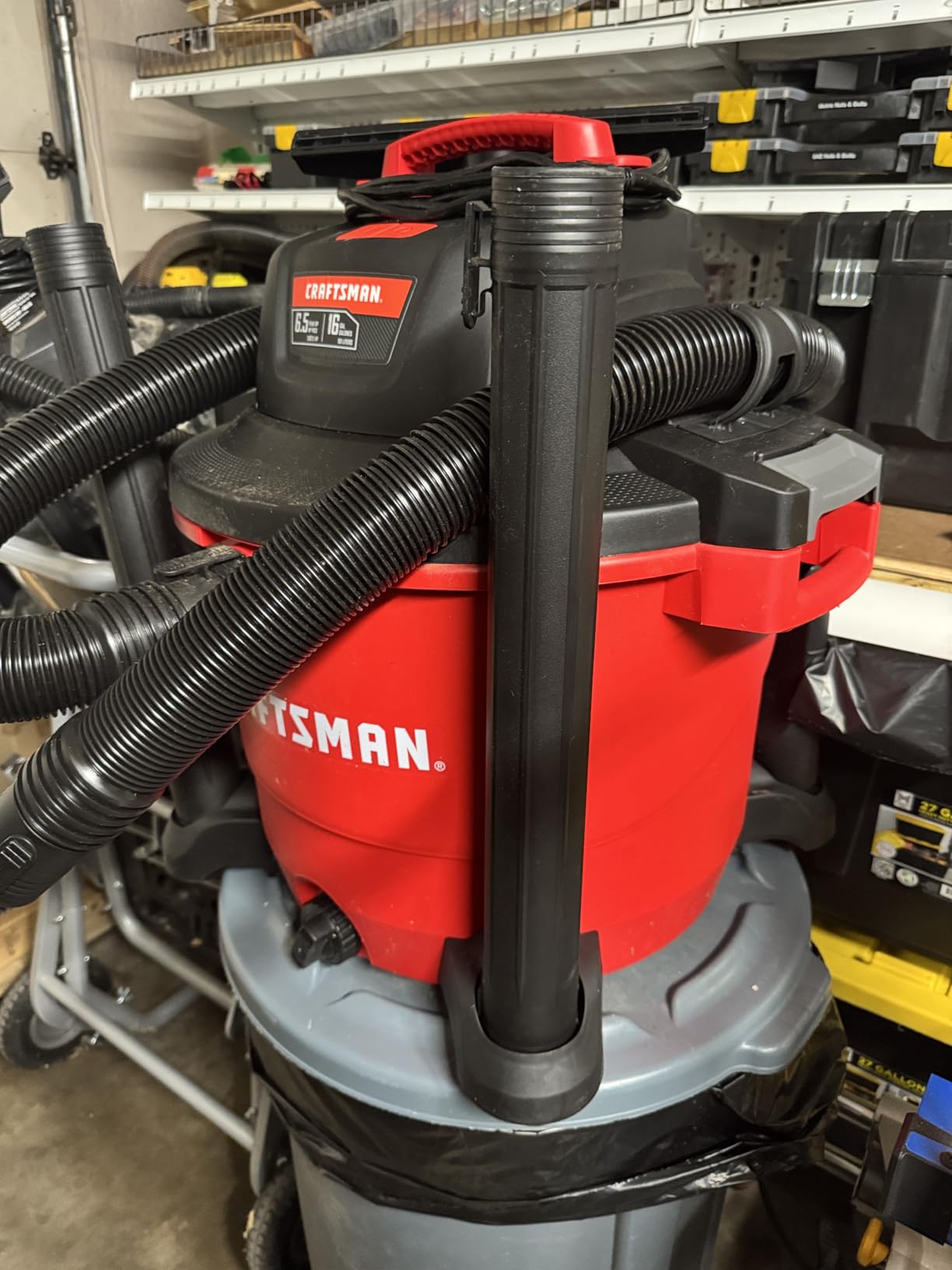
An oversized built-in drain makes emptying liquid a hose job instead of a tipping job, the rear blowing port handles leaves and yard clippings, and the Qwik Lock pleated paper filter mounts without wrestling a rubber gasket.
It is also the quietest machine in the lineup at 69 dB, which is genuinely unusual for a 16-gallon unit. The trade is weight: 26 pounds empty and a 21.03 by 23.8 by 26.7 inch footprint that wants a permanent corner of the floor rather than a shelf.
Why it suits a two-car garage or production shop
Volume is the whole argument. A 16-gallon tank holds roughly three times what a 5-gallon unit holds, so you can run a full day of routing, sanding and cleanup before touching the drain. The 2-1/2 in hose compounds the benefit because it keeps up with the volume of coarse debris that actually fills a big tank.
It also runs a 3-year limited warranty, which is the joint longest coverage in this lineup and the sort of detail that long-term owners on Fine Homebuilding threads treat as a tiebreaker between otherwise similar Ridgid and Shop-Vac units.
Where it falls short
At 26 pounds empty and 21.03 by 23.8 by 26.7 inches, this is the bulkiest unit here. It wants floor space near the machine, and moving it up stairs or into a van is a two-person job once the tank holds anything.
Its 46 inches of maximum suction is the lowest listed figure among the 5 HP and larger units, so for close-up extraction at a sander or spindle sander you get volume rather than pinpoint pull. If your work is dominated by bench-scale finishing, a smaller high-suction unit will serve you better.
3. DeWalt 6 Gallon 4 HP Wet/Dry Vac – Best Value
DEWALT Shop Vacuum 6 Gal 4 HP Poly Wet/Dry Vacuum with Blower DXV06P
6 gallon poly tank
4 HP, 50 in suction
77 dB
14.8 lb, 10 ft cord
Pros
- 4 HP with 50 in of maximum suction
- 10 ft power cord with wrap and 7 ft hose
- Built-in blower port clears dust piles
- Rubberized swivel casters
- 4.7 stars across 5712 reviews
Cons
- Filter must be installed before the unit will run
- 6 gallon tank fills fast with fine sawdust
- 7 ft hose limits reach on open shop floors
The DeWalt 6-gallon poly is the pick if you want the mainstream answer without paying for headroom you will not use. Four horsepower, 50 inches of maximum suction and a 6-gallon tank cover the overwhelming majority of workshop jobs, and 4.7 stars across 5712 reviews is about as settled a rating as this category produces.
Its distinguishing feature is electrical reach. A 10 ft power cord with a wrap, plus a 7 ft hose, gives you enough slack to clean a whole garage bench run without unplugging. That is a small spec on paper and a large quality-of-life difference in a room with one wall outlet.
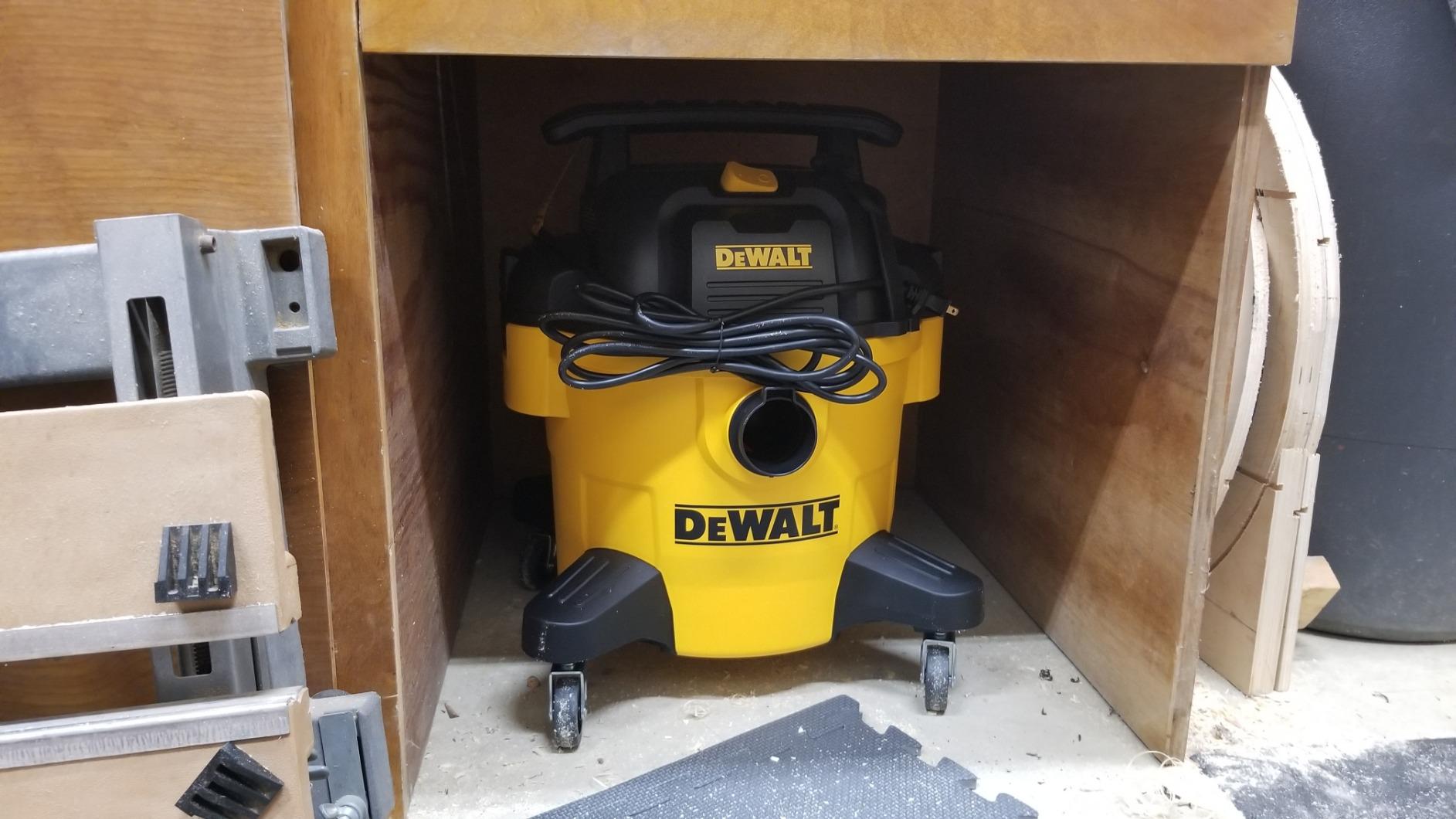
It converts to a blower through the built-in port, which is how most owners clear accumulated dust from a saw table or a run of floor. The rubberized swivel casters roll over a shop floor coated in sawdust without the grip problems cheaper wheels develop, and the accessory set includes a cartridge filter, dust bag, floor nozzle, utility nozzle, crevice nozzle and two extension wands.
Why it works for a mixed-use garage
Poly tank construction means dents and drops are survivable, and at 14.8 pounds it stays a one-person carry even when partly full, with a compact footprint that parks under a workbench. A single cartridge filter covers dry pickup, so you are not juggling a foam element and a paper element every time the job changes.
The DEWALT accessory ecosystem is also the widest in this group, and replacement parts, filters and nozzles are easy to source years after the original purchase. That long-term availability is a real part of the value case.
Where it falls short
The most common caution in the reviews is procedural: the filter has to be fitted before the unit will run, and first-time owners discover that in the middle of a spill. Find the latch and the filter seat before you need it.
Six gallons fills quickly with fine sawdust from a random orbital sander, and 50 inches of maximum suction gives less reserve as a filter loads than the Stanley 6-gallon’s 85 inches. If sanding is most of what you do, run it with a clean filter rather than pushing it.
4. Shop-Vac 5 Gallon 4.5 Peak HP Wet/Dry Vac – Best Stainless Tank
Shop-Vac 5989305 5 Gallon 4.5 Peak HP Wet/Dry Vacuum with Blower Function
5 gallon stainless tank
4.5 peak HP, 59 in suction
78 dB
14.5 lb, 3 year warranty
Pros
- Stainless steel tank takes knocks and resists rust
- Top and side carry handles plus full circumference dolly
- Cartridge filter
- foam sleeve and bag included
- Operates bagged for finer dust containment
Cons
- 5 gallons limits longer cleanup sessions
- 6 ft hose is shorter than most rivals
- 4.4 rating is the lowest in this lineup
The Shop-Vac 5-gallon is the tank choice. A stainless steel drum shrugs off the dropped chisels, kicked cans and dragged lumber that split polypropylene tanks over a few years, and the brand has one of the broadest ranges of filters, bags and attachments available, which is the practical point long-term owners care about.
Power sits at 4.5 peak HP with 59 inches of maximum suction, a useful middle ground between the high-suction 4 HP units and the 5 to 6.5 HP machines. The full-circumference dolly with top and side carry handles makes it easy to pick up either way, and bagged operation is available when you want the filter protected from fine dust.
Owners like the stainless tank and portability most. A notable share of lower ratings cite the two limits that show up in the specs: 5 gallons of capacity and a 6 ft hose.
Warranty is a 3-year term, which puts it alongside the Craftsman units at the top of this group, and the 78 dB figure sits mid-pack rather than at either loud extreme.
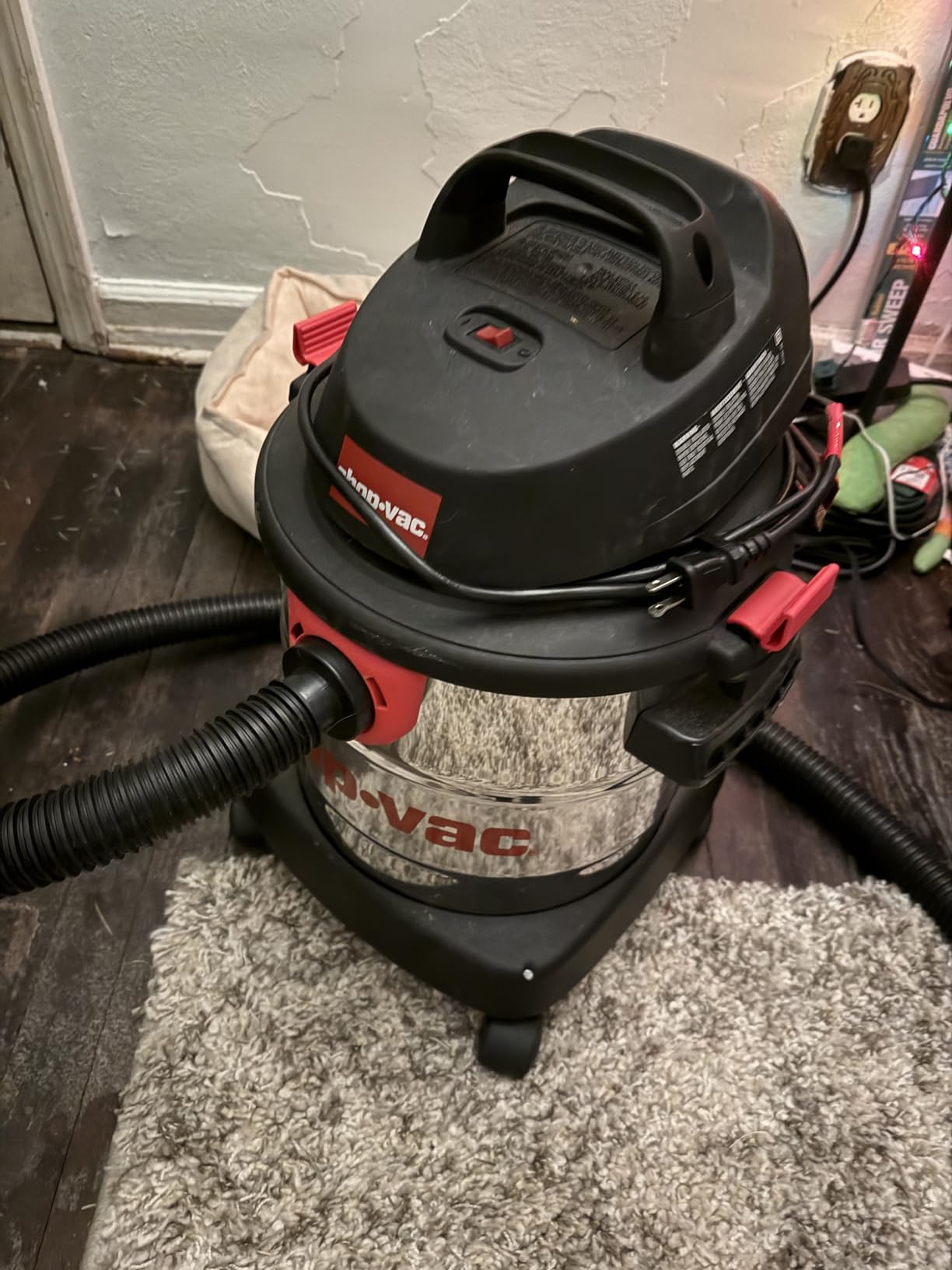
Why the tank material matters long term
Polypropylene tanks are lighter and cheaper, and they crack or split at the latch and port seams after a few seasons of being dragged and dropped. A stainless drum on a cast dolly is heavier, but it survives that treatment and stays weathertight if you store it in an unheated shop.
It also makes wet work less stressful. If you are draining a coolant bath or a bucket of finish thinner, a metal tank is the safer long-term home for that job than a poly shell you would not want to pour solvent near.
Where it falls short
Five gallons is the smallest tank here among units rated 4 HP and above, and fine sawdust is bulky. You will empty it more often than any other pick in this roundup except the 2.5-gallon Craftsman.
The 6 ft hose is the second-shortest included, and the 4.4 average rating is the lowest in the lineup. That rating reflects the capacity and hose complaints rather than a quality problem, but it is a fair signal that this model is not the one to buy if you are chasing maximum performance per dollar.
5. Vacmaster 5 Gallon 4 Peak HP Stainless Steel Vac – Most Versatile
Vacmaster VOC508S 1101 5-Gal 4 Peak HP Stainless Steel Wet/Dry Vac Red
5 gallon stainless tank
4 peak HP, 135 air watts
77 dB
960 W, cartridge filter
Pros
- Stainless steel tank at an entry-level price point
- 135 air watt motor delivers solid suction
- 16 ft of combined hose and cord reach
- Separate cartridge and foam filters included
- Converts to blower function
Cons
- 4 peak HP trails the 5 to 6.5 HP models
- 5 gallon tank fills quickly with fine dust
- 6 ft hose is on the short side
The Vacmaster VOC508S 1101 is the value entry here: a stainless tank, a 135 air watt motor and a blower port in a 5-gallon package that undercuts most of the field. It holds 4.5 stars across 2977 reviews, and reviewers consistently cite value, tank material and adequate suction as the reasons.
Two specs are worth pausing on. The motor is rated 960 watts at 4.36 amps, which is a modest draw on a 15-amp circuit, and the 16 ft combined reach of hose plus cord is longer than the 14 ft class of units it competes with.
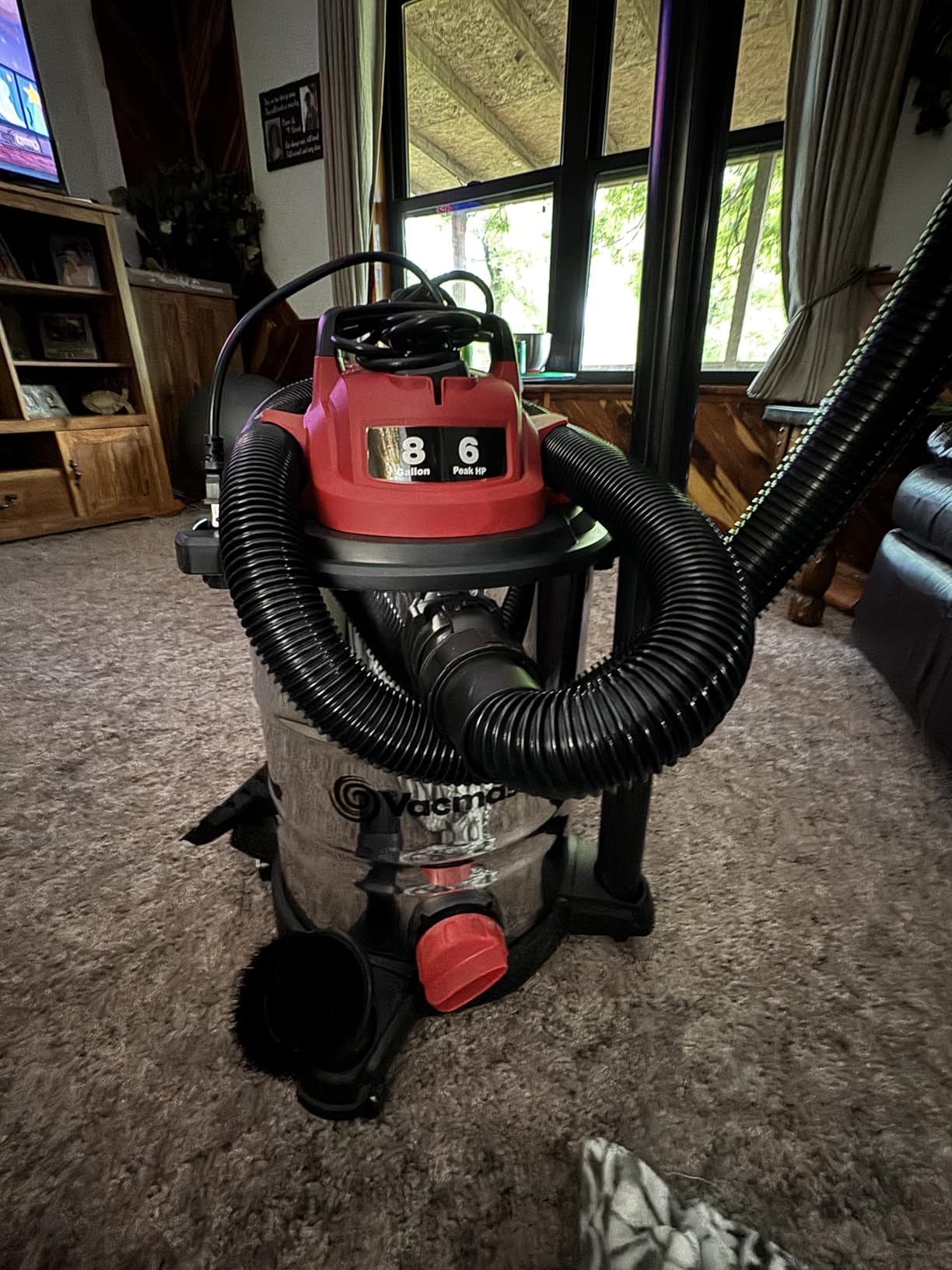
Airflow is the honest limitation. 135 air watts is a real figure, and it is the number that matters for fine dust, but it sits below what the 4 to 6.5 HP headline figures imply. Expect good pickup on a clean filter and noticeably faster slowdown as it loads.
The kit is complete for the class, with separate cartridge and foam filters, a dust bag and a blower port, so nothing has to be bought to switch between wet and dry work.
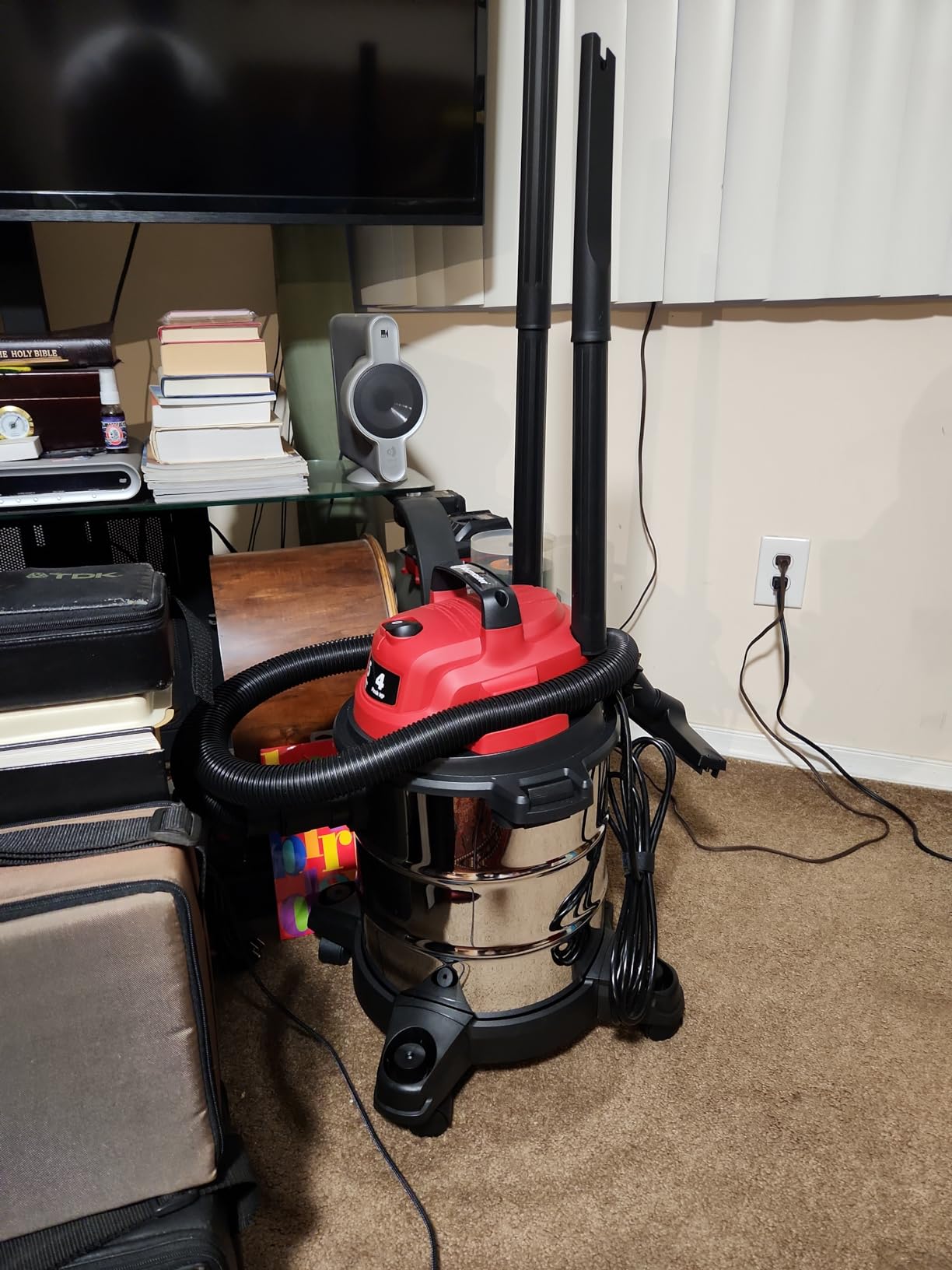
Why it works as a second shop vac
The low amp draw makes this the easiest unit here to share a circuit with a dust collector or a small machine tool without thinking about it. At 4.36 amps it is the least demanding machine in the group on a shared line.
Plenty of workshops end up with two machines: a large one parked near the saws, and a smaller one on a cart that moves to wherever you are working. The stainless tank means the second machine survives the same abuse as the first.
Where it falls short
It is the least powerful unit at this tank size in the group, and owners looking for heavy debris capability say so directly in the reviews. Chips, plaster and gravel are outside what this motor wants to do all day.
The 6 ft hose and 5-gallon tank combine into a short session. For a garage workshop where you clean up once a week, that is fine. For daily sanding, you will be making more trips than you expect.
6. Amazon Basics 4 Gallon 3 HP Wet/Dry Vac – Best for Small Shops
Amazon Basics Wet Dry Shop Vacuum Cleaner, 4 Gallon, 3 HP Stainless Steel, Grey/Black
4 gallon stainless tank
3 HP, 960 W
4.56 kg
On-board tool storage
Pros
- Lightweight stainless build rolls easily around benches
- On-board storage for nozzles and wands
- Reusable cloth filter plus foam wet filter included
- Locking hose attachment holds its fit
Cons
- 3 HP is the lowest output in the lineup
- 4 gallon tank needs frequent emptying
- No blower function
This is the small-shop and apartment-workshop answer. At 4.56 kg with a stainless tank and four wheels, it moves without negotiation, and the on-board accessory storage means the kit stays together instead of migrating across the floor by week three.
Buyers appreciate portability and storage most, and the locking hose attachment is a genuine upgrade over friction-fit designs because it will not walk off the port mid-session. The reusable cloth filter is meant to be rinsed rather than discarded, so a hobbyist running it a few times a month has almost no consumable cost.
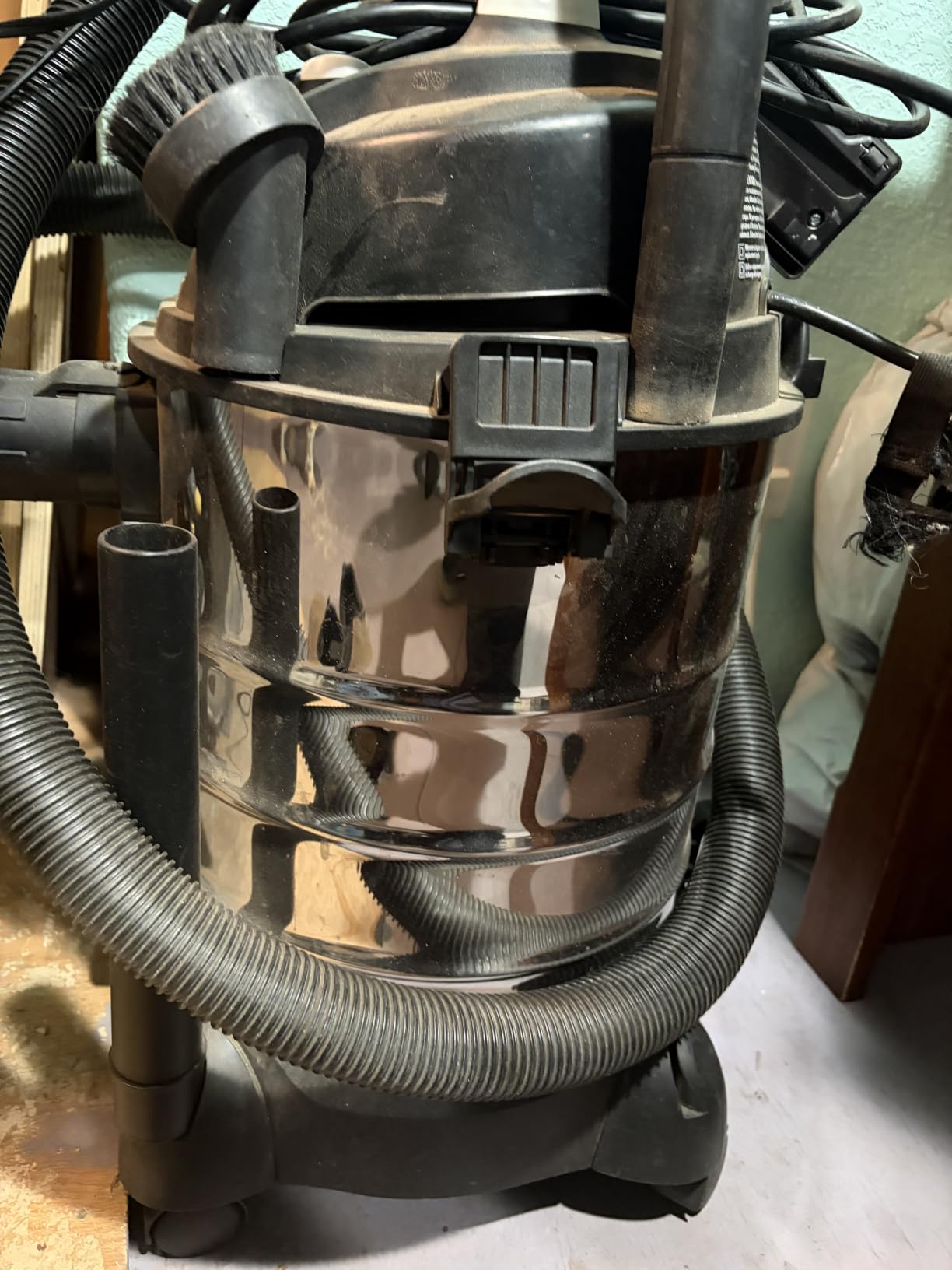
Limits are clear. At 3 HP and 960 watts this is the least powerful motor in the group, and there is no blower function, so clearing dust piles is done with the hose end rather than a reverse port.
The 72 inch locking hose with multiple nozzles and extension wands is generous for the size, which partly offsets the low suction figure on long runs.
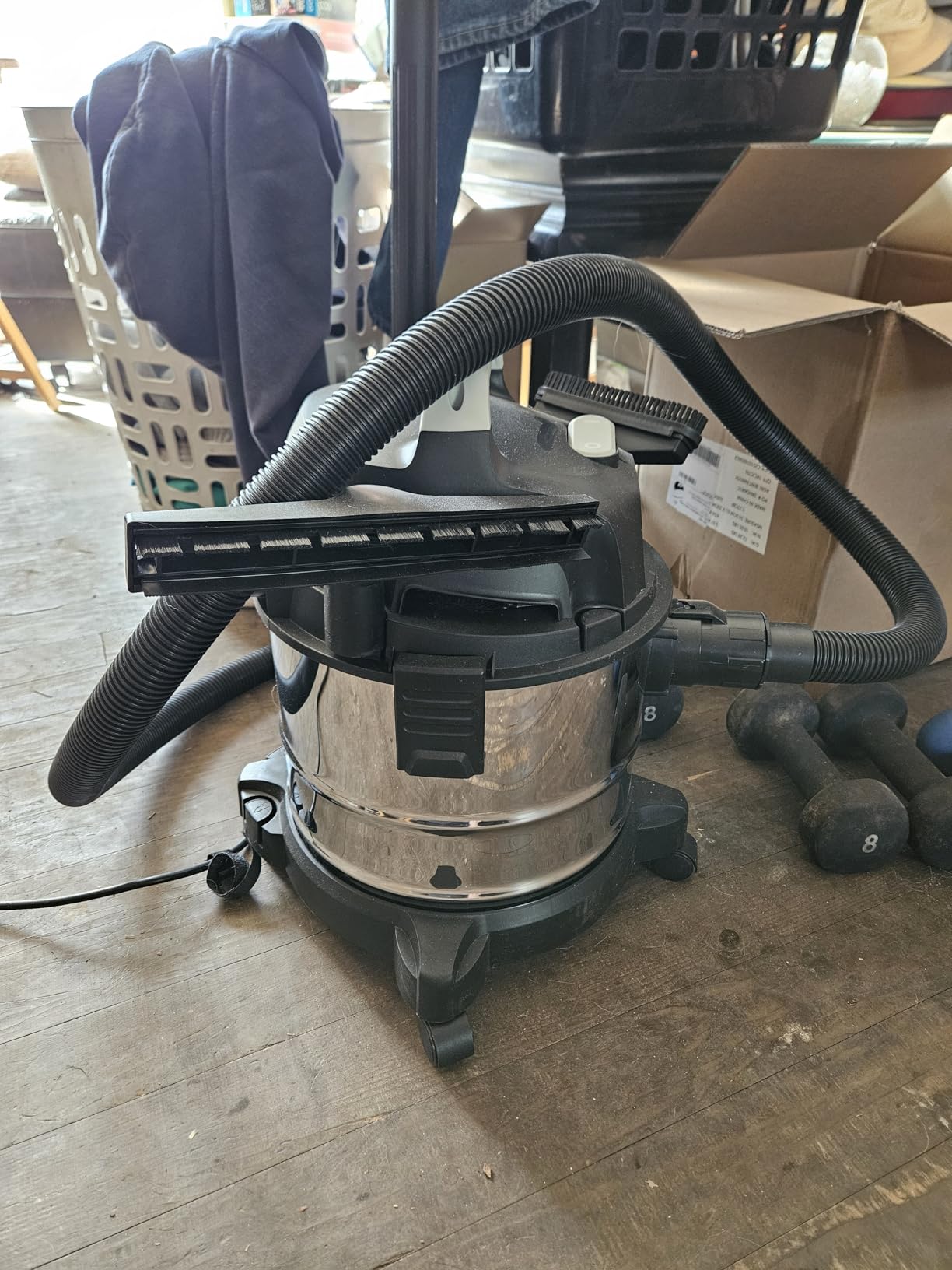
Why it works in a basement or spare-room shop
Weight is the deciding factor in a tight space. When your cleanup path includes a stair or a doorway with a low headroom, a lighter unit gets used and a heavier one gets ignored, and that is the whole point of having a vac.
Four gallons is also proportionate to the job. A hobby shop producing a few hours of sanding dust a week empties that tank once, not three times.
Where it falls short
Three horsepower is a real ceiling. Power and capacity are the two limitations owners name most often, and neither is fixable with an accessory.
For anyone whose plan includes renovation debris, concrete dust or a garage floor with grit on it, look at a 4 HP and up unit instead. This one is built for a bench, not a building.
7. DeWalt 9 Gallon 5 Peak HP Wet/Dry Vac – Best for Sanding
DEWALT 9 Gallon Wet/Dry VAC, Heavy-Duty Shop Vacuum with Attachments, 5 Peak HP, with Blower Function, DXV09PA
9 gallon tank
5 peak HP, 85 in suction
78 dB
22.5 lb, 3 year warranty
Pros
- 5 peak HP with 85 in of maximum suction
- 9 gallon tank balances capacity and weight
- Upgraded 1-7/8 in hose is more durable and flexible
- Blower port plus inflator adaptor
- 86% of reviews are five star
Cons
- 22.5 lb is heavy to carry up stairs
- 800 watt figure is modest for a 5 peak HP headline
- 1736 reviews give less long-term history than most
The 9-gallon DeWalt is the sanding pick. It combines 5 peak HP with 85 inches of maximum suction, the joint-highest suction figure in this lineup, in a 9-gallon tank that is a better weight-to-volume balance than any of the 10-gallon and 16-gallon units here.
It also holds the strongest rating distribution we recorded, with 86% of reviews at five stars. Owners praise suction and the accessory kit, and the complaints are about weight rather than performance.
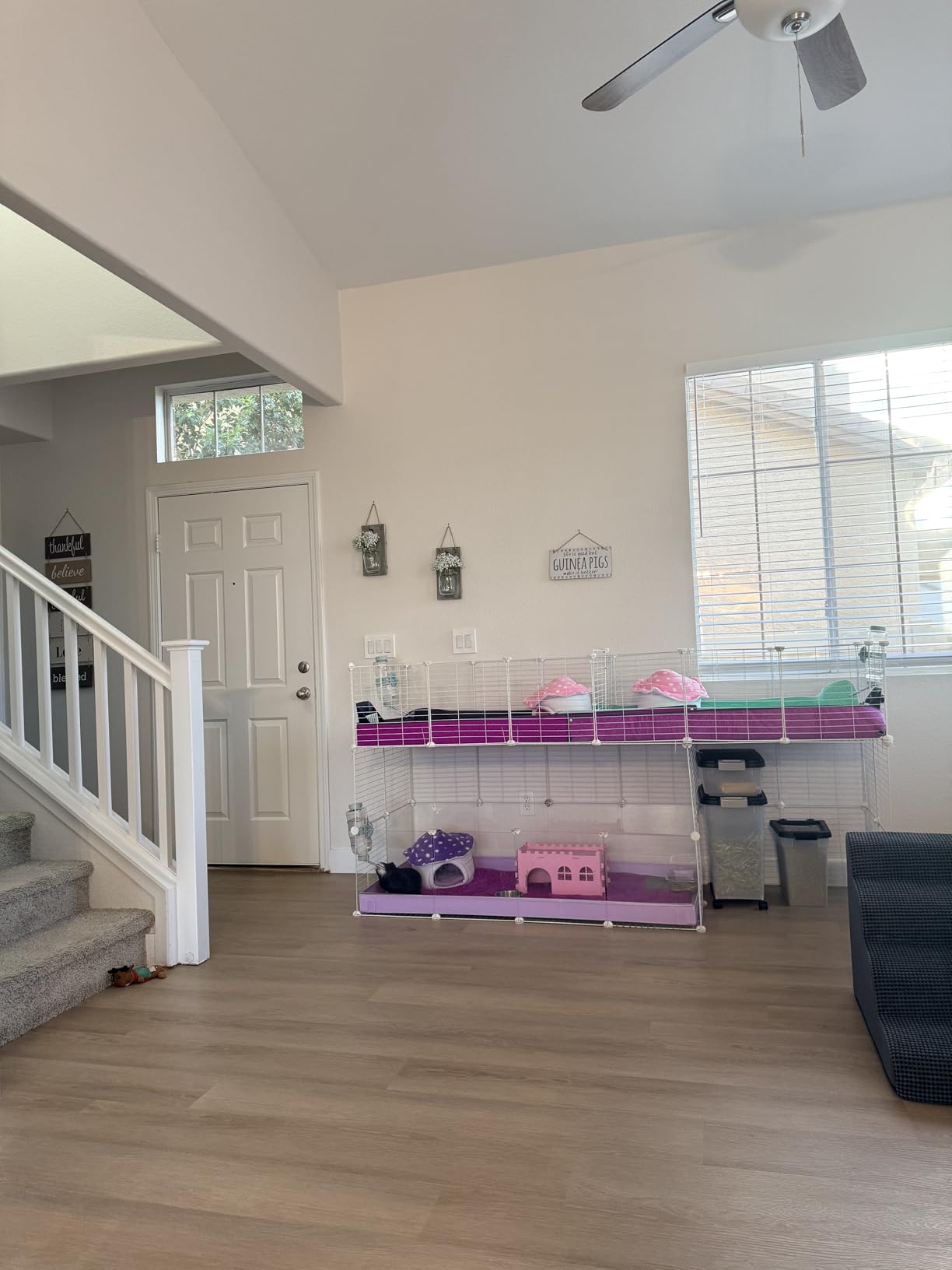
The accessory package is the best in the group for a reason: an accessory bag, round brush, inflator kit, disposable filter bag and multiple nozzles, plus a built-in blower port and inflator adaptor that turn it into an air pump.
A built-in tank drain and a water-resistant on/off switch are small engineering choices that pay off in a wet shop, and rubberized casters plus strong carry handles make it manageable on a flat floor.
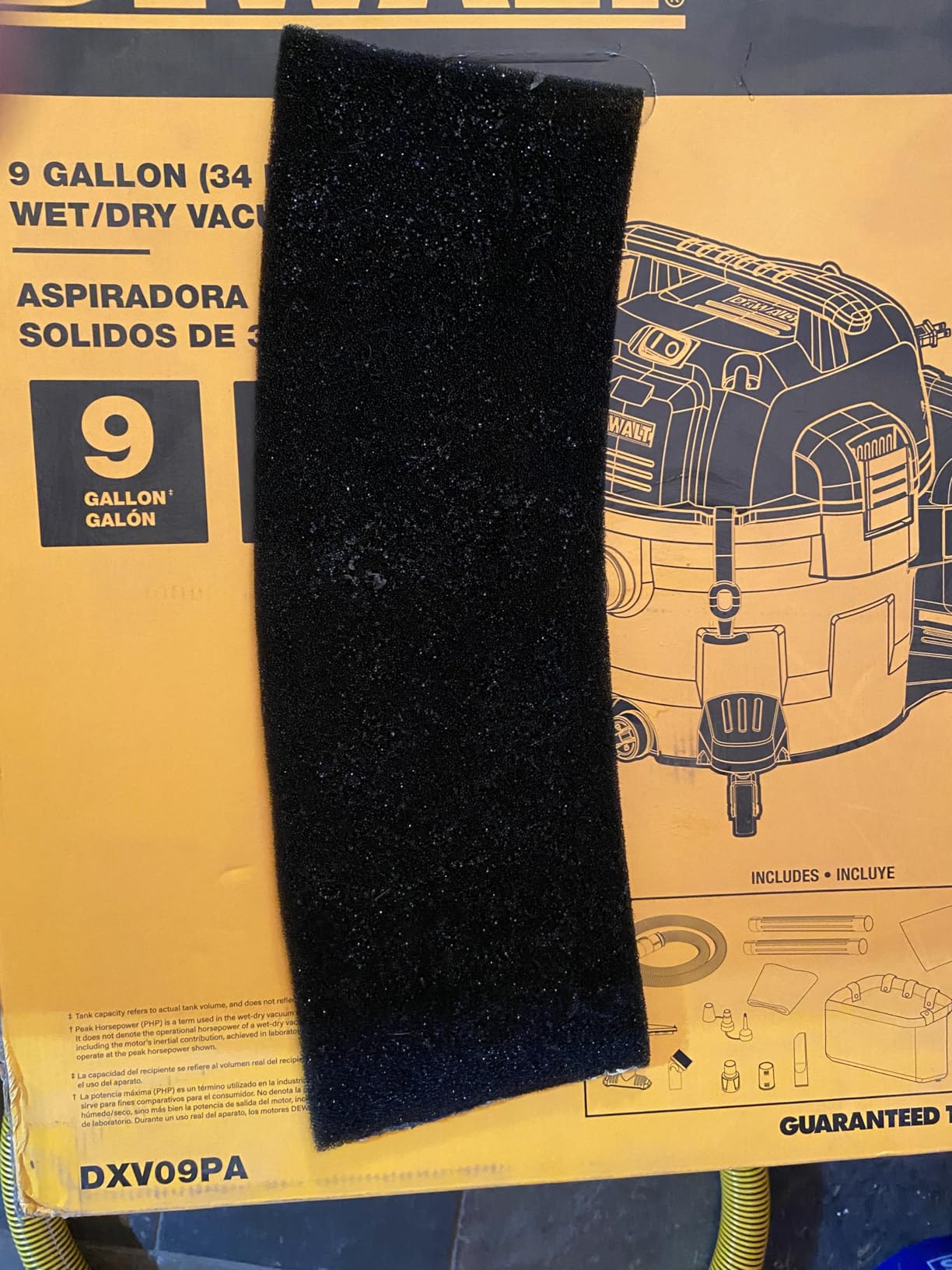
Why it suits a sanding-heavy week
Sanding dust is fine, light and constantly generated, so the two things that matter are suction reserve and how often you empty. This unit answers both: high suction holds up as the cartridge loads, and nine gallons is enough to clear a full day of orbital sanding without a stop.
The 1-7/8 in bore is a good middle diameter. It moves more air than a 1-1/4 in line without the drag of a 2-1/2 in hose at the sander port, and the upgraded flex is what keeps it from collapsing under its own suction.
Where it falls short
At 22.5 pounds empty, it is one of the heavier units here, and a full 9-gallon tank is a two-hand carry up a set of shop stairs.
The 800 watt rating sits oddly against a 5 peak HP headline, and with 1736 reviews there is less long-term ownership history behind it than the 14474-review Stanley or the 10134-review 2.5-gallon Craftsman. The 3-year warranty is solid and among the longest in this group.
8. Stanley 10 Gallon 6 Peak HP Wet/Dry Vac – Best for Wet Jobs
STANLEY 10 Gallon Wet Dry Vacuum, 6 Peak HP Poly Built-in Drain Shop Vac Blower with Powerful Suction, Multifunctional Shop Vacuum W/ 6 Horsepower Motor for Job Site, Garage, Basement, Van, Workshop
10 gallon poly tank
6 peak HP copper motor
80 dB
Buoy auto shut-off, 2 year warranty
Pros
- 6 peak HP pure copper motor with 85 in suction
- Buoy technology cuts power at the water threshold
- Over 24 ft of combined reach
- 10 gallon tank without the bulk of a 16 gallon
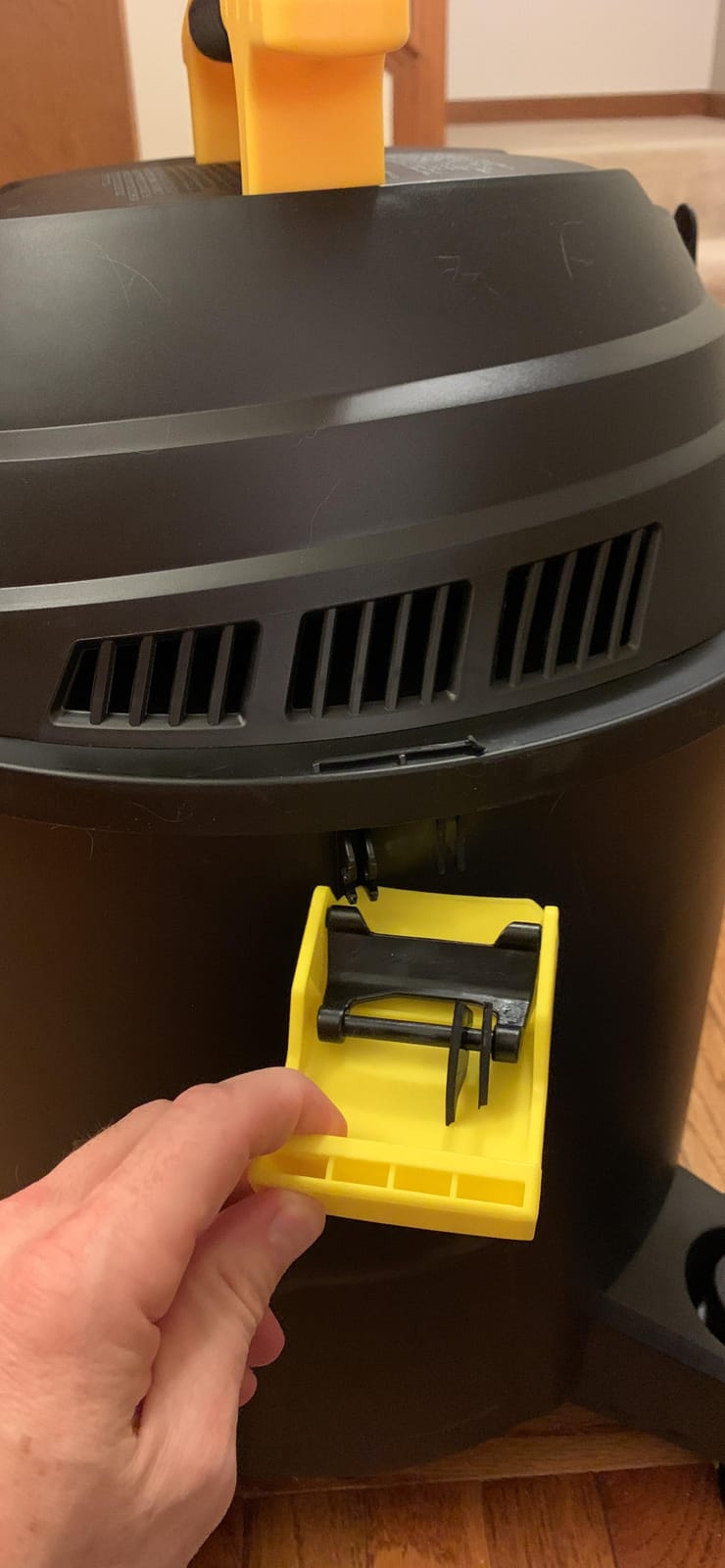
- Garden hose adaptor for draining
Cons
- 80 dB is among the loudest in the lineup
- 700 watt figure is low for a 6 peak HP headline
- 2 year warranty trails the 3 year models
The Stanley 10-gallon 6 peak HP is the pick if your workshop also floods. The buoy technology shuts the motor off automatically when water reaches a threshold, the single most useful wet-work feature on any shop vac.
Six peak HP with a pure copper motor and 85 inches of maximum suction is a serious figure at a 10-gallon size, and reviewers compare that pull favorably to leading DEWALT and RIDGID machines costing more.
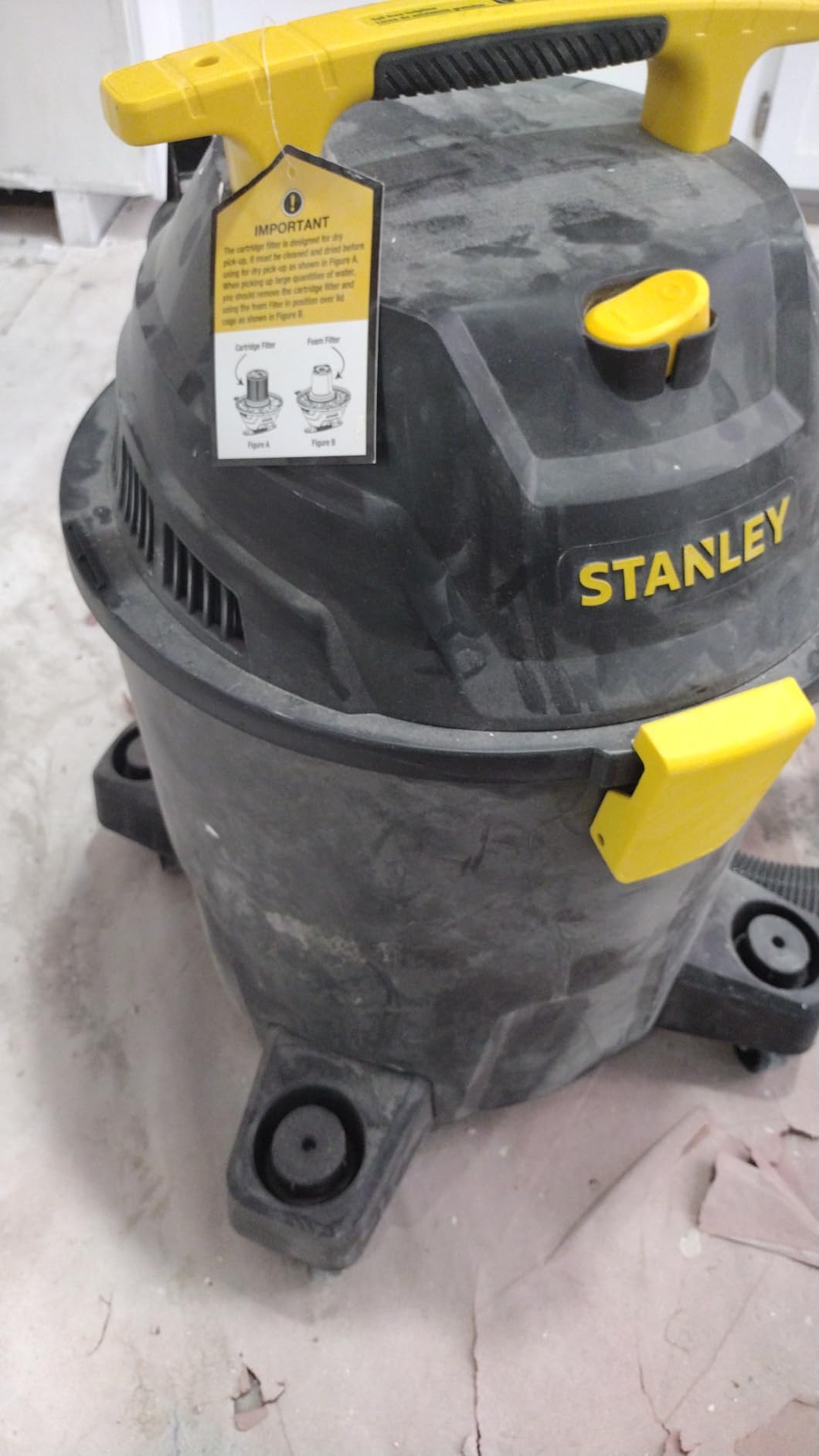
Over 24 ft of combined reach means a wet cleanup never involves dragging a loaded tank across a wet floor, and the garden hose adaptor plus a large drain port speed up emptying.
At 16 by 16 by 19.9 inches it is smaller in footprint than the 16-gallon Craftsman, so a 10-gallon tank with real power is a realistic option for a garage that has to store the vac somewhere other than the middle of the floor.
Why wet work changes the requirements
Long reach matters more here than in dry cleanup. Moving a 10-gallon tank across wet concrete is a bad idea, so this setup is designed to reach instead.
Wet-dry capability is also where filtration choice matters most. A sealed or watertight motor head, a water-resistant switch and a drain that seals properly are the three features that decide whether a shop vac survives a spill, and this model has all three.
Where it falls short
The 80 dB figure is among the loudest recorded here, and it is the most common criticism in the reviews. If wet cleanups happen early in the morning in an attached building, that is worth weighing.
The 700 watt rating is low relative to a 6 peak HP headline, and the 2-year limited warranty is shorter than the 3-year terms on the CRAFTSMAN and Shop-Vac units. Weight is not listed by the manufacturer, so check the tank yourself if stairs are part of your route.
9. Vacmaster 12 Gallon 5.5 Peak HP Wet/Dry Vac – Best Cord Reach
Vacmaster VJH1211PF 1101 12-Gal 5.5 Peak HP Heavy-Duty Wet/Dry Vac Red
12 gallon poly tank
5.5 peak HP, 1416 W
60 in suction
24.1 lb, 20 ft cord
Pros
- 27 ft of reach from a 20 ft power cord
- On-board hose
- cord and accessory storage
- Flat power head lets tools sit flat
- Oversized latches and a large drain port
- 9 accessories plus cartridge filter and bag
Cons
- 24.1 lb is heavy for a portable shop vac
- 984 reviews give the least long-term history
- 60 in suction trails the 85 in units
The Vacmaster 12-gallon solves the layout problem rather than the power problem. A 20 ft power cord plus a kink-resistant hose gives 27 ft of reach, so the unit can live in one corner and still service a full shop.
Power is solid at 5.5 peak HP and 1416 watts with 60 inches of maximum suction, and the 1416 watt draw at 11.8 amps is the second-highest current in this group, which matters for circuit planning.
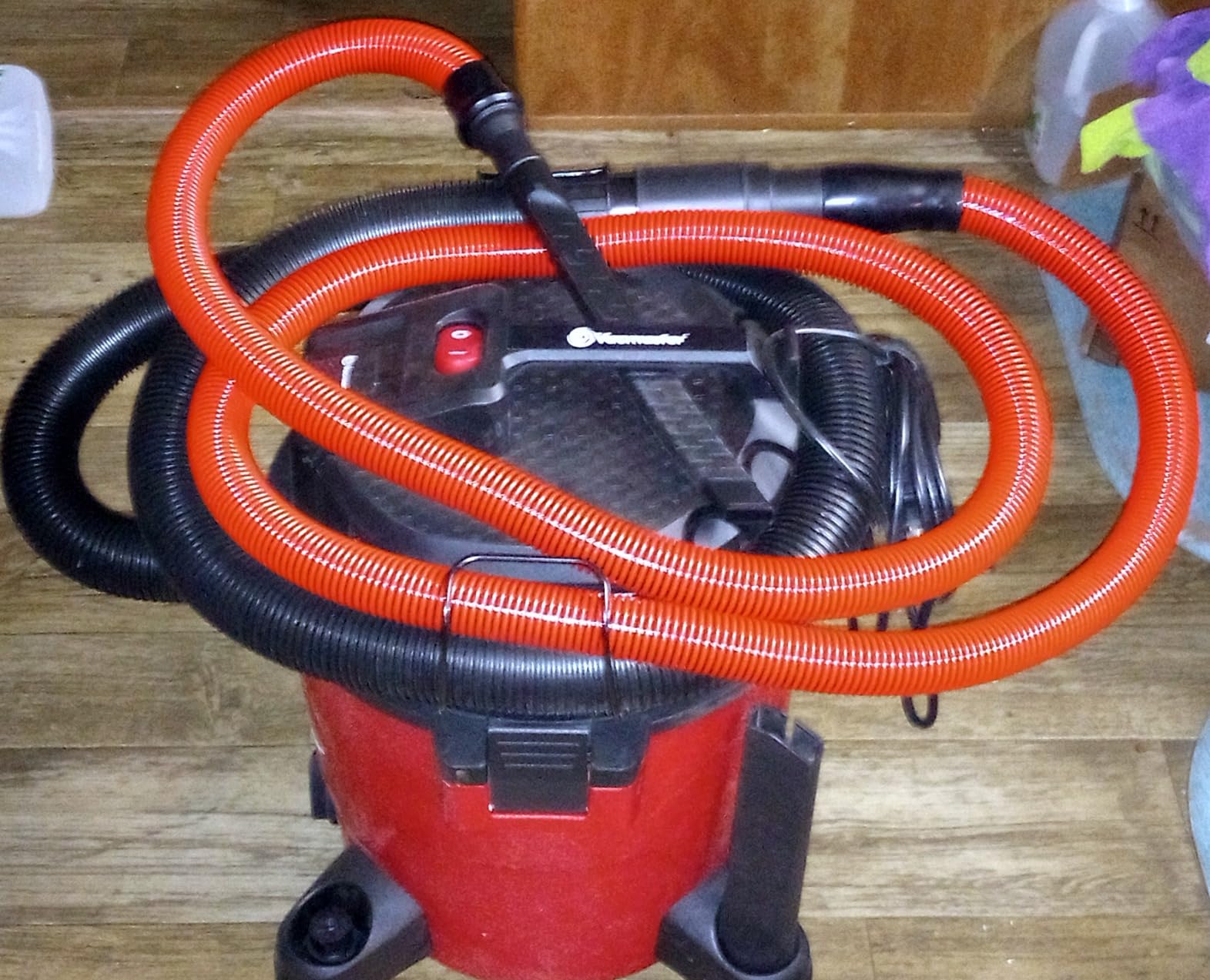
Design details are unusually thoughtful. The flat power head lets accessories sit flat and stay accessible rather than sliding off a domed lid, the oversized latches give a secure seal on a full tank, and a dust-sealed on/off switch keeps fine dust out of the switch housing.
It converts to a blower, and the accessory count reaches nine including a cartridge filter and dust bag, so it is a complete kit rather than a base unit.
Why long cord reach changes a shop layout
Reach, not capacity, is what lets a shop vac stay parked. The 27 ft of combined hose and cord means one outlet in a corner is enough for a bench run, a wall of shelving and a machine area, without dragging a 24-pound unit across the floor.
That matters most in shops where floor space is the scarce resource, since a unit parked permanently out of the walkway is one you never move and never have to move.
Where it falls short
At 24.1 pounds, it is the second-heaviest unit here, and the 1416 watt motor at 11.8 amps is close enough to a 15-amp limit that you should not share a circuit with a CNC router or a dust collector. Workshop owners posting on r/hobbycnc threads warn about exactly this with high-amp vacs.
With 984 reviews it carries the least long-term ownership history in this roundup, and its 60 inches of maximum suction gives less close-up pull than the 85-inch machines if fine extraction at the tool is your main task.
10. Craftsman 2.5 Gallon 2.5 Peak HP Shop Vac – Best for Quick Cleanups
CRAFTSMAN CMXEVBE17250 2.5 Gallon 2.5 Peak HP Wet Dry Shop Vacuum
2.5 gallon tank
2.5 peak HP, 50 in suction
69 dB
6.7 lb, 3 year warranty
Pros
- 6.7 lb is the lightest and most compact unit here
- 69 dB suits a shared or attached workspace
- Two-in-one vacuum and blower
- 1-1/4 in accessories reach tight spaces
- 3 year limited warranty
Cons
- 2.5 gallon tank and 2.5 peak HP limit big cleanups
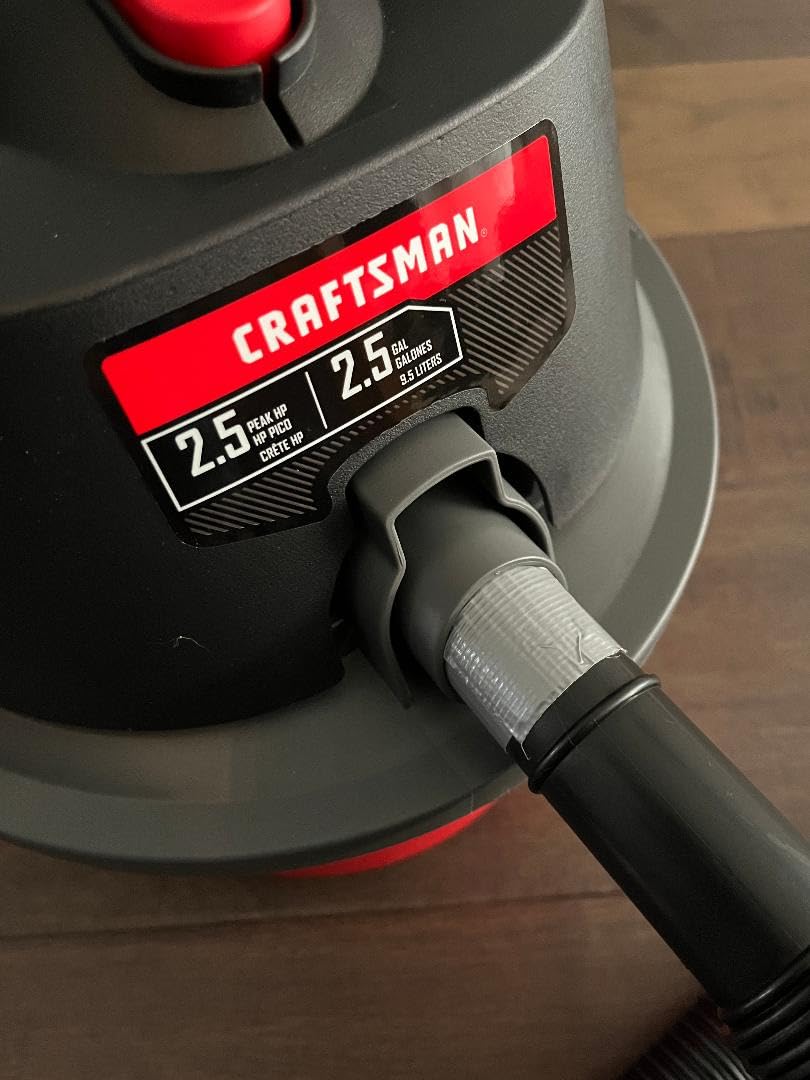
- Friction-fit hose can sit loose and need tape
- 5 ft hose is the shortest included
- Filter bag system gives up fine dust containment
The 2.5-gallon Craftsman is the bench companion. At 6.7 pounds it is the lightest unit we list, and the 1-1/4 in accessory system is sized for the gaps a full-size hose cannot reach: between a shelf and a wall, behind a machine, under a workbench.
It also has the largest review base in this roundup at 10134 ratings, and it sits at the top of the wet/dry shop vac best sellers chart. Owners love the size and weight, and the blower function turns it into a small blower for bench debris.
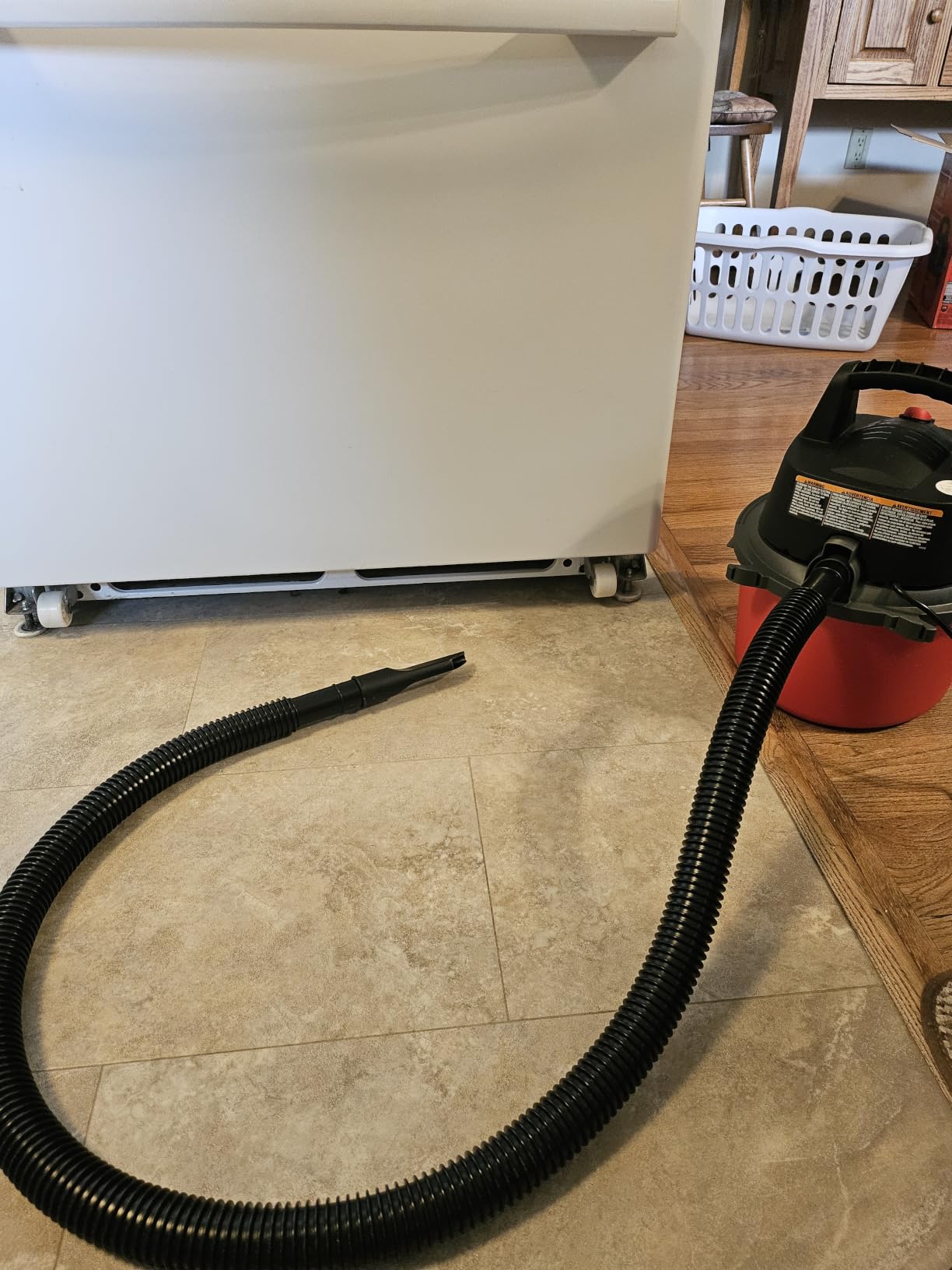
At 50 inches of maximum suction and a 1-1/4 in bore, it is well matched to fine dust from a hand block, a detail sander or a small random orbital, and the included filter bag is compatible with the CRAFTSMAN part number so replacements are easy to source.
At 13.1 by 12.57 by 14.74 inches it also stores on a shelf rather than taking a floor square, which matters more in a small shop than any of the headline specifications.
Why a second small vac earns its floor space
Because a large vac is a bad tool for a small job. Carrying a 16-gallon machine to the bench to wipe up 30 seconds of sanding dust is the fastest way to stop cleaning up entirely, and a 6.7-pound unit stays where the mess happens.
The 69 dB figure is the second-lowest here, which is what makes it usable in a shop attached to a living space or a shared workbench, and the 3-year warranty is longer than most of the machines it is cheaper than.
Where it falls short
A 2.5-gallon tank with 2.5 peak HP cannot handle renovation dust, and the reviews say so directly. This is a spot vac for a bench, not a shop vac for a shop.
The friction-fit hose connection can sit loose and some owners tape it, and the 5 ft hose is the shortest included in this group. The bag-only filtration also gives up the fine dust containment that a cartridge or HEPA-class filter provides, so do not use it as the machine that protects your air.
Shop Vac or Dust Collector: Which One Your Workshop Needs
Do you need a shop vac or a dust collector? The short answer is that a shop vac is for high-speed, close-up suction of fine dust, and a dust collector is for bulk debris. The long answer explains why those two jobs rarely overlap, and it is the single most confused topic in workshop vacuum advice.
A shop vac is built as a negative pressure machine. Its motor and hose are sized to hold a small bore open and pull hard, which is exactly what you want at a sander port or a spindle sander hood. It reacts within a second of the tool starting, so you capture dust at the source rather than chasing it around the room.
A dust collector is built as a volume machine. It has a larger impeller or fan and a bigger inlet, and it moves a lot of air at lower negative pressure. That is what you want behind a table saw, a jointer or a planer, where the goal is to carry off a stream of coarse debris and chips before they pile up.
Connect the two wrongly and you get the complaint that shows up repeatedly in workshop forums: a dust collector overwhelmed by a shop vac motor, or a shop vac choked by a large-diameter hose that bleeds away its suction. The general rule is simple. Coarse debris at a machine goes to a collector, fine dust at a tool goes to a shop vac, and if your shop is small enough that one machine has to do both jobs, buy the shop vac with a 2-1/2 in hose and accept that you will empty it more often.
Noise belongs in the same conversation. A shop vac running beside a sander is a continuous 69 to 80 dB source, and that is the level that makes a workshop uncomfortable rather than the extraction level that makes it dirty. If your shop is attached to a living space, pick the quietest model you can live with and schedule the loud work accordingly. Our shop lighting guide covers the other end of the sightline problem, and a garage workshop heater matters more in winter than most people expect.
How to Choose a Shop Vac for a Workshop?
What is the best vacuum for a workshop? It is the largest unit you can comfortably move when full, with a hose bore matched to your mess and a filter you can afford to replace. Rank capacity second and horsepower third, and the buying decision gets much easier.
Size the tank to your shop, not your ambition
A 4 to 6 gallon tank suits a one-car garage, a basement bench or a hobby shop where you clean up in a single session. A 9 to 12 gallon tank covers a two-car garage or a shop where you want to run cleanup without stopping mid-task. A 16 gallon tank is for production volume, and it comes with a weight penalty you should price into your decision.
The rule of thumb we use is floor area. Under about 200 square feet, 4 to 6 gallons empties rarely enough. Above that, every extra gallon saves a trip but adds weight, and weight is what stops people using the machine at all.
Read peak HP, rated HP and CFM together
Peak horsepower is the headline number on the box and it is the least useful one on its own. It describes the maximum output at a given moment, not the sustained airflow that moves fine dust. Rated horsepower and the air watt figure tell you more about real work, and air watt is the number that predicts how long a filter will hold suction.
You will see the mismatch clearly in this lineup. The Stanley 10-gallon advertises 6 peak HP on a 700 watt motor, while the Vacmaster 12-gallon runs 5.5 peak HP on 1416 watts. Neither is dishonest, but they are measuring different things, and a workshop doing fine dust should weight the wattage and the CFM figure more heavily.
CFM, or airflow in cubic feet per minute, is what fine dust actually responds to. Workshop owners in long-running threads often cite a unit around 180 CFM as the point where performance stops being a problem, so if a listing gives you CFM, take it seriously before the horsepower figure.
Get the hose diameter right
This is the most underrated upgrade in the category. A 1-1/4 in hose moves fine dust quickly and matches most sander ports, but it stalls on chips, plaster and shavings. A 2-1/2 in hose moves coarse debris and is the right choice behind a planer or a table saw, at the cost of needing a strong motor to hold suction.
Only the Craftsman 16-gallon in this roundup ships with a 2-1/2 in hose. Everywhere else, budget for an aftermarket hose and a POS-I-LOCK style adapter, and check that the port diameter on the vac will accept it.
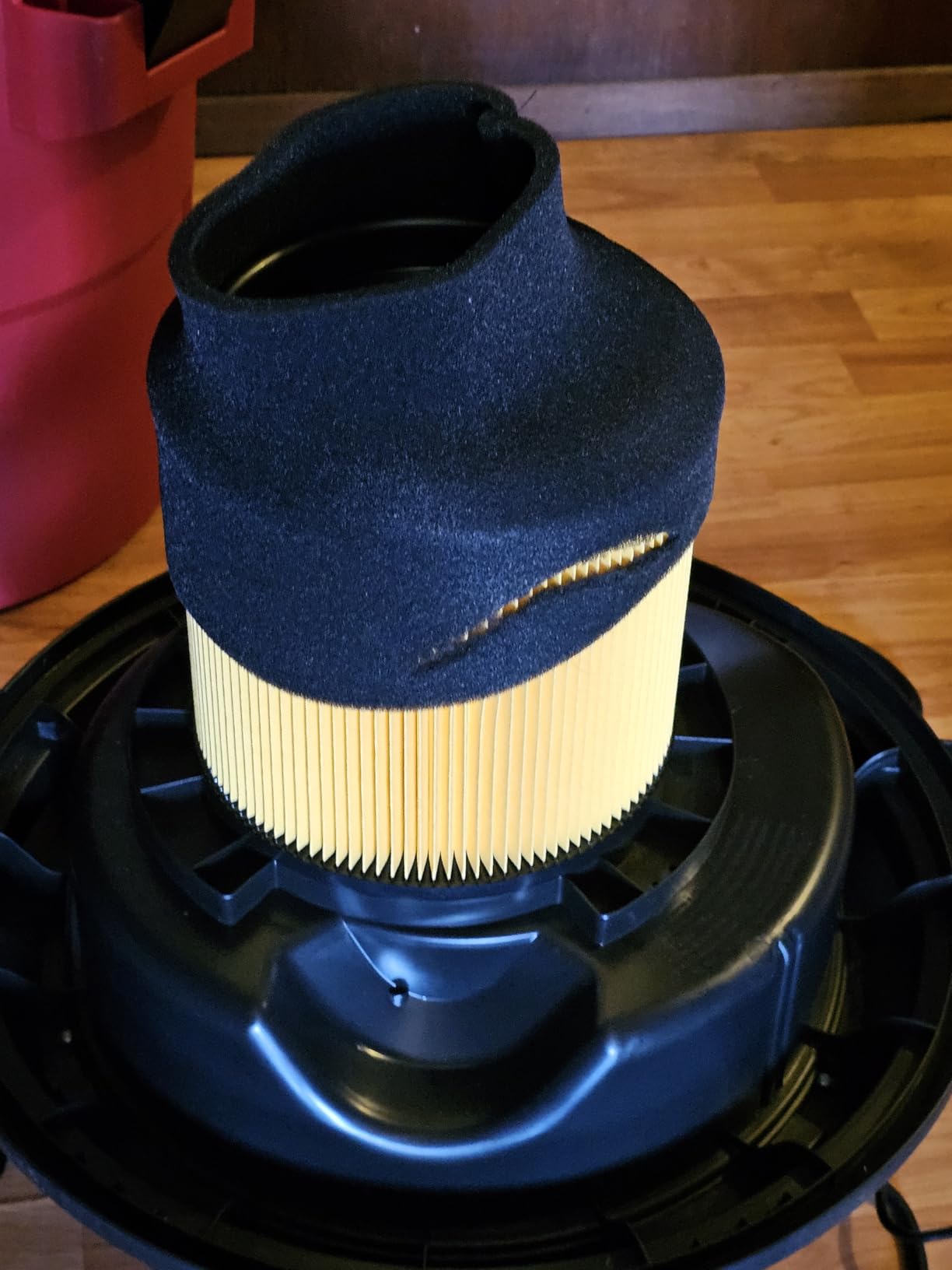
Plan for filter and bag cost
How often should you replace a shop vac filter? With fine wood dust, monthly, and after any renovation job. Fine dust blinds a pleated element faster than owners expect, and a clogged filter costs you suction before it costs you money.
That makes filter choice a running cost, not an accessory. Foam elements and cloth filters are cheap and reusable at the cost of fine dust performance. Cartridge and pleated paper filters cost more per element and do the heavy lifting on fine dust. A bag-only unit like the 2.5-gallon Craftsman is the cheapest to run and the weakest on containment.
One habit beats any filter choice: empty and wipe the element every week you use the machine on wood, and let it dry fully before refitting it. A clean filter recovers almost all the suction you thought the motor had lost.
Check the noise figure against your walls
How loud is a shop vac? The units in this roundup are published between 69 and 80 dB. For context, that is a range from a noisy conversation to a hair dryer, sustained, and it is the level that makes people buy hearing protection and eventually leave the room.
Two of the picks here run at 69 dB, the CRAFTSMAN 16-gallon and the 2.5-gallon CRAFTSMAN, and they are the two to favor in an attached or shared workspace. At the other end, the two Stanley units sit at 80 dB, which is fine in a detached shop and unpleasant next to a bedroom wall.
Respect your 15-amp circuit
Which brand makes the best shop vac on the market? For most workshops the answer is one of the established names, and warranty and parts access are the tiebreakers that long-term owners on Fine Homebuilding and Sawmill Creek threads keep coming back to. CRAFTSMAN and Shop-Vac both list 3-year warranties in this group, and DEWALT offers 3 years on the 9-gallon.
One electrical caution is worth stating plainly. The Vacmaster 12-gallon draws 11.8 amps and the CRAFTSMAN 16-gallon draws 12 amps, both on a 15-amp household circuit. Adding a CNC router, a dust collector or a table saw on the same circuit can trip the breaker, and workshop owners on r/hobbycnc threads report exactly that with 4.5 HP and larger vacs. Give the vac its own circuit if you run high-draw equipment nearby.
Connect it to a machine when you can
A shop vac that only cleans the floor after the fact is a comfort item, not a safety item. The high-value setup is connecting it to the tool: a random orbital sander through its dust port, or a planer, jointer or table saw through a proper adapter at the port with a correctly sized hose.
Rule of thumb on ports: match the hose bore to the port, avoid adapter leaks with a short length of flexible hose clamped at the junction, and check that your vac has enough negative pressure to hold the connection. Low-suction units in this group are fine for floor cleanup and marginal for on-tool extraction.
Frequently Asked Questions
What is the best vacuum for a workshop?
The Stanley 6 Gallon 4 HP Wet/Dry Vac is our pick for most workshops, because 6 gallons, 4 peak HP and 85 inches of maximum suction cover fine sanding dust, chips and spills without a bulk handling penalty. In a two-car garage or production shop, step up to the CRAFTSMAN 16-gallon 6.5 peak HP model for capacity and a 2-1/2 in hose.
What is the best vacuum for a garage workshop?
For a one-car garage, a 6 gallon unit with a 7 ft hose and roughly 16 ft of combined reach is enough, and the DeWalt 6-gallon poly model fits that brief with a 10 ft cord. For a two-car garage, choose 9 to 12 gallons so you are not emptying mid-task, and prefer a longer cord so the unit can stay parked. Budget a dedicated 15-amp circuit if the vac shares a room with a CNC router.
What is the best vacuum cleaner for a woodworking workshop?
A wet/dry shop vac with a fine-dust-rated cartridge or pleated filter, a 1-1/4 in or 1-7/8 in hose for sander hookup, and at least 6 gallons of capacity. Our best overall pick, the Stanley 6-gallon 4 HP, fits that brief, and the CRAFTSMAN 2.5-gallon is the quiet 69 dB companion for bench work. A household upright will not survive the dust load.
Who makes the best shop vac on the market?
Ridgid, Shop-Vac and DEWALT are the names workshop owners repurchase most, and CRAFTSMAN is close behind. Festool and Fein sit at the premium tier for quiet running, auto filter cleaning and tool-triggered extraction. Warranty length and parts availability usually settle the tie more than horsepower: CRAFTSMAN and Shop-Vac both list 3-year terms on the models in this roundup.
Do I need a shop vac or a dust collector?
You need a shop vac for high-speed close-up suction of fine dust at a tool such as a sander, and a dust collector for bulk debris behind a table saw, jointer or planer. A shop vac is a negative pressure machine built for a small bore, while a collector is a volume machine. In a small shop, one shop vac with a 2-1/2 in hose can cover both jobs if you accept more frequent emptying.
What size shop vac do I need for my workshop?
Under about 200 square feet, a 4 to 6 gallon tank empties rarely enough and stays light to carry. A two-car garage or small production shop is better served by 9 to 12 gallons so a full day of cleanup runs without a mid-task stop. A 16 gallon tank maximizes capacity but at 26 pounds empty it becomes a two-person carry and a permanent floor fixture.
Final Verdict: Which Shop Vac Should You Buy?
The best shop vacs for workshops in 2026 come down to two questions: how much debris do you make in a session, and how close is the nearest wall. For most people sanding at a bench in a one-car garage or basement, the Stanley 6 Gallon 4 HP Wet/Dry Vac is the right answer, with 85 inches of suction, 14474 reviews and a body light enough to actually be moved.
Buy the CRAFTSMAN 16-gallon 6.5 peak HP if volume is the problem and your floor space allows a 26-pound machine to live in one spot. Buy the DEWALT 9-gallon 5 peak HP if you sand daily and want high suction without a full-size tank.
Whichever you pick, buy the filter element at the same time, plan on a dedicated circuit if you run high-draw equipment nearby, and connect it to the tool rather than only to the floor. That last habit does more for your air than any spec on the box.