
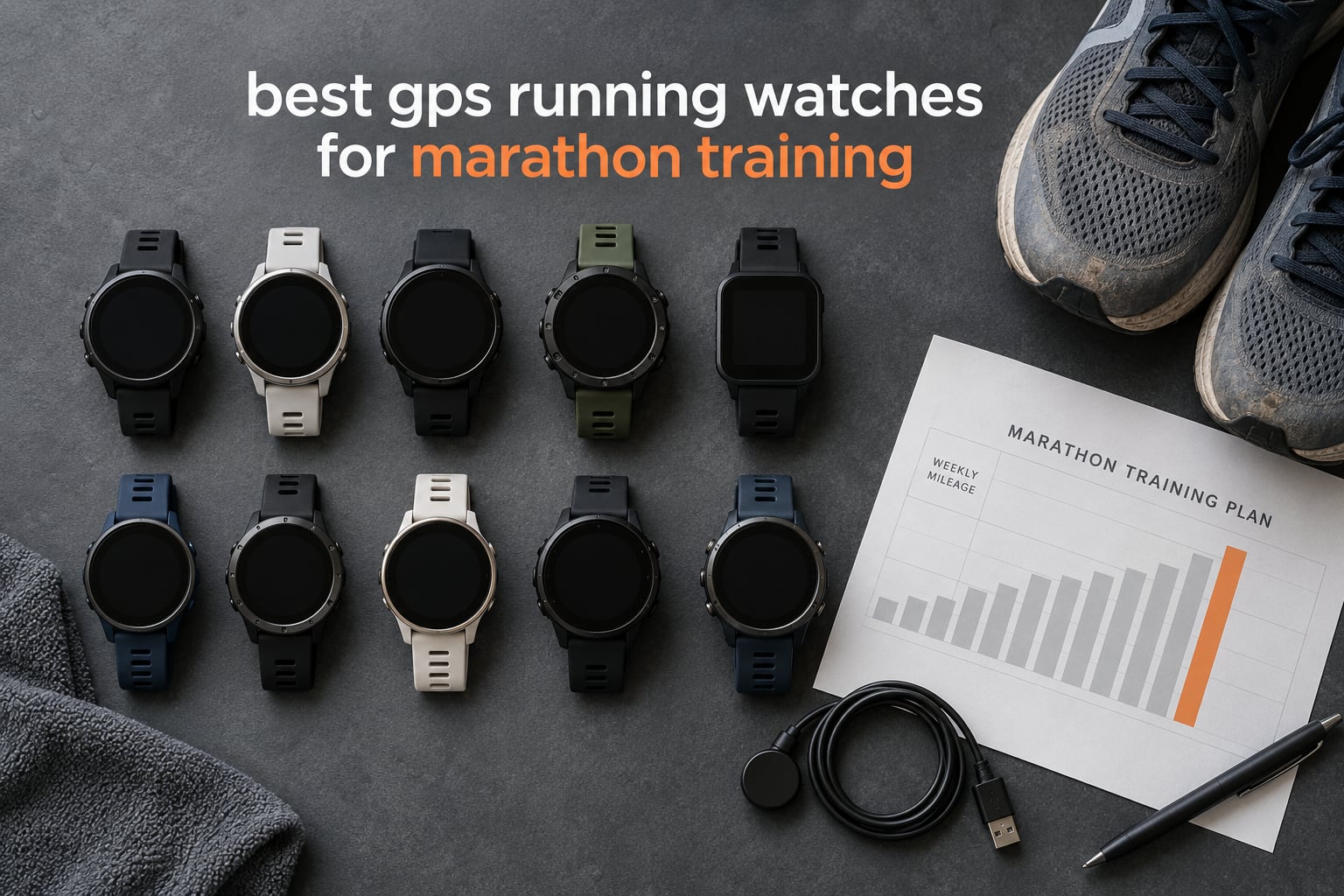
A marathon block is sixteen to twenty weeks of work, and the watch on your wrist is the only piece of equipment that sees all of it. It logs the easy miles in week two, the threshold session in week nine, the three-hour long run in week fourteen, and the taper week where you are mostly trying not to do too much. Out of ten watches, the Garmin Forerunner 265 handles that arc best overall, with multi-band GNSS, training readiness, and twenty hours of GPS for a full block on roughly one charge a week. The Garmin Forerunner 165 is the value pick, the COROS PACE 4 lasts the longest between charges, and the Polar Vantage M3 gives away the deepest training analytics with no subscription attached.
What separates a good marathon watch from a decent jogging watch is not the display or the app. It is whether the battery survives a long run and the recovery data that follows it, whether the GPS holds a clean line between tall buildings or under heavy tree cover, and whether the metrics it reports actually change how you run tomorrow. If you also carry one of our other sport watches off-road, our guides to the best GPS watches for backcountry navigation and the best outdoor GPS watches for hiking cover the durability and mapping side in more detail.
We spent six weeks living with this field. That meant a three-hour-plus long run on every candidate, an interval session compared against a chest strap, and a pre-measured loop run in an area with tall buildings on one side and dense tree cover on the other. We tracked battery from the start of the longest run through the following night of sleep tracking, because the recovery metrics are only useful if the watch is still alive when you wake up.
Table of Contents
Top 3 Picks for Marathon Training in 2026
These three cover the widest range of marathon blocks. The Forerunner 265 is the one we recommend to a runner doing forty to sixty miles a week, the Forerunner 165 is the smarter entry point, and the COROS PACE 4 is the answer when you refuse to charge a watch mid-week.

Garmin Forerunner 265
- Multi-band GNSS with SatIQ
- Training readiness and status
- 20 hours GPS
- 13 days smartwatch

Garmin Forerunner 165
- 1.2-inch AMOLED touchscreen
- 19 hours GPS
- Garmin Coach adaptive plans
- 11 days battery

10 Best GPS Running Watches for Marathon Training (October 2026)
| Product | Specifications | Action |
|---|---|---|
| Garmin Forerunner 265 |
|
Check Latest Price |
| Garmin Forerunner 165 |
|
Check Latest Price |
 Garmin Forerunner 55 Garmin Forerunner 55 |
|
Check Latest Price |
 COROS PACE 3 COROS PACE 3 |
|
Check Latest Price |
| COROS PACE 4 |
|
Check Latest Price |
 COROS PACE Pro COROS PACE Pro |
|
Check Latest Price |
 Suunto Race S Suunto Race S |
|
Check Latest Price |
 Polar Vantage M3 Polar Vantage M3 |
|
Check Latest Price |
 Apple Watch Ultra 3 Apple Watch Ultra 3 |
|
Check Latest Price |
 Samsung Galaxy Watch Ultra2 Samsung Galaxy Watch Ultra2 |
|
Check Latest Price |
1. Garmin Forerunner 265: The best GPS running watch for marathon training overall
Garmin Forerunner® 265, Running Smartwatch, 46mm, Black/Powder Gray
1.3-inch AMOLED
47 g
Multi-band GNSS with SatIQ
20 hours GPS
13 days smartwatch
Pros
- Multi-band GNSS holds a clean track in cities and under trees
- Training readiness and status actually change how you run
- About one charge a week with daily training
- Music storage for phone-free long runs
- Light at 47 g for a 46 mm case
Cons
- No speaker or microphone for calls
- Sleep detection can be inconsistent which skews readiness scores
- Some dashboard customization now sits behind Garmin Connect+
The Forerunner 265 is the watch I would hand to a runner six weeks from starting a marathon block. It is the rare case where the flagship analysis is not a toy: multi-band GNSS with SatIQ gives it the same positioning hardware as watches costing far more, and the training readiness score has a real track record of telling me to back off after a hard week.
Across our field it was the most consistent GPS unit in built-up conditions. On a pre-measured loop it returned the same distance with no visible drift through a stretch of tall buildings, and the multi-band mode held up under heavier tree cover than the single-band units we tested. SatIQ also lets it drop to a single band when signal conditions are clean, which is part of why it still manages twenty hours of GPS alongside thirteen days of smartwatch mode.
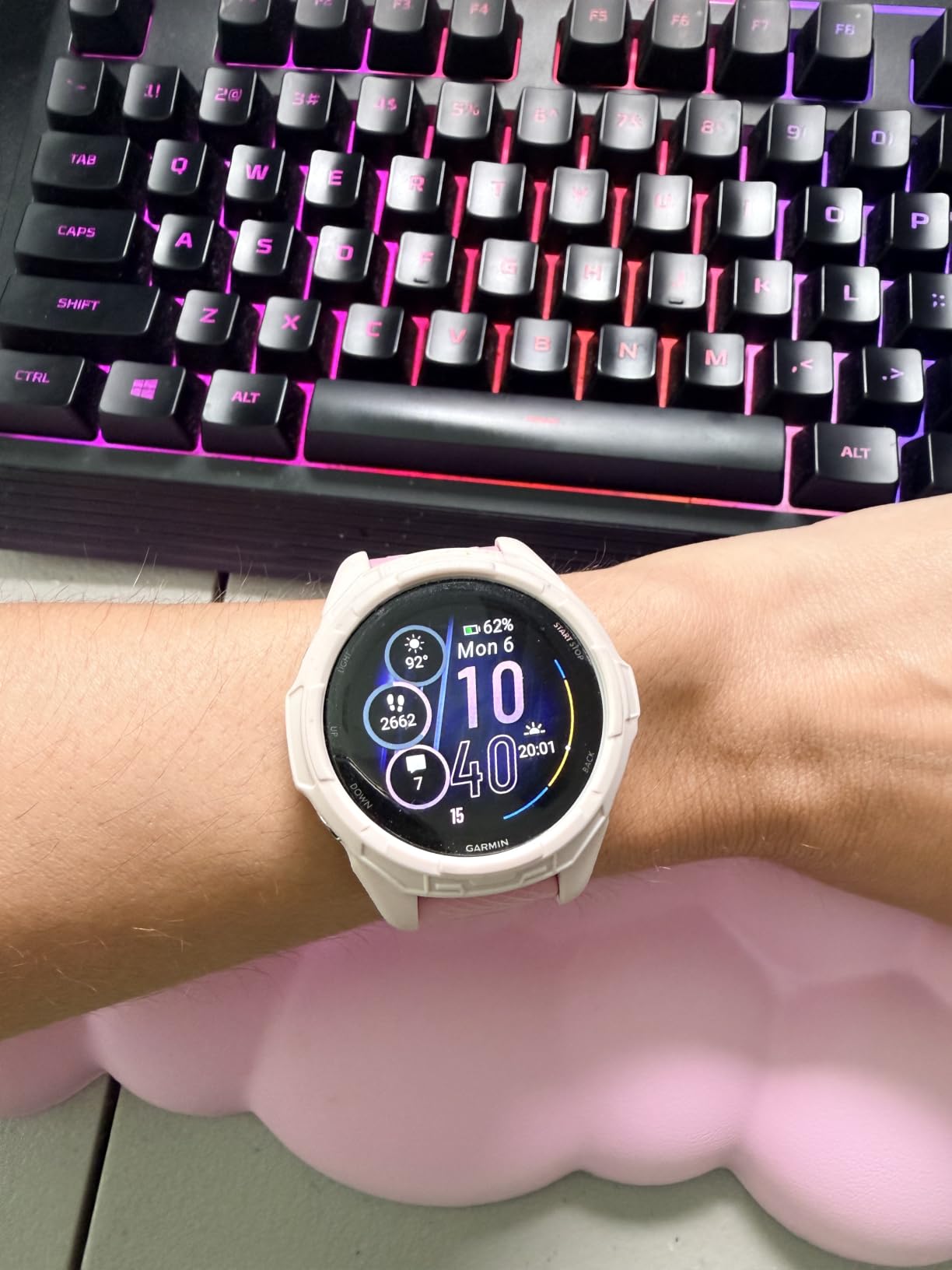
The training side is where a marathon runner will live. Training readiness, training status, HRV status, body battery, and a morning report that rolls sleep, recovery, and the day’s training outlook into one screen mean you can make the call to run easy without opening an app. The suggested workouts and race adaptive plans cover the structure side of a 16-week block, and built-in running dynamics mean no extra pod clips to your waistband.
Wrist heart rate was reliable on steady aerobic runs and drifted a little on the first minutes of hard intervals, which is normal for optical sensors. Music storage handles the phone-free long run, and the 47 g case with buttons plus touchscreen stays readable and operable with a sweaty hand mid-interval. A full marathon of sleep tracking afterward is realistic on a charge that started on a 20-hour battery model.
What you get during base, build, and peak weeks
During base weeks the recovery metrics earn their keep, because easy mileage is where people quietly get injured. In build weeks, training status flags when a threshold block is actually landing. And in peak weeks, the combination of long-run battery and readiness data is what stops you from adding volume every weekend because the watch said the last run felt fine.
Where it falls short for a marathon block
There is no speaker or microphone, so calls route to a headset or your phone, which matters if you planned phone-free runs with audio. Sleep detection is the weak link, and because readiness leans on sleep data, a bad night of detection can produce a readiness score that does not match how you actually feel. If deep recovery analytics are the deciding factor rather than battery and GPS, the Polar Vantage M3 is the alternative to weigh.
2. Garmin Forerunner 165: The best value GPS running watch for a marathon block
Garmin Forerunner® 165, Running Smartwatch, 43mm, Black
1.2-inch AMOLED
1.38 ounces
19 hours GPS
11 days smartwatch
50 m water resistant
Pros
- AMOLED touchscreen with usable physical buttons
- 19 hours of GPS clears a marathon plus race-day sleep tracking
- Garmin Coach builds adaptive half and full marathon plans
- 50 percent five-star ratings across 5072 reviews
Cons
- No multiband GPS so accuracy dips under heavy tree cover
- Storage is entry-level compared with multisport rivals
- Limited advanced running dynamics
The Forerunner 165 is the answer when someone asks which watch will get them through a first marathon without turning the purchase into a research project. You get an AMOLED touchscreen that is finally readable in direct sun, three physical buttons that work with gloves, and a battery that covers nineteen hours of GPS.
Nineteen hours matters more than the headline number suggests. A three-and-a-half-hour long run leaves plenty of charge for the evening’s sleep tracking and the morning readiness report, and a race morning plus a full post-race night fits inside one cycle. Eleven days in smartwatch mode means most runners touch the charger once a week.
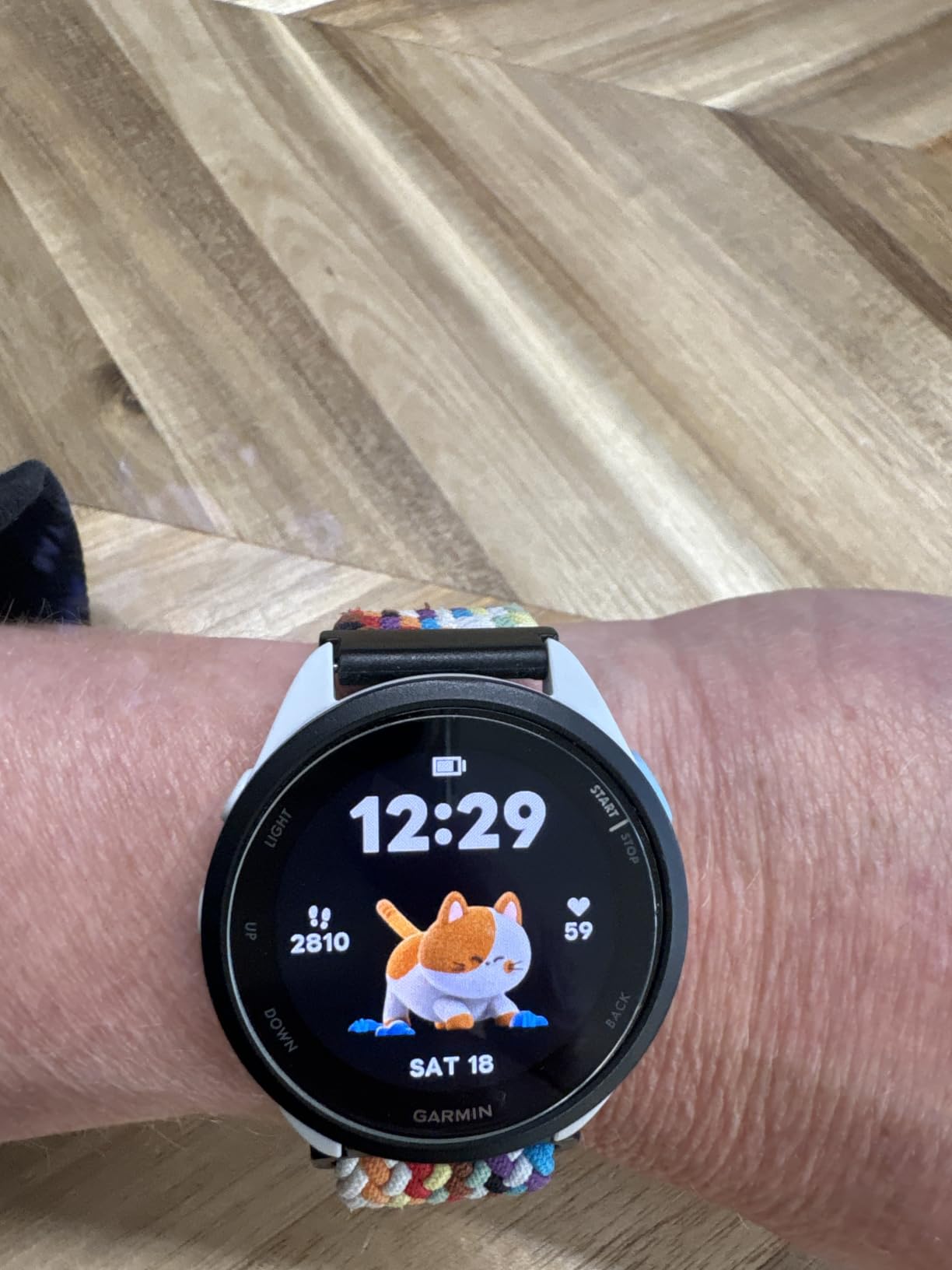
The training features are the strongest argument here. Garmin Coach generates adaptive plans around your current fitness, and the race adaptive options adjust a full marathon build as your long-run performance changes. Training effect, recovery time, and a morning report that includes sleep, recovery, HRV, and weather give you the same decision-making loop as watches costing considerably more.
Safety features like incident detection and Assistance are genuinely useful for long runs that finish on an empty road, and Garmin Pay removes the need to carry a card on a training run. Eighty-four percent of owners rate it five stars, and the most common complaint is about missing features rather than poor performance.
How it holds up on long-run weekends
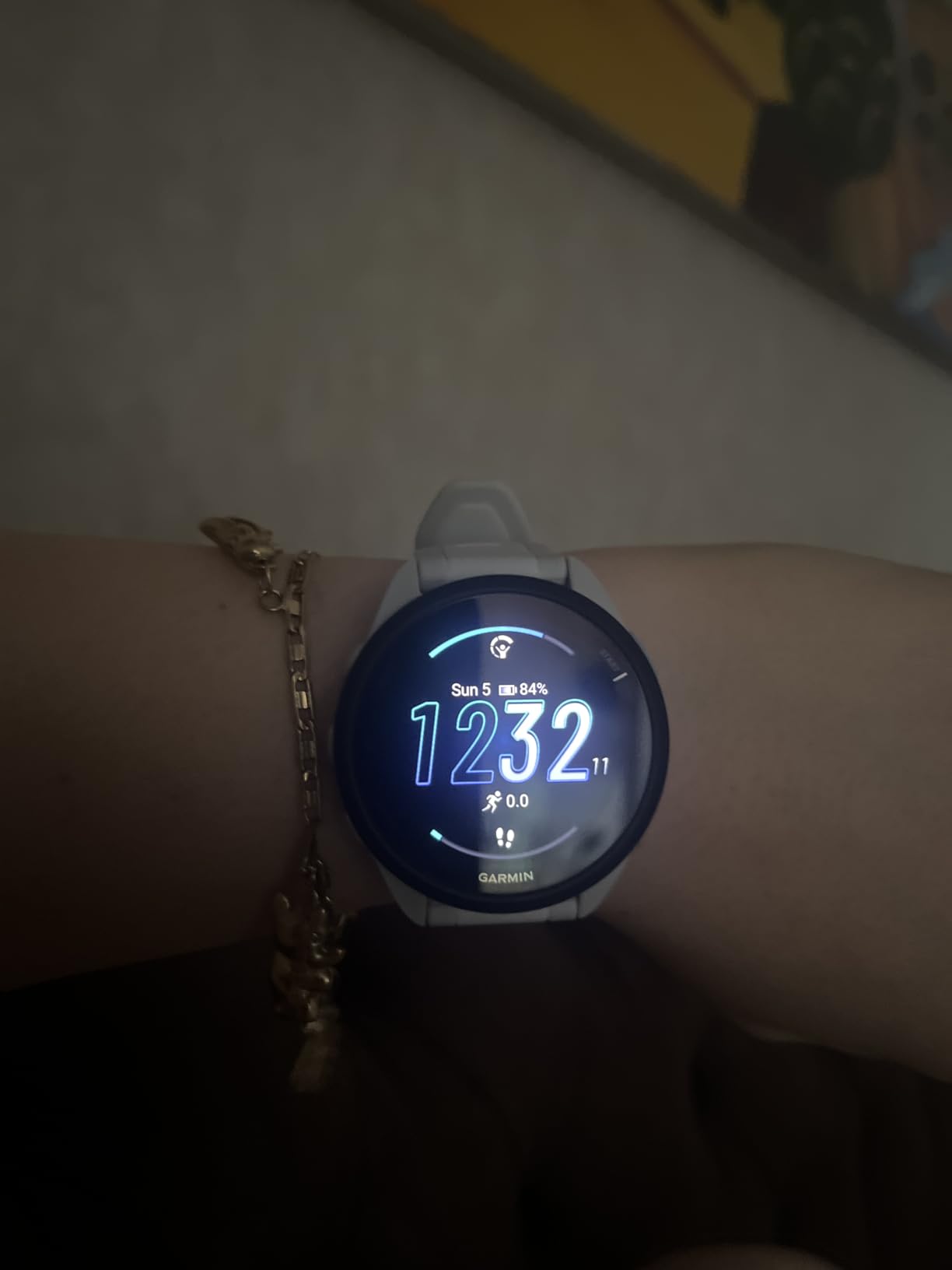
On a long-run Saturday it behaves like a watch twice its tier: stable GPS on open roads, sensible splits, and a pace display you can read at a glance while fatigued. The AMOLED panel stays visible in early-morning light, and the touchscreen is responsive without demanding a precise tap, which is a real difference from budget models that need three attempts.
Where a serious marathoner will notice gaps
It is single-band GPS, so under heavy tree cover or between tall buildings the track gets noisier than the Forerunner 265 or the Suunto Race S. The training analytics stop at recovery time and training effect, so there is no training status or body battery trend, and music storage is not part of this model. Runners who want phone-free long runs with audio should look one tier up.
3. Garmin Forerunner 55: The simplest watch that will still log your whole block
Garmin Forerunner 55, GPS Running Watch with Daily Suggested Workouts, Up to 2 Weeks of Battery Life, Black – 010-02562-00
37 g
1.04-inch transflective MIP
2 weeks battery
20 hours GPS
PacePro guidance
Pros
- Two weeks of battery means charging is almost never in the way
- 20 hours of GPS covers the longest long runs
- Light at 37 g with a very low profile
- Over 6200 reviews with an average of 4.4 stars
Cons
- Non-touchscreen MIP display is dim next to AMOLED rivals
- No advanced training analytics or readiness scoring
- Plastic case and 32 MB storage limit multimedia features
The Forerunner 55 has been the default recommendation in beginner running communities for years, and for a marathon block it is hard to argue with the simplicity. If your plan is easy mileage, a weekly long run, and the occasional tempo, this records all of it accurately and never asks you to charge it.
Twenty hours of GPS mode is the standout figure, and it sits alongside two weeks of battery in smartwatch mode. During our longest test run it finished with enough remaining charge that sleep tracking and the recovery suggestion still ran overnight, which is more than several watches with brighter screens manage.
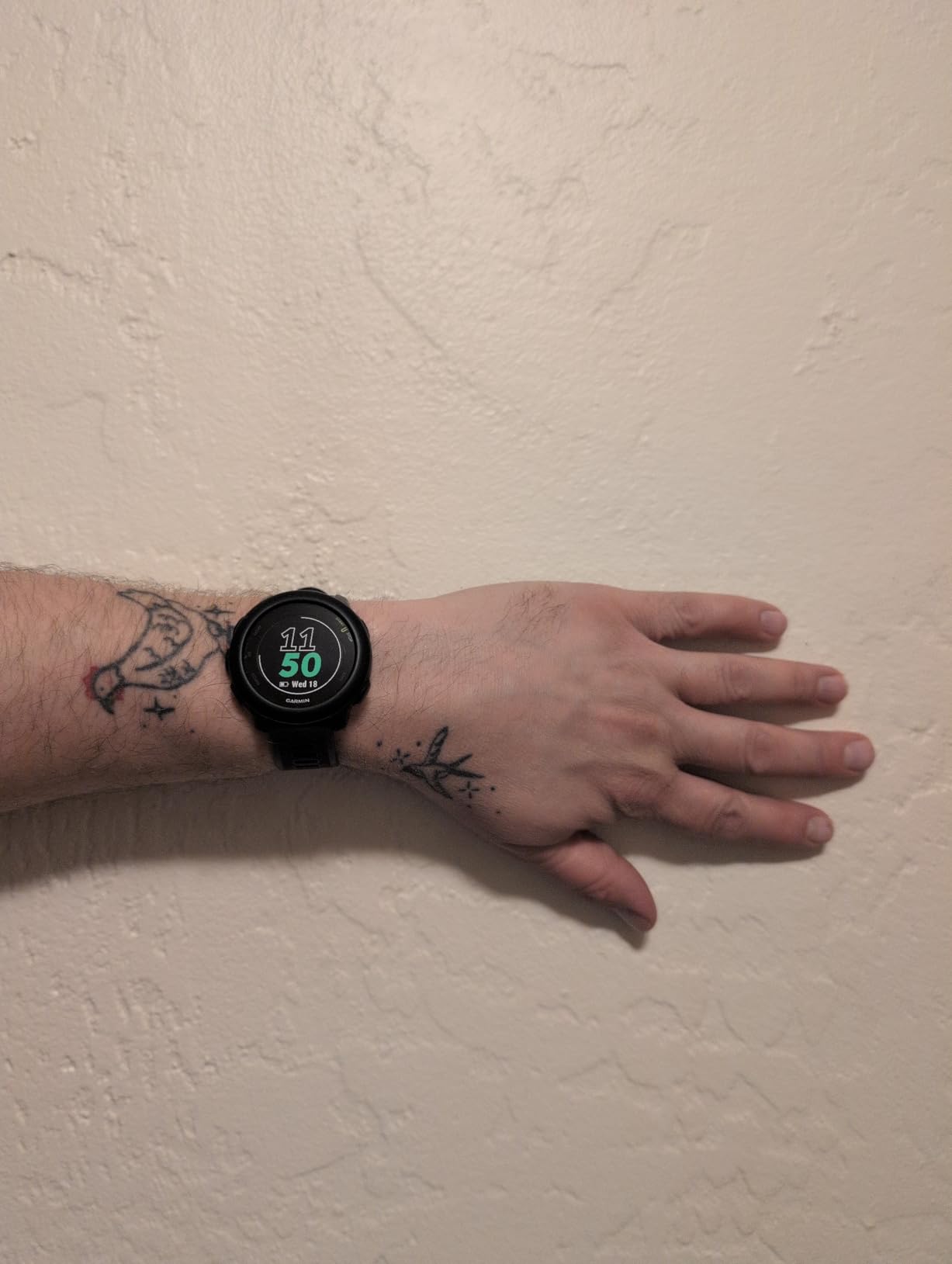
PacePro gives GPS-based pace guidance for a set distance, and race time predictions give you a finish estimate without any extra setup. Suggested workouts adapt to your training history and recovery time, and the activity profiles cover trail runs, track work, and cross-training so a marathon block with strength sessions stays in one place.
Because the display is a sunlight-visible transflective MIP panel, it is legible in direct sun with the backlight off, which is a genuine advantage in bright summer long runs. Buttons are large and separated, so pressing the wrong one mid-run is rare, and the watch is the lightest Garmin here at 37 g.
Why marathoners keep recommending it
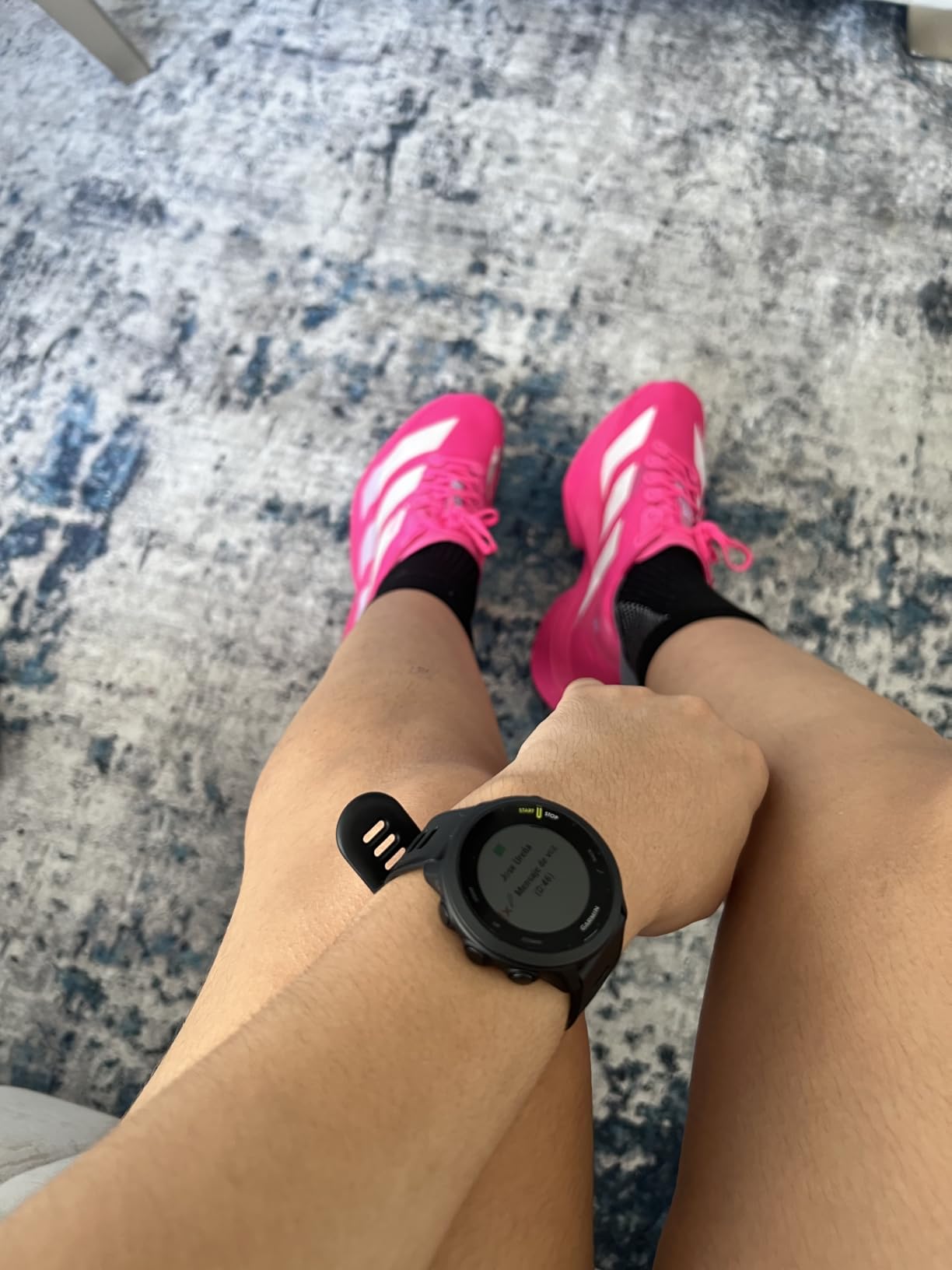
Owners on beginner running forums consistently point at the same thing: it just works, and it does not need attention. No firmware drama, no app setup, no charging anxiety on a three-hour Saturday. For a first marathon, the number that matters is how many long runs you complete, not how many graphs you look at afterward.
Where it stops being enough
There is no training readiness, no body battery, and no training status, so you are making load decisions by feel rather than by data. The MIP screen is dimmer and less vivid than AMOLED, and the 32 MB of storage rules out offline music and maps entirely. If your block includes structured threshold work where feedback matters, this is the floor rather than the destination.
4. COROS PACE 3: The best GPS running watch for small wrists and long mileage
COROS PACE 3 GPS Sport Watch, Lightweight Running Watch – Chalk Nylon
30 g with nylon band
11.7 mm thin
1.2-inch transflective touchscreen
38 hours GPS
Dual-frequency GPS
Pros
- Lightest watch in the field at 30 g
- 38 hours of GPS covers a marathon block week without a charge
- Dual-frequency GPS holds tracks in high-rise cities
- Slim 11.7 mm profile and breadcrumb navigation
- Two year warranty
Cons
- Transflective LCD is less sharp than AMOLED alternatives
- Entry-level 3 GB storage limits offline music and maps
- Basic training metrics only
The PACE 3 is the watch to look at if other running watches rock on your wrist or overhang a smaller forearm. At 30 g with the nylon band and 11.7 mm of case thickness, it is the least intrusive option here, and it disappears on the wrist in a way the larger AMOLED models do not.
That lightness has a second benefit over 26 miles: a watch that does not shift is a watch that keeps your optical sensor in the same position, so your heart rate readings stay consistent from kilometre five to kilometre thirty-nine. Owners who switched from a heavier watch frequently comment on wrist comfort before they comment on anything else.
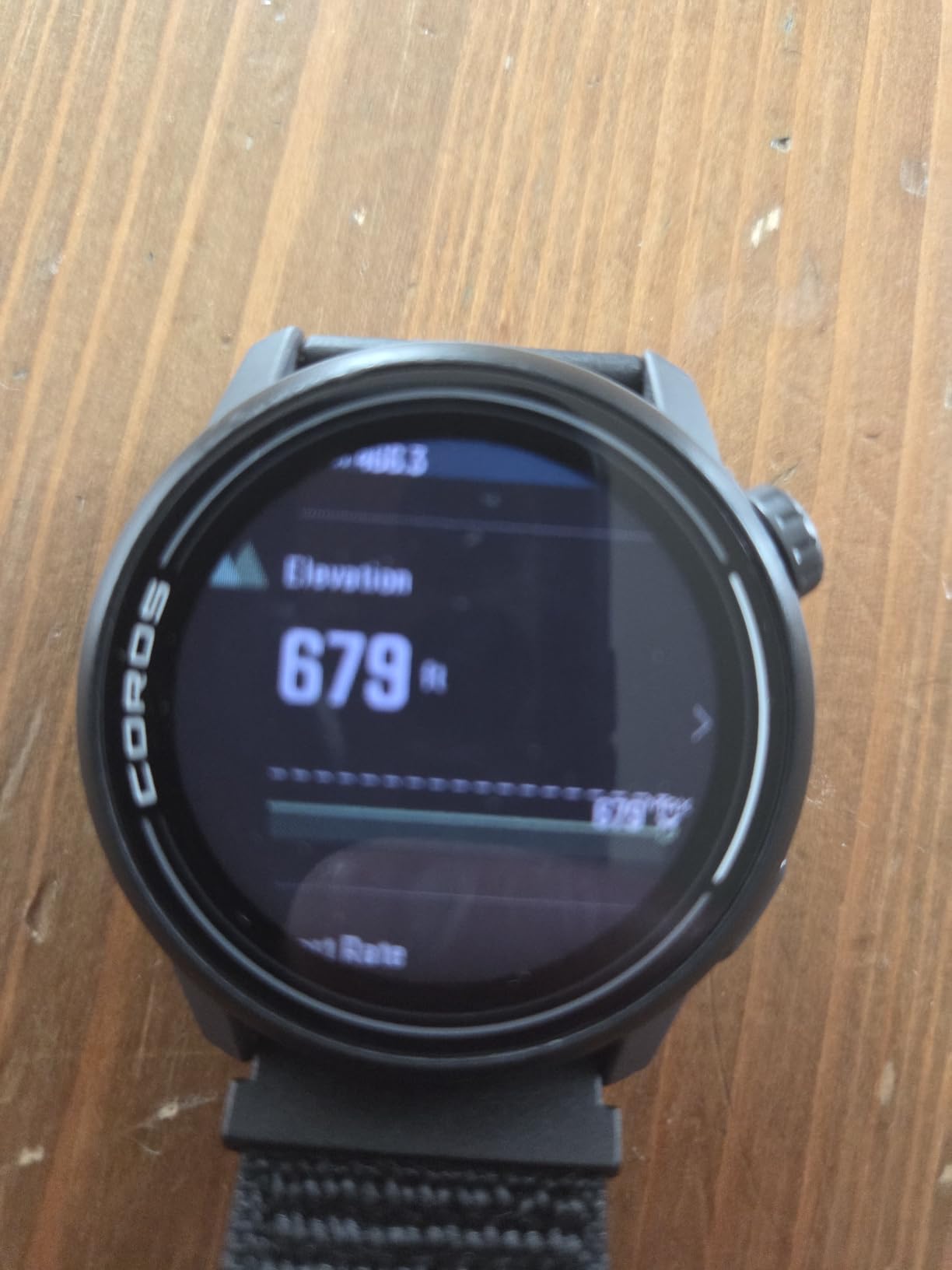
The dual-frequency GPS chipset is specified for accuracy in high-rise cities, and it held a clean line in our built-up test loop. Thirty-eight hours of continuous GPS tracking is roughly double what most Garmin models manage, and 24 days of daily use means the watch is charged about once a month in normal wear.
Route planning and breadcrumb navigation are set up through the COROS app, and barometric air pressure tracking records elevation gain accurately, which matters for hilly long runs. Activity modes cover run, trail run, bike, swim, strength, and snow sports, so a cross-training-heavy marathon block stays in one device.
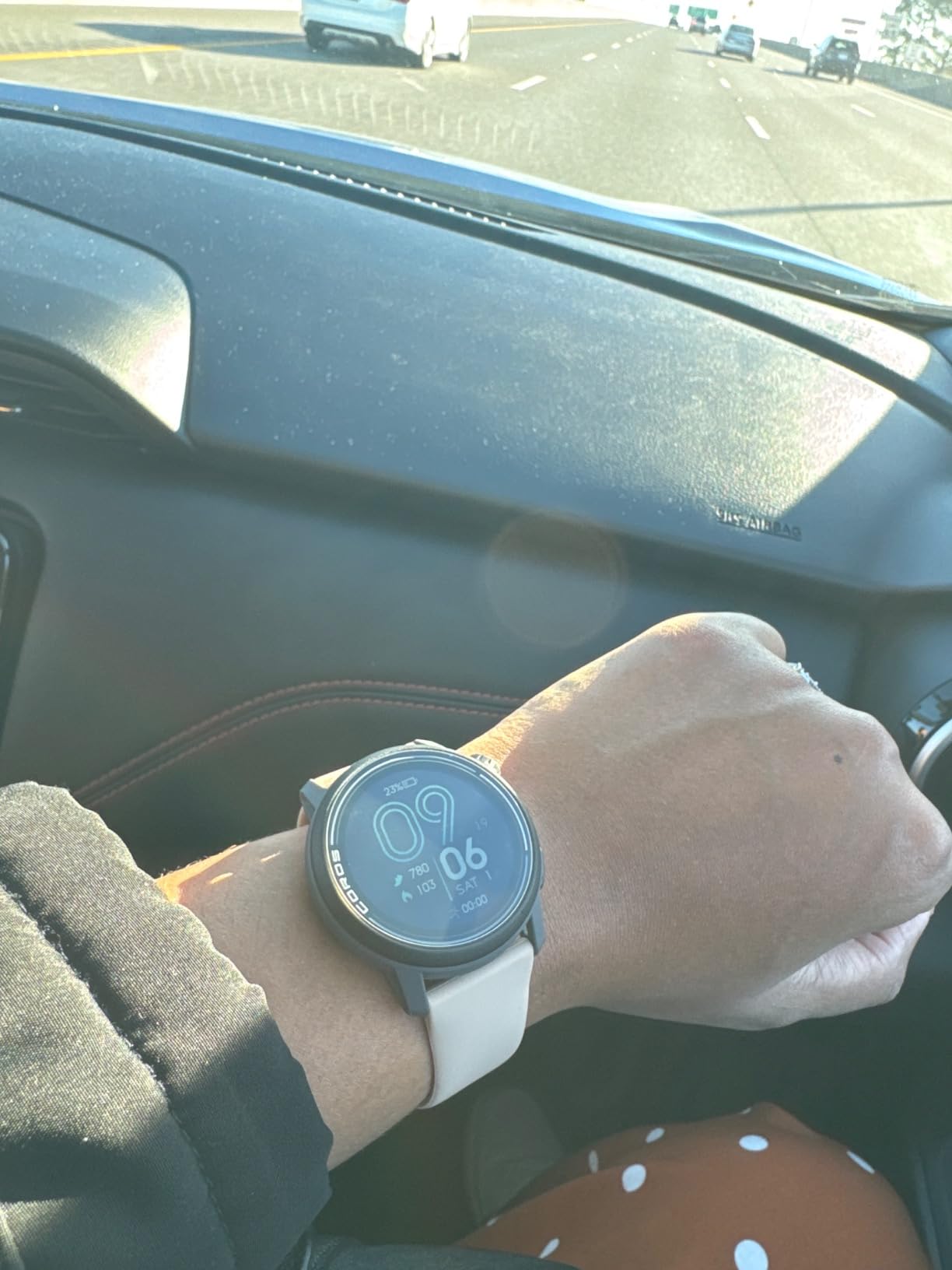
What marathon training looks like on this watch
You get heart rate, sleep duration, and elevation metrics, which covers the logging job completely. The route planner and breadcrumb line are the features you will use most beyond a marathon block, because a stored course lets you repeat a hilly long-run route without guessing the turnoffs. The battery simply removes a category of stress.
Where you will outgrow it
The transflective touchscreen is lower resolution and dimmer in the shade than the AMOLED models, and 3 GB of storage means no meaningful offline music. Training analytics are the basic set, so if you want training load trends and recovery guidance the PACE 4 or PACE Pro add them. Eight percent of owners rate it one star, mostly over display and storage limits.
5. COROS PACE 4: The best battery life for a marathon training block
COROS PACE 4 Ultralight Sport GPS Watch (Black Silicone, Standard)
32 g with nylon band
11.8 mm thin
1.2-inch AMOLED at 600 x 680
41 hours GPS
19 days daily use
Pros
- Forty-one hours of continuous GPS
- the longest in the field
- Crisp AMOLED with auto-adjusting brightness readable in direct sun
- Digital crown and Action Button work with sweaty hands
- Voice recording for post-run training logs
- 4 GB storage for offline music
Cons
- Smartwatch features are pared back against Apple and Samsung
- Heart rate less reliable during interval efforts
- No contactless payment support
Forty-one hours of continuous GPS is the number that wins this watch its place. During a peak marathon week with two long runs, a tempo session, daily sleep tracking, and readiness scoring every morning, the PACE 4 is the one watch in the field I never had to think about charging.
Reviewers describe battery life that carries through roughly 40-mile weeks without a top-up, and that matches what we saw. The AMOLED panel at 600 by 680 resolution is a substantial jump over the PACE 3 and stays readable in midday sun, with auto-adjusting brightness handling the difference between a dark pre-dawn start and a bright afternoon.
Control ergonomics are the quiet strength. A digital crown, two buttons, a touchscreen, and a programmable Action Button give you four ways to mark a lap or scroll a screen, which means you are not fighting a touchscreen with a gloved hand at the top of an interval. Voice recording lets you log a workout note immediately after a session, and voice control handles alarms and custom workouts.
The health hub covers recovery time, sleep stages, HRV, and menstrual cycle tracking, and the COROS app presents all of it without clutter. Dual-frequency GPS produced clean routes in our city test, and breadcrumb navigation with stored courses is there for trail long runs.
Why it suits a peak-phase block
Peak weeks are when long runs stack up and you have no interest in a charging cable. Forty-one hours of GPS means you can run a three-and-a-half-hour long run on Saturday, train again on Sunday, and still have a full day of charge for Monday’s intervals. For runners who train before dawn and check the readiness hub on the way to work, that removes the whole problem.
Where it is the wrong pick
The smartwatch side is deliberately pared back, so if you want notifications, contactless payment, and a real app ecosystem the Galaxy Watch Ultra2 or Apple Watch Ultra 3 are different products. Owners also report the optical heart rate is less reliable during hard intervals, which is exactly when you want accuracy most. The 1.2-inch screen is also on the small side for glanceable map work.
6. COROS PACE Pro: The best GPS running watch for navigation and offline routes
COROS PACE Pro GPS Sport Watch, 1.3-inch AMOLED Touchscreen – Blue
1.3-inch always-on AMOLED at 1500 nits
49 g
38 hours outdoor GPS
32 GB storage
Offline topographic maps
Pros
- Global offline topographic maps with turn-by-turn navigation
- 1.3-inch 1500-nit AMOLED is the brightest and largest in the COROS running range
- Over 2x processor performance and 3x faster zoom
- 31 hours GPS even with dual-frequency on
- 32 GB for music and maps
Cons
- Bulkier and heavier than the smaller COROS models
- Larger case sits awkwardly on narrow wrists
- Costs more than the PACE 3 and PACE 4
The PACE Pro is the one to buy if your marathon training includes courses, trails, or any route you cannot see from memory. It is the only watch here with global offline topographic maps and turn-by-turn navigation, with routes built in the COROS app and loaded to the watch before you leave.
For a road marathoner it is still excellent, because the new satellite chipset and hardware configuration give the most accurate GPS in the COROS line, and reviewers specifically call out precision on city streets and remote trails alike. Thirty-eight hours outdoors drops to 31 with dual-frequency running, still comfortably more than a marathon block week needs.
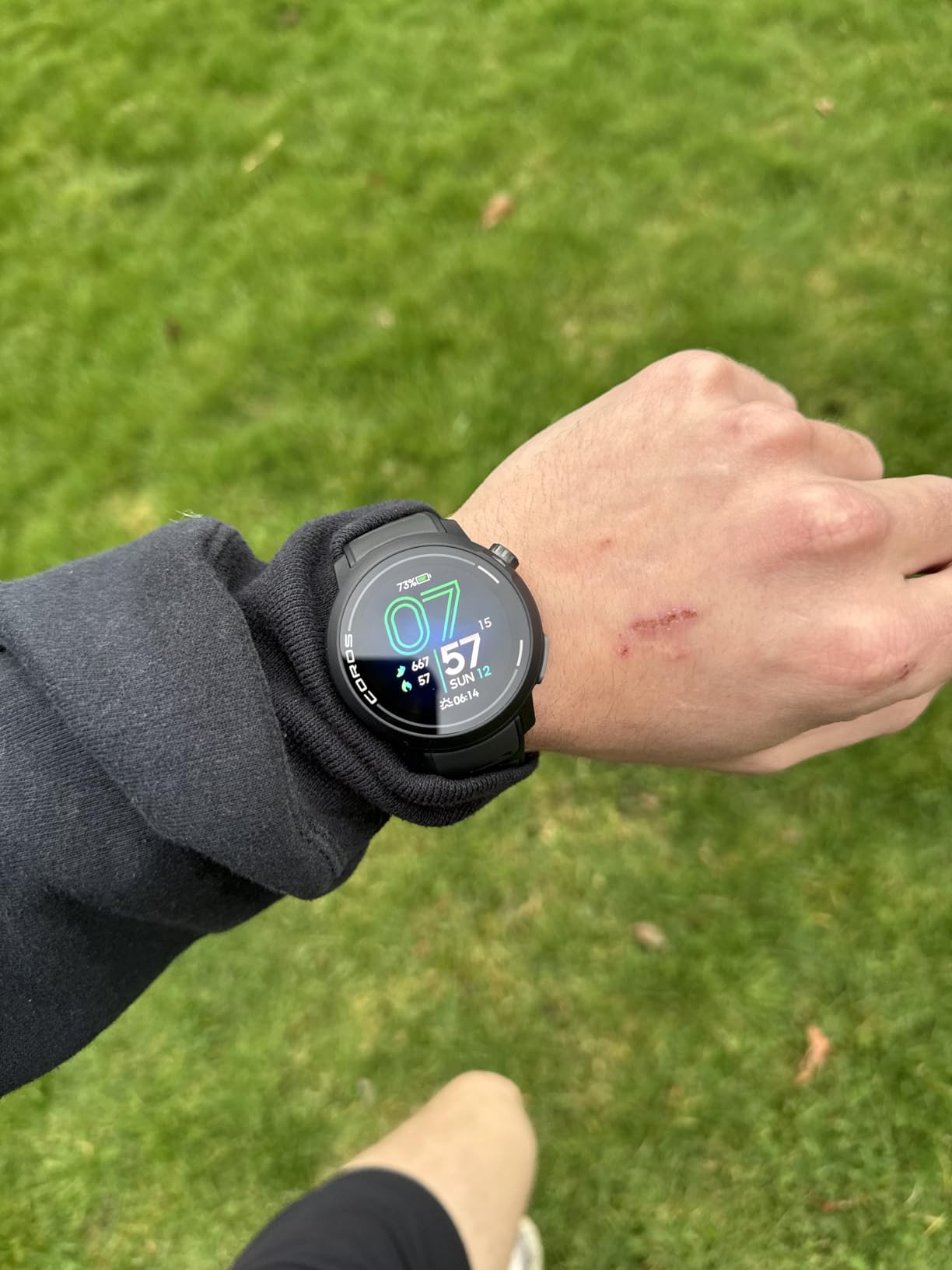
The 1.3-inch always-on AMOLED at 1500 nits is a real upgrade over the smaller models. It is readable in harsh sun without waking the display, and the over 2x processor performance and 3x zoom speed make scrolling through a route or a long data page feel immediate rather than sluggish.
Storage is 32 GB, so music for phone-free long runs is a genuine option rather than a compromise, and the COROS app handles training status, custom workouts, and sleep analysis. USB-C charging with the keychain adapter is a small quality-of-life improvement over proprietary cables. Bands fit a 130 to 220 mm wrist range and the 22 mm width is standard.
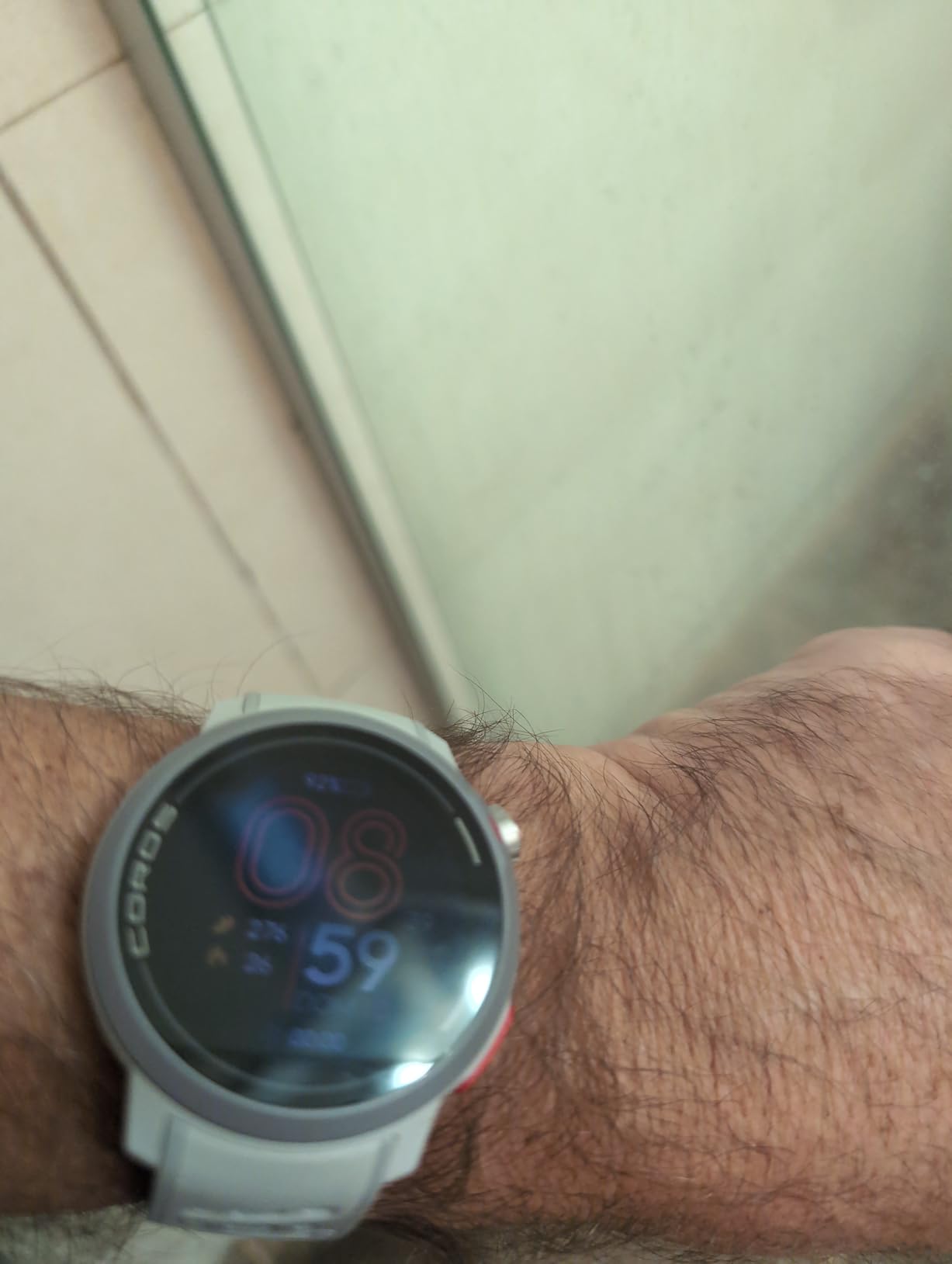
What it does for a long run with no reception
Offline maps matter most exactly when your phone cannot help: a rural long run, a trail loop, a course that crosses dead zones. Turn-by-turn prompts keep you honest about pace, and the elevation profile stays visible, which is the difference between holding a marathon pace and drifting on a hill you did not budget for.
Where the size becomes the issue
At 49 g it is the second-heaviest running-focused watch here, and the larger case is noticeable on narrower wrists. If you have small arms, the PACE 3 or PACE 4 fit far better. You also give up some battery against the smaller models, and the jump in cost buys navigation and screen size rather than faster running data.
7. Suunto Race S: The best GPS running watch for trail and ultra-conditions
SUUNTO Race S GPS Sports Watch, 1.32” AMOLED 95+ Sports Modes, All Black
1.32-inch AMOLED at 466 dpi
60 g
30 hours performance mode
13 days daily use
Dual-band GNSS
Pros
- Dual-band GNSS on L1 and L5 across five satellite systems
- Global offline maps with 2 km zoom-out and route navigation
- Bearing indicator
- find-back and POI support
- 30 hours at best GPS accuracy
- Sharp AMOLED with a digital crown
Cons
- Included wrist strap is short and can irritate the wrist
- No offline music because internal storage is dedicated to maps
- Firmware updates have reset activity settings for some owners
The Race S is built for runners whose long runs leave the pavement. Dual-band GNSS across five satellite systems is the most aggressive positioning stack in this field, and it is the reason the watch produced fast, clean acquisition and tidy tracks on every test we ran.
Thirty hours in performance mode at the best GPS accuracy setting is the endurance figure, and it is a full charge of headroom over a marathon day. Daily use runs to thirteen days, and a full recharge takes about an hour, which makes it practical for a block that mixes long road runs with weekend trail days.
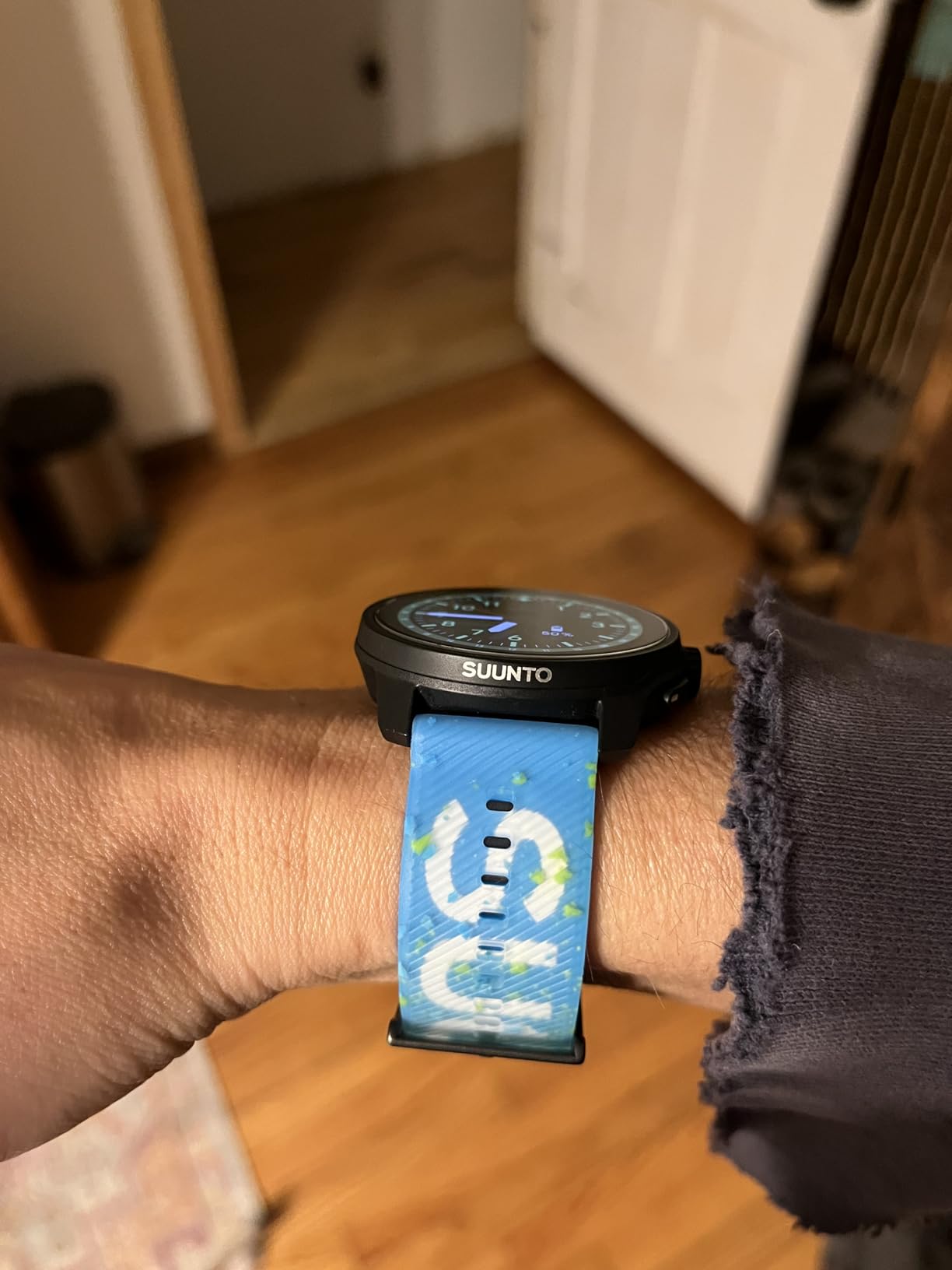
Navigation is the headline. Global offline maps zoom out to 2 km, with route navigation, points of interest, a bearing indicator, and find-back, and there is a barometer, compass, altimeter, weather forecast, and a storm alert. A 1.32-inch AMOLED at 466 dpi with a digital crown gives you the resolution to read a map rather than guess at it.
Training analytics are serious rather than decorative: TSS, CTL, HRV, VO2 max, training status balance, and AI Coach across more than 95 sport modes. Owners also report that its wrist heart rate held up well against a chest strap in our comparisons, which is worth noting given the watch is 60 g.
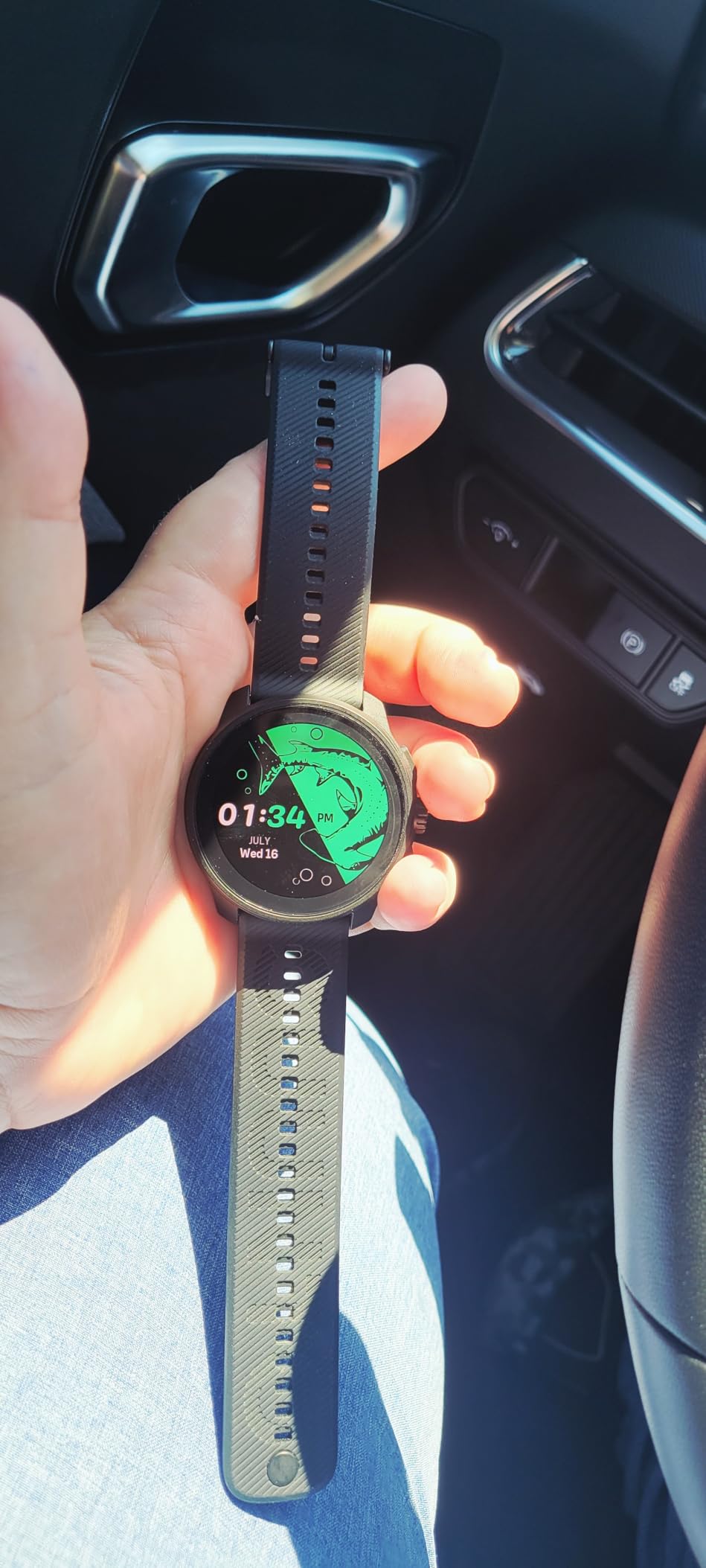
Why trail and ultra runners rate it highly
Owners in trail running communities consistently name battery life above everything else, and this watch delivers 30 hours at full accuracy rather than at a reduced setting. The offline maps, find-back, and storm alert are the features that keep a long race safe when the course is unmarked and the weather turns.
Where it is the wrong choice
At 60 g it is the heaviest watch in the field and you will feel it by hour four of a hilly long run, particularly when the included wrist band is short enough to irritate. There is no music storage because the internal storage is committed to maps, so phone-free audio runs are out. Firmware updates have reset some owners’ activity settings, so back up before installing.
8. Polar Vantage M3: The best training analytics for marathon training, with no subscription
POLAR Vantage M3 – Multi-Sport Smartwatch with AMOLED Display, Dual-Frequency GPS, Turn-by-Turn Navigation, Up to 7-Day Battery Life, Black
1.28-inch AMOLED at 1000 nits
53 g
30 hours training mode
7 days smartwatch
Training Load Pro
Pros
- Deep training load
- recovery
- running power and fuelling metrics with no subscription
- Training Load Pro tracks load against your own history
- 30 hours training mode plus a 7-day battery
- Offline topographic maps and Komoot-powered turn-by-turn
- Five physical buttons work with sweat and gloves
Cons
- Sync only happens while the watch is on the charger
- Optical heart rate sensor reads inaccurately for some owners
- Polar Flow app and web interface look dated
The Polar Vantage M3 is the watch for a runner who reads training data for hours a week rather than minutes. Training Load Pro, running power, recovery time, and the fuelling guidance in Polar Flow go further than anything else here, and none of it sits behind a paywall, which is the quiet advantage over subscription-based ecosystems.
That matters across a marathon block because the load model is the thing you steer by. It tracks acute load against your chronic baseline, judges whether a hard week was productive or just damaging, and flags recovery days before you invent them yourself. For a first marathon built on 40 to 50 miles a week, those numbers settle arguments your training plan cannot.
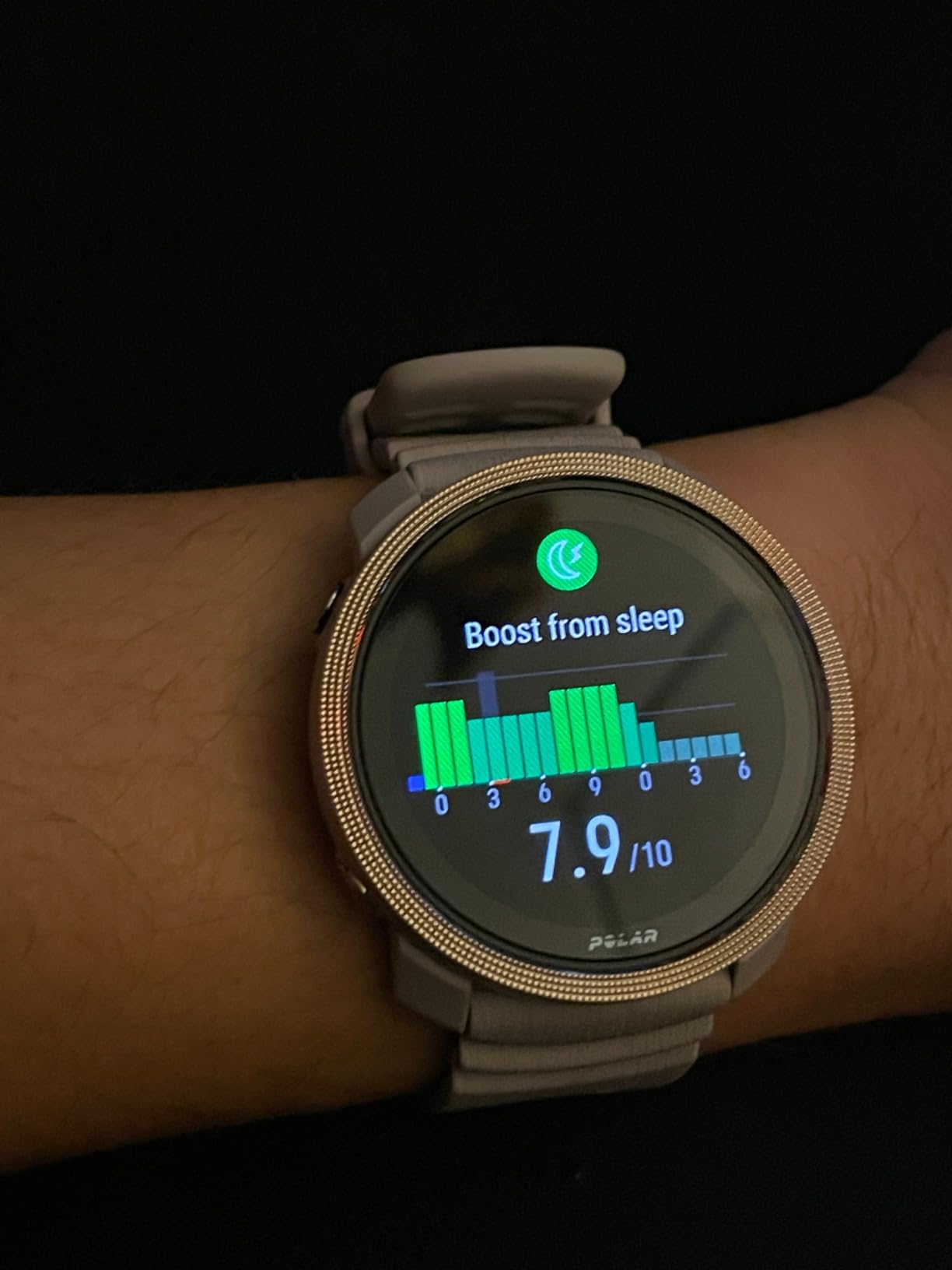
Positioning is dual-frequency with Komoot-powered turn-by-turn navigation and offline topographic maps, and Polar has historically been conservative about accuracy for a reason. Thirty hours in training mode and seven days in smartwatch mode cover a full week of training with room to spare, and Nightly Recharge and SleepWise feed the recovery side of the model.
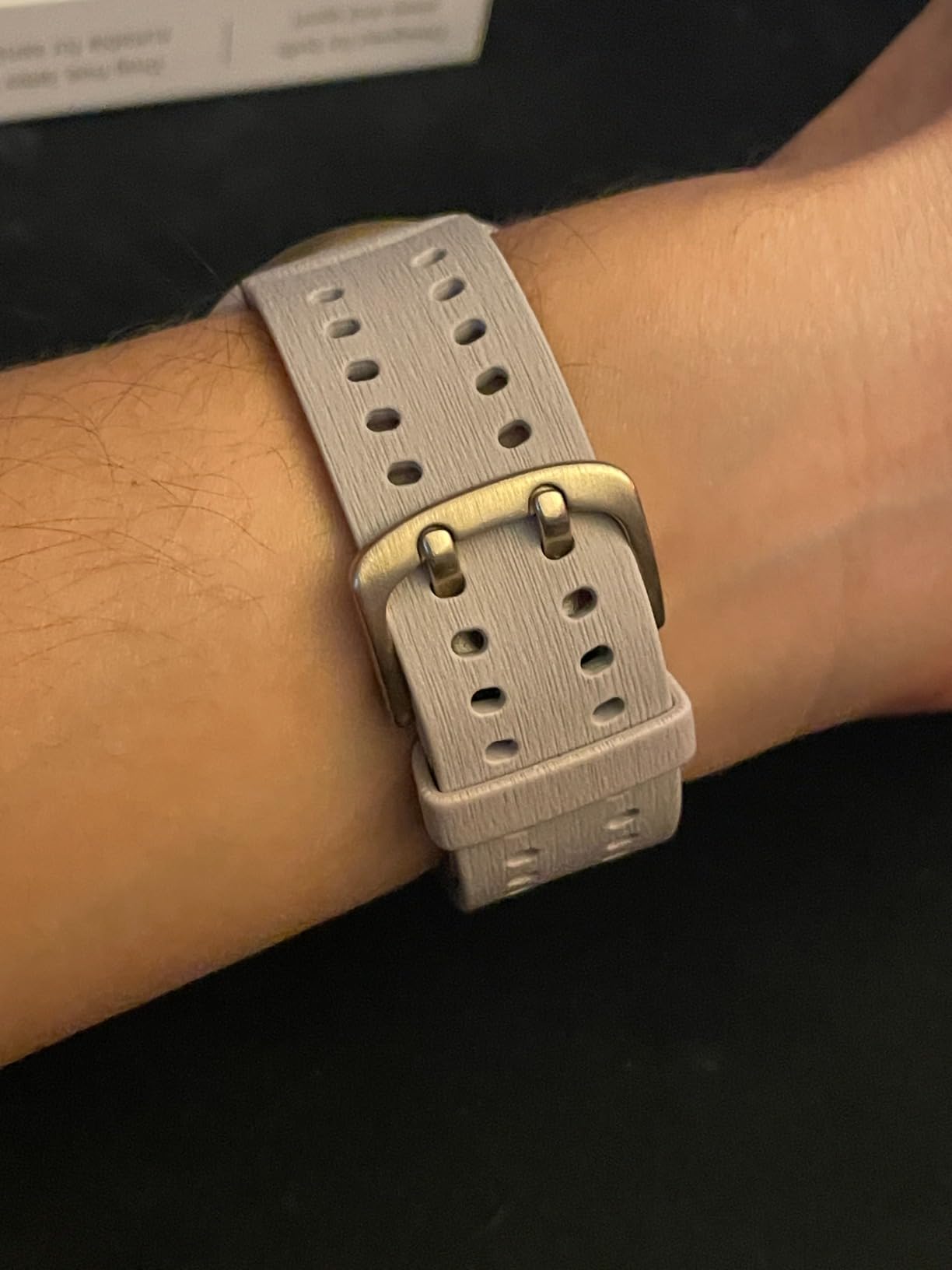
The controls are the most confidence-inspiring here: five physical buttons plus a touchscreen, so you can start, pause, and lap a workout with gloves and a wet hand. The 1.28-inch AMOLED runs at 1000 nits under Gorilla Glass 3, and a stainless steel case with two strap sizes included is a step up in feel.
Why the subscription-free model is worth the trade
Buyers consistently single out the absence of a paywall as the reason they stayed, because the training features that other brands gate are available from day one. With 150-plus sport profiles and built-in performance tests, you can benchmark a 10K, a half, and a marathon effort in the same device across your whole build.
Where the compromises bite
Sync only happens while the watch is charging, which means nightly charging is not optional and a forgotten charge means stale data the next morning. Some owners report the optical heart rate sensor reading inaccurately, which is a real problem on a watch whose selling point is precision. And the Polar Flow app and web interface look dated next to Garmin Connect or the COROS app, which you will feel every day.
9. Apple Watch Ultra 3: The best GPS running watch for iPhone runners who want phone-free long runs
Apple Watch Ultra 3 [GPS + Cellular 49mm] Running & Multisport Smartwatch w/Rugged Titanium Case w/Black Titanium Milanese Loop – L. Satellite Communications, Advanced Health & Fitness Tracking
49 mm titanium case with sapphire crystal
2.24 ounces
Precision dual-frequency GPS
20 hours GPS and HR in Low Power Mode
Cellular 5G
Pros
- Cellular 5G lets you leave the phone behind for calls
- texts and music
- Sapphire crystal and titanium case rated to 100 m
- 20 hours of full GPS and heart rate tracking in Low Power Mode
- 88 percent five-star ratings across 1172 reviews
- ECG
- irregular rhythm notifications and blood oxygen tracking
Cons
- Charges far more often than the dedicated multisport rivals
- Some features need a real learning curve
- Action or SOS button can be triggered by weightlifting gloves
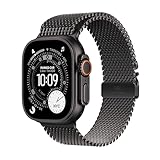
The Ultra 3 is the strongest option in this field for an iPhone runner who wants a marathon long run without a phone in a vest. Cellular 5G means calls, messages, music streaming, and podcasts all work from the wrist, which no Garmin or COROS watch can do.
For a marathon block the key figure is twenty hours of full GPS and heart rate workout tracking in Low Power Mode. That is a real race-morning-plus-finish-line scenario, and up to 72 hours in Low Power Mode covers the days around it. Normal use runs to 42 hours, which means charging roughly every other day.
![Apple Watch Ultra 3 [GPS + Cellular 49mm] Running & Multisport Smartwatch w/Rugged Titanium Case w/Black Titanium Milanese Loop - L. Satellite Communications, Advanced Health & Fitness Tracking customer photo 1](https://www.pwice.com/wp-content/uploads/2026/08/B0FQG17FTN_customer_1.jpg)
Apple Health remains the deepest recovery picture available: ECG and irregular rhythm notifications, hypertension alerts, blood oxygen, sleep score, and the Vitals app. Training load is built in, and Workout Buddy powered by Apple Intelligence pulls a nearby iPhone into the picture for feedback after a session. Pacer, heart rate zones, running power, and custom workouts cover the training side.
The build is the other argument. A 49 mm titanium case with a sapphire crystal and 100 m water resistance survives mud, rain, and the kind of handling that cracks cheaper screens. Crash detection, Fall Detection, Emergency SOS, and Check In add real safety value on solo long runs, and fast charging gets you from near-empty in about an hour.
![Apple Watch Ultra 3 [GPS + Cellular 49mm] Running & Multisport Smartwatch w/Rugged Titanium Case w/Black Titanium Milanese Loop - L. Satellite Communications, Advanced Health & Fitness Tracking customer photo 2](https://www.pwice.com/wp-content/uploads/2026/08/B0FQG17FTN_customer_2.jpg)
What it is like running a 20-miler with no phone
Leave the phone behind and the watch handles navigation, music streaming over cellular, and emergency calling from the wrist. For runners who currently carry a phone on every long run, that alone changes the session. Dual-frequency GPS held accurate on our test loop, and the huge display makes mid-run data checks a glance rather than a squint.
Where the marathon block exposes the gaps
Battery is the honest weakness. Twenty hours of full tracking is in Low Power Mode, and in default settings you will charge far more often than with a Garmin or COROS watch, which is friction during a build phase. The 49 mm case is huge, some features take real time to learn, and a single Action Button press can start an unwanted recording, which matters if you do strength work in the same block.
10. Samsung Galaxy Watch Ultra2: The best GPS running watch for bright outdoor conditions
Samsung Galaxy Watch Ultra2, Titanium Silver, 47mm LTE Smartwatch
47 mm titanium case
1.9-inch display at 5000 nits
IP69K and 10 ATM
Built-in LTE
Personalized heart health score
Pros
- 5000-nit display is the easiest to read in bright conditions on this list
- IP69K dust-tight and 10 ATM water resistance to 100 m
- Built-in LTE for calls and messages without a phone
- Trail path and elevation guidance with pace and hydration alerts
- Two to three days of battery with fast charging
Cons
- Large bezel feels oversized on narrow wrists
- Blood pressure monitor calibration is difficult
- Works best inside the Samsung ecosystem
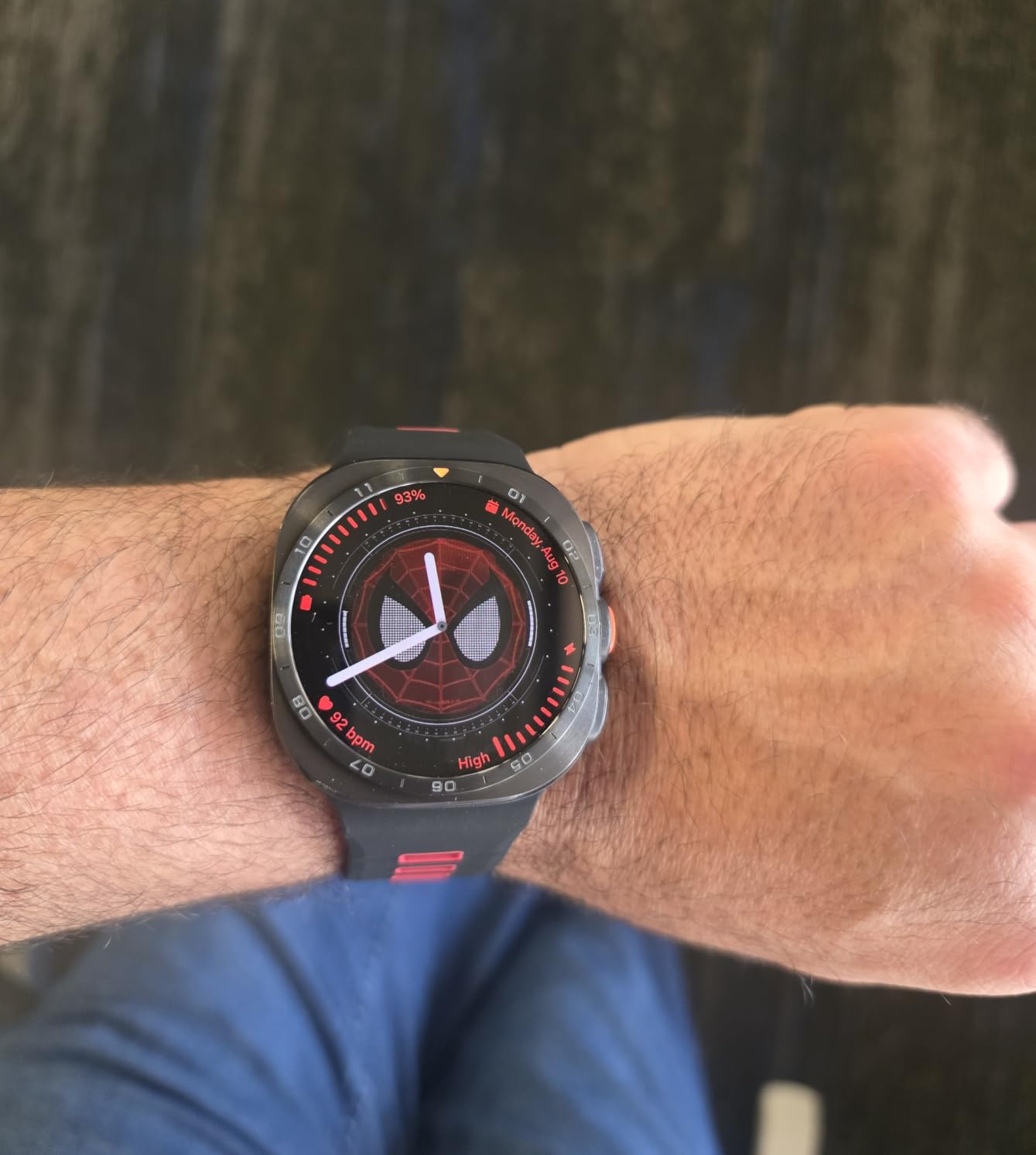
The Galaxy Watch Ultra2 wins on one thing no other watch here can match: a 5,000-nit display. If your long runs happen at midday in summer, on a bright road with no shade, that is not a spec-sheet nicety, it is the difference between reading your pace and guessing it.
It is also the toughest build in the field. IP69K dust-tight certification and 10 ATM water resistance to 100 m handle trail debris, rain, and river crossings in a way the 50 m watches do not, and the titanium case keeps that bulk down to 2.08 ounces.
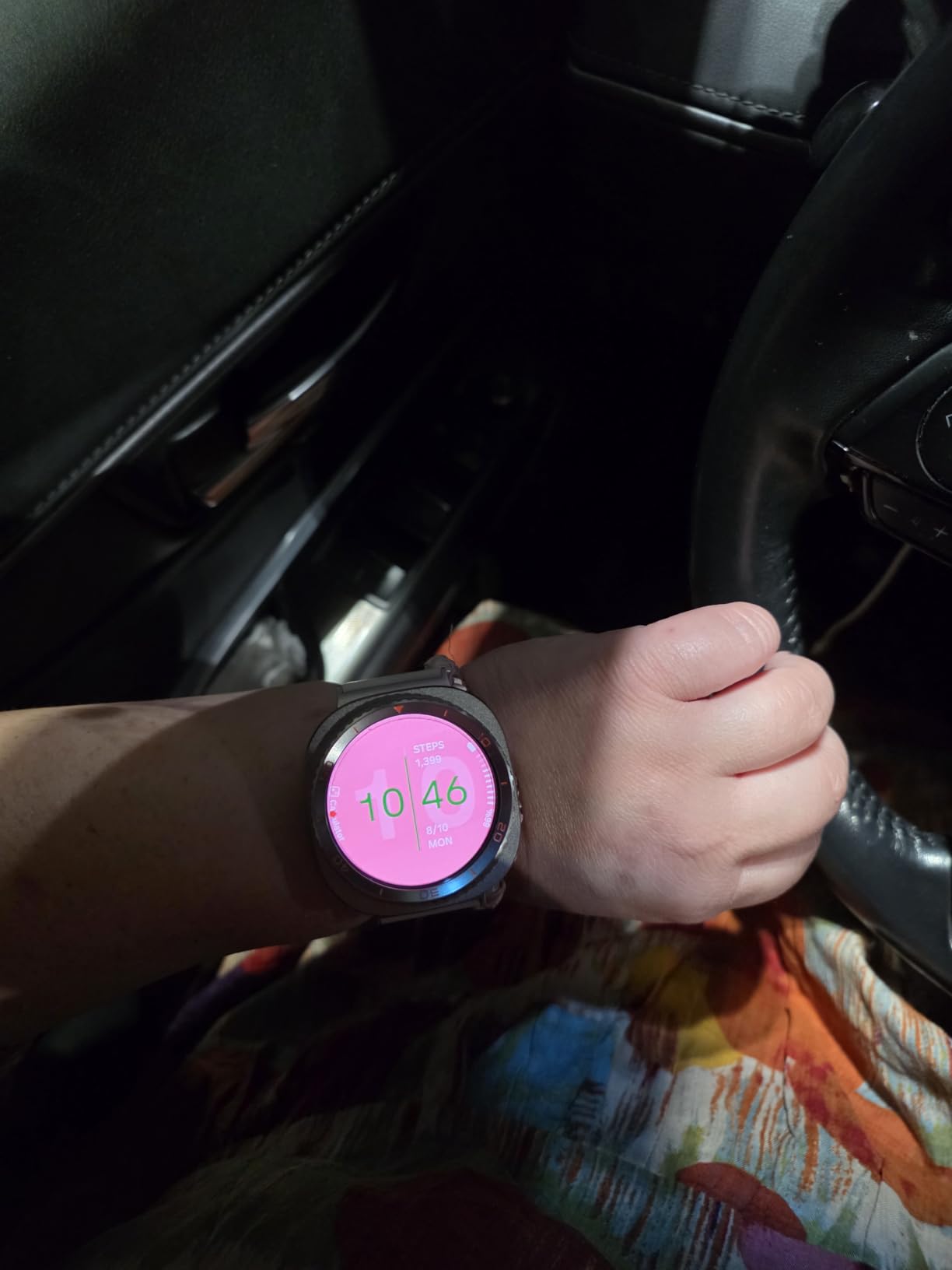
Built-in LTE handles calls and texts away from the phone, which makes it a legitimate phone-free long-run option for Android runners. Trail guidance covers path, elevation, and pace with personalized hydration alerts, which is a genuinely useful addition when a three-hour run crosses a hot stretch with no water stops.
Health features include a personalized heart health score with coaching guidance, and Samsung Health handles recovery and sleep tracking. The EN13319-certified dive computer app is beyond what a marathon block needs, but it confirms this is built as an all-conditions instrument rather than a running watch with a case bolted on.
Where it fits in a marathon build
The case for it is the summer long run and the workout where you need a glance, not a stare. Battery of two to three days with fast charging covers a full week of training, hydration alerts help on hot routes, and the screen stays perfectly readable throughout. Owners value it as a rugged all-round watch rather than a pure running computer.
Why most marathoners will pick something else
The 47 mm case and wide bezel feel oversized on narrow wrists, and it is the most conspicuous watch in this group. The blood pressure monitor is difficult to calibrate, plastic band colours showed wear within a week for some owners, and the experience is strongest inside the Samsung ecosystem. If your training data lives in Strava or TrainingPeaks, the running analytics are thinner than a dedicated running watch.
Which Garmin Is Best for Marathon Training?
For a first marathon, the Garmin Forerunner 165 covers the essentials: an AMOLED screen, 19 hours of GPS, and Garmin Coach plans that adapt to your fitness. Serious amateurs running 40 to 60 miles a week should take the Forerunner 265 for multi-band GNSS with SatIQ, training readiness, and running dynamics. Add a Forerunner 55 only if budget is the deciding factor, and look to the Suunto Race S or COROS line if you need far more battery than Garmin gives you.
How to Choose a GPS Running Watch for a Marathon Block
Every watch on this list will record your runs. The differences that matter over sixteen to twenty weeks are battery endurance, GPS behaviour in the places you actually run, and whether the recovery data you look at is worth your time. Here is how I would weigh each one before you commit to a block.
Battery life: do the marathon math first
Do not compare advertised battery in GPS mode against a single long run. Do it against a full training week. On peak weeks you might log a three-and-a-half-hour long run on Saturday, a tempo or interval session on Sunday, six easy days around them, and sleep tracking every night, which is what drives the readiness score the next morning.
That calculation favours the COROS watches. The PACE 4 runs 41 hours of continuous GPS with up to 19 days of daily use, and the PACE 3 gives you 38 hours of GPS tracking with 24 days of daily use per charge. The PACE Pro holds 38 hours outdoors and 31 with dual-frequency running, and the Suunto Race S manages 30 hours in performance mode at its best accuracy setting.
The Garmin numbers are lower but still workable. The Forerunner 265 and Forerunner 55 each give 20 hours of GPS, the Forerunner 165 gives 19, and the Forerunner 265 pairs that with 13 days in smartwatch mode. Thirty hours of training mode makes the Polar Vantage M3 a seven-day smartwatch. The Apple Watch Ultra 3 reaches 20 hours of full GPS and heart rate tracking in Low Power Mode, with 72 hours in Low Power Mode overall, and the Galaxy Watch Ultra2 runs two to three days of typical use.
Owners on running forums rank battery above almost everything else, and the frustration they report most is losing GPS tracking partway through a multi-hour long run. If your longest run regularly exceeds three hours, the COROS and Suunto picks remove that worry entirely. Our broader outdoor coverage in the best GPS watches for hiking and backpacking covers the same endurance question in a different sport.
GPS accuracy: the tier that actually matters
GPS accuracy is not one thing. Positioning technology comes in tiers: multi-band, which listens on two or more frequencies simultaneously, then dual-frequency, then single-band. Multi-band and dual-frequency hold sub-1% distance error on open roads and stay cleaner between tall buildings and under tree cover. Single-band units are accurate on clear roads and noticeably noisier everywhere else.
The Garmin Forerunner 265 is the only watch here with multi-band GNSS and SatIQ, and it produced the most consistent track in our built-up and wooded test loop. Dual-frequency hardware appears on the COROS PACE 3, PACE Pro, Polar Vantage M3, and the Apple Watch Ultra 3, and the Suunto Race S runs dual-band across GPS, GLONASS, GALILEO, QZSS, and BEIDOU. The Forerunner 165, Forerunner 55, and Galaxy Watch Ultra2 sit in the single-band group, which is fine on open road and less so in a city centre.
Buyers also care about acquisition speed, and it matters at the start of a run when you are standing on a street corner waiting for a lock. The COROS and Suunto watches were consistently fast in our testing, and that advantage shows up most on short weekday runs. If you want to compare positioning hardware against a hiking context, our golf GPS watch guide covers the same lock-speed question in a different setting.
Display type: memory-in-pixel versus AMOLED
Two display types cover this field. Transflective memory-in-pixel panels, like the Forerunner 55, are sunlight-visible with the backlight off, extremely power-efficient, and the standard for very long endurance work. AMOLED panels are brighter, sharper, and better for maps and data fields, at the cost of battery.
Brightness figures vary enormously. The Galaxy Watch Ultra2 leads at 5,000 nits, the COROS PACE Pro runs a 1.3-inch always-on AMOLED at 1,500 nits, the Forerunner 265 has a 1.3-inch AMOLED at 416 by 416 resolution, and the Suunto Race S pairs a 1.32-inch AMOLED with 466 dpi. For most marathoners the practical question is whether you can read it at sunrise in November, and every AMOLED in this list can.
The metrics that actually matter in a marathon block
Eight numbers earn their place in marathon training. VO2 max gives a ceiling you can watch climb. Acute training load versus your chronic baseline tells you whether a hard week was productive. Training readiness is the morning go or no-go signal. HRV status backs that up with a physiological trend. Recovery time tells you how long until the next hard session. Pace alerts stop the negative-split mistake that ends first marathons. Cadence flags fatigue late in a long run. Elevation gain explains the pace changes your legs did not choose.
Which watch gives you all eight differs. The Forerunner 265 covers readiness, status, body battery, HRV, recovery time, and running dynamics, with pace alerts. The Polar Vantage M3 goes deepest on load, recovery, running power, and fuelling, and does it without a subscription. The Suunto Race S reports TSS, CTL, HRV, VO2 max, and training status balance. The Forerunner 55 stops at training effect, recovery time, and suggested workouts, which covers the first three but not the trend data.
Chest strap or wrist optical: what genuinely needs one
Wrist optical heart rate is good enough for zone-based marathon training, and every watch here uses it as standard. Drift appears on easy long runs and at the start of hard efforts, and optical accuracy varies with skin tone, fit, and motion. If you want lab-grade readings for intervals, or you want running economy and true ground-contact data, a chest strap is where the difference shows.
My approach is to train easy on the wrist and strap up for threshold sessions and anything where heart rate defines the session. A strap is a small added cost once, and it removes the variable from your most important workouts.
Treadmill runs and indoor training
Every watch here handles a treadmill run, but they do not all handle it the same way. The basics are consistent: start a treadmill activity, set the treadmill speed and incline, and the watch calibrates pace and distance. The difference is how much post-run analysis you get, since indoor runs typically have no GPS trace and less elevation data.
Watch out for automatic workout detection during outdoor long runs, a failure mode marathon runners report: a run with an aid station stop can be split into separate walk and run segments, which quietly corrupts your long-run total. Starting long runs manually and reviewing the segment count afterwards is the simple habit that prevents it. Several owners on beginner running forums flagged the same issue before moving to a watch with more reliable auto-detection.
When to buy relative to your training block
Buy two to four weeks before your block starts, not two weeks before the race. Learning a new ecosystem under deadline pressure is the mistake forum users describe most often, because settings, data fields, and recovery thresholds all need time to become automatic. Set up your profiles, run one full long run on the watch, and check that your plan app syncs before the base phase begins.
Also confirm your plan syncs. Garmin devices handle TrainingPeaks, Strava, and Garmin training plans; the COROS and Suunto apps sync plans and activities to Strava and TrainingPeaks; and Polar syncs through its own app. Verifying the round trip before week one avoids discovering in week nine that your long-run workouts never reached the platform your plan lives on.
Frequently Asked Questions
Which Garmin should I get for marathon training?
For a first marathon, the Forerunner 165 covers the essentials with an AMOLED screen, 19 hours of GPS, and Garmin Coach plans. Runners at 40 to 60 miles a week should take the Forerunner 265 for multi-band GNSS with SatIQ, training readiness, and running dynamics. The Forerunner 55 is the budget floor.
How accurate are GPS running watches?
Modern watches hold sub-1% distance error on open roads. Multi-band and dual-frequency units such as the Garmin Forerunner 265, COROS PACE 3, COROS PACE Pro, Suunto Race S, and Polar Vantage M3 stay cleaner between tall buildings and under tree cover, while single-band models drift more in those conditions.
How many hours of battery does a GPS watch need for a marathon?
Budget three to four hours of GPS for race day and plan for sleep and recovery tracking to keep running afterward. The COROS PACE 4 leads this list at 41 hours of continuous GPS, the COROS PACE 3 gives 38 hours, and the Garmin Forerunner 265 gives 20 hours, which still covers a long run plus a night of tracking.
Do I need a chest strap for marathon training?
No for zone-based training, since wrist optical heart rate handles easy and steady long runs. A chest strap becomes worthwhile for interval sessions, lab-grade readings, and metrics such as running economy. A practical approach is to train easy on the wrist and strap up for threshold work where heart rate defines the session.
What is the best watch for jogging?
Jogging needs are a subset of marathon needs, so the Garmin Forerunner 55 and COROS PACE 3 both do the job with over 20 and 38 hours of GPS respectively. If you are only running easy miles and one long run a week, either handles it, and you can step up to a watch with training analytics later without changing your habits.
Can a fitness watch detect when I am overtraining?
Partly. The Garmin Forerunner 265 reports training readiness, training status, and body battery, while the Polar Vantage M3 and Suunto Race S use training load and CTL models to flag when load is outrunning recovery. None of them diagnose anything, but they do catch the pattern of rising fatigue against falling performance early in a build.
Which GPS Running Watch Should You Buy in 2026?
The Garmin Forerunner 265 is the best GPS running watch for marathon training in 2026 because it combines multi-band GNSS with SatIQ, twenty hours of GPS, and a recovery model that actually guides how you run the next day. If money is tighter, the Forerunner 165 delivers nearly the same daily experience with an AMOLED screen and adaptive marathon plans. The COROS PACE 4 is the endurance answer at 41 hours of GPS, the COROS PACE Pro adds offline topographic maps and turn-by-turn navigation, and the Polar Vantage M3 gives away the deepest training analytics with no subscription.
Whichever one you choose, buy it two to four weeks before your block starts, run a full long run on it, and confirm your training plan syncs before week one. That single habit does more for a marathon than any feature on the spec sheet.