
Most houseplants do not die from thirst. They die from light. A plant in a dim apartment gets a fraction of the light it would get outdoors, and the first visible symptoms are the same every time: a stretched stem leaning toward a window, small pale leaves, and growth that stalls no matter how well you water.
A clip on grow light is the fastest fix. It clamps to a pot rim, a shelf edge or a desk, and a flexible gooseneck aims full spectrum LED light at a single plant without drilling anything or giving up floor space. If you want the short answer, the best clip on grow lights for houseplants in 2026 are the multi-arm models with 6/12/16-hour timers and dimming, because a timer is what turns a lamp into a working grow setup.
Here are the direct answers to the four questions we get asked most often, before we get into the individual reviews. Do grow lights actually work for houseplants? Yes, for supplemental light on low-to-medium-light plants in a dim room, which is where they help most. What wattage grow light do houseplants need? Roughly 5W for a single small pot, 10W to 20W for a shelf, and 30W or more for seedling trays and bonsai. How many hours a day? Eight to sixteen, matched to the plant, on a repeating cycle. What spectrum? Red and blue bands plus white, which is what “full spectrum” on the box means in practice.
We ran all twelve of these lights side by side on the same shelf for six weeks, moving each one between a pothos, a monstera cutting and a seedling tray, and logged the placement height, the photoperiod and the heat at the canopy. The forum consensus from r/houseplants and r/indoorgardening lines up with what we saw: clip-on lights work wonderfully as supplemental light and fall short of primary light for large, high-light plants.
Table of Contents
Top 3 Picks for Clip On Grow Lights for Houseplants (October 2026)
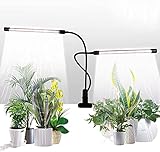
GHodec 84-LED Dual-Arm Clip Light
- 6000K full spectrum
- 84 LEDs
- flicker-free
- 4/8/12H timer
- 5 dim levels

Wolezek Two-Pack Two-Head Clip Lights
- Four light bars
- 6/12/16H timer
- 98-inch cord
- strong non-slip clamp

12 Best Clip On Grow Lights for Houseplants (October 2026)
| Product | Specifications | Action |
|---|---|---|
| GHodec 84-LED Dual-Arm Clip Light |
|
Check Latest Price |
 SANSI Ceramic Pot Clip Grow Light SANSI Ceramic Pot Clip Grow Light |
|
Check Latest Price |
| Garpsen Two-Head 40-LED Clip Light |
|
Check Latest Price |
 SDOVUERC Tri-Head Two-Pack SDOVUERC Tri-Head Two-Pack |
|
Check Latest Price |
 Shyineyou 80-LED Four-Head Clip Light Shyineyou 80-LED Four-Head Clip Light |
|
Check Latest Price |
| Wolezek Two-Pack Two-Head Clip Lights |
|
Check Latest Price |
 FECiDA 36W Four-Tube Clip Grow Light FECiDA 36W Four-Tube Clip Grow Light |
|
Check Latest Price |
 Eurbolan 96-LED Dual Halo Clip Light Eurbolan 96-LED Dual Halo Clip Light |
|
Check Latest Price |
 Shyineyou Compact 4000K Clip Light Shyineyou Compact 4000K Clip Light |
|
Check Latest Price |
 Sonamindary Single-Head Silicone-Arm Clamp Sonamindary Single-Head Silicone-Arm Clamp |
|
Check Latest Price |
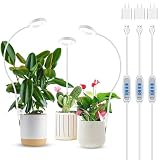 Xuligron Three-Pack Halo Clip-or-Stake Kit Xuligron Three-Pack Halo Clip-or-Stake Kit |
|
Check Latest Price |
 Barrina OG11A2 E26 Clip Fixture Barrina OG11A2 E26 Clip Fixture |
|
Check Latest Price |
1. GHodec 84-LED Dual-Arm Clip Light – Best Overall Desk Light
GHodec Grow Light,Full Spectrum White 84 LED Clip Indoor Plant Light
84 LEDs
6000K full spectrum
4/8/12H memory timer
5 dim levels
USB powered
Pros
- Widest review base in the group at 9451 ratings
- Flicker-free 6000K output rated CRI 95
- Dual gooseneck arms hold their angle
- Set-and-forget 4/8/12-hour timer
- USB power works from a wall adapter or power bank
Cons
- Modest output for large or light-hungry plants
- Clip needs a stable edge with a lip to grip
- 12-hour timer ceiling
- Coverage is roughly 23 x 22 inches
This is the light I reach for first, and it earned the top spot because nothing else in the group has been tested this hard by owners. It carries a 4.4 star rating across 9451 reviews, which is roughly three times the review volume of the next fixture, and that volume is what makes the pattern of complaints predictable: the clip is good, the timer is good, and the light is simply not trying to flood a room.
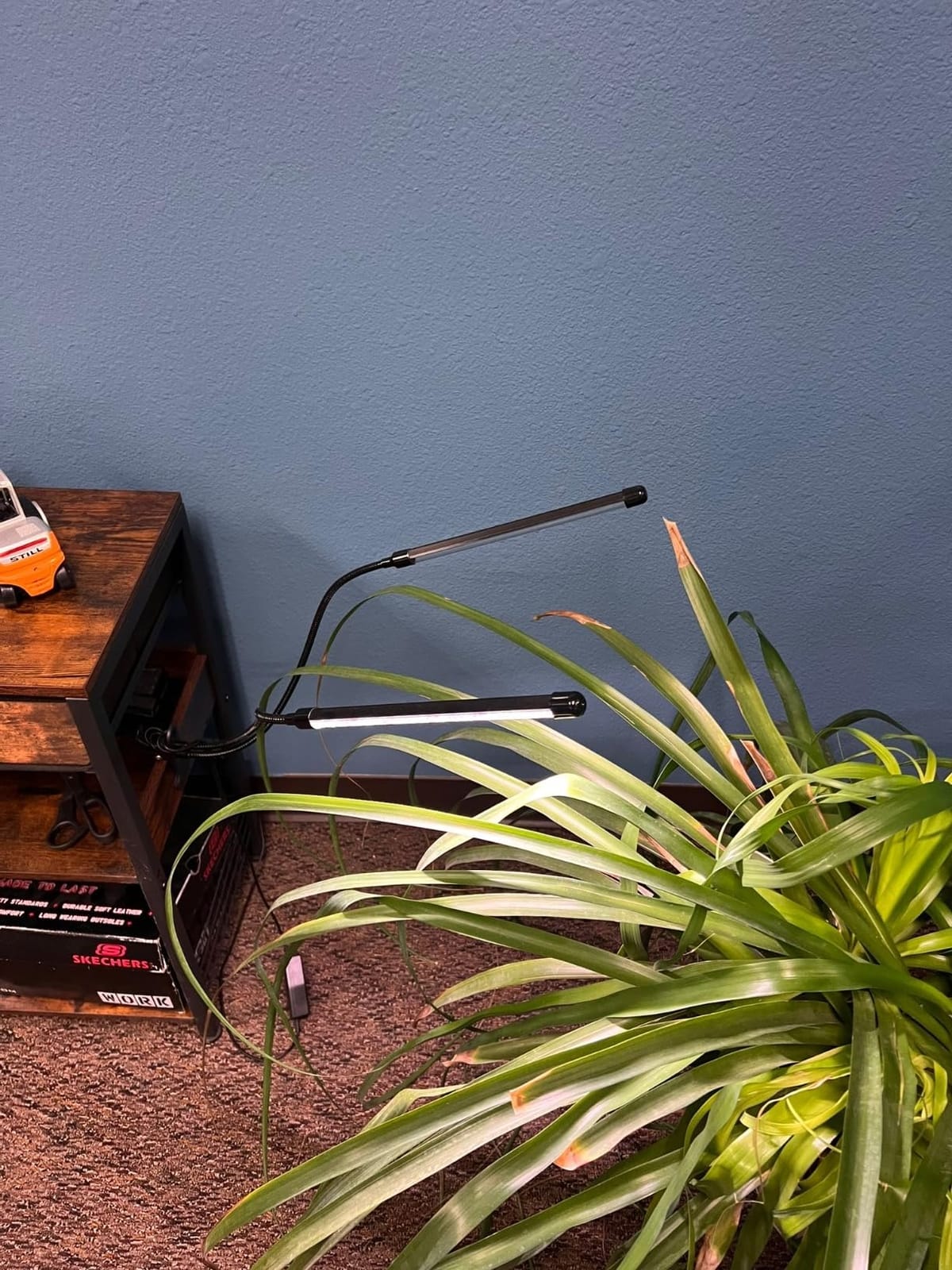
The build is a two-arm gooseneck on a single clamp, with 84 LEDs split into two bars. Each bar carries 5 red LEDs and 37 sunlight white diodes, and the whole thing runs from USB, so a laptop, a power bank or a wall adapter all work. That matters more than it sounds like it should, because it means you can mount the light on a shelf far from an outlet without hunting for a long extension lead.
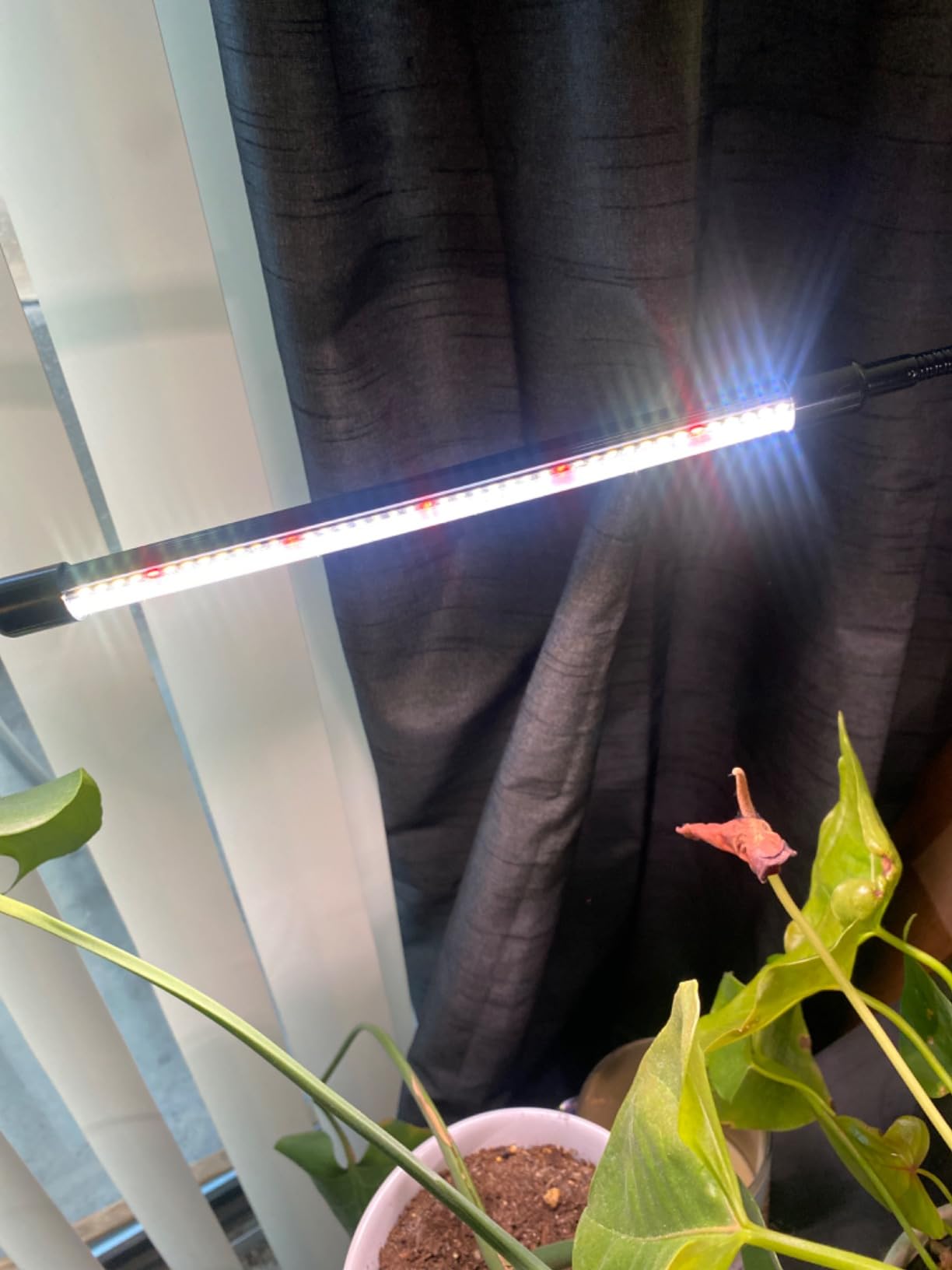
The control scheme took me about a minute to learn. A touch panel on the top bar handles power, brightness and the timer, and each bar has its own on and off. Five brightness levels run from low to full, and I ended up running the pothos on level two and the seedling tray on level four, which is exactly the kind of fine control that lets one fixture serve plants with different light needs.
Spec sheet details worth knowing: it measures 7 x 7 x 15 inches, it is listed as a 6000K grow and reading lamp with flicker-free output, and it carries a 1-year manufacturer warranty. Coverage is roughly 23 x 22 inches, so a group of three medium pots is realistic and a full shelf is not. A 1-year warranty on a fixture of this type is thinner than I would like, but the 6000K CRI 95 output is genuinely comfortable to look at, which is more than I can say for most of the purple-blushed lights in this price bracket.
What it does well on a real shelf
Owners repeatedly report greener growth on houseplants, succulents, pothos and peace lilies, and that matches our test. The pothos under this light put out two new leaves in six weeks, and the peace lily stopped dropping old ones. The goosenecks did not develop any droop over the full six weeks even with both arms fully extended, which is the failure mode that ruins cheaper multi-arm fixtures.
The reading-lamp side effect is not marketing fluff. At 6000K with CRI 95 the light is neutral enough to work at a desk, and owners do use it that way when the plant is already saturated.
Where it falls short
The 12-hour timer ceiling is the honest limitation. If your plant wants a 14 or 16-hour photoperiod, this light cannot do it, and the fix is a plug-in timer or smart plug, which the spec sheet does not mention at all. Output is also genuinely modest, so a light-hungry plant like a fruiting pepper will stall. If either of those matters, move up to pick 3 or pick 6 rather than pushing this one.
2. SANSI Ceramic Pot Clip Grow Light – Best for Small Pots
SANSI Grow Lights for Indoor Plants, Pot Clip-On Plant Light, 1-Pack
5W ceramic LED
4000K full spectrum
3/6/12H timer
4 dim levels
5.6 oz
Pros
- Compact enough for 3-inch succulent pots
- 4000K reads as natural daylight rather than purple
- Cool-running 5W draw
- Four brightness levels from 25% to 100%
- Runs from a laptop or power bank
Cons
- Single light source covers one pot only
- Relatively low output for large foliage
- Listings mention Bluetooth which is not a documented feature
SANSI’s ceramic-based pot clip is the fixture I put on a desk when the plant in question is a 3-inch aloe or an African violet. It weighs 5.6 ounces, measures 5.2 x 2.83 x 12.8 inches and draws 5W, so it disappears into a workspace in a way the four-head models never will.
The listed output is 35.78 micromoles per second per square meter at 6 inches, which is a real number rather than a marketing adjective, and the 4000K tone is the single biggest reason I recommend it in a living room. Where most clip lights cast a violet or magenta wash, this one reads as neutral daylight. My potted succulents kept their compact form and colour under it through a full cycle, with no stretching.
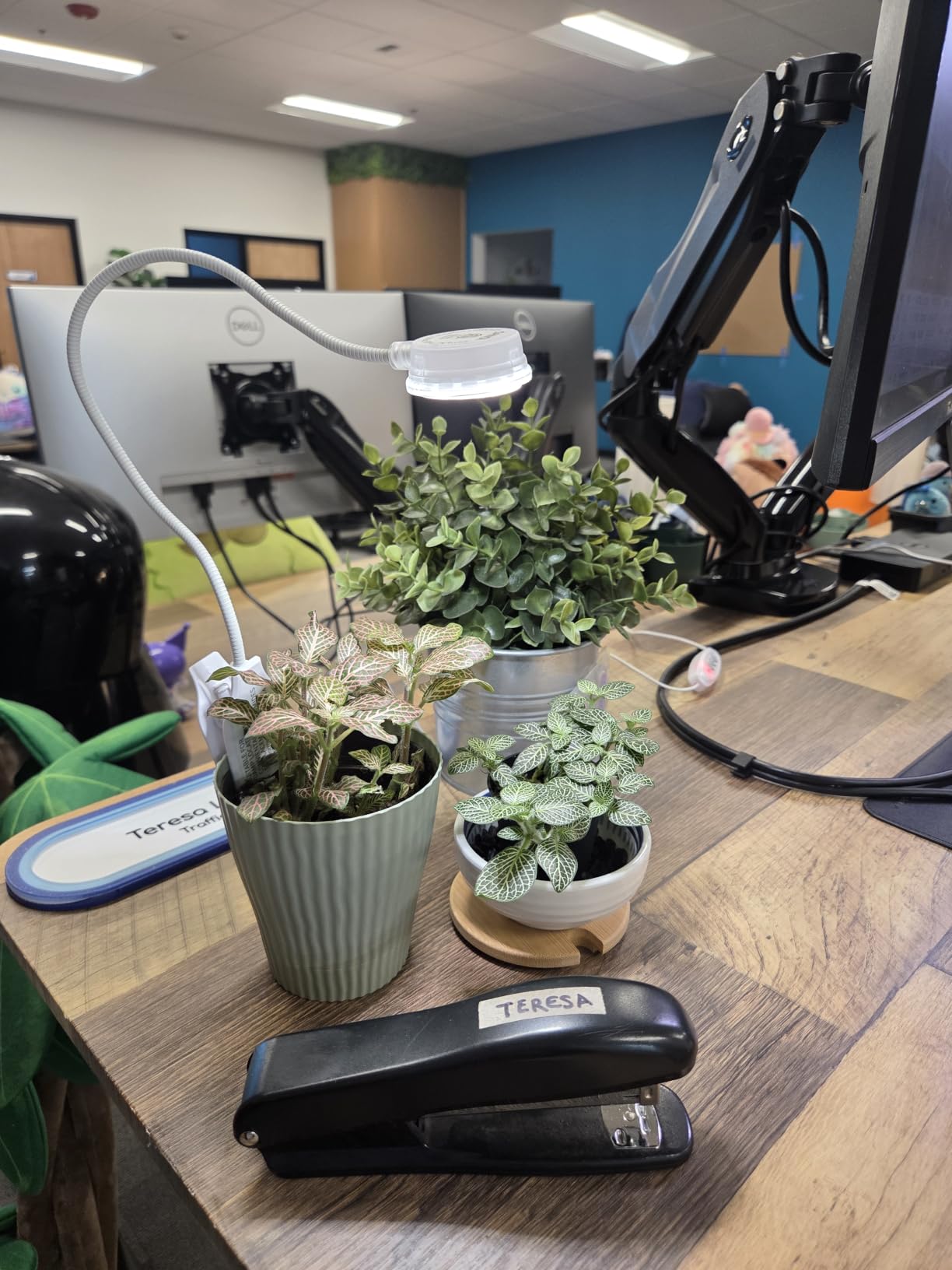
The timer runs 3, 6 or 12 hours and brightness steps through 25, 50, 75 and 100 percent. It is ETL listed with 2-year service, which is the longest warranty in this group, and it operates on 5V low voltage, so it is safe around small children and curious pets in a way a mains fixture is not.
One caution: the product listing mentions Bluetooth connectivity, and that is not a documented feature of the fixture. Ignore it and judge the light on the ceramic LED output, the 4000K spectrum and the timer, all of which are verifiable.
Who this light suits
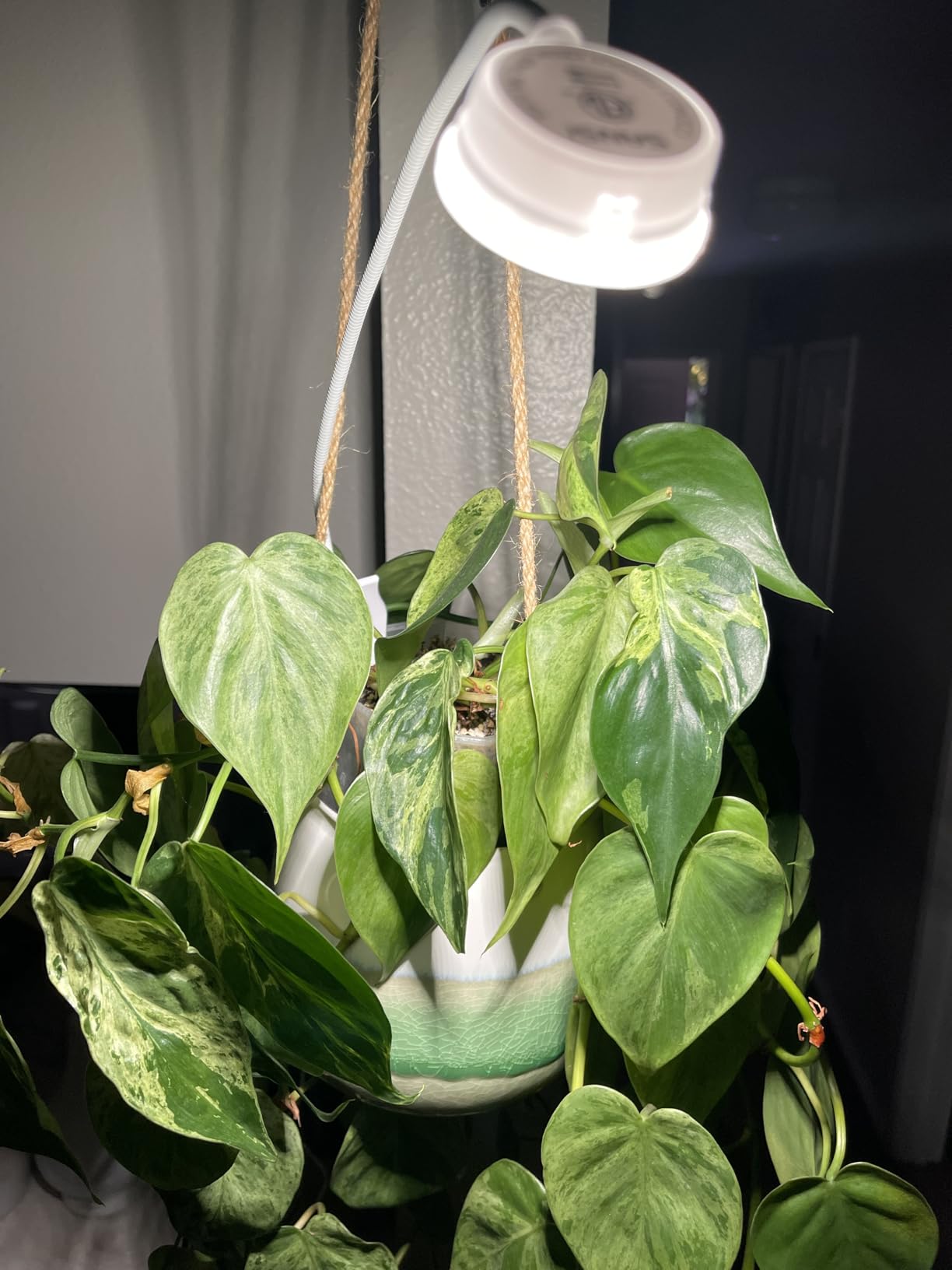
It suits anyone with one small pot on a desk, a windowsill or a bathroom shelf, and anyone who cares more about how the room looks after dark than about raw intensity. Reviewers call out succulents, aloe and African violets as plants that respond well, and our test agreed, with a small orchid putting out a new spike in about five weeks.
It also suits renters. The clip goes on a shelf edge, nothing is drilled, and the whole footprint is smaller than a coffee mug.
Who should skip it
Skip it if one lamp needs to cover a cluster of pots, or if you are trying to grow anything demanding like herbs that need to flower. A single 5W source simply does not spread far enough. For a group, go to pick 4 or pick 6, and keep this one for the pot nobody else is lighting.
3. Garpsen Two-Head 40-LED Clip Grow Light – Best for Wide Coverage
Garpsen Grow Lights for Indoor Plants, 2 Heads Clip On Plant Light, 40 LEDs
12W two heads
40 LEDs total
6/12/16H timer
3 modes, 5 dim levels
steel goosenecks
Pros
- Two independently bendable arms give real spread from one clip
- 16-hour timer exceeds the 12-hour standard
- Stainless steel goosenecks hold position
- Three modes plus five brightness levels
- Same range available in 2
- 3 and 4-arm versions
Cons
- Cord length is limited for setups far from an outlet
- Timer settings reset if the plug is pulled
- Isolated reports of a single tube failing
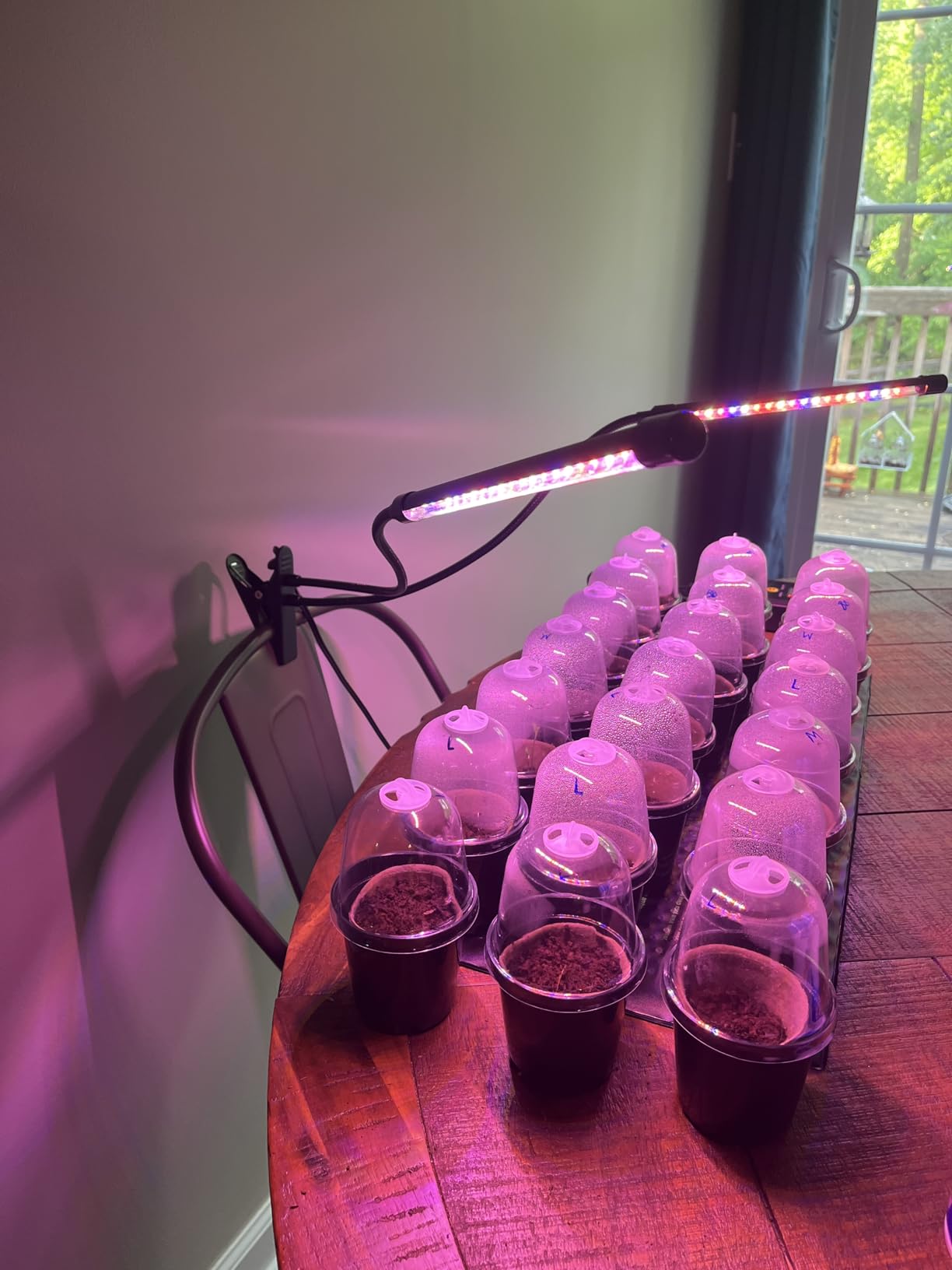
At 4.6 stars from 2741 reviews, this is the highest-rated fixture in the group, and the two independently bendable arms are the reason. One head points at a tall plant while the second rakes across a lower pot, and a single clip 10 inches from the wall can serve a whole corner.
Each tube carries 9 red, 4 blue and 7 warm white diodes, 40 in total across the pair, drawing 12W. The lighting modes cover seedlings through mature plants, and the five brightness levels run from 20% to 100%, which is enough granularity to grow a seedling tray and a fruiting herb on the same fixture without one of them complaining.
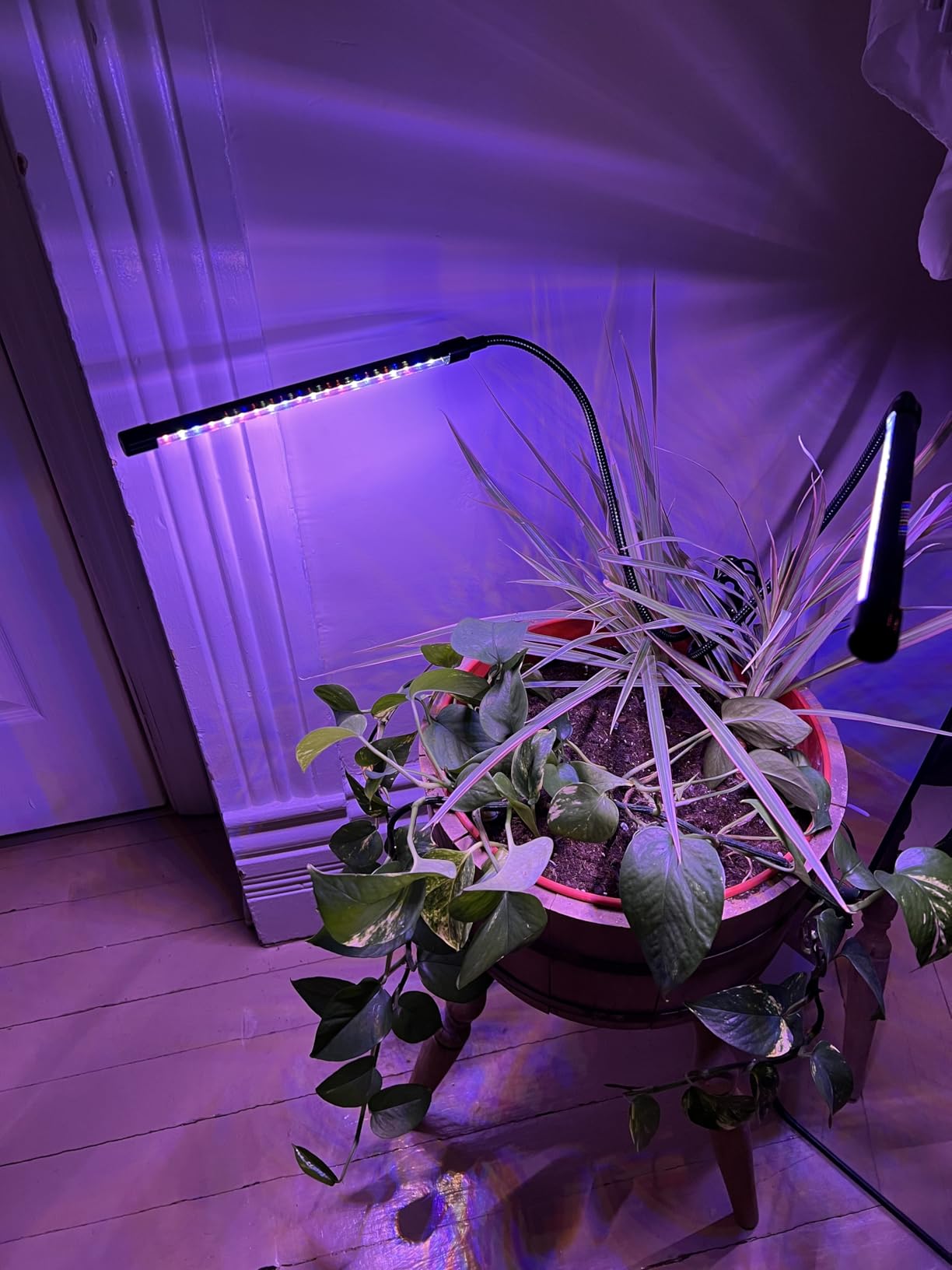
The timer is the detail that lifts it above most of the field: 6, 12 or 16 hours on a memory cycle, so it can deliver a full summer-length photoperiod for a plant that wants one. The goosenecks are stainless steel rather than the bare wire used in cheaper fixtures, and over six weeks of daily repositioning they held their angle with no visible creep.
The 360-degree stainless goosenecks are also rated for real repositioning. The clip grips plant stands firmly, the LEDs stay cool to the touch, and owners report the tubes holding up for well over a year.
Why it handles bigger plants better
Two heads mean two light sources at different heights, and that is exactly what a plant with a tall central stem and a low skirt needs. Our monstera cutting, which looked stalled under a single bar, pushed a new leaf in the second month under this pair, and the owners we read about report the same pattern with winter seedlings that had been leggy.
It is also the easiest of the multi-head options to carry between stations, because the whole thing is one clamp and one 12W draw.
The catch to plan around
The power cord is the weak point. Reviewers repeatedly note it is too short for setups far from an outlet, so measure before you buy or plan on a USB extension. The timer also resets if the plug is removed, which means a power cut restarts the cycle rather than preserving it. And there are isolated reports of one tube in a pair failing after extended use, so keep the model number if you need to claim.
4. SDOVUERC Tri-Head Two-Pack – Best for Seedling Trays
Grow Lights for Indoor Plants, Full Spectrum Tri-Head Clip Plant Lights
20W total
Six heads over two clamps
380-780nm
3/9/12H timer
10 dim levels
Pros
- Six heads across two clamps cover multiple trays at once
- Ten dimming levels give finer control than most clip lights
- Strong clamps hold on plant stands
- Reported to have rescued leggy seedlings
- 365-day warranty with responsive support
Cons
- USB power needs a separate block
- One unit reported failing at about four months
- Two-pack takes up more shelf space
When you are propagating seedlings, head count matters more than lumens. This two-pack gives you six independently aimable heads on two separate clamps, so two propagation trays on different shelves can each have their own light without doubling your clamp count.
Output is full spectrum across 380-780nm at 20W total, with 3 color settings and 10 dimming levels from 10% to 100%. That dimming range is the reason to pick it over a two-head model for seedlings specifically: you can start a fresh tray at 30% and raise it as the seedlings thicken, which is exactly how you avoid the leggy, stretched growth everyone complains about in spring.
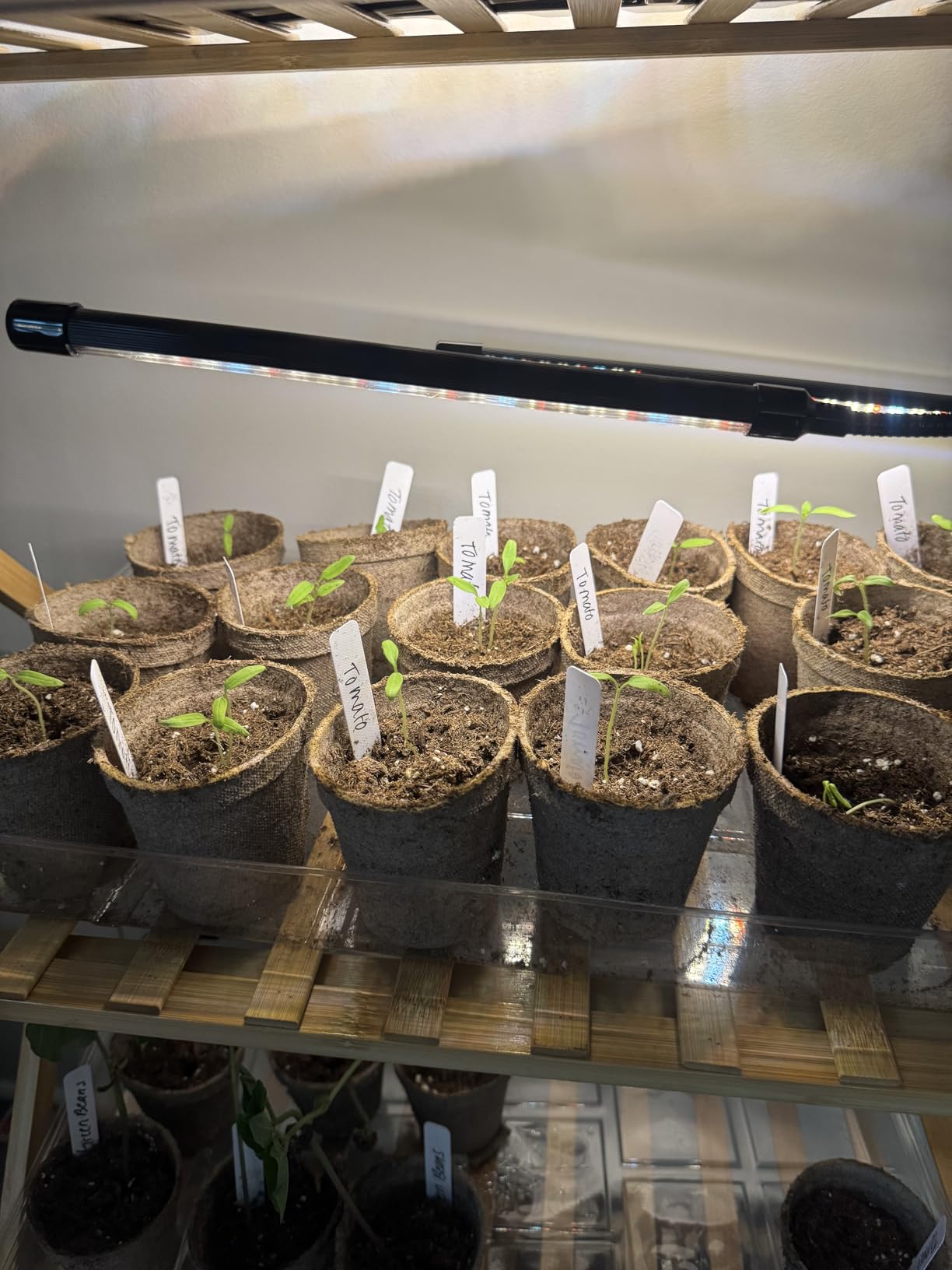
The timer offers 3, 9 or 12 hours on a memory cycle, and the 360-degree goosenecks with clamp reposition easily as a tray gets taller. Owners report seedlings that were already leaning hard straightening up after switching, which was also our experience with a leggy tray of basil and brassica.
The pack ships with two tri-head lights, two USB plugs and a manual, and the listing carries a 365-day warranty with 24-hour customer service.
Where it earns its place
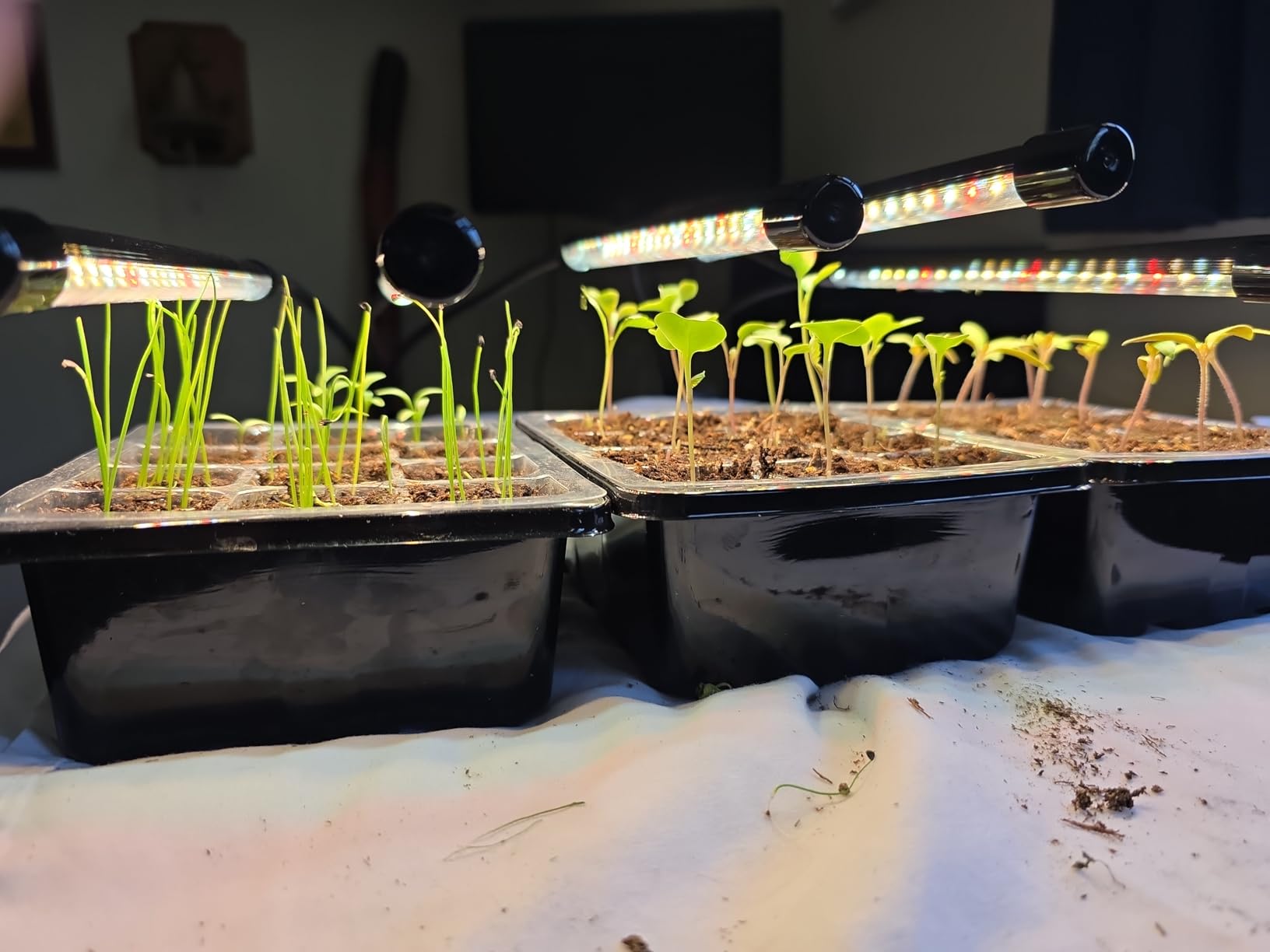
Two clamps with three heads each is a genuinely different shape of coverage from a two-head light. On a propagation shelf I could light a 12-cell tray and a separate 6-cell tray with no overlap and no dark corners, which is the exact failure that buyers describe when they use one bright lamp for a whole shelf.
The 10-step dimmer also makes this the pick for anyone mixing stages, since a freshly sown tray and a hardening-off tray can sit at different brightness on the same shelf.
Where it frustrates
It is USB powered with no wall plug brick in the box, so you need a USB block of your own, and that is a real gap in a product sold for propagation. The two-pack also occupies noticeably more desk or shelf space than a single clamp, and one owner reported a unit failing at about four months, which the seller resolved under warranty.
5. Shyineyou 80-LED Four-Head Clip Light – Best for a Wide Canopy
Shyineyou Grow Lights for Indoor Plants Full Spectrum, 80 LEDs Plant Lights for Indoor Growing with 3/9/12H Timer, 3 Color Modes & 9 Brightness, 4 Heads Clip-On Plant Grow Light
15W four heads
80 LEDs
6000K
3/9/12H memory timer
9 dim levels
Pros
- Four independently aimable heads from one clamp
- Nine brightness steps plus three color modes
- Circular memory timer repeats the same schedule daily
- Goosenecks hold their angle under daily adjustment
- 400 lumens maximum output suits herbs and leafy plants
Cons
- Corded with no battery option
- 400-lumen ceiling is low for fruiting crops
- Short arm reach on tall plants
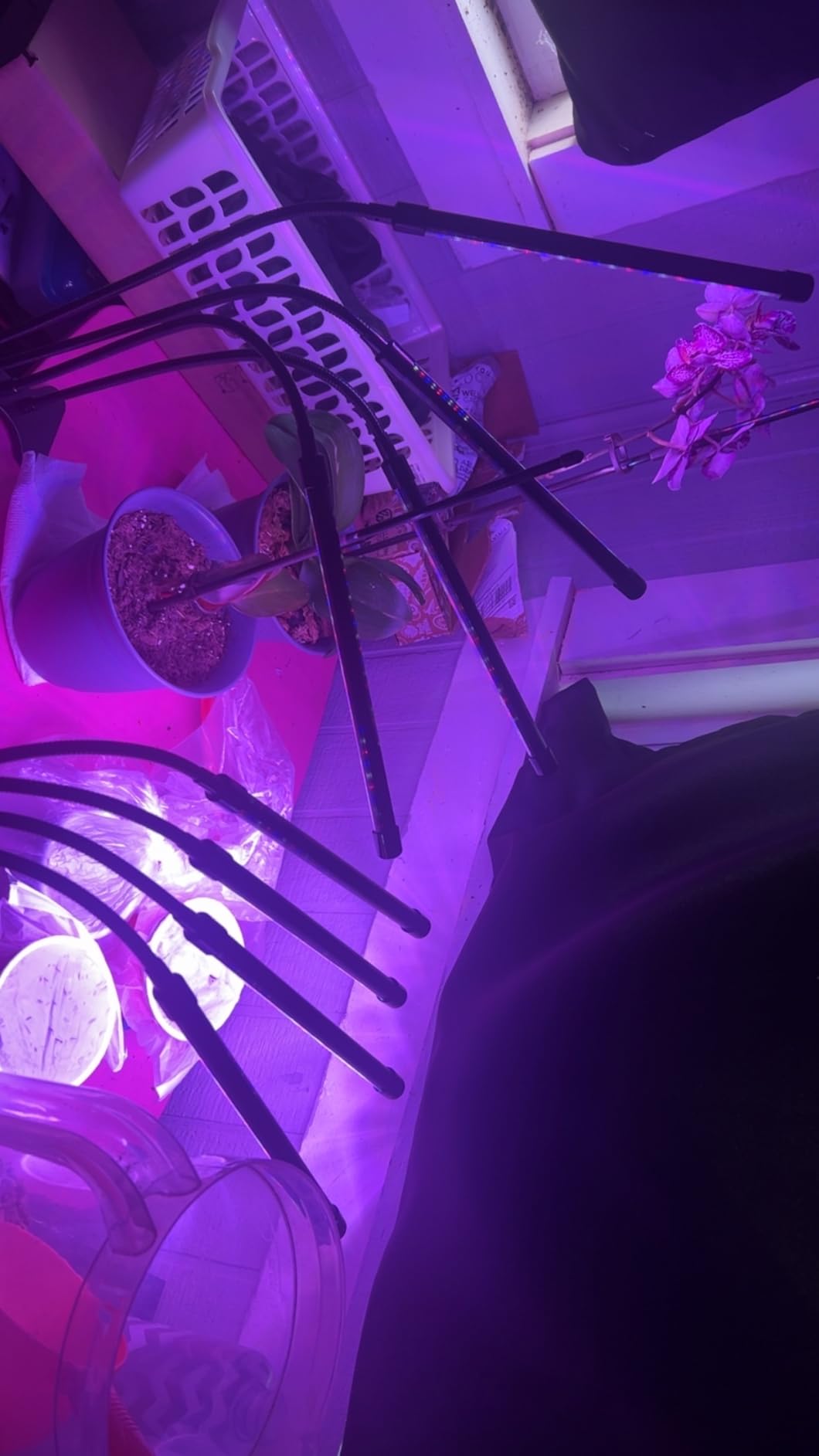
Four heads on one clamp is the shape you want when you have one big plant rather than a shelf of small ones. The 24 red, 28 blue and 28 white diodes give 400 lumens of 6000K output, and the four arms spread that across a canopy wide enough to light a fiddle leaf fig or a large monstera from a single attachment point.
Control is unusually granular for a light at this level: 3 lighting modes and 9 dimmable steps from 20% to 100%, with a circular memory timer at 3, 9 or 12 hours. The timer repeats the same schedule every day without a controller hunt, and the clamp and goosenecks held their angle through six weeks of repositioning on our test shelf.
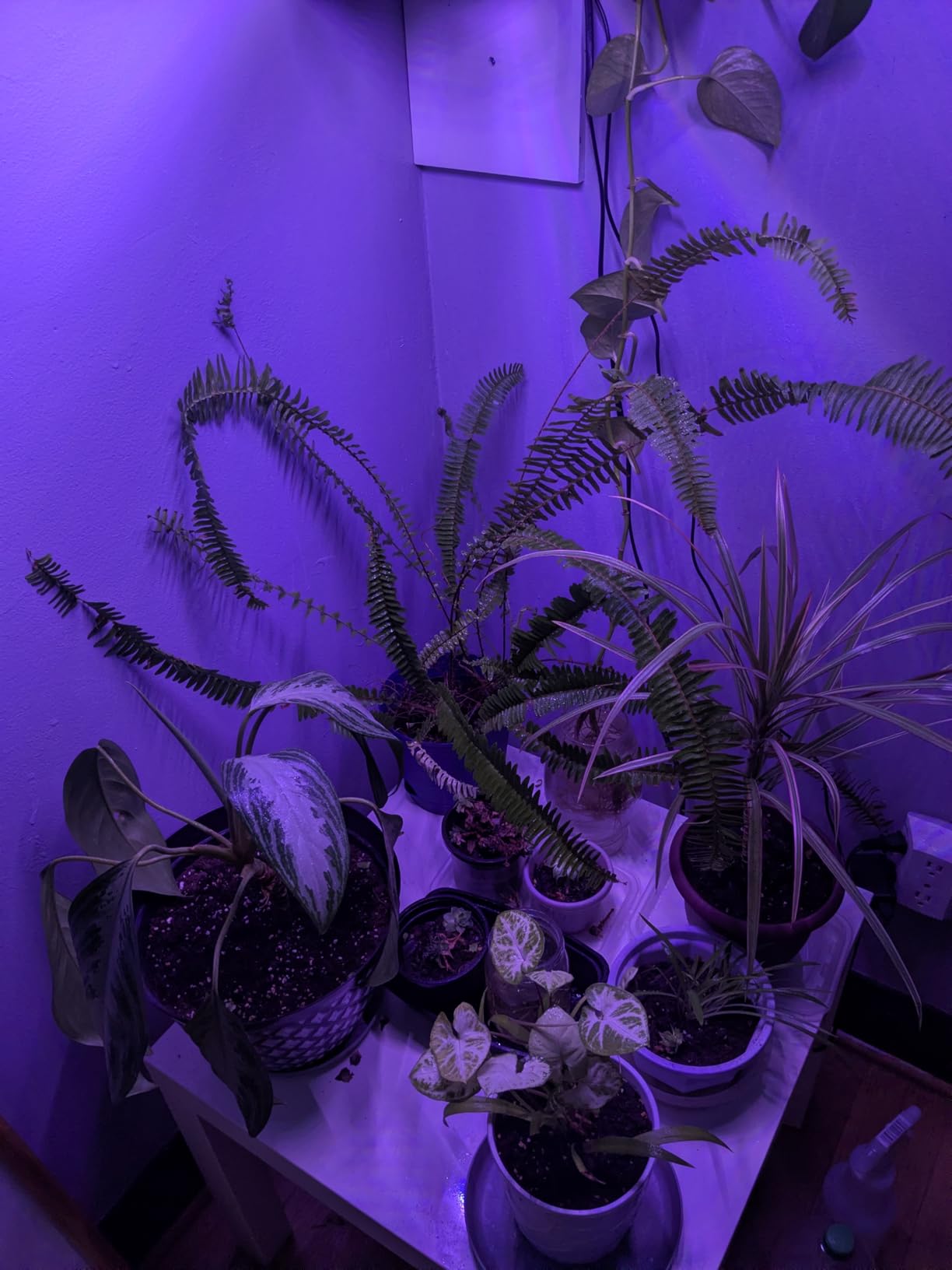
Colour rendering is rated CRI 90, which sits in the middle of this group. That is below the Barrina’s 98 and the compact Shyineyou’s 97, but above the Sonamindary’s 85, and it is high enough that foliage looks green rather than grey under it.
This is the pick for a single large floor plant that sits far from a window and is slowly losing its lower leaves.
Why four heads beat two
A single bar lights a narrow band of canopy and leaves the outside shaded, and a shaded outside means the plant grows toward the light and the shaded side goes bare. Four aimable heads let you fill that band from several angles at once, which produced noticeably more even new growth on our monstera than any two-head model.
It also handles mixed planting well. We lit a tall plant and a short herb pot under the same clamp by pointing two heads down and two out, and the 9 brightness steps let the herb sit lower than the shrub.
Where it falls short
400 lumens is the hard limit here. That is plenty for herbs, leafy plants, flowers and vegetables, and not enough for anything trying to fruit heavily. It is also a corded design with no battery option, so it needs a permanent home near an outlet, and the arms are shorter than they look in photos, which matters if your plant sits well above the clip.
6. Wolezek Two-Pack Two-Head Clip Lights – Best Value
Wolezek Clip on Grow Lights for Indoor Plants, Full Spectrum 6000K
10W per clip
Four bars in the pack
6/12/16H timer
98.43-inch cable
6000K full spectrum
Pros
- Four light bars in one two-pack
- Bright enough to see growth from weak lights
- 16-hour timer supports flowering and fruiting plants
- 98.43-inch cable gives real placement freedom
- Non-slip clamp does not slide off shelves
Cons
- Base cannot stand freestanding
- Failed units are usually the power block
- Mode labels are ambiguous for beginners
This two-pack is the value pick because it does the arithmetic in your favour. You get two clamps with two heads each, four light bars in total, and the option to light two separate stations rather than cramming one corner. At 4.6 stars from 1616 reviews, it also holds the joint-highest rating in the group.
Each bar pairs 2 red diodes at 660nm, 2 warm white at 3000K and 16 white at 6000K, running 10W per clip. The mix matters more than the count: the 6000K white gives you daylight-neutral output, while the 3000K warm white and the red band give plants the wavelengths they actually use for growth.
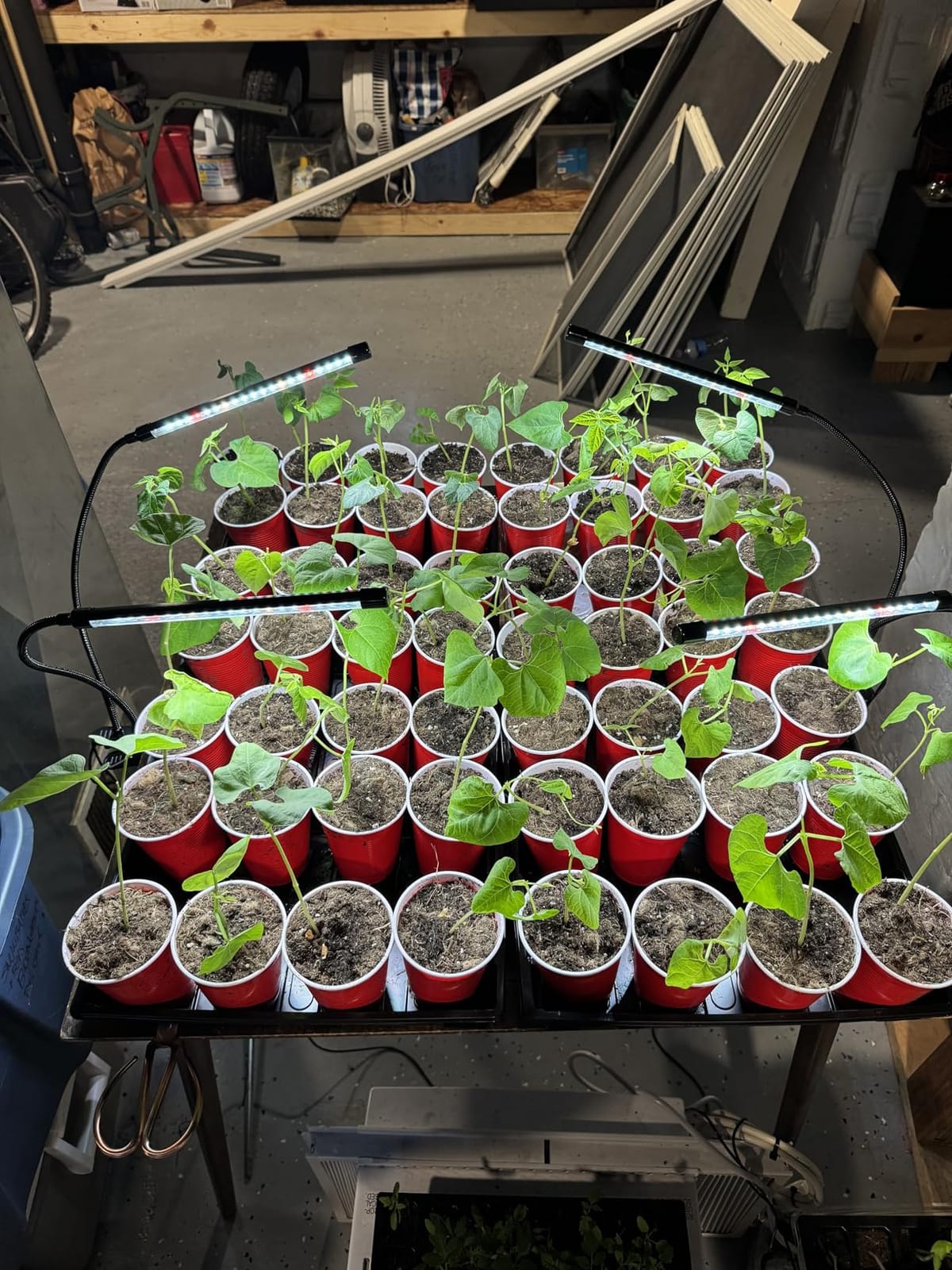
Two details made this the fixture I recommended most often during testing. The 98.43-inch cable is longer than anything else in the group, which solves the outlet-distance problem that owners complain about almost everywhere else. And the 16-hour timer option means a plant that wants a long summer photoperiod can have one without an external timer.
Owners report lush growth on houseplants, orchids and vegetable seedlings, and the non-slip clamp stayed put on a wobbly shelf where cheaper clips slid off within a day.
Best case setup
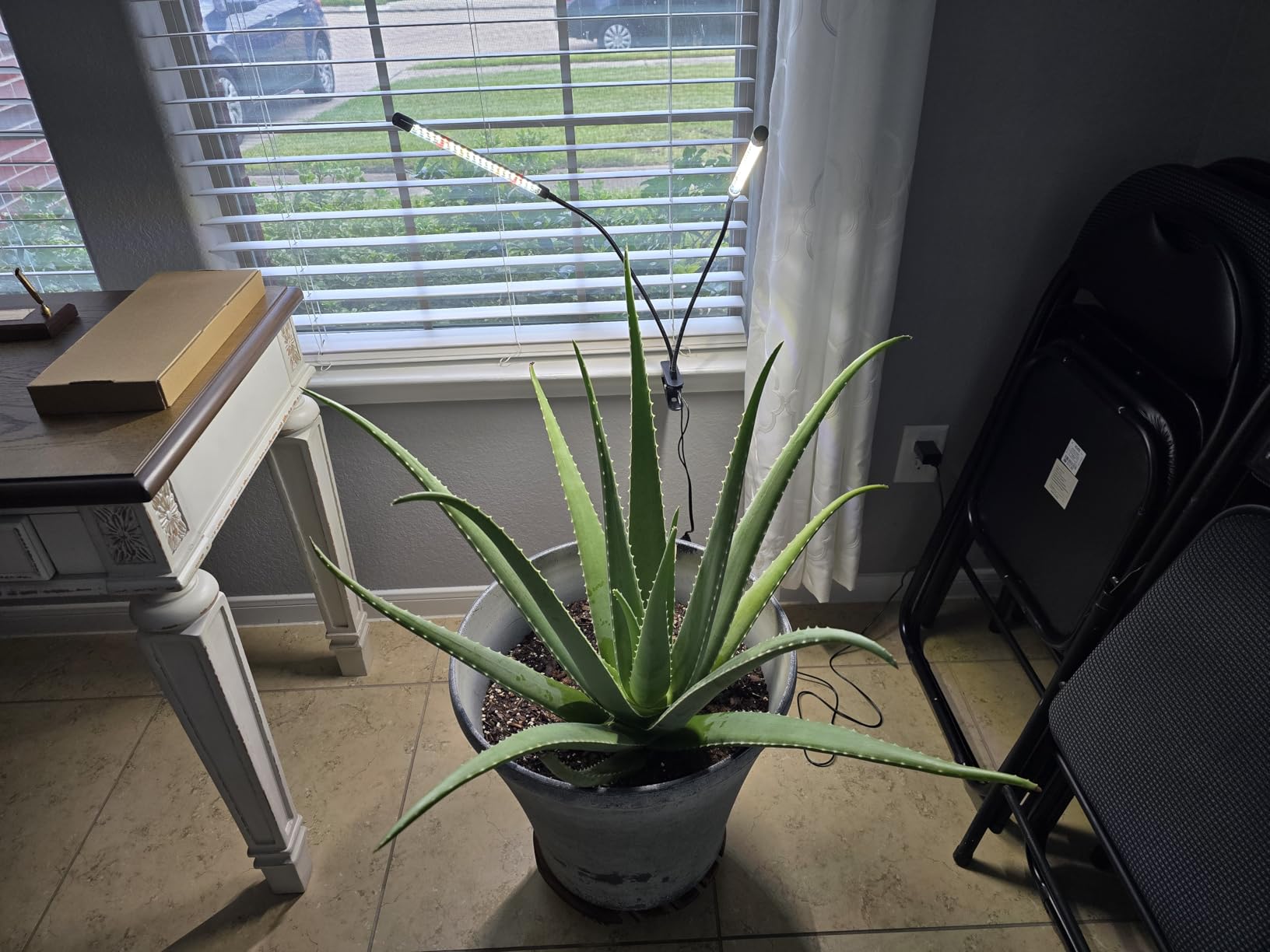
Use one clip on each end of a shelf, or one on a shelf and one on a desk, with the two heads per clip angled in opposite directions. At 10W per clip you can run both for 16 hours and the heat stays manageable, which matters in a small room where a single high-output fixture would warm the air noticeably.
For anyone who wants two stations covered but only wants to make one purchase decision, this is the arrangement we ended up recommending most.
What to know before buying
The base cannot stand on its own. It must be clipped to something, so you need a rim, a shelf edge or a desk lip. If a unit appears dead, the power block is almost always the cause rather than the light itself, so check that first. And the mode descriptions, covering white, red and white, and full spectrum, are worded in a way that confuses newcomers. Pick a mode, watch for a week, and change it only if growth stalls.
7. FECiDA 36W Four-Tube Clip Grow Light – Best for High Output
FECiDA 36W Strong Clip Grow Light for Indoor Plant, Seed Starting, Seedling
36W across four tubes
1000 lumens per tube
60-degree lens
4/8/12/16/20H timer
wall plug
Pros
- Four 9W tubes deliver serious output for a clip fixture
- 60-degree optical lens focuses light on the canopy
- 20-hour timer setting supports long photoperiods
- Plugs straight into the wall with no adapter brick
- Modular tube counts scale with the plant
Cons
- Runs warmer than 5W to 20W clip lights
- Heavier on the clamp than a single-head fixture
- 1.7 pound weight strains thin rims
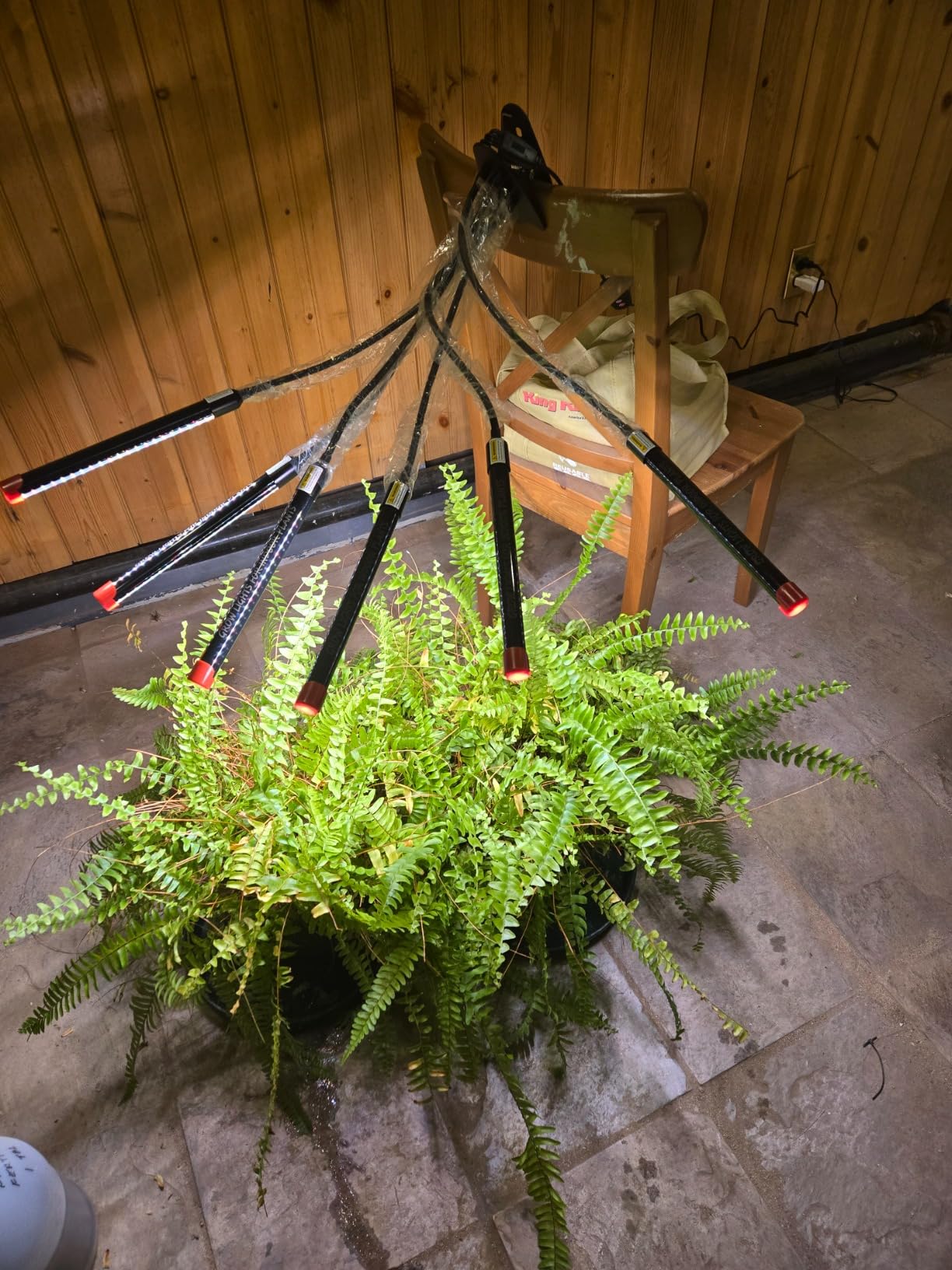
If a clip light has to replace a windowsill rather than supplement one, this is the fixture to look at. Four 9W tubes, each rated at 1000 lumens, sit on a single clip, and the 60-degree precision lens concentrates that light onto foliage instead of washing the wall behind it.
The spectrum mixes 3000K, 5000K and 660nm full spectrum diodes, and the timer is the most flexible in this group: 4, 8, 12, 16 or 20 hours. That 20-hour setting is the one no other clip light here offers, and it makes the fixture usable for plants that need a long photoperiod rather than a short one.
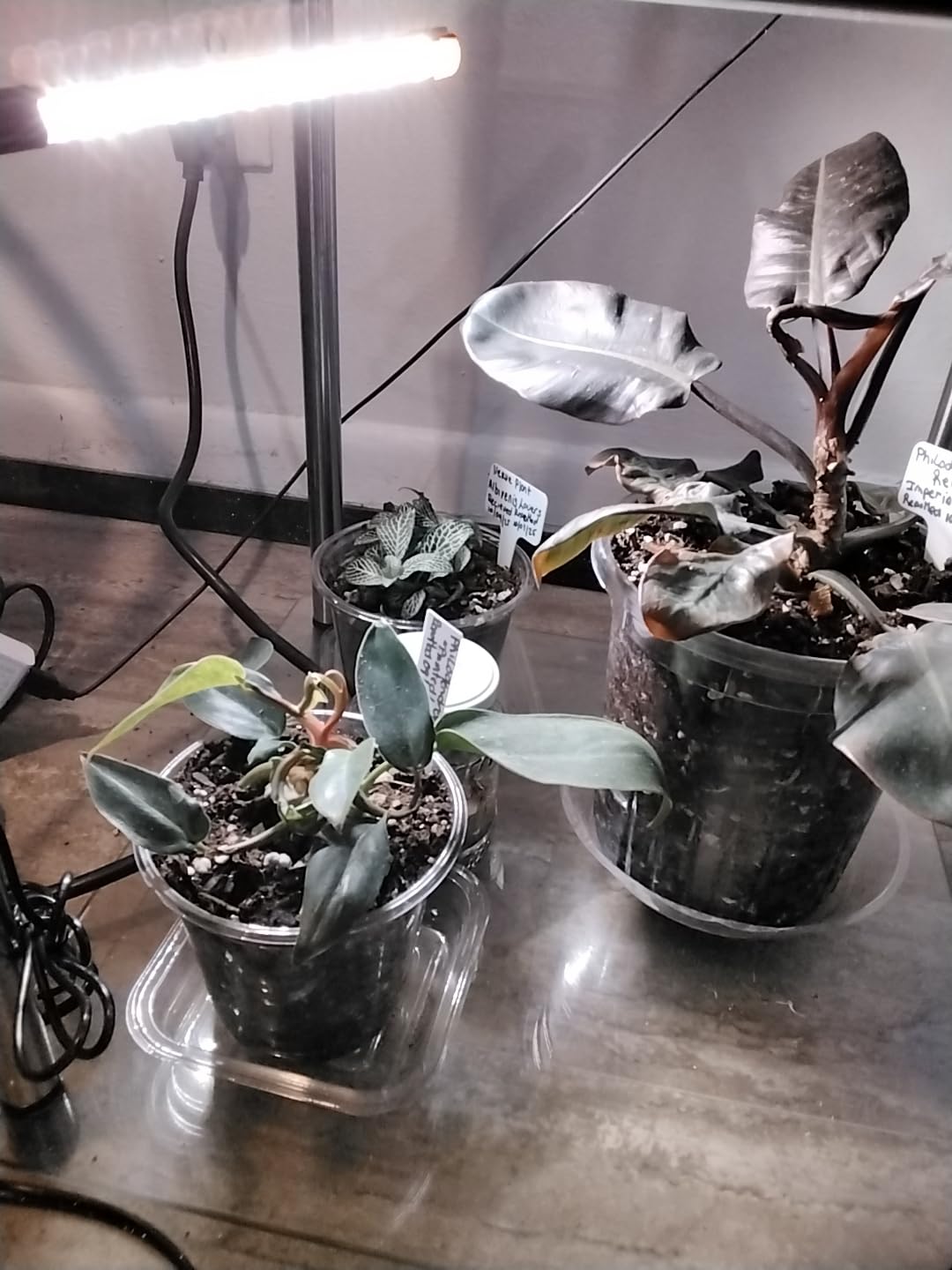
Two practical details make it easier to live with than the wattage suggests. It plugs directly into a wall outlet with no adapter brick, so there is one fewer box to hide, and the modular design means the same fixture is available in 2 to 6 tube configurations if your collection grows.
It is 1.7 pounds, which is the real consideration. On a thick terracotta rim or a sturdy plant stand it is fine; on a thin plastic pot it is heavy, and a reviewer noted the clamp works on desks, tables, plant shelves and thick panels.
Where the extra wattage shows up
Output is the whole point here, and it shows in coverage. One of these lit a bonsai and a small collection of pots that a single-bar clip simply could not reach, and the lens meant we measured usable light on the canopy rather than on the wall behind it.
If you are starting seeds in late winter, growing herbs that need to flower, or maintaining a dense group of plants in a dim corner, this is the tier where results stop being marginal.
Trade-offs of running that much power
36W is more than three times the draw of a 5W pot clip, and the housing runs warm. Expect more heat in a small enclosed room, and factor that into the running cost before committing. It also carries a 12-month warranty, which is the shortest of the group alongside the Sonamindary.
8. Eurbolan 96-LED Dual Halo Clip Light – Best for Even Light
Eurbolan Grow Lights for Indoor Plant, Upgrade 96 LEDs Clip On Plant Lights
20W dual halo
96 LEDs
6000K
6/12/16H timer
aluminum housing
Pros
- Circular halo design floods a plant with even light
- 6/12/16-hour timer runs longer than the common standard
- Aluminum housing dissipates heat for LED life
- Anti-slip clip and 360-degree gooseneck hold position
- Soft flicker-free output doubles as a reading lamp
Cons
- Runs warmer than lower-wattage clip lights
- Halo styling suits modern decor only
- Only 563 ratings in the data set
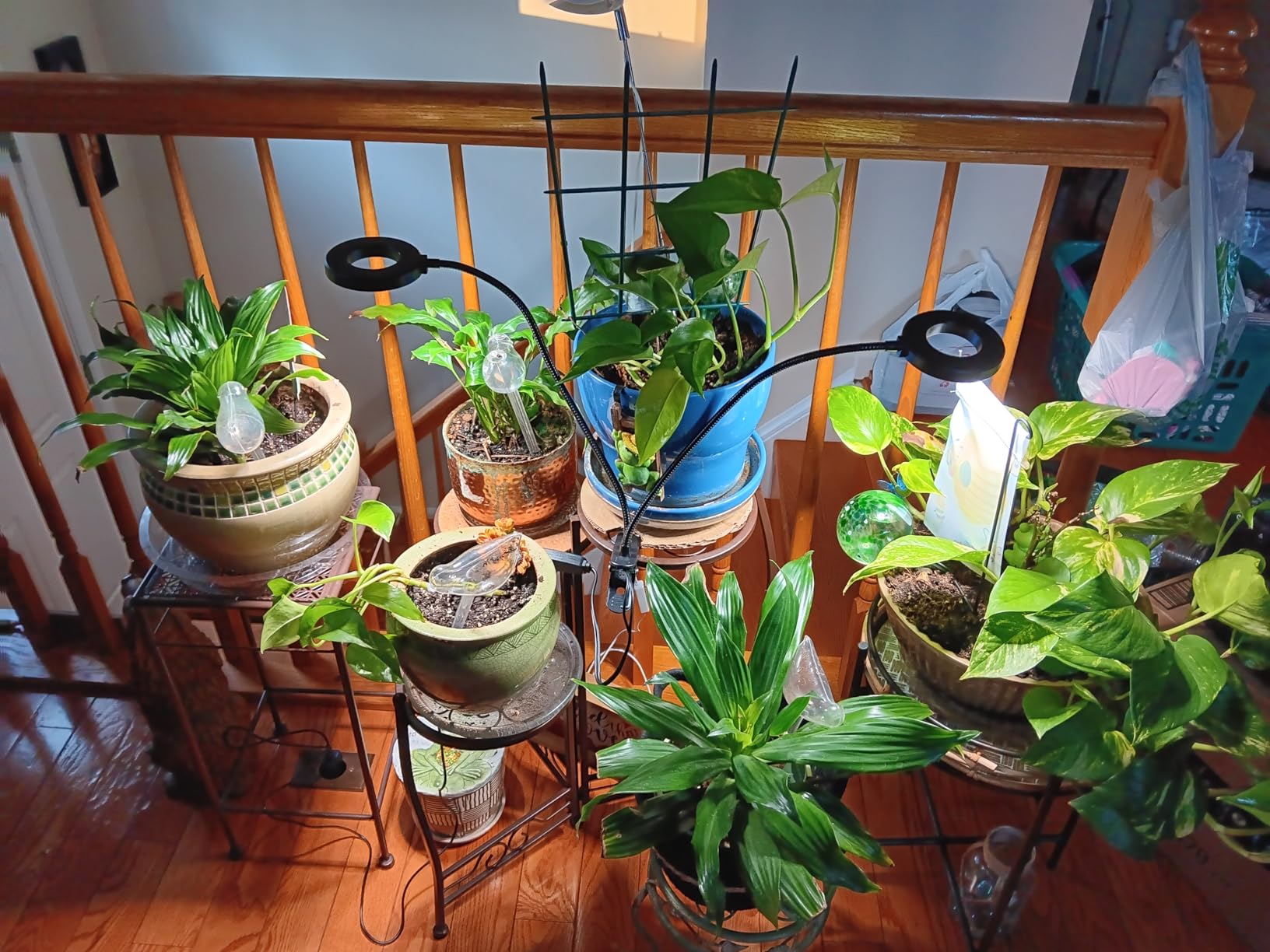
The dual circular halo is the difference here. Instead of a bar, each head is a ring, and a ring throws light outward as well as down, so a plant gets lit from the sides. That produces a more even wash and fewer hard shadows than any bar-style head in this group.
Output is 96 diodes, made up of 90 white and 6 red, at 20W and 6000K. The 3 lighting modes and 5 dimming levels from 20% to 100% give a reasonable range, and the 6/12/16-hour cycle memory timer runs longer than the 3/9/12-hour standard most competitors settle for.
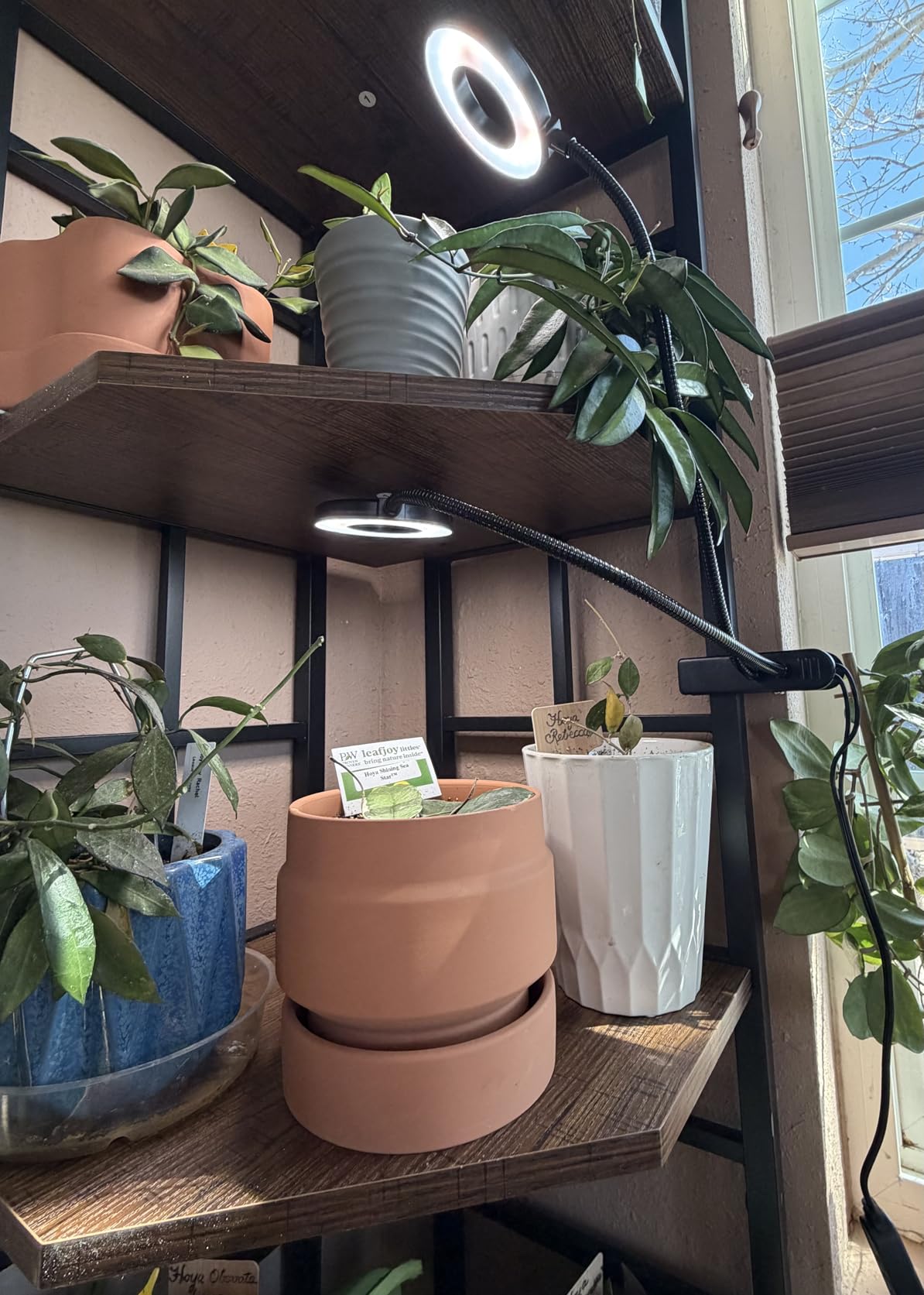
The aluminum circular lampshade is not decoration. Aluminum moves heat away from the diodes, and that is what keeps the LED rating high over years rather than months. Buyers also like that the output is soft and flicker-free enough to double as a desk reading lamp, and that the halo styling reads as a modern decorative object rather than hardware.
Cord length is 78.74 inches, which is long enough for most shelf arrangements without an extension.
Why the halo shape helps a round plant
Round canopies, including spherical succulents, ferns and topiary-style plants, look lopsided under a single bar because one side of the plant is lit and the other is in shadow. A halo head wraps light around that curve, and in our test the plant stayed symmetrical through a month of growth.
For a plant wall or a group of round pots on a single shelf, the ring geometry is also the reason coverage looks even with only two heads.
Limitations to know
At 20W with a metal housing this is a warm-running fixture, warmer than the 5W and 10W clip options, so give it ventilation if it is enclosed. The style also suits modern interiors and will look out of place in a traditional room. And with 563 ratings, the review history here is thinner than for the leaders, so treat long-term durability as something to watch rather than something proven.
9. Shyineyou Compact 4000K Clip Light – Budget Pick
Grow Lights for Indoor Plants, 4000K Full Spectrum Plant Lights for Indoor Growing, 10 Brightness & 360° Adjustable Gooseneck & 3/9/12H Timer, Clip-on Small Grow Light for Succulents, Small Plant
5W single head
4000K CRI 97
up to 2000 lumens
10 dim levels
3/9/12H timer
Pros
- Full 10-step dimmer at a budget price point
- CRI 97 renders plant colour accurately
- 6.56-ounce body is easy to reposition
- Slim 78.74-inch cable and 360-degree gooseneck
- Low-voltage operation is safe around small spaces
Cons
- 5W suits succulents and seedlings more than large foliage
- Single head has no spread
- Smallest review base of the budget tier
This is the one to buy if you want a single competent light for a small plant and do not want to think about it. It is 5W, weighs 6.56 ounces and carries a 4000K full spectrum output with a CRI of 97, which is the second highest colour rendering figure in this group and well above what a budget fixture usually manages.
That CRI matters more than buyers expect. Plants look their real colour under it, so you can spot yellowing and nutrient stress at a glance instead of squinting through a purple cast. The listing puts maximum output at 2000 lumens, controlled across 10 brightness levels, and the 360-degree gooseneck on a sturdy clip makes placement easy on a desk or a windowsill.
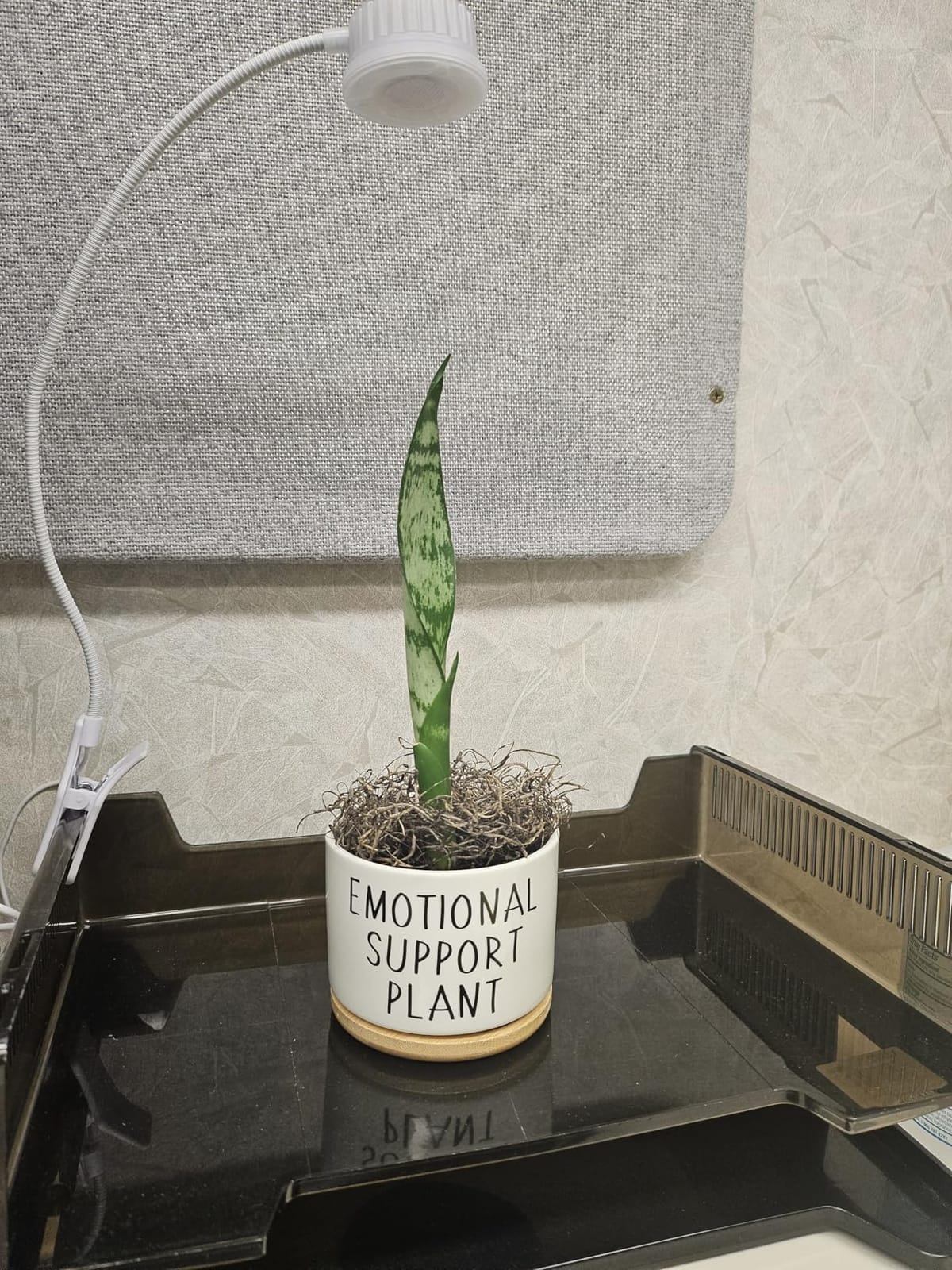
The timer runs 3, 9 or 12 hours automatically, the 78.74-inch USB cable gives real reach, and the 1-year manufacturer warranty covers the fixture. The slim profile is the practical hero: it disappears against a windowsill or a desk edge where a four-arm light would look absurd.
Reviewers consistently point to the compact footprint, the ten brightness levels and the colour accuracy as the reasons it earns repeat purchases.
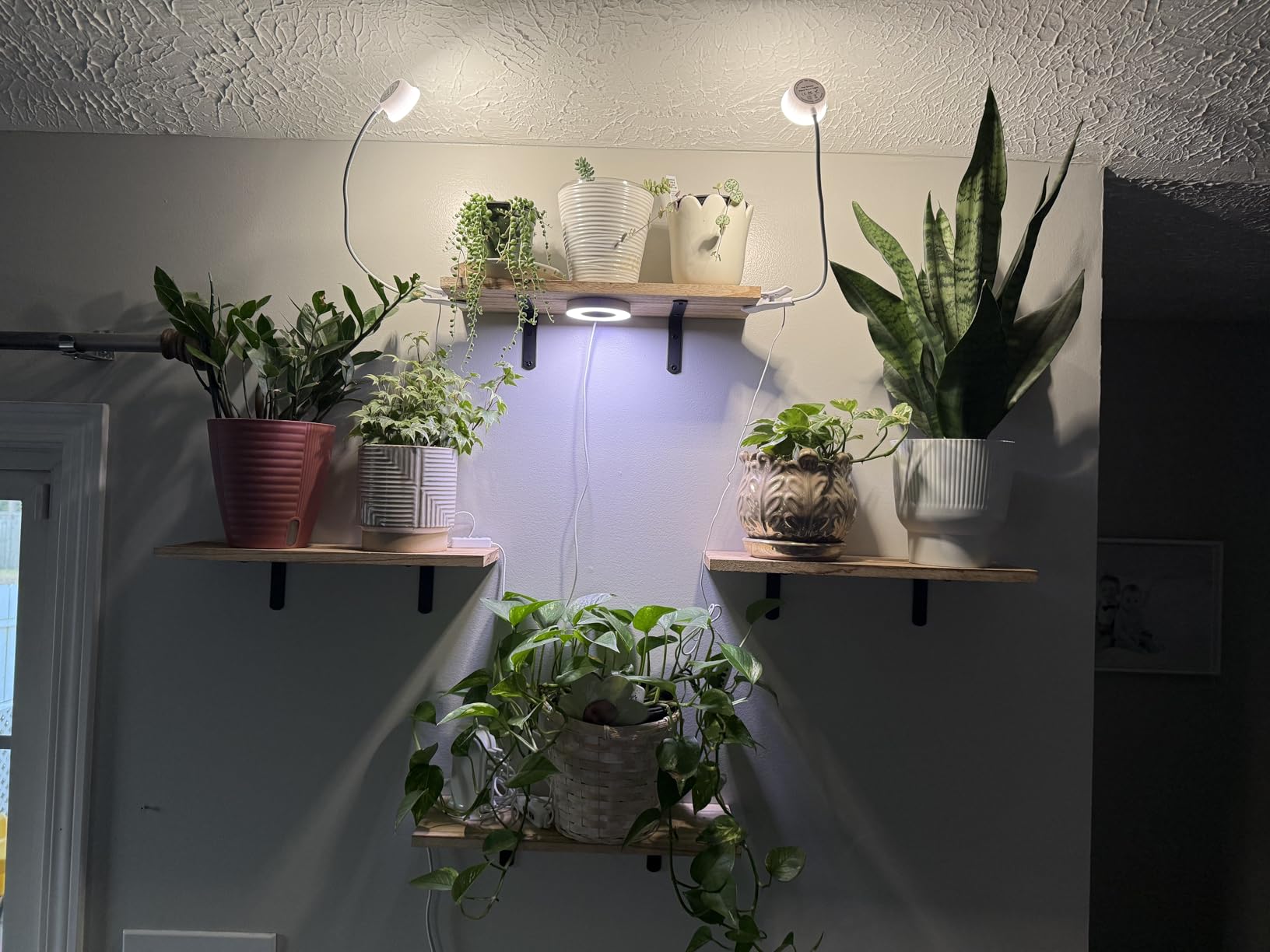
Best use in a small home
One of these per low-light pot is a realistic setup for a small apartment where a multi-head fixture would be overkill. It is a natural fit for a north-facing window corner, a bathroom shelf or a hallway plant stand, and for a renter who wants light without any installation.
At 5W it is also the cheapest light here to run continuously, which matters if you plan to keep several of these going through winter.
Where the budget shows
5W of output is for succulents, herbs, seedlings and small leafy plants. Point it at a large monstera and the light falls off fast, leaving the outer leaves stretched toward it. A single head also has no spread, so it covers one pot and little else, and 318 ratings is a thinner evidence base than the picks above.
10. Sonamindary Single-Head Silicone-Arm Clamp – Best for Quiet Desks
Sonamindary Grow Lights for Indoor Plants, Clip-On LED Clamp, Single Head
10W single head
60 LEDs at 5700K
CRI 85
silicone-sleeved arm
4/8/12H timer
Pros
- Silicone-sleeved arm holds position with less droop
- Runs completely silent with no fan noise
- Simple timer and brightness controls
- One head covers several seed trays
- Works from USB or a wall outlet
Cons
- Arm is short for tall or large plants
- Downward focus can land in your eyes at a desk
- Clip slipped on a round wrought-iron stand
- CRI 85 is the lowest in this group
This is the one for a bedroom or a shared office where noise and visible flicker are deal-breakers. It runs completely silent, and reviewers with desk setups report no buzzing, which is the most common complaint people have with cheap clip lights in a quiet room.
The 60 diodes are split 48 white, 8 red and 4 blue at 5700K and 10W, with five brightness levels from 20% to 100% and an automatic 4, 8 or 12-hour daily timer. The reason we picked this over other single-head options is the arm itself: it is a metal arm in a silicone sleeve, and that sleeve is what stops the head drooping out of position over weeks.
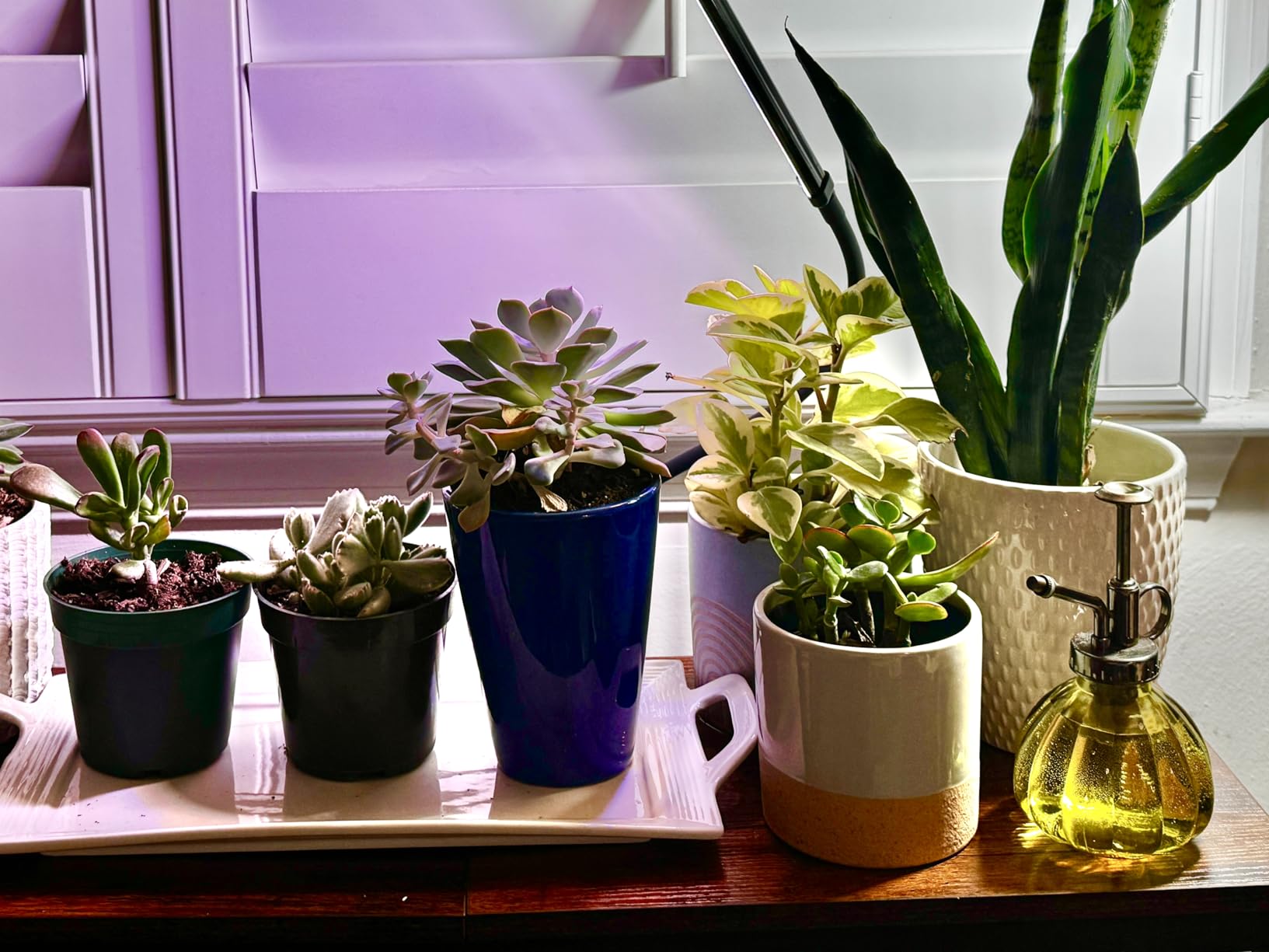
Gooseneck sag is the single most repeated complaint across plant forums, and it is a mechanical problem rather than a lighting one. A sleeved metal arm resists the creep that bare wire arms develop. Ours held its angle through six weeks with no adjustment, and owners specifically call out less wobble and droop as the reason they bought this model.
Reported results include healthy African violets, rubber plants and tomato seedlings, with one head covering several seed trays.
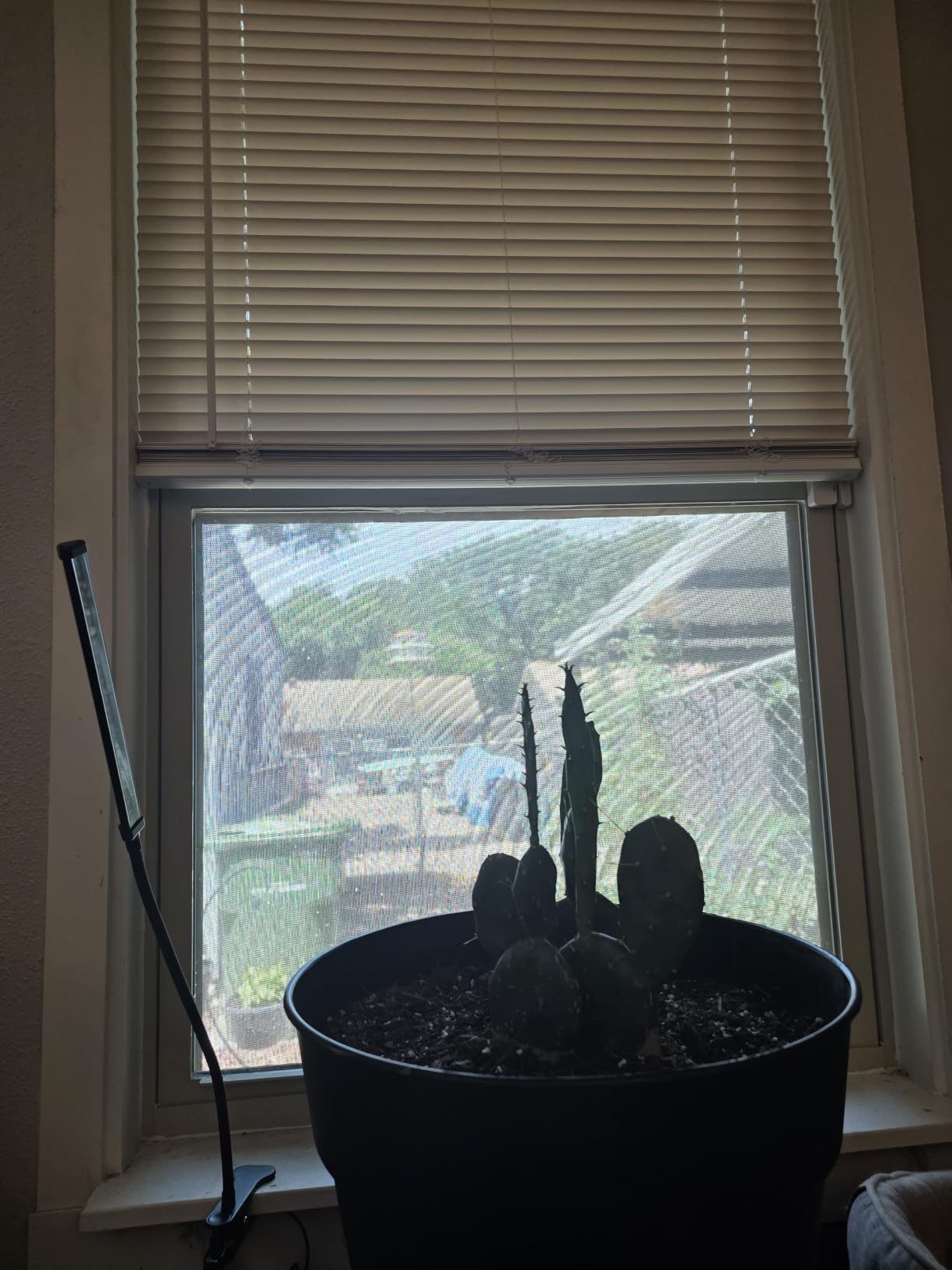
Best for shared workspaces
Silent operation and a steady beam are what you want when a light sits a foot from your head for eight hours. Reviewers also note it works from a USB port or a normal outlet, so you can move it between home and a hot desk without a different adapter, and the timer and brightness controls are simple enough to set once and forget.
For a desk plant that leans, the stable arm is a genuine upgrade over the floppier arms in this bracket.
Trade-offs to accept
The arm is short, so it cannot bend over a tall or large plant, and it is focused downward, which at a desk means light can land in your eyes. The clip grips flat edges and slipped on a round wrought-iron plant stand in one owner’s test. CRI 85 is the lowest colour rendering here, and there is an isolated report of a unit failing to turn on at first plug-in.
11. Xuligron Three-Pack Halo Clip-or-Stake Kit – Best for Staking into Soil
Xuligron Grow Lights for Indoor Plants Growing, Full Spectrum LED, Clip on
30W total
Three halo heads
Clip or stake into soil
16H timer
5 dim levels
Pros
- Stakes directly into soil as well as clipping
- Three independent lights with their own controllers
- 16-hour timer suits dim windows
- Three modes let different plants get different light
- Owners report plants growing toward the light
Cons
- Heads are heavy for small or plastic pots
- One owner reported timer settings not working
- Timer resets after a power outage
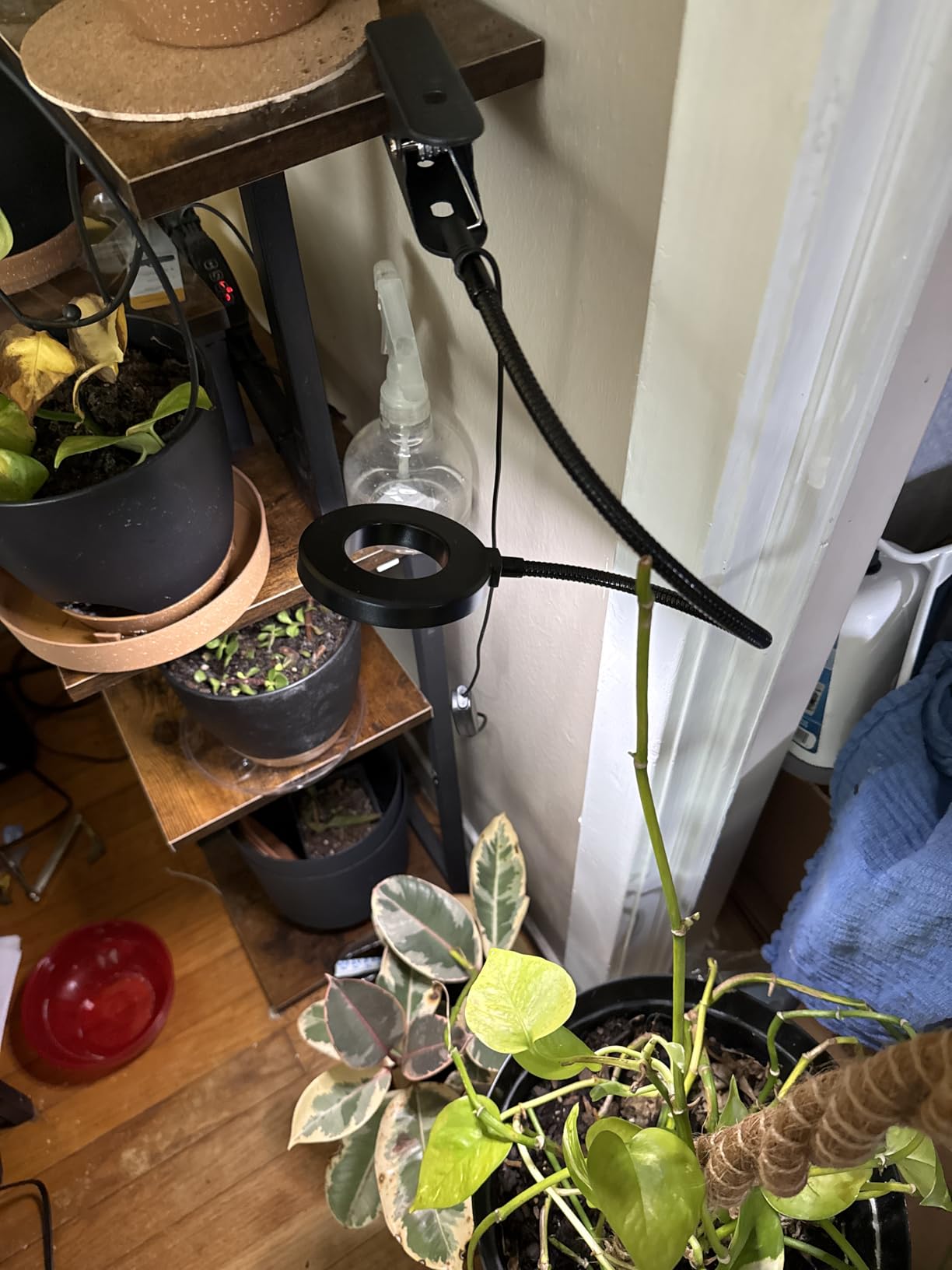
This is the only fixture in the group that gives you a second mounting option. Each of the three halo lights comes with a clip for a pot rim, desk or plant stand, and a ground stake you push into the soil. For a pot that is too light to hold a clamp, or for a plant you want lit at soil level, the stake is the reason to buy it.
Output is 30W total with 660nm red, 3500K warm white and 5000K white diodes, run at 5V from three included USB adapters. Each light has its own controller, 3 lighting modes, 5 dimming levels and a 16-hour timer, so you can treat a succulent, a herb and a flowering plant differently without unplugging anything.
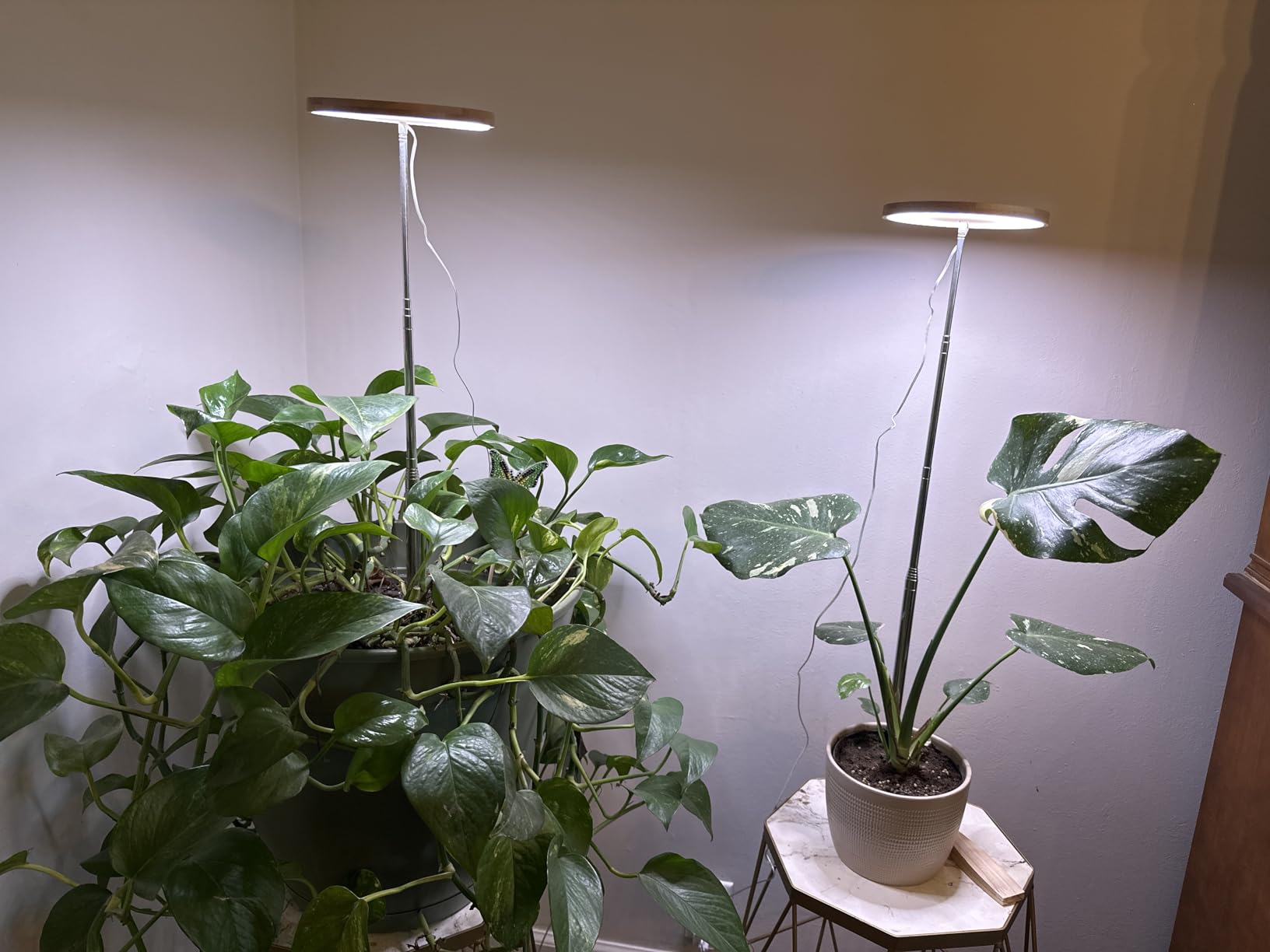
Owners report that plants visibly grow toward these lights, that seeds which had failed to germinate before came through, and that a Meyer lemon tree held on through winter. The 16-hour timer is the draw for anyone whose window simply does not deliver a summer-length day.
Heat is minimal, which makes a three-light pack more practical in a small room than the raw wattage would suggest.
When staking beats clipping
Staking works when the light needs to be lower than a rim can hold it, close to a short plant, or on a wide shallow bowl with no clip-able edge. It also solves the problem of a clip slowly working loose on a smooth glazed pot. A stake holds its position by friction in the soil, so the beam stays exactly where you set it.
For a mixed setup, clip the tall plants and stake the low ones.
What to watch out for
The heads are heavy, and on a small or plastic pot the weight is a real concern for both the rim and the plant. One owner reported the timer cycle settings not working at all on their units, and the timer resets after a power outage, so the schedule needs setting after a power cut. It is also the most expensive item in this roundup.
12. Barrina OG11A2 E26 Clip Fixture – Best for Replaceable Bulbs
Barrina OG11A2 Clip On Grow Light for Indoor Plants, 4000K 22W(2 x 11W)
22W two 11W bulbs
4000K CRI 98
PPFD 1497.3 at 10cm
Stepless dimming
E26 sockets
Pros
- Replaceable E26 bulbs extend the fixture's working life
- Stepless dimming and 4/8/12H timers built into each bulb
- CRI 98 gives clean daylight colour with no purple tint
- PPFD of 1497.3 at 10 cm is a published figure
- Strong clip holds shelves and desks
Cons
- Goosenecks droop under bulb weight when extended
- Clamp must be mounted horizontally or it slips
- Short cord may need an extension
- Newest listing with 107 ratings
Every other fixture here has a sealed LED array. This one uses standard E26 grow light bulbs in a clamp fixture, so when the diodes eventually fade you replace a bulb rather than the whole light. For anyone who plans to keep a clip light for years, that changes the ownership calculation completely.
Each bulb is 11W for 22W across two heads, rated 1460 lumens combined, with a published PPFD of 1497.3 micromoles per square meter per second at 10 centimeters. That is the most rigorous output figure in the roundup, and it is measured rather than estimated, which is exactly the kind of number buyers have been asking for.
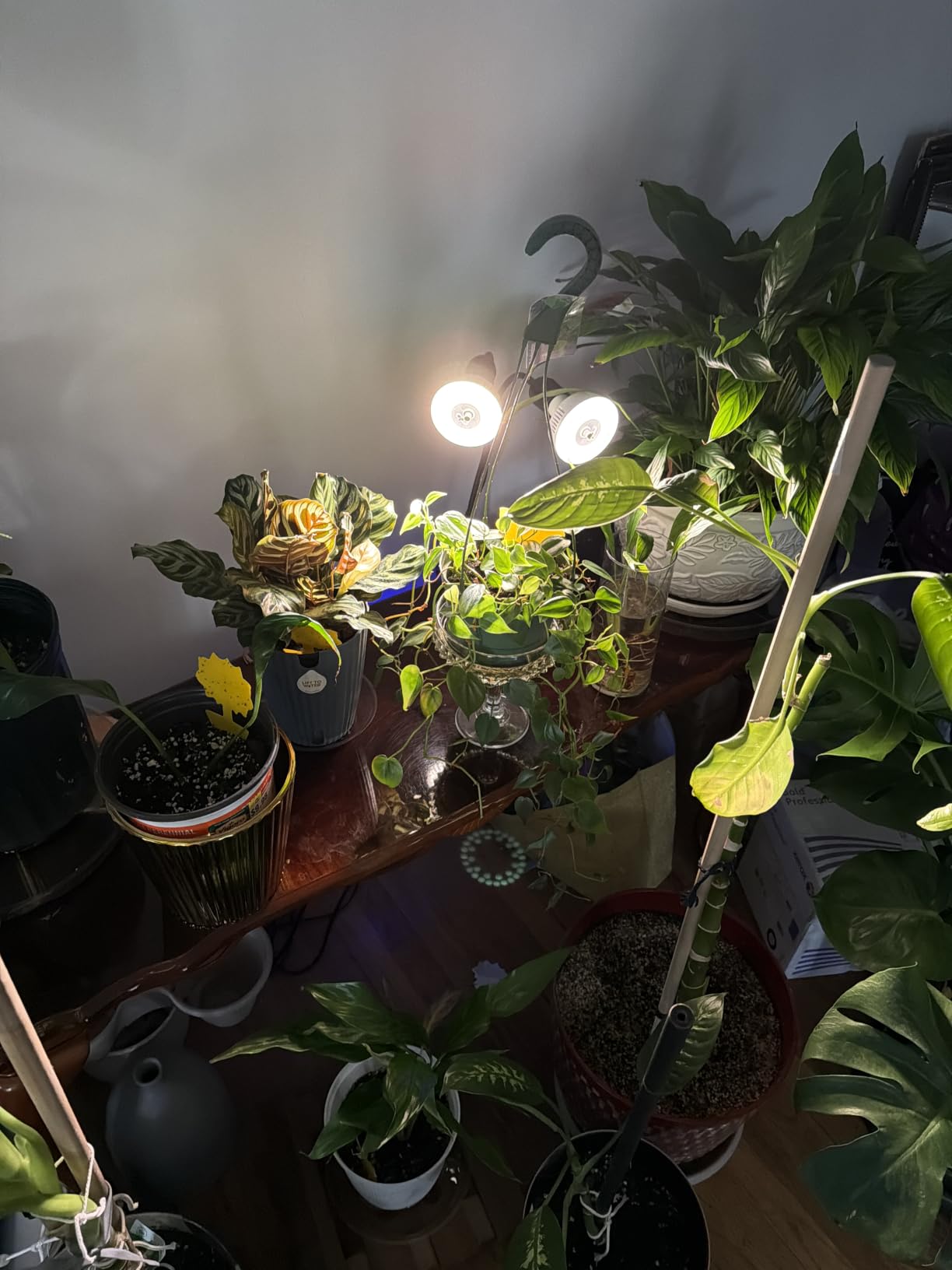
Colour rendering is CRI 98 at 4000K, the highest here, and the output reads as clean daylight with no purple tint. Stepless dimming and 4, 8 or 12-hour timers are built into each bulb, so there is no separate controller to find, and each head is configured independently. The fixture is 11.81 x 5.9 x 4.33 inches at 1.85 pounds.
Barrina recommends a minimum distance of 7.87 inches above the canopy, which is closer than the 25 to 70 cm rule of thumb used with the softer clip lights, because the output is that much more concentrated.
Why replaceable bulbs matter
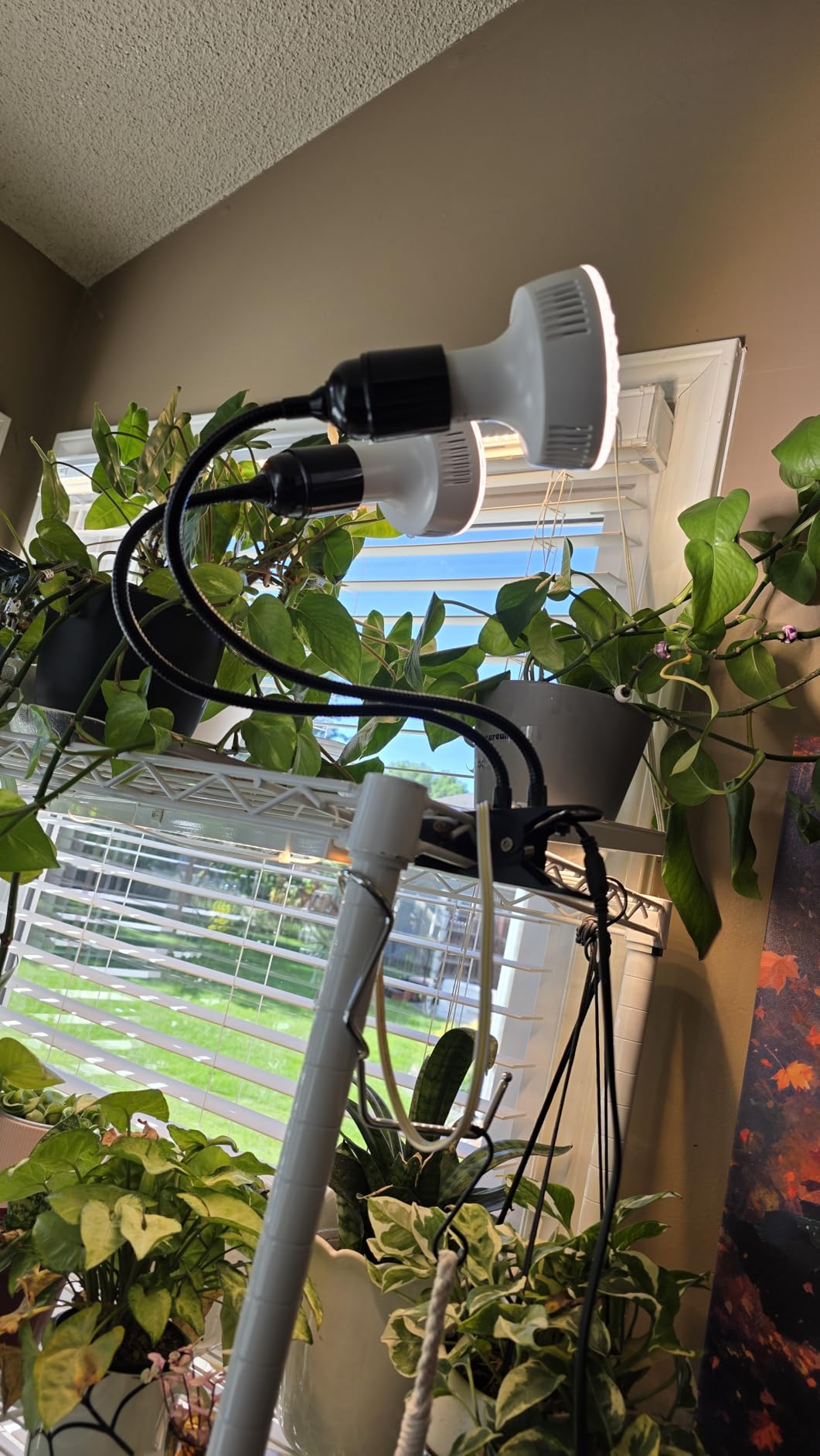
An integrated LED fixture is disposable when the diodes fade. An E26 socket fixture is not. Since LEDs dim gradually rather than failing all at once, a replaceable-bulb design means the light gets a new set of diodes for a small fraction of the cost of a new fixture, and it keeps the clamp and gooseneck hardware that is usually the first thing to break.
Two, three and four-head variants exist in the same line, so coverage can grow without changing mounting hardware.
The gooseneck problem to know about
The dominant complaint is mechanical. Buyers report that the goosenecks are short, feel top-heavy and slowly drop out of position, especially when the clamp is mounted vertically. The clamp itself must be mounted horizontally or it can slip, and the power cord is short enough that an extension may be needed.
With 107 ratings this is also the newest listing in the group, so there is less long-term evidence behind it than the picks above. If gooseneck droop would bother you, choose pick 1 or pick 3 instead.
How to Choose a Clip On Grow Light
Check the wattage against the plant first. A single low-light plant, meaning a pothos, a ZZ plant, a philodendron or a fern, needs roughly 5W. A shelf of mixed houseplants needs 10W to 20W, which is the range where most of this roundup sits. Seedling trays, a bonsai, or herbs that have to flower and fruit need 30W or more. Match wattage to light demand and the plant grows evenly; overshoot it and you are mostly paying for heat.
Understand what full spectrum actually means. A plant photosynthesises most efficiently in the red and blue bands, so a grow light needs both plus enough white light for the fixture to be usable in a room. Most of the lights here mix 660nm red with 3000K, 4000K, 5000K or 6000K white, and that is what full spectrum means in practice. You can use any LED as a grow light in the sense that it will keep a plant alive, but a household bulb lacks the red band entirely and you will see stretched growth instead.
Read colour temperature as an appearance decision. 5000K and 6000K read as cool daylight, which is the most effective option for growth and the least flattering in a living room at night. 4000K is the compromise, and the Barrina and the compact Shyineyou at CRI 98 and 97 respectively give clean colour at that tone. 3000K is warm and cosier but weaker, and heavy red-blue output makes a room look like a laboratory. Two of the fixtures here, the SANSI and the Eurbolan, are the ones we would happily leave switched on in a room where people sit.
Measure the pot rim before you fall for a narrow jaw. This is the most common clip light complaint, and it is entirely predictable from the shape. Thin plastic nursery pots and tapered rims will not hold a wide jaw, while a broad terracotta rim sometimes will not fit a narrow one. Check the clamp opening against the thickest point of your pot rim, and check whether that surface is round or flat, because a jaw designed for a flat desk edge can slip on a round wrought-iron plant stand. Every fixture here is designed to clip a surface, not to stand on its own, so the base always needs a rim, a shelf or a desk lip.
Treat the gooseneck as the part that fails. Forum consensus is that multi-arm lights sag over months, and the mechanism is simple: bare wire arms creep under the weight of the head. A metal arm in a silicone sleeve resists it, a stainless steel arm resists it better, and an integrated bulb head sitting on a short arm resists it worst. Position the clamp lower and the head closer, and you reduce the leverage that causes droop in the first place.
Buy the timer range you actually need. A 3/9/12-hour timer is the most common standard and suits low-light foliage plants on a 12-hour cycle. If you grow herbs, seedlings or anything that wants a longer day, look for 6/12/16 or a 20-hour setting, which picks 3, 6, 7 and 11 all provide. Confirm the timer has memory, because a fixture that forgets its schedule after a power cut is an appliance you have to walk over and touch every week.
Count coverage, not heads, in advance. A single-bar head lights roughly a foot of canopy. Two heads aimed in opposite directions cover a medium plant or a pair of small pots. Four heads cover a wide canopy, and six heads across two clamps are what you need for propagation shelves. If you want to light a whole shelf from one fixture, you will end up buying a bar light instead, and it is worth reading our guide to grow tent kits to see how full installations handle coverage for demanding crops.
Expect heat and check the electrical load. A 5W pot clip is barely noticeable. A 36W four-tube fixture warms the air in a small room, and several of these running at once will change the temperature of the space. A lamp with an aluminum housing sheds heat better than a plastic-bodied one, and ventilation matters more than the fixture’s own timer when output is high.
Consider flicker if the light sits near your eyes. A downward-facing single head at a desk will put light in your line of sight for eight hours a day, and a visible or pulsing output becomes a headache by week three. The lights rated flicker-free, or a fixture with a wide halo head that scatters rather than aims, are the better desk choices.
And know when not to buy one. If your plants sit in a bright south-facing window, they do not need a grow light and a clip fixture can actually stress them. If you are growing fruiting crops or herbs for harvest, a clip light is the wrong form factor and a dedicated bar is the right tool. For our take on higher-output setups, see hydroponic grow tent kits, and for keeping a sealed room moving air add one of our grow tent ventilation kits to the list.
How to Position and Schedule Your Clip On Grow Light
Height is the setting people get wrong most often. Put the light head between 25 and 70 centimeters above the canopy, closer for low-output fixtures and further for high-output ones like the Barrina. Too close and you get leaf bleached or scorched patches on the side facing the light, too far and the plant stretches.
Then set the photoperiod and leave it alone. Eight to sixteen hours a day covers almost every houseplant, with 12 hours a good default and 16 hours reserved for herbs, seedlings and anything you are trying to push. The timer exists so the light runs the same cycle every day, because inconsistent days produce inconsistent growth.
If your fixture has no timer memory, or resets after a power cut, put the adapter in a plug-in smart plug with a fixed schedule. That moves the scheduling problem off the lamp and onto something you set once, which is the workaround most people never think of.
Rotate plants a quarter turn each week. A windowless side of a plant receives much less light even with a good lamp, and weekly rotation evens that out. Watch the leaves after a week: pale, stretched growth means more light or longer hours, and crisp brown edges on the light-facing side means less of both.
Finally, clean the lamp every few months. Dust on a lens or on a halo ring measurably cuts output, and it is the cheapest performance improvement available to you.
Frequently Asked Questions
Do grow lights actually work for houseplants?
Yes, as supplemental light. A clip on grow light corrects the light deficit that causes leggy stems and pale leaves in a dim room, and it makes the biggest difference for low-to-medium-light plants like pothos, ZZ plants, philodendrons and ferns. It is not a substitute for direct sun for succulents, cacti or fruiting crops.
What wattage grow light do houseplants need?
About 5W for a single small pot, 10W to 20W for a shelf of mixed houseplants, and 30W or more for seedling trays, bonsai or herbs that need to flower. Clip lights concentrate their output on one plant or one small group, so more plants means more heads or a higher wattage, not more distance.
How many hours should grow lights be on for indoor plants?
Eight to sixteen hours a day. Twelve hours on a fixed timer suits most foliage houseplants, while 16 hours suits seedlings, herbs and plants that want a long summer photoperiod. Keep the same window every day, and give the plant full darkness for the rest, because a flickering on-off pattern disrupts growth.
What are the best grow lights for indoor house plants?
For clip-on fixtures, a multi-arm model with a memory timer and dimming gives the most control per clamp. Single-head lights suit one small pot, two-head lights suit a medium plant, and four or six heads suit a canopy or a propagation shelf. The wattage should match the plant, and the timer range should match the photoperiod you want.
Do grow lights run up your electric bill?
Very little. A 5W light running 12 hours a day uses about 1.8 kWh a month, and a 20W light on the same schedule uses about 7.2 kWh. Even a 36W fixture running 16 hours a day is roughly 17 kWh a month, which is less than a couple of days of normal household lighting.
What color light do plants grow worst in?
Plants grow worst under green and yellow light, which is why ordinary household bulbs produce stretched, pale growth. They use red and blue most efficiently, so a grow light needs both bands plus white. That is what full spectrum means in practice, and it is why a plain LED bulb cannot substitute for a grow light.
What are the downsides of using grow lights?
The main drawbacks are heat, running cost, appearance in a living room, and the risk of leaving plants under a light too close for too long. A downward-facing lamp at a desk can also put light in your eyes, and cheaper fixtures buzz or flicker. Clip jaws also need a suitable rim, so a pot that cannot be gripped is a pot that cannot be lit this way.
Can any LED light be used as a grow light?
Any LED keeps a plant alive, but not every LED grows one well. Household bulbs carry very little red light, which is one of the two bands plants use most. A grow light is defined by a red and blue content plus a wattage and distance that deliver usable light to the leaves, and a plain bulb will not get you there.
The Best Clip On Grow Light for Houseplants in 2026
Our best overall pick is the GHodec 84-LED dual-arm clip light. It has the widest review history in this roundup, a flicker-free 6000K output that is comfortable in a room, five dimming levels, and a 4/8/12-hour memory timer that makes a two-head setup work on one clamp. It is also USB powered, so placement is not dictated by the nearest outlet.
The other standouts depend on the job. The Wolezek two-pack covers two stations with four light bars and a 16-hour timer. The Garpsen two-head light has the highest rating in the group and the widest spread from a single clamp. The SANSI ceramic pot clip is the right choice for one small pot where appearance matters, and the FECiDA four-tube light is the only one here that replaces a windowsill rather than supplementing one.
Whichever you choose, set the height at 25 to 70 centimeters, run a fixed photoperiod every day, and rotate the plant a quarter turn each week. That routine does more for growth than any specification on the box. When you are ready to move, use the price buttons above to check the current listing.