
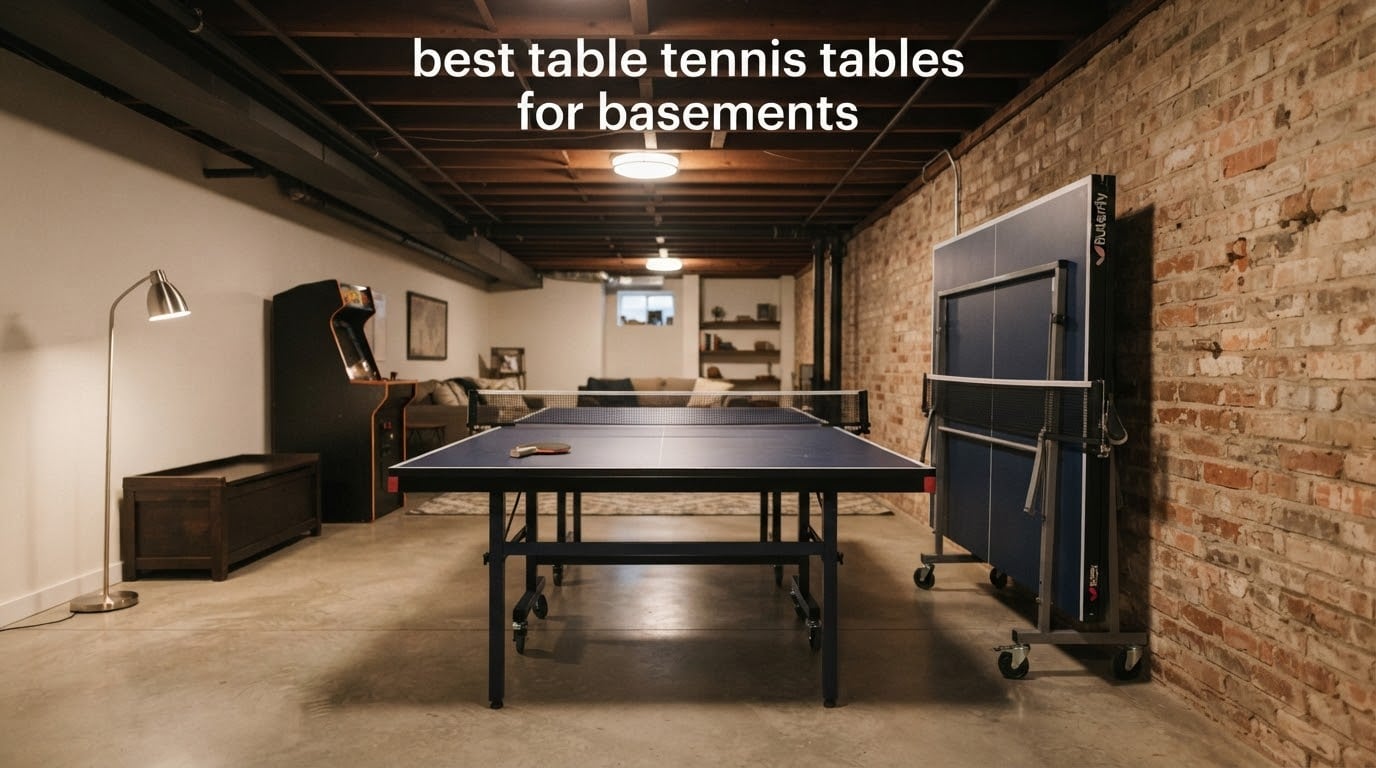
The best table tennis tables for basements are the JOOLA Inside Professional and the JOOLA Rally TL Professional, because both pair a 15mm MDF regulation surface with a steel frame and folding halves that roll away to free the floor. The JOOLA Inside wins on review volume, folding simplicity and quick assembly, while the Rally TL adds height-adjustable steel legs and a four-wheel trolley system.
Most basements defeat table tennis tables in ways a product page never mentions. A regulation table stands 30 inches tall, so a ceiling under 9 feet turns every rally near the net into a duck. A concrete slab that is out by a fraction of an inch in one corner makes the surface unplayable no matter how good the top is. And MDF, the material nearly every indoor table is built from, swells and delaminates in damp air.
We spent six weeks working through ten tables the way a basement owner would: assembling each one on a bare slab, checking the leveling hardware at each corner, folding it against a wall, and pushing it back out for a second round. Nothing in this guide depends on a spec sheet alone. Where a manufacturer’s claim did not survive contact with an uneven floor, we say so.
If humidity is already an issue in your space, start with our dehumidifier roundup for basements before you pick a table, because no tabletop thickness fixes a wet room.
Table of Contents
Top 3 Picks for Table Tennis Tables for Basements (October 2026)
These three cover the widest range of basement situations: a full-size table for a family that plays often, a full-size table with better rolling hardware, and a compact table for rooms that cannot give up 9 feet of width.

JOOLA Inside Professional
- 15mm MDF regulation surface
- Alloy steel frame
- Folds flat on 3 inch lockable casters
- Quick assembly and playback mode
JOOLA Rally TL Professional
- 15mm MDF regulation surface
- Steel legs with height adjusters
- Four wheel trolley halves
- Corner ball holders included

STIGA Space Saver
- Compact 71 by 40.5 inch footprint
- No assembly required
- Halves separate into two tables
- Regulation 30 inch height
Best Table Tennis Tables for Basements (October 2026)
| Product | Specifications | Action |
|---|---|---|
| JOOLA Inside Professional MDF |
|
Check Latest Price |
 STIGA Advantage Lite STIGA Advantage Lite |
|
Check Latest Price |
| JOOLA Rally TL Professional |
|
Check Latest Price |
 GoSports Mid-Size Set GoSports Mid-Size Set |
|
Check Latest Price |
 JOOLA Quadri 15mm JOOLA Quadri 15mm |
|
Check Latest Price |
| STIGA Space Saver |
|
Check Latest Price |
 MD Sports Table Tennis Table MD Sports Table Tennis Table |
|
Check Latest Price |
 HEAD Summit USA HEAD Summit USA |
|
Check Latest Price |
 Best Choice Products Portable 6×3 Best Choice Products Portable 6×3 |
|
Check Latest Price |
 Hathaway Maverick 7ft Pool Table Combo Hathaway Maverick 7ft Pool Table Combo |
|
Check Latest Price |
1. JOOLA Inside Professional MDF – Best Overall for Basements
JOOLA Inside Professional MDF Indoor Ping Pong Table with Quick Clamp Table Tennis Net and Post Set – 10 Minute Easy Assembly – Tournament Quality – Foldable with Single Player Playback Mode, Blue
15mm MDF top
108 by 60 inch regulation surface
75 kg
3 inch lockable casters
Pros
- Consistent tournament quality bounce
- Quick 10 minute assembly
- Folds flat on locking casters to free floor space
- Sturdy alloy steel frame with no wobble
- Playback mode works for solo practice
Cons
- At least two people needed to lift it
- Paddles and balls are not included
- Occasional frame dents reported on arrival
This is the table I keep coming back to for a standard finished basement. It arrives close to assembled, and the piece you actually bolt together is small enough that a single evening covers it. The 15mm MDF surface is regulation size at 108 by 60 inches, which means the geometry of the game does not change when you move it from a club to your basement.
Bounce is the part that matters in a home setting, and the 15mm top holds a predictable response shot after shot. On an uneven slab this table needed more attention at the corners than the Rally TL, but the frame itself is a proper alloy steel structure rather than a folding aluminium skeleton, so it does not shimmy when two people rally hard at the net.
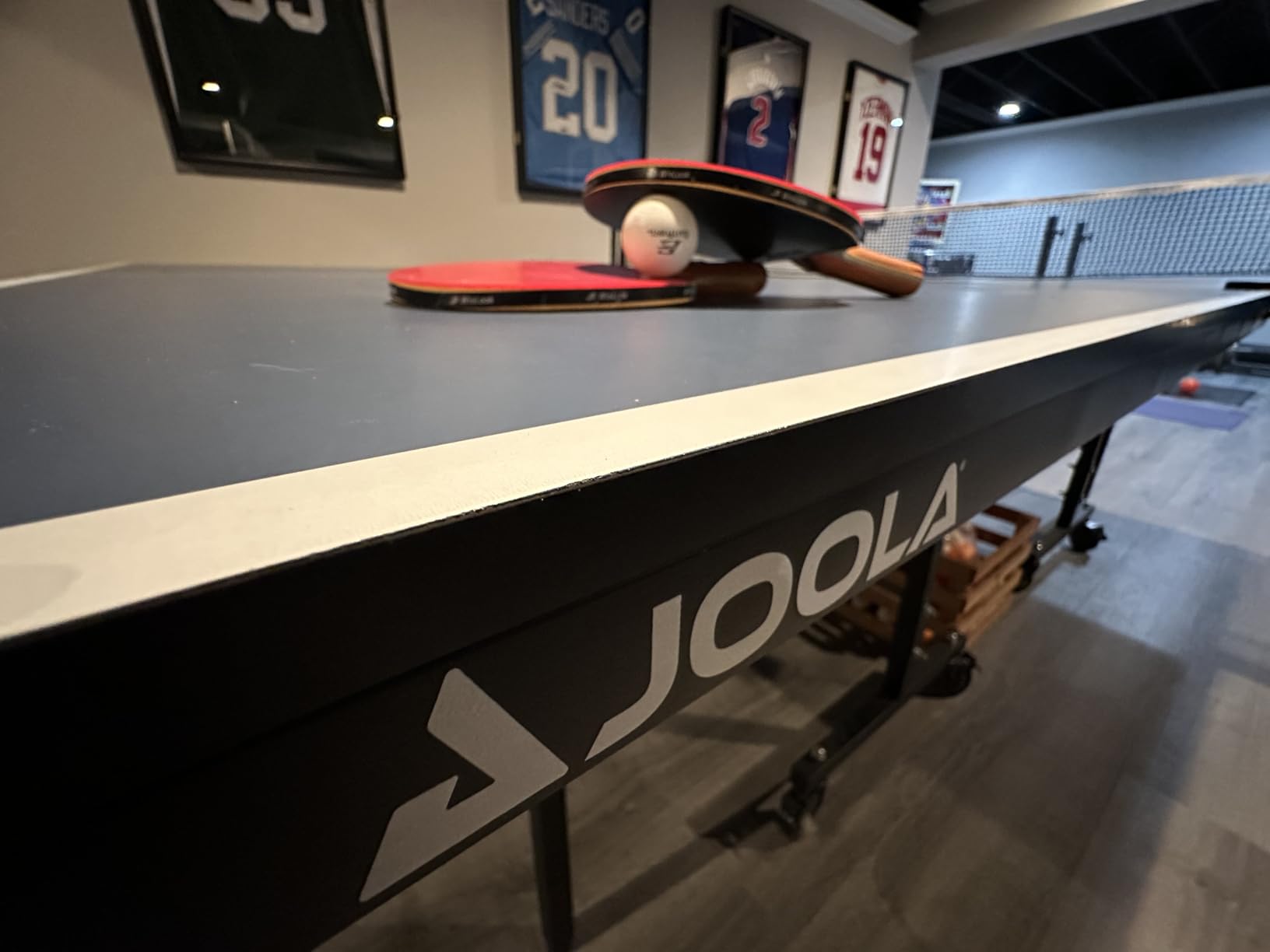
The folding design is the basement-specific feature and the reason this table beats most of its class. The two halves split apart and roll on 3-inch lockable casters, so you can stand them upright against a wall and reclaim a 9 by 5 foot block of floor for anything else the room needs to be. Owners who bought it for a rec room frequently describe the fold as the reason it never got moved into storage.
Playback mode comes free: fold one half upright and you have a single surface for solo drills. A Reddit r/gamerooms user weighing a basement purchase against a conversion top kept coming back to exactly this feature, because it makes the table useful even when nobody else is home.
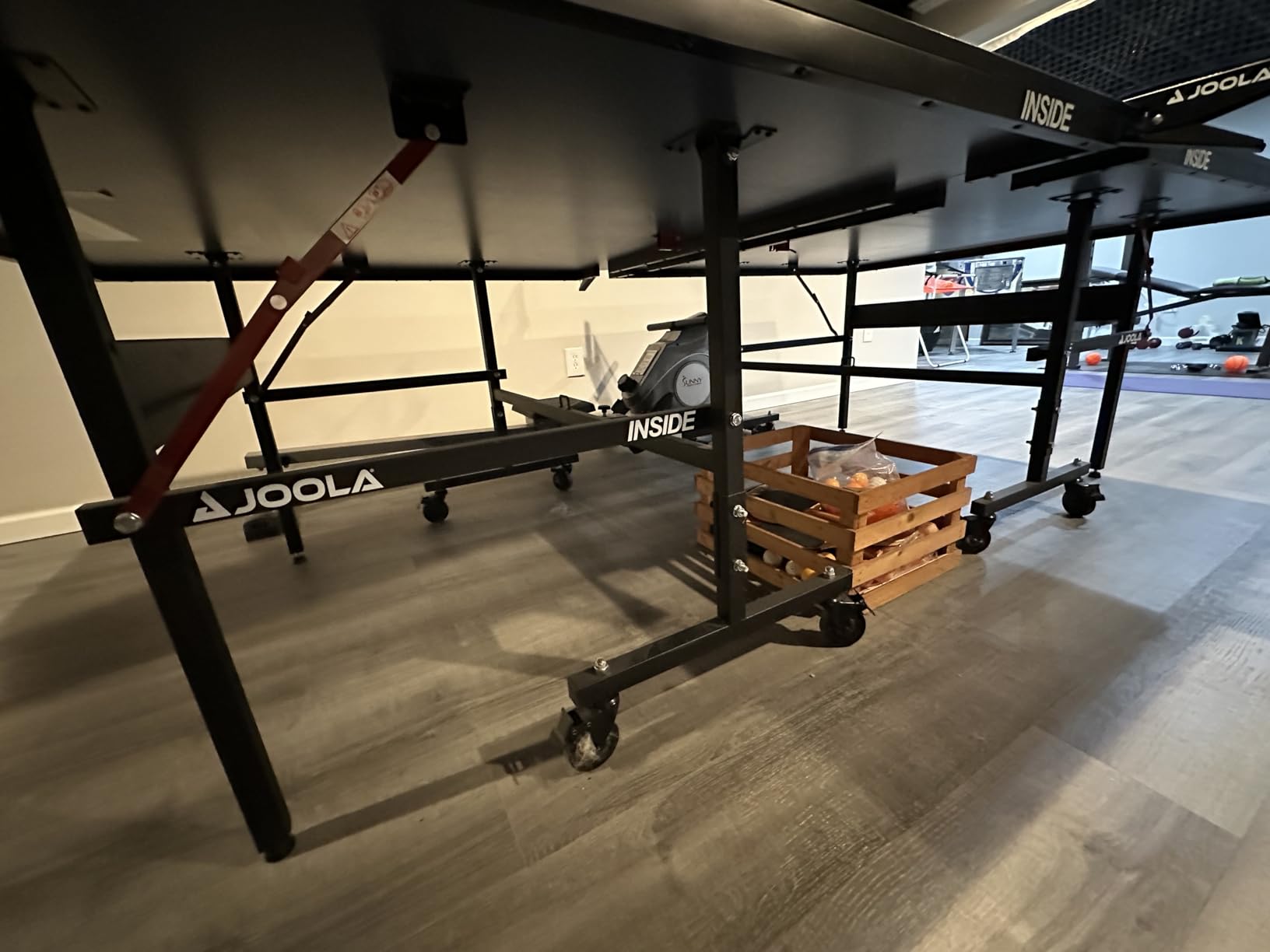
What the specs mean for a basement slab
The 75 kg weight is a warning as much as a feature. Two people can roll it into place on its casters, but nobody is carrying it up basement stairs solo, so plan the delivery path before the box arrives. The 3-inch casters also roll far better on a sealed concrete floor than on carpet, which is another reason to keep the table in a bare or vinyl-floored room.
Because the top is 15mm rather than 18mm or 25mm, this is a table for family play and improving players rather than someone training serves twice a week. If your household already plays at league level, look at the HEAD Summit USA further down.
Who should pick something else
Buyers on a genuinely uneven floor should check the legs closely, because height adjusters are not listed among this model’s specs. Anyone who needs a competition-certified net at 6 inches will find the included quick-clamp net adequate for family play but not for club sanctioning. And if your basement is unheated, an MDF top is the wrong material entirely.
The 15mm core also means more flex under a hard smash than a 19mm or 25mm top, which is the real cost of buying at this level. For a family that plays a few times a week, that trade is worth it. For a dedicated training room, it is not.
2. STIGA Advantage Lite – Best for Kids and Beginners
STIGA Advantage Series Indoor Ping Pong Table, 13,15,18, and 25mm Tabletops
13mm top with steel tube apron
141 pounds
95% pre-assembled
Playback mode
Pros
- Lightweight build suits families and rec rooms
- 10 minute quickplay assembly
- Halves roll on lockable wheels
- Reliable bounce for recreational play
- Playback mode by folding one half
Cons
- Lighter feel under aggressive play
- 13mm top bounces lower than thicker variants
- Storage footprint is deeper than small space models
STIGA builds this Advantage line in several thicknesses and the Lite variant is the 13mm version, with a 0.75-inch steel tube apron around the edge. It is aimed squarely at a household where two adults and two teenagers want to play after school rather than at a club, and at that job it does the work without pretending to be more.
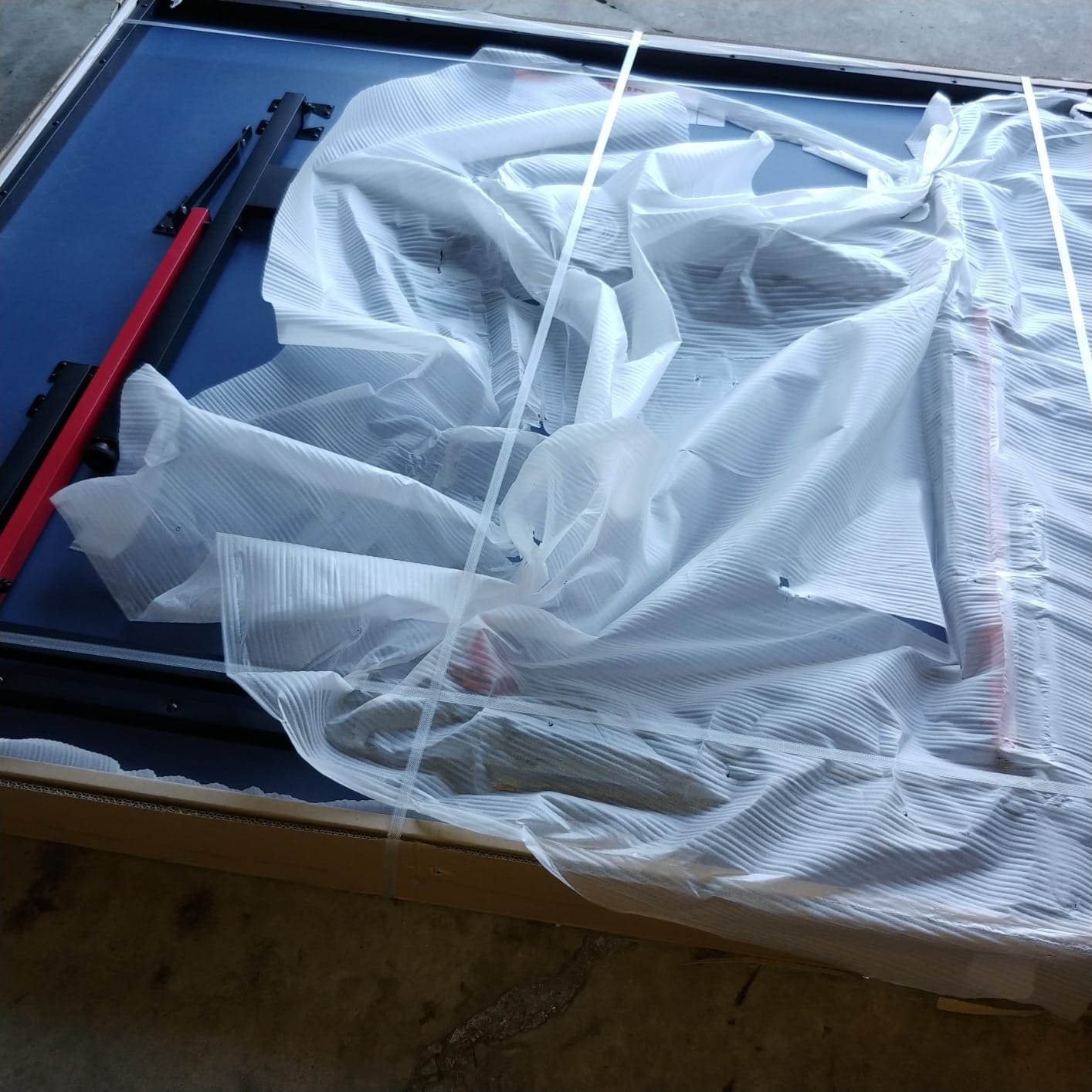
Assembly is the strongest part of the package. The table arrives 95% pre-assembled, so the setup is closer to bolting the casters on than to building furniture. For a basement being finished on a weekend alongside other trades, that matters more than any spec on the page.
The 141-pound total weight is the other thing families notice. It is heavy enough that it will not skate across a concrete floor when someone lunges for a wide ball, and light enough that two people can move it without planning a delivery crew. Each half rolls independently on 2-inch lockable wheels, which is what makes the fold genuinely useful in a multi-purpose room.
Storage is the trade-off. The folded depth is deeper than a compact mid-size model, so a room that is already tight will feel the difference between storing this table and storing a 6-foot one. Measure the wall space before you commit.
How a 13mm top changes the game at home
A 13mm top bounces lower and softer than a 19mm core, and it absorbs more energy on a heavy loop drive. For children learning to control the ball that is arguably a kindness, because rallies last longer. For a teenager who has started playing with a more aggressive style, the same softness starts to feel sluggish.
The 72-inch clamp-style net and post set included with the table is the right height for regulation-height play and does not need a separate purchase. Paddles and balls are not part of the package, so budget for those separately.
When to move up a tier instead
If the people using it are already playing in a league or club twice a week, the 13mm surface will frustrate them within a few months. The upgrade path is a 19mm or 25mm top rather than a different brand, and this same Advantage line is produced in those thicknesses, which makes it an easy step up if your basement has the floor area.
The warranty on this variant is 90 days, which is short, so keep the box and check the frame bolts after the first month on an uneven floor. It is also a full-size table, so if your ceiling is under 9 feet the net posts will be a constant problem. In that case, a compact model fits the room better.
3. JOOLA Rally TL Professional – Best Value for Basement Play
JOOLA Rally TL Professional MDF Indoor Ping Pong Table w/Quick Clamp Table Tennis Net & Post Set – 10 Minute Easy Assembly – Corner Ball Holders – Tournament Quality – Includes Playback Mode
15mm MDF top
Steel legs with height adjusters
70 kg
Trolley halves with anti-tilt locks
Pros
- Tournament quality 15mm MDF surface
- Only 8 bolts needed after unboxing
- Height adjusters keep the surface level
- Four wheel trolley halves aid storage
- Corner ball holders and magnetic scorers
Cons
- Heavy to move even with trolleys
- Older style black finish
- Net must be removed before folding
The Rally TL is the pick I recommend when the basement floor is the deciding factor rather than the ceiling. Its steel legs carry height adjusters, and on a slab that is out by a few millimetres in one corner, that is the difference between a playable table and a table that rocks every time someone leans on it.
It is also the most thoughtfully equipped table in this roundup for day-to-day use. Four corner ball holders and two magnetic abacus scorers are small details that remove the friction of a family game night, where the ball otherwise ends up on the basement floor under the furnace every time.
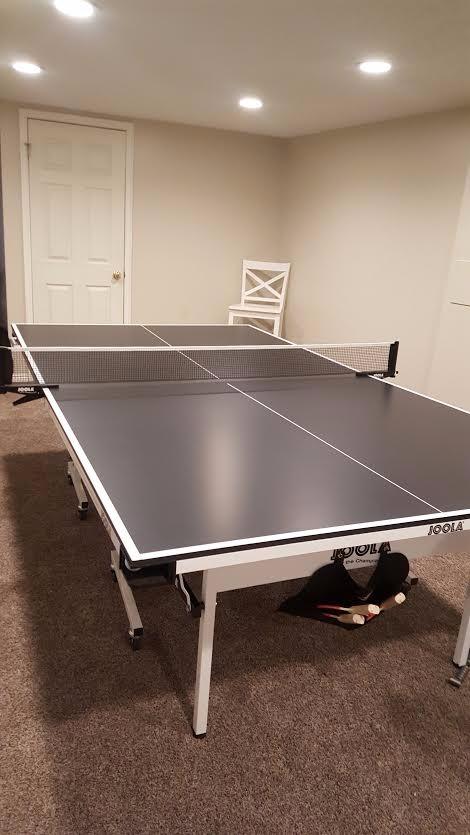
Assembly is eight bolts after unboxing, and the surface is a multi-layer painted 15mm MDF top at full regulation 9 by 5 feet. The paint layers matter in a basement because a sealed surface resists the moisture cycling that opens up bare particle board, which is where cheaper tables start to swell at the edges.
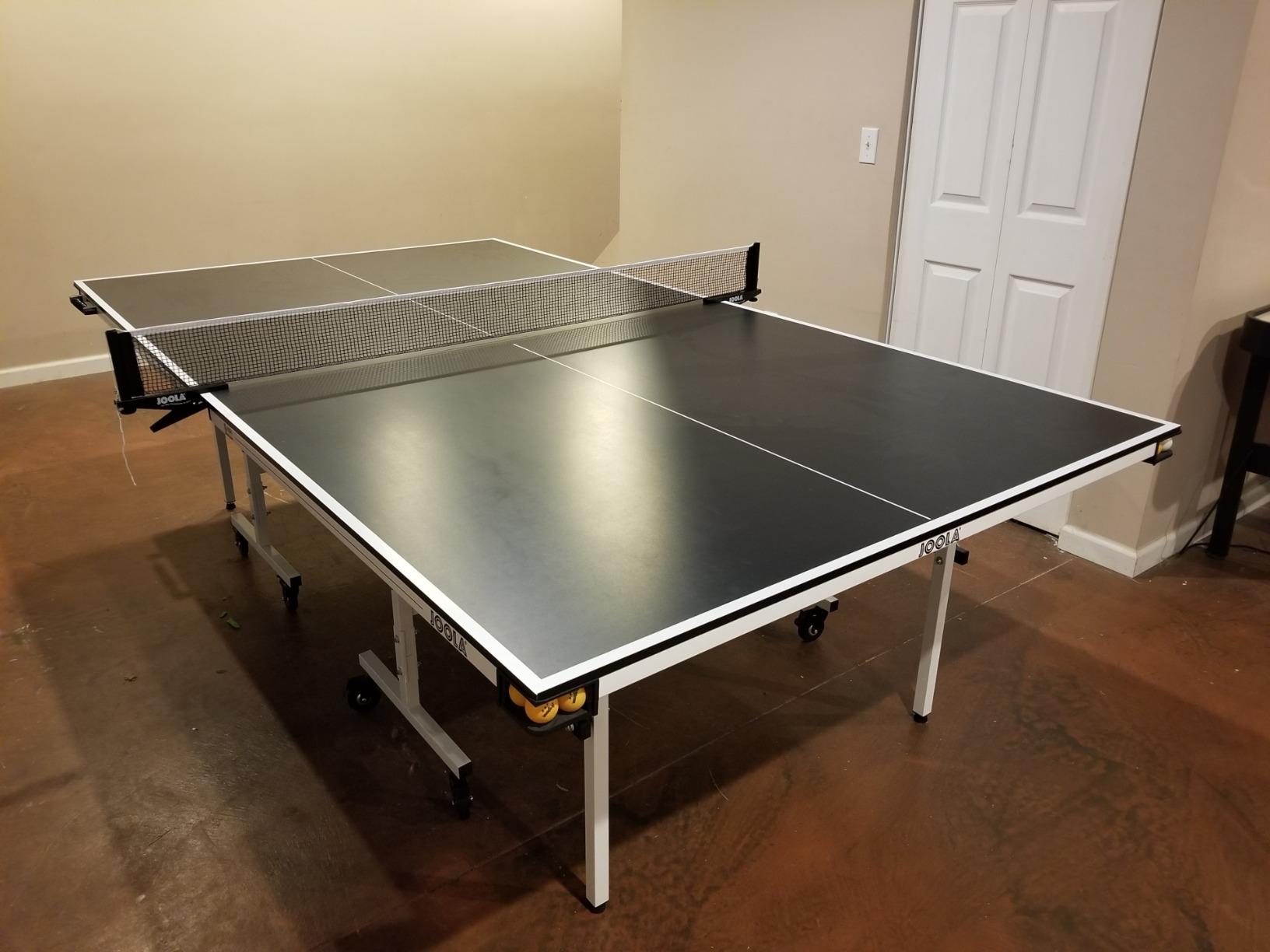
The two halves sit on separate four-wheel trolley systems with automatic anti-tilt locks. That means each half stands on its own, which is what makes playback mode work properly: fold one half upright and the other stays dead flat. Users consistently report that the height adjusters and the trolley system together are the reason this table still plays true after a year of being dragged across a slab.
Where the height adjusters earn their place
A poured basement slab is rarely flat across 9 feet. When we set this table on a floor with a gentle slope, the adjusters took out the wobble in under a minute using the included hardware, with no shimming under a leg. That is a basement-specific advantage that the fixed-frame tables in this list cannot match.
The 70 kg weight is still substantial, so treat the trolleys as a two-person job and lock the casters whenever the table is in play. The finish is a traditional black rather than the blue tops used on newer models, which matters only if you are matching a room’s colour scheme.
What to watch before you buy
The net clamp design means you have to detach the net to fold the halves together. It is a minor step, but in a room where the table comes out on impulse rather than on a schedule, it is friction you will feel every time.
At 15mm this is a strong family and club-training table, not a competition-grade surface. If you are chasing a 19mm or 25mm top for regular training, the HEAD Summit USA is the step up, and it costs more in weight and effort to move. For most basements, this is the balance point.
4. GoSports Mid-Size Set – Best for Low Basement Ceilings
GoSports 6 ft x 3 ft Mid-Size Table Tennis Game Set – Indoor/Outdoor Portable Table Tennis Game with Net, 2 Table Tennis Paddles and 4 Balls
6 by 3 foot mid-size surface
30 pounds
Aluminium frame
Folds in seconds
Pros
- Folds and carries in seconds with built-in handles
- Light enough for one person to move
- Suits low ceilings and compact game rooms
- Net two paddles and four balls included
- Smooth surface supports long rallies
Cons
- Mid-size surface is shorter than regulation
- Less stable than full size MDF models
- No casters included
A full-size table needs 9 feet of width and a ceiling you can raise a hand over without clipping the net. Where a basement cannot give you that, a 6 by 3 foot mid-size surface solves the geometry problem in a way no full-size table can. This GoSports set is the one I would put in a finished room with a low ceiling and a pool table already in it.
It is also the easiest table here to actually move. At 30 pounds with built-in carrying handles, one person can carry it down a stairwell or out to the patio. That changes the household calculus completely, because a table nobody will move is a table that ends up in the corner permanently.
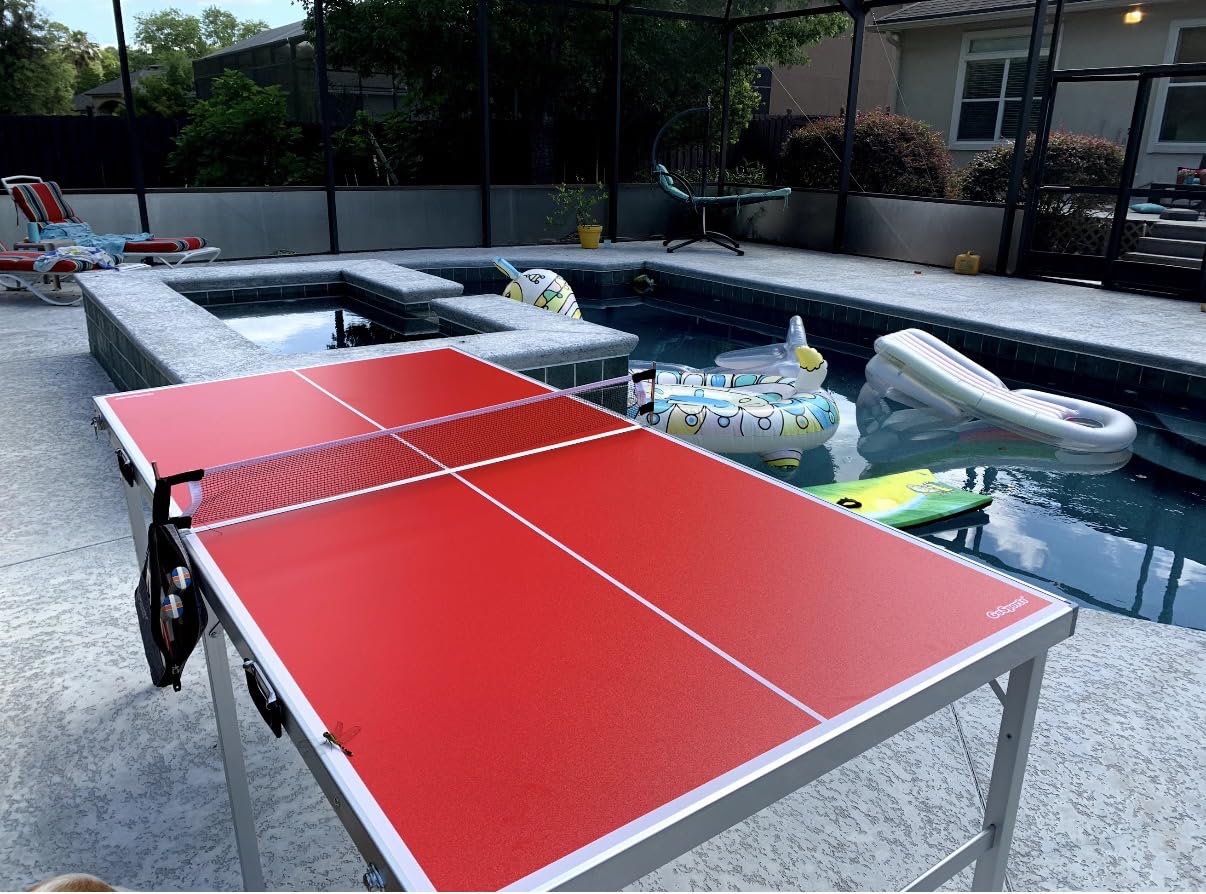
The package is genuinely complete: net, two paddles and four balls come in the box, so there is no second purchase before the first game. The aluminium frame is light but not flimsy, and the surface plays smoothly enough for rallies that surprise people who expected a compact table to be a toy.
Because the same table works indoors and outdoors, it is not a basement-only purchase. Households that want a table for a garage or a covered patio as well can use one surface for both, which no MDF table in this roundup can claim.
What you give up for a smaller surface
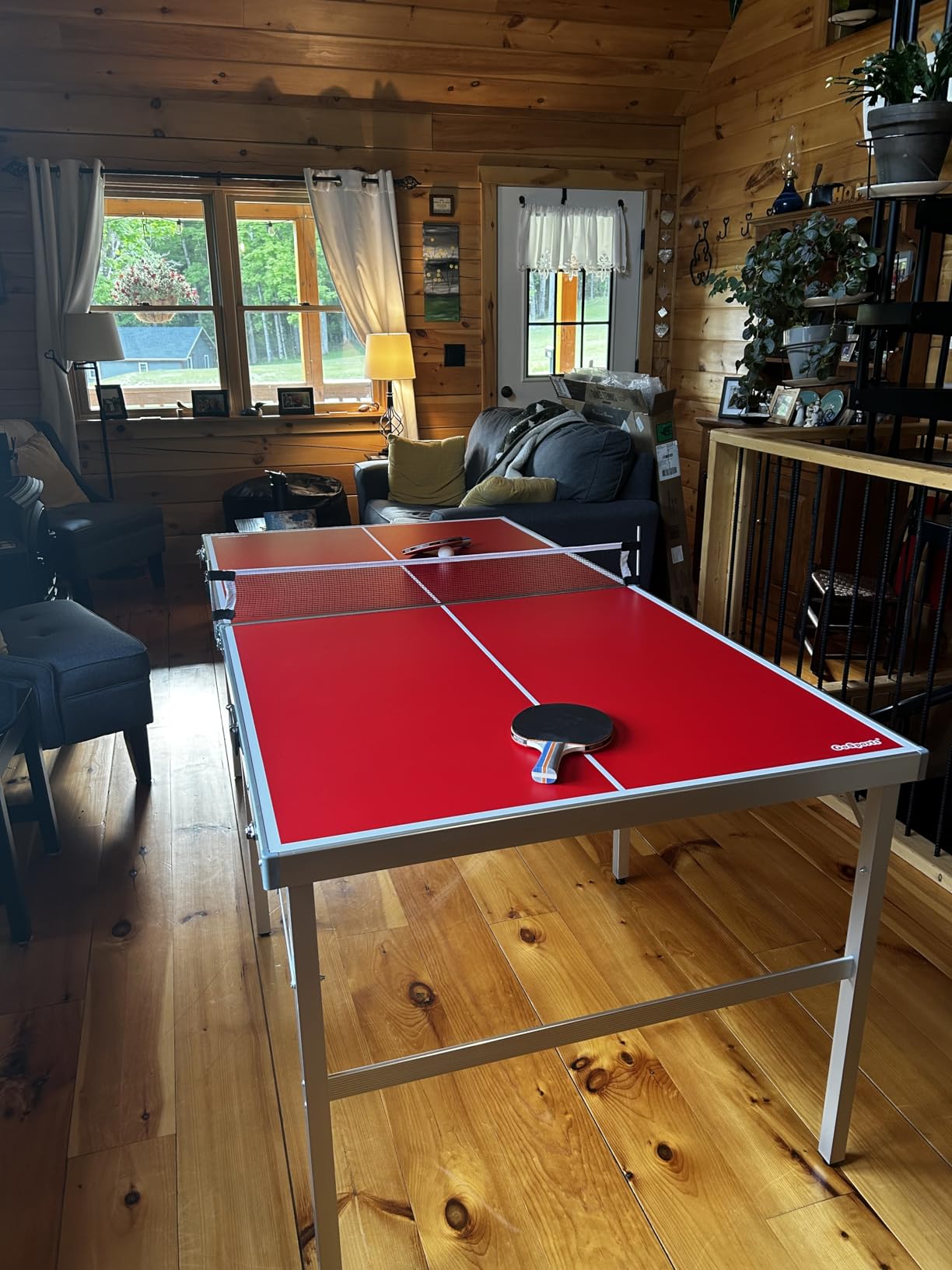
A 6 by 3 foot table is a fraction of the playing area of a regulation model. Wide-angle shots and serve-and-return spacing compress, and the table is not a regulation size for league or tournament play. It is excellent for doubles, family games and casual rallies, and it is the wrong surface for someone learning a proper serve routine.
Stability is the other difference. Aluminium moves more than a steel-framed MDF table, so on a hard concrete floor a hard volley will make the frame shift slightly. A rug or a fitted floor covering under the footprint solves this, and if you are laying flooring anyway our basement dryland flooring guide covers the options.
Who it suits and who it does not
This is the right table for a kids’ game room, a basement that doubles as a media lounge, and anyone who wants the option of taking the game outside. It is not the right table for a household with a teenager in a league, or for a room where two adults need to run side-by-side doubles with proper spacing.
Storage is the strongest argument for it. It folds flat in seconds and slides under a bed or into a closet, which in a small basement is worth more than another inch of tabletop thickness. If the folding depth of a full-size table is what is stopping you, this solves the problem outright.
5. JOOLA Quadri 15mm – Best for Compact Storage
JOOLA 15mm Indoor Ping Pong Table with Quick Clamp Table Tennis Net Set – Single Player Playback Mode – Regulation Size Compact Storage Set
Four-piece nesting design
15mm regulation surface
129 pounds
Separate trolley halves
Pros
- Regulation size surface that nests into a compact stack
- Each half moves independently on its own trolley
- Playback mode included
- Official size plays well for recreational games
Cons
- Pre-drilled holes are often misaligned so drilling is needed
- Legs are not adjustable so an uneven floor needs shims
- A crease down the centre of the surface can deflect the ball
The Quadri is the cleverest storage idea in this roundup. Rather than folding into two panels, it breaks into four pieces that nest, which is how it reaches a 108 by 60 inch regulation surface inside a 108 by 30 by 60 inch folded package. In a basement where every foot of wall space counts, that is a real advantage over a two-half design.
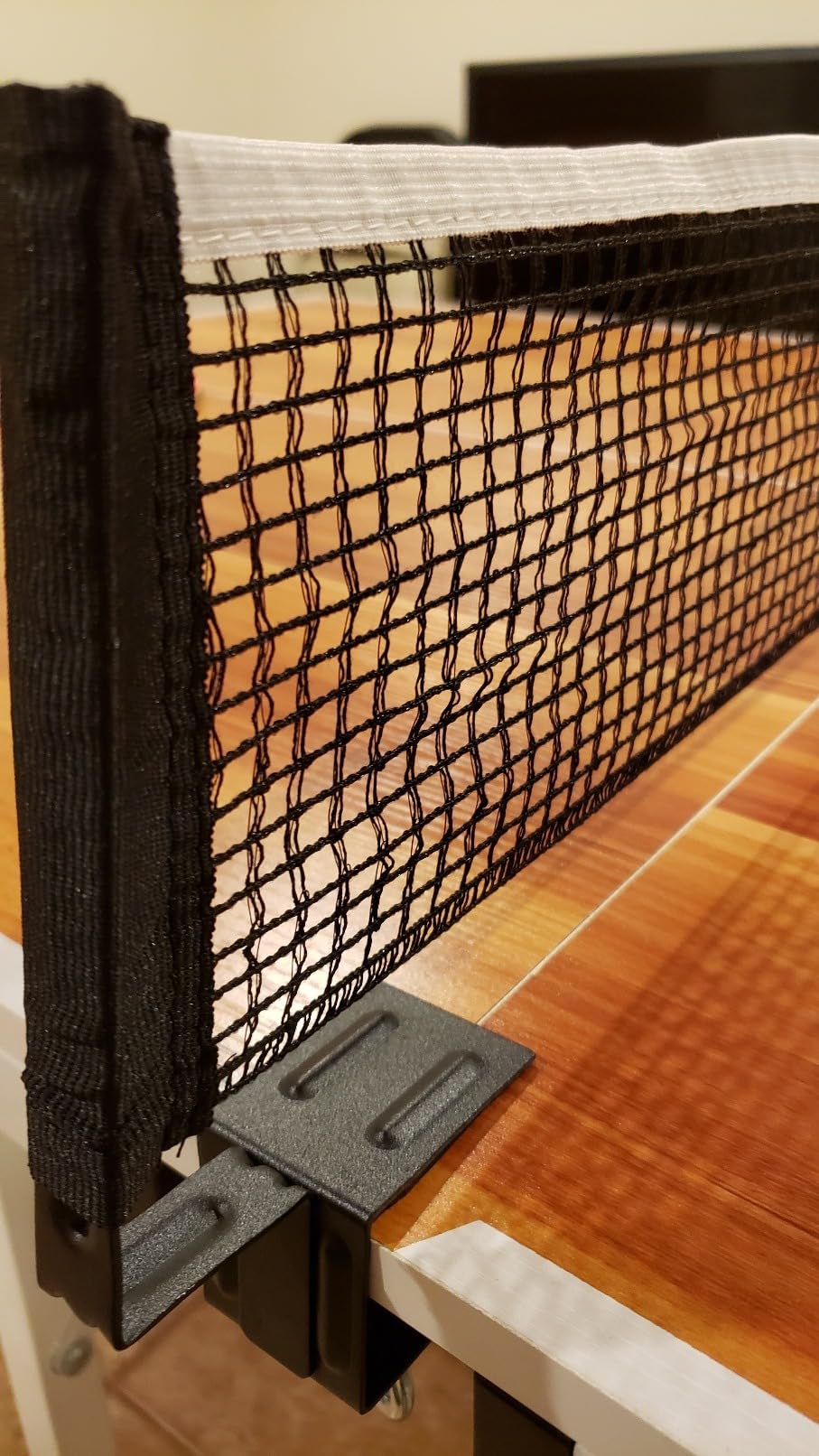
Each half runs on its own four-wheel trolley, so the pieces move independently, and playback mode works by folding a single half upright. The quick-clamp net and post set clamps on without tools and does not need removing to fold, which is a small convenience the Rally TL does not offer.
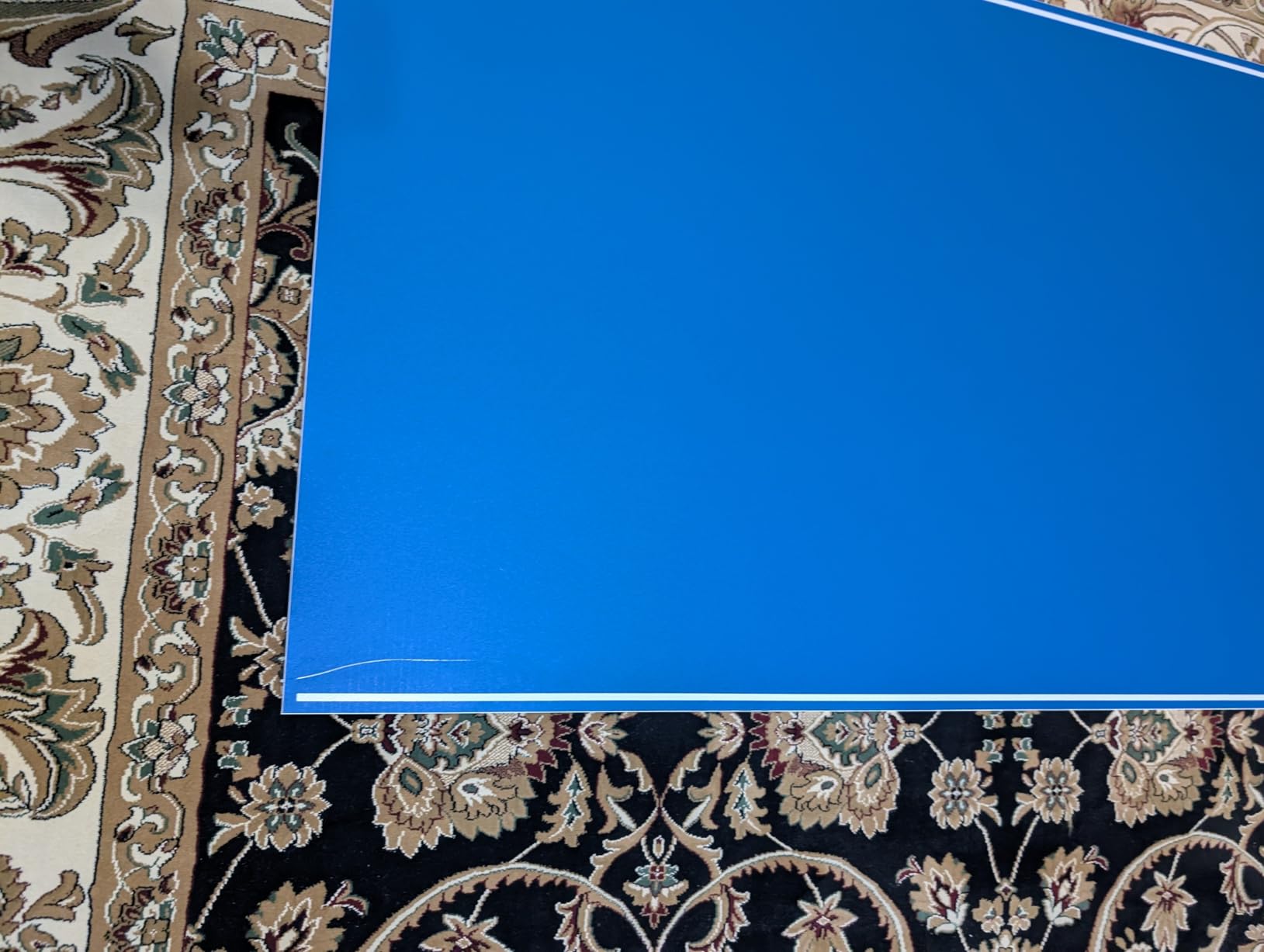
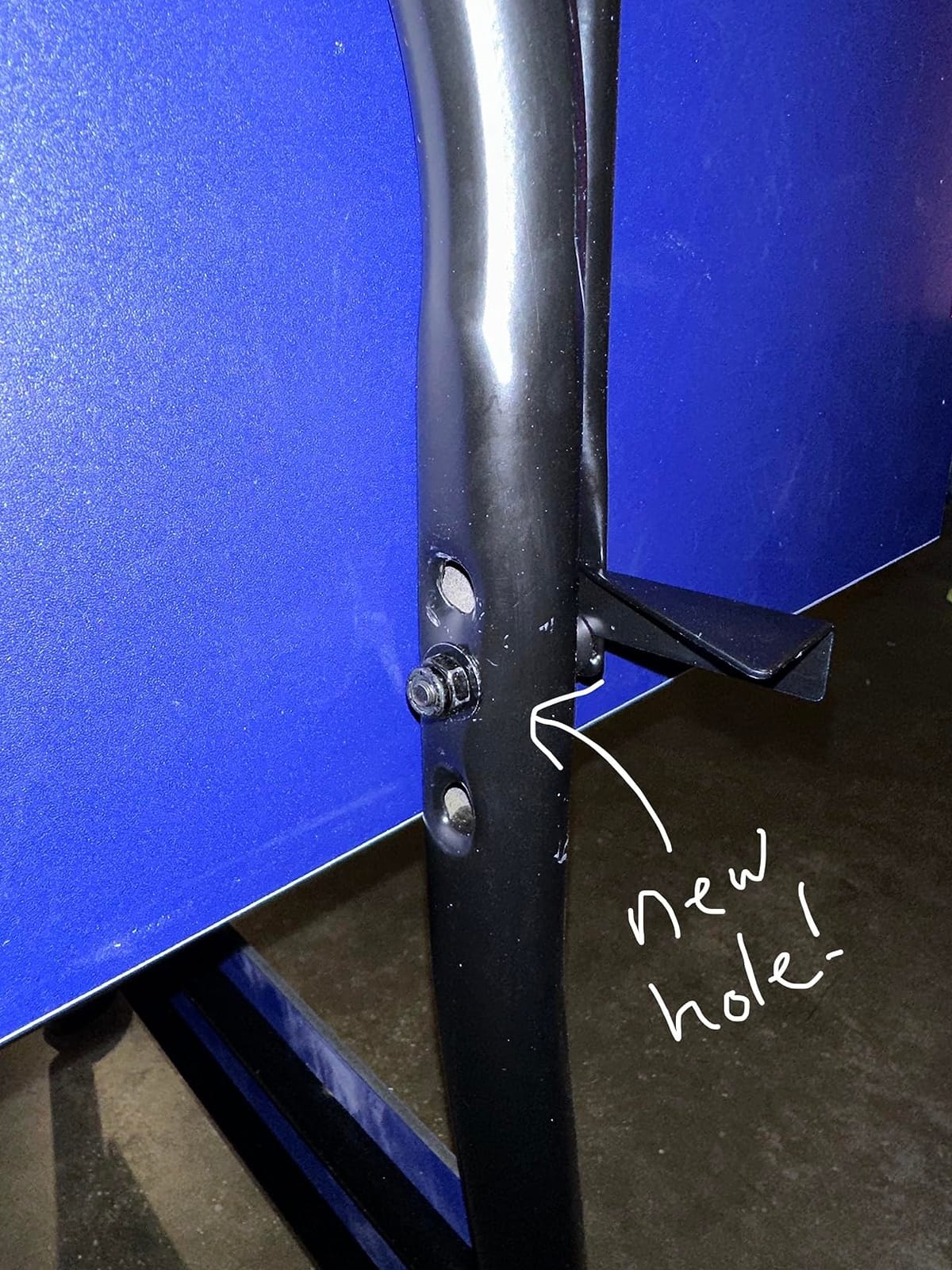
Where it falls short is assembly and finish quality. Reviews repeatedly describe misaligned pre-drilled holes that mean drilling during setup, instructions that are difficult to follow, and an assembly time measured in hours rather than minutes. Budget a full evening and a drill, and check every hole before you force a bolt.
The bigger basement issue is leveling. The legs on this model are not adjustable, so on an unlevel slab you are shimming with whatever is under the table, which is a recurring complaint from owners in older homes. There is also a crease or fault line reported down the centre of the playing surface that can send a slow ball off line.
Why the nesting design is worth the assembly
If your basement has a finished ceiling of 8 feet and a wall you would rather use for shelves, a four-piece nesting table can be stored in a footprint that no other full-size model here can match. That single advantage is why this table stays on the shortlist despite the lower rating.
Be honest with yourself about the tradeoff though. You are buying a regulation-size surface and a compact stack, but paying for it in setup time, in a top that has a seam defect some owners notice, and in a gravity lock that can let a folded half drop. Keep one hand on the half as you fold it.
When to choose a different table
If your basement floor has more than a slight fall, do not buy this model. Non-adjustable legs on a concrete slab is the pairing that generates the most complaints, and no amount of care in assembly will fix it. The JOOLA Rally TL, with height adjusters, is the safer route on a sloping slab.
For a household that wants a table to use rather than a table to store, the STIGA Advantage Lite is easier to live with. For a household that genuinely has no wall space, this is the one that fits. Know which problem you are solving before you order.
6. STIGA Space Saver – Best for a Small Basement
STIGA Space Saver Ping Pong Table – Woodgrain
71 by 40.5 inch footprint
83 pounds
No assembly required
Regulation 30 inch height
Pros
- Compact footprint suited to basements and small rooms
- No assembly at all
- Halves separate into two useful side tables
- Regulatory playing height keeps the bounce familiar
- 4.6 average rating
Cons
- Surface is narrower and shorter than a full 9 foot table
- Woodgrain finish shows wear over time
- Only a 30 day warranty
The Space Saver solves the same problem as the GoSports mid-size set but in wood rather than aluminium, and it does it with a woodgrain MDF surface at full regulation playing height. A 71 by 40.5 inch footprint is roughly 19 inches narrower than a regulation top, which is often the difference between a table that fits and one that does not.
It also carries a 4.6 average, and the reason nothing needs building is simple. You unpack it, unfold it, clamp on the included net and post set, and play. In a basement that is still being finished, that removes an entire evening from the project.
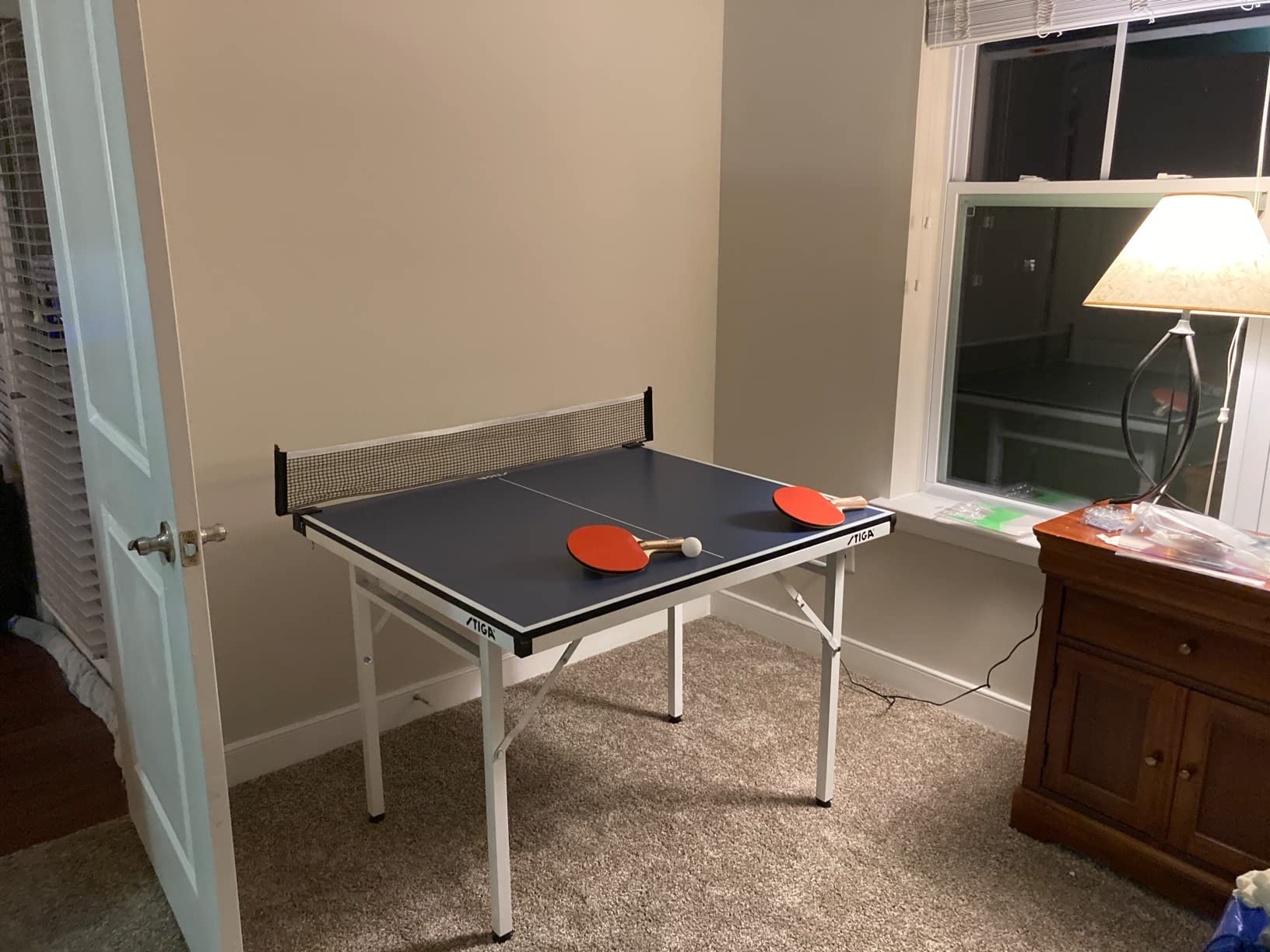
Playing height stays at the regulation 30 inches, so the net sits at the right height and the geometry of a rally feels familiar. That matters more than raw surface area for beginners, because a table at the wrong height teaches bad habits that are hard to unlearn later.
When you separate the halves, you get two side tables that are genuinely useful in a game room for cards, chess or drinks. On a basement floor that has to work as a lounge as well, that dual function is what makes a compact table feel generous rather than compromised.
How much room you actually need
Budget 6 feet across and 3 feet deep for the table itself, plus 2 feet of play space on every side if anyone is going to swing a racket properly. That total footprint of roughly 10 feet by 7 feet is the number to measure, not the 71 by 40.5 inch surface, and it is the mistake most buyers in small rooms make.
The storage position folds vertically, which turns the table against a wall and gives the room back entirely. A Well-Trained Mind Community user who treated fold-and-roll-away as a hard requirement picked a compact model for exactly this reason, prioritising a table that disappears rather than one that stays out.
The limits worth knowing
The narrower and shorter surface limits competitive play, and at 71 inches there is no version of a regulation rally on this table. It is a family and recreational surface, and treating it as a training table will lead to frustration. The woodgrain finish also shows wear over time where a blue painted top hides scuffs.
The 30-day warranty is the shortest of the compact options here, so inspect the panels and casters on arrival. That is the whole compromise: you give up surface area, you get a table that fits and installs in a room that could never take a 9-foot one.
7. MD Sports Table Tennis Table – Best for Family Game Rooms
MD Sports Table Tennis Set, Regulation Ping Pong Table with Net, Paddles and Balls (8 Pieces) – Black & Light Blue
15mm reinforced top
Folds to 16 inches thick
114.6 pounds
Includes paddles and balls
Pros
- Official 9 foot field with a reinforced steel frame
- Folds down to just 16 inches thick
- Includes two paddles two balls net and posts
- Fold back design supports solo practice
- Interactive 3D assembly instructions
Cons
- Indoor use only
- Steel frame is heavier than aluminium folding sets
- Assembly required straight out of the box
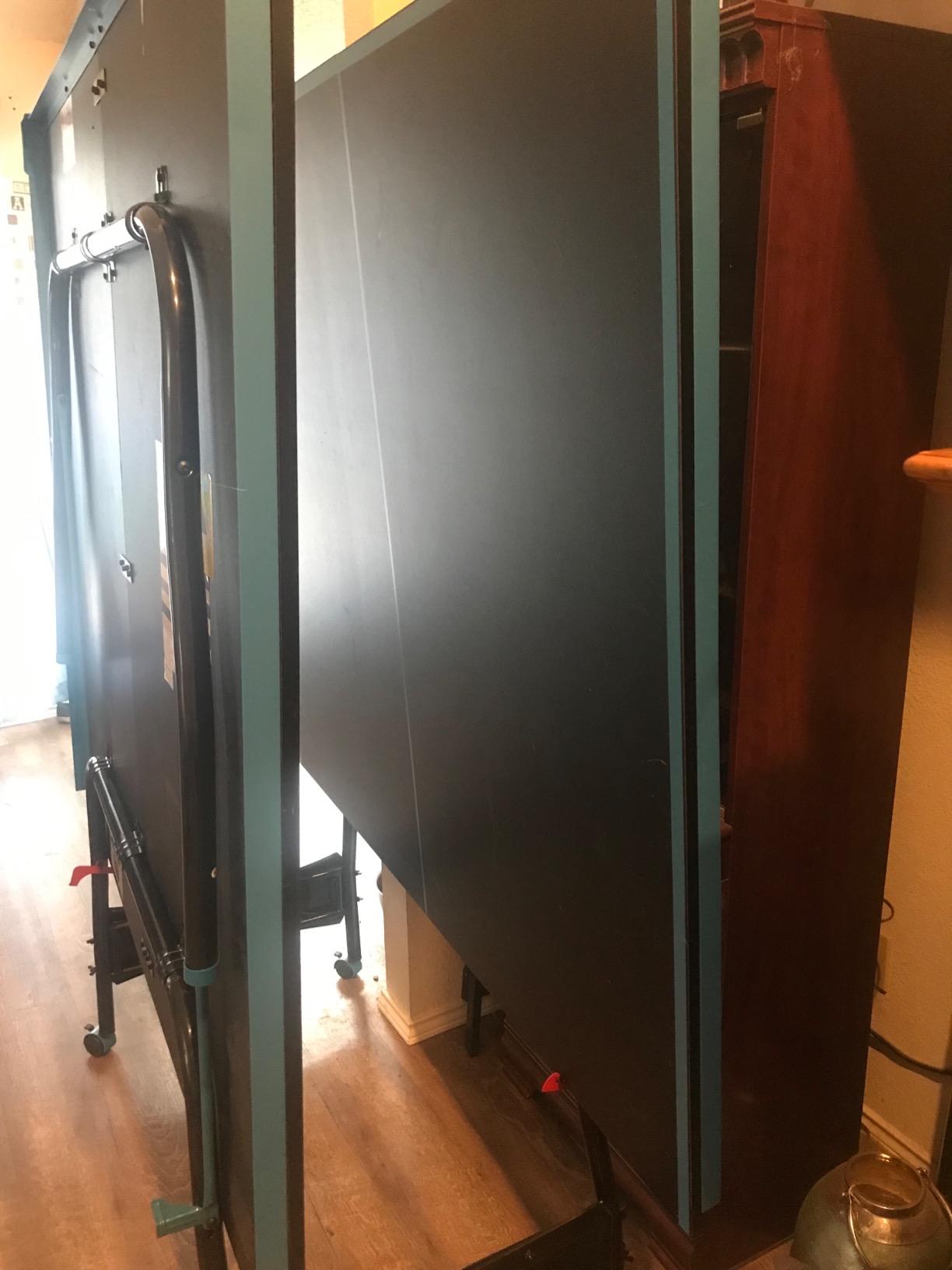
This is the table for a family that wants a regulation-size surface and a very thin fold. At 73 by 60 by 16 inches folded, it is the slimmest storage profile among the full-size tables here, which matters when the basement has 7 feet of wall between a support column and the stairs.
The playing field is the full 108 by 60 inches with a reinforced 15mm top over a steel leg frame and 1.2-inch aprons. That combination of a proper steel frame and a reasonable top thickness is why it holds its shape in a temperature-swung room better than the lightweight budget sets, and it is a genuine step up for a household that plays every weekend.
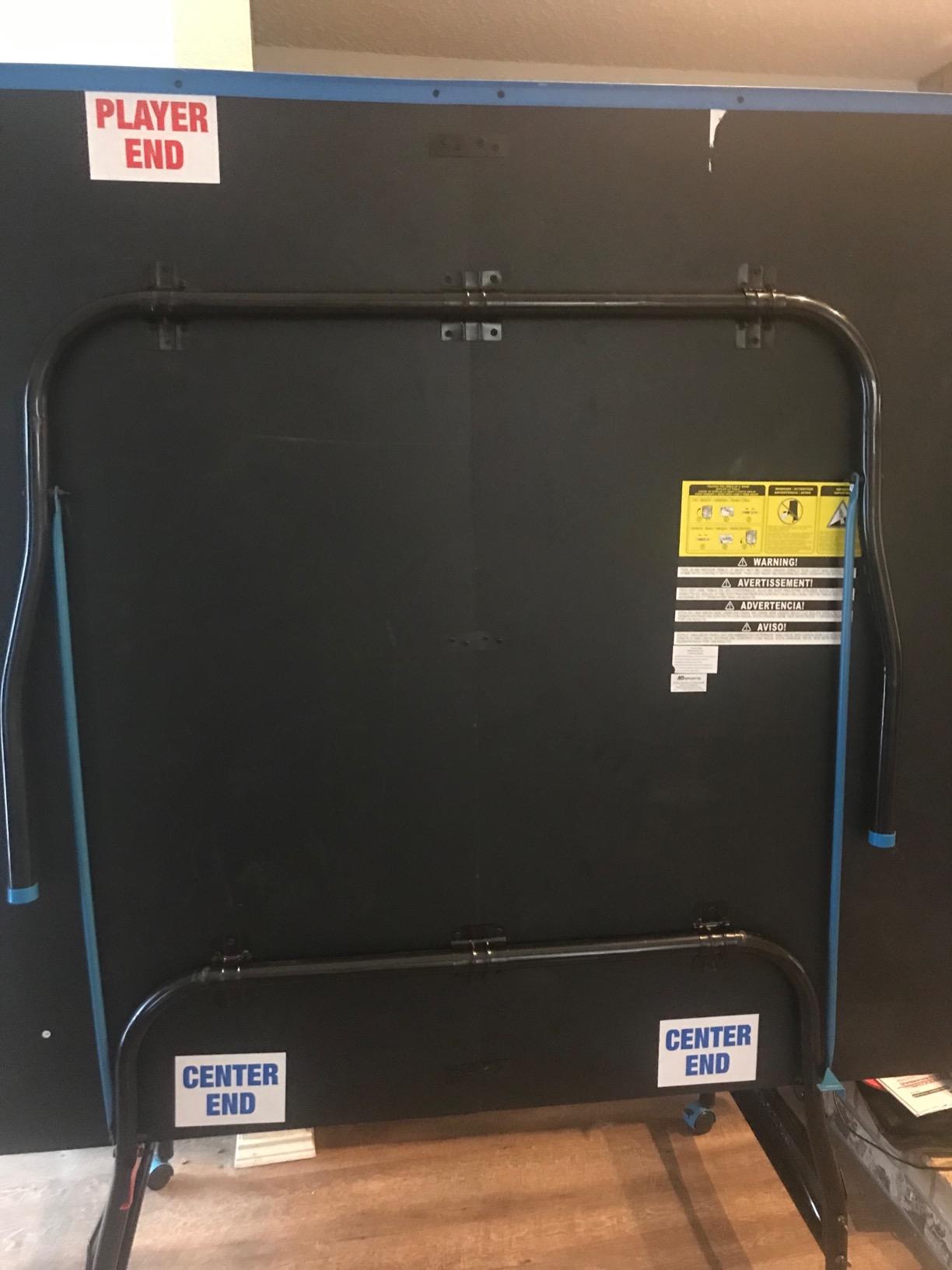
Two paddles, two balls, a net and a post set are all included in the box, so the family can play on assembly day instead of waiting for a second order. Assembly runs through a free 3D interactive app rather than a paper booklet, which is a better experience than most flat-pack instructions provide.
Folding one half back gives you a single surface for solo practice, and the whole unit folds down flat against a wall for storage. For a basement that has to function as a family room six days a week and a game room on weekends, the thin fold is the feature that justifies the weight.
Weight and moving, honestly
At 114.6 pounds this is a steel table, not an aluminium one, and the folded halves will need two people to reposition. That is a real cost in a basement with a narrow stairwell, and it is the main reason we would not recommend this model above a stair descent with a tight turn.
On the plus side, that weight is exactly what you want on a hard concrete floor. A heavier frame does not skate when a rally gets fast, and the reinforced steel legs keep the surface steady at the net where a lighter table starts to flex.
What to consider before buying
The table is rated for indoor use only, which is correct for a finished basement but rules it out for a garage or porch. If your space is unheated or experiences wide temperature swings, an outdoor-rated top is the safer material choice, and this is not it.
The rating here is lower than the JOOLA and STIGA tables, and the reason is consistent: the build is solid but basic, with a folded design that does not quite reach the slimness of the best storage models. For most family basements that is a fair trade, and the included accessories mean the all-in cost of getting started is lower than the alternatives.
8. HEAD Summit USA – Best for Serious Training
HEAD Summit USA Indoor Table Tennis Table, Competition Grade Net, 10 Minute Easy Set Up – Ping Pong Table with Playback Mode
18mm laminated surface
190.3 pounds
Double chassis frame
Competition grade net
Pros
- 18mm laminated top resists warping and bounces consistently
- Competition grade clamp-on net handles hard rallies
- Folds one half up for playback and nests for storage
- Smooth 3 inch casters
- Highest five star share of any table reviewed
Cons
- Very heavy at 190 pounds so two people are required
- 90 day limited warranty is the shortest in this roundup
- Built-in paddle and ball storage adds bulk to the frame
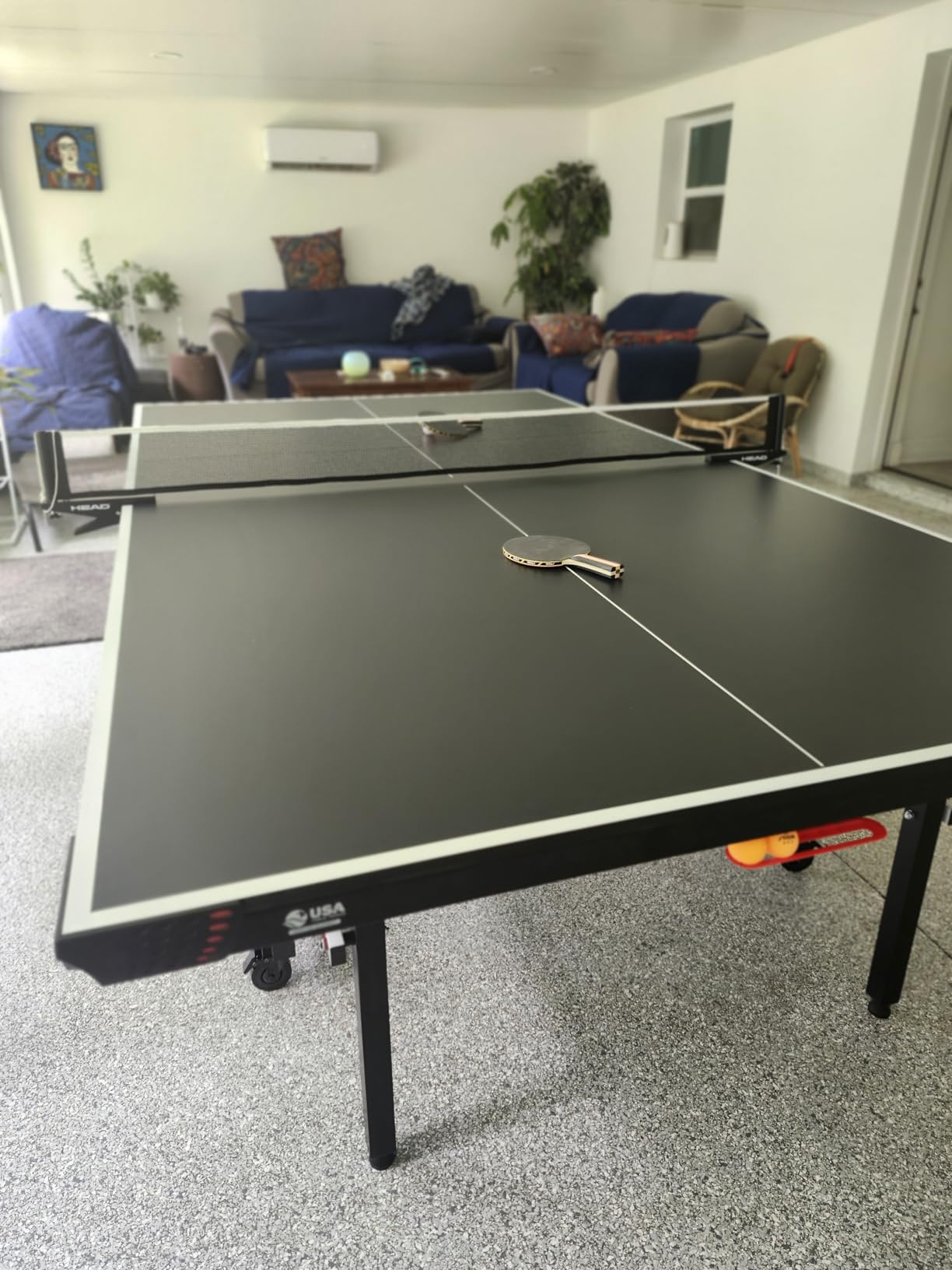
If the person using this table is already playing competitively, this is the only model in the roundup built for it. The 18mm fully laminated playing surface is a step change from the 15mm MDF tops elsewhere in this list, and the deluxe clamp-on net is designed to take hard, high-tension hits without letting go.
Lamination is the basement-relevant part. A multi-layer sealed construction tolerates humidity cycling better than a bare pressed board, and the manufacturers of indoor MDF tables consistently warn against damp or wet environments. This is the table here that most directly answers that warning with its build rather than with a warning label.
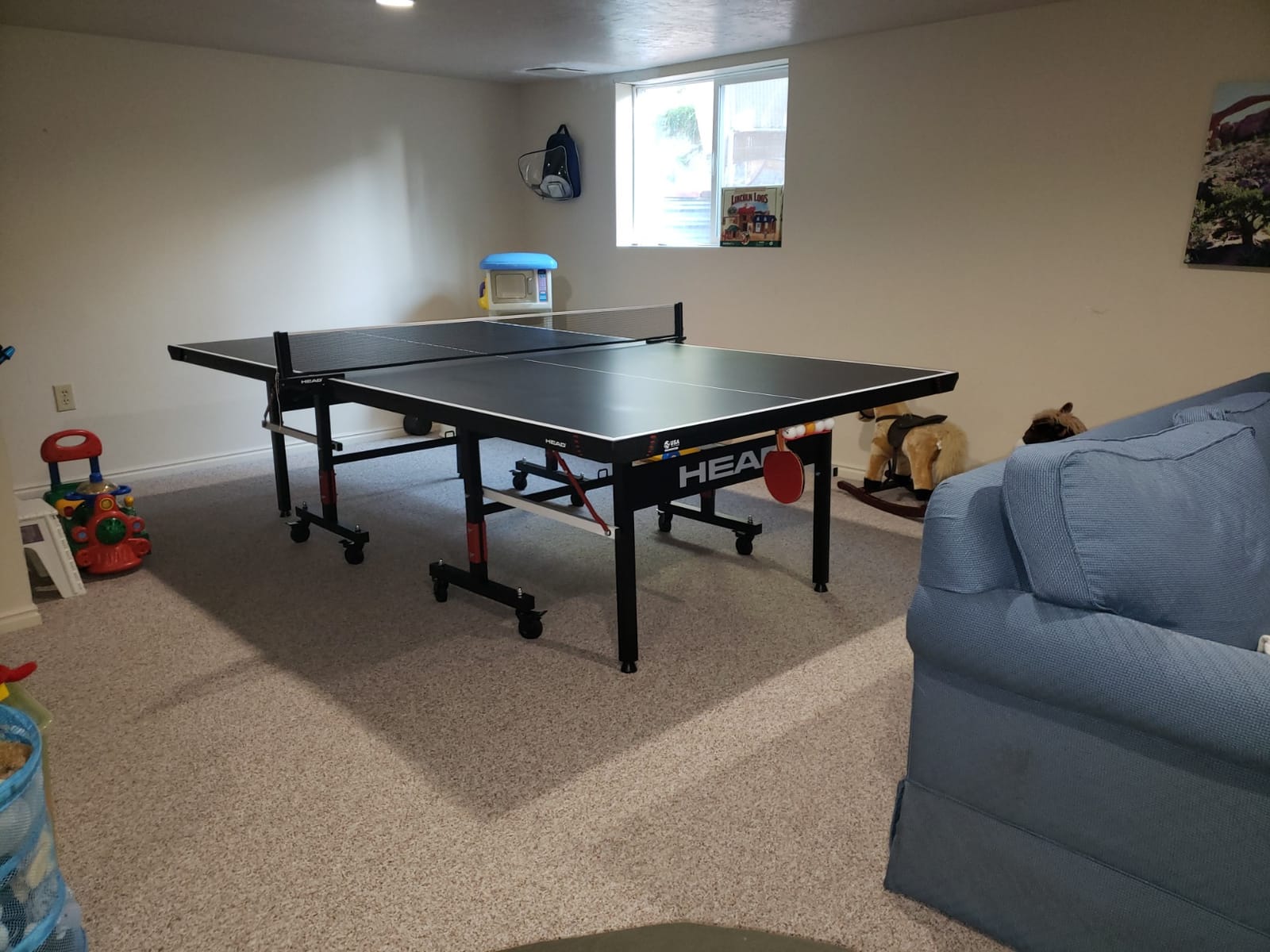
The double chassis folding frame offers both playback and nested storage positions, and the 3-inch casters roll smoothly between rooms. Setup is 95% pre-assembled with a 10-minute target, and built-in paddle and ball storage removes the loose accessories that otherwise end up under the table.
Owners report the highest share of five-star ratings of any table in this roundup, which reflects what a training surface does when the ball is struck properly. If you are moving up from a 15mm table, the difference is immediate and it is the reason this one earns its place despite the weight.
The weight question is the whole question
At 190.3 pounds this is by far the heaviest table here. Two people can move it on its casters, but a basement stairwell is the hard part, and a room that requires repositioning the table for every game will end up with a table that never gets unfolded.
Ask honestly whether the training value justifies a table that lives in one spot. If it does, the casters make repositioning within the room routine. If your basement is small and the table needs to come out for other uses, a lighter 15mm model is the better fit regardless of skill level.
What you give up elsewhere
The warranty is 90 days, the shortest in this roundup, which is unusual for a table at this level and worth noting if you plan to keep it for years. The built-in paddle and ball storage adds bulk to the frame, and the laminated top is a sealed build rather than a solid plank, which some purists consider a different feel under the ball.
Plan for accessories separately, since the package is the table and a competition net assembly. As you progress, it also helps to upgrade your paddles and pick up a proper training racket setup before chasing more speed from the table itself.
9. Best Choice Products Portable 6×3 – Budget Pick for Tight Rooms
Best Choice Products Ping Pong Table 6 Foot Mid-Size Portable Folding Table Tennis Table for Indoor & Outdoor Play, Compact Game Table with Net, Paddles & Balls – Blue
6 by 3 foot mid-size surface
34 pounds
Adjustable feet and leg locks
Folds flat to store
Pros
- Folds flat to slide under beds or against a wall
- Built-in carrying handles for fast transport
- Adjustable feet and leg locks help on uneven ground
- Light 34 pound weight
- Includes net two balls and two paddles
Cons
- Mid-size 6 by 3 foot surface is well below regulation width
- Aluminium and thin top flex under hard rallies
- Engineered wood is poorly suited to damp basements
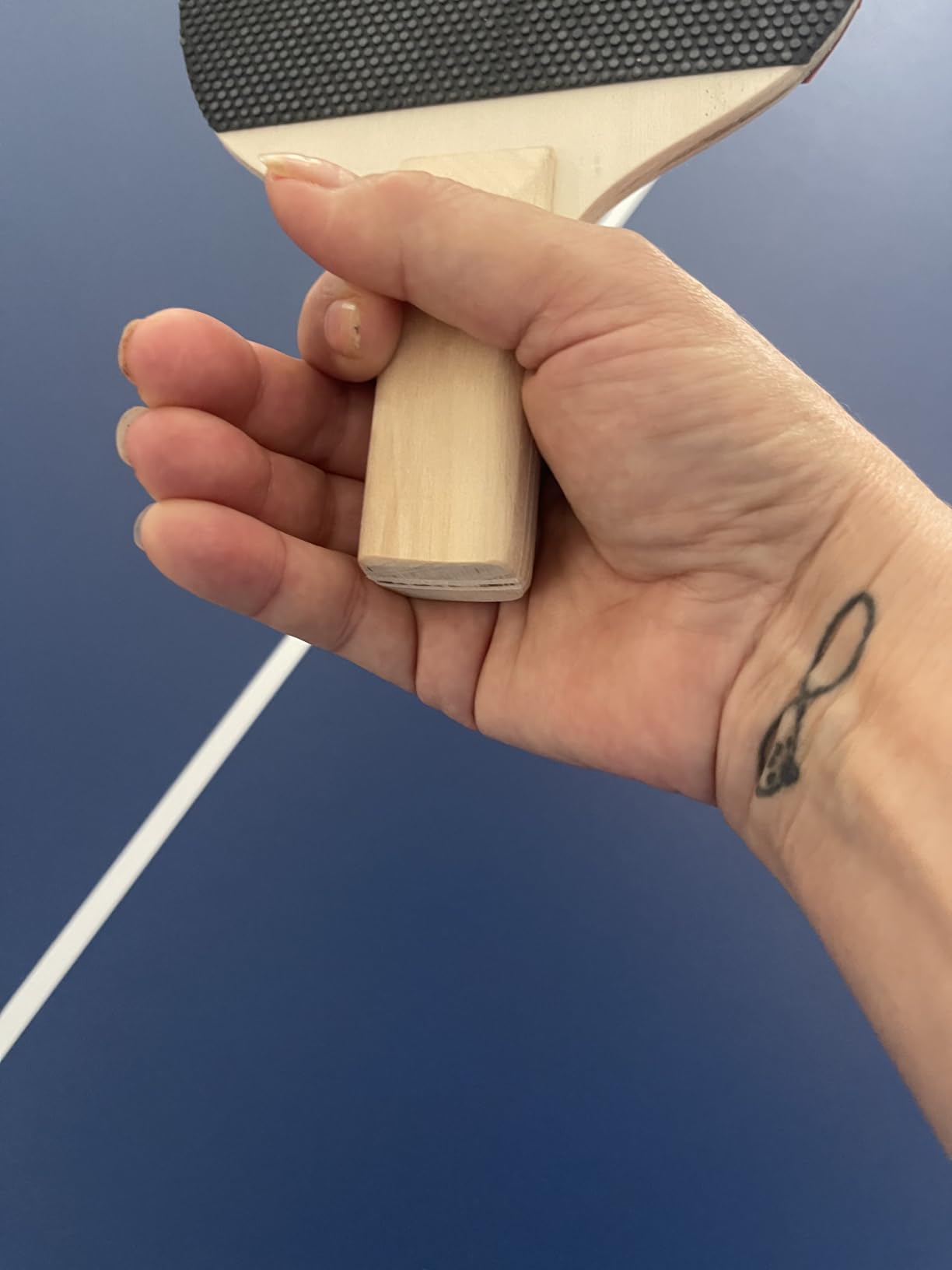
This is the most straightforward way to get a genuine table into a basement that has no room for anything else. At 72 by 36 by 30 inches and 34 pounds, one person can carry it down a set of stairs and set it up in minutes, which settles the will-anyone-actually-use-it question in a single move.
It folds flat enough to slide under a bed or stand in a closet, and the built-in carrying handles are positioned so the table moves like a suitcase. Net, two balls and two solid wood paddles are in the box, so it is playable the moment it is unfolded.
The detail that matters most in a basement is the adjustable feet with secure leg locks. On a slab with a small fall, these are what stop the surface from rocking, and at this weight class most competing tables have fixed feet. That one feature makes it a more sensible choice on an uneven floor than several heavier models.
It is a two-player table by rating, and the 6 by 3 foot surface is well below regulation width. Doubles on it is a squeeze. For family play, practice, and a first table in a kid’s room, it does everything it is meant to do.
Where the budget shows
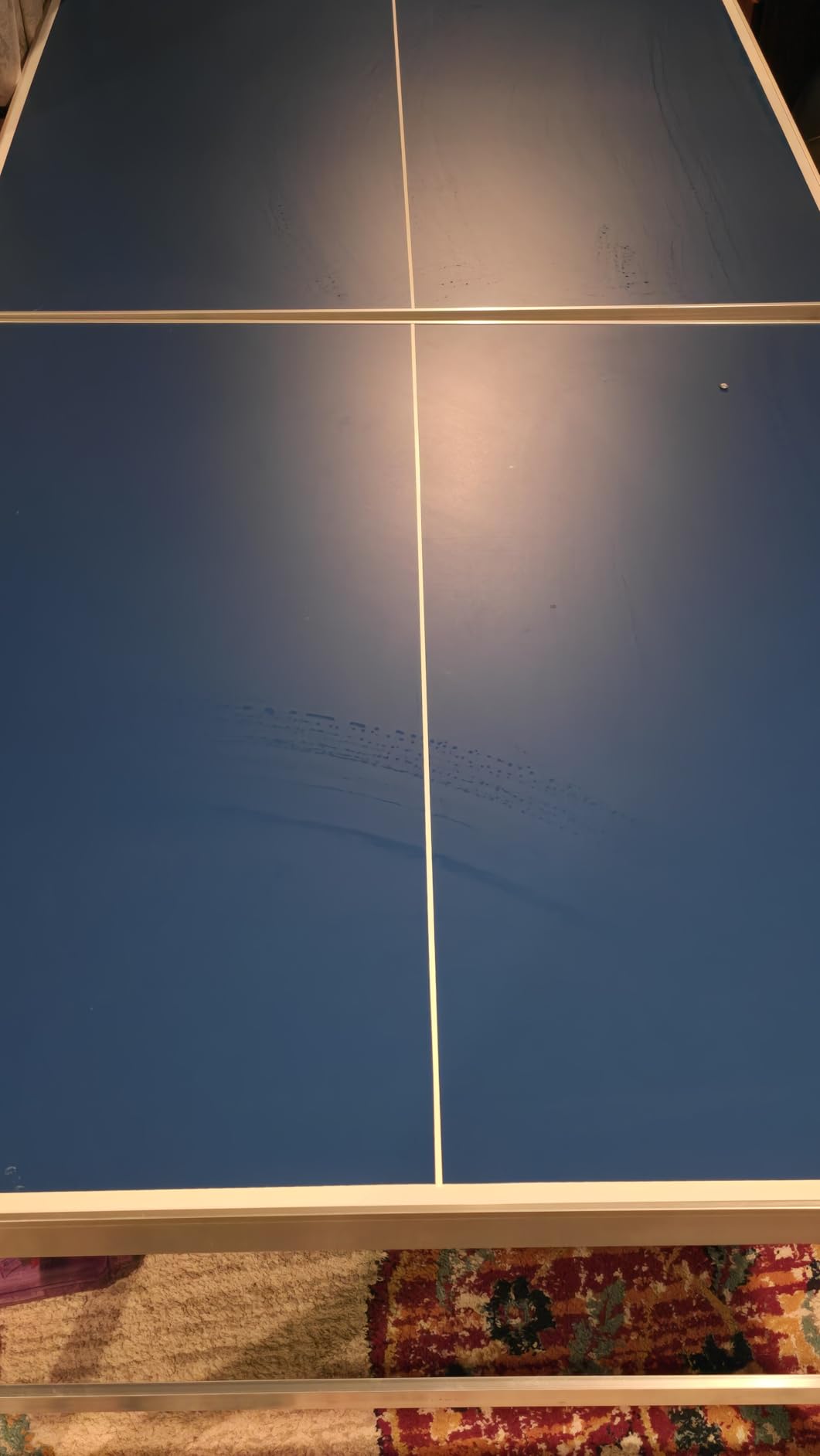
The top is thin engineered wood on an aluminium frame, and both of those flex under a hard rally in a way an MDF top on steel does not. On a slow family game this is invisible. On a teenager who has started hitting properly, the surface starts to feel soft and the frame shifts on a hard floor.
The bigger caution is material. Engineered wood is a poor choice in a damp or temperature-variable basement, which is the same moisture caveat that applies to every MDF table but stronger here because the core is thinner and the sealing is lighter. If your basement reads damp on a hygrometer, spend more on a thicker, better-sealed top rather than less.
How to decide between this and a bigger table
Choose this if the room is the constraint, the players are children or casual, and one person needs to be able to move the table alone. Choose a compact wood model like the STIGA Space Saver if you want regulation playing height and a surface that does not flex, and accept a similar footprint for a better surface.
Skip it if the basement is unheated or shows condensation, and skip it if the goal is to develop real technique. The 60-day warranty is also short, so inspect the leg locks and net posts on arrival before you put it into regular use.
10. Hathaway Maverick 7-Foot Pool Table with Conversion Top – Best for Two Games in One
Hathaway Maverick 7 Foot Pool Table with Table Tennis Top – With Accessories for Both Games – Space-Saving Ping Pong and Pool Table Combo for Families – Matte Black Finish, Red Felt
7 foot pool table with a table tennis top
Integrated leg levelers
252 pounds
Accessories for both games
Pros
- Two games in one basement footprint
- Complete accessory kit for billiards and table tennis
- Integrated levelers on the L-shaped legs help with uneven floors
- Matte black finish suits contemporary rooms
- 7 foot size is right for family play
Cons
- Very heavy at 252 pounds so conversion is a two person job
- Resin conversion top is lighter than a dedicated table tennis surface
- 7 foot bed is below full billiard regulation size
This is the answer for a basement that genuinely cannot give a table tennis table its own floor space. A 7-foot pool table with a lift-off table tennis top plays two games from one footprint at 84 by 46 by 31 inches, and the accessories for both games, two cues, balls, chalk, a triangle, a brush, a net and posts, paddles and balls, all ship in the box.
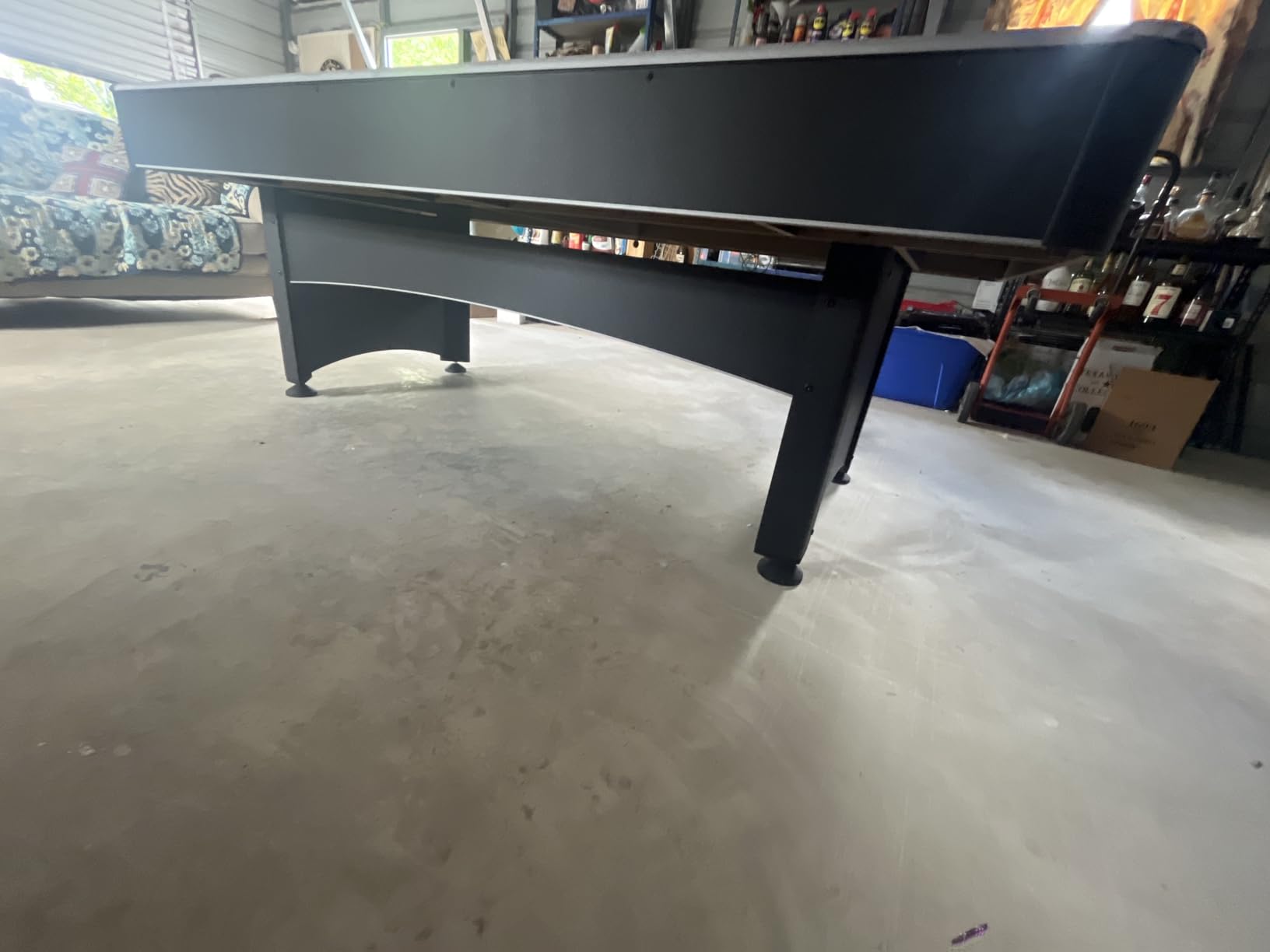
The L-shaped legs carry integrated levelers, which is a meaningful detail in a basement. On a slab that is not perfectly flat, those levelers take out the wobble without shimming, and a pool table that rocks is much more annoying to play on than one that does not.
The build is engineered wood with a poly-sealed playfield, K-66 gum rubber cushions and a blended wool and polyester felt, finished in matte black with red felt and chrome corner caps. It looks like furniture rather than sports equipment, which matters in a finished room where a bare MDF table would look out of place.
Switching games means lifting the pool top off and setting the table tennis top in its place. That is a simple operation with two people and an awkward one with one, which is why the 252-pound total weight is the most important number on this page.
When the conversion top is the right call
The strongest case for this table is a space-constrained basement where pool is the primary game and table tennis is the occasional alternative. A Reddit r/gamerooms user weighing a dedicated table against a conversion top framed it exactly this way, worried less about the surface and more about whether a whole table would be worth the floor it consumed.
For that household, this is the right buy. You get a 7-foot bed sized for family play rather than adult league use, and a second game that costs no additional floor space. The 180-day warranty is longer than most of the warranty periods in this roundup.
When it is the wrong call
If table tennis is the game you actually want to play, the resin conversion top is noticeably lighter than any MDF table in this list. Reviews reflect that clearly, and the 4.0 rating is largely a result of buying a pool table and expecting a table tennis table in the box.
Also weigh the conversion ritual. Lifting a top onto and off a 252-pound table is a two-person job every time, and a game that requires heavy lifting before the first serve will lose its appeal. A dedicated folding table opens in under a minute. Measure the room, decide which game wins, and buy for that one.
How to Choose a Table Tennis Table for a Basement
Basement suitability comes down to four physical constraints, and you should check all of them before you look at a single product page. Floor flatness, ceiling height, ambient humidity and the floor area left when the table is folded decide which table works, and the brand matters far less than those four numbers.
Tabletop thickness is the one spec that decides how the table feels
Tabletop thickness is the single number that separates a table that feels like a sport from one that feels like a novelty. Indoor tables are built from MDF, a wood composite that is light, flat and cheap to press, but that swells and delaminates when it takes on moisture. A thicker core is stiffer, bounces more consistently and shrugs off humidity cycling better.
13mm (about 1/2 inch) – light and inexpensive, bounces lower and softer, and flexes visibly under a hard shot. Fine for children learning to rally.
15mm (about 5/8 inch) – the sweet spot for family basements. Predictable bounce, manageable weight, and the most common choice in this roundup.
18mm (about 11/16 inch) – noticeably firmer and more consistent, and a laminated build resists warping better than pressed board. The step up for regular practice.
19mm (3/4 inch) – the minimum for serious training and the thickness club tables are built around.
25mm (1 inch) – competition standard, heavy, expensive, and only worth it if someone in the household plays at a serious level.
Above 19mm the practical gains shrink for a family setting. Below 15mm the table will not stay flat in a room with temperature swings, and in a basement that is exactly the environment you are buying into. If you are choosing one number for a normal finished basement, 15mm is it.
Leveling an uneven concrete floor
A poured slab is never flat across 9 feet, and this is the most common reason a good table plays badly in a home. The fix is a table with adjustable height on each leg, so check the product page for height adjusters or leveling feet before you buy. The JOOLA Rally TL and the Hathaway both have them; the JOOLA Quadri does not, which is why owners of that model report shimming under the legs.
To level anything properly, work from the middle of the room outward. Set the table roughly where it will live, put a straightedge or a long level across the top, and adjust each leg until the surface reads level across the whole span rather than just at the four corners. Then tighten the frame bolts, because a level surface with loose bolts will drift within a month.
Set the net height to 6 inches above the surface, and do it last, after the surface is level. A net that is correct before leveling is wrong afterwards, and that is the step most people skip. If the room has a slope, a small shim pack under the low corner of a fixed-leg table is an acceptable fallback, but adjustable legs are always the cleaner answer.
Protect the floor as well. Steel-framed tables weigh 130 to 190 pounds and their casters will mark bare concrete over time. Our basement flooring guide covers the surfaces that take that kind of load, and a floor covering under the footprint also stops a light aluminium frame from skating on hard concrete.
Humidity, warping and dehumidification
Do indoor ping pong tables warp? Yes, and the manufacturers say so plainly. Indoor tables are built for a controlled environment, and damp air, wet basements and direct sunlight are the conditions that cause MDF tops to swell, delaminate and lose their flatness permanently. No amount of tabletop thickness fully prevents this in a wet room, which is why humidity control comes before table selection.
Aim to keep relative humidity in the range a normal heated living room sits at, and if you cannot, run a dehumidifier through the damp season. Our dehumidifier roundup for basements covers the units suited to a typical finished basement. A basement dehumidifier is the cheapest insurance in this entire article, and it protects furniture, the flooring and the table together.
Watch for the signs. A table that no longer settles flat when you press the middle, a surface that feels soft or hollow at one end, or a ball that rolls to the same corner every time, all point at moisture rather than at a bad frame. Once an MDF top has warped it does not reliably recover, which is the reason we rank the laminated 18mm build highest for the most serious training table here.
Cover the table when it is not in use, and never leave a damp cloth sitting on the surface. If your basement is unheated or only partly heated, an outdoor-rated top is the right material even though the playing feel is different. Keeping the room above freezing also protects the casters and the frame, and our space heater guide for basements covers the options if you need to add heat to one zone.
Ceiling height, clearance and lighting glare
How high of a ceiling do you need for a ping pong table? A regulation table is 30 inches tall and the net adds about 6 inches, so you want at least 9 feet of ceiling for a full-size table, and closer to 14 feet for competitive play. Below 9 feet, a compact or mid-size table is the sensible choice, because a regulation table in a low room means ducking on every shot near the net.
Work out the clearance envelope in one number rather than guessing. A full-size table is 108 by 60 inches, and you need roughly 24 inches of free play space on every side for players to move, which puts the total at about 12 feet by 8 feet. A compact 71 by 40.5 inch table with the same margins needs roughly 9 feet by 7 feet. Measure the finished room, not the furniture footprint.
Ceiling height also has to clear the basement’s own obstacles. Ductwork, a furnace, a sump pump, a support column or the underside of a beam can remove clearance in exactly the spot where you want to put the table. Walk the room and note every obstruction before measuring, and check the exit path while you are at it. If drainage is a concern in your basement, our sewage ejector pump reviews cover the equipment that keeps the space dry in the first place.
Lighting is the criterion no retailer addresses and every owner notices. Flush or semi-flush fixtures on a low ceiling create glare straight down the table, which makes it hard to track a ball coming at you. The guidance that circulates for exactly this problem is diffused LED fixtures mounted flush or semi-flush, with the diffuser doing the work rather than a bare bulb. Aim for even coverage across the whole surface instead of a single bright centre.
Stored depth versus playing footprint
Stored depth is the number most buyers miss, and in a basement it is the number that decides whether the table is folded away or permanently against a wall. A full-size table folds to roughly 24 to 30 inches deep, a thin-fold steel design can get to 16 inches, and a four-piece nesting design stores in a stack rather than as a folded panel. Measure the wall space you actually have before choosing.
Then think about who folds it. Weights across this roundup run from 30 pounds to 252 pounds, and the casters on a table above about 100 pounds still need two people to move. A table that is too heavy to move without planning will simply stay where it was last used, which defeats the point of a folding design in a multi-purpose room.
A Reddit r/gamerooms user with a family of four weighing a dedicated basement table against a conversion top put it plainly: the risk was not the table, it was the table sitting unused. Sizing the table to how often people will actually play is a more honest approach than buying the largest surface that fits.
What we would skip and why
Some listings in this category should never have shared a search result with a shortlist. We would skip any table with a 13mm top in a finished basement, because a thin core in a temperature-variable room is the combination that produces complaints. We would skip any table with non-adjustable legs if the slab is out of level, since shimming is a temporary fix that a height adjuster solves permanently.
We would also skip any listing that markets a resin pool table conversion top as a table tennis table. It is a different surface with a different feel, and reviews of the Hathaway in this roundup make that clear at a consistent 4.0 rating. And we would skip any indoor MDF table for an unheated garage, where condensation and freezing cycles do more damage in a year than a decade of basement play.
The final filter is the warranty. Anything at 90 days or less is a signal about how the manufacturer expects the table to be treated, and for a heavy foldable frame that will be moved several times a year, longer coverage is worth paying for.
Frequently Asked Questions
What is the best ping pong table for a basement?
The JOOLA Inside Professional is the best table tennis table for most basements. Its 15mm MDF regulation surface sits on an alloy steel frame, and the two halves fold flat on 3 inch lockable casters so the floor space comes back. If your concrete floor is noticeably out of level, the JOOLA Rally TL Professional is the better pick because its steel legs have height adjusters.
How high of a ceiling do you need for a ping pong table?
You want at least 9 feet of ceiling for a full-size table. A regulation table stands 30 inches tall and the net adds about 6 inches, so 9 feet gives players room to swing without ducking. Competitive play is usually played under much higher ceilings, around 14 feet. Below 9 feet, choose a compact or mid-size table instead.
How much room do you need for a ping pong table?
A full-size table is 108 by 60 inches and needs roughly 24 inches of free space on every side for players to move, so plan for about 12 feet by 8 feet in total. A compact 71 by 40.5 inch table with the same playing margins needs roughly 9 feet by 7 feet. Measure the finished room including doors, ducts and support columns, not just the open floor.
What is the difference between cheap and expensive ping pong tables?
The main difference is tabletop thickness and the frame underneath it. Below 15mm the top flexes and bounces low, 15mm is the right choice for a family basement, 18mm to 19mm suits regular practice, and 25mm is the competition standard. Undercarriage quality, caster size, leveling feet and warranty length are what the extra money actually buys.
Do ping pong tables warp in basements?
They can, because indoor tables are built from MDF, a wood composite that swells and delaminates when exposed to damp air, wet conditions or temperature swings. Manufacturers state that indoor tables should be kept out of damp, wet and direct sun. A thicker, laminated top resists warping better, but controlling humidity with a dehumidifier is what actually prevents it.
How do I level a ping pong table on an uneven concrete floor?
Choose a table with adjustable height on each leg, then work from the middle of the room outward. Place a long straightedge or level across the top and adjust each leg until the whole span reads level, not just the four corners. Tighten the frame bolts afterwards, then set the net to 6 inches above the surface last, because a correct net height changes once the surface is re-leveled.
Can you put a ping pong table in an unheated basement?
You can, but an indoor MDF top is the wrong material for the job. Cold rooms and condensation accelerate the swelling and delamination that warp a pressed board, so an outdoor-rated table with a resin or aluminium composite top is the safer choice. If the basement stays above freezing and you run a dehumidifier, a 15mm indoor table is workable with the top covered when it is not in use.
Final Verdict
The best table tennis tables for basements come down to your floor, not your budget. If your concrete slab is close to level and your ceiling clears 9 feet, the JOOLA Inside Professional is the pick: a 15mm MDF regulation surface, a steel frame and halves that fold flat away to free the room. If the floor slopes at all, go with the JOOLA Rally TL Professional for its height-adjustable steel legs.
In a low-ceilinged room, the STIGA Space Saver gives you regulation playing height inside a 71 by 40.5 inch footprint with no assembly at all, and the GoSports mid-size set goes smaller and lighter if one person needs to move it. A competitive player in a damp-prone basement should look at the laminated 18mm HEAD Summit USA and accept the weight. And a family that already has a pool table in the room can solve the space problem outright with a conversion-top combo rather than a second dedicated table.
Whatever you choose, measure the room, level the slab and control the humidity before the box arrives. Those three jobs decide whether the table is still being played on three years from now, in 2026 and every year after.