
Last Updated: October 2026 — reviewed and re-checked against current listings by the Pwice gear desk. We earn from qualifying purchases.
A squat rack is the single biggest purchase most people make when they build a home gym. It is the one piece of equipment that lets you squat, bench and press heavy barbell alone, with a safety catch under the bar if a rep goes wrong. Everything else in the room is an accessory to it.
That makes the search for the best squat racks under 500 a search with a real ceiling, not a soft target. We spent weeks reading owner reviews, spec sheets and warranty terms on every rack in this list, and the honest summary is that this budget buys you solid beginner and intermediate steel with a few compromises you should know about before you buy.
Here is what 500 does and does not buy. It buys 11 to 14 gauge steel, 600 to 1200 lb of rated capacity, 1 inch or near-standard hole spacing, and real safety arms on the better models. It does not buy you the deepest accessory ecosystem, the tightest Westside bench spacing, or a long warranty — the lifetime guarantees that show up on racks costing well past this ceiling are not available here. You are choosing where to spend a limited budget, not getting every feature at once.
Table of Contents
Top 3 Picks for the Best Squat Racks Under $500 (October 2026)

Sunny Health Full Size Power Rack
- 18-point J-hook adjustment
- 8-position pull-up bar
- 300 lb component ratings
- plate storage
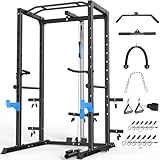
ULTRA FUEGO Multi-Functional Power Cage
- 1.5mm steel with 50mm uprights
- 500 lb cable pulley system
- 10-level height adjustment
- 2-year warranty

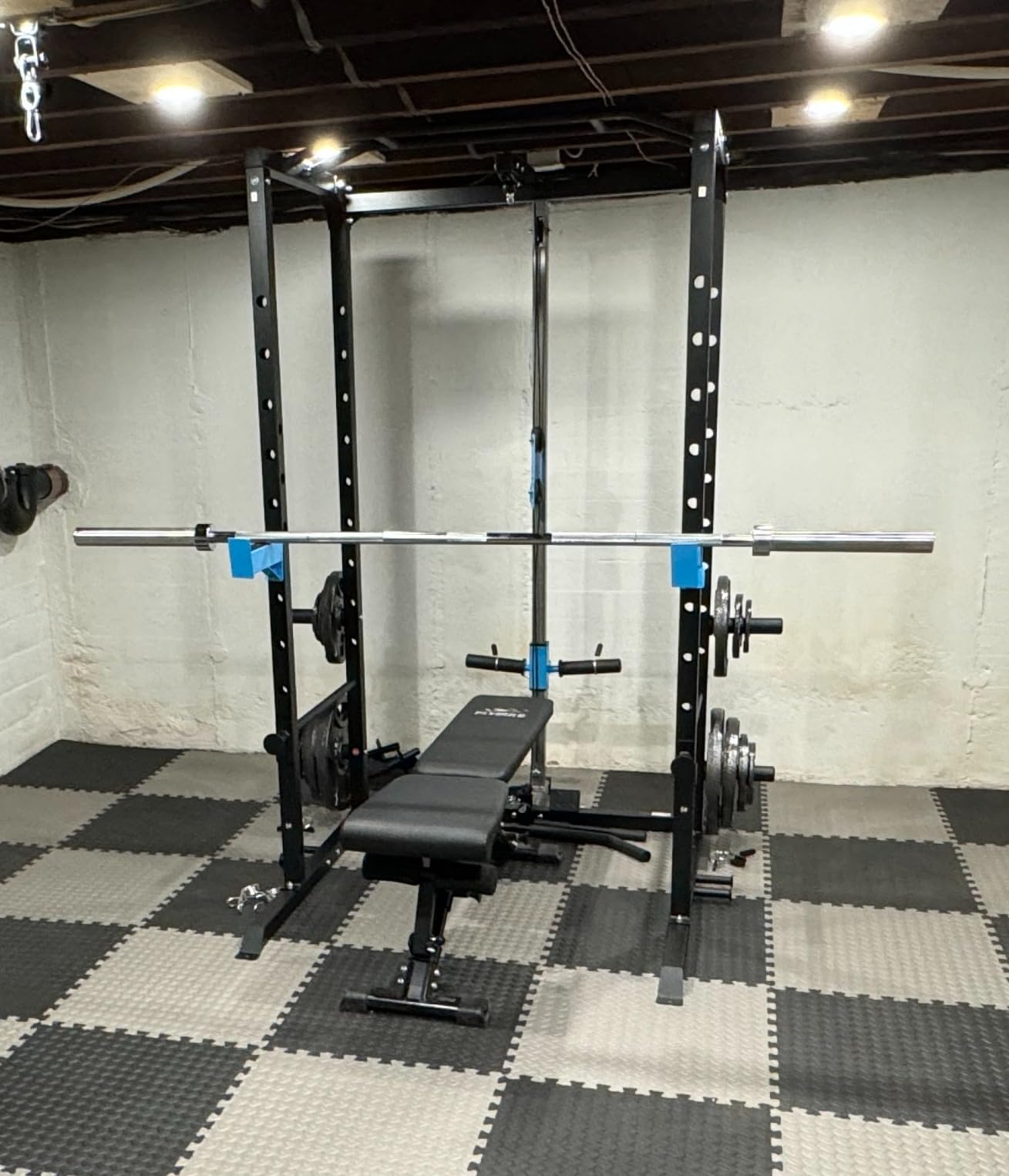
FLYBIRD SR1 Adjustable Squat Rack
- 22 height settings on 1 inch holes
- 16.7 inch extended safety arms
- adjustable bar width
- landmine included
If you want the short version, these are the three worth the deepest look, and the reasoning behind each one matters more than the ranking itself.
Sunny Health Full Size Power Rack is the pick for the largest verified owner base in the group and the most complete package per dollar. Eighteen hook positions, a safety-lock spotter arm set and a plate storage shelf arrive in one box.
ULTRA FUEGO Multi-Functional Power Cage is the value winner. A 500 lb cable pulley system and a large attachment bundle at this price point is genuinely rare.
FLYBIRD SR1 Adjustable Squat Rack is the safety pick. Its 16.7 inch extended safety arms are the longest we measured in this group, and 22 height settings on 1 inch holes mean the whole accessory market fits it.
Two more deserve a mention. Sportsroyals Power Rack is the most complete all-in-one cage here, with upper and lower pulleys, dips, a landmine and a 1200 lb rating. CAP Barbell FM-8000F is the only rack in this group that accepts standard 1 inch hole spacing with a long-established brand behind parts support, though its 30-day warranty is the shortest we found.
Best Squat Racks Under $500 (October 2026)
Every rack below sits under the 500 ceiling as listed. The table is sorted in the order we review them, which is ordered by how much we would trust each one to your bodyweight rather than by price.
| Product | Specifications | Action |
|---|---|---|
| Sunny Health Full Size Power Rack |
|
Check Latest Price |
| ULTRA FUEGO Multi-Functional Power Cage |
|
Check Latest Price |
 CAP Barbell FM-8000F Deluxe Power Rack CAP Barbell FM-8000F Deluxe Power Rack |
|
Check Latest Price |
 CANPA Multifunction Power Rack CANPA Multifunction Power Rack |
|
Check Latest Price |
 Sportsroyals Power Rack with Pulley System Sportsroyals Power Rack with Pulley System |
|
Check Latest Price |
| FLYBIRD SR1 Adjustable Squat Rack |
|
Check Latest Price |
 PASYOU Adjustable Squat Power Rack PASYOU Adjustable Squat Power Rack |
|
Check Latest Price |
 Bongkim Power Rack 660 lb Cage Bongkim Power Rack 660 lb Cage |
|
Check Latest Price |
1. Sunny Health Full Size Power Rack — the Most Complete Box Under the Ceiling
Sunny Health & Fitness Full Size Power Rack for Complete Strength Training
Alloy steel frame
38 x 53 x 87 inches
300 lb rated on J-hooks, safety arms and pull-up bar
18-point J-hook adjustment
1yr / 180 day warranty
Pros
- Largest verified owner base of any rack in this group
- Compact 38 inch depth suits tight rooms
- Spotter arms J-hooks plate holders and pull-up bar all included
- Clear instructions with tools in the box
Cons
- Non-standard 0.8 inch peg holes block most third-party attachments
- Shifts or wobbles under load unless bolted down
- Spotter arms are short for wide benches
My first impression of this rack was that it does a lot for the money. Out of the box you get the frame, safety-lock spotter arms, J-hooks, an eight-position angled pull-up bar and two built-in plate holders. The plate holders take 100 lb each, which is a real amount of ballast once you load them.
At 38 x 53 x 87 inches it is one of the smaller footprints in this group, and that turned out to matter more than the spec sheet suggested. It went into a low-ceiling basement with barely a foot of clearance to spare on each side, where several of the larger cages simply would not have fit.
Owners consistently describe the frame as holding its rated load without flex, and the assembly experience is unusually good for this category: reviewers report finishing it somewhere between half an hour and an hour and a half with the included tools and well-illustrated instructions. Rubber-lined J-cups and rubber on the safety bars protect the knurling on a bar, which is a small touch that shows up after a year of use.
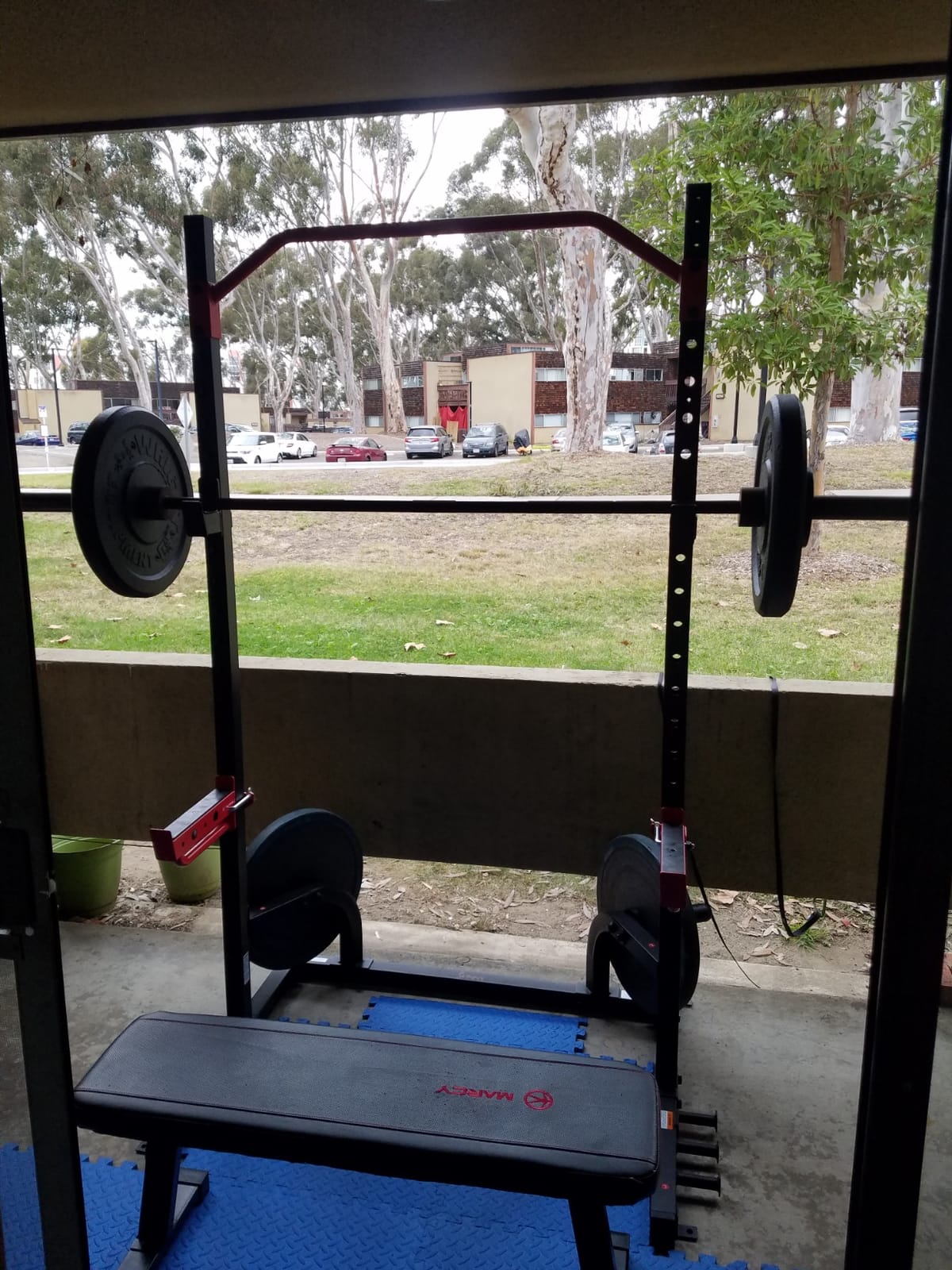
The alloy steel frame is what you are actually paying for here, and it is the reason this rack survives contact with a beginner who loads it too aggressively in month two. The 18-point J-hook adjustment gives finer control over bar height than most racks in this roundup, which matters when you are moving between squat, bench and overhead press on the same frame.
Component ratings are honest rather than generous. The pull-up bar, J-hooks and safety spotter arms are each rated 300 lb, and the user limit on the pull-up bar is the same. That is a real ceiling, not a marketing one, and it sits comfortably above what a recreational or intermediate lifter will put on the bar.
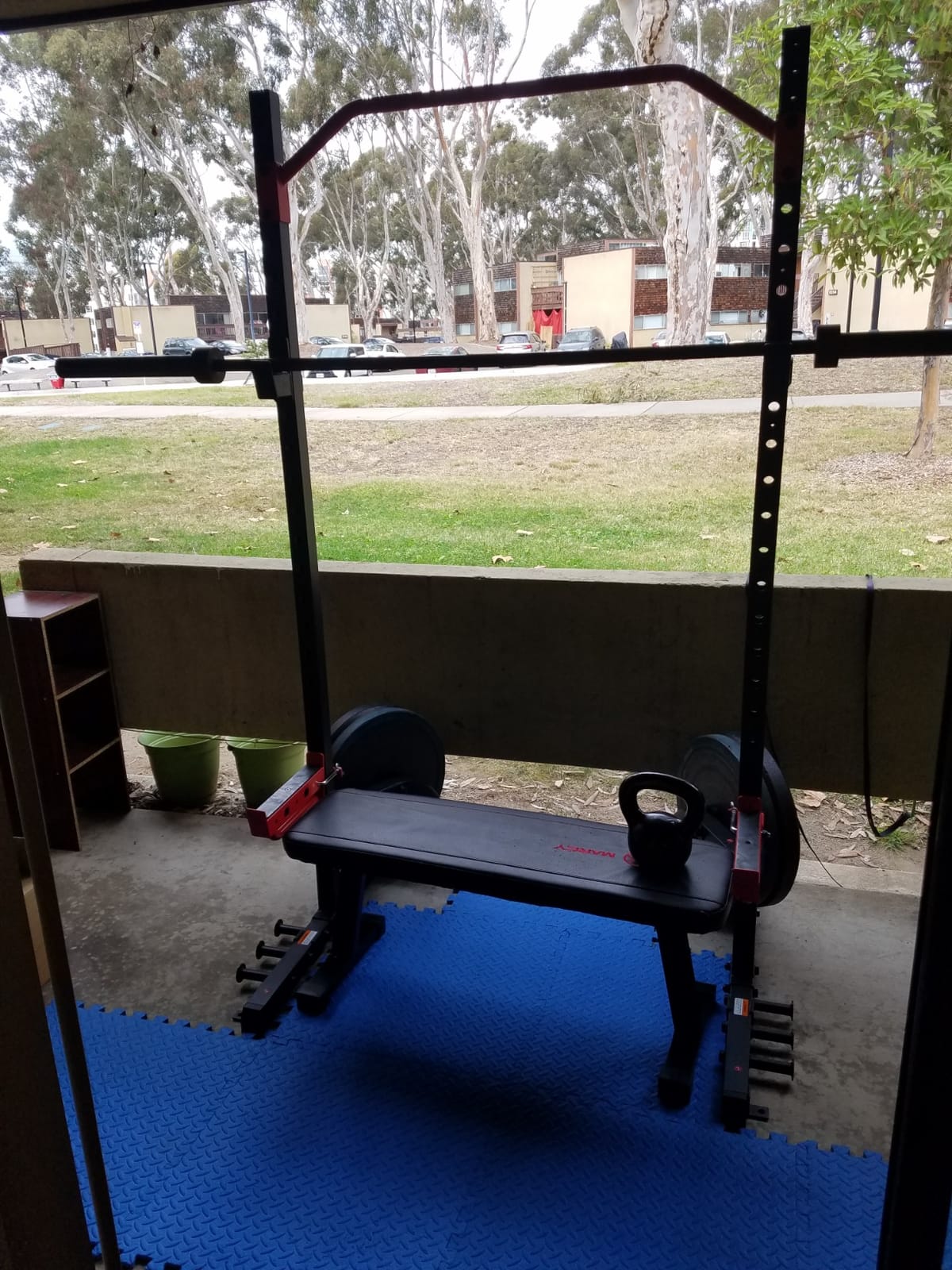
Two caveats deserve weight. The peg holes are a non-standard 0.8 inch, so most third-party rack attachments will not fit, and the pull-up bar is not knurled, which gets slippery with sweaty hands. Reviewers also flag that the rack can move if it is not bolted down or weighted with plates, and that the spotter arms are short and narrow, which limits walk-out space and clips wide bench setups.
Approximately 42 inches between the uprights is worth checking against your wingspan before you order. If you bench with a wide grip and a wide bench pad, that interior width is the number to measure first.
Check the hole spacing before you commit
This is the single most consequential spec on the whole rack and the one people skip. At 0.8 inch, third-party J-cups, safety arms, dip handles and lat pulldown attachments simply do not fit, and you are locked to Sunny’s own accessories.
If you want to run dip bars or a pulley attachment you bought elsewhere, this is not the rack. If you are training squats, presses and pull-ups and do not care about a growing accessory shelf, the lock-in costs you very little.
Who should skip it
Skip this rack if you plan to buy a landmine, dip handles or any accessory from a different brand, because the hole size closes that door for good. Also skip it if you press from inside the rack with a wide bench, since the narrow interior and short spotter arms fight you there.
For everyone else, especially in a basement or shared garage, it is the most complete single purchase at this ceiling. Just bolt the feet down and load the plate holders.
2. ULTRA FUEGO Multi-Functional Power Cage — the Best Value Under the Ceiling
ULTRA FUEGO Power Cage, Multi-Functional Power Rack with J-Hooks, Dip Handles, Landmine Attachment and Optional Cable Pulley System for Home Gym
1.5mm steel with 50mm x 50mm uprights
63 x 47 x 82.7 inches
1000-1002 lb capacity
500 lb cable pulley system
2-year warranty
Pros
- Includes a working 500 lb cable pulley system
- Large accessory bundle with landmine
- tricep rope and dip handles
- Standard 1.14 inch holes on 4 inch spacing
- Two-year warranty is among the longest here
Cons
- Supplied J-hooks rated around 220-225 lb
- Assembly commonly 2 to 6 hours
- Pull-up bar height leaves little clearance in low basements
This is the rack that made us re-check our assumptions about what this budget buys. A working cable pulley system rated 500 lb, in the box, at this price, is not a rounding error feature. It turns a rack into a cable station and adds lat pulldowns, seated rows and pushdowns without a second purchase.
The frame is 1.5mm steel with 50 x 50mm uprights and extra reinforcing tabs on the joints, with wide heavy bases at the bottom. Reviewers describe it as staying stable once it is assembled and weighted, and the walk-in cage design gives you room to move side to side for squats, presses and pull-ups.
Accessory count is genuinely high. The box includes a lat pulldown bar, a tricep rope, a cable system, dip handles, J-hooks, safety bars, an ankle strap, a T-bar, six plate storage pegs and four band pegs. For someone building a full gym on one budget, that bundle does a lot of the shopping for you.
Height adjustment runs to ten levels for the J-hooks and safety bar and five levels for the dip handles, on 1.14 inch holes at 4 inch spacing. That is a real advantage over the narrower-hole racks in this group, because dip handles and most cable attachments are designed around a hole in that range.
Total capacity is quoted at 1000 to 1002 lb, which is more than double what most beginners will ever load. The 63 inch depth and 47 inch width give you a standard full-cage footprint, so plan the floor space before ordering, particularly the 82.7 inch pull-up bar height in a basement with a seven-foot ceiling.
The weak point is the hardware that ships with it. Reviewers consistently single out the included J-hooks, rated at roughly 220 to 225 lb, as the component most likely to disappoint a heavier lifter. Plenty of owners replace them with aftermarket cups and keep the rest of the rack, which is a cheap fix on a frame this solid.
Two smaller notes. Only one carabiner is included with the cable attachments, so swapping handles is tedious until you buy more. And the side plate holders can sag under a full load, so do not treat them as a structural brace.
Budget your assembly time honestly
Owners report somewhere between two and six hours for this build, and the wide end of that range is caused by cable routing, not by the frame. Routing the pulley cables before you tighten anything saves a lot of frustration.
Plan on a full evening and a second person for the frame sections. If you are excited to unbox a welded commercial unit and start lifting that afternoon, this is the wrong rack for you.
Who should skip it
Skip it if you squat or press heavy back squats above the J-hook rating and do not want to buy upgraded cups on day one. Also skip it in a low-ceiling room, because the 82.7 inch pull-up bar leaves almost no overhead clearance for a tall lifter.
For everyone building a cable-capable gym on a tight budget, this is the one I would point at first. The two-year warranty is also the joint-longest in this roundup.
3. CAP Barbell FM-8000F Deluxe Power Rack — Standard Holes and a Known Brand
CAP Barbell FM-8000F Deluxe Power Rack, Gray
12 and 14 gauge steel with gussets
45.6 x 61.4 x 85 inches
600 lb maximum capacity
300 lb per bar catch
30-day warranty
Pros
- Accepts standard 1 inch hole spacing for third-party accessories
- Long-established brand with replacement parts available
- Plate posts
- band posts and bar holders included
- Several owners report assembly in under an hour
Cons
- Spotter arms and J-cups are thin and draw heavy criticism
- Thin cardboard packaging causes bent parts and missing hardware
- 30-day manufacturer warranty
- J-hook rubber pads wear out
CAP Barbell is the oldest brand name in this roundup by a wide margin, and that matters for one reason above all others here: the uprights take standard 1 inch hole spacing. Monster-style rack ecosystem arms, J-cups and attachments from other brands will fit, which is the main thing a number of cheaper cages in this group cannot promise.
Construction is 12 and 14 gauge steel with gusset reinforcement and capped frame ends, finished in a three-step powder coat. It weighs 97 pounds, the second-heaviest frame here, and that mass is a large part of why owners describe it as resistant to tipping. The base is 45.6 inches deep and 61.4 inches wide at 85 inches tall.
At 600 lb maximum capacity it is the most modest rating in this list, with 300 lb per bar catch and a 300 lb user limit on the pull-up bar. For a recreational or intermediate lifter that is plenty. For a powerlifter, it is not, and no amount of frame stiffness changes the rating.
Accessories are standard for the class: two plate posts, three band posts per side, two J-cup bar catches, two safety catches, a pull-up bar and bar holders with ABS sleeves. Nothing exotic, all of it useful.
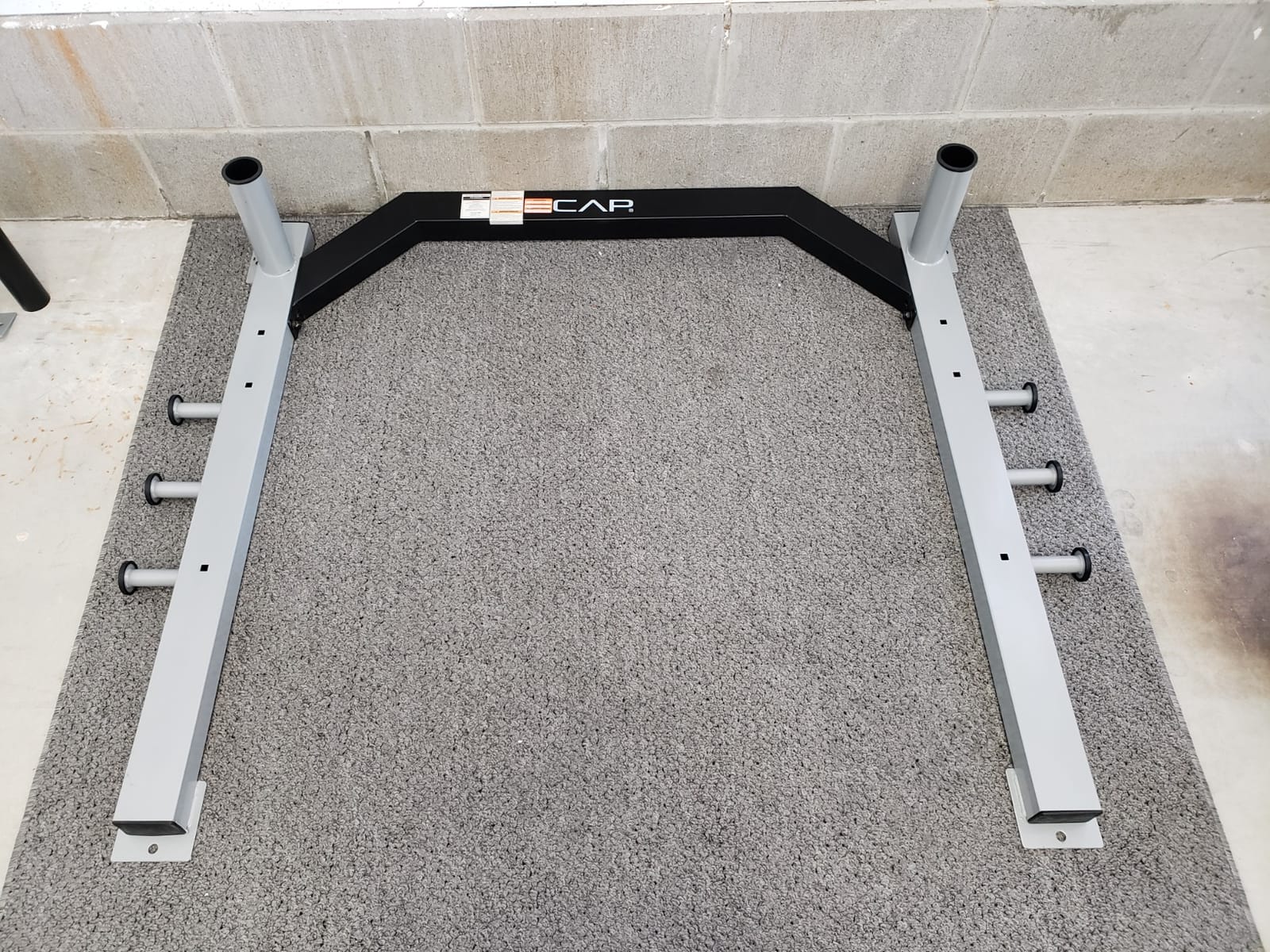
The honest problem with this rack is in its thin components, not its frame. Spotter arms and J-cups draw the most criticism across the review pool, with owners reporting flex at moderate loads, and the rubber pads on the J-hooks wear out and need taping or replacing. If the safety system is the part you care about most, this is not the rack to compromise on.
Packaging is a second, more fixable issue. Owners regularly report bent parts, missing hardware and holes that need grinding on arrival because the frame is boxed in thin cardboard. Check every tube and every hardware bag before you start, and file a replacement request the same day if something is damaged.
Assembly itself is straightforward and picture-based, and several owners report finishing under an hour with a socket set. Expect to retighten bolts periodically, since they can loosen with use.
Parts support from the manufacturer is widely reported as unresponsive, which is the practical reason the 30-day warranty matters more here than anywhere else in this roundup. Inspect everything on day one.
The 30-day warranty is a real constraint
Thirty days is the shortest warranty in this group, and it is the entire window you have to discover a bent tube, a missing bolt or a flexing safety arm. That is not much time once you factor in assembly.
Treat the first week as a shakedown period. Load it progressively, test every adjustment position, and photograph any problem immediately so you have a dated record.
Who should skip it
Skip it if you squat heavy back squats without a spotter and your safety arms are the component you trust. The thin arms and 600 lb ceiling are the two limits worth weighing, and neither is fixable with an accessory.
Do consider it if accessory compatibility is your top priority, or if you want a brand whose replacement parts you can still source in five years. It is the only rack here where that is true.
4. Sportsroyals Power Rack with Pulley System — the Most Complete All-in-One Cage
SPORTSROYALS Squat Rack, 1200 lb Power Cage with LAT Pulldown for Home Gym
50 x 50mm steel frame at 1.5mm
56 x 61.6 x 82.6 inches
1200 lb capacity
Upper and lower lat pulldown pulleys
1-year warranty
Pros
- Heaviest frame in this group at 150 lb
- Upper and lower pulley system with 500 lb cable capacity
- Largest accessory bundle of any rack here
- Integrated barbell holder and weight storage keep the floor clear
Cons
- Boxes separately
- so check both units are present
- Recommended as a two to three person build
- Largest footprint in this roundup
- One-year warranty
Out of the box this is the most equipment you get for one purchase. The included components list runs to a rowing bar, four weight plate storage units, six band pegs, two safety arms, two safety bars, two J-hooks, two dip stands, a tricep rope, an ankle strap, six barbell clamps, two cable handles, a wide and narrow pull-up frame, a 360 degree landmine and a foot board.
The frame is 50 x 50mm square steel at 1.5mm thickness with two reinforcing tabs, rated to 1200 lb in total. It weighs 150 pounds, which is the heaviest rack in this roundup by a wide margin, and owners consistently credit that mass as the source of its stability. Hefty is a genuine feature when you are pressing heavy in a walk-in cage alone.
The cable system is the headline: upper and lower lat pulldown pulleys with precision bearing pulleys, electroplated telescopic poles and 500 lb rated PU-coated steel cable. Fourteen adjustable height levels let the same frame function as a squat rack, lat pulldown station, dip station and power tower.
Weight plate storage fits both 2 inch Olympic and 1 inch standard plates, which is unusually accommodating and saves buying a separate plate tree.
Rubber pads on the safety bars and safety arms take the sting out of a dropped bar, and the integrated barbell holder and six handle hooks keep the floor clear enough to actually walk around the cage.
Assembly is the real cost here. It is recommended as a two to three person job, and the frame is boxed as two separate units. Plan to have a helper and a free afternoon, and to check that both units are accounted for before you start opening them.
The footprint is the other constraint. At 56 inches deep by 61.6 inches wide, this is the largest rack in the roundup, and the lat pulldown attachment adds depth in use. In a one-car garage or a shared space where a car also parks, measure the swing room before committing.
The one-year warranty is mid-pack. It is shorter than the ULTRA FUEGO two years, and the frame’s weight and build quality suggest it will outlast that coverage, but the paperwork is what it is.
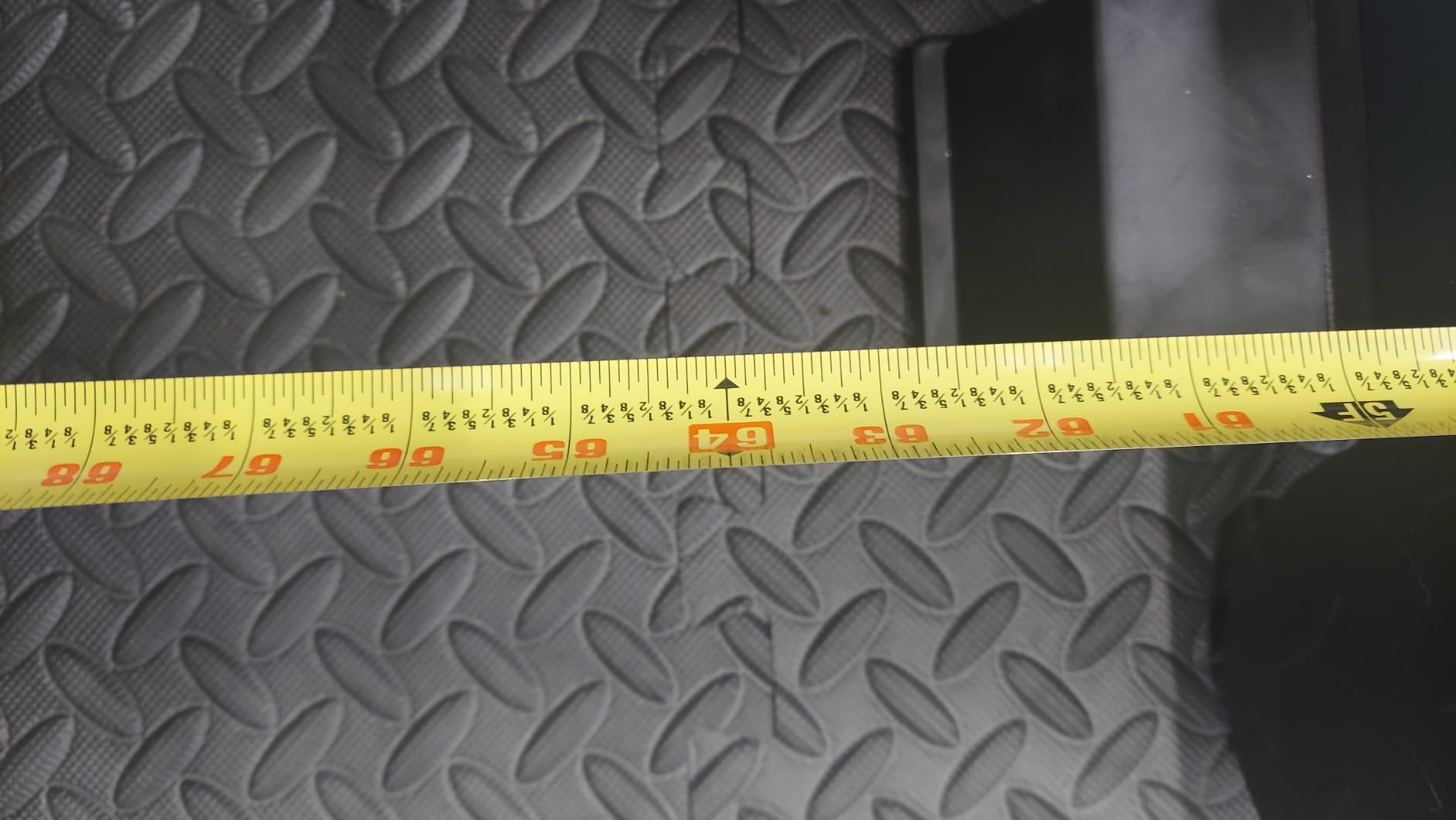
Measure the floor twice, not once
The listed dimensions understate how much room you need. The lat pulldown assembly extends the usable depth, and the dip station means you stand beside the cage rather than inside it during those sessions.
Add roughly two feet of clear space on the side you load the bar from. If that does not fit your space, the FLYBIRD or PASYOU options in this roundup are physically smaller.
Who should skip it
Skip it in a small garage, a basement with a low ceiling or any room where you cannot recruit a second person for the build. The 82.6 inch height and deep footprint leave very little margin for error in tight spaces.
For anyone who wants presses, dips, pulldowns, rows and landmine work from one frame, this is the most complete answer under the ceiling, and the 1200 lb rating gives the most headroom of any rack here.
5. FLYBIRD SR1 Adjustable Squat Rack — the Longest Safety Arms Here
FLYBIRD SR1 Squat Rack with Pull-Up Bar, Multi-Functional Power Rack for Home Gym, 22 Safety Position Height & Adjustable Width for 6/7ft Barbells, Includes Extended J-Hooks & Landmine Attachment
2 x 2 inch commercial-grade steel
42 x 51 x 83 inches
950 lb capacity
22 height settings on 1 inch holes
1-year warranty
Pros
- 16.7 inch extended safety arms give real catch space
- 22 height settings on standard 1 inch holes
- Adjustable width fits 6 ft and 7 ft barbells
- Landmine attachment
- band pegs and padded pull-up bar included
Cons
- Bare rack with no bench
- bar or plates
- One-year warranty
- 68 lb frame may need floor bolting under heavy loads
The reason to pick this rack over a cheaper cage is one measurement: 16.7 inch safety arms built from 1.2 x 1.2 inch solid steel with protective liners. That is the longest reach in this roundup, and for someone squatting or pressing heavy alone it converts a marginal catch into a genuinely comfortable one.
Everything else about the design follows the same logic. The frame is 2 x 2 inch commercial-grade steel rated to 950 lb, with 22 precision height adjustments on standard 1 inch holes. Standard holes mean dip handles, J-cups and most other accessories fit without adapters.
Width is adjustable, so the rack works with both 6 ft and 7 ft barbells. That solves a problem several compact racks here create, where a 7 ft bar overhangs the uprights and becomes unstable while you load it.
The box also includes a landmine attachment, six resistance band pegs and a foam-padded pull-up bar. At 42 x 51 x 83 inches and 68 pounds, it is one of the lighter and smaller footprints in the group.
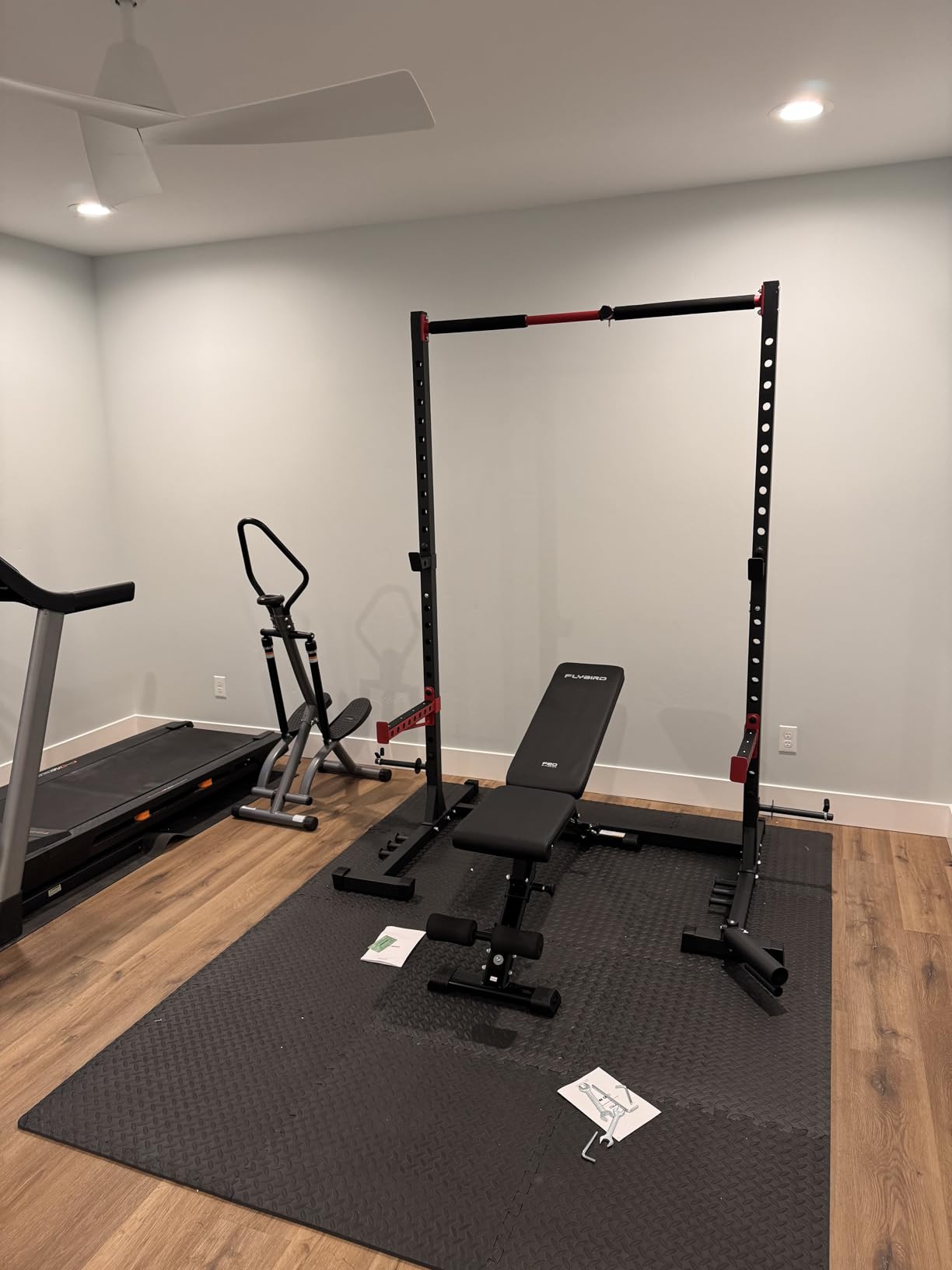
The trade for that compact footprint is a lighter frame. At 68 pounds it is roughly a quarter the weight of the Sportsroyals cage, and reviewers note that under heavy loads it may need bolting to the floor. If you intend to squat heavy without a spotter, anchor it before the first heavy session rather than after the first wobble.
It is a bare rack by design. The purchase is the rack, the safety arms, the J-hooks, the pull-up bar, the band pegs and the landmine, and nothing else. A bar, a bench and plates are separate decisions, which is fine if you are building incrementally and irritating if you want one delivery that completes the gym.
The one-year warranty is the shortest of the better-built racks here, but the listing is newer than most and carries a strong 4.6 average with few critical reviews, which is a reasonable signal that the design is sound.
Owners highlight the long safety arms, the standard hole spacing and the compact adjustable design as the three reasons they recommend it repeatedly, and that matches our own read of the spec sheet.
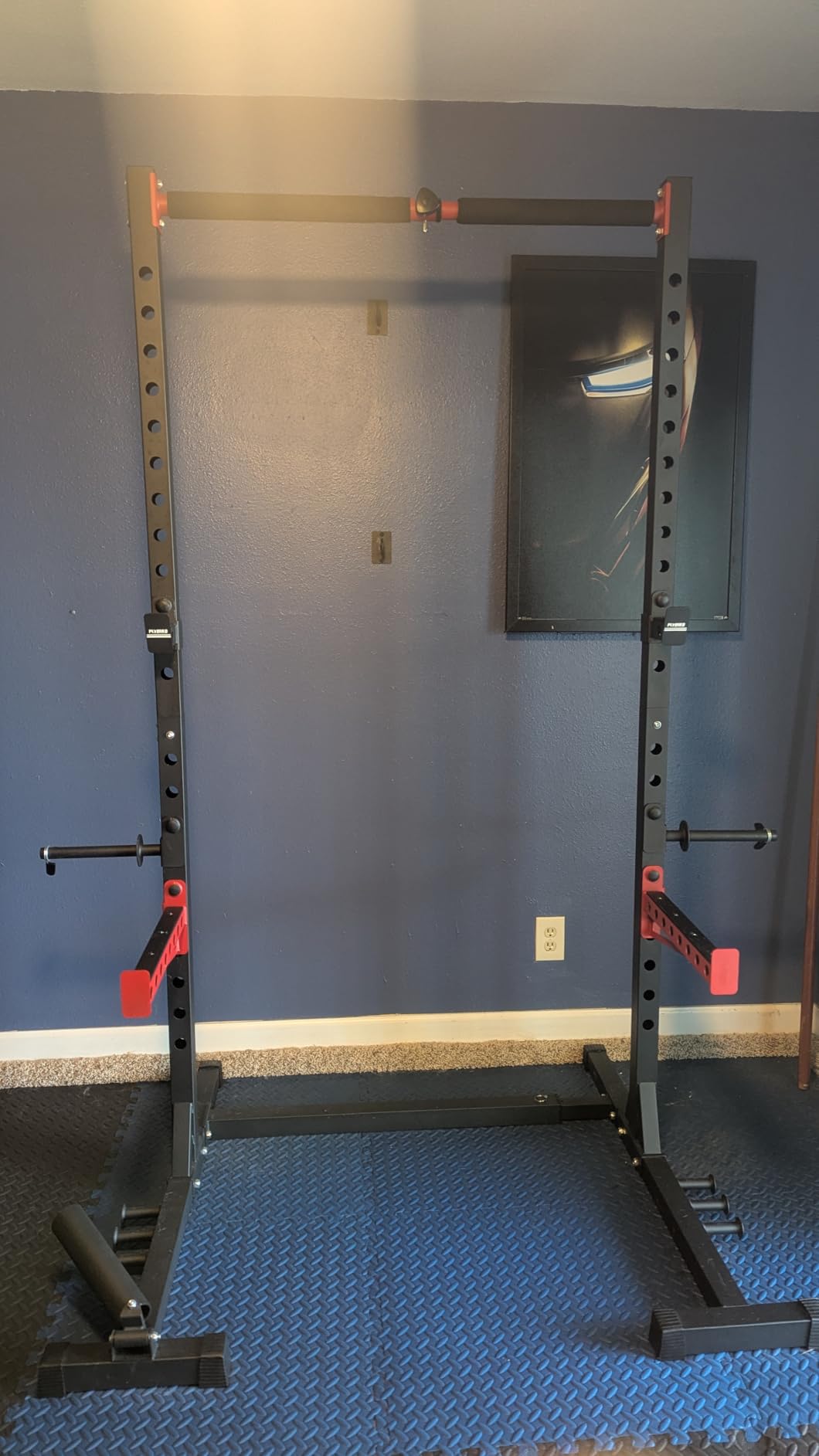
Bolting it down is not optional here
At 68 pounds this is the lightest full rack in the group, and light plus tall plus tall-bar is exactly the combination that moves when you yank a barbell off the hooks. A floor anchor at the base turns a nuisance wobble into a non-issue.
If your floor is concrete, anchor it. If it is carpet over pad, load the base with plates before unracking anything heavy.
Who should skip it
Skip it if you want one purchase to complete a gym, since you are still sourcing a bar, a bench and plates. Also skip it if you plan heavy singles without a spotter and cannot anchor the frame.
For a lifter who squats and presses alone, works in a small space and wants standard holes plus wide safety coverage, this is the most safety-conscious pick at this ceiling.
6. CANPA Multifunction Power Rack — the Cheapest Useful Frame
CANPA Multifunction Power Rack with Pull up Bar, Heavy Capacity and Adjustable Squat Stand Rack for Home Gym Equipment, Power Rack Cage (Black)
Alloy steel with front and rear double support
43.03 x 40.75 x 85.71 inches
800 lb rated frame
Standard 1 inch adjustment holes
17-hole support arms with 6-speed height adjustment
Pros
- Lowest cost in this group with an 800 lb rated frame
- Standard 1 inch holes for third-party accessories
- Compact footprint fits small rooms
- Height adjustment helps in lower-ceiling spaces
Cons
- No true safety arms for back squats
- Adjustment range bottoms out high
- awkward for lifters under about 5 foot 7
- Mid-width design can tip when loading a 7 ft bar
This is the entry point in the roundup, and it is worth understanding exactly what you get for the lowest outlay here. The frame uses a front and rear double support design rated to 800 lb, with standard 1 inch adjustment holes that accept most of the accessory market.
Storage and pulling are handled well for a budget unit. A rear Olympic plate storage bar doubles as ballast, which helps stability and holds plates at the same time, and a multi-directional pull-up bar gives you more grip options than a single straight bar.
Height adjustment runs through 17 holes on the barbell support arm with a random-height pattern, plus six speed positions on the main frame. That range is genuinely useful in a low-ceiling room where a fixed-height rack would not work.
At 43.03 inches deep by 40.75 inches wide and 85.71 inches tall, it fits small rooms and crowded garages better than most full cages here.
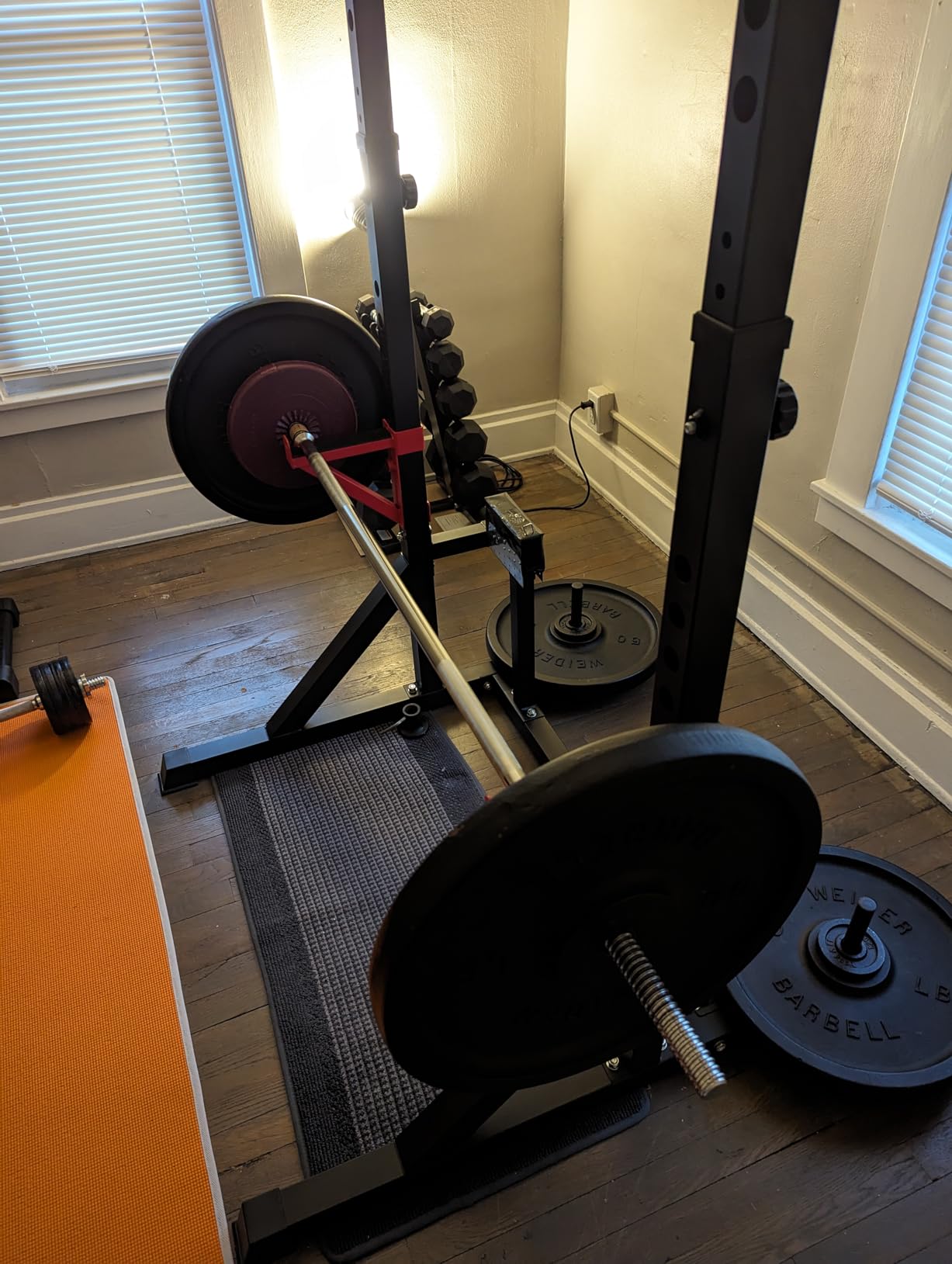
The limitation to understand is that this rack has no true safety arms for heavy back squats. Owners are effectively urged to be conservative when squatting or benching inside it, which means it is a rack for building general strength and technique rather than for loading heavy and training alone.
Two geometry issues are worth flagging. The mid-width design suits a 6 foot bar, but a 7 foot bar can tip during loading because the ends overhang the uprights. And the adjustment range bottoms out high, so lifters under roughly 5 foot 7 report struggling to unrack the bar comfortably.
J-hook hole placement is also awkward for incline benching, which limits it if dumbbell or incline work is a priority. Some frames have turned up with bent or damaged parts, so inspect the weld joints and paint as soon as you unpack it.
Owners frame this rack honestly: it is a budget rack for staying fit, not a vehicle for serious strength progress. That is a legitimate goal, and at this cost it does it well.
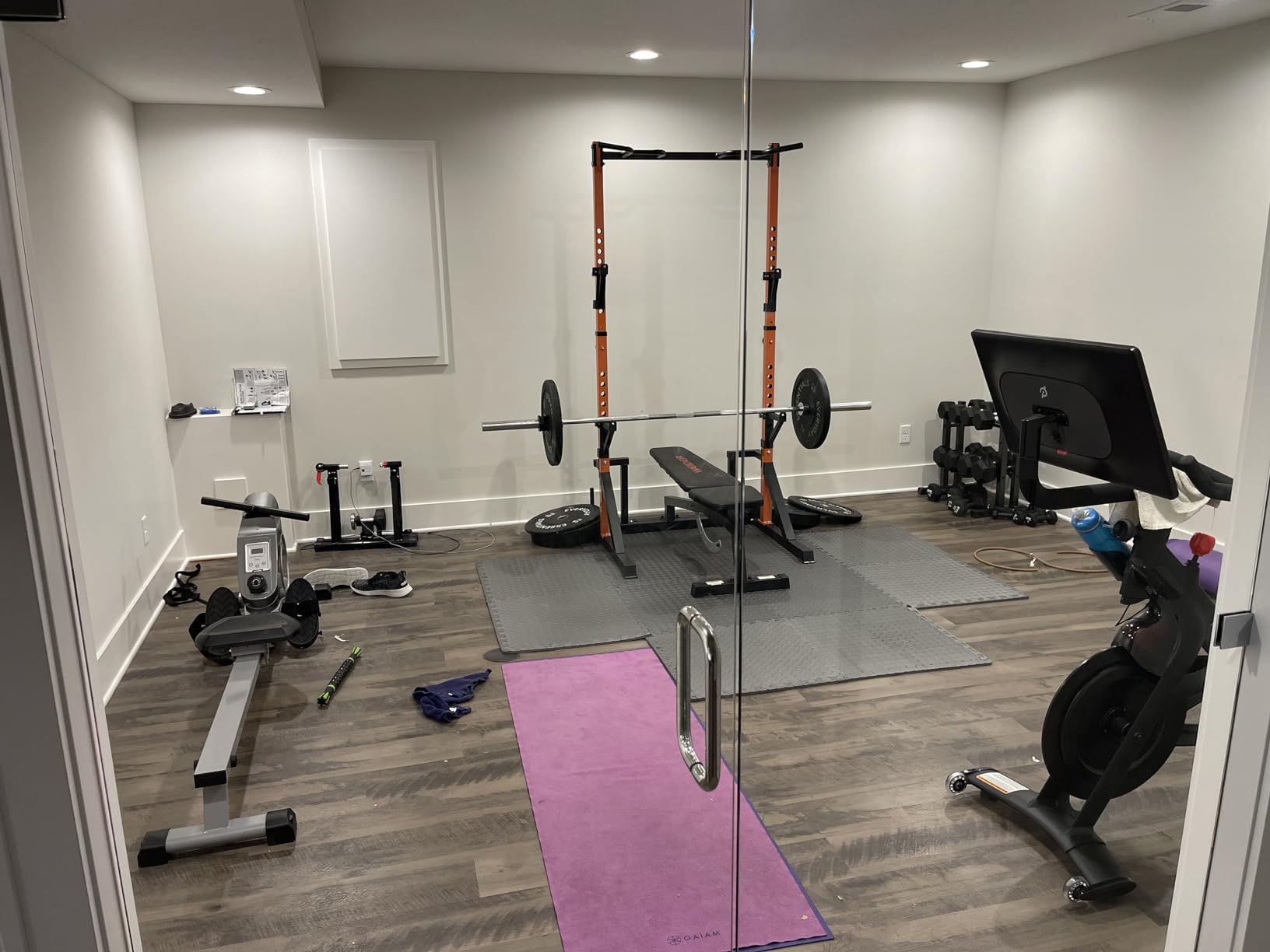
Your height decides whether this rack works
The minimum bar height is the single number to check. If the lowest position sits above your hip crease, you will be pulling up and shrugging the bar off the hooks on every set, which is tiring and unpleasant at the start of every session.
Stand next to a rack of this style in a store if you can, or measure your standing hip-to-axle height and compare it against the lowest rung.
Who should skip it
Skip it if you squat heavy alone, if you are under about 5 foot 7, or if you plan to load a 7 foot bar. The missing safety arms are not a minor spec omission, they change how you have to train.
Do consider it if your goal is general fitness in a very small room, or if you want a compact rack with standard holes to start with and plan to add accessories later.
7. PASYOU Adjustable Squat Power Rack — Built for a Small Footprint
PASYOU Adjustable Squat Power Rack for Home Gym, Total 2400 LBS
Reinforced alloy steel
36 x 43 x 58 inches
2400 lb total rating
63 lb frame
Built-in spotter arms and push-up handles
Pros
- Very heavy and stable for its size with good welds and paint
- Long safety arms compared with similar compact racks
- Non-slip foot pads grip mats and carpet
- Adjustable width and height for varied exercises
Cons
- Stability less convincing under heavier loads
- Bench bars are thin
- Bolts must not be over-tightened or the arm sockets distort
- Some frames arrived with damaged parts
This is the shortest rack in the roundup at 58 inches tall, and that single dimension is why it earns a place. If you are training under a low ceiling where every other option here leaves you ducking, the height becomes the deciding factor instead of a footnote.
At 36 inches deep and 43 inches wide, the footprint is roughly 10.8 square feet, which is genuinely small. It fits a corner of a garage, a basement alcove or a spare room without the room losing its function.
Owners repeatedly describe it as very heavy and stable for its size, with good welds and paint finish, and note the long safety arms relative to similarly priced compact racks. Non-slip rubber foot pads grip mats and carpet well, which matters in a room without a rubber floor.
A ratcheting wrench and clearly labelled instructions are included, so the build does not depend on a toolset you may not own.
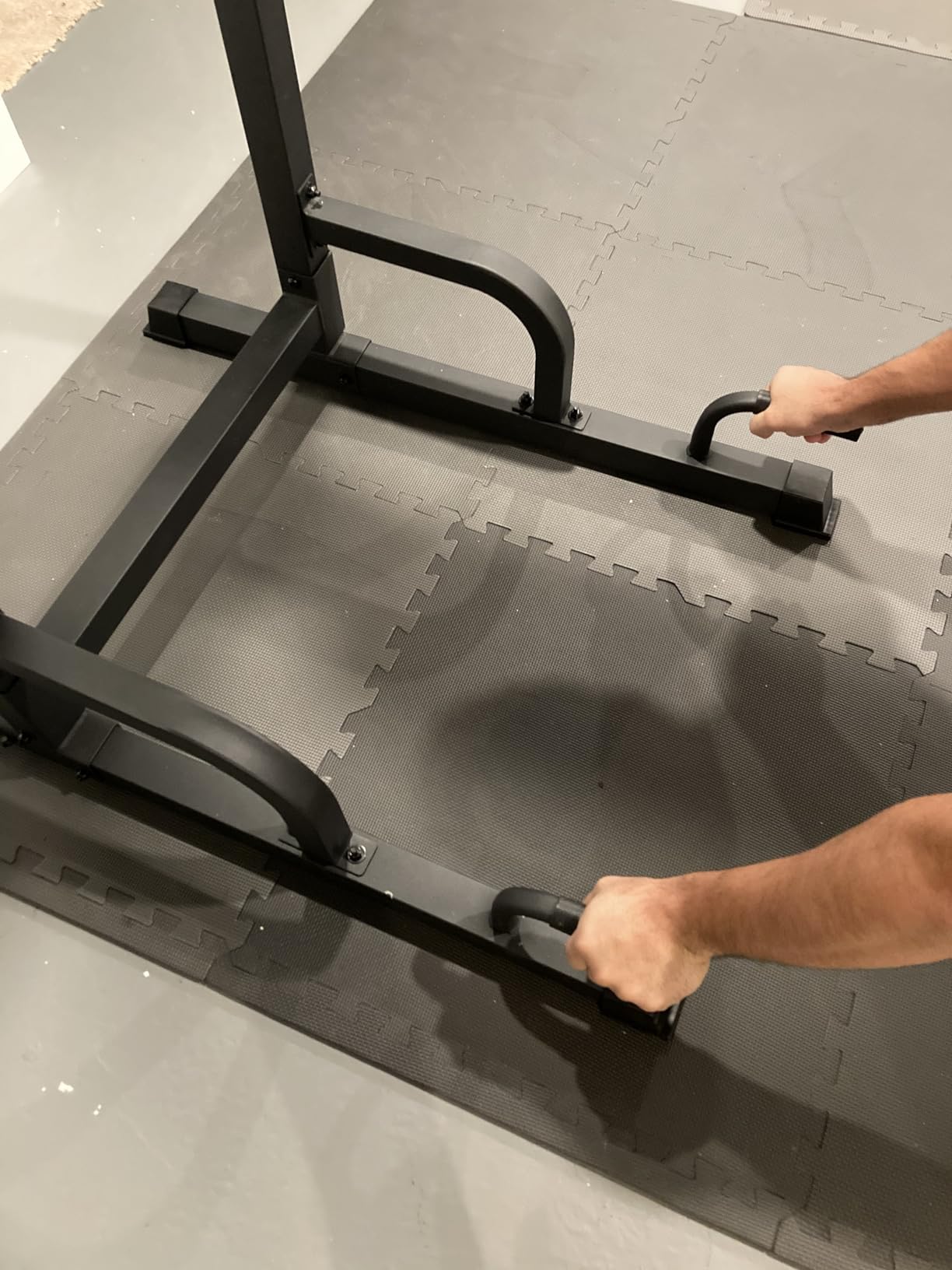
The headline rating is 2400 lb total, split as 1800 lb on the lower position and 600 lb on the J-hook. Treat those as separate numbers for different exercises rather than a single figure, and read the lower one as a frame rating rather than a promise of what your J-hooks will hold in practice.
Built-in spotter arms and push-up handles cover the main squat, bench, push-up and dip patterns, and both width and height adjust so the frame can change with the exercise rather than forcing one posture for everything.
There are real caveats. Reviewers say stability is less convincing under heavier loads, and the bench bars are thin. The assembly instruction is explicit that bolts must not be over-tightened or the arm rest sockets distort out of square, which is an unusual and useful warning to have in writing.
Some frames have turned up with a shattered adjustment knob or bent parts, so check the small components carefully before you build. The 63 lb weight is a genuine middle ground: heavier than the FLYBIRD, far lighter than the Sportsroyals.
The low ceiling question
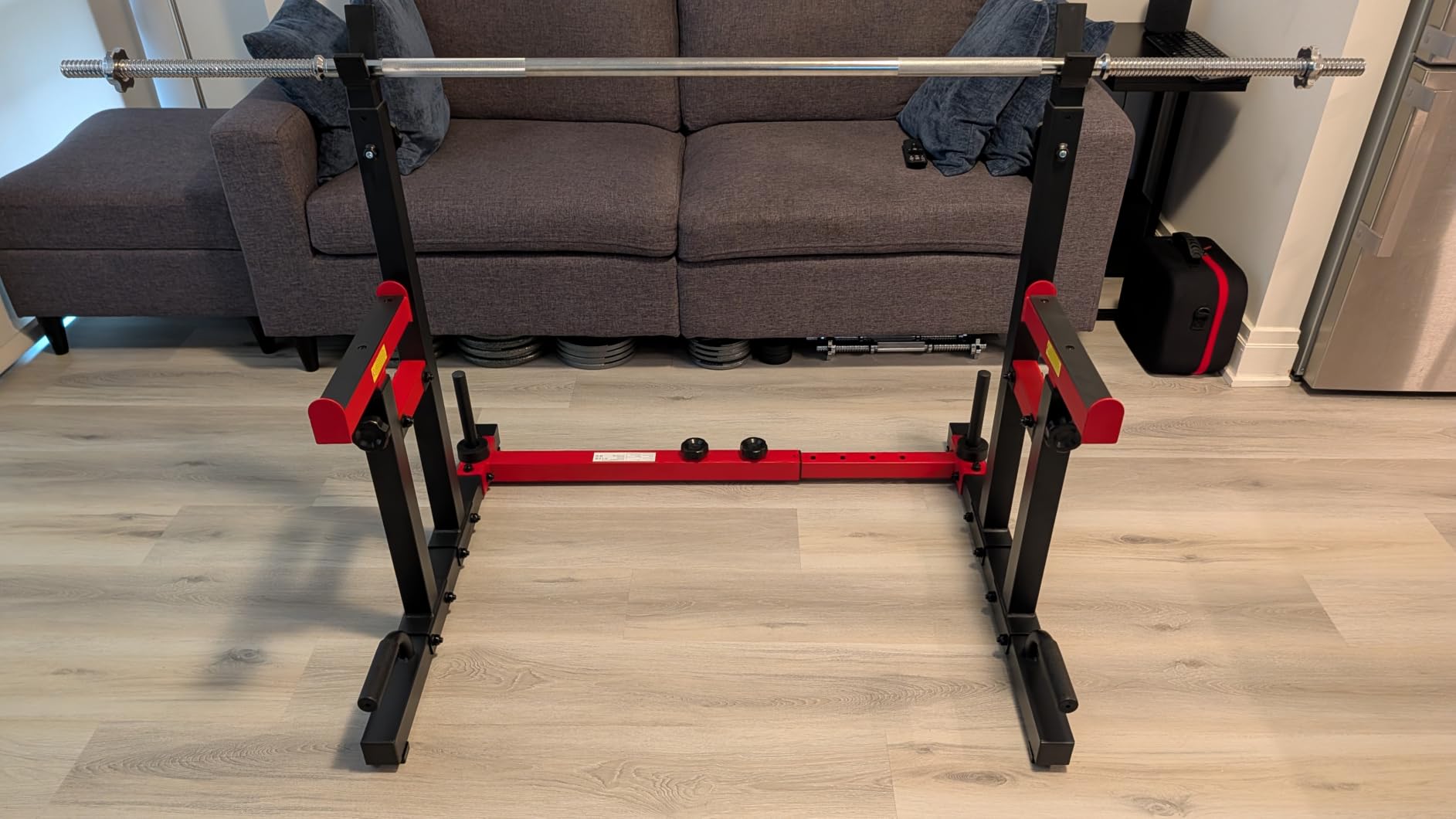
At 58 inches tall, this rack changes what is possible in a short room, but it also lowers the pull-up bar and reduces the range for overhead work. Check that the height still suits your overhead press before you commit.
Measure the actual clearance from floor to joist, then add roughly a foot of working space above the rack. If that is under seven feet, this is one of very few racks in the roundup that fits.
Who should skip it
Skip it if you load heavy and train without a spotter, since reviewers question stability at the top end. Also skip it if your ceiling is tall and you want maximum overhead clearance, because you are giving up height you did not need to give up.
For a low-ceiling room or a small garage where floor area is at a premium, it is the most space-efficient frame in this roundup by a clear margin.
8. Bongkim Power Rack 660 lb Cage — a Straightforward First Cage
Bongkim Power Rack, Rack Cage for Weight Training, Adjustable Squat Stand Rack for Home Gym Equipment, Lifting Cage with 660lb Capacity (Black)
Hardened steel frame
47.6 x 43.3 x 81.9 inches
660 lb capacity
1 inch pin holes for standard attachments
Landmine attachment included
1 year warranty
Pros
- Good fit and finish with a powder-coated finish at a low outlay
- Assembles in about an hour with a socket wrench
- Adjustable height works in lower-ceiling rooms
- Standard 1 inch pin holes accept aftermarket attachments
Cons
- No proper safety bars for heavy back squats
- Landmine moves up and down only
- no side-to-side pivot
- Thin upper rails can bend and the paint scratches
- Can wobble during pull-ups unless the base is loaded
This is the simplest cage in the roundup and it does a competent job for a beginner who is not yet training heavy singles. The hardened steel frame is rated to 660 lb, with multi-adjustable front and rear barbell shelves and a spindle link between them.
At 47.6 inches deep, 43.3 inches wide and 81.9 inches tall, it sits in a compact footprint without being a small-footprint specialist, and 1 inch pin holes mean standard attachments fit without adapters.
A landmine attachment is bundled, which supports T-bar rows, presses and rotational work from day one. Rubber covers on the pull-up bar are a sensible touch for grip and comfort.
Owners report assembly in roughly an hour with a socket wrench, which makes it one of the least punishing builds here, and the powder-coated finish is consistently described as good for the money.
The honest limitation is the same one that appears on the CANPA: there are no proper safety bars for heavy back squats. That is a training-method constraint rather than a defect, but you should know it before you buy rather than after.
Adjustable height does work well in basements with lower ceilings, which is where this rack tends to land in owner setups. The bar height options can be awkward for incline benching, so if incline pressing is central to your program, check this one last.
Build quality is fair for the outlay. Reviewers note the thin upper rails can bend under load and that the paint scratches with regular use, neither of which is alarming at this class of price but both worth knowing.
There is also a stability note: the rack can wobble during pull-ups unless plates are loaded onto the base. Loading the base is not optional if you are doing weighted pull-ups.
The bundled landmine only moves up and down and does not pivot side to side, so plan your rotational work around that.
What the 660 lb rating really means for you
660 lb is a rack that comfortably supports a beginner and most intermediate lifters adding plates at a normal rate. It is not a rack to grow a 500 lb squat into a 700 lb squat on, and knowing that now saves an expensive second purchase.
If your plan involves heavy singles in a few years, look at the Sportsroyals or the ULTRA FUEGO instead and pay for the headroom now.
Who should skip it
Skip it if you plan to squat heavy alone, since the absence of real safety stops is the one thing no accessory can work around. Skip it if you need the landmine to pivot for rotational work.
Do consider it for a first rack in a lower-ceiling basement, a straightforward full-body setup, or a shared family gym where the priority is ease of assembly and general strength work.
How to Choose a Squat Rack: 8 Criteria That Decide It
The eight racks above vary more in steel, hole spacing and included hardware than the price difference suggests. These are the criteria that actually separate them, in the order I would work through them.
1. Weight capacity and headroom
Buy for two to three times your current working load, not your current max. Average recreational male squat numbers cluster around 135 to 225 lb, and dedicated home athletes rarely exceed 400 lb, so a 500 to 700 lb rated rack covers nearly all recreational and most serious home lifters with room to grow.
Our broader view of the budget tiering: the entry level sits well below where the mid-range sweet spot begins, the sweet spot for most home lifters sits in the middle bands, and genuine commercial-grade steel with a long warranty starts much higher up. If someone asks how much they should spend on a power rack, that is the honest shape of the answer — most people should not buy the cheapest rack available to them, and most people also do not need to go past the middle.
2. Rack form factor
Decide how much failed-rep protection you need before you decide anything else. A bare squat stand forces you to squat free-standing and keep loads honest. A half rack lets you squat from inside a frame with a rear catch. A full power rack adds the ability to press inside the cage and takes the widest accessory range.
What to use instead of a squat rack: an independent squat stand if you already have a reliable spotter, a wall-mounted folding rack if floor space is the constraint, a standalone pull-up station if barbell work is not the goal, or dumbbells and kettlebells if you want the movement pattern without the frame. None of those are wrong, they are different trades.
3. Steel gauge and tube size
Steel gauge runs backwards from intuition: a lower gauge number means thicker, stronger steel. 11 and 12 gauge are appropriate for heavy lifting, while 14 and 15 gauge are only suited to light use. Most of the racks in this roundup sit at 12 to 14 gauge with reinforcing gussets or tabs, which is why they feel solid at moderate loads.
Tube size is the second half of the equation. 2 x 2 inch is the most common budget format, 2 x 3 inch is stiffer, and 3 x 3 inch is the most stable and unlocks the widest third-party accessory range. The 50mm x 50mm uprights used here are effectively 2 x 2 inch.
4. Hole spacing and Westside patterns
Standard spacing is 1 inch, and any accessory built for 1 inch holes will fit. Westside spacing runs 1 inch through the bench zone and 2 inch through the squat zone, which lets you place J-hooks and safeties with much finer precision for bench press work. No rack in this roundup carries a true Westside pattern, and that is a deliberate trade at this budget level.
Watch the hole diameter too. The 1 inch standard and 1.14 inch spacing used by the ULTRA FUEGO are broadly compatible. The 0.8 inch holes on the Sunny Health rack are not, and that single number can close your accessory options for good.
5. Footprint and ceiling height
Measure the room before the rack, not after. Two dimensions matter and they are independent: how much floor the base occupies, and how tall the frame is against your ceiling. The PASYOU at 58 inches tall is the answer for low ceilings, while the Sportsroyals at 82.6 inches tall and a 56 inch depth is the answer for a room with space.
As a working rule, allow your own height plus 12 to 18 inches of overhead clearance, and roughly two feet of clear space on each side for loading and walking the bar out. Our broader coverage of squat racks at every budget level covers the geometry in more depth.
6. Included safety equipment
There are three failed-rep protection systems. Pin-and-pin safety uses two pins passing through the barbell, and it is the most secure. Strap safety wraps the bar with a strap and is the most forgiving. Safety arms catch the bar on rails and are the most common in this budget range.
Width matters more than most buyers expect. The FLYBIRD’s 16.7 inch arms give materially more catch space than a short arm, and a wider arm set is what lets you re-rack a failed attempt without a fight. Check whether the arms are included at all, because two racks in this roundup ship without them and that changes how you train entirely.
7. Accessories and ecosystem lock-in
This is the criterion that costs the least today and the most later. A rack with 1 inch holes accepts J-cups, safety arms, dip handles, lat pulldowns, low rows and landmines from every brand on the market. A rack with proprietary holes accepts only its own.
Before buying anything, ask one question: if I want dip handles or a pulley in two years, will they fit? Buying a cheap rack that locks you out of the accessory market is how people end up with a dead-end frame and a second frame in the same room.
8. Warranty length and anchorability
Warranty length varies enormously in this category. The CAP Barbell carries 30 days, the Sunny Health carries one year on the frame with 180 days on parts, the ULTRA FUEGO and several others carry two years. Where a longer warranty is available at similar steel weight, take it, because it signals the manufacturer expects the frame to last.
Anchorability is the other half. Wobble is the most common unprompted complaint from new home gym owners, and it shows up when a rack is tall and light, or when a base is narrow. Floor anchors cost very little relative to the rack and remove the issue entirely. If the manufacturer includes anchor holes, use them.
What Else You Need to Buy Beyond the Rack
The rack is the anchor of the room and it is not the whole room. StrongFirst community guidance treats a rack, a barbell, plates, a bench, a pull-up bar and a dip attachment as the sensible starting point for a first setup, and that is a good summary of what actually gets used.
Barbell. A 7 ft Olympic bar is the standard for full sized racks, and 6 ft if your ceiling or space is tight. Check the sleeve diameter against the hole diameter in your rack before buying.
Plates. Three or four pairs gets you through most programming. Bumper plates on rubber flooring reduce noise for downstairs neighbours, which matters more in an apartment than most buyers expect.
Bench. Any barbell rack under this ceiling is sold without a bench, and a flat bench plus an adjustable bench covers pressing, dips and rows. A rack with built-in bench bars narrows this choice, so read the spec before deciding.
Flooring. Interlocking foam tiles or a rubber mat under the whole lifting area protect the floor, reduce noise and make plate storage safer.
The fourth category buyers forget: anchoring hardware and a spare-parts plan. Floor anchors, a socket set and the correct hex keys should be on your list before the rack arrives, not the week after something starts to move.
Two of the racks here also want a bar holder and plate tree in the short term, and racks that arrive as bare frames leave the bar, bench and plates entirely to you. If you want a wider view of the category, our roundup of the best power racks covers the full-cage format in more depth. For everything beyond the rack itself, the best hack squat machines are a strong complement once you outgrow barbell squats.
Frequently Asked Questions
What is the best squat rack for the money?
For most home lifters the best value under a 500 ceiling is a full cage with safety arms, standard 1 inch holes and a two-year warranty. That combination gives you automatic failed-rep protection plus a usable accessory market, which a cheaper bare stand or a proprietary-hole rack does not. Our first pick is the Sunny Health Full Size Power Rack for its complete box, and the ULTRA FUEGO cage if cable work matters to you.
How much should I spend on a power rack?
Most home lifters should spend in the middle of the market rather than at either extreme. Entry racks cover general fitness but usually lack safety arms. The middle tier buys 11 to 12 gauge steel, real safety arms and standard hole spacing, which is where the best value sits. Spending far above that only pays off if you want commercial-grade steel and a long warranty, neither of which most home gyms need.
What is a good weight capacity for a squat rack?
A 500 to 700 lb rated rack covers nearly all recreational and most serious home lifters, and the rule of thumb is to buy for two to three times your current working load rather than your current max. Average recreational male squat numbers sit around 135 to 225 lb. Choose 1000 lb or more only if you already train heavy singles or plan to within a couple of years.
What is the best home gym equipment under a 500 total budget?
A full rack alone rarely leaves room for the rest of the setup, so the most useful answer is a shopping list: a squat rack with safety arms, an Olympic barbell, three or four pairs of plates, a flat bench, an adjustable bench, flooring, and floor anchoring hardware. If your budget is truly fixed, start with the rack and safety arms, then add the bar and two pairs of plates before anything else.
Is a power rack enough for a home gym?
A power rack is enough for a complete barbell-focused home gym on its own, because a rack with safety arms, a pull-up bar and dip handles covers squats, presses, rows, pull-ups and dips. What it does not cover is cardio, dumbbell movements and machines. Most people pair one rack with a bench, plates, a bar and flooring rather than adding a second piece of equipment at the start.
What to use instead of a squat rack?
An independent squat stand works if you already have a spotter or train conservatively. A wall-mounted folding rack works if floor space is the binding constraint. A standalone pull-up station covers bodyweight pulling without a frame. For the squat movement pattern itself, adjustable dumbbells and a goblet squat replace the barbell. None of these are wrong, they trade safety or load range for space or cost.
Do cheap squat racks need to be bolted down?
Any rack you load heavy without a spotter should be anchored, and light or narrow-base racks need it most. Wobble is the most common complaint from new home gym owners, and floor anchors cost very little relative to the rack itself. A rack with a heavy frame, wide base and manufacturer-supplied anchor holes may be fine free-standing once the plate storage is loaded, but check the base width first.
How long does it take to assemble a squat rack?
A simple bolt-together frame takes about an hour with a socket set. Cages with pulley systems and cable routing take considerably longer, commonly two to six hours, and are much easier with a second person. Larger all-in-one cages are commonly recommended as a two to three person build. Count on an evening, not an afternoon, and route any cables before tightening the frame fully.
Our Final Verdict for 2026
The best squat racks under 500 are not all the same purchase, and the difference is mostly about which compromise you can live with. Our first pick is the Sunny Health Full Size Power Rack, because it arrives complete, fits small rooms, and has the largest body of real owner feedback behind it of anything in this roundup. Anchor it and load the plate holders and it will serve a beginner through to an intermediate lifter for years.
If your budget goes further toward a single all-in-one frame, the ULTRA FUEGO Multi-Functional Power Cage is the better deal, and its two-year warranty and 500 lb cable system are hard to argue with. Replace the J-hooks when you outgrow them. If your ceiling is the problem, the PASYOU at 58 inches tall is the only pick here that solves it. If you squat heavy alone and want the widest catch, the FLYBIRD SR1 has the safety arms the rest of this budget cannot match.
Two honest warnings before you check out. The CAP Barbell FM-8000F takes standard holes, which is genuinely useful, but its 30-day warranty and thin safety arms make it a careful buy rather than a safe one. And the CANPA and Bongkim racks have no real safety arms for heavy back squats, which changes how you have to train rather than what you can buy later.
Whatever you choose, buy the bar, the plates and the bench in the same quarter you buy the rack, and anchor the frame to the floor before your first heavy session. That is where the budget stops mattering and the training starts.