
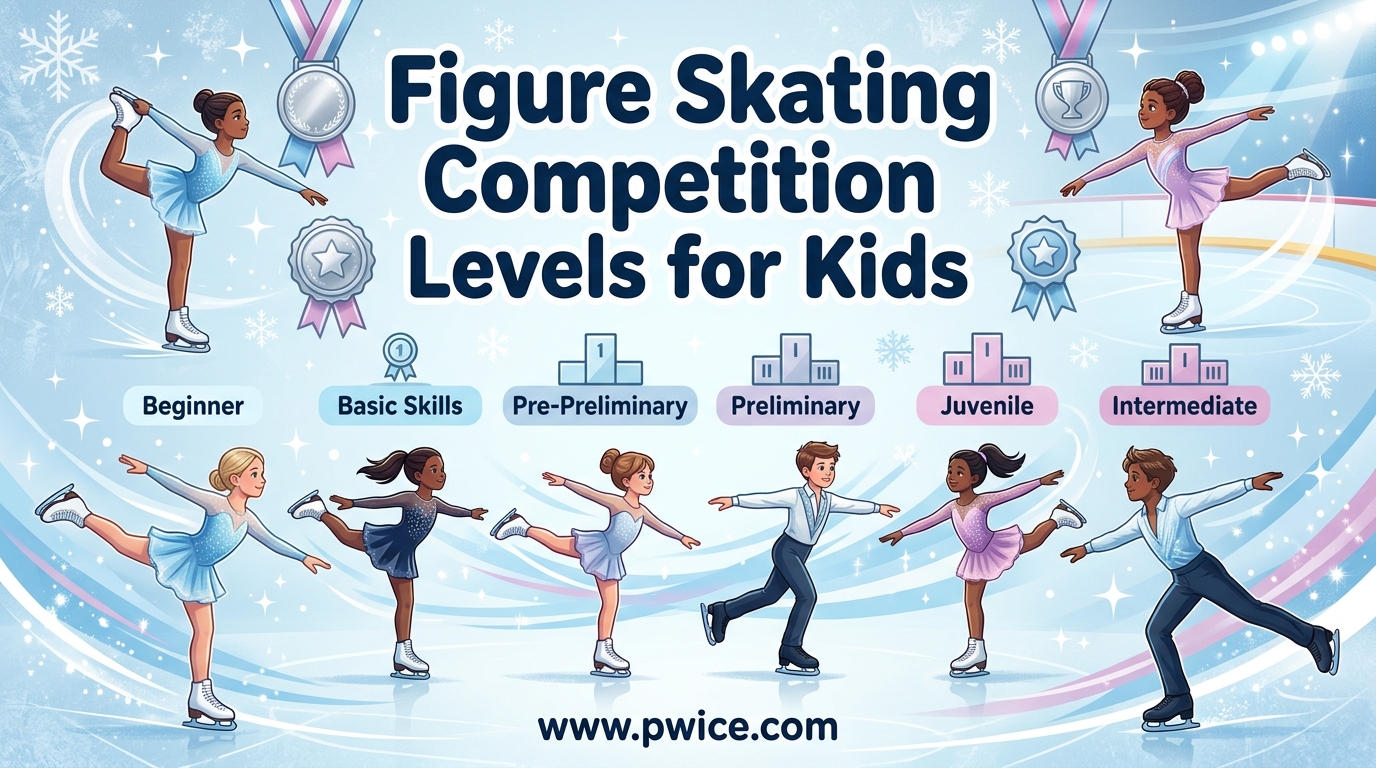
Understanding figure skating competition levels for kids explained in clear terms helps parents support their young skaters through every stage of development. The progression system can seem overwhelming at first glance, but it follows a logical structure designed to build skills safely while keeping the sport fun and achievable.
There are eight official competition levels in U.S. Figure Skating, organized primarily by age and test achievement: senior, junior, novice, intermediate, juvenile, pre-juvenile, preliminary, and pre-preliminary. Skaters advance by passing standardized tests in skating skills and free skate elements, with each level introducing progressively complex jumps, spins, and choreography requirements.
In this guide, I will walk you through every level from a toddler’s first steps on ice to competitive senior skating. Whether your child dreams of competing locally or has Olympic aspirations, this roadmap shows exactly what to expect at each stage.
Table of Contents
Figure Skating Competition Levels for Kids Explained: The Complete Picture
The U.S. Figure Skating system operates on two parallel tracks that eventually merge. Young skaters typically begin with Learn to Skate USA, a recreational program that builds foundational skills through fun, age-appropriate classes. Once skaters master the basics, they transition into the U.S. Figure Skating test structure, which opens doors to sanctioned competitions.
Testing and competing are separate but related achievements. A skater can hold a specific test level while competing at a lower level for experience, or test up quickly and compete at their achieved level. This flexibility allows coaches to match competition difficulty to each skater’s readiness and confidence.
The eight competition levels split naturally into three groups. Entry levels (pre-preliminary through pre-juvenile) welcome new competitors with simpler programs and lower expectations. Middle levels (juvenile through intermediate) introduce double jumps and complex spin combinations. Elite levels (novice through senior) feature triple jumps, intricate footwork, and the possibility of qualifying for national championships.
Beginner Levels: Learn to Skate USA (Ages 3-12)
Before kids enter the competitive pipeline, most begin with Learn to Skate USA. This program serves as the official entry point for aspiring figure skaters, providing structured instruction that prepares children for the more demanding test structure ahead.
Snowplow Sam (Ages 3-6)
The Snowplow Sam curriculum welcomes the youngest skaters with four levels that emphasize balance, forward movement, and basic gliding. Level 1 introduces falling safely and standing up independently. By Level 4, skaters perform forward swizzles, backward wiggles, and two-foot hops. Most children spend 4-8 weeks at each Snowplow level.
Classes typically run 30 minutes with a low coach-to-student ratio of about 1:4 or 1:6. The focus stays firmly on building comfort on ice rather than technical precision. Parents watch from designated areas while instructors use games, toys, and songs to keep young skaters engaged.
Basic Skills (Basic 1-6)
Basic Skills levels serve children ages 6 through 12, though older beginners can start here too. Each level introduces specific elements that build toward figure skating fundamentals. Basic 1 covers marching, forward two-foot glides, and dips. Basic 6 introduces forward inside three-turns, backward outside edges, and the beginning of spin positions.
Skaters usually progress through one Basic Skills level per 8-week session. Testing happens during regular class time with instructors evaluating each element. The skills learned in Basic 1-6 directly transfer to the U.S. Figure Skating pre-preliminary test level.
Pre-Free Skate and Free Skate 1-6
After completing Basic 6, skaters enter Pre-Free Skate, which bridges recreational skating and the competitive track. This level introduces more advanced moves like forward outside and inside edges on circles, backward crossovers, and the Waltz jump. Free Skate 1-6 continues building jump and spin vocabulary, culminating in elements needed for the pre-preliminary test.
Excel Program
U.S. Figure Skating’s Excel program offers an alternative competitive path for skaters who want to compete without the pressure of the standard test track. Excel competitions use simplified rules and allow more program flexibility. Many skaters compete in Excel while working through their standard test levels, gaining valuable performance experience before entering the more rigorous qualifying pipeline.
Singles Competition Levels: Pre-Preliminary Through Senior
The competitive track in U.S. Figure Skating consists of eight distinct levels, each with specific age restrictions and technical requirements. Understanding these levels helps parents set realistic expectations and celebrate meaningful milestones along their child’s skating journey.
Pre-Preliminary: The Entry Point
Pre-preliminary represents the first official competition level in U.S. Figure Skating. Most skaters enter between ages 5 and 9 after passing the pre-preliminary skating skills test and free skate test. Programs last one minute and 10 seconds, requiring only five basic jumps: Waltz jump, Salchow, toe loop, half flip, and half Lutz.
No spins are required at this level, though many skaters include simple upright spins for presentation points. The focus remains on clean technique, proper posture, and demonstrating control over the basic elements. Judges look for confident stroking, smooth transitions, and the beginning of artistic presentation.
Preliminary: Building the Foundation
The preliminary level introduces the first required spin and expands jump requirements. Skaters perform a one minute and 30 second program containing the same five jumps as pre-preliminary plus a single loop jump. The one-foot upright spin becomes mandatory, teaching skaters to center their rotation and maintain balance.
Most skaters spend one to two years at the preliminary level, solidifying their technique before attempting more difficult elements. This level filters out skaters who lack the commitment or physical readiness for higher-level skating. Coaches emphasize proper jump technique over height or rotation speed.
Pre-Juvenile: Introduction to Double Jumps
Pre-juvenile skating opens the door to double jumps and combination jumps. Programs extend to two minutes, and skaters must include a double Salchow or double toe loop along with any two single jumps. The spin requirements expand to include a back spin and a sit spin or camel spin.
Age requirements become stricter at this level. Skaters must be under 14 years old to compete as pre-juvenile. This cutoff encourages timely progression while keeping age groups somewhat competitive. Most pre-juvenile skaters train 8-12 hours per week across on-ice and off-ice sessions.
Juvenile: Under 13 Competition
Juvenile represents a significant step up in difficulty and commitment. Skaters must be under 13 years old as of the competition date. Programs run two minutes and 30 seconds, requiring a double Salchow-toe loop combination, one additional double jump, and three different spins including a change-foot spin.
The juvenile level demands consistent double jumps and the beginning of program construction. Skaters learn to connect elements with choreography and transitions rather than simply skating from one element to the next. Many skaters spend two to three years at juvenile, mastering double flip and double Lutz before moving up.
Intermediate: The Double Axel Gateway
Intermediate skating sits at a crucial transition point. Skaters must be under 16 years old. The technical requirements jump significantly: programs last three minutes and include two different double jumps, one jump combination, and four different spins including a flying spin or spin with flying entrance.
The double Axel, considered the gateway jump to elite skating, often makes its first appearance at intermediate. This jump requires two and a half rotations in the air and separates serious competitive skaters from recreational competitors. Training hours typically increase to 15-20 per week at this level.
Novice: Advanced Competition
Novice represents the first truly advanced level with strict age limits and demanding technical content. Skaters must be at least 13 years old but under 17 years old. Programs extend to three minutes and 30 seconds and require five double jumps including one in combination, a double Axel attempt, and five different spins.
Novice skaters can qualify for sectional championships and potentially advance to the U.S. Championships through the novice event. This level serves as the proving ground for junior and senior skating. Most novice competitors train 20-25 hours weekly and work with multiple coaches specializing in different disciplines.
Junior: The Path to Elite
Junior skaters must be at least 14 years old but under 19 years old. Programs run four minutes and require six different double jumps, one triple jump attempt, a double Axel in combination, and five different spins including a change-foot spin with at least one change of position.
Junior competition opens access to international competitions and the Junior Grand Prix series. This level produces many of the skaters who eventually represent the United States at World Championships and Olympics. Junior skaters typically train 25-35 hours per week with comprehensive off-ice conditioning.
Senior: The Highest Level
Senior skating has no upper age limit, though skaters must be at least 15 years old. Programs run four minutes and require seven different double jumps, two triple jumps, a double Axel in combination, and five different spins. Many senior programs include three or more triple jumps and difficult spin combinations.
Senior skaters compete at the highest levels including Grand Prix events, Four Continents Championships, World Championships, and the Olympic Games. Reaching senior level represents years of dedicated training, significant financial investment, and exceptional athletic talent.
Age Requirements Summary
Understanding age cutoffs helps parents plan their child’s skating trajectory. Pre-juvenile requires skaters to be under 14. Juvenile demands under 13. Intermediate allows skaters under 16. Novice accepts skaters 13 to 17. Junior spans ages 14 to 19. Senior starts at age 15 with no upper limit.
These age restrictions prevent older, more physically mature skaters from competing against younger opponents. They also encourage timely progression through the levels. A skater who ages out of a level without testing up must move to the next category regardless of readiness.
Understanding the U.S. Figure Skating Test Structure
Testing forms the backbone of the U.S. Figure Skating progression system. Unlike competitions where skaters face subjective judging and placement against opponents, testing offers an objective pass-fail evaluation of specific skills. Passing tests unlocks higher competition levels and marks concrete achievements in a skater’s development.
Five Testing Areas
U.S. Figure Skating offers tests in five disciplines. Skating Skills tests evaluate edge quality, turns, and power. Singles tests cover free skate elements including jumps and spins. Pattern Dance tests measure ability to perform set dances with a partner. Free Dance tests assess creative movement to music with a partner. Pairs tests evaluate partnered elements like lifts and side-by-side jumps.
Most skaters begin with Skating Skills and Singles Free Skate tests, as these form the foundation for all other disciplines. Dance and Pairs require finding a compatible partner, which can delay entry into those tracks. The Adult Track offers modified versions of all tests for skaters age 21 and older.
2025 Update: Skating Skills Replaces Moves in the Field
In 2026, U.S. Figure Skating completed the transition from “Moves in the Field” to “Skating Skills.” The new name better reflects what these tests evaluate: comprehensive skating ability rather than just set patterns across the ice. The test content remains similar, with skaters demonstrating turns, edges, and power through prescribed exercises.
Skating Skills tests progress from pre-preliminary through senior levels, with additional Gold, Platinum, and Diamond designations for advanced skaters. Each level builds on the previous one, adding complexity to turns, introducing multi-rotation elements, and demanding higher quality edge execution.
The Testing Process
Test sessions occur at rinks throughout the country, typically organized by local clubs. Skaters register in advance, pay a test fee, and perform their elements before a panel of judges. Each test requires specific elements performed to minimum standards. Judges evaluate edge quality, turn execution, power, and flow.
A test receives either a “pass” or “retry” designation. Passing moves the skater to the next level. A retry means the skater must wait a specified period before attempting that test again. Most skaters pass skating skills tests on their first or second attempt, as these tests reward consistent practice over raw talent.
Test Fees and Scheduling
Testing costs vary by level and region but typically range from $40 for pre-preliminary tests to $100 or more for senior tests. Additional fees include ice time rental, coach accompaniment charges, and test session registration. Many families budget $500 to $1,000 annually for testing fees as their skater progresses through multiple levels.
From Local Competitions to Nationals: The Competition Pathway
Not all figure skating competitions operate under the same rules or offer the same advancement opportunities. Understanding the competition pathway helps parents choose appropriate events and set realistic goals for their child’s competitive career.
Non-Qualifying Competitions
Non-qualifying competitions, often called Compete USA events, welcome skaters of all levels without requiring specific test achievements. These local and regional competitions focus on performance experience rather than advancement. Skaters compete for medals, personal bests, and judging feedback.
Most skaters begin their competitive journey at non-qualifying events. These competitions offer lower pressure environments where young skaters can practice performing their programs, managing nerves, and learning competition protocols. Entry fees typically range from $75 to $150 per event.
NQS: Non-Qualifying Series
The Non-Qualifying Series (NQS) represents a middle tier between local competitions and the qualifying pipeline. These events follow stricter protocols and attract more competitive fields while remaining accessible to skaters who have not yet entered the qualifying track. NQS competitions often serve as preparation for qualifying events.
The Qualifying Pipeline
The qualifying pipeline offers the path to U.S. Championships and international competition. It begins with Regionals, where skaters compete against others from their geographic region. Top finishers advance to Sectionals, covering larger territories. Sectional medalists qualify for U.S. Championships in their respective levels.
Qualifying competitions require skaters to have passed specific tests and meet age requirements. The competition becomes significantly more intense at this level, with skaters training specifically for peak performance at these events. Only novice, junior, and senior skaters can enter the qualifying pipeline.
ISU-Sanctioned Competitions
The International Skating Union (ISU) governs international figure skating, including the World Championships and Olympic Games. ISU-sanctioned competitions follow different rules than domestic events and require skaters to meet international age minimums. Junior and senior skaters who excel domestically may receive invitations to international events.
Parent’s Guide: Costs, Time Commitment, and What to Expect
Few sports match figure skating’s combination of equipment costs, coaching fees, ice time charges, and competition travel expenses. Understanding these commitments helps families prepare financially and logistically for their child’s skating development.
Testing Costs by Level
Annual testing expenses vary dramatically by level and ambition. Recreational skaters testing once or twice yearly might spend $200 to $400. Competitive skaters testing multiple levels across skating skills and free skate could face $800 to $1,500 in annual testing fees. Senior level testing, combined with international test fees, can exceed $2,000 yearly.
Competition Entry Fees
Local non-qualifying competitions charge $75 to $150 per event entered. NQS events typically cost $150 to $250. Qualifying competitions (Regionals and Sectionals) have higher fees, often $200 to $400, plus travel and accommodation costs. A competitive season with five to eight competitions can easily cost $2,000 to $5,000 in entry fees alone.
Equipment Progression
Beginner skaters start with basic recreational skates costing $100 to $300. As skaters advance, boot and blade quality becomes critical. Intermediate and advanced skaters require custom-fitted boots and premium blades costing $600 to $1,500 per pair. Most competitive skaters replace boots annually as they break down from intensive training.
Additional equipment includes practice clothing ($50 to $200 per outfit), competition costumes ($200 to $1,000+), protective gear, off-ice training shoes, and spinners for off-ice practice. Budget $500 to $2,000 annually for equipment as your skater advances.
Time Commitment by Level
Pre-preliminary through preliminary skaters typically train 4-8 hours weekly. Juvenile and intermediate skaters increase to 12-18 hours. Novice, junior, and senior skaters commit 20-35 hours weekly across on-ice and off-ice training. This time investment affects family schedules, school commitments, and social activities.
Off-ice training becomes essential at higher levels. Stretching, strength conditioning, ballet or dance classes, and jump practice on specialized equipment all contribute to on-ice success. Most competitive skaters spend as much time training off-ice as on-ice by the juvenile level.
Coach Selection Considerations
Coach fees vary by region and coach experience, ranging from $40 to $100+ per hour. Pre-preliminary skaters might take one or two lessons weekly. Advanced skaters often work with multiple coaches specializing in jumps, spins, choreography, and skating skills, accumulating 8-15+ hours of coaching weekly.
Choosing the right coach matters as much as raw talent. Look for coaches with experience at your child’s target level, positive communication style, and compatible personality. Many successful skaters switch coaches as they advance, seeking specialists who excel at specific levels or elements.
Frequently Asked Questions
What are the levels of figure skating competitions?
There are eight official competition levels in U.S. Figure Skating: pre-preliminary, preliminary, pre-juvenile, juvenile, intermediate, novice, junior, and senior. These levels progress from beginner-friendly one-minute programs with basic jumps to elite four-minute programs featuring triple jumps and complex choreography.
What are the 4 types of figure skating?
The four main disciplines of figure skating are singles (men’s and women’s individual skating), pairs (male and female partners performing lifts and side-by-side elements), ice dance (partners dancing together with emphasis on rhythm and interpretation), and synchronized skating (teams of 16 skaters performing together). Most children begin with singles skating before potentially branching into other disciplines.
What are the grades in figure skating?
Figure skating uses test levels rather than traditional grades. In Skating Skills (formerly Moves in the Field), tests progress through pre-preliminary, preliminary, pre-juvenile, juvenile, intermediate, novice, junior, senior, and then Bronze, Silver, Gold, Platinum, and Diamond medal tests. Each passed test represents a concrete achievement in a skater’s development.
What is level 7 ice skating?
In the Learn to Skate USA curriculum, Level 7 corresponds to Free Skate 1, the first level after completing the Basic Skills sequence. In U.S. Figure Skating competition levels, there is no official Level 7, though intermediate skating (the sixth competition level) could be considered the seventh step when counting from pre-preliminary through senior.
What is pre-juvenile figure skating?
Pre-juvenile is the third competition level in U.S. Figure Skating, positioned between preliminary and juvenile. Skaters must be under 14 years old and perform two-minute programs featuring double jumps, combination jumps, and multiple spin positions. This level marks the transition from foundational skating to competitive athletics.
What are the levels of figure skating testing?
Figure skating tests follow eight levels: pre-preliminary, preliminary, pre-juvenile, juvenile, intermediate, novice, junior, and senior. Beyond senior, skaters can test for Bronze, Silver, Gold, Platinum, and Diamond medals in Skating Skills. Tests exist in five disciplines: Skating Skills, Singles Free Skate, Pattern Dance, Free Dance, and Pairs.
How long does it take to progress through figure skating levels?
Progression speed varies dramatically by skater. Most children spend 2-4 years in Learn to Skate USA before entering U.S. Figure Skating. From pre-preliminary through senior, the journey typically takes 8-12 years for competitive skaters. Recreational skaters might spend decades enjoying the sport without ever reaching senior level. Consistent practice, physical readiness, and quality coaching all affect progression speed.
Final Thoughts
The figure skating competition levels for kids explained in this guide represent a structured pathway from first steps to elite competition. Every skater’s journey follows a unique timeline based on talent, commitment, resources, and opportunities. Some skaters race through levels in record time. Others savor each stage, building confidence and technique before advancing.
Success in figure skating means different things to different families. For some, reaching senior level and competing at Nationals represents achievement. For others, mastering a clean double Salchow at juvenile level brings equal pride. The U.S. Figure Skating system accommodates both ambitions, offering tests and competitions for every commitment level.
If your child shows interest in figure skating, begin with Learn to Skate USA classes at your local rink. Watch their joy on ice. Support their goals without imposing your own. And remember that the journey through figure skating competition levels offers lessons in discipline, resilience, and self-expression that extend far beyond the ice rink.