
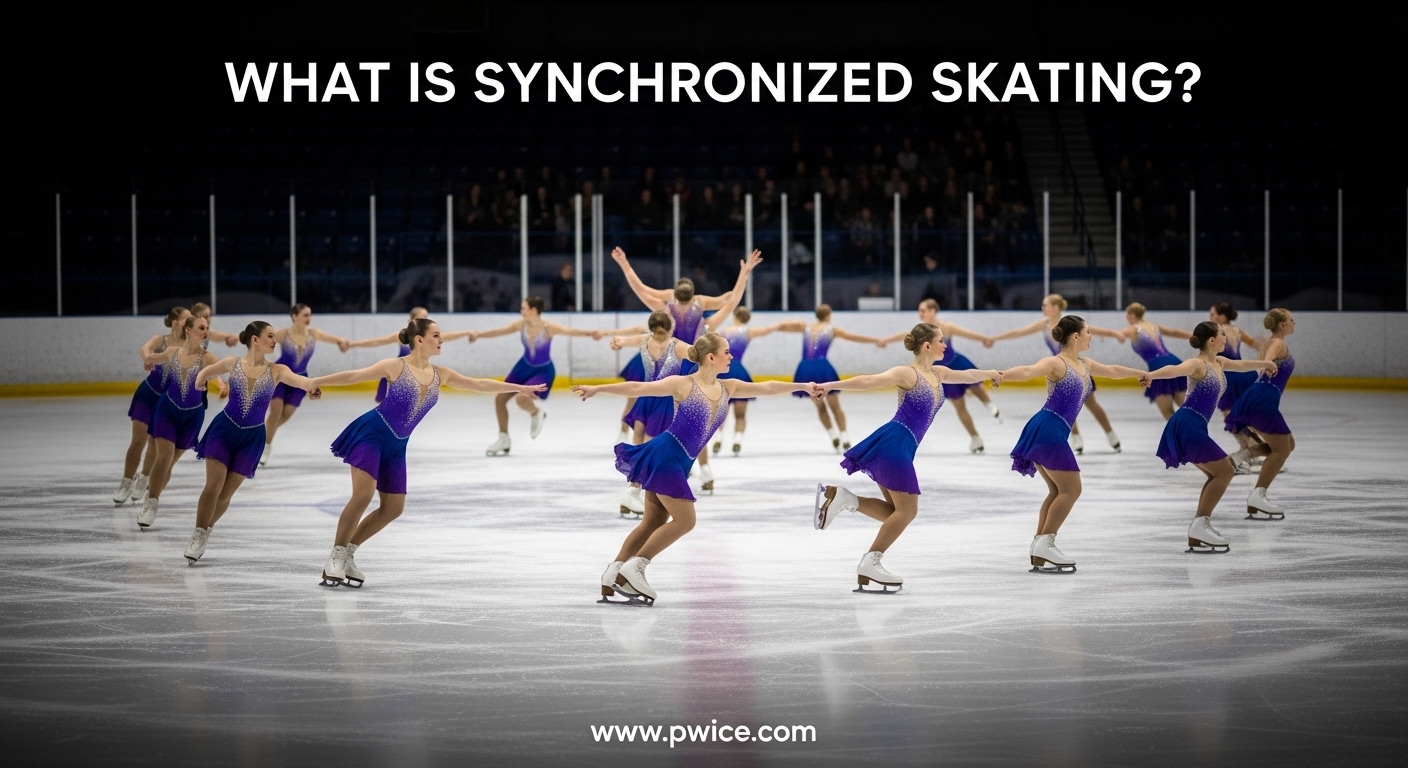
What is synchronized skating? It is a team figure skating discipline where 8 to 20 athletes perform intricate formations and step sequences together in perfect unison. Teams move as one unit across the ice, executing blocks, circles, wheels, and lines while maintaining precise timing and spacing.
This sport, often called “synchro” by those who practice it, combines the athleticism of singles skating with the teamwork of group performance. I have watched teams train for years, and the level of coordination required is unlike anything else in figure skating.
Originally known as “precision skating,” this discipline has grown into the fastest-growing segment of figure skating worldwide. It offers skaters something that individual disciplines cannot: the chance to compete and perform as part of a cohesive team.
Table of Contents
What Is Synchronized Skating? A Complete Overview
Synchronized skating is a discipline of figure skating where teams perform choreographed programs to music while skating in various formations. The sport emphasizes unison, precision, speed, and complex choreography that showcases both individual skill and collective teamwork.
Teams compete using the International Judging System, the same scoring method used in singles, pairs, and ice dance. Judges evaluate both technical elements and program components, rewarding teams that demonstrate clean execution, strong skating skills, and artistic interpretation.
What makes synchro unique is the requirement for absolute synchronization. Every skater must execute turns, steps, and transitions at exactly the same moment. The result looks like a single organism gliding across the ice rather than a group of individuals.
History and Origins: From Precision Skating to Synchro
The history of synchronized skating dates back to 1956 when Dr. Richard Porter organized the first team at the Ann Arbor Figure Skating Club in Michigan. He called it “precision skating,” a name that reflected the sport’s emphasis on exact timing and formation accuracy.
The discipline grew slowly through the 1960s and 1970s, with teams forming at clubs across the United States. The first official competition took place in 1976, and the sport began spreading internationally during the 1980s.
In 1994, the International Skating Union formally recognized synchronized skating as an official discipline of figure skating. This recognition elevated the sport from a club activity to an international competitive discipline with World Championships.
By the early 2000s, the name “synchronized skating” had largely replaced “precision skating” in official usage. Today, the sport continues to expand globally with teams in over 20 countries competing at various levels.
How Synchronized Skating Works?
Understanding how synchronized skating works requires knowledge of team composition, required elements, and the judging system. Teams range from 8 to 20 skaters depending on the competitive level, with most elite teams fielding 16 athletes.
Programs consist of two main components: the short program and the free skate. The short program runs approximately 2 minutes and 50 seconds and includes mandatory elements that all teams must perform. The free skate lasts about 4 minutes and allows more creative freedom in element selection and choreography.
Required Elements and Formations
Competitive programs must include specific elements that demonstrate different skating skills. These required elements include:
- Blocks: Rectangular formations where skaters align in straight lines
- Circles: Round formations that rotate while maintaining shape
- Wheels: Spoke-like formations radiating from a central point
- Lines: Straight formations that travel across the ice
- Intersections: Complex passing patterns where lines cross through each other
- No-hold elements: Rotating formations without physical contact between skaters
- Group lifts: Pairs elements performed simultaneously by multiple pairs
- Spins: Synchronized rotational elements executed as a team
- Step sequences: Complex footwork patterns performed in unison
Each element requires precise distance control, timing, and edge quality. Teams practice these formations for months to achieve the unison that judges reward with high scores.
Team Composition and Roles
While all team members perform the same choreography, individual roles exist within the formation. Skaters positioned at formation edges must maintain exact spacing to preserve the visual shape. Those in the center often execute more complex turns since they have more space.
Team members rotate through different positions during programs. A skater might start in a block, transition to a circle, then join a line for an intersection element. This constant movement keeps programs visually dynamic while maintaining the synchronized appearance.
Competition Levels and Structure
Synchronized skating offers competitive pathways for athletes of all ages and skill levels. In the United States, U.S. Figure Skating organizes competition into three main tiers: Aspire, Developmental, and Competitive.
Aspire Programs
The Aspire levels introduce young skaters to team skating fundamentals. Teams typically include 8 to 16 skaters who have passed basic skills tests. These programs focus on building unison, learning simple formations, and developing team chemistry.
Many clubs offer beginner synchro programs through Learn to Skate USA. This entry point allows children to experience synchronized skating before committing to more competitive levels.
Developmental Levels
Developmental levels include Preliminary, Pre-Juvenile, Open Juvenile, and Juvenile divisions. These categories serve as stepping stones between beginner and competitive skating. Teams at these levels perform shorter programs with fewer required elements.
Age requirements vary by level, with most divisions requiring skaters to be under specific age limits. The Juvenile level, for example, typically restricts participants to skaters 14 years old and younger.
Competitive Levels
The competitive tier includes Intermediate, Novice, Junior, and Senior divisions. These levels feature longer programs with more complex required elements and higher test requirements. Senior teams, the highest level, compete at ISU World Championships.
Senior teams field 16 skaters with up to 4 alternates. They perform programs that showcase elite athleticism and artistry. The top Senior teams from each country compete annually at the World Synchronized Skating Championships.
Adult and Collegiate Skating
Adult synchronized skating provides opportunities for skaters aged 21 and older to continue competing. Teams range from beginner adult divisions to elite adult levels. Many adult skaters report that synchro keeps them motivated to maintain their skating skills.
Collegiate synchronized skating has grown significantly in 2026, with teams representing universities at national championships. These programs allow college students to continue competing while pursuing their education.
The Judging System Explained
Synchronized skating competitions use the International Judging System, which evaluates both technical merit and artistic presentation. Judges assign grades of execution for each element based on quality, unison, and difficulty.
Technical scores come from the base values of required elements plus or minus execution grades. A perfectly executed difficult element receives positive grades, while falls or synchronization errors result in deductions.
Program components scores evaluate skating skills, transitions, performance, choreography, and interpretation. These scores reflect how well the team performs as a cohesive unit rather than as individuals.
Benefits of Synchronized Skating
Participating in synchronized skating offers benefits that extend far beyond the ice rink. Based on forum discussions with adult skaters, the community aspect stands out as the primary advantage over individual disciplines.
Team members develop lifelong friendships through shared practices, competitions, and travel experiences. The non-toxic environment attracts skaters who want camaraderie without the intense individual pressure of singles skating.
Synchro also improves individual skating skills. The need to maintain unison with teammates pushes skaters to refine their technique, edge quality, and timing. Many singles skaters credit synchro with making them better individual competitors.
The discipline teaches teamwork and communication skills that transfer to other areas of life. Skaters learn to support each other, celebrate collective achievements, and work through challenges as a group.
Getting Started with Synchronized Skating
If you want to start synchronized skating, contact your local figure skating club to ask about team opportunities. Most clubs with synchro programs hold tryouts in spring or early summer for the following season.
Skill requirements vary by level. Beginner teams typically require only basic skating skills and a willingness to learn. Higher competitive levels require specific test passes in Moves in the Field and ice dance patterns.
Do not worry if your skills seem rusty or if you are starting as an adult. Forum discussions reveal that mixed skill levels are normal on beginner teams. Coaches expect to teach synchronization skills to new members regardless of their individual skating background.
Frequently Asked Questions About Synchronized Skating
What is the difference between synchronized skating and figure skating?
Synchronized skating is a discipline within figure skating, not a separate sport. While singles, pairs, and ice dance focus on individual or duo performance, synchronized skating involves teams of 8 to 20 skaters performing together. Synchro emphasizes unison, formations, and teamwork rather than individual jumps and spins. Many skaters participate in both individual and synchronized disciplines.
How many skaters are in synchronized skating?
Teams consist of 8 to 20 skaters depending on the competitive level. Senior and Junior teams typically field 16 skaters with up to 4 alternates. Developmental and Aspire levels often use smaller teams of 8 to 12 skaters. All team members perform the same choreography simultaneously while maintaining precise spacing and timing.
What is the hardest move in synchronized skating?
The intersection element is widely considered the most difficult and dangerous move in synchronized skating. During intersections, lines of skaters pass through each other at high speeds with minimal clearance. Teams must maintain perfect timing to avoid collisions. Other challenging elements include no-hold blocks, where skaters rotate formations without touching, and complex group lifts performed by multiple pairs simultaneously.
Why is synchronised skating not an Olympic sport?
Synchronized skating has not yet been added to the Olympic program despite ongoing efforts by the International Skating Union. The primary barriers include the large number of athletes required per team (making venue logistics challenging), limited global participation compared to other disciplines, and the IOC’s restrictions on adding new events without removing existing ones. The ISU continues advocating for Olympic inclusion, and many in the sport hope for future acceptance.
Conclusion
What is synchronized skating? It is a beautiful combination of athletic skill, artistic expression, and teamwork that creates something greater than individual performance. From its origins as precision skating in 1956 to its current status as the fastest-growing figure skating discipline, synchro continues attracting skaters of all ages.
Whether you are a young skater looking for your first team experience, an adult seeking community on the ice, or simply a fan discovering this discipline, synchronized skating offers something unique. The sight of 16 skaters moving as one across the ice remains one of the most impressive spectacles in all of sports.
Consider contacting your local figure skating club to learn more about what synchronized skating could offer you. The team might be waiting for you to join them on the ice.