
The best insulated bib overalls for men are the Carhartt Yukon Extremes for harsh, wet, windy work; the Berne Heartland for traditional insulated duck coverage; and RefrigiWear’s -40°F model for the coldest listed conditions. Each answers a different problem, so I would match the shell, insulation, mobility, and leg closure to the workday instead of treating every bib as interchangeable.
An insulated bib traps warm air around the legs and torso while its shell takes the wear that trousers would normally take. That extra coverage helps construction crews, farmers, cold-storage workers, hunters, ice anglers, and spectators who will stand outdoors for a long stretch.
I ranked the 10 options below using their listed shell fabrics, insulation details, published temperature ratings where available, reinforcement, zippers, pockets, fit features, and review summaries. A rating is a helpful starting point, not a promise: wind, wet clothing, your activity level, and the base layers underneath can change how warm the same bib feels.
If you mainly watch games or work a low-motion outdoor shift, start with our guide to the best insulated bibs for outdoor activities. Hunters who need quieter, purpose-specific options can also compare these work-oriented choices with our cold weather hunting bibs.
Table of Contents
These Are the Top 3 Picks for Insulated Bib Overalls
Carhartt Yukon Extremes earns my overall pick because its 500-denier Cordura nylon shell, 150g Thinsulate insulation, DWR finish, wind protection, and ankle-to-thigh zippers cover the broadest hard-weather work needs. Berne is the practical duck-canvas choice, while the RefrigiWear -40°F is purpose-built for the least forgiving listed temperature range.
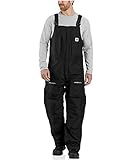
Carhartt Yukon Extremes Biberall
- 500D Cordura shell
- 150g Thinsulate
- Wind Fighter
- thigh leg zippers

Berne Heartland Insulated Duck Bib
- 12 oz duck shell
- heavyweight insulation
- brass zippers
- hammer loop

RefrigiWear -40°F Insulated Bib
- -40°F rating
- 500g insulation
- flex ridges
- reinforced patches
These 10 Bib Overalls Cover Winter Work and Snow Use in 2026
This quick view separates workwear-focused duck and nylon bibs from the Arctix snow bib. Read the temperature figures as manufacturer-listed conditions, then use the fuller reviews to decide whether you need greater insulation, weather protection, knee reinforcement, or easier boot access.
| Product | Specifications | Action |
|---|---|---|
| Berne Heartland Duck Bib |
|
View Details |
| Carhartt Yukon Extremes |
|
View Details |
 RefrigiWear -20°F Bib RefrigiWear -20°F Bib |
|
View Details |
| RefrigiWear -40°F Bib |
|
View Details |
 Ergodyne N-Ferno 6471 Ergodyne N-Ferno 6471 |
|
View Details |
 Dickies Premium Duck Bib Dickies Premium Duck Bib |
|
View Details |
 Carhartt Washed Duck Bib Carhartt Washed Duck Bib |
|
View Details |
 Carhartt Super Dux Bib Carhartt Super Dux Bib |
|
View Details |
 Wrangler Insulated Duck Bibs Wrangler Insulated Duck Bibs |
|
View Details |
 Arctix Essential Bib Arctix Essential Bib |
|
View Details |
1. Berne Heartland Is the Best Duck Bib for Traditional Winter Work
Berne Men’s Heartland Insulated Washed Bib Overall, Large Regular, Bark
12 oz duck
Heavyweight insulation
Brass leg zippers
Pros
- Durable 12 oz duck shell
- High insulated back
- Brass zipper hardware
- Deep pocket layout
- Hammer loop
Cons
- May run large
- Heavy for mild days
The Berne Heartland uses a 12-ounce, 100% cotton sanded-duck shell over heavyweight insulation quilted to polyester taffeta. Its insulated high back and outside storm flap make sense when the wind reaches the gap between a jacket and ordinary work pants.
I would put it first for someone who wants the familiar feel and abrasion resistance of duck canvas rather than a technical nylon shell. The listed four-needle waistband, elastic inserts, brass rivets at front stress points, and brass two-way front zipper point to a build aimed at regular jobsite use.
Storage is unusually well sorted for a traditional work bib: there are inside chest pockets, chest pockets with a pencil slot, deep front pockets, utility pockets, reinforced rear pockets, a hidden zip pocket, and a hammer loop. Review summaries praise the durable shell, warmth, and storage, with 81% of the listed ratings at five stars.
Layering fits best when you account for the roomy cut
Some reviewers report that the Heartland runs large, so I would begin with Berne’s size guidance and your intended base layer rather than automatically adding extra size. Its elastic waistband inserts and adjustable elasticized straps offer some room to tune the fit after you decide how much insulation belongs underneath.
A roomy bib can help on a static outdoor shift, but cotton duck and heavyweight insulation can feel burdensome once the work becomes fast or temperatures rise. For high-output tasks, build in a way to vent or take a break before sweat turns into a cooling problem.
Boot changes are easier with the brass leg zippers
Heavy-duty brass leg zippers and snap closures are the key convenience feature here. They should make the bib easier to put on over work boots than a fixed ankle, though the listing does not specify a boot gaiter or a waterproof membrane.
The practical choice is a dry-work, cold-weather bib for trades, chores, or equipment work rather than a snow-specific garment. Inspect the snaps and zipper track after muddy use, because forum users often flag leg zippers as a high-wear point across insulated bib brands.
2. Carhartt Yukon Extremes Is the Best Overall Bib for Wind and Wet Work
Carhartt Men’s Yukon Extremes Loose Fit Insulated Biberall-Black-Medium
500D Cordura
150g Thinsulate
DWR shell
Pros
- Tough Cordura shell
- Wind Fighter protection
- Rain Defender DWR
- Thigh leg zippers
- Knee-pad openings
Cons
- Loose fit is not for everyone
- No listed temperature rating
Carhartt’s Yukon Extremes combines a 6.5-ounce, 500-denier Cordura nylon shell with 150g of 3M Thinsulate insulation. Wind Fighter technology and the Rain Defender durable water-repellent finish target the two things that can make a cold shift miserable even when the thermometer is not at its lowest.
This is my best insulated bib overalls for men pick for exposed work because the specification balances weather defense, insulation, access, and wear protection without relying on a published temperature claim. Review data is also strong: the supplied summary shows a 4.7 rating and 86% five-star ratings from more than 1,100 reviews.
Carhartt adds double-layer knees with openings for knee pads, bar tacks at stress points, cargo pockets, hand pockets, secured back pockets, and reflective taping. That package suits workers moving between vehicles, loading areas, and outdoor tasks where fabric durability and visibility both matter.
Boot access works best with the ankle-to-thigh zippers
The ankle-to-thigh zippers have storm flaps and snap closures, so this pair is built for pulling on over bulky work boots instead of forcing your heel through a narrow cuff. That is particularly useful when changing outside or when a boot needs to stay on for safety reasons.
Close the storm flaps after dressing, since an open zipper path can admit wind and blowing snow. The listing gives a DWR treatment, which sheds light moisture, but it does not say that this model has sealed waterproof seams.
Movement stays practical when the loose fit matches your layers
The listed fit is loose, and the adjustable elastic suspenders use low-profile buckles. I would choose the size around the layers you truly expect to wear; adding room without a plan can leave a heavy bib shifting when climbing, kneeling, or entering equipment.
Forum feedback reports long-term warmth from Yukon Extremes in sub-zero conditions, but activity still matters. For fast physical labor, open the front or leg zippers during a pause if safe to do so, and avoid piling on layers until you know how the 150g insulation feels on your job.
3. RefrigiWear -20°F Is the Best High-Visibility Bib for Severe Cold Work
RefrigiWear Insulated Bib Overalls – Rated -20°F Insulated Coveralls – Wind-Resistant Snow Pants – Waterproof Mens Overalls – Black/Charcoal – Medium
-20°F rated
400g insulation
HiVis reflective tape
Pros
- Published -20°F rating
- Over 400g insulation
- Wind-tight shell
- High-visibility details
- Boot-friendly leg zippers
Cons
- Sizing feedback varies
- Too warm for moderate weather
RefrigiWear lists more than 400g of insulation and a -20°F rating for this bib, backed by a wind-tight, water-resistant polyester outer shell. It also carries HiVis neon color and 2-inch silver reflective tape, a meaningful distinction for a work area where being seen is part of the day.
The product data assigns this one a 4.7 rating, and its review summary says 87% of ratings are five stars. It is a direct fit for cold-storage assignments or outdoor winter work where warmth and visibility should arrive in the same garment.
Heavy-duty Y-back suspenders, two zippered front pockets, one chest pocket, heel-reinforcement patches, and abrasion-resistant knee patches round out the work-first design. The listed weight is 3.63 pounds, which is a useful reminder that this insulation level is intended for cold exposure, not mild-weather chores.
The -20°F rating matters most during lower-output work
The published -20°F figure is the clearest warmth cue in this roundup, but it cannot account for a person’s movement, wind exposure, moisture, or layers. I would reserve this amount of insulation for genuinely cold work, standing duty, or slow-moving tasks instead of treating it as an all-winter uniform.
Workers who generate a lot of body heat may find it too warm in moderate weather, a limitation also reflected in the supplied review summary. A moisture-managing base layer and a simple upper layer are usually more sensible than stacking several heavy garments under a 400g bib.
Tall work boots pair well with the above-knee zippers
The leg zippers extend above the knee, helping the bib clear boots without a wrestling match at the ankle. Heel reinforcement also matters if you frequently drag the back hem over boot heels or climb steps and truck rails.
This model is described as water-resistant, not fully waterproof, and no sealed-seam detail is provided. In prolonged wet snow or rain, use that distinction when choosing between it and a bib with stated seam sealing.
4. RefrigiWear -40°F Is the Best Bib for the Most Extreme Listed Cold
RefrigiWear Insulated Bib Overalls for Men – Wind-Resistant Work Bibs – 40°F Winter Overalls – Mens Insulated Coveralls – Black/Charcoal – X-Large Tall
-40°F rated
500g insulation
Flex knee and side ridges
Pros
- Published -40°F rating
- Over 500g insulation
- Heat-retaining lining
- Flex panels
- Reinforced knee-to-ankle areas
Cons
- Very warm outside severe cold
- Heavier 4.5 pound build
The RefrigiWear -40°F bib is the warmest product on this list by its published rating and insulation amount: over 500g. Its tricot laminated silver lining is listed to retain heat, while the outer construction is described as wind-tight and water-repellent.
I would only choose this model when a -40°F-rated garment is relevant to the actual shift or environment. At 4.5 pounds, it is deliberately substantial, and the supplied review summary says it may be too warm outside extreme conditions.
Its performance-focused details are more than insulation: expanding ridges at the knees and sides aim to preserve movement, while abrasion-resistant patches run from knee to ankle. Two chest pockets, two zippered hand-warmer pockets, two side-leg pockets, and an inside zip pocket also give tools and small gear defined places.
Extreme insulation works when the task does not create excess heat
A -40°F rating makes this an obvious cold-storage and extreme-winter candidate, not a default choice for fast-paced work. The best approach is to start with a lighter, moisture-moving base layer and assess warmth early, since overheating and sweat can make later breaks feel colder.
The 4.7 rating and supplied 88% five-star share show high customer approval, but no listed rating replaces judgment around wind chill, wet conditions, and individual circulation. Take the stated figure as a product reference, not a personal safety threshold.
Reinforced lower legs help when boots meet rough surfaces
Heel-reinforcement patches and knee-to-ankle abrasion patches address the areas that catch on boot hooks, steps, and floor surfaces. That is useful for people who work around pallets, metal thresholds, or rough outdoor ground.
There is no listed leg-zipper detail for this model, so check the current listing’s sizing and entry layout before ordering for a specific tall-boot routine. The Performance-Flex ridges are the supplied mobility feature, making them more relevant than assuming a loose cut alone will solve bending comfort.
5. Ergodyne N-Ferno 6471 Is the Best Bib for Kneeling and Active Jobsite Work
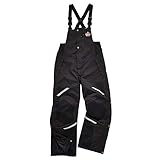
Ergodyne N-Ferno 6471 Heavy Duty Insulated Bib Overalls, Winter Workwear, 3M Thinsulate, Removable Knee/Shin Pads, Black, Small
500D nylon
80g Thinsulate
-15°F rated
Pros
- Removable knee and shin pads
- 1600D reinforcements
- Full YKK leg zippers
- Stretch side panels
- Lifetime defect warranty
Cons
- 80g insulation is lighter
- Smaller review sample
The Ergodyne N-Ferno 6471 takes a different path from the heaviest cold-storage bibs. Its 500D nylon shell, 80g 3M Thinsulate insulation, and -15°F published rating pair with removable knee and shin pads, 1600D reinforcement in high-wear areas, and four-way stretch side panels.
I would choose it for jobs that involve repeated kneeling, climbing, or crouching, such as field service and maintenance. The product data lists a regular fit and a 2.1-pound weight, so it may feel less restrictive than the much heavier extreme-cold choices while still offering insulation.
It also has a chest pocket, two side pockets, elastic bib straps, full-length YKK leg zippers, and machine-washable care. Ergodyne states a lifetime warranty against defects in materials and workmanship for the original purchaser, which is useful context when workwear sees regular abuse.
Knee protection is strongest when the pads match the job
The removable knee and shin pads are the deciding feature here, not just an extra accessory. They can help when the work requires long periods near the ground, and they can be removed when bulk around the lower leg becomes annoying.
Forum discussions frequently mention knee wear as a weak point in insulated work bibs, so the 1600D reinforced zones are worth prioritizing for this use. Check that the pads sit at your own kneeling point after adjusting the suspenders, because bib inseam and torso fit change pad placement.
Full-length zippers simplify changing over boots
Each leg has a full-length YKK zipper, giving the N-Ferno one of the clearest boot-access systems in the roundup. That helps when changing after a shift or when you need to add the bib over footwear already laced for work.
Its 80g insulation is much lower than RefrigiWear’s listed 400g-plus options, so treat the -15°F figure and your activity level together. It makes more sense for active cold work than for standing still for hours in severe wind.
6. Dickies Premium Duck Is the Best Straightforward Bib for Everyday Work
Dickies Mens Premium Insulated Duck Bib Overalls and Coveralls Workwear Apparel, Black, Large Short US
10 oz duck
Waist-height zippers
Double knees
Pros
- 10 oz duck fabric
- Zip-to-waist entry
- Double knees
- Brass zippers
- Elastic waist inserts
Cons
- No listed weather membrane
- No stated temperature rating
Dickies keeps the formula simple with 10-ounce high-performance duck, double knees, heavy-duty brass zippers, elastic waist inserts, a rule pocket, and a hammer loop. The listed zip-to-waist entry is its standout feature because it addresses the daily frustration of getting bibs on and off around boots.
This is the uncomplicated option for workers who want a duck-canvas bib with familiar utility storage instead of technical fabrics or a stated weather system. Its supplied data shows a 4.6 rating across more than 5,400 reviews, the largest review count among these ten products.
There is no listed insulation weight, temperature rating, DWR finish, or sealed-seam claim in the available product data. I would treat it as a durable insulated work layer and select it by local conditions, rather than assuming it can replace an extreme-cold bib.
Zip-to-waist access makes daily dressing less tedious
Waist-high zippers reduce the need to pull a rigid duck bib over boots through a narrow lower leg. That feature is especially welcome when you change at a jobsite or need to take the bib off before driving home.
As with every zipper-heavy work garment, brushing off grit before closing it can help the track operate cleanly. The availability of heavy-duty brass hardware is a positive construction signal, but it is still worth inspecting zippers during regular washing and maintenance.
Elastic waist inserts favor bending over rigid duck comfort
The rear elastic waist inserts are intended to allow freer movement, and the double knees target a common abrasion zone. That combination makes more sense for chores, repair work, and tasks with frequent bending than a stiff bib with no give at the midsection.
Choose a layering plan before selecting size because the available data does not make a specific sizing claim. If your work shifts between cold mornings and warmer afternoons, a bib without stated waterproofing may be easier to reserve for dry days.
7. Carhartt Washed Duck Is the Best Classic Bib with Stretch and Reinforced Kicks
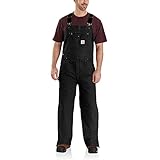
Carhartt Men’s Washed Duck Insulated Bib Overall, Black, Large
12 oz washed duck
3M Thinsulate
Cordura kick panels
Pros
- Ringspun washed duck
- Stretch side panels
- Thinsulate leg insulation
- Cordura kick panels
- Triple-stitched seams
Cons
- No listed temperature rating
- No stated waterproof treatment
This Carhartt model has a 12-ounce, 100% cotton ringspun washed-duck shell with 3M Thinsulate insulation through the legs. It adds adjustable elastic suspenders, stretch side panels, Cordura reinforced kick panels, ankle-to-knee zippers, and triple-stitched main seams.
I would select it for someone who wants a classic workwear look but needs extra movement at the sides and protection where boot heels scuff the hem. The supplied rating is 4.6 from nearly 2,900 reviews, with 82% recorded as five-star ratings.
The combination of washed duck and reinforced kick panels is practical for ordinary outdoor trades, property work, and farm use. It does not have a supplied temperature rating or water-repellent claim, so it belongs in the durable-work category rather than the dedicated wet-weather category.
Stretch sides make a difference when the torso is working
Stretch side panels and front-elastic suspenders are valuable when reaching forward, getting into equipment, or bending at the waist. They give this bib a more accommodating fit approach than a duck shell alone.
That does not mean the bib will feel cool during heavy labor; 12-ounce cotton plus leg insulation can still hold heat. Start with a lighter base layer for active work, then add warmth at the upper body as conditions demand.
Cordura kick panels protect the hem around boots
The Cordura kick panels target the lower-leg zone that rubs against boots, pedals, and steps. Pair them with the ankle-to-knee zippers when you need to change over standard work boots without fully removing footwear.
Triple-stitched main seams are a useful durability marker, especially on a garment expected to bend and pull throughout a workday. Keep in mind that the available data does not list knee-pad openings, so choose the Yukon or Ergodyne if built-in kneeling support is a priority.
8. Carhartt Super Dux Is the Best Bib for Mobility with Weather Resistance
Carhartt mens Super Dux Relaxed Fit Insulated Bibs Overalls, Black, Medium US
Nylon spandex shell
80g Thinsulate
DWR and wind protection
Pros
- Stretch nylon spandex shell
- Rain Defender finish
- Wind Fighter protection
- Sherpa-lined upper
- Chap-style double front
Cons
- Lighter 80g insulation
- No listed temperature rating
The Super Dux skips heavy duck canvas for an 8.1-ounce fabric made from 97% nylon and 3% spandex. It has Rain Defender durable water-repellent finish, Wind Fighter technology, 80g of 3M Thinsulate from the waist down, and Sherpa lining across the upper front and back.
I would favor this bib when climbing, walking, and bending are part of the work, and a lighter technical shell sounds better than heavyweight cotton duck. Its fabric mix and relaxed fit point toward mobility, while the double-front, chap-style construction adds another layer at the front.
The listed review summary gives it a 4.6 rating, with 83% of its ratings at five stars. It has no stated temperature rating, which is sensible to remember when comparing its lighter 80g insulation with the deep-insulation RefrigiWear choices.
Weather resistance works for exposure, not standing water
Rain Defender and Wind Fighter are the major reasons to choose the Super Dux for variable outdoor weather. A DWR finish is meant to repel water at the fabric surface, but the available listing does not call this a waterproof, seam-sealed garment.
For rain, wet snow, or sitting on slushy surfaces, look for a stated waterproof membrane and seam sealing rather than relying on any water-repellent finish. The insulated ski pants guide is a useful companion when weather sealing is more important than tool storage.
Lighter insulation helps when the job keeps you moving
The 80g Thinsulate specification is well below the heavier winter-work bibs, so it is likely easier to regulate during physical labor. I would layer it according to the forecast instead of expecting one bib to handle every temperature without adjustment.
The Sherpa-lined upper keeps the torso section more insulated while the waist-down quilted area stays focused on the legs. That split construction can appeal to workers who want warmth at the chest without choosing a uniformly bulky garment.
9. Wrangler Insulated Duck Bibs Are the Best for Active Bending and Tool Carry
Wrangler Riggs Workwear Men’s Insulated Duck Bibs, Duck Brown, Large
Articulated knees
Knee barrier
Hem-to-knee zippers
Pros
- Articulated knees
- Hidden knee barrier
- Tool storage
- Metal front zipper
- Partial-elastic suspenders
Cons
- No listed insulation weight
- No stated weather rating
Wrangler’s insulated duck bibs focus on movement and practical storage. Their listed features include articulated knees, a hidden knee barrier, adjustable suspenders with partial elastic, a heavy-duty metal front zipper, chest patch pockets, a side-leg tool pocket, hem-to-knee zippers, and quilted insulation.
I would point active workers toward this model when flexible knees and a tool pocket matter more than a stated cold rating. The available data has no insulation-weight figure, waterproof claim, or temperature range, so it is best judged as a general insulated work bib rather than an extreme-cold tool.
The 4.6 rating comes from 269 reviews in the supplied product data. Its knee-focused layout gives it a clear identity among duck bibs: it is built to make repeated bending and carrying a little less awkward.
Articulated knees help when bending repeats all day
Articulated shaping gives the knee a pre-formed bend, while the hidden knee barrier adds protection at a high-contact point. Those details can be more useful than simply sizing up when climbing ladders, crouching, or stepping into a truck.
The listing does not say that this bib includes removable pads or knee-pad openings. Workers who need dedicated cushioned protection should compare it with the Ergodyne’s removable knee and shin pads rather than assuming every reinforced knee has the same function.
Tool pockets matter when small equipment needs a fixed home
Chest patch pockets and the side-leg tool pocket can keep frequently used small items accessible without overloading jacket pockets. A secure routine still matters: use pockets for appropriate items and keep sharp tools stored safely for the task.
The hem-to-knee zipper should make boot changes simpler than a fixed cuff. For tall work boots, check the current size chart and the zip opening against your boot shaft because the listing does not provide a specific circumference measurement.
10. Arctix Essential Is the Best Bib for Snow, Boots, and Outdoor Recreation
Arctix Men’s Essential Insulated Bib Overalls, Black, X-Large/32″ Inseam
8000mm resistance
85g insulation
Boot gaiters
Pros
- Critical seams sealed
- 8000mm water resistance
- 85g recycled insulation
- Ballistic scuff guards
- Boot gaiters
Cons
- Built for snow use
- Not the heaviest workwear shell
Arctix Essential is the outlier in this group because it is a ski bib rather than conventional duck workwear. Its listing calls out 8000mm water resistance, critical seams that are sealed, 85g of recycled insulation, elasticized side gussets, fleece-lined hand-warmer pockets, 600-denier ballistic ankle and hem guards, and boot gaiters with grippers.
The manufacturer states a range from -20 to plus 35 degrees depending on activity, which puts the emphasis on activity level rather than a fixed industrial-work rating. I would choose it for snow clearing, sledding, ice fishing, rink spectating, and other outdoor recreation where weather control and boot sealing matter.
Its 4.5 rating is supported by more than 4,200 supplied reviews, and it is the only option here with stated boot gaiters. That feature helps keep snow and moisture out around the boot opening, something ordinary work bib cuffs do not always address.
Sealed critical seams help most in snow and wet weather
The 8000mm water-resistant rating and critical-seam sealing give Arctix a stronger stated wet-snow story than the work bibs described only as water-repellent. It is a better choice for sitting, kneeling, or walking in snow where water exposure is part of the activity.
It is still wise to distinguish critical-seam sealing from a claim that every seam is sealed. For ski-specific comparisons, see our best ski pants for men, where the use case is closer to Arctix than to a worksite duck bib.
Boot gaiters keep snow out when cuffs meet winter boots
The gaiters with grippers are the feature that makes this bib especially useful with snow boots. They form an inner barrier at the boot, which is helpful when walking through deeper snow or spending time outdoors near the ground.
For heavy construction or abrasive shop work, a duck or Cordura work bib may be the more appropriate match because those models prioritize jobsite reinforcement and tool storage. For family snow days, the related guide to winter snow pants for kids can help outfit younger members of the group with the same weather focus.
The Right Bib Starts with Your Cold, Weather, and Workload
The first decision is warmth. Use the listed -40°F and -20°F RefrigiWear ratings for severe, lower-output exposure, while remembering that those figures are manufacturer references rather than universal guarantees.
For active winter work, medium or lighter insulation can be more comfortable because it leaves more room to manage perspiration. Carhartt Yukon Extremes lists 150g Thinsulate, while Ergodyne and Super Dux list 80g; the fabric, wind, and your movement change the result as much as the number does.
Choose insulation by activity before choosing the heaviest bib
Standing, operating equipment, ice fishing, and cold storage tend to call for more insulation because body heat production is lower. Loading materials, walking a large site, shoveling, or climbing can create enough heat that a heavily insulated cotton duck bib becomes uncomfortable.
Forum conversations repeatedly raise this issue: cotton duck can become too hot during physical labor, and bibs built for sub-zero exposure can feel excessive on mild days. Pick a wicking base layer first, then use a bib whose insulation fits the coldest sustained part of your task.
Choose a weather shell by the moisture you actually face
Wind can drain warmth quickly, so Wind Fighter on the Yukon and Super Dux is relevant for exposed work. Rain Defender DWR and water-resistant shells help with light moisture, but they are not the same as a waterproof membrane with sealed seams.
Arctix specifically lists 8000mm water resistance and critical-seam sealing, which is why it is the snow choice here. For wet work, read the product’s weather wording closely instead of treating “water-resistant,” “water-repellent,” and “waterproof” as identical terms.
Choose the fit around the layers you will really wear
Measure with the clothing you normally use in cold conditions and follow the current brand size chart. Layering can require room, and many trade users recommend sizing up, but the Berne review summary also says some customers find it large, so an automatic size increase is not reliable.
Adjustable suspenders, elastic waist inserts, stretch side panels, and a relaxed or loose cut each solve fit in different ways. Put the bib on with your work boots and bend, squat, climb a step, and sit before deciding the straps are correctly set.
Choose leg access and cuffs around your boots
Leg zippers are not a minor convenience if you dress over tall work boots. Yukon Extremes runs from ankle to thigh, Ergodyne has full-length YKK zippers, Berne has heavy-duty brass leg zippers, and Wrangler runs from hem to knee.
For snow boots, gaiters can matter more than zipper length; Arctix has boot gaiters with grippers. A reinforced heel or kick panel also helps protect the cuff from abrasion, with examples including the RefrigiWear heel patches and Carhartt Cordura kick panels.
Choose durability where your work wears through first
Duck canvas, 500D nylon, Cordura panels, 1600D reinforcement, double knees, bar tacks, and triple-stitched seams each address wear differently. For kneeling, Ergodyne’s removable knee and shin pads plus 1600D reinforcements are more targeted than a generic double knee.
For crawling, steps, and boot scuffs, inspect lower-leg reinforcement. Forum users also call out zipper failures and knee wear after hard use, so clean grit from zip tracks, inspect snaps, and repair small damage before it grows.
Choose pockets for the tools you carry every day
Berne has the most expansive listed work-pocket layout, including a pencil slot, hidden zip pocket, utility pockets, rear pockets, and a hammer loop. Dickies offers a rule pocket and hammer loop, while Wrangler offers chest and side-leg storage.
For winter recreation, fleece-lined hand-warmer pockets and a key or glove O-ring may matter more than a hammer loop; Arctix has both. The better layout is the one that keeps your everyday items accessible without making the bib heavy or awkward when you move.
These FAQs Answer the Most Common Bib-Overall Questions
Who makes the best insulated bib overalls?
Carhartt makes the best all-around insulated bib in this group with the Yukon Extremes, thanks to its 500-denier Cordura shell, 150g Thinsulate insulation, wind protection, DWR finish, knee-pad openings, and ankle-to-thigh zippers. For the most severe listed cold, RefrigiWear has the -40°F-rated option; Berne is the traditional duck-work choice.
Are insulated bibs worth it?
Insulated bibs are worth it for prolonged outdoor work or recreation because they cover the legs and torso in one layer, trap warm air, block wind when the shell is designed for it, and add pockets plus abrasion protection. They are less useful for mild weather or high-output labor if the insulation causes overheating.
What are the best brands of insulated coveralls for men?
The strongest brands represented here are Carhartt for hard-weather work bibs and duck construction, RefrigiWear for published extreme-cold ratings, Berne for insulated duck workwear, Ergodyne for kneeling protection, Dickies and Wrangler for practical work details, and Arctix for snow-oriented weather features.
Who makes the best overalls for men?
The best maker depends on the task. Carhartt Yukon Extremes fits exposed winter work, RefrigiWear -40°F fits the coldest listed conditions, Ergodyne suits frequent kneeling, Berne fits traditional duck-canvas work, and Arctix suits snow-focused recreation with boot gaiters and critical-seam sealing.
The Best Choice Is the Bib That Matches Your Real Winter Shift
For broad winter work, I would begin with Carhartt Yukon Extremes because its listed Cordura shell, wind management, DWR finish, 150g insulation, knee details, and long leg zippers cover so many practical needs. Choose Berne Heartland for heavyweight duck construction, RefrigiWear -40°F for the most severe listed cold, Ergodyne for kneeling work, and Arctix for snow-focused use.
The best insulated bib overalls for men in 2026 are not simply the thickest. Select the level of warmth you can work in, verify the weather protection language, test the fit over your own layers and boots, then choose the pocket and reinforcement layout that fits the work you actually do.