
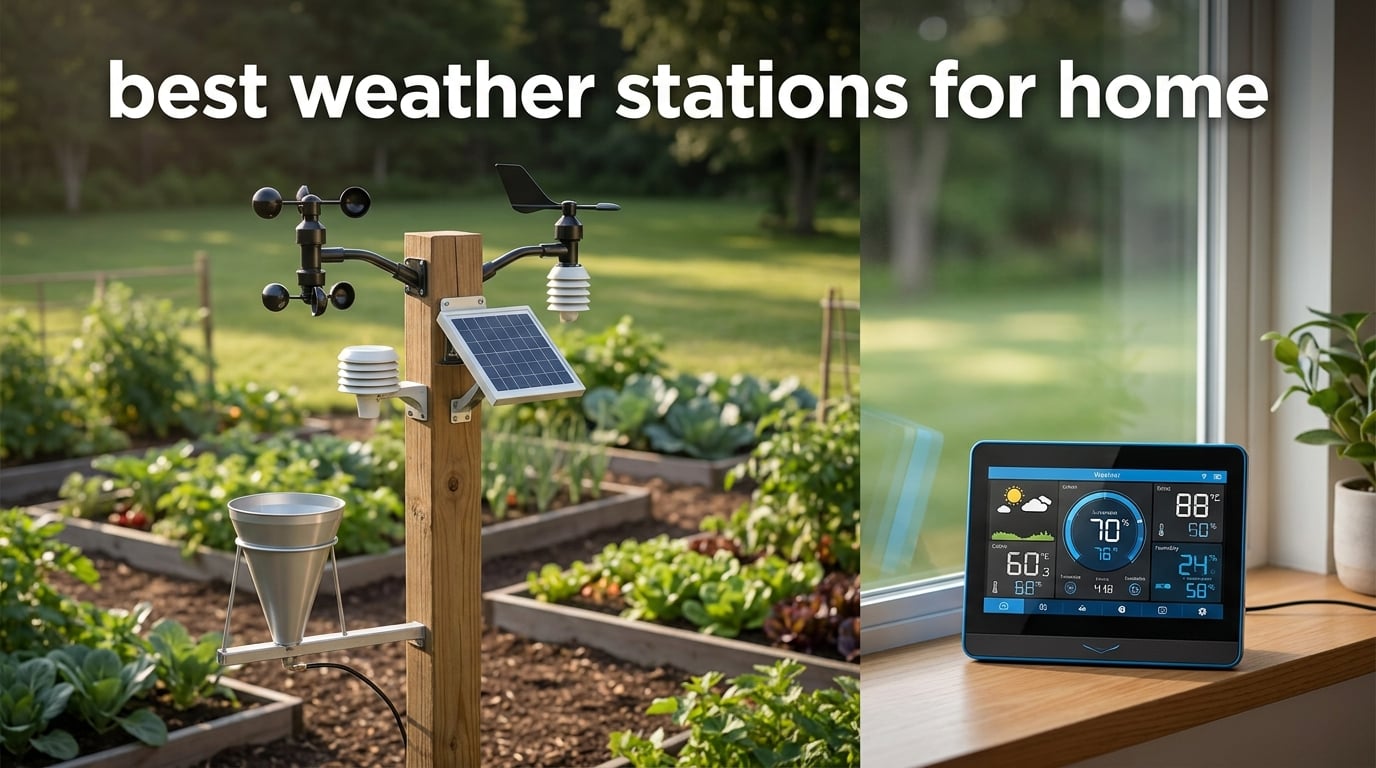
The best weather stations for home replace a broad regional forecast with conditions from your own yard. That difference matters when a storm misses the airport station, the garden dries faster than expected, or wind makes an outdoor plan uncomfortable even though the app says everything is calm.
A home weather station is a group of sensors that measures conditions at a specific location, then sends them to a display, app, or online dashboard. Depending on the model, those measurements can include temperature, humidity, barometric pressure, wind speed and direction, rainfall, UV, and light intensity.
We compared the five available stations by their verified sensor hardware, connection method, display, data access, power arrangement, stated integration, and buyer feedback volume. This is not a laboratory accuracy test, and a station’s final readings depend heavily on mounting, maintenance, and a stable signal.
For most households, the useful distinction is simple: choose a straightforward wireless weather station if you want a readable indoor answer to “what is happening outside?”, or choose a connected model if alerts, history, and remote monitoring matter. Gardeners, rural homeowners, hobbyists, and smart-home users will usually get more from the second group.
Table of Contents
Top 3 Picks Answer the Main Home Weather Needs
Ambient Weather WS-1965 is our Editor’s Choice because its all-in-one array, 16-second console updates, Ambient Weather Network access, and named Alexa, Google Home, and IFTTT compatibility make it the most rounded connected pick in this set. AIR ALFA is the range-focused choice for a sensor that must sit far from the house, while Sainlogic makes sense for people who care most about a readable console and exportable history.


The category labels are about fit, not a claim that one station will read identically at every property. A roofline, nearby trees, hard paving, wall heat, radio interference, and even a bird sitting near a sensor can alter what you see.
Best Weather Stations for Home in 2026 at a Glance
The table puts the important ownership differences in one place. Read the product reviews before deciding, especially if you need a long radio path, downloadable files, a specific voice-platform connection, or moving-parts-free sensing.
| Product | Specifications | Action |
|---|---|---|
| Sainlogic Smart WiFi Weather Station |
|
View Product |
 AIR ALFA 7-in-1 LoRa Station AIR ALFA 7-in-1 LoRa Station |
|
View Product |
 La Crosse V42-PRO-INT La Crosse V42-PRO-INT |
|
View Product |
| Ambient Weather WS-1965 |
|
View Product |
 Ambient Weather WS-4000 Ambient Weather WS-4000 |
|
View Product |
All five send outdoor conditions indoors or online, but their paths are not interchangeable. The Sainlogic station uses 2.4 GHz Wi-Fi, AIR ALFA combines Wi-Fi with long-range LoRa and radio frequency, La Crosse lists a 400-foot wireless range, and the two Ambient Weather products feed the Ambient Weather Network.
1. Sainlogic Smart WiFi Weather Station Is the Best for Readable Data and Excel History
Sainlogic Smart WiFi Weather Station, Wireless Indoor Outdoor Weather Station with 24/7 Weather Forecast, Wind Speed, Rain Gauge, Alerts & 2-Year Data Export for Home Garden
Wi-Fi
2-year Excel export
High-contrast LCD
Pros
- High-contrast enlarged display
- 2-year data storage
- Excel export
- App alerts
Cons
- 2.4 GHz Wi-Fi only
- Outdoor array needs careful siting
- Reported app connection issues
Sainlogic earns its place for the household that wants both an at-a-glance indoor console and a record of what happened over time. Its LCD uses high contrast and enlarged bold fonts, a practical feature when the console will be read from across a kitchen, mudroom, or home office.
The stated data feature is unusually clear for this group: two years of storage with Excel export, with up to 30 days included in each export. That gives a gardener or property owner a way to compare heat, humidity, or rainfall patterns without treating the app as the only place where the data exists.
The station pairs Wi-Fi with the Weatherseed app for 24/7 forecast information and alerts. It can issue notices for temperature, humidity, and barometric-pressure changes, so it suits someone who wants a prompt when a greenhouse gets too cold or a sudden weather change is developing.
Its rain specification states professional-grade rainfall monitoring with accuracy of plus or minus 1 mm for rainfall below 15 mm. Treat that as a product claim rather than a promise for every installation; a tilted sensor, leaves, pollen, or a mounting surface that shakes will still hurt rain results.
The Sainlogic Station Works Best When Display Readability Comes First
I would put this model high on the list for a household where more than one person will check the display and nobody wants to open a phone just to see outdoor conditions. Large text does not make a sensor better, but it removes a daily point of friction that feature-heavy stations often overlook.
It is also a sensible weather station for a backyard gardener who wants spreadsheet-friendly notes next to irrigation, planting, or frost records. The included storage and Excel pathway are verified strengths, whereas smart-home compatibility is explicitly not listed for this product.
The Sainlogic Station Requires a 2.4 GHz Network and Clear Sensor Siting
The console is not the hard part; the outdoor array deserves the planning. Give the rain collector a level, open spot, keep it away from roof runoff and trees, and avoid a wall that absorbs afternoon sun if temperature readings matter.
Only 2.4 GHz Wi-Fi is supported. Check that your router exposes a 2.4 GHz network during setup, because a phone that is connected only to a 5 GHz band can make pairing feel like a station fault when the network choice is the actual issue.
Buyer reports include some app connectivity trouble, so I would test the app, alerts, and export process during the return window rather than assuming a successful first pairing settles the matter. If your main goal is local automation, this is not the verified smart-home option in this group.
2. AIR ALFA 7-in-1 LoRa Station Is the Best for a Distant Sensor Location
AIR ALFA 4900FT WiFi Smart Weather Stations Wireless Indoor Outdoor, LoRa Based Wireless Weather Station with 7-in-1 Solar Sensor, Thermo-Hygro Sensor, Bird Spike, CSV Export & Calibration Black
4900 ft LoRa
Solar 7-in-1 sensor
CSV export
Pros
- Very long stated LoRa range
- 7-in-1 measurements
- Solar panel
- CSV export
- Expandable sensor system
Cons
- Small review sample
- Five AA batteries needed
- Account setup required
AIR ALFA’s reason to exist is range. Its listing states LoRa transmission up to 4,900 feet, far beyond the 400-foot range stated for the La Crosse model, so it deserves attention when the best mounting point sits at the edge of a large property rather than beside the house.
The solar 7-in-1 outdoor sensor tracks temperature, humidity, rainfall, wind speed, wind direction, UV, and light intensity. That is a useful bundle for someone monitoring a garden, pasture, workshop, guest building, or broad yard where the outdoor sensor cannot be placed only for convenience.
CSV export matters here because it avoids trapping every historical observation inside a dashboard. You can build your own rainfall log, compare wind conditions across months, or keep a copy before changing apps or devices.
The outdoor unit combines an adjustable solar panel with five AA batteries, and the product states that its adjusted panel can extend battery life up to 2.5 years. Solar assistance is helpful, but a heavily shaded site needs an honest look at its exposure before that claim becomes part of your maintenance plan.
The AIR ALFA Station Fits Large Lots and Expandable Monitoring Plans
This is the pick I would investigate first when a normal sensor range could be blocked by a long driveway, outbuilding, mature trees, or the distance between a house and garden. Long-distance radio capability does not remove every obstacle, but it gives the installation more margin than short-range arrangements.
The system is listed as expandable to seven temperature/humidity sensors, four air-quality sensors, and three water-leak sensors. That is valuable for a household that wants to begin with outdoor weather and later monitor a greenhouse, basement, garage, or more than one zone.
Its protective bird spikes address a very ordinary outdoor problem: birds can interfere with a rain gauge or wind readings. They are a thoughtful physical detail, although you should still inspect the gauge after leaf fall and pollen season.
The AIR ALFA Station Needs a Thoughtful Power and App Plan
The outdoor package needs five AA batteries in addition to solar power, so stock the correct batteries and note the installation date. Cold snaps can reduce battery performance, a recurring complaint among weather-station owners, and the solar panel is not a substitute for checking power status.
The app requires an account during initial setup. If local-only data handling is a non-negotiable requirement, do not assume that “smart home compatible” means it will work with a particular automation platform; the available product data does not name Home Assistant, Alexa, Google Home, or IFTTT.
The major caution is its small review base of 30 reviews. A 4.3 rating is encouraging, but it gives much less ownership history than the larger-review-count Sainlogic, La Crosse, or Ambient Weather WS-1965 listings.
3. La Crosse V42-PRO-INT Is the Best for an Information-Rich Indoor Console
La Crosse Technology Professional Smart Wi-Fi Weather Station with Remote Monitoring (400 Foot Range), Wind and Rain Gauges, Temperature and Humidity Sensors, and Forecasting – V42-PRO-INT
Ultrasonic sensor
400 ft wireless range
Color Wi-Fi display
Pros
- Wide stated temperature range
- Six display views
- 7-day forecast
- Custom alerts
- UV and air-quality data
Cons
- Separate sensor batteries
- Shorter stated range
- Reported app issues
La Crosse V42-PRO-INT is the display-led choice. Its color LCD provides six views, dynamic forecast icons, seasonal foliage scenes, an indoor comfort meter, and a seven-day forecast when the unit is connected to Wi-Fi.
The local sensors cover wind data, rainfall, temperature, and humidity, while the Wi-Fi connection adds AccuWeather streaming. It also lists UV index, sunrise and sunset times, thunderstorm information, and air-quality data, which makes the console feel more like a household weather center than a simple thermometer.
Its outdoor-temperature range is stated as -40°F to 140°F, so it covers very cold and very hot climates on paper. That range tells you what the product is designed to measure; it does not override site conditions such as a hot exterior wall, a poorly ventilated enclosure, or direct reflected sun.
The V42-PRO-INT uses ultrasonic sensing, which is associated here with the product’s sensor design, while its setup includes separate LTV-TH5i and LTV-WSDR1 sensors. Keep the sensor inventory in mind when planning the mount and batteries rather than assuming there is one all-in-one outdoor unit.
The La Crosse Station Fits Homes That Want a Screen Full of Context
This station makes sense when the indoor console is the main destination for the data. A household can see local measurements alongside forecast, comfort, sun, thunderstorm, and air-quality information without switching among separate apps.
Custom alerts and app notifications add a practical layer for frost-prone gardens, a nursery room, or a space where a sudden change in temperature or humidity needs attention. The product lists smart-home compatibility through the La Crosse View app, but does not name specific voice platforms or Home Assistant.
The 1,394-review count is among the larger samples in this comparison. It is a more useful confidence signal than rating alone, while still not a substitute for confirming that your property can support the sensor layout and 400-foot stated wireless path.
The La Crosse Station Needs Batteries and a Realistic Range Check
The stated wireless range is 400 feet, which is plenty for many suburban yards but considerably less forgiving than AIR ALFA’s listed LoRa range. Walls, foil insulation, metal siding, terrain, and dense vegetation can shorten a practical radio path.
The listed outdoor sensors need separate AA batteries that are not included, while the console uses its supplied 5V adapter and a CR2032 backup battery. Make a small maintenance note for each battery set, especially before winter, rather than trying to remember which sensor was changed last.
Some buyers report app connectivity concerns, and forum discussion around the brand includes frustration with customer-service response. I would prioritize a strong Wi-Fi signal, complete the connection before permanent mounting, and document serial numbers and setup steps in case support is needed.
4. Ambient Weather WS-1965 Is the Best Connected All-Rounder for Most Homes
Ambient Weather WS-1965 WiFi Weather Station w/Remote Monitoring and Ambient Weather Network Access
16-second updates
Ambient Weather Network
Alexa Google Home IFTTT
Pros
- Named smart-home integrations
- Frequent console updates
- All-in-one array
- Custom dashboard
- Remote alerts
Cons
- Batteries not included
- Wi-Fi setup can be difficult
- 915 MHz interference possible
Ambient Weather WS-1965 is the most broadly useful pick because it combines an all-in-one sensor array with a color LCD, remote monitoring through the Ambient Weather Network, and named integrations with IFTTT, Google Home, and Alexa. It is the clearest fit for a connected household that wants weather information to do more than sit on one display.
The array measures temperature, humidity, barometric pressure, wind speed, wind direction, and rainfall. Console readings update every 16 seconds, a quick cadence for watching a passing shower or wind change without claiming that it makes every sensor more accurate.
Ambient Weather Network access provides cloud storage and a customizable dashboard-tile view. You can remotely manage alerts, so this is useful for a second home, a garden checked while away, or anyone who wants a notification rather than a routine of opening the app.
For smart-home shoppers, the named compatibility is the deciding detail. Alexa, Google Home, and IFTTT are verified on the listing; Home Assistant is not named in the available data, so we would not buy it on the assumption of direct support without checking the current documentation yourself.
The WS-1965 Fits Connected Homes That Need Remote Alerts
I recommend this model when the question is “what can I do with the reading after I see it?” rather than only “can I see it indoors?” Its remote dashboard and alerts create a path to keep an eye on rain, wind, or temperature away from home.
The all-in-one format also makes the physical installation easier to understand than a multi-sensor layout. You still need a good mount: place the wind sensor away from obstructions where possible, level the rain gauge, and avoid heat radiating from roofs, walls, and pavement.
Its stated temperature accuracy is plus or minus 1.11°C. Compare that number only against a known reference in a correctly sited location, because a poor mount can produce a bigger real-world error than the sensor specification suggests.
The WS-1965 Requires Wi-Fi Patience and Frequency Awareness
Some buyers report that Wi-Fi setup can be challenging, which echoes a common forum complaint about connected weather stations generally. Bring the console close to the router for first setup if possible, confirm the connection before drilling or mast mounting, and keep router credentials ready.
The listed 915 MHz frequency may encounter interference in some locations. That does not mean it will fail at your home, but it is a reason to locate the console thoughtfully and to test the signal at the intended sensor position before making the installation permanent.
Batteries are not included. Add them before scheduling installation day, and remember that the Ambient Weather Network is cloud storage, not a stated CSV or Excel export feature for this model.
5. Ambient Weather WS-4000 Is the Best Low-Maintenance Sensor Design
Ambient Weather WS-4000 Solar Powered UltraSonic Wi-Fi Weather Station
Ultrasonic wind
Haptic rain
Solar power
Premium color console
Pros
- No moving sensor parts
- No-tools installation
- Solar powered
- Premium console
- Remote AWN monitoring
Cons
- Smaller review sample
- Shade can affect solar power
- Cloud data rather than stated file export
Ambient Weather WS-4000 is the specialist pick for a buyer who wants fewer moving parts outdoors. It combines ultrasonic wind measurement and a haptic rain gauge, and the product describes both as having no moving parts, a design intended to reduce physical wear compared with mechanical collectors and vanes.
The kit runs on solar power and includes a premium color LCD console used on the brand’s 2000 and 5000 models. It also includes a WH32B indoor sensor for indoor temperature, humidity, and barometric pressure, separating indoor conditions from the outdoor station.
Remote monitoring runs through Ambient Weather Network, and the listing includes one month of AWN+ access. That makes it a compelling digital weather station for someone who values the dashboard and wants the station to be simple to physically mount.
Do not confuse a moving-parts-free design with a maintenance-free one. Dust, spider webs, bird droppings, mounting looseness, and a shaded solar site can still create trouble, so the unit needs periodic visual checks just like any outdoor weather station.
The WS-4000 Fits Buyers Who Want No-Tools Installation and Fewer Moving Parts
This is the right direction for a home where climbing to service a mechanical rain collector would be annoying or impractical. The listing says no-tools installation, which can make initial placement less intimidating than systems that require more assembly.
Ultrasonic wind sensing uses sound waves rather than a spinning cup or vane. Haptic rain sensing detects the impact or vibration of raindrops rather than collecting and tipping water, so both systems avoid the familiar moving hardware found in a traditional tipping bucket setup.
The haptic approach has an important tradeoff. Forum users often like its lack of moving parts but report that haptic rain sensing can be less accurate than a properly maintained tipping bucket, particularly when exact rainfall totals are the top priority.
The WS-4000 Needs Good Solar Exposure and Measured Expectations
A solar-powered outdoor unit needs a site with usable exposure. A location shaded by tall evergreens, a deep roof overhang, or neighboring buildings can weaken the power plan, so inspect the site across the day rather than judging it at noon alone.
This product has 85 reviews, a much smaller ownership sample than the other Ambient Weather model in this article. Its 4.0 rating and specific design are worth considering, but I would not treat it as the safest option for someone who wants years of review history.
The product is listed as smart-home compatible, yet the provided details do not identify specific platforms. It stores data through Ambient Weather Network rather than claiming CSV, Excel, SD-card, or other local-file export, so data portability should be confirmed before purchase if it matters to you.
A Good Home Weather Station Starts With the Measurements You Will Act On
Buy the sensors that change a decision. Temperature and humidity help with comfort, frost risk, and greenhouse checks; rainfall supports irrigation choices; wind speed and direction matter for exposed properties and outdoor activities; barometric pressure can add context to changing conditions.
UV and light data are helpful for gardeners and solar-aware households, but they should not displace the core sensors if the main job is tracking rain and temperature. An outdoor weather station is more useful when every measurement answers a real question than when the console is crowded with readings you never use.
For basic backyard monitoring, temperature, humidity, and a rain gauge are enough. For serious storm tracking or amateur meteorology, add wind and pressure, then think about data history, siting, and maintenance before choosing the most feature-filled array.
Sensor Placement Determines Whether the Numbers Mean Anything
Place a temperature and humidity sensor away from direct sunlight, walls, dryer vents, air-conditioner exhaust, and large paved areas that radiate heat. A shaded, ventilated location is more representative than a convenient spot under a sun-baked eave.
Put a rain gauge level and clear of roofs, trees, fences, and surfaces that can splash or drip into it. Clean leaves, pollen, seeds, and insects from a tipping-bucket collector as part of regular yard work; a clogged gauge can falsely report little or no rain.
Wind is the hardest measurement to site at a typical home. The more nearby rooflines, chimneys, trees, and fences disturb the air, the less the sensor reflects open-area wind; mount as high and clear as your property and safety situation reasonably allow.
Before final mounting, run a temporary signal test from the intended position. A claimed transmission distance is measured under favorable conditions, while brick, metal, foil-backed insulation, dense landscaping, and terrain can reduce a radio link sharply.
Wi-Fi, Radio Range, and Data Access Decide Daily Convenience
A Wi-Fi weather station is useful when you want phone access, remote alerts, or cloud dashboards. It also adds setup steps, router compatibility questions, and an account in some cases, so test every connected feature early rather than waiting for the first storm.
A long-range radio design can be more important than Wi-Fi when the sensor must live far from the console. AIR ALFA’s stated 4,900-foot LoRa range is the standout here, while La Crosse lists 400 feet; those figures guide planning but do not cancel local interference.
Data access differs from data viewing. Sainlogic offers two-year storage with Excel export, AIR ALFA offers CSV export, and the two Ambient Weather products list cloud storage through Ambient Weather Network; La Crosse lists tracking through the La Crosse View app.
If you intend to make your own charts, compare seasons, share data, or keep a backup outside an app, choose a stated file-export path. If you only need live readings and alerts, an app dashboard may be enough, but confirm which functions require an account or subscription before committing.
Rain-Sensor Type Changes Both Maintenance and Interpretation
A tipping bucket rain gauge collects water until a small bucket tips, then counts the tips to calculate rainfall. It is an established method that can provide useful totals when level and clean, but debris and insects can interfere with the collector and moving mechanism.
A haptic rain sensor detects drop impacts or vibration rather than collecting water. The WS-4000 uses this approach, which removes moving rain-gauge parts and can simplify outdoor upkeep, although community feedback warns that it may be less precise than a well-maintained tipping bucket.
Neither type makes placement optional. Keep the sensor away from splashing, dripping gutters, and tall obstructions, and inspect it after storms rather than assuming the dashboard itself can tell you whether the physical sensor stayed clear.
Smart-Home Compatibility Must Be Verified Platform by Platform
“Smart home compatible” is not a universal promise. In this product set, Ambient Weather WS-1965 explicitly names Alexa, Google Home, and IFTTT, AIR ALFA and WS-4000 are generally listed as smart-home compatible, La Crosse works with its View app, and Sainlogic is listed as not smart-home compatible.
Home Assistant is a separate question. Weather enthusiasts often value local data control, and forum discussions frequently recommend Ecowitt for that purpose, but Ecowitt is not one of the five products analyzed here and none of these listings confirms direct Home Assistant compatibility.
Buy from confirmed compatibility, not a broad label. Write down the platform, the trigger or action you need, whether internet access is acceptable, and whether you need local history or only an alert before choosing a connected station.
Reliability Comes From Hardware, Siting, and Maintenance Together
There is no universal “most reliable” answer among these five because no common long-term test data is provided. Larger review samples provide more ownership context, but a clean rain gauge, fresh batteries, a clear radio path, and a correct mount will often matter more than a small rating difference.
Inspect the outdoor hardware after extreme weather, battery changes, pollen season, and leaf fall. Also compare your readings with a trusted nearby reference only as a rough check: a true hyperlocal station can legitimately differ from an airport or official station several miles away.
Use that comparison to find obvious installation mistakes, not to force your backyard to match another site. Temperature inversions, elevation, shade, tree cover, and distance from pavement can all produce real differences.
Frequently Asked Questions Give the Short Answers
What weather station is the most reliable?
No single model can be called the most reliable from the available five-product data because there is no shared long-term test. For a dependable result, choose verified features that fit the property, mount the sensor correctly, maintain the rain gauge or solar site, and test wireless signal strength before permanent installation.
Which is better, La Crosse or AcuRite?
This comparison includes La Crosse V42-PRO-INT but not an AcuRite product, so it cannot fairly name a winner. La Crosse offers a color console, Wi-Fi, a stated 400-foot wireless range, weather data views, and app alerts. Compare the exact AcuRite model’s sensor set, connectivity, and data features before deciding.
What is the best home weather station Consumer Reports?
Consumer Reports has its own test results and may change its recommendations. Within this independently selected five-product group, Ambient Weather WS-1965 is the strongest all-round connected choice because it has an all-in-one sensor array, 16-second console updates, Ambient Weather Network access, and named Alexa, Google Home, and IFTTT compatibility.
Are home weather stations worth it?
Home weather stations are worth it when conditions at your property affect gardening, irrigation, storm preparation, outdoor work, or smart-home alerts. They measure temperature, humidity, rainfall, wind, and pressure at your location rather than relying on a distant airport observation. Their value depends on proper placement and choosing data access you will actually use.
The Best Choice Depends on What You Need to Know at Home
For most connected households, Ambient Weather WS-1965 is the best weather station for home because its sensor array, frequent console updates, remote dashboard, and named integrations cover the widest range of everyday use. Choose AIR ALFA when range and expandability are the central problem, Sainlogic when clear display text and Excel export are priorities, La Crosse for a detail-rich console, or WS-4000 for its moving-parts-free outdoor sensor approach.
Install the station for the measurement you care about most, then test its signal, app, alerts, and data access before relying on it. A carefully placed, maintained station will tell you far more about your home than a general forecast can.